Bulk-Handling and Process-Plant Scanning in Hemmant and Lytton

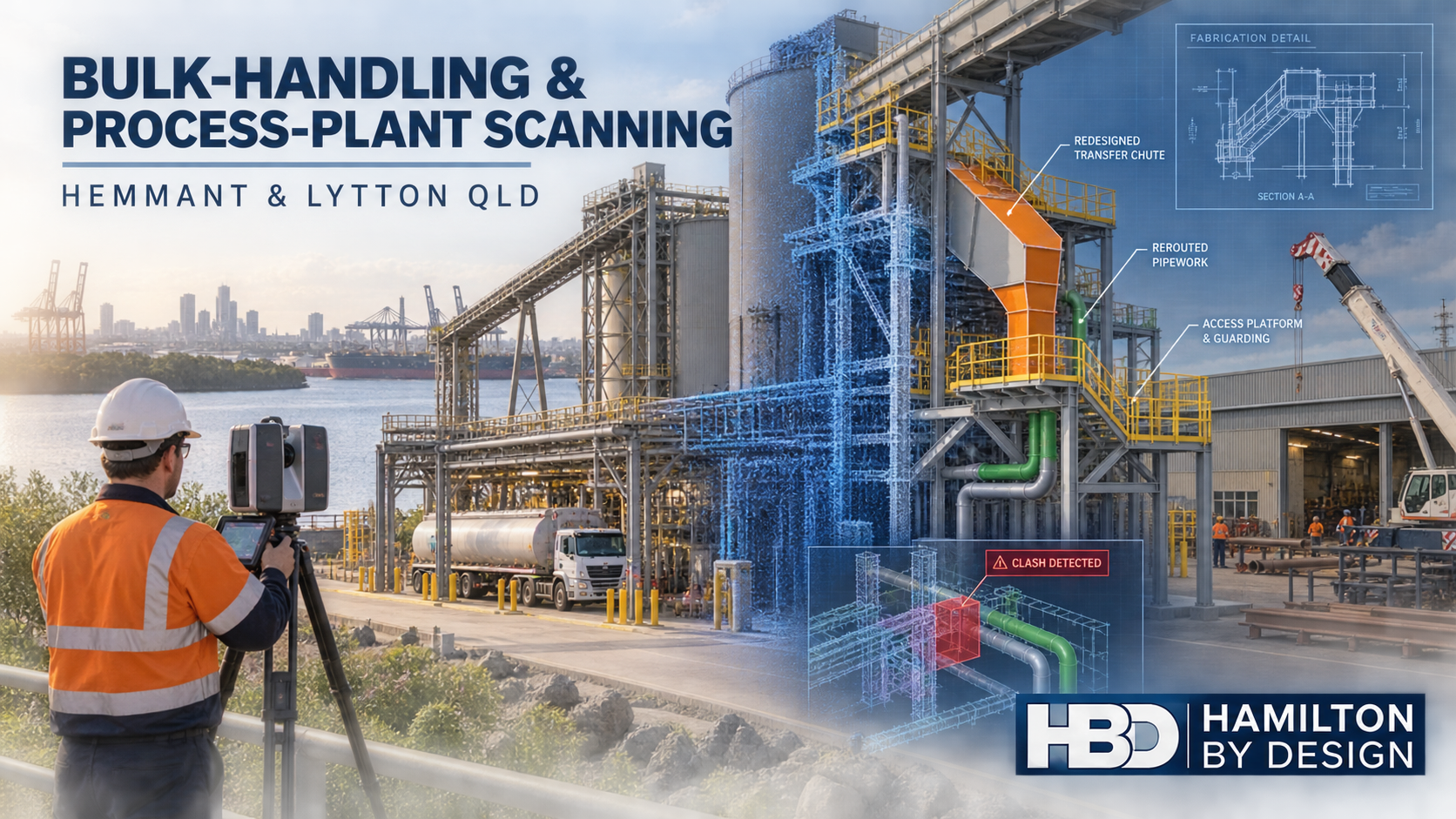
Hamilton By Design engineer using a 3D laser scanner at a bulk-handling and process plant in Hemmant and Lytton, Queensland.
Blue 3D LiDAR scanner icon on a tripod with scanning waves

Hemmant and Lytton occupy a strategically important part of Brisbaneโ€™s industrial landscape. Located near the mouth of the Brisbane River and the Port of Brisbane, the two suburbs support a concentration of fuel infrastructure, bulk-material handling, marine engineering, fabrication, warehousing and freight operations.

This is not a conventional light-industrial precinct. Many facilities contain interconnected conveyors, storage tanks, pipework, loading gantries, transfer stations, access platforms and process equipment. Some operate continuously, while others depend on tightly controlled maintenance shutdowns.

These operating conditions create a particular engineering challenge: how can an existing plant be modified when the available drawings may no longer represent what is actually installed?

Hamilton By Design supports Hemmant and Lytton facilities through engineering-led 3D laser scanning, point-cloud modelling, mechanical design and fabrication documentation. By capturing the plant as it exists, proposed modifications can be developed around real site conditions rather than assumptions carried forward from historical drawings.

An Industrial Area Shaped by the Port

Hemmant and Lytton share a close relationship with the Port of Brisbane, but each suburb has a slightly different industrial character.

Lytton contains some of the corridorโ€™s largest infrastructure-dependent operations. Its industrial landscape includes fuel refining, petroleum storage, import terminals, pipelines, loading facilities and large logistics sites. Much of this infrastructure requires specialised land, established transport connections and separation from residential development.

Hemmant has a more varied industrial profile. Transport depots and warehouses operate alongside fabrication workshops, machinery businesses and riverfront marine facilities. Its position between Brisbaneโ€™s established industrial suburbs and the port gives businesses access to the Gateway Motorway, port terminals, the Brisbane River and the wider South East Queensland freight network.

This combination creates opportunities for engineering work across several levelsโ€”from scanning an individual worn component to documenting a complete terminal, conveyor system or process area.

Hamilton By Designโ€™s Port of Brisbane engineering and 3D laser scanning services are particularly relevant to facilities that must integrate new mechanical equipment into complex operating sites.

Why Existing-Plant Projects Are Difficult

Brownfield engineering is rarely as simple as replacing an old item with a new version of the same component.

Industrial plants evolve over time. Platforms are extended, pipework is rerouted, supports are reinforced and equipment is repositioned. Repairs may have been completed during short shutdowns without every change being incorporated into the master drawing set.

Consequently, several versions of the plant may exist simultaneously:

  • The original design drawings.
  • Later modification drawings.
  • Maintenance sketches and site mark-ups.
  • The actual installed arrangement.
  • The operatorโ€™s practical understanding of how the plant now works.

The last two are often the most important.

A replacement chute might match an old drawing but interfere with a platform brace added years later. A pipe spool may be dimensionally correct but impossible to install because there is no access for lifting or bolting. A new guard may prevent a maintenance task from being completed safely.

Engineering-grade site capture helps identify these issues before fabrication begins.

Creating a Reliable Record with 3D Laser Scanning

Terrestrial laser scanning records millions of measured points across the visible surfaces of a facility. Once the individual scans are registered, they form a coordinated three-dimensional point cloud.

For a Hemmant or Lytton industrial site, the captured information may include:

  • Conveyors and supporting frames.
  • Transfer chutes and hoppers.
  • Storage tanks and adjacent infrastructure.
  • Pipework routes and equipment connections.
  • Structural columns, beams and bracing.
  • Platforms, stairs, ladders and handrails.
  • Pumps, motors and mechanical equipment.
  • Cable trays, ducts and visible services.
  • Access ways and maintenance clearances.
  • Fabrication and installation interfaces.

A point cloud is more than a collection of measurements. It provides spatial context. An engineer can see not only the equipment being modified but also the surrounding structures and services that could affect the design.

Hamilton By Design can retain agreed project information such as registered plant point clouds, conveyor models, pipework routes, equipment interfaces, clash reports, fabrication drawings and revision histories. This creates a useful reference for later plant changes, provided the data-retention and confidentiality arrangements are defined with the client.

Conveyor and Chute Engineering

Conveyors and transfer points are critical parts of many terminals and process plants. They are also common sources of wear, spillage, dust, blockages and unplanned downtime.

A chute may appear straightforward, but its performance depends on several interacting variables:

  • Material type and bulk density.
  • Particle size and moisture content.
  • Belt width and speed.
  • Feed direction and discharge trajectory.
  • Impact angle and wear pattern.
  • Available transfer height.
  • Liner arrangement.
  • Maintenance access.
  • Surrounding plant geometry.

Changing production rates or material characteristics can expose weaknesses in a chute that previously operated acceptably. Increased moisture can promote build-up, while higher throughput can increase impact loads, dust generation and liner wear.

Hamilton By Design provides chute design and materials-handling engineering for existing industrial facilities. This may include scanning the transfer station, modelling the relevant interfaces, developing a revised arrangement and preparing fabrication-ready documentation.

Potential deliverables include general arrangements, plate details, liner drawings, support-frame drawings, bills of materials and CAD models for fabrication or client review.

Mechanical Design for Brownfield Modifications

An effective brownfield design must satisfy more than the immediate process requirement. It must also be practical to fabricate, transport, install, inspect and maintain.

Hamilton By Design can assist with mechanical modifications involving:

  • Conveyor and transfer-station layouts.
  • Chutes, hoppers and bins.
  • Pipework routes and equipment interfaces.
  • Pump and equipment skids.
  • Access platforms and maintenance structures.
  • Guards and machinery-safety improvements.
  • Support frames and brackets.
  • Removable sections and maintenance tooling.
  • Lifting arrangements for plant components.
  • Reverse-engineered replacement parts.

The proposed equipment can be modelled against the point cloud to identify potential clashes. Installation clearances, bolt access, welding access and component-removal paths can then be considered before drawings are issued.

HBDโ€™s broader mechanical engineering services for the Port of Brisbane support this connection between measured site information and practical industrial design.

Mechanical Drafting and Fabrication Documentation

A successful industrial modification depends on clear communication between the designer, client, fabricator and installer.

Hamilton By Design can prepare:

  • Existing-condition CAD models.
  • Concept layouts.
  • General arrangement drawings.
  • Fabrication and assembly drawings.
  • Plate and folded-component details.
  • Pipe spool drawings.
  • Platform and access drawings.
  • Installation reference dimensions.
  • Bills of materials.
  • DXF cutting profiles.
  • STEP and Parasolid models.
  • Issued-for-review, issued-for-approval and issued-for-construction packages.
  • Final as-built records.

Document control is especially important where several contractors are working on the same plant. Drawing numbers, revision status, design assumptions and approval responsibilities should be visible and traceable.

The objective is not simply to produce a drawing that looks complete. The documentation must provide enough information for the item to be manufactured, checked and installed with a clear understanding of its interfaces.

Safety, Access and Maintainability

Industrial safety cannot be added at the end of a project. It must influence the geometry of the design from the beginning.

For conveyor, chute and process-plant modifications, this may require consideration of:

  • Nip, crush, shear and entanglement hazards.
  • Access to isolation points.
  • Fixed and removable guarding.
  • Inspection-door locations.
  • Safe liner replacement.
  • Stair, ladder and platform access.
  • Handrail continuity.
  • Trip hazards and restricted walkways.
  • Lifting points and component weights.
  • Dropped-object exposure.
  • Emergency egress.
  • Access for cleaning and spill recovery.

The AS/NZS 4024 series may apply to machinery safety and risk reduction. AS 1657 is commonly relevant to fixed platforms, walkways, stairways and ladders, while AS 4991 may apply to purpose-designed lifting devices.

Other standards may apply depending on the project, including AS 3990 for mechanical-equipment steelwork, AS 4041 for pressure piping, AS 1210 for pressure vessels, AS 4100 for steel structures and AS 1940 for flammable and combustible liquids.

The applicable standards and required professional responsibilities should be established at the start of each project. Hamilton By Design provides mechanical engineering and drafting services. Structural, civil, electrical, hazardous-area, fire and process certification should be completed by appropriately qualified specialists where required.

The Five Recurring Problems in Hemmant and Lytton Projects

1. Drawings do not match the plant

Outdated or incomplete drawings can cause incorrect interface dimensions, fabrication errors and unexpected site modifications. A current point cloud establishes a measurable record of visible site conditions.

2. The work area is congested

Pipework, steelwork, electrical services and access structures often occupy the same limited space. Three-dimensional coordination helps expose clashes that may not be apparent in a two-dimensional drawing.

3. Shutdown time is limited

Unexpected cutting, drilling or rework can consume a large portion of a shutdown window. Pre-shutdown scanning and installation planning help reduce avoidable site work.

4. Ageing equipment has changed shape

Wear, corrosion, impact and previous repairs can cause the installed component to differ from its original design. Scanning and reverse engineering can help document the current interfaces before replacement equipment is manufactured.

5. The design fits but cannot be maintained

A component may perform mechanically while creating poor inspection, cleaning or removal access. Maintenance activities must be considered alongside the operating function.

Engineering Support for Logistics and Terminal Operations

Not every project in Hemmant or Lytton is part of a process plant. Warehouses, freight depots and loading facilities also need accurate layouts for new equipment and operational changes.

Hamilton By Design can assist logistics and terminal operators with:

  • Warehouse and hardstand scanning.
  • Loading-area layouts.
  • Conveyor and automation interfaces.
  • Equipment clearances.
  • Maintenance-access zones.
  • Crane and lifting access.
  • Guarding arrangements.
  • Equipment-removal studies.
  • Clash detection.
  • Staged installation planning.
  • Updated as-built layouts.

Vehicle swept paths, pavement design, drainage and formal traffic engineering should be referred to the appropriate civil or traffic specialist where they sit outside the mechanical scope.

From Site Capture to Fabrication

A typical HBD workflow begins by defining the engineering outcome rather than scanning an arbitrary area.

The process may include:

  1. Reviewing the operational problem, available drawings and required deliverables.
  2. Planning the scan around design interfaces, access restrictions and site rules.
  3. Capturing the relevant equipment and surrounding work envelope.
  4. Registering and quality-checking the point cloud.
  5. Modelling the existing plant to the level needed for the project.
  6. Developing one or more modification concepts.
  7. Reviewing clashes, access and installation constraints.
  8. Preparing approval, fabrication and installation documentation.
  9. Recording approved revisions and final as-built information.

This connected approach reduces the information gap that can occur when one party scans the plant, another produces the model and a third completes the design.

Hamilton By Designโ€™s experience with bulk-material handling, ROM systems, conveyors and transfer engineering is transferable to port, terminal and process-plant applications where fit, reliability and maintainability are critical.

Frequently Asked Questions

Can a process plant be scanned while it remains operational?

In many cases, yes. The scan plan must account for site access, exclusion zones, moving equipment, hazardous areas and operational controls. Some critical interfaces may still require access during an isolation or shutdown.

What can be delivered from a plant scan?

Deliverables can include registered point clouds in formats such as E57, RCP, RCS or LAS, along with selected CAD models, plans, sections, general arrangements, fabrication drawings and clash-review information. The appropriate deliverable depends on the intended engineering outcome.

Can HBD work from point-cloud data captured by another company?

Potentially, yes. The supplied dataset should first be reviewed for registration quality, point density, coverage and visibility of the required interfaces. Missing flange faces, pipe centrelines, bolt holes or concealed areas may limit the achievable result.

Does laser scanning capture internal pipe or vessel conditions?

No. Terrestrial laser scanning primarily records visible external surfaces. Internal condition, wall thickness, corrosion and material integrity normally require specialist inspection methods such as ultrasonic testing, internal inspection or non-destructive examination.

Can HBD design a replacement chute from the scan?

Yes, subject to an agreed scope and sufficient operating information. A scan establishes existing geometry, but chute design may also require material properties, throughput, belt speed, moisture content, wear history and operator feedback.

Does HBD provide structural certification?

Hamilton By Design provides mechanical engineering and structural drafting support but is not offering structural certification through this service. Where structural verification or certification is required, the work should be completed or reviewed by an appropriately qualified structural engineer.

Can scanning help with shutdown planning?

Yes. A point cloud can support prefabrication, clash detection, access reviews, crane planning and installation sequencing. It does not eliminate every shutdown risk, but it can significantly reduce uncertainty about visible site geometry.

How accurate is an industrial point cloud?

Accuracy depends on the scanner, range, target arrangement, registration method, environmental conditions and visibility. The required accuracy should be discussed before scanning so that the capture method is suitable for the intended design or verification task.

Can HBD retain the project data for future modifications?

Yes, subject to the agreed commercial, confidentiality and retention arrangements. Records may include registered point clouds, equipment models, interface information, drawings and modification histories.

Engineering Existing Plant with Greater Confidence

Hemmant and Lytton are shaped by infrastructure that must remain safe, reliable and productive. Their fuel terminals, process facilities, conveyors, warehouses, marine workshops and freight operations are expensive to interrupt and difficult to modify using incomplete site information.

Engineering-led 3D scanning gives project teams a stronger starting point. When accurate site capture is combined with mechanical design, fabrication documentation and practical installation planning, brownfield modifications can be developed with a clearer understanding of the plant they must fit.

Hamilton By Design can assist clients in Hemmant, Lytton and the wider Port of Brisbane corridor with process-plant scanning, bulk-handling design, point-cloud modelling, reverse engineering, mechanical drafting and brownfield upgrade documentation.

To discuss a conveyor, chute, pipework, terminal or existing-plant project, contact Hamilton By Design with the site location, a short description of the problem, available drawings or photographs, required deliverables and any planned shutdown dates.

Hamilton By Design logo displayed on a blue tilted rectangle with a grey gradient background

Contact Us – Talk To Us

Name
Would you like us to arrange a phone consultation for you?
Address

Our clients:


Lae Container Terminal 3D Scanning | Scan-to-CAD PNG

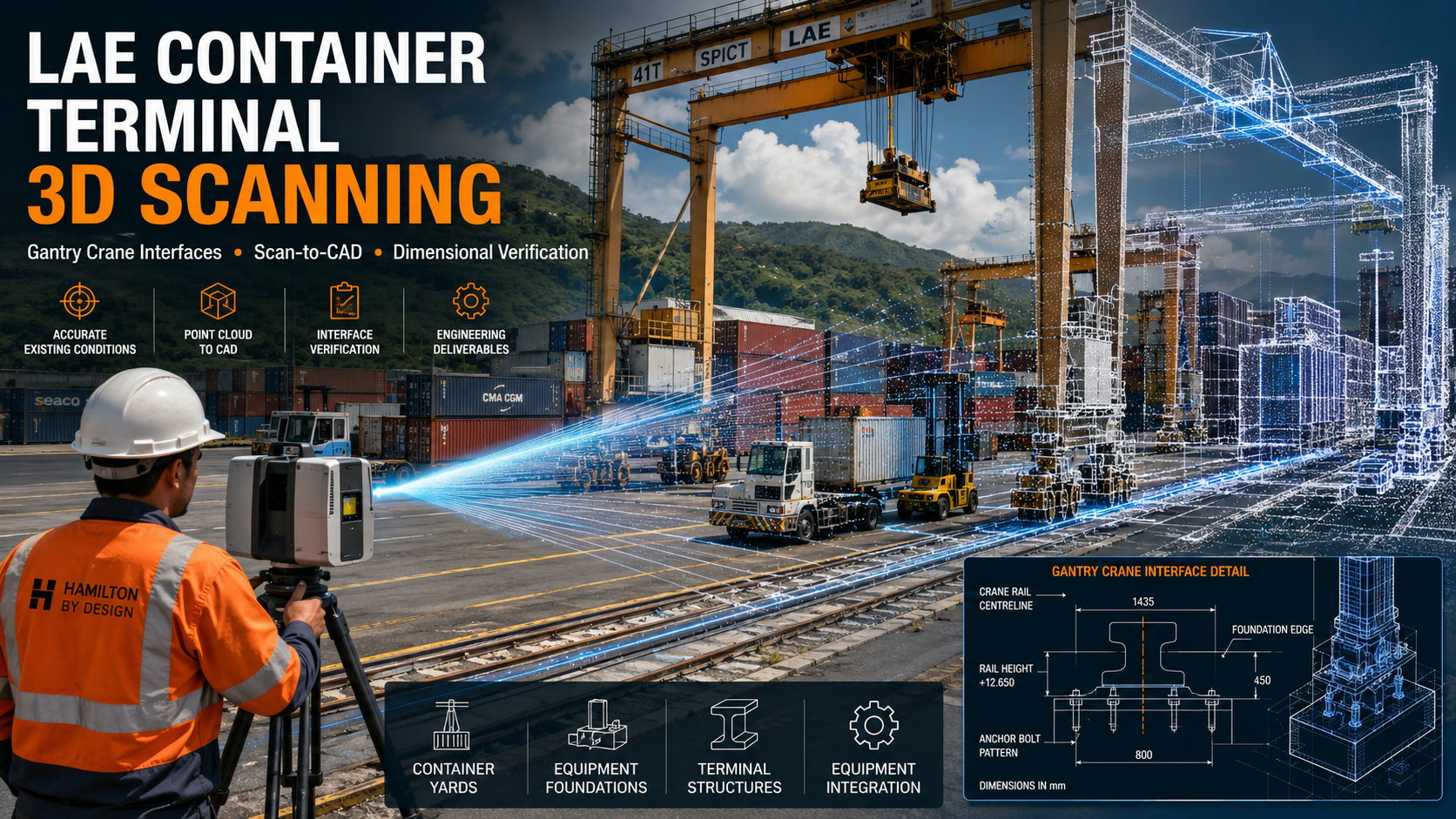
Engineer performing 3D laser scanning at Lae Container Terminal in Papua New Guinea, with gantry cranes, container yards, crane rails, point-cloud overlays and scan-to-CAD interface verification.

The South Pacific International Container Terminal in Lae, Morobe Province, is an important part of Papua New Guineaโ€™s freight and logistics network. As terminal infrastructure develops, new cranes, handling equipment, foundations, services and structural systems must be integrated with existing operating assets.

This creates a practical engineering challenge: new equipment must fit accurately within an existing brownfield environment.

Hamilton By Design provides engineer-led Lae Container Terminal 3D Scanning, combining terrestrial LiDAR scanning with mechanical engineering, CAD modelling, reverse engineering, dimensional verification and fabrication documentation.

The objective is not simply to capture a point cloud. The objective is to create reliable engineering information that can support design, equipment integration, fabrication and installation planning.

A typical workflow may include:

3D Scanning โ†’ Point Cloud โ†’ CAD Model โ†’ Interface Verification โ†’ Engineering Design โ†’ Fabrication Documentation

Hamilton By Designโ€™s engineering-grade 3D laser scanning services are suited to brownfield industrial and infrastructure projects where dimensional accuracy and reliable existing-condition information are important to the success of the project.

Why Existing-Condition Accuracy Matters at a Container Terminal

Container terminals are complex operating environments.

Cranes, foundations, structural steel, service routes, access systems, buildings and mobile equipment all occupy limited space. Over time, many of these assets may also be modified, repaired or replaced.

As a result, historical drawings do not always represent the current installed condition.

This can create problems when new equipment is introduced.

A crane rail may not be positioned exactly as shown on an old drawing. A foundation may have been modified. A service may pass through an area that appears clear on the design documentation. Existing structural steel may also restrict the installation or maintenance envelope of new machinery.

Hamilton By Designโ€™s 3D laser scanning services provide a practical method of recording the physical condition of the terminal before design or fabrication begins.

The resulting point cloud can provide a coordinated three-dimensional reference for engineers, designers and project teams.

Gantry Crane Interface Scanning

Gantry cranes and container-handling equipment rely on a number of critical physical interfaces.

Depending on the project, these may include:

  • crane rails
  • equipment foundations
  • structural support points
  • anchor locations
  • access platforms
  • maintenance clearances
  • cable routes
  • service corridors
  • adjacent buildings
  • surrounding mechanical equipment.

3D laser scanning allows these features to be captured within a common spatial environment.

For a proposed crane upgrade or new equipment installation, Hamilton By Design can use the scan data to create CAD geometry around the areas that are most important to the engineering scope.

The proposed equipment model can then be coordinated with the existing-condition model.

This allows the design team to assess questions such as:

  • Will the new equipment fit within the available space?
  • Are the existing foundations located where expected?
  • Are the critical structural interfaces aligned?
  • Is there adequate maintenance access?
  • Will the installation interfere with existing services?
  • Is additional steelwork or modification required?

The purpose is to identify potential interface problems before they become fabrication or site-installation problems.

Point Cloud to CAD for Terminal Engineering

A registered point cloud provides extensive dimensional information, but not every part of the scan needs to be converted into a detailed engineering model.

Hamilton By Design can develop selected geometry from the point cloud based on the requirements of the project.

Its Point Cloud to CAD services can support mechanical, structural and infrastructure projects where existing-condition geometry is needed for design and coordination.

For a container-terminal project, CAD modelling may focus on:

  • foundations
  • crane rails
  • columns
  • beams
  • bracing
  • machinery frames
  • platforms
  • walkways
  • equipment interfaces
  • service routes
  • surrounding structures.

This targeted modelling approach keeps the CAD model practical and relevant to the engineering task.

Dimensional Verification of Equipment Foundations

Equipment foundations are one of the most important interfaces in brownfield terminal projects.

Where new machinery or crane components are fabricated remotely, incorrect foundation information can lead to significant installation delays.

3D scanning can assist with the verification of existing foundation geometry before fabrication or mobilisation.

Depending on the scope, HBD can assess:

  • foundation location
  • relative position
  • equipment footprint
  • levels and elevations
  • centre distances
  • surrounding clearances
  • existing structural interfaces
  • visible anchor and connection geometry.

Where high-precision survey control or specialised metrology is required, the measurement strategy should be selected to suit the project tolerance.

The broader objective remains the same: verify critical interfaces before the new equipment reaches site.

Mechanical Engineering for Container-Terminal Assets

The value of reality capture increases when the scan data is directly connected to engineering.

Hamilton By Designโ€™s engineering services combine 3D scanning with mechanical engineering, CAD modelling, drafting, verification and brownfield design support.

For Lae container-terminal infrastructure, potential services include the following.

Equipment Support Structures

Existing geometry can be scanned before new support frames, brackets, machinery bases or structural interfaces are designed.

This allows new components to be developed around the actual installed condition rather than relying entirely on historic documentation.

Access Platforms, Stairs and Walkways

Maintenance access is an important part of container-terminal operation.

Hamilton By Design can support the design and drafting of:

  • access platforms
  • walkways
  • stairs
  • ladders
  • handrails
  • maintenance structures.

These systems can be coordinated with existing machinery and structural steel captured in the point cloud.

Machinery Guarding

Mechanical equipment may require new or modified guarding as part of an upgrade.

3D scanning can assist with documenting the available space around machinery so that guards and access systems can be designed to suit the actual installation.

Equipment Modifications

Existing machinery can be scanned and modelled where a modification is required to accept new equipment, improve access or resolve an interface problem.

Structural and Mechanical Coordination

Mechanical equipment models can be coordinated with structural steel and surrounding services to identify clashes before fabrication.

Reverse Engineering Existing Terminal Equipment

Container terminals often operate mechanical equipment over long service periods.

During that time, original drawings may become incomplete, outdated or unavailable.

Hamilton By Designโ€™s reverse engineering 3D scanning services can support the redevelopment of existing equipment where accurate dimensional information is required.

Potential applications include:

  • brackets
  • covers
  • guards
  • equipment supports
  • structural frames
  • machinery interfaces
  • replacement components
  • maintenance assemblies.

Reverse engineering should not be treated as simply copying an existing component.

Where appropriate, scanning can be combined with physical measurement, material assessment, engineering calculations and CAD modelling to develop a replacement or modified component that is suitable for its intended duty.

Brownfield Port Engineering

An operating container terminal is a brownfield engineering environment.

New equipment must often be installed around assets that cannot easily be relocated.

Hamilton By Designโ€™s approach to brownfield port engineering combines reality capture with engineering design to reduce uncertainty around existing conditions.

At Lae, this methodology could support:

  • crane replacement
  • terminal expansion
  • equipment relocation
  • new machinery installation
  • structural modifications
  • service coordination
  • access improvements
  • maintenance upgrades.

The principal advantage is that the design can be developed around the existing installed condition.

This is particularly useful where the available space is limited or where site access is difficult.

Scan-to-CAD Before Equipment Is Mobilised to PNG

Remote projects benefit from resolving engineering issues as early as possible.

If equipment is fabricated outside Papua New Guinea, a dimensional error discovered after delivery can lead to rework, additional mobilisation and installation delays.

A scan-to-CAD workflow can reduce this risk.

Hamilton By Design can:

  1. capture the existing terminal area;
  2. register the point-cloud data;
  3. identify critical interfaces;
  4. develop the required CAD geometry;
  5. import the proposed equipment model;
  6. assess clearances and clashes;
  7. develop engineering modifications where required;
  8. prepare fabrication and installation drawings.

This approach is consistent with HBDโ€™s Scan to CAD port engineering services.

The engineering objective is straightforward:

identify interface problems digitally before they become problems on site.

Mechanical Engineering Support for Papua New Guinea

Projects in Papua New Guinea can involve significant mobilisation costs and limited access to specialist engineering resources.

For this reason, it can be valuable to capture the required site information efficiently and then continue a large portion of the engineering work remotely.

Hamilton By Design provides mechanical engineering support for Papua New Guinea across industrial, mining and infrastructure projects.

Once suitable reality-capture data has been obtained, engineering development can continue through CAD modelling, design review, clash assessment and fabrication documentation.

This approach can reduce unnecessary repeat site visits while maintaining access to detailed existing-condition information.

Australian Standards and Engineering Requirements

Projects undertaken at Lae must be designed in accordance with applicable Papua New Guinea legislation, client requirements, terminal standards and the project-specific engineering design basis.

Australian Standards should not automatically be assumed to govern a project in PNG.

However, where Australian Standards are nominated or accepted by the client, relevant standards may include:

AS 4100 โ€“ Steel Structures
Relevant to structural steelwork and equipment support structures.

AS/NZS 1170 series โ€“ Structural Design Actions
Relevant to structural actions and load combinations where adopted by the project.

AS 1657 โ€“ Fixed Platforms, Walkways, Stairways and Ladders
Relevant to industrial access systems around terminal equipment.

AS/NZS 4024 series โ€“ Safety of Machinery
Relevant to machinery guarding, access and mechanical safety.

AS 4991 โ€“ Lifting Devices
Potentially relevant to below-the-hook lifting devices and maintenance lifting arrangements.

AS 1418 series โ€“ Cranes, Hoists and Winches
Potentially relevant to crane-related engineering depending on the equipment and scope.

AS 2550 series โ€“ Cranes, Hoists and Winches โ€“ Safe Use
Potentially relevant where engineering work affects crane operation, maintenance or access.

AS/NZS 1554 series โ€“ Structural Steel Welding
Relevant to welded structural-steel fabrication where applicable.

The final engineering standards should always be confirmed for the specific project, asset and contractual requirements.

From 3D Scanning to Engineering Delivery

The purpose of engineering-grade scanning is not simply to produce a visual representation of the terminal.

Its greatest value is achieved when the information is used to support better engineering decisions.

For Lae container-terminal projects, Hamilton By Design can combine:

3D laser scanning + point-cloud processing + CAD modelling + dimensional verification + mechanical engineering + fabrication documentation

This integrated approach can support the installation of new cranes, container-handling equipment, structural steel and terminal infrastructure.

By establishing accurate existing-condition information early, project teams can reduce uncertainty and improve confidence in the design before fabrication and mobilisation begin.

For brownfield terminal upgrades, the key principle is simple:

Capture the existing asset accurately, verify the critical interfaces and engineer the new installation around what is actually on site.

Frequently Asked Questions

What is Lae Container Terminal 3D Scanning?

Lae Container Terminal 3D Scanning involves the use of terrestrial LiDAR technology to capture the existing geometry of cranes, foundations, structural steel, equipment, buildings, services and associated terminal infrastructure.

What assets can Hamilton By Design scan at a container terminal?

Potential assets include crane interfaces, crane rails, foundations, structural steelwork, container-handling equipment, warehouses, access platforms, stairs, walkways and surrounding infrastructure.

Can 3D scanning be used to verify equipment foundations?

Yes. Scanning can assist with documenting foundation geometry, location and surrounding interfaces. The measurement method should be selected to suit the required project tolerance.

Can new equipment be checked against the point cloud?

Yes. Proposed equipment or vendor CAD models can be coordinated with the existing-condition point cloud or derived CAD geometry to assess fit, clearance and possible clashes.

Can Hamilton By Design convert scan data into CAD?

Yes. Selected parts of the point cloud can be converted into engineering CAD geometry to support design, coordination, drafting and fabrication.

Can scanning reduce installation risk?

It can help reduce uncertainty by allowing the design team to identify potential dimensional and interface problems before equipment is fabricated or installed.

Does Hamilton By Design provide mechanical engineering as well as scanning?

Yes. Hamilton By Design combines 3D laser scanning with mechanical engineering, CAD modelling, reverse engineering, drafting and verification.

Can existing terminal equipment be reverse engineered?

Yes, where appropriate. Scanning can be combined with measurement, engineering assessment and CAD modelling to support the replacement or modification of existing components.

Do Australian Standards automatically apply in Papua New Guinea?

No. Applicable PNG legislation, client requirements and the project engineering basis must first be established. Australian Standards may be incorporated where they are formally adopted for the project.

Why is 3D scanning useful before equipment is shipped to Lae?

It allows critical existing interfaces to be verified before fabrication and mobilisation. This can help identify fit, clearance and coordination issues while they are still easier to resolve in the engineering model.


Hamilton By Design logo displayed on a blue tilted rectangle with a grey gradient background

Contact Us – Talk To Us

Name
Would you like us to arrange a phone consultation for you?
Address

Our clients:


Lae Port 3D Laser Scanning PNG | Port Engineering & Scan-to-CAD

The Port of Lae and Lae Tidal Basin are critical pieces of transport and logistics infrastructure for Papua New Guinea, supporting containers, general cargo, mining supply chains and bulk-material movements throughout Morobe Province and beyond.

As container-terminal infrastructure develops, one of the major engineering challenges is ensuring that new cranes, equipment, structural steelwork, access systems and cargo-handling assets integrate correctly with the infrastructure already operating on site.

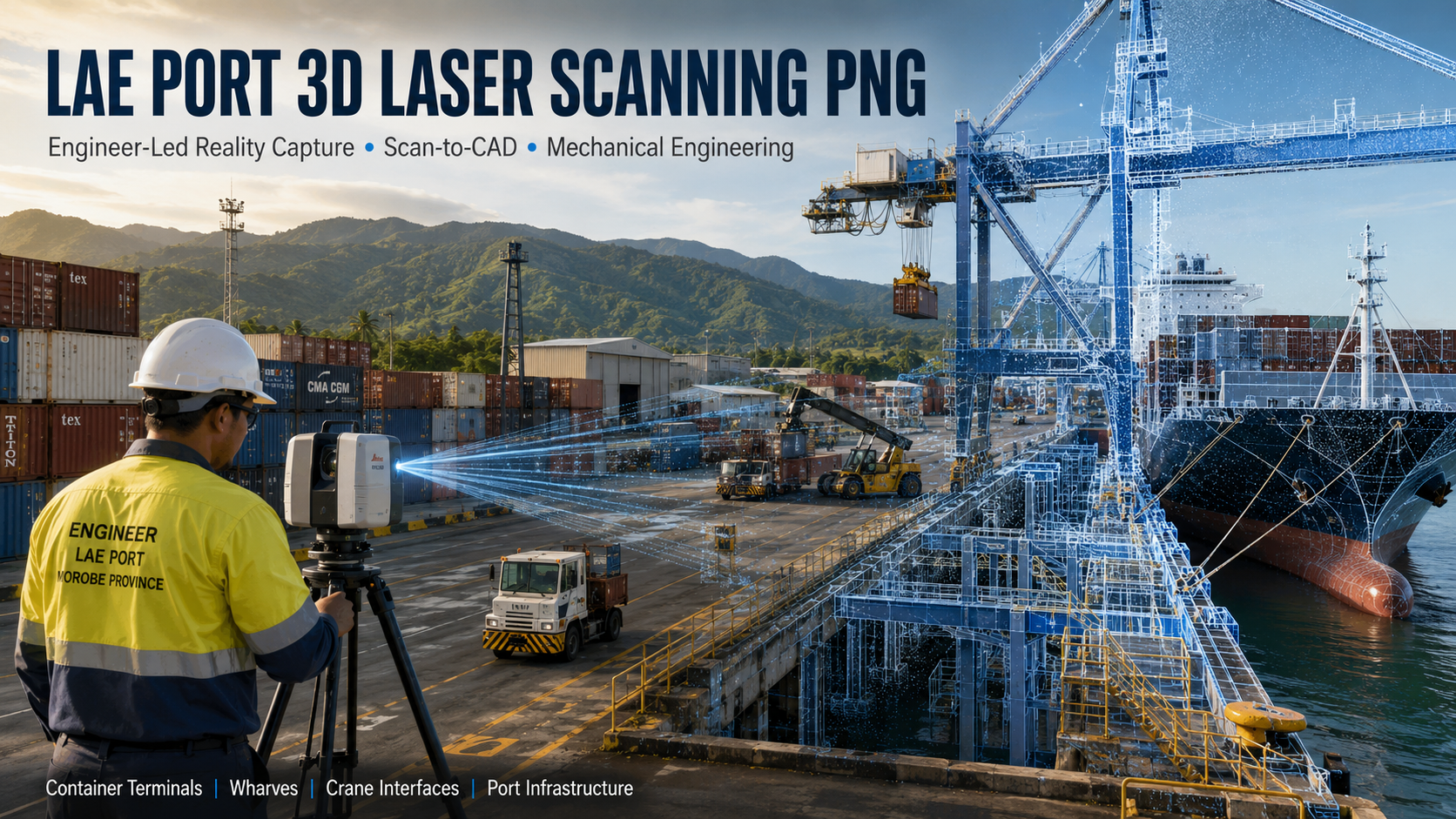
Hamilton By Design provides an engineer-led approach to Lae Port 3D laser scanning PNG, combining high-accuracy reality capture with mechanical engineering, CAD modelling, structural drafting, reverse engineering and fabrication-ready documentation.

Rather than treating laser scanning as an isolated surveying exercise, our approach creates an engineering workflow from:

Site Capture โ†’ Point Cloud โ†’ CAD Model โ†’ Engineering โ†’ Verification โ†’ Fabrication

Our 3D laser scanning services are suited to complex brownfield environments where reliable existing-condition information is essential before new infrastructure is designed, fabricated or installed.

Why 3D Laser Scanning Matters at an Operating Container Terminal

Port infrastructure rarely remains exactly as originally documented.

Wharves are repaired and extended. Structural steel is modified. Platforms and services are added. Equipment is replaced. Crane interfaces evolve, and new cargo-handling systems need to be installed around assets that may have been operating for decades.

As a result, historic drawings may no longer accurately represent what exists on site.

Engineering-grade LiDAR scanning provides a way to establish a new dimensional baseline.

A terrestrial laser scanner captures millions of three-dimensional points describing the actual position of structures, machinery, pipework, platforms, buildings and surrounding infrastructure.

This information can then be registered into a coordinated point cloud that engineering teams can use to measure and model the existing facility.

For brownfield projects, this can reduce reliance on repeated tape measurements, photographs, hand sketches and assumptions.

Hamilton By Design’s engineering-grade 3D laser scanning workflow is focused on producing data that can support actual engineering decisions rather than visualisation alone.

Container Terminal and Crane Interface Scanning

One of the strongest applications for 3D laser scanning at Lae is the integration of new container-terminal equipment with existing infrastructure.

This could include:

  • ship-to-shore crane interfaces
  • crane rails and supporting structures
  • machinery platforms
  • structural frames
  • cable and service routes
  • access stairs and walkways
  • maintenance areas
  • wharf structures
  • container-handling equipment
  • existing foundations and connection points.

Before new equipment is fabricated or shipped to Papua New Guinea, the existing infrastructure can be captured and converted into usable engineering geometry.

Vendor equipment models can then be positioned within the scanned environment to assess interfaces and potential clashes.

This provides engineers with the ability to ask practical questions before installation begins:

Will the equipment fit?

Are the existing connection points where the drawings say they are?

Is there enough maintenance access?

Will new steelwork interfere with existing services?

Can the equipment be installed without major site modification?

These are exactly the types of issues where accurate existing-condition data can reduce risk.

Point Cloud to CAD for Lae Port Infrastructure

Capturing the site is only the first stage.

Hamilton By Design can convert selected portions of the point cloud into engineering CAD models suitable for design development, equipment layouts and fabrication documentation.

Our Point Cloud to CAD services provide a pathway from LiDAR data into practical engineering deliverables.

Depending on the project, these can include:

  • SolidWorks models
  • AutoCAD drawings
  • Inventor-compatible geometry
  • general arrangement drawings
  • sections and elevations
  • structural models
  • equipment layouts
  • fabrication drawings
  • STEP or SAT geometry
  • registered point-cloud deliverables.

Not every object visible in a scan needs to be modelled.

For engineering work, it is often more efficient to model the geometry that influences the project: structural interfaces, machinery, connection points, access zones and potential clashes.

This keeps the model useful rather than unnecessarily complicated.

Mechanical Engineering for Port Assets

Hamilton By Design can take the project beyond scanning by applying mechanical engineering to the captured site information.

Typical port engineering opportunities can include:

Equipment Support Structures

Existing infrastructure can be scanned before new support frames, brackets or machinery bases are designed.

Machinery Modifications

Mechanical components can be redesigned or modified to suit the actual installed geometry.

Maintenance Access

Platforms, ladders, stairs, walkways and handrails can be developed around existing machinery and structural constraints.

Guards and Safety Improvements

Machine guarding and access-control structures can be designed around equipment captured directly from site.

Materials Handling Equipment

Conveyors, transfer points, chutes and associated structural interfaces can be developed using verified existing-condition data.

Equipment Replacement

Obsolete or undocumented machinery components can be reconstructed through scanning, measurement and engineering assessment.

Our reverse engineering 3D scanning capability is particularly useful where original manufacturing drawings no longer exist or where the installed asset has changed significantly during its service life.

Wharves, Structural Steel and Brownfield Port Infrastructure

Wharf areas can contain dense combinations of structural steel, concrete, services, lifting equipment, access structures and mechanical systems.

This makes conventional measurement difficult.

Laser scanning allows large areas to be documented while maintaining the spatial relationship between different assets.

For example, a proposed structural modification may require the engineering team to understand:

  • column locations
  • beam elevations
  • connection geometry
  • platform heights
  • nearby machinery
  • service penetrations
  • access restrictions
  • maintenance clearances.

The scan becomes a common dimensional reference that can be reviewed by engineering, fabrication and construction teams.

Hamilton By Design applies similar workflows to Australian port environments through services such as mechanical engineering for the Port of Newcastle, where site capture can feed directly into CAD development and fabrication documentation.

Scan-to-CAD for Equipment Upgrades

The real value of 3D scanning becomes clearer when new equipment needs to be fitted into an existing operating facility.

Consider a new container-terminal system being manufactured outside PNG.

A traditional workflow might rely on old drawings and a limited site survey. Problems may only become apparent after fabricated equipment reaches Lae.

A scan-to-CAD workflow changes that process.

Hamilton By Design can:

  1. capture the existing installation;
  2. register the scan data;
  3. create CAD geometry around critical interfaces;
  4. import the proposed equipment model;
  5. check clearances and clashes;
  6. identify structural or mechanical modifications;
  7. develop revised engineering;
  8. produce fabrication drawings.

This approach is similar to our Scan to CAD Port of Brisbane services, where LiDAR data can be converted into practical engineering information for existing port assets.

The objective is straightforward:

find problems digitally before they become fabrication or installation problems on site.

Structural Steel, Platforms and Maintenance Access

Port infrastructure often requires ongoing modification as equipment and operating practices change.

Hamilton By Design can assist with the development of:

  • structural equipment frames
  • machinery platforms
  • access platforms
  • stairs
  • ladders
  • handrails
  • maintenance walkways
  • guards
  • equipment supports
  • connection details.

Laser scanning is particularly valuable because these structures must often fit around existing machinery.

Instead of designing from an idealised drawing, the engineer can develop the modification around the actual asset.

Reverse Engineering Port Equipment

Ports frequently operate mechanical equipment for long periods.

Some components may no longer have reliable drawings, while others may have been repaired or modified several times.

Reverse engineering can provide a pathway to replacement or improvement.

Hamilton By Design can combine:

  • 3D scanning
  • physical measurement
  • dimensional verification
  • CAD modelling
  • engineering assessment
  • material consideration
  • fabrication documentation.

Rather than simply copying an old component, the objective is to understand how the part functions and how the replacement must interface with surrounding equipment.

Our broader reverse engineering for mining and industrial equipment experience applies particularly well to ports supporting mining and heavy-industry supply chains.

Australian Standards and Engineering for PNG Projects

Projects at Lae Port are located in Papua New Guinea, so applicable PNG legislation, project specifications, PNG Ports Corporation requirements and client engineering standards must be established for each project.

Where nominated as part of the project engineering basis, Hamilton By Design can also work with relevant Australian Standards.

Depending on the scope, these may include:

AS 4100 โ€“ Steel Structures
For structural steelwork and equipment support structures.

AS/NZS 1170 series โ€“ Structural Design Actions
For structural actions and engineering load combinations where applicable to the project design basis.

AS 1657 โ€“ Fixed Platforms, Walkways, Stairways and Ladders
For industrial access systems around machinery and port infrastructure.

AS/NZS 4024 series โ€“ Safety of Machinery
For machinery safety, guarding and materials-handling systems.

AS 4991 โ€“ Lifting Devices
For appropriate below-the-hook lifting devices and maintenance lifting arrangements.

AS 2550 series โ€“ Cranes, Hoists and Winches โ€“ Safe Use
Potentially relevant where engineering interfaces with crane and lifting operations.

AS/NZS 1554 series
For welding of structural steelwork where applicable.

Engineering requirements should always be confirmed against the specific asset, duty, client specification and PNG regulatory requirements before design begins.

Engineering Before Fabrication

The principal advantage of combining scanning with engineering is the opportunity to resolve problems earlier.

A point cloud provides dimensional evidence.

A CAD model makes that information easier to design around.

Engineering turns the captured geometry into a practical solution.

Fabrication drawings then allow the solution to be manufactured.

This is why Hamilton By Design focuses on an integrated engineering approach rather than treating 3D scanning as the final deliverable.

Our broader Scan to BIM and point-cloud modelling services can also support warehouse, building and infrastructure documentation where the project requires more extensive digital asset information.

Lae Port 3D Laser Scanning PNG

For developing port infrastructure, accurate existing-condition information can make the difference between a modification that fits first time and one that requires extensive site rework.

Hamilton By Design can support Port of Lae projects involving container terminals, wharves, structural steelwork, warehouses, mechanical equipment and materials-handling infrastructure.

Our engineer-led workflow combines:

3D laser scanning + point clouds + CAD modelling + mechanical engineering + reverse engineering + fabrication documentation.

For brownfield port upgrades, the goal is not simply to scan what exists.

It is to understand what exists well enough to design what comes next.

Frequently Asked Questions

Can Hamilton By Design provide 3D laser scanning at Lae Port?

Hamilton By Design can support engineering-grade 3D laser scanning for port and industrial infrastructure projects subject to project requirements, site access, mobilisation arrangements and client approvals.

What port assets can be scanned?

Typical assets include wharves, structural steel, cranes and crane interfaces, cargo-handling equipment, warehouses, conveyors, pipework, machinery, platforms, stairs, handrails and surrounding infrastructure.

Can you convert the point cloud into CAD?

Yes. Selected scan data can be converted into engineering CAD geometry, drawings and models suitable for equipment integration, mechanical design, structural detailing and fabrication planning.

Can HBD work with equipment models supplied by another manufacturer?

Yes. Vendor CAD models can be coordinated with the captured existing-condition environment to assess positioning, clearances, access and potential clashes.

Can scanning help before a shutdown?

Yes. Capturing existing geometry before a shutdown can allow a substantial amount of measurement, modelling, clash checking and fabrication planning to occur before the shutdown begins.

Can you reverse engineer existing port equipment?

Where appropriate, HBD can combine scanning, measurement, engineering assessment and CAD modelling to develop replacement or modified components for undocumented or obsolete equipment.

Does HBD only provide the point cloud?

No. Point-cloud delivery can form part of the scope, but HBD’s key advantage is the ability to continue through CAD modelling, mechanical engineering, reverse engineering and fabrication-ready drafting.

Are Australian Standards applicable in Papua New Guinea?

Australian Standards should not automatically be assumed to govern a PNG project. Applicable PNG legislation, project specifications, client requirements and asset-owner standards must first be identified. Relevant Australian Standards can then be incorporated where they form part of the agreed engineering basis.

Why use engineer-led 3D laser scanning for Lae Port?

Because the scan can be captured with the eventual engineering problem in mind. Critical interfaces, access areas, structural connections and surrounding equipment can be captured so the resulting data supports real design, fabrication and installation decisions.

What is the main advantage for brownfield port upgrades?

The principal advantage is the ability to design against the actual installed condition rather than relying solely on historic drawings. This can help identify clashes and fit-up issues before equipment is fabricated, transported to Papua New Guinea or installed on site.


Hamilton By Design logo displayed on a blue tilted rectangle with a grey gradient background

Contact Us – Talk To Us

Name
Would you like us to arrange a phone consultation for you?
Address

Our clients:
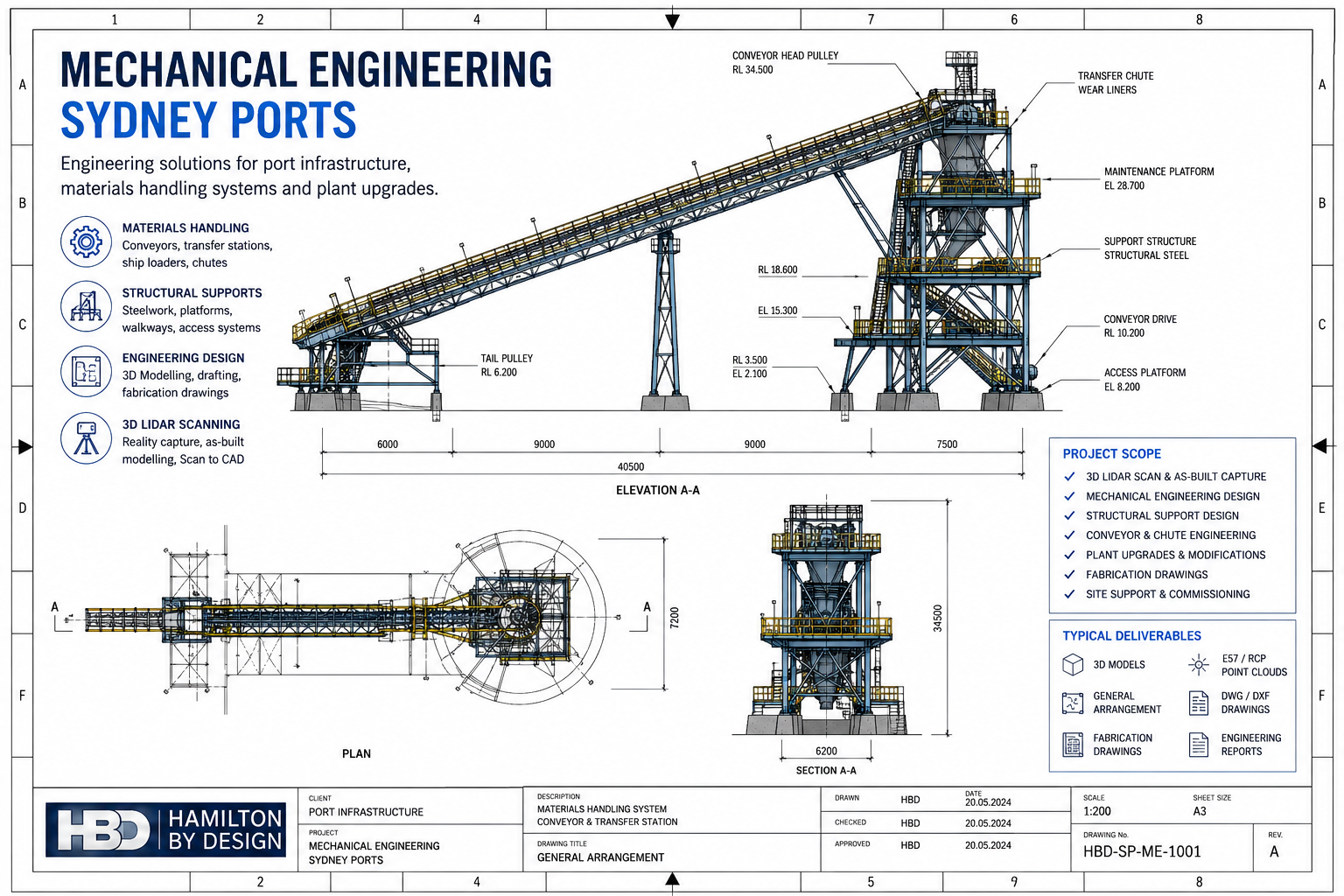


Mechanical Engineering Sydney Ports

Mechanical Engineering Sydney Ports technical drawing showing conveyor systems, transfer stations, structural steel, materials handling infrastructure, 3D LiDAR scanning services and engineering deliverables by Hamilton By Design.

Mechanical Engineering Sydney Ports | Hamilton By Design

Blue 3D LiDAR scanner icon on a tripod with scanning waves

Sydney’s ports are critical infrastructure assets that support Australia’s import, export, logistics and maritime industries. Maintaining, upgrading and expanding port facilities requires practical mechanical engineering expertise capable of working within live operating environments while minimising disruption to ongoing operations.

Hamilton By Design provides mechanical engineering services for Sydney ports, marine terminals, bulk handling facilities, container terminals, wharves and associated industrial infrastructure. Our services support asset owners, port operators, contractors, manufacturers and maintenance teams requiring engineering solutions for materials handling systems, plant upgrades, structural modifications and brownfield developments.

Based in NSW and supporting projects throughout Sydney and regional Australia, we combine mechanical engineering, 3D LiDAR scanning, CAD design and engineering documentation to deliver practical, engineering-led outcomes.


Mechanical Engineering Services for Sydney Ports

Port facilities contain a wide range of mechanical systems that require ongoing maintenance, modification and improvement. Our engineering services are tailored to support both day-to-day operational requirements and major capital projects.

Typical services include:

  • Mechanical engineering design
  • Materials handling system design
  • Conveyor upgrades and modifications
  • Transfer chute design
  • Structural steel support design
  • Walkways, platforms and access systems
  • Equipment relocation projects
  • Plant upgrade engineering
  • Mechanical drafting and documentation
  • Reverse engineering of components
  • Engineering inspections and assessments
  • Brownfield infrastructure modifications
  • 3D LiDAR scanning and reality capture
  • Scan to CAD services
  • As-built documentation

Our experience across industrial and mining environments provides practical insight into maintaining operational facilities while delivering engineering improvements.


Industries and Port Infrastructure We Support

Sydney ports contain a diverse range of infrastructure requiring specialised engineering support.

We regularly assist with:

Bulk Materials Handling Facilities

  • Conveyor systems
  • Transfer stations
  • Ship loaders
  • Hopper systems
  • Stockpile conveyors
  • Materials handling equipment
  • Dust collection systems

Container Terminal Infrastructure

  • Container handling equipment
  • Mechanical support structures
  • Equipment foundations
  • Maintenance access systems
  • Service platforms

Marine and Wharf Facilities

  • Wharf structures
  • Mechanical services infrastructure
  • Pipework systems
  • Utility installations
  • Maintenance access platforms

Industrial Port Facilities

  • Warehouses
  • Processing plants
  • Storage facilities
  • Bulk liquid terminals
  • Manufacturing facilities
  • Logistics infrastructure

Engineering Design for Brownfield Port Facilities

Many Sydney port facilities have been operating for decades and contain limited or outdated engineering documentation.

Before modifications can commence, accurate information about existing conditions is essential.

Hamilton By Design specialises in engineering support for brownfield environments through:

  • Existing condition surveys
  • 3D LiDAR scanning
  • Point cloud capture
  • As-built modelling
  • Scan to CAD conversion
  • Equipment verification
  • Clash detection
  • Layout development

By capturing existing infrastructure before design begins, project risks can be significantly reduced while improving installation accuracy.


3D LiDAR Scanning and Mechanical Engineering

Modern engineering projects increasingly rely on accurate digital representations of existing facilities.

Our engineering team uses advanced 3D LiDAR scanning technology to capture:

  • Conveyors
  • Pipework
  • Structural steel
  • Transfer stations
  • Ship loading infrastructure
  • Equipment layouts
  • Processing plant assets
  • Mechanical services

The resulting point cloud data can be converted into engineering models and drawings used for:

  • Upgrade design
  • Retrofit projects
  • Structural modifications
  • Equipment replacements
  • Maintenance planning
  • Fabrication detailing

This approach reduces site rework, minimises clashes and improves project confidence.


Materials Handling Engineering

Materials handling systems form the backbone of many port operations.

Our mechanical engineering services include:

Conveyor System Design

We provide engineering support for:

  • New conveyor installations
  • Conveyor upgrades
  • Conveyor extensions
  • Transfer point modifications
  • Conveyor guarding
  • Structural support systems

Transfer Chute Design

Efficient transfer chutes are critical for reducing wear, dust generation and material spillage.

Services include:

  • Chute assessments
  • Flow analysis
  • Wear reduction solutions
  • Maintenance improvements
  • Upgrade concepts

Maintenance and Asset Improvement

Engineering support can assist with:

  • Reliability improvements
  • Equipment modifications
  • Replacement strategies
  • Asset life extension
  • Shutdown planning

Mechanical Drafting and Documentation

Clear engineering documentation is essential for fabrication, installation and maintenance activities.

Deliverables may include:

  • General arrangement drawings
  • Mechanical layouts
  • Fabrication drawings
  • Assembly drawings
  • Equipment models
  • Structural details
  • Site layouts
  • Installation drawings
  • CAD documentation

We work with commonly used engineering platforms including:

  • SolidWorks
  • Autodesk Inventor
  • AutoCAD
  • Autodesk ReCap
  • Navisworks

Typical Deliverables

Depending on project requirements, deliverables may include:

  • Mechanical engineering reports
  • Concept designs
  • Detailed engineering drawings
  • General arrangement drawings
  • CAD models
  • SolidWorks models
  • STEP files
  • DWG files
  • DXF files
  • Point cloud data
  • E57 files
  • RCP and RCS files
  • As-built documentation
  • Equipment layouts
  • Engineering recommendations

Our objective is to provide practical deliverables that can be directly used by project teams, fabricators and contractors.


Why Choose Hamilton By Design?

Hamilton By Design combines practical engineering experience with modern digital engineering technologies.

Our clients benefit from:

  • Mechanical engineering expertise
  • Engineering-led LiDAR scanning services
  • Brownfield project experience
  • Materials handling knowledge
  • Practical design solutions
  • Fast project mobilisation
  • Australia-wide support
  • Accurate engineering documentation

By combining engineering design with reality capture technologies, we help reduce project uncertainty while improving the quality of engineering outcomes.


Frequently Asked Questions

What mechanical engineering services do you provide for Sydney ports?

We provide engineering design, conveyor upgrades, materials handling engineering, plant modifications, structural support design, drafting and 3D LiDAR scanning services.

Can you scan existing port infrastructure before design work begins?

Yes. We provide engineering-grade 3D LiDAR scanning services to accurately capture existing facilities and create as-built models.

Do you work on operational port facilities?

Yes. Many projects are completed within live operational environments, allowing engineering work to be undertaken while minimising disruption.

Can you convert point clouds into CAD models?

Yes. Point cloud data can be converted into CAD drawings, SolidWorks models and engineering documentation.

Do you support conveyor upgrade projects?

Yes. We regularly assist with conveyor modifications, transfer chute improvements and materials handling upgrades.

Can you provide fabrication drawings?

Yes. Detailed fabrication and installation drawings can be produced where required.

What software do you use?

We commonly use SolidWorks, Autodesk Inventor, AutoCAD, Autodesk ReCap and Navisworks.

Do you provide Scan to CAD services?

Yes. We convert laser scan data into accurate engineering drawings and 3D models.

Do you work outside Sydney?

Yes. We support projects throughout NSW and Australia, including ports, mining operations, manufacturing facilities and industrial sites.

How do I obtain a quote?

Contact Hamilton By Design with your project requirements, available drawings and site information. We can then prepare a tailored proposal for your Sydney port engineering project.

Hamilton By Design logo displayed on a blue tilted rectangle with a grey gradient background

Contact Hamilton By Design

If you require Mechanical Engineering Sydney Ports services, Hamilton By Design can assist with engineering design, plant upgrades, materials handling systems, 3D LiDAR scanning, Scan to CAD and engineering documentation.

Contact our team today to discuss your Sydney port infrastructure project and obtain a tailored engineering solution.

Talk to Us – Contact Us

Name
Would you like us to arrange a phone consultation for you?
Address

Our clients:


3D LiDAR Scanning Darwin for engineering surveys, laser scanning, reality capture and point cloud modelling services
3D LiDAR Scanning Australia engineering services for laser scanning, reality capture, scan-to-CAD, Scan-to-BIM and as-built documentation across Australia
3D LiDAR scanning services on the Central Coast providing engineering-grade laser scanning, point cloud capture, scan-to-CAD modelling and industrial reality capture for infrastructure and industrial projects.

Malaysia 3D LiDAR Engineering Scanning Service

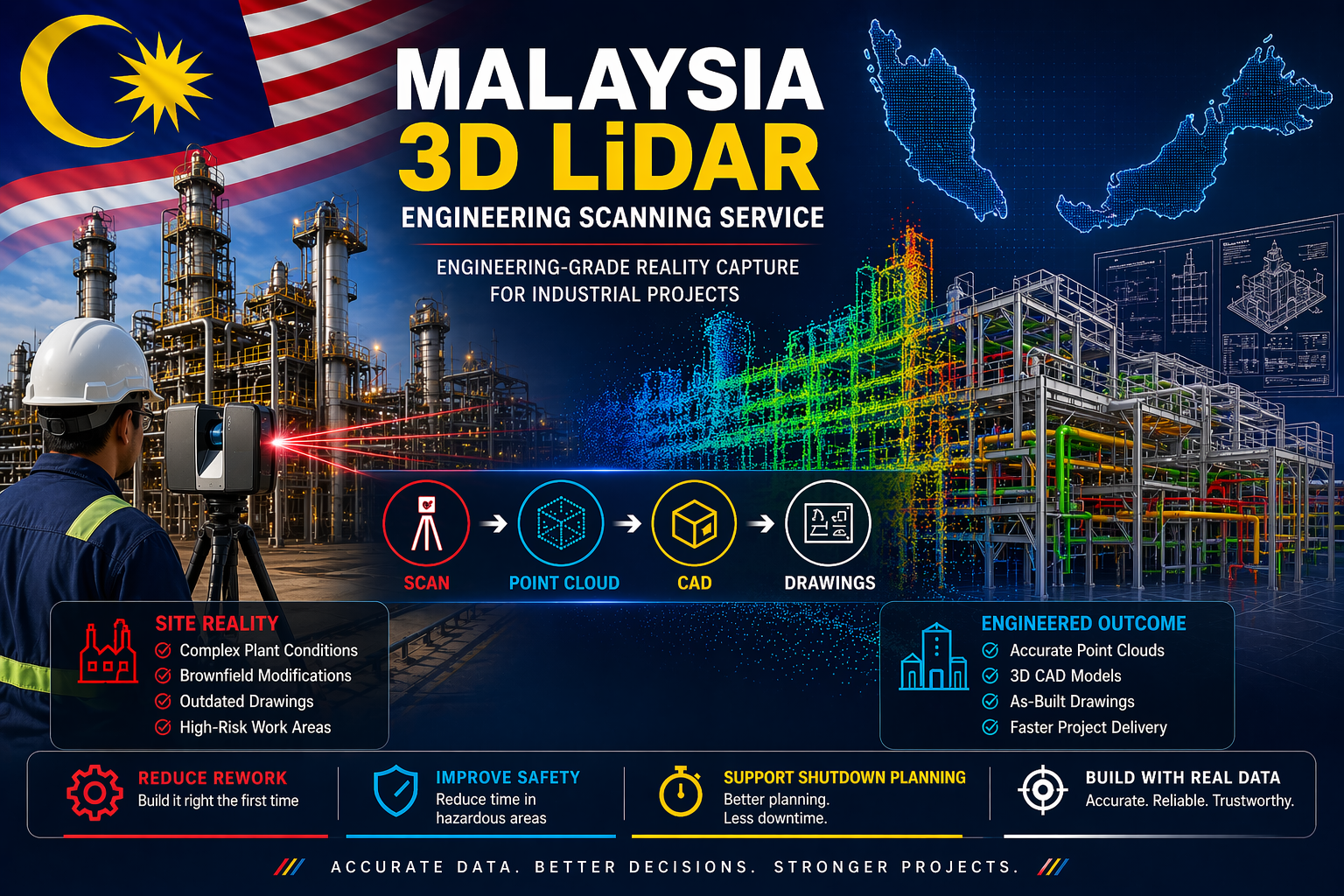
3D LiDAR scanning of a Malaysian industrial plant showing point cloud data converted into CAD models and engineering drawings

Malaysia is a major hub for industrial activity across oil and gas, manufacturing, palm oil processing, and infrastructure. These facilities are often complex environments where accuracy is critical to project success.

Hamilton By Design provides Malaysia 3D LiDAR engineering scanning services, delivering accurate site data that supports safer, faster, and more reliable engineering outcomes.

Traditional measurement methods rely on outdated drawings, manual measurements, and assumptions. Over time, industrial plants change, and what exists on paper often does not reflect what has actually been built.

This creates risk across design, fabrication, and installation.

3D LiDAR scanning removes this uncertainty. Using high-speed laser measurement, millions of data points are captured to create a point cloud. This point cloud represents the exact geometry of the site as it exists in reality.

The data can then be converted into 3D CAD models and engineering drawings, providing a reliable foundation for project delivery.

3D LiDAR scanning and 3D modelling service button โ€” laser scanner capturing a point cloud for engineering and CAD modelling
Mechanical engineering services

The benefits are immediate.

Engineering accuracy improves because designs are based on real-world conditions. Clash detection can be completed before fabrication begins, reducing rework and avoiding costly delays.

Project timelines are reduced. Engineering teams can work remotely using accurate data, limiting the need for repeated site visits.

Safety is improved by reducing the time spent in hazardous environments. This is especially important during shutdowns and brownfield upgrades.

Shutdown planning becomes more effective. Components can be prefabricated, installation can be planned in detail, and downtime can be minimised.

Most importantly, 3D LiDAR scanning provides true as-built documentation. Every visible element of the plant is captured, allowing accurate layouts, sections, and models to be generated without returning to site.

The real value comes from the workflow.

Scan the site.
Process the point cloud.
Build the CAD model.
Produce engineering drawings.

This process transforms raw data into practical, engineering-ready deliverables that can be used across the full lifecycle of a project.

These services are widely used across oil and gas facilities, palm oil processing plants, manufacturing operations, mining infrastructure, and power generation sites throughout Malaysia.

Typical applications include plant upgrades, structural modifications, equipment installations, and shutdown planning.

In todayโ€™s environment, projects are expected to be delivered faster, safer, and with greater accuracy. 3D LiDAR scanning supports these outcomes by ensuring decisions are based on real data rather than assumptions.

If you are planning an upgrade, shutdown, or new installation within an industrial facility in Malaysia, accurate information is critical.

To learn more about how Hamilton By Design can support your project, visit:

Talk to Us – Contact Us

Name
Would you like us to arrange a phone consultation for you?
Address
3D CAD Modelling Australia service banner for Hamilton By Design

Our clients

3D LiDAR Scanning Darwin for engineering surveys, laser scanning, reality capture and point cloud modelling services
3D LiDAR Scanning Australia engineering services for laser scanning, reality capture, scan-to-CAD, Scan-to-BIM and as-built documentation across Australia
3D LiDAR scanning services on the Central Coast providing engineering-grade laser scanning, point cloud capture, scan-to-CAD modelling and industrial reality capture for infrastructure and industrial projects.
3D LiDAR Scanning Perth for engineering surveys, laser scanning, reality capture and point cloud modelling services
3D LiDAR Scanning Sydney for engineering surveys, laser scanning, reality capture and point cloud modelling services
3D LiDAR Scanning Brisbane for engineering surveys, laser scanning, reality capture and point cloud modelling services
3D LiDAR Scanning Canberra for engineering surveys, laser scanning, reality capture and point cloud modelling services
3D LiDAR Scanning Newcastle for engineering surveys, laser scanning, reality capture and point cloud modelling services
3D LiDAR Scanning Adelaide for engineering surveys, laser scanning, reality capture and point cloud modelling services

Engineering-Grade 3D Scanning in Papua New Guinea

3D laser scanner capturing point cloud data of remote processing plant.

Papua New Guinea presents some of the most demanding industrial environments in the Asia-Pacific region. Remote terrain, ageing infrastructure, complex plant layouts and tight shutdown windows demand precision, efficiency and engineering certainty.

Hamilton By Design delivers engineering-grade 3D scanning services in Papua New Guinea, supporting mining, processing, infrastructure and industrial projects with accurate digital capture and practical engineering outcomes.

If you are planning a plant expansion, shutdown upgrade, brownfield modification or condition assessment in PNG, high-resolution laser scanning provides the clarity your project needs.

๐Ÿ‘‰ Learn more about our dedicated PNG services here:
https://www.hamiltonbydesign.com.au/3d-scanning-papua-new-guinea/


Industrial mining facility in PNG captured with engineering-grade 3D scanning technology.

Why 3D Laser Scanning Matters in PNG

Traditional measurement methods are time-consuming and prone to error โ€” especially in remote or operational sites. 3D laser scanning eliminates guesswork by capturing millions of precise data points in a matter of hours.

The result is a complete and reliable as-built digital record of your asset.

This enables:

  • Accurate retrofit and tie-in design
  • Reduced site revisits
  • Improved shutdown planning
  • Clash detection before fabrication
  • Safer project execution

In remote PNG environments, reducing mobilisation and rework is not just convenient โ€” it is critical to project success.


From Point Cloud to Engineering Outcome

At Hamilton By Design, we go beyond scanning.

We transform raw point cloud data into usable engineering outputs including:

  • SolidWorks-ready 3D models
  • Structural and mechanical layouts
  • Fabrication drawings
  • Design verification data
  • Digital asset records

Our difference is simple: we are engineers first. Scanning is integrated directly into mechanical and structural design workflows, ensuring data captured onsite translates into practical, buildable solutions.

For a broader overview of our national capability, explore our full 3D laser scanning services here:
https://www.hamiltonbydesign.com.au/home/engineering-services/3d-laser-scanning/


Supporting Mining & Industrial Projects Across Papua New Guinea

Our PNG capability supports:
  • Mining processing plants
  • Conveyors and transfer stations
  • Pump stations and pipework systems
  • Structural steel and platforms
  • Smelter and refinery infrastructure
  • Brownfield plant upgrades

Whether your site is operational, remote or in early planning stages, we deliver data accuracy that reduces risk and accelerates decision-making.


Reduce Risk. Increase Certainty.

In complex industrial environments, uncertainty drives cost.

3D laser scanning provides:
  • Accurate geometry
  • Faster design cycles
  • Reduced fabrication errors
  • Improved stakeholder confidence

When combined with Hamilton By Designโ€™s engineering capability, it becomes a powerful project delivery tool.


Delivering Engineering Certainty in Papua New Guinea

If your organisation is undertaking upgrades, expansions or asset assessments in Papua New Guinea, we are ready to support your project.

Explore our dedicated PNG scanning capability:
๐Ÿ‘‰ https://www.hamiltonbydesign.com.au/3d-scanning-papua-new-guinea/

Or view our broader engineering-led 3D laser scanning services:
๐Ÿ‘‰ https://www.hamiltonbydesign.com.au/home/engineering-services/3d-laser-scanning/


3D LiDAR scanning and 3D modelling service button โ€” laser scanner capturing a point cloud for engineering and CAD modelling
Mechanical engineering services
Name
Would you like us to arrange a phone consultation for you?
Address

3D CAD Modelling Australia service banner for Hamilton By Design
Australian Drafting logo featuring bold white text reading "Australian Drafting" centred on a blue rounded rectangle background.
Engineering Governance title graphic featuring bold white text reading "Engineering Governance" centred on a blue rounded rectangle background.
Mechanical, Structural & Pipework Drafting service banner by Hamilton By Design featuring white text on a blue background.
Mechanical engineering services
Blue rounded button with the text โ€œSolidWorks Designโ€ in white.
Finite Element Analysis (FEA) engineering simulation button
3D LiDAR Scanning Darwin for engineering surveys, laser scanning, reality capture and point cloud modelling services
3D LiDAR Scanning Australia engineering services for laser scanning, reality capture, scan-to-CAD, Scan-to-BIM and as-built documentation across Australia
3D LiDAR scanning services on the Central Coast providing engineering-grade laser scanning, point cloud capture, scan-to-CAD modelling and industrial reality capture for infrastructure and industrial projects.
3D LiDAR Scanning Perth for engineering surveys, laser scanning, reality capture and point cloud modelling services
3D LiDAR Scanning Sydney for engineering surveys, laser scanning, reality capture and point cloud modelling services
3D LiDAR Scanning Brisbane for engineering surveys, laser scanning, reality capture and point cloud modelling services
3D LiDAR Scanning Canberra for engineering surveys, laser scanning, reality capture and point cloud modelling services
3D LiDAR Scanning Newcastle for engineering surveys, laser scanning, reality capture and point cloud modelling services
3D LiDAR Scanning Adelaide for engineering surveys, laser scanning, reality capture and point cloud modelling services