Scan to Fabrication Services in Tomago NSW

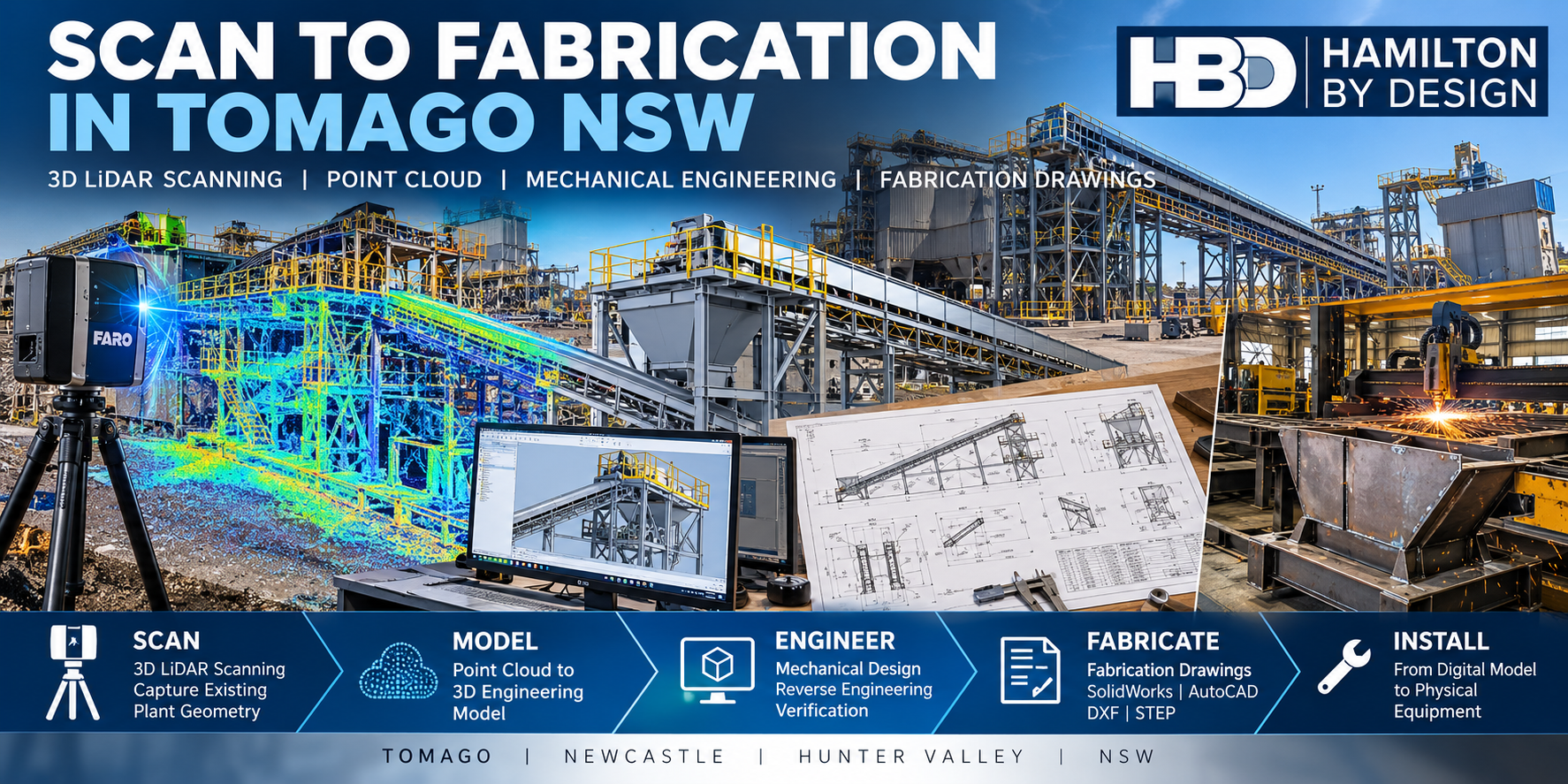
Scan to fabrication in Tomago NSW by Hamilton By Design, showing FARO 3D LiDAR scanning, industrial point clouds, mechanical CAD models, fabrication drawings and steel manufacturing.

From Existing Plant to Fabrication-Ready Drawings โ€“ Hamilton By Design

Scan to Fabrication Services in Tomago NSW

Blue 3D LiDAR scanner icon on a tripod with scanning waves

Hamilton By Design provides professional scan-to-fabrication services in Tomago, Newcastle and the Hunter Region, combining 3D LiDAR scanning, mechanical engineering, reverse engineering and detailed fabrication drawings to support industrial maintenance, plant modifications and equipment upgrades.

Our scan-to-fabrication workflow allows manufacturers, maintenance contractors, engineering companies and industrial operators to capture existing plant geometry and develop accurate 3D CAD models and fabrication drawings for new or replacement components.

Whether modifying an existing conveyor, replacing a worn chute, installing new pipework or designing structural steelwork interfaces, our approach helps reduce site measurement errors, fabrication rework and installation delays.

We scan existing equipment, develop engineering models and prepare drawings that support fabrication and installation.

What Is Scan to Fabrication?

Scan to fabrication is the process of converting physical equipment, structures and industrial environments into digital engineering information suitable for manufacturing and installation.

Using 3D LiDAR scanning, Hamilton By Design captures the existing geometry of industrial facilities, including equipment positions, connection points, structural interfaces and surrounding obstructions.

The captured point cloud is processed and converted into 3D CAD geometry using engineering software such as SolidWorks and AutoCAD.

Our mechanical engineering capabilities allow the captured geometry to be developed into practical engineering designs, incorporating material selection, mechanical clearances, fabrication requirements and installation constraints.

The resulting deliverables may include:

  • Registered 3D point clouds
  • Existing-condition 3D CAD models
  • Mechanical assembly models
  • General arrangement drawings
  • Detailed fabrication drawings
  • Steelwork and equipment interface drawings
  • Plate developments and DXF cutting profiles
  • Pipework arrangements and spool drawings
  • STEP and Parasolid manufacturing files
  • Installation and assembly documentation

Scan to Fabrication for Tomago’s Industrial Sector

Tomago is one of the Hunter Region’s established industrial and manufacturing centres, supporting aluminium production, engineering workshops, fabrication businesses, equipment maintenance and industrial processing operations.

Hamilton By Design supports these industries by providing site measurement, digital modelling and mechanical design services for existing and proposed plant.

Conveyor Systems and Materials Handling

Conveyor modifications frequently require new components to interface with existing structures, drives, transfer points and support arrangements.

Our scan-to-fabrication services support:

  • Conveyor extensions and relocations
  • Transfer chute modifications
  • Skirt plate arrangements
  • Conveyor guarding
  • Drive and pulley support interfaces
  • Maintenance platforms and access arrangements
  • Replacement mechanical components

Capturing existing equipment geometry helps identify installation constraints before components are manufactured.

Chute Design and Replacement

Industrial chutes are frequently exposed to abrasion, impact loading and material build-up.

Hamilton By Design uses 3D scanning and mechanical CAD modelling to document existing chute geometry and develop replacement or modified arrangements.

Services include chute assembly models, liner layouts, plate developments, fabrication drawings and installation interface details.

This approach is particularly useful when original manufacturing drawings are unavailable or existing equipment has been modified over time.

Pipework and Mechanical Services

Retrofitting pipework into an operating industrial facility can present challenges due to existing equipment, restricted access and congested service corridors.

3D LiDAR scanning allows the surrounding environment to be captured before pipe routes are developed.

Applications include:

  • Process pipework modifications
  • Pump suction and discharge arrangements
  • Pipe supports and brackets
  • Flanged connection interfaces
  • Pipe spool modelling
  • Equipment tie-ins
  • Maintenance clearance assessments

The digital model provides a reference for developing pipework arrangements and fabrication documentation.

Pump Skids and Mechanical Equipment

Hamilton By Design supports the modification and replacement of pump skids, mechanical assemblies and industrial equipment.

Our services include reverse engineering, equipment arrangement modelling, baseplate design, connection interface documentation and detailed manufacturing drawings.

Existing equipment can be scanned to establish installation envelopes and connection geometry before replacement assemblies are designed.

Structural Steelwork Interfaces and Access Platforms

Industrial modifications often require mechanical equipment to interface with existing structural steelwork.

3D scanning provides dimensional information for developing equipment supports, access arrangements, guarding and maintenance platforms.

Hamilton By Design can prepare CAD models and fabrication documentation for these arrangements, with structural design verification and certification undertaken by appropriately qualified structural engineers where required.

Our Scan-to-Fabrication Workflow

Stage 1 โ€“ Site Inspection and 3D LiDAR Scanning

We attend the Tomago industrial site and capture the existing equipment, structures and surrounding environment using 3D LiDAR scanning.

The scan area is selected to include relevant connection points, installation clearances and adjacent equipment.

Stage 2 โ€“ Point Cloud Registration and Processing

Individual scans are registered into a coordinated point cloud dataset.

The processed data provides a digital reference for the existing installation and can be reviewed before detailed modelling begins.

Stage 3 โ€“ 3D CAD Modelling

Using SolidWorks and AutoCAD, we develop 3D CAD geometry from the registered scan data.

Depending on project requirements, modelling may include existing equipment, new components, mechanical assemblies and proposed modifications.

Stage 4 โ€“ Mechanical Engineering and Design Development

The proposed arrangement is reviewed for practical installation, equipment access, mechanical clearances, material selection and fabrication requirements.

Where required, engineering calculations and finite element analysis can support the design development process.

Stage 5 โ€“ Fabrication Drawings and Manufacturing Files

Following design review and approval, detailed manufacturing documentation is prepared.

Deliverables may include general arrangements, assembly drawings, individual component drawings, material schedules, cutting profiles and manufacturing CAD files.

Stage 6 โ€“ Fabrication and Installation Support

Hamilton By Design can provide technical support to fabrication contractors during manufacturing and installation.

This may include drawing clarification, dimensional checks, design revisions and resolution of site interface issues.

Benefits of Scan to Fabrication

Reduced Site Measurement Errors

3D scanning captures the surrounding equipment and installation environment, reducing reliance on isolated manual measurements.

Reduced Fabrication Rework

Developing components against existing-condition CAD geometry helps identify dimensional conflicts before manufacturing.

Improved Installation Planning

Digital models allow equipment arrangements and installation constraints to be reviewed before fabrication.

Faster Engineering Documentation

Registered point clouds provide a consistent dimensional reference for CAD modelling and detailed drawing development.

Improved Asset Documentation

Existing equipment can be documented even when original engineering drawings are missing or outdated.

Support for Future Plant Upgrades

Digital models and point clouds can be retained and reused for subsequent maintenance and engineering projects.

Mechanical Engineering and 3D LiDAR Scanning in Tomago

Hamilton By Design combines site-based 3D LiDAR scanning with practical mechanical engineering and fabrication experience.

Our capabilities extend beyond producing a point cloud. We can use captured site geometry to develop mechanical designs, equipment modifications and fabrication documentation.

Our services support:

  • Aluminium processing and associated industrial facilities
  • Heavy engineering and fabrication workshops
  • Manufacturing and production plants
  • Mining equipment maintenance
  • Materials handling systems
  • Mechanical equipment replacement
  • Plant shutdowns and maintenance projects
  • Industrial plant upgrades and brownfield modifications

We understand the importance of designing equipment that can be manufactured, transported, installed and maintained within an existing industrial environment.

Frequently Asked Questions

Can you produce fabrication drawings from a 3D laser scan?

Yes. Hamilton By Design can develop 3D CAD models and detailed fabrication drawings using registered point cloud data, supplemented by engineering measurements and design verification where required.

Can you reverse engineer equipment without original drawings?

Yes. Existing mechanical equipment can be scanned and measured to develop replacement component models and manufacturing documentation.

Can you scan an operating industrial plant?

Yes, subject to site access, safety requirements, visibility and operational constraints. Scanning activities can be planned around production and maintenance requirements.

Can you provide DXF and STEP files for manufacturing?

Yes. Depending on the project, deliverables can include DXF cutting profiles, STEP models, Parasolid files, SolidWorks assemblies and PDF fabrication drawings.

Does scan to fabrication eliminate the need for dimensional verification?

No. Critical manufacturing interfaces, tolerances and connection dimensions must still be verified using appropriate measurement methods. LiDAR provides valuable existing-condition geometry but does not replace precision metrology where tight tolerances are required.

Do you provide services outside Tomago?

Yes. Hamilton By Design supports engineering and industrial projects throughout Newcastle, Beresfield, Hexham, Mayfield, Rutherford, the Hunter Valley and other locations across Australia.

Scan to Fabrication in Tomago โ€“ Contact Hamilton By Design

If your Tomago facility requires replacement equipment, conveyor modifications, new chutes, mechanical assemblies, pipework or fabrication drawings, Hamilton By Design can assist.

Our integrated approach combines 3D LiDAR scanning, reverse engineering, mechanical design and fabrication documentation to support practical industrial upgrades.

From existing plant geometry to manufacturing-ready documentation, we help bridge the gap between site measurement and fabrication.


Hamilton By Design logo displayed on a blue tilted rectangle with a grey gradient background

Contact Us – Talk To Us

Name
Would you like us to arrange a phone consultation for you?
Address

Our clients:


Contact Hamilton By Design to discuss your next scan-to-fabrication project in Tomago NSW.

Hamilton By Design โ€“ Scan. Model. Engineer. Fabricate.
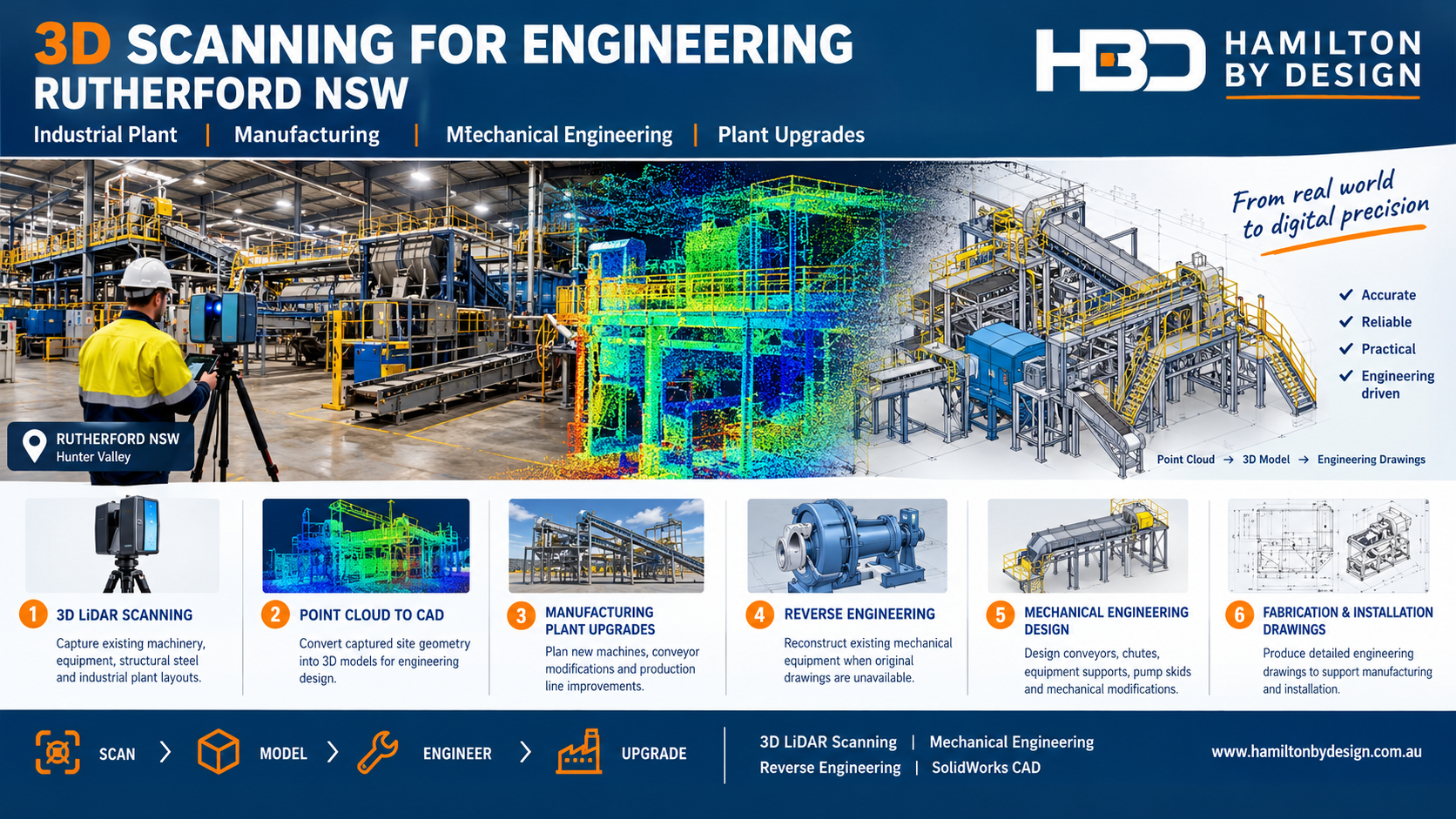
3D Scanning for Engineering in Rutherford NSW โ€“ Industrial Plant, Manufacturing & Mechanical Engineering

3D scanning for engineering in Rutherford NSW by Hamilton By Design, featuring industrial LiDAR scanning, point cloud to CAD modelling, mechanical engineering, reverse engineering, manufacturing plant upgrades and fabrication drawings.

3D LiDAR Scanning | Mechanical Engineering | Reverse Engineering | Plant Upgrades | Scan-to-CAD

3D Scanning for Engineering in Rutherford, NSW

Blue 3D LiDAR scanner icon on a tripod with scanning waves

Hamilton By Design provides professional 3D scanning for engineering in Rutherford NSW, supporting manufacturers, mining equipment suppliers, fabrication workshops and industrial facilities throughout Rutherford, Maitland and the Hunter Valley.

Using 3D LiDAR scanning technology, we capture existing machinery, equipment, structural interfaces, pipework and industrial plant layouts to develop accurate digital representations of operating facilities.

Our approach combines 3D laser scanning with practical mechanical engineering experience, allowing businesses to plan equipment modifications, machinery installations and production upgrades with greater confidence.

Rather than relying on incomplete drawings or manual measurements, our clients can use point cloud data and 3D CAD models to understand existing site conditions before fabrication or installation begins.

3D LiDAR Scanning for Rutherford’s Manufacturing and Industrial Sector

Rutherford is an established industrial and manufacturing precinct within the Maitland region, supporting engineering workshops, equipment maintenance, fabrication, transport and businesses servicing the Hunter Valley mining industry.

Hamilton By Design supports these operations with engineering-grade 3D scanning services for:

  • Manufacturing plants and production facilities
  • Mining equipment maintenance and refurbishment
  • Industrial machinery installations and replacements
  • Conveyor systems and material handling equipment
  • Fabrication workshops and mechanical assemblies
  • Pump installations, skids and associated pipework
  • Structural steel interfaces and access platforms
  • Industrial plant expansions and production upgrades

Our objective is to provide reliable dimensional information that engineers, designers and fabricators can use when planning modifications to existing equipment.

Plant Layouts and Production Upgrades โ€“ Making New Equipment Fit

One of the significant challenges when upgrading an operating manufacturing facility is determining whether new equipment will fit within the existing plant.

A new machine may fit on paper but interfere with existing conveyors, pipework, structural members, maintenance access or production equipment.

3D scanning for engineering helps identify these problems before equipment is manufactured or delivered to site.

Hamilton By Design can scan the existing facility and develop a 3D CAD model that allows engineers to position proposed equipment within the captured environment.

Typical applications include:

  • Installing new production machinery
  • Relocating existing manufacturing equipment
  • Modifying conveyor layouts and transfer points
  • Designing new chutes and material handling systems
  • Checking maintenance and operational clearances
  • Planning equipment access and removal paths
  • Identifying clashes between new and existing equipment

This process can reduce unnecessary site modifications, fabrication rework and installation delays.

Reverse Engineering of Existing Industrial Equipment

Many manufacturing and mining facilities operate machinery for which original engineering drawings are incomplete, outdated or unavailable.

Hamilton By Design provides 3D scanning and reverse engineering services in Rutherford, helping businesses recover dimensional information from existing mechanical equipment.

Applications include:

  • Reverse engineering machinery components
  • Reconstructing existing mechanical assemblies
  • Developing replacement component geometry
  • Creating CAD models of fabricated structures
  • Recording existing equipment arrangements
  • Preparing engineering drawings for refurbishment or modification

Depending on the component size, accessibility and required tolerances, we can use terrestrial LiDAR scanning or higher-resolution metrology scanning equipment.

The resulting information can support maintenance planning, equipment upgrades and the manufacture of replacement components, subject to appropriate engineering verification.

3D Scanning for Mining Equipment and Heavy Engineering

Rutherford’s proximity to the Hunter Valley mining industry makes it an important location for mining equipment servicing, mechanical fabrication and industrial maintenance.

Hamilton By Design provides 3D scanning services for engineering projects involving:

  • Conveyor structures and transfer chutes
  • Mining equipment refurbishment
  • Pump and piping installations
  • Equipment support frames
  • Wear liner and chute replacement projects
  • Maintenance platforms and guarding
  • Material handling equipment
  • Mechanical equipment modifications

By capturing the existing equipment geometry, we can develop CAD models and engineering drawings to support planned modifications and fabrication.

From 3D Point Clouds to SolidWorks and AutoCAD

Capturing a 3D point cloud is only the first stage of an engineering project.

Hamilton By Design combines reality capture with mechanical engineering and CAD modelling to develop practical project deliverables.

Our workflow:

Stage 1 โ€“ Site 3D Scanning

Capture existing plant, machinery and surrounding infrastructure using 3D LiDAR scanning equipment.

Stage 2 โ€“ Point Cloud Registration

Process and register individual scans into a coordinated digital dataset.

Stage 3 โ€“ 3D CAD Modelling

Develop CAD models using SolidWorks, AutoCAD or other appropriate engineering software.

Stage 4 โ€“ Engineering Design

Design equipment modifications, machinery arrangements, support structures, conveyors and associated mechanical systems.

Stage 5 โ€“ Engineering Drawings

Prepare general arrangement drawings, fabrication details and installation documentation according to the agreed project scope.

Typical deliverables include E57 and RCP point clouds, STEP and Parasolid models, 2D engineering drawings, and 3D CAD assemblies.

Reduce Installation Risk with As-Built 3D Scanning

Existing industrial facilities rarely match their original construction drawings perfectly.

Machinery may have been relocated, pipework modified, structural supports replaced or additional equipment installed over many years.

3D scanning captures the current physical arrangement rather than relying entirely on historical documentation.

For Rutherford businesses planning plant upgrades, this can help:

  • Reduce dimensional uncertainty
  • Identify potential equipment clashes
  • Improve fabrication planning
  • Reduce repeat site measurement visits
  • Support shutdown and installation planning
  • Improve coordination between engineers and contractors

Scan accuracy and modelling tolerances depend on the equipment, site conditions, registration quality and project requirements. Critical fabrication dimensions should be independently verified where necessary.

Mechanical Engineering and 3D Scanning from One Provider

Hamilton By Design offers more than point cloud capture.

As a mechanical engineering consultancy, we can assist with the transition from site measurements through to equipment design, CAD modelling and fabrication documentation.

Our capabilities include:

  • 3D LiDAR scanning and reality capture
  • Mechanical engineering design
  • SolidWorks 3D modelling
  • AutoCAD drafting
  • Reverse engineering
  • Conveyor and chute design
  • Mechanical equipment arrangements
  • Machine guarding design
  • Fabrication and installation drawings
  • Engineering support for plant modifications

This integrated approach reduces the need to transfer dimensional information between multiple service providers.

Servicing Rutherford, Maitland and the Hunter Valley

Based in Wyong on the NSW Central Coast, Hamilton By Design provides engineering and 3D scanning services throughout the Hunter region.

Our service areas include Rutherford, Maitland, Thornton, Beresfield, Hexham, Tomago, Newcastle, Singleton, Mount Thorley, Muswellbrook and surrounding industrial locations.

We support both small engineering workshops and larger manufacturing, processing and mining operations.

Frequently Asked Questions

Can 3D scanning help determine whether a new machine will fit inside an existing factory?

Yes. By capturing the existing plant and combining the point cloud with a proposed equipment CAD model, engineers can evaluate available space, clearances and potential clashes before installation.

Can you create SolidWorks models from 3D laser scanning data?

Yes. Hamilton By Design can use registered point clouds to develop SolidWorks models of existing equipment, machinery arrangements and mechanical interfaces.

Can you scan a factory while it is operating?

Many facilities can be scanned during normal operations, subject to safe access, visibility and site requirements. Moving equipment and restricted areas may require additional planning.

Do you provide engineering drawings as well as 3D scanning?

Yes. We can provide general arrangement drawings, mechanical design models and fabrication documentation depending on the project requirements.

Can you scan existing machinery without original drawings?

Yes. 3D scanning and reverse engineering can help reconstruct equipment geometry when original drawings are unavailable.

Do you travel to Rutherford for smaller engineering projects?

Yes. Hamilton By Design can discuss projects of varying sizes, from individual mechanical components to complete industrial plant layouts.

Discuss Your Rutherford 3D Scanning Project

Whether you are installing new production equipment, modifying conveyors, reverse engineering machinery or planning an industrial plant upgrade, Hamilton By Design can assist with capturing the existing conditions and developing practical engineering documentation.


Hamilton By Design logo displayed on a blue tilted rectangle with a grey gradient background

Contact Us – Talk To Us

Name
Would you like us to arrange a phone consultation for you?
Address

Our clients:


Hamilton By Design โ€“ 3D Scanning for Engineering in Rutherford NSW

Scan โ†’ Model โ†’ Engineer โ†’ Upgrade

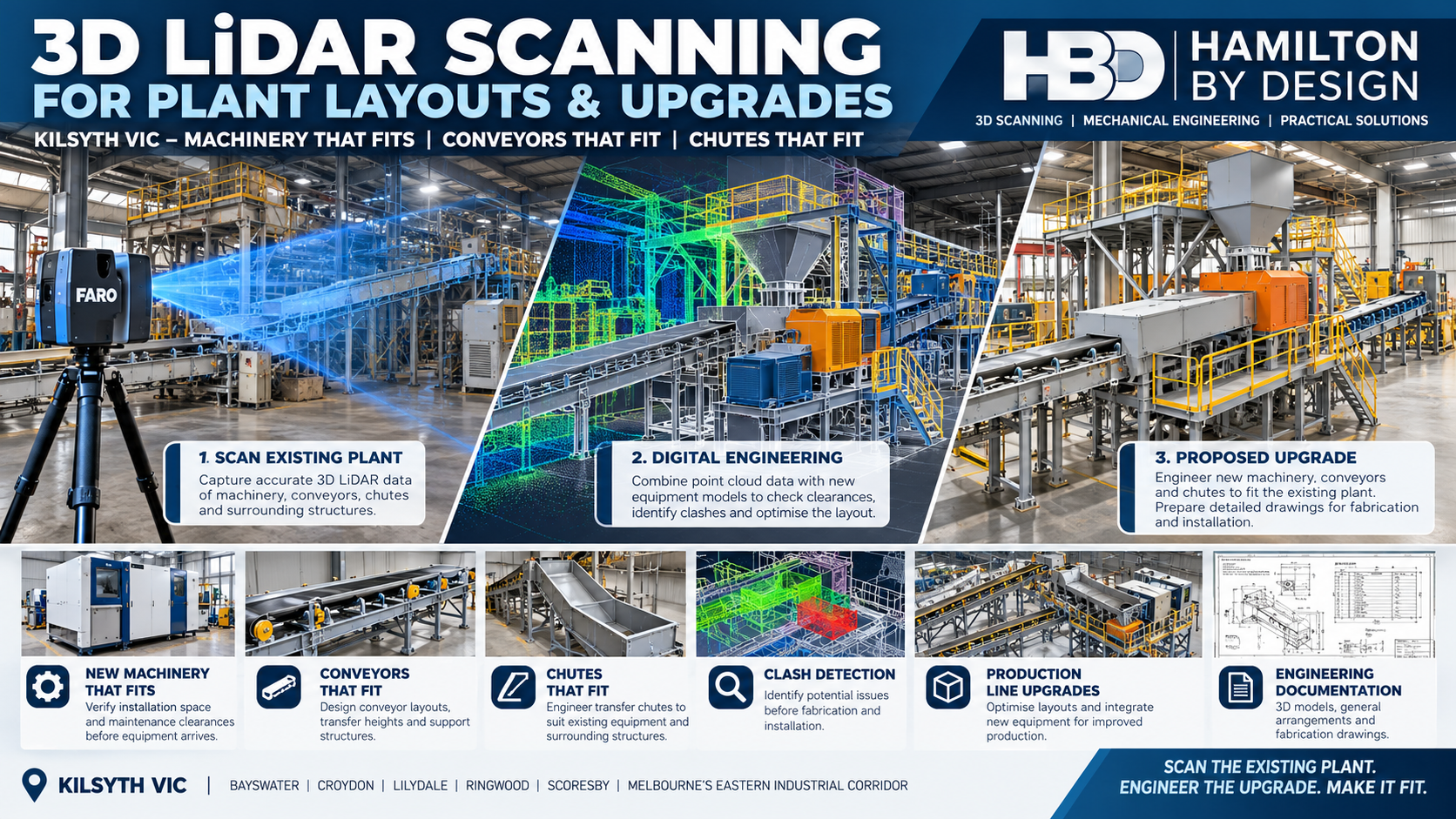
3D LiDAR Scanning for Plant Layouts & Upgrades in Kilsyth VIC โ€“ Machinery, Conveyors, Chutes & Production Engineering

3D LiDAR scanning for plant layouts and upgrades in Kilsyth VIC by Hamilton By Design, showing FARO laser scanning, point cloud modelling, new machinery installations, conveyor systems, chute design, clash detection and mechanical engineering.

Making New Machinery Fit, Conveyors Fit and Production Upgrades Work โ€“ Before Fabrication Begins.

Blue 3D LiDAR scanner icon on a tripod with scanning waves

Hamilton By Design provides professional 3D LiDAR scanning for plant layouts, machinery installations and production upgrades in Kilsyth, Victoria, supporting manufacturers, engineering workshops and industrial facilities throughout Melbourne’s eastern industrial corridor.

Installing new machinery into an existing factory can present significant engineering challenges. Equipment must fit within available space, conveyors must align with existing production lines, chutes must connect to the correct transfer points, and maintenance access must remain practical.

Without accurate existing-condition information, seemingly straightforward plant upgrades can result in costly fabrication modifications, installation delays and production interruptions.

Hamilton By Design combines 3D laser scanning, point cloud processing, SolidWorks CAD modelling and mechanical engineering to help manufacturers plan upgrades around the actual dimensions of their facilities.

Our approach is straightforward:

Scan the Existing Plant โ†’ Model the Proposed Equipment โ†’ Check the Fit โ†’ Engineer the Upgrade โ†’ Prepare Installation Drawings

3D LiDAR Scanning for Industrial Plant Layouts in Kilsyth

Industrial manufacturing facilities often evolve over many years. Production equipment is relocated, conveyors are modified, machinery is replaced and additional services are installed.

As these changes accumulate, original factory layouts and engineering drawings may no longer accurately represent existing conditions.

3D LiDAR scanning captures the physical geometry of a manufacturing facility, providing a registered point cloud that can be used to develop an accurate spatial reference for engineering design.

We can capture:

  • Existing manufacturing machinery and production equipment
  • Conveyor systems, transfer points and chutes
  • Structural steelwork, platforms and accessways
  • Pipework, ducting and industrial services
  • Floor levels, columns, walls and roof structures
  • Equipment foundations and mounting locations
  • Maintenance clearances and available installation space

This information allows proposed plant modifications to be developed within a digital representation of the existing facility.

New Machinery That Fits โ€“ Before It Arrives on Site

Purchasing new production equipment is a significant investment. However, confirming that a machine will physically fit inside an existing manufacturing facility involves more than checking its overall dimensions.

Engineers must consider equipment orientation, maintenance access, operator access, existing structures, services and connections to surrounding machinery.

Hamilton By Design uses 3D LiDAR scanning and mechanical CAD modelling to help verify the available installation space before equipment is delivered.

Where manufacturer CAD models are available, we can position the proposed machinery within the registered point cloud to assess its relationship with existing equipment.

This process can help identify:

  • Insufficient equipment clearances
  • Interference with existing structural steelwork
  • Conflicts with pipework and electrical services
  • Incorrect connection heights
  • Restricted maintenance and operator access
  • Potential installation and assembly constraints

The objective is to identify dimensional problems during engineering rather than during installation.

Conveyor Systems That Fit Existing Production Lines

Conveyor modifications are common during manufacturing upgrades, particularly where production capacity is being increased or new machinery is introduced.

However, integrating new conveyors into an existing factory can be challenging when equipment positions, floor levels and transfer heights are not accurately documented.

Hamilton By Design provides 3D scanning and mechanical engineering support for conveyor installations and modifications.

Our services can assist with:

  • Conveyor relocation and replacement
  • Conveyor centreline and elevation verification
  • New conveyor connections to existing machinery
  • Transfer point alignment
  • Conveyor support steelwork
  • Drive and maintenance access
  • General arrangement and fabrication drawings

By combining existing plant scans with proposed conveyor CAD models, we can assess the equipment arrangement and identify potential clashes before fabrication.

Chutes That Fit โ€“ Transfer Points, Clearances & Wear Protection

Chutes and transfer systems must connect correctly to existing conveyors, processing machinery and surrounding structures.

Incorrect transfer point geometry can create installation difficulties, material handling problems and maintenance challenges.

Hamilton By Design provides mechanical engineering services for chute modifications, replacements and new installations.

Using 3D LiDAR scanning, we can capture existing conveyor discharge positions, receiving equipment, support structures and available space.

The resulting point cloud can support:

  • Chute geometry development
  • Transfer point alignment
  • Chute replacement and modification
  • Wear liner arrangements
  • Access door positioning
  • Support steelwork and connection details
  • Maintenance and removal clearances
  • Fabrication and installation documentation

Where required, the scanned geometry can be used to develop SolidWorks models of proposed chute arrangements.

The aim is to engineer chute systems that integrate with the existing plant, rather than relying on assumptions about site dimensions.

Production Line Upgrades Without Unnecessary Rework

Manufacturers continually seek opportunities to improve productivity, increase throughput, reduce manual handling and introduce new technology.

These improvements often involve modifications to existing machinery and production layouts.

3D LiDAR scanning provides a valuable engineering reference when planning production upgrades within operating facilities.

Hamilton By Design can assist with:

Production Line Reconfiguration

Capture existing equipment arrangements and develop alternative layouts for improved material flow, access and production efficiency.

New Machinery Integration

Position proposed equipment within existing plant geometry to assess installation requirements and connection points.

Conveyor & Material Handling Upgrades

Develop conveyor layouts, transfer arrangements and associated mechanical support structures.

Automation & Robotic Equipment

Provide existing-condition geometry to support the planning of automation cells, robotic equipment and associated guarding.

Maintenance & Access Improvements

Assess available space for platforms, walkways, machinery guarding and equipment maintenance.

Brownfield Plant Modifications

Support engineering modifications within established facilities where surrounding equipment and infrastructure must remain in place.

Scan-to-CAD โ€“ From Existing Plant to Engineering Design

Hamilton By Design uses FARO 3D LiDAR scanning equipment to capture industrial facilities and machinery.

Following scanning, the registered point cloud can be imported into engineering software to support modelling and design.

Our software capabilities include SolidWorks, AutoCAD, Autodesk ReCap and Navisworks workflows.

Depending on project requirements, deliverables may include:

  • Registered 3D point clouds in E57 or RCP format
  • Existing plant layout models
  • SolidWorks mechanical assemblies
  • Proposed equipment installation models
  • General arrangement drawings
  • Conveyor and chute fabrication drawings
  • Equipment interface and clearance drawings
  • Installation and modification documentation

By combining scanning and mechanical engineering, we can support projects from initial site measurement through to engineering documentation.

Reducing Installation Risk Through 3D Engineering

One of the greatest benefits of 3D LiDAR scanning is the opportunity to identify potential installation conflicts before equipment is fabricated or delivered.

Traditional site measurements may capture individual dimensions without documenting the full relationship between surrounding machinery, structures and services.

A registered 3D point cloud provides a more comprehensive spatial reference.

When combined with proposed equipment models, it can help engineers assess whether new installations will fit within existing plant constraints.

This can support:

  • Reduced dimensional uncertainty
  • Improved equipment positioning
  • Earlier identification of potential clashes
  • Better fabrication planning
  • More accurate installation drawings
  • Reduced risk of site rework
  • Improved shutdown and installation coordination

While scanning does not eliminate every installation risk, it provides valuable information for better engineering decisions.

Supporting Kilsyth’s Manufacturing & Industrial Businesses

Kilsyth is part of Melbourne’s eastern manufacturing and industrial corridor, with businesses involved in machinery, fabrication, manufacturing, processing and industrial services.

Hamilton By Design supports engineering projects throughout Kilsyth and surrounding areas, including:

LocationPlant Upgrade & Engineering Applications
KilsythFactory layouts, machinery installations and production upgrades
BayswaterIndustrial machinery, conveyors and manufacturing plant modifications
CroydonMechanical engineering, fabrication and equipment upgrades
LilydaleProduction facilities, material handling and industrial plant layouts
RingwoodIndustrial equipment installations and facility modifications
BoroniaManufacturing machinery and workshop layouts
ScoresbyAdvanced manufacturing, automation and production equipment
Dandenong SouthHeavy manufacturing, processing equipment and conveyor systems

Our scanning and engineering services are also available throughout Melbourne, regional Victoria and interstate Australia.

Why Choose Hamilton By Design for Plant Upgrades?

Hamilton By Design combines practical mechanical engineering experience with industrial 3D scanning technology.

We understand that manufacturing equipment must do more than fit within a building. It must integrate with existing processes, provide suitable maintenance access and operate within the constraints of the surrounding plant.

Our services combine:

3D LiDAR Scanning โ€“ Capture existing plant geometry.

Point Cloud Processing โ€“ Establish a registered spatial reference.

SolidWorks CAD Modelling โ€“ Develop and position proposed equipment.

Mechanical Engineering โ€“ Design equipment modifications and assess mechanical interfaces.

Engineering Drawings โ€“ Prepare general arrangements, fabrication details and installation documentation.

This integrated approach is particularly valuable for brownfield manufacturing upgrades where existing equipment and structures limit the available installation space.

Frequently Asked Questions

Can 3D LiDAR scanning confirm whether new machinery will fit?

3D LiDAR scanning can provide existing-condition geometry that allows proposed machinery models to be checked against surrounding equipment, structures and services. Final installation verification may require additional dimensional checks and manufacturer information.

Can you design conveyors to connect with existing machinery?

Yes. Hamilton By Design can use scanning information to develop conveyor layouts, assess transfer heights and prepare mechanical engineering models and drawings.

Can you scan existing conveyors and design replacement chutes?

Yes. We can capture existing conveyor and transfer point geometry to support the development of replacement chutes, modifications and associated fabrication documentation.

Can you scan an operating factory?

Yes. Industrial scanning can often be undertaken while facilities remain operational, depending on access, safety requirements, equipment movement and site conditions.

Can you use CAD models supplied by machinery manufacturers?

Yes. Manufacturer CAD models can be incorporated into the existing plant geometry to support layout planning, clearance assessments and equipment integration.

Can you produce fabrication drawings following scanning?

Yes. Hamilton By Design can develop mechanical CAD models, general arrangement drawings and fabrication documentation as part of the engineering scope.

Planning a Machinery Installation or Production Upgrade in Kilsyth?

New machinery must fit. Conveyors must align. Chutes must connect. Production upgrades must work within the existing plant.

Hamilton By Design provides 3D LiDAR scanning, plant layout modelling, mechanical engineering and fabrication documentation to support manufacturing upgrades throughout Kilsyth and Melbourne’s eastern industrial corridor.

Whether you’re installing a single machine, modifying a conveyor system or upgrading an entire production line, we can assist with capturing existing conditions and developing practical engineering solutions.

Contact Hamilton By Design


Hamilton By Design logo displayed on a blue tilted rectangle with a grey gradient background

Contact Us – Talk To Us

Name
Would you like us to arrange a phone consultation for you?
Address

Our clients:


3D LiDAR Scanning Kilsyth VIC โ€“ Capture Existing Conditions, Model with Confidence and Engineer Practical Solutions.

Hamilton By Design โ€“ Scan the Existing Plant. Engineer the Upgrade. Make It Fit.

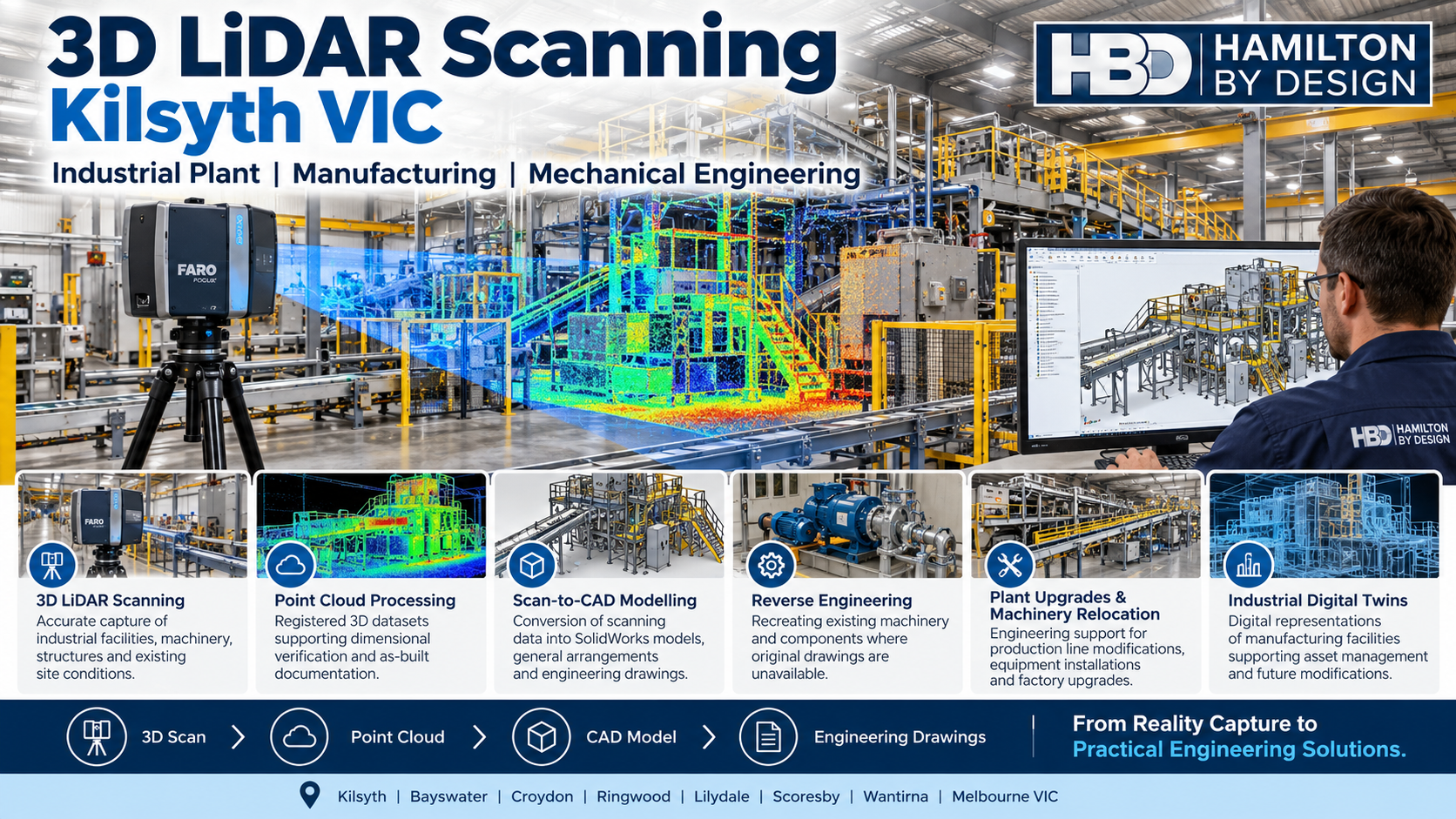
3D LiDAR Scanning Kilsyth VIC โ€“ Industrial Plant, Manufacturing & Mechanical Engineering

3D LiDAR scanning Kilsyth Victoria by Hamilton By Design, showing industrial manufacturing equipment, FARO laser scanning, point cloud processing, SolidWorks CAD modelling, reverse engineering and mechanical engineering services.
Blue 3D LiDAR scanner icon on a tripod with scanning waves

Hamilton By Design provides professional 3D LiDAR scanning services in Kilsyth, Victoria, supporting manufacturing facilities, industrial workshops, engineering businesses and production environments across Melbourne’s eastern industrial corridor.

Our 3D laser scanning and mechanical engineering services help businesses capture accurate existing-site geometry, develop 3D CAD models, prepare engineering drawings and plan modifications to industrial equipment and facilities.

From individual machinery installations to complete factory layouts, we provide practical engineering solutions using 3D reality capture, reverse engineering and mechanical design.

3D LiDAR Scanning for Kilsyth’s Manufacturing Industry

Kilsyth is an established industrial and manufacturing area within Melbourne’s eastern suburbs, with businesses involved in engineering, metal fabrication, machinery, automotive-related activities, industrial equipment and production services.

Hamilton By Design supports these industries through accurate site measurement and engineering documentation.

Our services are particularly useful for facilities where original drawings are unavailable, machinery has been modified over time or new equipment must be installed within existing operating environments.

Our 3D LiDAR Scanning Services in Kilsyth

1. Industrial Plant & Factory Scanning

We capture existing industrial facilities to develop accurate spatial records of buildings, production equipment, structural steelwork, pipework and machinery.

Applications include factory layout modifications, equipment relocation, plant upgrades and maintenance planning.

2. Manufacturing Equipment & Production Line Scanning

Our scanning services support manufacturers undertaking production line improvements, machinery installation, automation upgrades and equipment replacement.

Point cloud information helps engineers understand existing clearances and identify potential installation conflicts before fabrication or construction begins.

3. Scan-to-CAD & Mechanical Engineering

Hamilton By Design converts 3D scanning information into engineering models using SolidWorks and AutoCAD.

Typical deliverables include:

  • Registered 3D point clouds
  • 3D CAD models and assemblies
  • General arrangement drawings
  • Fabrication and installation drawings
  • Equipment layouts and mechanical design documentation
  • STEP, DXF, E57 and other agreed engineering formats

4. Reverse Engineering & Existing Equipment

Many established manufacturing facilities operate equipment with limited engineering documentation.

We use 3D scanning, dimensional verification and CAD modelling to assist with reverse engineering of existing machinery, components and mechanical assemblies.

5. Plant Modifications & Equipment Relocation

3D LiDAR scanning provides useful dimensional information for planning machinery relocations, new production equipment, access platforms, conveyors and associated services.

Our mechanical engineering capabilities allow scanning data to be incorporated directly into practical engineering designs.

6. Industrial Digital Twins & Asset Documentation

Registered point clouds and 3D models provide a digital representation of existing industrial facilities.

These datasets can support maintenance planning, future upgrades, asset management and coordination between engineering contractors.

Industries We Support in Kilsyth

IndustryTypical 3D Scanning Applications
Metal FabricationWorkshop layouts, equipment positioning and machinery upgrades
Machinery ManufacturingReverse engineering, machine assemblies and installation planning
Automotive ManufacturingProduction equipment layouts and dimensional verification
Food and PackagingProduction line modifications and equipment integration
Plastics ManufacturingMachinery relocation and factory layouts
Industrial AutomationRobot cell layouts, clearances and equipment positioning
Warehousing and LogisticsConveyor layouts, access systems and equipment installation
General EngineeringAs-built documentation, mechanical design and fabrication support

Why Choose Hamilton By Design?

Hamilton By Design combines 3D LiDAR scanning with qualified mechanical engineering expertise, allowing site measurements to be developed into practical engineering solutions.

Rather than supplying point cloud data alone, we can assist with the complete engineering workflow:

3D LiDAR Scanning โ†’ Point Cloud Processing โ†’ 3D CAD Modelling โ†’ Mechanical Engineering โ†’ Fabrication Drawings

Our services are suitable for both small engineering projects and larger industrial plant upgrades.

By combining reality capture with mechanical engineering, we help clients reduce dimensional uncertainty, improve design coordination and minimise potential installation conflicts.

Servicing Kilsyth and Melbourne’s Eastern Industrial Corridor

In addition to Kilsyth, Hamilton By Design can support industrial clients in surrounding locations, including:

LocationIndustrial Focus
BayswaterManufacturing, machinery and industrial engineering
BoroniaLight manufacturing and engineering workshops
CroydonFabrication, industrial services and machinery
RingwoodCommercial facilities and engineering services
LilydaleManufacturing, industrial plant and equipment
ScoresbyAdvanced manufacturing and industrial technology
WantirnaCommercial and industrial facilities
Dandenong SouthHeavy manufacturing, fabrication and processing

Our services are available throughout metropolitan Melbourne, regional Victoria and interstate Australia.

Frequently Asked Questions

Can you scan an operating manufacturing facility in Kilsyth?

Yes. Depending on site conditions, 3D LiDAR scanning can often be completed around existing machinery and operating equipment, subject to safety requirements and access restrictions.

Can you produce SolidWorks models from 3D scanning data?

Yes. Hamilton By Design can develop SolidWorks models from registered point clouds to support mechanical design, equipment modifications and engineering documentation.

How accurate is industrial 3D LiDAR scanning?

Accuracy depends on equipment, scanning distance, site conditions and registration quality. Registered industrial point cloud datasets commonly target approximately ยฑ5โ€“10 mm, with project-specific verification requirements established before scanning.

Can you scan machinery for relocation or replacement?

Yes. We can capture existing equipment, surrounding structures and available installation space to support machinery relocation, replacement and upgrade planning.

Do you provide engineering drawings after scanning?

Yes. Our services include 3D CAD modelling, general arrangement drawings, mechanical design and fabrication documentation where required.

Can 3D LiDAR scanning help reduce installation problems?

Yes. Accurate existing-condition data helps identify potential clashes, dimensional constraints and equipment clearance issues during the design stage, reducing the likelihood of unexpected modifications during installation.

Request a 3D LiDAR Scanning Quote in Kilsyth

Planning a manufacturing facility upgrade, machinery relocation or industrial engineering project in Kilsyth, Victoria?

Hamilton By Design can assist with 3D LiDAR scanning, point cloud processing, reverse engineering, mechanical design and engineering drawings.

Whether you require a single machinery scan or a complete industrial facility survey, we can develop a scope of work suited to your engineering requirements.

Contact Hamilton By Design


Hamilton By Design logo displayed on a blue tilted rectangle with a grey gradient background

Contact Us – Talk To Us

Name
Would you like us to arrange a phone consultation for you?
Address

Our clients:


3D LiDAR Scanning Kilsyth VIC โ€“ Capture Existing Conditions, Model with Confidence and Engineer Practical Solutions.

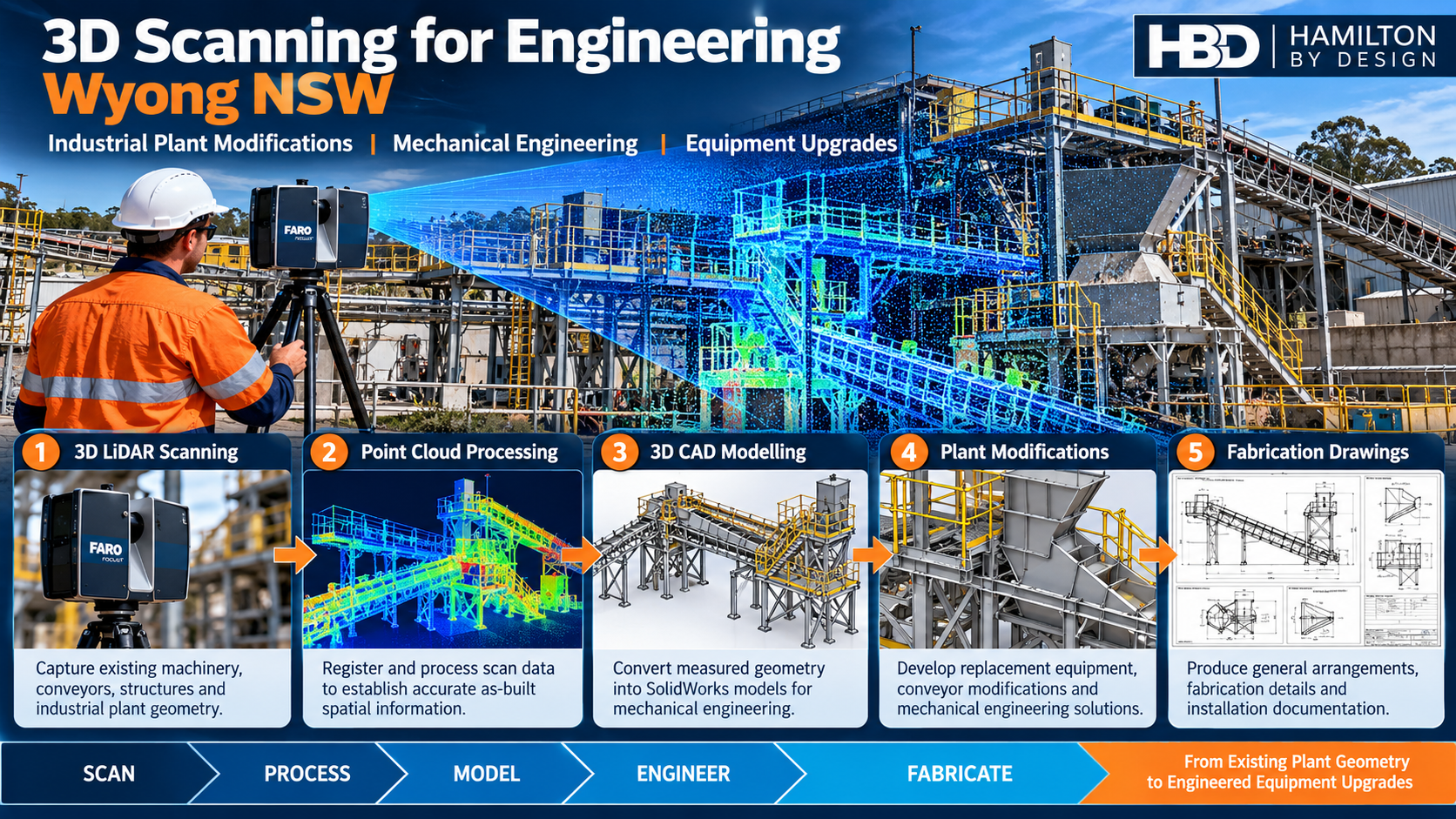
3D Scanning for Engineering Wyong โ€“ Industrial Plant Modifications and Equipment Upgrades

3D scanning for engineering in Wyong NSW by Hamilton By Design, showing industrial LiDAR scanning, point cloud processing, SolidWorks CAD modelling, mechanical engineering, plant modifications and fabrication drawings.

3D Scanning | Mechanical Engineering | Reverse Engineering | Industrial Plant Upgrades | Wyong NSW

3D Scanning for Engineering in Wyong NSW

Blue 3D LiDAR scanner icon on a tripod with scanning waves

Hamilton By Design provides 3D scanning for engineering projects in Wyong, supporting manufacturers, industrial operators, maintenance teams and fabrication businesses across the NSW Central Coast.

Our services combine 3D LiDAR scanning, point cloud processing, mechanical engineering and 3D CAD modelling to help businesses understand existing equipment geometry before undertaking modifications, replacements or upgrades.

Whether you are modifying a conveyor, replacing worn equipment, installing new machinery or developing fabrication drawings, our approach helps reduce dimensional uncertainty and identify potential installation conflicts before work begins.

Unlike scanning-only providers, Hamilton By Design can support projects from initial site measurement through to mechanical design and fabrication documentation.

Why Use 3D Scanning for Engineering?

Industrial facilities often operate with equipment that has been modified over many years. Original drawings may be missing, outdated or inconsistent with the equipment currently installed.

Traditional measurements can be time-consuming, particularly around congested machinery, pipework, structural steel and elevated equipment.

3D scanning allows engineers to capture existing conditions and develop a digital reference for engineering decisions.

Common Engineering Applications

  • Industrial plant modifications: Capture existing equipment arrangements before modifications or upgrades.
  • Conveyor engineering: Measure conveyors, transfer points, support structures and surrounding equipment.
  • Reverse engineering: Reconstruct CAD models of existing mechanical components and assemblies.
  • Equipment replacement: Verify available space, mounting locations and connection points.
  • Pipework modifications: Capture existing pipework geometry to assist with routing and spool design.
  • Fabrication engineering: Develop models and drawings for replacement or modified components.
  • As-built verification: Compare installed equipment against design models and drawings.
  • Shutdown planning: Identify dimensional constraints before fabrication and installation activities.

Supporting Wyong’s Manufacturing and Industrial Businesses

Wyong and the surrounding Central Coast industrial areas contain manufacturing, warehousing, processing and engineering operations that depend on reliable mechanical equipment.

Hamilton By Design supports businesses in Wyong and nearby industrial locations including Tuggerah, North Wyong, Warnervale, Berkeley Vale and Somersby.

Our engineering scanning services are particularly relevant where existing plant must remain operational while modifications are designed and prepared.

Manufacturing Equipment Upgrades

Manufacturing facilities frequently need to introduce new equipment into established production environments.

Existing conveyors, access platforms, structural steel, electrical services and pipework can create installation constraints.

3D scanning provides spatial information that can be used to develop and check equipment layouts before installation.

Conveyor and Materials Handling Modifications

Conveyor systems may require modifications to improve product flow, reduce wear, increase accessibility or accommodate replacement equipment.

We can capture existing conveyor arrangements and use the point cloud data to develop SolidWorks models of proposed modifications.

Typical projects include transfer chute upgrades, conveyor relocations, guarding modifications and mechanical support arrangements.

Reverse Engineering Existing Equipment

Many industrial facilities operate equipment for which original manufacturer drawings are no longer available.

Where appropriate, we combine LiDAR scanning with close-range 3D measurement techniques to develop CAD models of existing components.

These models can support replacement part development, engineering assessments and fabrication.

The selected measurement method depends on component size, access, surface condition and required accuracy.

From 3D Scanning to Mechanical Engineering

Hamilton By Design provides an integrated workflow that connects site measurement with engineering deliverables.

Stage 1 โ€“ Site Inspection and 3D Scanning

We review the project requirements and identify the equipment, structures and interfaces requiring measurement.

A 3D LiDAR scanner captures the existing arrangement, with supplementary measurements undertaken where greater dimensional accuracy is required.

Stage 2 โ€“ Point Cloud Registration and Processing

Individual scans are registered into a coordinated point cloud dataset.

The information is reviewed for coverage, alignment and suitability for the intended engineering application.

Stage 3 โ€“ 3D CAD Modelling

Using SolidWorks and other CAD tools, we develop models of the relevant existing equipment and proposed modifications.

The level of modelling detail is selected according to the engineering requirements rather than modelling unnecessary plant components.

Stage 4 โ€“ Mechanical Engineering and Design

We use the measured geometry to develop engineering solutions, review equipment arrangements and assess installation interfaces.

Where required, this can include mechanical design calculations, component selection and finite element analysis.

Stage 5 โ€“ Fabrication and Installation Documentation

Project deliverables may include:

  • 3D SolidWorks models and assemblies
  • STEP and Parasolid files
  • General arrangement drawings
  • Fabrication and detail drawings
  • DXF files for manufacturing
  • Point cloud datasets
  • Installation reference models
  • Navisworks-compatible coordination models

Engineering Accuracy and Measurement Limitations

3D scanning accuracy depends on the selected equipment, measurement distance, environmental conditions, registration quality and access to the relevant surfaces.

For larger industrial LiDAR projects, registered point cloud datasets may typically achieve approximately ยฑ5โ€“10 mm under suitable conditions. This is not a guaranteed tolerance for every feature.

Components requiring tighter manufacturing tolerances may require close-range metrology scanning or supplementary dimensional measurements.

Hamilton By Design considers the intended engineering application when selecting the appropriate measurement approach.

A point cloud provides measured geometry, but engineering judgement is still required to determine whether that information is suitable for design and fabrication.

Why Choose Hamilton By Design?

Mechanical Engineering Knowledge

Hamilton By Design is led by a qualified mechanical engineer with practical fitting and industrial maintenance experience.

This combination helps connect dimensional measurement with the practical requirements of manufacturing, fabrication and installation.

Scanning and Engineering in One Service

Our services extend beyond the delivery of a point cloud. We can use the captured information to develop mechanical designs, equipment layouts and fabrication documentation.

Local Central Coast Support

Based in Wyong NSW, Hamilton By Design can support engineering projects across the Central Coast, Newcastle, Hunter Valley and greater Sydney.

Practical Industrial Experience

Our experience includes conveyors, chutes, materials handling systems, mechanical equipment, industrial plant and maintenance engineering applications.

Frequently Asked Questions

Can 3D scanning be used to design replacement equipment?

Yes. Scanning can capture the existing equipment arrangement and available installation space. The resulting geometry can be used to develop replacement equipment models, subject to verification of critical interfaces and tolerances.

Can you produce fabrication drawings from a 3D scan?

Yes. Hamilton By Design can develop CAD models and fabrication drawings using scanned geometry, supplementary measurements and mechanical engineering design information.

Do we need to shut down our manufacturing plant for scanning?

Not always. Many areas can be scanned while a facility remains operational, subject to site safety requirements, visibility and equipment movement. Some locations may require controlled access or shutdown arrangements.

Can you work with existing SolidWorks models?

Yes. Existing CAD models can be incorporated into the engineering workflow and compared with captured site geometry.

Do you service areas outside Wyong?

Yes. We support projects throughout the Central Coast, Newcastle, the Hunter Valley, Sydney and interstate.

Discuss Your Wyong Engineering Project

Planning a plant modification, machinery upgrade, conveyor replacement or reverse engineering project?

Hamilton By Design can help capture your existing equipment geometry and develop the engineering information needed to progress your project.

From 3D scanning to CAD modelling, mechanical engineering and fabrication drawings, we provide a practical approach to industrial equipment modifications.


Hamilton By Design logo displayed on a blue tilted rectangle with a grey gradient background

Contact Us – Talk To Us

Name
Would you like us to arrange a phone consultation for you?
Address

Our clients:


Hamilton By Design โ€“ Wyong NSW

3D Scanning | Mechanical Engineering | Industrial Plant Modifications | Reverse Engineering


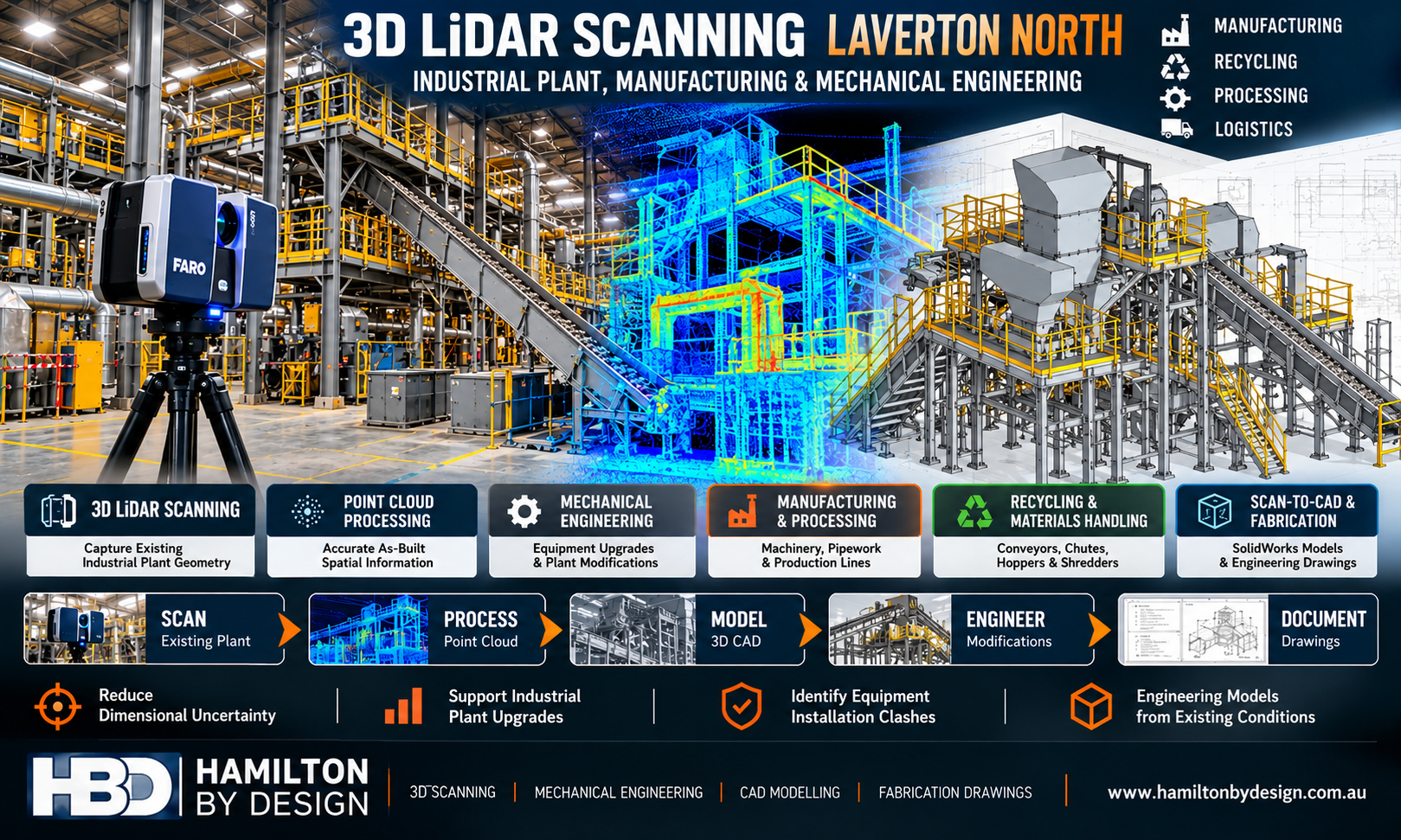
3D LiDAR Scanning Laverton North โ€“ Industrial Plant and Manufacturing Engineering

3D LiDAR scanning Laverton North for industrial manufacturing, recycling and processing plants, showing FARO laser scanning, point cloud processing, mechanical engineering and SolidWorks CAD modelling by Hamilton By Design.

3D LiDAR Scanning for Industrial Facilities in Laverton North, Victoria

Blue 3D LiDAR scanner icon on a tripod with scanning waves

Industrial plant modifications often begin with a fundamental engineering challenge: understanding the exact geometry of existing equipment, structures, pipework and machinery before new designs are developed.

Hamilton By Design provides 3D LiDAR scanning services in Laverton North, Victoria, supporting heavy manufacturing, industrial processing, recycling facilities, logistics operations and mechanical engineering projects throughout Melbourne’s western industrial corridor.

Our approach combines 3D laser scanning, point cloud processing, mechanical engineering, 3D CAD modelling and fabrication drawings to help businesses plan equipment modifications with greater dimensional confidence.

Whether a facility is replacing a conveyor, installing processing equipment, modifying a production line or upgrading mechanical infrastructure, reliable existing-condition information is essential.

Rather than relying entirely on historical drawings, tape measurements or assumptions, 3D LiDAR scanning allows engineers to develop a detailed spatial record of the existing facility.

Our engineering workflow:

3D LiDAR Scanning โ†’ Point Cloud Registration โ†’ Mechanical Engineering โ†’ 3D CAD Modelling โ†’ Equipment Modifications โ†’ Fabrication Drawings


Supporting Laverton North’s Heavy Industrial and Manufacturing Sector

Laverton North is an established industrial area within Melbourne’s western manufacturing and logistics corridor.

Its industrial character makes 3D LiDAR scanning particularly relevant to businesses operating facilities containing complex machinery, conveyors, material handling systems, processing equipment and industrial infrastructure.

Hamilton By Design supports engineering applications across several industrial environments.

Industrial sectorTypical 3D LiDAR scanning applications
Heavy manufacturingMachinery upgrades, production line modifications, equipment installation and factory layouts
Recycling and resource recoveryConveyors, shredders, screening equipment, hoppers and processing plant modifications
Industrial processingPipework, pumps, mechanical equipment, access platforms and plant upgrades
Logistics and distributionWarehouse equipment layouts, material handling systems and automation interfaces
Metal fabricationExisting structure interfaces, machinery positioning and fabrication verification
Materials handlingConveyor transfers, chutes, support structures and equipment replacements

Each facility presents different engineering constraints, including limited access, congested plant layouts, restricted shutdown windows and incomplete historical documentation.

3D scanning helps establish the existing geometry before detailed engineering begins.

3D LiDAR Scanning for Existing Industrial Plant and Equipment

Industrial facilities frequently undergo modifications throughout their operating lives.

Equipment may have been relocated, additional pipework installed, platforms modified or conveyor systems upgraded without corresponding updates to the original engineering drawings.

Over time, this creates uncertainty about the actual installed geometry.

3D LiDAR scanning provides a practical method of capturing existing plant conditions.

Using terrestrial laser scanning equipment, Hamilton By Design can capture spatial information relating to:

  • Industrial machinery and equipment footprints
  • Conveyors, transfer stations and processing systems
  • Pipework, pumps, valves and mechanical services
  • Steelwork, platforms, walkways and access arrangements
  • Building columns, walls, floors and roof interfaces
  • Existing installation clearances and equipment access zones

Multiple scan positions can be registered into a combined point cloud, providing a spatial reference for subsequent engineering work.

The resulting dataset can be used to establish existing conditions, develop CAD models, review equipment layouts and identify potential dimensional conflicts.

Why existing-condition verification matters

A small dimensional discrepancy can create significant problems when installing large mechanical equipment.

Incorrect assumptions about conveyor centreline positions, flange locations, structural interfaces or equipment clearances can result in fabrication changes, additional site work and installation delays.

3D scanning helps reduce these risks by allowing critical dimensions and interfaces to be assessed before fabrication.

Scanning accuracy and final modelling tolerances depend on the equipment, scanning conditions, registration quality, access and project requirements. Critical fabrication interfaces may require supplementary dimensional verification.


From 3D Point Clouds to Mechanical Engineering Design

Collecting point cloud data is only the first stage of an industrial engineering project.

The greater value comes from converting that information into usable engineering deliverables.

Hamilton By Design combines 3D scanning with mechanical engineering and CAD capabilities to support equipment modifications from initial site capture through to detailed design.

Stage 1 โ€“ Site scanning

Existing equipment, structures and installation areas are captured using 3D LiDAR scanning equipment.

Stage 2 โ€“ Point cloud registration

Individual scans are aligned and processed to establish a combined spatial dataset.

Stage 3 โ€“ Existing-condition modelling

Relevant equipment, structures and mechanical interfaces are reconstructed using CAD software.

Stage 4 โ€“ Mechanical engineering

Proposed equipment arrangements, modifications, installation clearances and mechanical interfaces are developed and reviewed.

Stage 5 โ€“ Engineering drawings

Depending on the project scope, deliverables may include:

  • General arrangement drawings
  • Equipment modification drawings
  • Fabrication and assembly drawings
  • Installation interface details
  • 3D SolidWorks models
  • AutoCAD drawings and DXF files
  • STEP and Parasolid models
  • Registered point cloud datasets

This integrated approach allows industrial clients to work with a mechanical engineering provider rather than coordinating scanning and mechanical design as entirely separate activities.

Conveyor Systems, Transfer Chutes and Materials Handling Equipment

Conveyor systems are widely used in manufacturing, recycling, bulk materials handling and industrial processing.

Modifying an existing conveyor system can involve several interconnected engineering considerations.

These may include conveyor alignment, transfer geometry, supporting steelwork, access requirements, drive arrangements and equipment clearances.

Hamilton By Design uses 3D scanning and mechanical engineering to support projects involving:

  • Conveyor relocations and extensions
  • Transfer chute replacements and modifications
  • Hopper and discharge arrangements
  • Conveyor support interfaces
  • Belt transfer geometry
  • Wear liner arrangements
  • Maintenance access and guarding
  • Installation and fabrication drawings

Example: Existing conveyor modification

Consider a Laverton North recycling facility planning to replace an existing conveyor transfer chute.

The original drawings may not reflect modifications made during previous maintenance activities.

By scanning the existing conveyor arrangement, the engineering team can establish relevant equipment geometry, identify surrounding obstructions and develop a replacement chute design around verified site information.

The objective is to reduce uncertainty before fabrication and minimise avoidable modification work during installation.


3D LiDAR Scanning for Recycling and Waste Processing Facilities

Recycling and resource recovery facilities present particular engineering challenges because equipment often operates in abrasive, dusty and mechanically demanding environments.

Common equipment includes conveyors, shredders, screens, hoppers, feeders, bins and material transfer systems.

These systems may require modification because of equipment wear, changes in material characteristics, production requirements or maintenance access constraints.

Typical engineering applications

Conveyor and transfer chute upgrades

Capture existing equipment geometry before designing replacement chutes, liners or material transfer arrangements.

Shredder and screening equipment installation

Establish equipment footprints, supporting interfaces and surrounding clearances for replacement machinery.

Hopper and bin modifications

Develop existing-condition models to support changes to discharge geometry, access arrangements and mechanical components.

Maintenance access improvements

Assess existing machinery arrangements when developing platforms, walkways and guarding modifications.

Plant reconfiguration

Use registered point cloud data to evaluate proposed equipment positions within an established processing facility.

Importantly, 3D scanning establishes geometry; it does not independently determine material flow performance, structural adequacy or equipment capacity.

These matters require appropriate engineering assessment and, where necessary, additional analysis.

Manufacturing Equipment and Production Line Upgrades

Manufacturing facilities regularly introduce new equipment to improve production capacity, product quality, maintenance performance or operational efficiency.

However, installing new machinery within an existing factory can be challenging when floor space is limited and surrounding equipment must remain in place.

3D LiDAR scanning supports the engineering process by establishing the spatial relationships between existing machinery, structural elements and building services.

Applications include:

  • Machinery replacement and relocation
  • Production line extensions
  • Factory equipment layout planning
  • Mechanical service modifications
  • Equipment support and baseplate interfaces
  • Maintenance and installation clearance reviews
  • Clash assessment between new and existing equipment

Reducing installation uncertainty

A new machine may fit within the nominal available floor area but still conflict with existing pipework, access routes, maintenance zones or structural columns.

Combining point cloud information with proposed equipment CAD models allows these potential conflicts to be reviewed during design rather than discovered during installation.

This is particularly useful where shutdown time is limited or machinery must be installed around operating production systems.


Industrial Pipework, Pumps and Mechanical Services

Existing industrial pipework can be difficult to measure using conventional methods, particularly where services are elevated, congested or routed around machinery.

3D scanning can provide spatial information for pipework modifications and equipment connections.

Hamilton By Design supports engineering work involving:

  • Existing pipework route capture
  • Pump and equipment connection interfaces
  • Pipe support arrangements
  • Mechanical equipment replacement
  • Flange location and orientation assessment
  • Proposed pipe routing and spatial clash reviews
  • Mechanical arrangement and fabrication drawings

Point cloud information can help engineers develop proposed routing arrangements around existing equipment.

Where fabrication tolerances require greater precision than the registered scan data provides, critical connections should be independently verified before manufacture.

3D Scanning for Logistics and Distribution Facilities

Laverton North’s industrial environment also includes warehousing, transport and logistics operations.

These facilities may require modifications to material handling equipment, loading systems, automated machinery and building services.

3D LiDAR scanning can support:

  • Warehouse equipment layouts
  • Conveyor and sorting system installation
  • Automated material handling upgrades
  • Equipment clearance assessments
  • Loading and unloading infrastructure modifications
  • Building and mechanical service coordination
  • Existing-condition documentation for facility upgrades

For logistics operations, the principal benefit is establishing reliable spatial information before installing equipment into an operating facility.

Supporting Industrial Shutdowns and Equipment Installation

Industrial shutdowns often involve significant coordination between engineering, fabrication, maintenance and installation teams.

When equipment must be installed within a restricted timeframe, dimensional uncertainty can become a major project risk.

3D LiDAR scanning allows existing equipment interfaces and surrounding geometry to be captured before shutdown work begins, where safe access is available.

The resulting information can support:

  1. Existing-condition verification
  2. Proposed equipment layout development
  3. Spatial clash identification
  4. Fabrication drawing preparation
  5. Installation sequence planning
  6. Pre-installation engineering reviews

The objective is to identify dimensional and spatial problems before they affect the shutdown schedule.

While scanning cannot eliminate all installation risks, it can provide a more reliable basis for engineering decisions and fabrication planning.


Why Choose Hamilton By Design for 3D LiDAR Scanning in Laverton North?

Hamilton By Design combines practical mechanical engineering experience with 3D laser scanning and CAD modelling capabilities.

Our services extend beyond the collection of point cloud data.

Qualified mechanical engineering capability

Hamilton By Design is led by a qualified mechanical engineer with mechanical fitting trade experience and practical exposure to industrial equipment, fabrication, installation and maintenance environments.

Industrial site experience

Our experience includes mining, manufacturing, materials handling, mechanical equipment and industrial plant modifications.

Integrated scanning and CAD workflow

We use technologies including FARO laser scanning, SolidWorks and AutoCAD to support existing-condition capture and mechanical design.

Practical fabrication understanding

Engineering models and drawings are developed with consideration for equipment interfaces, fabrication requirements, installation constraints and maintenance access.

Industrial site access qualifications

Relevant qualifications and competencies include working at heights, confined space, rigging and industrial site supervision training, subject to project-specific access and safety requirements.

Flexible engineering deliverables

Projects can be scoped for scanning only, registered point clouds, existing-condition models, mechanical design or detailed fabrication drawings.

Frequently Asked Questions โ€“ 3D LiDAR Scanning Laverton North

Who provides 3D LiDAR scanning for industrial facilities in Laverton North?

Hamilton By Design provides 3D LiDAR scanning and mechanical engineering services for industrial projects in Laverton North and surrounding Melbourne industrial areas. Services include existing-condition scanning, point cloud processing, CAD modelling and engineering drawings.

Can 3D LiDAR scanning be used in operating manufacturing facilities?

Yes. 3D LiDAR scanning can be undertaken in many operating industrial environments, subject to site safety requirements, equipment movement, visibility and access restrictions. Some areas may require planned access or shutdown arrangements.

Can an existing conveyor system be converted into a SolidWorks model?

Yes. Point cloud data can be used as a spatial reference to reconstruct existing conveyor geometry and develop SolidWorks models. The required level of detail depends on the intended engineering use and available scan information.

Can 3D scanning help with recycling plant modifications?

Yes. Scanning can capture existing conveyors, hoppers, shredders, screening equipment and surrounding structures to support equipment replacement, layout modifications and mechanical engineering design.

What is the difference between 3D scanning and reverse engineering?

3D scanning captures the geometry of existing objects and environments. Reverse engineering interprets that information to reconstruct usable engineering geometry, components or assemblies. Additional measurements and engineering judgement may be necessary.

How accurate is industrial 3D LiDAR scanning?

Accuracy depends on the scanner, distance, site conditions, registration process and required deliverables. Registered industrial datasets may achieve millimetre-level accuracy under suitable conditions, but project-specific tolerances must be assessed and verified.

Can Hamilton By Design provide fabrication drawings after scanning?

Yes. Depending on the agreed scope, Hamilton By Design can use scan data to develop mechanical CAD models, general arrangement drawings, equipment modifications and fabrication drawings.

Is 3D LiDAR scanning useful when original plant drawings are unavailable?

Yes. One of the principal applications of industrial scanning is establishing existing geometry where historical drawings are missing, incomplete or no longer reflect the installed equipment.


Request a 3D LiDAR Scanning Quotation in Laverton North

Planning an industrial equipment upgrade, conveyor modification, recycling plant improvement or manufacturing facility expansion in Laverton North?

Hamilton By Design can assist with existing-condition scanning, point cloud processing, mechanical engineering, 3D CAD modelling and fabrication documentation.

Our approach is designed to help industrial clients establish reliable site information before committing to equipment modifications and fabrication.

Contact Hamilton By Design to discuss your Laverton North industrial scanning and engineering requirements.


Hamilton By Design logo displayed on a blue tilted rectangle with a grey gradient background

Contact Us – Talk To Us

Name
Would you like us to arrange a phone consultation for you?
Address

Our clients:


3D LiDAR Scanning | Scan-to-CAD | Mechanical Engineering | SolidWorks Modelling | Industrial Equipment Design | Fabrication Drawings