Reverse Engineering Milperra: 3D Scanning, Mechanical Design and Manufacturing Support

Milperra is one of south-west Sydney’s established industrial areas, supporting manufacturing, aviation-related businesses, metal fabrication, machinery suppliers, warehousing and logistics operations. Its proximity to Bankstown Airport, the M5 motorway and major freight routes makes the area attractive to businesses that depend on reliable machinery, accurate engineering information and efficient production facilities.
However, many established industrial operations face a common problem: the available drawings no longer represent the machinery or factory as it currently exists. Equipment may have been modified, replacement parts may be obsolete, and additions to the factory may never have been formally documented.
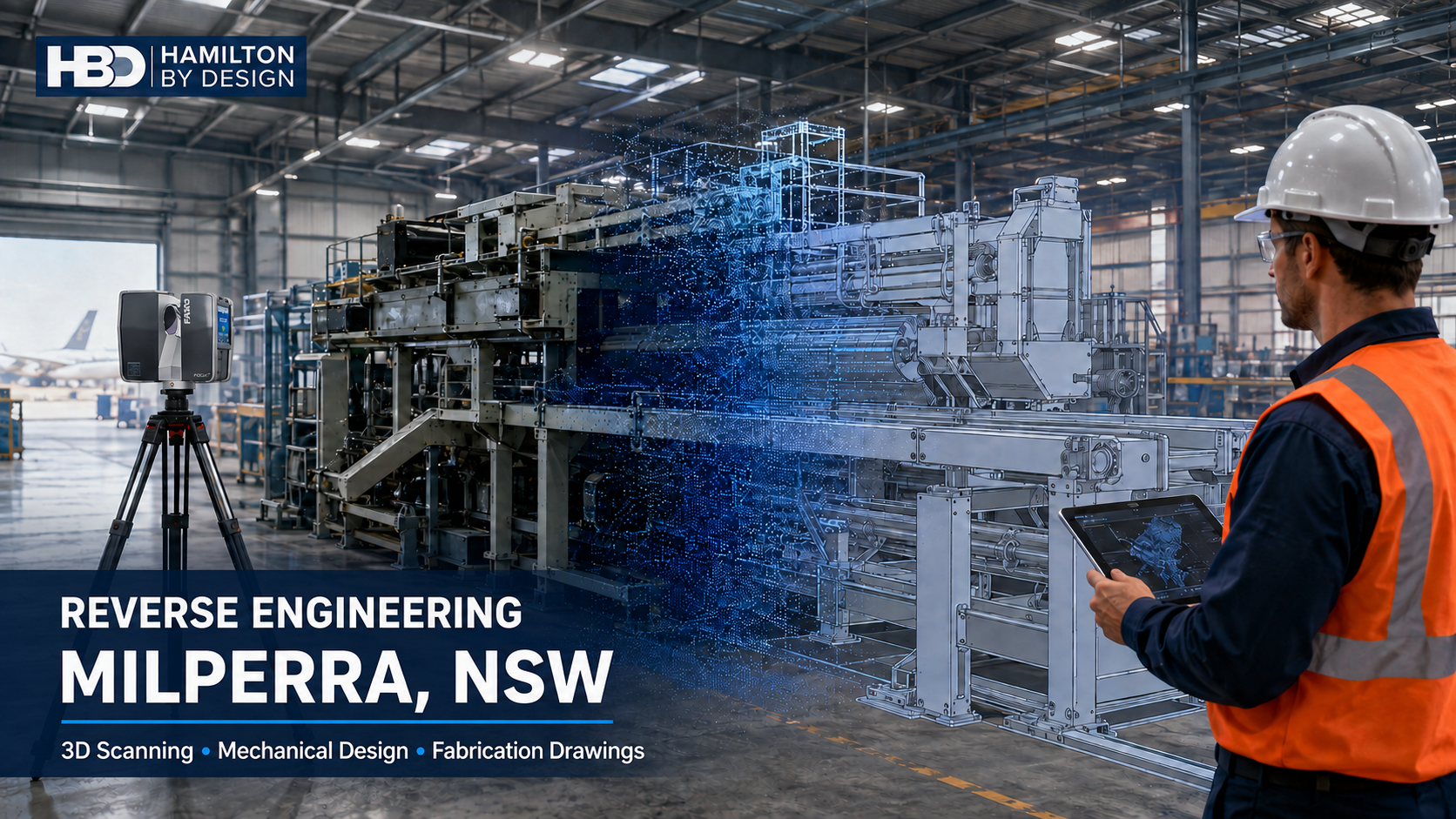
Hamilton By Design provides reverse engineering in Milperra, combining engineering-grade 3D scanning, mechanical engineering, CAD modelling and fabrication drawings to help businesses understand, maintain and improve their physical assets.
Solving problems caused by missing engineering information
Machinery often remains in service for decades. During that time, guards, frames, drives, conveyors, pipework and other components may be repaired or altered. Original equipment manufacturers can cease trading, spare parts can become unavailable and engineering drawings can be lost.
Without reliable information, even a relatively simple modification can involve considerable uncertainty. Incorrect measurements can result in components that do not fit, installation clashes, workshop rework and extended production shutdowns.
Hamilton By Design’s reverse-engineering and 3D-scanning services can capture an existing component or machine and convert the required geometry into a usable CAD model. Depending on the purpose of the project, the resulting information may include a component model, complete assembly, general arrangement drawing, fabrication drawing or controlled as-built record.
This gives manufacturers and machinery operators a practical way to replace obsolete components, document modified equipment and establish reliable engineering information for future work.
3D scanning machinery and factories in Milperra

Traditional measurement tools remain valuable, but complex machinery and congested factory environments can be difficult to document with tapes and handheld laser-measuring devices alone. Important interfaces may be inaccessible, and individual measurements do not always communicate the full spatial relationship between equipment, structures and services.
Hamilton By Design’s engineering-grade 3D laser-scanning service captures millions of measurable points from the existing environment. These points form a three-dimensional point cloud representing the machinery, factory or component at the time of scanning.
Factory and machinery scanning can assist with:
- Capturing existing machinery and production equipment
- Recording frames, guards, conveyors and fabricated assemblies
- Locating columns, walls, pipework and building services
- Confirming equipment connection and mounting points
- Checking maintenance and installation clearances
- Planning equipment relocations and factory modifications
- Comparing manufactured or installed equipment with a design model
- Creating an accurate reference for later engineering projects
Point-cloud data can be incorporated into a CAD environment, allowing proposed equipment to be modelled in relation to the existing factory. Potential clashes can then be identified before components are manufactured or installers arrive on site.
Mechanical engineering services for manufacturers
A point cloud records what exists, but engineering knowledge is required to turn that information into a safe, practical and manufacturable solution.
Through its mechanical-engineering consulting services, Hamilton By Design can assist Milperra manufacturers with machinery modifications, special-purpose equipment, production improvements, guards, access systems, mechanical supports, conveyors and equipment layouts.
The engineering process can consider:
- The intended function of the equipment
- Operating and environmental conditions
- Applied, dynamic and cyclic loads
- Materials and manufacturing methods
- Installation constraints
- Inspection and maintenance access
- Interaction between workers and machinery
- Existing structural and mechanical interfaces
- Relevant Australian Standards and client specifications
Where component strength, stiffness, fatigue or stability requires investigation, Hamilton By Design can also provide finite element analysis and mechanical assessment. FEA can support design development by showing how a component or frame is expected to respond to defined loading conditions.
Depending on the particular scope, relevant standards may include the AS/NZS 4024 machinery-safety series, AS 3990 for mechanical equipment steelwork, AS 4100 for steel structures and AS 1657 for fixed platforms, walkways, stairs and ladders. The applicable standards must be identified for each project rather than applying one general standard to every item of machinery.
Mechanical drafting and fabrication documentation

A successful design must be communicated clearly to the people responsible for purchasing materials, machining components, cutting plate, welding assemblies and installing equipment.
Hamilton By Design’s mechanical drafting services can produce:
- Three-dimensional component models
- Machinery and equipment assemblies
- General arrangement drawings
- Fabrication and workshop drawings
- Machined-component drawings
- Plate and sheet-metal details
- Bills of materials
- Weld and assembly information
- Installation drawings
- Factory and equipment layouts
- As-built engineering records
The company’s fabrication and product-design service connects engineering intent with practical workshop requirements. Drawing packages can be developed around the required manufacturing process, materials, tolerances and assembly sequence.
Mechanical drawings may be prepared with reference to the AS 1100 technical-drawing series, including the conventions applicable to mechanical engineering drawings. Fabricated steelwork may also require consideration of AS/NZS 1554.1 for welding, AS/NZS 5131 for structural steelwork fabrication and erection, and other project-specific standards.
The drawing package should clearly identify which standards and specifications apply. It should not claim general compliance with unrelated standards.
Engineering support for logistics and warehousing
Milperra’s logistics and warehousing sector also depends on machinery, conveyors, storage equipment, loading facilities and safe movement through the workplace.
Hamilton By Design can scan an operating warehouse and develop a coordinated layout showing existing structures, equipment and relevant services. Proposed conveyors, platforms or machinery can then be positioned within the scanned environment to assess available space and potential interference.
Engineering assistance for logistics operations may include:
- Conveyor and materials-handling layouts
- Equipment supports and platforms
- Loading and transfer equipment
- Forklift and pedestrian-separation concepts
- Machinery guarding
- Protective barriers
- Maintenance-access systems
- Warehouse and facility layouts
- Installation-clearance assessments
- As-built CAD documentation
Depending on the project, applicable standards may include AS/NZS 4024.3610 for conveyors, AS 2359.1 for powered industrial trucks, AS 4084.1 for steel storage racking design and AS 4084.2 for the operation and maintenance of steel storage racking.
Machinery safety and risk-management support
Manufacturing and logistics businesses must manage hazards associated with moving machinery, conveyors, forklifts, stored energy, maintenance activities and access at height.
SafeWork NSW identifies machinery and mobile plant as major workplace hazards and emphasises guarding, safe isolation and controls that prevent access to dangerous moving parts. Hamilton By Design can provide engineering support by helping clients identify hazards that may require a physical design response.
This assistance may include:
- Machinery hazard identification
- Guarding assessments and guard design
- Identification of crush, shear and entanglement points
- Maintenance and inspection-access reviews
- Platform, stair and walkway design
- Mechanical isolation-point documentation
- Barrier and equipment-separation design
- Assessment of ejected-component hazards
- Design reviews for plant modifications
- Design-risk registers
- Documentation of residual engineering risks
Risk-management activities can be structured with reference to AS ISO 31000, while machinery-specific risk reduction may draw on the AS/NZS 4024 series. AS/NZS ISO 45001 may also inform the client’s broader occupational health and safety management system.
Hamilton By Design’s role is to supply engineering analysis, design and documentation that support risk reduction. Operational procedures, worker consultation, training, electrical validation and statutory compliance may require collaboration with the client, specialist safety advisers and licensed practitioners.
Retaining valuable machinery and factory data
Following completion of an agreed project, Hamilton By Design can retain selected engineering information to support future work. This may include machinery models, component scans, CAD assemblies, fabrication documentation and facility layouts.
Retaining controlled information means a client may not need to start again when a component requires replacement or another factory modification is planned. Existing data can provide a valuable starting point, subject to verification that the asset has not changed since it was captured.
Frequently asked questions
What is reverse engineering?
Reverse engineering is the process of examining an existing component, machine or assembly to produce usable engineering information. This can include measurements, scan data, CAD models and manufacturing drawings.
Can 3D scanning reproduce a damaged component?
Scanning can capture the component’s existing geometry, including wear or damage. Engineering judgement is then required to determine the intended geometry and whether a replacement should reproduce, repair or improve the original design.
Can Hamilton By Design scan an operating factory?
Yes, subject to site access, safety requirements and scanning conditions. LiDAR can capture substantial information remotely, reducing the need to physically access every measurement point. Some equipment may still need to be isolated or made accessible.
What information can be supplied to a fabricator?
Depending on the agreed scope, Hamilton By Design can supply 3D models, general arrangements, fabrication drawings, component details and bills of materials. Required tolerances, materials, welding details and applicable standards should be established during the project.
Can scanning help reduce shutdown time?
Scanning does not eliminate every project risk, but it can reduce repeated site measurement, identify clashes earlier and allow more planning to occur before a shutdown begins.
Which Australian Standards apply?
The applicable standards depend on the machinery, materials, loads, workplace and intended use. Common references may include AS/NZS 4024, AS 1657, AS 3990, AS 4100, AS/NZS 1554.1 and AS ISO 31000. Standards should be confirmed for each individual scope.
How can I discuss a Milperra project?
Businesses requiring reverse engineering, 3D scanning, mechanical engineering or factory scanning in Milperra can contact Hamilton By Design to discuss the machinery, available information, required deliverables and proposed timeframe.
Contact Us – Talk To Us
Our clients: