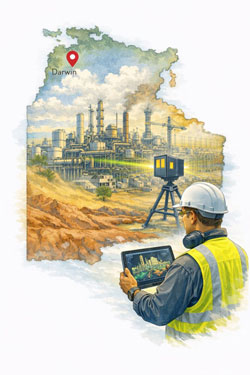
3D Laser Scanning Northern Territory

Getting Engineering Geometry Right for Remote & Regional Projects

Across the Northern Territory, engineering projects operate under a very different set of constraints to those in metropolitan Australia. Vast distances, limited local fabrication capability, extreme environmental conditions and complex logistics mean that engineering accuracy is critical from the outset.

Hamilton By Design provides engineering-led 3D laser scanning services across the Northern Territory, supporting regional and remote projects where fabricated steel and mechanical components must often travel long distances before installation. In these conditions, the cost of getting the geometry wrong is significantly higher.

This page builds on our Darwin-focused scanning services, expanding the discussion to regional NT projects and explaining why laser scanning is essential when distance, logistics and fabrication risk are key drivers.


Engineering in the Northern Territory โ€“ Why Accuracy Is Non-Negotiable

Northern Territory projects frequently involve:

  • Remote or semi-remote sites
  • Limited access to specialist fabrication and trades
  • Long lead times for materials and equipment
  • High transport and mobilisation costs
  • Restricted shutdown or installation windows

In many NT projects, steelwork and mechanical assemblies are designed in one location, fabricated interstate, and transported hundreds or thousands of kilometres to site. Once components are in transit, design errors become extremely expensive to resolve.

This is why Hamilton By Design advocates for engineering-grade 3D laser scanning as the foundation for design and fabrication in the NT.


How This Page Fits with Our Darwin Scanning Services

This Northern Territory page complements our location-specific Darwin services:

  • 3D Scanning Darwin โ€“ focused on project types within Darwin and surrounding areas
  • Darwin LiDAR & Laser Scanning Services โ€“ focused on LiDAR technology and its advantages over traditional measurement

Together, these pages form a connected service offering:

  • Darwin-based projects
  • Regional and remote NT projects
  • Engineering-led scanning for fabrication-critical outcomes

By linking these services, clients can clearly see how scanning scales from urban Darwin projects to remote NT operations.


Why Geometry Matters More on Regional NT Projects

In metropolitan environments, incorrect geometry may result in:

  • A site revisit
  • Minor fabrication changes
  • Manageable delays

In the Northern Territory, the same issue can cause:

  • Fabricated steel arriving on site and not fitting
  • Extended shutdowns while solutions are found
  • Costly re-fabrication or scrapping of components
  • Emergency freight or remobilisation of contractors
  • Significant program delays

Laser scanning reduces these risks by ensuring that design and fabrication are based on verified, real-world geometry, not assumptions or incomplete measurements.


Engineering-Grade 3D Laser Scanning Explained

3D laser scanning uses terrestrial LiDAR to capture millions of spatial data points, creating an accurate digital representation of existing conditions.

Hamilton By Designโ€™s approach is engineering-led, meaning:

  • Scan scope is defined by mechanical and structural requirements
  • Interfaces, tolerances and critical geometry are prioritised
  • Data density supports modelling, detailing and fabrication

This ensures scanning data flows directly into scan-to-CAD, engineering design and fabrication documentation, rather than being a standalone visual output.


Regional Northern Territory Projects That Benefit From Laser Scanning

Mining & Mineral Processing Facilities

Mining operations across the NT often involve plant that has evolved through multiple upgrades.

Laser scanning supports:

  • Conveyor and chute upgrades
  • Crushing and screening plant modifications
  • Structural strengthening and fatigue mitigation

Accurate geometry allows fabrication drawings to be produced confidently, even where legacy drawings no longer reflect reality.


Ports, Marine & Export Infrastructure

Regional ports and export facilities operate in corrosive, high-load environments.

Laser scanning captures:

  • Deformed or corroded steelwork
  • Misalignment from settlement or loading
  • Complex interfaces between old and new structures

This ensures fabricated steel components fit correctly when delivered to site.


Oil, Gas & Energy Infrastructure

Energy projects often rely on prefabrication to minimise shutdown time.

Laser scanning enables:

  • Accurate pipework tie-ins
  • Modular skid installation
  • Structural verification prior to fabrication

This directly supports the Darwin LiDAR & Laser Scanning Services approach by extending it to regional energy assets.


Defence & Government Infrastructure

Defence and government assets across the NT often involve ageing buildings and undocumented modifications.

Laser scanning reduces:

  • Site access requirements
  • Rework during installation
  • Coordination issues between disciplines

This builds on the 3D Scanning Darwin service offering by supporting secure and regional assets.


Water, Sewer & Utilities Infrastructure

Utilities infrastructure must remain operational and reliable.

Laser scanning supports:

  • Pump station upgrades
  • Treatment plant modifications
  • Pipework routing in congested environments

Accurate geometry reduces excavation risk and improves installation certainty.


Fabrication Distance Changes the Risk Profile

In the Northern Territory, fabrication commonly occurs:

  • Interstate
  • In major capital cities
  • At specialist workshops far from site

Once components are fabricated and shipped:

  • Changes are slow and expensive
  • On-site fixes are limited
  • Schedules are exposed

Laser scanning reduces this risk by ensuring fabrication drawings are based on precise, verified geometry, giving confidence that components will fit on arrival.


Laser Scanning vs Traditional Measurement in the NT

AspectTraditional Measurement3D Laser Scanning
Data coverageSelectiveComprehensive
Ability to re-measure remotelyNoYes
Suitability for prefabricationLimitedExcellent
Risk of fabrication errorHighSignificantly reduced
Site revisits requiredFrequentMinimized
Cost impact of errorsSevereControlled

In remote NT projects, the margin for error is simply too small to rely on traditional methods alone.


Engineer-Led Scanning โ€“ A Key Differentiator

Hamilton By Designโ€™s scanning services are delivered by engineers who understand:

  • Fabrication tolerances
  • Structural behaviour
  • Installation sequencing
  • Construction realities

This ensures scanning data integrates seamlessly with:


From Northern Territory Scan to Fabrication-Ready Delivery

Typical NT projects progress from:

  1. On-site 3D laser scanning
  2. Registered point clouds
  3. Engineering-aligned 3D models
  4. Fabrication-ready drawings
  5. Installation-ready outcomes

This workflow supports fit-first-time fabrication, even when components must travel long distances to site.


3D Laser Scanning Northern Territory โ€“ Designed for Distance & Risk

In regional and remote NT projects, geometry errors do not remain isolated โ€” they cascade through fabrication, transport and installation.

By linking Darwin-based scanning services with Northern Territory-wide laser scanning, Hamilton By Design provides a scalable, engineering-focused solution that reduces risk where it matters most.

When steel and mechanical components need to travel long distances, accurate geometry is not optional โ€” it is the foundation of project success.

Hamilton By Design logo displayed on a blue tilted rectangle with a grey gradient background
3D LiDAR scanning and 3D modelling service button โ€” laser scanner capturing a point cloud for engineering and CAD modelling
Mechanical engineering services

Our clients:

Name
Would you like us to arrange a phone consultation for you?
Address

Darwin LiDAR & Laser Scanning Services

Industrial plant in Darwin being digitally captured with 3D scanning to support engineering design and upgrade planning.

Engineering-Grade Reality Capture for the Top End

Darwin projects operate in one of Australiaโ€™s most demanding environments. Remote logistics, extreme heat, cyclone exposure, corrosive coastal conditions and ageing infrastructure all place pressure on engineering projects to get it right the first time.

Hamilton By Design provides LiDAR and laser scanning services in Darwin that go beyond basic measurement. Our scanning is engineering-led, meaning data is captured with the end goal in mind โ€” mechanical design, structural verification, fabrication and construction.

This page complements our 3D Scanning Darwin landing page by focusing specifically on LiDAR and laser scanning and clearly explaining why these methods outperform traditional measurement techniques on Darwin-based projects.


What Is LiDAR & Laser Scanning?

LiDAR (Light Detection and Ranging) and terrestrial laser scanning use high-precision laser pulses to capture millions of spatial data points per second. These points form a 3D point cloud, accurately representing existing structures, plant, terrain and assets.

Unlike manual measurement, LiDAR captures entire environments, not just selected dimensions. This creates a permanent, revisit able digital record that engineers can interrogate long after leaving site.

In Darwin, where site access is costly and conditions are challenging, this capability is invaluable.


Why LiDAR & Laser Scanning Are Ideal for Darwin Projects

Darwin projects often involve:

  • Brownfield assets with poor documentation
  • Live facilities with limited access windows
  • Remote locations where repeat visits are expensive
  • Structures affected by corrosion, movement and deformation

LiDAR scanning directly addresses these challenges by replacing assumptions with measured reality.


LiDAR & Laser Scanning vs Traditional Measurement Methods

Traditional Measurement Methods

Common traditional approaches include:

  • Tape measures and laser distos
  • Total stations used selectively
  • Manual sketching and hand-marked dimensions
  • Assumptions based on legacy drawings

While these methods still have a place, they struggle in Darwinโ€™s complex industrial environments.


LiDAR & Laser Scanning โ€“ A Comparative Overview

AspectTraditional MethodsLiDAR & Laser Scanning
Data capturedLimited, selectiveMillions of points
AccuracyDepends on access & operatorConsistent, verifiable
Site timeHighReduced
Rework riskHighSignificantly reduced
Ability to revisit dataNoYes
SafetyManual access requiredReduced physical access
Suitability for brownfield sitesLimitedExcellent

Key Benefits of LiDAR & Laser Scanning in Darwin

1. Reduced Site Time in Remote Locations

Darwin projects often involve:

  • Fly-in/fly-out logistics
  • Restricted access windows
  • Live plant environments

LiDAR allows large, complex sites to be captured in a single visit, reducing the need for repeated trips.


2. Improved Safety in Harsh Conditions

Traditional measurement often requires:

  • Working at height
  • Accessing confined or hot spaces
  • Measuring near live equipment

Laser scanning significantly reduces the need for physical interaction with hazardous environments, improving safety outcomes.


3. Accurate Capture of Deformed & Corroded Assets

Darwinโ€™s tropical climate accelerates:

  • Steel corrosion
  • Structural movement
  • Alignment drift

LiDAR captures as-is geometry, not what drawings say should exist. This is critical for:

  • Port infrastructure
  • Marine assets
  • Industrial plant and pipework

4. Better Outcomes for Brownfield Engineering

Most Darwin projects are brownfield in nature. LiDAR supports:

  • Clash-free design
  • Accurate retrofit modelling
  • Confident fabrication

Designers can work knowing the model reflects reality, not assumptions.


5. Permanent Digital Record of Existing Conditions

Once scanned, a site becomes a digital asset. Engineers can:

  • Take additional measurements remotely
  • Validate future changes
  • Use scans as baseline data

This is particularly valuable for long-term asset management in the Northern Territory.


Engineering-Led LiDAR Scanning (Why It Matters)

Not all scanning services are equal.

Hamilton By Design delivers engineering-led LiDAR scanning, meaning:

  • Scans are planned around engineering outcomes
  • Data density suits mechanical and structural modelling
  • Critical interfaces and tolerances are prioritised

This ensures the point cloud transitions cleanly into design, analysis and fabrication, not just visualisation.


Typical Darwin Projects Using LiDAR & Laser Scanning

Defence & Government Facilities

  • Existing buildings with no drawings
  • Secure sites with limited access
  • Retrofit and upgrade projects

LiDAR reduces site exposure while improving design accuracy.


Ports & Marine Infrastructure

  • Wharf structures and steelwork
  • Bulk handling systems
  • Corrosion and deformation monitoring

Scanning enables fit-first-time fabrication in marine environments.


Oil, Gas & Energy Facilities

  • Congested process plants
  • Pipework tie-ins
  • Structural verification

LiDAR supports safe, efficient shutdown planning.


Mining & Bulk Materials

  • Crushing and screening plants
  • Conveyors and chutes
  • Remote site upgrades

Scanning allows design work to occur off-site with confidence.


Cyclone Remediation & Compliance

  • Structural assessment
  • Asset hardening
  • Documentation for compliance

LiDAR provides accurate baseline data for engineering decisions.


Utilities & Water Infrastructure

  • Pump stations
  • Treatment plants
  • Pipework routing

Scanning reduces excavation risk and coordination issues.


From LiDAR Scan to Engineering Deliverables

Hamilton By Design provides more than raw data.

Our Typical Deliverables Include:

  • Registered point clouds
  • 3D CAD models aligned to engineering standards
  • Fabrication-ready drawings
  • Structural and mechanical layouts
  • As-built documentation

This ensures scanning data is immediately useful, not an additional burden for project teams.


Integration With Hamilton By Design Services

LiDAR scanning in Darwin is often combined with:

Together, these services support a single-source, accountable workflow from capture to construction.


Why LiDAR Is Replacing Traditional Measurement in Darwin

In Darwin, traditional measurement methods often result in:

  • Missed dimensions
  • Rework and fabrication issues
  • Costly site returns
  • Program delays

LiDAR & laser scanning replace this uncertainty with measured reality, improving project certainty and reducing risk โ€” particularly in remote and high-cost environments.


Darwin LiDAR & Laser Scanning โ€“ Built for Real Conditions

Whether you are working on defence infrastructure, ports, LNG facilities, mining plant or cyclone-prone assets, LiDAR and laser scanning provide the foundation for better engineering outcomes.

Hamilton By Design delivers Darwin LiDAR scanning services that are practical, accurate and engineered for real-world construction โ€” not just data capture.

If your project requires certainty before design or fabrication begins, LiDAR scanning is not an optional extra โ€” itโ€™s the smart starting point.

Hamilton By Design logo displayed on a blue tilted rectangle with a grey gradient background
3D LiDAR scanning and 3D modelling service button โ€” laser scanner capturing a point cloud for engineering and CAD modelling
Mechanical engineering services

Our clients:

Name
Would you like us to arrange a phone consultation for you?
Address

3D Scanning Darwin

Engineering-Grade Laser Scanning, Modelling & Design for the Top End

Blue 3D LiDAR scanner icon on a tripod with scanning waves

Darwin presents a unique engineering environment. Remote logistics, extreme climate conditions, cyclone exposure, corrosive coastal air and a heavy concentration of defence, port, energy and industrial assets mean that engineering work in the Top End demands accuracy from day one.

Hamilton By Design provides engineering-led 3D laser scanning services in Darwin, supporting projects where traditional measurement methods fall short. By combining high-accuracy LiDAR scanning with mechanical engineering, structural design and fabrication-ready documentation, we help Darwin-based projects move from concept to construction with confidence.

This page outlines the types of projects in Darwin that benefit most from 3D scanning, and how Hamilton By Design supports those projects with a complete scan-to-engineering workflow.


Why 3D Scanning Matters in Darwin

Many Darwin projects share common challenges:

  • Limited or unreliable as-built drawings
  • Assets modified repeatedly over decades
  • Restricted site access and tight shutdown windows
  • High cost of rework due to remoteness
  • Structural deformation from heat, corrosion and cyclonic loading

3D laser scanning addresses these issues by creating a high-fidelity digital record of existing conditions, allowing engineering decisions to be made using reality-based data rather than assumptions.

Hamilton By Design delivers engineer-led scanning, meaning the data captured on site is purpose-driven for mechanical design, structural verification and fabrication โ€” not just visualisation.


Defence & Federal Infrastructure Projects in Darwin

Darwin is a critical defence hub, hosting permanent and rotating military assets, training facilities and secure infrastructure.

Typical Defence Projects

  • Building upgrades and refurbishments
  • Mechanical and services retrofits
  • Structural strengthening works
  • New plant and equipment installations within existing facilities

How 3D Scanning Supports Defence Projects

  • Accurate capture of ageing buildings with no reliable drawings
  • Reduced time on secure sites
  • Precise modelling of existing services and structures
  • Improved coordination between disciplines

3D scanning allows defence projects to progress with minimal disruption, fewer site visits and reduced security exposure, while still achieving high engineering accuracy.


Ports, Marine & Coastal Infrastructure

Darwin Port supports bulk materials, defence logistics, LNG export and general shipping. Marine environments are unforgiving, and many port assets have experienced decades of corrosion, deformation and incremental modification.

Typical Port & Marine Projects

  • Wharf upgrades and extensions
  • Conveyor and bulk handling modifications
  • Structural remediation and strengthening
  • Mechanical plant replacements

Value of 3D Scanning

  • Captures true geometry of deformed steelwork
  • Enables fabrication-ready design without repeated site measurement
  • Reduces risk of misalignment during installation

For marine and port works, scan-to-CAD modelling ensures fabricated components fit first time โ€” critical in tide-affected, high-cost construction environments.


Oil, Gas & Energy Facilities

Darwinโ€™s proximity to offshore resources and export infrastructure makes it a key energy hub, including LNG processing, fuel storage and power generation assets.

Typical Energy Projects

  • Brownfield plant modifications
  • Pipework rerouting and tie-ins
  • Skid and modular equipment installation
  • Structural verification of existing frames

Why 3D Scanning Is Essential

  • Highly congested plant environments
  • Shutdowns measured in hours, not weeks
  • Zero tolerance for clashes or rework

Hamilton By Design supports energy projects by capturing engineering-grade point clouds, developing accurate 3D models and producing documentation suitable for fabrication and installation planning.


Mining, Quarrying & Bulk Materials Projects

Across the Northern Territory, mining and quarrying operations rely on reliable materials handling infrastructure operating in harsh conditions.

Typical Mining & Quarry Projects

  • Crushing and screening plant upgrades
  • Conveyor replacements and extensions
  • Chute redesigns
  • Structural strengthening and fatigue mitigation

3D Scanning Benefits

  • Enables off-site design with minimal return visits
  • Captures heavily modified plant accurately
  • Supports safer, faster project delivery

For remote mining operations, 3D scanning dramatically reduces project risk by allowing engineering, design and detailing to occur away from site.


Cyclone Remediation & Asset Hardening

Darwinโ€™s built environment is heavily influenced by cyclone design requirements, with assets frequently assessed and upgraded to meet evolving standards.

Typical Cyclone-Related Projects

  • Post-cyclone damage assessment
  • Structural strengthening works
  • Roof, faรงade and services upgrades
  • Compliance and certification projects

How 3D Scanning Helps

  • Rapid capture of damaged structures
  • Safer data collection compared to manual access
  • Enables deformation and alignment analysis

3D scanning creates a baseline digital record that supports engineering assessment, insurance reporting and compliance documentation.


Water, Sewer & Utilities Infrastructure

Water treatment plants, pump stations and utilities infrastructure in Darwin often operate continuously and in confined or congested environments.

Typical Utilities Projects

  • Pump station upgrades
  • Water treatment plant modifications
  • Pipework replacement and rerouting
  • Structural audits and asset life extension

Value Delivered by 3D Scanning

  • Accurate mapping of existing plant layouts
  • Reduced excavation and clash risk
  • Improved coordination between contractors and consultants

Scanning supports safer, more efficient upgrades to essential services without unnecessary shutdowns.


Commercial, Industrial & Government Buildings

Darwin includes a mix of older public buildings and newer commercial developments, many requiring refurbishment or adaptive reuse.

Typical Building Projects

  • Mechanical and HVAC upgrades
  • Structural assessments
  • Refurbishments and compliance upgrades
  • Fit-outs within existing structures

3D Scanning Outcomes

  • Accurate architectural and structural models
  • Improved coordination of services
  • Reduced variations during construction

In buildings where nothing is square, level or documented, scan-to-model workflows significantly improve project certainty.


How Hamilton By Design Delivers 3D Scanning in Darwin

Hamilton By Design does more than collect point clouds. Our workflow is designed around engineering outcomes.

Our Typical Process

  1. On-site 3D laser scanning using survey-grade equipment
  2. Point cloud registration and quality assurance
  3. Engineering-focused modelling aligned to project scope
  4. Delivery of drawings, models and data suitable for construction

This approach ensures that scanning data transitions seamlessly into engineering design, documentation and fabrication.


Integrated Engineering & Scanning Services

Darwin clients benefit most when scanning is combined with engineering expertise. Hamilton By Design offers a fully integrated service, including:

These services allow Darwin projects to move from existing conditions โ†’ engineered design โ†’ fabrication-ready documentation under one accountable workflow.


Why Choose Hamilton By Design for 3D Scanning in Darwin

  • Engineer-led scanning, not survey-only capture
  • Experience with brownfield and remote projects
  • Focus on fit-first-time fabrication outcomes
  • Reduced site visits and rework
  • Data you can design and build from

We understand the realities of working in the Top End and tailor our services to suit Darwinโ€™s operational, environmental and logistical constraints.


3D Scanning Darwin โ€“ Built for Real Projects

Whether you are upgrading defence infrastructure, modifying a live plant, strengthening cyclone-exposed assets or planning a remote mining upgrade, 3D scanning provides the certainty required to design and build with confidence.

Hamilton By Design supports Darwin projects with practical, engineering-focused digital capture that reduces risk, improves coordination and delivers real value on site.

If youโ€™re planning a project in Darwin or the Northern Territory, 3D scanning is not just an optional extra โ€” itโ€™s the foundation for getting it right the first time.

Hamilton By Design logo displayed on a blue tilted rectangle with a grey gradient background
3D LiDAR scanning and 3D modelling service button โ€” laser scanner capturing a point cloud for engineering and CAD modelling
Mechanical engineering services

Our clients

Name
Would you like us to arrange a phone consultation for you?
Address

3D Point Cloud Scanning in Sydney

Engineering-Grade LiDAR Scanning for Accurate Digital Site Capture

Blue 3D LiDAR scanner icon on a tripod with scanning waves

Across Sydney and the wider metropolitan region, engineering, construction, and industrial projects increasingly depend on accurate digital representations of existing conditions. In dense urban environments, outdated drawings, undocumented modifications, and complex services layouts make assumptions costly. 3D Point Cloud Scanning in Sydney provides a reliable foundation for design, verification, and construction by capturing reality exactly as it exists.

Hamilton By Design delivers engineering-grade 3D point cloud scanning services, using high-accuracy terrestrial LiDAR to support design, retrofit, construction verification, and asset documentation.


What Is 3D Point Cloud Scanning?

3D point cloud scanning uses LiDAR (Light Detection and Ranging) technology to measure millions of points in three-dimensional space. Each scan captures precise X, Y, and Z coordinates, producing a dense digital representation of physical environments.

The resulting point cloud accurately reflects:

  • Geometry
  • Spatial relationships
  • Clearances and interfaces
  • Installed conditions at a specific moment in time

Unlike traditional surveys or manual measurements, point cloud scanning captures complete spatial context, making it particularly valuable in complex or congested environments.


Why 3D Point Cloud Scanning Is Essential in Sydney

Sydney projects face unique challenges:

  • High-density commercial buildings
  • Congested mechanical and electrical services
  • Live, operational sites
  • Brownfield and retrofit-driven works
  • Limited tolerance for rework or shutdowns

In these conditions, incomplete information leads directly to clashes, redesign, and delays. 3D point cloud scanning reduces risk by providing a single source of spatial truth that engineers, designers, and builders can rely on.


Engineering-Led Scanning at Hamilton By Design

At Hamilton By Design, point cloud scanning is delivered as an engineering service, not a commodity scan.

Our typical workflow includes:

  • Engineer-led scan planning aligned to project objectives
  • High-accuracy terrestrial LiDAR scanning suited to confined and complex sites
  • Controlled registration and validation of scan data
  • Engineering interpretation of point cloud information
  • Optional conversion into CAD models and drawings

This ensures the scan data is not just accurate, but fit for purpose for downstream engineering use.


Common Applications of 3D Point Cloud Scanning in Sydney

As-Built Site Capture

Point cloud scanning is widely used to capture:

  • Commercial building interiors and exteriors
  • Structural elements, slabs, columns, and penetrations
  • Plant rooms, basements, and rooftops

These scans form the basis for accurate as-built documentation and refurbishment planning.

Mechanical and Services Environments

In congested ceiling spaces and plant areas, point cloud scanning accurately captures:

  • HVAC ductwork
  • Pipework and valves
  • Cable trays and electrical services
  • Fire and hydraulic systems

This data supports coordination, retrofit design, and fabrication planning.

Construction Verification and Digital QA

During construction, point cloud scanning is used for:

  • Installed versus design verification
  • Fit-up and alignment checks
  • Quality assurance reporting
  • Progress documentation

Each scan provides a defensible digital record of what has been built.

Brownfield and Retrofit Projects

For ageing or undocumented assets, scanning allows engineers to:

  • Design upgrades with confidence
  • Minimise site rework
  • Reduce shutdown and access risks

This is particularly valuable in Sydney CBD projects where access is limited.


From Scan Data to Engineering Outcomes

Point cloud data can be used directly for measurement and verification, or extended into Scan to CAD workflows.

Hamilton By Design can convert scan data into:

  • SolidWorks-based mechanical models
  • As-built CAD drawings
  • Fabrication-ready documentation
  • Inputs for FEA and mechanical assessment

By linking scanning directly to engineering and CAD, the data remains consistent and traceable throughout the project lifecycle.


Benefits of 3D Point Cloud Scanning

For Sydney-based projects, the benefits are clear:

  • Reduced design uncertainty
  • Improved coordination across disciplines
  • Early identification of clashes and fit-up issues
  • Fewer site variations and rework
  • Strong digital records for handover and asset management

Working from accurate scan data allows problems to be resolved digitally, before they become physical and expensive.


Why Choose Hamilton By Design

Hamilton By Design offers a single-source digital engineering workflow, combining:

  • High-accuracy 3D point cloud scanning
  • Mechanical engineering expertise
  • CAD modelling and verification
  • Fabrication-ready documentation
  • Optional FEA and assessment services

This integrated approach ensures scan data is not just collected, but used effectively to support real engineering decisions.


Hamilton By Design logo displayed on a blue tilted rectangle with a grey gradient background

3D Point Cloud Scanning in Sydney

Whether supporting a CBD refurbishment, a construction verification program, or a complex mechanical upgrade, 3D Point Cloud Scanning in Sydney provides the foundation for confident, data-driven engineering.

Hamilton By Design delivers scanning services built around accuracy, engineering intent, and practical outcomes โ€” helping projects move forward with clarity and reduced risk.

Our Clients:
Name
Would you like us to arrange a phone consultation for you?
Address

Related Sydney Services

Hamilton By Design provides engineering-led 3D scanning, LiDAR scanning, mechanical engineering and digital engineering services throughout Sydney and Greater Sydney.

Explore our related Sydney services:


  • 3D Scanning Sydney โ€“ Engineering-grade terrestrial laser scanning, as-built surveys and point cloud capture for industrial, infrastructure and commercial projects.
  • Reality Capture Sydney โ€“ High-accuracy reality capture, digital twins, asset documentation and engineering-grade site verification.
  • Scan to CAD Sydney โ€“ Convert point cloud data into AutoCAD, SolidWorks, Inventor and other engineering-ready CAD deliverables.
  • Point Cloud Modelling Sydney โ€“ Engineering-grade point cloud processing, clash detection, as-built verification and 3D modelling.
  • Mechanical Engineering Sydney โ€“ Mechanical design, plant upgrades, materials handling systems, conveyors, chutes, platforms and engineering support.
  • Structural Drafting Sydney โ€“ Structural steel drafting, fabrication drawings, GA drawings, workshop detailing and as-built documentation.

Hamilton By Design supports projects throughout Sydney CBD, Parramatta, Liverpool, Penrith, Blacktown, Chatswood, Alexandria, Mascot, Newcastle and the Central Coast.


3D CAD in Sydney

3D Construction Scan in Sydney

3D CAD in Sydney

3D LiDAR scanning and 3D modelling service button โ€” laser scanner capturing a point cloud for engineering and CAD modelling
Mechanical engineering services
Finite Element Analysis (FEA) engineering simulation button
Mechanical engineering services
Blue banner graphic displaying the text "Point Cloud to CAD - Australia" in large white lettering, representing point cloud processing, scan-to-CAD conversion and digital engineering services across Australia.
Blue banner graphic displaying the text "Scan to CAD Sydney" in large white lettering, representing engineering-led point cloud to CAD conversion, LiDAR scanning and digital engineering services in Sydney.
Blue banner graphic displaying the text "Reality Capture Sydney - CBD" in large white lettering, representing engineering-led reality capture, LiDAR scanning and digital engineering services within Sydney CBD commercial buildings and infrastructure.

3D Scanning Engineering in Brisbane

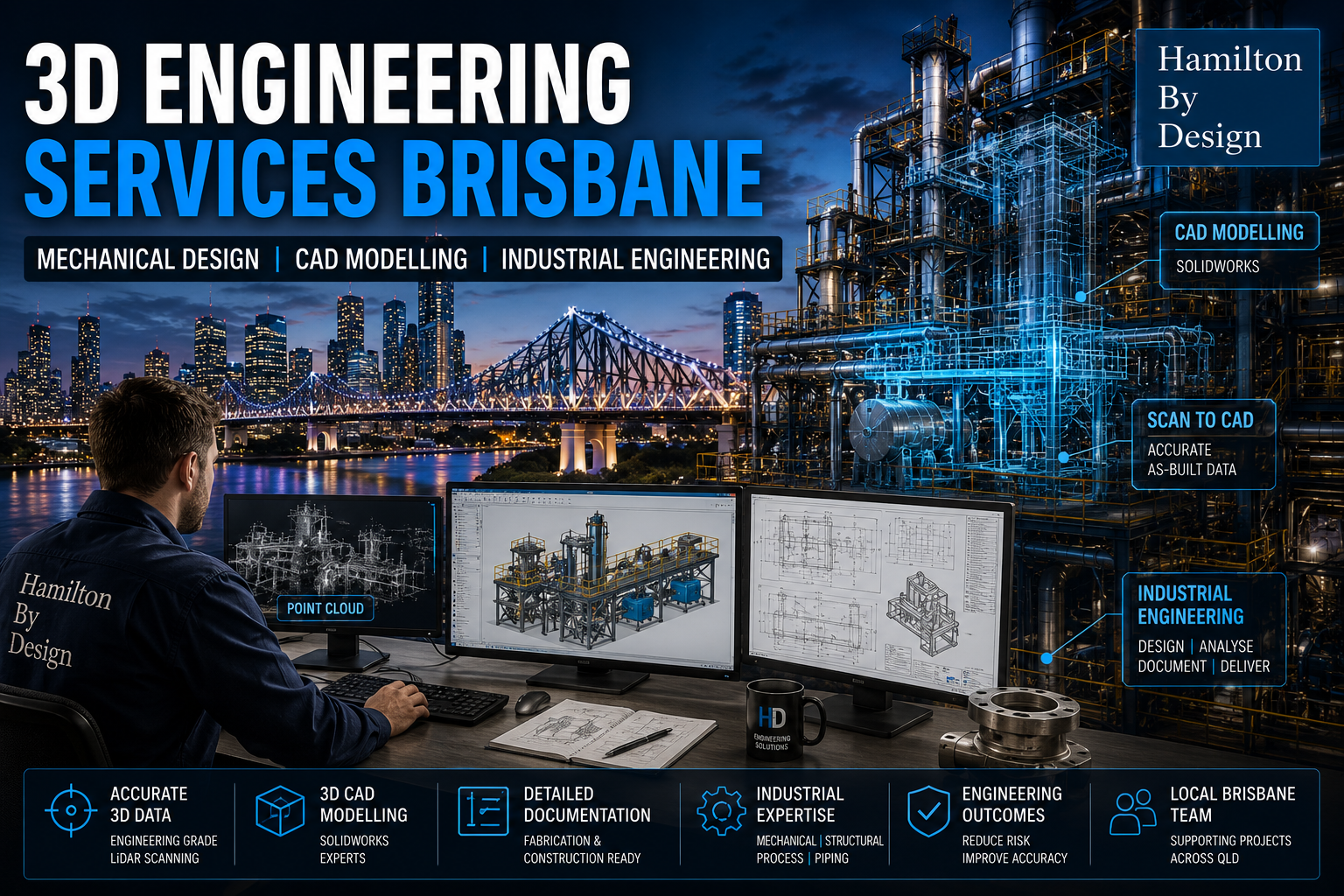
3D engineering services in Brisbane featuring industrial CAD modelling, scan-to-CAD workflows, and mechanical engineering visualisations with Brisbane skyline background.

3D Scanning Engineering in Brisbane

Blue 3D LiDAR scanner icon on a tripod with scanning waves

Brisbane has emerged as one of Australiaโ€™s most important digital engineering hubs, supporting mining, industrial, and infrastructure assets located across Queensland and remote regions of Australia. While many of these assets are far from the CBD, the engineering that supports them is increasingly delivered from Brisbane using accurate 3D site data.

Hamilton By Design specialises in engineer-led 3D scanning engineering in Brisbane, combining on-site 3D LiDAR laser scanning with Brisbane-based mechanical and structural engineering, 3D CAD modelling, FEA, and fabrication-ready drafting. This workflow allows projects to be designed, analysed, and documented with confidenceโ€”without the need for repeated site attendance.


Brisbane as a digital engineering hub for mining and industry

Brisbane engineering teams support a wide range of assets, including remote mining operations, coal handling and preparation plants (CHPPs), bulk materials handling systems, ports, and energy infrastructure. The cityโ€™s strength lies in its ability to process accurate digital site data and convert it into buildable engineering outcomes.

By capturing site conditions once and completing engineering in Brisbane, projects benefit from reduced travel, improved coordination, and lower riskโ€”particularly for brownfield and retrofit works.


3D point clouds: the foundation of remote engineering

At the core of modern digital engineering is the 3D point cloud. High-accuracy point clouds provide a true digital representation of existing assets, allowing engineers to design from reality rather than assumptions.

Our article 3D Point Clouds Are a Game-Changer for Your Projects explains how expert modelling from point-cloud data improves accuracy, coordination, and constructability.

For Brisbane-based engineers, point clouds enable:

  • Confident mechanical and structural design
  • Reduced reliance on outdated drawings
  • Early clash detection and fit-up checks
  • Fewer site changes and rework

3D laser scanning of mining and industrial sites

Hamilton By Design delivers high-accuracy 3D Scanning across mining and industrial sites throughout Queensland and Australia. Scanning is typically completed during short, controlled site visits, minimising disruption to operations.

3D laser scanning is particularly valuable for:

  • Remote or FIFO-based mining sites
  • Brownfield industrial facilities
  • Assets with incomplete or outdated documentation
  • Projects with tight shutdown windows

Once scanning is complete, all data is transferred to Brisbane for processing and engineering.


Brisbane-based experts in 3D laser scanning and mechanical design

Hamilton By Design integrates scanning and engineering as a single service, rather than treating scanning as a standalone deliverable. This approach is detailed in Your Experts in 3D Laser Scanning & Mechanical Design.

By combining scanning with mechanical and structural engineering expertise, Brisbane-based engineers can:

  • Design directly from real site geometry
  • Understand existing load paths and constraints
  • Optimise layouts for constructability and access

This is especially important for mining and heavy industry projects where fit-for-purpose design matters.


Engineering without constant site attendance

With accurate scan data and point clouds available, most engineering work can be completed remotely from Brisbane. This allows:

  • Mechanical and structural design without repeated site visits
  • Digital design reviews with stakeholders
  • Reduced FIFO travel and project costs
  • Improved safety by limiting on-site exposure

For asset owners, this approach delivers faster, more predictable outcomes.


3D CAD modelling built from real site conditions

Scan data is converted into detailed 3D CAD Modelling using SolidWorks and related platforms. Models represent what actually exists on site, forming a reliable digital baseline for future work.

These models support:

  • Mechanical upgrades and plant modifications
  • Structural additions such as platforms and walkways
  • Integration of new equipment into existing facilities
  • Long-term asset documentation and reuse

Coordinated mechanical and structural engineering

Working within a single digital environment allows Brisbane engineers to coordinate mechanical and structural design effectively. This reduces clashes, improves constructability, and limits late-stage design changesโ€”particularly in congested brownfield environments.


FEA and verification completed in Brisbane

Finite Element Analysis (FEA) is applied to scan-based models to verify performance and compliance. Brisbane-based FEA supports:
  • Structural capacity and load checks
  • Fatigue and vibration assessment
  • Verification of modified or existing assets
  • Engineering approval and sign-off

Because analysis is based on real geometry, results better reflect real-world behaviour.


Fabrication-ready drafting that fits first time

Final designs are issued as fabrication-ready drawings suitable for workshops and installation teams. Drawings are developed directly from coordinated 3D models, improving clarity and reducing errors during fabrication and installation.


Hamilton By Design logo displayed on a blue tilted rectangle with a grey gradient background
3D LiDAR scanning and 3D modelling service button โ€” laser scanner capturing a point cloud for engineering and CAD modelling
Mechanical engineering services

Brisbane delivering engineering outcomes across Queensland

Brisbaneโ€™s role as a digital engineering centre continues to grow as 3D scanning and model-based engineering become standard practice. Hamilton By Design uses this Brisbane-based workflow to support mining and industrial projects across Queensland and Australiaโ€”capturing site reality once and engineering with confidence.

Our clients

Name
Would you like us to arrange a phone consultation for you?
Address

3D Scanning Engineering in Traralgon

Engineer using 3D LiDAR laser scanning to capture a power plant in the Latrobe Valley for engineering and as-built documentation.

3D Scanning Engineering in Traralgon

Traralgon sits at the centre of the Latrobe Valley โ€” one of Australiaโ€™s most significant energy and industrial regions. For decades, the area supported large-scale power generation and heavy infrastructure. Today, Traralgon is at the frontline of energy transition, where legacy assets, decommissioning works, rehabilitation, and new infrastructure all coexist.

Engineering in this environment is rarely simple. Projects often involve ageing plant, undocumented modifications, strict safety requirements, and high public scrutiny. Getting the data right up front is critical.

Hamilton By Design supports Traralgon projects with engineering-led 3D LiDAR laser scanning, mechanical and structural engineering, 3D modelling, FEA, and easy-to-build fabrication drawings with engineering approval, helping asset owners and contractors reduce risk and move confidently from concept to construction.


Engineering in Traralgon: Legacy Assets and Future Infrastructure

Most engineering work in Traralgon is brownfield by default. Typical projects include:

  • Power station and energy-related infrastructure
  • Decommissioning and staged demolition works
  • Industrial plant upgrades and repurposing
  • Transmission, substations, and supporting structures

Many assets were designed to older standards and modified repeatedly over decades. Accurate as-built information, conservative engineering judgement, and clear documentation are essential to safely manage change.


Engineer performing 3D laser scanning of an industrial power plant in the Latrobe Valley.

3D Laser Scanning for Traralgon Sites

High-accuracy 3D LiDAR laser scanning provides the foundation for safe and efficient engineering in Traralgon.

Hamilton By Design captures precise as-built data for:

  • Large industrial plant and energy infrastructure
  • Structural steel, conveyors, platforms, and access ways
  • Decommissioning and rehabilitation sites
  • Assets with limited, outdated, or unreliable drawings

3D scanning records the true as-built condition โ€” including deformation, misalignment, corrosion loss, and undocumented changes โ€” without disrupting live operations.

This enables:
  • Reduced assumptions in high-risk environments
  • Better planning for shutdowns and staged works
  • Safer decommissioning and modification strategies
  • Lower fabrication and installation risk

Learn more about our scanning services here:
3D Laser Scanning


3D Modelling from Real As-Built Data

From the point cloud, Hamilton By Design develops accurate 3D CAD models that reflect what actually exists on site โ€” not what legacy drawings suggest.

Our 3D modelling services support:

  • Brownfield upgrades and plant modifications
  • Decommissioning and dismantling planning
  • Clash detection between new and existing systems
  • Modular design and construction sequencing
  • Digital asset records for future redevelopment

In Traralgonโ€™s complex industrial environment, modelling from real data significantly reduces safety, cost, and schedule risk.

Explore our modelling capability:
3D CAD Modelling


FEA for Verification of Existing and Modified Assets

Traralgon engineering frequently involves verifying old assets under new conditions. Finite Element Analysis (FEA) plays a critical role in understanding real structural behaviour.

Hamilton By Design applies FEA to:

  • Assess structural capacity and load paths
  • Check deflection, fatigue, and buckling
  • Verify temporary and permanent works
  • Support strengthening, reuse, or staged demolition decisions

By analysing as-built geometry, FEA provides more reliable insight โ€” essential when working with large, safety-critical infrastructure.

Learn more about our analysis services:
FEA Capabilities


Easy-to-Build Fabrication Drawings with Engineering Approval

Clear, practical documentation is vital for Traralgon projects, where fabrication, installation, and demolition often occur in high-risk environments.

Hamilton By Design delivers easy-to-build fabrication and installation drawings, including:

  • General arrangement drawings
  • Fabrication and workshop details
  • Installation, lifting, and staging layouts
  • As-built documentation

Drawings are produced directly from scanned data and validated 3D models and can be issued with engineering approval, giving contractors confidence that what is built or modified will fit, function, and comply.

View our drafting services here:
Drafting Services


Hamilton By Design logo displayed on a blue tilted rectangle with a grey gradient background

Why Hamilton By Design in Traralgon?

Hamilton By Design provides a single, engineering-led digital workflow โ€” from site capture through to modelling, analysis, and construction documentation.

For Traralgon clients, this means:

  • Reduced risk on complex brownfield and transition sites
  • Better decision-making before shutdowns or demolition works
  • Designs grounded in real site conditions
  • Fabrication-ready drawings backed by engineering sign-off

Whether youโ€™re modifying legacy energy infrastructure, planning decommissioning works, or developing the next generation of industrial assets, Hamilton By Design delivers accurate, practical, and build-ready engineering solutions tailored to Traralgonโ€™s unique challenges.

Our clients


Name
Would you like us to arrange a phone consultation for you?
Address
3D LiDAR scanning and 3D modelling service button โ€” laser scanner capturing a point cloud for engineering and CAD modelling
Mechanical engineering services
Finite Element Analysis (FEA) engineering simulation button
Mechanical engineering services