Mechanical Engineering | 3D Scanning | 3D Modelling
Tag: Risk Management
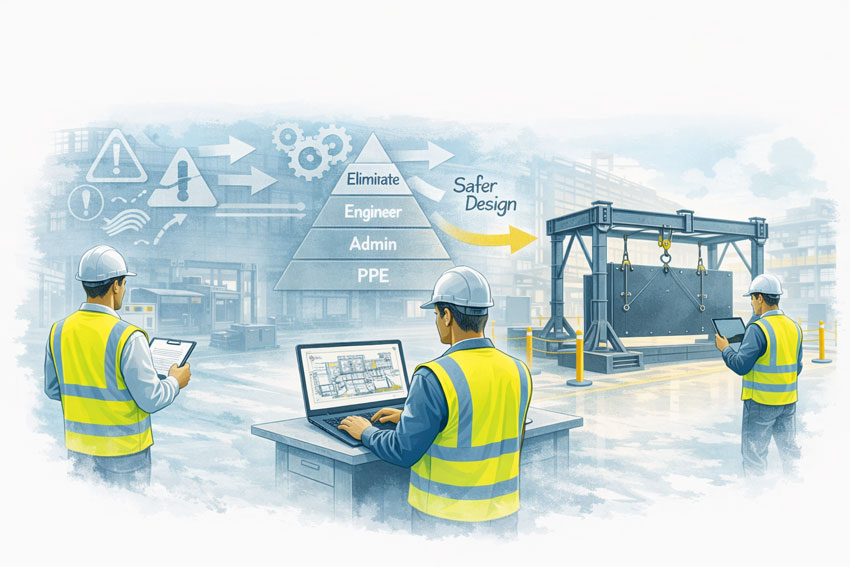
Posts focused on engineering risk management, including hazard identification, risk assessment and design controls to improve safety and reliability in industrial and infrastructure environments.
Hamilton By Design is committed to protecting the health and safety of employees, contractors, clients, and visitors by ensuring effective planning, preparedness, and response to emergency situations.
This Emergency Management Policy outlines the framework for identifying potential emergency situations and responding in a timely, coordinated, and effective manner to minimise harm to people, property, and the environment.
Scope
This policy applies to all Hamilton By Design activities, including:
Office-based engineering and design work
3D LiDAR scanning and site data capture
Engineering inspections and site visits
Work performed at client, construction, industrial, and mining sites
Interaction with clients, contractors, and visitors
Emergency Preparedness
Hamilton By Design will:
Identify potential emergency situations relevant to its activities, including but not limited to:
Fire and smoke
Medical emergencies
Chemical exposure or spills
Electrical incidents
Structural instability or collapse
Vehicle incidents
Extreme weather events
Maintain emergency response procedures appropriate to the nature of work being undertaken
Ensure access to emergency contact information and first aid resources
Comply with client and site-specific emergency management requirements when working off-site
Emergency Response
In the event of an emergency, Hamilton By Design will:
Prioritise the safety of people above all other considerations
Follow established emergency response procedures and site-specific emergency plans
Evacuate or isolate areas as required
Notify emergency services and relevant authorities when required
Communicate clearly with affected personnel, clients, and contractors
Roles and Responsibilities
Management
Management is responsible for:
Ensuring emergency management procedures are in place and maintained
Providing appropriate resources, training, and support
Coordinating emergency response where reasonably practicable
Employees and Contractors
Employees and contractors are responsible for:
Familiarising themselves with emergency procedures relevant to their work
Following emergency instructions and site rules
Reporting emergencies, hazards, or near misses immediately
Training and Awareness
Hamilton By Design ensures that:
Personnel are informed of emergency procedures applicable to their workplace or site
Site-specific emergency inductions are completed where required
Emergency awareness is maintained through ongoing communication
Incident Reporting and Review
All emergency incidents, near misses, and significant events must be reported. Hamilton By Design will investigate incidents to identify causes and implement corrective actions to prevent recurrence.
Business Continuity Considerations
Where appropriate, Hamilton By Design will take reasonable steps to:
Protect critical data and digital assets
Maintain continuity of engineering services following an emergency
Support recovery and return-to-work activities
Review and Continuous Improvement
This Emergency Management Policy is reviewed periodically to ensure it remains current, effective, and aligned with legislative requirements, operational changes, and industry best practice.
Hamilton By Design is committed to providing a safe, healthy, and productive work environment. The purpose of this Fatigue Management Policy is to identify, assess, and manage fatigue-related risks to ensure work is performed safely and effectively.
Fatigue can impair judgement, reaction time, decision-making, and situational awareness. In engineering and site-based environments, unmanaged fatigue presents a significant safety risk.
2. Scope
This policy applies to:
Employees
Directors and officers
Contractors and consultants
Subcontractors
Any person performing work on behalf of Hamilton By Design
This policy applies to office work, remote work, travel, and site-based activities, including shutdowns and extended work periods.
3. Definition of Fatigue
Fatigue is a state of physical and/or mental exhaustion that reduces a personโs ability to perform work safely and effectively.
Fatigue may result from:
Long work hours
Insufficient sleep or rest
Extended travel or commuting
High mental workload or sustained concentration
Night work or early starts
Poor work-life balance
4. Responsibilities
4.1 Hamilton By Design
Hamilton By Design will:
Plan work to minimise fatigue risk
Monitor working hours, travel demands, and workload
Avoid scheduling excessive hours where practicable
Ensure fatigue risks are considered when planning site work and shutdown activities
Encourage open communication regarding fatigue concerns
Take reasonable action where fatigue risk is identified
4.2 Workers
All workers are responsible for:
Presenting fit for work and adequately rested
Managing personal fatigue and wellbeing
Not performing work when fatigued to the point it may affect safety
Reporting fatigue concerns to management as soon as practicable
Following client and site-specific fatigue management requirements
5. Working Hours and Rest
To manage fatigue, Hamilton By Design will, where reasonably practicable:
Plan work schedules to allow adequate rest between shifts
Consider cumulative fatigue during extended or consecutive workdays
Manage travel to avoid excessive driving hours, particularly after long workdays
Allow rest breaks during prolonged periods of work or travel
Workers must take reasonable steps to ensure they obtain sufficient sleep and rest prior to performing work.
6. Travel and Remote Work
Hamilton By Design recognises that travel and remote work can significantly contribute to fatigue.
Travel time will be considered when planning work schedules
Workers must not drive or operate vehicles when fatigued
Alternative arrangements (rest breaks, overnight accommodation, or schedule changes) will be implemented where practicable
Remote and isolated work will be planned to minimise fatigue risk
7. High-Risk and Safety-Critical Work
Additional fatigue controls may be implemented for:
Shutdowns and time-critical work
Work requiring high levels of concentration or judgement
Site activities with elevated safety risk
Where fatigue is identified as a risk, work may be modified, delayed, or suspended.
8. Reporting Fatigue
Workers are encouraged to report fatigue without fear of reprisal.
Fatigue reports will be treated seriously and confidentially
Reporting fatigue will not result in disciplinary action when raised in good faith
Early reporting helps prevent incidents and injuries
9. Non-Compliance
Failure to comply with this policy may result in:
Removal from work duties or site
Review of work arrangements
Disciplinary action where applicable
Termination of engagement in serious or repeated cases
10. Policy Review
This policy will be reviewed periodically to ensure alignment with:
Australian WHS legislation
Client and site requirements
Industry best practice
11. Commitment
Hamilton By Design is committed to managing fatigue proactively to protect the safety, wellbeing, and performance of all people engaged in our work.
Hamilton By Design is committed to providing a safe, healthy, and productive working environment for employees, contractors, clients, and visitors. The purpose of this Fitness for Work Policy is to ensure that all persons performing work on behalf of Hamilton By Design are physically and mentally capable of safely carrying out their duties, without risk to themselves or others.
Fitness for work is critical to maintaining high standards of safety, engineering judgement, and professional performanceโparticularly when working on industrial sites, construction environments, and shutdown-critical projects.
2. Scope
This policy applies to:
Employees
Directors and officers
Contractors and consultants
Subcontractors
Any person performing work on behalf of Hamilton By Design
This policy applies to office-based work, remote work, and site-based activities, including travel to and from work sites where required as part of duties.
3. Definition of Fitness for Work
A person is considered fit for work when they are in a physical and mental condition that enables them to perform assigned tasks competently and safely.
Factors that may affect fitness for work include, but are not limited to:
Fatigue
Alcohol or drug use
Medical conditions or injuries
Stress or mental health concerns
Medication that may impair performance
Illness
Excessive working hours or insufficient rest
4. Responsibilities
4.1 Hamilton By Design
Hamilton By Design will:
Take reasonable steps to ensure workers are fit for work
Manage work hours, travel, and workload to reduce fatigue risk
Comply with client site fitness-for-work and drug & alcohol requirements
Provide a supportive environment where fitness-for-work concerns can be raised without fear of reprisal
Take appropriate action where fitness for work may be compromised
4.2 Workers
All workers are responsible for:
Presenting fit for work at all times
Managing personal health and fatigue
Not attending work while impaired by alcohol, drugs, fatigue, or illness
Complying with client and site-specific fitness-for-work requirements
Promptly reporting any condition that may affect their ability to work safely
5. Fatigue Management
Hamilton By Design recognises fatigue as a significant safety risk.
To manage fatigue:
Work hours and travel will be planned to allow adequate rest
Extended hours and high-risk activities will be assessed and managed
Workers must advise management if they believe fatigue may affect their safety or performance
Workers must not perform safety-critical tasks when fatigued
6. Alcohol and Drugs
Workers must not attend work while under the influence of alcohol or drugs that may impair judgement, coordination, or reaction time.
Zero tolerance applies where required by client or site rules
Workers must comply with client drug and alcohol testing requirements
Prescription and over-the-counter medications that may affect performance must be managed responsibly
Any concerns regarding impairment will be addressed immediately and may result in removal from work duties.
7. Medical Conditions and Medication
Workers must ensure that any medical condition, injury, or medication does not compromise their ability to work safely.
Where required:
Workers should inform management of any condition that may affect safety
Reasonable adjustments may be implemented where practicable
Medical clearance may be required for specific site or task requirements
All medical information will be treated confidentially.
8. Mental Health and Wellbeing
Hamilton By Design recognises that mental health is an important component of fitness for work.
Workers are encouraged to speak up if experiencing stress, anxiety, or other mental health concerns
Supportive and practical solutions will be considered where possible
No worker will be disadvantaged for raising genuine fitness-for-work concerns
9. Non-Compliance
Failure to comply with this policy may result in:
Removal from work duties or site
Further assessment of fitness for work
Disciplinary action, where applicable
Termination of engagement in serious cases
10. Review and Continuous Improvement
This policy will be reviewed periodically to ensure it remains current with legislative requirements, client expectations, and industry best practice.
11. Commitment
Hamilton By Design is committed to ensuring that all work is carried out by people who are fit for work, capable of exercising sound engineering judgement, and able to perform their duties safely and professionally.
Machine guarding remains one of the most persistent and preventable safety risks across Australian industry. Despite improvements in automation, safety culture, and regulatory oversight, serious injuries and fatalities involving machinery continue to occur every year, particularly in manufacturing, mining, food processing, and materials handling.
Over the past decade, regulators, courts, and insurers have consistently reinforced one message: machine guarding is not optional, not administrative, and not a โfit-laterโ activity โ it is a core engineering and governance responsibility.
This article examines:
The international and Australian standards framework for machine guarding
Accident and injury trends over the past ten years
Legal and enforcement signals emerging from prosecutions
Why machine guarding must be treated as a strategic asset-risk issue, not just a safety task
The Global Framework: International Standards for Machine Guarding
Machine guarding is governed globally through standards developed by the International Organization for Standardization (ISO).
ISO standards portal Core International Standards
ISO 12100 Risk assessment
ISO 14120 Guard design
ISO 13857 Safety distances
ISO 13849-1 Interlocks & control systems
These standards establish a risk-based engineering approach, requiring hazards to be:
Identified
Eliminated where possible
Engineered out through guards and control systems
Verified through geometry, distances, and fail-safe logic
This methodology underpins CE marking, global OEM compliance, and multinational EPC project delivery.
The Australian Context: AS 4024 and WHS Expectations
Australia adopts and localises ISO principles through AS 4024 โ Safety of Machinery, referenced extensively by regulators under Work Health and Safety (WHS) legislation.
While standards themselves are not legislation, courts and regulators consistently use AS 4024 as the benchmark for determining whether risks have been managed so far as is reasonably practicable.
A Decade of Data: What the Accident Trends Tell Us
Australia does not publish a dedicated โmachine guarding accidentโ metric. However, national data from Safe Work Australia clearly shows machinery remains a leading cause of serious harm.
For executives and boards, machine guarding intersects with:
Officer due diligence obligations
Asset lifecycle risk
Insurance and liability exposure
Business continuity and ESG performance
Well-designed guarding:
Reduces downtime
Enables safer automation
Improves workforce confidence
Creates defensible compliance positions
The Engineering Reality: Geometry Drives Compliance
Modern compliance relies on:
Verified reach distances
Measured openings and clearances
Validated interlock logic
This is why accurate:
As-built capture
3D modelling
Engineering-grade spatial data
are increasingly essential for brownfield and high-risk plant.
Looking Ahead: The Next Decade
Trends indicate:
Greater scrutiny of legacy machinery
Stronger linkage between standards and prosecutions
Higher expectations for engineering evidence
Increased use of digital engineering to prove compliance
Organisations that integrate guarding early into engineering workflows will be better protected legally, operationally, and reputationally.
Final Thought
Machine guarding is not about mesh and fences. It is about engineering intent, risk ownership, and accountability.
The last decade of Australian data, prosecutions, and standards alignment is clear: when guarding fails, the outcomes are predictable โ and preventable.
In the mining industry, system uptime isnโt just a goalโitโs a necessity. Transfer points such as chutes, hoppers, and conveyors are often the most failure-prone components in processing plants, especially in high-wear environments like HPGR (High Pressure Grinding Rolls) circuits. Abrasive ores, heavy impact, fines accumulation, and moisture can all combine to reduce flow efficiency, damage components, and drive up maintenance costs.
At Hamilton By Design, we help mining clients minimise downtime and extend the life of their material handling systems by applying advanced 3D scanning, DEM simulation, smart material selection, and modular design strategies. This ensures that transfer points operate at peak efficiencyโday in, day out.
Hereโs how we do it:
Optimised Flow with DEM-Based Chute & Hopper Design
Flow blockages and misaligned velocities are among the biggest contributors to transfer point failure in the mining industry. Thatโs why we use Discrete Element Method (DEM) simulations to model bulk material flow through chutes, hoppers, and transfer transitions.
Through DEM, we can simulate how different oresโranging from dry coarse rock to sticky finesโmove, compact, and impact structures. This allows us to tailor chute geometry, outlet angles, and flow paths in advance, helping:
Prevent material buildup or arching inside hoppers and chutes
Align material velocity with the conveyor belt speed using hood & spoon or trumpet-shaped designs
Reduce wear by managing trajectory and impact points
Not all wear is the sameโand neither are the materials we use to combat it. By studying the abrasion and impact zones in your chute and hopper systems, we strategically apply wear liners suited to each application.
Our engineering team selects from:
AR (Abrasion-Resistant) steels for high-wear areas
Ceramic liners in fines-rich or ultra-abrasive streams
Rubber liners to absorb shock and reduce noise
This approach reduces liner replacement frequency, improves operational safety, and lowers the risk of unplanned shutdowns at key transfer points.
Dust and Spillage Control: Cleaner, Safer Operation
Dust and spillage around conveyors and transfer chutes can lead to extensive cleanup time, increased maintenance, and health hazards. At Hamilton By Design, we treat this as a core design challenge.
We design chutes and hoppers with:
Tight flange seals at interface points
Enclosed transitions that contain dust at the source
Controlled discharge points to reduce turbulent material drops
This reduces environmental risk and contributes to more consistent plant performanceโespecially in confined or enclosed processing facilities in the mining industry.
Modular & Accessible Designs for Faster Maintenance
When liners or components need replacement, every minute counts. That’s why our chute and hopper systems are built with modular sectionsโeach engineered for fast removal and reinstallation.
Key maintenance-driven design features include:
Bolt-on panels or slide-in liner segments
Accessible inspection doors for safe visual checks
Lightweight modular components for easy handling
These details reduce labour time, enhance safety, and keep your plant online longerโespecially critical in HPGR zones where throughput is non-stop.
Precision 3D Scanning & 3D Modelling for Retrofit Accuracy
One of the most powerful tools we use is 3D scanning. In retrofit or brownfield projects, physical measurements can be inaccurate or outdated. We solve this by conducting detailed laser scans that generate accurate point cloud dataโa precise digital twin of your plant environment.
That data is then transformed into clean 3D CAD models, which we use to:
Design retrofits that precisely match existing structure
Identify interferences or fit-up clashes before fabrication
Reduce install time by ensuring right-first-time fits
This scan-to-CAD workflow dramatically reduces rework and error margins during installation, saving time and cost during shutdown windows.
Real-World Application: HPGR & Minerals Transfer Systems
In HPGR-based circuits, transfer points between crushers, screens, and conveyors experience high rates of wear, dust generation, and blockagesโparticularly where moisture-rich fines are present.
Hereโs how Hamilton By Designโs methodology addresses these pain points:
DEM-based flow modelling ensures the HPGR discharge flows cleanly into chutes and onto conveyors without buildup.
Hood/spoon geometries help track material to belt velocityโminimising belt wear and reducing misalignment.
Strategic liner selection extends life in critical wear zones under extreme abrasion.
Modular chute designs allow for fast liner swap-outs without major disassembly.
3D scanning & CAD design ensures new chute sections fit seamlessly into existing HPGR and conveyor frameworks.
By designing smarter transfer systems with these technologies, we enable operators to reduce downtime, increase liner life, and protect critical assets in high-throughput mining applications.
Faster maintenance turnarounds during scheduled shutdowns
3D scanning & CAD integration
Precise fit, reduced installation time, fewer errors during retrofit
Final Word: Engineering That Keeps the Mining Industry Moving
At Hamilton By Design, we combine mechanical engineering expertise with 3D modelling, material flow simulation, and smart fabrication practices to deliver high-performance chute, hopper, and transfer point systems tailored for the mining industry.
Whether youโre dealing with a problematic HPGR discharge, spillage issues, or planning a brownfield upgrade, our integrated design process delivers results that improve reliability, extend service life, and protect uptime where it matters most.
Looking to retrofit or upgrade transfer systems at your site? Letโs talk. We bring together 3D scanning, DEM modelling, practical engineering, and proven reliability to deliver systems that workโfrom concept through to install.
To provide the best experiences, we use technologies like cookies to store and/or access device information. Consenting to these technologies will allow us to process data such as browsing behaviour or unique IDs on this site. Not consenting or withdrawing consent, may adversely affect certain features and functions.
Functional
Always active
The technical storage or access is strictly necessary for the legitimate purpose of enabling the use of a specific service explicitly requested by the subscriber or user, or for the sole purpose of carrying out the transmission of a communication over an electronic communications network.
Preferences
The technical storage or access is necessary for the legitimate purpose of storing preferences that are not requested by the subscriber or user.
Statistics
The technical storage or access that is used exclusively for statistical purposes.The technical storage or access that is used exclusively for anonymous statistical purposes. Without a subpoena, voluntary compliance on the part of your Internet Service Provider, or additional records from a third party, information stored or retrieved for this purpose alone cannot usually be used to identify you.
Marketing
The technical storage or access is required to create user profiles to send advertising, or to track the user on a website or across several websites for similar marketing purposes.