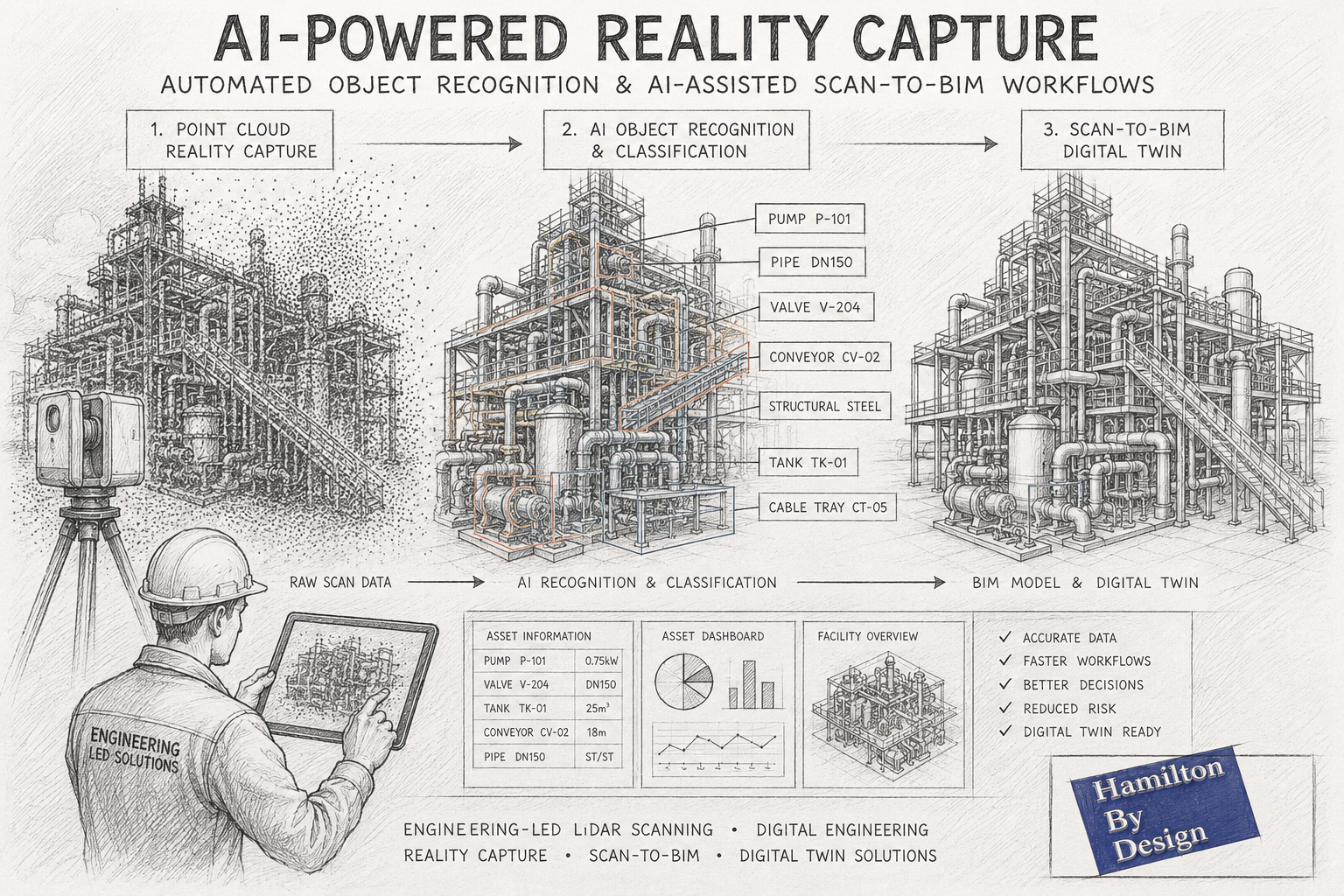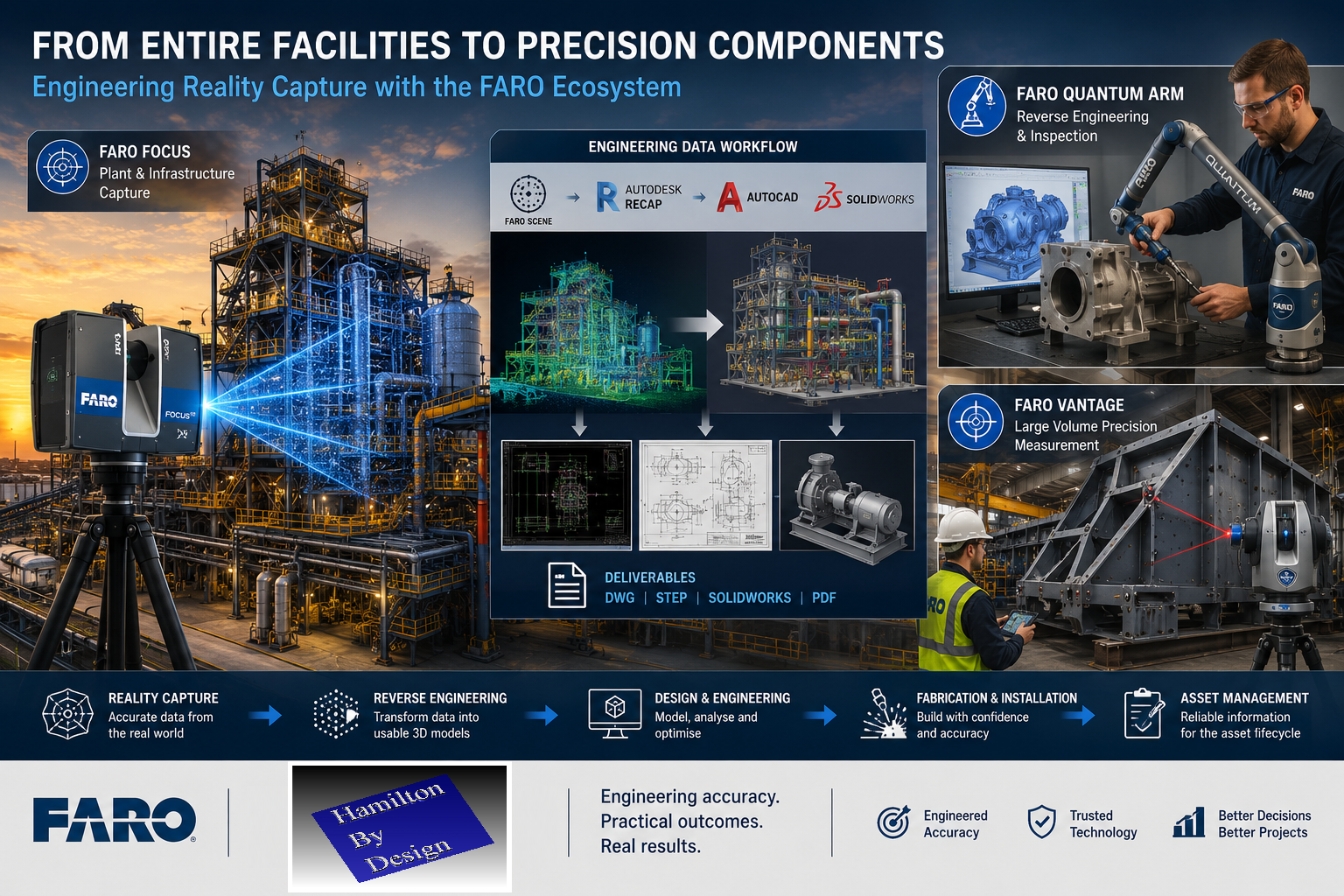
3D Scanning for Mining Shutdown Projects

3D Scanning for Mining Shutdown Projects | Engineering Laser Scanning

Mining shutdowns are critical windows where maintenance, upgrades, and engineering improvements must be completed quickly and safely. These shutdown periods often involve complex work scopes such as equipment replacements, structural upgrades, conveyor modifications, and new process installations.

One of the most effective technologies supporting shutdown planning today is engineering-grade 3D laser scanning. By capturing highly accurate spatial data of existing infrastructure, engineers can design and verify upgrades before the shutdown begins, reducing risk, rework, and costly delays.

At Hamilton By Design, 3D laser scanning plays a key role in helping mining operations capture accurate plant conditions and convert them into usable engineering data.


Why Mining Shutdowns Require Accurate Site Data

Mining plants evolve over decades. Equipment is modified, conveyors are relocated, structural steel is reinforced, and piping systems are extended or replaced. Unfortunately, plant drawings often do not reflect these changes.

During shutdown projects this creates significant risk, including:

  • Interference between new equipment and existing structures
  • Unexpected clashes with pipework or cable trays
  • Incorrect equipment fitment
  • Delays caused by rework or site modifications

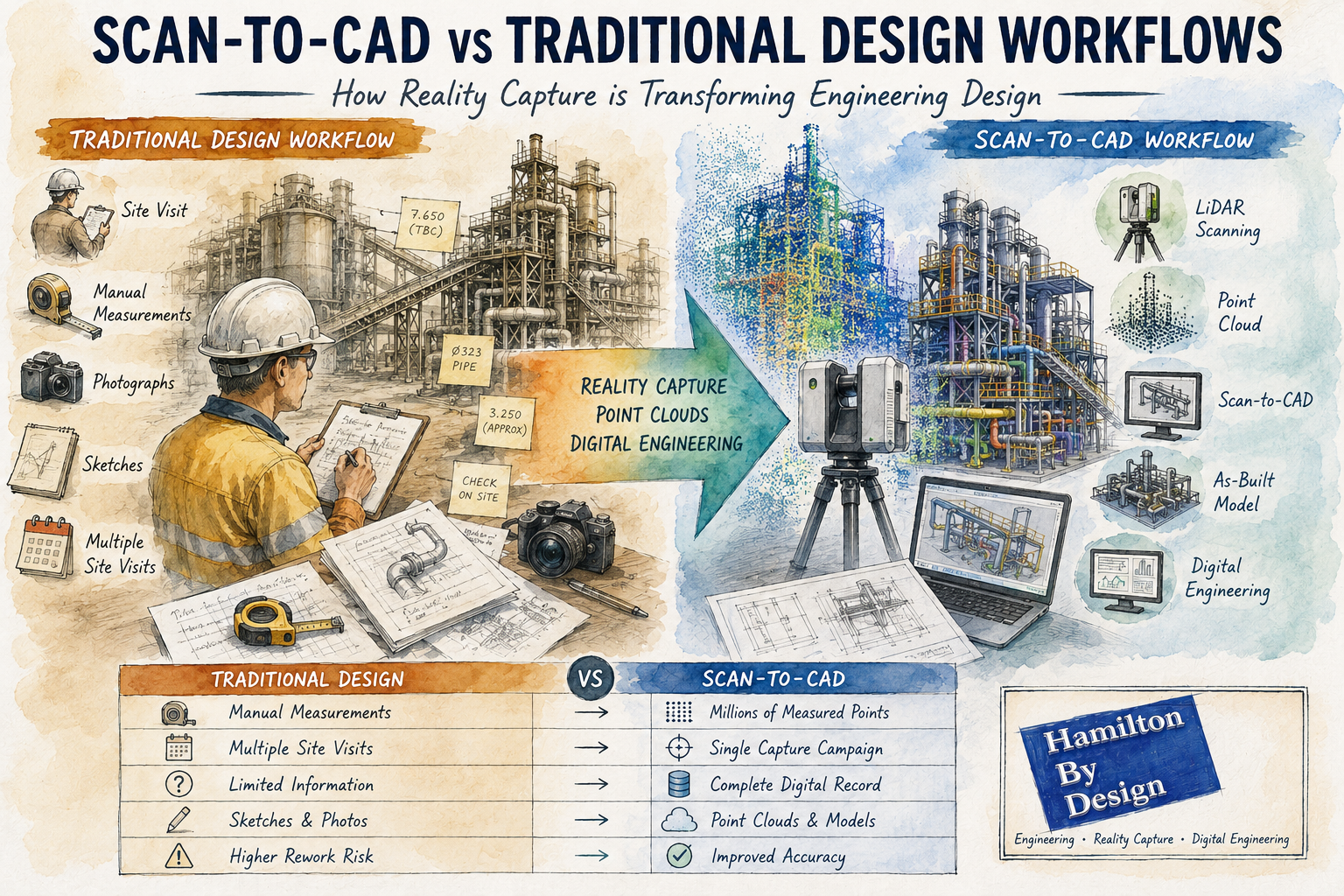
3D laser scanning eliminates these uncertainties by capturing the true as-built condition of the plant.

Millions of spatial measurements are collected in minutes, producing a detailed point cloud model of the plant that engineers can use during design and planning.


How 3D Laser Scanning Supports Shutdown Planning

Engineering scanning provides accurate digital data that allows engineers to prepare shutdown work well before crews arrive onsite.

Capture Existing Plant Geometry

Scanning records the exact positions of key plant infrastructure including:

  • Conveyor structures
  • Transfer chutes
  • Structural steel
  • Pump skids
  • Pipework and services
  • Access platforms and walkways

This data forms a digital model of the plant that engineers can use during design.


Scan-to-CAD Engineering Models

Once scanning is complete, the point cloud data can be converted into CAD models. These models allow engineers to:

  • Design new components around existing infrastructure
  • Develop fabrication drawings
  • Plan shutdown installation sequences
  • Verify spatial clearances

This process is commonly known as Scan-to-CAD engineering modelling.


Clash Detection Before the Shutdown

One of the biggest advantages of scanning is the ability to identify problems before the shutdown begins.

Engineers can compare the scanned plant with proposed designs and identify potential clashes between:

  • Existing structures
  • Pipework and services
  • New equipment
  • Structural modifications

This ensures equipment will fit correctly when installation begins.


Typical Shutdown Projects That Benefit from 3D Scanning

Many mining upgrade projects benefit from scanning before shutdown work begins.

Conveyor and Transfer Upgrades

Mining conveyors are frequently modified during shutdowns. Engineers may need to:

  • Redesign transfer chutes
  • Install new belt cleaners
  • Upgrade pulley assemblies
  • Replace conveyor structures

Scanning ensures new equipment integrates correctly with existing infrastructure.


Pump and Process Equipment Replacement

Pump skids and process equipment often require precise alignment with existing pipework and foundations.

3D scanning allows engineers to verify:

  • Pipe flange locations
  • Equipment clearances
  • Structural support requirements

This reduces installation issues during shutdown.


Structural Steel Modifications

Structural upgrades are common in older processing plants. Scanning helps engineers assess:

  • Beam locations
  • Column spacing
  • Structural clearances
  • Equipment support interfaces

Accurate geometry reduces fabrication errors.


Brownfield Plant Expansions

Shutdowns are often used to integrate new plant sections into existing infrastructure.

Scanning allows engineers to design upgrades within tight spatial constraints, particularly in brownfield mining environments where space is limited.


Engineering-Grade Scanning vs Survey Scanning

Not all scanning services are the same.

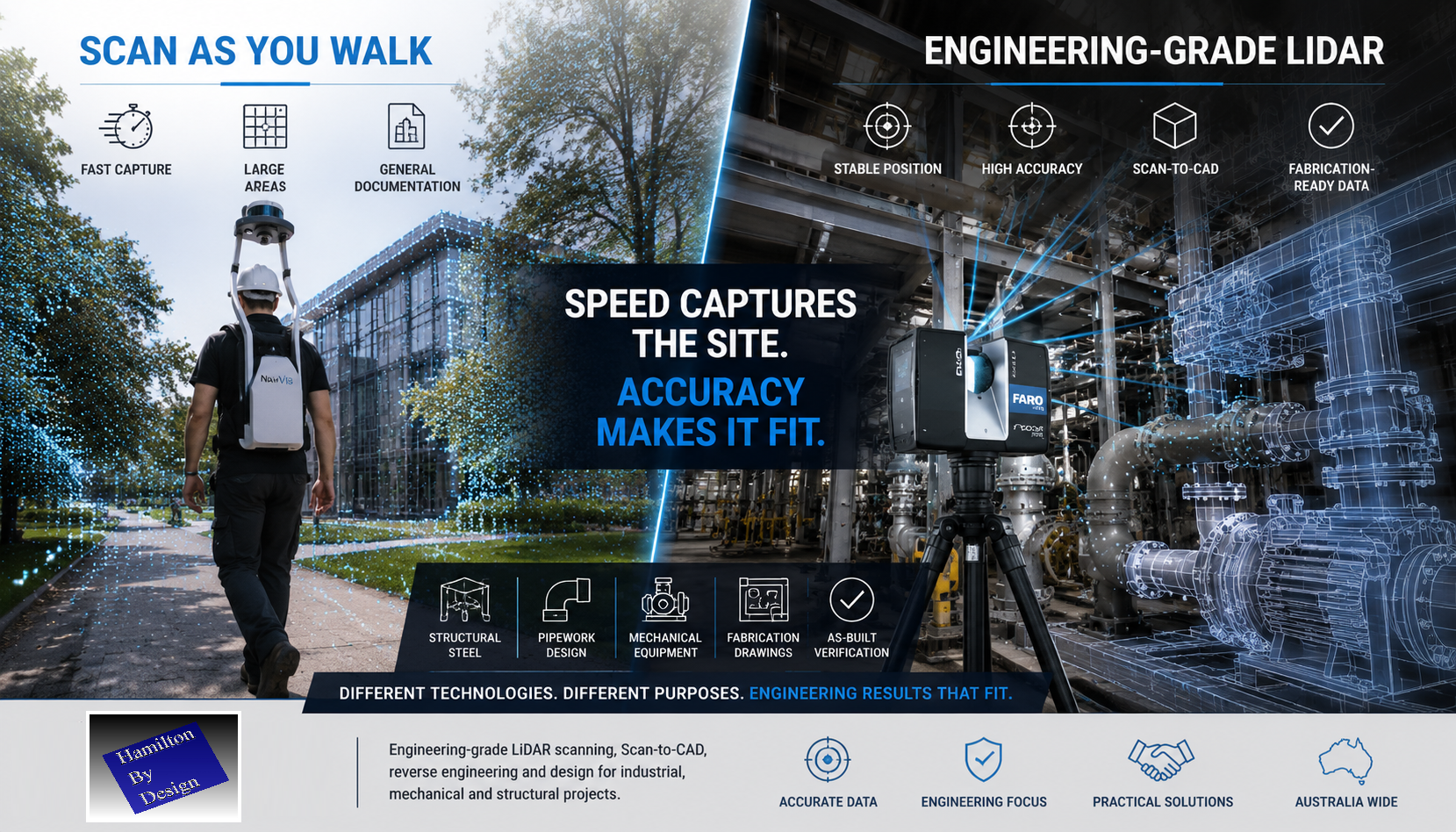
Engineering-grade scanning focuses on design and fabrication accuracy, rather than simply generating visual models.

Hamilton By Design scanning workflows typically combine:

  • Engineering LiDAR scanners
  • Handheld metrology scanners where required
  • SolidWorks modelling
  • Engineering interpretation of point cloud data

This ensures the data supports real engineering decisions, not just visualisation.


Benefits for Mining Operations

Using 3D scanning during shutdown planning delivers several key advantages.

Reduced shutdown risk through accurate site data.

Faster engineering design using precise plant geometry.

Improved fabrication accuracy for shutdown components.

Reduced rework caused by installation clashes.

Improved safety through better shutdown planning.


Supporting Mining Shutdown Projects with Engineering 3D Scanning

Hamilton By Design provides engineering-led 3D laser scanning services for mining and industrial projects across Australia.

Our scanning workflows support:

  • Shutdown planning
  • Mechanical design upgrades
  • Scan-to-CAD modelling
  • Structural verification
  • Plant layout assessments
3D LiDAR scanning and 3D modelling service button โ€” laser scanner capturing a point cloud for engineering and CAD modelling
Mechanical engineering services

By combining advanced scanning technology with mechanical engineering expertise, we help mining companies reduce risk and deliver successful shutdown projects.


Name
Would you like us to arrange a phone consultation for you?
Address

3D CAD Modelling Australia service banner for Hamilton By Design

Engineering-Grade 3D Laser Scanning for Mining & Industrial Projects

Executive infographic showing engineering-grade 3D laser scanning workflow from brownfield uncertainty to installed mining asset.

When a project slows down, itโ€™s rarely because the engineering team lacks capability. Itโ€™s usually because the site reality is unclear: legacy drawings donโ€™t match whatโ€™s installed, shutdown windows are tight, and one wrong assumption can cascade into rework, delays, and variation costs.

Engineering-grade 3D laser scanning is how you remove uncertainty early and build momentum fast.

At Hamilton By Design, we deliver 3D engineering scans that donโ€™t stop at โ€œcapturing points.โ€ We focus on engineering outcomesโ€”accurate as-built evidence, point cloud processing, scan-to-CAD modelling, and fit-for-purpose deliverables that support design, fabrication, and installation across mining and heavy industry.


Mining infrastructure upgrade workflow using LiDAR scanning, CAD modelling and engineering validation.

Why โ€œEngineering-Gradeโ€ Scanning Matters

Not all scanning services are equal. Scan density alone doesnโ€™t guarantee a usable engineering resultโ€”what matters is how the scan is controlled, interpreted, and translated into engineering decisions.

If youโ€™re planning upgrades in brownfield environments (plants, conveyors, chutes, pump skids, steelwork tie-ins), engineering-grade scanning helps you:

  • Verify true geometry before you design
  • Reduce shutdown risk and rework
  • Improve fit-up confidence for fabricated parts
  • Create accurate as-built documentation that stays useful over time

To understand what โ€œengineering-gradeโ€ really means, start here:
Engineering-Grade LiDAR Scanning (service page)
https://www.hamiltonbydesign.com.au/home/engineering-services/engineering-grade-lidar-scanning/

Engineering-Grade LiDAR Scanning (article/definition page)
https://www.hamiltonbydesign.com.au/engineering-grade-lidar-scanning/


Our Core 3D Engineering Scan Capability

3D Laser Scanning โ€“ Service Overview

This is the best โ€œhubโ€ page for prospects who want the full scanning capability and what it supports (engineering models, documentation, project delivery).
https://www.hamiltonbydesign.com.au/home/engineering-services/3d-laser-scanning/

3D Laser Scanning for Engineering

If your audience is engineers, project managers, and maintenance teams, this page speaks directly to engineering use-cases and how scanning reduces risk.
https://www.hamiltonbydesign.com.au/home/engineering-services/3d-laser-scanning/3d-laser-scanning-for-engineering/

Engineering-Grade 3D Laser Scanning Across Australia

For national capability (remote sites, shutdown support, travel-ready service delivery), use this page as the authority link.
https://www.hamiltonbydesign.com.au/engineering-grade-3d-laser-scanning-australia/

3D Laser Scanning Across Australia

A complementary national service page that reinforces coverage across mining, industry, and infrastructure.
https://www.hamiltonbydesign.com.au/home/engineering-services/3d-laser-scanning/3d-laser-scanning-across-australia/


Turning Point Clouds into Real Project Momentum

A point cloud is evidenceโ€”but the value is unlocked when that evidence becomes engineering geometry and fabrication-ready decisions.

Hamilton By Design supports scan-based workflows that typically include:

  • Scan control and site capture planning
  • Point cloud processing aligned to engineering datums
  • Model development for fit-up checks and tie-ins
  • Documentation updates and revision control pathways

For scanning + modelling capability in one place:
3D LiDAR Scanning and 3D Modelling (Sydney)
https://www.hamiltonbydesign.com.au/home/3d-lidar-scanning-and-3d-modelling-in-sydney/

For reverse engineering where the goal is better outcomes, not just copying old geometry:
Reverse Engineer 3D Scanning
https://www.hamiltonbydesign.com.au/reverse-engineer-3d-scanning/


Construction & Fit-Out Scanning (Sydney and Greater Metro)

For construction, retrofit, or building services environments, scanning often supports safe coordination, clash reduction, and fast design decisions.

If your audience includes builders, architects, MEP contractors, or refurbishment teams, link these pages:

3D Scanning for Construction in Sydney
https://www.hamiltonbydesign.com.au/home/engineering-services/3d-scanning-sydney/3d-scanning-for-construction-in-sydney/

3D Construction Scan Sydney
https://www.hamiltonbydesign.com.au/home/engineering-services/3d-scanning-sydney/3d-scanning-services-in-sydney/3d-construction-scan-sydney/

3D Scanning & BIM Across Greater Sydney
https://www.hamiltonbydesign.com.au/home/engineering-services/3d-scanning-sydney/3d-scanning-bim-greater-sydney/

3D LiDAR Scanning Chatswood & Greater Sydney
https://www.hamiltonbydesign.com.au/home/engineering-services/3d-scanning-sydney/3d-scanning-services-in-sydney/mechanical-engineers-in-sydney-hamilton-by-design/3d-lidar-scanning-chatswood/


Mining and Process Plant Scanning (CHPP and Heavy Industry)

Mining projects demand more than visual accuracyโ€”they demand engineering judgement around interfaces, access constraints, and shutdown deliverability.

If you want a clear scanning-to-mining outcome page, use:
CHPP Engineering, 3D Scanning & Upgrade Services
https://www.hamiltonbydesign.com.au/home/engineering-services/mining-engineering-services-australia/chpp-engineering-3d-scanning-upgrade-services/

For an educational/insight piece that supports credibility and internal linking:
How LiDAR Scanning is Transforming Mining Process Plants
https://www.hamiltonbydesign.com.au/seeing-the-unseen-how-lidar-scanning-is-transforming-mining-process-plants/


Regional and Project Delivery Pages

These pages are useful for local SEO and converting clients who search by region:
3D Scanning Engineering in Brisbane
https://www.hamiltonbydesign.com.au/home/engineering-services/3d-laser-scanning/3d-scanning-engineering-brisbane/

3D Laser Scanning & Mechanical Engineering in Wyong (NSW Central Coast)
https://www.hamiltonbydesign.com.au/nsw-central-coast/3d-laser-scanning-mechanical-engineering-in-wyong-nsw/


Ready to Start With an Engineering-Grade Scan?

If your project involves brownfield upgrades, shutdown tie-ins, or legacy infrastructure that canโ€™t be trusted from drawings alone, the fastest way to move forward is to capture reality, then design with certainty.

Start with the main scanning overview and follow the pathway that matches your project:


3D LiDAR scanning and 3D modelling service button โ€” laser scanner capturing a point cloud for engineering and CAD modelling
Mechanical engineering services
Name
Would you like us to arrange a phone consultation for you?
Address

3D CAD Modelling Australia service banner for Hamilton By Design

Why Projects Fail Before Construction Starts

3D scanning reality capture workflow converting legacy drawings into a verified site model for construction planning.

The missing step between site reality and project planning

Most project delays donโ€™t begin during construction.

They begin months earlier โ€” at the planning stage.

Not because engineers lack skill.
Not because contractors lack experience.

But because decisions are made using incomplete or assumed information.


Construction planning comparison between assumed data and verified point-cloud model using laser scanning.

The hidden gap in almost every project

In industrial and brownfield environments, teams typically work from:

  • legacy drawings
  • outdated models
  • partial surveys
  • contractor interpretation
  • verbal site knowledge

Each group fills in the missing details differently.

The result is predictable:

  • clashes discovered during installation
  • materials ordered incorrectly
  • redesign during construction
  • variations and disputes
  • safety risks

The project didnโ€™t fail during construction.
It failed when planning began without verified reality.


Planning systems only work if the starting data is correct

Modern project environments rely heavily on structured planning:
  • scheduling
  • procurement
  • prefabrication
  • shutdown coordination
  • multi-contractor installation

But structured planning requires structured information.

If the starting information is uncertain, the entire workflow becomes an organised way of distributing errors.


The role of a reality-based dataset

Before a project can be planned properly, one thing must exist:

A trusted digital representation of the physical asset

This is not a drawing.
This is not a sketch.
This is not a collection of markups.

It is a measurable, verifiable record of what physically exists.

Once this exists:

  • engineers design accurately
  • planners sequence correctly
  • contractors install confidently
  • procurement orders correctly
  • changes are controlled

What our consultancy provides

Hamilton By Design acts as the bridge between site conditions and project planning.

We provide a structured workflow:

  1. Capture the physical environment using high-accuracy laser scanning
  2. Create a controlled digital model of the asset
  3. Make the data accessible to all project stakeholders
  4. Lock the dataset during design and upgrade phases
  5. Update the dataset following modifications

This creates a single project reference โ€” removing interpretation between disciplines.


The outcome for projects

Instead of discovering problems during installation, they are resolved during planning.

Instead of managing variations, teams manage decisions.

Instead of reacting to site conditions, teams design around verified reality.


The value of independent verification

Our role is not to design the system or build the works.

Our role is to ensure every party begins with the same trusted information.

When reality is agreed, coordination becomes straightforward.


Before planning, establish certainty

Projects do not fail because teams are incapable.
They fail because teams start from different assumptions.

Providing a verified digital record of the site removes those assumptions.

And once assumptions disappear โ€” so do most surprises.


Hamilton By Design
Creating trusted project reality before planning begins.

Name
Would you like us to arrange a phone consultation for you?
Address


3D LiDAR scanning and 3D modelling service button โ€” laser scanner capturing a point cloud for engineering and CAD modelling
Mechanical engineering services
Finite Element Analysis (FEA) engineering simulation button
Mechanical engineering services

3D Laser Scanning Brisbane โ€“ From Site Capture to Engineering Outcomes

Engineering-grade laser scanning of Australian industrial and mining assets

3D Laser Scanning Brisbane | Site Capture to Engineering Outcomes

A Connected Workflow for Reliable Project Delivery

Most projects in Brisbane do not begin with empty space.
They begin with existing buildings, infrastructure and operating facilities.

Over time, equipment is replaced, services are rerouted and structures are modified. Drawings rarely keep pace with reality. When upgrades are designed from outdated information, installation conflicts and construction delays follow.

3D laser scanning allows project teams to start with measured conditions rather than assumptions.

Hamilton By Design provides a connected workflow โ€” from site capture through to engineering modelling โ€” supporting accurate design and predictable installation.


3D LiDAR scanning services across Australia for mining and industrial facilities

Step 1 โ€” Capture the Real Conditions

Start with measured reality

The first step is collecting reliable site data using high-accuracy LiDAR scanning. This creates a spatial record of structures, services and equipment exactly as they exist.

3D Scanning Brisbane
https://www.hamiltonbydesign.com.au/laser-scanning-engineering-brisbane-cbd/3d-scanning-brisbane/

This process replaces manual measurement and reduces uncertainty before design begins.


Step 2 โ€” Apply Engineering Understanding

Turn measurements into decisions
Scan data alone does not solve problems โ€” interpretation does.
Engineering review ensures the captured data supports real project outcomes such as upgrades, replacements and modifications.
3D Scanning Engineering Brisbane
https://www.hamiltonbydesign.com.au/home/engineering-services/3d-laser-scanning/3d-scanning-engineering-brisbane/

This stage identifies constraints, access limitations and constructability issues before fabrication.


Step 3 โ€” Develop Buildable Models

Create fabrication-ready information

Once verified, the measured conditions are converted into coordinated models used by designers, fabricators and contractors.

Scan to CAD Brisbane
https://www.hamiltonbydesign.com.au/scan-to-cad-brisbane/

Accurate models allow components to be designed to fit existing conditions rather than adjusted in the field.


Step 4 โ€” Apply to Real Projects

Support upgrades and modifications

Reliable as-built information improves planning and installation across many sectors:

3D Scanning Services in Brisbane
https://www.hamiltonbydesign.com.au/laser-scanning-engineering-brisbane-cbd/3d-scanning-brisbane/3d-scanning-services-in-brisbane/

Typical applications include industrial upgrades, infrastructure changes and facility modifications.


Why a Connected Workflow Matters

Many project delays occur because measurement, modelling and engineering are treated as separate tasks. When they are integrated, problems are identified earlier and resolved more efficiently.

This approach helps:

  • reduce rework
  • shorten shutdown durations
  • improve installation certainty
  • support accurate fabrication

Instead of reacting to site conditions, projects are planned around them.


Hamilton By Design logo displayed on a blue tilted rectangle with a grey gradient background

Engineering Starts With Reliable Information

The quality of the final outcome depends on the quality of the starting data.
When existing conditions are known, design becomes predictable.

By linking site capture, modelling and engineering decisions, projects can move forward with confidence.

If your project depends on existing assets, accurate measurement is the first step toward reliable delivery.

3D LiDAR scanning and 3D modelling service button โ€” laser scanner capturing a point cloud for engineering and CAD modelling
Mechanical engineering services
Name
Would you like us to arrange a phone consultation for you?
Address

3D CAD Modelling Australia service banner for Hamilton By Design

LiDAR Scanning for Industrial Retrofit Engineering

Industrial facility captured using 3D laser scanning for brownfield plant upgrade

LiDAR Scanning for Industrial Retrofit Engineering | Brownfield Plant As-Built Capture

Steel Mills, Manufacturing Plants & Legacy Facility Upgrades

Across industrial regions such as Pittsburgh, Carnegie and Norristown, engineering teams are not scanning sites for mapping โ€” they are scanning them because they are about to change something critical.

Brownfield facilities rarely match drawings.
Plant modifications fail when decisions are made from assumptions rather than measurements.

Hamilton By Design provides engineering-grade LiDAR scanning and modelling specifically for retrofit engineering โ€” capturing existing assets so upgrades install correctly the first time.


Engineer performing industrial LiDAR scan of a processing plant for retrofit design

Why Industrial Facilities Require Scanning Before Design

In heavy industry the problem is rarely design capability โ€” it is uncertainty of the existing plant.

Old facilities typically contain:

  • undocumented structural alterations
  • relocated services and pipework
  • equipment installed over decades
  • distorted steelwork
  • unavailable or unreliable drawings

When upgrades are designed from historical drawings, fabrication errors and shutdown overruns occur.

Our process replaces assumption with measured reality.

We capture what actually exists โ€” then design from truth.

Hamilton By Design combines mechanical engineering with LiDAR capture to reduce fabrication and installation risk on operating assets.


Typical Projects Supported

Brownfield Industrial Plants

  • plant expansions
  • conveyor modifications
  • structural replacement
  • maintenance shutdown preparation

Steel Mills & Heavy Manufacturing

  • equipment replacement
  • platform and access upgrades
  • retrofit guarding & compliance
  • mechanical component redesign

Utilities & Processing Facilities

  • pipe routing development
  • pump and tank replacement
  • asset life-extension upgrades
  • tie-in engineering

These projects require accurate as-built conditions before design โ€” not survey grade positioning, but engineering-grade dimensional certainty.


Our Retrofit Engineering Workflow

1. Field Capture โ€” Engineering LiDAR Scanning

We capture operating facilities without interrupting production and obtain full spatial reality of structures, equipment and services.

2. Digital As-Built Model

Point cloud data is converted into coordinated 3D engineering models for decision-making and clash prevention.

3. Mechanical & Structural Design

Designs are developed directly from measured geometry rather than historic drawings.

4. Fabrication-Ready Deliverables

We provide models and drawings suitable for fabrication and installation.

This approach allows components to fit existing plant conditions on installation rather than being adjusted in the field.


What This Solves

Industrial retrofit projects fail due to dimensional unknowns โ€” not poor engineering.

LiDAR-driven design removes:

  • shutdown delays
  • rework fabrication
  • on-site modifications
  • installation conflicts
  • access clashes

Hamilton By Design supports manufacturing, processing and heavy industry with accurate as-built data and coordinated models for upgrades, maintenance and asset life-extension projects.


Engineering-Led Scanning โ€” Not Just Surveying

Many scanning providers supply point clouds.

We provide engineering decisions.

The difference is accountability โ€” one team responsible from measurement to design.

One team accountable from scan to fabrication.


When to Engage Us

Engage scanning early when a project involves:

  • replacing equipment
  • modifying structure
  • adding services
  • shutdown installation
  • upgrading legacy facilities

If fabrication depends on existing conditions, scanning should precede design โ€” not follow it.


Hamilton By Design logo displayed on a blue tilted rectangle with a grey gradient background

Talk to Hamilton By Design

Hamilton By Design delivers engineering-grade LiDAR scanning and retrofit design support for operating industrial assets worldwide.

Reduce installation risk.
Design from measured reality.

Name
Would you like us to arrange a phone consultation for you?
Address
Name
Would you like us to arrange a phone consultation for you?
Address

3D CAD Modelling Australia service banner for Hamilton By Design
3D LiDAR scanning and 3D modelling service button โ€” laser scanner capturing a point cloud for engineering and CAD modelling
Mechanical engineering services
Finite Element Analysis (FEA) engineering simulation button
Mechanical engineering services

3D Engineering Scanning in Fiji โ€“ Reliable Point Clouds for Global Engineering

Engineer performing 3D laser scanning in Fiji with point cloud transforming into BIM model and FEA analysis beside a tropical port.

3D Engineering Scanning Fiji โ€“ Point Clouds for Design & FEA | Hamilton By Design

Hamilton By Design provides professional 3D laser scanning services across Fiji, delivering high-accuracy point clouds that allow designers, engineers, and asset owners anywhere in the world to work with real, measured dataโ€”without stepping foot on site.

Our focus is simple:
capture the truth of your asset once, and let every engineering discipline design from the same digital backbone.


Engineering-Grade Data You Can Design From

In Fiji, many industrial, marine, and commercial assets have:

  • incomplete or outdated drawings
  • decades of informal modifications
  • mixed construction standards
  • corrosion and cyclone damage history

Traditional measurement methods struggle in this environment. Our 3D scanning service produces a survey-accurate digital replica that can be used for:

  • 3D modelling in Revit, Plant3D, Tekla, SolidWorks
  • structural analysis and FEA studies
  • clash detection for new equipment
  • fabrication of steel and pipework
  • condition assessments and deformation checks

We deliver neutral, open formats so your teamโ€”anywhere in Australia, New Zealand, Fiji, or globallyโ€”can immediately begin engineering work.


What We Deliver

Core Outputs

  • Registered point clouds (E57 / RCP / LAS)
  • Colourised, engineering-accurate datasets
  • Site coordinate systems or project datum
  • Mesh models for Navisworks / visualisation
  • 2D plans, elevations, and sections

Optional Engineering Deliverables

  • Scan-to-BIM models (LOD 200โ€“350)
  • Steel and pipe geometry extraction
  • Tie-in coordinates for brownfields projects
  • Deformation and roundness reports
  • Clash and constructability reviews

Every dataset is processed in Australia under formal QA procedures so it can be relied upon for detailed design, certification, and FEA modelling.


Designed for Fiji Conditions

Scanning in Fiji requires more than equipmentโ€”it requires experience in Pacific environments.

We plan projects around:

  • tropical heat and humidity
  • sudden rain events
  • reflective stainless and bright sunlight
  • inter-island logistics
  • remote power and access constraints
  • cyclone season scheduling

Our workflows are built so field capture is efficient and robust, while processing and modelling are completed by our Australian engineering team.


Industries We Support in Fiji

  • Ports and wharves โ€“ Suva, Lautoka, Levuka
  • Power generation and utilities
  • Sugar and food processing plants
  • Water and wastewater infrastructure
  • Resorts and commercial buildings
  • Bridges and civil structures
  • Post-cyclone assessments
  • Mining and materials handling

A Digital Backbone for Global Teams

A quality scan is the backbone of every downstream task.
If the backbone is wrong, every model, drawing, and FEA result is compromised.

Our aim is to give your project a foundation that:

  • removes re-measure risk
  • allows off-site fabrication
  • supports remote engineering teams
  • shortens shutdowns
  • improves safety and constructability

Designers and engineers in any location can open our data and begin work immediatelyโ€”confident it represents the real world.

3D LiDAR scanning and 3D modelling service button โ€” laser scanner capturing a point cloud for engineering and CAD modelling
Mechanical engineering services

Hamilton By Design logo displayed on a blue tilted rectangle with a grey gradient background

Why Choose Hamilton By Design

  • Engineer-led scanning team
  • Australian processing and QA
  • experience in PNG and Pacific brownfields
  • deliverables tailored to your software
  • practical understanding of fabrication and FEA requirements

We donโ€™t just capture pointsโ€”we deliver usable engineering information.


Talk to Us About Your Fiji Project

Whether you need a single building, a wharf, or a full processing plant captured, we can mobilise quickly and provide data your global team can trust.

Hamilton By Design
Engineering certainty through 3D scanning.

Name
Would you like us to arrange a phone consultation for you?
Address

3D CAD Modelling Australia service banner for Hamilton By Design
Finite Element Analysis (FEA) engineering simulation button
Mechanical engineering services