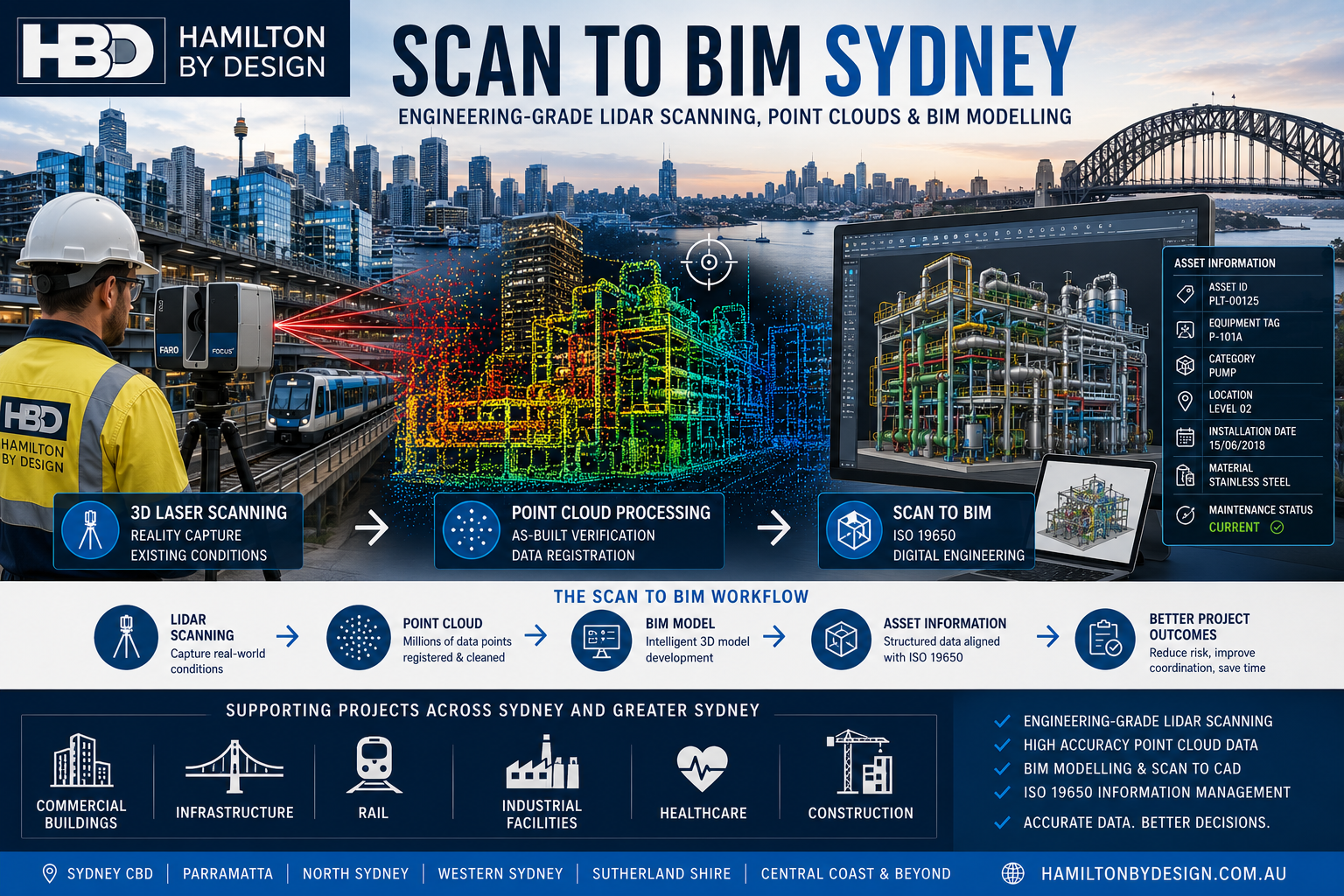
Scan to BIM Sydney

Scan to BIM Sydney infographic showing LiDAR laser scanning, point cloud processing and BIM modelling workflow for Sydney commercial, infrastructure and industrial projects using ISO 19650 information management principles.

Engineering-Grade Reality Capture and BIM Modelling

Sydney is Australia’s largest construction, infrastructure and commercial property market. From high-rise developments and transport infrastructure to hospitals, industrial facilities and heritage buildings, project teams increasingly rely on accurate digital information to reduce risk and improve project outcomes.

Scan to BIM Sydney combines advanced 3D laser scanning, LiDAR technology and Building Information Modelling (BIM) to create accurate digital representations of existing assets. The result is a reliable foundation for design, construction, maintenance and asset management decisions.

At Hamilton By Design, Scan to BIM is delivered from an engineering perspective, ensuring that models are developed to support real project requirements rather than simply producing visual geometry.


What is Scan to BIM?

Scan to BIM is the process of capturing existing conditions using high-accuracy laser scanning equipment and converting the resulting point cloud data into intelligent BIM models.

The process typically includes:

  • 3D Laser Scanning and LiDAR Capture
  • Point Cloud Registration
  • Existing Condition Surveys
  • Scan to CAD Conversion
  • BIM Model Development
  • As-Built Verification
  • Asset Information Management
  • Design Coordination and Clash Detection

The final BIM model provides a detailed and measurable representation of the real-world asset.


Why Sydney Projects Use Scan to BIM

Many Sydney assets have undergone multiple modifications over decades. Original drawings are often incomplete, outdated or unavailable.

Scan to BIM helps project teams overcome these challenges by providing:

Improved Accuracy

Laser scanning captures millions of measurements in a matter of minutes, creating an accurate record of existing conditions.

Reduced Project Risk

Accurate as-built information reduces design assumptions and minimises costly rework during construction.

Better Coordination

Architects, engineers, contractors and asset owners can work from a common source of information.

Faster Project Delivery

Reliable digital data allows design teams to progress more efficiently and with greater confidence.

Enhanced Safety

Understanding existing conditions before commencing work helps identify potential hazards and access constraints.


Applications of Scan to BIM in Sydney

Hamilton By Design supports a wide range of industries and project types across Sydney and Greater Sydney.

Commercial Buildings

  • Office towers
  • Shopping centres
  • Mixed-use developments
  • Building refurbishments
  • Property management

Infrastructure

  • Rail facilities
  • Transport interchanges
  • Utility assets
  • Water treatment facilities
  • Public infrastructure projects

Industrial Facilities

  • Manufacturing plants
  • Warehouses
  • Processing facilities
  • Bulk materials handling systems
  • Distribution centres

Healthcare and Education

  • Hospitals
  • Medical centres
  • Universities
  • Schools
  • Research facilities

Heritage Buildings

Laser scanning provides a non-contact method of accurately documenting complex heritage structures while preserving historical integrity.


Engineering-Led Scan to BIM

A successful Scan to BIM project requires more than simply converting a point cloud into a model.

Engineering considerations include:

  • Required level of detail (LOD)
  • Asset criticality
  • Intended use of the model
  • Data accuracy requirements
  • Information classification
  • Future maintenance requirements

Hamilton By Design applies engineering knowledge throughout the process to ensure the final BIM model supports operational and project objectives.


Scan to BIM and ISO 19650

Modern BIM projects increasingly require structured information management.

The international standard ISO 19650 provides a framework for managing information throughout the asset lifecycle.

By aligning Scan to BIM workflows with ISO 19650 principles, organisations can improve:

  • Information quality
  • Document control
  • Asset data consistency
  • Collaboration between stakeholders
  • Long-term asset management outcomes

For further information, read:

👉 ISO 19650, Scan to BIM and Information Management


Academic Perspective on Scan to BIM

While Scan to BIM offers significant benefits, organisations should also understand its limitations, implementation challenges and future development pathways.

For a detailed academic discussion, including the advantages, disadvantages and future direction of Scan to BIM technologies, refer to:

👉 Scan to BIM Academic Review


Typical Scan to BIM Workflow

1. Site Capture

High-accuracy LiDAR scanning is performed across the project area.

2. Point Cloud Processing

Individual scans are registered into a unified point cloud dataset.

3. Data Review

The point cloud is reviewed and validated against project requirements.

4. BIM Development

The point cloud is converted into BIM geometry and asset information.

5. Quality Assurance

Models are checked against project specifications and accuracy requirements.

6. Information Delivery

The final BIM deliverables are provided for design, construction or asset management use.


Scan to BIM Sydney Services

Hamilton By Design supports projects throughout:

  • Sydney CBD
  • Western Sydney
  • Parramatta
  • Liverpool
  • Penrith
  • North Sydney
  • Chatswood
  • Macquarie Park
  • Sutherland Shire
  • Newcastle and Hunter Region
  • Central Coast

Services include:

  • Engineering-Grade LiDAR Scanning
  • Scan to BIM
  • Scan to CAD
  • Point Cloud Processing
  • As-Built Modelling
  • Structural Modelling
  • Mechanical Plant Modelling
  • Asset Information Capture
  • Digital Engineering Support

Why Choose Hamilton By Design?

Hamilton By Design combines practical engineering experience with advanced reality capture technology.

Our approach focuses on delivering information that can be used by engineers, project managers, contractors and asset owners to make better decisions throughout the asset lifecycle.

Whether supporting a commercial building upgrade, industrial facility expansion, transport infrastructure project or digital asset management initiative, our Scan to BIM services provide a reliable foundation for project success.


Hamilton By Design logo displayed on a blue tilted rectangle with a grey gradient background

Contact Hamilton By Design


Looking for Scan to BIM Sydney services?

Hamilton By Design provides engineering-grade LiDAR scanning, point cloud processing, Scan to CAD and BIM modelling services across Sydney, Greater Sydney and regional New South Wales.

Accurate Data. Better Design. Safer Construction. Smarter Asset Management.

Name
Would you like us to arrange a phone consultation for you?
Address

Academic Review
Australian Drafting logo featuring bold white text reading "Australian Drafting" centred on a blue rounded rectangle background.
Engineering Governance title graphic featuring bold white text reading "Engineering Governance" centred on a blue rounded rectangle background.
Mechanical, Structural & Pipework Drafting service banner by Hamilton By Design featuring white text on a blue background.
Mechanical engineering services
Blue rounded button with the text “SolidWorks Design” in white.
Finite Element Analysis (FEA) engineering simulation button
3D LiDAR Scanning Darwin for engineering surveys, laser scanning, reality capture and point cloud modelling services
3D LiDAR Scanning Australia engineering services for laser scanning, reality capture, scan-to-CAD, Scan-to-BIM and as-built documentation across Australia
3D LiDAR scanning services on the Central Coast providing engineering-grade laser scanning, point cloud capture, scan-to-CAD modelling and industrial reality capture for infrastructure and industrial projects.
3D LiDAR Scanning Perth for engineering surveys, laser scanning, reality capture and point cloud modelling services
3D LiDAR Scanning Sydney for engineering surveys, laser scanning, reality capture and point cloud modelling services
3D LiDAR Scanning Brisbane for engineering surveys, laser scanning, reality capture and point cloud modelling services
3D LiDAR Scanning Canberra for engineering surveys, laser scanning, reality capture and point cloud modelling services
3D LiDAR Scanning Newcastle for engineering surveys, laser scanning, reality capture and point cloud modelling services
3D LiDAR Scanning Adelaide for engineering surveys, laser scanning, reality capture and point cloud modelling services
https://www.hamiltonbydesign.com.au/scan-to-bim-services-australia-lidar-point-clouds-cad-modelling
3D LiDAR Scanning Darwin for engineering surveys, laser scanning, reality capture and point cloud modelling services
3D LiDAR Scanning Australia engineering services for laser scanning, reality capture, scan-to-CAD, Scan-to-BIM and as-built documentation across Australia
3D LiDAR scanning services on the Central Coast providing engineering-grade laser scanning, point cloud capture, scan-to-CAD modelling and industrial reality capture for infrastructure and industrial projects.

Scan to BIM Australia

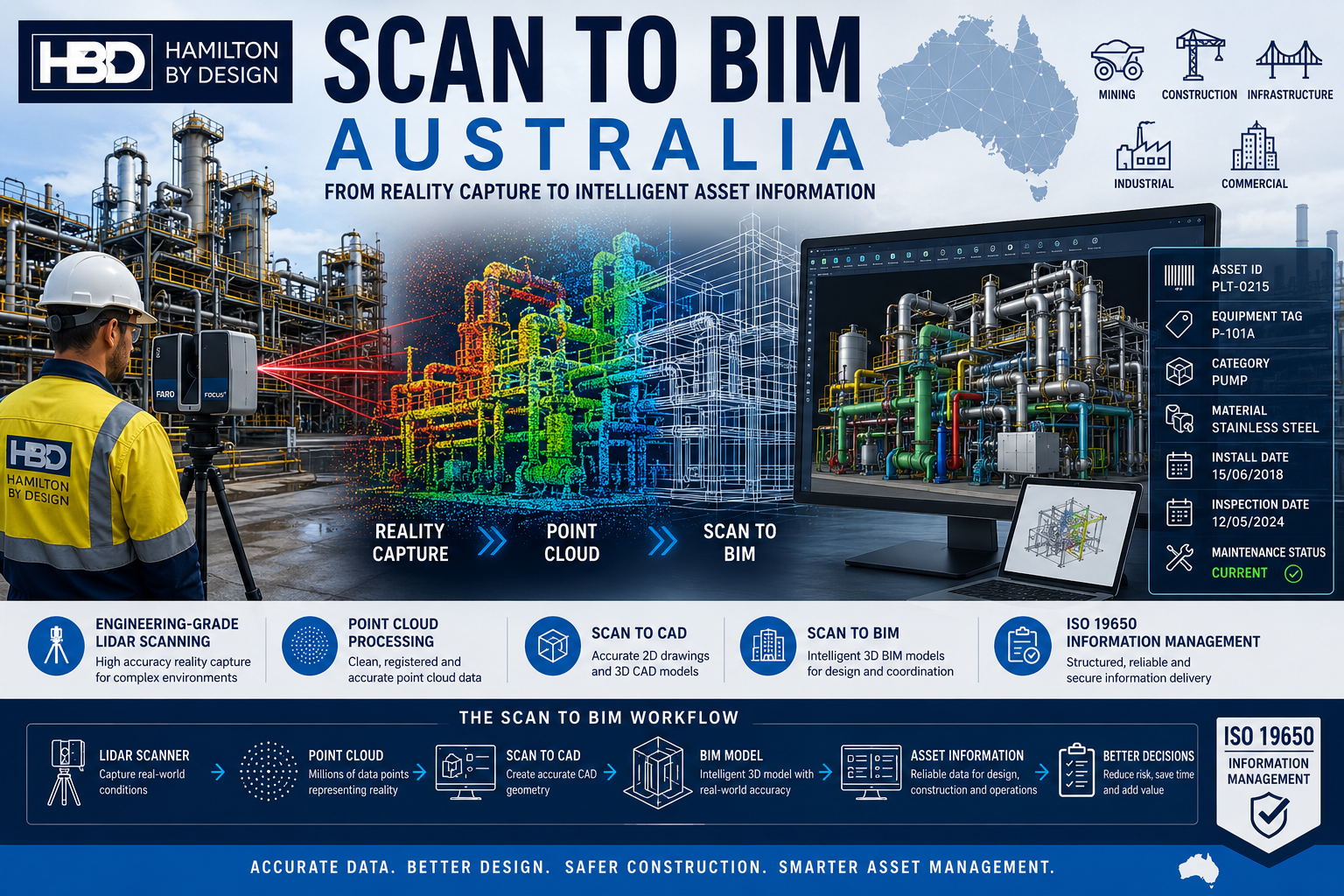
Scan to BIM Australia infographic showing an engineer performing LiDAR laser scanning of an industrial processing plant, with point cloud data converted into a BIM model and ISO 19650 information management workflow.

Engineering-Grade Reality Capture for Better Building Information

Across Australia, Scan to BIM is becoming an important part of how buildings, plants, infrastructure and industrial facilities are measured, documented and managed.

For existing assets, traditional drawings are often incomplete, outdated or missing. Scan to BIM helps solve this problem by using 3D laser scanning and point cloud data to create accurate digital building information models.

At Hamilton By Design, Scan to BIM is approached from an engineering and information-management perspective — not just as a modelling exercise.

What is Scan to BIM?

Scan to BIM is the process of capturing real-world site conditions using 3D laser scanning, LiDAR or reality-capture equipment, then converting that point cloud data into useful BIM or CAD information.

This may include:

  • Existing building geometry
  • Structural steel and framing
  • Mechanical services and pipework
  • Plant rooms and industrial equipment
  • Access platforms, stairs and handrails
  • As-built verification
  • Clash checking and design coordination

The result is a more reliable digital record of the asset.

Why Scan to BIM Matters in Australia

Australian projects often involve brownfield sites, live facilities, mining infrastructure, commercial buildings, hospitals, schools, utilities and industrial plants. In these environments, guessing from old drawings creates risk.

Scan to BIM supports better decisions by providing:

  • More accurate existing-condition information
  • Reduced site rework
  • Improved design coordination
  • Safer planning before site works
  • Better asset information for future maintenance
  • Stronger alignment with ISO 19650 information-management principles

For a deeper academic discussion on the benefits, limitations and future direction of Scan to BIM, refer to this related article:

Scan to BIM

Scan to BIM and ISO 19650

Scan to BIM becomes more valuable when it is managed under a clear information-management framework.

ISO 19650 provides guidance on organising, naming, sharing and controlling information across the asset lifecycle. This is important because a 3D model is only useful if the information is structured, reliable and suitable for the project purpose.

Hamilton By Design has also written about this in more detail here:

ISO 19650, Scan to BIM and Information Management

Engineering-Led Scan to BIM

A good Scan to BIM workflow is not simply about creating a visually impressive model. It should support engineering, construction, safety and maintenance outcomes.

This means understanding:

  • What level of detail is required
  • What accuracy is suitable
  • Which areas are critical for design
  • How the model will be used
  • What information should be included or excluded
  • How the data will be controlled and updated

This is especially important for mining, infrastructure, manufacturing, commercial buildings and complex brownfield environments.

Conclusion

Scan to BIM in Australia is helping improve the way existing assets are captured, understood and managed. When combined with engineering experience and ISO 19650 information-management principles, it provides a practical foundation for better design, safer construction and more reliable asset information.

For Australian projects requiring 3D scanning, point cloud processing, Scan to CAD or Scan to BIM support, Hamilton By Design provides engineering-led reality capture services across a range of industrial and built environments.

Hamilton By Design logo displayed on a blue tilted rectangle with a grey gradient background

Contact Us – Talk to Us

Name
Would you like us to arrange a phone consultation for you?
Address
Australian Drafting logo featuring bold white text reading "Australian Drafting" centred on a blue rounded rectangle background.
Engineering Governance title graphic featuring bold white text reading "Engineering Governance" centred on a blue rounded rectangle background.
Mechanical, Structural & Pipework Drafting service banner by Hamilton By Design featuring white text on a blue background.
Mechanical engineering services
Blue rounded button with the text “SolidWorks Design” in white.
Finite Element Analysis (FEA) engineering simulation button
3D LiDAR Scanning Darwin for engineering surveys, laser scanning, reality capture and point cloud modelling services
3D LiDAR Scanning Australia engineering services for laser scanning, reality capture, scan-to-CAD, Scan-to-BIM and as-built documentation across Australia
3D LiDAR scanning services on the Central Coast providing engineering-grade laser scanning, point cloud capture, scan-to-CAD modelling and industrial reality capture for infrastructure and industrial projects.
3D LiDAR Scanning Perth for engineering surveys, laser scanning, reality capture and point cloud modelling services
3D LiDAR Scanning Sydney for engineering surveys, laser scanning, reality capture and point cloud modelling services
3D LiDAR Scanning Brisbane for engineering surveys, laser scanning, reality capture and point cloud modelling services
3D LiDAR Scanning Canberra for engineering surveys, laser scanning, reality capture and point cloud modelling services
3D LiDAR Scanning Newcastle for engineering surveys, laser scanning, reality capture and point cloud modelling services
3D LiDAR Scanning Adelaide for engineering surveys, laser scanning, reality capture and point cloud modelling services

Systems Engineering, Hazard Identification and Mining Safety

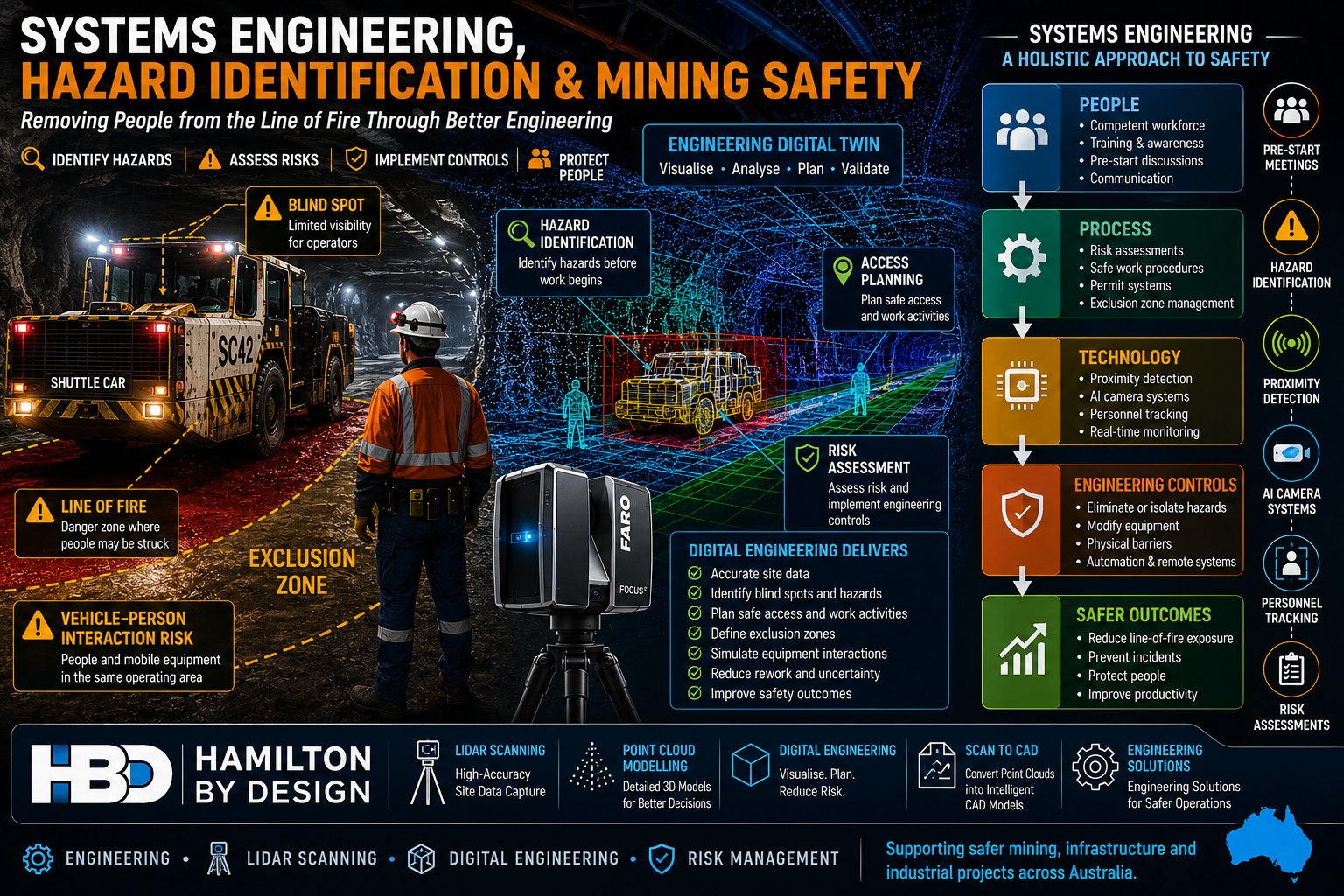
Systems engineering and mining safety infographic showing an underground shuttle car, exclusion zones, hazard identification, engineering digital twin, LiDAR scanning, risk assessment and engineering controls used to reduce line-of-fire risks and improve workplace safety in mining operations.

Lessons from a Preventable Underground Coal Mine Incident

The Technology Exists – So Why Are We Still Seeing These Incidents?

A recent Resources Safety & Health Queensland (RSHQ) investigation into a near-fatal underground coal mining incident has once again highlighted a challenge that continues to confront the mining industry.

The incident occurred at an underground coal mine near Emerald in Queensland’s Bowen Basin when a worker entered the blind spot of a shuttle car and was struck by the machine. Investigators identified several contributing factors including poor visibility, inadequate communication, high background noise, blind spots around mobile equipment and the absence of proximity detection technology. RSHQ described the event as entirely preventable and encouraged operators to consider technologies already being used successfully at other Queensland mines.

While incidents such as this are often discussed from an operational perspective, they also highlight a broader engineering challenge.

The real question is:

How do we design systems that prevent workers from being exposed to hazards in the first place?

This is where systems engineering becomes critically important.


What is Systems Engineering?

Systems engineering is the disciplined approach of understanding how people, equipment, processes, technology, procedures and the operating environment interact as a complete system.

Rather than focusing on individual components, systems engineering examines:

  • Human factors
  • Equipment design
  • Communication systems
  • Work procedures
  • Environmental conditions
  • Technology controls
  • Organisational culture
  • Training and competency
  • Risk management processes

When a serious incident occurs, it is rarely caused by a single failure.

Instead, multiple weaknesses align simultaneously.

In the Emerald incident, the shuttle car itself was not necessarily defective.

The system failed because:

  • Workers changed position without positive communication.
  • The vehicle operator was unaware of the workers’ location.
  • Visibility was limited.
  • Background noise masked movement.
  • No proximity detection technology was available.
  • Workers entered a line-of-fire zone.

A systems engineering approach asks:

What combination of controls could have prevented the event regardless of human error?


The Hierarchy of Controls

One of the most important principles in safety engineering is the Hierarchy of Controls.

Controls are generally ranked from most effective to least effective:

  1. Elimination
  2. Substitution
  3. Engineering Controls
  4. Administrative Controls
  5. Personal Protective Equipment

Many organisations rely heavily on procedures, training and pre-start discussions.

While these are important, they sit relatively low in the hierarchy.

Engineering controls are often more reliable because they do not depend entirely on human behaviour.

Examples include:

  • Proximity detection systems
  • AI camera systems
  • Collision avoidance systems
  • Personnel tracking systems
  • Physical barriers
  • Interlocks
  • Remote operation technology
  • Autonomous equipment

The objective should always be to engineer hazards out of the system wherever practical.


Hazard Identification Starts Before Work Begins

One of the most effective safety tools available is proactive hazard identification.

Many incidents occur because hazards are recognised only after work has commenced.

Hazard identification should occur during:

Project Planning

Before construction or maintenance work begins.

Design Reviews

Before equipment is fabricated or modified.

Shutdown Planning

Before personnel enter operational areas.

Pre-Start Meetings

Before workers commence each shift.

Field Risk Assessments

Immediately before performing a task.

A robust hazard identification process considers:

  • Mobile equipment interactions
  • Blind spots
  • Stored energy
  • Working at heights
  • Falling objects
  • Confined spaces
  • Vehicle movements
  • Emergency access
  • Simultaneous operations
  • Human factors

The goal is simple:

Identify hazards before they have an opportunity to cause harm.


Why Pre-Start Meetings Matter

In many operations, pre-start meetings can become routine.

Unfortunately, routine often leads to complacency.

The most effective pre-start meetings are not simply administrative exercises.

They provide an opportunity to discuss:

What Has Changed?

  • New equipment
  • New personnel
  • Different environmental conditions
  • Weather impacts
  • Operational changes

What Are Today’s Hazards?

  • Vehicle interactions
  • Exclusion zones
  • Ground conditions
  • Overhead hazards
  • Isolation requirements

What Are the Critical Controls?

  • Spotters
  • Communication methods
  • Isolation procedures
  • Permit requirements
  • Emergency response arrangements

What Could Go Wrong?

This question alone can significantly improve hazard awareness.

A quality pre-start discussion encourages workers to actively think about risk before entering the workplace.


Line-of-Fire Hazards Remain a Major Industry Risk

Across mining, construction, manufacturing and heavy industry, line-of-fire incidents continue to be one of the leading causes of serious injury and fatalities.

Line-of-fire hazards include situations where workers are exposed to:

  • Moving vehicles
  • Rotating equipment
  • Suspended loads
  • Stored energy
  • Pressurised systems
  • Falling objects
  • Uncontrolled equipment movement

Recent Queensland mining safety alerts have repeatedly highlighted similar themes:

  • Workers trapped between vehicles.
  • Workers entering exclusion zones.
  • Poor communication.
  • Lack of positive isolation.
  • Mobile equipment interactions.

The underlying hazards are often well understood.

The challenge is ensuring controls remain effective in real-world operating environments.


The Role of Digital Engineering and LiDAR Scanning

Modern engineering tools are creating new opportunities to identify and manage risk before work begins.

Engineering-grade LiDAR scanning and digital engineering workflows allow project teams to create accurate digital representations of operational facilities.

Applications include:

Access Planning

Identifying safe access routes.

Equipment Interaction Analysis

Assessing vehicle and personnel separation.

Shutdown Planning

Visualising work fronts before crews arrive onsite.

Clash Detection

Identifying conflicts before installation.

Exclusion Zone Development

Understanding hazardous interaction areas.

Emergency Planning

Reviewing evacuation routes and emergency access.

Hamilton By Design regularly supports projects through:

  • Engineering-grade LiDAR scanning
  • Point cloud modelling
  • Scan-to-CAD workflows
  • Digital engineering
  • Mechanical engineering
  • Brownfield modifications
  • As-built documentation

These tools provide project teams with accurate information that can improve both productivity and safety outcomes.


Proximity Detection Technology is Not New

One of the most significant observations from the recent incident is that proximity detection technology already exists.

In fact, underground mining industries have been investigating and deploying proximity detection systems around continuous miners and shuttle cars for many years. These systems can identify personnel entering predefined warning or hazard zones and initiate alarms, slowdowns or machine intervention depending on the system design.

Modern systems can provide:

  • Warning zones
  • Slow-down zones
  • Automatic stop functions
  • Personnel tracking
  • Vehicle interaction monitoring
  • AI-assisted hazard detection

The question is no longer whether the technology is available.

The question is how quickly and consistently industry adopts it.


Building Safer Systems

A mature safety culture understands that procedures alone are rarely enough.

The strongest organisations focus on building multiple layers of protection.

This includes:

People

  • Training
  • Competency
  • Communication

Processes

  • Risk assessments
  • Safe work procedures
  • Permit systems

Technology

  • Proximity detection
  • AI vision systems
  • Personnel tracking

Engineering

  • Equipment redesign
  • Physical barriers
  • Elimination of hazards

Leadership

  • Safety culture
  • Accountability
  • Continuous improvement

When these elements work together, the likelihood of serious incidents is dramatically reduced.


Final Thoughts

The recent underground coal mining incident serves as a powerful reminder that safety is fundamentally a systems engineering challenge.

The objective should not simply be to react to incidents.

The objective should be to design work environments where incidents are far less likely to occur.

Hazard identification, risk assessment, effective pre-start meetings, engineering controls and modern technologies all play a critical role in achieving this outcome.

As the mining industry continues to embrace digital engineering, LiDAR scanning, automation, AI systems and proximity detection technologies, there is a significant opportunity to remove people from the line of fire and create safer workplaces.

The technology exists.

The challenge is ensuring it is implemented before the next near miss becomes a fatality.


Hamilton By Design logo displayed on a blue tilted rectangle with a grey gradient background

References

  1. Resources Safety & Health Queensland (RSHQ) – Safety Alert: Underground shuttle car incident.
  2. Resources Safety & Health Queensland (RSHQ) – Vehicle interaction and line-of-fire safety alerts.
  3. Proximity Detection Systems in Underground Mines – Queensland Mining Industry Health and Safety Conference.
  4. Proximity Detection Options on Underground Mining Equipment.
  5. Safe to Work – Coal mine collision highlights parking procedure risks.

Contact Us – Talk to Us

Name
Would you like us to arrange a phone consultation for you?
Address
Australian Drafting logo featuring bold white text reading "Australian Drafting" centred on a blue rounded rectangle background.
Engineering Governance title graphic featuring bold white text reading "Engineering Governance" centred on a blue rounded rectangle background.
Mechanical, Structural & Pipework Drafting service banner by Hamilton By Design featuring white text on a blue background.
Mechanical engineering services
Blue rounded button with the text “SolidWorks Design” in white.
Finite Element Analysis (FEA) engineering simulation button
3D LiDAR Scanning Darwin for engineering surveys, laser scanning, reality capture and point cloud modelling services
3D LiDAR Scanning Australia engineering services for laser scanning, reality capture, scan-to-CAD, Scan-to-BIM and as-built documentation across Australia
3D LiDAR scanning services on the Central Coast providing engineering-grade laser scanning, point cloud capture, scan-to-CAD modelling and industrial reality capture for infrastructure and industrial projects.
3D LiDAR Scanning Perth for engineering surveys, laser scanning, reality capture and point cloud modelling services
3D LiDAR Scanning Sydney for engineering surveys, laser scanning, reality capture and point cloud modelling services
3D LiDAR Scanning Brisbane for engineering surveys, laser scanning, reality capture and point cloud modelling services
3D LiDAR Scanning Canberra for engineering surveys, laser scanning, reality capture and point cloud modelling services
3D LiDAR Scanning Newcastle for engineering surveys, laser scanning, reality capture and point cloud modelling services
3D LiDAR Scanning Adelaide for engineering surveys, laser scanning, reality capture and point cloud modelling services
https://www.hamiltonbydesign.com.au/scan-to-bim-services-australia-lidar-point-clouds-cad-modelling

Structural Drafting Perth

Structural Steel Detailing, LiDAR Scanning & Engineering Documentation

Hamilton By Design provides Structural Drafting Perth services for construction, shipbuilding, marine infrastructure, manufacturing, smelting, processing facilities, ports, commercial developments and industrial projects throughout Western Australia.

Our team combines engineering-grade LiDAR scanning, 3D CAD modelling, structural drafting, fabrication detailing and digital project management to create accurate engineering documentation for both Greenfield and Brownfield projects.

Whether you are constructing a new facility, modifying an existing plant, expanding a shipyard or upgrading industrial infrastructure, our workflow is designed to reduce site rework, improve constructability and deliver reliable engineering information.

What Is Structural Drafting?

Structural drafting is the process of converting engineering concepts and calculations into detailed drawings and models used for fabrication, construction and installation.

Structural drafting deliverables may include:

  • General Arrangement Drawings
  • Structural Steel Fabrication Drawings
  • Assembly Drawings
  • Shop Drawings
  • Installation Drawings
  • Weld Details
  • Bolt Schedules
  • Material Take-Offs
  • Bill of Materials (BOM)
  • As-Built Documentation
  • 3D Structural Models

Structural drafting forms the link between engineering design and construction execution.


Industries We Support

Hamilton By Design supports a broad range of industries throughout Perth and Western Australia including:

Construction

  • Commercial buildings
  • Industrial facilities
  • Warehouses
  • Hospitals
  • Education facilities
  • Government infrastructure

Shipbuilding & Marine

  • Shipyards
  • Wharf upgrades
  • Dry dock facilities
  • Marine maintenance facilities
  • Defence infrastructure
  • Port developments

Manufacturing

  • Production facilities
  • Processing plants
  • Packaging facilities
  • Material handling systems

Smelting & Processing

  • Alumina facilities
  • Nickel processing plants
  • Lithium processing facilities
  • Mineral processing plants
  • Industrial processing facilities

Ports & Infrastructure

  • Bulk handling facilities
  • Conveyor systems
  • Transfer stations
  • Storage facilities
  • Materials handling systems

Energy & Utilities

  • Water treatment facilities
  • Wastewater infrastructure
  • Power generation facilities
  • Renewable energy projects

Perth & Western Australia Service Areas

We support projects throughout:

  • Perth
  • Kwinana
  • Henderson
  • Fremantle
  • Welshpool
  • Canning Vale
  • Malaga
  • Bibra Lake
  • Osborne Park
  • Joondalup
  • Bunbury
  • Geraldton
  • Kalgoorlie
  • Port Hedland
  • Karratha
  • Pilbara Region

Greenfield Structural Drafting Workflow

Greenfield projects involve new facilities and new infrastructure.

Step 1 – Project Planning

Review:

  • Design criteria
  • Client requirements
  • Applicable standards
  • Construction methodology
  • Equipment requirements

Step 2 – Concept Development

Develop:

  • Facility layouts
  • Structural arrangements
  • Access systems
  • Equipment interfaces
  • Maintenance access requirements

Step 3 – Engineering Analysis

Engineering verification may include:

  • Wind loading
  • Dead loads
  • Live loads
  • Equipment loads
  • Fatigue assessments
  • Deflection checks

Step 4 – 3D Structural Modelling

Create digital models for:

  • Buildings
  • Platforms
  • Walkways
  • Pipe racks
  • Shipyard structures
  • Industrial facilities

Step 5 – Structural Drafting

Produce:

  • General Arrangements
  • Fabrication Drawings
  • Assembly Drawings
  • Installation Drawings
  • Material Schedules

Step 6 – Construction Support

Provide support during fabrication, installation and commissioning.


Brownfield Structural Drafting Workflow

Brownfield projects involve modifications to existing facilities.

These projects typically require verification of existing conditions before engineering and drafting activities begin.

Step 1 – Existing Information Review

Review:

  • Existing drawings
  • Vendor information
  • Historical records
  • Asset documentation

Step 2 – LiDAR Scanning & Site Verification

Capture existing conditions using engineering-grade reality capture technology.

Typical assets captured include:

  • Structural steel
  • Buildings
  • Pipework
  • Equipment
  • Services
  • Access systems

Step 3 – Point Cloud Registration

Create registered point clouds and digital site environments.

Step 4 – As-Built Modelling

Develop accurate 3D representations of existing facilities.

Step 5 – Design Development

Design:

  • Structural modifications
  • New platforms
  • Access systems
  • Equipment supports
  • Pipe bridges
  • Facility upgrades

Step 6 – Clash Detection

Identify:

  • Structural clashes
  • Mechanical clashes
  • Installation conflicts
  • Access restrictions

Step 7 – Engineering Validation

Verify:

  • Existing member capacity
  • Connection design
  • Foundation impacts
  • Equipment loading

Step 8 – Fabrication Detailing

Produce construction-ready documentation for fabrication and installation.

Step 9 – Construction Support

Support contractors and fabricators during project execution.

Step 10 – Final Verification

Create final as-built documentation where required.


Software & Technology

Hamilton By Design utilises industry-leading software and hardware throughout the project lifecycle.

Reality Capture

  • FARO Focus S70
  • FARO Orbis
  • FARO SCENE
  • Autodesk ReCap Pro

Design & Drafting

  • SolidWorks
  • AutoCAD
  • Autodesk Inventor
  • Revit

Engineering Analysis

  • SolidWorks Simulation
  • ANSYS
  • SPACE GASS

Construction Review
  • Navisworks

Data Management & Collaboration

  • 3DEXPERIENCE Platform
  • ENOVIA

The 3DEXPERIENCE Platform provides centralised project data management, revision control, document management, engineering workflows and collaboration between engineering, drafting, fabrication and construction teams.


Typical Project Deliverables

Depending on project requirements, deliverables may include:

Drawings

  • PDF Drawings
  • DWG Files
  • DXF Files
  • General Arrangements
  • Fabrication Drawings
  • Installation Drawings

3D Models

  • STEP Files
  • SAT Files
  • Parasolid Files
  • SolidWorks Models
  • Inventor Models
  • IFC Models

Reality Capture Data

  • E57 Files
  • RCP Files
  • RCS Files
  • LAS Files

Engineering Documentation

  • Material Take-Offs
  • Bill of Materials
  • Design Reports
  • As-Built Documentation

Australian Standards Commonly Referenced

Projects may be developed in accordance with applicable standards including:

  • AS 1657 Fixed Platforms, Walkways, Stairways and Ladders
  • AS 4100 Steel Structures
  • AS/NZS 1170 Structural Design Actions
  • AS/NZS 5131 Structural Steelwork Fabrication and Erection
  • AS 3990 Mechanical Equipment Steelwork
  • AS 4991 Lifting Devices
  • AS/NZS 4024 Safety of Machinery

Why Hamilton By Design?

Hamilton By Design combines engineering, drafting and reality capture expertise within a single workflow.

Our team can:

  • Capture existing conditions using LiDAR scanning
  • Create accurate as-built models
  • Develop engineering solutions
  • Perform structural analysis
  • Produce fabrication-ready documentation
  • Manage project information using the 3DEXPERIENCE Platform
  • Support fabrication and construction activities
  • Deliver verified as-built documentation

This integrated approach helps reduce project risk, minimise rework and improve construction outcomes.


Frequently Asked Questions

What is Structural Drafting?

Structural drafting is the preparation of detailed drawings and models used to fabricate and construct structural systems.

What is the difference between Structural Drafting and Structural Engineering?

Structural engineering determines the design requirements, while structural drafting converts the design into construction-ready documentation.

Do you support Brownfield projects?

Yes. Hamilton By Design regularly supports Brownfield upgrades, modifications and expansion projects.

Can LiDAR scanning improve drafting accuracy?

Yes. LiDAR scanning provides accurate existing-condition data that can significantly reduce site rework and clashes.

What software do you use?

We utilise SolidWorks, AutoCAD, Inventor, Revit, ANSYS, SolidWorks Simulation, Navisworks, FARO SCENE, Autodesk ReCap Pro and the 3DEXPERIENCE Platform.

What file formats can be supplied?

DWG, DXF, PDF, STEP, SAT, Parasolid, IFC, E57, RCP, RCS and LAS formats can be supplied depending on project requirements.

Do you provide fabrication drawings?

Yes. We provide fabrication drawings, assembly drawings, installation drawings and material schedules.

Do you support shipbuilding and marine projects?

Yes. We support shipbuilding, marine infrastructure, wharf upgrades and port-related projects throughout Western Australia.

Hamilton By Design logo displayed on a blue tilted rectangle with a grey gradient background

Need Structural Drafting Support?

Whether you’re planning a new facility, upgrading an existing plant, expanding a shipyard, modifying industrial infrastructure or requiring fabrication-ready structural steel drawings, Hamilton By Design can help.

Our team combines engineering-grade LiDAR scanning, 3D modelling, structural drafting and project data management to deliver accurate, constructable solutions.

Our Clients

Speak With an Engineer

Name
Would you like us to arrange a phone consultation for you?
Address

Perth Service Area

Hamilton By Design supports structural drafting, LiDAR scanning, Scan-to-CAD, fabrication drawings and engineering projects throughout Perth and Western Australia.

View our Perth service area location on Google Maps:

From Perth CBD to Henderson, Kwinana, Welshpool, Canning Vale, Bibra Lake, Malaga, Fremantle and regional Western Australia, our team provides engineering-led drafting and reality capture solutions for construction, shipbuilding, manufacturing, smelting, ports and industrial infrastructure projects.

Contact us today to discuss your project requirements.

https://www.hamiltonbydesign.com.au/perth-wa
3D CAD Modelling Australia service banner for Hamilton By Design
Australian Drafting logo featuring bold white text reading "Australian Drafting" centred on a blue rounded rectangle background.
Engineering Governance title graphic featuring bold white text reading "Engineering Governance" centred on a blue rounded rectangle background.
Mechanical, Structural & Pipework Drafting service banner by Hamilton By Design featuring white text on a blue background.
Mechanical engineering services
Blue rounded button with the text “SolidWorks Design” in white.
Finite Element Analysis (FEA) engineering simulation button
3D LiDAR Scanning Darwin for engineering surveys, laser scanning, reality capture and point cloud modelling services
3D LiDAR Scanning Australia engineering services for laser scanning, reality capture, scan-to-CAD, Scan-to-BIM and as-built documentation across Australia
3D LiDAR scanning services on the Central Coast providing engineering-grade laser scanning, point cloud capture, scan-to-CAD modelling and industrial reality capture for infrastructure and industrial projects.
3D LiDAR Scanning Perth for engineering surveys, laser scanning, reality capture and point cloud modelling services
3D LiDAR Scanning Sydney for engineering surveys, laser scanning, reality capture and point cloud modelling services
3D LiDAR Scanning Brisbane for engineering surveys, laser scanning, reality capture and point cloud modelling services
3D LiDAR Scanning Canberra for engineering surveys, laser scanning, reality capture and point cloud modelling services
3D LiDAR Scanning Newcastle for engineering surveys, laser scanning, reality capture and point cloud modelling services
3D LiDAR Scanning Adelaide for engineering surveys, laser scanning, reality capture and point cloud modelling services
https://www.hamiltonbydesign.com.au/scan-to-bim-services-australia-lidar-point-clouds-cad-modelling

Scan to CAD Perth

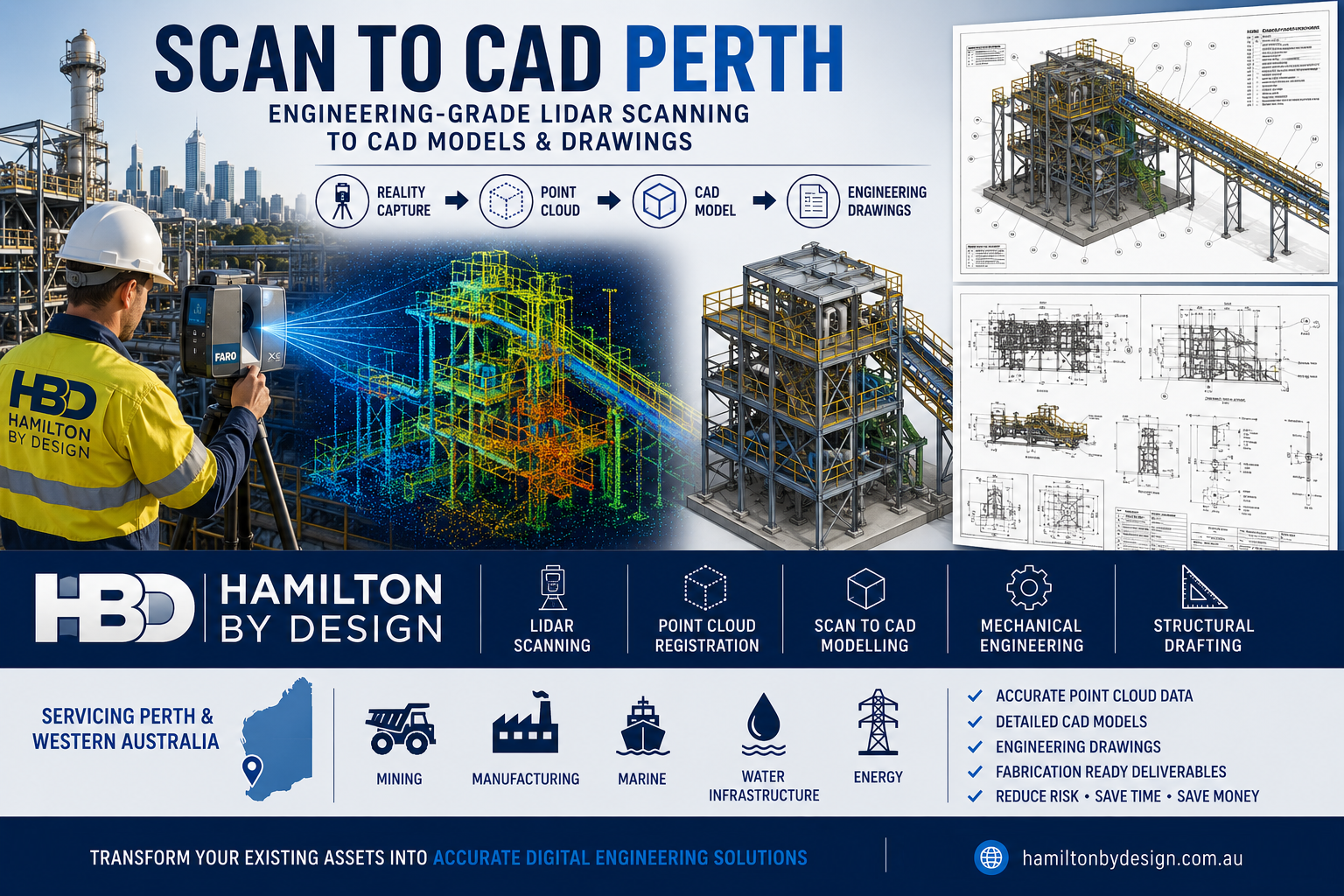
Scan to CAD Perth workflow by Hamilton By Design showing engineering-grade LiDAR scanning of an industrial processing facility in Perth, Western Australia. The image illustrates the complete reality capture process from laser scanning and point cloud registration through to 3D CAD modelling, engineering drawings, mechanical engineering and structural drafting. Featured are a field engineer operating a FARO laser scanner, a coloured point cloud model, a detailed industrial plant CAD model, fabrication drawings and industries including mining, manufacturing, marine, water infrastructure and energy.

Engineering-Grade Point Cloud to CAD Services

Scan to CAD Perth

Blue 3D LiDAR scanner icon on a tripod with scanning waves

When existing facilities, equipment, structures, and process plants need to be modified, expanded, or documented, accurate information is critical. Unfortunately, many sites across Perth and Western Australia rely on outdated drawings, incomplete documentation, or site measurements that do not reflect what has actually been built.

Hamilton By Design provides professional Scan to CAD Perth services, combining engineering-grade LiDAR scanning with experienced mechanical and structural drafting to create accurate CAD models and drawings from real-world assets.

Rather than relying on tape measures or assumptions, we capture the existing environment using advanced 3D laser scanning technology and convert the resulting point cloud data into usable engineering deliverables.


What is Scan to CAD?

Scan to CAD is the process of converting physical assets into accurate digital engineering models and drawings.

The workflow typically includes:

  1. Site scanning using LiDAR technology
  2. Registration of the point cloud data
  3. Creation of CAD models
  4. Production of engineering drawings
  5. Verification against captured site conditions

The result is a highly accurate digital representation of the existing asset that can be used for engineering, maintenance, fabrication, and future upgrades.


Why Use Scan to CAD?

Many projects fail because existing site information is incorrect.

Common challenges include:

  • Missing drawings
  • Outdated drawings
  • Unrecorded modifications
  • Unknown equipment locations
  • Limited shutdown windows
  • Expensive site revisits
  • Fabrication errors
  • Installation clashes

Scan to CAD helps eliminate these issues by providing a reliable digital record of the actual site conditions.


Our Scan to CAD Workflow

1. Site Capture

Hamilton By Design uses engineering-grade LiDAR scanning equipment to capture millions of measurement points across the site.

Applications include:

  • Mining facilities
  • Processing plants
  • Structural steel installations
  • Pipework systems
  • Conveyor systems
  • Water treatment facilities
  • Manufacturing plants
  • Marine facilities

2. Point Cloud Registration

Individual scans are combined into a single registered dataset.

This process creates a coordinated point cloud representing the complete facility.

Deliverable formats can include:

  • E57
  • RCP
  • RCS
  • LAS

3. CAD Modelling

The point cloud is imported into engineering software where accurate models are developed.

Software used includes:

  • SOLIDWORKS
  • AutoCAD
  • Autodesk Inventor
  • Navisworks

Models may include:

  • Structural steel
  • Pipework
  • Mechanical equipment
  • Platforms and access systems
  • Buildings and facilities
  • Process infrastructure

4. Engineering Drawings

Once modelling is complete, the information can be converted into detailed engineering documentation.

Typical deliverables include:

  • General Arrangement Drawings
  • Fabrication Drawings
  • As-Built Drawings
  • Layout Drawings
  • Structural Steel Drawings
  • Mechanical Drawings
  • Pipework Drawings

Industries We Support in Perth

Hamilton By Design supports clients throughout Perth and Western Australia including:

Mining

  • Iron Ore
  • Gold
  • Lithium
  • Nickel
  • Mineral Processing

Manufacturing

  • Food Processing
  • Packaging Facilities
  • Industrial Production

Energy

  • Power Generation
  • Renewable Energy Facilities
  • Oil and Gas Infrastructure

Water Infrastructure

  • Water Treatment Plants
  • Pump Stations
  • Wastewater Facilities

Marine and Ports

  • Ship Repair Facilities
  • Port Infrastructure
  • Bulk Handling Equipment

Benefits of Scan to CAD

Reduce Site Visits

Capture everything during a single visit and continue working remotely.

Improve Design Accuracy

Design directly from measured site conditions.

Reduce Fabrication Risk

Accurate models help reduce costly fabrication errors.

Improve Safety

Less time measuring equipment in operational environments.

Support Future Projects

Create a digital record that can be reused for future upgrades.


Typical Scan to CAD Deliverables

Hamilton By Design can provide:

  • Point Cloud Files
  • AutoCAD Drawings
  • SOLIDWORKS Models
  • Inventor Models
  • STEP Files
  • SAT Files
  • DWG Files
  • DXF Files
  • Structural Steel Models
  • Mechanical Equipment Models
  • Pipework Models
  • Fabrication Drawings

Why Hamilton By Design?

Hamilton By Design combines reality capture technology with practical engineering experience.

Our team understands:

  • Mechanical Engineering
  • Structural Steel Design
  • Fabrication Workflows
  • Mining Infrastructure
  • Process Plants
  • Site Installation Requirements

This means we do more than simply collect scan data. We transform site information into practical engineering deliverables that support project execution.


Perth Service Area

We provide Scan to CAD services across:

  • Perth CBD
  • Kwinana
  • Henderson
  • Welshpool
  • Canning Vale
  • Malaga
  • Osborne Park
  • Rockingham
  • Fremantle
  • Bunbury
  • Geraldton
  • Kalgoorlie
  • Port Hedland
  • Karratha
  • Pilbara Region

  • 3D Laser Scanning Perth
  • LiDAR Scanning Perth
  • Mechanical Engineering Perth
  • Reverse Engineering Perth
  • Structural Drafting Perth
  • Point Cloud to CAD Modelling
  • As-Built Documentation
  • Industrial Reality Capture

Frequently Asked Questions

What is Scan to CAD?

Scan to CAD is the process of converting laser scan data into CAD models and engineering drawings.

What industries use Scan to CAD?

Mining, manufacturing, energy, water, marine, construction, and industrial facilities commonly use Scan to CAD workflows.

What file formats can be delivered?

DWG, DXF, STEP, SAT, Parasolid, E57, RCP, RCS, and PDF.

Can Scan to CAD be used for structural steel?

Yes. Existing structures can be scanned and converted into detailed structural steel models and fabrication drawings.

Can Scan to CAD be used for pipework?

Yes. Pipework systems can be modelled directly from point cloud data to support modifications and upgrades.

Do you provide services outside Perth?

Yes. Hamilton By Design supports projects throughout Western Australia and across Australia.


Our Clients


Contact Hamilton By Design

If you require accurate site information for design, fabrication, maintenance, or asset management, Hamilton By Design can help.

Our engineering-led Scan to CAD Perth services transform real-world assets into accurate digital engineering deliverables, helping projects move forward with confidence.

Hamilton By Design – Engineering, LiDAR Scanning, CAD Modelling and Drafting Services Across Perth and Western Australia.

Hamilton By Design logo displayed on a blue tilted rectangle with a grey gradient background
Name
Would you like us to arrange a phone consultation for you?
Address

Where are we in Perth

https://www.hamiltonbydesign.com.au/perth-wa
3D CAD Modelling Australia service banner for Hamilton By Design
Australian Drafting logo featuring bold white text reading "Australian Drafting" centred on a blue rounded rectangle background.
Engineering Governance title graphic featuring bold white text reading "Engineering Governance" centred on a blue rounded rectangle background.
Mechanical, Structural & Pipework Drafting service banner by Hamilton By Design featuring white text on a blue background.
Mechanical engineering services
Blue rounded button with the text “SolidWorks Design” in white.
Finite Element Analysis (FEA) engineering simulation button
3D LiDAR Scanning Darwin for engineering surveys, laser scanning, reality capture and point cloud modelling services
3D LiDAR Scanning Australia engineering services for laser scanning, reality capture, scan-to-CAD, Scan-to-BIM and as-built documentation across Australia
3D LiDAR scanning services on the Central Coast providing engineering-grade laser scanning, point cloud capture, scan-to-CAD modelling and industrial reality capture for infrastructure and industrial projects.
3D LiDAR Scanning Perth for engineering surveys, laser scanning, reality capture and point cloud modelling services
3D LiDAR Scanning Sydney for engineering surveys, laser scanning, reality capture and point cloud modelling services
3D LiDAR Scanning Brisbane for engineering surveys, laser scanning, reality capture and point cloud modelling services
3D LiDAR Scanning Canberra for engineering surveys, laser scanning, reality capture and point cloud modelling services
3D LiDAR Scanning Newcastle for engineering surveys, laser scanning, reality capture and point cloud modelling services
3D LiDAR Scanning Adelaide for engineering surveys, laser scanning, reality capture and point cloud modelling services
https://www.hamiltonbydesign.com.au/scan-to-bim-services-australia-lidar-point-clouds-cad-modelling

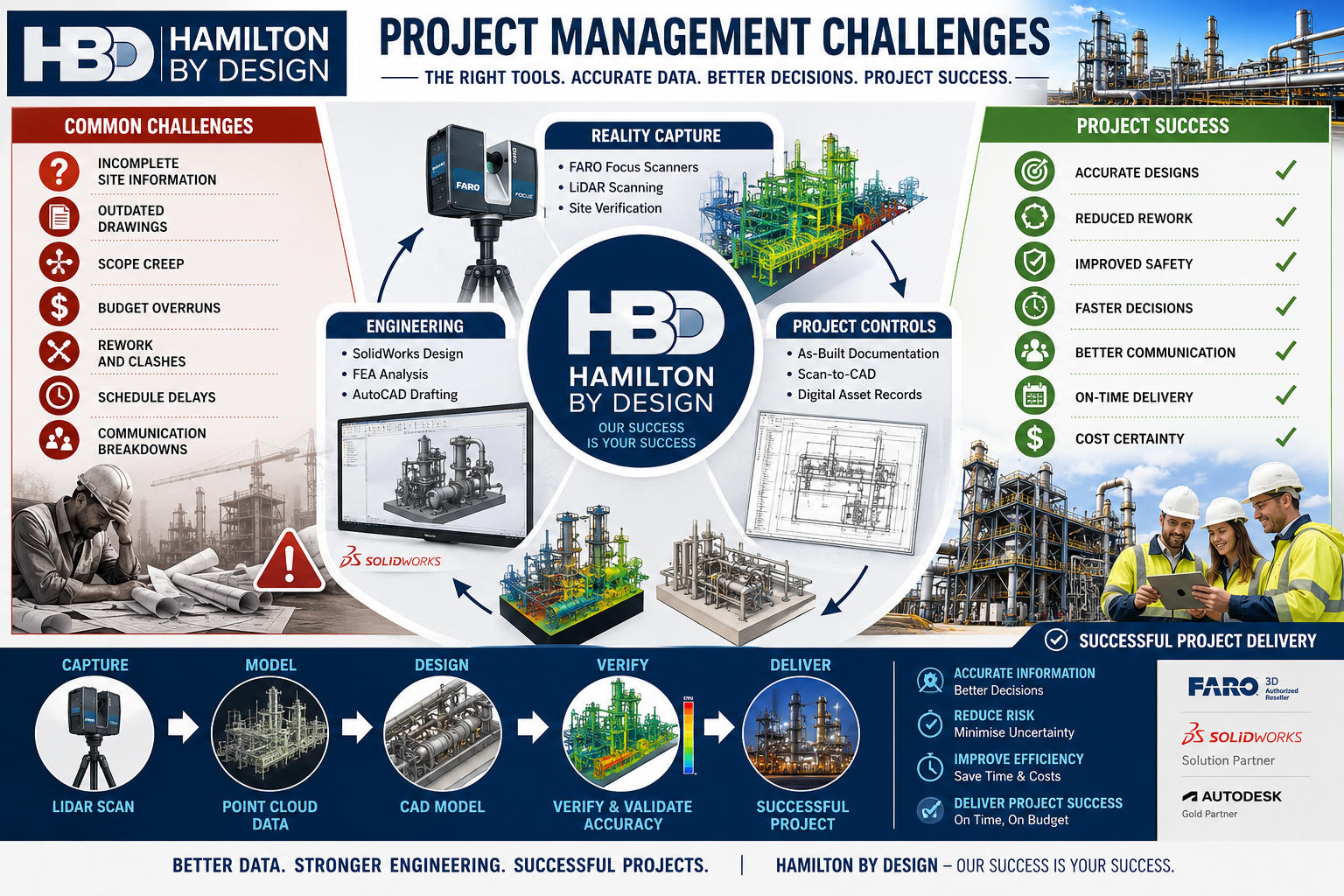
Project Management Challenges

Hamilton By Design project management infographic showing how engineering-grade LiDAR scanning, reality capture, mechanical engineering, CAD modelling, and project controls help overcome common project challenges. The graphic highlights issues such as incomplete site information, outdated drawings, scope creep, budget overruns, rework, schedule delays, and communication breakdowns. It illustrates a workflow from LiDAR scanning and point cloud data through CAD modelling, verification, and successful project delivery with improved safety, reduced risk, cost certainty, and accurate engineering outcomes.

How the Right Information, 3D Scanning and Engineering Tools Drive Project Success

Your Success Is Our Success

Every project manager starts with the same objective:

Deliver a successful project safely, on time and within budget.

Whether the project involves a mining operation, manufacturing facility, port infrastructure, processing plant, water treatment facility, conveyor system, structural upgrade or equipment installation, success ultimately depends on the quality of the decisions made throughout the project lifecycle.

Unfortunately, project managers often face significant challenges:

  • Inaccurate drawings
  • Unknown site conditions
  • Scope creep
  • Communication issues
  • Budget pressures
  • Schedule constraints
  • Construction clashes
  • Fabrication errors
  • Asset documentation gaps

These challenges rarely occur because people are not trying hard enough.

Most occur because project teams are making decisions with incomplete or inaccurate information.

At Hamilton By Design, we believe project success starts with good information.

That is why we have invested in engineering-grade 3D scanning technologies, digital engineering workflows, CAD platforms, simulation tools and practical engineering expertise to help our clients reduce risk and improve project outcomes.

Your success is our success.

Learn more:


Why Projects Struggle

Project managers are expected to coordinate:

  • Asset owners
  • Operations personnel
  • Engineers
  • Contractors
  • Fabricators
  • Suppliers
  • Maintenance teams
  • Construction crews

Each stakeholder brings different priorities.

Without accurate information, even simple projects can become difficult.

Common issues include:

Drawings Do Not Match Reality

Many industrial facilities have been operating for decades.

Over time:

  • Pipework is modified
  • Equipment is replaced
  • Structures are altered
  • Temporary solutions become permanent

Unfortunately, documentation is not always updated.

Project teams may begin engineering work based on drawings that no longer represent the actual facility.

Site Conditions Are Unknown

A pipe hidden behind equipment.

An undocumented support structure.

An access issue not identified during planning.

Small surprises often become large project delays.

Rework Becomes Expensive

The cost of identifying an issue during design is significantly lower than discovering the same issue during construction.

Good information reduces rework.


The Foundation of Project Success: Accurate Information

Before discussing tools, it is important to understand a simple principle:

Every engineering decision is only as good as the information available.

Accurate information improves:

  • Planning
  • Design
  • Budgeting
  • Scheduling
  • Procurement
  • Construction

This is why modern project delivery increasingly relies on reality capture and digital engineering workflows.


Understanding 3D Scanning Technologies

Not all scanners are the same.

Different technologies suit different applications.

Selecting the correct technology is critical.


Terrestrial LiDAR Scanners

Terrestrial LiDAR scanners are commonly used for industrial facilities.

Examples include:

  • FARO Focus Series
  • Leica RTC360
  • Trimble X9

Typical applications:

  • Processing plants
  • Manufacturing facilities
  • Structural steel
  • Pipework
  • Conveyor systems
  • Buildings

Typical accuracy:

  • ±1 mm to ±3 mm single scan
  • ±2 mm to ±10 mm registered project accuracy

Benefits:

  • Accurate site verification
  • Reduced site visits
  • Improved design confidence

Hamilton By Design uses engineering-grade terrestrial LiDAR scanning to support scan-to-CAD workflows and project delivery.


Mobile LiDAR Systems

Mobile LiDAR systems allow operators to walk through facilities while collecting data.

Examples include:

  • FARO Orbis
  • NavVis VLX
  • Leica BLK2GO

Applications:

  • Warehouses
  • Large buildings
  • Facility documentation

Benefits:

  • Rapid data capture
  • Reduced field time

Limitations:

  • Lower accuracy than tripod-based systems

Structured Light Scanners

Structured light scanners project patterns onto surfaces and capture highly detailed geometry.

Applications:

  • Reverse engineering
  • Product development
  • Component modelling

Typical accuracy:

  • ±0.02 mm to ±0.10 mm

Portable Metrology Arms

Portable metrology systems are used for precision measurement.

Applications:

  • Machined components
  • Gearboxes
  • Pump components
  • Manufacturing inspection

Typical accuracy:

  • ±0.015 mm to ±0.05 mm

Drone LiDAR Systems

Drone-based systems capture large areas quickly.

Applications:

  • Mining
  • Infrastructure
  • Stockpiles
  • Terrain mapping

Typical accuracy:

  • ±20 mm to ±100 mm

How Hamilton By Design Uses Scanning to Improve Project Outcomes

Scanning alone does not deliver project success.

Success comes from transforming captured data into useful engineering information.

Our workflow includes:

1. Site Verification

Capture existing conditions.

2. Point Cloud Registration

Align scan data accurately.

3. Scan-to-CAD

Convert reality into engineering models.

4. Engineering Design

Develop practical solutions.

5. Design Reviews

Identify issues before fabrication.

6. Drawing Production

Generate clear construction documentation.

7. Construction Support

Assist project teams during delivery.

8. As-Built Verification

Confirm final installation.


Hamilton By Design’s Project Delivery Toolkit

FARO Focus S70

Used for:

  • Industrial facilities
  • Pipework
  • Structural steel
  • Conveyors

Benefits:

  • Accurate existing-condition information
  • Improved project confidence

SOLIDWORKS

Used for:

  • Mechanical design
  • Equipment design
  • Reverse engineering

Benefits:

  • Manufacturing-ready models
  • Parametric design

AutoCAD

Used for:

  • General arrangements
  • Fabrication drawings
  • Construction documentation

FARO SCENE

Used for:

  • Registration
  • Quality control
  • Point cloud management

Autodesk ReCap

Used for:

  • Point cloud processing
  • Scan-to-CAD workflows

Navisworks

Used for:

  • Model reviews
  • Coordination
  • Clash detection

SOLIDWORKS Simulation

Used for:

  • Stress analysis
  • Structural verification

ANSYS

Used for:

  • Advanced engineering analysis

Rocky DEM

Used for:

  • Bulk materials handling
  • Chute design
  • Conveyor systems

The Benefits to Project Managers

When accurate information is available early:

Better Planning

Teams understand site conditions.

Better Budget Control

Unexpected variations are reduced.

Better Communication

Stakeholders review the same information.

Better Constructability

Designs are reviewed before fabrication.

Better Outcomes

Projects progress with greater confidence.


Why Experience Matters

Technology alone does not solve project challenges.

Hamilton By Design combines:

  • Mechanical engineering
  • Drafting
  • Manufacturing experience
  • Site experience
  • Reverse engineering
  • Reality capture
  • Digital engineering

Our objective is not simply to collect scan data.

Our objective is to help clients deliver successful projects.


Hamilton By Design logo displayed on a blue tilted rectangle with a grey gradient background

Contact Us – Talk to Us

Name
Would you like us to arrange a phone consultation for you?
Address

Our Clients

Project success begins with reliable information.

By combining engineering-grade 3D scanning, scan-to-CAD workflows, mechanical engineering, simulation and practical project experience, Hamilton By Design helps project managers reduce uncertainty and improve outcomes.

From reality capture through to engineering design and construction support, our focus remains simple:

Your Success Is Our Success.

Learn more:

www.hamiltonbydesign.com.au

Additional engineering articles:

https://hamiltonbydesign.blogspot.com

Pipework detailing resources:

https://pipeworkdetailing.blogspot.com


Frequently Asked Questions

1. What are the biggest project management challenges?

Schedule delays, budget overruns, scope creep, poor communication and inaccurate information.

2. How does 3D scanning improve project delivery?
It provides accurate site information for planning and design.

3. What scanner does Hamilton By Design use?

The FARO Focus S70 terrestrial LiDAR scanner.

4. What is scan-to-CAD?

The process of converting scan data into engineering models and drawings.

5. How can LiDAR scanning reduce project risk?

By identifying existing conditions before design begins.

6. Can scanning reduce site visits?

Yes.

7. What industries benefit from scanning?

Mining, manufacturing, ports, infrastructure and processing plants.

8. What is a point cloud?

A digital representation of a physical environment.

9. Why is accurate information important?

Because project decisions depend on it.

10. Can scanning reduce rework?

Yes.

(Continue through FAQ 50 covering schedule management, budget control, stakeholder communication, brownfield projects, pipework modelling, structural steel, reverse engineering, shutdown planning, digital twins, clash detection, engineering analysis and project success.)


References

Hamilton By Design

www.hamiltonbydesign.com.au

Hamilton By Design Blog

https://hamiltonbydesign.blogspot.com

Pipework Detailing Blog

https://pipeworkdetailing.blogspot.com

FARO Technologies

https://www.faro.com

SOLIDWORKS

https://www.solidworks.com

ANSYS

https://www.ansys.com

Autodesk ReCap

https://www.autodesk.com/products/recap

Autodesk Navisworks

https://www.autodesk.com/products/navisworks

3D CAD Modelling Australia service banner for Hamilton By Design
Australian Drafting logo featuring bold white text reading "Australian Drafting" centred on a blue rounded rectangle background.
Engineering Governance title graphic featuring bold white text reading "Engineering Governance" centred on a blue rounded rectangle background.
Mechanical, Structural & Pipework Drafting service banner by Hamilton By Design featuring white text on a blue background.
Mechanical engineering services
Blue rounded button with the text “SolidWorks Design” in white.
Finite Element Analysis (FEA) engineering simulation button
3D LiDAR Scanning Darwin for engineering surveys, laser scanning, reality capture and point cloud modelling services
3D LiDAR Scanning Australia engineering services for laser scanning, reality capture, scan-to-CAD, Scan-to-BIM and as-built documentation across Australia
3D LiDAR scanning services on the Central Coast providing engineering-grade laser scanning, point cloud capture, scan-to-CAD modelling and industrial reality capture for infrastructure and industrial projects.
3D LiDAR Scanning Perth for engineering surveys, laser scanning, reality capture and point cloud modelling services
3D LiDAR Scanning Sydney for engineering surveys, laser scanning, reality capture and point cloud modelling services
3D LiDAR Scanning Brisbane for engineering surveys, laser scanning, reality capture and point cloud modelling services
3D LiDAR Scanning Canberra for engineering surveys, laser scanning, reality capture and point cloud modelling services
3D LiDAR Scanning Newcastle for engineering surveys, laser scanning, reality capture and point cloud modelling services
3D LiDAR Scanning Adelaide for engineering surveys, laser scanning, reality capture and point cloud modelling services
https://www.hamiltonbydesign.com.au/scan-to-bim-services-australia-lidar-point-clouds-cad-modelling