3D Laser Scanning of Pump Stations for Reverse Engineering Sydney NSW

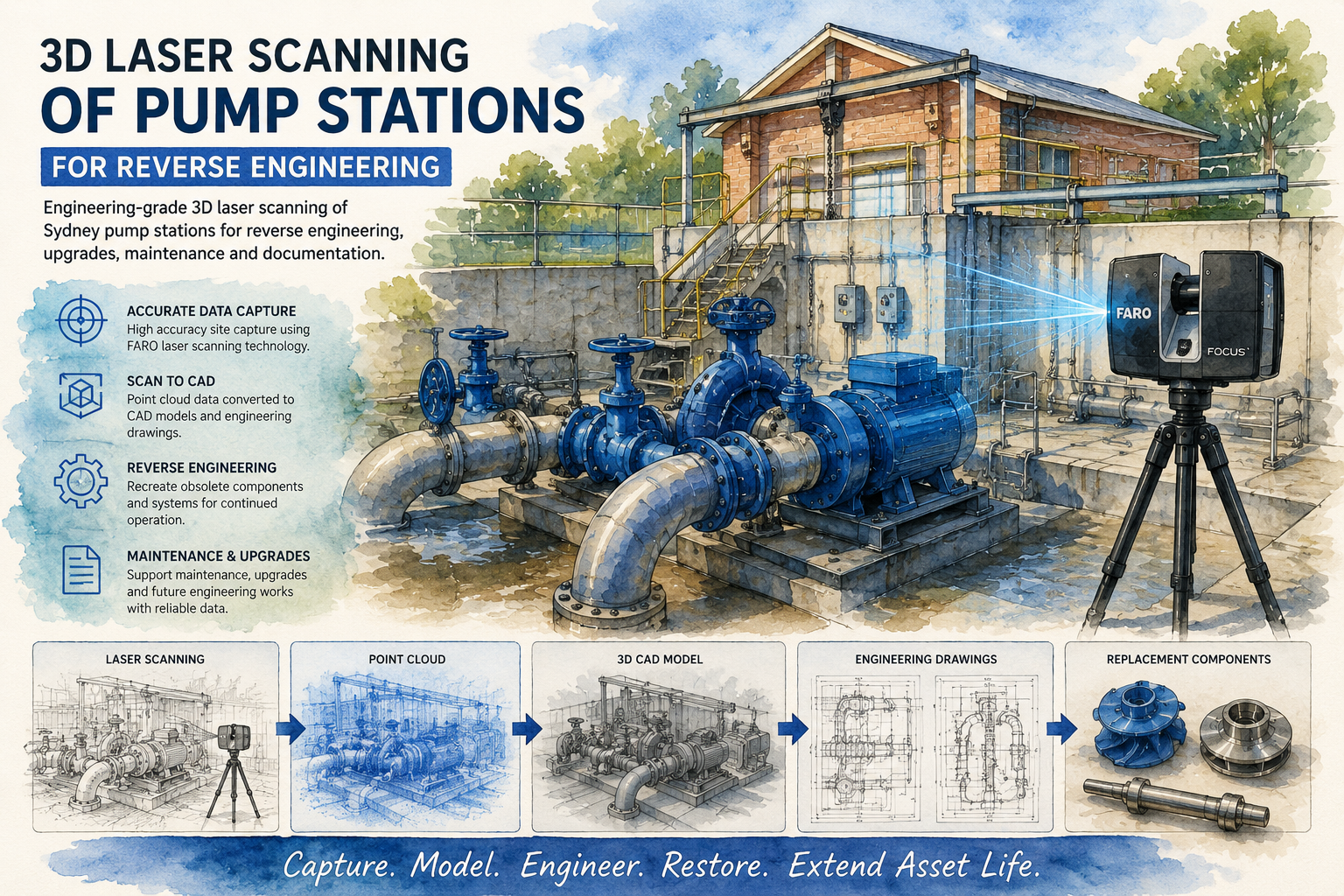
Watercolour illustration of 3D laser scanning of a Sydney pump station for reverse engineering, asset life extension and engineering documentation

Engineering-Grade 3D Laser Scanning of Sydney Pump Stations for Reverse Engineering, Upgrades, Maintenance and Documentation
Pump and Motor Assembly Icon for Reverse Engineering and Water Infrastructure Engineering Services

Hamilton By Design provides engineering-grade 3D laser scanning of pump stations throughout Sydney NSW. Using advanced FARO laser scanning technology, we capture highly accurate digital records of pump stations, mechanical equipment, pipework systems and structural infrastructure to support reverse engineering, maintenance planning, asset life extension, upgrades and engineering documentation.

Many water utilities, wastewater treatment facilities, councils and infrastructure owners operate ageing pump stations with incomplete drawings, obsolete equipment and limited documentation. Our 3D laser scanning services provide accurate as-built information that enables engineers, maintenance teams and asset managers to make informed decisions while reducing risk, downtime and costly site rework.

Whether the project involves reverse engineering a discontinued pump component, planning a pump station upgrade, developing manufacturing drawings or documenting an existing facility, Hamilton By Design delivers accurate engineering data that supports the entire asset lifecycle.


Why 3D Laser Scanning is Valuable for Pump Stations

Pump stations are complex facilities containing interconnected mechanical, structural and civil infrastructure. Over time, modifications are often made without updating drawings, resulting in discrepancies between existing documentation and actual site conditions.

Traditional measurement methods can be time-consuming, disruptive and prone to inaccuracies.

3D laser scanning captures millions of measurement points across an entire facility, creating a highly accurate digital representation of the site.

Benefits include:

  • Accurate As-Built Documentation
  • Reduced Site Rework
  • Improved Design Accuracy
  • Safer Data Collection
  • Faster Project Delivery
  • Reduced Shutdown Requirements
  • Improved Asset Management
  • Better Maintenance Planning
  • Enhanced Engineering Outcomes

Supporting Reverse Engineering of Pump Station Assets

One of the most valuable applications of 3D laser scanning is reverse engineering.

Many Sydney pump stations contain equipment that is no longer supported by the original manufacturer. Spare parts may be unavailable, drawings may be missing and replacement lead times may be unacceptable for critical infrastructure operations.

Hamilton By Design uses laser scanning and reverse engineering techniques to recreate:

  • Pump Casings
  • Pump Impellers
  • Pump Shafts
  • Bearing Housings
  • Wear Rings
  • Couplings
  • Valve Components
  • Pipework Assemblies
  • Structural Supports
  • Access Platforms
  • Equipment Mounting Systems

By capturing accurate geometry directly from the existing asset, replacement components can be engineered without relying on original OEM drawings.


Applications Across Sydney Water Infrastructure

Our 3D laser scanning services support a wide range of water and infrastructure assets across Sydney.

Water Pump Stations

Capture existing pump layouts, pipework systems, valve arrangements and structural infrastructure to support maintenance and future upgrades.

Wastewater Pump Stations

Document ageing facilities, verify site conditions and develop accurate engineering models for refurbishment projects.

Water Treatment Plants

Create digital twins of treatment infrastructure to support reverse engineering, plant modifications and ongoing asset management.

Wastewater Treatment Facilities

Capture process equipment, mechanical assets and structural systems to facilitate maintenance and engineering design.

Local Government Infrastructure

Support councils responsible for managing water and wastewater assets through accurate facility documentation and engineering-grade data capture.

Industrial and Mining Water Systems

Provide accurate site information for water transfer systems, pumping infrastructure and process water facilities.


FARO Laser Scanning Technology

Hamilton By Design utilises professional FARO laser scanning equipment capable of capturing engineering-grade measurements suitable for design and manufacturing applications.

Our technology enables:

  • High Accuracy Measurements
  • Detailed Facility Capture
  • Rapid Site Data Collection
  • Comprehensive Asset Documentation
  • Engineering-Grade Deliverables

Laser scanning allows the capture of equipment, structures and plant environments that would be difficult or impractical to measure using conventional methods.


Scan-to-CAD Services for Pump Stations

Following site capture, point cloud data is processed and converted into engineering deliverables suitable for design, drafting and maintenance projects.

Our Scan-to-CAD services include:

  • Existing Condition Drawings
  • General Arrangement Drawings
  • Equipment Layout Drawings
  • Structural Drawings
  • Pipework Drawings
  • Plant Documentation
  • Asset Records

These deliverables provide engineers and asset owners with reliable information for future projects.


3D Modelling and Digital Asset Creation

Laser scan data can be converted into detailed 3D CAD models using industry-leading engineering software.

Hamilton By Design develops:

  • SolidWorks Models
  • AutoCAD Models
  • STEP Files
  • Parasolid Files
  • Manufacturing Models
  • Assembly Models

These models can be used for:

  • Reverse Engineering
  • Asset Management
  • Upgrade Design
  • Interference Checking
  • Maintenance Planning
  • Replacement Component Design

Deliverables

Clients typically receive deliverables tailored to project requirements.

Common outputs include:

Point Cloud Deliverables

  • E57 Files
  • RCP Files
  • RCS Files
  • Registered Point Clouds

CAD Deliverables

  • DWG Drawings
  • DXF Drawings
  • AutoCAD Models
  • SolidWorks Models

Manufacturing Deliverables

  • STEP Files
  • Parasolid Files
  • Manufacturing Drawings
  • Fabrication Drawings
  • Assembly Drawings

Engineering Deliverables

  • Site Verification Reports
  • Asset Documentation
  • Reverse Engineering Models
  • Upgrade Planning Documentation

Supporting Asset Life Extension Projects

Water utilities and infrastructure owners are increasingly seeking ways to extend the life of existing assets while reducing capital expenditure.

3D laser scanning provides the foundation for asset life extension by delivering accurate information about existing conditions.

Our services support:

  • Asset Renewal Programs
  • Pump Replacement Projects
  • Maintenance Shutdowns
  • Infrastructure Upgrades
  • Equipment Refurbishments
  • Reverse Engineering Initiatives
  • Documentation Recovery Projects

Accurate data reduces uncertainty and enables more effective engineering decisions.


Typical Workflow

1. Site Inspection

Review project objectives, site access requirements and available documentation.

2. Laser Scanning

Capture the pump station using FARO laser scanning technology.

3. Point Cloud Registration

Process and register scan data into a unified engineering model.

4. Engineering Review

Verify dimensions, equipment layouts and site conditions.

5. Scan-to-CAD Modelling

Develop engineering drawings and 3D CAD models.

6. Reverse Engineering

Create replacement component models and manufacturing documentation where required.

7. Project Delivery

Provide engineering deliverables suitable for maintenance, upgrades and future asset management.


Why Choose Hamilton By Design?

Hamilton By Design combines practical engineering experience with advanced reality capture technology.

Unlike scanning companies that simply deliver point clouds, we provide engineering-focused solutions that support real-world maintenance, design and reverse engineering projects.

Our capabilities include:

  • Mechanical Engineering
  • Reverse Engineering
  • 3D Laser Scanning
  • Scan-to-CAD
  • Engineering Drafting
  • SolidWorks Modelling
  • AutoCAD Drafting
  • FEA Analysis
  • Manufacturing Documentation
  • Asset Life Extension Engineering

This combination allows us to deliver complete solutions from site capture through to engineered replacement components.


3D Laser Scanning of Pump Stations Across Sydney NSW

Hamilton By Design supports water utilities, wastewater operators, councils, infrastructure owners, engineering consultancies and maintenance contractors throughout Sydney NSW.

Whether you require accurate as-built documentation, reverse engineering of obsolete pump components, Scan-to-CAD services or support for a major pump station upgrade, our engineering-grade laser scanning services provide the information needed to reduce risk and improve project outcomes.

Contact Hamilton By Design to discuss your pump station scanning and reverse engineering requirements.

Talk to Us – Contact Us

Name
Would you like us to arrange a phone consultation for you?
Address

Our clients:
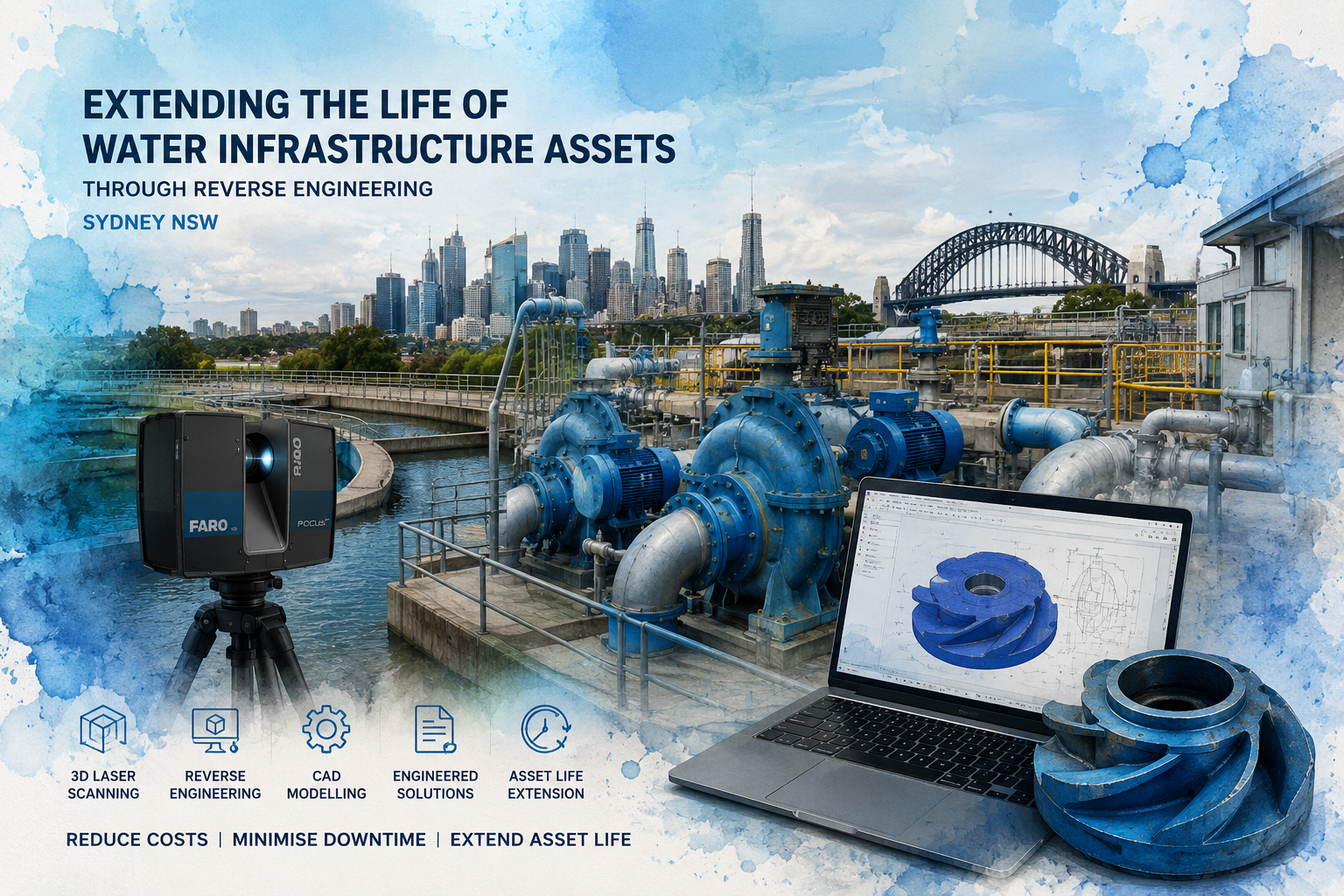

Sydney Water Infrastructure Asset Life Extension Through Reverse Engineering

Water infrastructure asset life extension project in Sydney using reverse engineering, 3D laser scanning, CAD modelling and engineered replacement pump components for water utilities.

Extend the Service Life of Critical Water Assets Without Full Replacement

Hamilton By Design provides reverse engineering, 3D laser scanning, engineering design, and replacement component manufacturing support for water infrastructure assets throughout Sydney and New South Wales. We help water utilities, local councils, infrastructure owners, treatment plants, pumping stations, and maintenance contractors extend the life of aging equipment when OEM support is unavailable, replacement costs are excessive, or lead times are unacceptable.

Many water and wastewater facilities across Sydney operate assets that have been in service for decades. Pumps, valves, impellers, pipework, mechanical equipment, access systems, and structural components often remain functional but suffer from wear, corrosion, erosion, or obsolescence. In many cases, original drawings no longer exist, suppliers have ceased operations, or replacement parts are no longer manufactured.

Using engineering-grade 3D laser scanning, reverse engineering, CAD modelling, and manufacturing documentation, we recreate existing assets and produce engineered replacement components that enable continued operation and asset life extension.


Supporting Sydney’s Water Infrastructure

Hamilton By Design supports water infrastructure projects throughout Sydney and regional NSW including:

  • Water treatment plants
  • Wastewater treatment facilities
  • Pumping stations
  • Sewage treatment plants
  • Stormwater infrastructure
  • Water reservoirs
  • Water transfer stations
  • Desalination facilities
  • Council water assets
  • Utility infrastructure upgrades
  • Brownfield infrastructure projects
  • Maintenance shutdowns and asset renewal programs

Our services are suitable for asset owners seeking to maximise the return on existing infrastructure investments while reducing capital expenditure.


Why Reverse Engineering Is Critical for Water Infrastructure

Many water assets remain structurally sound long after spare parts become unavailable.

Common challenges include:

  • Discontinued OEM equipment
  • Missing engineering drawings
  • Obsolete pump models
  • Long replacement lead times
  • High replacement costs
  • Equipment no longer supported by manufacturers
  • Limited maintenance documentation
  • Corrosion and wear damage
  • Asset renewal budget constraints

Rather than replacing an entire system, reverse engineering allows specific components to be recreated and manufactured, significantly reducing downtime and capital expenditure.

This approach can often extend asset life by many years while maintaining operational reliability.


Components Commonly Reverse Engineered

We regularly reverse engineer:

Pump Components

  • Impellers
  • Pump casings
  • Wear rings
  • Shafts
  • Bearing housings
  • Mechanical seal assemblies
  • Couplings
  • Diffusers
  • Pump baseplates

Water Infrastructure Components

  • Valve bodies
  • Flanges
  • Pipe fittings
  • Structural supports
  • Access platforms
  • Mechanical assemblies
  • Fabricated steelwork
  • Maintenance access systems
  • Custom brackets and supports

Treatment Plant Equipment

  • Mixer components
  • Augers
  • Conveyors
  • Screens
  • Mechanical drives
  • Guarding systems
  • Process equipment assemblies

Engineering-Grade 3D Scanning for Existing Assets

The first stage of most projects involves capturing accurate field measurements using terrestrial laser scanning.

Hamilton By Design uses:

  • FARO Focus Premium Laser Scanners
  • FARO Orbis Mobile Scanning Systems
  • FARO SCENE Processing Software
  • Autodesk ReCap
  • SolidWorks
  • AutoCAD
  • Inventor

Laser scanning captures millions of measurement points from existing assets, creating an accurate digital record of equipment and surrounding infrastructure.

Deliverables may include:

  • E57 files
  • RCP files
  • RCS files
  • LAS files
  • Registered point clouds
  • Scan reports
  • Asset condition records

This data becomes the foundation for reverse engineering and future maintenance activities.


Reverse Engineering Workflow

1. Site Inspection

Our engineers inspect the asset and identify components requiring replacement, modification, or documentation.

2. 3D Laser Scanning

The equipment and surrounding infrastructure are scanned to capture accurate geometry and spatial relationships.

3. Component Assessment

Existing parts are assessed for:

  • Wear
  • Corrosion
  • Damage
  • Manufacturing methods
  • Functional requirements

4. CAD Modelling

Components are recreated using engineering CAD software.

Models may include:

  • Individual components
  • Assemblies
  • Mechanical interfaces
  • Structural elements

5. Engineering Verification

Designs are reviewed and validated to ensure fit, function, and manufacturability.

Where required, engineering calculations and Finite Element Analysis (FEA) can be performed.

6. Manufacturing Documentation

Detailed drawings are produced for fabrication or machining.

7. Manufacturing Support

Documentation is supplied to approved manufacturers for production of replacement components.


Asset Life Extension Benefits

Reverse engineering provides significant advantages for water infrastructure operators.

Reduced Capital Expenditure

Avoid replacing complete systems when only specific components have failed.

Reduced Downtime

Manufacture replacement parts without waiting for OEM support.

Improved Asset Knowledge

Generate accurate engineering documentation for future maintenance.

Improved Reliability

Replace worn or damaged components with engineered solutions.

Future-Proof Asset Management

Create digital asset records that support future maintenance and upgrades.

Support for Aging Infrastructure

Extend the useful life of critical water assets while maintaining operational performance.


Typical Deliverables

Clients may receive:

  • Registered point clouds
  • E57 files
  • RCP files
  • RCS files
  • LAS files
  • Scan reports
  • Reverse engineered CAD models
  • SolidWorks files
  • STEP files
  • Parasolid files
  • DWG drawings
  • DXF drawings
  • General arrangement drawings
  • Manufacturing drawings
  • Fabrication drawings
  • Assembly drawings
  • Bill of Materials (BOM)
  • Engineering reports
  • FEA reports where required

Industries We Support

Water Utilities

Support for treatment plants, pumping stations, reservoirs, and distribution infrastructure.

Local Government

Asset management and life extension programs for council-owned infrastructure.

Infrastructure Owners

Engineering support for aging mechanical and structural assets.

Wastewater Treatment Facilities

Reverse engineering and replacement component development.

Industrial Water Operations

Support for manufacturing facilities and process plants with critical water infrastructure.


Why Choose Hamilton By Design?

Hamilton By Design combines practical engineering experience with advanced digital capture technology.

Our capabilities include:

  • Mechanical Engineering
  • Reverse Engineering
  • 3D Laser Scanning
  • 3D LiDAR Scanning
  • Scan to CAD
  • Engineering Drafting
  • Asset Documentation
  • Finite Element Analysis (FEA)
  • Manufacturing Support
  • Brownfield Infrastructure Engineering

We understand the challenges faced by water utilities operating aging infrastructure and provide practical solutions that reduce costs, minimise downtime, and extend asset life.


Sydney Water Infrastructure Reverse Engineering Services

If your organisation operates aging pumps, treatment equipment, mechanical assets, or infrastructure components that are no longer supported by the original manufacturer, Hamilton By Design can help.

Through reverse engineering, 3D scanning, CAD modelling, and manufacturing documentation, we provide practical asset life extension solutions for water infrastructure across Sydney and New South Wales.

Contact Hamilton By Design today to discuss reverse engineering solutions for obsolete water infrastructure assets, replacement components, and asset life extension projects throughout Sydney NSW.

Talk to Us – Contact Us

Name
Would you like us to arrange a phone consultation for you?
Address

Our clients:


https://www.hamiltonbydesign.com.au/scan-to-bim-services-australia-lidar-point-clouds-cad-modelling
3D LiDAR Scanning Darwin for engineering surveys, laser scanning, reality capture and point cloud modelling services
3D LiDAR Scanning Australia engineering services for laser scanning, reality capture, scan-to-CAD, Scan-to-BIM and as-built documentation across Australia
3D LiDAR scanning services on the Central Coast providing engineering-grade laser scanning, point cloud capture, scan-to-CAD modelling and industrial reality capture for infrastructure and industrial projects.

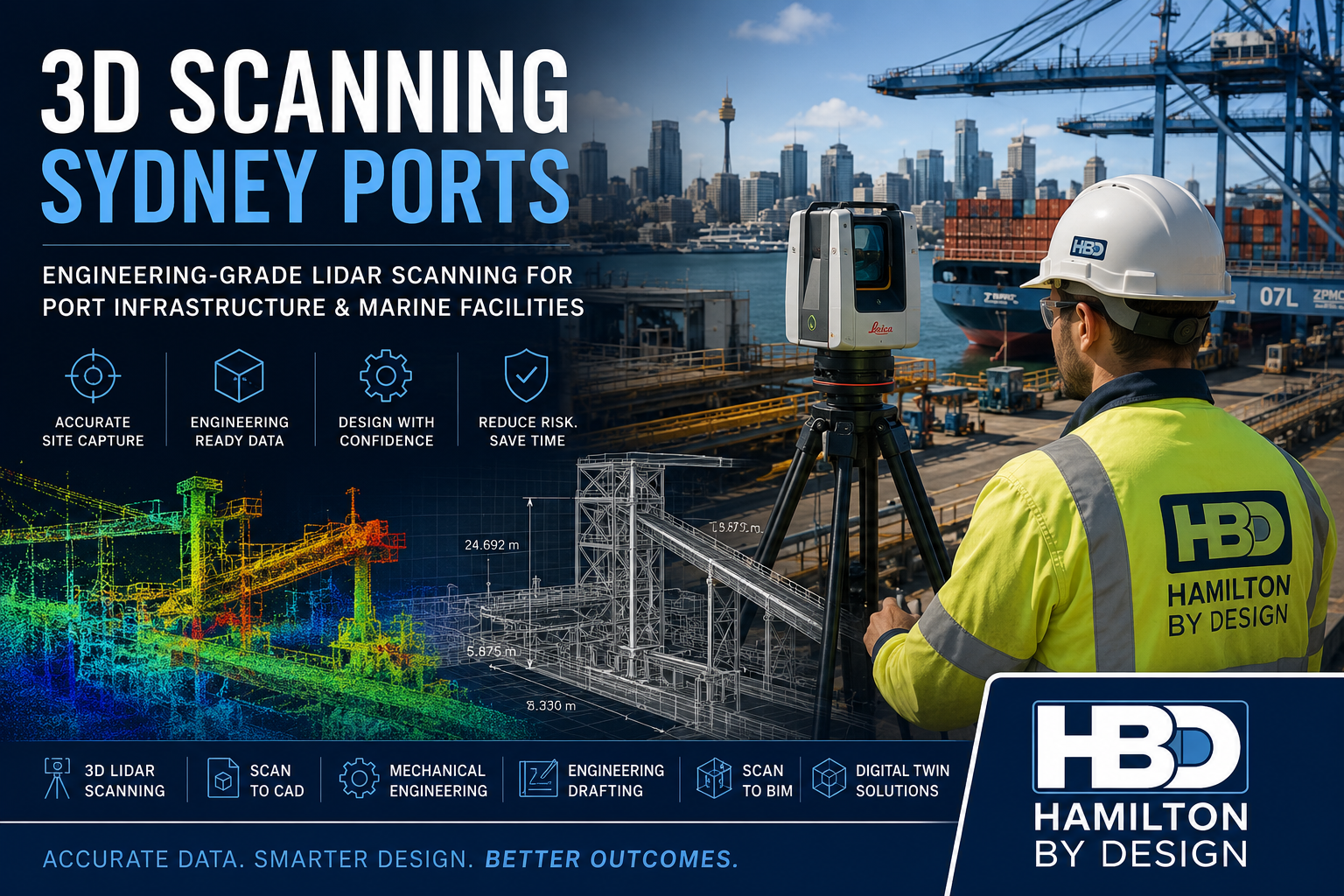
3D LiDAR Scanning Services for Sydney Ports

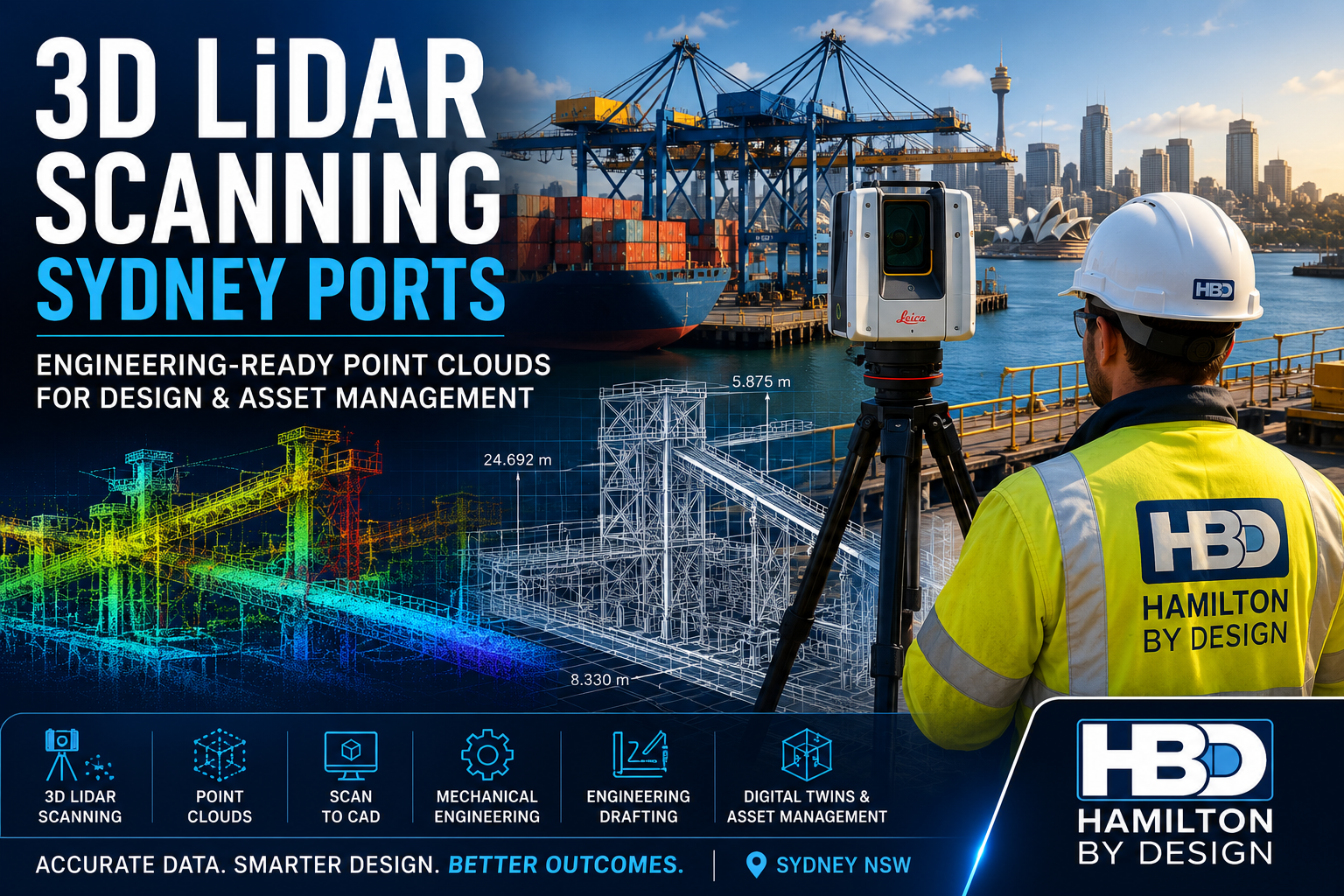
Engineer using 3D LiDAR scanner at Sydney port with container cranes, marine infrastructure and point cloud overlay for engineering design.

Sydney’s ports are critical gateways for Australia’s import, export and logistics industries. Facilities such as container terminals, bulk materials handling operations, fuel terminals, marine loading facilities and supporting infrastructure require accurate engineering information to support maintenance, upgrades and future expansion.

Hamilton By Design provides engineering-grade 3D LiDAR scanning services for Sydney ports, delivering highly accurate point cloud data for engineering design, drafting, asset management, digital twins and brownfield infrastructure projects.

Using advanced terrestrial LiDAR technology, we capture millions of measurement points across complex operating environments, creating detailed digital records that allow engineers, asset owners and project teams to make informed decisions with confidence.


What is 3D LiDAR Scanning?

LiDAR (Light Detection and Ranging) uses laser technology to accurately measure and record physical assets.

The result is a highly detailed point cloud, representing existing infrastructure in three dimensions. This digital dataset can be used for:

  • Mechanical engineering
  • Structural engineering
  • Engineering drafting
  • Scan to CAD workflows
  • Asset management
  • Digital twin development
  • BIM modelling
  • Shutdown planning
  • As-built verification

For ports and marine facilities, LiDAR scanning provides an efficient method of capturing accurate site information while reducing the need for repeat site visits.


Why Sydney Ports Use LiDAR Scanning

Many port facilities have evolved over decades through multiple upgrade projects, equipment replacements and operational modifications.

As a result, common challenges include:

  • Missing drawings
  • Outdated documentation
  • Inaccessible areas
  • Congested infrastructure
  • Unknown clearances
  • Limited shutdown windows
  • Safety restrictions

LiDAR scanning creates a complete digital record of the facility, allowing project teams to design around actual site conditions rather than assumptions.


Typical Sydney Port Assets We Scan

Container Terminals

We capture:

  • Container crane structures
  • Storage yards
  • Maintenance workshops
  • Container handling equipment
  • Access roads and infrastructure

Bulk Materials Handling Facilities

Our scanning services support:

  • Conveyors
  • Transfer stations
  • Ship loaders
  • Stackers
  • Reclaimers
  • Chutes and hoppers
  • Stockpile systems

Marine Infrastructure

LiDAR scanning is ideal for:

  • Wharves
  • Jetties
  • Berths
  • Loading facilities
  • Access walkways
  • Marine structures

Industrial Plant Assets

We regularly scan:

  • Pipework systems
  • Pump stations
  • Mechanical equipment
  • Structural steelwork
  • Maintenance platforms
  • Process infrastructure

Benefits of LiDAR Scanning for Port Engineering Projects

Accurate Site Capture

LiDAR scanning captures millions of survey-grade measurements to create a highly accurate representation of existing conditions.


Engineering-Ready Point Clouds

Data is delivered in formats suitable for engineering workflows including:

  • E57
  • RCP
  • RCS
  • LAS
  • LGS

Reduced Project Risk

Accurate site information reduces:

  • Design clashes
  • Installation issues
  • Site rework
  • Construction delays

Faster Engineering Design

Engineering teams can begin modelling and drafting immediately using accurate site information.


Improved Shutdown Planning

Detailed reality capture allows project teams to:

  • Plan work before mobilisation
  • Reduce site measurements
  • Minimise downtime
  • Improve installation efficiency

Engineering Applications

Mechanical Engineering

LiDAR scanning supports:

  • Equipment upgrades
  • Conveyor modifications
  • Plant expansions
  • Equipment replacement projects
  • Retrofit engineering

By designing around actual site conditions, engineers can reduce uncertainty and improve installation outcomes.


Engineering Drafting

Point cloud data can be converted into:

  • General arrangement drawings
  • Plant layouts
  • Fabrication drawings
  • Structural steel models
  • Equipment drawings
  • Installation documentation

Scan to CAD

Hamilton By Design can convert point cloud data into:

  • AutoCAD models
  • SolidWorks models
  • Inventor models
  • STEP files
  • As-built CAD documentation

This is particularly valuable when original drawings are unavailable or no longer accurate.


Asset Management & Digital Twins

Many port operators are implementing digital asset management systems.

LiDAR scanning provides the foundation for:

  • Digital twins
  • Asset registers
  • BIM models
  • Maintenance planning
  • Future upgrade projects

Engineering Deliverables

Depending on project requirements, Hamilton By Design can provide:

Point Cloud Deliverables

  • E57
  • RCP
  • RCS
  • LAS
  • LGS

CAD Deliverables

  • DWG
  • DXF
  • AutoCAD Models
  • Engineering Layouts

3D Models

  • SolidWorks
  • Inventor
  • STEP
  • Parasolid
  • SAT

BIM Deliverables

  • Revit Models
  • IFC Models
  • Scan to BIM Models
  • Asset Information Models

Why Choose Hamilton By Design?

Unlike many reality capture providers, Hamilton By Design combines:

  • 3D LiDAR Scanning
  • Mechanical Engineering
  • Engineering Drafting
  • Scan to CAD
  • Reverse Engineering
  • Structural Design Support
  • Digital Engineering Workflows

This engineering-first approach ensures that the information captured on site directly supports practical project outcomes.

Our team understands how point cloud data is used during engineering, design, fabrication and construction, enabling us to deliver solutions that reduce risk and improve project efficiency.


Sydney Port Locations We Support

We provide services throughout:

  • Port Botany
  • White Bay
  • Glebe Island
  • Sydney Harbour Industrial Facilities
  • Container Terminals
  • Bulk Handling Facilities
  • Intermodal Freight Terminals
  • Marine Infrastructure Assets

We also support projects throughout:

  • Sydney
  • Newcastle
  • Central Coast
  • Wollongong
  • Regional NSW
  • Australia-wide
Hamilton By Design logo displayed on a blue tilted rectangle with a grey gradient background

Need a 3D LiDAR Scanning Quote for a Sydney Port Project?

Whether you’re planning a brownfield upgrade, shutdown project, asset management program or engineering design activity, Hamilton By Design can provide accurate, engineering-grade reality capture services tailored to your project requirements.

Our Sydney Port Services Include:

โœ” 3D LiDAR Scanning
โœ” Terrestrial Laser Scanning
โœ” Scan to CAD
โœ” Mechanical Engineering
โœ” Engineering Drafting
โœ” Reverse Engineering
โœ” Scan to BIM
โœ” Digital Twin Development

Contact Hamilton By Design to discuss your Sydney port infrastructure project and obtain a tailored proposal.

Talk to Us – Contact Us

Name
Would you like us to arrange a phone consultation for you?
Address

Our clients:

Frequently Asked Questions โ€“ 3D LiDAR Scanning Sydney Ports

1. What is 3D LiDAR scanning and how is it used in Sydney ports?

3D LiDAR scanning uses laser technology to capture millions of accurate measurements of existing infrastructure. In Sydney ports, it is used to document container terminals, wharves, conveyors, ship loaders, pipework and marine facilities for engineering, maintenance and upgrade projects.


2. What are the benefits of LiDAR scanning for port infrastructure projects?

LiDAR scanning provides accurate as-built information, reduces site visits, improves engineering design accuracy, minimises project risk and helps prevent costly rework during construction and shutdown activities.


3. What types of Sydney port assets can be scanned?

Hamilton By Design can scan a wide range of infrastructure including:

  • Container terminals
  • Wharves and jetties
  • Ship loaders
  • Conveyors
  • Chutes and hoppers
  • Pipework systems
  • Structural steelwork
  • Pump stations
  • Marine loading facilities
  • Maintenance platforms

4. How accurate is 3D LiDAR scanning?

Engineering-grade LiDAR scanning can achieve millimetre-level accuracy. Typical registered point cloud datasets for industrial facilities are suitable for mechanical engineering, drafting, Scan to CAD and BIM workflows.


5. Can LiDAR scanning be performed while a port remains operational?

Yes. Many scanning projects are completed during normal operations, maintenance periods or scheduled shutdowns. The scanning process is non-contact and can often be completed with minimal disruption to operations.


6. What deliverables can be produced from a LiDAR scanning project?

Deliverables may include:

  • E57 Point Clouds
  • RCP and RCS Files
  • AutoCAD Drawings
  • SolidWorks Models
  • STEP Files
  • General Arrangement Drawings
  • Scan to BIM Models
  • Asset Information Models

7. How does LiDAR scanning support mechanical engineering projects?

LiDAR scanning provides accurate dimensional data that engineers can use to design replacement equipment, upgrade conveyors, modify structures, assess clearances and plan brownfield engineering projects with confidence.


8. Can point cloud data be converted into CAD models?

Yes. Hamilton By Design provides Scan to CAD services, converting point cloud data into accurate 2D drawings and 3D models suitable for engineering design, drafting, fabrication and asset management.


9. Is LiDAR scanning suitable for digital twin and asset management projects?

Absolutely. LiDAR scanning forms the foundation of many digital twin initiatives by creating accurate digital representations of physical assets that can be used for maintenance planning, inspections, upgrades and future development projects.


10. Why choose Hamilton By Design for Sydney port LiDAR scanning?

Hamilton By Design combines:

  • 3D LiDAR Scanning
  • Mechanical Engineering
  • Engineering Drafting
  • Scan to CAD
  • Reverse Engineering
  • Digital Twin Development

Unlike survey-only providers, we understand how scan data is used throughout the engineering lifecycle, delivering practical outcomes for Sydney port operators, engineering consultants and infrastructure asset owners.


3D Scanning Services for Sydney Ports and Marine Infrastructure

Engineer performing terrestrial LiDAR scanning at Sydney port infrastructure with container cranes, marine facilities and digital point cloud modelling for engineering design and asset management.

3D Scanning Sydney Ports | Engineering LiDAR Scanning Services


Sydney is home to some of Australia’s busiest maritime and logistics facilities. From container terminals and bulk materials handling infrastructure through to wharves, jetties, ship loading facilities and industrial port assets, accurate site information is critical when planning upgrades, maintenance activities and engineering projects.

Hamilton By Design provides engineering-grade 3D scanning services for Sydney ports, delivering accurate reality capture data that supports mechanical engineering, drafting, structural design, Scan to CAD, asset management and brownfield infrastructure upgrades.

Using advanced terrestrial LiDAR scanning technology, we capture existing conditions quickly and safely, producing highly detailed point cloud data that can be converted into engineering deliverables including:

  • 3D CAD Models
  • AutoCAD Drawings
  • General Arrangement Drawings
  • Scan to BIM Models
  • Structural Steel Models
  • Mechanical Equipment Models
  • Plant Layouts
  • As-Built Documentation
  • Digital Twin Models

Our engineering-led approach means the scan data is collected with the end engineering outcome in mind.


Why Sydney Ports Require Accurate 3D Scanning

Port infrastructure is continually evolving.

Container terminals, bulk handling facilities, fuel terminals, intermodal logistics hubs and marine infrastructure are frequently upgraded to accommodate increasing throughput, changing equipment requirements and modern safety standards.

One of the largest challenges facing engineering teams is obtaining reliable information about existing assets.

Common issues include:

  • Outdated drawings
  • Missing documentation
  • Multiple undocumented modifications
  • Restricted site access
  • Shutdown constraints
  • Safety requirements
  • Complex pipework and structures
  • Congested operating environments

Engineering-grade 3D scanning provides an accurate digital representation of existing conditions, allowing projects to progress with confidence.


Typical Sydney Port Infrastructure We Scan

Hamilton By Design regularly supports industrial and infrastructure environments where accurate site data is essential.

Typical assets include:

Container Terminals

  • Container handling equipment
  • Crane support structures
  • Container storage areas
  • Access roads
  • Maintenance workshops

Bulk Materials Handling Facilities

  • Conveyors
  • Transfer stations
  • Chutes
  • Hoppers
  • Loading facilities
  • Stockpile infrastructure

Marine Infrastructure

  • Wharves
  • Jetties
  • Berths
  • Mooring structures
  • Marine loading arms
  • Access walkways

Industrial Port Assets

  • Pipework systems
  • Pump stations
  • Mechanical equipment
  • Structural steelwork
  • Maintenance platforms
  • Access structures

Engineering Applications of 3D Scanning in Sydney Ports

The value of a high-quality scan extends far beyond simple surveying.

Our clients use scan data to support a wide range of engineering activities.

Mechanical Engineering

3D scanning enables engineers to:

  • Verify existing plant dimensions
  • Design replacement equipment
  • Check equipment clearances
  • Plan shutdown activities
  • Validate installation requirements
  • Develop retrofit solutions

Mechanical engineering projects can proceed with confidence knowing the design is based on actual site conditions.


Scan to CAD

Point cloud data can be converted into:

  • AutoCAD layouts
  • Equipment drawings
  • Structural steel models
  • Plant layouts
  • Detailed engineering documentation

This provides accurate engineering information where original drawings may no longer exist.


Brownfield Design Projects

Many Sydney port facilities have been operating for decades.

Over time, modifications can create significant discrepancies between drawings and reality.

3D scanning provides:

  • Accurate as-built verification
  • Clash detection
  • Installation planning
  • Design validation
  • Reduced project risk

Shutdown Planning

Port shutdowns are expensive and highly planned events.

Accurate site data allows engineering teams to:

  • Complete design work before site mobilisation
  • Reduce field measurements
  • Minimise rework
  • Improve installation certainty
  • Reduce shutdown durations

Benefits of Engineering-Grade LiDAR Scanning

Improved Accuracy

Laser scanning captures millions of measurement points, creating a highly accurate representation of existing conditions.

Reduced Site Visits

Comprehensive data capture reduces the need for repeat site attendance.

Improved Safety

Site exposure can be significantly reduced by using digital site information during design development.

Faster Project Delivery

Design teams can begin work sooner with accurate information available immediately after processing.

Better Project Outcomes

Improved information leads to improved engineering decisions.


Deliverables Available

Hamilton By Design can provide deliverables tailored to project requirements.

Common outputs include:

Point Cloud Deliverables

  • E57
  • RCP
  • RCS
  • LAS
  • LGS

CAD Deliverables

  • DWG
  • DXF
  • AutoCAD Models
  • Layout Drawings

3D Models

  • SolidWorks
  • Inventor
  • STEP
  • SAT
  • Parasolid

BIM Deliverables

  • Revit Models
  • Scan to BIM
  • Asset Information Models
  • Digital Twin Foundations

Why Choose Hamilton By Design?

Unlike survey-only providers, Hamilton By Design combines:

  • Mechanical Engineering
  • Engineering Drafting
  • 3D LiDAR Scanning
  • Scan to CAD
  • Reverse Engineering
  • Structural Detailing
  • Industrial Design Support

This allows us to understand not only how to capture data but how that information will be used during engineering and construction activities.

Our team has supported projects throughout Australia across:

  • Ports
  • Mining
  • Materials Handling
  • Manufacturing
  • Water Infrastructure
  • Industrial Processing Plants
  • Energy Facilities

Sydney Port Scanning Services

We support projects across:

  • Port Botany
  • White Bay
  • Glebe Island
  • Sydney Harbour Industrial Facilities
  • Intermodal Freight Terminals
  • Bulk Handling Facilities
  • Container Terminals
  • Marine Infrastructure Assets

We also support engineering projects throughout:

  • Sydney
  • Newcastle
  • Central Coast
  • Wollongong
  • Regional NSW
  • Australia-wide industrial facilities

Hamilton By Design logo displayed on a blue tilted rectangle with a grey gradient background

Need a 3D Scanning Quote for a Sydney Port Project?

Whether you require accurate site capture for a brownfield upgrade, mechanical engineering project, shutdown planning exercise or Scan to CAD workflow, Hamilton By Design can provide engineering-grade LiDAR scanning services tailored to your project requirements.

Our services include:

โœ“ 3D LiDAR Scanning
โœ“ Terrestrial Laser Scanning
โœ“ Scan to CAD
โœ“ Mechanical Engineering
โœ“ Engineering Drafting
โœ“ Reverse Engineering
โœ“ Scan to BIM
โœ“ Asset Capture & Digital Twin Development

Contact Hamilton By Design today to discuss your Sydney port infrastructure project and obtain a tailored proposal.

Talk to Us – Contact Us

Name
Would you like us to arrange a phone consultation for you?
Address

Our clients:
Frequently Asked Questions โ€“ 3D Scanning Sydney Ports

1. What is 3D scanning and how is it used in Sydney ports?

3D scanning uses LiDAR technology to capture millions of accurate measurement points from existing infrastructure. In Sydney ports, it is commonly used to document wharves, conveyors, ship loaders, pipelines, structural steelwork and terminal facilities for engineering and design projects.


2. What types of port infrastructure can be scanned?

Hamilton By Design can scan a wide range of port assets including:

  • Container terminals
  • Bulk materials handling facilities
  • Conveyors
  • Transfer stations
  • Wharves and jetties
  • Structural steelwork
  • Pipework systems
  • Pump stations
  • Ship loading equipment
  • Maintenance platforms
  • Marine infrastructure

3. How accurate is LiDAR scanning for engineering projects?

Engineering-grade terrestrial LiDAR scanning typically achieves millimetre-level accuracy. Depending on project requirements, scan registration accuracy is commonly within ยฑ5 mm to ยฑ10 mm across large industrial facilities.


4. Can 3D scanning be completed while a port remains operational?

Yes. Most scanning projects can be undertaken during normal operations, planned maintenance periods or shutdowns. This minimises disruption while providing comprehensive site data for engineering teams.


5. What deliverables can be produced from a port scanning project?

Deliverables may include:

  • E57 point clouds
  • RCP and RCS files
  • AutoCAD drawings
  • 3D CAD models
  • SolidWorks models
  • STEP files
  • General arrangement drawings
  • Scan to BIM models
  • As-built documentation

6. How does 3D scanning reduce engineering project risk?

Accurate site data helps eliminate assumptions and reduces the likelihood of design clashes, installation issues and costly rework. Engineers can design directly from verified site conditions rather than relying on outdated drawings.


7. Can laser scan data be converted into CAD drawings?

Yes. Hamilton By Design provides Scan to CAD services that convert point cloud data into:

  • Floor plans
  • Elevations
  • Sections
  • Equipment layouts
  • Structural steel models
  • Mechanical engineering drawings

8. What are the benefits of 3D scanning for port shutdown planning?

3D scanning allows engineering teams to:

  • Capture existing conditions before shutdowns
  • Reduce field measurements
  • Improve installation planning
  • Identify clashes early
  • Minimise shutdown durations
  • Improve project execution

9. Can 3D scanning support digital twin and BIM projects?

Yes. Laser scan data provides the foundation for digital twin and BIM workflows. Accurate models can be created for asset management, maintenance planning, future upgrades and operational optimisation.


10. Why choose Hamilton By Design for Sydney port scanning projects?

Hamilton By Design combines:

  • Engineering-grade LiDAR scanning
  • Mechanical engineering expertise
  • Engineering drafting services
  • Scan to CAD capability
  • Reverse engineering experience
  • Brownfield industrial project experience

Unlike survey-only providers, we understand how scan data is used throughout the engineering, design, fabrication and construction process, helping deliver practical outcomes for port infrastructure projects.


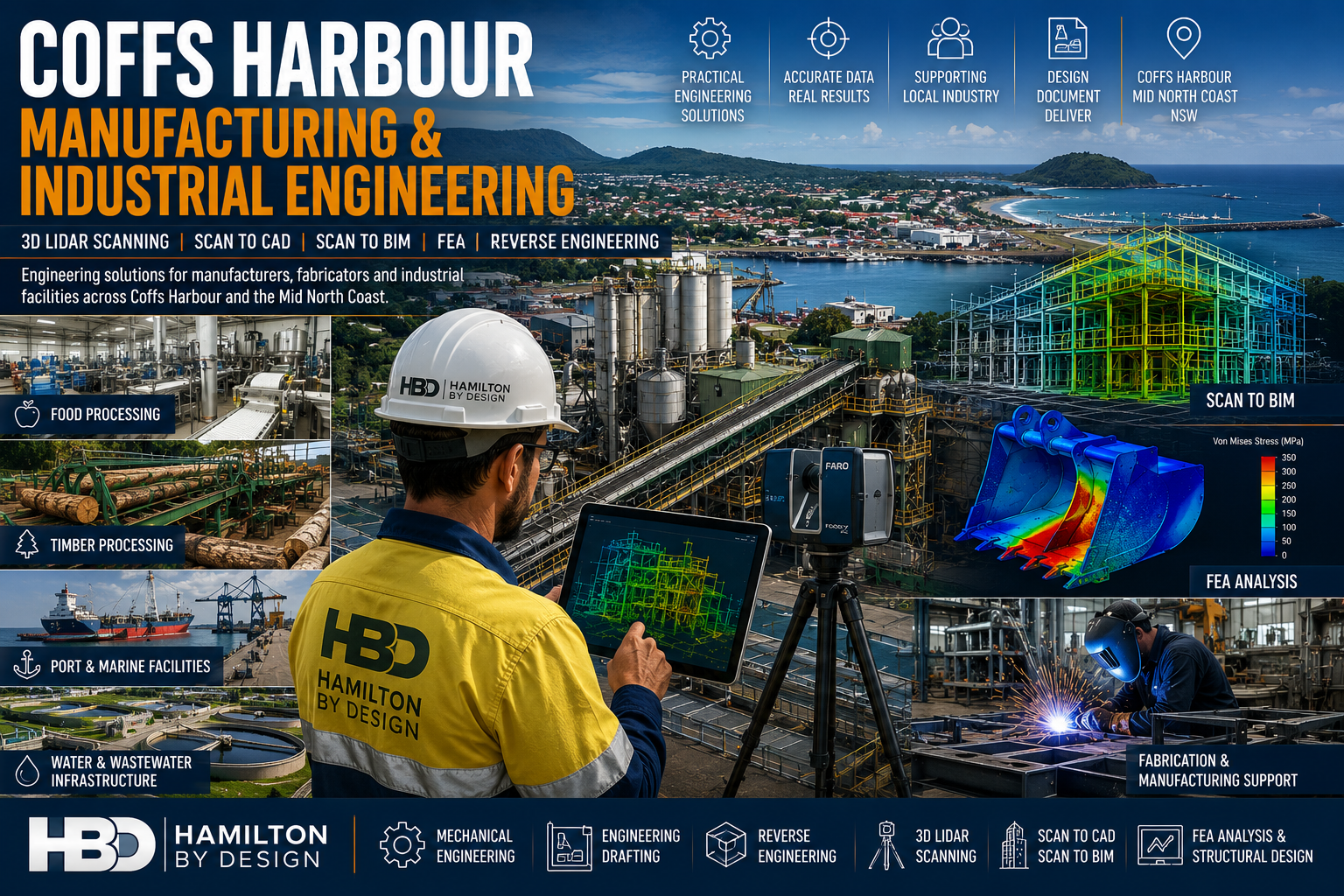
Coffs Harbour Manufacturing & Industrial Engineering

Coffs Harbour manufacturing and industrial engineering services featuring 3D LiDAR scanning, Scan to BIM, FEA analysis, food processing facilities, timber processing plants, marine infrastructure and fabrication workshops.

Coffs Harbour Manufacturing & Industrial Engineering

Engineering Solutions for Manufacturers, Fabricators & Industrial Facilities Across the Coffs Coast

Hamilton By Design provides engineering-led mechanical engineering, 3D LiDAR scanning, Scan to CAD, Scan to BIM, reverse engineering, finite element analysis (FEA) and engineering drafting services throughout Coffs Harbour, Toormina, Sawtell, Woolgoolga, Grafton and the wider North Coast region.

Coffs Harbour is one of regional New South Wales’ most diverse industrial centres, supporting manufacturing, food processing, timber processing, transport infrastructure, marine industries, water utilities and industrial facilities.

As facilities expand and equipment ages, accurate engineering information becomes critical for reducing project risk, improving asset reliability and supporting future growth.

Hamilton By Design helps manufacturers, engineers, fabricators and industrial asset owners capture existing conditions, develop accurate engineering models and deliver practical engineering solutions for both brownfield and greenfield projects.


Engineering Services for Manufacturing & Industry

Supporting Regional Industry Growth

Our services support:

  • Manufacturers
  • Fabricators
  • Timber Processing Facilities
  • Food Processing Plants
  • Water Utilities
  • Industrial Workshops
  • Logistics Facilities
  • Airport Infrastructure
  • Marine Facilities
  • Government Infrastructure

Services include:

  • Mechanical Engineering
  • Engineering Design
  • Reverse Engineering
  • Engineering Drafting
  • FEA Analysis
  • 3D LiDAR Scanning
  • Scan to CAD
  • Scan to BIM
  • Asset Documentation

3D LiDAR Scanning Coffs Harbour

Engineering Grade Reality Capture

Hamilton By Design provides engineering-grade terrestrial laser scanning services throughout Coffs Harbour and Northern NSW.

Laser scanning captures highly accurate site information that can be used for:

  • Existing Condition Surveys
  • Industrial Plant Upgrades
  • Manufacturing Facility Modifications
  • Structural Steel Modelling
  • Pipework Modelling
  • Asset Management
  • Construction Verification

Applications include:

Food Processing Facilities

Capture production equipment, processing lines, conveyors and services prior to upgrades and expansions.

Timber Processing Facilities

Accurately model sawmills, conveyors, log handling systems and timber processing infrastructure.

Industrial Manufacturing Facilities

Document existing plant conditions for engineering design and construction planning.


Sawmill & Timber Processing Engineering

Supporting Brownfield Upgrades

The North Coast has a strong timber processing industry with facilities often containing decades of modifications and undocumented changes.

Hamilton By Design supports:

  • Sawmill Expansions
  • Conveyor Upgrades
  • Dust Extraction Systems
  • Structural Modifications
  • Equipment Replacements
  • Facility Modernisation Projects

Using 3D LiDAR scanning and engineering modelling, we help reduce project risk and improve fabrication accuracy.


Scan to BIM Services

Building Information Modelling for Existing Assets

Hamilton By Design develops BIM models from laser scan data for:

  • Buildings
  • Manufacturing Facilities
  • Industrial Plants
  • Water Infrastructure
  • Utilities
  • Government Assets
  • Airport Infrastructure
  • Processing Facilities

Benefits include:

  • Improved project coordination
  • Reduced design clashes
  • Better asset management
  • Digital Twin Development
  • Enhanced project planning

Finite Element Analysis (FEA)

Engineering Validation Before Fabrication

Hamilton By Design provides FEA services for:

Loader Buckets

  • Wear analysis
  • Structural assessment
  • Reinforcement design

Excavator Buckets

  • Impact load analysis
  • Structural integrity reviews

Grader Blades

  • Ground engagement loading
  • Structural performance verification

Chutes & Hoppers

  • Material loading analysis
  • Wear zone identification
  • Structural optimisation

Industrial Structures

  • Platforms
  • Walkways
  • Support frames
  • Access systems

Reverse Engineering Services

When drawings are unavailable or outdated, reverse engineering allows valuable engineering information to be recovered.

Applications include:

  • Pumps
  • Shafts
  • Castings
  • Conveyor Components
  • Machine Components
  • Structural Assemblies
  • Wear Parts

Deliverables include:

  • SolidWorks Models
  • STEP Files
  • SAT Files
  • Manufacturing Drawings
  • Fabrication Documentation

Why Choose Hamilton By Design?

Engineering-Led Solutions

We understand how engineering information is used throughout the project lifecycle.

Practical Industry Experience

Supporting:

  • Manufacturing
  • Timber Processing
  • Food Processing
  • Utilities
  • Infrastructure
  • Industrial Facilities

Advanced Technology

Using:

  • FARO Focus Laser Scanners
  • FARO Orbis
  • FARO SCENE
  • SolidWorks
  • ANSYS
  • Autodesk Inventor
  • AutoCAD
  • Navisworks

Regional NSW Support

Providing engineering services throughout:

  • Coffs Harbour
  • Sawtell
  • Toormina
  • Woolgoolga
  • Grafton
  • Port Macquarie
  • Kempsey
  • Northern NSW
Hamilton By Design logo displayed on a blue tilted rectangle with a grey gradient background

Talk to Us – Contact Us

Name
Would you like us to arrange a phone consultation for you?
Address

Our clients:
3D LiDAR Scanning Darwin for engineering surveys, laser scanning, reality capture and point cloud modelling services
3D LiDAR Scanning Australia engineering services for laser scanning, reality capture, scan-to-CAD, Scan-to-BIM and as-built documentation across Australia
3D LiDAR scanning services on the Central Coast providing engineering-grade laser scanning, point cloud capture, scan-to-CAD modelling and industrial reality capture for infrastructure and industrial projects.

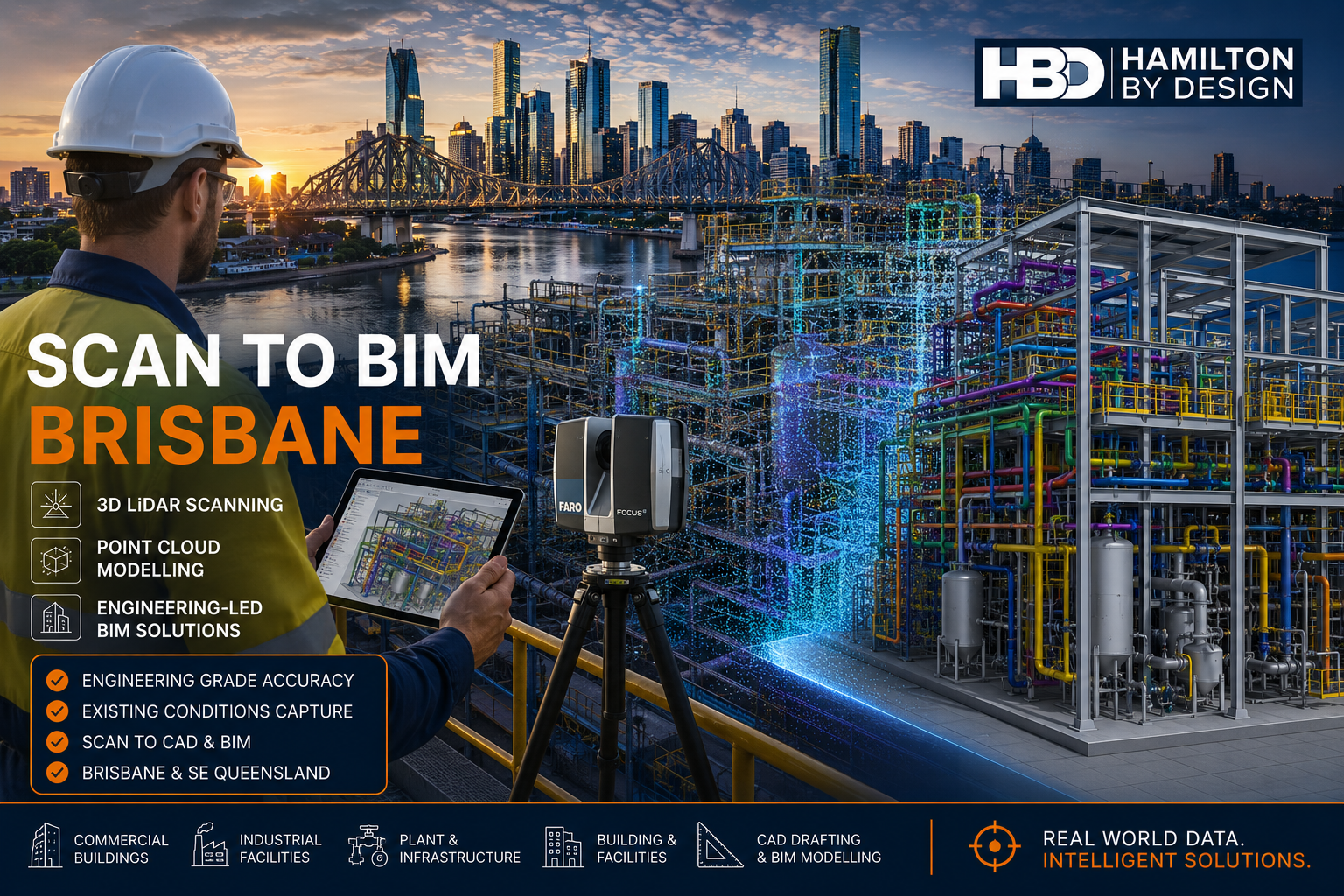
Scan to BIM Brisbane

Scan to BIM Brisbane project showing 3D LiDAR scanning, point cloud modelling and BIM development of an industrial facility with the Brisbane skyline and Story Bridge in the background.

Scan to BIM Brisbane | 3D LiDAR Scanning & BIM Modelling

Engineering-led Scan to BIM services for Brisbane buildings, plants, infrastructure and industrial sites.

Hamilton By Design provides Scan to BIM Brisbane services for projects that need accurate existing-condition information before design, construction, upgrade or refurbishment work begins.

Using 3D LiDAR scanning, point cloud processing and CAD/BIM modelling workflows, we help turn real-world site conditions into practical digital information that engineers, architects, builders, asset owners and project teams can use with confidence.


Scan to BIM Services in Brisbane

Brisbane continues to grow across commercial construction, infrastructure, manufacturing, health, education, water, transport and industrial sectors. Many projects begin with one major challenge:

The existing drawings are incomplete, outdated or do not match site conditions.

Scan to BIM helps solve this problem by capturing the real site in 3D and converting that data into a usable digital model.

Hamilton By Design supports Brisbane projects with:

  • 3D LiDAR scanning
  • Point cloud registration
  • Scan to BIM modelling
  • Existing-condition BIM models
  • As-built verification
  • Mechanical and structural CAD support
  • Plant room and services modelling
  • Scan to CAD deliverables
  • Engineering-grade site capture

Why Scan to BIM Matters

Before starting design or construction work, it is important to understand what is already there.

Poor existing information can lead to:

  • Rework
  • Design clashes
  • Site delays
  • Incorrect measurements
  • Fabrication errors
  • Safety risks
  • Cost overruns

A Scan to BIM workflow gives project teams a clearer understanding of the site before decisions are made.

This is especially useful for Brisbane projects involving brownfield sites, operating facilities, plant upgrades, building refurbishments and complex service areas.


Brisbane Projects We Support

Hamilton By Design can support Scan to BIM projects across Brisbane and South East Queensland, including:

  • Commercial buildings
  • Plant rooms
  • Industrial facilities
  • Processing plants
  • Pump stations
  • Water and wastewater assets
  • Hospitals and health facilities
  • Schools and universities
  • Warehouses
  • Manufacturing sites
  • Mining support facilities
  • Mechanical services areas
  • Structural steel and access platforms

Our background is not just scanning. We understand engineering, drafting, mechanical design, plant layout and construction documentation.

That means the point cloud is not treated as just a visual file. It becomes part of a practical engineering workflow.


What Is Scan to BIM?

Scan to BIM is the process of capturing an existing site using 3D laser scanning or LiDAR technology, then using that point cloud data to create a digital BIM model.

The process generally includes:

  1. Site scanning
  2. Point cloud registration
  3. Data cleaning and checking
  4. BIM or CAD modelling
  5. Review against project requirements
  6. Issue of model files, drawings or as-built documentation

The final deliverables can support design coordination, construction planning, asset management, clash detection and future maintenance.


Scan to BIM for Brownfield Sites

Many Brisbane projects are not greenfield projects. They involve existing buildings, existing services, operating plants or older facilities where drawings may not be reliable.

This is where Scan to BIM becomes valuable.

For brownfield projects, we can capture:

  • Pipework
  • Ductwork
  • Structural steel
  • Platforms and stairs
  • Plant equipment
  • Machinery layouts
  • Electrical and service zones
  • Building geometry
  • Slab and wall locations
  • Existing access constraints

This helps engineers and contractors design around real conditions, not assumptions.


Engineering-Led Site Capture

Hamilton By Design provides an engineering-led approach to 3D scanning and BIM modelling.

We understand that a model needs to be useful, not just visually impressive.

A good Scan to BIM model should help answer practical questions such as:

  • Will the new equipment fit?
  • Is there enough access?
  • Where are the existing services?
  • Are there clashes with structure or pipework?
  • Can the fabrication drawings be developed from this information?
  • What needs to be checked before construction starts?

This is why our Scan to BIM Brisbane service is suited to engineering, construction and industrial projects where accuracy and practical site knowledge matter.


Deliverables

Depending on the project, we can provide:

  • Registered point cloud data
  • E57 files
  • RCP / RCS files
  • Revit BIM models
  • DWG files
  • 2D plans, sections and elevations
  • 3D CAD models
  • STEP / SAT files
  • Existing-condition drawings
  • As-built verification reports
  • Mechanical and structural drafting support

Deliverables can be tailored to suit the design team, builder, engineer or asset owner.


Scan to BIM Brisbane for Design Coordination

Scan to BIM can improve design coordination by helping project teams compare proposed design work against existing site conditions.

This is useful for:

  • Refurbishment projects
  • Plant upgrades
  • Building services upgrades
  • Mechanical installations
  • Structural modifications
  • Access platform design
  • Equipment replacement
  • Pipework routing
  • Shutdown planning

By starting with better existing information, the project team can reduce uncertainty before work begins on site.


Benefits of Scan to BIM

The key benefits include:

  • Better understanding of existing conditions
  • Reduced site measurement errors
  • Improved design coordination
  • Better clash detection
  • Faster decision-making
  • Reduced rework
  • Better project planning
  • Improved confidence before fabrication or construction
  • More accurate as-built records

For complex Brisbane sites, Scan to BIM can be a practical investment that reduces risk early in the project.


Why Hamilton By Design?

Hamilton By Design combines 3D scanning, mechanical engineering, drafting and CAD modelling experience.

We support projects where the final outcome needs to be more than a scan.

Our experience includes:

  • Mechanical engineering
  • Structural drafting
  • Plant layout
  • Reverse engineering
  • Scan to CAD
  • Scan to BIM
  • Industrial site capture
  • Mining and processing facilities
  • Building and infrastructure projects

This gives clients a single point of support from site capture through to usable engineering documentation.


Brisbane and South East Queensland Support

Hamilton By Design can support projects across:

  • Brisbane CBD
  • South Brisbane
  • Fortitude Valley
  • Eagle Farm
  • Pinkenba
  • Rocklea
  • Acacia Ridge
  • Logan
  • Ipswich
  • Redcliffe
  • Moreton Bay
  • Gold Coast
  • Sunshine Coast
  • Toowoomba
  • Regional Queensland

We can also support interstate clients managing Queensland-based assets.


Hamilton By Design logo displayed on a blue tilted rectangle with a grey gradient background

Call to Action

Need accurate existing-condition information for a Brisbane project?

Hamilton By Design can help with Scan to BIM Brisbane, 3D LiDAR scanning, point cloud modelling, CAD drafting and engineering-led documentation.

Contact Hamilton By Design to discuss your Brisbane Scan to BIM project.

Talk to Us – Contact Us

Name
Would you like us to arrange a phone consultation for you?
Address

Our clients:

3D LiDAR Scanning Darwin for engineering surveys, laser scanning, reality capture and point cloud modelling services
3D LiDAR Scanning Australia engineering services for laser scanning, reality capture, scan-to-CAD, Scan-to-BIM and as-built documentation across Australia
3D LiDAR scanning services on the Central Coast providing engineering-grade laser scanning, point cloud capture, scan-to-CAD modelling and industrial reality capture for infrastructure and industrial projects.
3D LiDAR Scanning Perth for engineering surveys, laser scanning, reality capture and point cloud modelling services
3D LiDAR Scanning Sydney for engineering surveys, laser scanning, reality capture and point cloud modelling services
3D LiDAR Scanning Brisbane for engineering surveys, laser scanning, reality capture and point cloud modelling services
3D LiDAR Scanning Canberra for engineering surveys, laser scanning, reality capture and point cloud modelling services
3D LiDAR Scanning Newcastle for engineering surveys, laser scanning, reality capture and point cloud modelling services
3D LiDAR Scanning Adelaide for engineering surveys, laser scanning, reality capture and point cloud modelling services