Reverse Engineering Mining Industry

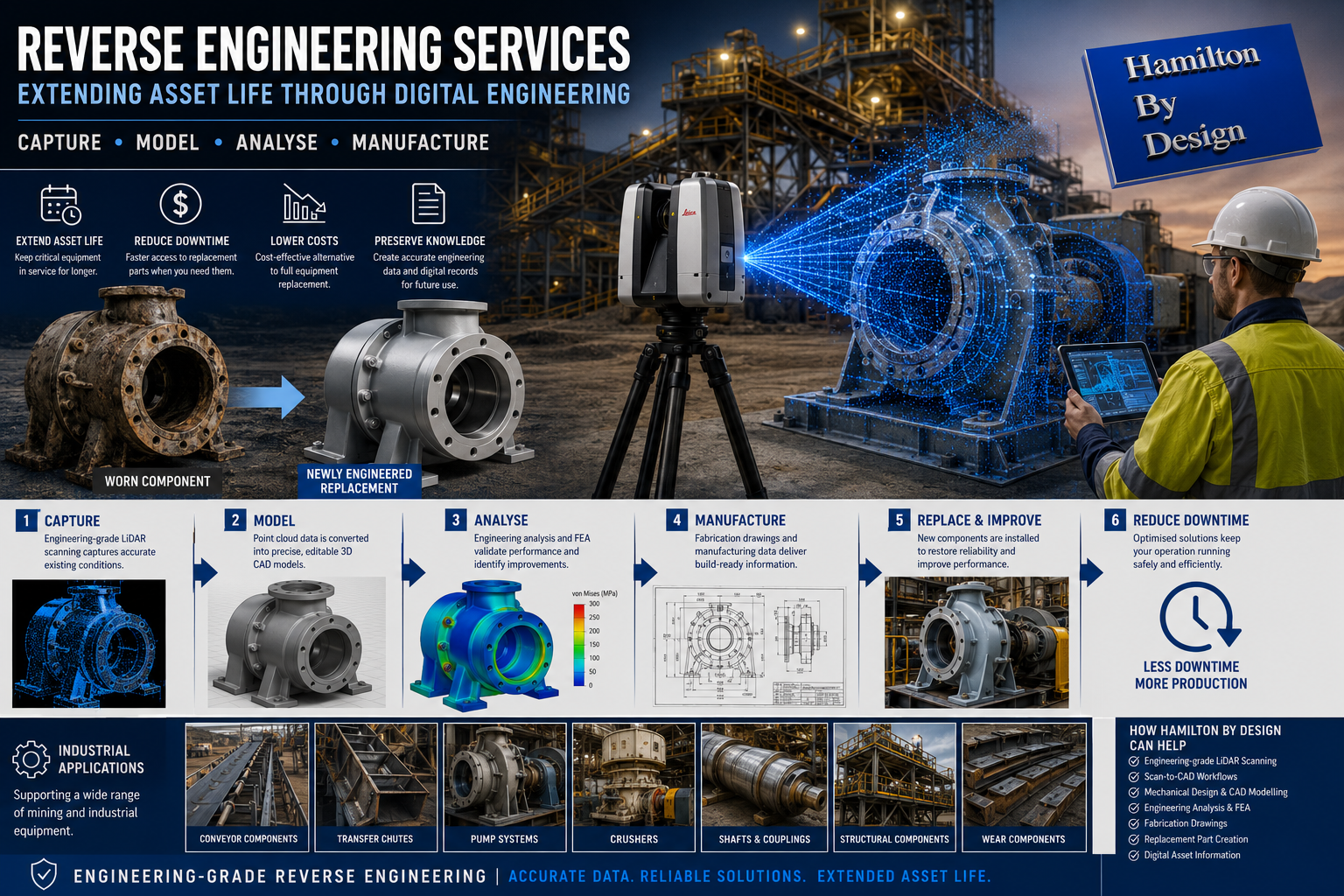
Engineering-grade reverse engineering workflow showing LiDAR scanning, CAD modelling, and FEA analysis used to recreate industrial equipment components.

Mining and industrial facilities often operate equipment for many years beyond its original installation date. Over time, machinery evolves through repairs, modifications, upgrades, and changing operational requirements. While equipment may continue performing effectively, obtaining replacement components can become increasingly difficult.

One of the most common challenges faced by industrial operations is finding replacement parts for ageing equipment where:

  • Original equipment manufacturers (OEMs) no longer support the product
  • Engineering drawings are unavailable
  • Documentation has been lost
  • Components have become obsolete
  • Lead times are excessive
  • Full equipment replacement becomes expensive

In these situations, reverse engineering can provide a practical pathway to maintain equipment performance and extend asset life.

At Hamilton By Design, we support mining and industrial operations through engineering-grade reverse engineering workflows incorporating 3D LiDAR scanning, CAD modelling, engineering analysis, and fabrication-ready documentation.

What is Reverse Engineering?

Reverse engineering involves capturing and analysing an existing component or system to recreate accurate engineering information.

Rather than starting from a new concept design, the process begins with an existing asset and develops:

  • Digital geometry
  • Engineering drawings
  • CAD models
  • Dimensional information
  • Design documentation
  • Manufacturing information

The goal is creating accurate engineering data that supports maintenance, fabrication, and equipment improvement.

Why Mining and Industrial Operations Use Reverse Engineering

Many industrial facilities contain equipment that may have operated for decades.

Examples include:

  • Conveyors
  • Transfer chutes
  • Pumps
  • Crushers
  • Structural components
  • Wear liners
  • Shafts
  • Fabricated assemblies
  • Mechanical components
  • Materials handling systems

As equipment ages, facilities can encounter increasing challenges obtaining replacement parts.

3D CAD Modelling Australia service banner for Hamilton By Design

Common issues include:

  • Obsolete components
  • Long manufacturing lead times
  • Missing drawings
  • Unknown modifications
  • Reduced OEM support
  • Increased maintenance costs

Reverse engineering helps bridge this information gap.

Obsolete Components and Missing Documentation

A common situation occurs when maintenance teams identify a failed component but no manufacturing information exists.

Examples may include:

  • Worn shafts
  • Custom brackets
  • Conveyor components
  • Pump assemblies
  • Structural items
  • Wear components

Without engineering information, organisations may face:

  • Extended downtime
  • Emergency fabrication
  • Manual measurement errors
  • Increased costs

Reverse engineering can convert physical components into accurate engineering data.

Extending Equipment Life

Full equipment replacement is not always necessary.

In many situations:

  • The surrounding system remains functional
  • Only selected components require replacement
  • Minor improvements may improve performance
  • Existing equipment can continue operating effectively

Extending equipment life may provide:

  • Lower capital expenditure
  • Reduced project risk
  • Reduced downtime
  • Improved return on investment
  • Improved operational continuity

Replacement Part Creation

Hamilton By Design can support replacement component development through engineering workflows including:

Existing Condition Capture

Capture existing equipment using:

  • Engineering-grade LiDAR scanning
  • Physical measurements
  • Dimensional verification

CAD Modelling

Develop:

  • Editable CAD models
  • Mechanical assemblies
  • Manufacturing information

Engineering Drawings

Generate:

  • General arrangement drawings
  • Fabrication drawings
  • Manufacturing documentation

Engineering Validation

Support projects through:

  • Design assessment
  • Engineering analysis
  • Finite Element Analysis (FEA)
  • Structural validation

Reducing Downtime

Unexpected equipment failures can significantly affect production.

Potential impacts may include:

  • Lost production
  • Shutdown delays
  • Increased labour requirements
  • Emergency maintenance costs
  • Reduced operational efficiency

Reverse engineering can support maintenance planning by creating:

  • Digital spare part libraries
  • Engineering records
  • Manufacturing information
  • Improved replacement processes

This allows organisations to move from reactive responses toward more structured asset management.

Cost Versus Full Equipment Replacement

Replacing an entire system can involve:

  • High capital cost
  • Long procurement timeframes
  • Installation costs
  • Production interruptions
  • Project risk

Reverse engineering may provide an alternative where:

  • Existing equipment remains suitable
  • Only selected components require replacement
  • Performance improvements can be introduced

Engineering decisions can then focus on lifecycle value rather than simply replacing complete systems.

Industrial Applications

Reverse engineering can support:

Mining Operations

  • Conveyor systems
  • Transfer chutes
  • Crushers
  • Pump systems
  • Structural assets
  • Processing equipment

Manufacturing Facilities

  • Production equipment
  • Mechanical assemblies
  • Custom components

Industrial Processing Plants

  • Wear components
  • Mechanical equipment
  • Plant modifications
  • Existing assets
3D LiDAR scanning and 3D modelling service button โ€” laser scanner capturing a point cloud for engineering and CAD modelling
Mechanical engineering services

How Hamilton By Design Supports Reverse Engineering Projects

Hamilton By Design combines engineering tools and practical engineering experience to support reverse engineering projects through:

  • Engineering-grade 3D LiDAR scanning
  • Scan-to-CAD workflows
  • Mechanical design
  • CAD modelling
  • Engineering analysis and FEA
  • Fabrication documentation
  • Existing condition verification

The objective is not simply reproducing a component.

The objective is creating reliable engineering information that supports productivity, maintenance, and long-term asset performance.

Engineering-grade reverse engineering helps transform ageing assets from a limitation into an opportunity for improved operational performance.

Our Clients:

3D CAD Modelling Australia service banner for Hamilton By Design
Australian Drafting logo featuring bold white text reading "Australian Drafting" centred on a blue rounded rectangle background.
Engineering Governance title graphic featuring bold white text reading "Engineering Governance" centred on a blue rounded rectangle background.
Mechanical, Structural & Pipework Drafting service banner by Hamilton By Design featuring white text on a blue background.
Mechanical engineering services
Blue rounded button with the text โ€œSolidWorks Designโ€ in white.
Finite Element Analysis (FEA) engineering simulation button
3D LiDAR Scanning Darwin for engineering surveys, laser scanning, reality capture and point cloud modelling services
3D LiDAR Scanning Australia engineering services for laser scanning, reality capture, scan-to-CAD, Scan-to-BIM and as-built documentation across Australia
3D LiDAR scanning services on the Central Coast providing engineering-grade laser scanning, point cloud capture, scan-to-CAD modelling and industrial reality capture for infrastructure and industrial projects.
3D LiDAR Scanning Perth for engineering surveys, laser scanning, reality capture and point cloud modelling services
3D LiDAR Scanning Sydney for engineering surveys, laser scanning, reality capture and point cloud modelling services
3D LiDAR Scanning Brisbane for engineering surveys, laser scanning, reality capture and point cloud modelling services
3D LiDAR Scanning Canberra for engineering surveys, laser scanning, reality capture and point cloud modelling services
3D LiDAR Scanning Newcastle for engineering surveys, laser scanning, reality capture and point cloud modelling services
3D LiDAR Scanning Adelaide for engineering surveys, laser scanning, reality capture and point cloud modelling services

Forestry Industry & Timber Processing: Engineering Machinery for Productivity and Long-Term Value

Engineering-grade LiDAR scanning and FEA simulation workflow for forestry and timber processing equipment design.

The forestry and timber processing industries operate in demanding environments where productivity, reliability, and equipment performance directly influence profitability. Whether processing logs, handling timber products, operating sawmills, or managing materials handling systems, machinery downtime and inefficiencies can significantly affect production output and operating costs.

Modern engineering is moving beyond traditional design approaches and increasingly using digital engineering tools to optimise equipment before fabrication and installation begins.

At Hamilton By Design, we combine engineering-grade 3D LiDAR scanning, 3D modelling, and Finite Element Analysis (FEA) to support forestry and timber processing operations by delivering machinery and engineered systems designed for productivity, reliability, and long-term return on investment.

Designing for More Than Initial Cost

The lowest purchase price does not always provide the lowest operating cost.

Machinery and processing systems can incur substantial ongoing costs through:

  • Excessive wear
  • Unplanned maintenance
  • Downtime
  • Energy consumption
  • Material build-up
  • Inefficient layouts
  • Reduced production capacity
  • Premature equipment failure

Engineering decisions made during the design stage can influence the total lifecycle cost of equipment for many years after installation.

The objective is not simply designing machinery that works.

The objective is designing machinery that continues to perform efficiently throughout its operational life.

Engineering-Grade 3D LiDAR Scanning

For existing timber processing plants and brownfield facilities, one of the biggest challenges is understanding current conditions accurately.

Many facilities contain:

  • Existing conveyors
  • Timber processing machinery
  • Structural steel
  • Pipework
  • Platforms and access systems
  • Building constraints
  • Historical modifications

Outdated drawings or manual measurements can introduce risk into engineering projects.

Hamilton By Design uses engineering-grade 3D LiDAR scanning to capture accurate existing conditions and generate high-quality point cloud data.

This provides:

  • Accurate plant geometry
  • Existing condition verification
  • Reduced design assumptions
  • Improved fit-up accuracy
  • Reduced installation risk
  • Faster project development

Rather than designing around assumptions, engineering decisions can be based on actual site information.

3D Modelling for Better Project Outcomes

Once site information has been captured, point cloud data can be converted into editable engineering models.

3D CAD Modelling Australia service banner for Hamilton By Design

3D modelling provides benefits including:

  • Improved visualisation
  • Clash detection
  • Layout optimisation
  • Equipment integration
  • Fabrication planning
  • Improved communication

For forestry and timber processing projects this may include:

  • Log handling systems
  • Conveyors
  • Transfer systems
  • Chutes
  • Processing equipment
  • Access platforms
  • Structural modifications
  • Production upgrades

Digital models help identify issues before they become site problems.

Finite Element Analysis (FEA)

Engineering performance extends beyond appearance and fit-up.

Equipment must withstand:

  • Dynamic loading
  • Material impacts
  • Fatigue
  • Wear
  • Structural loading
  • Operational forces

Hamilton By Design can support projects through Finite Element Analysis (FEA) to evaluate equipment and structural performance before fabrication begins.

FEA can assist with:

  • Stress assessment
  • Deflection analysis
  • Structural performance
  • Design optimisation
  • Weight reduction opportunities
  • Reliability improvements

Rather than overdesigning equipment or relying on assumptions, designs can be refined using measurable engineering information.

Maximising Return on Investment

A successful project should not simply focus on reducing initial capital cost.

The real value often comes from:

  • Increased production rates
  • Reduced maintenance costs
  • Improved reliability
  • Reduced downtime
  • Improved safety
  • Lower lifecycle costs
  • Longer equipment life
  • Improved operational efficiency
3D LiDAR scanning and 3D modelling service button โ€” laser scanner capturing a point cloud for engineering and CAD modelling
Mechanical engineering services

Engineering decisions made early in a project often have long-term financial impacts.

How Hamilton By Design Supports Forestry and Timber Processing

Hamilton By Design combines digital engineering tools with practical engineering experience to support projects from concept through to delivery.

Our services include:

  • Engineering-grade 3D LiDAR scanning
  • Scan-to-CAD workflows
  • 3D modelling
  • Mechanical engineering design
  • Finite Element Analysis (FEA)
  • Engineering drawings
  • Fabrication documentation
  • Existing condition verification
  • Brownfield project support

By integrating reality capture, digital modelling, and engineering analysis, projects can move from assumptions toward measurable engineering outcomes.

The goal is simple:

Design machinery and systems that maximise productivity while delivering stronger long-term returns on investment.

3D CAD Modelling Australia service banner for Hamilton By Design
Australian Drafting logo featuring bold white text reading "Australian Drafting" centred on a blue rounded rectangle background.
Engineering Governance title graphic featuring bold white text reading "Engineering Governance" centred on a blue rounded rectangle background.
Mechanical, Structural & Pipework Drafting service banner by Hamilton By Design featuring white text on a blue background.
Mechanical engineering services
Blue rounded button with the text โ€œSolidWorks Designโ€ in white.
Finite Element Analysis (FEA) engineering simulation button
3D LiDAR Scanning Darwin for engineering surveys, laser scanning, reality capture and point cloud modelling services
3D LiDAR Scanning Australia engineering services for laser scanning, reality capture, scan-to-CAD, Scan-to-BIM and as-built documentation across Australia
3D LiDAR scanning services on the Central Coast providing engineering-grade laser scanning, point cloud capture, scan-to-CAD modelling and industrial reality capture for infrastructure and industrial projects.
3D LiDAR Scanning Perth for engineering surveys, laser scanning, reality capture and point cloud modelling services
3D LiDAR Scanning Sydney for engineering surveys, laser scanning, reality capture and point cloud modelling services
3D LiDAR Scanning Brisbane for engineering surveys, laser scanning, reality capture and point cloud modelling services
3D LiDAR Scanning Canberra for engineering surveys, laser scanning, reality capture and point cloud modelling services
3D LiDAR Scanning Newcastle for engineering surveys, laser scanning, reality capture and point cloud modelling services
3D LiDAR Scanning Adelaide for engineering surveys, laser scanning, reality capture and point cloud modelling services

Engineering Analysis & Simulation: Turning Engineering Assumptions into Measured Decisions

Engineering Analysis and Simulation infographic showing LiDAR scanning, scan-to-CAD workflows, finite element analysis (FEA), and digital engineering processes used to optimise industrial plant design and improve project outcomes.

In modern engineering projects, assumptions can quickly become expensive. Whether designing a transfer chute, assessing a structural support frame, modifying a conveyor system, or evaluating equipment performance, understanding how a system will behave before fabrication or installation can reduce risk, minimise rework, and improve project outcomes.

Engineering analysis and simulation allow engineers to move beyond simple calculations and create a deeper understanding of how equipment, structures, and systems will perform under real operating conditions.

At Hamilton By Design, we provide engineering analysis and simulation services to support mining, manufacturing, infrastructure, and industrial projects by combining engineering judgement with digital engineering tools and practical industry experience.

What is Engineering Analysis and Simulation?

Engineering analysis and simulation involve creating mathematical and digital representations of real-world systems to predict behaviour and performance before implementation.

Examples include:

  • Structural analysis
  • Finite Element Analysis (FEA)
  • Stress and deflection assessment
  • Equipment performance modelling
  • Load analysis
  • Materials handling analysis
  • Mechanical design validation
  • Existing asset assessments
  • Failure investigations
  • Brownfield modification studies

Rather than relying solely on assumptions or conservative estimates, simulation can provide measurable engineering data to support decision making.

Why Engineering Analysis Matters

Engineering projects often involve balancing multiple competing factors:

  • Safety
  • Cost
  • Performance
  • Weight
  • Reliability
  • Manufacturability
  • Maintenance access
  • Project schedule

Without engineering analysis, projects can encounter:

  • Unexpected structural failures
  • Excessive equipment wear
  • Over-designed systems
  • Fabrication clashes
  • Higher maintenance costs
  • Delays during installation

Simulation allows these issues to be identified earlier in the project lifecycle.

Hamilton By Design Engineering Analysis Services

Hamilton By Design offers engineering analysis and simulation services integrated with practical engineering workflows and reality capture technologies.

Our services can include:

Finite Element Analysis (FEA)

FEA can be used to assess:

  • Structural loading
  • Stress concentrations
  • Deflection
  • Equipment supports
  • Platform structures
  • Mechanical components
  • Existing assets

This allows engineers to identify areas of concern before fabrication or installation.

3D CAD Modelling Australia service banner for Hamilton By Design

Mechanical Design Validation

Engineering models can be assessed against:

  • Expected operational loads
  • Serviceability requirements
  • Design standards
  • Fatigue considerations
  • Practical operating conditions

Scan-to-Analysis Workflows

Traditional analysis often starts with assumptions about existing conditions.

Hamilton By Design can integrate:

  • Engineering-grade LiDAR scanning
  • Point cloud capture
  • Existing condition verification
  • Scan-to-CAD workflows

This allows simulations to be based on actual site geometry rather than estimated dimensions.

For brownfield mining and industrial projects this can significantly reduce uncertainty.

Applications Across Industry

Engineering analysis and simulation can support:

Mining

  • Conveyor systems
  • Transfer chutes
  • Processing equipment
  • Structural platforms
  • Plant modifications
  • Shutdown planning

Manufacturing

  • Production equipment
  • Structural supports
  • Machine layouts
  • Fabrication design

Infrastructure

  • Existing asset modifications
  • Structural assessments
  • Mechanical systems
  • Upgrade projects

Moving Beyond Assumptions

One of the biggest advantages of digital engineering is moving from:

Estimated geometry โ†’ Verified geometry

Rather than assuming dimensions from old drawings or field measurements, engineering analysis can be built around actual conditions captured through reality capture and CAD workflows.

This creates:

  • Improved confidence
  • Reduced project risk
  • Better fabrication outcomes
  • Reduced rework
  • More reliable project delivery
3D LiDAR scanning and 3D modelling service button โ€” laser scanner capturing a point cloud for engineering and CAD modelling
Mechanical engineering services

Supporting Better Engineering Decisions

At Hamilton By Design, engineering analysis is not treated as an isolated activity. It becomes part of a broader engineering workflow combining:

  • LiDAR scanning
  • Scan-to-CAD conversion
  • Mechanical design
  • Engineering documentation
  • Simulation and analysis
  • Project delivery support

The objective is not simply creating models. The objective is delivering engineering information that supports practical decisions and better outcomes.

Engineering analysis and simulation help projects move beyond assumptions and toward measurable, evidence-based engineering decisions.

Name
Would you like us to arrange a phone consultation for you?
Address

Our clients:
3D CAD Modelling Australia service banner for Hamilton By Design
Australian Drafting logo featuring bold white text reading "Australian Drafting" centred on a blue rounded rectangle background.
Engineering Governance title graphic featuring bold white text reading "Engineering Governance" centred on a blue rounded rectangle background.
Mechanical, Structural & Pipework Drafting service banner by Hamilton By Design featuring white text on a blue background.
Mechanical engineering services
Blue rounded button with the text โ€œSolidWorks Designโ€ in white.
Finite Element Analysis (FEA) engineering simulation button
3D LiDAR Scanning Darwin for engineering surveys, laser scanning, reality capture and point cloud modelling services
3D LiDAR Scanning Australia engineering services for laser scanning, reality capture, scan-to-CAD, Scan-to-BIM and as-built documentation across Australia
3D LiDAR scanning services on the Central Coast providing engineering-grade laser scanning, point cloud capture, scan-to-CAD modelling and industrial reality capture for infrastructure and industrial projects.
3D LiDAR Scanning Perth for engineering surveys, laser scanning, reality capture and point cloud modelling services
3D LiDAR Scanning Sydney for engineering surveys, laser scanning, reality capture and point cloud modelling services
3D LiDAR Scanning Brisbane for engineering surveys, laser scanning, reality capture and point cloud modelling services
3D LiDAR Scanning Canberra for engineering surveys, laser scanning, reality capture and point cloud modelling services
3D LiDAR Scanning Newcastle for engineering surveys, laser scanning, reality capture and point cloud modelling services
3D LiDAR Scanning Adelaide for engineering surveys, laser scanning, reality capture and point cloud modelling services

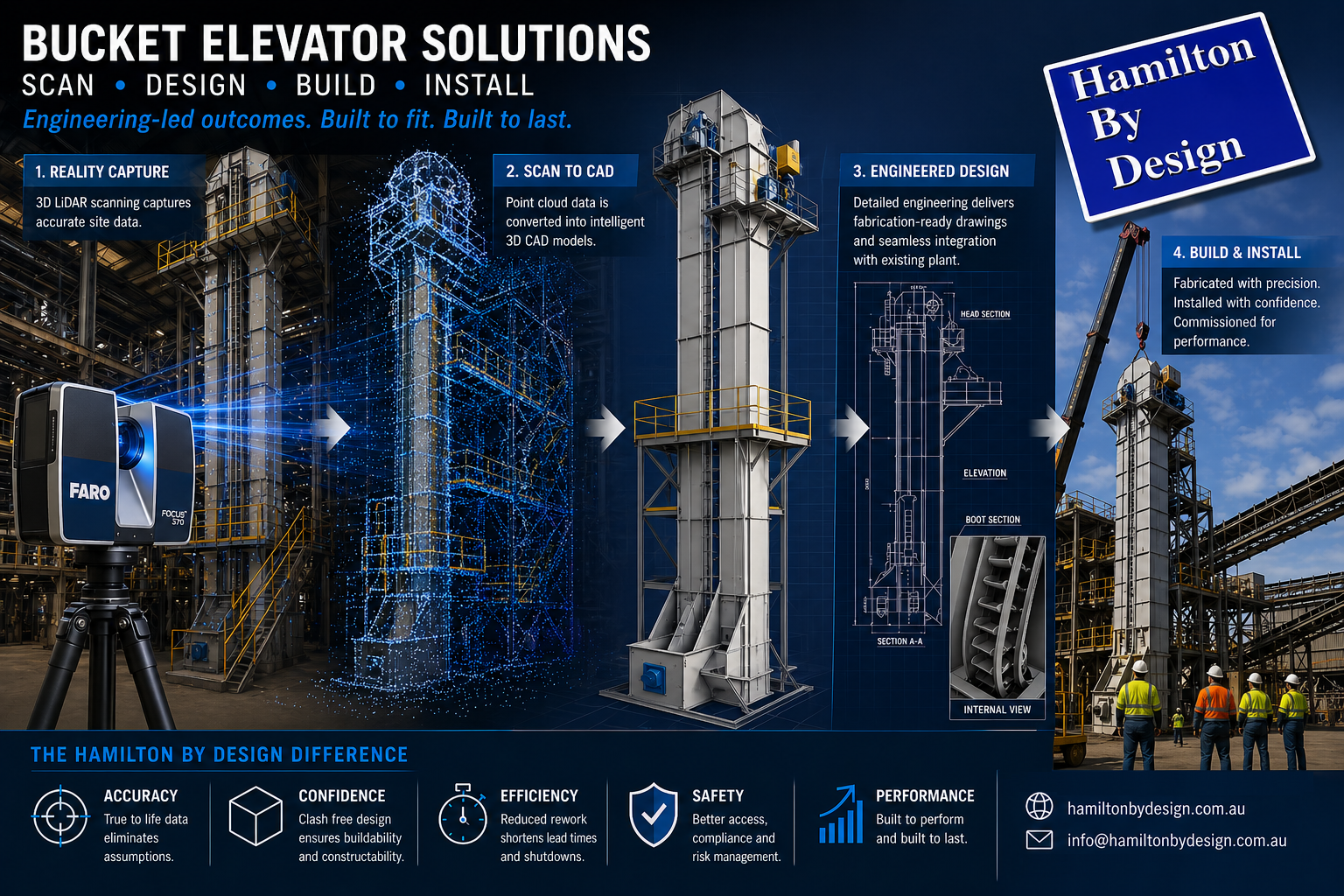
Material Handling: Bucket Elevator Scan, Design, Build and Install

3D LiDAR scanning to CAD modelling workflow for a bucket elevator system in an industrial material handling plant

An Engineering-Led Approach for Brownfield Industrial Environments

Bucket elevators are a fundamental component of bulk material handling systems, providing an efficient and reliable method for the vertical transport of materials such as ores, grains, cement, and industrial powders. Despite their apparent simplicity, the successful design and installation of bucket elevators within existing (brownfield) facilities presents significant engineering challenges. These challenges typically arise from undocumented modifications, limited access, and the inherent complexity of integrating new infrastructure into legacy plant environments.

This paper outlines an engineering-led methodology adopted by Hamilton By Design, incorporating 3D LiDAR scanning, scan-to-CAD modelling, and fabrication-ready design to deliver a complete scan, design, build, and install solution for bucket elevator systems.


3D CAD Modelling Australia service banner for Hamilton By Design

Limitations of Traditional Design Methodologies

Conventional approaches to bucket elevator design often rely on outdated drawings, manual site measurements, and engineering assumptions regarding existing plant conditions. While these methods may be adequate for greenfield developments, they are frequently inadequate in brownfield environments.

Common issues associated with traditional methodologies include:

  • Dimensional inaccuracies leading to misalignment during installation
  • Increased fabrication rework due to unforeseen clashes
  • Extended shutdown durations and associated production losses
  • Elevated safety risks resulting from poor integration with existing infrastructure

In material handling systems, particularly those involving rotating equipment and vertical conveyance, dimensional accuracy is critical. Minor deviations can result in significant operational inefficiencies, including premature wear, belt tracking issues, and mechanical failure.


Engineering-Grade 3D LiDAR Scanning

To address these challenges, an engineering-grade 3D LiDAR scanning process is employed to capture a high-resolution, spatially accurate representation of the existing plant environment. This process generates a point cloud dataset that reflects the true geometry of all visible structures, equipment, and interfaces.

The application of LiDAR scanning provides the following advantages:

  • Accurate capture of structural steelwork, platforms, and existing material handling systems
  • Identification of spatial constraints and potential clashes prior to design development
  • Reliable definition of tie-in points for new equipment
  • Reduction in reliance on assumptions and manual measurement

Importantly, the point cloud dataset is treated as an engineering input, rather than a visual reference. This distinction ensures that all subsequent design activities are grounded in verified, real-world data.


Scan-to-CAD Modelling and Engineering Design

Following data acquisition, the point cloud is processed and converted into a structured, parametric CAD model. This scan-to-CAD workflow enables the development of detailed engineering designs that accurately reflect existing site conditions.

Typical deliverables include:

  • Three-dimensional parametric models suitable for engineering analysis and coordination
  • General Arrangement (GA) drawings illustrating system layout and interfaces
  • Detailed sections and elevations through critical components
  • Interface definitions with existing conveyors, chutes, and structural systems

This approach facilitates seamless integration of the bucket elevator with existing plant infrastructure. Furthermore, it enables multidisciplinary coordination, ensuring alignment between mechanical, structural, and operational requirements.

A key differentiator of this methodology is the focus on producing fabrication-ready outputs, rather than conceptual or visual models. This ensures that the design intent can be directly translated into manufacturable components.


Engineering Considerations in Bucket Elevator Design

The design of a bucket elevator system must address a range of mechanical, structural, and operational factors.

Mechanical Design Parameters

  • Selection of belt or chain systems based on material characteristics and throughput requirements
  • Determination of bucket spacing, capacity, and configuration
  • Design of head pulley assemblies and drive systems
  • Specification of boot sections, including tensioning and clean-out provisions

Structural Integration

  • Design of support frames and load transfer mechanisms
  • Assessment of existing structural capacity and required reinforcements
  • Compliance with relevant standards, including AS 1657 for access and maintenance systems

Operational and Maintenance Considerations

  • Material flow behaviour and potential for blockages
  • Dust containment and environmental controls
  • Provision of safe access for inspection, maintenance, and replacement activities

By integrating scan data with engineering analysis, the resulting design is optimised for both performance and constructability within the constraints of the existing facility.


Fabrication and Quality Assurance

The transition from design to fabrication is significantly enhanced by the availability of accurate, detailed engineering documentation. Fabrication drawings derived from scan-based models provide a high degree of confidence in component fitment and assembly.

Key benefits include:

  • Reduction in fabrication errors and rework
  • Improved efficiency in workshop processes
  • Accurate material take-offs and procurement planning
  • Enhanced quality assurance through alignment with verified design data

Engineering oversight during fabrication ensures that all components meet specified tolerances and performance requirements.


Installation and Commissioning

Installation of bucket elevator systems within operational facilities is typically constrained by limited shutdown windows and restricted access. As such, careful planning and coordination are essential.

An engineering-led installation approach includes:

  • Development of detailed installation methodologies and sequencing
  • Planning of lifting operations and access requirements
  • Verification of alignment and fitment using scan data
  • Provision of on-site engineering support during critical installation phases

The use of pre-validated design data significantly reduces installation risk, minimises delays, and ensures a more efficient commissioning process.


Benefits of an Integrated Scan, Design, Build and Install Approach

The integration of LiDAR scanning, engineering design, and fabrication support provides a number of measurable benefits:
  • Reduced project risk through improved dimensional accuracy
  • Enhanced constructability and reduced fabrication rework
  • Shorter installation durations and reduced plant downtime
  • Improved coordination between engineering, fabrication, and site teams

For project stakeholders, this approach delivers greater certainty in both project outcomes and timelines.


Applications in Industry

This methodology is applicable across a range of industries where bulk material handling systems are utilised, including:

  • Mining and mineral processing operations
  • Agricultural and grain handling facilities
  • Cement and bulk powder processing plants
  • Recycling and industrial manufacturing environments

It is particularly valuable in brownfield projects involving upgrades, retrofits, or replacement of existing bucket elevator systems.


Conclusion

The successful implementation of bucket elevator systems in brownfield environments requires a departure from traditional design methodologies. By adopting an engineering-led approach grounded in accurate spatial data, it is possible to significantly reduce project risk and improve overall outcomes.

Hamilton By Design provides a comprehensive solution that integrates 3D LiDAR scanning, scan-to-CAD modelling, and fabrication-ready design. This approach ensures that bucket elevator systems are not only theoretically sound but also practically deliverable within the constraints of real-world industrial environments.

3D LiDAR scanning and 3D modelling service button โ€” laser scanner capturing a point cloud for engineering and CAD modelling
Mechanical engineering services

Contact Us – Talk to Us


Hamilton By Design logo displayed on a blue tilted rectangle with a grey gradient background

E-Mail: [email protected]

3D CAD Modelling Australia service banner for Hamilton By Design
Australian Drafting logo featuring bold white text reading "Australian Drafting" centred on a blue rounded rectangle background.
Engineering Governance title graphic featuring bold white text reading "Engineering Governance" centred on a blue rounded rectangle background.
Mechanical, Structural & Pipework Drafting service banner by Hamilton By Design featuring white text on a blue background.
Mechanical engineering services
Blue rounded button with the text โ€œSolidWorks Designโ€ in white.
Finite Element Analysis (FEA) engineering simulation button
3D LiDAR Scanning Darwin for engineering surveys, laser scanning, reality capture and point cloud modelling services
3D LiDAR Scanning Australia engineering services for laser scanning, reality capture, scan-to-CAD, Scan-to-BIM and as-built documentation across Australia
3D LiDAR scanning services on the Central Coast providing engineering-grade laser scanning, point cloud capture, scan-to-CAD modelling and industrial reality capture for infrastructure and industrial projects.
3D LiDAR Scanning Perth for engineering surveys, laser scanning, reality capture and point cloud modelling services
3D LiDAR Scanning Sydney for engineering surveys, laser scanning, reality capture and point cloud modelling services
3D LiDAR Scanning Brisbane for engineering surveys, laser scanning, reality capture and point cloud modelling services
3D LiDAR Scanning Canberra for engineering surveys, laser scanning, reality capture and point cloud modelling services
3D LiDAR Scanning Newcastle for engineering surveys, laser scanning, reality capture and point cloud modelling services
3D LiDAR Scanning Adelaide for engineering surveys, laser scanning, reality capture and point cloud modelling services

Engineering-Grade 3D Laser Scanning & Scan-to-CAD Services in Branchburg, New Jersey

3D laser scanner overlooking Raritan River and farmland in Branchburg New Jersey with industrial plant point cloud overlay

Introduction

Hamilton By Design provides engineering-grade 3D laser scanning, scan-to-CAD, and mechanical drafting services to industrial and infrastructure clients in Branchburg, New Jersey and surrounding regions.

Unlike low-cost scanning providers that deliver raw meshes or unverified data, our approach is grounded in mechanical engineering outcomesโ€”ensuring every scan translates into accurate, buildable, and fabrication-ready models.

Whether you are upgrading an industrial facility, planning a shutdown, or coordinating multi-disciplinary engineering works, our workflow ensures a clear bridge between reality and design intent.


Why Engineering-Led Scanning Matters

Many organisations underestimate the risk associated with poor-quality scan data. Cheap scans often result in:

  • Misaligned models
  • Missing geometry due to poor line-of-sight planning
  • Fabrication errors and costly rework
  • Delays during installation

At Hamilton By Design, we position scanning as the first step in engineeringโ€”not just data capture.

๐Ÿ‘‰ Our focus is simple:
Scan โ†’ Model โ†’ Detail โ†’ Verify โ†’ Deliver

This ensures your project progresses with confidence, accuracy, and traceability.


Our Services in Branchburg

1. 3D Laser Scanning (LiDAR)

We utilise professional-grade terrestrial LiDAR systems to capture high-density, survey-quality point clouds.

Typical applications include:

  • Industrial plants and processing facilities
  • Pipework systems and structural steel
  • Conveyor systems and bulk handling infrastructure
  • Brownfield upgrades and retrofit projects

Deliverables:
  • Registered point clouds (.E57, .RCP, .LAS)
  • Scan reports and alignment verification
  • Optional Scene LT viewer access
3D CAD Modelling Australia service banner for Hamilton By Design

2. Scan-to-CAD / Scan-to-Model

We convert point cloud data into accurate, usable engineering models.

Outputs include:
  • STEP / Parasolid models for fabrication
  • AutoCAD 2D drawings (GA, sections, elevations)
  • Revit-compatible geometry (where required)

This is where most scanning providers fall shortโ€”
we ensure models are usable for engineering, not just visualisation.


3. Mechanical Engineering & Drafting

Our team supports:

  • Equipment design and modification
  • Pipework and structural detailing
  • Shutdown engineering support
  • Reverse engineering of legacy assets

We understand brownfield constraints, ensuring designs fit first time.


Applications Across Industry

We support projects across:

  • Manufacturing facilities
  • Mining and bulk materials handling
  • Energy and utilities infrastructure
  • Water treatment and pumping stations

For clients in Branchburg and the broader New Jersey region, our services are particularly valuable for:

โœ” Retrofit and upgrade projects
โœ” Congested plant environments
โœ” Legacy asset documentation
โœ” Multi-vendor coordination


The Problem with โ€œCheap Scansโ€

A common issue we see:

โ€œWe already have a scanโ€”but itโ€™s not usable.โ€

This usually stems from:

  • Low-resolution capture
  • Incomplete coverage
  • Lack of engineering interpretation

The result?
You pay twiceโ€”once for the scan, and again to fix it.

Hamilton By Design eliminates this risk by delivering:

  • Verified geometry
  • Engineering-ready outputs
  • Clear documentation and traceability

Our Workflow

  1. Project Planning
    Define scope, access, and required deliverables
  2. On-Site Scanning
    Structured capture ensuring full coverage and accuracy
  3. Point Cloud Registration
    Alignment, cleaning, and validation
  4. Model Development
    Engineering-grade CAD modelling
  5. Drawing Production
    Fabrication-ready documentation
  6. Quality Assurance
    Dimensional checks against scan data

Data Governance & Digital Engineering

We go beyond scanning by offering structured engineering data governance.

Using platforms such as the 3DEXPERIENCE Platform, we provide:

  • Version-controlled drawing environments
  • Secure data storage and access
  • Audit trails for engineering changes
  • 24/7 access to project information

This is critical for multi-contractor environments and long-term asset management.


Working with Hamilton By Design

We operate internationally and can support projects in Branchburg through:

  • Mobilised site scanning teams
  • Remote scan-to-CAD workflows
  • Hybrid engagement models (scan + engineering + drafting)

Our typical engagement includes:

  • Fast turnaround from data capture to deliverables
  • Clear communication and defined scope
  • Engineering accountability for outputs

Why Choose Hamilton By Design

โœ” Engineering-first approach
โœ” Fabrication-ready deliverables
โœ” Proven experience in brownfield environments
โœ” Advanced LiDAR and CAD capabilities
โœ” Focus on risk reduction and project certainty


Conclusion

For organisations in Branchburg, New Jersey, the difference between a successful project and a costly rework often comes down to data quality and engineering interpretation.

Hamilton By Design ensures your project starts with accurate, reliable, and usable dataโ€”ready for real-world application.


3D LiDAR scanning and 3D modelling service button โ€” laser scanner capturing a point cloud for engineering and CAD modelling
Mechanical engineering services

Get in Touch

If you are planning a project in Branchburg or the surrounding New Jersey region, reach out to discuss how we can support:

Strengthen Your Project with Australian Engineering

Hamilton By Design logo displayed on a blue tilted rectangle with a grey gradient background

“We are process driven”

๐ŸŒ www.hamiltonbydesign.com.au
๐Ÿ“ฉ Contact us to arrange a consultation or request a proposal

Name
Would you like us to arrange a phone consultation for you?
Address
Finite Element Analysis (FEA) engineering simulation button
Mechanical engineering services

Mechanical Drafting Services Sydney

Mechanical engineer reviewing CAD drafting drawings and 3D plant model in Sydney engineering office

Engineering-Led CAD Drafting for Industrial & Mining Projects

Structural engineering drafting icon showing a seated engineer working at a drafting table in blue vector style.

In a city like Sydney, where infrastructure, manufacturing, and industrial upgrades are constantly evolving, mechanical drafting is not just about drawings โ€” itโ€™s about delivering buildable, accurate, and compliant engineering outcomes.

At Hamilton By Design, our mechanical drafting services are built around engineering-first principles, ensuring every drawing is aligned with real-world conditions, fabrication requirements, and Australian Standards.


What is Mechanical Drafting?

Mechanical drafting is the process of creating technical drawings and models that communicate how components, systems, and plant equipment are designed, assembled, and built.

Modern drafting uses advanced CAD tools to produce highly accurate 2D and 3D representations, enabling engineers, fabricators, and project teams to clearly understand design intent and construction requirements.


Our Mechanical Drafting Services in Sydney

At Hamilton By Design, we provide a complete drafting solution tailored to industrial, mining, and infrastructure projects:

1. Shop Drawings & Fabrication Details

  • Fully dimensioned drawings for manufacturing and installation
  • Weld details, bolt patterns, and material specifications
  • Designed for workshop-ready fabrication

2. General Arrangement (GA) Drawings

  • Plant layouts and equipment positioning
  • Conveyors, chutes, tanks, and process systems
  • Interface coordination with structural and civil components

3. Assembly & Detail Drawings

  • Component-level detailing for mechanical systems
  • Exploded views and assembly sequences
  • Bill of Materials (BOM) integration

4. Piping & Process Drafting

  • P&IDs and piping layouts
  • Slurry, water, and process systems
  • Integration with plant upgrades and brownfield modifications

5. Point Cloud to CAD Modelling

  • LiDAR scan integration for accurate as-built drawings
  • Clash detection and retrofit design
  • Reduced rework and site risk

6. CAD Conversions & Drawing Updates

  • PDF to CAD conversions
  • Legacy drawing upgrades
  • Revision control and drawing standardisation

3D CAD Modelling Australia service banner for Hamilton By Design

Why Mechanical Drafting Matters

Mechanical drafting is the single source of truth between design and construction. High-quality drafting delivers:

  • Reduced rework through accurate, buildable designs
  • Improved design clarity for fabrication and installation teams
  • Compliance with Australian Standards
  • Faster project delivery with fewer site queries
  • Better cost control through precise documentation

In industrial environments, even small errors in drawings can lead to significant downtime and cost โ€” making accuracy critical.


Engineering-Led Drafting vs Traditional Drafting

Most drafting services focus on producing drawings.
We focus on producing engineering outcomes.

At Hamilton By Design, drafting is integrated with:

  • Mechanical engineering design
  • Structural considerations
  • Site-based realities
  • Fabrication constraints

This ensures your drawings are not just correct on paper โ€” but correct in the field.


Our Workflow: Scan โ†’ Model โ†’ Draft โ†’ Deliver

Our typical mechanical drafting workflow includes:

  1. Site Data Capture (Optional)
    LiDAR scanning or client-supplied data
  2. 3D Modelling
    SolidWorks or CAD model development
  3. Drafting & Detailing
    Creation of GA, shop, and fabrication drawings
  4. Engineering Review
    Compliance checks and validation
  5. Final Deliverables
    • PDF drawings
    • CAD files (DWG, STEP, Parasolid)
    • Point cloud integration (E57, RCP if required)

This structured approach ensures accuracy, traceability, and quality control across every project.


Industries We Support in Sydney

We provide mechanical drafting services across:

  • Mining & mineral processing
  • Manufacturing & fabrication
  • Water & wastewater systems
  • Infrastructure & transport
  • Industrial plant upgrades (brownfield projects)

Our experience in complex environments ensures we understand real-world constraints โ€” not just theoretical design.


Our clients

Why Choose Hamilton By Design?

  • Engineering-led drafting (not just CAD operators)
  • Experience across mining and heavy industry
  • Integration with LiDAR and digital engineering workflows
  • Fast turnaround with high-quality outputs
  • Scalable support โ€” from single drawings to full project packages

As outlined on our site, we deliver accurate shop drawings, assemblies, and fabrication-ready documentation that integrate seamlessly with engineering and site data.


Hamilton By Design logo displayed on a blue tilted rectangle with a grey gradient background

Mechanical Drafting Sydney โ€“ Get Started

If youโ€™re planning a project in Sydney and need reliable, engineering-grade mechanical drafting, Hamilton By Design can support from concept through to fabrication.

Whether itโ€™s a brownfield upgrade, plant layout, or detailed fabrication package, we ensure your drawings are:

โœ” Accurate
โœ” Buildable
โœ” Compliant
โœ” Delivered on time


Contact Hamilton By Design

Name
Would you like us to arrange a phone consultation for you?
Address
3D Scanning Sydney banner promoting engineering-grade 3D laser scanning, LiDAR scanning, and reality capture services by Hamilton By Design.
Mechanical Engineering Sydney banner with white text on a blue background representing Hamilton By Design's mechanical engineering services in Sydney.
Mechanical Drafting and 3D Modelling Sydney banner highlighting Hamilton By Design's CAD drafting, 3D modelling, and engineering design services in Sydney.


Mechanical Engineering | Structural Engineering


Hamilton By Design provides engineering-led 3D scanning, LiDAR scanning, mechanical engineering and digital engineering services throughout Sydney and Greater Sydney.

Explore our related Sydney services:


  • 3D Scanning Sydney โ€“ Engineering-grade terrestrial laser scanning, as-built surveys and point cloud capture for industrial, infrastructure and commercial projects.
  • Reality Capture Sydney โ€“ High-accuracy reality capture, digital twins, asset documentation and engineering-grade site verification.
  • Scan to CAD Sydney โ€“ Convert point cloud data into AutoCAD, SolidWorks, Inventor and other engineering-ready CAD deliverables.
  • Point Cloud Modelling Sydney โ€“ Engineering-grade point cloud processing, clash detection, as-built verification and 3D modelling.
  • Mechanical Engineering Sydney โ€“ Mechanical design, plant upgrades, materials handling systems, conveyors, chutes, platforms and engineering support.
  • Structural Drafting Sydney โ€“ Structural steel drafting, fabrication drawings, GA drawings, workshop detailing and as-built documentation.

Hamilton By Design supports projects throughout Sydney CBD, Parramatta, Liverpool, Penrith, Blacktown, Chatswood, Alexandria, Mascot, Newcastle and the Central Coast.


Blue banner graphic displaying the text "Point Cloud to CAD - Australia" in large white lettering, representing point cloud processing, scan-to-CAD conversion and digital engineering services across Australia.
Blue banner graphic displaying the text "Scan to CAD Sydney" in large white lettering, representing engineering-led point cloud to CAD conversion, LiDAR scanning and digital engineering services in Sydney.
Blue banner graphic displaying the text "Reality Capture Sydney - CBD" in large white lettering, representing engineering-led reality capture, LiDAR scanning and digital engineering services within Sydney CBD commercial buildings and infrastructure.
3D LiDAR Scanning Darwin for engineering surveys, laser scanning, reality capture and point cloud modelling services
3D LiDAR Scanning Australia engineering services for laser scanning, reality capture, scan-to-CAD, Scan-to-BIM and as-built documentation across Australia
3D LiDAR scanning services on the Central Coast providing engineering-grade laser scanning, point cloud capture, scan-to-CAD modelling and industrial reality capture for infrastructure and industrial projects.