An Engineering-Led Approach for Brownfield Industrial Environments
Bucket elevators are a fundamental component of bulk material handling systems, providing an efficient and reliable method for the vertical transport of materials such as ores, grains, cement, and industrial powders. Despite their apparent simplicity, the successful design and installation of bucket elevators within existing (brownfield) facilities presents significant engineering challenges. These challenges typically arise from undocumented modifications, limited access, and the inherent complexity of integrating new infrastructure into legacy plant environments.
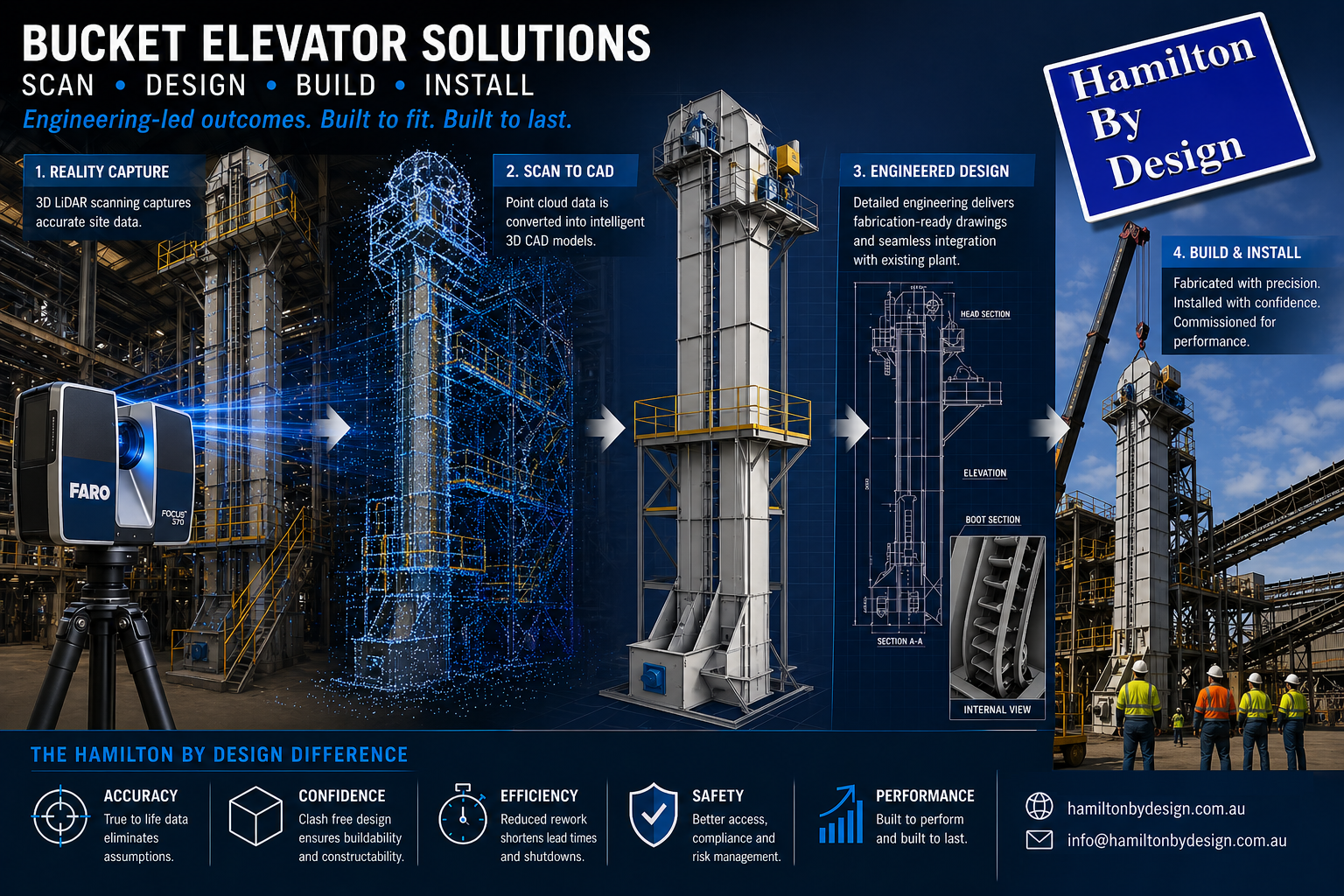
This paper outlines an engineering-led methodology adopted by Hamilton By Design, incorporating 3D LiDAR scanning, scan-to-CAD modelling, and fabrication-ready design to deliver a complete scan, design, build, and install solution for bucket elevator systems.
Limitations of Traditional Design Methodologies
Conventional approaches to bucket elevator design often rely on outdated drawings, manual site measurements, and engineering assumptions regarding existing plant conditions. While these methods may be adequate for greenfield developments, they are frequently inadequate in brownfield environments.
Common issues associated with traditional methodologies include:
- Dimensional inaccuracies leading to misalignment during installation
- Increased fabrication rework due to unforeseen clashes
- Extended shutdown durations and associated production losses
- Elevated safety risks resulting from poor integration with existing infrastructure
In material handling systems, particularly those involving rotating equipment and vertical conveyance, dimensional accuracy is critical. Minor deviations can result in significant operational inefficiencies, including premature wear, belt tracking issues, and mechanical failure.
Engineering-Grade 3D LiDAR Scanning
To address these challenges, an engineering-grade 3D LiDAR scanning process is employed to capture a high-resolution, spatially accurate representation of the existing plant environment. This process generates a point cloud dataset that reflects the true geometry of all visible structures, equipment, and interfaces.
The application of LiDAR scanning provides the following advantages:
- Accurate capture of structural steelwork, platforms, and existing material handling systems
- Identification of spatial constraints and potential clashes prior to design development
- Reliable definition of tie-in points for new equipment
- Reduction in reliance on assumptions and manual measurement
Importantly, the point cloud dataset is treated as an engineering input, rather than a visual reference. This distinction ensures that all subsequent design activities are grounded in verified, real-world data.
Scan-to-CAD Modelling and Engineering Design
Following data acquisition, the point cloud is processed and converted into a structured, parametric CAD model. This scan-to-CAD workflow enables the development of detailed engineering designs that accurately reflect existing site conditions.
Typical deliverables include:
- Three-dimensional parametric models suitable for engineering analysis and coordination
- General Arrangement (GA) drawings illustrating system layout and interfaces
- Detailed sections and elevations through critical components
- Interface definitions with existing conveyors, chutes, and structural systems
This approach facilitates seamless integration of the bucket elevator with existing plant infrastructure. Furthermore, it enables multidisciplinary coordination, ensuring alignment between mechanical, structural, and operational requirements.
A key differentiator of this methodology is the focus on producing fabrication-ready outputs, rather than conceptual or visual models. This ensures that the design intent can be directly translated into manufacturable components.
Engineering Considerations in Bucket Elevator Design
The design of a bucket elevator system must address a range of mechanical, structural, and operational factors.
Mechanical Design Parameters
- Selection of belt or chain systems based on material characteristics and throughput requirements
- Determination of bucket spacing, capacity, and configuration
- Design of head pulley assemblies and drive systems
- Specification of boot sections, including tensioning and clean-out provisions
Structural Integration
- Design of support frames and load transfer mechanisms
- Assessment of existing structural capacity and required reinforcements
- Compliance with relevant standards, including AS 1657 for access and maintenance systems
Operational and Maintenance Considerations
- Material flow behaviour and potential for blockages
- Dust containment and environmental controls
- Provision of safe access for inspection, maintenance, and replacement activities
By integrating scan data with engineering analysis, the resulting design is optimised for both performance and constructability within the constraints of the existing facility.
Fabrication and Quality Assurance
The transition from design to fabrication is significantly enhanced by the availability of accurate, detailed engineering documentation. Fabrication drawings derived from scan-based models provide a high degree of confidence in component fitment and assembly.
Key benefits include:
- Reduction in fabrication errors and rework
- Improved efficiency in workshop processes
- Accurate material take-offs and procurement planning
- Enhanced quality assurance through alignment with verified design data
Engineering oversight during fabrication ensures that all components meet specified tolerances and performance requirements.
Installation and Commissioning
Installation of bucket elevator systems within operational facilities is typically constrained by limited shutdown windows and restricted access. As such, careful planning and coordination are essential.
An engineering-led installation approach includes:
- Development of detailed installation methodologies and sequencing
- Planning of lifting operations and access requirements
- Verification of alignment and fitment using scan data
- Provision of on-site engineering support during critical installation phases
The use of pre-validated design data significantly reduces installation risk, minimises delays, and ensures a more efficient commissioning process.
Benefits of an Integrated Scan, Design, Build and Install Approach
The integration of LiDAR scanning, engineering design, and fabrication support provides a number of measurable benefits:
- Reduced project risk through improved dimensional accuracy
- Enhanced constructability and reduced fabrication rework
- Shorter installation durations and reduced plant downtime
- Improved coordination between engineering, fabrication, and site teams
For project stakeholders, this approach delivers greater certainty in both project outcomes and timelines.
Applications in Industry
This methodology is applicable across a range of industries where bulk material handling systems are utilised, including:
- Mining and mineral processing operations
- Agricultural and grain handling facilities
- Cement and bulk powder processing plants
- Recycling and industrial manufacturing environments
It is particularly valuable in brownfield projects involving upgrades, retrofits, or replacement of existing bucket elevator systems.
Conclusion
The successful implementation of bucket elevator systems in brownfield environments requires a departure from traditional design methodologies. By adopting an engineering-led approach grounded in accurate spatial data, it is possible to significantly reduce project risk and improve overall outcomes.
Hamilton By Design provides a comprehensive solution that integrates 3D LiDAR scanning, scan-to-CAD modelling, and fabrication-ready design. This approach ensures that bucket elevator systems are not only theoretically sound but also practically deliverable within the constraints of real-world industrial environments.


Contact Us – Talk to Us

E-Mail: [email protected]