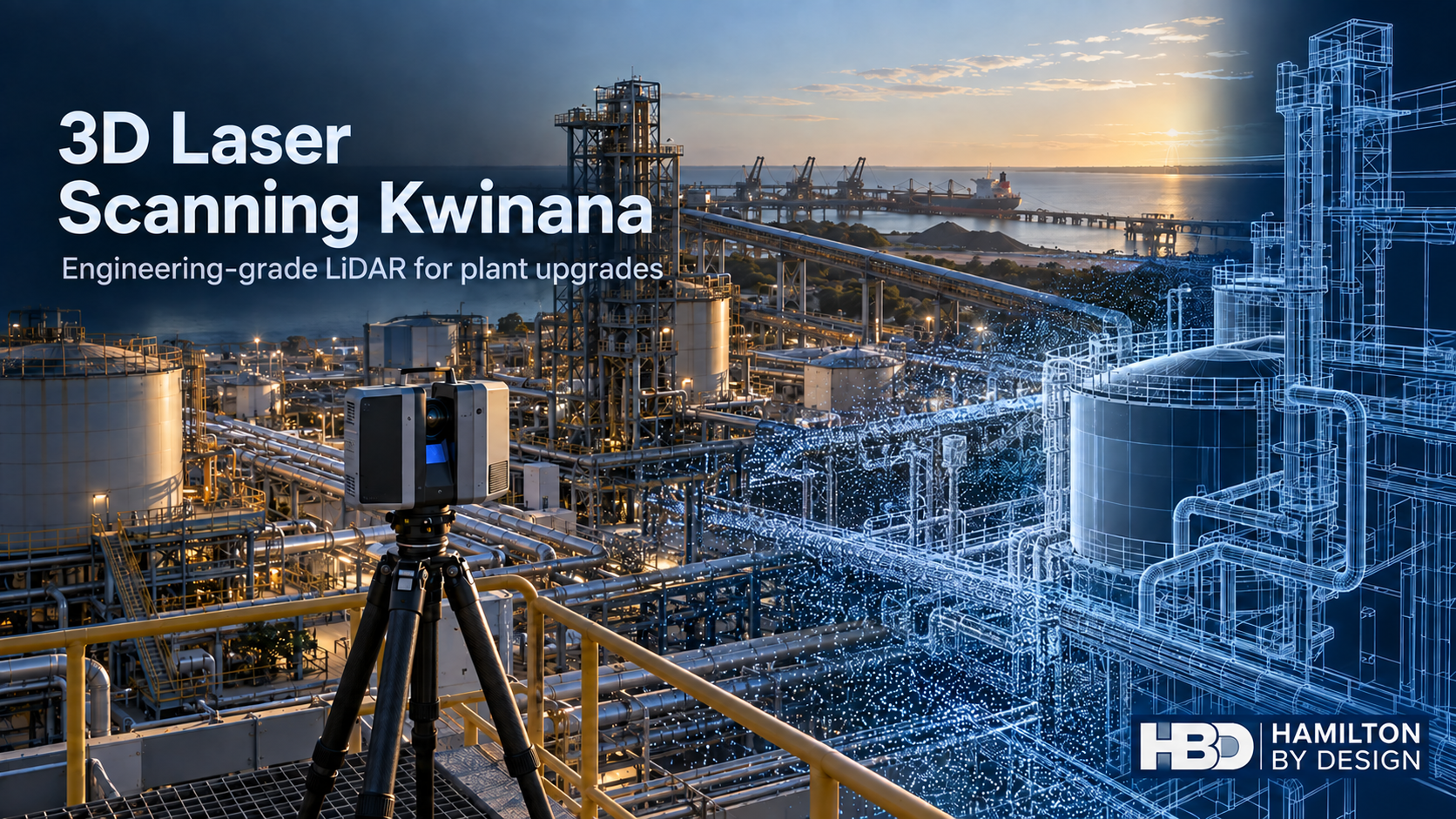
3D Laser Scanning Kwinana: Engineering-Grade LiDAR for Industrial Plant

3D laser scanner overlooking a Kwinana industrial plant, with pipework and tanks transitioning into a blue point cloud and CAD model.
Blue 3D LiDAR scanner icon on a tripod with scanning waves

Know what is actually on site before you design, fabricate or shut down. Hamilton By Design provides engineering-grade 3D laser scanning in Kwinana and Kwinana Beach for process plants, bulk materials facilities, workshops and industrial infrastructure. We turn measured site conditions into point clouds, usable CAD models and drawings that help project teams plan modifications around existing equipment.

A Kwinana plant upgrade rarely starts with an empty space. New pipework must pass existing services. A replacement pump skid must align with foundations and connection points. A conveyor modification needs room for guarding, inspection and maintenance. When drawings have not kept pace with years of alterations, a reliable site survey is a practical first step.

Our engineering laser scanning workflow connects reality capture with mechanical design and fabrication information. The scope is agreed around the decisions you need to make, from a localised equipment interface to a wider plant area.

Why Kwinana needs an engineering-led scan

Kwinana’s heavy industrial core brings chemical and resource processing, bulk port activities, energy infrastructure and support businesses together. The Western Trade Coast also has extensive exchanges of materials, by-products and utilities between businesses. That concentration creates useful industrial connections, but it makes interfaces and access especially important when existing plant is changed. Kwinana Industries Council describes the precinct and its industrial synergies.

In Kwinana Beach, a survey may need to capture more than the item being replaced: adjacent lines, supports, cable routes, walkways, laydown space, lifting paths and the clearances needed to maintain the equipment later. Our measured model gives designers and fabricators a common reference. Critical dimensions and tolerances are separately checked for their intended use; a point cloud alone does not certify every interface dimension.

The precinct is also evolving. Industrial recycled-water capacity is being expanded, while Kwinana Bulk Terminal redevelopment is in planning. These developments illustrate the mix of existing assets and proposed new work that requires careful coordination. Their schedules and approvals belong to the respective project owners.

What we can scan

  • Operating process areas, pump rooms, plant rooms and production equipment.
  • Pipework corridors, tanks, vessels, skids and connection points.
  • Conveyors, transfer stations, chutes, hoppers and bulk-handling interfaces.
  • Platforms, stairs, walkways, guards and maintenance access.
  • Workshop equipment, fabrication interfaces and obsolete components.
  • Areas affected by shutdown work, equipment replacement or site redevelopment.

Terrestrial LiDAR is suited to capturing a wider plant area and the relationships between its components. Close-range scanning and direct measurement can then be used for smaller parts or critical features when the specified tolerance demands it. We choose the capture method after discussing access, geometry, surface conditions and the required deliverable.

From point cloud to a useful engineering deliverable

  1. Define the question. Identify the equipment, interfaces, required accuracy, site controls and decisions the survey must support.
  2. Capture the existing conditions. Scan accessible areas under the site’s induction, permit and isolation arrangements.
  3. Register and review. Align the scans, review coverage and flag obscured or uncertain areas.
  4. Model the relevant geometry. Build the amount of CAD detail needed for equipment fit, routing, access or fabrication.
  5. Check critical interfaces. Confirm important dimensions by suitable measurement before relying on them for manufacture.
  6. Issue controlled information. Provide the agreed point cloud, model, general arrangements and drawings with clear revision status.

Depending on the brief, deliverables may include E57 or other point-cloud formats, ReCap-compatible files, SolidWorks models, STEP geometry, DWG/DXF drawings, general arrangements, sections and fabrication details. A point cloud is a measured record; the CAD model is an interpretation prepared to the agreed purpose and level of detail.

Five common problems we help Kwinana teams work through

1. Existing drawings do not reflect the plant

Shutdown changes, rerouted pipework and replacement equipment can leave the drawing register behind. LiDAR capture establishes a current geometric baseline. We can compare the scan with a proposed layout and prepare as-built CAD and scan-to-CAD models for the affected area.

2. New equipment may not fit

A skid may clear the floor plan but conflict with a valve, cable tray or lifting path. We can model the proposed envelope against the point cloud, identify potential clashes and develop interface drawings before workshop manufacture. The final site checks are set by the project’s tolerance and installation method.

3. Pipework is congested

A replacement route must accommodate existing lines, supports, access and maintenance. We can provide measured routing information, 3D layouts and mechanical and pipework drafting. Pressure-piping design, inspection and testing requirements must be established for the actual service and project scope.

4. Bulk-handling equipment needs modification

Transfer chutes, conveyors and hoppers can suffer from poor fit, material build-up, wear or restricted access. We can scan the installed geometry, model proposed changes and produce drawings for fabrication review. See our chute and materials-handling engineering capability.

5. Maintenance access and machinery hazards are difficult to resolve

A guard or platform must fit the actual machine while allowing safe operating and maintenance tasks. We can map the existing equipment, support a task-based hazard review and develop guarding and access concepts with the site team. Our machine guarding service explains the engineering approach.

Mechanical engineering and drafting support

Hamilton By Design can continue beyond the survey. Our mechanical engineering work may include equipment layouts, pump skids, replacement component modelling, reverse engineering, conveyor and chute modifications, access concepts and mechanical assessment. SolidWorks and AutoCAD drawings can communicate the arrangement to the workshop and installation crew. Where calculations, FEA, process design or specialist certification are needed, the scope and responsible disciplines should be established at the start.

Fabrication-ready information may include a general arrangement, sections, part and assembly drawings, interfaces, tolerances, materials, weld notes and a drawing register. Drawing content depends on the manufacturing method and the client’s specification. Our existing Kwinana service overview covers the wider mechanical and reverse-engineering offering.

Safety and standards are part of the brief

The applicable requirements depend on the equipment, location, hazards and the work being performed. Examples for a Kwinana mechanical project include the AS/NZS 4024 machinery-safety series for safeguarding, AS 1657 for fixed access, AS 4041 for pressure piping and AS 4991 for relevant lifting devices. A bulk-solids container may require AS 3774; conveyor requirements need a separate equipment-specific review. These references are starting points for scope definition, not a blanket claim that every standard applies to every asset.

For plant and chemical facilities, the site operator’s risk assessment, permits, isolation procedures and management of change remain essential. WorkSafe WA’s plant risk code provides guidance. We can help document geometry, mechanical hazards, access constraints and proposed design controls for review with the responsible site personnel and other specialists.

Who this service is for

We work with maintenance managers who need reliable information before a shutdown; project engineers developing brownfield upgrades; fabricators checking fit before cutting steel; and asset owners building a usable record of existing plant. The service can support chemical processing, minerals processing, water infrastructure, bulk materials, energy facilities and industrial workshops across Kwinana, Kwinana Beach and the wider Perth region.

Our Perth 3D scanning and mechanical engineering page covers work across the wider metropolitan area. This page focuses on the engineering decisions faced by Kwinana industrial teams.

Frequently asked questions

Can you scan an operating plant?

Often, yes, subject to the site’s access, safety, permit and isolation requirements. We agree the scan area and any operational restrictions before mobilisation. Some hidden or inaccessible geometry may need a later shutdown survey.

Is a point cloud accurate enough for fabrication?

That depends on the feature, distance, access, registration, surface and required tolerance. We specify the intended use and verify critical dimensions by an appropriate method. A general plant scan should not be treated as a universal tolerance certificate.

Do we receive CAD drawings or only scan data?

Either can be supplied. The scope may cover scanning only, an as-built model, layout drawings or a complete mechanical design and fabrication drawing package. Tell us who will use the information and what decision it must support.

Can you work from old drawings and an existing model?

Yes. Existing information can be compared against measured conditions. We identify discrepancies and model the relevant interfaces so the project team can decide which information is suitable for the modification.

What should we send for a proposal?

Share the site location, photographs or marked-up plans, the equipment or area involved, desired deliverables, required tolerances, access windows and target dates. A short phone discussion can then define the survey and engineering scope.

Discuss your Kwinana project

Planning a plant modification, equipment replacement or shutdown in Kwinana? Contact Hamilton By Design with the problem you need to solve. We can define the capture area, critical interfaces and deliverables before arranging site work.


Hamilton By Design logo displayed on a blue tilted rectangle with a grey gradient background

Contact Us – Talk To Us

Name
Would you like us to arrange a phone consultation for you?
Address

Our clients:
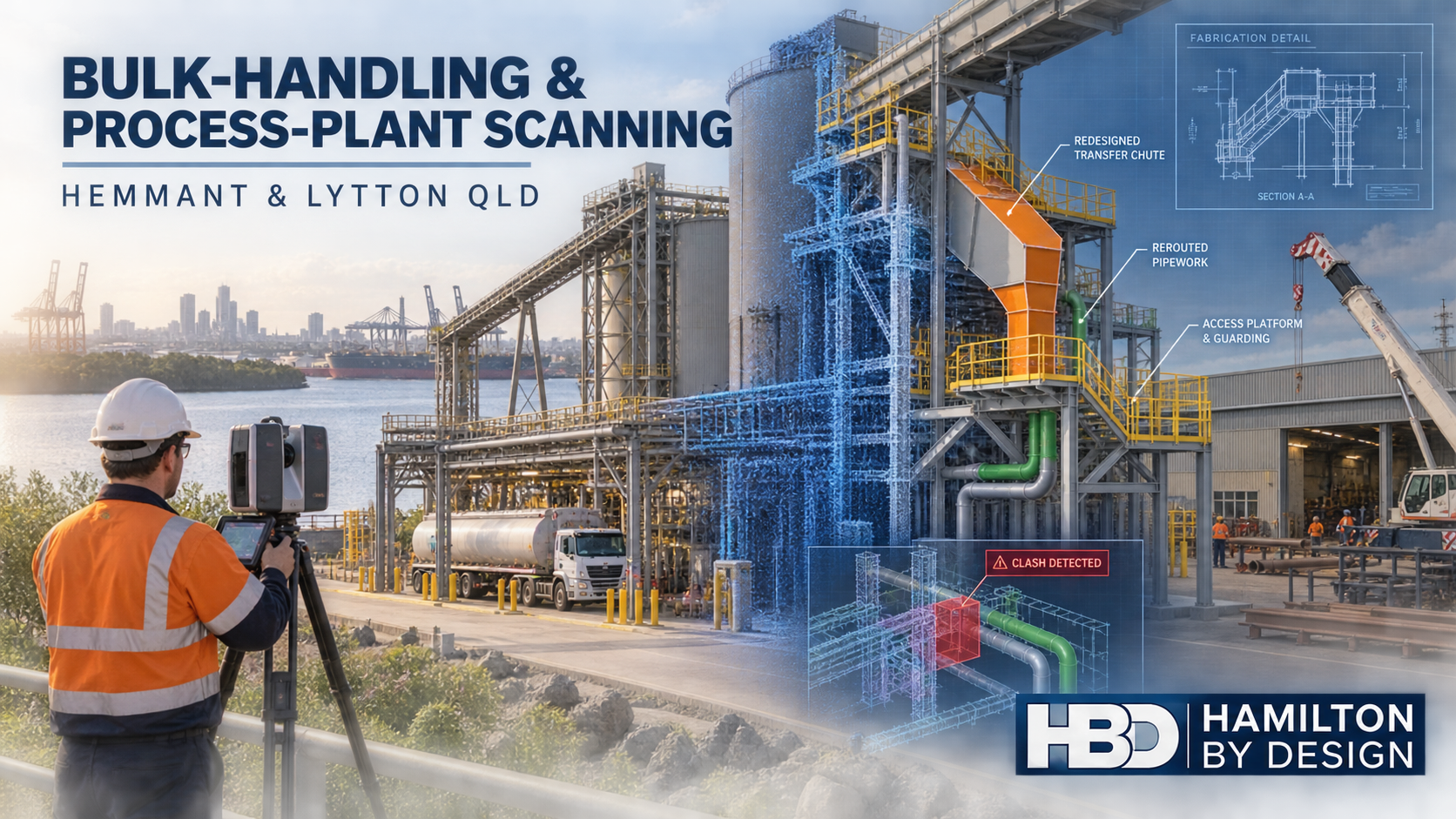


Bulk-Handling and Process-Plant Scanning in Hemmant and Lytton

Hamilton By Design engineer using a 3D laser scanner at a bulk-handling and process plant in Hemmant and Lytton, Queensland.
Blue 3D LiDAR scanner icon on a tripod with scanning waves

Hemmant and Lytton occupy a strategically important part of Brisbaneโ€™s industrial landscape. Located near the mouth of the Brisbane River and the Port of Brisbane, the two suburbs support a concentration of fuel infrastructure, bulk-material handling, marine engineering, fabrication, warehousing and freight operations.

This is not a conventional light-industrial precinct. Many facilities contain interconnected conveyors, storage tanks, pipework, loading gantries, transfer stations, access platforms and process equipment. Some operate continuously, while others depend on tightly controlled maintenance shutdowns.

These operating conditions create a particular engineering challenge: how can an existing plant be modified when the available drawings may no longer represent what is actually installed?

Hamilton By Design supports Hemmant and Lytton facilities through engineering-led 3D laser scanning, point-cloud modelling, mechanical design and fabrication documentation. By capturing the plant as it exists, proposed modifications can be developed around real site conditions rather than assumptions carried forward from historical drawings.

An Industrial Area Shaped by the Port

Hemmant and Lytton share a close relationship with the Port of Brisbane, but each suburb has a slightly different industrial character.

Lytton contains some of the corridorโ€™s largest infrastructure-dependent operations. Its industrial landscape includes fuel refining, petroleum storage, import terminals, pipelines, loading facilities and large logistics sites. Much of this infrastructure requires specialised land, established transport connections and separation from residential development.

Hemmant has a more varied industrial profile. Transport depots and warehouses operate alongside fabrication workshops, machinery businesses and riverfront marine facilities. Its position between Brisbaneโ€™s established industrial suburbs and the port gives businesses access to the Gateway Motorway, port terminals, the Brisbane River and the wider South East Queensland freight network.

This combination creates opportunities for engineering work across several levelsโ€”from scanning an individual worn component to documenting a complete terminal, conveyor system or process area.

Hamilton By Designโ€™s Port of Brisbane engineering and 3D laser scanning services are particularly relevant to facilities that must integrate new mechanical equipment into complex operating sites.

Why Existing-Plant Projects Are Difficult

Brownfield engineering is rarely as simple as replacing an old item with a new version of the same component.

Industrial plants evolve over time. Platforms are extended, pipework is rerouted, supports are reinforced and equipment is repositioned. Repairs may have been completed during short shutdowns without every change being incorporated into the master drawing set.

Consequently, several versions of the plant may exist simultaneously:

  • The original design drawings.
  • Later modification drawings.
  • Maintenance sketches and site mark-ups.
  • The actual installed arrangement.
  • The operatorโ€™s practical understanding of how the plant now works.

The last two are often the most important.

A replacement chute might match an old drawing but interfere with a platform brace added years later. A pipe spool may be dimensionally correct but impossible to install because there is no access for lifting or bolting. A new guard may prevent a maintenance task from being completed safely.

Engineering-grade site capture helps identify these issues before fabrication begins.

Creating a Reliable Record with 3D Laser Scanning

Terrestrial laser scanning records millions of measured points across the visible surfaces of a facility. Once the individual scans are registered, they form a coordinated three-dimensional point cloud.

For a Hemmant or Lytton industrial site, the captured information may include:

  • Conveyors and supporting frames.
  • Transfer chutes and hoppers.
  • Storage tanks and adjacent infrastructure.
  • Pipework routes and equipment connections.
  • Structural columns, beams and bracing.
  • Platforms, stairs, ladders and handrails.
  • Pumps, motors and mechanical equipment.
  • Cable trays, ducts and visible services.
  • Access ways and maintenance clearances.
  • Fabrication and installation interfaces.

A point cloud is more than a collection of measurements. It provides spatial context. An engineer can see not only the equipment being modified but also the surrounding structures and services that could affect the design.

Hamilton By Design can retain agreed project information such as registered plant point clouds, conveyor models, pipework routes, equipment interfaces, clash reports, fabrication drawings and revision histories. This creates a useful reference for later plant changes, provided the data-retention and confidentiality arrangements are defined with the client.

Conveyor and Chute Engineering

Conveyors and transfer points are critical parts of many terminals and process plants. They are also common sources of wear, spillage, dust, blockages and unplanned downtime.

A chute may appear straightforward, but its performance depends on several interacting variables:

  • Material type and bulk density.
  • Particle size and moisture content.
  • Belt width and speed.
  • Feed direction and discharge trajectory.
  • Impact angle and wear pattern.
  • Available transfer height.
  • Liner arrangement.
  • Maintenance access.
  • Surrounding plant geometry.

Changing production rates or material characteristics can expose weaknesses in a chute that previously operated acceptably. Increased moisture can promote build-up, while higher throughput can increase impact loads, dust generation and liner wear.

Hamilton By Design provides chute design and materials-handling engineering for existing industrial facilities. This may include scanning the transfer station, modelling the relevant interfaces, developing a revised arrangement and preparing fabrication-ready documentation.

Potential deliverables include general arrangements, plate details, liner drawings, support-frame drawings, bills of materials and CAD models for fabrication or client review.

Mechanical Design for Brownfield Modifications

An effective brownfield design must satisfy more than the immediate process requirement. It must also be practical to fabricate, transport, install, inspect and maintain.

Hamilton By Design can assist with mechanical modifications involving:

  • Conveyor and transfer-station layouts.
  • Chutes, hoppers and bins.
  • Pipework routes and equipment interfaces.
  • Pump and equipment skids.
  • Access platforms and maintenance structures.
  • Guards and machinery-safety improvements.
  • Support frames and brackets.
  • Removable sections and maintenance tooling.
  • Lifting arrangements for plant components.
  • Reverse-engineered replacement parts.

The proposed equipment can be modelled against the point cloud to identify potential clashes. Installation clearances, bolt access, welding access and component-removal paths can then be considered before drawings are issued.

HBDโ€™s broader mechanical engineering services for the Port of Brisbane support this connection between measured site information and practical industrial design.

Mechanical Drafting and Fabrication Documentation

A successful industrial modification depends on clear communication between the designer, client, fabricator and installer.

Hamilton By Design can prepare:

  • Existing-condition CAD models.
  • Concept layouts.
  • General arrangement drawings.
  • Fabrication and assembly drawings.
  • Plate and folded-component details.
  • Pipe spool drawings.
  • Platform and access drawings.
  • Installation reference dimensions.
  • Bills of materials.
  • DXF cutting profiles.
  • STEP and Parasolid models.
  • Issued-for-review, issued-for-approval and issued-for-construction packages.
  • Final as-built records.

Document control is especially important where several contractors are working on the same plant. Drawing numbers, revision status, design assumptions and approval responsibilities should be visible and traceable.

The objective is not simply to produce a drawing that looks complete. The documentation must provide enough information for the item to be manufactured, checked and installed with a clear understanding of its interfaces.

Safety, Access and Maintainability

Industrial safety cannot be added at the end of a project. It must influence the geometry of the design from the beginning.

For conveyor, chute and process-plant modifications, this may require consideration of:

  • Nip, crush, shear and entanglement hazards.
  • Access to isolation points.
  • Fixed and removable guarding.
  • Inspection-door locations.
  • Safe liner replacement.
  • Stair, ladder and platform access.
  • Handrail continuity.
  • Trip hazards and restricted walkways.
  • Lifting points and component weights.
  • Dropped-object exposure.
  • Emergency egress.
  • Access for cleaning and spill recovery.

The AS/NZS 4024 series may apply to machinery safety and risk reduction. AS 1657 is commonly relevant to fixed platforms, walkways, stairways and ladders, while AS 4991 may apply to purpose-designed lifting devices.

Other standards may apply depending on the project, including AS 3990 for mechanical-equipment steelwork, AS 4041 for pressure piping, AS 1210 for pressure vessels, AS 4100 for steel structures and AS 1940 for flammable and combustible liquids.

The applicable standards and required professional responsibilities should be established at the start of each project. Hamilton By Design provides mechanical engineering and drafting services. Structural, civil, electrical, hazardous-area, fire and process certification should be completed by appropriately qualified specialists where required.

The Five Recurring Problems in Hemmant and Lytton Projects

1. Drawings do not match the plant

Outdated or incomplete drawings can cause incorrect interface dimensions, fabrication errors and unexpected site modifications. A current point cloud establishes a measurable record of visible site conditions.

2. The work area is congested

Pipework, steelwork, electrical services and access structures often occupy the same limited space. Three-dimensional coordination helps expose clashes that may not be apparent in a two-dimensional drawing.

3. Shutdown time is limited

Unexpected cutting, drilling or rework can consume a large portion of a shutdown window. Pre-shutdown scanning and installation planning help reduce avoidable site work.

4. Ageing equipment has changed shape

Wear, corrosion, impact and previous repairs can cause the installed component to differ from its original design. Scanning and reverse engineering can help document the current interfaces before replacement equipment is manufactured.

5. The design fits but cannot be maintained

A component may perform mechanically while creating poor inspection, cleaning or removal access. Maintenance activities must be considered alongside the operating function.

Engineering Support for Logistics and Terminal Operations

Not every project in Hemmant or Lytton is part of a process plant. Warehouses, freight depots and loading facilities also need accurate layouts for new equipment and operational changes.

Hamilton By Design can assist logistics and terminal operators with:

  • Warehouse and hardstand scanning.
  • Loading-area layouts.
  • Conveyor and automation interfaces.
  • Equipment clearances.
  • Maintenance-access zones.
  • Crane and lifting access.
  • Guarding arrangements.
  • Equipment-removal studies.
  • Clash detection.
  • Staged installation planning.
  • Updated as-built layouts.

Vehicle swept paths, pavement design, drainage and formal traffic engineering should be referred to the appropriate civil or traffic specialist where they sit outside the mechanical scope.

From Site Capture to Fabrication

A typical HBD workflow begins by defining the engineering outcome rather than scanning an arbitrary area.

The process may include:

  1. Reviewing the operational problem, available drawings and required deliverables.
  2. Planning the scan around design interfaces, access restrictions and site rules.
  3. Capturing the relevant equipment and surrounding work envelope.
  4. Registering and quality-checking the point cloud.
  5. Modelling the existing plant to the level needed for the project.
  6. Developing one or more modification concepts.
  7. Reviewing clashes, access and installation constraints.
  8. Preparing approval, fabrication and installation documentation.
  9. Recording approved revisions and final as-built information.

This connected approach reduces the information gap that can occur when one party scans the plant, another produces the model and a third completes the design.

Hamilton By Designโ€™s experience with bulk-material handling, ROM systems, conveyors and transfer engineering is transferable to port, terminal and process-plant applications where fit, reliability and maintainability are critical.

Frequently Asked Questions

Can a process plant be scanned while it remains operational?

In many cases, yes. The scan plan must account for site access, exclusion zones, moving equipment, hazardous areas and operational controls. Some critical interfaces may still require access during an isolation or shutdown.

What can be delivered from a plant scan?

Deliverables can include registered point clouds in formats such as E57, RCP, RCS or LAS, along with selected CAD models, plans, sections, general arrangements, fabrication drawings and clash-review information. The appropriate deliverable depends on the intended engineering outcome.

Can HBD work from point-cloud data captured by another company?

Potentially, yes. The supplied dataset should first be reviewed for registration quality, point density, coverage and visibility of the required interfaces. Missing flange faces, pipe centrelines, bolt holes or concealed areas may limit the achievable result.

Does laser scanning capture internal pipe or vessel conditions?

No. Terrestrial laser scanning primarily records visible external surfaces. Internal condition, wall thickness, corrosion and material integrity normally require specialist inspection methods such as ultrasonic testing, internal inspection or non-destructive examination.

Can HBD design a replacement chute from the scan?

Yes, subject to an agreed scope and sufficient operating information. A scan establishes existing geometry, but chute design may also require material properties, throughput, belt speed, moisture content, wear history and operator feedback.

Does HBD provide structural certification?

Hamilton By Design provides mechanical engineering and structural drafting support but is not offering structural certification through this service. Where structural verification or certification is required, the work should be completed or reviewed by an appropriately qualified structural engineer.

Can scanning help with shutdown planning?

Yes. A point cloud can support prefabrication, clash detection, access reviews, crane planning and installation sequencing. It does not eliminate every shutdown risk, but it can significantly reduce uncertainty about visible site geometry.

How accurate is an industrial point cloud?

Accuracy depends on the scanner, range, target arrangement, registration method, environmental conditions and visibility. The required accuracy should be discussed before scanning so that the capture method is suitable for the intended design or verification task.

Can HBD retain the project data for future modifications?

Yes, subject to the agreed commercial, confidentiality and retention arrangements. Records may include registered point clouds, equipment models, interface information, drawings and modification histories.

Engineering Existing Plant with Greater Confidence

Hemmant and Lytton are shaped by infrastructure that must remain safe, reliable and productive. Their fuel terminals, process facilities, conveyors, warehouses, marine workshops and freight operations are expensive to interrupt and difficult to modify using incomplete site information.

Engineering-led 3D scanning gives project teams a stronger starting point. When accurate site capture is combined with mechanical design, fabrication documentation and practical installation planning, brownfield modifications can be developed with a clearer understanding of the plant they must fit.

Hamilton By Design can assist clients in Hemmant, Lytton and the wider Port of Brisbane corridor with process-plant scanning, bulk-handling design, point-cloud modelling, reverse engineering, mechanical drafting and brownfield upgrade documentation.

To discuss a conveyor, chute, pipework, terminal or existing-plant project, contact Hamilton By Design with the site location, a short description of the problem, available drawings or photographs, required deliverables and any planned shutdown dates.


Hamilton By Design logo displayed on a blue tilted rectangle with a grey gradient background

Contact Us – Talk To Us

Name
Would you like us to arrange a phone consultation for you?
Address

Our clients:
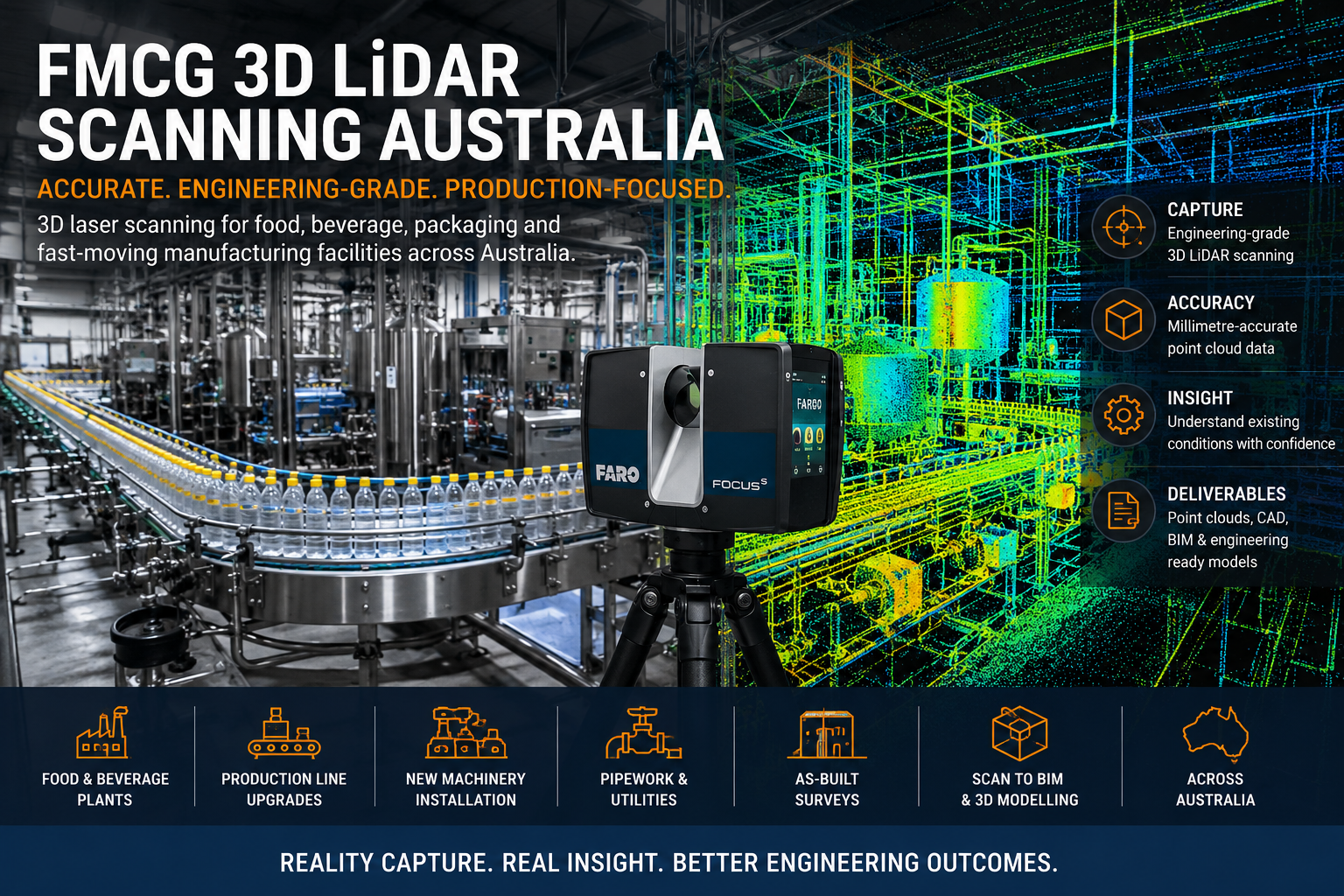


FMCG 3D LiDAR Scanning Australia | Food & Beverage Plants

FMCG 3D LiDAR scanning in an Australian food and beverage manufacturing plant showing a FARO laser scanner, production line and point-cloud overlay.

FMCG 3D LiDAR Scanning Australia

Engineering-Grade 3D Laser Scanning for Food, Beverage, Packaging and Fast-Moving Manufacturing Facilities

Fast-moving consumer goods manufacturing is built around production.

Food, beverage, packaging and consumer-product facilities depend on machinery, conveyors, pipework, utilities, structural steel and automated systems operating together in increasingly congested production environments.

The challenge is that these facilities rarely remain exactly as they were originally designed.

Production lines change. New machinery is installed. Conveyors are extended. Pipework is rerouted. Packaging systems are replaced. Platforms are modified. Automation is introduced. Utilities are relocated.

Over time, the physical factory can become significantly different from the drawings available to the engineering team.

Hamilton By Design provides FMCG 3D LiDAR scanning services across Australia, capturing accurate existing factory conditions to support production-line upgrades, machinery installation, plant modifications, engineering design and as-built documentation.

Our approach combines engineering-grade reality capture with mechanical engineering, 3D CAD modelling and drafting so the captured data can be used to solve practical industrial problems.

For projects requiring the captured factory to be developed into coordinated BIM or digital models, see our Factory Scan to BIM Australia service.


The Biggest Problem: The Factory Changes Faster Than the Drawings

One of the biggest engineering problems within an FMCG facility is not necessarily the machinery itself.

It is knowing exactly what is already there.

Food, beverage and consumer-goods factories can undergo numerous modifications during their operating life.

Individual projects may alter:

  • production machinery;
  • conveyors;
  • packaging lines;
  • pipework;
  • valves;
  • pumps;
  • ducting;
  • structural steel;
  • access platforms;
  • guarding;
  • cable trays;
  • electrical services;
  • compressed-air systems;
  • process utilities;
  • equipment foundations; and
  • maintenance access.

Those changes are not always incorporated into the original drawings.

The result is a familiar brownfield engineering problem:

Tomorrow’s production equipment may be designed using yesterday’s factory information.

In an FMCG environment, this becomes particularly important because installation work may need to occur during tightly controlled shutdown periods.

If a new machine, conveyor, platform, pipe spool or structural component does not fit when it arrives on site, the problem can quickly become more than an engineering inconvenience.

It can affect production.

3D LiDAR scanning helps reduce this uncertainty by creating a measurable digital record of the facility as it exists today.


What Is FMCG 3D LiDAR Scanning?

3D LiDAR scanning uses laser measurements to capture the geometry of an existing factory, production line or industrial environment.

Multiple scanner positions can be combined to create a registered 3D point cloud representing the physical facility.

The point cloud can capture the spatial relationship between:

  • machinery;
  • conveyors;
  • pipework;
  • platforms;
  • structures;
  • services;
  • equipment;
  • access areas; and
  • surrounding building geometry.

Hamilton By Design’s 3D Laser Scanning for Engineering Projects service is focused on using captured site information as an engineering resource rather than simply producing a visual scan.

Depending on the project, the resulting information can support:

  • 3D CAD modelling;
  • Scan to BIM;
  • equipment layout design;
  • general arrangement drawings;
  • existing-condition documentation;
  • clash assessment;
  • mechanical design;
  • fabrication planning; and
  • installation engineering.

Why 3D Scan an FMCG Factory?

Traditional site measurement can work well when only a small number of dimensions are required.

The difficulty arises when a project has to interact with an entire production environment.

A single equipment installation may need to account for:

  • floor levels;
  • surrounding machinery;
  • access clearances;
  • structural columns;
  • overhead steelwork;
  • pipework;
  • cable trays;
  • conveyors;
  • maintenance access;
  • operator access;
  • hygiene zones; and
  • installation pathways.

Rather than attempting to predict every dimension that may be required later, 3D laser scanning captures a broader representation of the existing environment.

This provides engineers with a digital reference that can be reviewed after the site visit.

For broader manufacturing and industrial projects, Hamilton By Design also provides 3D Laser Scanning for Industrial Plants, combining plant capture with point-cloud-to-CAD, Scan to BIM and engineering applications.


3D Scanning for Food Manufacturing Plants

Food manufacturing facilities can contain complex combinations of processing machinery, conveyors, pipework, tanks, vessels, platforms and building services.

A proposed upgrade may need to integrate into an operating environment where space is already heavily utilised.

3D LiDAR scanning can support projects involving:

  • process-line modifications;
  • new production equipment;
  • conveyor changes;
  • packaging-line upgrades;
  • pipework modifications;
  • plant-room alterations;
  • new platforms and access;
  • utility changes; and
  • factory redevelopment.

Existing-condition capture can be particularly valuable where the original drawings are incomplete or numerous plant changes have occurred over time.

Hamilton By Design already supports food, beverage and manufacturing businesses through its broader Mechanical Engineering Services on the Central Coast, including plant upgrades, component replacement and 3D LiDAR scanning.


3D Laser Scanning for Beverage Plants

Beverage-production facilities often combine process equipment with extensive pipework, tanks, conveyors, filling machinery and packaging systems.

A relatively small modification can therefore involve several engineering interfaces.

Typical applications may include:

  • bottling-line modifications;
  • filling equipment;
  • tank installations;
  • process pipework;
  • conveyor rerouting;
  • packaging equipment;
  • palletising systems;
  • structural platforms;
  • access modifications; and
  • service coordination.

Capturing the surrounding environment before design begins provides a more reliable basis for positioning new equipment and identifying potential conflicts.


Packaging-Line 3D Scanning

Packaging lines can involve closely integrated machinery operating within limited floor space.

Equipment may include:

  • fillers;
  • cappers;
  • labellers;
  • wrappers;
  • case packers;
  • carton systems;
  • conveyors;
  • inspection equipment;
  • palletisers; and
  • robotic handling systems.

When one piece of machinery is replaced, the new equipment may still have to connect with the existing upstream and downstream production systems.

3D scanning can capture those interfaces so the engineering team can assess the available space before the replacement equipment is installed.


Production-Line Modifications

Production lines evolve.

New products may require different machinery.

Higher throughput may require new conveying systems.

Manual operations may be automated.

Existing machines may need to move.

The surrounding factory does not necessarily move with them.

This means a production-line modification may have to fit between existing machinery, structural columns, platforms, services and access areas.

An engineering-grade point cloud can provide the design team with an accurate reference for developing the revised production layout.

For projects where a full digital representation of the factory is required, our Factory Scan to BIM Australia service can convert existing-condition capture into practical BIM and CAD information for factory upgrades.


New Machinery and Equipment Installation

Installing new equipment into an existing FMCG factory is fundamentally different from placing machinery in an empty building.

The proposed machine may need to fit around:

  • existing production equipment;
  • conveyors;
  • structural steel;
  • services;
  • access routes;
  • maintenance zones;
  • existing foundations;
  • floor penetrations;
  • overhead obstructions; and
  • operator working areas.

3D scanning before detailed design can help establish these interfaces.

The proposed equipment can then be modelled within the captured environment.

This can assist the engineering team in answering practical questions such as:

Will the machine fit?

Can it be installed?

Can it be maintained once installed?

Will existing equipment obstruct access?

Do surrounding services need to move?

Will the new conveyor align with the existing production line?


Brownfield Engineering for FMCG Facilities

Most existing FMCG upgrade projects are brownfield projects.

The new engineering has to work around what already exists.

This may include equipment installed decades earlier, later modifications, undocumented steelwork, relocated services and machinery that cannot easily be moved.

Hamilton By Design’s broader Engineering Services combine reality capture with mechanical engineering, modelling and drafting for brownfield and retrofit projects.

The advantage of integrating scanning with engineering is that the scanning strategy can be developed around what the project team actually needs to design.

The purpose is not simply to capture everything.

The purpose is to capture the information required to make better engineering decisions.


FMCG Factory As-Built Surveys

Accurate as-built documentation can be difficult to maintain in a continuously evolving production facility.

Drawings may show what was originally installed rather than what exists today.

A LiDAR-based as-built survey can create a new spatial reference for the factory.

This may be useful where:

  • drawings are unavailable;
  • existing drawings are outdated;
  • equipment has moved;
  • pipework has changed;
  • platforms have been added;
  • production systems have been modified;
  • multiple contractors have changed the facility; or
  • future upgrades are being planned.

For larger digital documentation projects, Hamilton By Design’s national Scan to BIM Australia services provide a pathway from measured reality to structured digital models.


Scan Before the Shutdown

Production shutdowns can represent one of the most expensive periods of an FMCG engineering project.

The installation window may be fixed while numerous contractors and activities compete for access.

Where practical, scanning before the shutdown allows engineering work to begin while the plant is still operating.

A typical workflow can become:

3D Site Scanning

โ†“

Point-Cloud Registration

โ†“

Existing-Condition Review

โ†“

3D CAD Modelling

โ†“

Engineering Design

โ†“

Fabrication Planning

โ†“

Shutdown Installation

The more engineering that can be completed before the shutdown begins, the less work needs to be resolved while production is offline.

Hamilton By Design’s 3D Laser Scanning for Engineering service is specifically focused on using accurate existing-condition data to support brownfield upgrades, shutdown engineering and fabrication planning.


Conveyor and Materials-Handling 3D Scanning

Conveyors are common throughout FMCG production and packaging systems.

They may connect several machines across a production line and frequently pass beneath or around existing structures and services.

3D scanning can capture:

  • conveyor centre lines;
  • conveyor elevations;
  • support frames;
  • transfer locations;
  • machinery interfaces;
  • surrounding structures;
  • access areas;
  • guarding;
  • platforms; and
  • overhead restrictions.

This information can support conveyor extensions, production-line changes and new machinery integration.


Pipework, Utilities and Factory Services

Food, beverage and FMCG plants can contain extensive networks of mechanical and electrical services.

Depending on the facility, these may include:

  • process pipework;
  • compressed air;
  • water;
  • steam;
  • cleaning systems;
  • drainage;
  • electrical services;
  • cable trays;
  • ventilation;
  • ducting; and
  • equipment utilities.

These services often occupy congested spaces above, below and around production equipment.

3D laser scanning provides a way to capture their spatial relationship to the surrounding factory.

The resulting point cloud can then support routing studies, plant modifications and equipment connections.


Structural Steel, Platforms and Access

New equipment does not exist independently of the surrounding structure.

Manufacturing facilities may contain:

  • structural columns;
  • beams;
  • roof trusses;
  • equipment support structures;
  • platforms;
  • stairs;
  • handrails;
  • equipment frames;
  • walkways; and
  • mezzanines.

Capturing this geometry provides engineers with a reference when developing equipment layouts or assessing structural interfaces.


From FMCG Point Cloud to CAD and BIM

The registered point cloud is only the starting point.

Depending on the project requirement, captured factory information can be converted into engineering geometry.

This may include:

  • SolidWorks models;
  • AutoCAD drawings;
  • BIM models;
  • equipment layouts;
  • mechanical arrangements;
  • structural interfaces;
  • sections and elevations;
  • general arrangement drawings;
  • fabrication reference geometry; and
  • existing-condition models.

Hamilton By Design’s Scan to BIM Sydney service demonstrates the broader workflow of combining LiDAR scanning with BIM to establish accurate digital representations for design, maintenance and asset-management applications.


Engineer-Led FMCG 3D Scanning

A factory can be scanned in many different ways.

The most appropriate scanning strategy depends on what the project needs to achieve.

An engineering-led approach considers questions such as:

  • What is being modified?
  • Which interfaces are critical?
  • What equipment is being replaced?
  • Which dimensions will matter during installation?
  • Does the surrounding structure need to be modelled?
  • What CAD system will be used?
  • Does fabrication need to occur before the shutdown?
  • Which areas are difficult to access?
  • What level of modelling is actually required?

Hamilton By Design combines 3D scanning with mechanical engineering and design experience so the scanning scope can be developed around the downstream engineering requirement.


FMCG 3D LiDAR Scanning Across Australia

Hamilton By Design provides FMCG, factory and industrial 3D laser scanning services for projects across Australia.

We can support projects in:

  • Sydney;
  • Newcastle;
  • Central Coast NSW;
  • Wollongong;
  • Brisbane;
  • Gold Coast;
  • Melbourne;
  • Adelaide;
  • Perth;
  • Darwin;
  • regional NSW;
  • regional Queensland;
  • regional Victoria;
  • regional South Australia;
  • regional Western Australia; and
  • other industrial locations throughout Australia.

For broader national reality-capture requirements, see our 3D Laser Scanning services.


FMCG Industries We Can Support

3D LiDAR scanning can support a wide range of fast-moving manufacturing environments, including:

  • food manufacturing;
  • beverage production;
  • dairy processing;
  • bakeries;
  • bottling plants;
  • breweries;
  • confectionery;
  • frozen-food production;
  • meat processing;
  • packaging plants;
  • consumer-product manufacturing;
  • personal-care manufacturing;
  • household-product manufacturing;
  • warehousing;
  • logistics;
  • automated production;
  • palletising facilities; and
  • general manufacturing.

The common requirement is an existing production environment where new engineering must fit around the real facility.


Typical FMCG 3D Scanning Deliverables

Project deliverables can be tailored to suit the downstream engineering workflow and may include:

  • registered 3D point clouds;
  • E57 files;
  • RCP/RCS datasets;
  • LAS files;
  • 3D CAD models;
  • BIM models;
  • SolidWorks models;
  • STEP files;
  • SAT files;
  • AutoCAD DWG files;
  • DXF files;
  • general arrangement drawings;
  • sections;
  • elevations;
  • equipment layouts;
  • existing-condition plans; and
  • engineering documentation.

Not every project requires every deliverable.

The appropriate output should be determined by what the engineering team needs to achieve.


Frequently Asked Questions

What is FMCG 3D LiDAR scanning?

FMCG 3D LiDAR scanning uses laser-based reality capture to document the existing geometry of food, beverage, packaging and consumer-goods manufacturing facilities. The resulting point cloud can support engineering, CAD, BIM and plant-upgrade projects.

Can you scan an operating food or manufacturing factory?

Many facilities can be scanned while normal operations continue, subject to site safety requirements, access restrictions and the nature of the production process.

Can production machinery be included in the scan?

Yes. Machinery, conveyors, structural steel, platforms, services, pipework and surrounding building geometry can be captured according to the requirements of the project.

Can scanning help before installing new machinery?

Yes. Capturing the surrounding environment before equipment installation allows the proposed machinery and its interfaces to be evaluated against existing factory geometry.

Can you scan conveyor systems?

Yes. Conveyor geometry, supports, interfaces, transfers, surrounding structures and associated equipment can be included in the scan.

What happens if our factory drawings are outdated?

This is one of the main reasons to consider reality capture. 3D scanning records the existing physical condition rather than relying entirely on legacy drawings.

Can FMCG scan data be used for Scan to BIM?

Yes. Where required, point-cloud information can be developed into BIM or CAD models. See our Factory Scan to BIM Australia service for more information.

Can the scan data be used in SolidWorks?

Point-cloud information can be used as reference data for developing appropriate engineering geometry for SolidWorks workflows.

Do you provide FMCG 3D scanning outside Sydney?

Yes. Hamilton By Design supports 3D laser scanning and engineering projects throughout Australia.


Planning an FMCG Factory Upgrade?

A successful factory modification starts with understanding what is already there.

Before designing a new production line, installing machinery, modifying conveyors or fabricating equipment around old drawings, capture the existing facility accurately.

Hamilton By Design provides FMCG 3D LiDAR scanning, Factory Scan to BIM, mechanical engineering, 3D modelling and drafting services across Australia.

Our goal is to provide engineering teams with a reliable digital starting point for brownfield projects where fit, access, interfaces and shutdown duration matter.

Capture the existing factory. Understand the interfaces. Engineer the upgrade around reality.


Hamilton By Design logo displayed on a blue tilted rectangle with a grey gradient background

Contact Us – Talk To Us

Name
Would you like us to arrange a phone consultation for you?
Address

Our clients:


Gold Mine 3D Scanning NSW | Mineral Processing Engineering

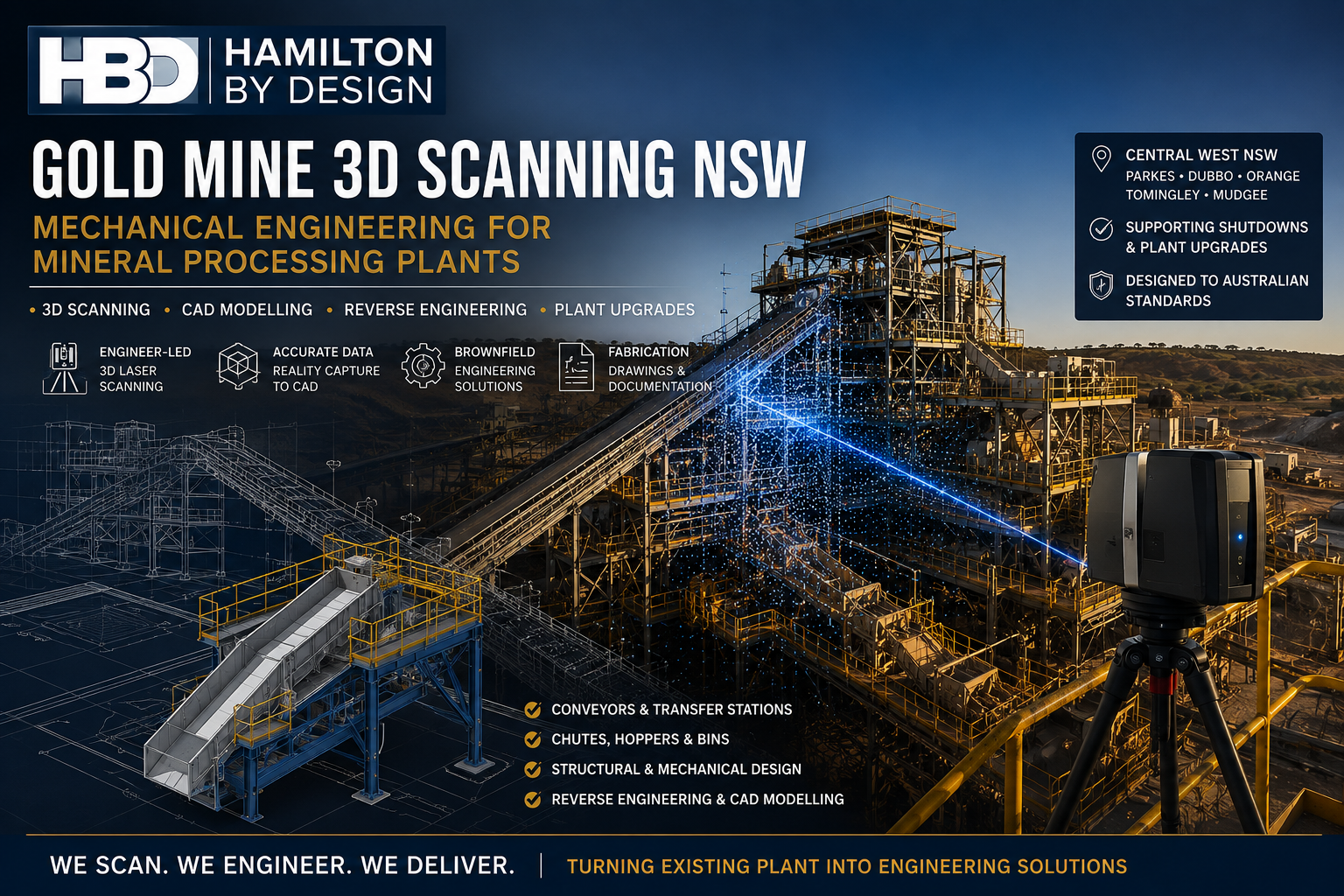
Gold mine 3D scanning NSW infographic showing a mineral processing plant, LiDAR point cloud, CAD model, conveyors, chutes and mechanical engineering services.

Gold processing plants across Central West NSW are continually changing. Conveyors are extended, chutes are replaced, pumps are upgraded, platforms are modified, pipework is rerouted and new equipment is installed around infrastructure that may have been operating for decades.

The challenge is that the engineering drawings available for an established plant do not always represent what actually exists on site.

For brownfield projects, even a relatively small dimensional discrepancy can result in fabrication problems, clashes, installation delays or additional work during a planned shutdown.

Hamilton By Design provides engineer-led 3D laser scanning, mechanical engineering, reverse engineering and CAD modelling to support gold mines and mineral-processing facilities throughout regional NSW.

Our broader Mining NSW engineering and 3D scanning services support mine operators, engineering teams, maintenance departments and contractors that need reliable existing-condition information before plant modifications are designed.

Engineering Starts With Understanding What Is Actually There

A common challenge in an operating gold processing plant is the difference between the original design and the plant’s current configuration.

Over years of operation, equipment may have been replaced, structural steel altered, platforms added and process lines rerouted. Maintenance modifications may never have been incorporated into the original drawings.

When another upgrade is required, engineers can therefore find themselves designing from incomplete or inaccurate information.

Engineering-grade 3D LiDAR scanning provides another approach.

Hamilton By Design can capture the existing plant as a detailed three-dimensional point cloud, providing a measurable representation of equipment, structures and surrounding interfaces.

For regional projects, our engineering-grade 3D LiDAR scanning in Parkes NSW demonstrates how this approach can be applied to processing plants, conveyors, transfer points, structural steel, pipework and access platforms throughout Central West NSW.

The objective is simple:

Scan the existing plant before designing the modification.

What Can Be Captured in a Gold Processing Plant?

Terrestrial LiDAR scanning is particularly useful where many different systems occupy a congested area.

A scanning scope can include:

  • crushers and screens;
  • conveyors and transfer stations;
  • chutes and hoppers;
  • feeders;
  • pumps and pump bases;
  • pipework;
  • tanks and process equipment;
  • structural steel;
  • maintenance platforms;
  • stairs and walkways;
  • guards;
  • motors and gearboxes;
  • equipment foundations; and
  • surrounding interfaces.

Multiple scan positions can be registered together to create a coordinated point cloud of the required area.

Hamilton By Design’s broader engineering-grade 3D laser scanning services across Australia are specifically directed toward producing engineering-useful information for mining, heavy industrial and brownfield projects.

Rather than treating reality capture as the final deliverable, the scan can become the dimensional foundation for the engineering project.

Mechanical Engineering for Mineral Processing Plant Upgrades

Once existing conditions have been captured, the point cloud can be brought into the mechanical design environment.

Hamilton By Design provides mechanical engineering for mining infrastructure, supporting equipment associated with extraction, mineral processing and materials handling.

Typical brownfield engineering scopes may include:

  • conveyor modifications;
  • replacement transfer chutes;
  • hopper modifications;
  • equipment replacement layouts;
  • crusher and screen interfaces;
  • pump arrangements;
  • equipment support frames;
  • maintenance access;
  • machinery guarding;
  • structural/mechanical interfaces; and
  • plant retrofit projects.

This creates a practical Scan โ†’ Model โ†’ Design โ†’ Document workflow.

Instead of designing a new component independently and hoping it fits the existing plant, the proposed arrangement can be developed around captured site geometry.

That can be particularly valuable when fabrication is completed off site and installation must occur within a tightly controlled shutdown window.

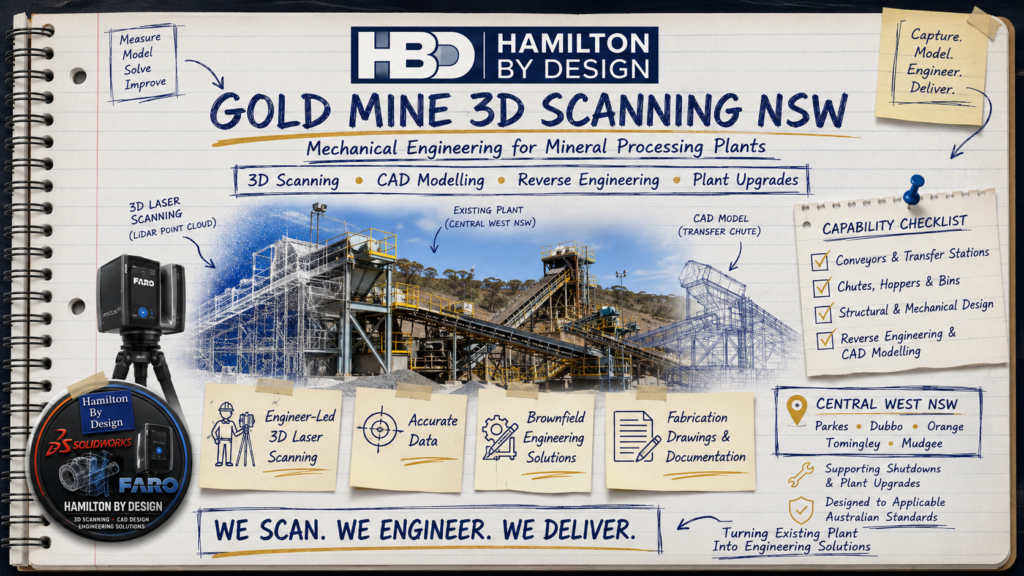
Gold Mine 3D Scanning NSW notebook infographic showing LiDAR scanning, CAD modelling, conveyors, chutes, reverse engineering and mineral processing plant upgrades.

Conveyors, Chutes, Hoppers and Transfer Points

Materials handling is one of the strongest applications for this workflow.

Gold-processing facilities depend on reliable movement of crushed ore and processed material between different stages of the plant. Transfer points can consequently become important areas for maintenance, wear management and future upgrades.

Hamilton By Design provides engineering support for bulk material handling in mining, including conveyors, transfer points, chutes, ROM bins, hoppers and associated steelwork.

For an existing transfer station, scanning can establish the position of:

  • conveyor centre lines;
  • head and tail pulleys;
  • surrounding steelwork;
  • existing chute geometry;
  • platforms;
  • handrails;
  • drives;
  • guards; and
  • adjacent plant.

A replacement chute or conveyor modification can then be modelled within this captured environment.

This provides greater confidence that interfaces, access requirements and surrounding infrastructure have been considered before fabrication begins.

Reverse Engineering Existing Mining Equipment

Not every plant problem requires completely new equipment.

Regional mining facilities can contain equipment that is no longer adequately documented or has been modified throughout its service life. In other cases, replacement parts may be difficult to source or the original manufacturer may no longer support the equipment.

Hamilton By Design’s reverse engineer 3D scanning service combines reality capture with engineering judgement and CAD modelling to assist with large industrial assets.

Depending on the component, reverse-engineering projects can establish existing geometry and interfaces before a replacement or improved design is developed.

Applications in a mineral-processing environment may include:

  • obsolete equipment components;
  • worn chute assemblies;
  • equipment bases;
  • housings;
  • fabricated structures;
  • guards;
  • ducting;
  • support frames; and
  • replacement mechanical assemblies.

The aim is not simply to copy an existing item. It is to understand how the component fits into the surrounding plant and develop an appropriate engineering solution for the required application.

Supporting Shutdown Engineering

Shutdowns provide limited opportunities to complete modifications to operating mineral-processing equipment.

Discovering that a fabricated component does not fit after the shutdown has commenced can result in significant pressure on maintenance and construction teams.

Hamilton By Design provides 3D scanning for mining shutdown projects to support plant upgrades, mechanical design, Scan-to-CAD modelling, structural verification and layout assessment before the shutdown begins.

Early scanning can allow engineering teams to investigate:

  • equipment installation envelopes;
  • structural interfaces;
  • pipework conflicts;
  • removal paths;
  • maintenance clearances;
  • access requirements;
  • conveyor interfaces; and
  • fabrication dimensions.

Proposed equipment can then be checked against captured existing conditions while there is still time to modify the design.

Scanning cannot remove every shutdown risk, but better existing-condition information can reduce the number of assumptions entering the engineering process.

From Point Cloud to Fabrication Documentation

Capturing the plant is only useful if the information can be converted into practical engineering deliverables.

Depending on the project scope, scan information can progress into:

  • registered point clouds;
  • existing-condition CAD models;
  • SolidWorks models;
  • STEP or SAT geometry;
  • equipment layouts;
  • general arrangements;
  • sections and elevations;
  • fabrication drawings;
  • DXF files;
  • bills of materials; and
  • installation information.

Hamilton By Design also provides mechanical drafting services across Australia for mining, industrial and plant projects, allowing the project to continue from site capture through design development and into documentation for fabrication.

This integrated approach can be valuable for regional mines because the same project information can be carried through multiple stages rather than being repeatedly interpreted by separate scanning, drafting and engineering providers.

Australian Standards for Mineral Processing Engineering

The standards applicable to a project depend on the particular equipment, design scope and site requirements.

For mechanical and structural modifications within mineral-processing facilities, applicable Australian Standards may include:

AS/NZS 4024 โ€“ Safety of Machinery
Relevant to machinery risk reduction, guarding and safety considerations associated with mechanical equipment and conveyor systems.

AS/NZS 4024.3610 โ€“ Conveyors โ€“ General Requirements
Potentially relevant where engineering modifications involve conveyor systems, transfer areas, guarding and associated safety requirements.

AS 1657 โ€“ Fixed Platforms, Walkways, Stairways and Ladders
Important where equipment modifications affect plant access, maintenance platforms, stairs, ladders, walkways and handrails.

AS 3990 โ€“ Mechanical Equipment โ€“ Steelwork
May apply to steelwork associated with mechanical equipment and equipment-support arrangements.

AS 4100 โ€“ Steel Structures
Relevant where a plant modification requires structural steel design, alteration, support frames or strengthening.

AS 3774 โ€“ Loads on Bulk Solids Containers
May be applicable when assessing loads associated with bins, hoppers and other structures containing bulk solids.

Other Australian Standards, client engineering specifications and statutory requirements may apply depending on the equipment and project.

Standards should therefore be identified as part of the project-specific engineering scope rather than assuming the same standards apply to every modification.

Gold Mine 3D Scanning Across Central West NSW

Hamilton By Design can support gold mines, mineral-processing facilities and industrial operations throughout Central West and regional NSW, including areas around:

Tomingley, Dubbo, Narromine, Peak Hill, Parkes, Orange, Bathurst, Mudgee and surrounding mining regions.

Site work can be combined with off-site point-cloud processing, CAD modelling, mechanical engineering and drafting.

This model is particularly suited to regional brownfield projects where the central engineering problem is straightforward:

The plant has changed, but the drawings have not.

By capturing the existing facility first, engineers can develop modifications using information that represents the plant as it exists today rather than relying entirely on historical documentation.

Engineer-Led Reality Capture for Brownfield Gold Plants

Hamilton By Design combines practical mechanical engineering experience with terrestrial LiDAR scanning and CAD modelling.

For mineral-processing projects, that means the scanning process can be planned around the engineering problem.

If the project involves replacing a transfer chute, modifying a conveyor, installing new equipment or reverse engineering an existing asset, the scan can focus on the interfaces needed to complete that work.

The result is more than a point cloud.

It is a digital engineering workflow designed to help turn existing plant conditions into practical information for design, fabrication, installation and future asset documentation.


Frequently Asked Questions

What is Gold Mine 3D Scanning?

Gold mine 3D scanning uses terrestrial laser scanning or LiDAR to capture accurate three-dimensional information about mining and mineral-processing infrastructure. The resulting point cloud can be used for CAD modelling, plant modifications, equipment replacement, reverse engineering and existing-condition documentation.

Can Hamilton By Design scan an operating gold processing plant?

Yes. Appropriate scanning scopes can capture conveyors, chutes, processing equipment, structural steel, pipework, platforms and other infrastructure. Site access, safety requirements and operational restrictions need to be considered when planning the work.

Can you design the modification after completing the scan?

Yes. One of the main benefits of an engineer-led scanning workflow is the ability to continue from reality capture into CAD modelling, mechanical engineering, clash checking and drafting.

Can you scan conveyors and transfer stations?

Yes. Conveyors, transfer stations, chutes, supporting steelwork, drives, platforms, guarding and surrounding equipment are well suited to terrestrial 3D laser scanning.

Can 3D scanning assist with shutdown preparation?

Yes. Scanning before a shutdown can provide existing-condition information for equipment replacement, fabrication, structural modifications, access planning and installation interfaces before the shutdown starts.

Does Hamilton By Design provide reverse engineering?

Yes. Existing industrial and mining assets can be captured using 3D scanning and developed into engineering CAD geometry where reverse engineering forms part of the project scope.

Which Australian Standards apply to mineral-processing plant modifications?

The standards depend on the equipment and scope. Commonly relevant standards can include AS/NZS 4024 for machinery safety, AS/NZS 4024.3610 for conveyors, AS 1657 for fixed access systems, AS 3990 for mechanical equipment steelwork, AS 4100 for structural steel and AS 3774 where bulk-solids-container loading is applicable.

Does Hamilton By Design service Central West NSW?

Yes. Hamilton By Design supports regional NSW mining and industrial projects, with site-based reality capture able to be combined with off-site point-cloud processing, CAD modelling, mechanical engineering and drafting.

Planning a Gold Processing Plant Upgrade?

If existing drawings cannot be trusted, obtaining reliable existing-condition information before detailed engineering begins can significantly improve the quality of a brownfield project.

Hamilton By Design can assist with 3D LiDAR scanning, mechanical engineering, reverse engineering, CAD modelling and fabrication documentation for gold mines and mineral-processing plants throughout Central West NSW and regional Australia.

Scan what exists. Engineer what is required. Design it to fit.


Hamilton By Design logo displayed on a blue tilted rectangle with a grey gradient background

Contact Us – Talk To Us

Name
Would you like us to arrange a phone consultation for you?
Address

Our clients:


Copper Mine Concentrator Mechanical Engineering & 3D Scanning NSW

Hero image showing a copper mine concentrator in regional NSW with conveyors carrying ore, a crusher and transfer structures, while an engineer in high-visibility clothing uses a tripod-mounted 3D laser scanner in the foreground. A blue point-cloud overlay highlights the plant, with headline text reading โ€œCopper Mine Concentrator Mechanical Engineeringโ€ and supporting text about 3D scanning, conveyors, crushers, chutes and mineral processing.
Blue Gear and Spanner icon

Copper mineral processing plants operate in demanding environments where crushers, conveyors, transfer chutes, hoppers, pumps, pipework and supporting structures must work together continuously and reliably. When these facilities are modified or upgraded, one of the biggest engineering challenges is often not designing the new equipmentโ€”it is establishing exactly what already exists.

Across established mining areas such as Cobar and Nyngan in regional NSW, concentrators and materials-handling plants may have undergone decades of repairs, equipment replacements and incremental modifications. Original drawings may no longer accurately represent the installed plant.

Hamilton By Design provides mechanical engineering, 3D laser scanning, CAD modelling and engineering drafting services to support brownfield mineral-processing projects. Our approach combines practical mechanical engineering with accurate existing-condition capture so modifications can be developed around the actual plant rather than assumptions based on historical drawings.

For operations in the Cobar mining region, our broader Mining Engineering Services in Cobar NSW can support projects involving crushing, conveying, materials handling and plant upgrades.

Mechanical Engineering for Copper Mineral Processing Plants

A copper concentrator contains interconnected mechanical systems. A modification to one area can have consequences elsewhere in the process.

Replacing a crusher, for example, may change discharge geometry, chute arrangements, access requirements or structural loads. Increasing conveyor capacity may require changes to transfer points, liners, skirting, supporting structures or maintenance access.

Hamilton By Design can assist with mechanical engineering associated with:

  • crushers and crusher interfaces
  • belt conveyors and conveyor modifications
  • transfer stations
  • chutes and spoon arrangements
  • feed and discharge hoppers
  • bins and bulk-material storage
  • feeders
  • screens and equipment interfaces
  • slurry pumps and pump arrangements
  • process pipework
  • mechanical equipment supports
  • machinery guarding
  • maintenance platforms and access
  • brownfield equipment replacements
  • plant layout changes
  • fabrication and installation documentation.

Our broader approach to Mechanical Engineering in Mining Infrastructure considers conveyors, crushing and screening equipment, pumping systems, slurry transport, chutes, bins and mechanical plant modifications as interconnected parts of the processing facility.

Engineering Around Existing Plant Geometry

One of the greatest risks on a brownfield mineral-processing project is relying on information that no longer reflects the plant.

A drawing may show where a conveyor was originally designed to run, but the installed conveyor may differ slightly. Structural steel may have been altered during previous shutdowns. Platforms, pipework, cable trays, guards and equipment may have been added over time.

Small dimensional differences can become significant when a new chute, conveyor section, pump skid or structural frame has already been fabricated.

This is where Hamilton By Design’s 3D Laser Scanning for Cobar Mining can become an important part of the mechanical engineering workflow.

Engineering-grade LiDAR scanning can capture the existing arrangement of:

  • conveyors
  • crusher structures
  • pulleys
  • transfer stations
  • structural steel
  • equipment bases
  • floors and concrete
  • pipework
  • platforms
  • stairs
  • guards
  • surrounding services.

The resulting point cloud can be used directly within the mechanical design process.

Rather than treating scanning as an isolated surveying exercise, Hamilton By Design uses an engineering-led capture approach. Our Engineering-Led LiDAR and Mechanical Design services in Cobar are intended to connect site capture directly with engineering design, modelling and documentation.

Conveyor Engineering and Materials Handling

Conveyors form critical links between crushing, screening, storage and downstream mineral-processing operations.

Mechanical engineering may be required when changing:

  • conveyor head or tail arrangements
  • drive locations
  • pulley positions
  • conveyor trajectories
  • discharge arrangements
  • loading zones
  • supporting frames
  • guards
  • access platforms
  • transfer chutes.

For belt conveyors handling bulk material, AS/NZS 4024.3611 โ€“ Safety of machinery, Conveyors โ€“ Belt conveyors for bulk materials handling is particularly relevant. It establishes lifecycle safety requirements for belt conveyors used for bulk-material handling.

The broader AS 4024 Safety of Machinery series may also apply when considering machinery hazards, guarding, access and risk reduction.

For a copper concentrator, compliance needs to be considered as part of the mechanical design process rather than added to the design afterwards.

Chutes and Transfer Points

Transfer points can have a disproportionate effect on mineral-processing plant performance.

A poorly performing chute can contribute to:

  • excessive liner wear
  • belt mistracking
  • spillage
  • dust
  • blockages
  • poor material presentation
  • high impact loads
  • maintenance problems
  • shutdown requirements.

Hamilton By Design provides Conveyor Transfer Chute Design for Mining as part of its mechanical and bulk-materials-handling capability.

Where required, chute development can consider material trajectory, impact zones, wear areas, replaceable liners, access, fabrication requirements and the relationship between the chute and surrounding equipment.

For more difficult material-flow problems, our approach to Chute Design in the Mining Industry can incorporate accurate as-built geometry and engineering analysis, with DEM simulation considered where appropriate.

The objective is not simply to make a chute that fits. It is to develop a practical mechanical arrangement that considers flow, wear, maintainability, safety and fabrication.

Hoppers, Bins and Feed Arrangements

Copper processing plants can include feed hoppers, surge bins and other bulk-solids containment equipment.

When modifying these systems, engineers may need to consider:

  • material density
  • stored volume
  • wall loads
  • discharge conditions
  • eccentric loading
  • flow characteristics
  • liners
  • feeder interfaces
  • supporting steelwork.

AS 3774 โ€“ Loads on bulk solids containers may be relevant where the equipment falls within the standard’s scope. The standard deals with determination of loads used in designing structures for the mass storage of bulk solids.

Supporting steelwork may also require assessment against AS 4100 โ€“ Steel structures, together with relevant structural design actions under the AS/NZS 1170 series.

Slurry Pumps and Process Pipework

Mechanical engineering in a copper concentrator extends beyond dry materials handling.

Once ore enters wet processing stages, slurry pumping and process-water systems become important elements of plant reliability.

Hamilton By Design can assist with engineering and modelling associated with:

  • pump replacement arrangements
  • pump bases and supports
  • suction and discharge layouts
  • pipe routing
  • equipment clearances
  • maintenance access
  • existing pipework verification
  • plant modifications around pumps and piping.

Where pressure piping falls within its scope, AS 4041 โ€“ Pressure piping may be applicable.

The exact design standard should be established during the project because mineral-processing pipe systems vary significantly in pressure, material, duty and service conditions.

Maintenance Access and Machinery Safety

A mechanical modification also needs to be maintainable.

A technically functional chute or conveyor modification is of limited value if maintenance crews cannot safely inspect it, remove liners, access bearings or replace components.

AS 1657 โ€“ Fixed platforms, walkways, stairways and ladders is therefore particularly relevant to mineral-processing projects where modifications affect permanent access for operators and maintenance personnel.

Mechanical design should consider access requirements early enough that platforms, stairs, handrails and equipment removal paths form part of the plant arrangement.

Machine guarding and hazardous machinery interfaces should similarly be considered against the applicable AS 4024 series requirements.

Structural Steel Supporting Mechanical Equipment

Although the project may be driven by mechanical engineering, mineral-processing equipment must usually connect to structural steel.

New chutes, conveyors, pumps and equipment can introduce loads into existing structures.

Relevant standards can include:

  • AS 4100 โ€“ Steel structures
  • AS/NZS 1170 series โ€“ Structural design actions
  • AS/NZS 5131 โ€“ Structural steelwork fabrication and erection
  • AS/NZS 1554 series โ€“ Structural steel welding.

The specific standards and engineering checks required depend on the scope, existing structure, loads and mine requirements.

Engineering for Shutdown Installation

Mineral-processing shutdowns place additional pressure on brownfield design.

Fabricated equipment may have only a short installation window. Discovering during shutdown that a chute does not fit, a pipe clashes with structural steel or a support frame is incorrectly dimensioned can quickly affect the shutdown schedule.

Hamilton By Design’s approach to 3D Scanning for Mining Shutdown Projects is based on capturing existing conditions before the shutdown and using that information for mechanical design and verification.

The workflow can be:

Site inspection โ†’ 3D laser scanning โ†’ registered point cloud โ†’ mechanical CAD model โ†’ design development โ†’ clash checking โ†’ fabrication drawings โ†’ shutdown installation.

Our additional 3D Scanning Engineering services in Cobar can support the transition from existing-condition capture through to usable engineering information for plant modification projects.

Practical Mechanical Engineering for Regional NSW Mining

The value Hamilton By Design brings to mineral-processing projects is the combination of mechanical engineering, practical manufacturing knowledge and digital site capture.

For copper concentrator projects around Cobar, Nyngan and regional NSW, this approach can support everything from a relatively small chute modification through to larger conveyor, crusher, pump or processing-plant upgrades.

The objective is straightforward: understand the existing plant accurately, engineer the modification practically and identify potential problems before fabrication and shutdown installation.

Australian Standards are then incorporated according to the actual scope of work, including machinery safety, conveyor safety, access, structural steel, bulk-solids loads, piping and fabrication requirements.


Frequently Asked Questions

What mechanical engineering services can Hamilton By Design provide for a copper concentrator?

Hamilton By Design can assist with conveyor modifications, transfer chutes, crusher interfaces, hoppers, feeders, slurry pump arrangements, process pipework, mechanical equipment layouts, machinery guarding, maintenance access, equipment supports, reverse engineering and fabrication documentation.

Why use 3D laser scanning before modifying a mineral-processing plant?

Brownfield plants frequently differ from historical drawings. Laser scanning captures the actual location of equipment, structural steel, pipework and surrounding infrastructure so mechanical modifications can be designed around existing conditions.

Can Hamilton By Design design conveyor transfer chutes?

Yes. Transfer chute work can include existing-condition capture, mechanical arrangement development, material trajectory considerations, wear areas, liners, supporting structures, maintenance access and fabrication documentation.

What Australian Standard applies to mining conveyors?

AS/NZS 4024.3611 specifically addresses safety requirements for belt conveyors used for bulk-material handling. Other parts of the AS 4024 series may also apply depending on the machinery and hazards involved.

What standard applies to mining access platforms and stairs?

AS 1657 covers fixed platforms, walkways, stairways and ladders and is commonly relevant when designing permanent access around mineral-processing equipment.

What Australian Standards may apply to hoppers and bins?

AS 3774 may apply to the determination of loads for bulk-solids containers where the equipment falls within its scope. AS 4100 and the AS/NZS 1170 series may also apply to supporting structural steel.

Can existing plant be scanned before a shutdown?

Yes. This can be one of the most valuable uses of engineering-grade 3D scanning. The existing plant can be captured before shutdown so equipment can be modelled, designed and checked while the plant remains in service, subject to site access and operational requirements.

Can Hamilton By Design produce fabrication drawings?

Yes. Mechanical design can progress into 3D CAD models, assemblies, fabrication drawings, DXF information, bills of materials and installation documentation as required by the project.

Does Hamilton By Design only provide 3D scanning?

No. The key distinction is that Hamilton By Design combines 3D scanning with mechanical engineering and CAD design. For mineral-processing projects, scanning is used to obtain reliable existing-condition information that supports the engineering process.

Which Australian Standards apply to a copper concentrator modification?

There is no single Australian Standard covering every concentrator modification. Depending on the project, relevant standards may include AS/NZS 4024.3611, the AS 4024 series, AS 1657, AS 4100, AS/NZS 1170, AS 3774, AS 4041, AS/NZS 5131 and AS/NZS 1554. The applicable standards should be established for each engineering scope, together with the mine operator’s specifications and statutory requirements.


Hamilton By Design logo displayed on a blue tilted rectangle with a grey gradient background

Contact Us – Talk To Us

Name
Would you like us to arrange a phone consultation for you?
Address

Our clients:
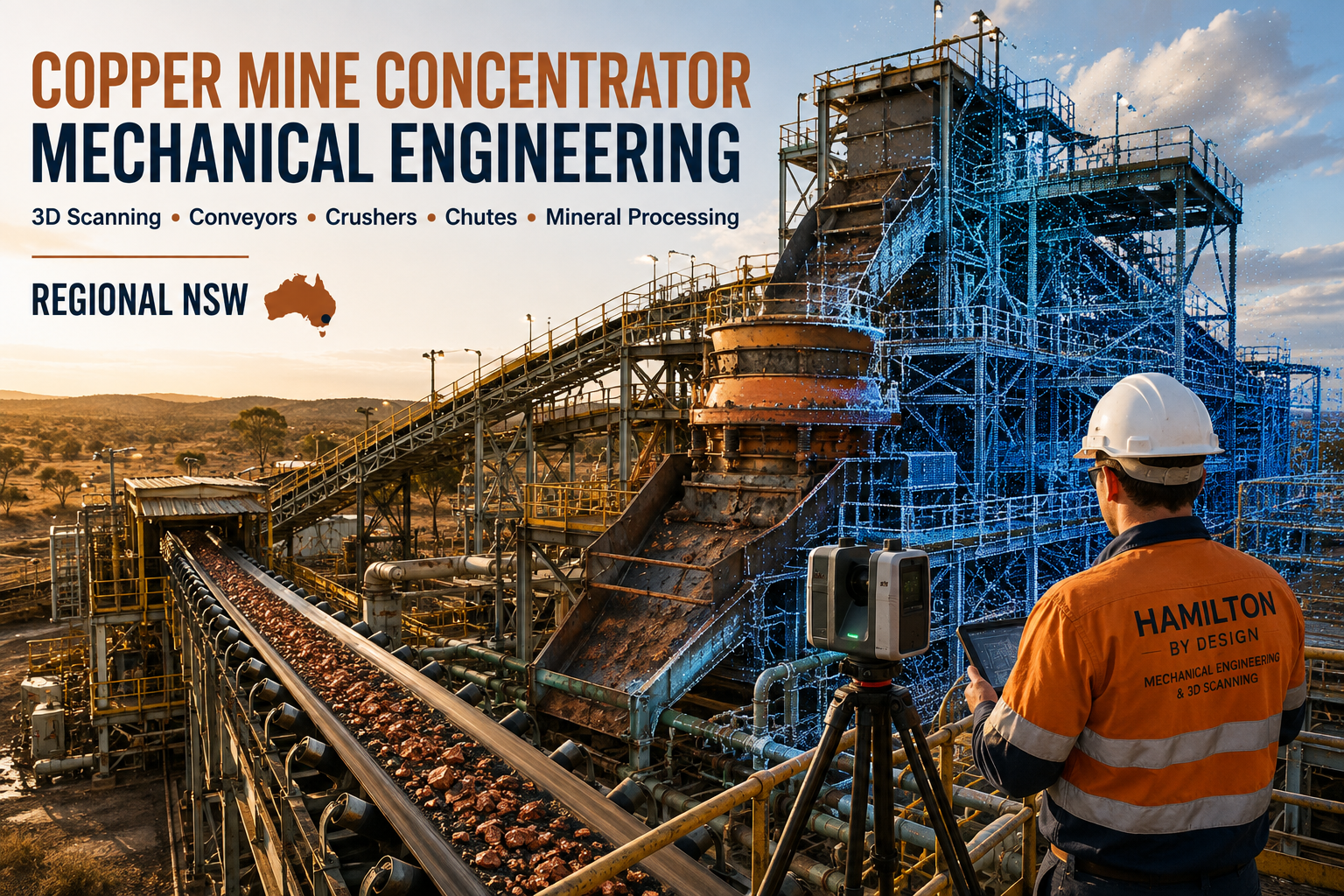


Engineering Governance Documentation Support for Rosebery, Tasmania

Rosebery is a working mining and processing town where engineering decisions need to be clear, traceable and practical.

On brownfield mining sites, the issue is often not just the design itself. The issue is whether the information behind the design can be trusted. Old drawings may not match the plant. Modifications may have been made during shutdowns. Fabrication details may sit across emails, markups, PDFs, contractor sketches and site knowledge held by fitters and supervisors.

Hamilton By Design supports Rosebery and Tasmaniaโ€™s west coast with engineering governance documentation, mechanical engineering support, 3D laser scanning, scan-to-CAD, drafting and reverse engineering for mining, concentrator and industrial sites.

What Is Engineering Governance Documentation?

Engineering governance documentation helps show how technical decisions were made, checked and controlled.

For mining and processing sites, this may include:

  • drawing registers
  • revision control
  • design basis documents
  • site measurement records
  • scan-to-CAD records
  • engineering markups
  • redline drawing updates
  • scope clarification documents
  • fabrication drawing control
  • as-built verification
  • inspection records
  • change documentation
  • technical queries and responses
  • document transmittals
  • approval workflows

The goal is to reduce confusion between site, engineering, fabrication and installation teams.

Why It Matters in Rosebery

Remote mining locations can make poor documentation expensive. If the wrong drawing is used, or if a fabrication package is based on outdated information, the result can be rework, delay, unsafe access or a failed installation during a shutdown.

Engineering governance documentation helps answer important questions:

  • What drawing is current?
  • What was measured on site?
  • What changed from the original design?
  • Who reviewed the information?
  • What assumptions were made?
  • What needs client approval?
  • What information is still missing?
  • What is suitable for fabrication?
  • What is suitable for construction or installation?

For Rosebery mining and concentrator work, this is especially useful where plant areas have been modified over many years.

Supporting Fitters, Riggers and Maintenance Teams

Fitters, riggers and maintenance supervisors often know the plant better than anyone. They can see what has worn, what does not fit, what is hard to access and what will cause problems during installation.

Hamilton By Design helps turn that site knowledge into controlled engineering documentation.

This can include:

  • site inspection notes
  • redline markups
  • measured sketches
  • 3D scan records
  • updated CAD drawings
  • fabrication-ready details
  • installation planning documents
  • clash and clearance checks
  • reverse engineering records
  • documented assumptions and exclusions

This gives the site team a clearer path from โ€œwe know there is a problemโ€ to โ€œwe have controlled information we can act onโ€.

3D Scanning as a Governance Tool

3D laser scanning is not only a measurement tool. Used properly, it becomes part of the engineering record.

Hamilton By Design can capture existing plant conditions using 3D laser scanning services and use the scan data to support drawing updates, fabrication checks, design reviews and as-built verification.

This is useful for:

  • chute and hopper replacements
  • conveyor transfer point upgrades
  • slurry pipework changes
  • pump and baseplate replacement
  • access platform modifications
  • guarding changes
  • shutdown planning
  • brownfield plant upgrades
  • concentrator plant documentation

Mechanical Engineering and Drawing Control

Hamilton By Design provides mechanical engineering support for practical plant issues where documentation needs to support real-world fabrication and installation.

This may include:

  • reviewing existing drawings
  • identifying missing information
  • checking fit-up constraints
  • developing design options
  • preparing general arrangement drawings
  • preparing fabrication drawings
  • maintaining drawing registers
  • managing revision changes
  • recording design assumptions
  • supporting technical clarification with site teams

The aim is not paperwork for the sake of paperwork. The aim is controlled information that helps people build, install, inspect and maintain with confidence.

Reverse Engineering Documentation

Where parts are worn, obsolete or poorly documented, Hamilton By Design can assist with reverse engineering with 3D scanning.

This can support:

  • replacement components
  • pump parts
  • brackets and supports
  • chute liners
  • pipe spools
  • guards
  • baseplates
  • custom mechanical parts

The reverse engineering process can be documented so that future repairs are not dependent on memory, guesswork or one-off site sketches.

Secondment and Embedded Documentation Support

For longer projects, shutdowns or ongoing plant upgrades, Hamilton By Design can also provide secondment services.

This allows experienced engineering, drafting or site-support personnel to work alongside your team to help manage technical documentation, drawing updates, site measurement records and engineering deliverables during peak workload periods.

Servicing Rosebery and Tasmaniaโ€™s West Coast

Hamilton By Design can support engineering governance documentation for Rosebery and nearby Tasmanian west coast locations, including:

  • Tullah
  • Zeehan
  • Queenstown
  • Strahan
  • Burnie
  • Devonport
  • broader Tasmanian mining and industrial sites

Need Engineering Governance Documentation Support in Rosebery?

If your Rosebery project needs clearer drawings, controlled revisions, scan-backed as-built records, fabrication documentation or engineering support for brownfield plant changes, Hamilton By Design can assist.

Contact Hamilton By Design to discuss engineering governance documentation, mechanical engineering, 3D scanning, scan-to-CAD or secondment support for Rosebery, Tasmania.

Talk to Us – Contact Us

Name
Would you like us to arrange a phone consultation for you?
Address

Our clients:


https://www.hamiltonbydesign.com.au/scan-to-bim-services-australia-lidar-point-clouds-cad-modelling