Smelter Scan to CAD Services in Newcastle NSW

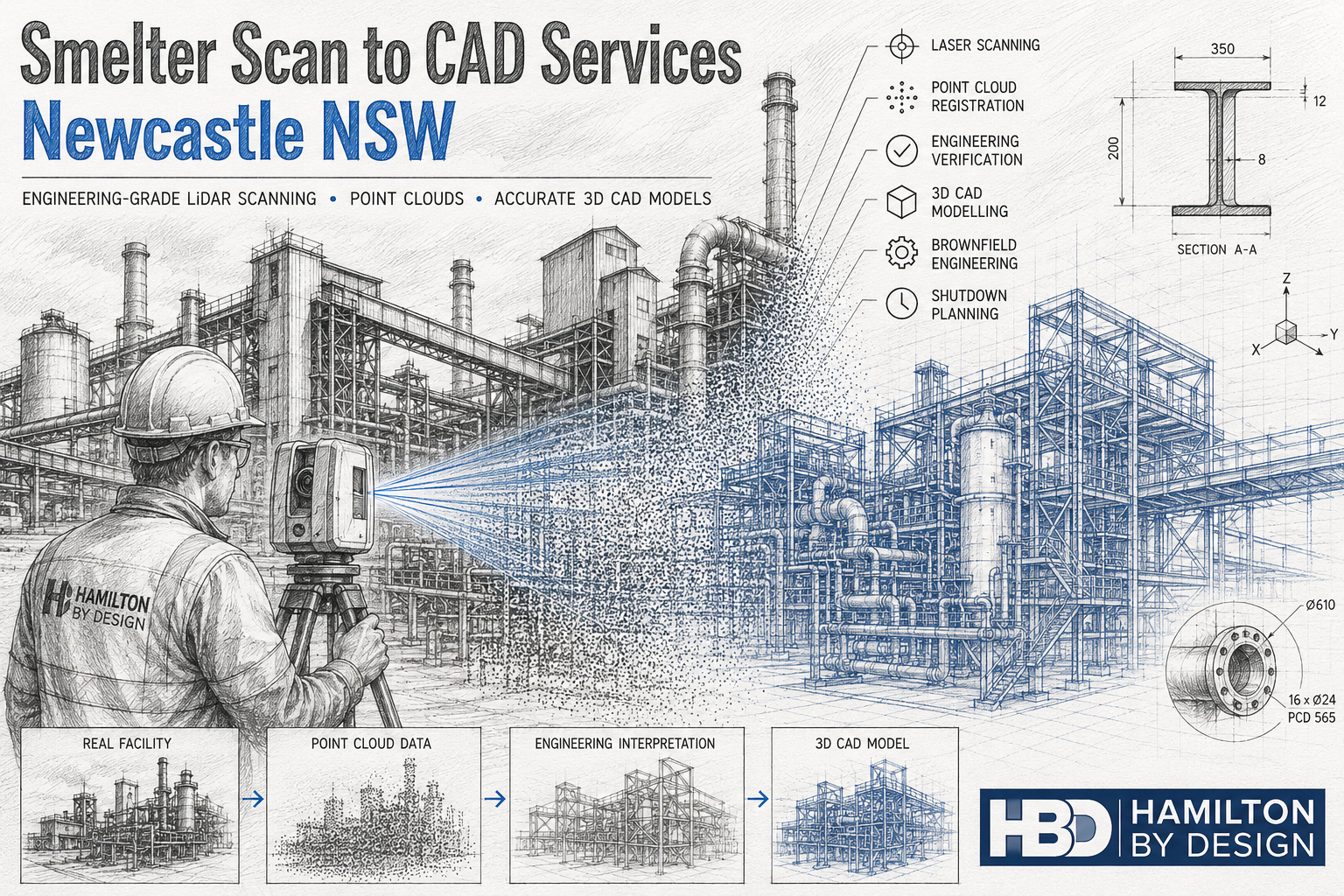
Engineering pencil drawing illustrating Smelter Scan to CAD Services in Newcastle NSW, showing LiDAR laser scanning, point cloud registration and conversion into accurate 3D CAD models for brownfield smelter and heavy industrial facilities.
Blue line-art icon of an industrial smelting furnace pouring molten metal into a ladle, representing engineering-grade 3D LiDAR scanning services for smelters, brownfield plant upgrades and as-built documentation.

Heavy industrial facilities rarely remain unchanged. Smelters are continually upgraded to improve production, replace ageing equipment, meet environmental regulations and increase operational efficiency. Over decades of operation, countless modifications are made, many of which are only partially documented or never recorded at all. As a result, engineering teams are often forced to work with outdated drawings, incomplete documentation or no reliable three-dimensional CAD model of the facility.

Hamilton By Design provides Smelter Scan to CAD Services in Newcastle NSW, transforming high-accuracy terrestrial laser scan data into engineering-grade CAD models that accurately represent existing plant conditions. These models provide a trusted foundation for brownfield engineering projects, shutdown planning, equipment replacements, structural modifications and future asset management.

Whether your project involves replacing conveyors, upgrading process equipment, modifying structural steel, rerouting pipework or expanding a processing facility, having an accurate digital model of the existing plant dramatically reduces project risk while improving engineering confidence.


Why Existing Smelter Drawings Cannot Always Be Trusted

Many smelters operating throughout the Newcastle and Hunter Region have been in service for decades. During this time they have experienced numerous shutdowns, maintenance campaigns and capital improvement projects.

Typical undocumented changes include:

  • Additional platforms and access walkways
  • Modified conveyor systems
  • Pipe rerouting
  • Structural steel alterations
  • Equipment replacements
  • Cable tray additions
  • Temporary modifications becoming permanent
  • New services installed around existing infrastructure

While individual projects may have produced updated drawings, these revisions are not always consolidated into a complete plant model. Over time, engineering documentation becomes fragmented, making it increasingly difficult to determine the true “as-built” condition of the facility.

This creates significant challenges whenever new engineering work is required.


The Cost of Working from Outdated Information

When engineering teams lack an accurate three-dimensional representation of the plant, projects become more complex than necessary.

Common issues include:

  • Unexpected clashes during installation
  • Fabrication errors
  • Incorrect field measurements
  • Delayed shutdowns
  • Increased site rework
  • Additional crane time
  • More site welding and modifications
  • Higher project costs
  • Safety risks associated with unforeseen obstacles

Every incorrect assumption increases project risk.

Accurate Scan to CAD services eliminate much of this uncertainty by providing engineers with an engineering-grade digital representation of the existing facility before design work begins.


What is Scan to CAD?

Scan to CAD is the process of converting terrestrial laser scan data into intelligent engineering models.

Rather than relying solely on old drawings or manual measurements, millions of highly accurate laser measurements are captured throughout the facility to create a complete three-dimensional point cloud.

Experienced engineers then interpret this data to develop accurate CAD models representing existing equipment, structures and plant layouts.

The result is an engineering model that reflects the current state of the facilityโ€”not how it looked twenty years ago.


Our Scan to CAD Workflow

Hamilton By Design follows a structured engineering workflow designed specifically for complex industrial facilities.

1. High-Accuracy Laser Scanning

Using professional terrestrial laser scanners, millions of survey-grade measurements are captured throughout the plant.

Typical assets include:

  • Furnace buildings
  • Material handling systems
  • Pipework
  • Tanks
  • Chutes
  • Hoppers
  • Structural steel
  • Platforms
  • Conveyors
  • Cable trays
  • Mechanical equipment
  • Access structures

Large facilities can be captured with complete overlap to ensure comprehensive coverage and minimal shadowing.


2. Point Cloud Registration

Individual scans are registered into one accurate coordinate system.

This creates a unified digital representation of the entire facility while maintaining engineering-grade accuracy suitable for detailed design work.


3. Engineering Interpretation

Unlike automated modelling software, engineering interpretation identifies:

  • Structural members
  • Mechanical equipment
  • Process pipework
  • Equipment interfaces
  • Critical connection points
  • Existing plant constraints

Engineering judgement ensures the model reflects functional plant assets rather than simply reproducing raw geometry.


4. CAD Model Development

Point cloud data is converted into engineering CAD models suitable for design and documentation.

Depending on project requirements, deliverables may include:

  • Mechanical equipment
  • Structural steel
  • Pipework
  • Access platforms
  • Stairs
  • Handrails
  • Tanks
  • Ducting
  • Buildings
  • Foundations

Models can be produced to the required Level of Detail (LOD) to support conceptual studies, detailed engineering or fabrication.


5. Verification

Critical dimensions are checked against the registered point cloud before project completion.

Verification commonly includes:

  • Flange locations
  • Bolt centres
  • Equipment centres
  • Structural interfaces
  • Pipe elevations
  • Nozzle positions

This verification process gives engineering teams greater confidence that the CAD model accurately reflects existing site conditions.


Typical Smelter Applications

Scan to CAD services support a wide range of engineering activities, including:

Brownfield Plant Modifications

Existing infrastructure is accurately modelled before new equipment is designed.

This significantly reduces installation conflicts.


Shutdown Planning

Shutdown durations are often measured in hours rather than days.

Accurate CAD models enable:

  • Off-site fabrication
  • Installation planning
  • Lift studies
  • Construction sequencing
  • Clash reviews

Better planning helps minimise production downtime.


Conveyor Upgrades

Conveyor replacements frequently require precise integration with existing structures.

Scan to CAD provides engineers with accurate structural interfaces before fabrication begins.


Structural Modifications

Existing platforms, access systems and support structures can be accurately modelled before alterations are designed.

This improves fabrication accuracy while reducing field modifications.


Equipment Replacement

Replacement pumps, tanks, vessels, ductwork and process equipment can be designed to fit existing plant geometry before arriving on site.


Engineering Software Compatible Deliverables

Hamilton By Design can supply deliverables compatible with many common engineering platforms, including:

  • SOLIDWORKS
  • Autodesk Inventor
  • AutoCAD
  • Autodesk Plant 3D
  • Autodesk Revit
  • Navisworks
  • STEP
  • SAT
  • DWG
  • DXF
  • IFC
  • E57
  • RCP
  • LAS

This flexibility allows engineering teams to continue working within their preferred software environment.


Benefits of Accurate Scan to CAD Models

Investing in accurate engineering models provides measurable project benefits:

  • Reduced site measurements
  • Improved design accuracy
  • Lower fabrication risk
  • Fewer installation clashes
  • Reduced shutdown duration
  • Better project planning
  • Faster engineering workflows
  • Improved asset documentation
  • Enhanced maintenance planning
  • Long-term digital asset management

For facilities undertaking ongoing brownfield improvements, a reliable CAD model becomes a valuable engineering asset that continues delivering value long after the initial scanning project is complete.


Supporting Newcastle’s Heavy Industry

Newcastle has long been recognised as one of Australia’s major industrial centres, supporting steel manufacturing, mineral processing, bulk materials handling, port infrastructure and heavy engineering. Many of these facilities have evolved through decades of expansion, leaving engineering teams with incomplete or outdated documentation.

Hamilton By Design specialises in engineering-led Scan to CAD services that bridge this gap. By combining high-accuracy terrestrial laser scanning with mechanical engineering expertise, we produce practical CAD models that support real-world engineering decisions.

Whether your project involves a single process area or an entire smelter, our workflow provides engineering teams with accurate digital information they can rely on for design, fabrication and construction.


Hamilton By Design logo displayed on a blue tilted rectangle with a grey gradient background

Why Choose Hamilton By Design?

Hamilton By Design understands that successful brownfield projects begin with accurate existing-condition information. We combine terrestrial laser scanning with practical engineering experience to deliver CAD models that are not only geometrically accurate but also structured for engineering use.

Our services are tailored to the needs of heavy industry, with experience supporting shutdowns, equipment upgrades, structural modifications, process improvements and long-term asset management. From initial site capture through to verified CAD deliverables, we focus on reducing uncertainty so your engineering team can design with confidence.

If your Newcastle smelter or heavy industrial facility lacks reliable 3D CAD models, Hamilton By Design can help convert reality into accurate engineering dataโ€”providing the digital foundation needed for safer, faster and more cost-effective projects.

Talk to Us – Contact Us

Name
Would you like us to arrange a phone consultation for you?
Address

Our clients:

https://www.hamiltonbydesign.com.au/scan-to-bim-services-australia-lidar-point-clouds-cad-modelling

Aluminium Smelter Laser Scanning Services in Tomago NSW

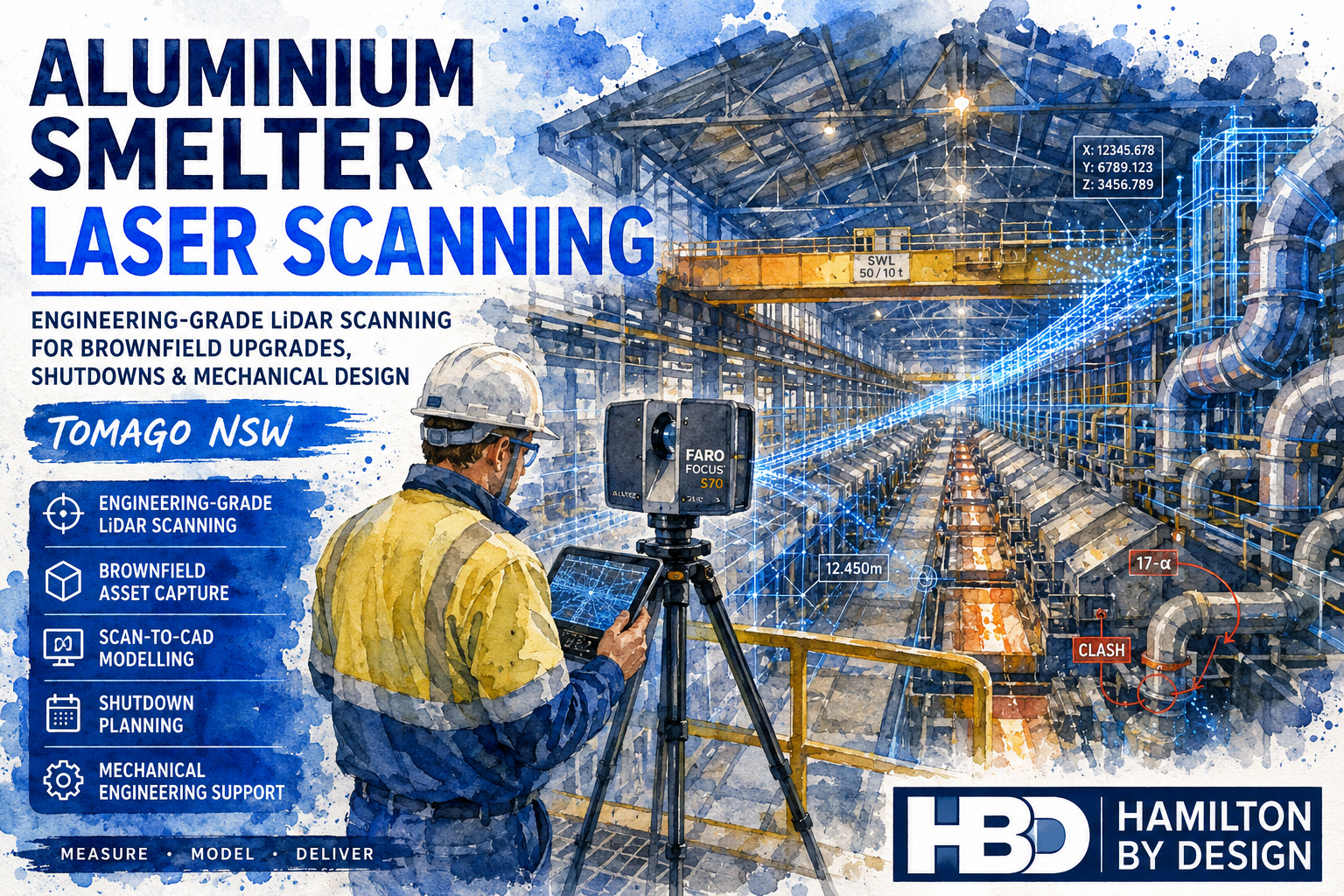
Engineering-grade LiDAR laser scanning inside an aluminium smelter in Tomago NSW supporting brownfield upgrades, shutdown planning, Scan-to-CAD modelling and mechanical engineering.

Brownfield engineering projects are among the most technically demanding activities undertaken within an aluminium smelter. Unlike a new (greenfield) facility, every modification inside an operating smelter must integrate with decades of existing infrastructure, often installed during multiple expansion and upgrade phases. Over time, plant layouts evolve, undocumented modifications occur, and original engineering drawings become outdated or incomplete.

For facilities such as Tomago Aluminium in Tomago NSW, accurate existing-condition information is essential before any engineering design, shutdown planning or equipment installation begins. Without reliable dimensional data, project teams risk discovering clashes, incorrect fabrication dimensions and unforeseen site conditions only after installation has commencedโ€”when delays are most costly.

Hamilton By Design provides engineering-grade 3D laser scanning services that create highly accurate digital representations of existing assets. Using advanced LiDAR technology, millions of measurement points are captured in a matter of minutes, producing an engineering-quality point cloud that forms the foundation for mechanical design, structural engineering, Scan-to-CAD workflows and brownfield project delivery.

Whether your project involves replacing conveyors, upgrading process equipment or planning a major shutdown, laser scanning dramatically reduces uncertainty while improving safety, engineering confidence and project outcomes.


Why Accurate Measurement Matters in an Aluminium Smelter

Aluminium smelters operate continuously, twenty-four hours a day, every day of the year. Every hour of lost production has significant financial consequences, making shutdown windows tightly planned and carefully managed.

Unlike manufacturing facilities with spare production capacity, major engineering work often needs to occur within limited shutdown periods where multiple contractors work simultaneously.

This creates several engineering challenges:

  • Existing structures may not match historical drawings.
  • Pipework has often been modified over decades.
  • Equipment relocations are poorly documented.
  • Platforms and walkways have changed.
  • Electrical cable trays have expanded.
  • New services compete for limited installation space.
  • Structural members have been strengthened without drawing revisions.

Traditional surveying techniques simply cannot capture the complexity of these environments efficiently.


The Brownfield Engineering Challenge

Every brownfield project starts with one simple question:

What actually exists today?

Unfortunately, this is rarely easy to answer.

Many aluminium smelters have been operating for forty years or more. During that time, thousands of engineering changes may have occurred.

Common examples include:

  • Emergency repairs
  • Maintenance modifications
  • Temporary installations becoming permanent
  • Equipment replacements
  • Structural strengthening
  • Additional pipe supports
  • New cable routes
  • Instrument upgrades
  • Maintenance access improvements

Many of these modifications were completed under shutdown pressure where updating engineering drawings was understandably not the highest priority.

The result is that engineering teams often begin projects using documentation that no longer accurately reflects the physical plant.


Why Traditional Site Measurement Falls Short

Historically, engineers relied upon:

  • Tape measures
  • Total stations
  • Hand sketches
  • Photographs
  • Manual dimensions

While these methods still have their place, they become increasingly impractical inside large industrial facilities.

Consider attempting to measure:

  • 40 metres of overhead pipework
  • Multiple elevations
  • Congested cable trays
  • Structural steel connections
  • Existing conveyors
  • Crane beams
  • Process vessels

Access alone may require elevated work platforms, confined space permits, scaffolding and isolation procedures.

Even after several days onsite, only selected dimensions have been captured.

If additional information is later required, another site visit becomes necessary.


How Engineering Laser Scanning Changes the Process

Laser scanning fundamentally changes how brownfield engineering projects are delivered.

Instead of recording hundreds of manual dimensions, terrestrial LiDAR scanners collect millions of highly accurate measurements covering the complete work area.

The result is an engineering-grade point cloud that accurately represents existing plant geometry.

This digital environment allows engineers to perform much of their work from the office rather than returning repeatedly to site.

Once captured, the scan data can be converted into accurate Scan-to-CAD models and engineering drawings, enabling mechanical, structural and piping designers to work confidently using verified as-built information.

Typical benefits include:

  • Complete site capture
  • Reduced survey time
  • Improved design accuracy
  • Fewer site visits
  • Better collaboration
  • Improved documentation
  • Reduced engineering risk

Typical Areas Scanned Within an Aluminium Smelter

Engineering projects commonly occur throughout the facility, including:

Potlines

  • Structural modifications
  • Busbar alterations
  • Access platform changes
  • Mechanical equipment installation

Casthouse

  • Furnace upgrades
  • Casting equipment
  • Overhead cranes
  • Hydraulic systems
  • Cooling systems

Carbon Plant

  • Conveyors
  • Crushers
  • Dust extraction
  • Structural supports
  • Material handling systems

Utility Systems

  • Cooling water
  • Compressed air
  • Natural gas
  • Fire services
  • Hydraulic systems
  • Electrical substations

Highly congested service corridors benefit significantly from comprehensive reality capture.


Supporting Shutdown Engineering

Shutdowns represent one of the highest-value applications for engineering laser scanning.

Every task within a shutdown depends upon accurate planning.

When equipment has already been fabricated, there is little tolerance for discovering dimensional discrepancies during installation.

Laser scanning supports shutdown engineering and brownfield project planning by providing:

  • Existing-condition verification
  • Installation planning
  • Crane access studies
  • Temporary works design
  • Pipe spool verification
  • Structural modification planning
  • Clash detection
  • Construction sequencing

The result is improved confidence before shutdown activities begin.


Mechanical Engineering Applications

Mechanical engineering projects commonly include:

  • Pump replacements
  • Conveyor upgrades
  • Chute redesign
  • Tank modifications
  • Ducting replacement
  • Pressure vessel connections
  • Machine foundations

Instead of estimating dimensions from old drawings, engineers can design directly against the current plant geometry.

This greatly improves fabrication accuracy.


Structural Engineering Benefits

Structural engineers frequently encounter undocumented modifications.

Laser scanning enables accurate modelling of:

  • Structural steel
  • Columns
  • Bracing
  • Platforms
  • Stairways
  • Handrails
  • Crane beams
  • Pipe supports

Existing structures can then be verified before additional loads are introduced.


Digital Twins and Asset Management

Laser scanning also provides the foundation for developing digital twins.

Rather than relying solely on historical drawings, operators gain access to an accurate digital representation of the physical plant.

Benefits include:

  • Asset management
  • Maintenance planning
  • Future project planning
  • Condition assessments
  • Engineering verification
  • Operator training
  • Long-term documentation

Where legacy equipment has little or no documentation, Hamilton By Design can also provide reverse engineering services to recreate accurate CAD models and manufacturing drawings directly from laser scan data.


Engineering Software Used

Hamilton By Design supports engineering workflows using industry-recognised software, including:

  • FARO Focus terrestrial laser scanners
  • FARO SCENE
  • Autodesk ReCap
  • Autodesk Navisworks
  • SOLIDWORKS
  • Autodesk Inventor
  • AutoCAD
  • AutoCAD Plant 3D
  • Revit
  • E57 point cloud exchange
  • STEP and Parasolid mechanical models

This enables seamless collaboration with engineering consultants, asset owners and contractors.


Typical Deliverables

Every project is tailored to client requirements, but deliverables may include:

  • Registered point clouds
  • E57 files
  • Autodesk ReCap projects (RCP/RCS)
  • Scan-to-CAD drawings
  • Existing-condition layouts
  • General arrangement drawings
  • Mechanical models
  • Structural steel models
  • Pipework models
  • Equipment verification
  • Clash detection reviews
  • Engineering mark-ups
  • As-built documentation

Why Tomago NSW Is an Ideal Application

Tomago is one of Australia’s most significant heavy industrial precincts, and engineering projects are continually undertaken to improve safety, reliability and production efficiency.

Many upgrades involve integrating modern equipment into infrastructure that has evolved over decades.

This makes accurate existing-condition information invaluable.

Laser scanning enables project teams to:

  • Reduce uncertainty
  • Improve engineering quality
  • Minimise shutdown risk
  • Support prefabrication
  • Improve contractor coordination
  • Reduce costly rework

For brownfield engineering, accurate information at the beginning of the project often determines the success of the entire installation.


Hamilton By Design logo displayed on a blue tilted rectangle with a grey gradient background

Conclusion

Brownfield engineering projects succeed when decisions are based on accurate information. In aluminium smelters operating in Tomago NSW, where infrastructure has evolved over decades, relying on outdated drawings or incomplete measurements introduces unnecessary risk, delays and cost.

Engineering-grade laser scanning provides a reliable foundation for mechanical upgrades, shutdown planning, structural modifications and future asset management. By capturing millions of accurate measurements in a single survey, project teams gain confidence that new equipment will fit, fabrication can proceed with certainty, and installation risks are significantly reduced.

If your next project involves upgrading conveyors, replacing process equipment, modifying structural steel or planning a major shutdown, Hamilton By Design can deliver the accurate reality capture and engineering support needed to reduce uncertainty and keep your project moving forward. By combining advanced LiDAR technology with practical engineering expertise, we help aluminium smelter operators make better decisions, minimise rework and achieve safer, more efficient brownfield project outcomes throughout Tomago NSW.

Talk to Us – Contact Us

Name
Would you like us to arrange a phone consultation for you?
Address

Our clients:

https://www.hamiltonbydesign.com.au/scan-to-bim-services-australia-lidar-point-clouds-cad-modelling

Smelter 3D LiDAR Scanning Services Newcastle NSW

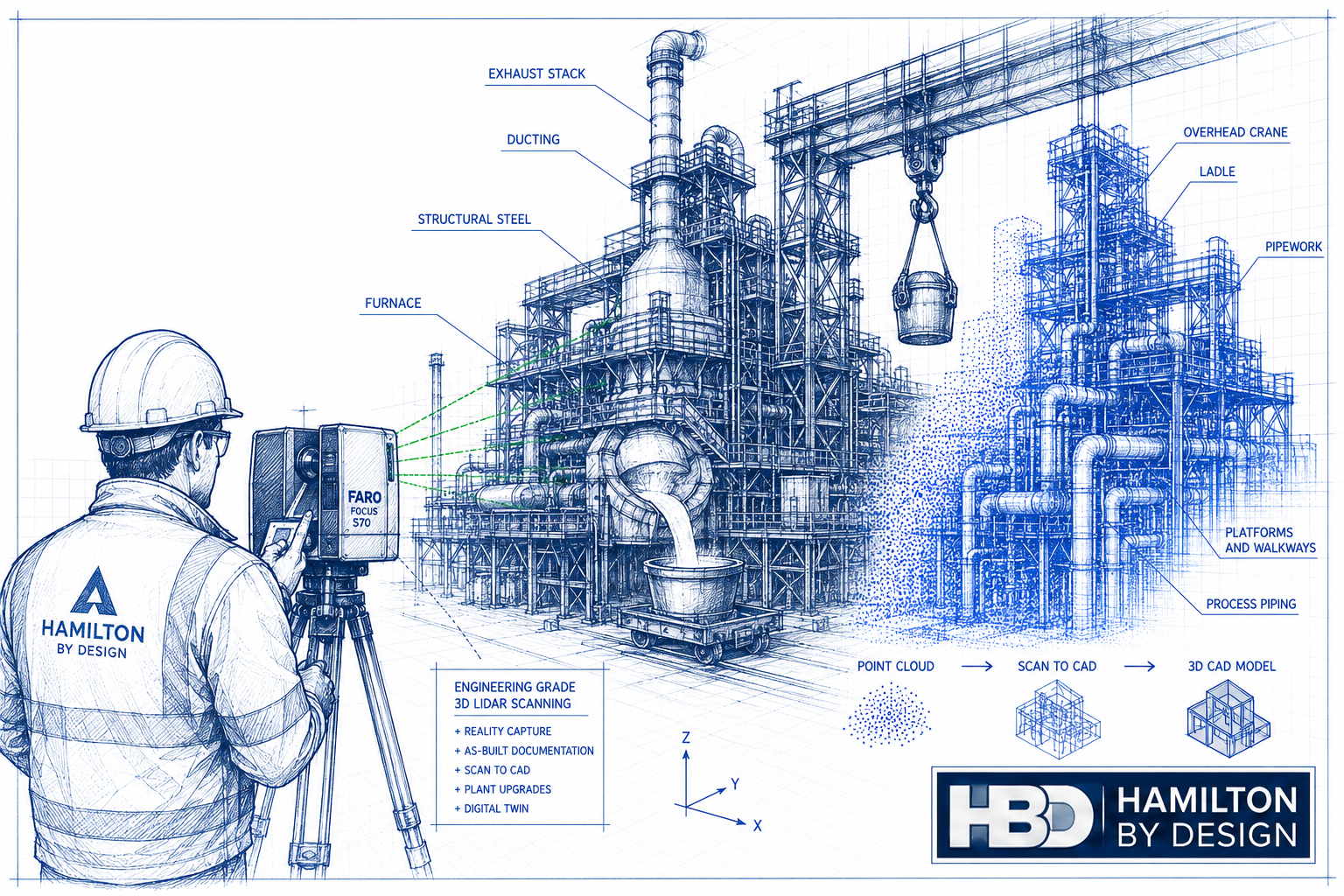
Technical blueprint illustration of a smelter facility in Newcastle NSW being captured with a FARO Focus S70 LiDAR scanner, showing point cloud reality capture, Scan to CAD conversion and engineering-grade as-built documentation for brownfield plant upgrades.

Smelter 3D LiDAR Scanning Services in Newcastle NSW

Blue line-art icon of an industrial smelting furnace pouring molten metal into a ladle, representing engineering-grade 3D LiDAR scanning services for smelters, brownfield plant upgrades and as-built documentation.

Many smelter facilities throughout Newcastle NSW have been operating for decades. During that time, plant expansions, maintenance shutdowns, emergency repairs and equipment upgrades have gradually changed the facility from its original design. Unfortunately, these changes are not always reflected in the engineering drawings.

The result is a common challenge faced by plant owners and engineering teams: the existing drawings no longer accurately represent what is installed on site.

This creates unnecessary risk during every engineering project. Pipework clashes with new equipment, structural steel connections differ from the drawings, platforms have been modified, cable trays have been rerouted, and access ways no longer match historical documentation.

Hamilton By Design provides Smelter 3D LiDAR Scanning Services in Newcastle NSW, delivering engineering-grade reality capture that allows project teams to work from accurate as-built information rather than outdated drawings. Using our 3D Laser Scanning Services, we capture millions of measurements across existing facilities and convert this information into engineering-ready point clouds, CAD models and digital as-built documentation.

Whether your project involves a shutdown, brownfield expansion, equipment replacement or complete plant upgrade, accurate site data is the foundation of successful engineering.


Why Existing Drawings Become Unreliable

Few industrial facilities remain unchanged over their operating life.

Most smelters have experienced numerous modifications, including:

  • New process equipment
  • Replacement pipework
  • Conveyor upgrades
  • Structural strengthening
  • Additional platforms and access ways
  • New services and cable trays
  • Dust extraction modifications
  • Pump replacements
  • Instrumentation upgrades
  • Temporary repairs that became permanent installations

While individual projects may have produced updated drawings, complete documentation is rarely maintained over several decades.

As a result, engineering teams frequently discover discrepancies only after arriving on site or during construction. These unexpected differences often lead to redesign, fabrication changes, additional site work and costly project delays.

Hamilton By Design helps eliminate this uncertainty by capturing the plant exactly as it exists today.


Engineering-Grade 3D LiDAR Scanning

Unlike traditional site measuring, terrestrial LiDAR scanning captures millions of highly accurate measurements in every scan position.

Our engineering workflow records:

  • Structural steel
  • Pipework
  • Tanks
  • Pressure vessels
  • Pumps
  • Valves
  • Conveyors
  • Chutes
  • Platforms
  • Walkways
  • Stairs
  • Handrails
  • Cable trays
  • Mechanical equipment
  • Existing foundations
  • Process buildings

This comprehensive digital record becomes the foundation for future engineering, drafting and asset management activities.

Once captured, the point cloud can be transformed into intelligent engineering models using our Scan to CAD Services, allowing designers to work efficiently from accurate digital information.


Reduce Brownfield Engineering Risk

Brownfield projects present unique engineering challenges because new equipment must integrate into an existing operating plant.

Typical risks include:

  • Unknown clearances
  • Hidden structural members
  • Pipe routing conflicts
  • Maintenance access restrictions
  • Interference with electrical services
  • Equipment clashes
  • Incorrect foundation locations

Without accurate site information, engineers are forced to make assumptions.

These assumptions often become expensive construction variations.

Hamilton By Design captures the existing plant with engineering-grade accuracy, allowing designers to verify every interface before fabrication begins. Our Brownfield Engineering Services help clients confidently integrate new equipment into existing facilities while reducing construction risk.


Support Shutdown Planning

Shutdown windows are expensive.

Every additional hour impacts production and increases contractor costs.

Accurate LiDAR scanning allows engineering teams to complete much of the design work before the shutdown begins.

Instead of relying on multiple site visits, designers work directly from the captured point cloud to develop:

  • Mechanical layouts
  • Structural modifications
  • Pipe routing
  • Equipment positioning
  • Maintenance access reviews
  • Installation sequencing

By reducing uncertainty during the design phase, shutdown activities become faster, safer and more predictable.


Accurate As-Built Documentation

One of the greatest long-term benefits of LiDAR scanning is the creation of accurate as-built documentation.

Hamilton By Design can provide:

  • Registered point clouds
  • AutoCAD drawings
  • 3D CAD models
  • SolidWorks assemblies
  • Autodesk Inventor models
  • STEP models
  • Navisworks coordination models
  • Structural steel models
  • Equipment models
  • General arrangement drawings
  • Engineering verification models

These deliverables provide a reliable engineering record that can be reused for future projects, maintenance planning and asset management.


Improve Design Accuracy

Engineering design is only as accurate as the information used to create it.

By working from an accurate point cloud, engineers can confidently design:

  • Replacement conveyors
  • Pipework systems
  • Pump installations
  • Structural platforms
  • Maintenance access systems
  • Mechanical upgrades
  • Process equipment
  • Tank modifications
  • Support steel
  • Ducting systems

This greatly reduces the need for redesign during construction.


Digital Twins for Smelter Facilities

Many industrial operators are now investing in digital engineering workflows.

A high-quality LiDAR scan forms the basis of a digital twin by accurately representing the current physical condition of the facility.

A digital twin can support:

  • Asset management
  • Future expansions
  • Shutdown planning
  • Maintenance strategies
  • Engineering studies
  • Safety assessments
  • Training
  • Plant familiarisation

Instead of relying on incomplete drawings, engineers have access to a complete digital representation of the plant.


Typical Areas We Scan

Hamilton By Design provides LiDAR scanning throughout industrial smelter facilities, including:

  • Ore handling systems
  • Crushing areas
  • Conveyors
  • Transfer towers
  • Smelting furnace buildings
  • Casting facilities
  • Refining areas
  • Pipe racks
  • Cooling water systems
  • Structural steel
  • Dust extraction systems
  • Process pipework
  • Pump stations
  • Tank farms
  • Workshops
  • Compressor rooms
  • Electrical substations
  • Cable tray systems
  • Access platforms
  • Walkways
  • Stair systems

Our approach ensures all critical engineering interfaces are captured for future design work.


Engineering-Led Scan-to-CAD Services

Hamilton By Design is more than a scanning provider.

As a mechanical engineering consultancy, we understand how captured data will be used during design, drafting and construction.

Our services include:

  • Engineering drafting
  • Mechanical design
  • Structural steel detailing
  • Scan-to-CAD conversion
  • Reverse engineering
  • Plant layout development
  • As-built verification
  • Brownfield engineering support
  • 3D modelling
  • Engineering documentation

Because scanning and engineering are delivered together, the final outputs are tailored to the needs of designers, fabricators and asset owners.

If replacement components need to be recreated where original OEM drawings no longer exist, our Reverse Engineering Services provide accurate engineering models developed directly from LiDAR scan data.

For clients requiring complete engineering support beyond scanning, our Mechanical Engineering Services deliver practical solutions from concept design through to detailed drafting and fabrication documentation.


Why Newcastle NSW?

Newcastle has a long history of heavy industry, steel manufacturing, minerals processing and industrial engineering. Many facilities have evolved through decades of operational improvements, making accurate engineering documentation increasingly important.

LiDAR scanning provides a practical solution for organisations managing ageing infrastructure by creating a reliable digital record of current plant conditions.

Whether the project involves equipment replacement, structural modifications, shutdown planning or long-term asset management, engineering teams benefit from working with accurate, up-to-date information rather than relying on historical drawings.


Why Choose Hamilton By Design?

Hamilton By Design combines advanced terrestrial LiDAR scanning technology with practical engineering experience.

Our clients value our ability to deliver:

  • Engineering-grade LiDAR scanning
  • Accurate as-built documentation
  • Brownfield engineering support
  • Scan-to-CAD modelling
  • Mechanical engineering expertise
  • Structural modelling
  • Reverse engineering
  • Shutdown planning assistance
  • High-quality engineering documentation

We understand the demands of operating industrial facilities and the importance of delivering information that engineers can confidently use for design, fabrication and construction.


Hamilton By Design logo displayed on a blue tilted rectangle with a grey gradient background

Ready to Modernise Your Smelter Documentation?

If your smelter drawings no longer reflect the current plant, now is the time to create an accurate digital record.

Hamilton By Design provides Smelter 3D LiDAR Scanning Services in Newcastle NSW, helping industrial operators reduce brownfield engineering risk, improve shutdown planning and develop reliable as-built documentation for future projects.

Whether you require a single process area, a complete facility scan or ongoing engineering support, our team can deliver engineering-grade reality capture tailored to your project requirements.

Contact Hamilton By Design today to discuss your next smelter upgrade, shutdown or brownfield engineering project and discover how engineering-grade LiDAR scanning can reduce project risk while improving design accuracy.

Talk to Us – Contact Us

Name
Would you like us to arrange a phone consultation for you?
Address

Our clients:

https://www.hamiltonbydesign.com.au/scan-to-bim-services-australia-lidar-point-clouds-cad-modelling

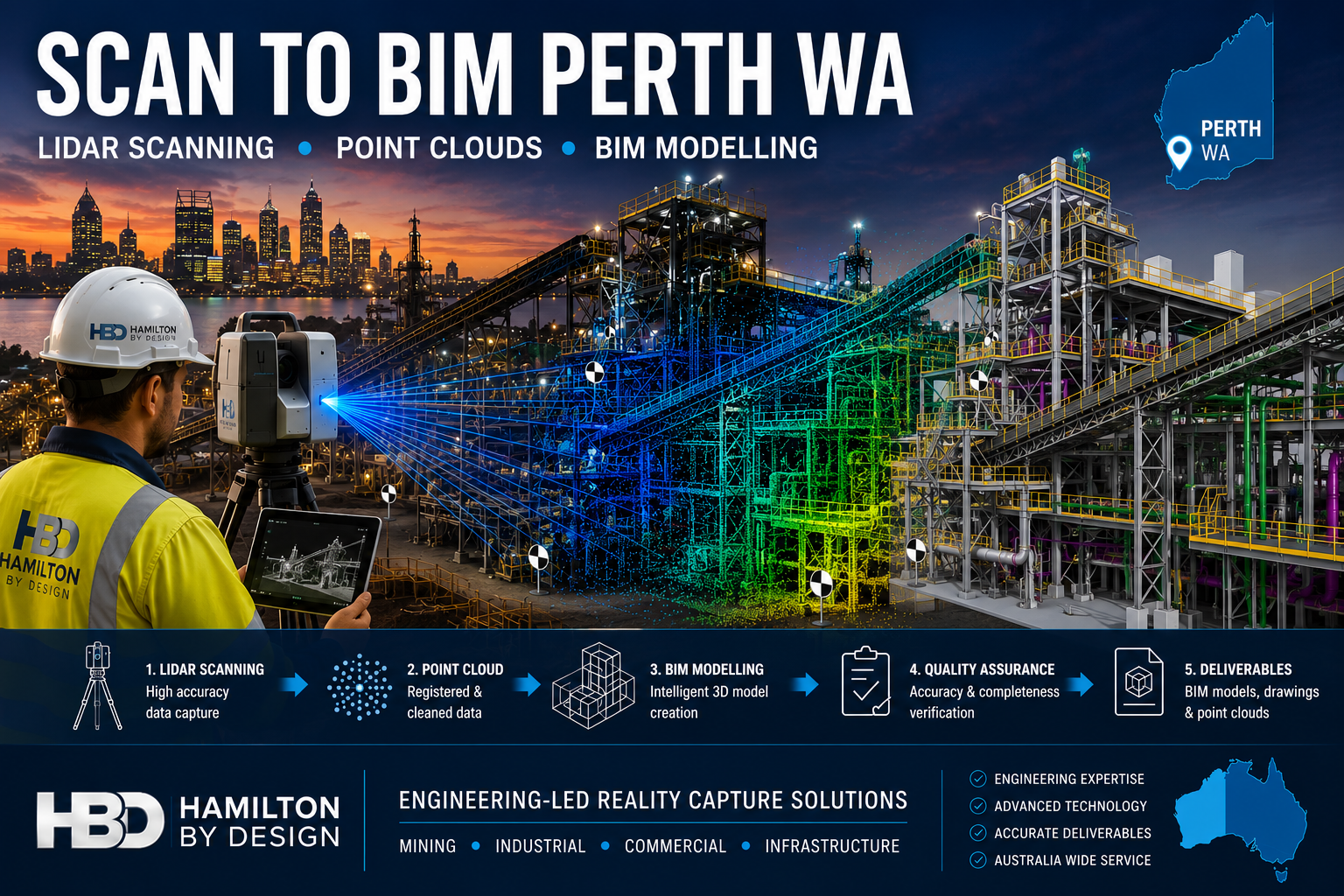
Scan to BIM Perth WA

Scan to BIM Perth WA engineering workflow showing LiDAR scanning, point cloud processing and BIM modelling of a Western Australian industrial facility using Hamilton By Design reality capture services.

Scan to BIM Perth WA

Engineering-Led Scan to BIM Services Across Perth and Western Australia

Blue 3D LiDAR scanner icon on a tripod with scanning waves

Hamilton By Design provides professional Scan to BIM services throughout Perth and Western Australia, helping mining, industrial, commercial, infrastructure and construction organisations transform accurate 3D laser scan data into intelligent Building Information Models (BIM).

Using engineering-grade LiDAR scanning technology and advanced BIM workflows, we capture existing facilities, process plants, buildings and infrastructure assets and convert them into accurate digital models suitable for design, planning, construction and asset management.

Whether your project involves a brownfield mining upgrade in the Pilbara, a commercial building in the Perth CBD, a processing plant in Kwinana or infrastructure works across regional Western Australia, our Scan to BIM services deliver reliable information for better engineering and project outcomes.


What is Scan to BIM?

Scan to BIM is the process of converting 3D laser scan data into an intelligent Building Information Model.

The process begins with high-accuracy LiDAR scanning, which captures millions of measurement points across a site. This data forms a point cloud that accurately represents existing conditions.

The point cloud is then used to create a BIM model containing structural, architectural and mechanical information that can be used throughout the project lifecycle.

The result is a highly accurate digital representation of the asset that supports:

  • Engineering design
  • Construction planning
  • Asset management
  • Facility upgrades
  • Maintenance planning
  • Clash detection
  • Digital twin development

Engineering-Led BIM Modelling

Unlike many scanning providers that focus only on data capture, Hamilton By Design combines engineering experience with reality capture technology.

This means the final BIM model is developed with an understanding of:

  • Mechanical systems
  • Structural steel
  • Conveyors
  • Chutes
  • Tanks
  • Pipework
  • Platforms and access systems
  • Process equipment
  • Material handling infrastructure

Our engineering background allows us to understand how facilities operate and how accurate models can improve future design decisions.


Perth Industries Using Scan to BIM

Mining and Resources

Western Australia remains one of the world’s largest mining regions.

Scan to BIM supports:

  • Iron ore facilities
  • Gold processing plants
  • Lithium operations
  • Rare earth projects
  • Bulk material handling systems
  • Port infrastructure

Accurate BIM models help engineering teams reduce shutdown durations and improve planning for plant upgrades.


Industrial Manufacturing

Many Perth manufacturers operate facilities that have evolved over decades.

Often existing drawings are incomplete or outdated.

Scan to BIM enables:

  • Accurate facility documentation
  • Equipment replacement projects
  • Structural upgrades
  • Capacity expansion projects
  • Maintenance planning

Commercial Buildings

Commercial property owners increasingly use BIM models to manage assets.

Applications include:

  • Building refurbishment
  • Services upgrades
  • HVAC replacement
  • Tenant fit-outs
  • Facility management

Infrastructure Projects

Scan to BIM can support:

  • Rail infrastructure
  • Ports
  • Water treatment facilities
  • Pump stations
  • Utility corridors
  • Government infrastructure

Accurate BIM models reduce project risk by ensuring designs are based on real-world conditions.


Our Scan to BIM Workflow

1. Site LiDAR Scanning

We perform engineering-grade laser scanning using professional reality capture equipment.

Millions of measurement points are collected across the facility.


2. Point Cloud Registration

Individual scans are aligned and processed into a unified point cloud.

Typical deliverables include:

  • E57
  • RCP
  • RCS
  • LAS

3. BIM Model Development

The point cloud is converted into BIM geometry using industry-standard software.

Models may include:

  • Structural steel
  • Mechanical equipment
  • Pipework
  • Buildings
  • Platforms
  • Access systems

4. Quality Assurance

Models are checked against scan data to verify accuracy and completeness.


5. Deliverables

Typical outputs include:

  • Autodesk Revit Models
  • Navisworks Models
  • IFC Files
  • DWG Drawings
  • PDF Documentation
  • Point Cloud Files

Benefits of Scan to BIM

Improved Accuracy

Laser scanning captures existing conditions with significantly greater accuracy than traditional site measurement methods.

Reduced Design Risk

Design teams can work from verified information rather than assumptions.

Faster Project Delivery

Accurate digital models reduce site revisits and minimise redesign.

Better Asset Management

Facility owners gain an accurate digital representation of their assets.

Improved Collaboration

BIM models provide a common source of information for engineers, designers, contractors and asset owners.


Scan to BIM for Brownfield Mining Projects

Brownfield projects often present unique challenges.

Existing facilities may contain undocumented modifications, ageing infrastructure and limited historical records.

Scan to BIM allows engineering teams to:

  • Verify existing conditions
  • Identify clashes before construction
  • Reduce shutdown risks
  • Improve design confidence
  • Support future digital twin initiatives

For mining operations throughout Perth, the Pilbara, Goldfields and regional Western Australia, accurate BIM models can significantly improve project outcomes.


Why Choose Hamilton By Design?

Hamilton By Design combines:

โœ” Engineering Experience

โœ” LiDAR Scanning Expertise

โœ” BIM Modelling Capability

โœ” Mechanical Design Knowledge

โœ” Structural Drafting Experience

โœ” Australia-Wide Project Delivery

โœ” Mining Industry Experience

We understand both the technology and the engineering requirements behind successful Scan to BIM projects.


Hamilton By Design logo displayed on a blue tilted rectangle with a grey gradient background

Scan to BIM Perth WA

If you require Scan to BIM services in Perth or anywhere across Western Australia, Hamilton By Design can provide engineering-grade reality capture and BIM modelling solutions tailored to your project requirements.

From mining facilities and industrial plants to commercial buildings and infrastructure projects, we help organisations capture existing conditions and create accurate digital models that support safer, more efficient project delivery.

Talk to Us – Contact Us

Name
Would you like us to arrange a phone consultation for you?
Address

Our clients:

3D LiDAR Scanning Darwin for engineering surveys, laser scanning, reality capture and point cloud modelling services
3D LiDAR Scanning Australia engineering services for laser scanning, reality capture, scan-to-CAD, Scan-to-BIM and as-built documentation across Australia
3D LiDAR scanning services on the Central Coast providing engineering-grade laser scanning, point cloud capture, scan-to-CAD modelling and industrial reality capture for infrastructure and industrial projects.
3D LiDAR Scanning Perth for engineering surveys, laser scanning, reality capture and point cloud modelling services
3D LiDAR Scanning Sydney for engineering surveys, laser scanning, reality capture and point cloud modelling services
3D LiDAR Scanning Brisbane for engineering surveys, laser scanning, reality capture and point cloud modelling services
3D LiDAR Scanning Canberra for engineering surveys, laser scanning, reality capture and point cloud modelling services
3D LiDAR Scanning Newcastle for engineering surveys, laser scanning, reality capture and point cloud modelling services
3D LiDAR Scanning Adelaide for engineering surveys, laser scanning, reality capture and point cloud modelling services
https://www.hamiltonbydesign.com.au/scan-to-bim-services-australia-lidar-point-clouds-cad-modelling

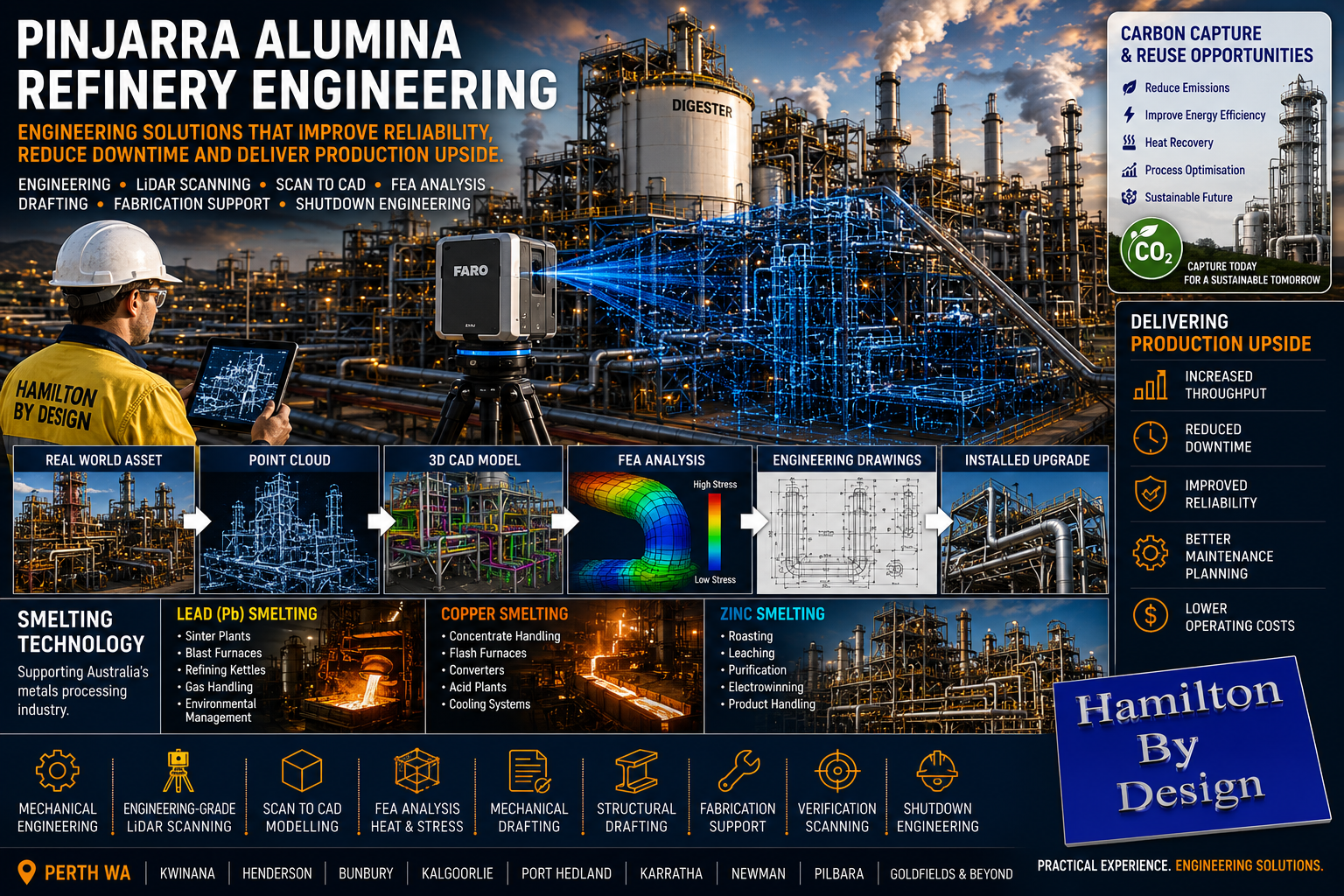
Engineering Support for Pinjarra Alumina Refinery & Smelting Operations

Engineering support for Pinjarra Alumina Refinery featuring LiDAR scanning, Scan to CAD, finite element analysis, drafting, fabrication support and shutdown engineering for refining and smelting operations.

Engineering Support for Alumina Refining, Smelting & Industrial Processing at Pinjarra Alumina Refinery

Western Australia is home to some of Australia’s largest mineral processing and refining facilities, with the Pinjarra Alumina Refinery playing a significant role in the global aluminium supply chain. Facilities such as Pinjarra operate in challenging environments where reliability, maintenance planning, shutdown execution and ongoing asset improvement are critical to maintaining production targets.

While alumina refining differs from traditional metal smelting, many of the engineering challenges are similar to those experienced in copper smelting, lead (Pb) smelting and zinc smelting operations. These facilities rely on large-scale materials handling systems, process equipment, conveyors, tanks, pipework, structural steel, furnaces, dust collection systems and complex utility networks.

Understanding Smelting Operations

Lead (Pb) Smelting

Lead smelting facilities process lead concentrates into refined lead products through a series of thermal and metallurgical processes. These operations involve sinter plants, blast furnaces, refining kettles, gas handling systems and extensive materials handling infrastructure. Equipment reliability and environmental management are critical due to the elevated temperatures and strict emissions requirements associated with lead processing.

Copper Smelting

Copper smelters convert copper concentrates into blister copper through high-temperature smelting and converting processes. Typical facilities contain concentrate handling systems, flash furnaces, converters, acid plants, cooling systems and extensive structural and mechanical infrastructure. Shutdown planning, asset inspections and engineering upgrades are essential to maintaining plant availability and production performance.

Zinc Smelting

Zinc smelting operations involve roasting, leaching, purification and electro-winning processes to produce refined zinc products. These facilities contain large process plants, pipework systems, tanks, conveyors, structural steel and utility infrastructure. The aggressive operating environments create ongoing challenges relating to corrosion, wear, thermal expansion and equipment maintenance.

Australia’s Energy Challenge and Carbon Reduction Opportunities

Australia’s industrial processing sector faces significant energy challenges as the nation seeks to balance energy security, affordability and emissions reduction. Smelters, refineries and sinter plants are among the largest industrial energy consumers due to their continuous high-temperature processes. As electricity prices and carbon management requirements continue to evolve, operators are increasingly exploring opportunities to improve energy efficiency while reducing greenhouse gas emissions.

Carbon capture, utilisation and storage (CCUS) technologies present opportunities for future emissions reduction within smelting and refining operations. Captured carbon dioxide can potentially be reused in industrial processes, mineral carbonation, chemical production and advanced materials manufacturing. Combined with process optimisation, waste heat recovery systems and modern digital engineering tools, these technologies may assist Australian smelters and refineries in improving sustainability while maintaining production competitiveness.

Engineering-Led Project Delivery

At Hamilton By Design, we provide engineering-led solutions that support industrial facilities throughout Australia, from concept development through to fabrication and installation.

Our workflow is focused on reducing project risk, improving constructability and maximising production uptime.

Mechanical Engineering

Every successful project starts with understanding the operating environment, process requirements and maintenance constraints. Our mechanical engineering services focus on developing practical, maintainable and production-focused solutions for industrial facilities.

Engineering-Grade 3D LiDAR Scanning

We perform engineering-grade terrestrial LiDAR scanning to capture accurate site conditions. Unlike basic surveying applications, engineering-grade scanning focuses on providing data suitable for detailed engineering, fabrication, maintenance planning and shutdown execution.

Applications include:

  • Smelters
  • Refineries
  • Sinter plants
  • Materials handling systems
  • Structural steel
  • Pipework systems
  • Conveyors
  • Tanks and vessels

3D Modelling and Digital Engineering

Point cloud data is transformed into intelligent 3D models that support:

  • Design development
  • Clash detection
  • Constructability reviews
  • Brownfield modifications
  • Shutdown planning
  • Stakeholder engagement

Finite Element Analysis (FEA)

Concepts can be assessed using Finite Element Analysis to evaluate:

  • Structural performance
  • Stress distribution
  • Thermal expansion
  • Heat transfer
  • Fatigue performance
  • Operational loading conditions

Heat and stress analysis provides valuable insight before fabrication commences, reducing project risk and improving confidence in engineering decisions.

Mechanical & Structural Drafting

Hamilton By Design produces detailed engineering documentation including:

  • General arrangement drawings
  • Mechanical fabrication drawings
  • Structural steel detailing
  • Pipework layouts
  • Installation documentation
  • Maintenance access reviews
  • Shutdown work packs

Fabrication Support

Our team combines engineering capability with practical trade, fabrication and machining experience. This ensures designs are practical to manufacture, install and maintain in operating industrial environments.

Verification Scanning Before Installation

Prior to fabrication or shutdown installation, verification scanning can be undertaken to confirm dimensions, interfaces and clearances.

This process assists in:

  • Reducing site rework
  • Minimising fitment issues
  • Confirming fabrication accuracy
  • Improving shutdown efficiency
  • Reducing project risk

Shutdown & Production Support

Accurate engineering information reduces uncertainty during shutdowns and maintenance activities.

By combining engineering-grade scanning, modelling, analysis and verification processes, projects can be delivered with greater confidence, improved safety and reduced downtime.

Delivering Production Upside

The ultimate objective of every engineering project is to improve reliability, maintainability and production performance.

Through engineering-led mechanical engineering, 3D LiDAR scanning, Scan-to-CAD modelling, finite element analysis, drafting, fabrication support and verification scanning, Hamilton By Design assists clients in delivering projects that minimise risk, reduce downtime and maximise production upside.

Whether supporting alumina refineries, copper smelters, lead smelters, zinc processing facilities, sinter plants or bulk materials handling operations, our focus remains the same:

Practical engineering solutions that improve reliability, reduce shutdown risk and support increased production performance.


Why Hamilton By Design?

Hamilton By Design combines:

  • Mechanical Engineering
  • Engineering-Grade 3D LiDAR Scanning
  • Scan to CAD Modelling
  • Finite Element Analysis
  • Heat & Stress Analysis
  • Mechanical Drafting
  • Structural Drafting
  • Fabrication Support
  • Verification Scanning
  • Shutdown Engineering

to deliver complete engineering solutions from concept through to installation.

By capturing accurate site conditions, validating concepts before fabrication and verifying fitment before shutdown execution, we help industrial facilities reduce risk, improve project outcomes and maintain production continuity.

3D CAD Modelling Australia service banner for Hamilton By Design
https://www.hamiltonbydesign.com.au/perth-wa
Mechanical Engineering Perth WA banner for Hamilton By Design featuring white text on a blue background.
3D Laser Scanning Perth WA banner for Hamilton By Design with white text on a blue background.
SolidWorks Perth WA banner for Hamilton By Design featuring white text on a blue background.

3D CAD Modelling Australia service banner for Hamilton By Design


CHPP Engineering title graphic featuring bold white text reading "CHPP Engineering" centred on a blue rounded rectangle background.
Pipework Drafting title graphic featuring bold white text reading "Pipework Drafting" centred on a blue rounded rectangle background.
3D LiDAR Scanning for Engineering Projects title graphic featuring bold white text on a blue rounded rectangle background.


Finite Element Analysis (FEA) engineering simulation button
Structural drafting services button
Mechanical drafting services button


Australian Drafting logo featuring bold white text reading "Australian Drafting" centred on a blue rounded rectangle background.
Engineering Governance title graphic featuring bold white text reading "Engineering Governance" centred on a blue rounded rectangle background.
Engineering-Grade LiDAR Scanning title graphic featuring bold white text on a blue rounded rectangle background.


Mechanical drafting services button
Structural drafting services button


Fabrication and product design services
3D CAD Modelling Australia service banner for Hamilton By Design
Mechanical, Structural & Pipework Drafting service banner by Hamilton By Design featuring white text on a blue background.


3D LiDAR scanning and 3D modelling service button โ€” laser scanner capturing a point cloud for engineering and CAD modelling
Mechanical engineering services
Mechanical Engineering Perth WA banner for Hamilton By Design featuring white text on a blue background.
3D Laser Scanning Perth WA banner for Hamilton By Design with white text on a blue background.
SolidWorks Perth WA banner for Hamilton By Design featuring white text on a blue background.
3D LiDAR scanning and 3D modelling service button โ€” laser scanner capturing a point cloud for engineering and CAD modelling
Mechanical engineering services
https://www.hamiltonbydesign.com.au/perth-wa

3D CAD Modelling Australia service banner for Hamilton By Design


CHPP Engineering title graphic featuring bold white text reading "CHPP Engineering" centred on a blue rounded rectangle background.
Pipework Drafting title graphic featuring bold white text reading "Pipework Drafting" centred on a blue rounded rectangle background.
3D LiDAR Scanning for Engineering Projects title graphic featuring bold white text on a blue rounded rectangle background.


Finite Element Analysis (FEA) engineering simulation button
Structural drafting services button
Mechanical drafting services button


Australian Drafting logo featuring bold white text reading "Australian Drafting" centred on a blue rounded rectangle background.
Engineering Governance title graphic featuring bold white text reading "Engineering Governance" centred on a blue rounded rectangle background.
Engineering-Grade LiDAR Scanning title graphic featuring bold white text on a blue rounded rectangle background.


Mechanical drafting services button
Structural drafting services button


Fabrication and product design services
3D CAD Modelling Australia service banner for Hamilton By Design
Mechanical, Structural & Pipework Drafting service banner by Hamilton By Design featuring white text on a blue background.


3D LiDAR scanning and 3D modelling service button โ€” laser scanner capturing a point cloud for engineering and CAD modelling
Mechanical engineering services

Yeppoon Mining Engineering & 3D Laser Scanning Services | Hamilton By Design

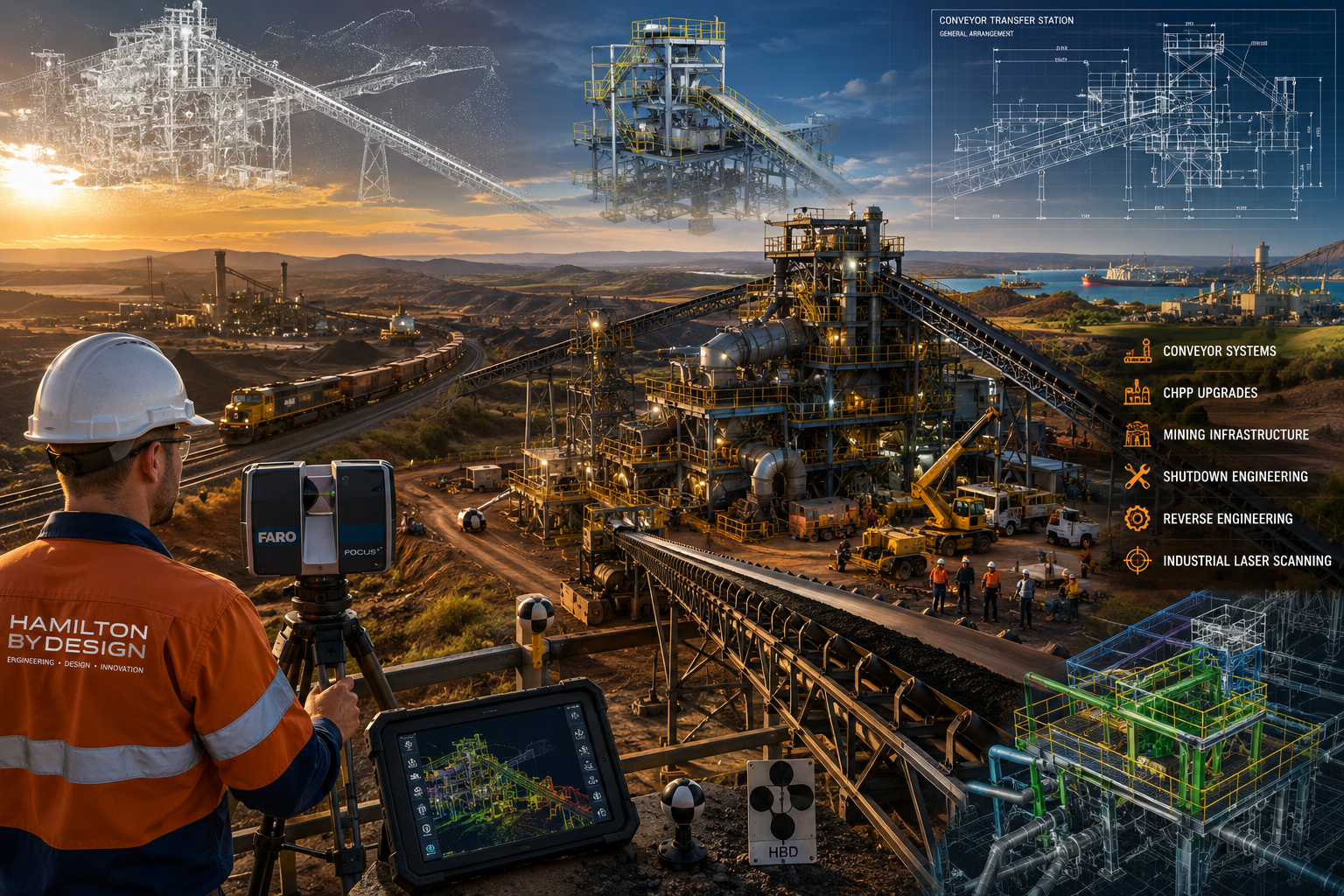
Engineering-grade 3D laser scanning and mining infrastructure project in Central Queensland, showing a conveyor transfer station, CHPP facility, coal train, industrial laser scanner, point cloud modelling and reverse engineering workflows supporting shutdown engineering and mining operations.

Yeppoon + Mechanical Engineering +Industrial Laser Scanning + Mining Infrastructure Services = Hamilton By Design

Supporting Central Queensland Mining, CHPP & Materials Handling Projects

Yeppoon sits at the gateway to Central Queensland’s mining and industrial sectors. While the Capricorn Coast is well known for tourism and marine industries, the region also supports major coal mining operations, coal handling and preparation plants (CHPP), bulk materials handling facilities, industrial infrastructure and shutdown maintenance projects throughout the Bowen Basin and Central Queensland.

At Hamilton By Design, we provide engineering-grade 3D laser scanning, mechanical engineering, reverse engineering and drafting services supporting mining, processing and materials handling facilities throughout Yeppoon, Rockhampton and the wider Central Queensland region.

Our team understands industrial facilities because we come from industry. Our experience includes mining operations, CHPP facilities, smelting plants, conveyor systems, materials handling infrastructure and brownfield plant modifications.


Why Yeppoon?

Yeppoon provides strategic access to some of Australia’s most significant mining and industrial operations.

The region supports:
  • Bowen Basin coal mines
  • Coal handling and preparation plants (CHPP)
  • Bulk materials handling systems
  • Port infrastructure
  • Industrial processing facilities
  • Heavy engineering workshops
  • Mining maintenance contractors
  • Marine and coastal infrastructure
  • Transport and logistics operations

For engineering companies supporting mining infrastructure, Yeppoon offers direct access to clients operating throughout Central Queensland.


Engineering-Grade 3D Laser Scanning

Not all scans are equal.

At Hamilton By Design, we specialise in engineering-grade terrestrial LiDAR scanning designed to support practical engineering outcomes.

Our scanning services assist with:

  • Conveyor upgrades
  • CHPP modifications
  • Shutdown planning
  • Structural steel verification
  • Pipework design
  • Access platform design
  • Brownfield plant upgrades
  • Equipment replacement projects
  • Existing condition surveys
  • Industrial asset capture

We deliver registered point cloud data suitable for:

  • SolidWorks
  • Autodesk Revit
  • AutoCAD
  • Navisworks
  • Inventor
  • Recap
  • Digital engineering workflows

Whether capturing an entire processing plant or a critical conveyor transfer station, our team provides accurate engineering-grade information for design, fabrication and construction.


Conveyor Systems & Materials Handling

Conveyors are the backbone of many mining and processing operations throughout Central Queensland.

Hamilton By Design supports projects involving:

  • Conveyor upgrades
  • Transfer station modifications
  • Conveyor gantries
  • Belt feeder systems
  • Chute design
  • Structural modifications
  • Maintenance access improvements
  • Conveyor replacement projects

Accurate site information is critical when working within operating facilities where shutdown durations are limited and installation tolerances are tight.

Our laser scanning and engineering services help reduce risk by ensuring designs are based on real-world site conditions.


CHPP Upgrades & Brownfield Modifications

Coal Handling and Preparation Plants continue to evolve as production requirements change and equipment reaches the end of its service life.

Hamilton By Design supports CHPP projects including:

  • Structural modifications
  • Conveyor upgrades
  • Pipework design
  • Access system improvements
  • Transfer chute modifications
  • Equipment replacements
  • Existing condition verification
  • Shutdown planning support

Using engineering-grade scan data, we help project teams understand existing site conditions before fabrication and installation begin.


Shutdown Engineering Support

Shutdowns are often where accurate engineering information provides the greatest value.

Every hour of downtime carries significant cost.

Our services assist shutdown teams with:

  • Existing condition capture
  • Site verification
  • Fabrication support
  • Installation planning
  • Clash detection
  • As-built verification
  • Asset documentation

Laser scanning prior to shutdown activities can significantly reduce rework, site fitment issues and project delays.


Reverse Engineering Services

Many mining and processing facilities continue to operate equipment where original drawings are incomplete, unavailable or no longer represent the asset currently installed.

Hamilton By Design provides reverse engineering services for:

  • Conveyor components
  • Chutes and transfer systems
  • Pump components
  • Castings
  • Wear liners
  • Structural assemblies
  • Fabricated equipment
  • Legacy plant infrastructure

Our team combines practical manufacturing knowledge with modern scanning technologies to develop detailed models and fabrication drawings suitable for refurbishment or replacement.


Mining Infrastructure Engineering

Mining infrastructure requires practical engineering solutions capable of operating in demanding environments.

We support projects involving:

  • Materials handling systems
  • Conveyor structures
  • Access platforms
  • Maintenance walkways
  • Structural steelwork
  • Pipework systems
  • Plant modifications
  • Asset upgrades

Our engineering approach focuses on constructability, maintainability and long-term asset performance.


Why Hamilton By Design?

Hamilton By Design combines practical trade experience with engineering capability.

Our background includes:
  • Mechanical engineering
  • Fitting and machining
  • Industrial drafting
  • Mining operations
  • Smelting facilities
  • Materials handling systems
  • Site-based engineering
  • Industrial maintenance

We understand that successful projects require more than accurate models. They require engineering solutions that can be fabricated, installed and maintained within real operating environments.


3D LiDAR scanning and 3D modelling service button โ€” laser scanner capturing a point cloud for engineering and CAD modelling
Mechanical engineering services

Servicing Yeppoon & Central Queensland

Hamilton By Design supports projects throughout:
  • Yeppoon
  • Rockhampton
  • Gladstone
  • Emerald
  • Blackwater
  • Moranbah
  • Dysart
  • Mackay
  • Bowen Basin
  • Central Queensland

Whether you require engineering-grade laser scanning, reverse engineering, conveyor design support or detailed drafting services, our team is available to assist.


Engineering Support for Central Queensland Industry

Hamilton By Design provides engineering-grade 3D laser scanning, mechanical engineering, drafting and reverse engineering services supporting mining infrastructure, CHPP facilities, conveyor systems and industrial processing plants throughout Yeppoon and Central Queensland.

Contact Us – Talk to Us

Contact our team to discuss your next project and discover how accurate site data and practical engineering experience can improve project outcomes, reduce shutdown risk and support long-term asset performance.

Name
Would you like us to arrange a phone consultation for you?
Address
CHPP Engineering title graphic featuring bold white text reading "CHPP Engineering" centred on a blue rounded rectangle background.
Pipework Drafting title graphic featuring bold white text reading "Pipework Drafting" centred on a blue rounded rectangle background.
3D LiDAR Scanning for Engineering Projects title graphic featuring bold white text on a blue rounded rectangle background.