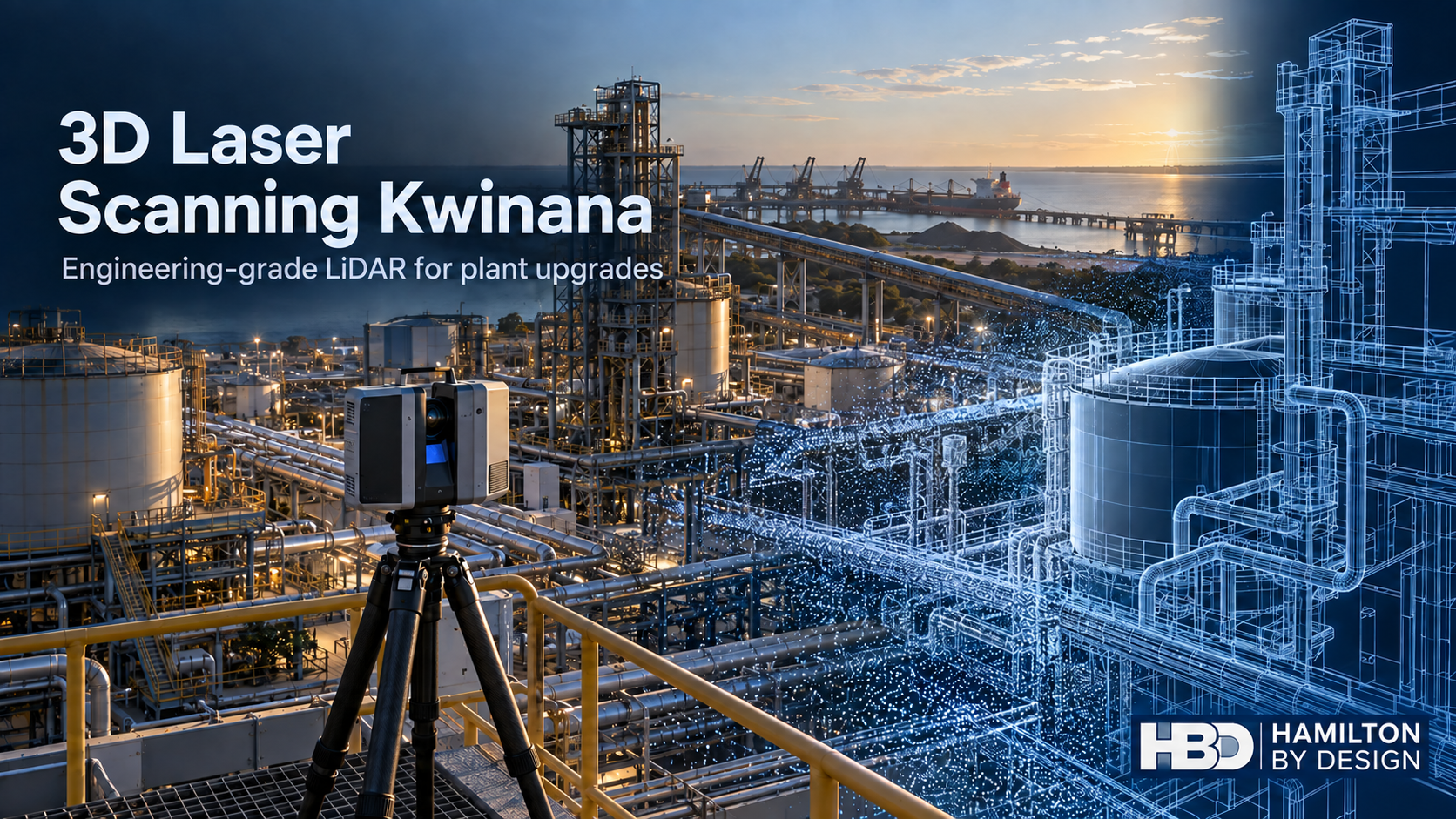

Know what is actually on site before you design, fabricate or shut down. Hamilton By Design provides engineering-grade 3D laser scanning in Kwinana and Kwinana Beach for process plants, bulk materials facilities, workshops and industrial infrastructure. We turn measured site conditions into point clouds, usable CAD models and drawings that help project teams plan modifications around existing equipment.
A Kwinana plant upgrade rarely starts with an empty space. New pipework must pass existing services. A replacement pump skid must align with foundations and connection points. A conveyor modification needs room for guarding, inspection and maintenance. When drawings have not kept pace with years of alterations, a reliable site survey is a practical first step.
Our engineering laser scanning workflow connects reality capture with mechanical design and fabrication information. The scope is agreed around the decisions you need to make, from a localised equipment interface to a wider plant area.
Why Kwinana needs an engineering-led scan
Kwinana’s heavy industrial core brings chemical and resource processing, bulk port activities, energy infrastructure and support businesses together. The Western Trade Coast also has extensive exchanges of materials, by-products and utilities between businesses. That concentration creates useful industrial connections, but it makes interfaces and access especially important when existing plant is changed. Kwinana Industries Council describes the precinct and its industrial synergies.
In Kwinana Beach, a survey may need to capture more than the item being replaced: adjacent lines, supports, cable routes, walkways, laydown space, lifting paths and the clearances needed to maintain the equipment later. Our measured model gives designers and fabricators a common reference. Critical dimensions and tolerances are separately checked for their intended use; a point cloud alone does not certify every interface dimension.
The precinct is also evolving. Industrial recycled-water capacity is being expanded, while Kwinana Bulk Terminal redevelopment is in planning. These developments illustrate the mix of existing assets and proposed new work that requires careful coordination. Their schedules and approvals belong to the respective project owners.
What we can scan
- Operating process areas, pump rooms, plant rooms and production equipment.
- Pipework corridors, tanks, vessels, skids and connection points.
- Conveyors, transfer stations, chutes, hoppers and bulk-handling interfaces.
- Platforms, stairs, walkways, guards and maintenance access.
- Workshop equipment, fabrication interfaces and obsolete components.
- Areas affected by shutdown work, equipment replacement or site redevelopment.
Terrestrial LiDAR is suited to capturing a wider plant area and the relationships between its components. Close-range scanning and direct measurement can then be used for smaller parts or critical features when the specified tolerance demands it. We choose the capture method after discussing access, geometry, surface conditions and the required deliverable.
From point cloud to a useful engineering deliverable
- Define the question. Identify the equipment, interfaces, required accuracy, site controls and decisions the survey must support.
- Capture the existing conditions. Scan accessible areas under the site’s induction, permit and isolation arrangements.
- Register and review. Align the scans, review coverage and flag obscured or uncertain areas.
- Model the relevant geometry. Build the amount of CAD detail needed for equipment fit, routing, access or fabrication.
- Check critical interfaces. Confirm important dimensions by suitable measurement before relying on them for manufacture.
- Issue controlled information. Provide the agreed point cloud, model, general arrangements and drawings with clear revision status.
Depending on the brief, deliverables may include E57 or other point-cloud formats, ReCap-compatible files, SolidWorks models, STEP geometry, DWG/DXF drawings, general arrangements, sections and fabrication details. A point cloud is a measured record; the CAD model is an interpretation prepared to the agreed purpose and level of detail.
Five common problems we help Kwinana teams work through
1. Existing drawings do not reflect the plant
Shutdown changes, rerouted pipework and replacement equipment can leave the drawing register behind. LiDAR capture establishes a current geometric baseline. We can compare the scan with a proposed layout and prepare as-built CAD and scan-to-CAD models for the affected area.
2. New equipment may not fit
A skid may clear the floor plan but conflict with a valve, cable tray or lifting path. We can model the proposed envelope against the point cloud, identify potential clashes and develop interface drawings before workshop manufacture. The final site checks are set by the project’s tolerance and installation method.
3. Pipework is congested
A replacement route must accommodate existing lines, supports, access and maintenance. We can provide measured routing information, 3D layouts and mechanical and pipework drafting. Pressure-piping design, inspection and testing requirements must be established for the actual service and project scope.
4. Bulk-handling equipment needs modification
Transfer chutes, conveyors and hoppers can suffer from poor fit, material build-up, wear or restricted access. We can scan the installed geometry, model proposed changes and produce drawings for fabrication review. See our chute and materials-handling engineering capability.
5. Maintenance access and machinery hazards are difficult to resolve
A guard or platform must fit the actual machine while allowing safe operating and maintenance tasks. We can map the existing equipment, support a task-based hazard review and develop guarding and access concepts with the site team. Our machine guarding service explains the engineering approach.
Mechanical engineering and drafting support
Hamilton By Design can continue beyond the survey. Our mechanical engineering work may include equipment layouts, pump skids, replacement component modelling, reverse engineering, conveyor and chute modifications, access concepts and mechanical assessment. SolidWorks and AutoCAD drawings can communicate the arrangement to the workshop and installation crew. Where calculations, FEA, process design or specialist certification are needed, the scope and responsible disciplines should be established at the start.
Fabrication-ready information may include a general arrangement, sections, part and assembly drawings, interfaces, tolerances, materials, weld notes and a drawing register. Drawing content depends on the manufacturing method and the client’s specification. Our existing Kwinana service overview covers the wider mechanical and reverse-engineering offering.
Safety and standards are part of the brief
The applicable requirements depend on the equipment, location, hazards and the work being performed. Examples for a Kwinana mechanical project include the AS/NZS 4024 machinery-safety series for safeguarding, AS 1657 for fixed access, AS 4041 for pressure piping and AS 4991 for relevant lifting devices. A bulk-solids container may require AS 3774; conveyor requirements need a separate equipment-specific review. These references are starting points for scope definition, not a blanket claim that every standard applies to every asset.
For plant and chemical facilities, the site operator’s risk assessment, permits, isolation procedures and management of change remain essential. WorkSafe WA’s plant risk code provides guidance. We can help document geometry, mechanical hazards, access constraints and proposed design controls for review with the responsible site personnel and other specialists.
Who this service is for
We work with maintenance managers who need reliable information before a shutdown; project engineers developing brownfield upgrades; fabricators checking fit before cutting steel; and asset owners building a usable record of existing plant. The service can support chemical processing, minerals processing, water infrastructure, bulk materials, energy facilities and industrial workshops across Kwinana, Kwinana Beach and the wider Perth region.
Our Perth 3D scanning and mechanical engineering page covers work across the wider metropolitan area. This page focuses on the engineering decisions faced by Kwinana industrial teams.
Frequently asked questions
Can you scan an operating plant?
Often, yes, subject to the site’s access, safety, permit and isolation requirements. We agree the scan area and any operational restrictions before mobilisation. Some hidden or inaccessible geometry may need a later shutdown survey.
Is a point cloud accurate enough for fabrication?
That depends on the feature, distance, access, registration, surface and required tolerance. We specify the intended use and verify critical dimensions by an appropriate method. A general plant scan should not be treated as a universal tolerance certificate.
Do we receive CAD drawings or only scan data?
Either can be supplied. The scope may cover scanning only, an as-built model, layout drawings or a complete mechanical design and fabrication drawing package. Tell us who will use the information and what decision it must support.
Can you work from old drawings and an existing model?
Yes. Existing information can be compared against measured conditions. We identify discrepancies and model the relevant interfaces so the project team can decide which information is suitable for the modification.
What should we send for a proposal?
Share the site location, photographs or marked-up plans, the equipment or area involved, desired deliverables, required tolerances, access windows and target dates. A short phone discussion can then define the survey and engineering scope.
Discuss your Kwinana project
Planning a plant modification, equipment replacement or shutdown in Kwinana? Contact Hamilton By Design with the problem you need to solve. We can define the capture area, critical interfaces and deliverables before arranging site work.

Contact Us – Talk To Us
Our clients: