AS 3774 Loads in Hopper Design

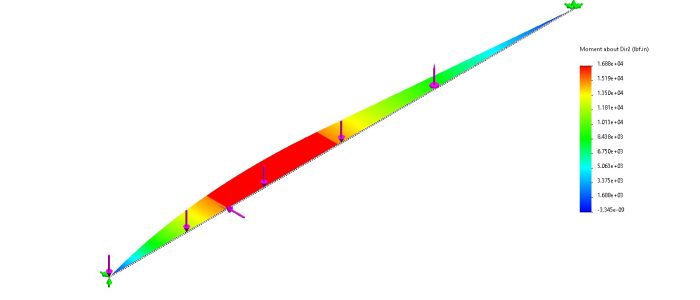
Cutaway view of an industrial mining hopper showing bulk material flow with AS 3774 load paths and FEA stress distribution on hopper walls.

AS 3774 Hopper Design Loads โ€“ Bulk Solids Handling Engineering

In bulk materials handling, the ultimate operational goal is steady-state production โ€” consistent throughput, predictable equipment loading, and minimal process disruption.

Hoppers play a critical role in achieving this outcome. However, the benefits they provide come with structural and load complexities that must be correctly understood and engineered. This is where AS 3774 โ€“ Loads on Bulk Solids Containers becomes essential.
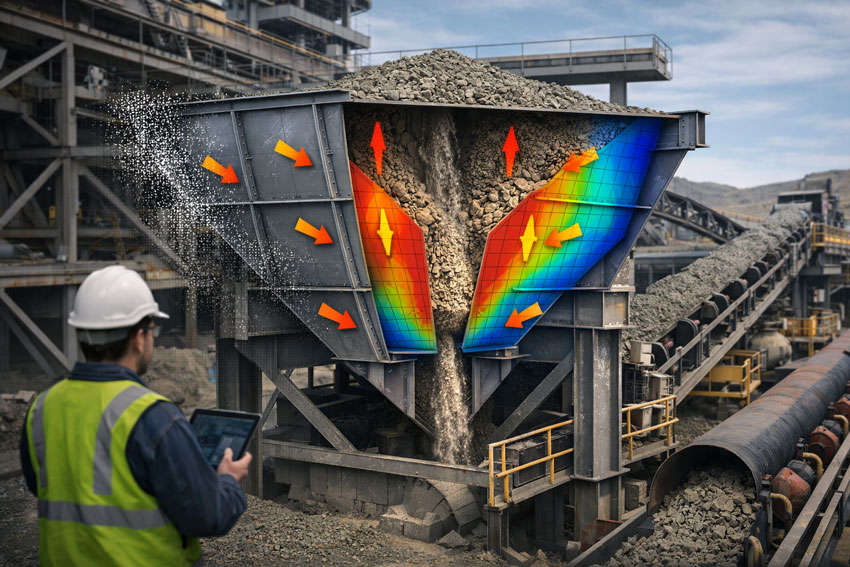

Mining hopper in a transfer station shown in cutaway, illustrating steady-state material flow, structural load distribution, and engineered hopper design.

Why Do You Want a Hopper in Your Process?

In simple terms, having a hopper in your system allows you to maintain constant production.

Most industrial plants aim to operate in a steady-state condition, where material flow remains as uniform as possible. In reality, upstream and downstream equipment rarely operate at the same rate, and bulk materials themselves are inherently variable.

A hopper acts as a buffer.

By decoupling one part of the process from another, a hopper allows fluctuations in feed rate, equipment performance, or material behaviour to be absorbed without immediately impacting the rest of the plant.

As a general principle:

The more hoppers you have in the right locations, the more steady-state your operation becomes.


Buffering Variability and Increasing Capacity

Hoppers contribute to steady-state operation in two key ways:

1. Stabilising Flow

Hoppers smooth out:

  • Surging feed rates
  • Short interruptions upstream
  • Variations in material size and moisture

This allows downstream equipmentโ€”such as feeders, conveyors, screens, and millsโ€”to operate closer to their design point.

2. Providing Extra Capacity

Hoppers also introduce process capacitance.

This additional capacity:

  • Buys time during plant upsets
  • Reduces nuisance trips and shutdowns
  • Improves overall plant availability

From a production perspective, hoppers are one of the most effective tools available for improving consistency and utilisation.


The Engineering Reality: Hoppers Are Load-Critical Structures

While hoppers improve process stability, they also introduce complex structural load cases.

Bulk solids do not behave like liquids or static dead loads. As material is filled, stored, and discharged, the loads acting on hopper walls and supporting steelwork change significantly.

AS 3774 exists to address this exact problem.

The standard defines load cases associated with:

  • Filling conditions
  • Static storage
  • Flow and discharge
  • Eccentric and asymmetric draw-down

These load cases are often higher and more uneven than designers expect, particularly during discharge.


What Happens When AS 3774 Is Not Properly Applied?

When hopper loads are underestimated or simplified, common outcomes include:

  • Buckled or permanently deformed hopper walls
  • Cracking at welds and transitions
  • Fatigue issues in supporting structures
  • Excessive vibration during operation
  • Premature failure during throughput increases

Ironically, the very hoppers intended to stabilise production can become the source of downtime if not correctly designed or assessed.


Geometry Matters: Why As-Built Conditions Are Critical

AS 3774 calculations are highly sensitive to geometry.

In brownfield plants, hopper drawings are often:

  • Out of date
  • Incomplete
  • No longer representative of site conditions

Modifications, liner additions, repairs, and wear can all change how loads are transferred into the structure.

This is why engineering-grade as-built data is critical when assessing existing hoppers.


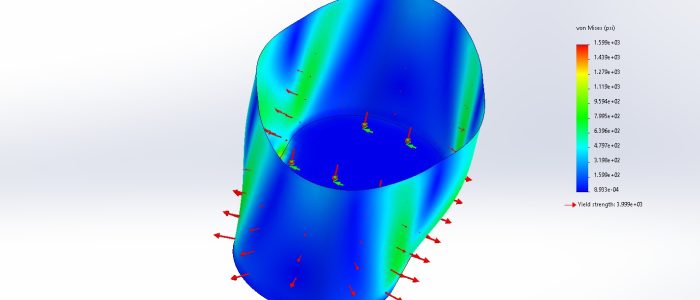
  • SolidWorks Simulation von Mises stress plot of an internally pressurised pressure vessel, viewed from above, showing colour-mapped stress distribution from low (blue) to high (red) with pressure arrows applied to the internal surfaces and deformation exaggerated for visualisation

Engineering-Led AS 3774 Assessment

At Hamilton By Design, hopper assessments are approached as a combined process and structural problem, not just a compliance exercise.

Our workflow typically integrates:

  • High-accuracy 3D LiDAR scanning to capture true geometry
  • SolidWorks 3D modelling of hoppers and support steelwork
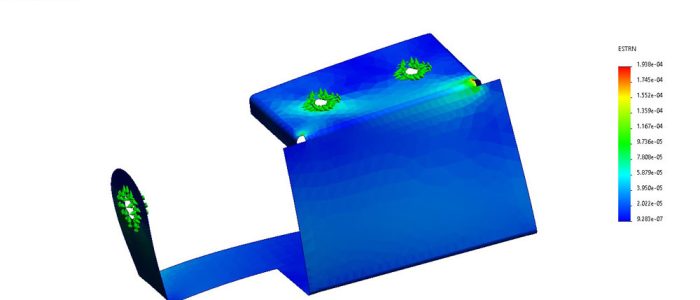
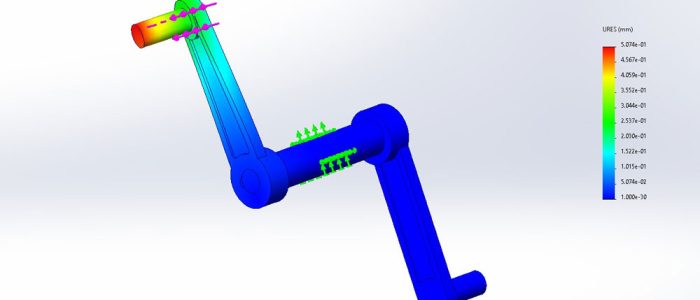
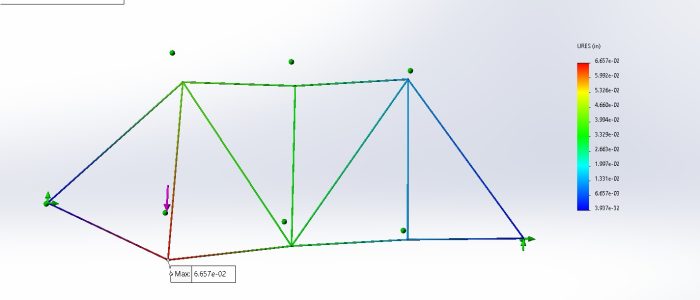
  • Structural FEA with AS 3774 load cases applied
  • Targeted strengthening or upgrade design where required

This allows clients to:

  • Increase throughput with confidence
  • Extend asset life
  • Avoid unnecessary replacement
  • Maintain steady-state operation safely

Hamilton By Design logo displayed on a blue tilted rectangle with a grey gradient background
3D LiDAR scanning and 3D modelling service button โ€” laser scanner capturing a point cloud for engineering and CAD modelling
Mechanical engineering services

Bringing It All Together

Hoppers are fundamental to stable, high-availability bulk materials processing.

They:

  • Enable steady-state production
  • Buffer variability
  • Provide valuable process capacity

But they also:

  • Introduce complex, non-intuitive loads
  • Demand careful application of AS 3774
  • Require accurate geometry and engineering verification

When hopper design and assessment are done correctly, they support production.
When they are not, they quietly become one of the highest structural risks in the plant.


Name
Would you like us to arrange a phone consultation for you?
Address

Our clients:


3D CAD Modelling Australia service banner for Hamilton By Design


CHPP Engineering title graphic featuring bold white text reading "CHPP Engineering" centred on a blue rounded rectangle background.
Pipework Drafting title graphic featuring bold white text reading "Pipework Drafting" centred on a blue rounded rectangle background.
3D LiDAR Scanning for Engineering Projects title graphic featuring bold white text on a blue rounded rectangle background.


Finite Element Analysis (FEA) engineering simulation button
Structural drafting services button
Mechanical drafting services button


Australian Drafting logo featuring bold white text reading "Australian Drafting" centred on a blue rounded rectangle background.
Engineering Governance title graphic featuring bold white text reading "Engineering Governance" centred on a blue rounded rectangle background.
Engineering-Grade LiDAR Scanning title graphic featuring bold white text on a blue rounded rectangle background.


Mechanical drafting services button
Structural drafting services button


Fabrication and product design services
3D CAD Modelling Australia service banner for Hamilton By Design
Mechanical, Structural & Pipework Drafting service banner by Hamilton By Design featuring white text on a blue background.


3D LiDAR scanning and 3D modelling service button โ€” laser scanner capturing a point cloud for engineering and CAD modelling
Mechanical engineering services

Mechanical Engineering | Structural Engineering


3D Lidar Scanning Services in Darwin

3D Scanning Services Darwin | Industrial LiDAR for Mining, Ports & Gas

Blue 3D LiDAR scanner icon on a tripod with scanning waves

Hamilton By Design delivers engineering-grade 3D scanning services in Darwin and the broader Northern Territory for mining operations, heavy construction projects, port facilities, and oil & gas infrastructure. Our services are engineered to support complex, high-risk environments where accuracy, reliability, and downstream usability of captured data directly influence project outcomes.

Darwin and the Northern Territoryโ€™s economy are underpinned by strategic investment in resources, energy, construction, and export infrastructure, including mineral extraction, liquefied natural gas projects, major port facilities, and associated heavy industry developments. nteconomy.nt.gov.au+1 Our 3D scanning services are tailored to meet the demands of these sectors, providing certified capture workflows that support planning, design, modification, fabrication, and compliance deliverables.


Why Darwin Projects Need an Engineering-Grade 3D Scanning Approach

Darwin projects commonly involve live industrial environments, large-scale equipment, and brownfield upgrades where assumptions cost time and money. Our engineering-led 3D scanning services provide precise digital representations of complex assets, enabling safer and faster decision-making on heavy industry projects.

Mining and resources infrastructure
The Northern Territoryโ€™s mining and resources sector contributes significantly to regional economic output, with mineral extraction, petroleum and natural gas operations, and associated processing facilities forming core project drivers. nteconomy.nt.gov.au+1 High-accuracy capture of pits, processing plants, stockpiles, conveyors, and infrastructure improves planning, risk reduction, and asset management.

Heavy construction and site coordination
Darwin is a hub for major construction and industrial projects, where detailed spatial knowledge is essential for avoiding clashes, verifying clearances, and supporting installation sequencing. nteconomy.nt.gov.au

Port and export infrastructure
Facilities such as Darwin Port require detailed asset capture for maintenance planning, structural verification, and integration of new systems within operational environments.

Oil, gas and energy facilities
Onshore and near-shore gas processing facilities, pipelines, and connected energy infrastructure demand detailed capture for retrofit, upgrade, and compliance work. The regionโ€™s ongoing energy projects, including export-oriented gas facilities, benefit from high-resolution site data for engineering assessment. Wikipedia


Our 3D Scanning Services in Darwin

We provide a comprehensive suite of industrial 3D scanning services built around engineering workflows and practical project outcomes:

  • Engineering-Grade LiDAR Scanning for Heavy Industry
    Accurate capture of plant, equipment, civil structures, stockpiles, and infrastructure.
  • Brownfield Retrofit & Upgrade Scanning
    Reliable, measurable site data to support modification, expansion, and construction.
  • Construction Coordination & Clash Avoidance
    High-precision datasets for clash detection, sequencing, and design validation.
  • Scan-to-CAD Modelling
    Converting point clouds into usable 3D CAD models for mechanical, structural, and fabrication workflows.
  • Verified Geometry for Compliance & Design
    Deliverables suitable for engineering verification, documentation, and approvals.
  • Precision Scanning for Fabrication & Installation Planning
    Supporting fit-first-time outcomes and reducing onsite rework.

Each capture is conducted with an understanding of how the data will be used by engineers, designers, and project teams โ€” not as standalone visuals but as actionable digital deliverables.


Our clients:

Industrial Use Cases Common in Darwin

Our Darwin 3D scanning projects frequently support:

  • Mining processing plants and material handling infrastructure
  • LNG and gas processing facilities
  • Heavy civil works and structural upgrades
  • Port infrastructure modifications and maintenance planning
  • Mechanical plant retrofit and replacement interfaces
  • Construction set-out and spatial verification

This focus ensures that scan data supports real engineering workflows โ€” from design and clash detection through to fabrication and installation.


Supporting Engineering Services for Darwin Projects

3D scanning in heavy industry rarely stands alone. Most projects require integrated engineering and documentation workflows, including:

  • 3D CAD Modelling (Scan-to-CAD)
    Translating site capture into engineering models ready for analysis and design.
  • As-Built Drawings for Compliance and Procedural Use
    Detailed documentation suitable for regulatory, contractor, and stakeholder use.
  • Emergency Exit & Egress Drawing Development
    Based on reliable scan data to support safety planning and compliance documentation.
  • Finite Element Analysis (FEA)
    Engineering verification where structure or component behaviour must be assessed under load.
  • 3D Rendering & Virtual Models
    Communicating complex spatial data to stakeholders during planning, approvals, or reviews.
  • Precision Scanning for Fabrication, Renovation & Upgrades
    Reducing risk and onsite uncertainty for installation and manufacturing.

Our clients

Engineering-Led 3D Scanning You Can Rely On

Hamilton By Designโ€™s 3D scanning services in Darwin are rooted in engineering fundamentals, not just capture. We prioritise data accuracy, usability, and integration with existing workflows, ensuring that point cloud data becomes a reliable foundation for design, construction, compliance, and verification in demanding industrial environments.


Hamilton By Design logo displayed on a blue tilted rectangle with a grey gradient background
3D LiDAR scanning and 3D modelling service button โ€” laser scanner capturing a point cloud for engineering and CAD modelling
Mechanical engineering services

Get in Touch About a Darwin 3D Scanning Project

Whether you are planning a mining plant retrofit, infrastructure upgrade, or heavy construction project in Darwin or the Northern Territory, contact Hamilton By Design to discuss your requirements and ensure your project benefits from high-precision, engineering-grade 3D scanning.

Name
Would you like us to arrange a phone consultation for you?
Address

Laser Scanning Engineering โ€“ Hobart CBD

Ship loader and bulk cargo vessel with GPS monitoring units and sensor overlays illustrating controlled loading zones and engineering oversight under AS 4324.1

Laser Scanning Engineering โ€“ Hobart CBD | Engineering-Grade LiDAR

Hamilton By Design provides laser scanning engineering services in Hobart CBD, supporting engineering and design teams responsible for remote manufacturing, logging, mining, and processing operations across Tasmania.

Hobart functions as the engineering, design, and decision-making centre for many of Tasmaniaโ€™s industrial assets, which are often located in remote, rugged, or operationally constrained environments. Accurate site information is essential when access is limited, travel is costly, and safety exposure must be minimised.

Engineering-grade 3D LiDAR scanning enables teams to safely capture reliable existing-condition data, allowing design and engineering work to be completed with confidence from Hobart โ€” without repeated or prolonged site exposure.


Hobart as Tasmaniaโ€™s Engineering & Design Hub

Across Tasmania, critical assets are often located far from population centres and include:

  • Manufacturing facilities
  • Forestry and logging infrastructure
  • Mining and mineral processing sites
  • Ports, utilities, and bulk handling facilities

Engineering teams based in Hobart rely on high-quality digital site data to design, review, and plan upgrades remotely.

3D laser scanning provides a safe, non-intrusive, and repeatable method of collecting detailed spatial information from these sites, supporting better engineering decisions without relying on assumptions or outdated drawings.


Engineering-Led Laser Scanning for Remote Tasmanian Assets

Hamilton By Design delivers engineering-led laser scanning, meaning scan capture is planned around what engineers need to design, coordinate, and verify โ€” not just visual documentation.

Our Hobart CBD laser scanning engineering services support:

  • Remote site upgrades and expansions
  • Manufacturing and processing plant modifications
  • Brownfield tie-ins and staged works
  • Asset life-extension and reliability projects

This same engineering-led approach is used across Tasmania, including:


Safer Data Capture Using 3D LiDAR Scanning

For remote and operational sites, 3D LiDAR scanning is one of the safest ways to collect engineering data.

It allows teams to:

  • Reduce time spent in hazardous or isolated locations
  • Minimise working-at-heights and confined-space exposure
  • Capture complex facilities quickly and accurately
  • Avoid repeat site visits caused by missing information

This safety-first approach is particularly important for Tasmaniaโ€™s dispersed industrial landscape.


From Scan Data to CAD-Ready Engineering Models

Laser scanning delivers the greatest value when scan data is converted into usable CAD and engineering models.

Hamilton By Design supports Hobart-based teams by transforming point cloud data into structured 3D CAD environments, enabling designers to develop the most appropriate solution for the defined scope of works.

3D CAD and modelling capability:
๐Ÿ‘‰ 3D CAD Modelling Australia
https://www.hamiltonbydesign.com.au/home/3d-cad-modelling-australia/

These models enable engineers to:

  • Validate fit-up and interfaces remotely
  • Check clearances, access, and installation paths
  • Coordinate mechanical and structural elements
  • Reduce design uncertainty before fabrication or construction

Typical Hobart CBD Use Cases

Laser scanning engineering services are commonly used in Hobart CBD to support:

  • Remote manufacturing and processing facilities
  • Forestry, logging, and materials handling infrastructure
  • Mining and mineral processing assets
  • Plantroom and services coordination
  • As-built documentation and upgrade scoping

Accurate digital site data allows Hobart-based teams to confidently design for assets located across Tasmania and surrounding regions.


Why Laser Scanning Improves Remote Engineering Outcomes

When engineering decisions are made far from site, information quality becomes critical.

3D laser scanning allows Hobart-based engineers and designers to:

  • Design to verified site conditions
  • Remove assumptions early in the design phase
  • Test solutions digitally before committing to site works
  • Reduce rework and variation caused by incomplete data

This leads to safer projects, fewer site surprises, and improved delivery certainty.


Why Hamilton By Design for Hobart CBD

  • Engineering-led laser scanning workflows
  • Experience supporting remote Tasmanian assets
  • Strong integration of scanning, CAD, and engineering design
  • Focus on safety, accuracy, and decision-ready data
  • Deliverables suited to real engineering and construction use

We donโ€™t just capture data โ€” we help Hobart-based teams make better engineering decisions for remote operations.


Hamilton By Design logo displayed on a blue tilted rectangle with a grey gradient background
3D LiDAR scanning and 3D modelling service button โ€” laser scanner capturing a point cloud for engineering and CAD modelling
Mechanical engineering services

Discuss Laser Scanning Engineering in Hobart CBD

If your Hobart-based team requires accurate, engineering-grade site data to support remote manufacturing, logging, mining, or processing projects, Hamilton By Design can assist โ€” from scan planning through to CAD-ready deliverables.

๐Ÿ“ฉ Contact us to discuss Laser Scanning Engineering โ€“ Hobart CBD and your project requirements.

Name
Would you like us to arrange a phone consultation for you?
Address

Laser Scanning Engineering โ€“ Darwin CBD

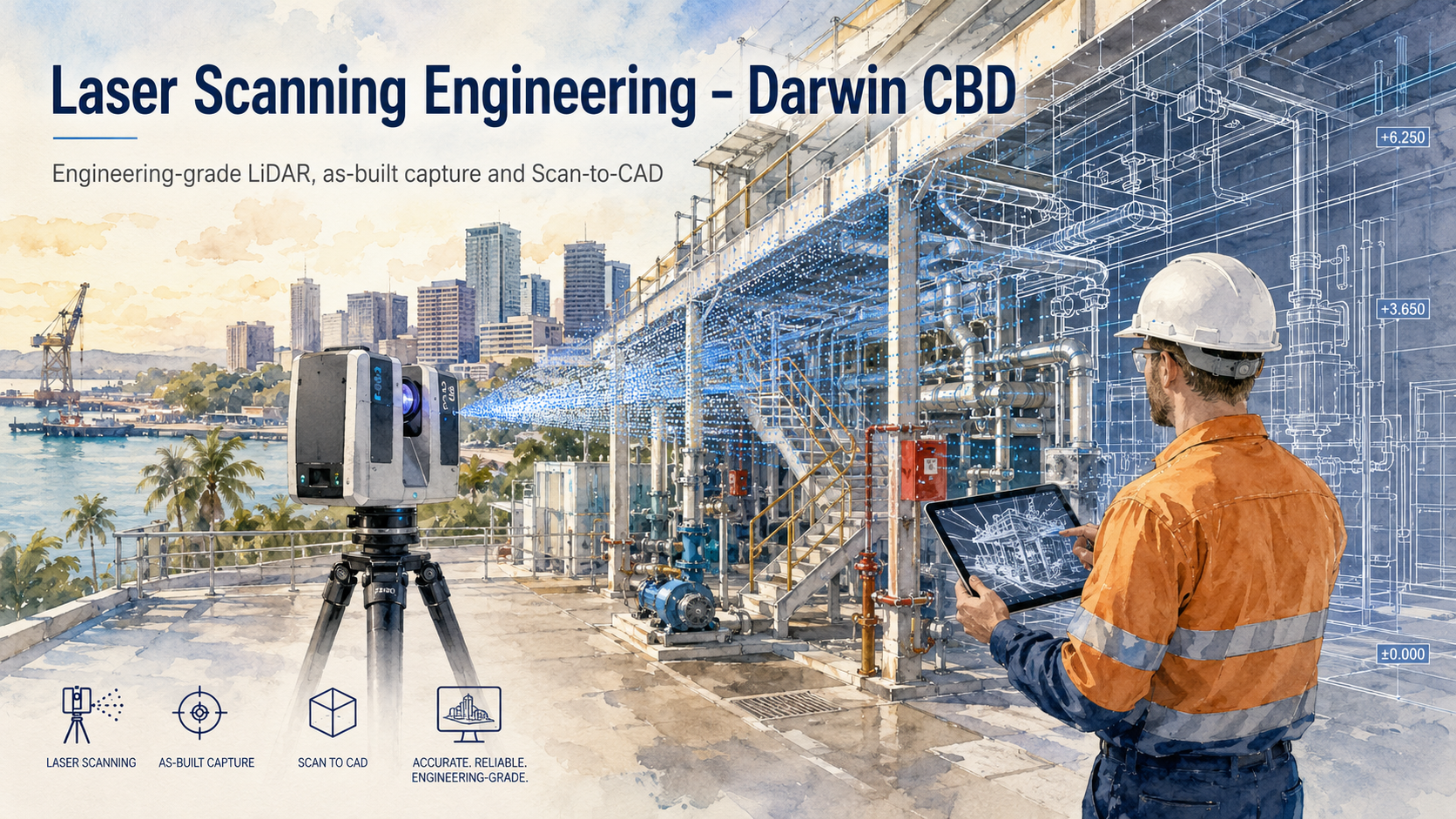
Watercolour hero image showing a 3D laser scanner capturing an industrial engineering site in Darwin CBD, with point-cloud data, CAD wireframe overlays, pipework, steelwork, harbour views and an engineer reviewing scan data on a tablet.

Hamilton By Design provides laser scanning engineering services in Darwin CBD for projects where designers and engineers need accurate existing-condition data before they commit to design, procurement, or construction.

Darwinโ€™s CBD and surrounding precincts combine tropical climate exposure, remote logistics, mixed-use infrastructure, and tight access windows. When scope is time-critical and site visits are expensive, engineering-grade LiDAR scanning and coordinated 3D modelling help teams make confident decisions early โ€” based on whatโ€™s actually there.

If youโ€™re looking for scanning that supports engineering outcomes (not just visuals), start here:


What We Deliver in Darwin CBD

Our Darwin CBD workflow is designed to produce usable engineering information, including:

  • 3D point clouds suitable for design coordination and verification
  • Existing-condition capture for refurbishments, upgrades, and staged works
  • Measured geometry for interfaces, clearances, penetrations, and plant tie-ins
  • Models and drawings that reflect real-world constraints

Our core scanning capability is outlined here:
https://www.hamiltonbydesign.com.au/3d-laser-scanning/


Why โ€œEngineering-Ledโ€ Scanning Matters

On CBD projects, small errors become big problems: tight plantrooms, congested service corridors, legacy construction, and compressed schedules leave little room for rework.

Engineering-led scanning means we capture what engineers actually need to know, such as:

  • critical interfaces and tie-in points
  • levels, plumb, alignment and deformation indicators
  • access constraints and installation pathways
  • โ€œunknownsโ€ that rarely appear on old drawings

This approach reduces RFIs, rework, fabrication errors, and site delays.


Hamilton By Design logo displayed on a blue tilted rectangle with a grey gradient background
3D LiDAR scanning and 3D modelling service button โ€” laser scanner capturing a point cloud for engineering and CAD modelling
Mechanical engineering services

From Scan to CAD: Turning Reality into a Design Environment

Laser scanning becomes truly valuable when it is converted into a coordinated 3D design environment.

Hamilton By Design supports Darwin CBD teams by converting scan data into structured CAD outputs that designers can use to develop the most appropriate solution for the scope of works.

Explore our 3D CAD capability here:


Mechanical Engineering Integration

Many Darwin CBD projects involve mechanical upgrades, asset life extension, or integration of new equipment into existing spaces. Accurate scan data enables mechanical designers to:

  • validate fit-up and installation clearances
  • design supports and interfaces correctly the first time
  • plan staged shutdown works with higher certainty
  • reduce the risk of โ€œsite surprisesโ€

Mechanical engineering capability:
https://www.hamiltonbydesign.com.au/mechanical-engineering/


Our clients


Typical Darwin CBD Use Cases

Our laser scanning engineering services are commonly used for:

  • Refurbishments and retrofits in occupied buildings
  • Plantroom and services coordination (tight spaces, complex interfaces)
  • Structural and mechanical integration (supports, platforms, equipment)
  • Upgrade scoping and feasibility (verify what exists before committing)
  • As-built documentation for handover and ongoing asset management

Why Laser Scanning Improves Design Quality

A 3D scan-based model gives designers and engineers a far stronger platform to develop the best design for the scope of works because it allows them to:

  • design to reality, not assumptions
  • test options digitally before issuing drawings
  • check installation constraints and access early
  • coordinate multiple disciplines with fewer clashes
  • reduce variations caused by missing or incorrect existing-condition data

For engineering project workflows specifically, see:


Talk to Us About Darwin CBD Laser Scanning

If your Darwin CBD project needs accurate, engineering-grade existing-condition capture to reduce risk and improve design outcomes, Hamilton By Design can help โ€” from scan planning through to CAD-ready deliverables.

Name
Would you like us to arrange a phone consultation for you?
Address

3D Scanning Melbourne CBD

Engineering-led LiDAR point cloud modelling of a Melbourne building with CAD data derived from 3D laser scanning

3D Scanning Melbourne CBD | Engineering-Grade Laser Scanning

Blue 3D LiDAR scanner icon on a tripod with scanning waves

Hamilton By Design provides engineering-grade 3D scanning services in Melbourne CBD, supporting designers, engineers, builders, and asset owners working in one of Australiaโ€™s most complex urban environments. Melbourne CBD projects are characterised by tight access, heritage overlays, staged construction, and dense services. Our 3D laser scanning workflows deliver accurate existing-condition data that allows engineering decisions to be made with confidence โ€” before work begins on site.


Why 3D Scanning Is Critical in Melbourne CBD

Melbourneโ€™s CBD presents challenges that cannot be reliably addressed using legacy drawings or assumed dimensions:

  • High-rise and podium structures with layered services
  • Heritage buildings integrated with modern construction
  • Restricted access and limited shutdown windows
  • Tight tolerance interfaces between new and existing works

3D laser scanning provides a measured digital record of what truly exists, allowing project teams to design within real constraints rather than assumptions.


Engineering-Led Laser Scanning

Hamilton By Design approaches scanning from an engineering perspective, not just data capture.

Our Melbourne CBD scanning services are designed to support:

  • Engineering design development
  • Certified drawings and documentation
  • Constructability and coordination reviews
  • Retrofit and upgrade projects

This approach aligns with our broader Melbourne capability:
3D Laser Scanning & Engineering Services Across Melbourne


From Scan Data to Engineering Decisions

A high-quality scan only delivers value when it is structured for engineering use.

Our Melbourne CBD deliverables support:

  • Accurate dimensional verification
  • Clearance and interface checking
  • Structural and mechanical alignment
  • Clash detection prior to construction

These outputs enable designers to work confidently in 3D, knowing the underlying data reflects real-world conditions.

Related Melbourne capability:
Mechanical Engineering & LiDAR Scanning in Melbourne


3D Scanning for Construction & Retrofit Projects

Melbourne CBD projects often involve brownfield upgrades, refurbishments, and live environments.

Our scanning services support:

  • Pre-construction verification
  • Staged construction planning
  • Retrofit design in occupied buildings
  • Coordination across multiple trades

By resolving spatial constraints digitally, project teams reduce rework, RFIs, and site-based uncertainty.

Melbourne scanning services are grouped under:
3D Scanning Melbourne


Accurate Information for Design Confidence

Designers working in Melbourne CBD must account for:

  • Existing structure geometry
  • Embedded services and plant
  • Tolerance stacking across interfaces
  • Access and installation constraints

3D scanning provides the verified information needed to develop the most appropriate design solution based on the actual scope of works โ€” not idealised assumptions.

This leads to:

  • Better design decisions
  • Fewer late-stage changes
  • Reduced construction risk
  • Improved project certainty

Hamilton By Design logo displayed on a blue tilted rectangle with a grey gradient background
3D LiDAR scanning and 3D modelling service button โ€” laser scanner capturing a point cloud for engineering and CAD modelling
Mechanical engineering services

Why Hamilton By Design for Melbourne CBD

  • Engineering-led scanning workflows
  • Accurate, repeatable point cloud data
  • Strong integration with CAD and engineering design
  • Experience in dense urban environments
  • Scanning planned around design outcomes, not just coverage

We donโ€™t scan for visualisation.
We scan to support engineering decisions that must stand up to scrutiny.


Our clients:

Discuss 3D Scanning in Melbourne CBD

If your Melbourne CBD project requires accurate existing-condition data to support design, coordination, or construction planning, Hamilton By Design can assist.

๐Ÿ“ฉ Contact us to discuss your 3D scanning requirements in Melbourne CBD.

Name
Would you like us to arrange a phone consultation for you?
Address
3D CAD Modelling Australia service banner for Hamilton By Design
Australian Drafting logo featuring bold white text reading "Australian Drafting" centred on a blue rounded rectangle background.
Engineering Governance title graphic featuring bold white text reading "Engineering Governance" centred on a blue rounded rectangle background.
Mechanical, Structural & Pipework Drafting service banner by Hamilton By Design featuring white text on a blue background.
Mechanical engineering services
Blue rounded button with the text โ€œSolidWorks Designโ€ in white.
Finite Element Analysis (FEA) engineering simulation button
3D LiDAR Scanning Darwin for engineering surveys, laser scanning, reality capture and point cloud modelling services
3D LiDAR Scanning Australia engineering services for laser scanning, reality capture, scan-to-CAD, Scan-to-BIM and as-built documentation across Australia
3D LiDAR scanning services on the Central Coast providing engineering-grade laser scanning, point cloud capture, scan-to-CAD modelling and industrial reality capture for infrastructure and industrial projects.
3D LiDAR Scanning Perth for engineering surveys, laser scanning, reality capture and point cloud modelling services
3D LiDAR Scanning Sydney for engineering surveys, laser scanning, reality capture and point cloud modelling services
3D LiDAR Scanning Brisbane for engineering surveys, laser scanning, reality capture and point cloud modelling services
3D LiDAR Scanning Canberra for engineering surveys, laser scanning, reality capture and point cloud modelling services
3D LiDAR Scanning Newcastle for engineering surveys, laser scanning, reality capture and point cloud modelling services
3D LiDAR Scanning Adelaide for engineering surveys, laser scanning, reality capture and point cloud modelling services

3D CAD Designer in Sydney

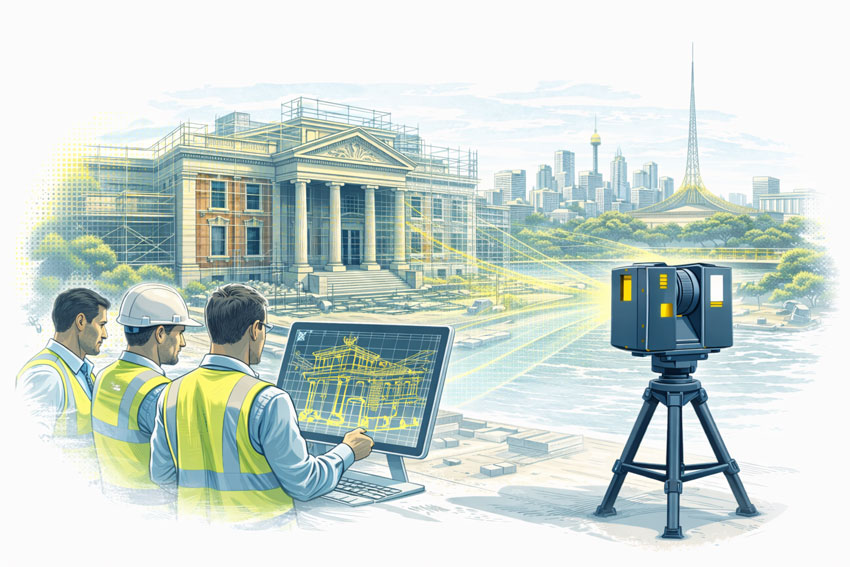
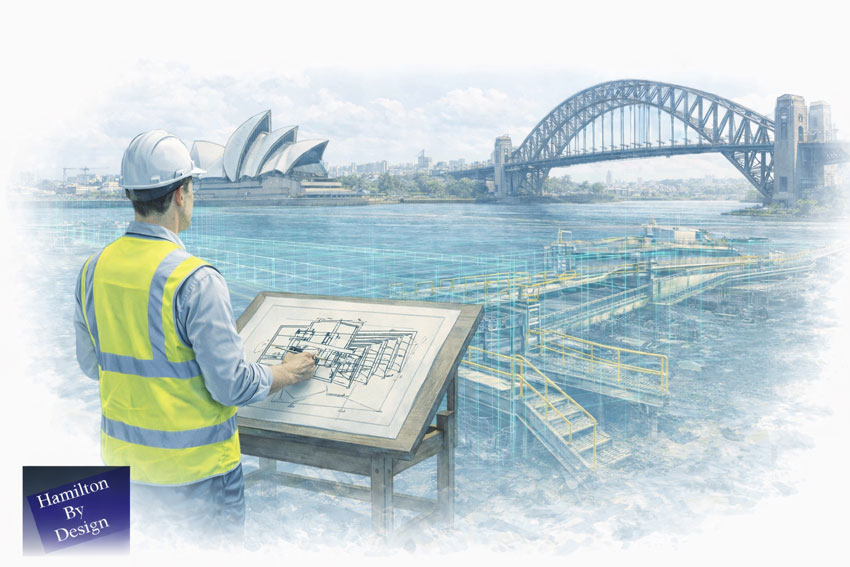
An engineer reviews detailed structural steel drawings at a drafting table while an engineering-grade LiDAR scan captures an existing waterfront structure in Sydney, illustrating data-driven structural drafting based on accurate as-built conditions.

3D CAD Designer in Sydney

Structural engineering drafting icon showing a seated engineer working at a drafting table in blue vector style.

Hamilton By Design provides engineering-led 3D CAD design services in Sydney, supporting construction, infrastructure, manufacturing, and industrial projects where accuracy, coordination, and certifiable outcomes matter.

Our Sydney-based 3D CAD services are built on measured reality, using professional laser scanning and point cloud data to ensure that CAD models reflect what truly exists on site โ€” not assumptions taken from legacy drawings or incomplete information.

This approach reduces risk, prevents rework, and supports engineers, builders, and asset owners in delivering reliable outcomes.


Engineering-Grade 3D CAD Design

A 3D CAD designer working on engineering projects must do more than โ€œdraw in 3Dโ€. Engineers rely on CAD models to:

  • Produce certified drawings
  • Verify interfaces and tolerances
  • Coordinate structural and mechanical elements
  • Support construction sequencing and installation
  • Reduce clashes and site modifications

Our CAD designers work as part of an integrated engineering workflow, aligned with how designs are reviewed, approved, and built in Sydney.


CAD Built from Real-World Data

Where projects involve existing buildings, plant, or infrastructure, our CAD models are developed directly from LiDAR scan data, ensuring dimensional accuracy and spatial confidence.

This service is closely linked with:

๐Ÿ‘‰ 3D CAD in Sydney

By working from point clouds rather than assumptions, designers and engineers gain a reliable digital environment for decision-making.


Scan to CAD for Sydney Projects

For brownfield upgrades, refurbishments, and complex construction sites, Scan to CAD is often essential.

Our Sydney Scan-to-CAD workflows support:

  • As-built documentation
  • Retrofit and upgrade design
  • Structural and mechanical coordination
  • Construction planning and verification

Related service:
๐Ÿ‘‰ Scan to CAD Sydney


Supporting Construction & Engineering Teams

Our 3D CAD designers regularly support Sydney construction and engineering teams by delivering models suitable for coordination, shop detailing, and constructability review.

This includes integration with:

  • Structural steel
  • Mechanical equipment
  • Pipework and conveyors
  • Building services and plant layouts

For construction-focused workflows, see:
๐Ÿ‘‰ 3D Construction Scan in Sydney


Point Cloudโ€“Driven CAD Modelling

When accuracy is critical, point cloud data provides the foundation for defensible CAD models.

Our designers work directly with registered engineers and project teams using structured point cloud models that support:

  • Dimensional verification
  • Clearance checking
  • Interface validation
  • Clash detection

Related capability:
๐Ÿ‘‰ 3D Point Cloud Modelling in Sydney


Our clients:


Why Choose Hamilton By Design in Sydney

  • Engineering-led CAD workflows
  • CAD models based on measured reality
  • Strong integration with laser scanning and point clouds
  • Experience across construction, industrial, and infrastructure projects
  • Models suitable for certified and reviewed engineering outcomes

We do not offer generic drafting. We provide 3D CAD design that engineers can rely on.


Hamilton By Design logo displayed on a blue tilted rectangle with a grey gradient background
3D LiDAR scanning and 3D modelling service button โ€” laser scanner capturing a point cloud for engineering and CAD modelling
Mechanical engineering services

Talk to a Sydney-Based 3D CAD Designer

If your project requires accurate CAD models built from real site conditions, Hamilton By Design can support your Sydney project from scan through to CAD delivery.

๐Ÿ“ฉ Contact us to discuss your 3D CAD designer requirements in Sydney.

Name
Would you like us to arrange a phone consultation for you?
Address
3D Scanning Sydney banner promoting engineering-grade 3D laser scanning, LiDAR scanning, and reality capture services by Hamilton By Design.
Mechanical Engineering Sydney banner with white text on a blue background representing Hamilton By Design's mechanical engineering services in Sydney.
Mechanical Drafting and 3D Modelling Sydney banner highlighting Hamilton By Design's CAD drafting, 3D modelling, and engineering design services in Sydney.

Hamilton By Design provides engineering-led 3D scanning, LiDAR scanning, mechanical engineering and digital engineering services throughout Sydney and Greater Sydney.

Explore our related Sydney services:

  • 3D Scanning Sydney โ€“ Engineering-grade terrestrial laser scanning, as-built surveys and point cloud capture for industrial, infrastructure and commercial projects.
  • Reality Capture Sydney โ€“ High-accuracy reality capture, digital twins, asset documentation and engineering-grade site verification.
  • Scan to CAD Sydney โ€“ Convert point cloud data into AutoCAD, SolidWorks, Inventor and other engineering-ready CAD deliverables.
  • Point Cloud Modelling Sydney โ€“ Engineering-grade point cloud processing, clash detection, as-built verification and 3D modelling.
  • Mechanical Engineering Sydney โ€“ Mechanical design, plant upgrades, materials handling systems, conveyors, chutes, platforms and engineering support.
  • Structural Drafting Sydney โ€“ Structural steel drafting, fabrication drawings, GA drawings, workshop detailing and as-built documentation.

Hamilton By Design supports projects throughout Sydney CBD, Parramatta, Liverpool, Penrith, Blacktown, Chatswood, Alexandria, Mascot, Newcastle and the Central Coast.


Blue banner graphic displaying the text "Point Cloud to CAD - Australia" in large white lettering, representing point cloud processing, scan-to-CAD conversion and digital engineering services across Australia.
Blue banner graphic displaying the text "Scan to CAD Sydney" in large white lettering, representing engineering-led point cloud to CAD conversion, LiDAR scanning and digital engineering services in Sydney.
Blue banner graphic displaying the text "Reality Capture Sydney - CBD" in large white lettering, representing engineering-led reality capture, LiDAR scanning and digital engineering services within Sydney CBD commercial buildings and infrastructure.

Mechanical Engineering | Structural Engineering


3D LiDAR Scanning Darwin for engineering surveys, laser scanning, reality capture and point cloud modelling services
3D LiDAR Scanning Australia engineering services for laser scanning, reality capture, scan-to-CAD, Scan-to-BIM and as-built documentation across Australia
3D LiDAR scanning services on the Central Coast providing engineering-grade laser scanning, point cloud capture, scan-to-CAD modelling and industrial reality capture for infrastructure and industrial projects.