LiDAR vs Photogrammetry for Industrial Engineering
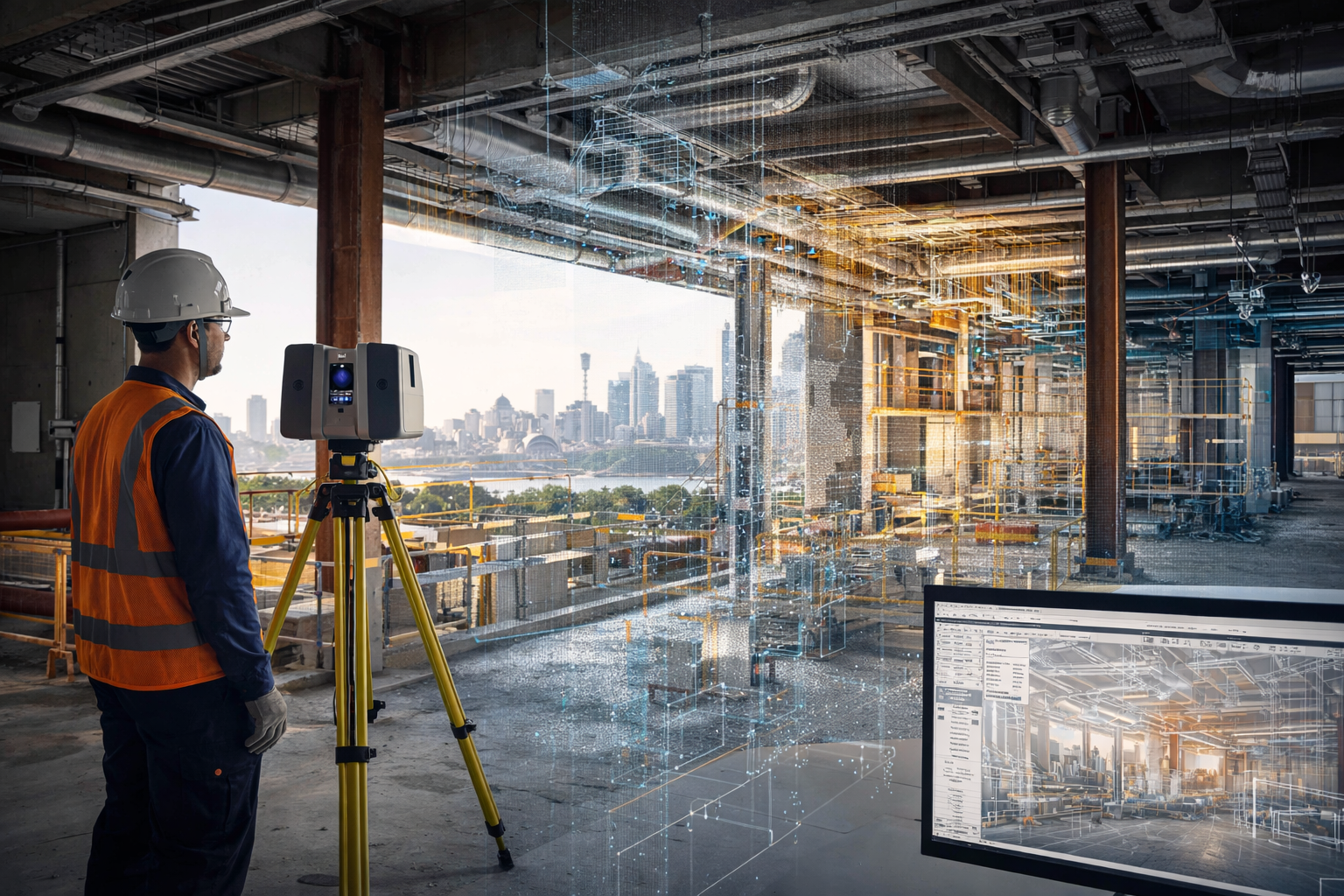
Engineering comparison of LiDAR scanning and photogrammetry used for capturing industrial plants and infrastructure.

Understanding the Difference Between LiDAR and Photogrammetry

When engineers need to capture accurate measurements of industrial infrastructure, two technologies are commonly considered: LiDAR scanning and photogrammetry.

Both methods allow engineers to create 3D digital models of real-world environments. However, when comparing LiDAR vs photogrammetry, each technology has different strengths depending on the type of engineering project.

For industries such as mining, processing plants, and heavy industrial facilities, choosing the right technology can significantly affect the accuracy, speed, and reliability of engineering design work.

At Hamilton By Design, LiDAR scanning is frequently used to capture existing conditions in complex industrial environments where precision is critical.

Learn more about engineering-grade scanning here:
https://www.hamiltonbydesign.com.au/home/engineering-grade-3d-laser-scanning-mining-industrial/


What is LiDAR Scanning?

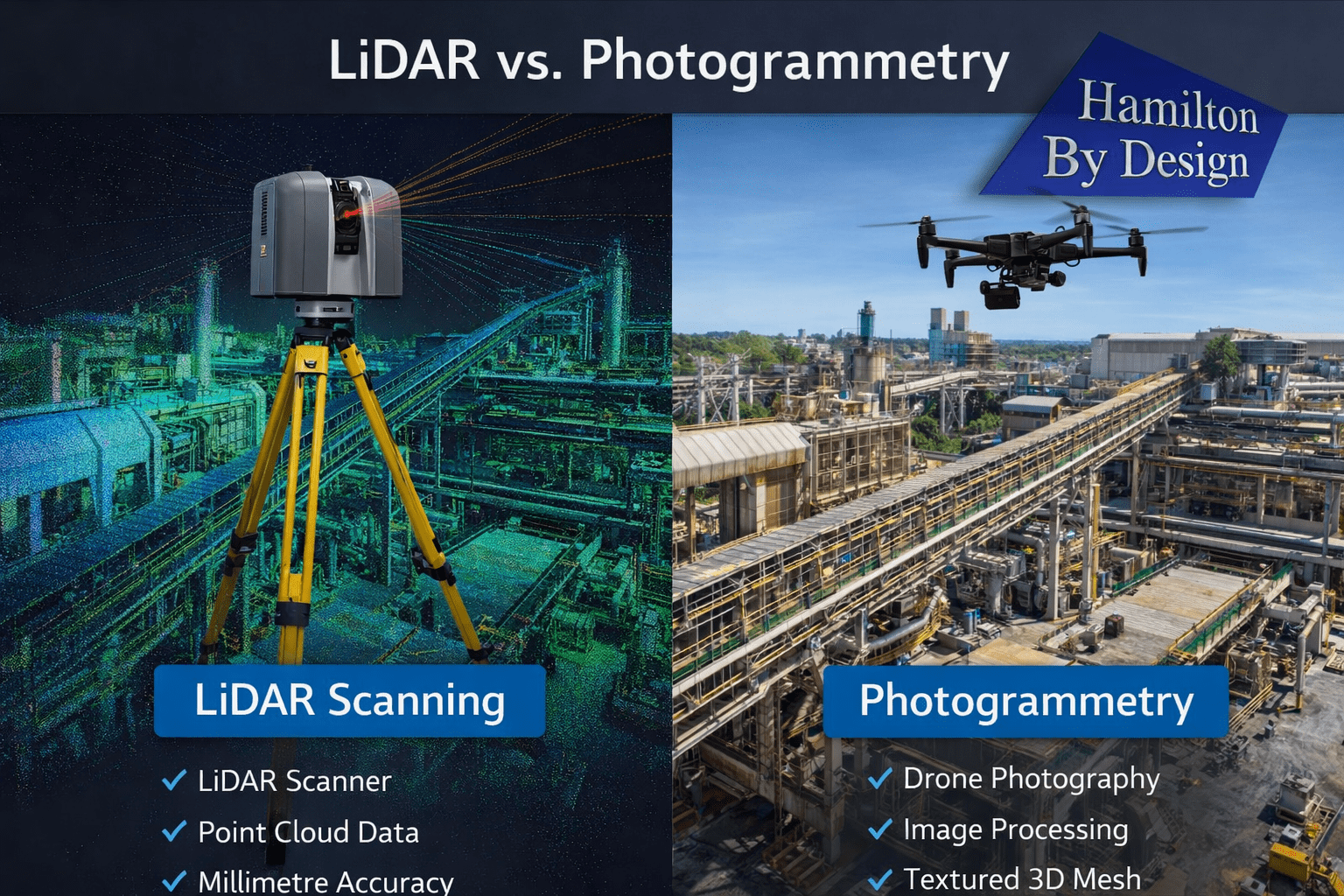
LiDAR (Light Detection and Ranging) uses laser pulses to measure the distance between the scanner and surrounding surfaces. A terrestrial laser scanner emits millions of laser pulses per second and records the returned signal to calculate precise spatial coordinates.

The result is a dense 3D point cloud representing the scanned environment.

Engineering-grade LiDAR scanners commonly achieve millimetre-level accuracy, making them well suited for capturing industrial infrastructure such as:

  • pipework systems
  • structural steel
  • conveyors
  • tanks and vessels
  • pump stations
  • processing equipment

LiDAR scanning is widely used for plant upgrades, shutdown planning, and mechanical design where accurate site data is essential.

More information on LiDAR scanning services:
https://www.hamiltonbydesign.com.au/home/engineering-services/3d-laser-scanning/


What is Photogrammetry?

Photogrammetry is a technique that creates 3D models using photographs captured from multiple angles. Specialised software analyses overlapping images and reconstructs a three-dimensional model of the scene.

Photogrammetry is commonly used in:

  • aerial mapping
  • surveying large land areas
  • construction progress monitoring
  • environmental mapping
  • drone-based inspections

Because the technique relies on photographs rather than laser measurements, the accuracy of photogrammetry depends on factors such as image quality, lighting conditions, and camera calibration.


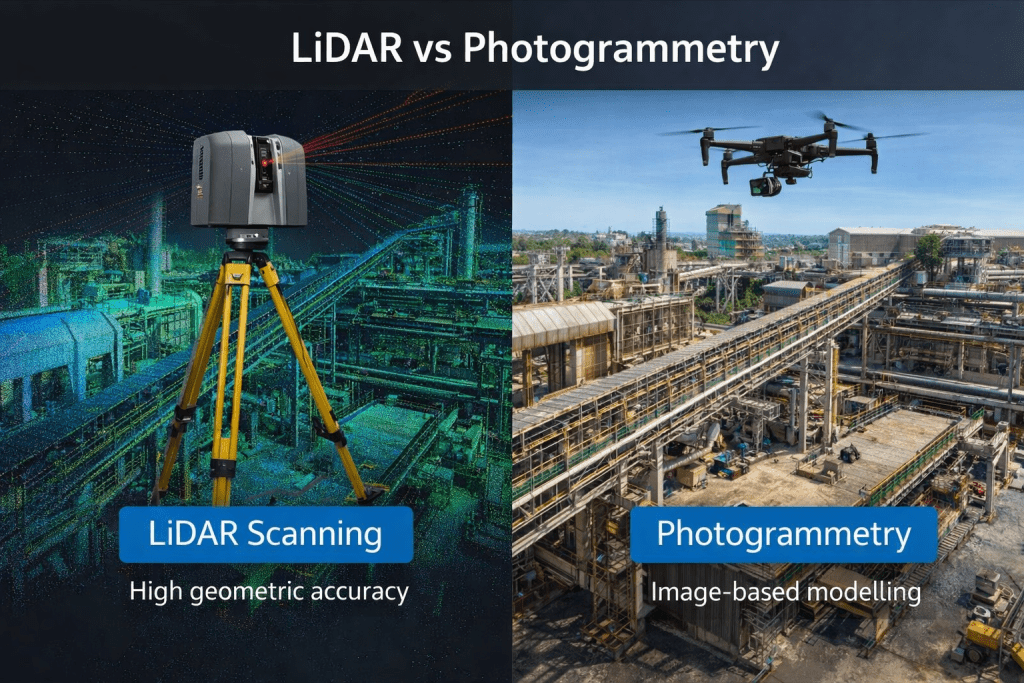
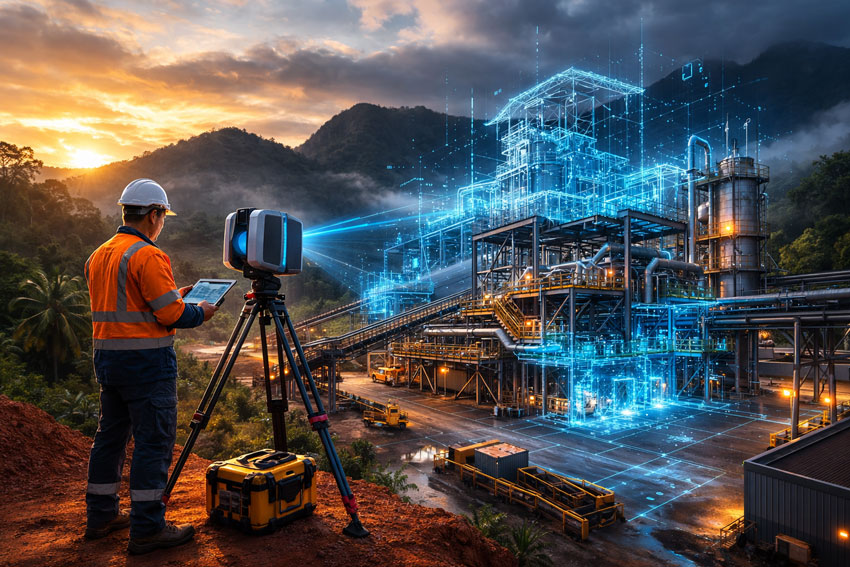
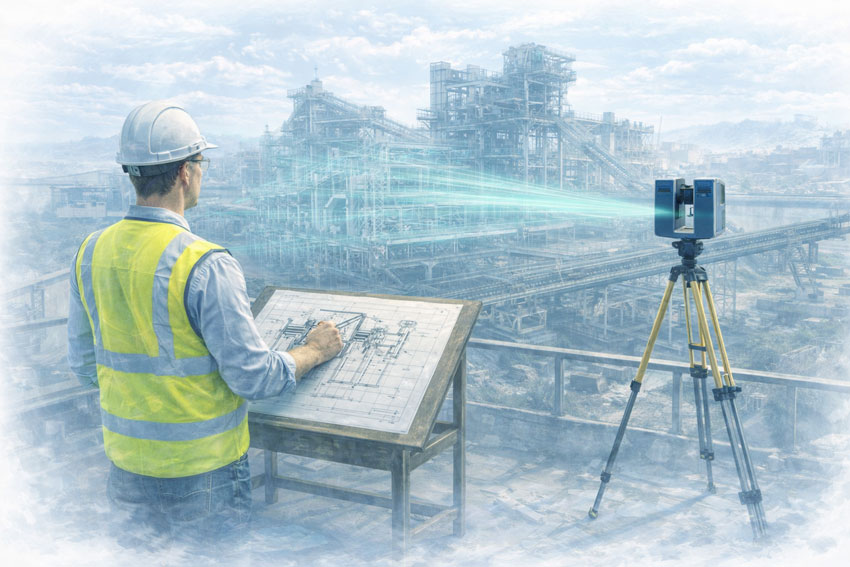
Comparison between LiDAR scanning and photogrammetry capturing an industrial engineering facility for 3D modelling.

LiDAR vs Photogrammetry: Key Differences

When comparing LiDAR vs photogrammetry, the main differences relate to measurement accuracy, speed of data capture, and suitability for complex environments.

FeatureLiDAR ScanningPhotogrammetry
Measurement MethodLaser distance measurementImage-based reconstruction
Typical AccuracyMillimetre-levelCentimetre-level (depending on conditions)
Performance in Low LightExcellentLimited
Surface DetailHigh geometric accuracyHigh visual detail
Performance in Complex PlantVery strongMore challenging
Data Capture SpeedVery fastModerate

For industrial engineering projects, LiDAR scanning typically provides more reliable geometric data, especially when scanning dense plant environments.


When LiDAR is Preferred in Industrial Engineering
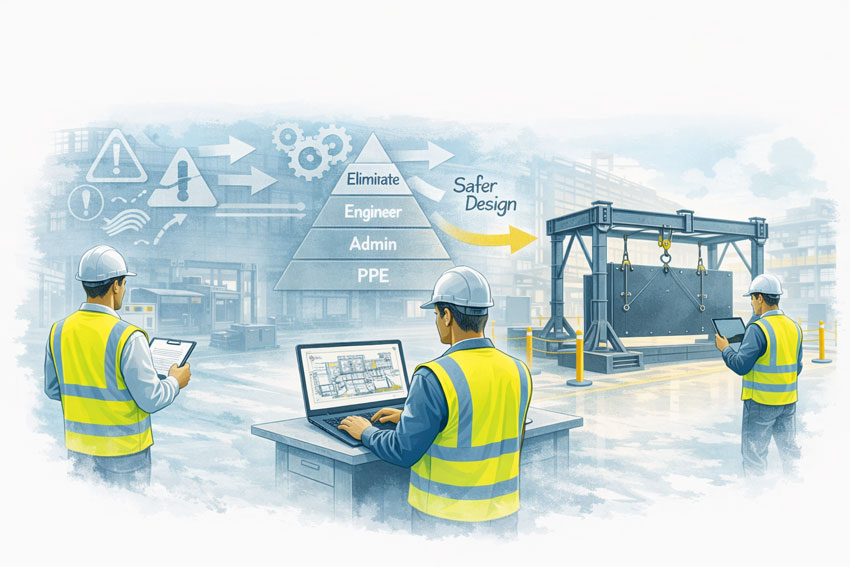
LiDAR scanning is often the preferred technology for projects involving complex infrastructure.

Common engineering applications include:

  • plant upgrades and retrofits
  • pipework modifications
  • structural steel design
  • conveyor and materials handling systems
  • pump installations
  • shutdown planning

In these environments, millimetre-level accuracy is required to ensure new components fit correctly within existing structures.

LiDAR scanning is also effective in environments with limited lighting or reflective metal surfaces, which are common in industrial facilities.

You can read more about how engineers capture existing conditions before plant upgrades here:
https://www.hamiltonbydesign.com.au/capture-existing-conditions-before-plant-upgrades/


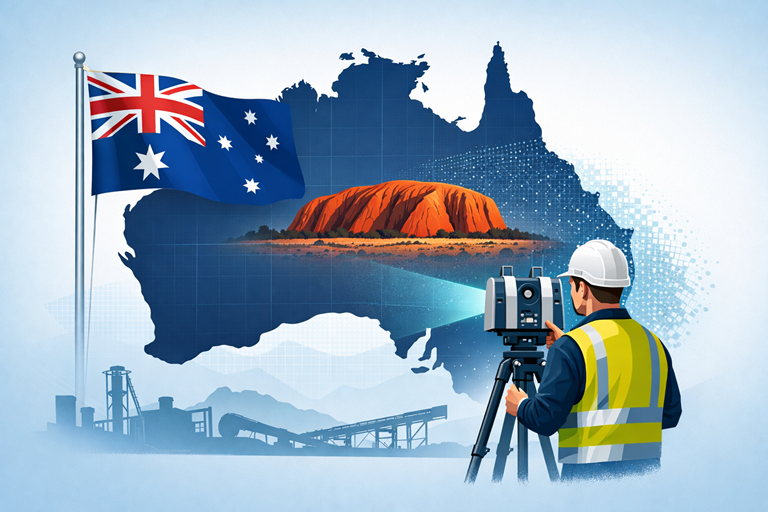
LiDAR scanning survey across Australia with engineer capturing industrial site data

When Photogrammetry is Useful

Photogrammetry remains a valuable tool for certain types of projects, particularly where large areas must be captured quickly.

Typical applications include:

  • drone-based terrain mapping
  • stockpile measurement
  • topographic surveys
  • construction progress documentation
  • infrastructure inspections

In these situations, photogrammetry provides an efficient method of capturing large datasets using aerial imagery.

However, for detailed industrial modelling, additional processing may be required to achieve the level of precision needed for engineering design.


Combining LiDAR and Photogrammetry

In some projects, engineers combine LiDAR scanning with photogrammetry to capture both accurate geometry and high-quality visual textures.

This approach can be useful when:

  • documenting heritage structures
  • visualising infrastructure for presentations
  • creating digital twins of facilities

However, for most industrial engineering applications, LiDAR scanning remains the primary technology used for accurate measurement.


From Scan Data to Engineering Models

Regardless of the capture method used, the final goal in engineering projects is often to convert the captured data into usable CAD models.

The typical workflow includes:

  1. Site data capture
  2. Data processing and alignment
  3. Point cloud generation
  4. Engineering modelling in CAD software
  5. Design and fabrication documentation

You can learn more about this process here:

Hamilton By Design logo displayed on a blue tilted rectangle with a grey gradient background

Conclusion

When comparing LiDAR vs photogrammetry, both technologies offer valuable tools for capturing real-world environments.

However, for most industrial engineering applications where accuracy and reliability are critical, LiDAR scanning typically provides the best results.
For mining, processing plants, and heavy industrial facilities, engineering-grade LiDAR scanning allows project teams to work from highly accurate digital models of existing infrastructure.

This improves design confidence, reduces installation risk, and helps ensure that new components integrate successfully with existing plant systems.

Hamilton By Design provides engineering-grade LiDAR scanning services to support industrial engineering projects across Australia.
3D LiDAR scanning and 3D modelling service button โ€” laser scanner capturing a point cloud for engineering and CAD modelling
Mechanical engineering services
Name
Would you like us to arrange a phone consultation for you?
Address
3D CAD Modelling Australia service banner for Hamilton By Design

From Point Cloud to Engineering Model Workflow
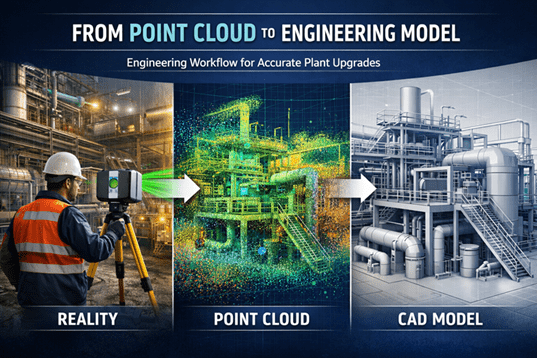
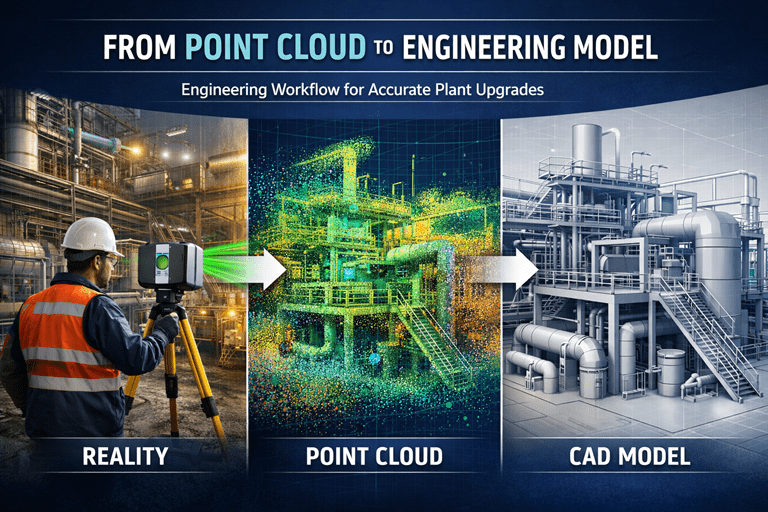
Engineering workflow showing industrial laser scanning, point cloud data, and a CAD model used for plant upgrade design.
Modern industrial facilitiesโ€”especially in mining, processing plants, and heavy infrastructureโ€”are complex environments where accurate site information is essential. Before engineers can design upgrades, modifications, or shutdown works, they must understand exactly what exists in the field today.

This is where the point cloud to engineering model workflow becomes critical.
Using engineering-grade 3D laser scanning, engineers can capture millions of spatial measurements in minutes, creating a highly accurate digital representation of existing plant conditions. These measurements form what is known as a point cloud, which becomes the foundation for accurate CAD models, engineering design, and upgrade planning.

Hamilton By Design specialises in this process through engineering-grade reality capture and modelling services across mining and industrial facilities.

Learn more about our scanning services here:
https://www.hamiltonbydesign.com.au/home/engineering-grade-3d-laser-scanning-mining-industrial/


Engineer using a laser scanner capturing an industrial facility, converting scan data into a point cloud and engineering CAD model.

What is a Point Cloud?

A point cloud is a dense collection of spatial coordinates captured by a 3D laser scanner. Each point represents a precise location on a surface such as steelwork, piping, equipment, or structures.

Modern scanners can capture millions of points per second, creating a digital snapshot of the real environment with millimetre-level accuracy.

Once captured, the point cloud becomes the digital foundation used by engineers to reconstruct existing plant geometry.

3D LiDAR scanning and 3D modelling service button โ€” laser scanner capturing a point cloud for engineering and CAD modelling
Mechanical engineering services

Hamilton By Design logo displayed on a blue tilted rectangle with a grey gradient background

The Point Cloud to Engineering Model Workflow

Turning raw scan data into usable engineering information involves several structured steps.

1. Project Planning and Site Preparation

Before scanning begins, engineers define:

  • Required accuracy
  • Project scope
  • Areas to be captured
  • Level of modelling detail required

This ensures the captured data supports downstream engineering tasks such as pipe routing, structural modifications, or equipment installations.

If you are planning a plant modification or shutdown project, capturing accurate field conditions early is essential.

Related article:
https://www.hamiltonbydesign.com.au/capture-existing-conditions-before-plant-upgrades/


2. Laser Scanning and Data Capture

During the field phase, laser scanners are positioned throughout the facility to capture overlapping scans of the plant.

Typical captured elements include:

  • Structural steel
  • Pipework
  • Mechanical equipment
  • Cable trays
  • Platforms and access ways
  • Tanks and vessels

Each scan records millions of measurements to create a complete 3D dataset of the site.


3. Scan Registration and Point Cloud Processing

After scanning, the raw scans must be processed. This includes:

  • Aligning multiple scans together (registration)
  • Removing noise or unwanted points
  • Optimising the dataset for modelling

This processing stage converts raw scan files into a coherent, usable point cloud model ready for engineering analysis.


4. Importing the Point Cloud into CAD Software

Once processed, the point cloud is imported into engineering software such as:

  • SolidWorks
  • AutoCAD
  • Revit
  • Plant design platforms

Within the design environment, the point cloud becomes a reference model that accurately represents real-world conditions. Engineers can rotate, section, and inspect the data to understand plant geometry before any design begins.


5. Engineering Model Creation

Using the point cloud as a guide, engineers begin creating intelligent CAD models of plant assets.

Typical modelling tasks include:

  • Pipe routing and spool modelling
  • Structural steel modelling
  • Equipment placement
  • Conveyor and mechanical system modelling
  • Access platforms and maintenance areas

The result is a clean engineering model derived directly from the scanned environment.

This process converts raw spatial data into parametric engineering objects, enabling design teams to work with accurate plant geometry.


6. Design Coordination and Clash Detection

Once the engineering model exists, it becomes a powerful tool for project planning.

Engineers can:

  • Test upgrade concepts
  • Perform clash detection
  • Evaluate maintenance access
  • Design shutdown modifications
  • Prepare fabrication drawings

Because the model reflects real site conditions, design errors and rework can be significantly reduced.


Why This Workflow Matters in Mining and Industrial Projects

Mining plants and processing facilities often evolve over decades. Drawings may be outdated, incomplete, or inaccurate.

Laser scanning solves this problem by capturing what actually exists today, not what legacy drawings suggest.

Benefits include:

  • Reduced design risk
  • Accurate retrofit engineering
  • Faster shutdown planning
  • Better contractor coordination
  • Improved safety planning

Point cloud modelling also allows engineers to handle complex plant geometries that would be difficult to measure manually.


3D Laser Scanning Across Australia

Hamilton By Design provides engineering-grade 3D laser scanning services across Australia, supporting mining operations, processing plants, and industrial facilities.

Our workflow focuses on delivering engineering-ready models, not just scan data.

Learn more here:
https://www.hamiltonbydesign.com.au/home/engineering-services/3d-laser-scanning/3d-laser-scanning-across-australia/


From Reality Capture to Engineering Insight

The transition from point cloud to engineering model is more than a technical workflowโ€”it is the bridge between physical infrastructure and digital engineering design.

By combining precise laser scanning with engineering modelling expertise, projects can move forward with confidence, knowing that designs are based on accurate site conditions.

At Hamilton By Design, we specialise in helping industrial operators convert reality capture into practical engineering outcomes for plant upgrades, shutdowns, and infrastructure projects.


If you would like to discuss how point cloud modelling can support your next project, explore our engineering scanning services here:

Name
Would you like us to arrange a phone consultation for you?
Address
3D CAD Modelling Australia service banner for Hamilton By Design

Engineering-Grade 3D Scanning in Papua New Guinea

3D laser scanner capturing point cloud data of remote processing plant.

Papua New Guinea presents some of the most demanding industrial environments in the Asia-Pacific region. Remote terrain, ageing infrastructure, complex plant layouts and tight shutdown windows demand precision, efficiency and engineering certainty.

Hamilton By Design delivers engineering-grade 3D scanning services in Papua New Guinea, supporting mining, processing, infrastructure and industrial projects with accurate digital capture and practical engineering outcomes.

If you are planning a plant expansion, shutdown upgrade, brownfield modification or condition assessment in PNG, high-resolution laser scanning provides the clarity your project needs.

๐Ÿ‘‰ Learn more about our dedicated PNG services here:
https://www.hamiltonbydesign.com.au/3d-scanning-papua-new-guinea/


Industrial mining facility in PNG captured with engineering-grade 3D scanning technology.

Why 3D Laser Scanning Matters in PNG

Traditional measurement methods are time-consuming and prone to error โ€” especially in remote or operational sites. 3D laser scanning eliminates guesswork by capturing millions of precise data points in a matter of hours.

The result is a complete and reliable as-built digital record of your asset.

This enables:

  • Accurate retrofit and tie-in design
  • Reduced site revisits
  • Improved shutdown planning
  • Clash detection before fabrication
  • Safer project execution

In remote PNG environments, reducing mobilisation and rework is not just convenient โ€” it is critical to project success.


From Point Cloud to Engineering Outcome

At Hamilton By Design, we go beyond scanning.

We transform raw point cloud data into usable engineering outputs including:

  • SolidWorks-ready 3D models
  • Structural and mechanical layouts
  • Fabrication drawings
  • Design verification data
  • Digital asset records

Our difference is simple: we are engineers first. Scanning is integrated directly into mechanical and structural design workflows, ensuring data captured onsite translates into practical, buildable solutions.

For a broader overview of our national capability, explore our full 3D laser scanning services here:
https://www.hamiltonbydesign.com.au/home/engineering-services/3d-laser-scanning/


Supporting Mining & Industrial Projects Across Papua New Guinea

Our PNG capability supports:

  • Mining processing plants
  • Conveyors and transfer stations
  • Pump stations and pipework systems
  • Structural steel and platforms
  • Smelter and refinery infrastructure
  • Brownfield plant upgrades

Whether your site is operational, remote or in early planning stages, we deliver data accuracy that reduces risk and accelerates decision-making.


Reduce Risk. Increase Certainty.

In complex industrial environments, uncertainty drives cost.

3D laser scanning provides:

  • Accurate geometry
  • Faster design cycles
  • Reduced fabrication errors
  • Improved stakeholder confidence

When combined with Hamilton By Designโ€™s engineering capability, it becomes a powerful project delivery tool.


Delivering Engineering Certainty in Papua New Guinea

If your organisation is undertaking upgrades, expansions or asset assessments in Papua New Guinea, we are ready to support your project.

Explore our dedicated PNG scanning capability:
๐Ÿ‘‰ https://www.hamiltonbydesign.com.au/3d-scanning-papua-new-guinea/

Or view our broader engineering-led 3D laser scanning services:
๐Ÿ‘‰ https://www.hamiltonbydesign.com.au/home/engineering-services/3d-laser-scanning/


3D LiDAR scanning and 3D modelling service button โ€” laser scanner capturing a point cloud for engineering and CAD modelling
Mechanical engineering services
Name
Would you like us to arrange a phone consultation for you?
Address

3D CAD Modelling Australia service banner for Hamilton By Design

Engineering-Led LiDAR & Mechanical Design for Mining & Heavy Industry โ€“ Blackwater QLD

Engineer-led LiDAR scanning at a mining heavy-industry site with point cloud overlay used for mechanical design and brownfield engineering.

Engineering-Led LiDAR & Mechanical Design for Mining | Blackwater QLD

Hamilton By Design provides engineering-led LiDAR scanning and mechanical design services to support mining and heavy-industry projects in Blackwater and Central Queensland. Our work is focused on brownfield assets, live operating plant, and shutdown-driven projects where accuracy, constructability, and risk control are critical.

This is not survey-only scanning. We integrate reality capture with mechanical and structural engineering to deliver fabrication-ready, fit-first-time outcomes for coal operations, CHPPs, and associated infrastructure across the Bowen Basin.


Mechanical engineer capturing a mining plant with LiDAR scanning, showing point cloud data integrated into engineering design workflows.

Engineering-Led LiDAR for Central Queensland Mining

Mining operations in and around Blackwater operate under tight production constraints, legacy infrastructure, and demanding shutdown schedules. Generic scanning services rarely address the realities of these environments.

Our engineering-led LiDAR approach is designed for:

  • Brownfield coal mine and CHPP assets
  • Multiple generations of undocumented modifications
  • Restricted access and live plant constraints
  • Shutdown-driven upgrades and replacements
  • Zero-tolerance fabrication and installation risk

LiDAR data is captured, interpreted, and applied by engineers who understand how mining plant actually works.


Integrated Scan-to-Engineering Workflow

Our services are delivered as a single, accountable workflow:

  1. On-site LiDAR scanning by engineers familiar with mining operations and access constraints
  2. Engineering-grade point-cloud processing aligned to modelling and fabrication requirements
  3. Mechanical and structural CAD modelling developed directly from scan data
  4. Fabrication-ready drawings suitable for workshops and shutdown execution
  5. Engineering support through fabrication, installation, and commissioning

This approach reduces interface risk between surveyors, designers, fabricators, and constructors โ€” a key issue on remote and shutdown-critical sites.


Mining & Heavy Industry Applications in Blackwater

Brownfield Engineering & Existing Assets

Coal operations in Central Queensland rely heavily on legacy plant and infrastructure. We support brownfield engineering where:

  • As-built drawings are incomplete or unreliable
  • Equipment has evolved through multiple shutdowns
  • Interface accuracy is critical to avoid rework

LiDAR provides accurate existing-condition data, while engineering oversight ensures the information is applied correctly during design.


Shutdown-Driven Projects

Shutdown windows are short and unforgiving.

Our work supports shutdown success by:

  • Capturing existing conditions before outages
  • Eliminating site measurement during shutdowns
  • Verifying interfaces, clearances, and constructability
  • Reducing fabrication and installation risk

Pre-validated designs lead to safer execution and reduced schedule overruns.


CHPP & Bulk Materials Handling

Blackwater and the Bowen Basin are dominated by CHPP and bulk materials infrastructure.

Our engineering-led LiDAR services support:

  • Conveyors and transfer stations
  • Hoppers, bins, and chutes
  • Crushers, screens, and feeders
  • Walkways, platforms, and guarding upgrades

Accurate scan-to-CAD workflows enable confident redesign, replacement, and compliance upgrades.


Heavy Plant & Mining Equipment

We support projects involving large and complex mining plant where traditional measurement methods are impractical or unsafe, including:

  • Stackers and reclaimers
  • Large conveyor systems
  • Structural steelwork and access systems

Engineering-led scanning ensures interfaces, notice envelopes, and installation constraints are understood before fabrication begins.


Risk Management for Mining Projects

In mining environments, risk is driven by unknown conditions, time pressure, and interface errors.

Our approach reduces risk by:

  • Removing reliance on outdated drawings
  • Capturing existing conditions prior to design
  • Identifying clashes and access issues early
  • Reducing hot works and site rework
  • Supporting safer shutdown execution

Risk is addressed upstream, where it is cheapest and safest to control.


Mining engineers applying design-for-safety principles to improve material handling systems in an industrial workshop

What Makes Our Approach Different

  • Engineer-led LiDAR scanning, not technician-only capture
  • Mechanical and structural engineering in-house
  • Coal and heavy-industry focus
  • Brownfield and shutdown experience
  • Single point of responsibility from scan through to design output

Typical Deliverables

Depending on project scope, deliverables may include:

  • Registered point-cloud datasets
  • Engineering-grade 3D CAD models
  • Mechanical and structural drawings
  • Interface and clearance verification
  • Fabrication and installation documentation

All deliverables are developed with fabrication, installation, and operational use in mind.


Who We Support

Our services support:

  • Coal mine asset owners
  • CHPP operators
  • Maintenance and shutdown teams
  • Project engineers and managers
  • Fabricators and constructors operating in Central Queensland

We work directly with asset owners or as part of multi-disciplinary project teams.


Hamilton By Design logo displayed on a blue tilted rectangle with a grey gradient background

Talk to an Engineer

If you are planning:

  • A brownfield upgrade
  • A shutdown-driven project
  • CHPP modifications or replacements
  • Conveyor or heavy plant upgrades

Hamilton By Design can support your project in Blackwater and Central Queensland with engineering-led LiDAR scanning and mechanical design.

Contact us to discuss your site, constraints, and project objectives.

Name
Would you like us to arrange a phone consultation for you?
Address

Our clients:


Finite Element Analysis (FEA) engineering simulation button
Mechanical engineering services

Reverse Engineering 3D Scanning Melbourne

Engineer-Led Reverse Engineering from Scan to Fabrication โ€” Supporting Victoria & Remote Sites

At Hamilton By Design, we provide reverse engineering supported by engineering-grade 3D LiDAR scanning from our Melbourne engineering hub, helping maintenance teams, project engineers, and manufacturers replace, reproduce, or validate critical components when drawings are missing, obsolete, or no longer reflect site reality.

We specialise in like-for-like replacement and fit-for-purpose engineering, particularly for manufacturing facilities, bulk materials handling, brownfield infrastructure, and industrial plant, where shutdown windows are tight and first-time fit-up is critical.


Reverse Engineering Built on Real Site Data

Reverse engineering only works when it starts with what actually exists on site.

We use engineering-grade 3D LiDAR scanning to capture accurate geometry from worn, modified, or undocumented assets, then apply engineering judgement to develop engineered models and drawings suitable for fabrication and installation.

This removes reliance on:

  • Missing, outdated, or incomplete drawings
  • OEM data that no longer matches the asset
  • Manual measurements in live or congested environments
  • Assumptions that lead to rework during shutdowns

Managing Director Insight

โ€œReverse engineering isnโ€™t about copying geometry โ€” itโ€™s about understanding wear, interfaces, and how an asset needs to function once itโ€™s reinstalled. We use 3D scanning to capture reality, but itโ€™s engineering judgement that ensures replacement components fit and perform as intended.โ€

โ€” Anthony Hamilton, Managing Director, Hamilton By Design


What We Reverse Engineer

From our Melbourne base, we support Victorian and remote operations with reverse engineering of:

  • Conveyor components (pulleys, frames, guards, transfer assemblies)
  • Bulk materials handling equipment (chutes, hoppers, bins, screens)
  • Worn or damaged components requiring like-for-like replacement
  • Obsolete or unsupported OEM parts
  • Structural steel components and assemblies
  • Machined components, housings, and brackets

These assets are often located in brownfield, live, or space-constrained environments, where accurate capture and engineering ownership are essential.


Engineering-Grade Accuracy for Shutdown-Critical Fit-Up

Our reverse engineering approach is designed for shutdown-critical replacement work, not visual modelling.

We emphasise:

  • Engineering-grade LiDAR scanning suitable for fit-for-purpose replacement parts
  • Accuracy verified through engineering judgement, not point clouds alone
  • Manual verification of critical interfaces where required
  • Deliverables suitable for fabrication, installation, and inspection

Our work is engineering-grade and defensibleโ€”appropriate for mechanical and structural replacement in operating industrial environments.


Reverse Engineering as an Engineering Process

Reverse engineering is treated as a complete engineering process, with 3D scanning as one input.

Our typical workflow includes:

3D LiDAR scanning โ†’ point-cloud analysis โ†’ engineered 3D modelling โ†’ design intent definition โ†’ fabrication and installation drawings

Where required, this process may also include:

  • Mechanical or structural checks
  • Review of wear patterns and failure modes
  • Fit-for-purpose assessment against operational requirements

This ensures replacement components are engineered to work, not blindly replicated.


Engineering Ownership, Accountability & Risk Management

Reverse engineering carries real technical and commercial risk.

Our approach includes:

  • Engineering sign-off and accountability
  • Clear documentation of assumptions and limitations
  • Fit-for-purpose design intent aligned with operational reality
  • Engineering judgement consistent with Australian Standards
  • Lessons learned from real shutdowns, upgrades, and replacements

Deliverables are suitable for engineering review, audits, and compliance requirements.


Melbourne Engineering Hub Supporting Victoria & Remote Sites

We operate with Melbourne as our engineering base, supporting:

  • Manufacturing and industrial facilities across Victoria
  • Bulk materials handling and processing plants
  • Infrastructure and brownfield assets
  • Remote sites supported from Victoria
  • Fabricators and machine shops requiring accurate reverse-engineered data

This model provides local engineering accountability with the flexibility to support geographically dispersed assets.


Designed for Maintenance, Reliability & Project Engineers

This service is well suited to:

  • Maintenance and reliability engineers managing ageing assets
  • Project engineers planning shutdown replacements and upgrades
  • Manufacturers reproducing legacy or unsupported components
  • Asset owners dealing with undocumented modifications
  • Fabricators requiring accurate, fabrication-ready documentation

We work collaboratively with your teams, focusing on fit-first-time outcomes.


Hamilton By Design logo displayed on a blue tilted rectangle with a grey gradient background
3D LiDAR scanning and 3D modelling service button โ€” laser scanner capturing a point cloud for engineering and CAD modelling
Mechanical engineering services

Talk to Us About Reverse Engineering 3D Scanning in Melbourne

If youโ€™re dealing with missing drawings, obsolete components, or shutdown-critical replacements, weโ€™d welcome the opportunity to help.

Submit an enquiry via our contact form


Name
Would you like us to arrange a phone consultation for you?
Address


3D CAD Modelling Australia service banner for Hamilton By Design


CHPP Engineering title graphic featuring bold white text reading "CHPP Engineering" centred on a blue rounded rectangle background.
Pipework Drafting title graphic featuring bold white text reading "Pipework Drafting" centred on a blue rounded rectangle background.
3D LiDAR Scanning for Engineering Projects title graphic featuring bold white text on a blue rounded rectangle background.


Finite Element Analysis (FEA) engineering simulation button
Structural drafting services button
Mechanical drafting services button


Australian Drafting logo featuring bold white text reading "Australian Drafting" centred on a blue rounded rectangle background.
Engineering Governance title graphic featuring bold white text reading "Engineering Governance" centred on a blue rounded rectangle background.
Engineering-Grade LiDAR Scanning title graphic featuring bold white text on a blue rounded rectangle background.


Mechanical drafting services button
Structural drafting services button


Fabrication and product design services
3D CAD Modelling Australia service banner for Hamilton By Design
Mechanical, Structural & Pipework Drafting service banner by Hamilton By Design featuring white text on a blue background.


3D LiDAR scanning and 3D modelling service button โ€” laser scanner capturing a point cloud for engineering and CAD modelling
Mechanical engineering services

3D Scanning Services in Melbourne

3D Scanning Services Melbourne | Engineering-Grade LiDAR for Construction & Manufacturing

Hamilton By Design provides engineering-grade 3D scanning services in Melbourne and Victoria, supporting local construction projects, manufacturing facilities, and industrial environments where accurate spatial data and engineering confidence are essential. Our services deliver reliable, measurable 3D data that feeds directly into design, coordination, fabrication, and compliance workflows, reducing risk and improving outcomes on complex projects.

Melbourneโ€™s diverse built environment includes major infrastructure, commercial and residential development, advanced manufacturing hubs, and precision fabrication facilities. These industries demand precise as-built documentation, engineering-ready models, spatial verification, and detailed capture workflows that support multi-discipline coordination and installation planning.


Why Melbourne Projects Benefit from Engineering-Grade 3D Scanning

3D scanning in Melbourne is not just about capture โ€” itโ€™s about delivering usable, accurate data that supports real engineering outcomes.

Construction Coordination & Verification
Melbourneโ€™s construction landscape involves high-density urban sites, retrofits, complex faรงade integration, and multi-trade coordination. High-accuracy 3D scan data supports clash detection, installation planning, and design validation.

Advanced Manufacturing & Fabrication
Manufacturing facilities โ€” from precision machine shops to large-scale fabrication plants โ€” rely on verified spatial information for layout verification, retrofit of plant and equipment, and precision assembly. Scan-to-CAD workflows ensure manufacturing outputs integrate correctly with existing infrastructure.

Brownfield & Retrofit Environments
Existing facilities and older infrastructure often lack reliable drawings. Engineering-grade scanning captures current conditions with measurable accuracy, allowing design and construction teams to work from a verified baseline.

Compliance & Documentation
As-built documentation is increasingly required for approvals, audits, regulatory compliance, and handover deliverables. Professional scanning workflows ensure outputs are traceable, measurable, and suitable for technical review.


Our 3D Scanning Services in Melbourne

We provide a comprehensive suite of engineering-focused 3D scanning services tailored to construction and manufacturing environments:

  • Engineering-Grade LiDAR & 3D Laser Scanning
    High-precision capture of buildings, structures, plant, and manufacturing assets.
  • Construction Verification & Clash Detection
    Spatial datasets aligned to design models to support coordination and sequencing.
  • Manufacturing Facility Scanning
    Accurate capture of machine centres, conveyors, jigs, fixtures, and factory layouts.
  • Brownfield & Retrofit Scanning
    Measurable site data for expansion, upgrade, and renovation projects.
  • Scan-to-CAD Modelling
    Transforming point clouds into usable 3D CAD models for engineering, fabrication, and drafting.
  • Verified Geometry for Compliance & Installation
    Deliverables suitable for engineering checks, compliance documentation, and construction execution.

Each scan is performed with the downstream use in mind โ€” data engineered for reliable decision-making, not just visual reference.


Our clients:

Typical Melbourne Project Applications

Our Melbourne 3D scanning services are frequently applied to:

  • High-density urban construction coordination
  • Structural and faรงade verification
  • Manufacturing plant layout and retrofit capture
  • Shop floor as-built documentation
  • Mechanical and ductwork coordination
  • Building systems integration and clash avoidance
  • Technical compliance and regulatory documentation

These use cases reflect real engineering and construction needs where traditional measurement methods fall short.


Supporting Engineering Services for Melbourne Projects

3D scanning is often integrated with broader engineering and documentation deliverables. Hamilton By Design provides:

  • 3D CAD Modelling (Scan-to-CAD)
    Delivering engineering-ready models from site capture data.
  • As-Built Drawings for Compliance & Procedural Use
    Documentation suitable for approvals, audits, and asset handover.
  • Emergency Exit & Egress Drawing Development
    Safety planning and compliance documentation based on verified geometry.
  • Finite Element Analysis (FEA)
    Engineering evaluation of load, deflection, or modification impacts.
  • 3D Rendering & Visual Models
    Supporting stakeholder reviews, approvals, and presentations.
  • Precision Scanning for Fabrication & Installation Planning
    Reducing onsite uncertainty and supporting fit-first-time outcomes.

Hamilton By Design logo displayed on a blue tilted rectangle with a grey gradient background
3D LiDAR scanning and 3D modelling service button โ€” laser scanner capturing a point cloud for engineering and CAD modelling
Mechanical engineering services

Engineering-Led 3D Scanning You Can Rely On

Hamilton By Designโ€™s 3D scanning services in Melbourne are deeply grounded in engineering practice, not just visual capture. We understand how scan data is used โ€” from initial design review through to fabrication and construction โ€” and we deliver 3D point clouds and models that integrate smoothly into engineering workflows. This ensures accuracy, confidence, and better project outcomes across the full lifecycle of your project.


Contact Us About a Melbourne 3D Scanning Project

If you are planning a construction project, manufacturing facility upgrade, or complex retrofit in Melbourne or regional Victoria and need engineering-grade 3D scanning, contact Hamilton By Design to discuss your requirements and ensure your data capture supports your engineering and project delivery objectives.

Name
Would you like us to arrange a phone consultation for you?
Address
3D LiDAR scanning and 3D modelling service button โ€” laser scanner capturing a point cloud for engineering and CAD modelling
Mechanical engineering services
Finite Element Analysis (FEA) engineering simulation button
Mechanical engineering services