From Existing Component to Fabrication Drawing: How Scan-to-CAD Supports Reverse Engineering

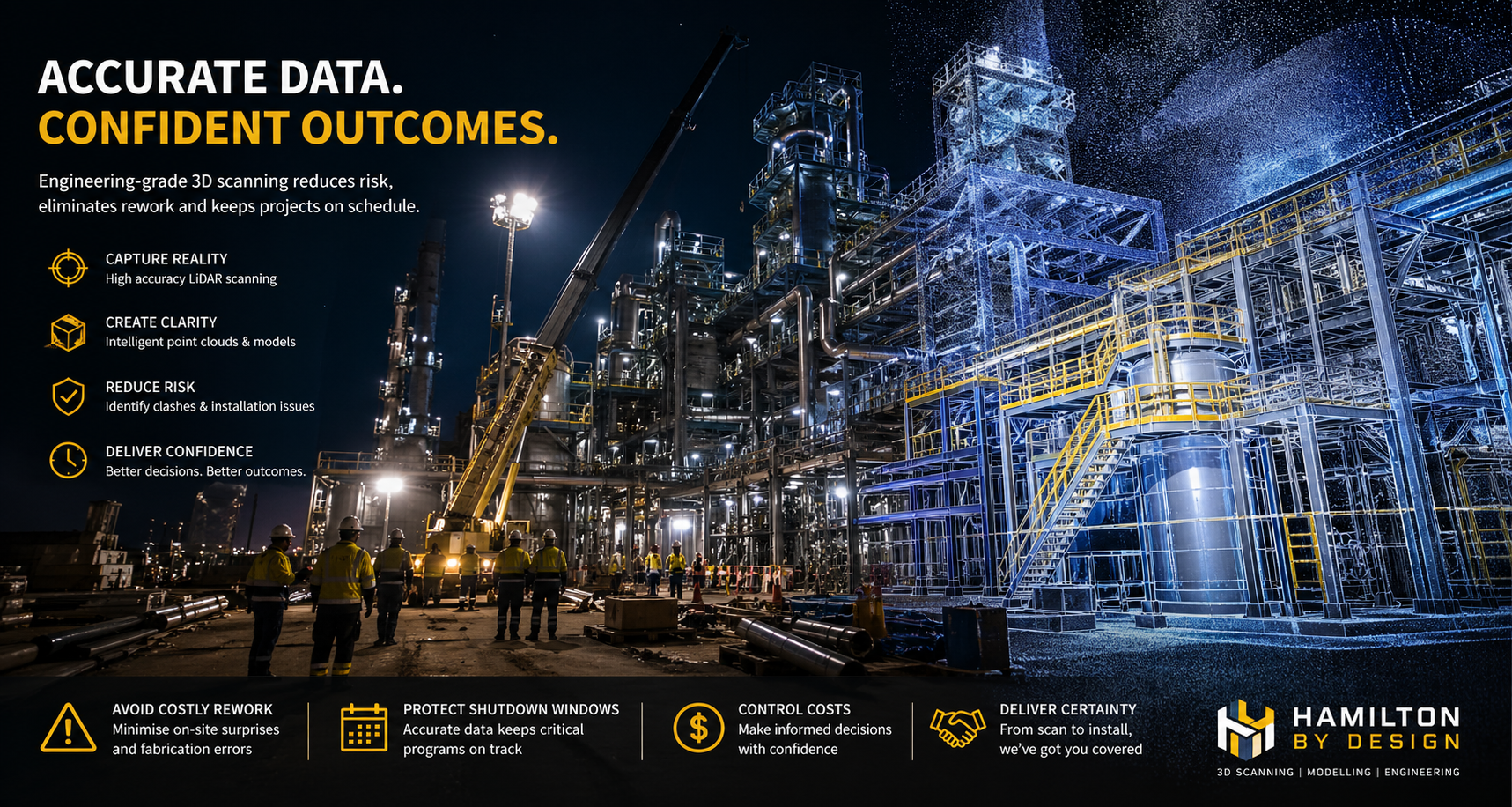
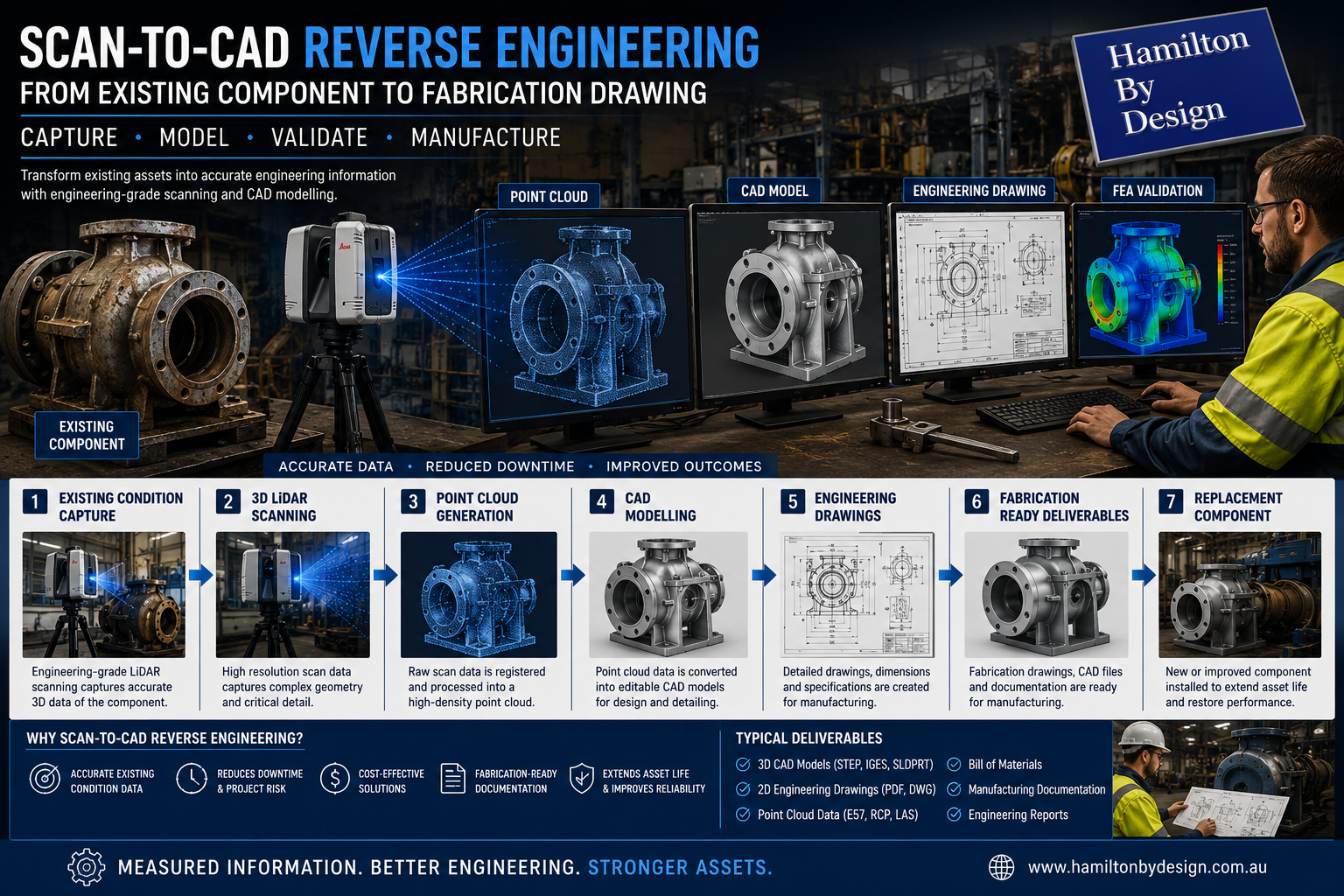
Engineering-grade Scan-to-CAD reverse engineering workflow converting existing industrial equipment into CAD models and fabrication-ready drawings.

Industrial facilities commonly rely on equipment that has operated for many years through upgrades, repairs, and ongoing modifications. Over time, engineering drawings may be lost, equipment may be altered from original configurations, or replacement components may become difficult to source.

When maintenance teams need to reproduce a component or modify an existing system, the challenge often becomes clear:

“We have the physical component, but we do not have the engineering information.”

Reverse engineering supported by Scan-to-CAD workflows provides a practical solution by converting physical assets into accurate digital engineering information.

At Hamilton By Design, we combine engineering-grade 3D LiDAR scanning, CAD modelling, and engineering documentation to transform existing components into fabrication-ready deliverables that support maintenance, upgrades, and improved asset management.

What is Scan-to-CAD Reverse Engineering?

Scan-to-CAD reverse engineering involves capturing a physical object or existing asset and converting it into editable engineering models and documentation.

Rather than relying on manual measurements or assumptions, engineering teams can create digital representations based on accurate measured information.

The workflow typically moves through:

Physical Component โ†’ Digital Capture โ†’ CAD Model โ†’ Engineering Documentation โ†’ Fabrication

The objective is creating engineering information that can support manufacturing and future asset management.

Existing Condition Capture

Reverse engineering begins with understanding the actual condition of an existing component.

Equipment operating in mining and industrial environments commonly experiences:

  • Wear
  • Modifications
  • Distortion
  • Repairs
  • Build-up
  • Material loss
  • Damage

Capturing existing conditions accurately becomes critical.

Typical assets may include:

  • Pump components
  • Shafts
  • Conveyor systems
  • Transfer chutes
  • Structural components
  • Wear liners
  • Mechanical assemblies
  • Processing equipment

Accurate existing condition capture reduces uncertainty before engineering work begins.
3D CAD Modelling Australia service banner for Hamilton By Design

Engineering-Grade 3D LiDAR Scanning

Hamilton By Design uses engineering-grade 3D LiDAR scanning to capture component geometry and surrounding environments.

LiDAR scanning can capture:

  • Complex geometry
  • Existing plant layouts
  • Mechanical equipment
  • Structural components
  • Dimensional relationships
  • Access constraints

Benefits may include:

  • Reduced manual measurement requirements
  • Improved accuracy
  • Faster information capture
  • Existing condition verification
  • Reduced engineering assumptions

Point Cloud Generation

Following site capture, scan information is processed into a point cloud dataset.

Point clouds provide:

  • Measured spatial information
  • Existing geometry
  • Dimensional verification
  • Digital representation of physical assets

Point cloud information becomes the foundation for further engineering development.

Point cloud deliverables may include:

  • .E57 files
  • .RCP files
  • .LAS files
  • Registration reports

Rather than relying on estimated dimensions, engineering decisions can be based on measured information.

CAD Modelling

Once point cloud information is generated, components can be converted into editable engineering models.

CAD modelling allows engineers to create:

  • Parametric models
  • Mechanical assemblies
  • Manufacturing geometry
  • Equipment layouts
  • Design modifications
  • Engineering improvements

Benefits include:

  • Improved visualisation
  • Future design flexibility
  • Digital asset information
  • Improved project coordination

For reverse engineering projects, editable CAD models become valuable long-term assets.

Engineering Drawings

Digital models can then be transformed into engineering documentation supporting fabrication and manufacturing activities.

Typical outputs include:

  • General arrangement drawings
  • Detail drawings
  • Assembly drawings
  • Dimensional drawings
  • Manufacturing drawings
  • Bills of materials

Documentation provides manufacturing teams with clear information for production.

Fabrication-Ready Deliverables

The final stage involves developing information that supports practical project execution.

Hamilton By Design deliverables may include:

  • 3D CAD models
  • PDF engineering drawings
  • DWG files
  • STEP files
  • Point cloud datasets
  • Manufacturing documentation
  • Engineering reports

The goal is delivering information that moves beyond visualisation and becomes usable engineering data.

Why Scan-to-CAD Matters for Reverse Engineering

Without digital engineering workflows, organisations may face:

  • Manual measurement errors
  • Missing information
  • Extended downtime
  • Increased fabrication risk
  • Higher project costs
  • Rework during installation

Scan-to-CAD workflows can improve:

  • Accuracy
  • Planning
  • Asset management
  • Fabrication outcomes
  • Project confidence
  • Long-term equipment support
3D LiDAR scanning and 3D modelling service button โ€” laser scanner capturing a point cloud for engineering and CAD modelling
Mechanical engineering services

How Hamilton By Design Supports Reverse Engineering Projects

Hamilton By Design combines practical engineering experience with digital engineering tools including:

  • Engineering-grade 3D LiDAR scanning
  • Existing condition capture
  • Scan-to-CAD workflows
  • CAD modelling
  • Engineering drawings
  • Fabrication documentation
  • Reverse engineering services

The objective is not simply reproducing components.

The objective is transforming existing assets into accurate engineering information that supports maintenance, manufacturing, and long-term operational performance.

Measured information creates better engineering outcomes than assumptions.

Our Clients:

Hamilton By Design logo displayed on a blue tilted rectangle with a grey gradient background
Name
Would you like us to arrange a phone consultation for you?
Address
3D CAD Modelling Australia service banner for Hamilton By Design
Australian Drafting logo featuring bold white text reading "Australian Drafting" centred on a blue rounded rectangle background.
Engineering Governance title graphic featuring bold white text reading "Engineering Governance" centred on a blue rounded rectangle background.
Mechanical, Structural & Pipework Drafting service banner by Hamilton By Design featuring white text on a blue background.
Mechanical engineering services
Blue rounded button with the text โ€œSolidWorks Designโ€ in white.
Finite Element Analysis (FEA) engineering simulation button
3D LiDAR Scanning Darwin for engineering surveys, laser scanning, reality capture and point cloud modelling services
3D LiDAR Scanning Australia engineering services for laser scanning, reality capture, scan-to-CAD, Scan-to-BIM and as-built documentation across Australia
3D LiDAR scanning services on the Central Coast providing engineering-grade laser scanning, point cloud capture, scan-to-CAD modelling and industrial reality capture for infrastructure and industrial projects.
3D LiDAR Scanning Perth for engineering surveys, laser scanning, reality capture and point cloud modelling services
3D LiDAR Scanning Sydney for engineering surveys, laser scanning, reality capture and point cloud modelling services
3D LiDAR Scanning Brisbane for engineering surveys, laser scanning, reality capture and point cloud modelling services
3D LiDAR Scanning Canberra for engineering surveys, laser scanning, reality capture and point cloud modelling services
3D LiDAR Scanning Newcastle for engineering surveys, laser scanning, reality capture and point cloud modelling services
3D LiDAR Scanning Adelaide for engineering surveys, laser scanning, reality capture and point cloud modelling services

Forestry Industry & Timber Processing: Engineering Machinery for Productivity and Long-Term Value

Engineering-grade LiDAR scanning and FEA simulation workflow for forestry and timber processing equipment design.

The forestry and timber processing industries operate in demanding environments where productivity, reliability, and equipment performance directly influence profitability. Whether processing logs, handling timber products, operating sawmills, or managing materials handling systems, machinery downtime and inefficiencies can significantly affect production output and operating costs.

Modern engineering is moving beyond traditional design approaches and increasingly using digital engineering tools to optimise equipment before fabrication and installation begins.

At Hamilton By Design, we combine engineering-grade 3D LiDAR scanning, 3D modelling, and Finite Element Analysis (FEA) to support forestry and timber processing operations by delivering machinery and engineered systems designed for productivity, reliability, and long-term return on investment.

Designing for More Than Initial Cost

The lowest purchase price does not always provide the lowest operating cost.

Machinery and processing systems can incur substantial ongoing costs through:

  • Excessive wear
  • Unplanned maintenance
  • Downtime
  • Energy consumption
  • Material build-up
  • Inefficient layouts
  • Reduced production capacity
  • Premature equipment failure

Engineering decisions made during the design stage can influence the total lifecycle cost of equipment for many years after installation.

The objective is not simply designing machinery that works.

The objective is designing machinery that continues to perform efficiently throughout its operational life.

Engineering-Grade 3D LiDAR Scanning

For existing timber processing plants and brownfield facilities, one of the biggest challenges is understanding current conditions accurately.

Many facilities contain:

  • Existing conveyors
  • Timber processing machinery
  • Structural steel
  • Pipework
  • Platforms and access systems
  • Building constraints
  • Historical modifications

Outdated drawings or manual measurements can introduce risk into engineering projects.

Hamilton By Design uses engineering-grade 3D LiDAR scanning to capture accurate existing conditions and generate high-quality point cloud data.

This provides:

  • Accurate plant geometry
  • Existing condition verification
  • Reduced design assumptions
  • Improved fit-up accuracy
  • Reduced installation risk
  • Faster project development

Rather than designing around assumptions, engineering decisions can be based on actual site information.

3D Modelling for Better Project Outcomes

Once site information has been captured, point cloud data can be converted into editable engineering models.

3D CAD Modelling Australia service banner for Hamilton By Design

3D modelling provides benefits including:

  • Improved visualisation
  • Clash detection
  • Layout optimisation
  • Equipment integration
  • Fabrication planning
  • Improved communication

For forestry and timber processing projects this may include:

  • Log handling systems
  • Conveyors
  • Transfer systems
  • Chutes
  • Processing equipment
  • Access platforms
  • Structural modifications
  • Production upgrades

Digital models help identify issues before they become site problems.

Finite Element Analysis (FEA)

Engineering performance extends beyond appearance and fit-up.

Equipment must withstand:

  • Dynamic loading
  • Material impacts
  • Fatigue
  • Wear
  • Structural loading
  • Operational forces

Hamilton By Design can support projects through Finite Element Analysis (FEA) to evaluate equipment and structural performance before fabrication begins.

FEA can assist with:

  • Stress assessment
  • Deflection analysis
  • Structural performance
  • Design optimisation
  • Weight reduction opportunities
  • Reliability improvements

Rather than overdesigning equipment or relying on assumptions, designs can be refined using measurable engineering information.

Maximising Return on Investment

A successful project should not simply focus on reducing initial capital cost.

The real value often comes from:

  • Increased production rates
  • Reduced maintenance costs
  • Improved reliability
  • Reduced downtime
  • Improved safety
  • Lower lifecycle costs
  • Longer equipment life
  • Improved operational efficiency
3D LiDAR scanning and 3D modelling service button โ€” laser scanner capturing a point cloud for engineering and CAD modelling
Mechanical engineering services

Engineering decisions made early in a project often have long-term financial impacts.

How Hamilton By Design Supports Forestry and Timber Processing

Hamilton By Design combines digital engineering tools with practical engineering experience to support projects from concept through to delivery.

Our services include:

  • Engineering-grade 3D LiDAR scanning
  • Scan-to-CAD workflows
  • 3D modelling
  • Mechanical engineering design
  • Finite Element Analysis (FEA)
  • Engineering drawings
  • Fabrication documentation
  • Existing condition verification
  • Brownfield project support

By integrating reality capture, digital modelling, and engineering analysis, projects can move from assumptions toward measurable engineering outcomes.

The goal is simple:

Design machinery and systems that maximise productivity while delivering stronger long-term returns on investment.

3D CAD Modelling Australia service banner for Hamilton By Design
Australian Drafting logo featuring bold white text reading "Australian Drafting" centred on a blue rounded rectangle background.
Engineering Governance title graphic featuring bold white text reading "Engineering Governance" centred on a blue rounded rectangle background.
Mechanical, Structural & Pipework Drafting service banner by Hamilton By Design featuring white text on a blue background.
Mechanical engineering services
Blue rounded button with the text โ€œSolidWorks Designโ€ in white.
Finite Element Analysis (FEA) engineering simulation button
3D LiDAR Scanning Darwin for engineering surveys, laser scanning, reality capture and point cloud modelling services
3D LiDAR Scanning Australia engineering services for laser scanning, reality capture, scan-to-CAD, Scan-to-BIM and as-built documentation across Australia
3D LiDAR scanning services on the Central Coast providing engineering-grade laser scanning, point cloud capture, scan-to-CAD modelling and industrial reality capture for infrastructure and industrial projects.
3D LiDAR Scanning Perth for engineering surveys, laser scanning, reality capture and point cloud modelling services
3D LiDAR Scanning Sydney for engineering surveys, laser scanning, reality capture and point cloud modelling services
3D LiDAR Scanning Brisbane for engineering surveys, laser scanning, reality capture and point cloud modelling services
3D LiDAR Scanning Canberra for engineering surveys, laser scanning, reality capture and point cloud modelling services
3D LiDAR Scanning Newcastle for engineering surveys, laser scanning, reality capture and point cloud modelling services
3D LiDAR Scanning Adelaide for engineering surveys, laser scanning, reality capture and point cloud modelling services

Material Handling: Bucket Elevator Scan, Design, Build and Install

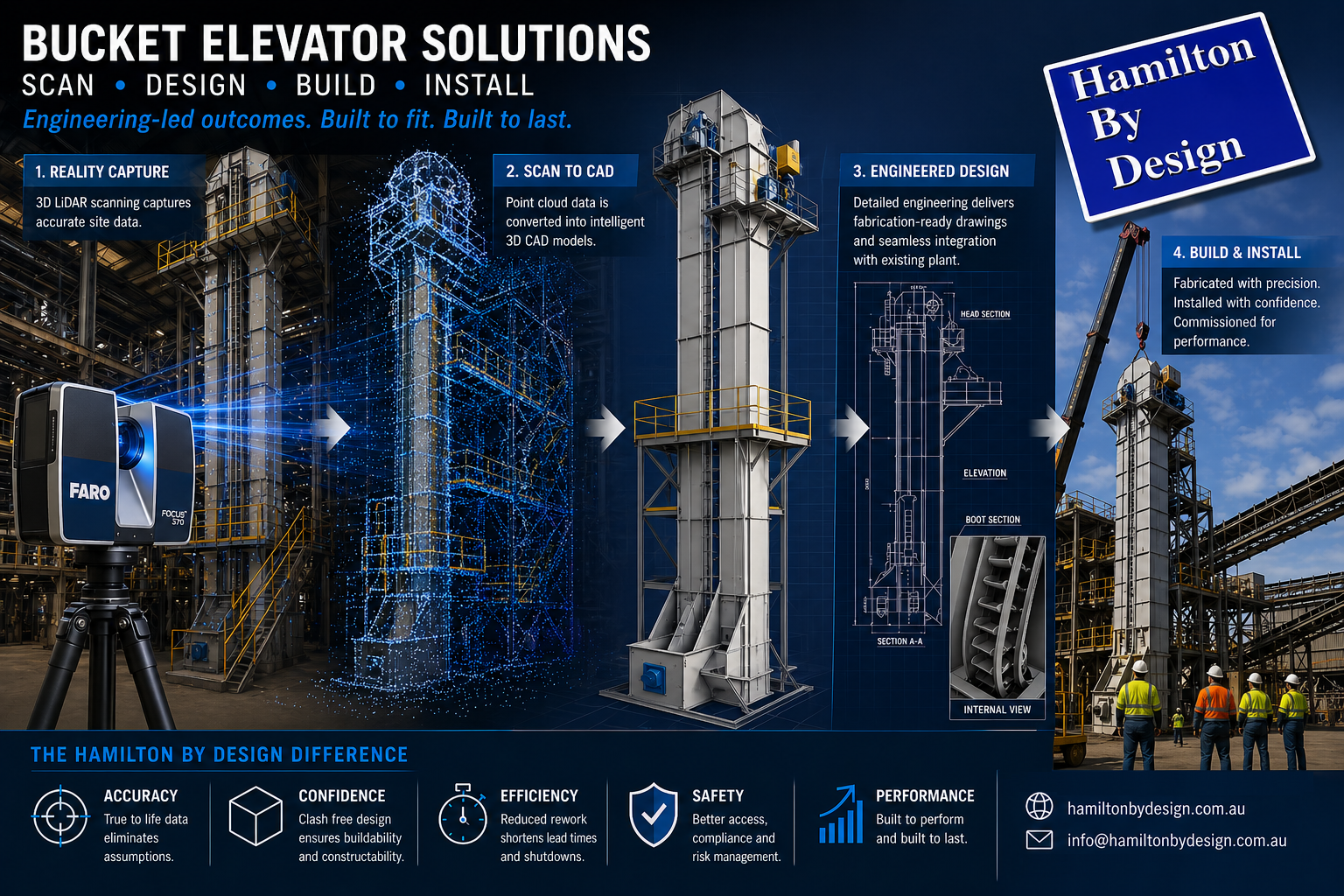
3D LiDAR scanning to CAD modelling workflow for a bucket elevator system in an industrial material handling plant

An Engineering-Led Approach for Brownfield Industrial Environments

Bucket elevators are a fundamental component of bulk material handling systems, providing an efficient and reliable method for the vertical transport of materials such as ores, grains, cement, and industrial powders. Despite their apparent simplicity, the successful design and installation of bucket elevators within existing (brownfield) facilities presents significant engineering challenges. These challenges typically arise from undocumented modifications, limited access, and the inherent complexity of integrating new infrastructure into legacy plant environments.

This paper outlines an engineering-led methodology adopted by Hamilton By Design, incorporating 3D LiDAR scanning, scan-to-CAD modelling, and fabrication-ready design to deliver a complete scan, design, build, and install solution for bucket elevator systems.


3D CAD Modelling Australia service banner for Hamilton By Design

Limitations of Traditional Design Methodologies

Conventional approaches to bucket elevator design often rely on outdated drawings, manual site measurements, and engineering assumptions regarding existing plant conditions. While these methods may be adequate for greenfield developments, they are frequently inadequate in brownfield environments.

Common issues associated with traditional methodologies include:

  • Dimensional inaccuracies leading to misalignment during installation
  • Increased fabrication rework due to unforeseen clashes
  • Extended shutdown durations and associated production losses
  • Elevated safety risks resulting from poor integration with existing infrastructure

In material handling systems, particularly those involving rotating equipment and vertical conveyance, dimensional accuracy is critical. Minor deviations can result in significant operational inefficiencies, including premature wear, belt tracking issues, and mechanical failure.


Engineering-Grade 3D LiDAR Scanning

To address these challenges, an engineering-grade 3D LiDAR scanning process is employed to capture a high-resolution, spatially accurate representation of the existing plant environment. This process generates a point cloud dataset that reflects the true geometry of all visible structures, equipment, and interfaces.

The application of LiDAR scanning provides the following advantages:

  • Accurate capture of structural steelwork, platforms, and existing material handling systems
  • Identification of spatial constraints and potential clashes prior to design development
  • Reliable definition of tie-in points for new equipment
  • Reduction in reliance on assumptions and manual measurement

Importantly, the point cloud dataset is treated as an engineering input, rather than a visual reference. This distinction ensures that all subsequent design activities are grounded in verified, real-world data.


Scan-to-CAD Modelling and Engineering Design

Following data acquisition, the point cloud is processed and converted into a structured, parametric CAD model. This scan-to-CAD workflow enables the development of detailed engineering designs that accurately reflect existing site conditions.

Typical deliverables include:

  • Three-dimensional parametric models suitable for engineering analysis and coordination
  • General Arrangement (GA) drawings illustrating system layout and interfaces
  • Detailed sections and elevations through critical components
  • Interface definitions with existing conveyors, chutes, and structural systems

This approach facilitates seamless integration of the bucket elevator with existing plant infrastructure. Furthermore, it enables multidisciplinary coordination, ensuring alignment between mechanical, structural, and operational requirements.

A key differentiator of this methodology is the focus on producing fabrication-ready outputs, rather than conceptual or visual models. This ensures that the design intent can be directly translated into manufacturable components.


Engineering Considerations in Bucket Elevator Design

The design of a bucket elevator system must address a range of mechanical, structural, and operational factors.

Mechanical Design Parameters

  • Selection of belt or chain systems based on material characteristics and throughput requirements
  • Determination of bucket spacing, capacity, and configuration
  • Design of head pulley assemblies and drive systems
  • Specification of boot sections, including tensioning and clean-out provisions

Structural Integration

  • Design of support frames and load transfer mechanisms
  • Assessment of existing structural capacity and required reinforcements
  • Compliance with relevant standards, including AS 1657 for access and maintenance systems

Operational and Maintenance Considerations

  • Material flow behaviour and potential for blockages
  • Dust containment and environmental controls
  • Provision of safe access for inspection, maintenance, and replacement activities

By integrating scan data with engineering analysis, the resulting design is optimised for both performance and constructability within the constraints of the existing facility.


Fabrication and Quality Assurance

The transition from design to fabrication is significantly enhanced by the availability of accurate, detailed engineering documentation. Fabrication drawings derived from scan-based models provide a high degree of confidence in component fitment and assembly.

Key benefits include:

  • Reduction in fabrication errors and rework
  • Improved efficiency in workshop processes
  • Accurate material take-offs and procurement planning
  • Enhanced quality assurance through alignment with verified design data

Engineering oversight during fabrication ensures that all components meet specified tolerances and performance requirements.


Installation and Commissioning

Installation of bucket elevator systems within operational facilities is typically constrained by limited shutdown windows and restricted access. As such, careful planning and coordination are essential.

An engineering-led installation approach includes:

  • Development of detailed installation methodologies and sequencing
  • Planning of lifting operations and access requirements
  • Verification of alignment and fitment using scan data
  • Provision of on-site engineering support during critical installation phases

The use of pre-validated design data significantly reduces installation risk, minimises delays, and ensures a more efficient commissioning process.


Benefits of an Integrated Scan, Design, Build and Install Approach

The integration of LiDAR scanning, engineering design, and fabrication support provides a number of measurable benefits:
  • Reduced project risk through improved dimensional accuracy
  • Enhanced constructability and reduced fabrication rework
  • Shorter installation durations and reduced plant downtime
  • Improved coordination between engineering, fabrication, and site teams

For project stakeholders, this approach delivers greater certainty in both project outcomes and timelines.


Applications in Industry

This methodology is applicable across a range of industries where bulk material handling systems are utilised, including:

  • Mining and mineral processing operations
  • Agricultural and grain handling facilities
  • Cement and bulk powder processing plants
  • Recycling and industrial manufacturing environments

It is particularly valuable in brownfield projects involving upgrades, retrofits, or replacement of existing bucket elevator systems.


Conclusion

The successful implementation of bucket elevator systems in brownfield environments requires a departure from traditional design methodologies. By adopting an engineering-led approach grounded in accurate spatial data, it is possible to significantly reduce project risk and improve overall outcomes.

Hamilton By Design provides a comprehensive solution that integrates 3D LiDAR scanning, scan-to-CAD modelling, and fabrication-ready design. This approach ensures that bucket elevator systems are not only theoretically sound but also practically deliverable within the constraints of real-world industrial environments.

3D LiDAR scanning and 3D modelling service button โ€” laser scanner capturing a point cloud for engineering and CAD modelling
Mechanical engineering services

Contact Us – Talk to Us


Hamilton By Design logo displayed on a blue tilted rectangle with a grey gradient background

E-Mail: [email protected]

3D CAD Modelling Australia service banner for Hamilton By Design
Australian Drafting logo featuring bold white text reading "Australian Drafting" centred on a blue rounded rectangle background.
Engineering Governance title graphic featuring bold white text reading "Engineering Governance" centred on a blue rounded rectangle background.
Mechanical, Structural & Pipework Drafting service banner by Hamilton By Design featuring white text on a blue background.
Mechanical engineering services
Blue rounded button with the text โ€œSolidWorks Designโ€ in white.
Finite Element Analysis (FEA) engineering simulation button
3D LiDAR Scanning Darwin for engineering surveys, laser scanning, reality capture and point cloud modelling services
3D LiDAR Scanning Australia engineering services for laser scanning, reality capture, scan-to-CAD, Scan-to-BIM and as-built documentation across Australia
3D LiDAR scanning services on the Central Coast providing engineering-grade laser scanning, point cloud capture, scan-to-CAD modelling and industrial reality capture for infrastructure and industrial projects.
3D LiDAR Scanning Perth for engineering surveys, laser scanning, reality capture and point cloud modelling services
3D LiDAR Scanning Sydney for engineering surveys, laser scanning, reality capture and point cloud modelling services
3D LiDAR Scanning Brisbane for engineering surveys, laser scanning, reality capture and point cloud modelling services
3D LiDAR Scanning Canberra for engineering surveys, laser scanning, reality capture and point cloud modelling services
3D LiDAR Scanning Newcastle for engineering surveys, laser scanning, reality capture and point cloud modelling services
3D LiDAR Scanning Adelaide for engineering surveys, laser scanning, reality capture and point cloud modelling services

Why Low-Cost 3D Scanning Often Results in Higher Fabrication Costs

Engineering-grade LiDAR scan of an industrial plant showing point cloud and CAD overlay for fabrication accuracy

A Risk-Based Perspective for Project Managers and Company Directors

Executive Summary

The increasing availability of low-cost 3D scanning services has led to a perception that reality capture is a commoditised input to engineering projects. However, within fabrication-driven environmentsโ€”particularly in mining, heavy industry, and brownfield infrastructureโ€”this assumption is fundamentally flawed.

3D scanning is not an isolated deliverable; it is a foundational dataset upon which design, fabrication, and installation decisions are made. When this dataset lacks accuracy, completeness, or governance, downstream impacts emerge in the form of rework, delays, cost overruns, and elevated operational risk.

This paper outlines why low-cost scanning solutions frequently result in higher total project costs and provides a framework for evaluating scanning methodologies from a lifecycle and risk perspective.


1. The Role of Reality Capture in the Project Lifecycle

In modern engineering workflows, 3D scanning underpins a sequence of dependent activities:
  • Site capture (point cloud acquisition)
  • Data registration and validation
  • 3D modelling and design development
  • Detailing for fabrication
  • Installation and commissioning

Each stage inherits the quality of the preceding one. As a result, deficiencies in the initial scan propagate throughout the project lifecycle. Errors introduced at the data capture stage are rarely isolated and are often only fully realised during fabrication or installationโ€”when rectification costs are at their highest.


2. Accuracy as a Determinant of Fabrication Success

Fabrication processes require dimensional certainty. Tolerances associated with structural steel, piping systems, and mechanical assemblies are typically measured in millimetres. Deviations beyond these tolerances can render components unfit for purpose.

Lower-cost scanning methodologies, particularly those relying on unstructured workflows or drift-prone systems, often exhibit:
  • Accumulated positional error over distance
  • Inconsistent alignment between scan sets
  • Limited or absent survey control
  • Reduced reliability in complex industrial environments

While such datasets may appear visually acceptable, they frequently lack the dimensional integrity required for fabrication-grade outputs. The result is misalignment, rework, and increased reliance on site-based modification.


3. Cost Amplification Through Downstream Rework

The primary issue with low-cost scanning is not the initial saving, but the amplification of costs downstream.

A typical failure pathway includes:

  • Design based on inaccurate geometry
  • Fabrication to incorrect specifications
  • Installation conflicts and misalignment

At the installation stage, corrective actions may include:

  • Cutting and re-welding on site
  • Redesign under time constraints
  • Expedited fabrication of replacement components
  • Additional labour and supervision

A relatively small saving in scanning costs can therefore result in significant increases in total project cost, particularly in time-critical environments.


3D CAD Modelling Australia service banner for Hamilton By Design

4. Operational Risk and Downtime Implications

In industrial environments, downtime represents one of the most significant cost drivers. Inaccurate scan data introduces risks that extend beyond fabrication and into operations, including:

  • Extended shutdown durations
  • Delayed commissioning
  • Installation clashes
  • Disruption to production schedules

Given the high cost of downtime in mining and processing facilities, even minor delays can have substantial financial consequences. Low-cost scanning therefore introduces not only technical risk but also operational and commercial risk.


5. Visual Fidelity Versus Engineering Validity

A common misconception is that visually impressive scan data equates to engineering accuracy. Modern software platforms can present dense, colourised point clouds that appear complete and reliable.

However, visual quality does not guarantee:

  • Verified spatial accuracy
  • Consistent coordinate alignment
  • Defined tolerances
  • Reliable integration into engineering workflows

For decision-makers, the critical question is whether the data is demonstrably accurate and suitable for its intended engineering purposeโ€”not whether it appears visually convincing.


6. Data Completeness and Design Integrity

In addition to accuracy, completeness of data capture is essential.

Low-cost scanning approaches often result in incomplete datasets due to time constraints, access limitations, or insufficient planning. Common omissions include:

  • Undersides of structures
  • Connection points and bolt details
  • Congested or hard-to-reach areas
  • Critical interfaces between systems

Incomplete data forces engineers to make assumptions, which introduces uncertainty into the design process. This often leads to conservative design, increased material usage, additional site visits, and iterative revisions.


7. Governance and Traceability

Effective project delivery requires a clear and controlled data environment.

Engineering-grade scanning workflows typically include:

  • Registration reports and validation metrics
  • Defined coordinate systems
  • Version control and data management
  • Traceability from scan to model to drawing

Low-cost scanning services often lack these controls, resulting in:

  • Multiple conflicting datasets
  • Poor coordination between disciplines
  • Limited accountability
  • Increased risk during audits or dispute resolution

Without a single source of truth, project risk increases significantly.


8. Fabrication Constraints and Irreversibility

Fabrication environments operate on precision and adherence to documented design. Workshops do not reinterpret dataโ€”they execute it.

When inaccurate scan data informs fabrication:

  • Errors are embedded in physical components
  • Materials and labour are consumed unnecessarily
  • Corrections become costly and complex

By the time issues are identified, the opportunity for low-cost correction has passed.


9. Reframing the Investment Decision

The evaluation of scanning services should be based on total project cost rather than initial expenditure.

  • Low-cost scanning: lower upfront cost, higher downstream risk
  • Engineering-grade scanning: moderate upfront cost, reduced risk and greater predictability

Given that scanning represents a small proportion of overall project cost, decisions based solely on price are often misaligned with project objectives.


10. A Structured Approach to Risk Mitigation

To reduce risk and improve outcomes, the following approach is recommended:

  • Define accuracy requirements aligned with fabrication tolerances
  • Select appropriate scanning methodologies
  • Implement controlled data acquisition and registration
  • Validate datasets prior to design development
  • Integrate scan data into coordinated modelling workflows
  • Maintain governance and version control throughout the project lifecycle

This ensures that reality capture supports, rather than undermines, project delivery.


Conclusion

Low-cost 3D scanning services may appear cost-effective at the outset, but they frequently result in increased costs, delays, and risk when evaluated across the full project lifecycle.

For project managers and company directors, the critical consideration is the integrity of the data informing engineering decisions. In fabrication-driven environments, accuracy and reliability are essential.

Investment in engineering-grade scanning should therefore be viewed not as an optional expense, but as a risk mitigation strategy that underpins successful project delivery.


To support fabrication certainty and reduce project risk, the following engineering-led services are available:

These services are specifically structured to deliver accurate, validated datasets suitable for engineering design and fabrication.


Ensuring Confidence in Fabrication Data

Where projects involve brownfield modifications, shutdown execution, or critical structural and mechanical installations, the reliability of underlying data is a key determinant of success.

Engineering-grade 3D LiDAR scanning provides a controlled and verifiable foundation for design, reducing uncertainty and enabling informed decision-making throughout the project lifecycle.

At Hamilton By Design, the focus is on delivering fit-for-purpose engineering dataโ€”ensuring that models, drawings, and fabrication outputs align with real-world conditions.


3D LiDAR scanning and 3D modelling service button โ€” laser scanner capturing a point cloud for engineering and CAD modelling
Mechanical engineering services

Independent Review of Existing Scan Data

Where scan data has already been captured, an independent review can be undertaken to assess its suitability for engineering and fabrication use.

This includes evaluation of:

  • Registration quality and alignment integrity
  • Dimensional accuracy relative to project requirements
  • Completeness of captured geometry
  • Suitability for downstream modelling and detailing

This approach provides clarity before further design or fabrication investment is committed.


Hamilton By Design logo displayed on a blue tilted rectangle with a grey gradient background

Contact Us – Talk to Us

For further discussion regarding project requirements or to review an existing scanning approach:

Hamilton By Design
Email: [email protected]
Website: www.hamiltonbydesign.com.au

Enquiries are welcome to arrange a brief discussion to determine the most appropriate approach for achieving reliable, fabrication-ready outcomes.

Name
Would you like us to arrange a phone consultation for you?
Address

Our clients


Mechanical Engineering | Structural Engineering


Structural Drafting Sydney

Structural drafting workflow showing LiDAR scanning, point cloud modelling, and steel detailing for accurate construction in Sydney

Structural Drafting Sydney | Engineering-Grade CAD & Steel Detailing

Engineering-Grade Detailing for Real-World Construction

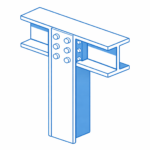
Structural steel I-beam bolted connection with column in isometric view.

Structural drafting in Sydney is often treated as a documentation exercise โ€” but in reality, it sits at the critical junction between design intent and construction reality.

At Hamilton By Design, we approach structural drafting as an engineering-led process, not just linework. By combining 3D LiDAR scanning, SolidWorks modelling, and practical site experience, we ensure drawings reflect what is actually built โ€” not what was assumed.


Why Structural Drafting Matters in Sydney

Sydney presents unique challenges:

  • Dense urban environments
  • Brownfield upgrades and legacy infrastructure
  • Tight construction tolerances
  • Multi-disciplinary coordination (mechanical, civil, structural)

Traditional drafting methods often rely on:

  • Outdated drawings
  • Manual measurements
  • Assumptions based on design models

This creates risk.


3D LiDAR scanning and 3D modelling service button โ€” laser scanner capturing a point cloud for engineering and CAD modelling
Mechanical engineering services

The Problem with Traditional Drafting

In many projects, structural drawings are created without verifying real-world conditions. This leads to:

  • Misaligned steelwork
  • Rework on-site
  • Fabrication errors
  • Cost overruns
  • Delays during installation

The issue is simple:
Design models โ‰  As-built reality


Our Approach: Scan โ†’ Model โ†’ Detail

We solve this using an engineering-grade workflow:

1. 3D Laser Scanning (LiDAR)

Using FARO terrestrial scanners, we capture accurate site geometry:

  • Steel structures
  • Concrete interfaces
  • Existing services
  • Connection points

Deliverables:

  • Registered point clouds (.E57, .RCP)
  • Full site coverage with traceable accuracy

2. Point Cloud to CAD Modelling

We convert reality into usable engineering models:

  • Clean, simplified geometry
  • Fabrication-ready references
  • Clash-aware modelling

3. Structural Drafting & Detailing

We produce:

  • GA drawings
  • Shop drawings
  • Sections and elevations
  • Connection details
  • Platework and steel member detailing

All drawings are structured for:

  • Fabrication
  • Installation
  • Compliance

Why Engineering-Led Drafting Wins

Most drafting services are CAD-driven.
We are engineering-driven.

This means:

  • Load paths are understood
  • Connections are practical
  • Fabrication methods are considered
  • Site constraints are built into the design

Sydney Project Applications

Our structural drafting services are ideal for:

  • Industrial plants
  • Mining infrastructure
  • Structural upgrades
  • Conveyor systems and transfer stations
  • Platforms, walkways, and access systems
  • Retrofit steelwork in existing buildings

The Role of Digital Engineering & Governance

By integrating with the 3DEXPERIENCE platform, we provide:

  • Version-controlled drawings
  • Full revision history
  • Chain of custody for engineering data
  • 24/7 access for stakeholders

This ensures:

  • One source of truth
  • Reduced miscommunication
  • Audit-ready documentation

Key Benefits

  • Reduced rework and site delays
  • Accurate fabrication first time
  • Faster project delivery
  • Improved safety and compliance
  • Better coordination across disciplines

Hamilton By Design logo displayed on a blue tilted rectangle with a grey gradient background

Hamilton By Design

Structural drafting in Sydney should not rely on guesswork.

By combining:

  • Reality capture (LiDAR scanning)
  • Engineering modelling
  • Practical drafting experience

Hamilton By Design delivers drawings that match reality โ€” not assumptions.


Industries We Support

Our structural drafting services support manufacturing facilities, industrial plants, commercial buildings, rail infrastructure, water treatment facilities and resource sector projects throughout Sydney.

Hamilton By Design prepares structural steel drawings, fabrication details, general arrangement drawings and as-built documentation to support construction, maintenance and asset improvement projects.

Hamilton By Design provides structural drafting services throughout Sydney CBD, Parramatta, Liverpool, Penrith, Chatswood, Alexandria, Mascot, Newcastle and the Central Coast. We prepare structural steel drawings, fabrication details, general arrangement drawings and as-built documentation for industrial, infrastructure and commercial projects.


Call to Action

If your project requires accurate, buildable structural drawings, contact:

Hamilton By Design
Engineering-led drafting and 3D scanning services across Sydney

Our clients

3D CAD Modelling Australia service banner for Hamilton By Design

Talk to Us – Contact Us

Name
Would you like us to arrange a phone consultation for you?
Address
3D Scanning Sydney banner promoting engineering-grade 3D laser scanning, LiDAR scanning, and reality capture services by Hamilton By Design.
Mechanical Engineering Sydney banner with white text on a blue background representing Hamilton By Design's mechanical engineering services in Sydney.
Mechanical Drafting and 3D Modelling Sydney banner highlighting Hamilton By Design's CAD drafting, 3D modelling, and engineering design services in Sydney.


Mechanical Engineering | Structural Engineering


Hamilton By Design provides engineering-led 3D scanning, LiDAR scanning, mechanical engineering and digital engineering services throughout Sydney and Greater Sydney.

Explore our related Sydney services:


  • 3D Scanning Sydney โ€“ Engineering-grade terrestrial laser scanning, as-built surveys and point cloud capture for industrial, infrastructure and commercial projects.
  • Reality Capture Sydney โ€“ High-accuracy reality capture, digital twins, asset documentation and engineering-grade site verification.
  • Scan to CAD Sydney โ€“ Convert point cloud data into AutoCAD, SolidWorks, Inventor and other engineering-ready CAD deliverables.
  • Point Cloud Modelling Sydney โ€“ Engineering-grade point cloud processing, clash detection, as-built verification and 3D modelling.
  • Mechanical Engineering Sydney โ€“ Mechanical design, plant upgrades, materials handling systems, conveyors, chutes, platforms and engineering support.
  • Structural Drafting Sydney โ€“ Structural steel drafting, fabrication drawings, GA drawings, workshop detailing and as-built documentation.

Hamilton By Design supports projects throughout Sydney CBD, Parramatta, Liverpool, Penrith, Blacktown, Chatswood, Alexandria, Mascot, Newcastle and the Central Coast.


Blue banner graphic displaying the text "Point Cloud to CAD - Australia" in large white lettering, representing point cloud processing, scan-to-CAD conversion and digital engineering services across Australia.
Blue banner graphic displaying the text "Scan to CAD Sydney" in large white lettering, representing engineering-led point cloud to CAD conversion, LiDAR scanning and digital engineering services in Sydney.
Blue banner graphic displaying the text "Reality Capture Sydney - CBD" in large white lettering, representing engineering-led reality capture, LiDAR scanning and digital engineering services within Sydney CBD commercial buildings and infrastructure.

Weโ€™re Getting It Wrong on Site (And Itโ€™s Costing More Than You Think)

Engineering-grade 3D laser scanner capturing Sydney industrial plant with point cloud overlay transitioning into CAD model

Thereโ€™s a problem happening on projects across Australia right now:

Design says one thing. Site builds another.

And no one realises until itโ€™s too late.


The Real Issue: Miscommunication Between Design and Build

Itโ€™s not that people arenโ€™t doing their job.

Itโ€™s that the information theyโ€™re working from isnโ€™t aligned.

  • Drawings donโ€™t reflect reality
  • Existing plant conditions are assumed, not verified
  • Fabrication is based on outdated or incomplete data
  • Site modifications happen on the fly

๐Ÿ‘‰ The result?

  • Rework
  • Delays
  • Cost blowouts
  • Frustrated teams

This is where most projects quietly bleed money.


3D LiDAR scanning and 3D modelling service button โ€” laser scanner capturing a point cloud for engineering and CAD modelling
Mechanical engineering services

โ€œWe Thought It Would Fitโ€ฆโ€ โ€” The Most Expensive Words on Site

If youโ€™ve ever heard:

  • โ€œThatโ€™s not what we expected on siteโ€
  • โ€œWeโ€™ll just make it workโ€
  • โ€œCan we modify it during install?โ€

Youโ€™re already in reactive mode.

And reactive mode is where projects lose control.


So What Are the Best 3D Scanning Platforms to Fix This?

Letโ€™s be clear:

๐Ÿ‘‰ Itโ€™s not just about the scanner
๐Ÿ‘‰ Itโ€™s about how the data is captured, interpreted, and delivered

But hereโ€™s how the platforms stack up in the real world:


1. FARO Focus (Engineering-Grade Reality Capture)

โœ” High accuracy (millimetre-level)
โœ” Ideal for brownfield industrial environments
โœ” Reliable for mechanical design, pipework, and structural interfaces

๐Ÿ’ก This is where engineering-led scanning matters

Anyone can scan.
Not everyone understands line-of-sight constraints, coverage, and design intent.


2. Leica RTC360 (Speed + Visualisation)

โœ” Fast capture and good for large areas
โœ” Strong visual workflows
โœ” Great for general site documentation

โš  But without engineering oversight, you still risk:

  • Missing critical geometry
  • Poor scan coverage
  • Misalignment with fabrication requirements

3. NavVis / Mobile Scanning (Speed Over Precision)

โœ” Rapid walkthrough capture
โœ” Useful for high-level coordination

โš  Not suitable for:

  • Fabrication-level accuracy
  • Mechanical interfaces
  • Detailed engineering design

The Truth Most People Miss

The platform doesnโ€™t fix the problem.

๐Ÿ‘‰ Engineering-led scanning does.


Why Engineering-Led Scanning Changes Everything

At Hamilton By Design, we donโ€™t just โ€œscan a siteโ€.

We capture it like engineers who have to design and build from it.

That means:

  • Understanding what needs to be modelled โ€” and what doesnโ€™t
  • Managing line-of-sight to eliminate data gaps
  • Delivering point clouds that actually support design decisions
  • Producing models and drawings that match real-world conditions

From Scan โ†’ Model โ†’ Build (No Guesswork)

When done properly, 3D scanning becomes:

โœ” A single source of truth
โœ” A digital twin of your site
โœ” A way to align design, fabrication, and installation

No assumptions.
No โ€œweโ€™ll fix it on siteโ€.
No disconnect.


If Youโ€™re Getting It Wrong on Site โ€” This Is Why

Itโ€™s not your team.

Itโ€™s the gap between:

๐Ÿ‘‰ What was designed
๐Ÿ‘‰ And what actually exists


Fix the Gap โ€” Not the Symptoms

If youโ€™re serious about reducing rework, delays, and cost blowouts:

๐Ÿ‘‰ Start with accurate, engineering-grade site data


Learn More

Explore how we deliver engineering-led 3D scanning in Sydney:


Name
Would you like us to arrange a phone consultation for you?
Address

3D CAD Modelling Australia service banner for Hamilton By Design

Mechanical Engineering | Structural Engineering


3D LiDAR Scanning Darwin for engineering surveys, laser scanning, reality capture and point cloud modelling services
3D LiDAR Scanning Australia engineering services for laser scanning, reality capture, scan-to-CAD, Scan-to-BIM and as-built documentation across Australia
3D LiDAR scanning services on the Central Coast providing engineering-grade laser scanning, point cloud capture, scan-to-CAD modelling and industrial reality capture for infrastructure and industrial projects.