Engineering-Grade LiDAR Scanning vs Scan-as-You-Walk Systems

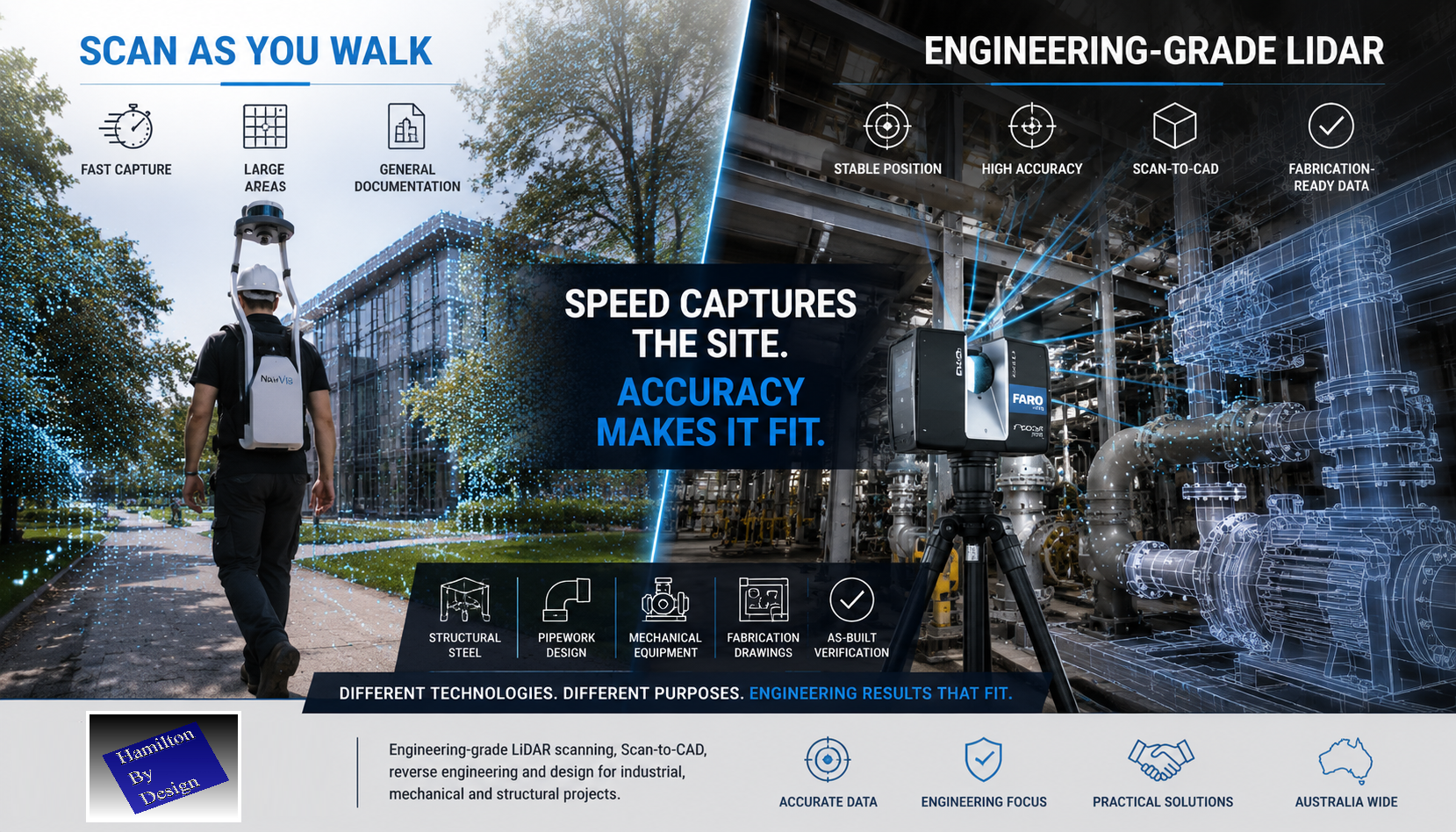
Split-screen comparison of mobile LiDAR scanning and engineering-grade terrestrial laser scanning. The left side shows a wearable scan-as-you-walk LiDAR system capturing a large outdoor environment, while the right side shows a tripod-mounted laser scanner capturing structural steel, pipework and mechanical equipment in an industrial facility. The image highlights the message: "Speed Captures the Site. Accuracy Makes It Fit."

Why Scanner Stability Matters When Accuracy Matters

LiDAR stands for Light Detection and Ranging. It uses laser light to measure distance and create a 3D digital representation of the real world.

But in engineering, the distance measurement is only part of the story.

To produce reliable design, drafting and fabrication data, the scanner also needs to know exactly where it was positioned, how it was orientated, and how every measurement relates to the rest of the site.

That is why stable, engineering-grade scanning matters.


Scan as You Walk Has Its Place

Walk-through LiDAR systems such as NavVis-style mobile scanners are impressive technologies. They allow an operator to move through an environment while capturing large volumes of spatial data quickly.

For some applications, this is a major advantage.

Scan-as-you-walk systems can be useful for:

  • Facility documentation
  • Asset walkthroughs
  • Digital tours
  • Large building capture
  • Universities
  • Shopping centres
  • Hospitals
  • National parks
  • General spatial records

If the objective is to document a large area quickly, mobile scanning can be a practical solution.

But speed is not the same as engineering certainty.


Engineering Accuracy Requires More Than Walking Through a Site

When a scanner is moving, the system must continuously calculate:

  • where the scanner is located
  • which direction it is facing
  • how fast it is moving
  • how it is rotating
  • how each scan position connects to the next

This is normally achieved using SLAM, cameras, IMUs and software-based positioning.

These systems are powerful, but they can still be affected by drift, movement, poor geometry, reflective surfaces, repetitive structures and weak reference points.

In engineering, small errors can become expensive problems.

A point cloud may look good on screen, but that does not always mean it is suitable for mechanical design, structural detailing or fabrication.


Why Hamilton By Design Uses FARO Focus Technology

At Hamilton By Design, we use FARO Focus terrestrial laser scanning for engineering-grade reality capture.

The FARO Focus scanner is set up on a stable tripod position. It captures high-density scan data from fixed locations, allowing the point cloud to be registered, checked and used for design work with confidence.

This approach is slower than simply walking through a site, but it provides the quality of data required for engineering deliverables.

We use FARO scanning for:

  • Scan-to-CAD
  • Reverse engineering
  • Mechanical design
  • Structural steel modelling
  • Pipework layouts
  • Fabrication drawings
  • As-built documentation
  • Clash detection
  • Plant room scanning
  • Industrial site verification
  • Shutdown planning

When structural steel needs to fit, pipework needs to align and fabricated components need to be manufactured from the captured data, accuracy matters.


The Difference Is the Final Outcome

A walk-through scan may be suitable when the purpose is general documentation.

A FARO Focus scan is more suitable when the data will be used to design, manufacture, install or verify engineered components.

That difference matters.

If the objective is to walk through a national park, a mobile scanner may be the right tool.

If the objective is to make sure structural beams, pipe spools, platforms, chutes, hoppers or mechanical components fit together correctly, then engineering-grade LiDAR scanning is the safer choice.

Because when the fabrication team arrives on site, the steel either fits or it does not.


Real-World Engineering Experience

Hamilton By Design is often asked to revisit sites where previous scan data was not suitable for engineering use.

In recent weeks, we have been requested multiple times to rescan building and industrial sites after earlier walk-through scanning did not provide the level of accuracy or detail required for design and drafting.

This does not mean mobile scanning is wrong.

It means the scanning method must match the intended use.

For general site capture, speed may be the priority.

For engineering, fabrication and installation, accuracy must come first.


LiDAR Measures Distance. Engineering Requires Position Certainty.

LiDAR uses light to measure distance.

However, engineering-grade point clouds require more than distance. They require confidence in the scanner position, orientation, registration and final geometry.

A simple way to explain it is this:

A tape measure may be accurate, but if you do not know exactly where the measurement started, the result can still be wrong.

The same applies to LiDAR scanning.

The laser may measure accurately, but if the scanner position is uncertain, the final point cloud may not be suitable for engineering work.


Where FARO Focus Scanning Adds Value

Hamilton By Design provides engineering-led LiDAR scanning for clients who need usable design data, not just a visual point cloud.

Our scanning and modelling services support:

  • Industrial plants
  • Mechanical rooms
  • Processing facilities
  • Mining infrastructure
  • Conveyor systems
  • Structural platforms
  • Pipework and services
  • Equipment layouts
  • Existing buildings
  • Brownfield modification projects

We do not just scan the site.

We understand how the scan data will be used in design, drafting, fabrication and installation.

That engineering understanding is what makes the difference.


Engineering-Grade Deliverables

Depending on the project requirements, Hamilton By Design can provide:

  • Registered point clouds
  • E57 files
  • RCP / RCS files
  • Scan-to-CAD models
  • AutoCAD drawings
  • SolidWorks models
  • Inventor models
  • STEP / SAT / Parasolid files
  • General arrangement drawings
  • Sections and elevations
  • Fabrication drawings
  • As-built verification models

Our focus is to provide practical engineering information that can be used by designers, fabricators, builders, installers and asset owners.


Choose the Right Scanner for the Right Job

Scan-as-you-walk systems are fast and useful for many documentation tasks.

FARO Focus scanning is better suited to engineering-grade work where accuracy, registration and point cloud quality are critical.

At Hamilton By Design, we believe the technology should be selected based on the outcome required.

If you need to document a large space quickly, mobile scanning may be suitable.

If you need structural steel, pipework or mechanical components to fit together first time, FARO Focus scanning is hard to go past.


Hamilton By Design โ€“ Engineering-Led LiDAR Scanning

Hamilton By Design provides engineering-grade LiDAR scanning, Scan-to-CAD, reverse engineering, mechanical drafting and structural design support across Australia.

We combine reality capture with practical engineering experience to help clients move from existing site conditions to accurate design and fabrication deliverables.

For industrial, mechanical and structural projects, the question is not just how fast the site can be scanned.

The real question is:

Can the scan data be trusted when it is time to design, fabricate and install?

That is where engineering-grade LiDAR scanning matters.

3D LiDAR scanning and 3D modelling services button
Mechanical engineering services
Building and construction services button
Hamilton By Design logo displayed on a blue tilted rectangle with a grey gradient background

Would you like to know more ?

Contact Us – Talk to Us

Name
Would you like us to arrange a phone consultation for you?
Address

Our Clients
3D LiDAR scanning and 3D modelling service button โ€” laser scanner capturing a point cloud for engineering and CAD modelling
Mechanical engineering services

3D Scanning Sydney banner promoting engineering-grade 3D laser scanning, LiDAR scanning, and reality capture services by Hamilton By Design.
Mechanical Engineering Sydney banner with white text on a blue background representing Hamilton By Design's mechanical engineering services in Sydney.
Mechanical Drafting and 3D Modelling Sydney banner highlighting Hamilton By Design's CAD drafting, 3D modelling, and engineering design services in Sydney.
Blue banner graphic displaying the text "Point Cloud to CAD - Australia" in large white lettering, representing point cloud processing, scan-to-CAD conversion and digital engineering services across Australia.
Blue banner graphic displaying the text "Scan to CAD Sydney" in large white lettering, representing engineering-led point cloud to CAD conversion, LiDAR scanning and digital engineering services in Sydney.
Blue banner graphic displaying the text "Reality Capture Sydney - CBD" in large white lettering, representing engineering-led reality capture, LiDAR scanning and digital engineering services within Sydney CBD commercial buildings and infrastructure.

Scan-to-CAD vs Traditional Design Workflows | Which Approach Delivers Better Engineering Outcomes?

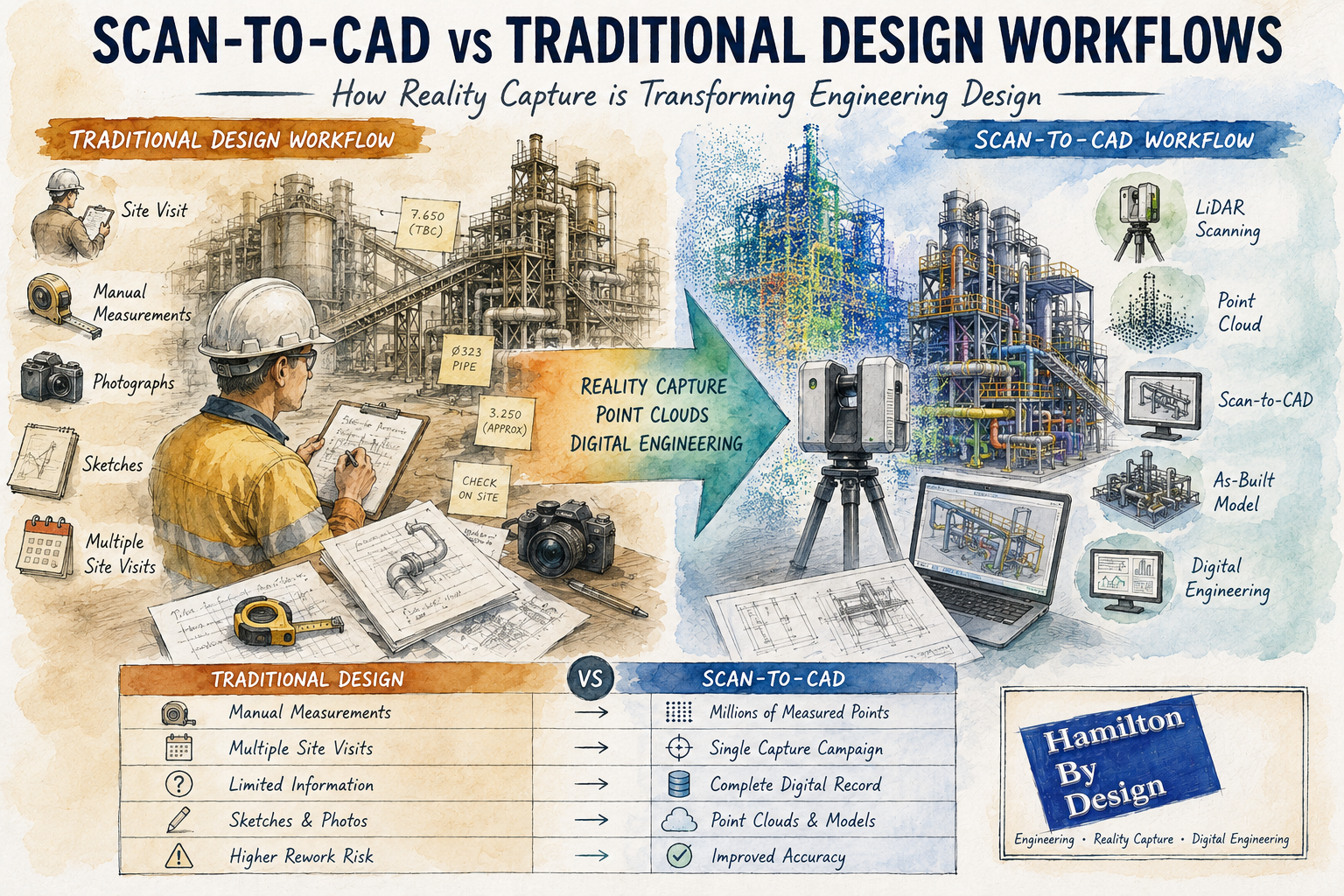
Scan-to-CAD vs traditional design workflows infographic showing LiDAR scanning, point cloud modelling, reality capture and digital engineering for industrial plant design and as-built documentation.

Scan-to-CAD vs Traditional Design Workflows: How Reality Capture is Transforming Engineering Design

For decades, engineering and drafting companies have relied on traditional design workflows to create new assets, modify existing facilities and develop construction documentation. These methods typically involve site visits, manual measurements, photographs, sketches and extensive assumptions about existing conditions.

While traditional design processes have successfully delivered countless projects, modern reality capture technologies are changing how engineering data is collected and utilised.

The introduction of terrestrial LiDAR scanning, engineering-grade reality capture and point cloud modelling has given design companies access to highly accurate representations of existing facilities. Rather than starting with assumptions and limited measurements, engineers can now begin with a digital copy of reality.

This approach is commonly known as Scan-to-CAD.

At Hamilton By Design, we have seen first-hand how Scan-to-CAD workflows can improve project accuracy, reduce site visits and provide better information for engineering decision-making. However, traditional design methods still have an important role to play.

The key is understanding where each approach provides the greatest value.


What is a Traditional Design Workflow?

Traditional design workflows generally begin with a site inspection and manual data collection process.

An engineer, designer or draftsperson visits the facility and records information such as:

  • Dimensions
  • Levels
  • Equipment locations
  • Structural arrangements
  • Pipe routing
  • Building layouts
  • Photographs
  • Sketches

The collected information is then used to develop drawings and 3D models.

A typical workflow may include:

  1. Site visit
  2. Manual measurements
  3. Photographic survey
  4. Sketch preparation
  5. CAD model creation
  6. Design development
  7. Drawing production
  8. Construction issue

This process has been the backbone of engineering design for many years.


Challenges with Traditional Design Methods

Although effective, traditional workflows present several challenges.

Limited Data Collection

No matter how experienced the survey team is, it is impossible to measure everything.

Often only dimensions considered important at the time are collected.

If additional information is required later, another site visit may be necessary.

Human Error

Manual measurements introduce opportunities for error.

Common issues include:

  • Incorrect dimensions
  • Missed measurements
  • Recording errors
  • Inconsistent datum references

These errors can propagate throughout the project.

Access Restrictions

Industrial facilities often contain:

  • Confined spaces
  • Elevated structures
  • Operational equipment
  • Hazardous environments

Obtaining measurements in these areas can be difficult and expensive.

Multiple Site Visits

Many projects require repeated visits to verify dimensions and resolve discrepancies.

This increases:

  • Project costs
  • Travel expenses
  • Programme duration

What is Scan-to-CAD?

Scan-to-CAD is the process of using reality capture technologies to create engineering drawings and models.

The workflow begins with a terrestrial LiDAR scan of the facility.

Millions or billions of measured points are captured to create a highly detailed point cloud.

The point cloud then becomes the foundation for:

  • CAD models
  • BIM models
  • General arrangement drawings
  • Structural models
  • Pipework layouts
  • Reverse engineering projects
  • Asset documentation

Rather than manually measuring selected features, Scan-to-CAD captures the entire environment.


How Scan-to-CAD Works

Step 1 โ€“ Reality Capture

A LiDAR scanner records the existing facility.

This may include:

  • Buildings
  • Process plants
  • Pipework
  • Conveyors
  • Tanks
  • Structural steel
  • Mechanical equipment

Step 2 โ€“ Point Cloud Registration

Individual scans are combined into a unified coordinate system.

The result is a complete digital representation of the site.

Step 3 โ€“ Engineering Review

Engineers review the point cloud and determine project requirements.

Step 4 โ€“ CAD Modelling

Relevant assets are modelled from the point cloud.

Outputs may include:

  • 2D drawings
  • 3D CAD models
  • BIM models
  • Fabrication drawings
  • Construction documentation

Step 5 โ€“ Design Development

The design team develops modifications directly against existing conditions.


Comparing Scan-to-CAD and Traditional Design Workflows

Accuracy

Traditional Workflow

Accuracy depends on:

  • Measurement methods
  • Survey coverage
  • Site conditions
  • Human interpretation

Typically, only selected dimensions are recorded.

Scan-to-CAD

Millions of measured points create a detailed digital representation.

Engineering-grade terrestrial LiDAR scanning can provide highly accurate spatial information across entire facilities.

Winner: Scan-to-CAD


Site Time

Traditional Workflow

Complex facilities may require several site visits.

Scan-to-CAD

Most information is captured during a single scanning campaign.

Winner: Scan-to-CAD


Data Availability

Traditional Workflow

Only measured dimensions are available.

Scan-to-CAD

The entire captured environment remains available for future reference.

Winner: Scan-to-CAD


Upfront Cost

Traditional Workflow

Lower initial survey costs.

Scan-to-CAD

Requires specialised scanning equipment and processing.

Winner: Traditional Workflow


Long-Term Value

Traditional Workflow

Information is often project-specific.

Scan-to-CAD

Point clouds become long-term digital assets.

Winner: Scan-to-CAD


Why Design Companies Are Adopting Scan-to-CAD

Increasingly, engineering consultancies and drafting companies are integrating reality capture into their workflows.

Benefits include:

Reduced Rework

Designs can be developed against actual site conditions.

Improved Clash Detection

Existing assets can be modelled accurately.

Better Stakeholder Communication

Point clouds and digital models improve project visualisation.

Enhanced Project Planning

Engineers can assess access and constructability earlier.

Faster Design Iterations

Additional measurements are often available without returning to site.


Applications Across Industries

Mining

Mining facilities contain extensive:

  • Conveyors
  • Chutes
  • Crushers
  • Tanks
  • Pipework

Scan-to-CAD can significantly improve brownfield modification projects.

Manufacturing

Production facilities frequently evolve over time.

Reality capture provides accurate documentation of current conditions.

Water and Wastewater

Pump stations and treatment plants often contain complex mechanical layouts.

Scan-to-CAD improves upgrade planning and documentation.

Commercial Buildings

Architects and engineers can generate accurate as-built documentation.

Energy

Power stations and industrial utilities benefit from detailed digital asset records.


When Traditional Workflows Still Make Sense

Despite the advantages of reality capture, traditional methods remain valuable.

Examples include:

Concept Design

Early-stage feasibility studies may not require detailed site data.

Greenfield Projects

When designing on vacant land, no existing assets exist to scan.

Small Modifications

Minor changes may not justify scanning costs.

Budget-Constrained Projects

Some projects require a lower-cost approach.

The most successful engineering organisations understand that both approaches have their place.


The Rise of AI-Assisted Scan-to-CAD

Artificial Intelligence is introducing new capabilities into reality capture workflows.

Emerging technologies can:

  • Identify pipework
  • Classify equipment
  • Recognise structural steel
  • Generate preliminary BIM models
  • Accelerate modelling workflows

Although engineering verification remains essential, AI-assisted modelling is expected to become increasingly common.


Digital Twins and Future Design Workflows

The future of engineering design is likely to combine:

  • Reality capture
  • Scan-to-CAD
  • Scan-to-BIM
  • Digital twins
  • Artificial intelligence
  • Cloud collaboration

Rather than creating drawings from limited measurements, engineering teams will increasingly work from comprehensive digital representations of existing assets.

This shift has the potential to improve project quality, reduce risk and accelerate project delivery.


How Hamilton By Design Supports Scan-to-CAD Projects

Hamilton By Design provides engineering-led reality capture and Scan-to-CAD services throughout Australia.

Our capabilities include:

  • Terrestrial LiDAR scanning
  • Engineering-grade reality capture
  • Point cloud registration
  • Scan-to-CAD
  • Scan-to-BIM
  • Reverse engineering
  • Mechanical design
  • Structural drafting
  • Asset documentation
  • Digital engineering support

We work across:

  • Mining
  • Manufacturing
  • Infrastructure
  • Energy
  • Commercial buildings
  • Water and wastewater

Our approach combines practical engineering experience with modern reality capture technology to deliver accurate and usable engineering information.


Hamilton By Design logo displayed on a blue tilted rectangle with a grey gradient background

Traditional design workflows have served the engineering industry well for decades and continue to play an important role in many projects.

However, the emergence of Scan-to-CAD workflows has fundamentally changed how existing facilities can be documented and modelled.

By capturing measured reality rather than relying solely on manual measurements, engineering teams gain access to more complete information, improved accuracy and greater flexibility throughout the design process.

For brownfield projects, industrial facilities and complex infrastructure, Scan-to-CAD is increasingly becoming the preferred method for developing accurate engineering deliverables.

Rather than replacing traditional design workflows, reality capture enhances them, providing engineers and designers with a richer foundation from which to make informed decisions.


Frequently Asked Questions (FAQ)

What is Scan-to-CAD?

Scan-to-CAD is the process of converting LiDAR scan data or point clouds into CAD drawings and 3D models. It allows engineers to develop designs using accurate representations of existing assets.

How accurate is Scan-to-CAD?

Accuracy depends on the scanning equipment and workflow used. Engineering-grade terrestrial LiDAR scanning can provide highly accurate spatial information suitable for engineering and drafting applications.

What industries benefit most from Scan-to-CAD?

Mining, manufacturing, infrastructure, energy, commercial buildings, water treatment facilities and industrial processing plants all benefit from Scan-to-CAD workflows.

Is Scan-to-CAD better than traditional surveying?

Both approaches have value. Scan-to-CAD generally provides more comprehensive site information, while traditional surveying may be appropriate for smaller or less complex projects.

Can point clouds be used directly in CAD software?

Yes. Many CAD platforms can reference point cloud data directly, allowing engineers to model against real-world measurements.

What is the difference between Scan-to-CAD and Scan-to-BIM?

Scan-to-CAD focuses on creating engineering drawings and CAD models, while Scan-to-BIM creates Building Information Models containing both geometry and asset information.

Does Scan-to-CAD reduce site visits?

In many cases, yes. Capturing comprehensive scan data can significantly reduce the need for repeat measurement visits.

Can AI automatically create CAD models from point clouds?

AI-assisted modelling tools are becoming increasingly capable, but engineering review and verification remain essential for accurate project outcomes.

What deliverables can be produced from a Scan-to-CAD project?

Deliverables may include point clouds, CAD models, BIM models, fabrication drawings, as-built drawings, general arrangement drawings and digital twin models.

Why choose Hamilton By Design for Scan-to-CAD projects?

Hamilton By Design combines engineering-led reality capture, practical industry experience and advanced digital engineering workflows to deliver accurate and usable engineering information for industrial and infrastructure projects throughout Australia.


Mechanical Engineering | Structural Engineering


3D LiDAR Scanning Darwin for engineering surveys, laser scanning, reality capture and point cloud modelling services
3D LiDAR Scanning Australia engineering services for laser scanning, reality capture, scan-to-CAD, Scan-to-BIM and as-built documentation across Australia
3D LiDAR scanning services on the Central Coast providing engineering-grade laser scanning, point cloud capture, scan-to-CAD modelling and industrial reality capture for infrastructure and industrial projects.
3D LiDAR Scanning Perth for engineering surveys, laser scanning, reality capture and point cloud modelling services
3D LiDAR Scanning Sydney for engineering surveys, laser scanning, reality capture and point cloud modelling services
3D LiDAR Scanning Brisbane for engineering surveys, laser scanning, reality capture and point cloud modelling services
3D LiDAR Scanning Canberra for engineering surveys, laser scanning, reality capture and point cloud modelling services
3D LiDAR Scanning Newcastle for engineering surveys, laser scanning, reality capture and point cloud modelling services
3D LiDAR Scanning Adelaide for engineering surveys, laser scanning, reality capture and point cloud modelling services

Automated Object Recognition from Point Clouds | AI-Assisted Scan-to-BIM Workflows

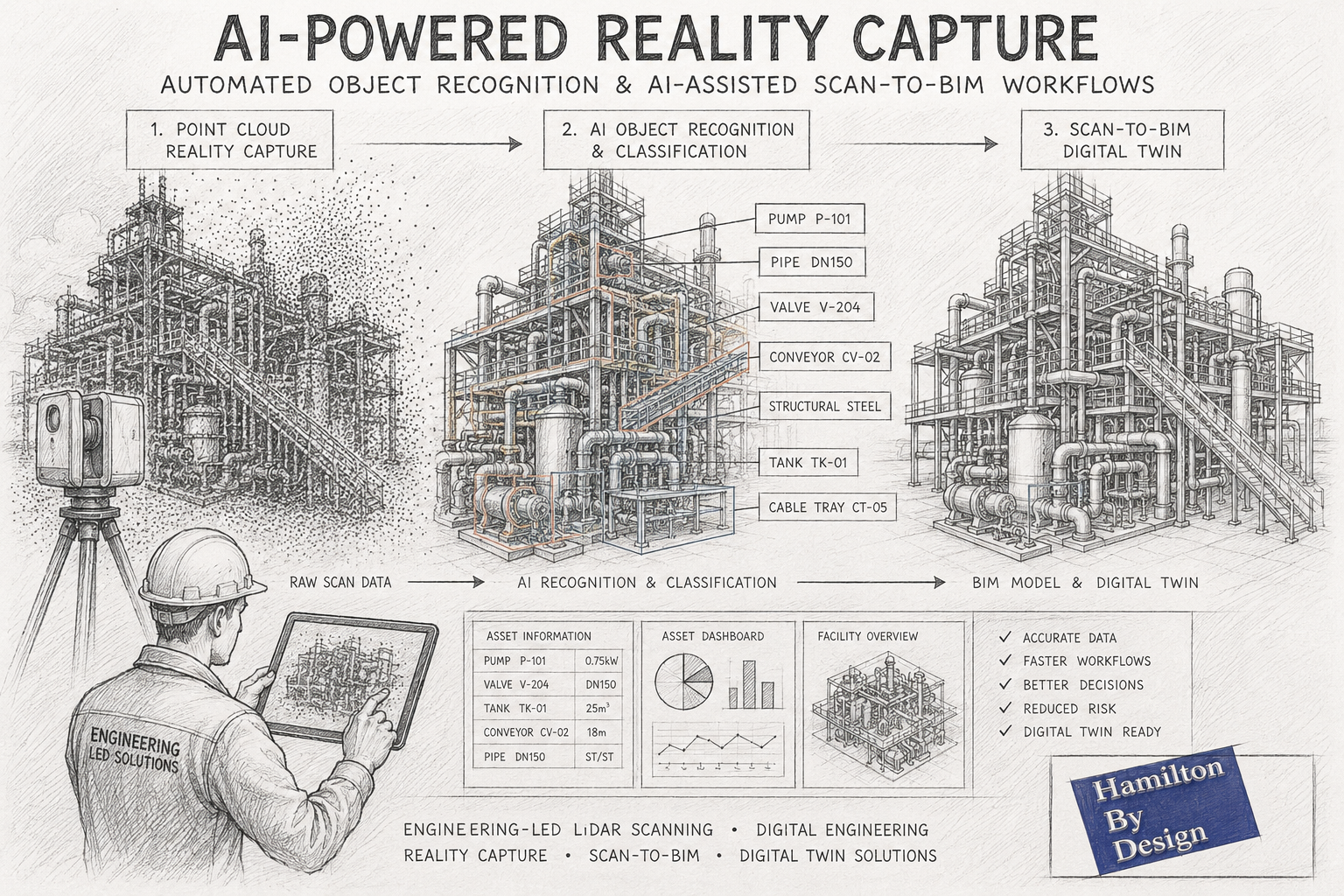
AI-assisted Scan-to-BIM workflow illustrated as a pencil sketch showing an industrial processing plant progressing from LiDAR point cloud capture through automated object recognition to a completed BIM digital twin model.

Automated Object Recognition from Point Clouds and AI-Assisted Scan-to-BIM Workflows

How Artificial Intelligence is Transforming Reality Capture and Digital Engineering

The reality capture industry is experiencing a significant transformation. While terrestrial LiDAR scanning, laser scanning and photogrammetry have been widely adopted across mining, manufacturing, construction and infrastructure sectors for many years, the emergence of Artificial Intelligence (AI) is fundamentally changing how point cloud data is processed and utilised.

Traditionally, converting a point cloud into useful engineering information required substantial manual effort. Engineers, designers and BIM technicians would spend hundreds of hours identifying equipment, tracing pipework, modelling structures and generating asset information from raw scan data.

Today, advances in automated object recognition and AI-assisted Scan-to-BIM workflows are reducing these manual processes and opening new opportunities for asset owners, engineering consultants and project teams.

At Hamilton By Design, we continue to monitor and evaluate emerging AI technologies while combining them with engineering-led reality capture workflows to deliver practical outcomes for industrial and infrastructure projects throughout Australia.


What is Automated Object Recognition?

Automated object recognition refers to the ability of software systems to identify and classify objects within a point cloud automatically.

Instead of manually examining millions or billions of points, AI algorithms analyse geometric patterns, spatial relationships, colours and textures to determine what each object represents.

For example, AI systems may automatically identify:

  • Structural steel members
  • Pipework systems
  • Valves
  • Pumps
  • Conveyors
  • Electrical equipment
  • Cable trays
  • Tanks and vessels
  • Building columns
  • Walls and floors
  • Doors and windows
  • Handrails and platforms
  • Mechanical equipment

The objective is to transform unstructured point cloud data into structured engineering information.

This allows project teams to move from raw scan data to usable digital assets much faster than traditional modelling methods.


Understanding Point Clouds

A point cloud is a collection of millions or billions of measured points captured using:

  • Terrestrial LiDAR scanners
  • Mobile mapping systems
  • Drone LiDAR systems
  • Photogrammetry
  • Structured light scanners
  • Handheld scanning systems

Each point contains spatial coordinates representing a physical location in the real world.

Modern scanners can capture:

  • Plant rooms
  • Industrial facilities
  • Processing plants
  • Mining infrastructure
  • Commercial buildings
  • Manufacturing equipment
  • Transport infrastructure
  • Refineries and smelters

The challenge has never been collecting data.

The challenge is turning that data into engineering information.

This is where AI is beginning to provide significant value.


Why Traditional Point Cloud Processing is Time Consuming

Historically, engineering teams have relied on manual modelling workflows.

A typical process might involve:

  1. Capturing scan data
  2. Registering point clouds
  3. Cleaning noise
  4. Importing into CAD or BIM software
  5. Identifying equipment manually
  6. Modelling structures
  7. Modelling pipework
  8. Generating asset information
  9. Producing drawings and deliverables

For complex facilities such as mines, smelters, power stations and manufacturing plants, this work can require hundreds or even thousands of engineering hours.

Although highly accurate, these workflows can be expensive and time intensive.


How AI is Changing Reality Capture

Artificial Intelligence is introducing a new layer of automation.

Modern AI systems can learn from vast datasets of industrial and architectural objects.

Rather than simply displaying a point cloud, AI attempts to understand what the data represents.

Examples include:

Pipe Recognition

AI algorithms can automatically identify cylindrical features and classify them as pipework.

Software can estimate:

  • Pipe centre lines
  • Pipe diameters
  • Connections
  • Elbows
  • Tees
  • Reducers

Structural Steel Recognition

Machine learning systems can identify:

  • Universal beams
  • Columns
  • Channels
  • Angles
  • Bracing members

This can accelerate structural modelling workflows.

Equipment Classification

AI systems are increasingly capable of identifying:

  • Pumps
  • Motors
  • Gearboxes
  • Tanks
  • Vessels
  • Heat exchangers

Although verification is still required, the process can dramatically reduce manual modelling time.

Building Element Recognition

For architectural and BIM applications, AI can automatically detect:

  • Walls
  • Floors
  • Ceilings
  • Doors
  • Windows
  • Roof systems

This enables faster generation of BIM models.


What is AI-Assisted Scan-to-BIM?

Scan-to-BIM is the process of converting reality capture data into Building Information Models.

Traditionally, BIM technicians manually created geometry based on point cloud information.

AI-assisted Scan-to-BIM introduces automated recognition tools that accelerate this process.

The workflow generally follows:

Step 1 โ€“ Reality Capture

A facility is scanned using terrestrial LiDAR technology.

Hamilton By Design typically captures:

  • Industrial facilities
  • Manufacturing plants
  • Mining infrastructure
  • Commercial buildings
  • Mechanical plant rooms
  • Process facilities

Step 2 โ€“ Point Cloud Registration

Individual scans are combined into a single registered dataset.

The result becomes a complete digital representation of the facility.

Step 3 โ€“ AI Object Recognition

Artificial Intelligence analyses the point cloud.

Potential objects are automatically identified and classified.

Step 4 โ€“ BIM Generation

Recognised objects are converted into BIM components.

This may include:

  • Structural members
  • Architectural features
  • Mechanical equipment
  • Pipework
  • Services

Step 5 โ€“ Engineering Verification

Engineers and BIM specialists verify the results.

This remains one of the most important stages.

AI can accelerate workflows, but engineering judgement remains essential.

Step 6 โ€“ Digital Twin Development

The resulting BIM model can support:

  • Asset management
  • Facility upgrades
  • Maintenance planning
  • Shutdown planning
  • Construction sequencing
  • Digital twin initiatives

Applications in Mining and Heavy Industry

Mining operations generate enormous quantities of asset information.

Facilities often contain:

  • Conveyors
  • Crushers
  • Chutes
  • Screens
  • Tanks
  • Pipework
  • Structural steel
  • Electrical infrastructure

AI-assisted recognition has the potential to significantly improve the efficiency of:

Brownfield Modifications

Existing assets can be scanned and classified more rapidly.

Shutdown Planning

Equipment and access areas can be documented more efficiently.

Asset Registers

Physical assets can be linked to digital asset management systems.

Digital Twin Creation

AI can accelerate the development of operational digital twins.

Condition Assessment

Automated recognition may eventually support condition monitoring and defect identification.


Current Limitations of AI Recognition

Despite impressive progress, AI is not yet capable of fully replacing experienced engineers.

Several challenges remain.

Complex Industrial Environments

Industrial facilities contain:

  • Congested pipework
  • Obstructions
  • Corrosion
  • Dust accumulation
  • Non-standard equipment

These conditions can confuse automated systems.

Unique Equipment

Mining and manufacturing plants often contain custom-built equipment.

AI systems trained on generic datasets may struggle to identify these assets accurately.

Data Quality

Recognition performance depends heavily on:

  • Scan quality
  • Resolution
  • Registration accuracy
  • Coverage

Poor quality input data typically produces poor quality output.

Engineering Intent

AI can identify geometry.

Understanding engineering intent remains much more difficult.

An experienced engineer can determine:

  • Why a system was designed a certain way
  • Potential maintenance issues
  • Access requirements
  • Structural concerns
  • Process constraints

This knowledge is difficult to automate.


Why Engineering Expertise Still Matters

At Hamilton By Design, we believe AI should be viewed as an engineering productivity tool rather than a replacement for engineering expertise.

The highest quality outcomes are achieved when:

  • High-quality scan data is captured
  • AI assists with recognition
  • Engineers validate results
  • Designers refine models
  • Project teams apply practical experience

This hybrid approach combines automation with engineering judgement.

For industrial facilities, this remains the most reliable pathway to accurate digital deliverables.


The Future of AI in Reality Capture

Over the next decade we expect to see:

Faster Model Creation

Many routine modelling tasks will become increasingly automated.

Improved Asset Classification

AI systems will recognise a broader range of industrial equipment.

Automated Drawing Generation

Point clouds may eventually generate engineering drawings automatically.

Predictive Asset Management

Digital twins may combine scan data with operational data to predict failures.

Real-Time Facility Updates

Facilities may continuously update digital models as changes occur.

Intelligent Maintenance Planning

AI systems could identify maintenance requirements before failures occur.


How Hamilton By Design Uses Reality Capture Today

Hamilton By Design provides engineering-led reality capture services throughout Australia.

Our services include:

  • Terrestrial LiDAR scanning
  • Engineering-grade reality capture
  • Point cloud registration
  • Scan-to-CAD
  • Scan-to-BIM
  • Reverse engineering
  • Mechanical design
  • Structural modelling
  • Digital engineering support
  • Asset documentation

We work across:

  • Mining
  • Manufacturing
  • Energy
  • Infrastructure
  • Commercial buildings
  • Water and wastewater facilities

Our focus remains on delivering practical engineering outcomes from accurate measured data.

As AI-assisted workflows continue to mature, we expect these technologies to further enhance project efficiency while maintaining the engineering oversight required for complex industrial environments.


Hamilton By Design logo displayed on a blue tilted rectangle with a grey gradient background

Automated object recognition and AI-assisted Scan-to-BIM workflows represent one of the most exciting developments in the reality capture industry.

The ability to automatically identify equipment, classify assets and accelerate BIM creation has the potential to significantly reduce modelling time while improving access to engineering information.

However, successful implementation still depends on high-quality scan data, robust workflows and experienced engineering oversight.

The future of digital engineering is unlikely to be fully manual or fully automated.

Instead, it will combine advanced reality capture technologies, artificial intelligence and practical engineering expertise to create smarter, more efficient project delivery.

For organisations looking to develop accurate digital representations of existing assets, AI-assisted reality capture is rapidly becoming an important part of the engineering toolkit.


Contact Us – Talk to Us

Name
Would you like us to arrange a phone consultation for you?
Address


Mechanical Engineering | Structural Engineering


3D CAD Modelling Australia service banner for Hamilton By Design
Australian Drafting logo featuring bold white text reading "Australian Drafting" centred on a blue rounded rectangle background.
Engineering Governance title graphic featuring bold white text reading "Engineering Governance" centred on a blue rounded rectangle background.
Mechanical, Structural & Pipework Drafting service banner by Hamilton By Design featuring white text on a blue background.
Mechanical engineering services
Blue rounded button with the text โ€œSolidWorks Designโ€ in white.
Finite Element Analysis (FEA) engineering simulation button
3D LiDAR Scanning Darwin for engineering surveys, laser scanning, reality capture and point cloud modelling services
3D LiDAR Scanning Australia engineering services for laser scanning, reality capture, scan-to-CAD, Scan-to-BIM and as-built documentation across Australia
3D LiDAR scanning services on the Central Coast providing engineering-grade laser scanning, point cloud capture, scan-to-CAD modelling and industrial reality capture for infrastructure and industrial projects.
3D LiDAR Scanning Perth for engineering surveys, laser scanning, reality capture and point cloud modelling services
3D LiDAR Scanning Sydney for engineering surveys, laser scanning, reality capture and point cloud modelling services
3D LiDAR Scanning Brisbane for engineering surveys, laser scanning, reality capture and point cloud modelling services
3D LiDAR Scanning Canberra for engineering surveys, laser scanning, reality capture and point cloud modelling services
3D LiDAR Scanning Newcastle for engineering surveys, laser scanning, reality capture and point cloud modelling services
3D LiDAR Scanning Adelaide for engineering surveys, laser scanning, reality capture and point cloud modelling services
3D LiDAR Scanning Darwin for engineering surveys, laser scanning, reality capture and point cloud modelling services
3D LiDAR Scanning Australia engineering services for laser scanning, reality capture, scan-to-CAD, Scan-to-BIM and as-built documentation across Australia
3D LiDAR scanning services on the Central Coast providing engineering-grade laser scanning, point cloud capture, scan-to-CAD modelling and industrial reality capture for infrastructure and industrial projects.

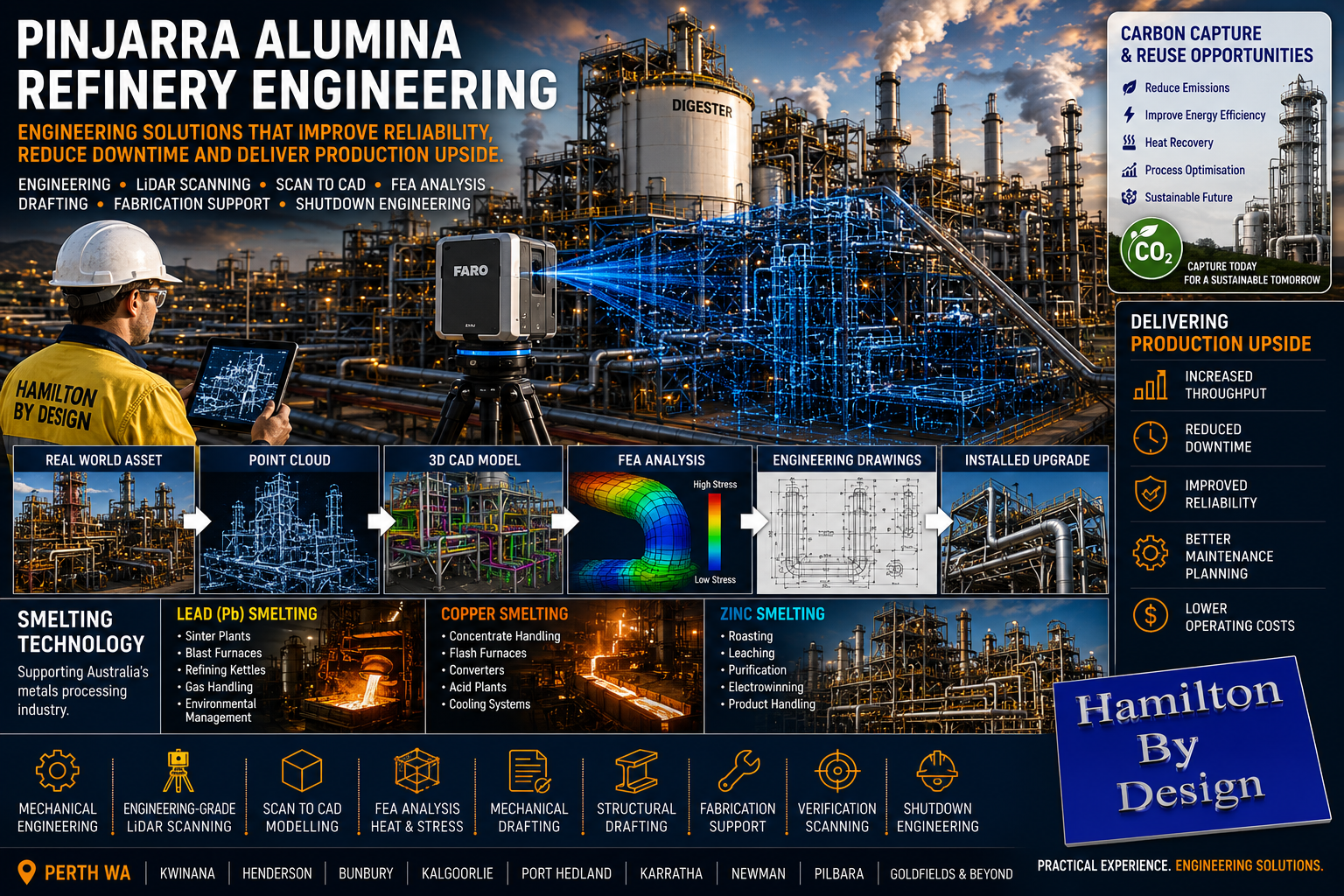
Engineering Support for Pinjarra Alumina Refinery & Smelting Operations

Engineering support for Pinjarra Alumina Refinery featuring LiDAR scanning, Scan to CAD, finite element analysis, drafting, fabrication support and shutdown engineering for refining and smelting operations.

Engineering Support for Alumina Refining, Smelting & Industrial Processing at Pinjarra Alumina Refinery

Western Australia is home to some of Australia’s largest mineral processing and refining facilities, with the Pinjarra Alumina Refinery playing a significant role in the global aluminium supply chain. Facilities such as Pinjarra operate in challenging environments where reliability, maintenance planning, shutdown execution and ongoing asset improvement are critical to maintaining production targets.

While alumina refining differs from traditional metal smelting, many of the engineering challenges are similar to those experienced in copper smelting, lead (Pb) smelting and zinc smelting operations. These facilities rely on large-scale materials handling systems, process equipment, conveyors, tanks, pipework, structural steel, furnaces, dust collection systems and complex utility networks.

Understanding Smelting Operations

Lead (Pb) Smelting

Lead smelting facilities process lead concentrates into refined lead products through a series of thermal and metallurgical processes. These operations involve sinter plants, blast furnaces, refining kettles, gas handling systems and extensive materials handling infrastructure. Equipment reliability and environmental management are critical due to the elevated temperatures and strict emissions requirements associated with lead processing.

Copper Smelting

Copper smelters convert copper concentrates into blister copper through high-temperature smelting and converting processes. Typical facilities contain concentrate handling systems, flash furnaces, converters, acid plants, cooling systems and extensive structural and mechanical infrastructure. Shutdown planning, asset inspections and engineering upgrades are essential to maintaining plant availability and production performance.

Zinc Smelting

Zinc smelting operations involve roasting, leaching, purification and electro-winning processes to produce refined zinc products. These facilities contain large process plants, pipework systems, tanks, conveyors, structural steel and utility infrastructure. The aggressive operating environments create ongoing challenges relating to corrosion, wear, thermal expansion and equipment maintenance.

Australia’s Energy Challenge and Carbon Reduction Opportunities

Australia’s industrial processing sector faces significant energy challenges as the nation seeks to balance energy security, affordability and emissions reduction. Smelters, refineries and sinter plants are among the largest industrial energy consumers due to their continuous high-temperature processes. As electricity prices and carbon management requirements continue to evolve, operators are increasingly exploring opportunities to improve energy efficiency while reducing greenhouse gas emissions.

Carbon capture, utilisation and storage (CCUS) technologies present opportunities for future emissions reduction within smelting and refining operations. Captured carbon dioxide can potentially be reused in industrial processes, mineral carbonation, chemical production and advanced materials manufacturing. Combined with process optimisation, waste heat recovery systems and modern digital engineering tools, these technologies may assist Australian smelters and refineries in improving sustainability while maintaining production competitiveness.

Engineering-Led Project Delivery

At Hamilton By Design, we provide engineering-led solutions that support industrial facilities throughout Australia, from concept development through to fabrication and installation.

Our workflow is focused on reducing project risk, improving constructability and maximising production uptime.

Mechanical Engineering

Every successful project starts with understanding the operating environment, process requirements and maintenance constraints. Our mechanical engineering services focus on developing practical, maintainable and production-focused solutions for industrial facilities.

Engineering-Grade 3D LiDAR Scanning

We perform engineering-grade terrestrial LiDAR scanning to capture accurate site conditions. Unlike basic surveying applications, engineering-grade scanning focuses on providing data suitable for detailed engineering, fabrication, maintenance planning and shutdown execution.

Applications include:

  • Smelters
  • Refineries
  • Sinter plants
  • Materials handling systems
  • Structural steel
  • Pipework systems
  • Conveyors
  • Tanks and vessels

3D Modelling and Digital Engineering

Point cloud data is transformed into intelligent 3D models that support:

  • Design development
  • Clash detection
  • Constructability reviews
  • Brownfield modifications
  • Shutdown planning
  • Stakeholder engagement

Finite Element Analysis (FEA)

Concepts can be assessed using Finite Element Analysis to evaluate:

  • Structural performance
  • Stress distribution
  • Thermal expansion
  • Heat transfer
  • Fatigue performance
  • Operational loading conditions

Heat and stress analysis provides valuable insight before fabrication commences, reducing project risk and improving confidence in engineering decisions.

Mechanical & Structural Drafting

Hamilton By Design produces detailed engineering documentation including:

  • General arrangement drawings
  • Mechanical fabrication drawings
  • Structural steel detailing
  • Pipework layouts
  • Installation documentation
  • Maintenance access reviews
  • Shutdown work packs

Fabrication Support

Our team combines engineering capability with practical trade, fabrication and machining experience. This ensures designs are practical to manufacture, install and maintain in operating industrial environments.

Verification Scanning Before Installation

Prior to fabrication or shutdown installation, verification scanning can be undertaken to confirm dimensions, interfaces and clearances.

This process assists in:

  • Reducing site rework
  • Minimising fitment issues
  • Confirming fabrication accuracy
  • Improving shutdown efficiency
  • Reducing project risk

Shutdown & Production Support

Accurate engineering information reduces uncertainty during shutdowns and maintenance activities.

By combining engineering-grade scanning, modelling, analysis and verification processes, projects can be delivered with greater confidence, improved safety and reduced downtime.

Delivering Production Upside

The ultimate objective of every engineering project is to improve reliability, maintainability and production performance.

Through engineering-led mechanical engineering, 3D LiDAR scanning, Scan-to-CAD modelling, finite element analysis, drafting, fabrication support and verification scanning, Hamilton By Design assists clients in delivering projects that minimise risk, reduce downtime and maximise production upside.
Whether supporting alumina refineries, copper smelters, lead smelters, zinc processing facilities, sinter plants or bulk materials handling operations, our focus remains the same:

Practical engineering solutions that improve reliability, reduce shutdown risk and support increased production performance.


Why Hamilton By Design?

Hamilton By Design combines:

  • Mechanical Engineering
  • Engineering-Grade 3D LiDAR Scanning
  • Scan to CAD Modelling
  • Finite Element Analysis
  • Heat & Stress Analysis
  • Mechanical Drafting
  • Structural Drafting
  • Fabrication Support
  • Verification Scanning
  • Shutdown Engineering

to deliver complete engineering solutions from concept through to installation.

By capturing accurate site conditions, validating concepts before fabrication and verifying fitment before shutdown execution, we help industrial facilities reduce risk, improve project outcomes and maintain production continuity.

3D CAD Modelling Australia service banner for Hamilton By Design
https://www.hamiltonbydesign.com.au/perth-wa
Mechanical Engineering Perth WA banner for Hamilton By Design featuring white text on a blue background.
3D Laser Scanning Perth WA banner for Hamilton By Design with white text on a blue background.
SolidWorks Perth WA banner for Hamilton By Design featuring white text on a blue background.

3D CAD Modelling Australia service banner for Hamilton By Design


CHPP Engineering title graphic featuring bold white text reading "CHPP Engineering" centred on a blue rounded rectangle background.
Pipework Drafting title graphic featuring bold white text reading "Pipework Drafting" centred on a blue rounded rectangle background.
3D LiDAR Scanning for Engineering Projects title graphic featuring bold white text on a blue rounded rectangle background.


Finite Element Analysis (FEA) engineering simulation button
Structural drafting services button
Mechanical drafting services button


Australian Drafting logo featuring bold white text reading "Australian Drafting" centred on a blue rounded rectangle background.
Engineering Governance title graphic featuring bold white text reading "Engineering Governance" centred on a blue rounded rectangle background.
Engineering-Grade LiDAR Scanning title graphic featuring bold white text on a blue rounded rectangle background.


Mechanical drafting services button
Structural drafting services button


Fabrication and product design services
3D CAD Modelling Australia service banner for Hamilton By Design
Mechanical, Structural & Pipework Drafting service banner by Hamilton By Design featuring white text on a blue background.


3D LiDAR scanning and 3D modelling service button โ€” laser scanner capturing a point cloud for engineering and CAD modelling
Mechanical engineering services
Mechanical Engineering Perth WA banner for Hamilton By Design featuring white text on a blue background.
3D Laser Scanning Perth WA banner for Hamilton By Design with white text on a blue background.
SolidWorks Perth WA banner for Hamilton By Design featuring white text on a blue background.
3D LiDAR scanning and 3D modelling service button โ€” laser scanner capturing a point cloud for engineering and CAD modelling
Mechanical engineering services
https://www.hamiltonbydesign.com.au/perth-wa

3D CAD Modelling Australia service banner for Hamilton By Design


CHPP Engineering title graphic featuring bold white text reading "CHPP Engineering" centred on a blue rounded rectangle background.
Pipework Drafting title graphic featuring bold white text reading "Pipework Drafting" centred on a blue rounded rectangle background.
3D LiDAR Scanning for Engineering Projects title graphic featuring bold white text on a blue rounded rectangle background.


Finite Element Analysis (FEA) engineering simulation button
Structural drafting services button
Mechanical drafting services button


Australian Drafting logo featuring bold white text reading "Australian Drafting" centred on a blue rounded rectangle background.
Engineering Governance title graphic featuring bold white text reading "Engineering Governance" centred on a blue rounded rectangle background.
Engineering-Grade LiDAR Scanning title graphic featuring bold white text on a blue rounded rectangle background.


Mechanical drafting services button
Structural drafting services button


Fabrication and product design services
3D CAD Modelling Australia service banner for Hamilton By Design
Mechanical, Structural & Pipework Drafting service banner by Hamilton By Design featuring white text on a blue background.


3D LiDAR scanning and 3D modelling service button โ€” laser scanner capturing a point cloud for engineering and CAD modelling
Mechanical engineering services

Yeppoon Mining Engineering & 3D Laser Scanning Services | Hamilton By Design

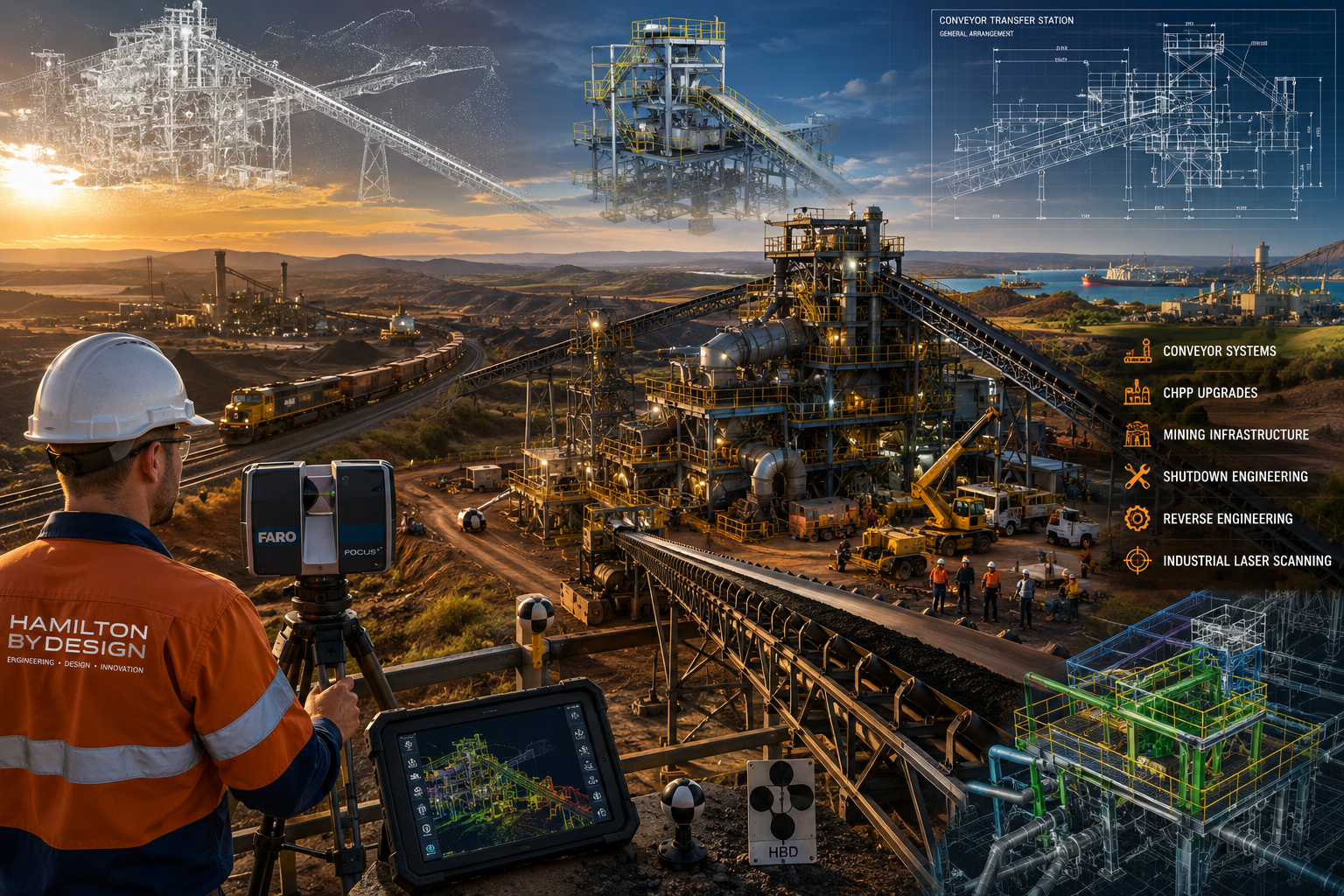
Engineering-grade 3D laser scanning and mining infrastructure project in Central Queensland, showing a conveyor transfer station, CHPP facility, coal train, industrial laser scanner, point cloud modelling and reverse engineering workflows supporting shutdown engineering and mining operations.

Yeppoon + Mechanical Engineering +Industrial Laser Scanning + Mining Infrastructure Services = Hamilton By Design

Supporting Central Queensland Mining, CHPP & Materials Handling Projects

Yeppoon sits at the gateway to Central Queensland’s mining and industrial sectors. While the Capricorn Coast is well known for tourism and marine industries, the region also supports major coal mining operations, coal handling and preparation plants (CHPP), bulk materials handling facilities, industrial infrastructure and shutdown maintenance projects throughout the Bowen Basin and Central Queensland.

At Hamilton By Design, we provide engineering-grade 3D laser scanning, mechanical engineering, reverse engineering and drafting services supporting mining, processing and materials handling facilities throughout Yeppoon, Rockhampton and the wider Central Queensland region.

Our team understands industrial facilities because we come from industry. Our experience includes mining operations, CHPP facilities, smelting plants, conveyor systems, materials handling infrastructure and brownfield plant modifications.


Why Yeppoon?

Yeppoon provides strategic access to some of Australia’s most significant mining and industrial operations.

The region supports:

  • Bowen Basin coal mines
  • Coal handling and preparation plants (CHPP)
  • Bulk materials handling systems
  • Port infrastructure
  • Industrial processing facilities
  • Heavy engineering workshops
  • Mining maintenance contractors
  • Marine and coastal infrastructure
  • Transport and logistics operations

For engineering companies supporting mining infrastructure, Yeppoon offers direct access to clients operating throughout Central Queensland.

Engineering-Grade 3D Laser Scanning

Not all scans are equal.

At Hamilton By Design, we specialise in engineering-grade terrestrial LiDAR scanning designed to support practical engineering outcomes.

Our scanning services assist with:

  • Conveyor upgrades
  • CHPP modifications
  • Shutdown planning
  • Structural steel verification
  • Pipework design
  • Access platform design
  • Brownfield plant upgrades
  • Equipment replacement projects
  • Existing condition surveys
  • Industrial asset capture

We deliver registered point cloud data suitable for:

  • SolidWorks
  • Autodesk Revit
  • AutoCAD
  • Navisworks
  • Inventor
  • Recap
  • Digital engineering workflows

Whether capturing an entire processing plant or a critical conveyor transfer station, our team provides accurate engineering-grade information for design, fabrication and construction.


Conveyor Systems & Materials Handling

Conveyors are the backbone of many mining and processing operations throughout Central Queensland.

Hamilton By Design supports projects involving:

  • Conveyor upgrades
  • Transfer station modifications
  • Conveyor gantries
  • Belt feeder systems
  • Chute design
  • Structural modifications
  • Maintenance access improvements
  • Conveyor replacement projects

Accurate site information is critical when working within operating facilities where shutdown durations are limited and installation tolerances are tight.

Our laser scanning and engineering services help reduce risk by ensuring designs are based on real-world site conditions.


CHPP Upgrades & Brownfield Modifications

Coal Handling and Preparation Plants continue to evolve as production requirements change and equipment reaches the end of its service life.
Hamilton By Design supports CHPP projects including:

  • Structural modifications
  • Conveyor upgrades
  • Pipework design
  • Access system improvements
  • Transfer chute modifications
  • Equipment replacements
  • Existing condition verification
  • Shutdown planning support

Using engineering-grade scan data, we help project teams understand existing site conditions before fabrication and installation begin.


Shutdown Engineering Support

Shutdowns are often where accurate engineering information provides the greatest value.

Every hour of downtime carries significant cost.

Our services assist shutdown teams with:

  • Existing condition capture
  • Site verification
  • Fabrication support
  • Installation planning
  • Clash detection
  • As-built verification
  • Asset documentation

Laser scanning prior to shutdown activities can significantly reduce rework, site fitment issues and project delays.


Reverse Engineering Services

Many mining and processing facilities continue to operate equipment where original drawings are incomplete, unavailable or no longer represent the asset currently installed.

Hamilton By Design provides reverse engineering services for:

  • Conveyor components
  • Chutes and transfer systems
  • Pump components
  • Castings
  • Wear liners
  • Structural assemblies
  • Fabricated equipment
  • Legacy plant infrastructure

Our team combines practical manufacturing knowledge with modern scanning technologies to develop detailed models and fabrication drawings suitable for refurbishment or replacement.


Mining Infrastructure Engineering

Mining infrastructure requires practical engineering solutions capable of operating in demanding environments.

We support projects involving:

  • Materials handling systems
  • Conveyor structures
  • Access platforms
  • Maintenance walkways
  • Structural steelwork
  • Pipework systems
  • Plant modifications
  • Asset upgrades

Our engineering approach focuses on constructability, maintainability and long-term asset performance.


Why Hamilton By Design?

Hamilton By Design combines practical trade experience with engineering capability.

Our background includes:

  • Mechanical engineering
  • Fitting and machining
  • Industrial drafting
  • Mining operations
  • Smelting facilities
  • Materials handling systems
  • Site-based engineering
  • Industrial maintenance

We understand that successful projects require more than accurate models. They require engineering solutions that can be fabricated, installed and maintained within real operating environments.


3D LiDAR scanning and 3D modelling service button โ€” laser scanner capturing a point cloud for engineering and CAD modelling
Mechanical engineering services

Servicing Yeppoon & Central Queensland

Hamilton By Design supports projects throughout:

  • Yeppoon
  • Rockhampton
  • Gladstone
  • Emerald
  • Blackwater
  • Moranbah
  • Dysart
  • Mackay
  • Bowen Basin
  • Central Queensland

Whether you require engineering-grade laser scanning, reverse engineering, conveyor design support or detailed drafting services, our team is available to assist.


Engineering Support for Central Queensland Industry

Hamilton By Design provides engineering-grade 3D laser scanning, mechanical engineering, drafting and reverse engineering services supporting mining infrastructure, CHPP facilities, conveyor systems and industrial processing plants throughout Yeppoon and Central Queensland.

Contact Us – Talk to Us

Contact our team to discuss your next project and discover how accurate site data and practical engineering experience can improve project outcomes, reduce shutdown risk and support long-term asset performance.

Name
Would you like us to arrange a phone consultation for you?
Address
CHPP Engineering title graphic featuring bold white text reading "CHPP Engineering" centred on a blue rounded rectangle background.
Pipework Drafting title graphic featuring bold white text reading "Pipework Drafting" centred on a blue rounded rectangle background.
3D LiDAR Scanning for Engineering Projects title graphic featuring bold white text on a blue rounded rectangle background.

Mechanical Engineering Services for Newcastle and the Hunter Valley

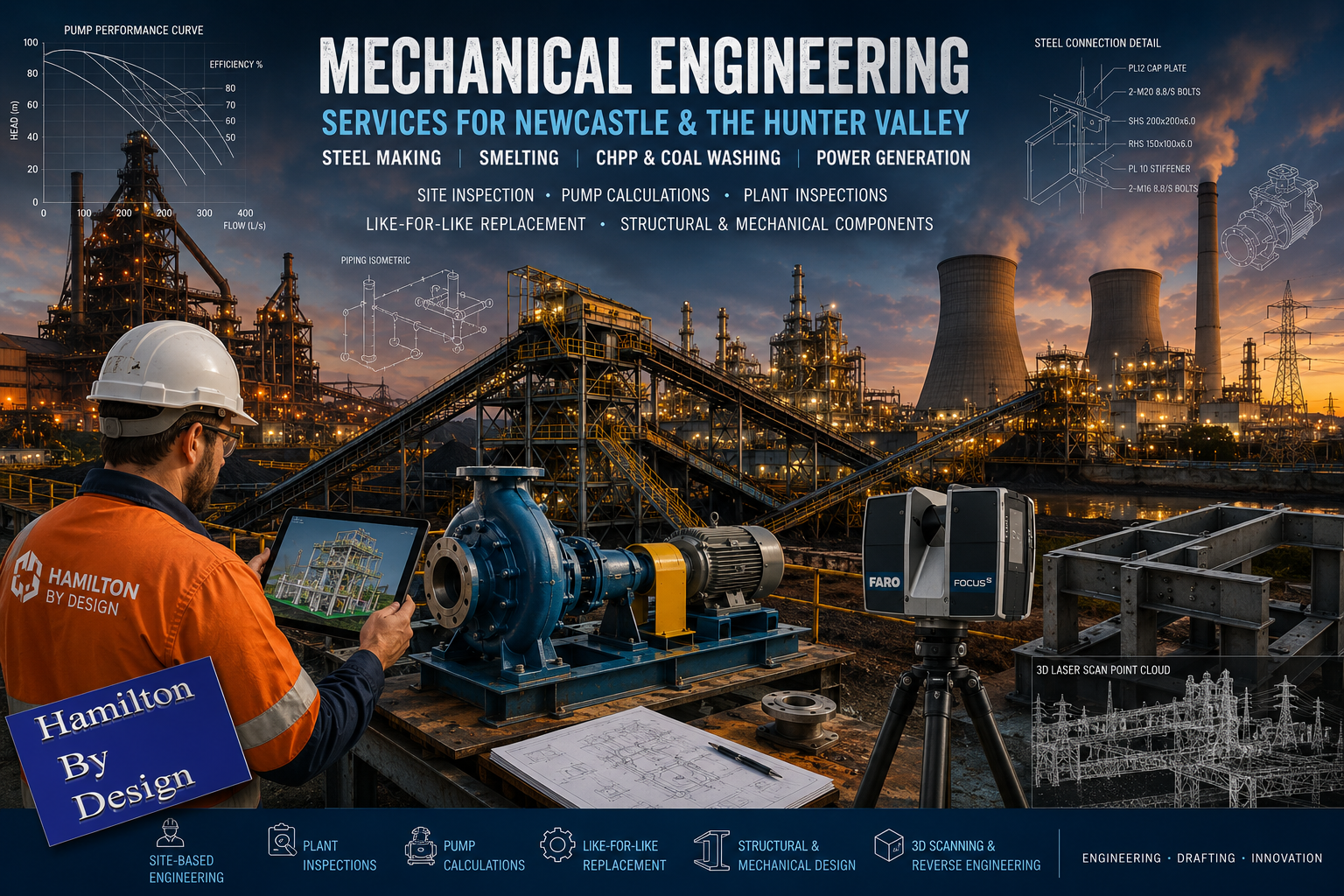
Mechanical engineer performing plant inspection at a Newcastle industrial facility with pumps, conveyors, steel making infrastructure, CHPP operations and power generation assets across the Hunter Valley.

Site-Based Mechanical Engineering for Heavy Industry, Mining and Power Generation

Blue Gear and Spanner icon

Hamilton By Design provides mechanical engineering support for industrial plants across Newcastle, the Hunter Valley and surrounding regions.

We support sites involved in steel making, smelting, coal handling and preparation plants, coal washing, power generation, bulk materials handling and heavy industrial maintenance.

The Hunter region has a long history in coal, power generation and steel-related industry, with coal mining, CHPP operations, power stations and export infrastructure continuing to play a major role in the regionโ€™s industrial base.

Mechanical Engineering Support for Operating Plants

Industrial sites require practical mechanical engineering that understands plant availability, shutdown windows, maintenance constraints and the reality of working around existing equipment.

Hamilton By Design can assist with:

  • Site-based mechanical engineering support
  • Mechanical plant inspections
  • Pump calculations and pump system reviews
  • Like-for-like replacement of mechanical components
  • Structural and mechanical component replacement
  • Conveyor, chute and transfer point reviews
  • CHPP and coal washing plant mechanical support
  • Smelting and steel plant mechanical support
  • Power station mechanical and structural support
  • Reverse engineering of worn or obsolete parts
  • Engineering drawings for fabrication and replacement
  • 3D laser scanning for existing plant and brownfield works

Mechanical Engineering for CHPP and Coal Washing Plants

Coal Handling and Preparation Plants operate under demanding conditions. Pumps, pipework, screens, launders, conveyors, chutes, guards and structural supports are exposed to wear, vibration, corrosion and material build-up.

Hamilton By Design can assist with inspection, measurement, design and documentation for:

  • Slurry pumps and process water systems
  • Pump baseplates and drive arrangements
  • Pipe supports and replacement pipework
  • Chutes, launders and transfer points
  • Conveyor structures and guarding
  • Access platforms, walkways and maintenance areas
  • Wear plate replacement and component redesign
  • Like-for-like replacement where production risk must be controlled

Where components are worn, damaged or no longer supported by the original supplier, we can use site measurement, 3D laser scanning and reverse engineering to develop fabrication drawings and replacement geometry.

Mechanical Engineering for Steel Making and Smelting Plants

Steel making, smelting and high-temperature processing plants require mechanical engineering that considers heat, wear, access, material selection and maintenance practicality.

Hamilton By Design can support mechanical and structural works around:

  • Furnace and smelting support equipment
  • Ducting, hoppers, bins and chutes
  • Cooling water and process pipework
  • Platforms, access steel and maintenance structures
  • Pump skids and mechanical drive systems
  • Heavy fabrication replacement items
  • Site inspection and defect reporting
  • Drafting and engineering documentation for fabrication

Our approach is practical and site-focused. We understand that industrial drawings need to be useful for fabrication, installation and maintenance โ€” not just theoretical design.

Mechanical Engineering for Power Generation Sites

Power generation sites across the Hunter region continue to require engineering support for maintenance, transition works, decommissioning, replacement equipment and brownfield upgrades. The region includes long-standing coal-fired power infrastructure, with Bayswater continuing to operate and Liddell now retired.

Hamilton By Design can assist with:

  • Mechanical inspection of existing plant
  • Pump and pipework calculations
  • Cooling water and process systems
  • Replacement steelwork and mechanical supports
  • Access platforms and maintenance structures
  • Brownfield scanning and as-built modelling
  • Fabrication drawings for replacement components
  • Shutdown planning support and site verification

Pump Calculations and Mechanical Reviews

Pumps are critical across CHPPs, smelters, steel plants and power generation sites. Incorrect pump selection, worn components or poor pipework arrangements can lead to reliability issues, cavitation, vibration and reduced plant availability.

Hamilton By Design can assist with:

  • Pump duty review
  • Flow and head calculations
  • Pipework pressure loss checks
  • Pump baseplate and support review
  • Like-for-like replacement checks
  • Reverse engineering of pump components
  • Wear assessment and replacement drawings
  • Arrangement drawings for maintenance and installation

Plant Inspection and Like-for-Like Replacement

Many industrial sites require replacement of existing structural or mechanical components without changing the function of the plant. In these cases, accuracy and practical site understanding are critical.

We can attend site to inspect, measure and document existing components, then develop drawings for:

  • Replacement frames
  • Platforms and access steel
  • Guards and brackets
  • Pump skids and bases
  • Chutes and liners
  • Pipe supports
  • Structural and mechanical interfaces
  • Worn or obsolete machine components

Where required, 3D laser scanning can be used to capture existing conditions and reduce the risk of fabrication or installation errors.

Why Hamilton By Design

Hamilton By Design is engineer-led. We combine mechanical engineering, drafting, 3D laser scanning, reverse engineering and fabrication-aware design.

This means we can support clients from site inspection through to practical engineering drawings suitable for review, fabrication and installation.

For Newcastle and Hunter Valley industrial sites, we provide mechanical engineering support that understands heavy industry, maintenance realities, shutdown risk and the need for clear, accurate deliverables.

3D LiDAR Scanning Hunter & Newcastle banner with white text on a blue background promoting engineering-grade laser scanning services for industrial, mining and infrastructure projects across the Hunter Valley and Newcastle region.
Mechanical Engineering Hunter & Newcastle banner promoting mechanical engineering services for mining, industrial plants, power generation, manufacturing and heavy industry throughout the Hunter Valley and Newcastle region.
Structural Drafting Hunter & Newcastle banner promoting structural drafting services for mining, industrial plants, power generation, manufacturing and infrastructure projects across the Hunter Valley and Newcastle region.

Contact Hamilton By Design

If your site requires mechanical engineering support for a CHPP, coal washing plant, smelter, steel plant, power generation facility or heavy industrial operation, Hamilton By Design can assist with site inspection, calculations, scanning, drafting and replacement component design.

Hamilton By Design logo displayed on a blue tilted rectangle with a grey gradient background

Name
Would you like us to arrange a phone consultation for you?
Address

Our Clients:

3D CAD Modelling Australia service banner for Hamilton By Design
CHPP Engineering title graphic featuring bold white text reading "CHPP Engineering" centred on a blue rounded rectangle background.
Pipework Drafting title graphic featuring bold white text reading "Pipework Drafting" centred on a blue rounded rectangle background.
3D LiDAR Scanning for Engineering Projects title graphic featuring bold white text on a blue rounded rectangle background.
Mechanical engineering services
Australian Drafting logo featuring bold white text reading "Australian Drafting" centred on a blue rounded rectangle background.