Mechanical Engineering | 3D Scanning | 3D Modelling
Tag: Engineering Governance
Engineering governance services providing structured technical assurance, design review, approval processes and compliance oversight to support safe, auditable and risk-controlled delivery of industrial and infrastructure projects.
Industrial assets change over time. Equipment is upgraded, drawings are revised, platforms are modified, components are replaced, and maintenance activities gradually reshape the plant.
When engineering information is spread across old drawings, uncontrolled PDFs, manual mark-ups, spreadsheets, and individual folders, asset management becomes harder than it needs to be.
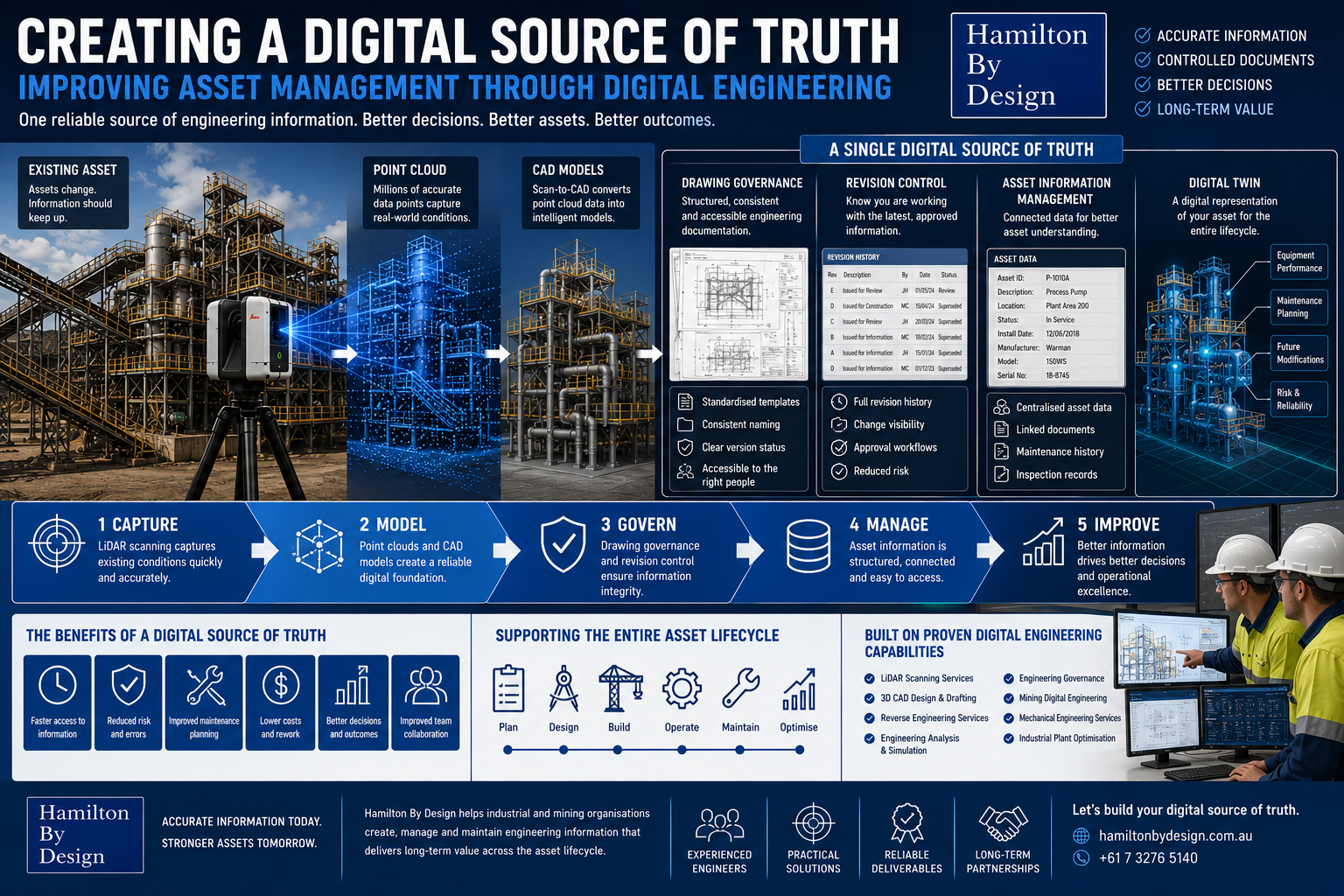
A digital source of truth helps bring engineering information together so teams can make decisions using reliable, current, and controlled data.
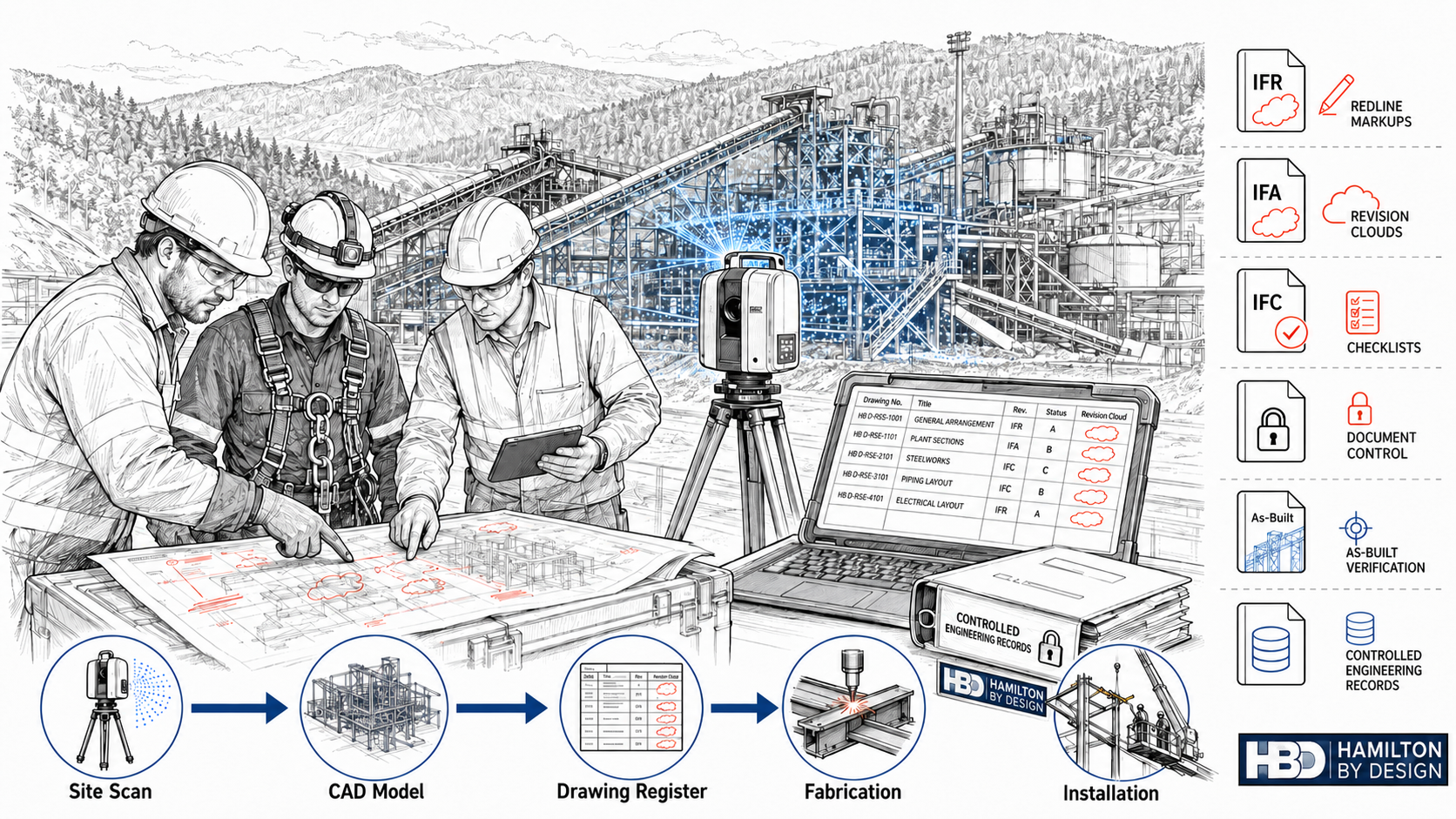
At Hamilton By Design, we support digital engineering asset management by combining LiDAR scanning, CAD modelling, drawing governance, revision control, and digital engineering workflows.
What is a Digital Source of Truth?
A digital source of truth is a controlled location where accurate engineering information can be stored, managed, accessed, and updated.
It may include:
Engineering drawings
CAD models
Point cloud data
Asset information
Revision history
Inspection records
Fabrication documentation
Engineering reports
The goal is simple:
One reliable place for engineering information.
Why Asset Information Management Matters
Poorly controlled information can create:
Outdated drawings
Duplicate files
Missing revisions
Conflicting information
Fabrication errors
Shutdown delays
Maintenance confusion
Good asset information management improves:
Decision making
Project planning
Maintenance efficiency
Drawing control
Long-term asset performance
Digital Engineering Workflows
Hamilton By Design can support workflows such as:
Engineering-grade LiDAR scanning
Existing condition capture
Point cloud generation
Scan-to-CAD conversion
CAD modelling
Engineering drawings
Revision-controlled documentation
Digital asset records
This turns real-world site information into usable engineering data.
Drawing Governance and Revision Control
Drawing governance helps ensure the right people are using the right information.
This includes:
Controlled drawing revisions
Clear document naming
Updated engineering records
Managed mark-ups
Approval workflows
Accessible project information
Without revision control, teams may unknowingly use superseded drawings.
Digital Twins and Long-Term Asset Management
A digital twin does not need to start as a complex system. For many industrial sites, it begins with accurate geometry, controlled drawings, and reliable asset records.
Digital engineering can support:
Plant upgrades
Maintenance planning
Shutdown preparation
Reverse engineering
Engineering analysis
Future modifications
Long-Term Operational Efficiency
A digital source of truth can reduce:
Time spent searching for drawings
Rework caused by outdated information
Repeated site measurements
Fabrication errors
Project uncertainty
It can improve:
Maintenance planning
Engineering confidence
Asset visibility
Operational efficiency
Project delivery
How Hamilton By Design Supports This
Hamilton By Design supports digital engineering asset management through:
3D CAD Design & Drafting
Engineering Governance
LiDAR Scanning Services
Industrial Plant Optimisation
Engineering Analysis & Simulation
Mining Digital Engineering
Mechanical Engineering Services
Reverse Engineering Services
The objective is not just to create drawings or models.
The objective is to create engineering information that remains useful throughout the asset lifecycle.
Conclusion
Industrial asset management depends on reliable information.
A digital source of truth helps organisations move from scattered documents and outdated drawings toward controlled, current, and usable engineering data.
Better information supports better asset decisions.
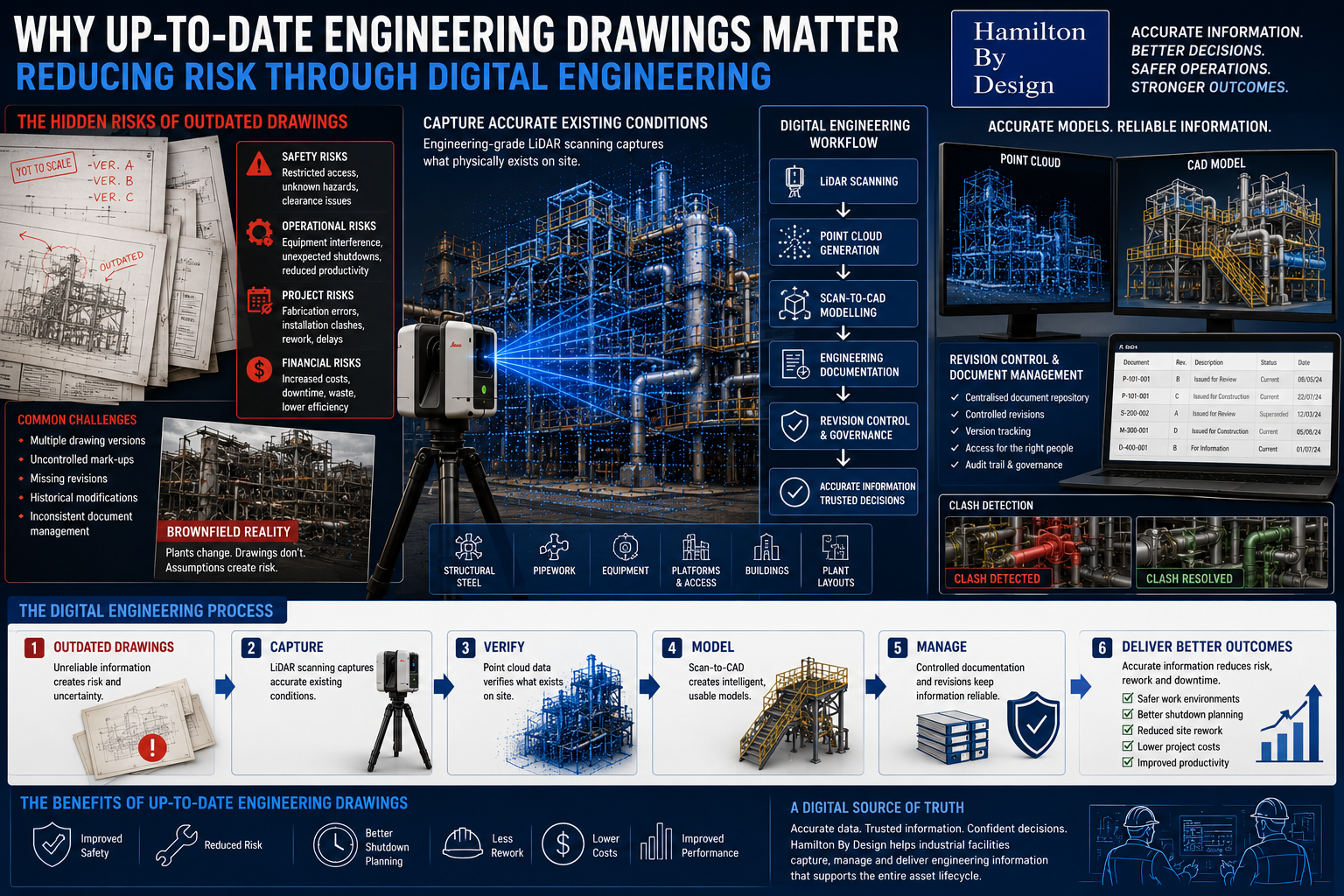
Industrial facilities rarely remain unchanged throughout their operating life. Equipment is upgraded, structural modifications occur, pipework is rerouted, platforms are added, and maintenance-driven changes become part of everyday operations.
Over time, these modifications can create a disconnect between what exists on site and what engineering documentation says exists.
When engineering drawings no longer accurately represent site conditions, the consequences can extend beyond inconvenience. Outdated information can introduce operational risk, safety concerns, project delays, and increased costs.
At Hamilton By Design, we believe engineering decisions should be based on accurate, measured information rather than assumptions.
Digital engineering workflows help transform existing assets into reliable engineering information that supports safer and more efficient project outcomes.
Why Engineering Drawings Matter
Engineering drawings provide more than dimensions and layouts.
They support:
Equipment maintenance
Plant upgrades
Shutdown activities
Fabrication works
Safety planning
Operational decisions
Future modifications
Drawings often become the primary source of information used by:
Engineers
Maintenance personnel
Project teams
Contractors
Fabricators
Operations personnel
If the information is incorrect, downstream decisions may also become incorrect.
Risks Created by Outdated Drawings
Even relatively small discrepancies between site conditions and engineering documentation can create significant problems.
Potential risks include:
Safety Risks
Outdated information may create:
Restricted access areas
Unidentified hazards
Clearance issues
Manual handling challenges
Unsafe work conditions
Operational Risks
Incorrect information can contribute to:
Equipment interference
Unexpected shutdown activities
Reduced productivity
Increased maintenance complexity
Project Risks
Engineering teams may encounter:
Fabrication errors
Installation clashes
Rework requirements
Increased labour costs
Schedule delays
Financial Risks
Minor inaccuracies can result in:
Increased project costs
Extended downtime
Material waste
Reduced project efficiency
Drawing Revisions and Version Control
Many industrial facilities operate using drawings developed over long periods of time.
Common challenges include:
Multiple drawing versions
Uncontrolled mark-ups
Missing revisions
Historical modifications
Inconsistent document management
Without effective version control, personnel may unknowingly use outdated information.
Digital engineering workflows support:
Revision tracking
Controlled updates
Centralised documentation
Improved information accessibility
Better engineering governance
Maintaining a controlled environment for engineering information helps reduce risk.
Existing Condition Capture
One of the most effective methods of maintaining drawing accuracy is capturing what physically exists on site.
Hamilton By Design supports projects through engineering-grade 3D LiDAR scanning to capture:
Structural steel
Pipework
Platforms
Mechanical equipment
Buildings
Existing plant layouts
Access systems
Existing condition capture allows engineering teams to work with measured information rather than assumptions.
Brownfield Projects Create Additional Challenges
Brownfield environments commonly include:
Historical modifications
Legacy equipment
Congested layouts
Existing structures
Limited access areas
Undocumented changes
Original documentation often no longer reflects actual site conditions.
Using inaccurate information during brownfield projects can increase:
Design uncertainty
Installation difficulties
Rework
Shutdown impacts
Fabrication risk
Engineering Governance and Digital Engineering
Digital engineering supports a structured approach to managing engineering information.
Engineering governance may include:
Revision control systems
Centralised documentation
Scan-to-CAD workflows
Digital asset information
Controlled engineering updates
Long-term information management
The objective is creating a digital source of truth where project teams can access reliable information.
Supporting Shutdown Planning
Shutdown periods are often constrained by:
Time limitations
Labour availability
Production requirements
Safety considerations
Incorrect engineering information during shutdowns can create:
Unexpected site modifications
Delays
Increased labour requirements
Reduced productivity
Accurate digital engineering information supports:

Improved planning
Better coordination
Reduced uncertainty
Reduced downtime
Reducing Site Rework
Site rework often results from discovering problems after fabrication or installation begins.
Typical causes include:
Missing dimensions
Existing condition inaccuracies
Equipment clashes
Incorrect assumptions
Documentation errors
Digital workflows including:
Existing condition capture
Point cloud modelling
Scan-to-CAD processes
Clash detection
can help identify issues before they become site problems.
How Hamilton By Design Supports Digital Engineering
Hamilton By Design combines engineering experience with digital workflows including:
Engineering-grade 3D LiDAR scanning
Existing condition capture
Scan-to-CAD workflows
CAD modelling
Engineering documentation
Engineering governance
Fabrication-ready deliverables
The goal is not simply creating drawings.
The goal is creating reliable engineering information that supports better operational decisions.
Better Information Creates Better Outcomes
Drawings influence every stage of an asset lifecycle.
When information becomes outdated, risk increases.
Maintaining accurate engineering documentation supports:

Safety improvements
Reduced project risk
Better shutdown outcomes
Reduced rework
Improved operational performance
Up-to-date engineering drawings create confidence across engineering, maintenance, and project delivery activities.
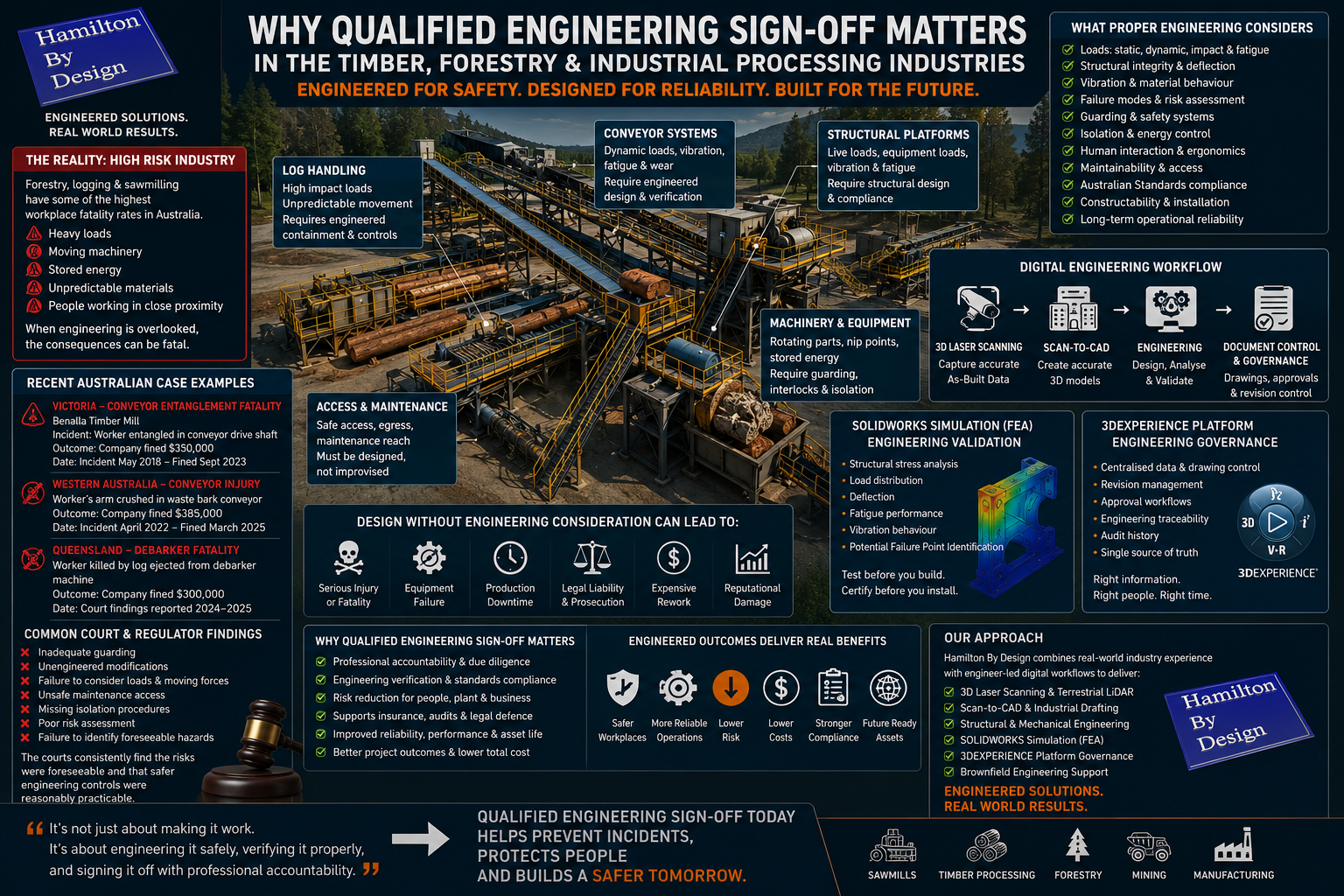
Across Australiaโs forestry, sawmill and timber processing industries, industrial infrastructure continues to evolve through ongoing maintenance, shutdown upgrades, plant expansions and operational modifications. Conveyor systems are extended, timber transfer systems are upgraded, structural steel platforms are altered, machinery is relocated and new processing equipment is integrated into ageing brownfield facilities that may have operated continuously for decades.
While many of these changes are often completed to improve productivity or maintain operational continuity, one of the greatest hidden risks within industrial environments is modifying or designing plant equipment without proper engineering review, engineering governance and qualified engineering sign-off.
In many industrial workplaces, practical trade experience is highly respected โ and rightly so. Skilled tradespeople are essential to fabrication, installation, shutdown works, plant maintenance and operational reliability. However, building something that functions mechanically is not the same as engineering a system that is safe, compliant, reliable and suitable for long-term industrial operation.
This distinction becomes critically important in industries such as forestry, logging and timber processing where machinery regularly handles heavy loads, rotating equipment, moving conveyors, unstable timber products, stored energy and high-throughput material handling systems.
Across sawmills and timber processing facilities throughout Australia, industrial systems are exposed to continuous operational stresses involving vibration, shock loading, impact forces, moisture, abrasive materials, dust contamination and changing environmental conditions. Conveyor systems, debarkers, screw augers, bucket elevators, log transfer systems and structural platforms must all operate safely while supporting continuous production under demanding industrial conditions.
Without proper engineering consideration, even seemingly simple modifications can introduce serious risk.
Over the past several decades, Australian workplace regulators and courts have repeatedly prosecuted companies following incidents involving timber handling systems, conveyors, rotating shafts, sawmill machinery and plant modifications that failed to adequately consider engineering safety requirements.
In one Victorian timber mill incident, a worker died after becoming entangled in a conveyor drive shaft. WorkSafe Victoria later found that engineering controls and guarding solutions were reasonably practicable and could have prevented the fatality. In Western Australia, a timber processing company was fined after a worker suffered catastrophic arm injuries involving inadequately guarded conveyor equipment. In Queensland, a timber company faced prosecution after a worker was killed by a log ejected from a debarker machine.
Although each incident involved different operational circumstances, the underlying engineering failures followed remarkably similar patterns:
inadequate guarding,
unengineered plant modifications,
failure to consider loads and moving forces,
unsafe maintenance access,
missing isolation procedures,
poor risk assessment,
insufficient structural verification,
lack of engineering review,
and failure to identify foreseeable operational hazards.
These are engineering failures โ not simply fabrication problems.
A tradesperson may know how to weld, fabricate, cut or assemble industrial equipment, but engineering requires a much deeper understanding of how systems behave under operational conditions over time.
Proper engineering design must consider:
static and dynamic loading,
fatigue and cyclic stresses,
vibration,
structural deflection,
torque and rotational forces,
impact loading,
material behaviour,
wear characteristics,
human interaction with machinery,
guarding requirements,
maintainability,
failure modes,
constructability,
Australian Standards compliance,
and long-term operational reliability.
This is why qualified engineering sign-off matters.
Engineering sign-off is not simply a signature placed on a drawing. It represents professional accountability that the design has been reviewed, assessed and verified against engineering principles, foreseeable operational conditions and applicable standards.
Without proper engineering oversight, industrial businesses expose themselves to major commercial, operational and legal risk.
Poorly engineered modifications can lead to:
worker injury or fatalities,
structural failure,
conveyor collapse,
equipment damage,
production downtime,
voided insurance claims,
failed audits,
regulatory prosecution,
expensive shutdown rework,
project delays,
and reputational damage.
In many industrial facilities, the risk develops gradually over time. Equipment modifications are often completed during shutdowns or urgent maintenance periods where production pressure overrides long-term engineering review. Small undocumented changes accumulate over years until facilities no longer reflect their original engineered design intent.
Drawings become outdated. Loads change. Access paths are altered. Equipment is relocated. Platforms are modified. Conveyors are extended. Additional services are added.
Over time, facilities can drift significantly away from their original engineered condition.
This is where engineering governance becomes critically important.
At Hamilton By Design, we are an engineer-led organisation focused on delivering engineered outcomes rather than simply trade-based solutions.
While practical trade experience remains essential within industrial environments, our approach extends beyond fabrication and installation alone. We apply engineering thinking, digital engineering workflows and industrial experience to support long-term operational reliability, constructability and risk reduction.
Using engineering-grade 3D laser scanning, terrestrial LiDAR capture and scan-to-CAD workflows, we help industrial clients establish accurate as-built conditions before design or fabrication work begins.
Rather than relying on outdated PDFs or manual measurements, project teams gain access to highly accurate point cloud data that reflects real-world plant conditions. This allows engineers, fabricators and project managers to identify operational risks earlier and improve confidence before fabrication or construction begins.
Engineering-grade point clouds can then be converted into detailed CAD models suitable for:
structural analysis,
equipment integration,
plant upgrades,
fabrication detailing,
conveyor layouts,
clash detection,
and engineering verification.
One of the major advantages of modern digital engineering workflows is the ability to perform engineering validation before equipment is manufactured or installed onsite.
Using SOLIDWORKS Simulation and Finite Element Analysis (FEA), industrial components and structures can be digitally tested under operational loading conditions to assess how equipment may behave before fabrication occurs.
FEA allows engineers to evaluate:
structural stress,
deflection,
load distribution,
fatigue performance,
vibration behaviour,
and potential failure points.
This becomes particularly valuable within forestry and timber processing facilities where conveyor systems, transfer structures, platforms and machinery supports are exposed to continuous operational loading and vibration.
Rather than relying on assumptions or โrule of thumbโ workshop modifications, FEA allows engineering decisions to be supported by measurable analysis and engineering verification.
This significantly improves confidence in the design process while helping reduce the risk of structural failure, overloading or premature wear.
At Hamilton By Design, digital engineering workflows can also be supported through the 3DEXPERIENCE platform, providing engineering governance and controlled management of industrial drawing systems and project information.
Modern industrial projects increasingly require:
revision control,
controlled approvals,
drawing issue states,
engineering traceability,
audit history,
and a single source of truth across multiple project stakeholders.
The 3DEXPERIENCE platform supports this by allowing controlled management of CAD models, drawings, revisions and engineering workflows within a centralised digital environment.
This provides significant advantages for industrial and brownfield projects where multiple contractors, engineers, fabricators and maintenance teams may all be interacting with the same plant infrastructure over long operational lifecycles.
Engineering governance through structured drawing control helps ensure:
approved drawings remain current,
revision history is traceable,
superseded drawings are controlled,
engineering changes are documented,
and project teams are working from reliable information.
In industries such as forestry, timber processing, mining and manufacturing, poor drawing control can create major operational and safety risks if outdated or unverified information is used during fabrication or construction activities.
At Hamilton By Design, our workflows focus on engineering-grade deliverables designed to support practical industrial outcomes.
This includes:
engineering-grade 3D laser scanning,
terrestrial LiDAR capture,
scan-to-CAD workflows,
industrial drafting,
structural and mechanical modelling,
FEA-supported engineering workflows,
revision-controlled drawing systems,
and brownfield engineering support.
We do not simply create geometry or visualisation models.
We focus on engineering workflows designed to support real-world industrial reliability, constructability and operational performance.
Because in high-risk industrial environments, โit worksโ is not the same as โit has been engineered safely.โ
Qualified engineering sign-off matters because the consequences of poor engineering decisions can extend far beyond production downtime โ affecting worker safety, operational reliability, legal liability and the long-term success of industrial infrastructure.
If your business is seeking engineered outcomes that outlast short-term fixes, Hamilton By Design provides engineer-led digital engineering support designed to help reduce risk and engineer success across industrial operations throughout Australia.
Engineering-Led CAD Drafting for Industrial & Mining Projects
In a city like Sydney, where infrastructure, manufacturing, and industrial upgrades are constantly evolving, mechanical drafting is not just about drawings โ itโs about delivering buildable, accurate, and compliant engineering outcomes.
At Hamilton By Design, our mechanical drafting services are built around engineering-first principles, ensuring every drawing is aligned with real-world conditions, fabrication requirements, and Australian Standards.
What is Mechanical Drafting?
Mechanical drafting is the process of creating technical drawings and models that communicate how components, systems, and plant equipment are designed, assembled, and built.
Modern drafting uses advanced CAD tools to produce highly accurate 2D and 3D representations, enabling engineers, fabricators, and project teams to clearly understand design intent and construction requirements.
Our Mechanical Drafting Services in Sydney
At Hamilton By Design, we provide a complete drafting solution tailored to industrial, mining, and infrastructure projects:
1. Shop Drawings & Fabrication Details
Fully dimensioned drawings for manufacturing and installation
Weld details, bolt patterns, and material specifications
Designed for workshop-ready fabrication
2. General Arrangement (GA) Drawings
Plant layouts and equipment positioning
Conveyors, chutes, tanks, and process systems
Interface coordination with structural and civil components
3. Assembly & Detail Drawings
Component-level detailing for mechanical systems
Exploded views and assembly sequences
Bill of Materials (BOM) integration
4. Piping & Process Drafting
P&IDs and piping layouts
Slurry, water, and process systems
Integration with plant upgrades and brownfield modifications
5. Point Cloud to CAD Modelling
LiDAR scan integration for accurate as-built drawings
Clash detection and retrofit design
Reduced rework and site risk
6. CAD Conversions & Drawing Updates
PDF to CAD conversions
Legacy drawing upgrades
Revision control and drawing standardisation
Why Mechanical Drafting Matters
Mechanical drafting is the single source of truth between design and construction. High-quality drafting delivers:
Reduced rework through accurate, buildable designs
Improved design clarity for fabrication and installation teams
Compliance with Australian Standards
Faster project delivery with fewer site queries
Better cost control through precise documentation
In industrial environments, even small errors in drawings can lead to significant downtime and cost โ making accuracy critical.
Engineering-Led Drafting vs Traditional Drafting
Most drafting services focus on producing drawings. We focus on producing engineering outcomes.
At Hamilton By Design, drafting is integrated with:
Mechanical engineering design
Structural considerations
Site-based realities
Fabrication constraints
This ensures your drawings are not just correct on paper โ but correct in the field.
Our Workflow: Scan โ Model โ Draft โ Deliver
Site Data Capture (Optional) LiDAR scanning or client-supplied data
3D Modelling SolidWorks or CAD model development
Drafting & Detailing Creation of GA, shop, and fabrication drawings
Engineering Review Compliance checks and validation
Final Deliverables
PDF drawings
CAD files (DWG, STEP, Parasolid)
Point cloud integration (E57, RCP if required)
This structured approach ensures accuracy, traceability, and quality control across every project.
Industries We Support in Sydney
We provide mechanical drafting services across:
Mining & mineral processing
Manufacturing & fabrication
Water & wastewater systems
Infrastructure & transport
Industrial plant upgrades (brownfield projects)
Our experience in complex environments ensures we understand real-world constraints โ not just theoretical design.
Our clients
Why Choose Hamilton By Design?
Engineering-led drafting (not just CAD operators)
Experience across mining and heavy industry
Integration with LiDAR and digital engineering workflows
Fast turnaround with high-quality outputs
Scalable support โ from single drawings to full project packages
As outlined on our site, we deliver accurate shop drawings, assemblies, and fabrication-ready documentation that integrate seamlessly with engineering and site data.
Mechanical Drafting Sydney โ Get Started
If youโre planning a project in Sydney and need reliable, engineering-grade mechanical drafting, Hamilton By Design can support from concept through to fabrication.
Whether itโs a brownfield upgrade, plant layout, or detailed fabrication package, we ensure your drawings are:
โ Accurate โ Buildable โ Compliant โ Delivered on time
Hamilton By Design provides engineering-led 3D scanning, LiDAR scanning, mechanical engineering and digital engineering services throughout Sydney and Greater Sydney.
Explore our related Sydney services:
3D Scanning Sydney โ Engineering-grade terrestrial laser scanning, as-built surveys and point cloud capture for industrial, infrastructure and commercial projects.
Reality Capture Sydney โ High-accuracy reality capture, digital twins, asset documentation and engineering-grade site verification.
Scan to CAD Sydney โ Convert point cloud data into AutoCAD, SolidWorks, Inventor and other engineering-ready CAD deliverables.
Point Cloud Modelling Sydneyโ Engineering-grade point cloud processing, clash detection, as-built verification and 3D modelling.
Mechanical Engineering Sydney โ Mechanical design, plant upgrades, materials handling systems, conveyors, chutes, platforms and engineering support.
Structural Drafting Sydneyโ Structural steel drafting, fabrication drawings, GA drawings, workshop detailing and as-built documentation.
Hamilton By Design supports projects throughout Sydney CBD, Parramatta, Liverpool, Penrith, Blacktown, Chatswood, Alexandria, Mascot, Newcastle and the Central Coast.
Brownfield projects are not clean, linear, or model-driven.
They are:
Reactive
Incremental
Constrained by existing infrastructure
Driven by time, cost, and operational pressure
In this environment, the idea of maintaining a fully coordinated 3D model is often unrealistic.
A simple example illustrates this:
An electrician installs an additional power point on site. The work is completed, energised, and signed off. The drawings may be updated later โ the model almost never is.
This is not a failure of process โ it is the reality of brownfield operations.
Engineering Reality: From Sketch to CAD
Before anything becomes a 3D model, it starts much simpler.
As engineers, we still:
Sketch ideas
Mark up drawings
Discuss constraints on site
Only after this thinking process do concepts become CAD models.
This reinforces a key principle:
Engineering decisions are not driven by software โ software supports engineering judgement.
The Problem with Model-Centric Workflows
Platforms such as Autodesk Navisworks Manage are often positioned as central coordination tools, and in the right context they are highly effective.
However, in brownfield environments they introduce challenges:
Model Drift
Models quickly become outdated
Site changes are rarely captured in real time
High Maintenance Cost
Continuous updates require time and budget
Maintenance of models is rarely prioritised operationally
Limited Long-Term Trust
Teams revert back to:
Drawings
Site verification
Experience
The result is that the model becomes a temporary tool rather than a reliable long-term asset.
Where Multi-Discipline Coordination Actually Matters
Navisworks is most powerful when used for:
Multi-discipline coordination
Clash detection
Design validation
This is critical in greenfield environments where:
Structural, mechanical, electrical, and civil systems are designed simultaneously
Multiple teams work in parallel
Design clashes must be resolved before construction
In these cases, Navisworks plays a vital role in reducing risk and improving delivery outcomes.
Brownfield Reality: Coordination Happens on Site
In brownfield environments, the situation is very different.
Work is typically:
Localised
Task-specific
Carried out in isolation
Constraints are:
Already physically present
Visible and measurable
Managed in real time on site
In many cases:
Multi-discipline coordination is minimal or already resolved physically.
For example, an electrician installing a new outlet:
Reviews the environment
Works around existing services
Completes the installation
There is no model update, no coordination session, and no Navisworks workflow involved.
Point Cloud Data: The True As-Built Record
Using platforms such as FARO SCENE, point cloud data provides:
A direct capture of real-world conditions
A measurable and verifiable dataset
A snapshot of the plant at a point in time
Unlike models, point clouds are not interpretations โ they are records of reality.
Critical Limitation: Line-of-Sight
Point cloud data is inherently line-of-sight dependent.
This means:
Only visible surfaces are captured
Occlusions create gaps in the dataset
When navigating a point cloud โ whether in SCENE or Navisworks โ moving outside original scan positions reveals these gaps.
Importantly:
This is not a software limitation
It is a fundamental characteristic of LiDAR capture
Creating a Navisworks model from a point cloud does not resolve this issue. It simply introduces another layer of processing without improving data completeness.
Why Navisworks Adds Limited Value for Point Cloud Management
If the objective is:
Visualisation
Measurement
Inspection
Then native scan platforms already provide these capabilities.
Within SCENE, users can:
Navigate freely
Measure accurately
Clip and section data
Access models using free viewer tools
Introducing Navisworks adds:
Additional processing steps
Data conversion (e.g. E57 to RCP)
Larger and duplicated datasets
No improvement in scan accuracy or completeness
Navisworks does not remove line-of-sight limitations, does not fill missing data, and does not enhance the underlying scan.
Best Practice: Brownfield Data Strategy
A more practical and effective approach is:
1. Point Cloud as the Primary Asset
Maintain original scan data (e.g. E57)
Store registered datasets
Use native platforms for access and interrogation
2. Targeted Modelling Only Where Required
Model critical interfaces and tie-in points
Avoid full plant modelling unless necessary
3. Drawings for Formal Deliverables
Maintain as-built documentation
Use redlines where appropriate
4. Navisworks for Project Phases Only
Apply Navisworks during major upgrades or greenfield-style coordination
Do not rely on it as a long-term data environment
Key Project Management Insight
Models degrade over time in brownfield environments.
Point cloud data remains a verifiable record of reality.
Conclusion
Navisworks remains a powerful tool for coordination and design validation, particularly in greenfield projects where multi-discipline interaction is high.
However, for brownfield project management:
Point clouds provide truth
Drawings provide documentation
Navisworks provides temporary coordination
If the objective is to visualise, measure, and understand existing conditions, managing point cloud data within native scanning platforms is more efficient, more accurate, and more sustainable than relying on Navisworks models.
One-Line Summary
In brownfield projects, the scan is the asset โ the model is only a moment in time.
At Hamilton By Design, we provide engineering-grade drafting services in Sydney, supporting mechanical, structural, and industrial projects with accurate, build-ready documentation.
We donโt just draft โ we engineer, verify, and deliver drawings that can be confidently used for fabrication, installation, and compliance.
What We Do
Our drafting services are tailored for real-world outcomes across industrial and infrastructure environments.
Mechanical Drafting
Conveyor systems and transfer stations
Pump systems and mechanical assemblies
Pipework layouts and isometrics
Equipment layouts and modifications
Structural Drafting
Structural steel detailing
Platforms, walkways, and access systems
Support frames and lifting structures
Connection detailing and fabrication drawings
Industrial & Plant Drafting
As-built documentation from point clouds
Brownfield plant upgrades
Shutdown scope drawings
Integration with existing infrastructure
Engineering-Led Drafting (What Sets Us Apart)
Most drafting services focus on producing drawings. We focus on producing drawings that work in the real world.
Engineering-backed drafting (not just CAD operators)
Integration with 3D laser scanning and point clouds
Fabrication-ready, workshop-friendly outputs
ISO-aligned CAD governance and revision control (IFR / IFA / IFC)
Software & Deliverables
We work within industry-standard platforms to ensure compatibility with your workflows:
SolidWorks (3D modelling + fabrication drawings)
AutoCAD (2D drafting and layouts)
Revit / BIM workflows (where required)
Typical Deliverables:
General arrangement (GA) drawings
Fabrication and shop drawings
Pipe spool drawings
Plan, elevation, and section views
3D models (STEP, SAT, Parasolid)
Point cloud referenced drawings (E57 / RCP compatible)
Drafting for Brownfield & Complex Sites
Sydney projects often involve existing infrastructure, limited access, and incomplete documentation.
We specialise in:
Working from point cloud data
Reverse engineering existing assets
Resolving clashes before fabrication
Delivering accurate as-built drawings
Typical Use Cases
Plant upgrades and modifications
Structural steel fabrication packages
Mechanical system design and documentation
Shutdown planning and execution
Asset documentation and compliance
Why Hamilton By Design?
Mechanical engineer-led consultancy
Proven industrial and mining experience
Fast turnaround (typically within 7 days)
Integrated scanning + drafting capability
Practical, site-ready deliverables
Our clients
Get Started
If you need reliable drafting services in Sydney, we can support your project from concept through to fabrication.
To provide the best experiences, we use technologies like cookies to store and/or access device information. Consenting to these technologies will allow us to process data such as browsing behaviour or unique IDs on this site. Not consenting or withdrawing consent, may adversely affect certain features and functions.
Functional
Always active
The technical storage or access is strictly necessary for the legitimate purpose of enabling the use of a specific service explicitly requested by the subscriber or user, or for the sole purpose of carrying out the transmission of a communication over an electronic communications network.
Preferences
The technical storage or access is necessary for the legitimate purpose of storing preferences that are not requested by the subscriber or user.
Statistics
The technical storage or access that is used exclusively for statistical purposes.The technical storage or access that is used exclusively for anonymous statistical purposes. Without a subpoena, voluntary compliance on the part of your Internet Service Provider, or additional records from a third party, information stored or retrieved for this purpose alone cannot usually be used to identify you.
Marketing
The technical storage or access is required to create user profiles to send advertising, or to track the user on a website or across several websites for similar marketing purposes.