Industrial facilities rarely remain unchanged throughout their operating life. Equipment is upgraded, structural modifications occur, pipework is rerouted, platforms are added, and maintenance-driven changes become part of everyday operations.
Over time, these modifications can create a disconnect between what exists on site and what engineering documentation says exists.
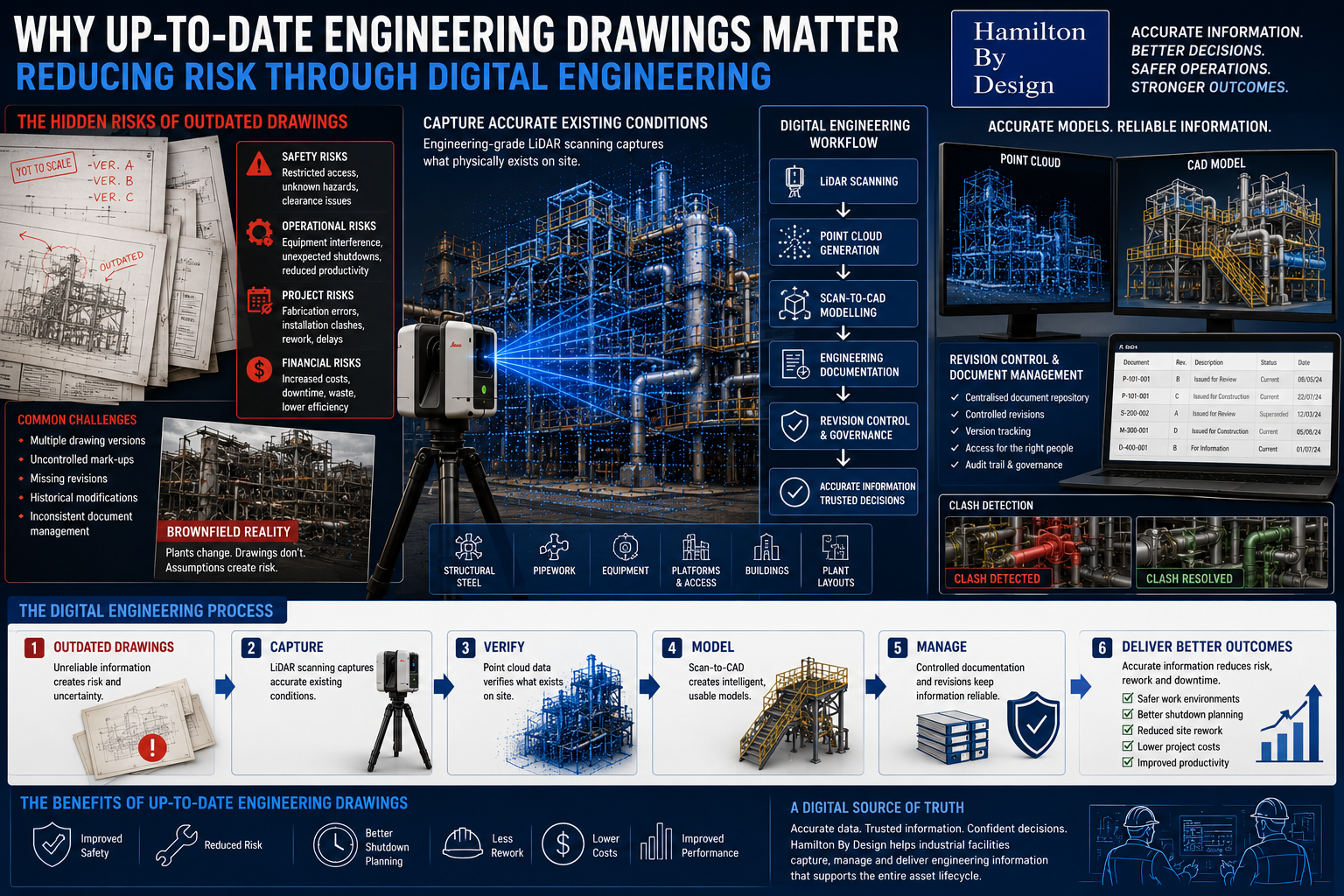
When engineering drawings no longer accurately represent site conditions, the consequences can extend beyond inconvenience. Outdated information can introduce operational risk, safety concerns, project delays, and increased costs.
At Hamilton By Design, we believe engineering decisions should be based on accurate, measured information rather than assumptions.
Digital engineering workflows help transform existing assets into reliable engineering information that supports safer and more efficient project outcomes.
Why Engineering Drawings Matter
Engineering drawings provide more than dimensions and layouts.
They support:
- Equipment maintenance
- Plant upgrades
- Shutdown activities
- Fabrication works
- Safety planning
- Operational decisions
- Future modifications
Drawings often become the primary source of information used by:
- Engineers
- Maintenance personnel
- Project teams
- Contractors
- Fabricators
- Operations personnel
If the information is incorrect, downstream decisions may also become incorrect.
Risks Created by Outdated Drawings
Even relatively small discrepancies between site conditions and engineering documentation can create significant problems.
Potential risks include:
Safety Risks
Outdated information may create:
- Restricted access areas
- Unidentified hazards
- Clearance issues
- Manual handling challenges
- Unsafe work conditions
Operational Risks
Incorrect information can contribute to:
- Equipment interference
- Unexpected shutdown activities
- Reduced productivity
- Increased maintenance complexity
Project Risks
Engineering teams may encounter:
- Fabrication errors
- Installation clashes
- Rework requirements
- Increased labour costs
- Schedule delays
Financial Risks
Minor inaccuracies can result in:
- Increased project costs
- Extended downtime
- Material waste
- Reduced project efficiency
Drawing Revisions and Version Control
Many industrial facilities operate using drawings developed over long periods of time.
Common challenges include:
- Multiple drawing versions
- Uncontrolled mark-ups
- Missing revisions
- Historical modifications
- Inconsistent document management
Without effective version control, personnel may unknowingly use outdated information.
Digital engineering workflows support:
- Revision tracking
- Controlled updates
- Centralised documentation
- Improved information accessibility
- Better engineering governance
Maintaining a controlled environment for engineering information helps reduce risk.
Existing Condition Capture
One of the most effective methods of maintaining drawing accuracy is capturing what physically exists on site.
Hamilton By Design supports projects through engineering-grade 3D LiDAR scanning to capture:
- Structural steel
- Pipework
- Platforms
- Mechanical equipment
- Buildings
- Existing plant layouts
- Access systems
Existing condition capture allows engineering teams to work with measured information rather than assumptions.
Brownfield Projects Create Additional Challenges
Brownfield environments commonly include:
- Historical modifications
- Legacy equipment
- Congested layouts
- Existing structures
- Limited access areas
- Undocumented changes
Original documentation often no longer reflects actual site conditions.
Using inaccurate information during brownfield projects can increase:
- Design uncertainty
- Installation difficulties
- Rework
- Shutdown impacts
- Fabrication risk
Engineering Governance and Digital Engineering
Digital engineering supports a structured approach to managing engineering information.
Engineering governance may include:
- Revision control systems
- Centralised documentation
- Scan-to-CAD workflows
- Digital asset information
- Controlled engineering updates
- Long-term information management
The objective is creating a digital source of truth where project teams can access reliable information.
Supporting Shutdown Planning
Shutdown periods are often constrained by:
- Time limitations
- Labour availability
- Production requirements
- Safety considerations
Incorrect engineering information during shutdowns can create:
- Unexpected site modifications
- Delays
- Increased labour requirements
- Reduced productivity
Accurate digital engineering information supports:
- Improved planning
- Better coordination
- Reduced uncertainty
- Reduced downtime
Reducing Site Rework
Site rework often results from discovering problems after fabrication or installation begins.
Typical causes include:
- Missing dimensions
- Existing condition inaccuracies
- Equipment clashes
- Incorrect assumptions
- Documentation errors
Digital workflows including:
- Existing condition capture
- Point cloud modelling
- Scan-to-CAD processes
- Clash detection
can help identify issues before they become site problems.
How Hamilton By Design Supports Digital Engineering
Hamilton By Design combines engineering experience with digital workflows including:
- Engineering-grade 3D LiDAR scanning
- Existing condition capture
- Scan-to-CAD workflows
- CAD modelling
- Engineering documentation
- Engineering governance
- Fabrication-ready deliverables
The goal is not simply creating drawings.
The goal is creating reliable engineering information that supports better operational decisions.

Better Information Creates Better Outcomes
Drawings influence every stage of an asset lifecycle.
When information becomes outdated, risk increases.
Maintaining accurate engineering documentation supports:
- Safety improvements
- Reduced project risk
- Better shutdown outcomes
- Reduced rework
- Improved operational performance
Up-to-date engineering drawings create confidence across engineering, maintenance, and project delivery activities.

Our Clients: