Mechanical Engineering | 3D Scanning | 3D Modelling
Tag: digital-twin-models
Hamilton By Design develops industrial digital twin models from 3D LiDAR scans, point-cloud data, CAD models and available asset information.
A digital twin provides a structured digital representation of a physical facility, machine or fixed plant asset. Depending on the required scope, it may combine existing geometry with equipment identification, technical information, maintenance records and revision-controlled documentation.
Our process can begin with LiDAR scanning to capture the installed position of machinery, conveyors, pipework, tanks, platforms, structural elements and surrounding buildings. The registered point cloud can then be converted into a coordinated CAD or BIM model at an agreed level of detail.
Digital twin models can support:
Existing-condition and as-built records
Equipment layouts and plant upgrades
Maintenance and shutdown planning
Clash detection and installation reviews
Asset identification and documentation
Design coordination and change management
Remote site familiarisation
Future scanning and condition comparisons
Deliverables may include E57, RCP or LAS point clouds, 3D CAD or BIM models, equipment layouts, technical drawings and associated asset information.
A static 3D model is not automatically a live digital twin. Integration with sensors, operational data or maintenance systems requires an agreed information structure and suitable software platform. Hamilton By Design can develop the geometric and engineering foundation for these broader digital-twin workflows.
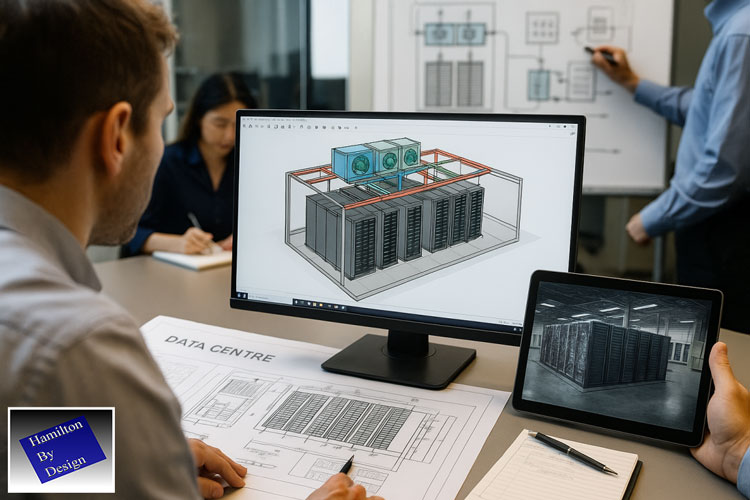
Australia’s digital infrastructure is expanding rapidly — and so is the demand for Data Centre Design that delivers reliability, performance, and scalability.
At Hamilton By Design, our team transforms concept and intent into manufacturable, modular, and compliant systems.
We specialise in Data Centre Design, mechanical and structural systems engineering, and fabrication-ready modelling that connect advanced engineering with real-world delivery. Every project is supported by traceable documentation, detailed verification, and hands-on manufacturing experience — ensuring confidence from start to finish.
Our Team Understands the Pressures of Data Centre Design
Our team understands that Data Centre Design is not just about drawings — it’s about precision, coordination, and absolute reliability.
We recognise the pressures of delivering mission-critical infrastructure: tight timelines, technical complexity, regulatory compliance, and no margin for downtime. That’s why our approach to Data Centre Design is built on clarity, accountability, and engineering confidence.
By combining advanced modelling with practical fabrication knowledge, our team ensures every interface aligns, every system performs, and every project milestone builds trust. Our goal is to make the journey from design to delivery simpler, faster, and more certain.
Our Integrated Data Centre Design Offerings
1. Modular & Prefabricated Systems
Factory-Built Reliability Our team delivers modular systems that make Data Centre Design faster, safer, and more predictable. We design and fabricate plug-and-play assemblies — cooling skids, racking frames, HVAC supports, and power-distribution modules — engineered for repeatability and verified off-site before installation. From design to deployment — built locally.
2. Mechanical & Structural Systems Engineering
Engineered for the Workshop Our team converts design concepts into fabrication-ready 3D models, optimised for Data Centre Design precision and installation accuracy. Using LiDAR scanning and FEA validation, we eliminate tolerance issues and ensure perfect fit-up on site. Designs that build themselves.
3. Energy & Water Integration
Engineered Sustainability Modules Modern Data Centre Design requires efficient energy and cooling systems. Our team develops renewable-ready modules, including battery enclosures, hybrid cooling loops, and water-recycling assemblies. These systems improve energy performance, reduce water consumption, and support sustainability targets. Turning sustainability into engineered reality.
4. Retrofit & Upgrade Engineering
Upgrades Without Downtime Our team delivers Data Centre Design solutions for live facilities needing upgrades or expansion. Through LiDAR scanning and modular fabrication, we create retrofit systems that fit precisely within existing structures — enabling capacity growth without disrupting operations.
Upgrades engineered to fit.
5. Documentation & Compliance
Audit-Ready Fabrication In Data Centre Design, compliance and traceability are critical. Our team provides complete documentation: material certificates, weld maps, QA records, and 3D-model traceability. Processes align with ISO 9001, AS 1554, and AS 4100, ensuring full accountability across every project phase. Every weld certified. Every drawing traceable.
Why Organisations Choose Hamilton By Design for Data Centre Design
Challenge
Our Response
Tight construction schedules
Off-site modular fabrication and verified fit-ups reduce rework and on-site time.
Design-to-fabrication disconnects
Integrated SolidWorks modelling, LiDAR scanning, and FEA deliver workshop-ready accuracy.
Risk and compliance pressures
Documented QA, full traceability, and standards-aligned processes protect project integrity.
Retrofit constraints
Modular upgrade solutions minimise downtime and maintain performance.
Sustainability goals
Energy-efficient and water-recycling modules lower PUE and environmental impact.
Partner With Hamilton By Design
Whether you are developing a new hyperscale facility or upgrading an existing site, Hamilton By Design provides Data Centre Design solutions that combine engineering precision, modular flexibility, and compliance confidence.
Our team doesn’t just fabricate — it engineers confidence into every component.
Contact our team today to discuss modular systems, retrofit upgrades, or compliant fabrication for your next Data Centre Design project.
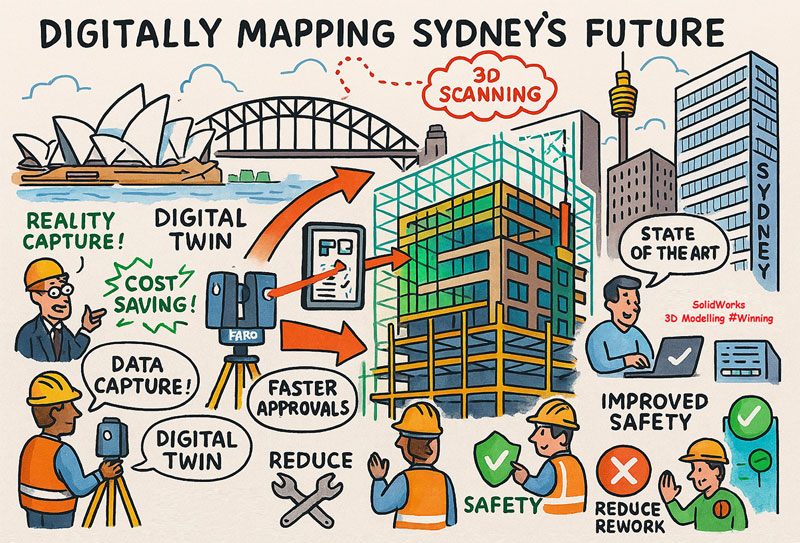
From the growing commercial hubs of Parramatta and Chatswood to the complex redevelopments across Sydney’s Eastern Suburbs, the construction industry is demanding more accuracy, faster turnaround, and fewer on-site surprises.
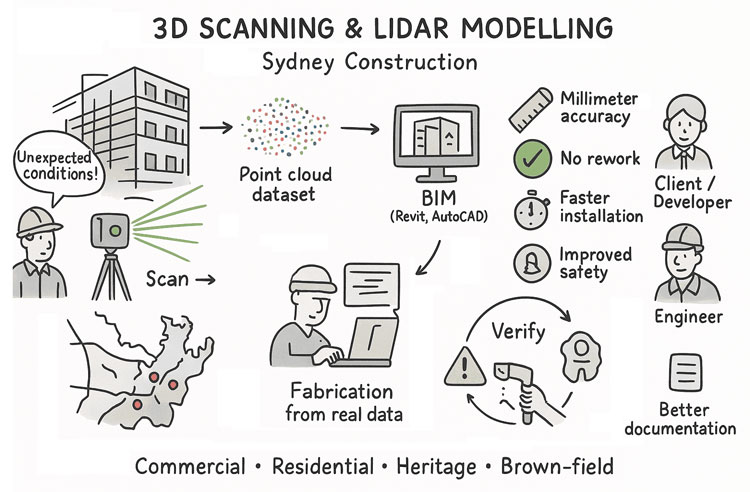
At Hamilton By Design, we use 3D scanning and LiDAR technology to help builders, engineers, and developers capture, model, and verify real site conditions with millimetre accuracy.
Our advanced 3D models ensure every structural, mechanical, or architectural component fits perfectly on site — helping Sydney’s construction professionals deliver projects right the first time.
High-Precision Site Capture with LiDAR Scanning
Using advanced LiDAR (Light Detection and Ranging) technology, our scanners record millions of laser points per second to create a complete 3D “point cloud” of your site or structure.
Whether we’re scanning a commercial building in Chatswood, a multi-level development in Parramatta, or a heritage renovation in Sydney’s Eastern Suburbs, LiDAR scanning allows us to document every detail — without disruption to your workflow.
The result is a digital twin of your project site that forms the foundation for precise design, fabrication, and installation.
From Point Cloud to Construction-Ready Model
Once scanning is complete, our engineers convert the LiDAR data into accurate 3D CAD and BIM models that integrate seamlessly into platforms such as Revit, AutoCAD, Navisworks, and SolidWorks.
This digital workflow allows your team to:
Validate as-built conditions before design or fabrication
Identify clashes and alignment issues early
Plan site installations with confidence
Reduce rework and delays during construction
By designing and fabricating to real-world data, Sydney contractors can save valuable time and eliminate unnecessary on-site adjustments.
Why Sydney Contractors Choose 3D Scanning and LiDAR
Millimetre Accuracy: Perfect alignment between fabricated and existing structures.
Reduced Rework: Detect and fix issues before they reach site.
Improved Safety: Non-invasive scanning of hard-to-reach areas.
Faster Installation: Minimise downtime and site delays.
Better Documentation: Maintain accurate records for QA and future maintenance.
Across Chatswood, Parramatta, and Sydney’s Eastern Suburbs, our clients use LiDAR scanning to bring greater certainty to every phase of construction.
Supporting Projects Across Sydney
Hamilton By Design supports a wide range of construction and engineering projects across metropolitan Sydney, including:
Commercial and retail developments in Chatswood and Parramatta
Luxury residential projects and architectural fit-outs in Sydney’s Eastern Suburbs
Industrial and infrastructure upgrades throughout Greater Sydney
Brownfield and refurbishment projects requiring accurate as-built data
Whether it’s a new build or a complex retrofit, we make sure every part of your design fits the first time.
Partner with Hamilton By Design
If you’re managing or planning a construction project in Chatswood, Parramatta, or Sydney’s Eastern Suburbs, Hamilton By Design offers the experience and technology to capture, model, and verify your site with precision.
Our 3D scanning and LiDAR services help Sydney builders, designers, and fabricators deliver more accurate results — reducing risk, rework, and cost.
Sydney’s construction industry is booming — from commercial towers and infrastructure upgrades to industrial developments and complex refurbishments. But as sites become more congested and designs more complex, achieving perfect alignment between fabricated and installed components has never been more challenging.
That’s where 3D scanning and LiDAR technology come in. At Hamilton By Design, we provide high-precision digital capture and 3D modelling services that ensure every element of your construction project fits seamlessly together, saving time, cost, and effort onsite.
Capturing the Real Site with LiDAR Scanning
Using LiDAR (Light Detection and Ranging) scanners, we capture millions of laser measurements per second to create an exact 3D digital record — known as a point cloud — of your construction site or structure.
This means we can document existing conditions, monitor progress, and verify installations with millimetre-level precision. For Sydney builders, engineers, and contractors, that data eliminates the guesswork and drastically reduces costly clashes and rework later on.
From Point Cloud to 3D Model
Once the LiDAR data is captured, it’s processed into detailed 3D CAD and BIM models compatible with leading design software such as Revit, AutoCAD, SolidWorks, and Navisworks.
These accurate models allow design teams to:
Validate and update as-built conditions before fabrication
Detect clashes and misalignments before installation
Plan modifications and extensions with confidence
Coordinate between mechanical, structural, and architectural disciplines
By working from a true digital twin of your Sydney site, you can be sure every part — from prefabricated frames to pipe runs — will fit exactly where it should.
Why Sydney Construction Projects Are Turning to 3D Scanning
Reduced Rework: Identify design and fabrication issues before they reach site.
Improved Safety: Capture high or restricted areas without scaffolding or shutdowns.
Shorter Installation Times: Minimise downtime and delays during fit-up.
Precise Documentation: Maintain accurate records for QA and handover.
Better Collaboration: Integrate real-world data into your BIM environment.
From commercial fit-outs to infrastructure projects across Greater Sydney, 3D scanning provides a single source of truth for every stakeholder.
Typical Sydney Projects Using LiDAR and 3D Modelling
Hamilton By Design supports a range of construction and engineering clients, including:
Commercial and residential developments in the CBD and inner suburbs
Industrial plant upgrades across Western Sydney
Transport and infrastructure projects under NSW Government programs
Refurbishment and brownfield works requiring detailed as-built verification
Each project benefits from faster delivery, greater precision, and stronger communication between designers, builders, and clients.
Partner with Hamilton By Design
If you’re working on a Sydney construction or infrastructure project and need accurate 3D site data, as-built modelling, or fit-up verification, Hamilton By Design can help.
Our experienced mechanical and design specialists combine field scanning with advanced 3D modelling to deliver practical, reliable results that make construction smoother — and smarter.
Capture. Model. Verify. Deliver — precision that builds Sydney better.
Our Clients:
Related Sydney Services
Hamilton By Design provides engineering-led 3D scanning, LiDAR scanning, mechanical engineering and digital engineering services throughout Sydney and Greater Sydney.
Explore our related Sydney services:
3D Scanning Sydney – Engineering-grade terrestrial laser scanning, as-built surveys and point cloud capture for industrial, infrastructure and commercial projects.
Reality Capture Sydney – High-accuracy reality capture, digital twins, asset documentation and engineering-grade site verification.
Scan to CAD Sydney – Convert point cloud data into AutoCAD, SolidWorks, Inventor and other engineering-ready CAD deliverables.
Point Cloud Modelling Sydney– Engineering-grade point cloud processing, clash detection, as-built verification and 3D modelling.
Mechanical Engineering Sydney – Mechanical design, plant upgrades, materials handling systems, conveyors, chutes, platforms and engineering support.
Structural Drafting Sydney– Structural steel drafting, fabrication drawings, GA drawings, workshop detailing and as-built documentation.
Hamilton By Design supports projects throughout Sydney CBD, Parramatta, Liverpool, Penrith, Blacktown, Chatswood, Alexandria, Mascot, Newcastle and the Central Coast.
Mining is evolving faster than ever. What was once an industry defined by physical muscle — haul trucks, crushers, conveyors — is now being transformed by data intelligence, digital modelling, and real-time insight.
At the heart of this transformation lies a quiet revolution: 3D scanning. Once used primarily for design verification or plant modification, scanning is now the gateway technology that feeds the emerging world of digital twins — live, data-driven replicas of mine assets that help engineers predict, plan, and optimise before problems occur.
At Hamilton By Design, we’ve spent years scanning and modelling chutes, hoppers, and material-handling systems across Australia’s mining sector. Each project has shown us one thing clearly:
Scanning isn’t just about geometry — it’s about knowledge. And digital twins are the next logical step in turning that knowledge into action.
What Exactly Is a Digital Twin?
Think of a digital twin as the digital counterpart of a physical asset — a chute, a conveyor, a processing plant, even an entire mine site.
It’s not a static 3D model; it’s a dynamic, data-linked environment that mirrors the real system in near real time. Sensors feed performance data into the twin: wear rates, temperature, vibration, flow speed, throughput. The twin then responds, updating its state and allowing engineers to simulate scenarios, forecast failures, and test design changes before touching the physical equipment.
In essence, a digital twin gives you a real-time window into the life of your assets — one that’s predictive, not reactive.
How 3D Scanning Powers the Digital Twin
To create a digital twin, you first need an accurate foundation — and that’s where 3D scanning comes in. The twin can only be as good as the geometry beneath it.
Laser scanning or LiDAR technology captures millimetre-accurate measurements of chutes, hoppers, crushers, conveyors, and processing structures. This creates a precise 3D “as-is” model — not what the plant was designed to be, but what it actually is after years of wear, repair, and modification.
That baseline geometry is then aligned with:
Operational data from sensors and PLCs (e.g. flow rates, temperatures, vibrations)
Material behaviour data from CFD and wear simulations
Design intent data from CAD and engineering archives
Once these layers are synchronised, the model becomes a living system — continuously updated, measurable, and comparable to its physical twin.
From Reactive Maintenance to Predictive Performance
In most operations today, maintenance still works on a reactive cycle — wait for a fault, shut down, repair, restart. It’s expensive, unpredictable, and risky.
With digital twins, that model flips. Instead of waiting for wear to become a failure, the twin uses real-time and historical data to forecast when parts will reach their limits. The result is predictive maintenance — planning shutdowns based on evidence, not emergency.
Imagine being able to simulate how a chute will behave under new flow conditions, or when a liner will reach its critical wear thickness, before you commit to a shutdown. That’s not future-speak — it’s what forward-thinking operators are doing right now.
Every hour of avoided downtime can mean tens or even hundreds of thousands of dollars saved. Even a modest 5 % reduction in unplanned outages can add millions to annual output.
Integrating Scanning, Simulation, and Sensors
A full digital-twin workflow in mining usually includes four steps:
Capture: 3D scanning provides the exact geometry of the asset.
Model: Engineers integrate the geometry with CAD, CFD, and FEA models.
Connect: Real-time data from sensors is linked to the model.
Predict: Algorithms and engineers analyse the twin to predict future performance.
The power lies in connection. Each new scan or dataset strengthens the model, improving its predictive accuracy. Over time, the digital twin evolves into a decision-support system for engineers, planners, and maintenance teams.
Real-World Applications Across the Mining Value Chain
1. Chute & Hopper Optimisation
Flow issues, blockages, and uneven wear can be modelled digitally before modifications are made. This reduces trial-and-error shutdowns and improves throughput reliability.
2. Conveyor Alignment
Scanning allows engineers to identify misalignment over kilometres of belting. A digital twin can then simulate tracking and tension to prevent belt failures.
3. Crusher and Mill Wear
By combining periodic scans with wear sensors, operators can visualise material loss and forecast replacement schedules.
4. Structural Monitoring
3D scanning enables long-term comparison between “as-built” and “as-maintained” geometry, detecting distortion or settlement early.
Each of these applications reinforces a core insight:
The line between mechanical engineering and data engineering is disappearing.
Why Digital Twins Matter for Australia’s Mining Future
Australia’s competitive advantage has always been resource-based. But the next advantage will be knowledge-based — how well we understand, model, and optimise those resources.
Digital twins represent that shift from raw extraction to engineering intelligence. They help miners lower costs, reduce emissions, and improve safety, while extending asset life and reliability.
As Australia pushes toward decarbonisation and productivity targets, technologies like scanning and digital twinning will underpin the next generation of sustainable mining design.
The Hamilton By Design Approach
Our philosophy is simple: technology only matters if it serves engineering integrity. That’s why our process always begins with real-world problems — not software.
Field Capture: We conduct high-resolution 3D scans under live or shutdown conditions.
Engineering Integration: Our designers and mechanical engineers turn that data into usable CAD and FEA models.
Digital Twin Setup: We connect the digital model to operational data, creating a living reference that evolves with the asset.
Continuous Support: We monitor, re-scan, and update as assets change.
This approach ensures every digital twin remains a tool for decision-making, not just a visualisation exercise.
That piece explored how scanning replaces manual measurement with safe, precise, data-rich modelling. Digital twins take that same data and carry it forward — connecting it to predictive insights and automated planning.
The flow looks like this:
3D Scan → Model → Digital Twin → Predict → Improve → Re-scan
Each loop makes the operation smarter, safer, and more efficient.
Lessons from Global Mining Leaders
Rio Tinto and BHP are already trialling digital twins for rail networks, conveyors, and entire processing plants.
Anglo American uses twin models to monitor tailings dam integrity, integrating LiDAR scans with geotechnical sensors.
Fortescue has explored twin-based predictive maintenance for haulage and fixed plant systems.
Internationally, countries like Finland and Canada have established digital-twin testbeds for mine ventilation, environmental monitoring, and process control — demonstrating that twinning isn’t a luxury, it’s a competitive necessity.
Looking Forward: The Road to Real-Time Mines
The next decade will see digital twins move from project pilots to enterprise-wide ecosystems. Future systems will integrate:
IoT sensors streaming continuous data
AI algorithms identifying anomalies in real time
Augmented-reality tools allowing operators to “see” the twin overlaid on the physical plant
Combined, these will make mines safer, cleaner, and more efficient — driven by data instead of downtime.
The Broader Economic Story
The technology’s value doesn’t stop at the mine gate. As digital twins become standard across energy, infrastructure, and manufacturing, Australia’s engineering capability grows alongside GDP.
Every dollar invested in scanning and twin development creates long-term dividends in productivity and sustainability. By connecting our data and design skills to resource industries, we strengthen both our domestic economy and our global competitiveness.
Building Smarter, Safer, and More Predictable Mines
Mining will always be a physically demanding industry — but its future will be defined by how intelligently we manage that physicality.
From the first laser scan to the fully connected digital twin, every step tightens the link between information and performance.
At Hamilton By Design, we’re proud to stand at that intersection — where mechanical precision meets digital innovation. We help our clients not just capture data, but understand it — turning measurements into models, and models into insight.
Because when you can see your mine in full digital clarity, you can shape its future with confidence.
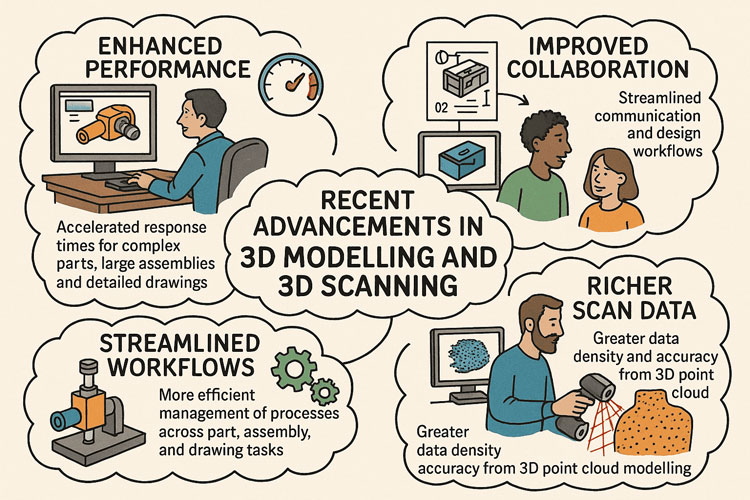
Collaboration is increasingly centred around 3D data. Modern platforms now let teams review, comment on, and markup native 3D models directly inside the design environment. Instead of relying solely on screenshots or static drawings, stakeholders can spin, section, and measure live models for better context. Real-time update notifications and cloud-connected revision control ensure that scanned 3D data and parametric CAD models stay synchronized — critical when working with reality capture data that represents the as-built environment. Hybrid data management options combine local PDM systems with cloud platforms, supporting distributed teams handling massive point clouds or mesh data. This tight integration means that model changes — whether from new design iterations or updated scans — propagate instantly across the project team. Decision-making becomes more visual and informed, keeping everyone aligned around a single, authoritative 3D dataset. Collaboration is no longer a separate process but embedded into daily 3D workflows.
2. Smarter Part Modelling
3D modelling tools are now more intelligent and better suited for working with scan-derived geometry. Designers can quickly apply chamfers, fillets, and shells across complex surfaces, even those imported from meshes or point cloud extractions. Automated bend notch creation and sheet metal tools are optimized to work with geometry derived from scanning existing parts, making reverse-engineering and fabrication preparation much faster. Reference geometry patterning allows engineers to build parametric frameworks over point cloud regions, speeding up master model creation. Cleanup utilities now support selectively removing unnecessary features or smoothing noisy scan data without rebuilding the entire model history. These advances turn what used to be a labour-intensive process into a streamlined workflow that transforms raw reality capture data into production-ready models. The focus is on reducing friction between physical and digital — allowing engineers to move quickly from scan to design, then to manufacturing.
3. Large Assembly Performance
Point cloud and mesh datasets are often extremely large, so performance improvements are critical. Modern CAD platforms now handle assemblies containing both traditional parametric models and massive scan data without bringing systems to a crawl. Engineers can duplicate components while maintaining mates, overlay scans onto assemblies to check fit, and perform interference detection even in lightweight modes. Visualization performance has been tuned for high-density point clouds, allowing smooth pan, zoom, and rotate interactions even with billions of points. Simplification and decimation tools let users strip out unneeded scan detail for faster load times while retaining critical geometry. Seamless transitions between lightweight review and full edit mode make it possible to work interactively with scanned environments. This capability is especially valuable for plant layout, construction validation, and retrofitting projects, where the ability to handle large, mixed-format 3D datasets directly within assemblies is a competitive advantage.
4. Enhanced Drawings and Documentation
Although 3D is the primary medium, 2D documentation remains essential — especially for suppliers and manufacturing partners. Modern CAD environments generate drawings directly from parametric models or scan-based reconstructions, ensuring that documentation matches the latest as-built conditions. Multi-approval stamps, BOM quantity overrides, and standards compliance tools make it easy to document parts created from reverse engineering or field measurement data. Automatic view generation and model-based definition (MBD) help reduce the reliance on fully manual drawings, embedding dimensions and tolerances directly into the 3D model where possible. For projects using scans, section views can be cut through the point cloud or mesh to produce accurate reference drawings without redrawing geometry. These improvements ensure that documentation is both faster to produce and more accurate — giving fabrication teams confidence that the deliverables reflect real-world conditions rather than idealized design intent.
5. Seamless ECAD/MCAD Integration
The convergence of 3D scanning and electronics integration is enabling more precise mechatronic design. Point cloud models of housings, enclosures, and factory floors can be combined with PCB outlines and component data for fit validation. Modern tools allow importing copper traces, vias, and keep-out regions into the mechanical model to run thermal or clearance checks directly against scanned geometry. This prevents collisions and ensures proper heat management early in the design cycle. Real-time synchronization between ECAD and MCAD domains means that if a scanned housing reveals unexpected tolerances, electrical designers can adjust their board layout accordingly. The result is a more accurate digital twin that accounts for both the designed and as-built states. This tighter integration avoids costly late-stage changes, shortens time-to-market, and ensures that mechanical and electrical systems are developed with a shared, reliable 3D reference that reflects physical reality.
6. Performance and Visualization
Visualization is where 3D scanning truly shines. GPU-accelerated engines now render massive point clouds, meshes, and parametric geometry in real time, allowing teams to virtually “walk through” captured environments or inspect reverse-engineered parts at full fidelity. Silhouette-based defeature tools can strip away irrelevant details while maintaining enough geometry for accurate reviews and clash detection. Cached mass property calculations extend to mesh and hybrid models, giving accurate weight and center of gravity data even from scan-derived parts. Photorealistic rendering using real-time ray tracing allows stakeholders to experience designs exactly as they will look, bridging the gap between scanned reality and proposed modifications. This level of visual fidelity improves collaboration, reduces the need for physical mock-ups, and accelerates stakeholder buy-in. High-quality 3D visualization is no longer a luxury — it is a daily tool for engineers, designers, and decision-makers alike.
7. Future Outlook
The future of 3D modelling is increasingly driven by AI and reality capture. Expect CAD platforms to automatically recognize features within point clouds — holes, slots, threads — and generate parametric features with minimal user input. Cloud-native workflows will make it easier to process extremely large scan datasets without local performance bottlenecks. Automated drawing generation and model-based definition will continue to reduce documentation overhead, while digital twin technology will tie live sensor data to scanned geometry for ongoing validation. Generative design powered by AI will be able to work directly with scanned environments, proposing optimized solutions that account for real-world constraints. This convergence of scanning, modelling, and simulation promises a future where physical and digital coexist seamlessly — enabling engineers to capture, design, simulate, and validate with unprecedented speed and accuracy, ultimately transforming how products, factories, and infrastructure are created and maintained.
How 3D Laser Scanning is Redefining Reality for Design, Construction & Heritage
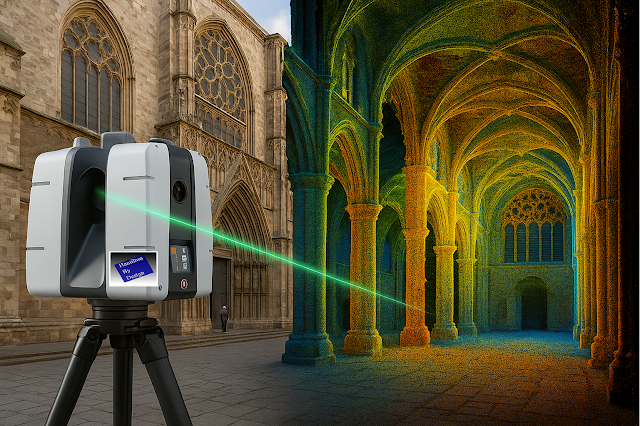
Imagine standing before a centuries-old cathedral, where every carved arch, every stained-glass pane, every weathered stone holds centuries of stories. Capturing its true form and condition with tape measure and camera? Tedious and prone to errors. But with 3D laser scanning, you can digitally freeze every detail—down to the imperfections—turning reality into an exact, manipulable model.
In an age where precision, speed, and data-driven decisions are non-negotiable, 3D laser scanning is no longer “nice to have”—it’s essential. Let’s explore what it is, why it’s transformative, where it’s being used most powerfully, and how you can harness its potential.
What Is 3D Laser Scanning?
At its core, 3D laser scanning sometimes called terrestrial laser scanning, (TLS) is the emission of laser pulses toward surfaces, recording the time it takes for those pulses to bounce back. From that comes a dense “point cloud” — billions of precise data points mapping shape, texture, orientation, and distance.
These point clouds become high-fidelity models, maps, meshes, or BIM ready files. Whether you’re scanning building exteriors, interiors, or industrial components, the result is more than just imagery—it’s measurable, analyzable geometry.
How It Works — The Process
Preparation & Planning
Define what you need: the level of detail (LOD), resolution, range, and whether external conditions (light, weather) will interfere.
Data Capture
Position the scanner at multiple stations to cover all surfaces. Use targets or reference markers for alignment and capture with overlapping scans.
Processing & Registration
Merge scans to align them properly, clean noise, filter out irrelevant data (like people, moving objects), calibrate.
Post-processing & Deliverables
Convert point clouds into usable outputs—floorplans, sections, elevations, 3D meshes, BIM models, virtual walkthroughs. Run analyses (clash detection, deformation etc.).
Integration & Use
Use the data in design, restoration, facility management, or documentation. The quality of integration (into BIM, GIS, CAD) is key to unlocking value.
Key Benefits
Benefit
What It Means in Practice
Real-World Impact
Extreme Precision
Sub-millimetre to millimetre accuracy depending on the scanner and conditions.
Less rework. Better fit for retrofit, renovation, or mechanical systems in tight tolerances.
Speed + Efficiency
Collect large amounts of spatial data in far less time than traditional measurement.
Faster project turnaround. Reduced site time costs.
Non-Contact / Low Disruption
Good for fragile structures, hazardous or difficult-to-access places.
Preserves integrity of heritage buildings; safer for workers.
Comprehensive Documentation
Full visual & geometric context.
Informs future maintenance. Acts as an archival record.
Better Decision Making & Conflict Detection
Early clash detection; scenario simulation; what-if modelling.
Avoids costly mistakes; helps build consensus among stakeholders.
Enhanced Visualisation & Communication
Stakeholders can see exactly what exists vs. what’s being proposed.
Facility Management: Digital twins, maintenance, asset tracking.
Environment & Surveying: Terrain mapping, forestry, flood risk mapping (especially when combined with aerial systems or mobile scanning).
Challenges & Best Practices
Nothing is perfect. To get the most out of 3D laser scanning, anticipate and mitigate:
Environmental factors: Light, dust, rain, reflective surfaces can introduce noise.
Data overload: Massive point clouds are large; need strong hardware & efficient workflows.
Alignment & registration errors: Overlaps, control points, and calibration are vital.
Skill & Planning: Good operators + good planning = much better outcomes.
Key best practices:
Use reference targets for precise registration.
Capture overlap of 30-50% between scan positions.
Break project into manageable segments.
Clean noise early.
Think ahead about deliverables and how clients will use the data (design, BIM, VR etc.).
Case Studies & Stories
Heritage in Danger: A cathedral in Europe threatened by pollution and structural decay was laser scanned. The point cloud revealed minute deformations, enabling an accurate restoration plan—saving costs and preserving history.
Infrastructure Efficiency: A civil engineering firm reduced design clashes by 80% on a complex highway project by integrating scans with their BIM workflow.
Industrial Switch-Over: Manufacturing plant layout was reconfigured using scan data; downtime reduced because the virtual model matched reality better than the old blueprints.
Software, Tools & Ecosystem
While scanners are vital, the software ecosystem is what unlocks value. Tools that turn raw data into actionable insights include:
Reality capture tools (processing point clouds).
BIM / CAD integration (e.g. Revit, AutoCAD).
Visualization tools (VR, AR, walkthrough).
Data sharing & collaboration platforms.
Cloud storage / processing if large point clouds.
SaaS/cloud-based workflows are increasingly important to share among remote teams, facilitate stakeholder review, and ensure data is accessible beyond just technical users.
Why It Matters Now
Global pressures (heritage, sustainability, faster build cycles, remote work) are raising the bar.
Regulatory compliance and “as-built” requirements are stricter.
Digital twins & smart infrastructure demand high fidelity data.
3D laser scanning acts as a bridge: between physical world and digital twin; between heritage past and future; between design promise and build reality. If you have a survey scan and want to make sense of point cloud data, contact Hamilton By Design
To provide the best experiences, we use technologies like cookies to store and/or access device information. Consenting to these technologies will allow us to process data such as browsing behaviour or unique IDs on this site. Not consenting or withdrawing consent, may adversely affect certain features and functions.
Functional
Always active
The technical storage or access is strictly necessary for the legitimate purpose of enabling the use of a specific service explicitly requested by the subscriber or user, or for the sole purpose of carrying out the transmission of a communication over an electronic communications network.
Preferences
The technical storage or access is necessary for the legitimate purpose of storing preferences that are not requested by the subscriber or user.
Statistics
The technical storage or access that is used exclusively for statistical purposes.The technical storage or access that is used exclusively for anonymous statistical purposes. Without a subpoena, voluntary compliance on the part of your Internet Service Provider, or additional records from a third party, information stored or retrieved for this purpose alone cannot usually be used to identify you.
Marketing
The technical storage or access is required to create user profiles to send advertising, or to track the user on a website or across several websites for similar marketing purposes.