Mechanical Engineering | 3D Scanning | 3D Modelling
Tag: digital-twin-models
Hamilton By Design develops industrial digital twin models from 3D LiDAR scans, point-cloud data, CAD models and available asset information.
A digital twin provides a structured digital representation of a physical facility, machine or fixed plant asset. Depending on the required scope, it may combine existing geometry with equipment identification, technical information, maintenance records and revision-controlled documentation.
Our process can begin with LiDAR scanning to capture the installed position of machinery, conveyors, pipework, tanks, platforms, structural elements and surrounding buildings. The registered point cloud can then be converted into a coordinated CAD or BIM model at an agreed level of detail.
Digital twin models can support:
Existing-condition and as-built records
Equipment layouts and plant upgrades
Maintenance and shutdown planning
Clash detection and installation reviews
Asset identification and documentation
Design coordination and change management
Remote site familiarisation
Future scanning and condition comparisons
Deliverables may include E57, RCP or LAS point clouds, 3D CAD or BIM models, equipment layouts, technical drawings and associated asset information.
A static 3D model is not automatically a live digital twin. Integration with sensors, operational data or maintenance systems requires an agreed information structure and suitable software platform. Hamilton By Design can develop the geometric and engineering foundation for these broader digital-twin workflows.
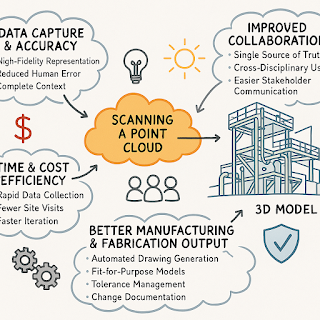
The world of manufacturing and fabrication is moving faster than ever. Point cloud scanning and 3D modeling have made it easier to capture reality with incredible accuracy — but simply collecting data isn’t enough.
Without the right expertise, point clouds often sit unused, underutilized, or worse — lead to costly mistakes when converted into incomplete or inaccurate drawings.
That’s why mechanical engineering consultants are becoming essential partners for forward-thinking businesses. They don’t just process point clouds — they turn them into:
High-precision 3D models that match real-world conditions
Fabrication-ready drawings that reduce errors and rework
Actionable insights that save time, money, and frustration
This is no longer just about technology — it’s about strategy and execution.
Read our full article to discover why now is the perfect time to engage consultants who can unlock the power of your point cloud data:
In the 1980s through to the early 2000s, AutoCAD ruled supreme. It revolutionised the way engineers and designers approached 2D drafting, enabling technical drawings to be created and shared with speed and precision across industries. For two decades, it set the benchmark for visual communication in engineering and construction. But that era has passed.
Today, we live and work in a three-dimensional world — not only in reality, but in design.
From 2D Drafting to Solid Modelling: The New Standard
At Hamilton By Design, we see 3D modelling not just as a tool, but as an essential evolution in how we think, design, and manufacture. The transition from 2D lines to solid geometry has reshaped the possibilities for every engineer, machinist, and fabricator.
With the widespread adoption of platforms like SolidWorks, design engineers now routinely conduct simulations, tolerance analysis, motion studies, and stress testing — all in a virtual space before a single part is made. Companies like Tesla, Ford, Eaton, Medtronic, and Johnson & Johnson have integrated 3D CAD tools into their product development cycles with great success, dramatically reducing rework, increasing precision, and accelerating innovation.
Where 2D design was once enough, now solid models drive machining, laser cutting, 3D printing, automated manufacturing, and finite element analysis (FEA) — all from a single digital source.
At Hamilton By Design, we work with and alongside these firms — and others — to deliver scalable, intelligent 3D modelling solutions to the Australian industrial sector. From laser scanning and site capture to custom steel fabrication, we translate concepts into actionable, manufacturable designs. Our clients benefit not only from our hands-on trade knowledge but also from our investment in cutting-edge tools and engineering platforms.
So What’s Next? The Future Feels More Fluid Than Solid
With all these tools now at our fingertips — FEA simulation, LiDAR scanning, parametric modelling, cloud collaboration — the question becomes: what comes after 3D?
We’ve moved from pencil to pixel, from 2D lines to intelligent digital twins. But now the line between design and experience is beginning to blur. Augmented reality (AR), generative AI design, and real-time simulation environments suggest that the next wave may feel more fluid than solid — more organic than mechanical.
We’re already seeing early glimpses of this future:
Generative design tools that evolve geometry based on performance goals
Real-time digital twins updating with sensor data from operating plants
AI-driven automation that simplifies design iterations in minutes, not days
In short: the future of 3D design might not be “3D” at all in the traditional sense — it could be interactive, immersive, adaptive.
At Hamilton By Design — We’re With You Now and Into the Future
Whether you’re looking to upgrade legacy 2D drawings, implement laser-accurate reverse engineering, or develop a full-scale 3D model for simulation or manufacturing — Hamilton By Design is here to help.
We bring hands-on trade experience as fitters, machinists, and designers, and combine it with the modern toolset of a full-service mechanical engineering consultancy. We’re not just imagining the future of design — we’re building it.
Let’s design smarter. Let’s think in 3D — and beyond.
By Hamilton By Design | www.hamiltonbydesign.com.au
In the 1980s through to the early 2000s, AutoCAD ruled supreme. It revolutionised the way engineers and designers approached 2D drafting, enabling technical drawings to be created and shared with speed and precision across industries. For two decades, it set the benchmark for visual communication in engineering and construction. But that era has passed.
Today, we live and work in a three-dimensional world — not only in reality, but in design.
From 2D Drafting to Solid Modelling: The New Standard
At Hamilton By Design, we see 3D modelling not just as a tool, but as an essential evolution in how we think, design, and manufacture. The transition from 2D lines to solid geometry has reshaped the possibilities for every engineer, machinist, and fabricator.
With the widespread adoption of platforms like SolidWorks, design engineers now routinely conduct simulations, tolerance analysis, motion studies, and stress testing — all in a virtual space before a single part is made. Companies like Tesla, Ford, Eaton, Medtronic, and Johnson & Johnson have integrated 3D CAD tools into their product development cycles with great success, dramatically reducing rework, increasing precision, and accelerating innovation.
Where 2D design was once enough, now solid models drive machining, laser cutting, 3D printing, automated manufacturing, and finite element analysis (FEA) — all from a single digital source.
At Hamilton By Design, we work with and alongside these firms — and others — to deliver scalable, intelligent 3D modelling solutions to the Australian industrial sector. From laser scanning and site capture to custom steel fabrication, we translate concepts into actionable, manufacturable designs. Our clients benefit not only from our hands-on trade knowledge but also from our investment in cutting-edge tools and engineering platforms.
So What’s Next? The Future Feels More Fluid Than Solid
With all these tools now at our fingertips — FEA simulation, LiDAR scanning, parametric modelling, cloud collaboration — the question becomes: what comes after 3D?
We’ve moved from pencil to pixel, from 2D lines to intelligent digital twins. But now the line between design and experience is beginning to blur. Augmented reality (AR), generative AI design, and real-time simulation environments suggest that the next wave may feel more fluid than solid — more organic than mechanical.
We’re already seeing early glimpses of this future:
Generative design tools that evolve geometry based on performance goals
Real-time digital twins updating with sensor data from operating plants
AI-driven automation that simplifies design iterations in minutes, not days
In short: the future of 3D design might not be “3D” at all in the traditional sense — it could be interactive, immersive, adaptive.
At Hamilton By Design — We’re with You Now and into the Future
Whether you’re looking to upgrade legacy 2D drawings, implement laser-accurate reverse engineering, or develop a full-scale 3D model for simulation or manufacturing — Hamilton By Design is here to help.
We bring hands-on trade experience as fitters, machinists, and designers, and combine it with the modern toolset of a full-service mechanical engineering consultancy. We’re not just imagining the future of design — we’re building it.
Let’s design smarter. Let’s think in 3D — and beyond.
Unlocking Engineering Potential with the 3DEXPERIENCE Platform
At Hamilton By Design, we are committed to pushing the boundaries of innovation and efficiency in industrial design and engineering. One of the most powerful tools enabling this shift is the 3DEXPERIENCE platform by Dassault Systèmes — a cloud-based, integrated environment that transforms how engineering, design, and manufacturing teams collaborate and operate.
But what makes this platform such a game-changer, particularly in heavy industrial environments?
A Unified Digital Ecosystem
Traditional design and engineering workflows often involve disjointed software systems, siloed communication, and a lack of visibility across teams. The 3DEXPERIENCE platform solves these challenges by offering a centralised digital workspace. It unifies CAD, simulation, data management, and project collaboration under one roof.
At Hamilton By Design, this means we can collaborate with clients, suppliers, and internal teams in real time — reducing delays, increasing transparency, and ensuring version control is never an issue.
Smarter Collaboration and Real-Time Decision-Making
For industrial clients, time is money. Delays caused by miscommunication or outdated files can cost thousands in downtime. With the 3DEXPERIENCE platform, all stakeholders — from engineers and designers to procurement and management — can access a single source of truth, anytime, anywhere.
Changes to 3D models, drawings, or requirements are reflected instantly across the platform. That kind of visibility ensures we’re always aligned with the project vision, improving decision-making speed and accuracy.
Advanced 3D Modelling and Simulation
Designing for complex environments — such as processing plants, mines, or heavy machinery installations — requires robust tools. The 3DEXPERIENCE platform delivers powerful 3D modelling and simulation capabilities through applications like CATIA, SIMULIA, and ENOVIA.
Whether we’re reverse engineering existing assets from LIDAR scans or developing new plant layouts, the platform helps us validate designs early through simulation and stress testing. This leads to fewer surprises during fabrication or installation, and stronger, safer designs.
Integration with LIDAR Scanning and Point Cloud Data
At Hamilton By Design, we often start projects using high-resolution LIDAR scans, capturing real-world conditions with millimetre precision. The 3DEXPERIENCE platform allows seamless integration of point cloud data, enabling our team to design directly within real-world geometry — reducing fitment issues and rework.
This integration ensures we don’t just create models — we create smart, context-aware models that interact meaningfully with the physical world.
Scalability and Security
As a cloud-based system, the 3DEXPERIENCE platform is scalable and secure. Whether we’re working on a small component upgrade or a large-scale plant overhaul, we can expand our toolset, users, and data storage with ease — all while maintaining enterprise-level data protection.
Conclusion
The 3DEXPERIENCE platform empowers Hamilton By Design to deliver faster, smarter, and more integrated engineering solutions. For clients in the heavy industrial space, it means fewer risks, better collaboration, and a clear digital path from concept to completion.
Want to know how the 3DEXPERIENCE platform can help your next project? Get in touch today at [email protected]
To provide the best experiences, we use technologies like cookies to store and/or access device information. Consenting to these technologies will allow us to process data such as browsing behaviour or unique IDs on this site. Not consenting or withdrawing consent, may adversely affect certain features and functions.
Functional
Always active
The technical storage or access is strictly necessary for the legitimate purpose of enabling the use of a specific service explicitly requested by the subscriber or user, or for the sole purpose of carrying out the transmission of a communication over an electronic communications network.
Preferences
The technical storage or access is necessary for the legitimate purpose of storing preferences that are not requested by the subscriber or user.
Statistics
The technical storage or access that is used exclusively for statistical purposes.The technical storage or access that is used exclusively for anonymous statistical purposes. Without a subpoena, voluntary compliance on the part of your Internet Service Provider, or additional records from a third party, information stored or retrieved for this purpose alone cannot usually be used to identify you.
Marketing
The technical storage or access is required to create user profiles to send advertising, or to track the user on a website or across several websites for similar marketing purposes.