Engineering-Grade Labour Hire: Why Governance Matters

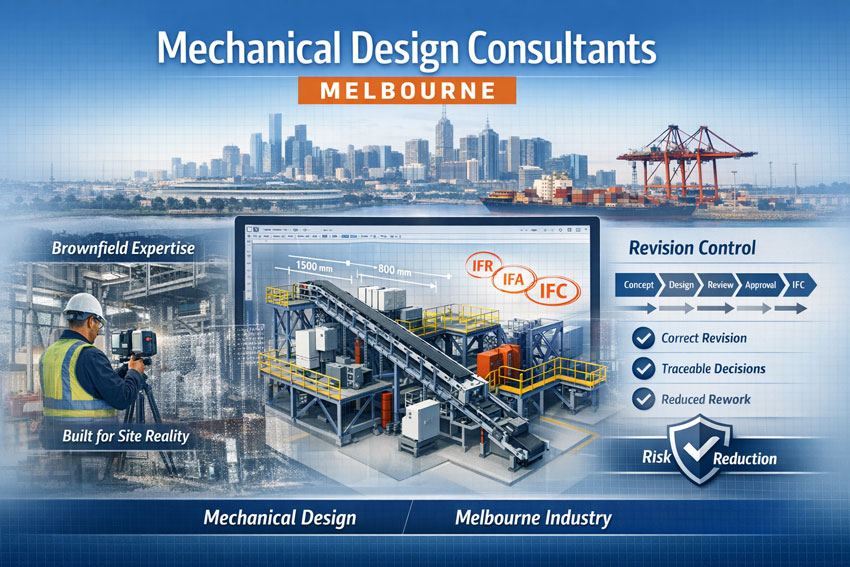
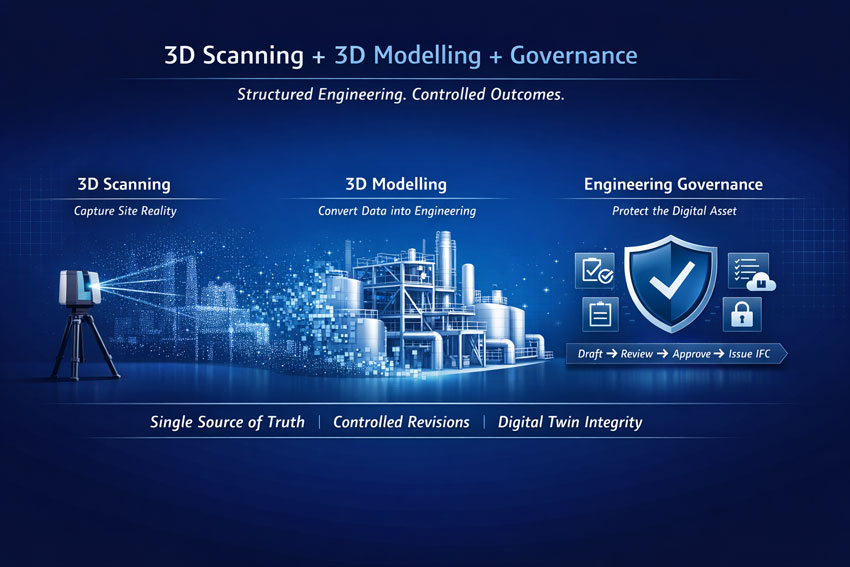
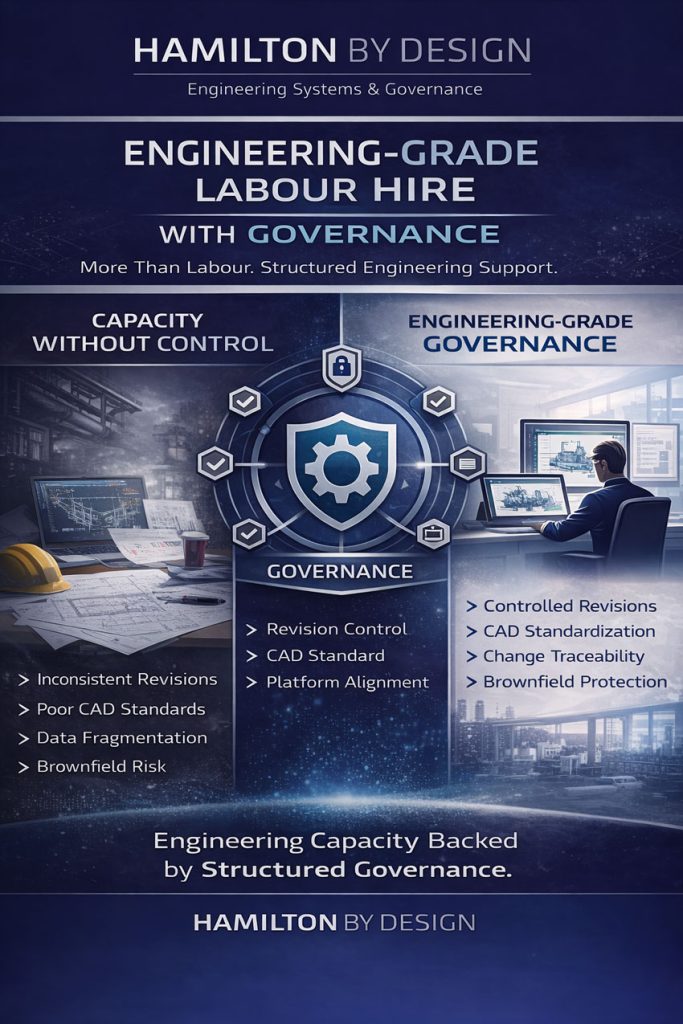
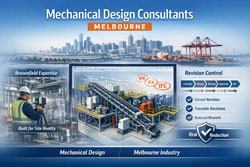
Engineering-grade labour hire with governance infographic showing structured CAD control and revision management.

Engineering-Grade Labour Hire with Governance | Hamilton By Design

In heavy industry, mining, manufacturing and infrastructure, labour hire is common.
But too often, it solves only one problem โ€” short-term capacity.

It does not solve control.

Drawings are produced. Models are updated. Changes are made.
Yet without structured governance, projects quietly lose alignment.

At Hamilton By Design, we approach labour hire differently.
We provide engineering-grade secondment backed by governance discipline.


Hamilton By Design engineering governance model contrasting uncontrolled labour hire with structured engineering oversight.

The Hidden Risk in Traditional Labour Hire

Most labour hire arrangements focus on hours and availability.

What is often overlooked:

  • Inconsistent CAD standards
  • Poor revision control
  • Unclear drawing issue status (IFR / IFA / IFC)
  • Fragmented contractor inputs
  • Brownfield upgrades corrupting master records
  • Loss of traceability during fast-tracked works

The result?

Capacity increases โ€” but risk increases with it.

Engineering environments, especially live operating sites, cannot afford that.


What Does โ€œEngineering Gradeโ€ Actually Mean?

Engineering-grade secondment is not simply providing a drafter or designer.

It means supplying personnel who understand:

  • Configuration control
  • Document lifecycle management
  • Industrial compliance requirements
  • Change management discipline
  • Digital environment structure
  • Risk in operational facilities

It means embedding someone who works within a governance framework โ€” not outside of it.


Governance Is the Difference

Engineering governance ensures:

  • Drawings reflect physical site reality
  • Revisions are auditable
  • Contractors work from approved documentation
  • Brownfield upgrades maintain data integrity
  • Digital models remain a reliable single source of truth
  • Risk is reduced before construction begins

Governance protects capital investment.

Without it, labour hire becomes a short-term patch that creates long-term technical debt.


Brownfield Environments Demand More

Live operating facilities are complex.

They involve:

  • Multi-vendor interfaces
  • Progressive isolation of operational zones
  • Legacy drawings
  • Unknown modifications
  • Production pressure

In these environments, uncontrolled changes can introduce safety, operational and financial risk.

Hamilton By Design brings governance discipline into the labour hire model โ€” ensuring upgrades, modifications and expansions are managed within structured engineering control.


Engineering Secondment with Digital Alignment

Our engineering-grade secondment integrates with structured digital environments, including:

  • Controlled CAD standards
  • Managed drawing registers
  • Platform-based collaboration environments
  • Revision tracking workflows
  • Vendor drawing review protocols

Rather than simply placing a resource on site, we align that resource with a defined governance system.

That alignment protects the project โ€” and the client.


More Than Labour. Structured Engineering Support.

Hamilton By Design delivers:

  • Engineering governance support
  • CAD and drawing control oversight
  • Brownfield upgrade discipline
  • Data integrity protection
  • Digital continuity across project stages

This is labour hire redefined.

It is engineering capacity supported by structure, accountability and technical leadership.


When Is Engineering-Grade Labour Hire Required?

  • Complex brownfield upgrades
  • Live operational facilities
  • Multi-contractor environments
  • Digital transformation programs
  • CAD standardisation projects
  • Projects requiring traceable revision control

If your project needs more than drafting โ€”
if it needs structured engineering control โ€”
Hamilton By Design delivers engineering-grade secondment aligned with governance, compliance and operational continuity.


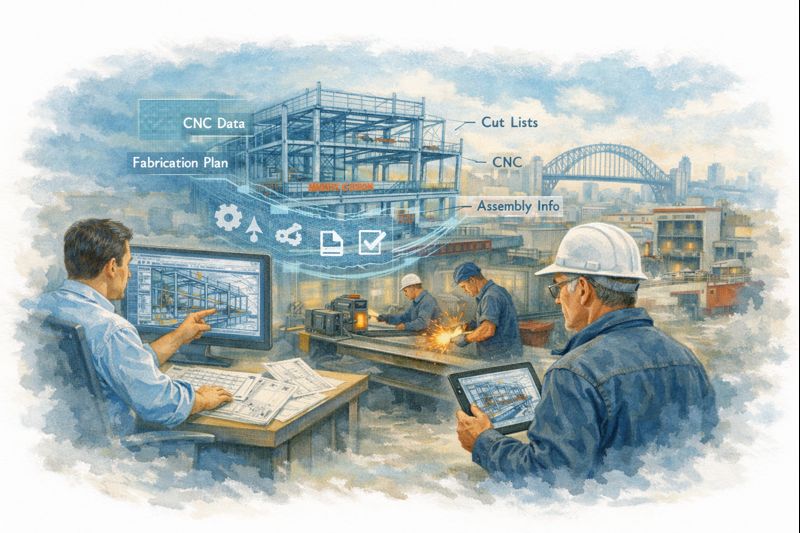
Fabrication Integrated Modelling in a Sydney workshop showing engineers and fabricators using a shared 3D model to drive CNC fabrication and steel assembly.

3D LiDAR scanning and 3D modelling service button โ€” laser scanner capturing a point cloud for engineering and CAD modelling
Mechanical engineering services

Protect Your Engineering Environment

Capacity solves workload.

Governance protects investment.

Hamilton By Design provides both.

Name
Would you like us to arrange a phone consultation for you?
Address


3D CAD Modelling Australia service banner for Hamilton By Design
Finite Element Analysis (FEA) engineering simulation button
Mechanical engineering services

3D LiDAR Scanning with Engineering Governance: Securing Your Asset Data for the Long Term

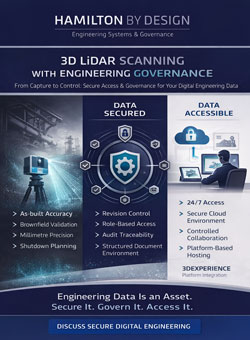
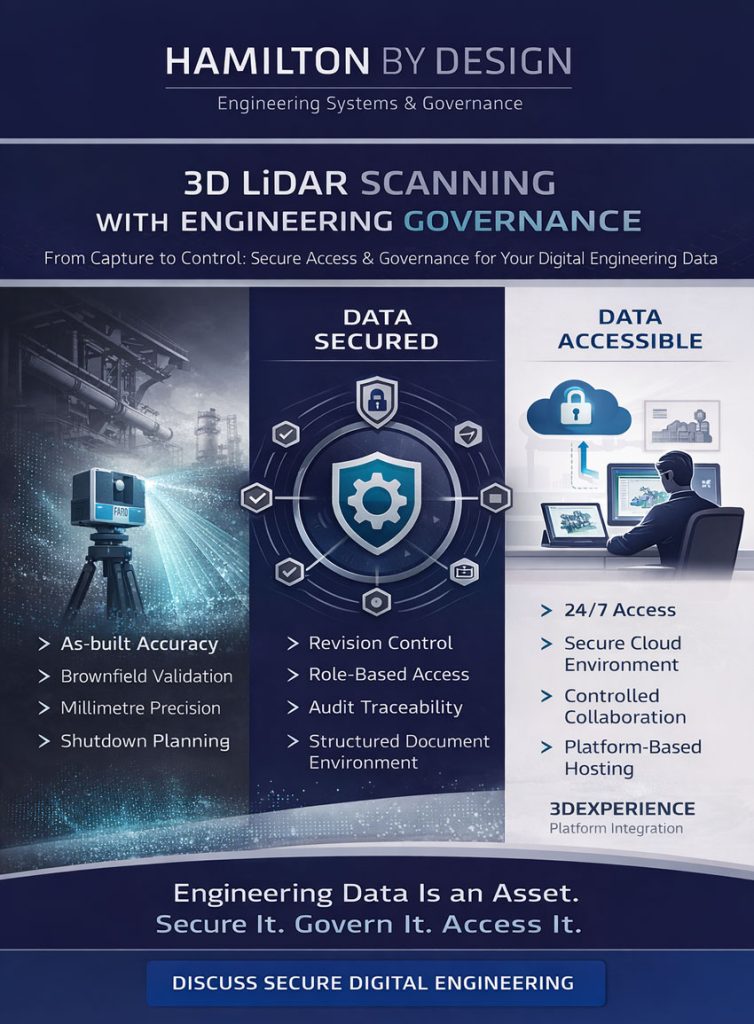
Industrial LiDAR scanning and digital engineering governance model demonstrating secure data capture, revision control and secure platform access.

3D LiDAR Scanning & Engineering Data Governance

3D LiDAR scanning has become a powerful tool in modern mechanical and industrial engineering.

It captures reality with millimetre precision.
It reduces site rework.
It improves brownfield design confidence.
It shortens shutdown risk.

But capturing data is only half the solution.

Without structured engineering governance, even the most accurate point cloud becomes just another unmanaged file sitting on a server.

At Hamilton By Design, we combine 3D LiDAR scanning with controlled digital environments โ€” ensuring your engineering data is not only captured, but secured, governed, and accessible when you need it.


The Risk: Uncontrolled Engineering Data

Across mining, manufacturing and heavy industry, we regularly see:

  • Point cloud files stored on local drives
  • Multiple uncontrolled drawing revisions
  • Contractors working from outdated geometry
  • Large scan files shared via unsecured links
  • No defined ownership of digital assets

When governance is absent, data degrades.

And when data degrades, engineering risk increases.


3D LiDAR Scanning Is the Starting Point โ€” Not the End

LiDAR scanning provides:

  • Accurate as-built geometry
  • Clash detection confidence
  • Brownfield validation
  • Structural and mechanical verification
  • Shutdown planning support

However, once the scan is complete, organisations must answer critical questions:

  • Who controls revision access?
  • Where is the master file stored?
  • How are updates managed after upgrades?
  • Who can access the model โ€” and when?
  • Is the data audit ready?

This is where engineering governance becomes essential.


Secure digital engineering workflow showing 3D point cloud capture, governance control and cloud-based 24-hour access.

Engineering Governance: Protecting Your Digital Assets

Engineering governance ensures:

  • Controlled document environments
  • Structured revision management
  • Defined user access permissions
  • Audit traceability
  • Secure cloud storage
  • Long-term digital asset stewardship

Without governance, digital engineering becomes fragmented.

With governance, it becomes a single source of truth.


Secured Access Through the 3DEXPERIENCE Platform

Hamilton By Design has partnered to support secure data environments through the 3DEXPERIENCE platform.

This allows clients to:

  • Access their 3D models 24 hours per day
  • Review point cloud data securely online
  • Manage drawing revisions in a controlled environment
  • Collaborate with contractors under structured permissions
  • Maintain engineering continuity across upgrades

Your data is not sent around via uncontrolled downloads.

It is hosted, governed, and managed within a structured platform environment.


Why 24/7 Access Matters

Industrial facilities do not operate between 9am and 5pm.

Shutdowns occur overnight.
Maintenance decisions happen urgently.
Capital approvals move quickly.

Having secure, controlled access to your digital engineering data โ€” at any time โ€” provides:

  • Faster decision-making
  • Reduced shutdown risk
  • Improved contractor coordination
  • Greater executive confidence

Engineering data becomes operational infrastructure.


Integrating LiDAR, Governance and Asset Integrity

When 3D LiDAR scanning is combined with structured governance and platform security, organisations gain:

  • A verified as-built model
  • Controlled revision history
  • Secure cloud-based storage
  • Role-based access control
  • Ongoing update capability following upgrades

This is particularly critical in:

  • Brownfield facilities
  • Mining operations
  • Manufacturing plants
  • Utilities infrastructure
  • Long-life industrial assets

Your scan data becomes a living engineering asset โ€” not a static deliverable.


From Capture to Control

At Hamilton By Design, we do not simply provide 3D scanning services.

We provide:

  • Site capture
  • Data processing
  • Model integration
  • Engineering governance
  • Secure platform hosting
  • Ongoing digital stewardship

The objective is simple:

To ensure your engineering data remains accurate, controlled, and accessible for the life of your asset.


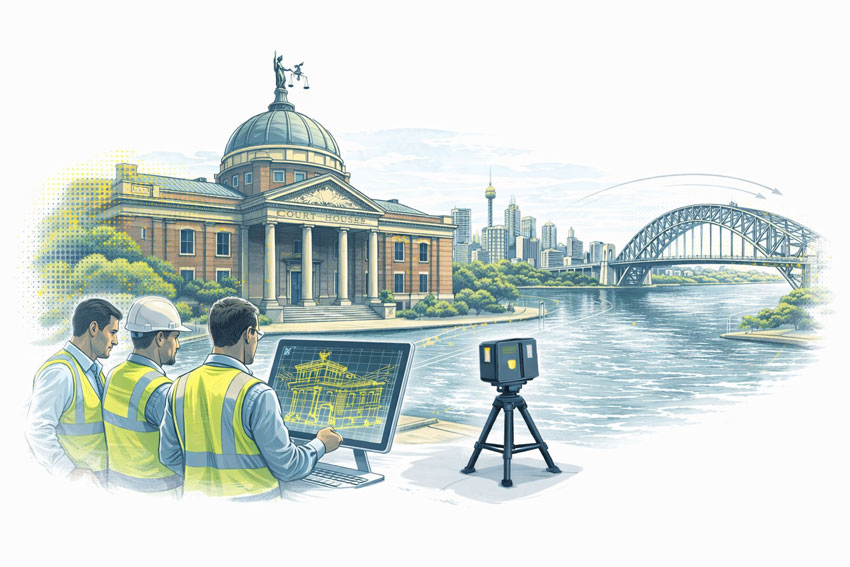
3D laser scanning in Sydney with an engineer capturing as-built conditions using LiDAR technology.

Engineering Data Is Corporate Risk

Unsecured or unmanaged engineering data creates exposure:

  • Design errors
  • Compliance failures
  • Shutdown overruns
  • Contractor disputes
  • Loss of institutional knowledge

Structured governance reduces this exposure.

When supported by secure platform access, your engineering records become resilient.


A Single Source of Truth โ€” Available Anytime

Through the integration of 3D LiDAR scanning and the 3DEXPERIENCE platform, Hamilton By Design enables:

  • 24/7 secure access
  • Controlled collaboration
  • Audit-ready documentation
  • Brownfield upgrade support
  • Digital continuity

Engineering is not just about building systems.

It is about protecting them โ€” physically and digitally.


Hamilton By Design logo displayed on a blue tilted rectangle with a grey gradient background

Hamilton By Design
3D LiDAR Scanning | Engineering Governance | Secure Digital Platforms

If your organisation is investing in digital capture, ensure your data is governed, protected and available whenever you need it.

3D LiDAR scanning and 3D modelling service button โ€” laser scanner capturing a point cloud for engineering and CAD modelling
Mechanical engineering services

Name
Would you like us to arrange a phone consultation for you?
Address

3D CAD Modelling Australia service banner for Hamilton By Design

Secondment for Mechanical Engineers: Strength Without Long-Term Overhead

Mechanical engineering secondment infographic showing embedded engineer support, brownfield governance control and operational stability in industrial environments.

Engineering Secondment for Mechanical Teams

Mechanical engineering teams today operate under sustained pressure.

  • Shutdown windows are tighter
  • Brownfield modifications are constant
  • Documentation is often incomplete
  • Internal engineering resources are stretched
  • Capital approval cycles are slow

In this environment, hiring permanent staff is not always the right answer.

A structured engineering secondment provides capability, continuity, and control โ€” without increasing long-term overhead.

At Hamilton By Design, secondment is not labour hire.
It is embedded technical capability.


What Is Engineering Secondment?

Engineering secondment is the temporary placement of an experienced engineering professional into your organisation to operate as part of your internal team.

Unlike traditional consulting:

  • The engineer works within your systems
  • Aligns with your standards
  • Supports your projects directly
  • Reports within your governance structure

The objective is not to deliver a report and leave.

It is to strengthen your mechanical function during periods of load, transition, or change.


Industrial engineering secondment visual showing internal mechanical pressure, embedded team integration and strengthened governance outcomes.
When Mechanical Teams Benefit Most

Secondment is particularly effective when:

  • A senior engineer has resigned or is on leave
  • A capital upgrade program has accelerated
  • Shutdown preparation requires additional oversight
  • Brownfield redesign is underway
  • Drawing governance needs to be stabilised
  • A 3D scanning and digital validation program is commencing

Instead of recruiting under pressure, secondment provides immediate capability.


1๏ธโƒฃ Stability During Engineering Transitions

Mechanical departments often rely heavily on a small number of experienced engineers.

When one leaves, knowledge gaps appear:

  • Historical plant decisions
  • Modification records
  • Informal workarounds
  • Vendor relationships

A seconded engineer with brownfield experience can:

  • Maintain continuity
  • Support decision-making
  • Preserve governance
  • Prevent reactive engineering

This reduces operational risk during transition periods.


2๏ธโƒฃ Controlled Support During Brownfield Upgrades

Brownfield engineering is rarely straightforward.

Existing conditions rarely match legacy drawings.
Interfaces are complex.
Shutdown timeframes are unforgiving.

A seconded engineer can:

  • Review site conditions alongside your team
  • Validate geometry through 3D scanning integration
  • Support constructability reviews
  • Manage drawing revisions and change control

This is especially valuable when your permanent team is already operating at full capacity.


3๏ธโƒฃ Strengthening Governance Without Growing Headcount

Many mechanical teams struggle with:

  • Drawing revision control
  • Asset record updates
  • Contractor data management
  • Change management tracking
  • Audit readiness

These responsibilities are critical โ€” but often under-resourced.

Secondment allows you to:

  • Embed structured engineering oversight
  • Improve documentation discipline
  • Align digital records with physical assets
  • Stabilise internal processes

All without committing to permanent salary overhead.


4๏ธโƒฃ Integration With Digital Validation & 3D Capture

Hamilton By Design integrates secondment with:

  • 3D Faro scanning capability
  • Digital model validation
  • Controlled data environments
  • Brownfield geometry verification

A seconded engineer who understands both mechanical systems and digital validation ensures that:

  • Design intent matches site conditions
  • Documentation remains current
  • Future modifications start from verified data

This creates long-term engineering value beyond the immediate assignment.


Secondment vs Consulting vs Labour Hire

ModelOutcomeLimitation
ConsultingAdvice & deliverablesLimited internal integration
Labour HireShort-term manpowerLimited governance structure
SecondmentEmbedded engineering capabilityRequires structured scope

Secondment sits between permanent recruitment and external consultancy โ€” providing practical integration with strategic oversight.


The Hamilton By Design Approach

Our secondment model focuses on:

  • Mechanical systems understanding
  • Brownfield engineering discipline
  • Governance and drawing control
  • Shutdown planning support
  • Digital validation integration
  • Asset stewardship

We operate as an extension of your mechanical team โ€” not as an external observer.


Engineering Is Capacity + Control

Mechanical engineering is not only about solving problems.

It is about maintaining system integrity over time.

Secondment provides:

  • Capacity when workload spikes
  • Control when governance weakens
  • Continuity during transition
  • Confidence before capital decisions

For mechanical engineering managers, it is often the most balanced solution between growth and risk.

Hamilton By Design logo displayed on a blue tilted rectangle with a grey gradient background


Hamilton By Design
Supporting mechanical engineers across Australia through structured secondment, digital validation, and engineering governance.


3D LiDAR scanning and 3D modelling service button โ€” laser scanner capturing a point cloud for engineering and CAD modelling
Mechanical engineering services
Name
Would you like us to arrange a phone consultation for you?
Address

3D CAD Modelling Australia service banner for Hamilton By Design

Why Projects Fail Before Construction Starts

3D scanning reality capture workflow converting legacy drawings into a verified site model for construction planning.

The missing step between site reality and project planning

Most project delays donโ€™t begin during construction.

They begin months earlier โ€” at the planning stage.

Not because engineers lack skill.
Not because contractors lack experience.

But because decisions are made using incomplete or assumed information.


Construction planning comparison between assumed data and verified point-cloud model using laser scanning.

The hidden gap in almost every project

In industrial and brownfield environments, teams typically work from:

  • legacy drawings
  • outdated models
  • partial surveys
  • contractor interpretation
  • verbal site knowledge

Each group fills in the missing details differently.

The result is predictable:

  • clashes discovered during installation
  • materials ordered incorrectly
  • redesign during construction
  • variations and disputes
  • safety risks

The project didnโ€™t fail during construction.
It failed when planning began without verified reality.


Planning systems only work if the starting data is correct

Modern project environments rely heavily on structured planning:

  • scheduling
  • procurement
  • prefabrication
  • shutdown coordination
  • multi-contractor installation

But structured planning requires structured information.

If the starting information is uncertain, the entire workflow becomes an organised way of distributing errors.


The role of a reality-based dataset

Before a project can be planned properly, one thing must exist:

A trusted digital representation of the physical asset

This is not a drawing.
This is not a sketch.
This is not a collection of markups.

It is a measurable, verifiable record of what physically exists.

Once this exists:

  • engineers design accurately
  • planners sequence correctly
  • contractors install confidently
  • procurement orders correctly
  • changes are controlled

What our consultancy provides

Hamilton By Design acts as the bridge between site conditions and project planning.

We provide a structured workflow:

  1. Capture the physical environment using high-accuracy laser scanning
  2. Create a controlled digital model of the asset
  3. Make the data accessible to all project stakeholders
  4. Lock the dataset during design and upgrade phases
  5. Update the dataset following modifications

This creates a single project reference โ€” removing interpretation between disciplines.


The outcome for projects

Instead of discovering problems during installation, they are resolved during planning.

Instead of managing variations, teams manage decisions.

Instead of reacting to site conditions, teams design around verified reality.


The value of independent verification

Our role is not to design the system or build the works.

Our role is to ensure every party begins with the same trusted information.

When reality is agreed, coordination becomes straightforward.


Before planning, establish certainty

Projects do not fail because teams are incapable.
They fail because teams start from different assumptions.

Providing a verified digital record of the site removes those assumptions.

And once assumptions disappear โ€” so do most surprises.


Hamilton By Design
Creating trusted project reality before planning begins.

Name
Would you like us to arrange a phone consultation for you?
Address


3D LiDAR scanning and 3D modelling service button โ€” laser scanner capturing a point cloud for engineering and CAD modelling
Mechanical engineering services
Finite Element Analysis (FEA) engineering simulation button
Mechanical engineering services

Onsite Scanning Australia Wide

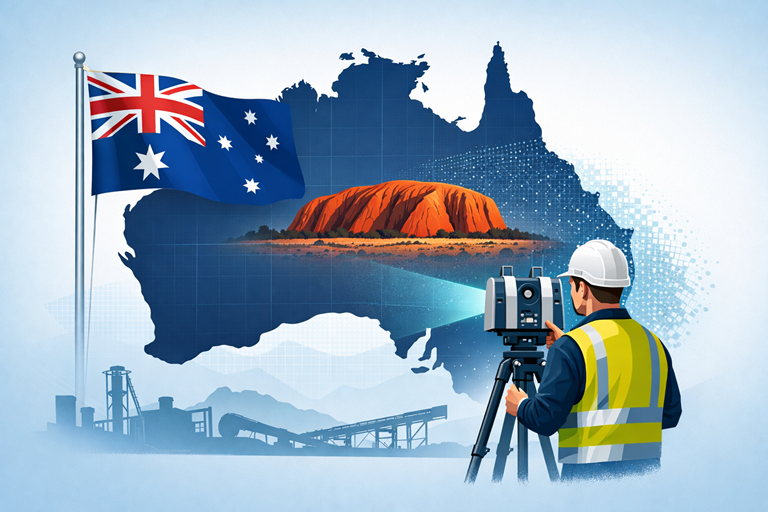
3D laser scanning services in Australia for mining and infrastructure modelling

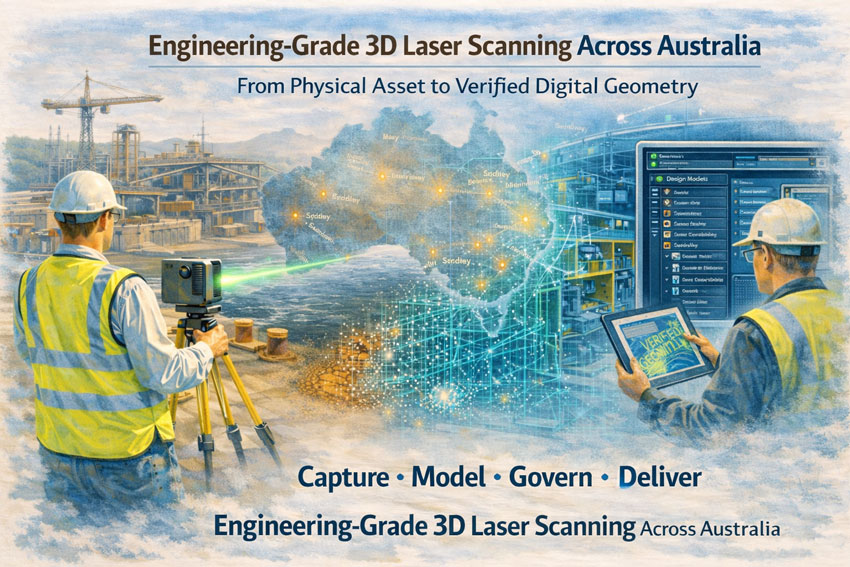
Engineering-grade 3D laser scanning, LiDAR and digital captureโ€”delivered to site, anywhere in Australia.

When youโ€™re working in a live facility, a remote site, or an aging asset thatโ€™s been modified a hundred times, the biggest risk is uncertainty. Missing dimensions. Out-of-date drawings. Unknown interferences. A โ€œclose enoughโ€ site measure that turns into rework, delays, and variations.

Hamilton By Design provides onsite scanning Australia wide to capture accurate, verifiable site conditionsโ€”so your engineers, designers, fabricators, and project managers can make confident decisions from day one.


LiDAR scanning survey across Australia with engineer capturing industrial site data

Why onsite scanning matters

Onsite scanning is the fastest way to convert real-world assets into reliable digital informationโ€”especially in brownfield and retrofit environments where original documentation is incomplete or incorrect.

Our field capture provides a precise baseline for:

  • As-built verification before upgrades, tie-ins, and shutdown works
  • Retrofit engineering for legacy plants and facilities
  • Clash detection and constructability checks before fabrication or installation
  • Digital engineering workflows (scan-to-model / scan-to-drawings)
  • Condition documentation for risk reduction, scope definition and handover records

In plain terms: the scan becomes the backbone of your project. If that backbone is broken (poor capture, gaps, or low confidence), everything downstream becomes harderโ€”engineering, drafting, fabrication and installation.


Australia-wide coverage, site-ready delivery

We mobilise to projects across Australiaโ€”metro, regional and remoteโ€”bringing the scanning equipment, field workflow and practical site experience needed to operate safely and efficiently.

Typical deployment environments include:

  • Mining & resources (processing plants, conveyors, workshops, pump stations)
  • Industrial manufacturing (steel, smelting, production lines, utilities)
  • Infrastructure and utilities (water, wastewater, power, transport assets)
  • Commercial and government assets (plantrooms, services corridors, legacy buildings)
  • Marine and ship repair (fit-up checks, reverse engineering, space claims)

If your site is difficult to access, operational, or time-restricted (e.g., night works), we can plan around your constraints.


What we scan onsite

We support a wide range of scanning objectives, including:

As-built capture for engineering and design

Capture existing steelwork, pipework, structures, platforms, equipment skids, services, and building geometryโ€”so design is based on reality, not assumptions.

Retrofit and brownfield modification support

Ideal for upgrades where the facility has changed over time and legacy drawings donโ€™t match current conditions.

Fabrication and installation verification

Use scans to confirm fitment, alignment, clearances, and integration points before committing to fabrication or mobilisation.

Reverse engineering and metrology-style capture

Where components are undocumented, worn, or customโ€”scanning provides a measurement foundation for remanufacture or replacement design.


Deliverables that suit real projects

Every project is different, so we align deliverables to what your team actually needs.

Common outputs include:

  • Registered point clouds (for design coordination and record)
  • 2D CAD outputs (elevations, sections, plans where required)
  • 3D model-ready datasets to support engineering and drafting
  • Digital verification notes to support design sign-off and QA

If youโ€™re not sure what deliverable is best, weโ€™ll recommend a practical option based on your scope, schedule, and how the data will be used downstream.


How our onsite scanning service works

  1. Scope & goals โ€“ what needs to be captured, why, and what level of detail is required
  2. Site requirements โ€“ access windows, inductions, permits, traffic management, WAH/EWP needs
  3. Onsite scanning mobilisation โ€“ safe, efficient field capture with a plan to minimise disruption
  4. Processing & registration โ€“ structured datasets prepared for engineering use
  5. Delivery & support โ€“ files issued with clear naming, coordination notes, and handover guidance

Safety and site integration

We operate with a strong focus on safe field work, practical site coordination, and minimal disruption to operations. Where required, we can work alongside site teams to manage access, exclusion zones, and staged capture.


Why Hamilton By Design

Weโ€™re an engineering-led team. That mattersโ€”because onsite scanning isnโ€™t just โ€œcollecting data.โ€ Itโ€™s collecting the right data, at the right density, in the right areas, with a clear understanding of how the information will be used for design, verification, and construction.

If you need confidence in your existing conditionsโ€”we can help.


Hamilton By Design logo displayed on a blue tilted rectangle with a grey gradient background

3D LiDAR scanning and 3D modelling service button โ€” laser scanner capturing a point cloud for engineering and CAD modelling
Mechanical engineering services

Request onsite scanning Australia wide

If you have an upcoming retrofit, upgrade, verification, or design project and you need accurate site capture, get in touch.

Contact Hamilton By Design to discuss your site, your schedule, and the deliverables you needโ€”anywhere in Australia.


Send us your site location, a brief scope, and any drawings/photos available, and weโ€™ll advise the best scanning approach.

Name
Would you like us to arrange a phone consultation for you?
Address

3D CAD Modelling Australia service banner for Hamilton By Design

Industrial LiDAR Scanning & Retrofit Engineering โ€“ Pittsburgh, Pennsylvania

Industrial facility captured using 3D laser scanning for brownfield plant upgrade

Engineering Certainty in Legacy Industrial Facilities

Pittsburgh is not a new-build engineering market.

It is a modification market.

Steel mills, manufacturing plants, utilities and infrastructure in the Pittsburgh region have evolved over decades โ€” often across multiple owners, upgrades and undocumented changes. As a result, existing drawings rarely represent real conditions.

Hamilton By Design supports engineering and project teams by capturing accurate as-built data before modification work begins.

Rather than designing around assumptions, projects are developed from measured reality.


Engineer performing industrial LiDAR scan of a processing plant for retrofit design

Why Retrofit Projects in Pittsburgh Require LiDAR Scanning

Legacy facilities typically contain:

  • undocumented plant changes
  • relocated equipment
  • structural distortion over time
  • incomplete or missing drawings
  • congested services and pipework

When upgrades are designed from outdated information, installation conflicts occur and shutdown durations increase.

High-accuracy LiDAR scanning captures millions of measurement points and creates a true digital representation of the operating facility, reducing rework and unexpected site conflicts.


Typical Pittsburgh Projects We Support

Steel & Heavy Manufacturing

  • equipment replacement
  • access platforms and walkways
  • structural refurbishment
  • plant safety upgrades

Utilities & Processing Facilities

  • pipe routing modifications
  • pump and tank replacement
  • tie-in engineering
  • maintenance shutdown planning

Industrial Infrastructure & Brownfield Sites

  • facility upgrades
  • expansion works
  • mechanical retrofits
  • reverse engineering of existing equipment

Hamilton By Design combines engineering knowledge with reality capture to reduce fabrication and installation risk on operating assets.


Our Engineering-Led Workflow

(See full process: Industrial Retrofit LiDAR Scanning)

1 โ€” Site Capture

We collect high-density scan data without interrupting operations.

2 โ€” Digital As-Built Model

Point clouds are converted into coordinated engineering models.

3 โ€” Retrofit Design

Designs are developed directly from actual geometry.

4 โ€” Fabrication & Installation Confidence

Projects install correctly the first time, reducing shutdown risk.

Engineering-grade scanning enables clash detection, brownfield integration and efficient shutdown planning.


What Problems This Solves

For retrofit projects the largest risk is dimensional uncertainty.

Our workflow removes:

  • field modification work
  • fabrication rework
  • installation clashes
  • extended shutdown durations

Hamilton By Design focuses on reducing engineering and fabrication risk on existing industrial assets using accurate scan data and mechanical design integration.


Engineering-Led, Not Survey-Led

Many providers deliver point clouds.

We deliver engineering decisions.

One team is responsible from measurement through to design support โ€” ensuring the data collected is practical and usable for real construction outcomes.

Supporting Pittsburghโ€™s Ongoing Industrial Evolution

Regions like Pittsburgh continue to modernise existing infrastructure rather than replace it. Successful upgrades depend on understanding what is already built.

LiDAR scanning provides the digital foundation for safe modification, accurate fabrication and predictable installation.


Hamilton By Design logo displayed on a blue tilted rectangle with a grey gradient background

3D LiDAR scanning and 3D modelling service button โ€” laser scanner capturing a point cloud for engineering and CAD modelling
Mechanical engineering services

Talk to Hamilton By Design

If your project involves modifying an existing facility, engage scanning before design begins.
Design from reality โ€” not assumption.

Name
Would you like us to arrange a phone consultation for you?
Address

3D CAD Modelling Australia service banner for Hamilton By Design