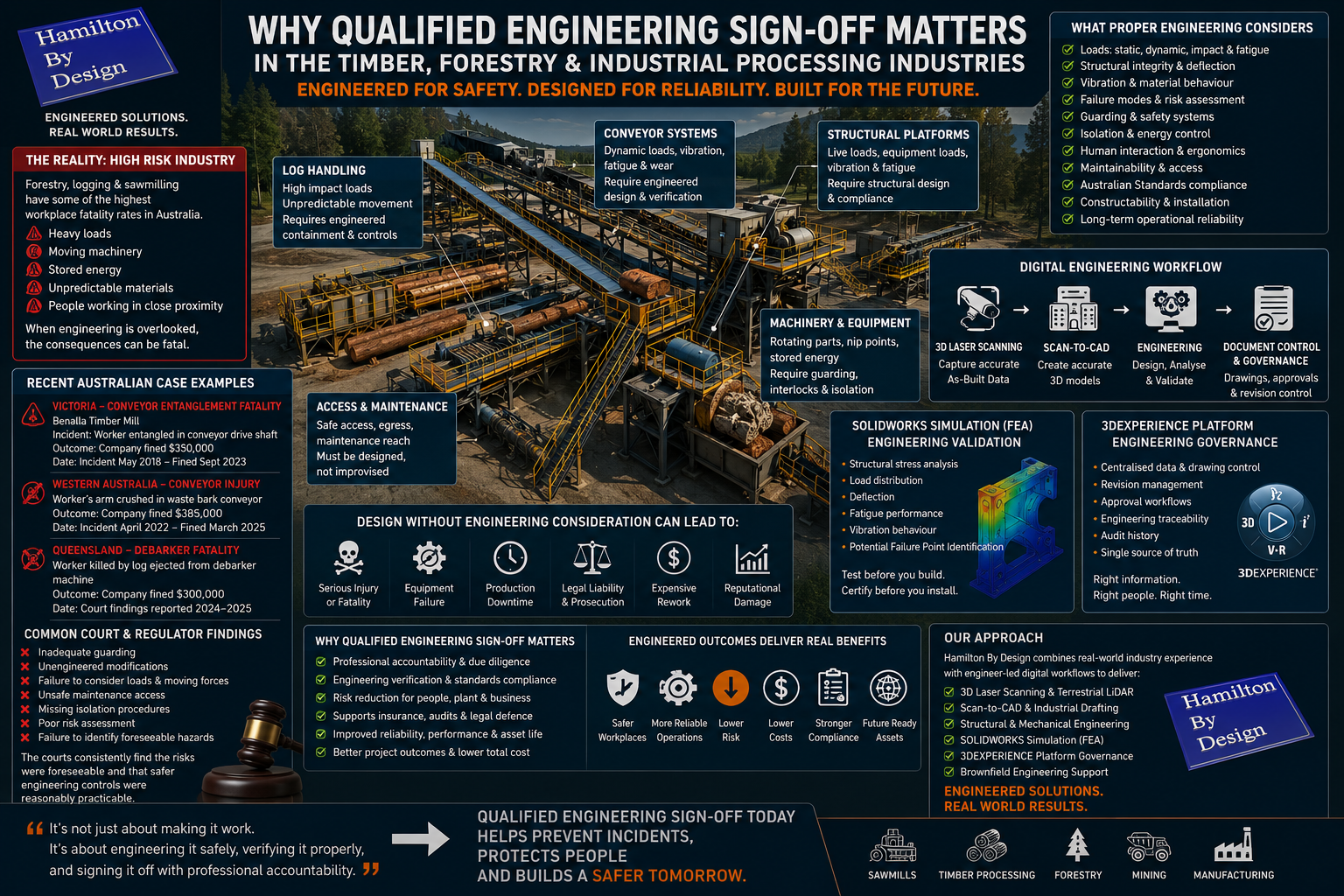
Why Qualified Engineering Sign-Off Matters in the Timber, Forestry and Industrial Processing Industries

nfographic-style industrial engineering poster by Hamilton By Design showing why qualified engineering sign-off matters in the timber, forestry and industrial processing industries. The image includes a sawmill facility with conveyors, log handling systems, engineering risk assessments, SOLIDWORKS Simulation FEA analysis and 3DEXPERIENCE engineering governance workflows.

Across Australiaโ€™s forestry, sawmill and timber processing industries, industrial infrastructure continues to evolve through ongoing maintenance, shutdown upgrades, plant expansions and operational modifications. Conveyor systems are extended, timber transfer systems are upgraded, structural steel platforms are altered, machinery is relocated and new processing equipment is integrated into ageing brownfield facilities that may have operated continuously for decades.

While many of these changes are often completed to improve productivity or maintain operational continuity, one of the greatest hidden risks within industrial environments is modifying or designing plant equipment without proper engineering review, engineering governance and qualified engineering sign-off.

In many industrial workplaces, practical trade experience is highly respected โ€” and rightly so. Skilled tradespeople are essential to fabrication, installation, shutdown works, plant maintenance and operational reliability. However, building something that functions mechanically is not the same as engineering a system that is safe, compliant, reliable and suitable for long-term industrial operation.

This distinction becomes critically important in industries such as forestry, logging and timber processing where machinery regularly handles heavy loads, rotating equipment, moving conveyors, unstable timber products, stored energy and high-throughput material handling systems.

Across sawmills and timber processing facilities throughout Australia, industrial systems are exposed to continuous operational stresses involving vibration, shock loading, impact forces, moisture, abrasive materials, dust contamination and changing environmental conditions. Conveyor systems, debarkers, screw augers, bucket elevators, log transfer systems and structural platforms must all operate safely while supporting continuous production under demanding industrial conditions.


3D CAD Modelling Australia service banner for Hamilton By Design

Without proper engineering consideration, even seemingly simple modifications can introduce serious risk.

Over the past several decades, Australian workplace regulators and courts have repeatedly prosecuted companies following incidents involving timber handling systems, conveyors, rotating shafts, sawmill machinery and plant modifications that failed to adequately consider engineering safety requirements.

In one Victorian timber mill incident, a worker died after becoming entangled in a conveyor drive shaft. WorkSafe Victoria later found that engineering controls and guarding solutions were reasonably practicable and could have prevented the fatality. In Western Australia, a timber processing company was fined after a worker suffered catastrophic arm injuries involving inadequately guarded conveyor equipment. In Queensland, a timber company faced prosecution after a worker was killed by a log ejected from a debarker machine.

Although each incident involved different operational circumstances, the underlying engineering failures followed remarkably similar patterns:

  • inadequate guarding,
  • unengineered plant modifications,
  • failure to consider loads and moving forces,
  • unsafe maintenance access,
  • missing isolation procedures,
  • poor risk assessment,
  • insufficient structural verification,
  • lack of engineering review,
  • and failure to identify foreseeable operational hazards.

These are engineering failures โ€” not simply fabrication problems.

A tradesperson may know how to weld, fabricate, cut or assemble industrial equipment, but engineering requires a much deeper understanding of how systems behave under operational conditions over time.

Proper engineering design must consider:

  • static and dynamic loading,
  • fatigue and cyclic stresses,
  • vibration,
  • structural deflection,
  • torque and rotational forces,
  • impact loading,
  • material behaviour,
  • wear characteristics,
  • human interaction with machinery,
  • guarding requirements,
  • maintainability,
  • failure modes,
  • constructability,
  • Australian Standards compliance,
  • and long-term operational reliability.

This is why qualified engineering sign-off matters.

Engineering sign-off is not simply a signature placed on a drawing. It represents professional accountability that the design has been reviewed, assessed and verified against engineering principles, foreseeable operational conditions and applicable standards.

Without proper engineering oversight, industrial businesses expose themselves to major commercial, operational and legal risk.

Poorly engineered modifications can lead to:

  • worker injury or fatalities,
  • structural failure,
  • conveyor collapse,
  • equipment damage,
  • production downtime,
  • voided insurance claims,
  • failed audits,
  • regulatory prosecution,
  • expensive shutdown rework,
  • project delays,
  • and reputational damage.

In many industrial facilities, the risk develops gradually over time. Equipment modifications are often completed during shutdowns or urgent maintenance periods where production pressure overrides long-term engineering review. Small undocumented changes accumulate over years until facilities no longer reflect their original engineered design intent.

Drawings become outdated.
Loads change.
Access paths are altered.
Equipment is relocated.
Platforms are modified.
Conveyors are extended.
Additional services are added.

Over time, facilities can drift significantly away from their original engineered condition.

This is where engineering governance becomes critically important.

At Hamilton By Design, we are an engineer-led organisation focused on delivering engineered outcomes rather than simply trade-based solutions.

While practical trade experience remains essential within industrial environments, our approach extends beyond fabrication and installation alone. We apply engineering thinking, digital engineering workflows and industrial experience to support long-term operational reliability, constructability and risk reduction.

Using engineering-grade 3D laser scanning, terrestrial LiDAR capture and scan-to-CAD workflows, we help industrial clients establish accurate as-built conditions before design or fabrication work begins.

Rather than relying on outdated PDFs or manual measurements, project teams gain access to highly accurate point cloud data that reflects real-world plant conditions. This allows engineers, fabricators and project managers to identify operational risks earlier and improve confidence before fabrication or construction begins.

Engineering-grade point clouds can then be converted into detailed CAD models suitable for:

  • structural analysis,
  • equipment integration,
  • plant upgrades,
  • fabrication detailing,
  • conveyor layouts,
  • clash detection,
  • and engineering verification.

One of the major advantages of modern digital engineering workflows is the ability to perform engineering validation before equipment is manufactured or installed onsite.

Using SOLIDWORKS Simulation and Finite Element Analysis (FEA), industrial components and structures can be digitally tested under operational loading conditions to assess how equipment may behave before fabrication occurs.

FEA allows engineers to evaluate:

  • structural stress,
  • deflection,
  • load distribution,
  • fatigue performance,
  • vibration behaviour,
  • and potential failure points.

This becomes particularly valuable within forestry and timber processing facilities where conveyor systems, transfer structures, platforms and machinery supports are exposed to continuous operational loading and vibration.

Rather than relying on assumptions or โ€œrule of thumbโ€ workshop modifications, FEA allows engineering decisions to be supported by measurable analysis and engineering verification.

This significantly improves confidence in the design process while helping reduce the risk of structural failure, overloading or premature wear.

At Hamilton By Design, digital engineering workflows can also be supported through the 3DEXPERIENCE platform, providing engineering governance and controlled management of industrial drawing systems and project information.

Modern industrial projects increasingly require:

  • revision control,
  • controlled approvals,
  • drawing issue states,
  • engineering traceability,
  • audit history,
  • and a single source of truth across multiple project stakeholders.

The 3DEXPERIENCE platform supports this by allowing controlled management of CAD models, drawings, revisions and engineering workflows within a centralised digital environment.

This provides significant advantages for industrial and brownfield projects where multiple contractors, engineers, fabricators and maintenance teams may all be interacting with the same plant infrastructure over long operational lifecycles.

Engineering governance through structured drawing control helps ensure:

  • approved drawings remain current,
  • revision history is traceable,
  • superseded drawings are controlled,
  • engineering changes are documented,
  • and project teams are working from reliable information.

In industries such as forestry, timber processing, mining and manufacturing, poor drawing control can create major operational and safety risks if outdated or unverified information is used during fabrication or construction activities.

At Hamilton By Design, our workflows focus on engineering-grade deliverables designed to support practical industrial outcomes.

This includes:

  • engineering-grade 3D laser scanning,
  • terrestrial LiDAR capture,
  • scan-to-CAD workflows,
  • industrial drafting,
  • structural and mechanical modelling,
  • FEA-supported engineering workflows,
  • revision-controlled drawing systems,
  • and brownfield engineering support.
3D LiDAR scanning and 3D modelling service button โ€” laser scanner capturing a point cloud for engineering and CAD modelling
Mechanical engineering services

We do not simply create geometry or visualisation models.

We focus on engineering workflows designed to support real-world industrial reliability, constructability and operational performance.

Because in high-risk industrial environments, โ€œit worksโ€ is not the same as โ€œit has been engineered safely.โ€

Hamilton By Design logo displayed on a blue tilted rectangle with a grey gradient background

Qualified engineering sign-off matters because the consequences of poor engineering decisions can extend far beyond production downtime โ€” affecting worker safety, operational reliability, legal liability and the long-term success of industrial infrastructure.

If your business is seeking engineered outcomes that outlast short-term fixes, Hamilton By Design provides engineer-led digital engineering support designed to help reduce risk and engineer success across industrial operations throughout Australia.


https://www.hamiltonbydesign.com.au/mechanical-engineering
3D CAD Modelling Australia service banner for Hamilton By Design
Australian Drafting logo featuring bold white text reading "Australian Drafting" centred on a blue rounded rectangle background.
Engineering Governance title graphic featuring bold white text reading "Engineering Governance" centred on a blue rounded rectangle background.
Mechanical, Structural & Pipework Drafting service banner by Hamilton By Design featuring white text on a blue background.
Mechanical engineering services
Blue rounded button with the text โ€œSolidWorks Designโ€ in white.
Finite Element Analysis (FEA) engineering simulation button
3D LiDAR Scanning Darwin for engineering surveys, laser scanning, reality capture and point cloud modelling services
3D LiDAR Scanning Australia engineering services for laser scanning, reality capture, scan-to-CAD, Scan-to-BIM and as-built documentation across Australia
3D LiDAR scanning services on the Central Coast providing engineering-grade laser scanning, point cloud capture, scan-to-CAD modelling and industrial reality capture for infrastructure and industrial projects.
3D LiDAR Scanning Perth for engineering surveys, laser scanning, reality capture and point cloud modelling services
3D LiDAR Scanning Sydney for engineering surveys, laser scanning, reality capture and point cloud modelling services
3D LiDAR Scanning Brisbane for engineering surveys, laser scanning, reality capture and point cloud modelling services
3D LiDAR Scanning Canberra for engineering surveys, laser scanning, reality capture and point cloud modelling services
3D LiDAR Scanning Newcastle for engineering surveys, laser scanning, reality capture and point cloud modelling services
3D LiDAR Scanning Adelaide for engineering surveys, laser scanning, reality capture and point cloud modelling services

Mechanical Drafting Services Sydney

Mechanical engineer reviewing CAD drafting drawings and 3D plant model in Sydney engineering office

Engineering-Led CAD Drafting for Industrial & Mining Projects

Structural engineering drafting icon showing a seated engineer working at a drafting table in blue vector style.

In a city like Sydney, where infrastructure, manufacturing, and industrial upgrades are constantly evolving, mechanical drafting is not just about drawings โ€” itโ€™s about delivering buildable, accurate, and compliant engineering outcomes.

At Hamilton By Design, our mechanical drafting services are built around engineering-first principles, ensuring every drawing is aligned with real-world conditions, fabrication requirements, and Australian Standards.


What is Mechanical Drafting?

Mechanical drafting is the process of creating technical drawings and models that communicate how components, systems, and plant equipment are designed, assembled, and built.

Modern drafting uses advanced CAD tools to produce highly accurate 2D and 3D representations, enabling engineers, fabricators, and project teams to clearly understand design intent and construction requirements.


Our Mechanical Drafting Services in Sydney

At Hamilton By Design, we provide a complete drafting solution tailored to industrial, mining, and infrastructure projects:

1. Shop Drawings & Fabrication Details

  • Fully dimensioned drawings for manufacturing and installation
  • Weld details, bolt patterns, and material specifications
  • Designed for workshop-ready fabrication

2. General Arrangement (GA) Drawings

  • Plant layouts and equipment positioning
  • Conveyors, chutes, tanks, and process systems
  • Interface coordination with structural and civil components

3. Assembly & Detail Drawings

  • Component-level detailing for mechanical systems
  • Exploded views and assembly sequences
  • Bill of Materials (BOM) integration

4. Piping & Process Drafting

  • P&IDs and piping layouts
  • Slurry, water, and process systems
  • Integration with plant upgrades and brownfield modifications

5. Point Cloud to CAD Modelling

  • LiDAR scan integration for accurate as-built drawings
  • Clash detection and retrofit design
  • Reduced rework and site risk

6. CAD Conversions & Drawing Updates

  • PDF to CAD conversions
  • Legacy drawing upgrades
  • Revision control and drawing standardisation

3D CAD Modelling Australia service banner for Hamilton By Design

Why Mechanical Drafting Matters

Mechanical drafting is the single source of truth between design and construction. High-quality drafting delivers:

  • Reduced rework through accurate, buildable designs
  • Improved design clarity for fabrication and installation teams
  • Compliance with Australian Standards
  • Faster project delivery with fewer site queries
  • Better cost control through precise documentation

In industrial environments, even small errors in drawings can lead to significant downtime and cost โ€” making accuracy critical.


Engineering-Led Drafting vs Traditional Drafting

Most drafting services focus on producing drawings.
We focus on producing engineering outcomes.

At Hamilton By Design, drafting is integrated with:

  • Mechanical engineering design
  • Structural considerations
  • Site-based realities
  • Fabrication constraints

This ensures your drawings are not just correct on paper โ€” but correct in the field.


Our Workflow: Scan โ†’ Model โ†’ Draft โ†’ Deliver

Our typical mechanical drafting workflow includes:

  1. Site Data Capture (Optional)
    LiDAR scanning or client-supplied data
  2. 3D Modelling
    SolidWorks or CAD model development
  3. Drafting & Detailing
    Creation of GA, shop, and fabrication drawings
  4. Engineering Review
    Compliance checks and validation
  5. Final Deliverables
    • PDF drawings
    • CAD files (DWG, STEP, Parasolid)
    • Point cloud integration (E57, RCP if required)

This structured approach ensures accuracy, traceability, and quality control across every project.


Industries We Support in Sydney

We provide mechanical drafting services across:

  • Mining & mineral processing
  • Manufacturing & fabrication
  • Water & wastewater systems
  • Infrastructure & transport
  • Industrial plant upgrades (brownfield projects)

Our experience in complex environments ensures we understand real-world constraints โ€” not just theoretical design.


Our clients

Why Choose Hamilton By Design?

  • Engineering-led drafting (not just CAD operators)
  • Experience across mining and heavy industry
  • Integration with LiDAR and digital engineering workflows
  • Fast turnaround with high-quality outputs
  • Scalable support โ€” from single drawings to full project packages

As outlined on our site, we deliver accurate shop drawings, assemblies, and fabrication-ready documentation that integrate seamlessly with engineering and site data.


Hamilton By Design logo displayed on a blue tilted rectangle with a grey gradient background

Mechanical Drafting Sydney โ€“ Get Started

If youโ€™re planning a project in Sydney and need reliable, engineering-grade mechanical drafting, Hamilton By Design can support from concept through to fabrication.

Whether itโ€™s a brownfield upgrade, plant layout, or detailed fabrication package, we ensure your drawings are:

โœ” Accurate
โœ” Buildable
โœ” Compliant
โœ” Delivered on time


Contact Hamilton By Design

Name
Would you like us to arrange a phone consultation for you?
Address
3D Scanning Sydney banner promoting engineering-grade 3D laser scanning, LiDAR scanning, and reality capture services by Hamilton By Design.
Mechanical Engineering Sydney banner with white text on a blue background representing Hamilton By Design's mechanical engineering services in Sydney.
Mechanical Drafting and 3D Modelling Sydney banner highlighting Hamilton By Design's CAD drafting, 3D modelling, and engineering design services in Sydney.


Mechanical Engineering | Structural Engineering


Hamilton By Design provides engineering-led 3D scanning, LiDAR scanning, mechanical engineering and digital engineering services throughout Sydney and Greater Sydney.

Explore our related Sydney services:


  • 3D Scanning Sydney โ€“ Engineering-grade terrestrial laser scanning, as-built surveys and point cloud capture for industrial, infrastructure and commercial projects.
  • Reality Capture Sydney โ€“ High-accuracy reality capture, digital twins, asset documentation and engineering-grade site verification.
  • Scan to CAD Sydney โ€“ Convert point cloud data into AutoCAD, SolidWorks, Inventor and other engineering-ready CAD deliverables.
  • Point Cloud Modelling Sydney โ€“ Engineering-grade point cloud processing, clash detection, as-built verification and 3D modelling.
  • Mechanical Engineering Sydney โ€“ Mechanical design, plant upgrades, materials handling systems, conveyors, chutes, platforms and engineering support.
  • Structural Drafting Sydney โ€“ Structural steel drafting, fabrication drawings, GA drawings, workshop detailing and as-built documentation.

Hamilton By Design supports projects throughout Sydney CBD, Parramatta, Liverpool, Penrith, Blacktown, Chatswood, Alexandria, Mascot, Newcastle and the Central Coast.


Blue banner graphic displaying the text "Point Cloud to CAD - Australia" in large white lettering, representing point cloud processing, scan-to-CAD conversion and digital engineering services across Australia.

Blue banner graphic displaying the text "Scan to CAD Sydney" in large white lettering, representing engineering-led point cloud to CAD conversion, LiDAR scanning and digital engineering services in Sydney.
Blue banner graphic displaying the text "Reality Capture Sydney - CBD" in large white lettering, representing engineering-led reality capture, LiDAR scanning and digital engineering services within Sydney CBD commercial buildings and infrastructure.
3D LiDAR Scanning Darwin for engineering surveys, laser scanning, reality capture and point cloud modelling services
3D LiDAR Scanning Australia engineering services for laser scanning, reality capture, scan-to-CAD, Scan-to-BIM and as-built documentation across Australia
3D LiDAR scanning services on the Central Coast providing engineering-grade laser scanning, point cloud capture, scan-to-CAD modelling and industrial reality capture for infrastructure and industrial projects.

High Court Changes Engineering Liability

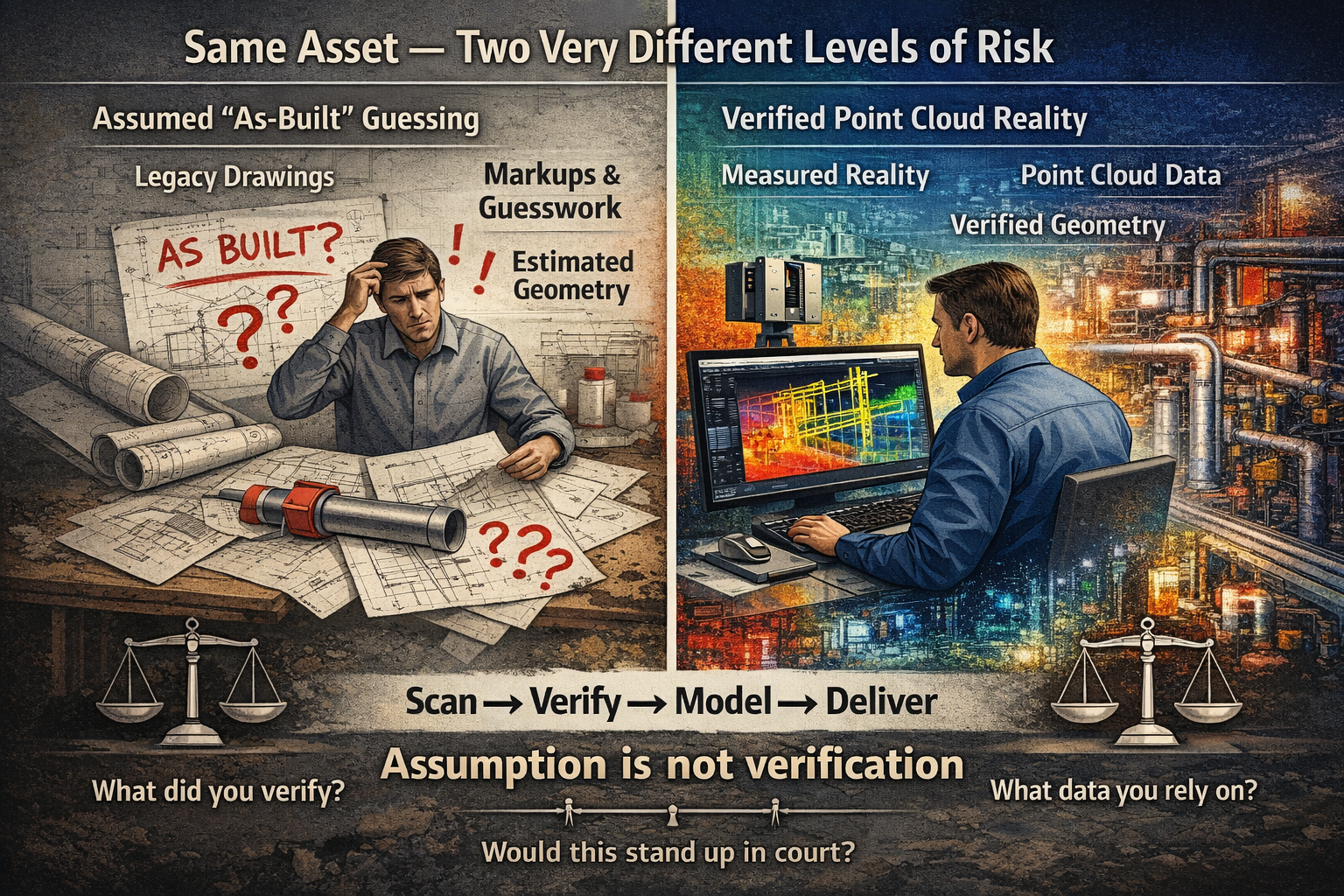
Split-screen engineering graphic comparing assumed as-built drawings with verified point cloud scanning data, highlighting the difference between estimated geometry and measured reality.

The High Court Just Changed Engineering Liability โ€” Why โ€œAs-Built Guessingโ€ Is No Longer Enough

The recent High Court decision in Pafburn Pty Ltd v The Owners โ€“ Strata Plan No 84674 has been widely discussed across the construction and legal sectors. Most commentary has focused on developers and builders, particularly the finding that they can be held fully liable for defects and cannot rely on proportionate liability to distribute responsibility.

But for engineers, designers, and anyone working in brownfield environments, the real impact runs deeper.

This case signals a clear shift in expectation โ€” away from assumption, and toward verified reality.


3D LiDAR scanning and 3D modelling service button โ€” laser scanner capturing a point cloud for engineering and CAD modelling
Mechanical engineering services

The Hidden Risk in โ€œAs-Builtโ€ Drawings

Across many projects, particularly in retrofit, maintenance, and upgrade work, design offices rely on what are commonly referred to as โ€œas-builtโ€ drawings.

In theory, these drawings represent what has actually been constructed on site.

In practice, however, that is not always the case.

Many โ€œas-builtsโ€ are produced through:

  • Manual markups during construction
  • Redline drawings updated after installation
  • Verbal confirmation from site teams
  • Interpretation of incomplete or outdated information

In some cases, they are never formally verified at all.

This creates a fundamental problem.

The design office is making decisions based on information that may be:

  • Incomplete
  • Inaccurate
  • Or in the worst case โ€” assumed

The Question That Is Now Being Asked

Following this High Court decision, the legal environment is changing.

It is no longer sufficient to say:

โ€œI worked from the drawings provided.โ€

Instead, the question is becoming:

What should a competent engineer have verified?

This is a significant shift.

It places responsibility not just on what information was used โ€” but on whether that information should have been trusted in the first place.


Assumption vs Measured Reality

At its core, this issue comes down to a simple comparison:

Does guessing what has been built offer the same level of coverage as measured data?

The answer is increasingly clear โ€” it does not.

When geometry is assumed:

  • Tolerances are unknown
  • Deviations from design are hidden
  • Errors compound as projects progress
  • Rework risk increases

More importantly, from a legal standpoint:

There is no defensible evidence of what actually existed at the time decisions were made.


The Role of Point Cloud Scanning

This is where point cloud scanning and reality capture fundamentally change the workflow.

Rather than relying on interpretation, point cloud data provides a direct measurement of site conditions.

A properly captured scan:

  • Records millions of measured points across the asset
  • Captures geometry exactly as installed
  • Provides a timestamped dataset of site conditions
  • Can be referenced, rechecked, and validated at any time

Most importantly, it creates a feedback loop between site and design.

Instead of guessing what has been built, the design office receives:

  • Accurate geometry
  • Verified spatial relationships
  • Real-world constraints

This allows models and drawings to be developed based on reality, not assumption.


Feeding Reality Back Into the Design Office

One of the most overlooked issues in engineering workflows is the disconnect between site and design.

Information typically flows in one direction:

  • Design โ†’ Construction

But the return flow:

  • Construction โ†’ Design

Is often inconsistent or incomplete.

Point cloud scanning closes this gap.

By scanning installed conditions and feeding that data back into the design environment, engineers can:

  • Align models with actual site geometry
  • Identify clashes before fabrication or installation
  • Validate clearances and fitment
  • Reduce the risk of downstream errors

This is not just about accuracy โ€” it is about confidence.


Why This Matters More After the High Court Decision

The implications of Pafburn Pty Ltd v The Owners โ€“ Strata Plan No 84674 go beyond contractual structures.

They influence how engineering decisions are evaluated.

When something goes wrong, the question is no longer simply:

โ€œWho was responsible for the design?โ€

It becomes:

  • What information was relied upon?
  • Was it reasonable to rely on that information?
  • Could the actual conditions have been verified?

If the tools to verify existed โ€” and were not used โ€” that becomes part of the discussion.


From Design Intent to Verified Condition

The industry is moving through a transition.

Historically, projects were driven by:

  • Design intent
  • Nominal dimensions
  • Idealised geometry

Today, the expectation is shifting toward:

  • Verified condition
  • Measured data
  • Real-world constraints

This shift is particularly important in:

  • Brownfield upgrades
  • Industrial plants
  • Mining infrastructure
  • Retrofit and modification projects

Where existing conditions rarely match original design documentation.


Practical Implications for Engineers

For engineers and designers, this means a change in approach.

Relying solely on drawings โ€” particularly for existing assets โ€” introduces risk.

A more robust workflow includes:

  • Verification of critical geometry
  • Clear documentation of data sources
  • Separation of assumed vs measured information
  • Use of reality capture where accuracy matters

This is not about replacing engineering judgement.

It is about supporting that judgement with evidence.


Conclusion: Coverage, Confidence, and Accountability

At the centre of this discussion is a simple idea:

Not all information offers the same level of coverage.

โ€œAs-builtโ€ drawings based on interpretation provide one level of confidence.

Measured point cloud data provides another.

As legal expectations evolve, the difference between the two becomes more significant.

Guessing what has been built โ€” even when done carefully โ€” does not offer the same level of coverage as data that can be measured, verified, and defended.


How We Approach It

At Hamilton By Design, our workflow is built around this principle:

Scan โ†’ Verify โ†’ Model โ†’ Deliver

By capturing real-world conditions and feeding that data back into the design process, we reduce uncertainty and provide a clear basis for engineering decisions.

Not just for better outcomes โ€” but for greater accountability.


If your next project relies on โ€œas-builtโ€ drawings alone, it is worth asking:

Are they measuredโ€ฆ or assumed?

3D CAD Modelling Australia service banner for Hamilton By Design

Our clients

Mechanical Design Consultants Hobart โ€“ Engineering for Tasmaniaโ€™s Unique Conditions

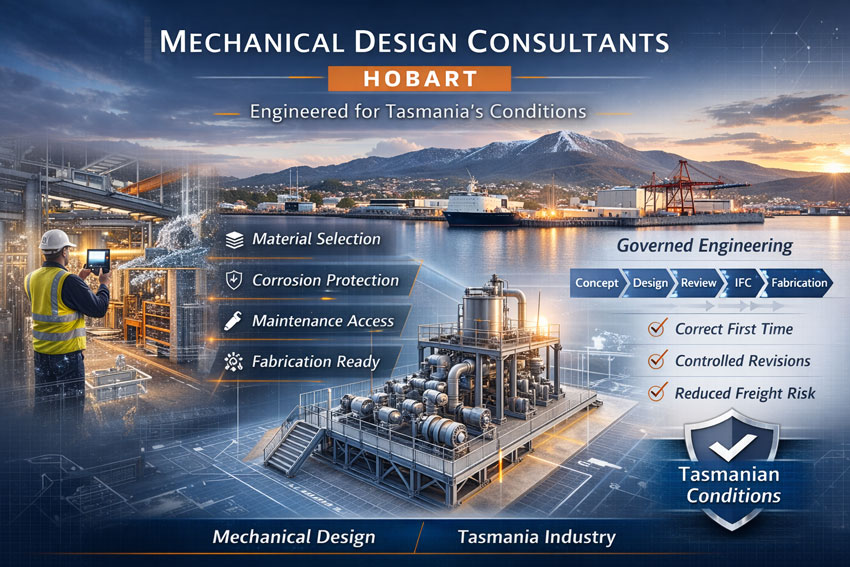
Hobart mechanical engineering consultancy highlighting fabrication-ready design and controlled revision workflow.

Mechanical Design Consultants Hobart | Tasmania Engineering Experts

Hobart is unlike mainland capital cities. Its maritime environment, cooler climate and geographic isolation create unique engineering challenges. Mechanical design in Hobart requires practical thinking, accurate documentation and a strong understanding of local conditions.

Hamilton By Design provides mechanical design consulting services to Hobart and broader Tasmania. We deliver governed, fabrication-ready engineering solutions built for real site conditions.

What Makes Mechanical Design in Hobart Unique

Maritime Environment
Hobartโ€™s proximity to the Southern Ocean and the Port creates exposure to salt-laden air and high corrosion environments. Mechanical systems must consider material selection, protective coatings, long-term durability and maintainability in marine conditions.

Cool Climate and Variable Weather
Tasmaniaโ€™s cooler temperatures and moisture exposure affect thermal expansion, outdoor equipment performance and environmental protection requirements. Mechanical design must account for weather sealing, drainage and long-term asset performance.

Geographic Isolation
Tasmaniaโ€™s separation from the mainland increases freight costs and lead times. Rework is expensive and delays are amplified. Mechanical design must be correct the first time, with controlled revisions and clear fabrication documentation.

Unique Mechanical Design Projects in Hobart

Food and Beverage Processing
Tasmaniaโ€™s premium produce industry requires hygienic mechanical systems, stainless fabrication, conveyor design and washdown-compatible plant layouts.

Aquaculture and Marine Infrastructure
Mechanical systems must withstand marine exposure while integrating with wharf structures, pumps, processing systems and coastal facilities.

Renewable and Energy Infrastructure
Tasmaniaโ€™s hydro and renewable energy assets require mechanical upgrades, maintenance platforms and brownfield integration within existing operational environments.

Industrial and Port Upgrades
Materials handling systems, structural interfaces and mechanical modifications must work within live facilities while minimising disruption.

Tasmanian mechanical design services with 3D scanning verification and marine industrial backdrop in Hobart.

Our Mechanical Design Approach

Hamilton By Design integrates practical engineering with structured governance. We deliver:

Mechanical 2D and 3D modelling
Brownfield site verification and measurement
Fabrication-ready workshop drawings
Revision-controlled issue states
Clear approval pathways
Maintainability-focused design

Mechanical design is not just geometry. It is accountability, constructability and lifecycle thinking.

Brownfield Engineering in Hobart

Many Hobart facilities operate within existing structures. Upgrades must work within tight spatial constraints and operational environments.

Mechanical design must consider:

Installation sequencing
Maintenance access
Load paths and structural interfaces
Compliance documentation
Minimal operational disruption

Clear documentation reduces risk and protects project budgets.

Why Engineering Governance Matters in Tasmania

When freight and remanufacture costs are high, mistakes become expensive quickly. Controlled documentation and disciplined revision management are essential.

Governed mechanical design ensures:

Correct drawing revision at fabrication
Traceable design decisions
Structured document control
Reduced rework risk
Clear communication between stakeholders

Supporting Hobart Industry

Hobartโ€™s industrial sector is innovative and export-focused. From marine and aquaculture to food production and renewable infrastructure, mechanical design must reflect Tasmaniaโ€™s environment and long-term asset strategy.

Hamilton By Design supports Hobart projects from concept through to detailed design and fabrication documentation, delivering practical engineering solutions built for site reality.

Mechanical Design Consultants Hobart โ€“ Letโ€™s Discuss Your Project

If your Hobart-based project requires structured mechanical design support and disciplined documentation control, Hamilton By Design is ready to assist.

We provide engineering clarity, reduced risk and fabrication-ready outcomes for Tasmania industry.


Name
Would you like us to arrange a phone consultation for you?
Address

3D CAD Modelling Australia service banner for Hamilton By Design
Finite Element Analysis (FEA) engineering simulation button
Mechanical engineering services

Mech Design Consultants Melbourne

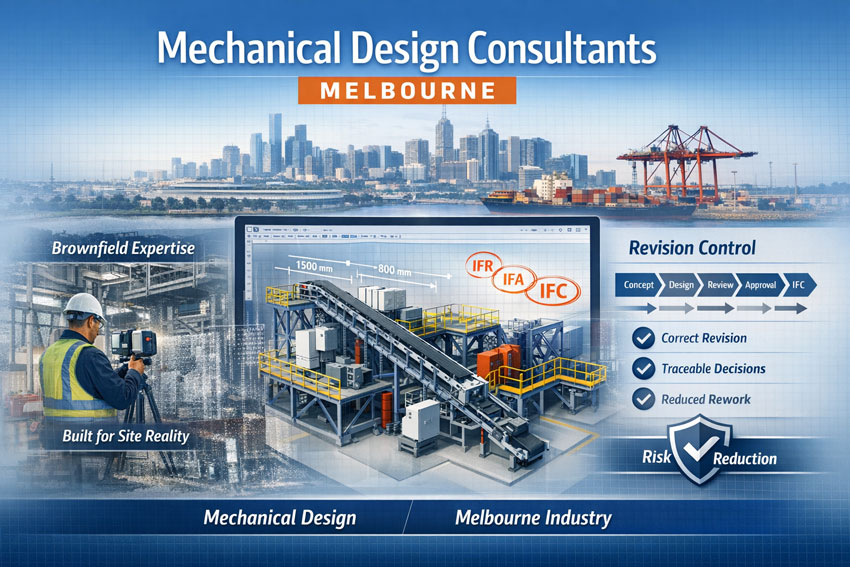
Melbourne mechanical engineering consultancy showcasing governed CAD design, brownfield expertise and controlled drawing revisions.

Mechanical Design Consultants Melbourne | Hamilton By Design

Melbourneโ€™s industrial landscape is evolving rapidly โ€” advanced manufacturing, logistics automation, food processing, infrastructure upgrades and brownfield plant modifications are all demanding stronger mechanical design capability and tighter governance.

At Hamilton By Design, we provide mechanical design consulting services to Melbourne-based businesses that need more than drawings โ€” they need clarity, compliance and confidence.


What We Deliver

As mechanical design consultants servicing Melbourne, our focus is practical engineering solutions that can be built, maintained and certified.

1. Mechanical Design & Drafting

  • 2D and 3D CAD modelling
  • Plant layout development
  • Conveyor and materials handling systems
  • Structural interface coordination
  • Detailed fabrication drawings

2. Brownfield & Upgrade Projects

Melbourne facilities are often live environments. We understand:

  • Working within existing constraints
  • Coordinating multi-vendor inputs
  • Managing drawing revisions (IFR / IFA / IFC)
  • Ensuring installation-ready documentation

3. Engineering Governance

High labour costs in Australia mean rework is expensive. We help you avoid:

  • Building to the wrong drawing revision
  • Supplier misalignment
  • Poor documentation control
  • Unverifiable design assumptions

Our governance approach includes:

  • Revision-controlled drawing systems
  • Structured issue states
  • Design change tracking
  • Documented decision pathways

Industrial mechanical design consultants Melbourne delivering plant modelling, site scanning and engineering governance.

Why Melbourne Clients Choose Mechanical Design Consultants Instead of โ€œJust Draftingโ€

There is a significant difference between drafting and engineering design.

Drafting produces geometry.
Engineering design produces accountable outcomes.

We focus on:

  • Load paths
  • Maintainability access
  • Compliance pathways
  • Constructability
  • Lifecycle thinking

That means fewer RFIs, fewer shutdown overruns and clearer certification pathways.


Mechanical Design Consultants Melbourne โ€“ Industries We Support

We regularly assist projects in:

  • Manufacturing facilities
  • Distribution centres
  • Mining and materials handling
  • Waste and recycling infrastructure
  • Food and beverage processing
  • Energy and utilities

Whether it is a small plant modification or a staged facility upgrade, structured mechanical design reduces downstream risk.


Our Difference: Design + Governance

Many consultants provide CAD. Few provide engineering governance integrated with design delivery.

We combine:

  • 3D scanning and point cloud verification
  • Solid modelling and layout coordination
  • Revision control systems
  • ISO-aligned documentation structures
  • Digital engineering workflows

This means your mechanical design is not just created โ€” it is controlled, traceable and defendable.


When Should You Engage a Mechanical Design Consultant?

You should consider engaging mechanical design consultants in Melbourne when:

  • You are modifying existing plant
  • Multiple vendors are contributing drawings
  • You require certification
  • You need clarity before fabrication
  • You want to reduce rework risk

The earlier structured engineering is introduced, the lower the total project cost.


Supporting Melbourne Projects from Concept to Construction

Hamilton By Design supports:

  • Concept feasibility
  • Detailed mechanical design
  • Fabrication documentation
  • Site coordination
  • As-built documentation
  • Governance setup for future upgrades

We operate with a practical, industry-informed mindset โ€” designs must work not just in CAD, but on site.


Hamilton By Design logo displayed on a blue tilted rectangle with a grey gradient background

3D LiDAR scanning and 3D modelling service button โ€” laser scanner capturing a point cloud for engineering and CAD modelling
Mechanical engineering services

Mechanical Design Consultants Melbourne โ€“ Letโ€™s Talk

If your project requires structured mechanical design support with governance discipline, we welcome the opportunity to assist.

Contact Hamilton By Design to discuss your Melbourne project requirements and how we can help deliver engineering clarity, reduced risk and confident outcomes.


Name
Would you like us to arrange a phone consultation for you?
Address
3D CAD Modelling Australia service banner for Hamilton By Design
Australian Drafting logo featuring bold white text reading "Australian Drafting" centred on a blue rounded rectangle background.
Engineering Governance title graphic featuring bold white text reading "Engineering Governance" centred on a blue rounded rectangle background.
Mechanical, Structural & Pipework Drafting service banner by Hamilton By Design featuring white text on a blue background.
Mechanical engineering services
Blue rounded button with the text โ€œSolidWorks Designโ€ in white.
Finite Element Analysis (FEA) engineering simulation button
3D LiDAR Scanning Darwin for engineering surveys, laser scanning, reality capture and point cloud modelling services
3D LiDAR Scanning Australia engineering services for laser scanning, reality capture, scan-to-CAD, Scan-to-BIM and as-built documentation across Australia
3D LiDAR scanning services on the Central Coast providing engineering-grade laser scanning, point cloud capture, scan-to-CAD modelling and industrial reality capture for infrastructure and industrial projects.
3D LiDAR Scanning Perth for engineering surveys, laser scanning, reality capture and point cloud modelling services
3D LiDAR Scanning Sydney for engineering surveys, laser scanning, reality capture and point cloud modelling services
3D LiDAR Scanning Brisbane for engineering surveys, laser scanning, reality capture and point cloud modelling services
3D LiDAR Scanning Canberra for engineering surveys, laser scanning, reality capture and point cloud modelling services
3D LiDAR Scanning Newcastle for engineering surveys, laser scanning, reality capture and point cloud modelling services
3D LiDAR Scanning Adelaide for engineering surveys, laser scanning, reality capture and point cloud modelling services

Identifying Fastener Threads in the Field

Metric vs American vs British Threads โ€” and the Australian Standards That Govern Them

In maintenance workshops and brownfield sites, one of the most common hidden problems is not bolt strength โ€” it is thread identification.

Equipment imported from the USA, Europe and the UK often ends up assembled together on Australian sites.
The bolts may look identical.
They may even screw together.

But they are not interchangeable.

Incorrect thread matching damages load capacity, prevents correct preload, and leads to loosening, fatigue cracking and eventual failure.

This guide explains the major fastening thread systems encountered in Australia (excluding pipe threads), how to recognise them, and the Australian Standards that apply.


1. The Three Fastener Thread Systems

There are three main fastening thread families encountered in mechanical and structural equipment:

SystemOriginThread AngleTypical Location
Metric ISOAustralia / Europe / modern equipment60ยฐMost modern machinery
Unified (UNC/UNF)USA60ยฐMining & imported plant
Whitworth (BSW/BSF/BA)UK / older Commonwealth55ยฐOlder equipment & legacy machinery

Even though UNC and Metric share a 60ยฐ angle, the pitch is different โ€” therefore they are not compatible.

Whitworth threads are particularly problematic because they will partially screw into metric or UNC holes before binding.


2. Metric Threads (ISO Metric โ€” Australian Standard Fasteners)

These are the primary fastening threads used in Australia.

(Coarse pitch series)

SizeMajor DiameterPitchMinor Diameter (approx)
M66.0 mm1.04.8 mm
M88.0 mm1.256.5 mm
M1010.0 mm1.58.2 mm
M1212.0 mm1.759.9 mm
M1616.0 mm2.013.8 mm
M2020.0 mm2.517.3 mm
M2424.0 mm3.020.8 mm

Fine pitch versions also exist for vibration and adjustment applications.

Typical Uses

  • Structural steel connections
  • Machinery assembly
  • Guards and access platforms
  • General engineering

3. Unified American Threads (UNC / UNF)

Common on imported mining and mobile equipment.

UNC โ€“ Coarse

SizeMajor DiameterPitch
1/4-206.35 mm1.27 mm
3/8-169.53 mm1.59 mm
1/2-1312.70 mm1.95 mm
3/4-1019.05 mm2.54 mm
1-825.40 mm3.18 mm

UNF โ€“ Fine

Used where vibration resistance is required.

Key Characteristic
UNC bolts will often start threading into metric holes but will not achieve correct preload.


4. British Threads (Whitworth Form)

Recognised by their 55ยฐ thread angle.

BSW โ€“ Coarse

SizeMajor DiameterPitch
1/4 BSW6.35 mm1.34 mm
3/8 BSW9.53 mm1.59 mm
1/2 BSW12.70 mm2.12 mm
3/4 BSW19.05 mm2.54 mm

BSF โ€“ Fine

Used historically in machinery.

BA Threads

Small instrumentation and electrical fasteners.

Typical Location

  • Pre-1980 plant
  • UK imported machinery
  • Electrical equipment

Why Incorrect Thread Matching Causes Failures

Threads do not primarily carry shear load โ€” they generate preload.

If pitch or angle differs:

  • preload is reduced
  • flank contact is uneven
  • joint loosens under vibration
  • fatigue cracking begins

Many failures blamed on vibration are actually incorrect thread engagement.


Field Identification Tips

ObservationLikely Thread
Marked M12Metric
Fraction size (1/2, 3/4)UNC/UNF or Whitworth
Smooth but tight engagementWrong pitch
Binds after 2 turnsWhitworth vs Metric

Thread gauge confirmation is always recommended.


Australian Standards Relating to Fastener Threads

Metric Thread Geometry

AS 1721 โ€” General purpose metric screw threads
AS 1275 โ€” Metric screw threads for fasteners

Fastener Product Standards

AS 1110 โ€” Metric hex bolts and screws
AS 1111 โ€” Commercial hex bolts and screws
AS 1112 โ€” Hexagon nuts
AS 1420 โ€” Socket head cap screws

Mechanical Properties

AS/NZS 4291.1 โ€” Mechanical properties of bolts, screws and studs
AS/NZS 4291.2 โ€” Mechanical properties of nuts
ISO 898-1 / ISO 898-2 โ€” Adopted strength properties
ISO 3506 โ€” Stainless steel fasteners

Structural Bolting

AS/NZS 1252 โ€” High strength structural bolting assemblies
AS 4100 โ€” Steel structures design
AS/NZS 5131 โ€” Fabrication and erection of structural steel

Coatings and Fit Allowances

AS/NZS 1214 โ€” Galvanised coatings on threaded fasteners
AS/NZS 4680 โ€” Hot dip galvanising
AS 2312.2 โ€” Corrosion protection guide
AS 1897 โ€” Electroplated coatings

3D LiDAR scanning and 3D modelling service button โ€” laser scanner capturing a point cloud for engineering and CAD modelling
Mechanical engineering services
Name
Would you like us to arrange a phone consultation for you?
Address

3D CAD Modelling Australia service banner for Hamilton By Design
3D LiDAR scanning and 3D modelling service button โ€” laser scanner capturing a point cloud for engineering and CAD modelling
Mechanical engineering services
Mechanical drafting services button
Blue rounded button with the text โ€œSolidWorks Designโ€ in white.
Blue banner graphic displaying the text "Point Cloud to CAD - Australia" in large white lettering, representing point cloud processing, scan-to-CAD conversion and digital engineering services across Australia.

Mechanical, Structural & Pipework Drafting service banner by Hamilton By Design featuring white text on a blue background.

Engineering Governance title graphic featuring bold white text reading "Engineering Governance" centred on a blue rounded rectangle background.
Mining Plant Upgrades promotional graphic with bold white text on a blue background representing mining infrastructure, plant improvement, and engineering upgrade projects.
3D Pipework promotional graphic with bold white text on a blue background representing pipework design, modelling, drafting, and engineering services.
Australian Drafting logo featuring bold white text reading "Australian Drafting" centred on a blue rounded rectangle background.
3D Pipework promotional graphic with bold white text on a blue background representing pipework design, modelling, drafting, and engineering services.
Mining Plant Upgrades promotional graphic with bold white text on a blue background representing mining infrastructure, plant improvement, and engineering upgrade projects.
3D LiDAR Scanning for Engineering Projects title graphic featuring bold white text on a blue rounded rectangle background.
Australian Drafting logo featuring bold white text reading "Australian Drafting" centred on a blue rounded rectangle background.
Engineering Governance title graphic featuring bold white text reading "Engineering Governance" centred on a blue rounded rectangle background.
Mechanical, Structural & Pipework Drafting service banner by Hamilton By Design featuring white text on a blue background.
Mechanical engineering services
Blue rounded button with the text โ€œSolidWorks Designโ€ in white.
Finite Element Analysis (FEA) engineering simulation button

Mechanical Engineering | Structural Engineering