Copper Mine Concentrator Mechanical Engineering & 3D Scanning NSW

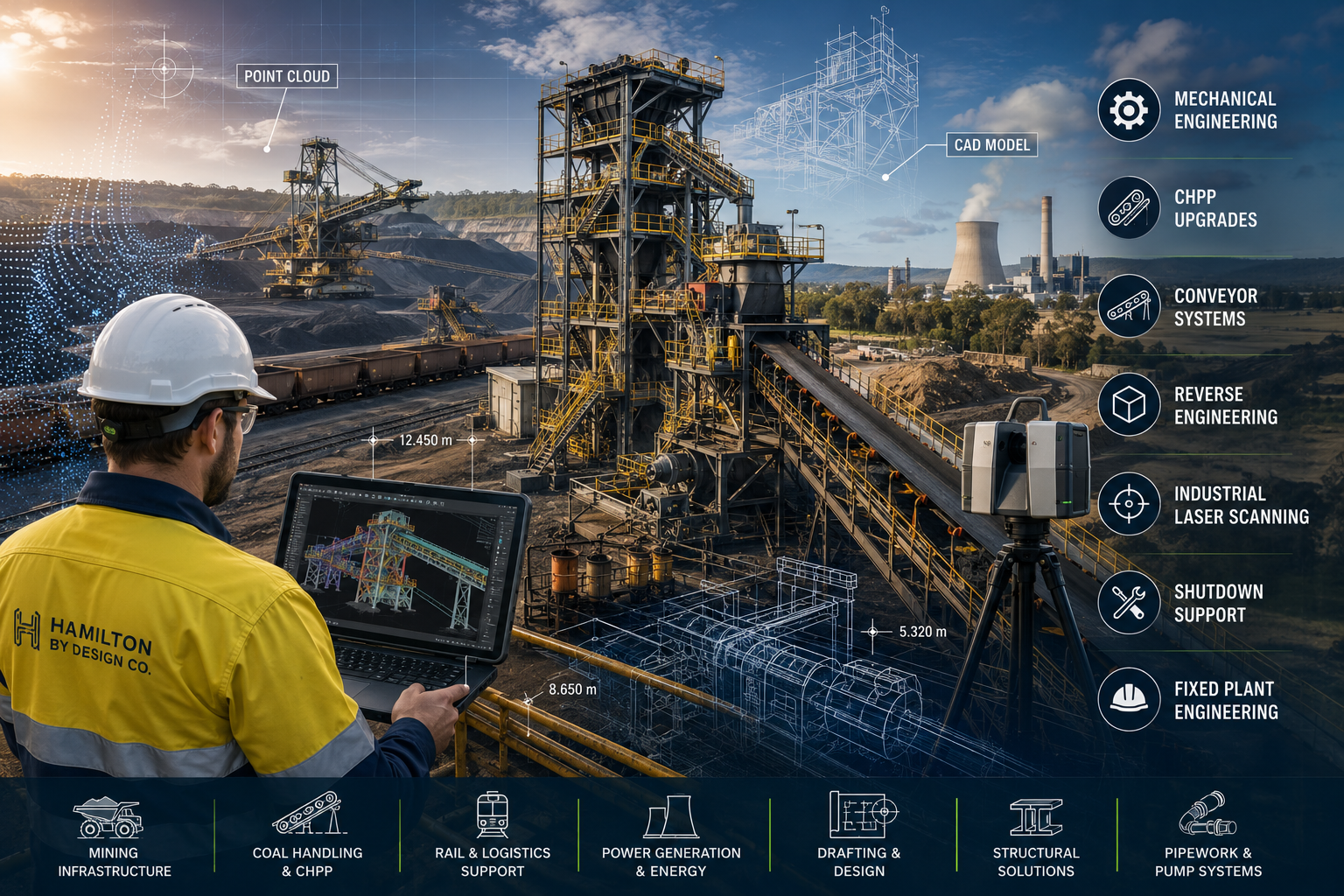
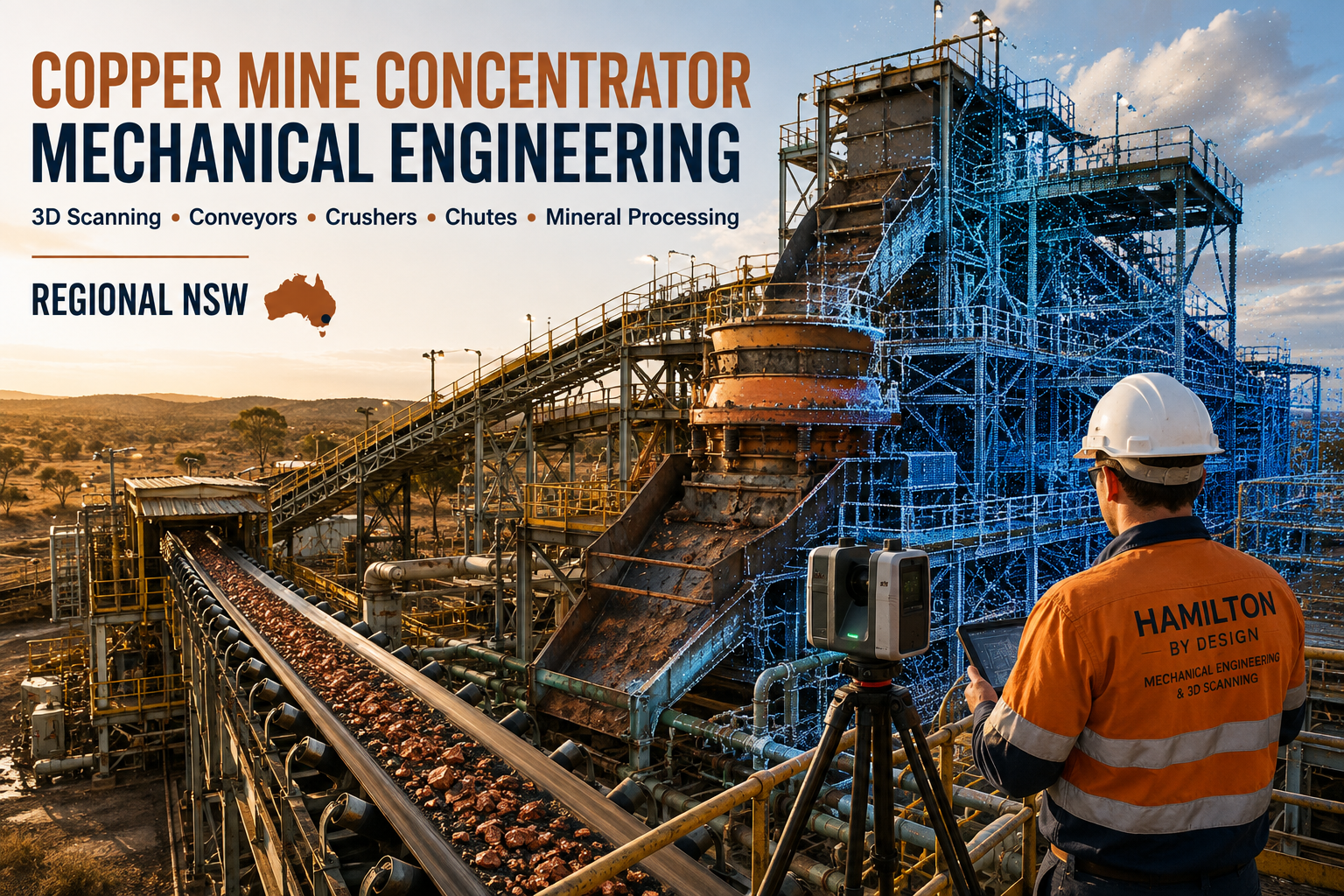
Hero image showing a copper mine concentrator in regional NSW with conveyors carrying ore, a crusher and transfer structures, while an engineer in high-visibility clothing uses a tripod-mounted 3D laser scanner in the foreground. A blue point-cloud overlay highlights the plant, with headline text reading “Copper Mine Concentrator Mechanical Engineering” and supporting text about 3D scanning, conveyors, crushers, chutes and mineral processing.
Blue Gear and Spanner icon

Copper mineral processing plants operate in demanding environments where crushers, conveyors, transfer chutes, hoppers, pumps, pipework and supporting structures must work together continuously and reliably. When these facilities are modified or upgraded, one of the biggest engineering challenges is often not designing the new equipment—it is establishing exactly what already exists.

Across established mining areas such as Cobar and Nyngan in regional NSW, concentrators and materials-handling plants may have undergone decades of repairs, equipment replacements and incremental modifications. Original drawings may no longer accurately represent the installed plant.

Hamilton By Design provides mechanical engineering, 3D laser scanning, CAD modelling and engineering drafting services to support brownfield mineral-processing projects. Our approach combines practical mechanical engineering with accurate existing-condition capture so modifications can be developed around the actual plant rather than assumptions based on historical drawings.

For operations in the Cobar mining region, our broader Mining Engineering Services in Cobar NSW can support projects involving crushing, conveying, materials handling and plant upgrades.

Mechanical Engineering for Copper Mineral Processing Plants

A copper concentrator contains interconnected mechanical systems. A modification to one area can have consequences elsewhere in the process.

Replacing a crusher, for example, may change discharge geometry, chute arrangements, access requirements or structural loads. Increasing conveyor capacity may require changes to transfer points, liners, skirting, supporting structures or maintenance access.

Hamilton By Design can assist with mechanical engineering associated with:

  • crushers and crusher interfaces
  • belt conveyors and conveyor modifications
  • transfer stations
  • chutes and spoon arrangements
  • feed and discharge hoppers
  • bins and bulk-material storage
  • feeders
  • screens and equipment interfaces
  • slurry pumps and pump arrangements
  • process pipework
  • mechanical equipment supports
  • machinery guarding
  • maintenance platforms and access
  • brownfield equipment replacements
  • plant layout changes
  • fabrication and installation documentation.

Our broader approach to Mechanical Engineering in Mining Infrastructure considers conveyors, crushing and screening equipment, pumping systems, slurry transport, chutes, bins and mechanical plant modifications as interconnected parts of the processing facility.

Engineering Around Existing Plant Geometry

One of the greatest risks on a brownfield mineral-processing project is relying on information that no longer reflects the plant.

A drawing may show where a conveyor was originally designed to run, but the installed conveyor may differ slightly. Structural steel may have been altered during previous shutdowns. Platforms, pipework, cable trays, guards and equipment may have been added over time.

Small dimensional differences can become significant when a new chute, conveyor section, pump skid or structural frame has already been fabricated.

This is where Hamilton By Design’s 3D Laser Scanning for Cobar Mining can become an important part of the mechanical engineering workflow.

Engineering-grade LiDAR scanning can capture the existing arrangement of:

  • conveyors
  • crusher structures
  • pulleys
  • transfer stations
  • structural steel
  • equipment bases
  • floors and concrete
  • pipework
  • platforms
  • stairs
  • guards
  • surrounding services.

The resulting point cloud can be used directly within the mechanical design process.

Rather than treating scanning as an isolated surveying exercise, Hamilton By Design uses an engineering-led capture approach. Our Engineering-Led LiDAR and Mechanical Design services in Cobar are intended to connect site capture directly with engineering design, modelling and documentation.

Conveyor Engineering and Materials Handling

Conveyors form critical links between crushing, screening, storage and downstream mineral-processing operations.

Mechanical engineering may be required when changing:

  • conveyor head or tail arrangements
  • drive locations
  • pulley positions
  • conveyor trajectories
  • discharge arrangements
  • loading zones
  • supporting frames
  • guards
  • access platforms
  • transfer chutes.

For belt conveyors handling bulk material, AS/NZS 4024.3611 – Safety of machinery, Conveyors – Belt conveyors for bulk materials handling is particularly relevant. It establishes lifecycle safety requirements for belt conveyors used for bulk-material handling.

The broader AS 4024 Safety of Machinery series may also apply when considering machinery hazards, guarding, access and risk reduction.

For a copper concentrator, compliance needs to be considered as part of the mechanical design process rather than added to the design afterwards.

Chutes and Transfer Points

Transfer points can have a disproportionate effect on mineral-processing plant performance.

A poorly performing chute can contribute to:

  • excessive liner wear
  • belt mistracking
  • spillage
  • dust
  • blockages
  • poor material presentation
  • high impact loads
  • maintenance problems
  • shutdown requirements.

Hamilton By Design provides Conveyor Transfer Chute Design for Mining as part of its mechanical and bulk-materials-handling capability.

Where required, chute development can consider material trajectory, impact zones, wear areas, replaceable liners, access, fabrication requirements and the relationship between the chute and surrounding equipment.

For more difficult material-flow problems, our approach to Chute Design in the Mining Industry can incorporate accurate as-built geometry and engineering analysis, with DEM simulation considered where appropriate.

The objective is not simply to make a chute that fits. It is to develop a practical mechanical arrangement that considers flow, wear, maintainability, safety and fabrication.

Hoppers, Bins and Feed Arrangements

Copper processing plants can include feed hoppers, surge bins and other bulk-solids containment equipment.

When modifying these systems, engineers may need to consider:

  • material density
  • stored volume
  • wall loads
  • discharge conditions
  • eccentric loading
  • flow characteristics
  • liners
  • feeder interfaces
  • supporting steelwork.

AS 3774 – Loads on bulk solids containers may be relevant where the equipment falls within the standard’s scope. The standard deals with determination of loads used in designing structures for the mass storage of bulk solids.

Supporting steelwork may also require assessment against AS 4100 – Steel structures, together with relevant structural design actions under the AS/NZS 1170 series.

Slurry Pumps and Process Pipework

Mechanical engineering in a copper concentrator extends beyond dry materials handling.

Once ore enters wet processing stages, slurry pumping and process-water systems become important elements of plant reliability.

Hamilton By Design can assist with engineering and modelling associated with:

  • pump replacement arrangements
  • pump bases and supports
  • suction and discharge layouts
  • pipe routing
  • equipment clearances
  • maintenance access
  • existing pipework verification
  • plant modifications around pumps and piping.

Where pressure piping falls within its scope, AS 4041 – Pressure piping may be applicable.

The exact design standard should be established during the project because mineral-processing pipe systems vary significantly in pressure, material, duty and service conditions.

Maintenance Access and Machinery Safety

A mechanical modification also needs to be maintainable.

A technically functional chute or conveyor modification is of limited value if maintenance crews cannot safely inspect it, remove liners, access bearings or replace components.

AS 1657 – Fixed platforms, walkways, stairways and ladders is therefore particularly relevant to mineral-processing projects where modifications affect permanent access for operators and maintenance personnel.

Mechanical design should consider access requirements early enough that platforms, stairs, handrails and equipment removal paths form part of the plant arrangement.

Machine guarding and hazardous machinery interfaces should similarly be considered against the applicable AS 4024 series requirements.

Structural Steel Supporting Mechanical Equipment

Although the project may be driven by mechanical engineering, mineral-processing equipment must usually connect to structural steel.

New chutes, conveyors, pumps and equipment can introduce loads into existing structures.

Relevant standards can include:

  • AS 4100 – Steel structures
  • AS/NZS 1170 series – Structural design actions
  • AS/NZS 5131 – Structural steelwork fabrication and erection
  • AS/NZS 1554 series – Structural steel welding.

The specific standards and engineering checks required depend on the scope, existing structure, loads and mine requirements.

Engineering for Shutdown Installation

Mineral-processing shutdowns place additional pressure on brownfield design.

Fabricated equipment may have only a short installation window. Discovering during shutdown that a chute does not fit, a pipe clashes with structural steel or a support frame is incorrectly dimensioned can quickly affect the shutdown schedule.

Hamilton By Design’s approach to 3D Scanning for Mining Shutdown Projects is based on capturing existing conditions before the shutdown and using that information for mechanical design and verification.

The workflow can be:

Site inspection → 3D laser scanning → registered point cloud → mechanical CAD model → design development → clash checking → fabrication drawings → shutdown installation.

Our additional 3D Scanning Engineering services in Cobar can support the transition from existing-condition capture through to usable engineering information for plant modification projects.

Practical Mechanical Engineering for Regional NSW Mining

The value Hamilton By Design brings to mineral-processing projects is the combination of mechanical engineering, practical manufacturing knowledge and digital site capture.

For copper concentrator projects around Cobar, Nyngan and regional NSW, this approach can support everything from a relatively small chute modification through to larger conveyor, crusher, pump or processing-plant upgrades.

The objective is straightforward: understand the existing plant accurately, engineer the modification practically and identify potential problems before fabrication and shutdown installation.

Australian Standards are then incorporated according to the actual scope of work, including machinery safety, conveyor safety, access, structural steel, bulk-solids loads, piping and fabrication requirements.


Frequently Asked Questions

What mechanical engineering services can Hamilton By Design provide for a copper concentrator?

Hamilton By Design can assist with conveyor modifications, transfer chutes, crusher interfaces, hoppers, feeders, slurry pump arrangements, process pipework, mechanical equipment layouts, machinery guarding, maintenance access, equipment supports, reverse engineering and fabrication documentation.

Why use 3D laser scanning before modifying a mineral-processing plant?

Brownfield plants frequently differ from historical drawings. Laser scanning captures the actual location of equipment, structural steel, pipework and surrounding infrastructure so mechanical modifications can be designed around existing conditions.

Can Hamilton By Design design conveyor transfer chutes?

Yes. Transfer chute work can include existing-condition capture, mechanical arrangement development, material trajectory considerations, wear areas, liners, supporting structures, maintenance access and fabrication documentation.

What Australian Standard applies to mining conveyors?

AS/NZS 4024.3611 specifically addresses safety requirements for belt conveyors used for bulk-material handling. Other parts of the AS 4024 series may also apply depending on the machinery and hazards involved.

What standard applies to mining access platforms and stairs?

AS 1657 covers fixed platforms, walkways, stairways and ladders and is commonly relevant when designing permanent access around mineral-processing equipment.

What Australian Standards may apply to hoppers and bins?

AS 3774 may apply to the determination of loads for bulk-solids containers where the equipment falls within its scope. AS 4100 and the AS/NZS 1170 series may also apply to supporting structural steel.

Can existing plant be scanned before a shutdown?

Yes. This can be one of the most valuable uses of engineering-grade 3D scanning. The existing plant can be captured before shutdown so equipment can be modelled, designed and checked while the plant remains in service, subject to site access and operational requirements.

Can Hamilton By Design produce fabrication drawings?

Yes. Mechanical design can progress into 3D CAD models, assemblies, fabrication drawings, DXF information, bills of materials and installation documentation as required by the project.

Does Hamilton By Design only provide 3D scanning?

No. The key distinction is that Hamilton By Design combines 3D scanning with mechanical engineering and CAD design. For mineral-processing projects, scanning is used to obtain reliable existing-condition information that supports the engineering process.

Which Australian Standards apply to a copper concentrator modification?

There is no single Australian Standard covering every concentrator modification. Depending on the project, relevant standards may include AS/NZS 4024.3611, the AS 4024 series, AS 1657, AS 4100, AS/NZS 1170, AS 3774, AS 4041, AS/NZS 5131 and AS/NZS 1554. The applicable standards should be established for each engineering scope, together with the mine operator’s specifications and statutory requirements.


Hamilton By Design logo displayed on a blue tilted rectangle with a grey gradient background

Contact Us – Talk To Us

Name
Would you like us to arrange a phone consultation for you?
Address

Our clients:


Engineering Support for Pinjarra Alumina Refinery & Smelting Operations

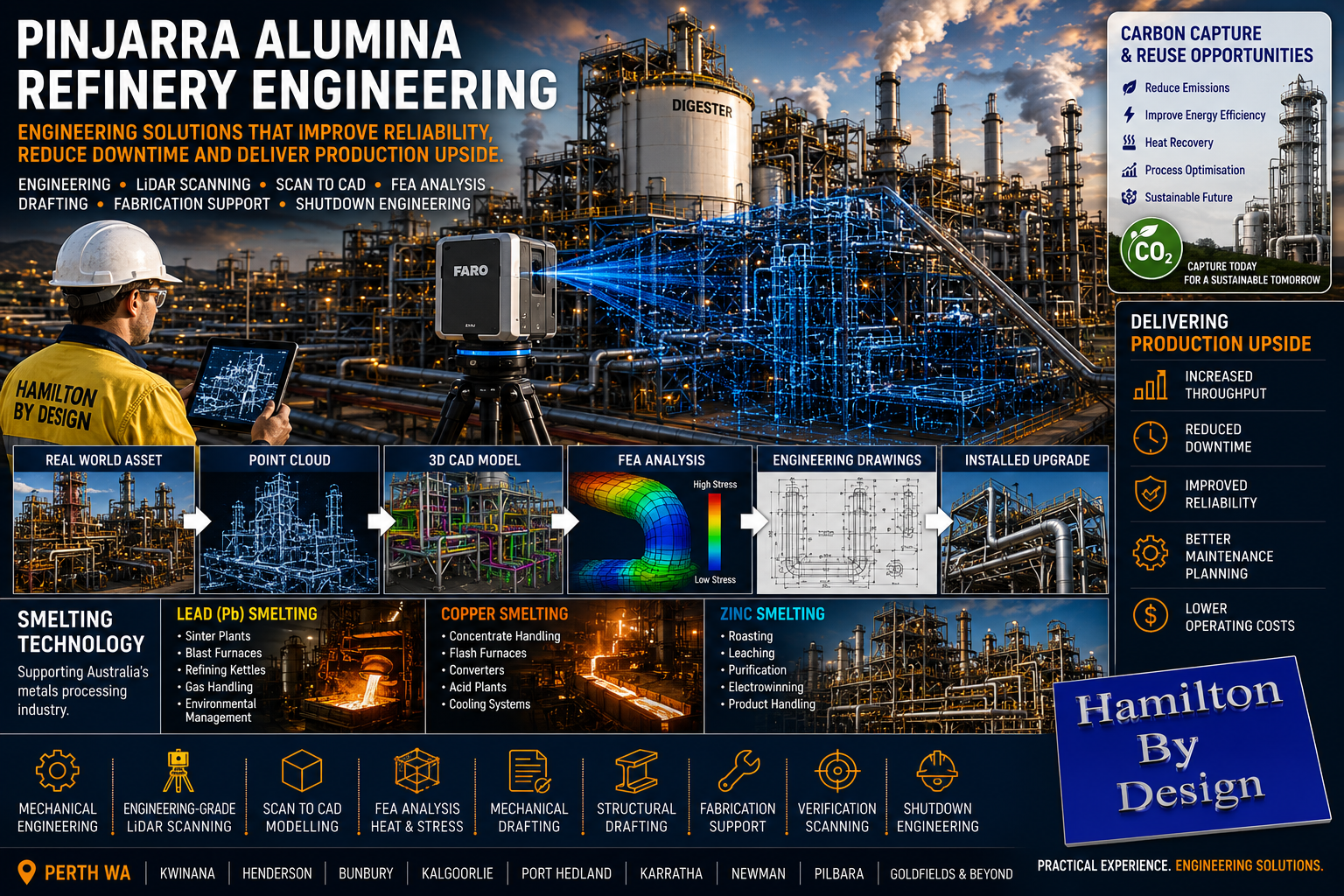
Engineering support for Pinjarra Alumina Refinery featuring LiDAR scanning, Scan to CAD, finite element analysis, drafting, fabrication support and shutdown engineering for refining and smelting operations.

Engineering Support for Alumina Refining, Smelting & Industrial Processing at Pinjarra Alumina Refinery

Western Australia is home to some of Australia’s largest mineral processing and refining facilities, with the Pinjarra Alumina Refinery playing a significant role in the global aluminium supply chain. Facilities such as Pinjarra operate in challenging environments where reliability, maintenance planning, shutdown execution and ongoing asset improvement are critical to maintaining production targets.

While alumina refining differs from traditional metal smelting, many of the engineering challenges are similar to those experienced in copper smelting, lead (Pb) smelting and zinc smelting operations. These facilities rely on large-scale materials handling systems, process equipment, conveyors, tanks, pipework, structural steel, furnaces, dust collection systems and complex utility networks.

Understanding Smelting Operations

Lead (Pb) Smelting

Lead smelting facilities process lead concentrates into refined lead products through a series of thermal and metallurgical processes. These operations involve sinter plants, blast furnaces, refining kettles, gas handling systems and extensive materials handling infrastructure. Equipment reliability and environmental management are critical due to the elevated temperatures and strict emissions requirements associated with lead processing.

Copper Smelting

Copper smelters convert copper concentrates into blister copper through high-temperature smelting and converting processes. Typical facilities contain concentrate handling systems, flash furnaces, converters, acid plants, cooling systems and extensive structural and mechanical infrastructure. Shutdown planning, asset inspections and engineering upgrades are essential to maintaining plant availability and production performance.

Zinc Smelting

Zinc smelting operations involve roasting, leaching, purification and electro-winning processes to produce refined zinc products. These facilities contain large process plants, pipework systems, tanks, conveyors, structural steel and utility infrastructure. The aggressive operating environments create ongoing challenges relating to corrosion, wear, thermal expansion and equipment maintenance.

Australia’s Energy Challenge and Carbon Reduction Opportunities

Australia’s industrial processing sector faces significant energy challenges as the nation seeks to balance energy security, affordability and emissions reduction. Smelters, refineries and sinter plants are among the largest industrial energy consumers due to their continuous high-temperature processes. As electricity prices and carbon management requirements continue to evolve, operators are increasingly exploring opportunities to improve energy efficiency while reducing greenhouse gas emissions.

Carbon capture, utilisation and storage (CCUS) technologies present opportunities for future emissions reduction within smelting and refining operations. Captured carbon dioxide can potentially be reused in industrial processes, mineral carbonation, chemical production and advanced materials manufacturing. Combined with process optimisation, waste heat recovery systems and modern digital engineering tools, these technologies may assist Australian smelters and refineries in improving sustainability while maintaining production competitiveness.

Engineering-Led Project Delivery

At Hamilton By Design, we provide engineering-led solutions that support industrial facilities throughout Australia, from concept development through to fabrication and installation.

Our workflow is focused on reducing project risk, improving constructability and maximising production uptime.

Mechanical Engineering

Every successful project starts with understanding the operating environment, process requirements and maintenance constraints. Our mechanical engineering services focus on developing practical, maintainable and production-focused solutions for industrial facilities.

Engineering-Grade 3D LiDAR Scanning

We perform engineering-grade terrestrial LiDAR scanning to capture accurate site conditions. Unlike basic surveying applications, engineering-grade scanning focuses on providing data suitable for detailed engineering, fabrication, maintenance planning and shutdown execution.

Applications include:

  • Smelters
  • Refineries
  • Sinter plants
  • Materials handling systems
  • Structural steel
  • Pipework systems
  • Conveyors
  • Tanks and vessels

3D Modelling and Digital Engineering

Point cloud data is transformed into intelligent 3D models that support:

  • Design development
  • Clash detection
  • Constructability reviews
  • Brownfield modifications
  • Shutdown planning
  • Stakeholder engagement

Finite Element Analysis (FEA)

Concepts can be assessed using Finite Element Analysis to evaluate:

  • Structural performance
  • Stress distribution
  • Thermal expansion
  • Heat transfer
  • Fatigue performance
  • Operational loading conditions

Heat and stress analysis provides valuable insight before fabrication commences, reducing project risk and improving confidence in engineering decisions.

Mechanical & Structural Drafting

Hamilton By Design produces detailed engineering documentation including:

  • General arrangement drawings
  • Mechanical fabrication drawings
  • Structural steel detailing
  • Pipework layouts
  • Installation documentation
  • Maintenance access reviews
  • Shutdown work packs

Fabrication Support

Our team combines engineering capability with practical trade, fabrication and machining experience. This ensures designs are practical to manufacture, install and maintain in operating industrial environments.

Verification Scanning Before Installation

Prior to fabrication or shutdown installation, verification scanning can be undertaken to confirm dimensions, interfaces and clearances.

This process assists in:

  • Reducing site rework
  • Minimising fitment issues
  • Confirming fabrication accuracy
  • Improving shutdown efficiency
  • Reducing project risk

Shutdown & Production Support

Accurate engineering information reduces uncertainty during shutdowns and maintenance activities.

By combining engineering-grade scanning, modelling, analysis and verification processes, projects can be delivered with greater confidence, improved safety and reduced downtime.

Delivering Production Upside

The ultimate objective of every engineering project is to improve reliability, maintainability and production performance.

Through engineering-led mechanical engineering, 3D LiDAR scanning, Scan-to-CAD modelling, finite element analysis, drafting, fabrication support and verification scanning, Hamilton By Design assists clients in delivering projects that minimise risk, reduce downtime and maximise production upside.

Whether supporting alumina refineries, copper smelters, lead smelters, zinc processing facilities, sinter plants or bulk materials handling operations, our focus remains the same:

Practical engineering solutions that improve reliability, reduce shutdown risk and support increased production performance.


Why Hamilton By Design?

Hamilton By Design combines:

  • Mechanical Engineering
  • Engineering-Grade 3D LiDAR Scanning
  • Scan to CAD Modelling
  • Finite Element Analysis
  • Heat & Stress Analysis
  • Mechanical Drafting
  • Structural Drafting
  • Fabrication Support
  • Verification Scanning
  • Shutdown Engineering

to deliver complete engineering solutions from concept through to installation.

By capturing accurate site conditions, validating concepts before fabrication and verifying fitment before shutdown execution, we help industrial facilities reduce risk, improve project outcomes and maintain production continuity.

3D CAD Modelling Australia service banner for Hamilton By Design
https://www.hamiltonbydesign.com.au/perth-wa
Mechanical Engineering Perth WA banner for Hamilton By Design featuring white text on a blue background.
3D Laser Scanning Perth WA banner for Hamilton By Design with white text on a blue background.
SolidWorks Perth WA banner for Hamilton By Design featuring white text on a blue background.

3D CAD Modelling Australia service banner for Hamilton By Design


CHPP Engineering title graphic featuring bold white text reading "CHPP Engineering" centred on a blue rounded rectangle background.
Pipework Drafting title graphic featuring bold white text reading "Pipework Drafting" centred on a blue rounded rectangle background.
3D LiDAR Scanning for Engineering Projects title graphic featuring bold white text on a blue rounded rectangle background.


Finite Element Analysis (FEA) engineering simulation button
Structural drafting services button
Mechanical drafting services button


Australian Drafting logo featuring bold white text reading "Australian Drafting" centred on a blue rounded rectangle background.
Engineering Governance title graphic featuring bold white text reading "Engineering Governance" centred on a blue rounded rectangle background.
Engineering-Grade LiDAR Scanning title graphic featuring bold white text on a blue rounded rectangle background.


Mechanical drafting services button
Structural drafting services button


Fabrication and product design services
3D CAD Modelling Australia service banner for Hamilton By Design
Mechanical, Structural & Pipework Drafting service banner by Hamilton By Design featuring white text on a blue background.


3D LiDAR scanning and 3D modelling service button — laser scanner capturing a point cloud for engineering and CAD modelling
Mechanical engineering services
Mechanical Engineering Perth WA banner for Hamilton By Design featuring white text on a blue background.
3D Laser Scanning Perth WA banner for Hamilton By Design with white text on a blue background.
SolidWorks Perth WA banner for Hamilton By Design featuring white text on a blue background.
3D LiDAR scanning and 3D modelling service button — laser scanner capturing a point cloud for engineering and CAD modelling
Mechanical engineering services
https://www.hamiltonbydesign.com.au/perth-wa

3D CAD Modelling Australia service banner for Hamilton By Design


CHPP Engineering title graphic featuring bold white text reading "CHPP Engineering" centred on a blue rounded rectangle background.
Pipework Drafting title graphic featuring bold white text reading "Pipework Drafting" centred on a blue rounded rectangle background.
3D LiDAR Scanning for Engineering Projects title graphic featuring bold white text on a blue rounded rectangle background.


Finite Element Analysis (FEA) engineering simulation button
Structural drafting services button
Mechanical drafting services button


Australian Drafting logo featuring bold white text reading "Australian Drafting" centred on a blue rounded rectangle background.
Engineering Governance title graphic featuring bold white text reading "Engineering Governance" centred on a blue rounded rectangle background.
Engineering-Grade LiDAR Scanning title graphic featuring bold white text on a blue rounded rectangle background.


Mechanical drafting services button
Structural drafting services button


Fabrication and product design services
3D CAD Modelling Australia service banner for Hamilton By Design
Mechanical, Structural & Pipework Drafting service banner by Hamilton By Design featuring white text on a blue background.


3D LiDAR scanning and 3D modelling service button — laser scanner capturing a point cloud for engineering and CAD modelling
Mechanical engineering services

Mechanical Engineering Muswellbrook NSW | Mining, CHPP & Industrial Engineering

Mechanical engineering services in Muswellbrook NSW including CHPP upgrades, conveyor systems, industrial laser scanning, reverse engineering, fixed plant engineering and mining infrastructure design.

Mechanical Engineering Services in Muswellbrook NSW

Blue Gear and Spanner icon

Muswellbrook sits at the centre of one of Australia’s most important heavy industrial regions. Located in the Upper Hunter Valley, the area supports large-scale coal mining, Coal Handling and Preparation Plants (CHPP), power generation, rail infrastructure, bulk materials handling systems, maintenance workshops and emerging energy projects.

At Hamilton By Design Co., we provide engineer-led mechanical engineering, industrial laser scanning, reverse engineering and drafting services for mining, power generation and heavy industry throughout Muswellbrook and the wider Hunter Valley region.


Supporting Mining & Fixed Plant Infrastructure

The Muswellbrook region remains heavily connected to mining operations, bulk materials handling and fixed plant infrastructure. These facilities require ongoing engineering support for maintenance, shutdowns, brownfield upgrades and asset life extension programs.

Our team can assist with:

  • Conveyor system engineering
  • Transfer chute design
  • Crusher and screening plant upgrades
  • Pump station engineering
  • Structural steel modifications
  • Mechanical equipment installations
  • Walkways, platforms and access systems
  • Shutdown engineering support
  • Maintenance engineering documentation
  • Fabrication and workshop drawings
  • Asset integrity inspections

Many sites throughout the Hunter Valley operate ageing infrastructure that requires modification around existing operating plant. Accurate site measurement, engineering-grade scanning and practical engineering experience become critical when working in these environments.


3D LiDAR Scanning Hunter & Newcastle banner with white text on a blue background promoting engineering-grade laser scanning services for industrial, mining and infrastructure projects across the Hunter Valley and Newcastle region.
Mechanical Engineering Hunter & Newcastle banner promoting mechanical engineering services for mining, industrial plants, power generation, manufacturing and heavy industry throughout the Hunter Valley and Newcastle region.
Structural Drafting Hunter & Newcastle banner promoting structural drafting services for mining, industrial plants, power generation, manufacturing and infrastructure projects across the Hunter Valley and Newcastle region.

CHPP & Coal Handling Engineering

Coal Handling and Preparation Plants (CHPP) remain a major part of the Muswellbrook industrial landscape.

Hamilton By Design can support projects involving:

  • Conveyor transfers
  • Transfer tower upgrades
  • Coal sampling systems
  • Stacker and reclaimer infrastructure
  • Surge bins and hoppers
  • Dust suppression systems
  • Structural modifications
  • Pipework and pumping systems
  • Maintenance access upgrades
  • Shutdown planning and engineering

Our experience in bulk materials handling allows us to support both operational facilities and brownfield upgrade projects where existing site conditions present significant engineering challenges.


Power Generation & Energy Infrastructure

Muswellbrook has long been associated with major power generation assets including Bayswater Power Station and the former Liddell Power Station.

Mechanical engineering support remains essential across:

  • Turbine systems
  • Boiler infrastructure
  • Cooling water systems
  • Ash handling systems
  • Pipework upgrades
  • Structural inspections
  • Mechanical maintenance projects
  • Asset integrity assessments
  • Brownfield modifications
  • Renewable energy infrastructure

As the Hunter Valley continues transitioning toward energy storage and renewable infrastructure, engineering companies capable of supporting both legacy industrial assets and future energy projects will continue to play an important role.


3D LiDAR scanning and 3D modelling service button — laser scanner capturing a point cloud for engineering and CAD modelling
Mechanical engineering services

Industrial 3D Laser Scanning in Muswellbrook

Hamilton By Design provides engineering-grade terrestrial LiDAR scanning services throughout Muswellbrook and the Hunter Valley.

Our scanning services support:

  • As-built verification
  • Conveyor systems
  • CHPP facilities
  • Power stations
  • Structural steelwork
  • Processing plants
  • Workshop facilities
  • Pipe racks
  • Tanks and vessels
  • Brownfield expansion projects

Deliverables can include:

  • Registered point clouds
  • E57 files
  • RCP and RCS datasets
  • CAD models
  • STEP files
  • SAT files
  • General Arrangement drawings
  • Fabrication drawings

Engineering-grade scanning reduces project risk by allowing accurate design work to occur around existing infrastructure before fabrication begins.


Reverse Engineering Services

Many mining and industrial sites throughout the Hunter Valley continue to operate equipment that is obsolete, difficult to source or no longer supported by the original manufacturer.

Hamilton By Design provides reverse engineering services for:

  • Mechanical components
  • Castings
  • Machined parts
  • Conveyor components
  • Wear liners
  • Pump assemblies
  • Couplings
  • Structural assemblies
  • Site-specific plant equipment

Using a combination of laser scanning, precision measurement, CAD modelling and practical manufacturing knowledge, we can recreate engineering models and fabrication drawings from existing components.


Mechanical Drafting & Design

Our drafting and design services support mining companies, fabrication workshops, contractors and maintenance teams throughout Muswellbrook and the Hunter Valley.

Services include:

  • Mechanical drafting
  • Structural drafting
  • Pipework drafting
  • Fabrication drawings
  • Workshop drawings
  • General Arrangement drawings
  • Site layouts
  • Conveyor detailing
  • Access platform design
  • Engineering documentation

We work across a range of deliverables including SolidWorks, AutoCAD, Inventor, STEP, DWG and PDF formats.


Supporting the Future of the Hunter Valley

The Upper Hunter region continues to undergo significant industrial transformation. While coal mining, bulk materials handling and fixed plant maintenance remain major industries, investment in energy storage, renewable energy and infrastructure upgrades is creating new engineering opportunities across the region.

Hamilton By Design supports clients throughout Muswellbrook, Singleton, Maitland, Newcastle and the wider Hunter Valley with engineer-led services focused on practical industrial outcomes.

Whether the project involves a conveyor upgrade, CHPP modification, power station infrastructure, reverse engineering, industrial laser scanning or mechanical drafting, our team can assist from site measurement through to detailed design documentation.

CHPP Engineering title graphic featuring bold white text reading "CHPP Engineering" centred on a blue rounded rectangle background.
Pipework Drafting title graphic featuring bold white text reading "Pipework Drafting" centred on a blue rounded rectangle background.
3D LiDAR Scanning for Engineering Projects title graphic featuring bold white text on a blue rounded rectangle background.

Contact Us – Talk to Us

Name
Would you like us to arrange a phone consultation for you?
Address

Our Clients:

3D CAD Modelling Australia service banner for Hamilton By Design
Finite Element Analysis (FEA) engineering simulation button
Structural drafting services button
Mechanical drafting services button
Australian Drafting logo featuring bold white text reading "Australian Drafting" centred on a blue rounded rectangle background.
Engineering Governance title graphic featuring bold white text reading "Engineering Governance" centred on a blue rounded rectangle background.
Engineering-Grade LiDAR Scanning title graphic featuring bold white text on a blue rounded rectangle background.
Mechanical engineering services
Australian Drafting logo featuring bold white text reading "Australian Drafting" centred on a blue rounded rectangle background.

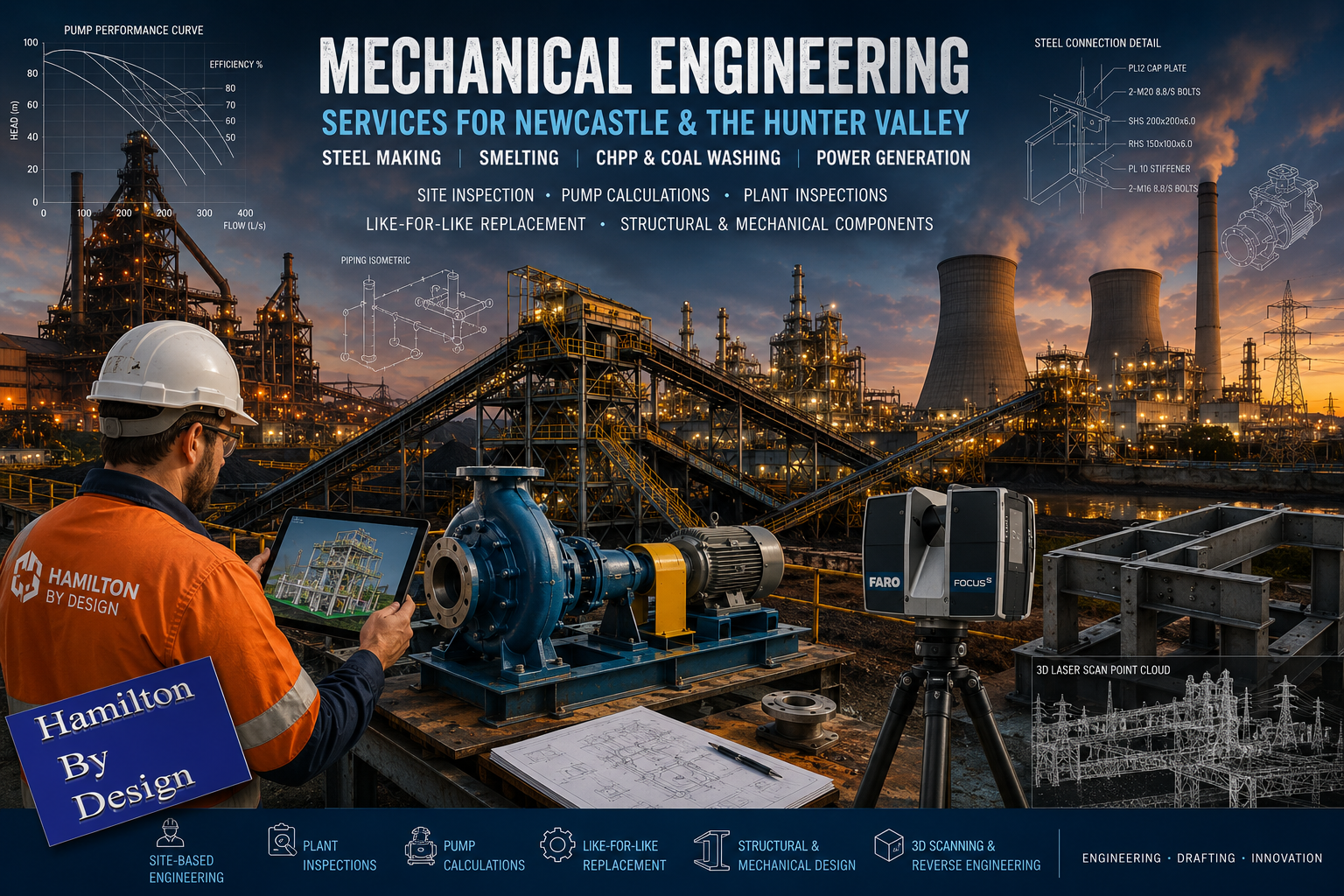
Mechanical Engineering Services for Newcastle and the Hunter Valley

Mechanical engineer performing plant inspection at a Newcastle industrial facility with pumps, conveyors, steel making infrastructure, CHPP operations and power generation assets across the Hunter Valley.

Site-Based Mechanical Engineering for Heavy Industry, Mining and Power Generation

Blue Gear and Spanner icon

Hamilton By Design provides mechanical engineering support for industrial plants across Newcastle, the Hunter Valley and surrounding regions.

We support sites involved in steel making, smelting, coal handling and preparation plants, coal washing, power generation, bulk materials handling and heavy industrial maintenance.

The Hunter region has a long history in coal, power generation and steel-related industry, with coal mining, CHPP operations, power stations and export infrastructure continuing to play a major role in the region’s industrial base.

Mechanical Engineering Support for Operating Plants

Industrial sites require practical mechanical engineering that understands plant availability, shutdown windows, maintenance constraints and the reality of working around existing equipment.

Hamilton By Design can assist with:

  • Site-based mechanical engineering support
  • Mechanical plant inspections
  • Pump calculations and pump system reviews
  • Like-for-like replacement of mechanical components
  • Structural and mechanical component replacement
  • Conveyor, chute and transfer point reviews
  • CHPP and coal washing plant mechanical support
  • Smelting and steel plant mechanical support
  • Power station mechanical and structural support
  • Reverse engineering of worn or obsolete parts
  • Engineering drawings for fabrication and replacement
  • 3D laser scanning for existing plant and brownfield works

Mechanical Engineering for CHPP and Coal Washing Plants

Coal Handling and Preparation Plants operate under demanding conditions. Pumps, pipework, screens, launders, conveyors, chutes, guards and structural supports are exposed to wear, vibration, corrosion and material build-up.

Hamilton By Design can assist with inspection, measurement, design and documentation for:

  • Slurry pumps and process water systems
  • Pump baseplates and drive arrangements
  • Pipe supports and replacement pipework
  • Chutes, launders and transfer points
  • Conveyor structures and guarding
  • Access platforms, walkways and maintenance areas
  • Wear plate replacement and component redesign
  • Like-for-like replacement where production risk must be controlled

Where components are worn, damaged or no longer supported by the original supplier, we can use site measurement, 3D laser scanning and reverse engineering to develop fabrication drawings and replacement geometry.

Mechanical Engineering for Steel Making and Smelting Plants

Steel making, smelting and high-temperature processing plants require mechanical engineering that considers heat, wear, access, material selection and maintenance practicality.

Hamilton By Design can support mechanical and structural works around:

  • Furnace and smelting support equipment
  • Ducting, hoppers, bins and chutes
  • Cooling water and process pipework
  • Platforms, access steel and maintenance structures
  • Pump skids and mechanical drive systems
  • Heavy fabrication replacement items
  • Site inspection and defect reporting
  • Drafting and engineering documentation for fabrication

Our approach is practical and site-focused. We understand that industrial drawings need to be useful for fabrication, installation and maintenance — not just theoretical design.

Mechanical Engineering for Power Generation Sites

Power generation sites across the Hunter region continue to require engineering support for maintenance, transition works, decommissioning, replacement equipment and brownfield upgrades. The region includes long-standing coal-fired power infrastructure, with Bayswater continuing to operate and Liddell now retired.

Hamilton By Design can assist with:

  • Mechanical inspection of existing plant
  • Pump and pipework calculations
  • Cooling water and process systems
  • Replacement steelwork and mechanical supports
  • Access platforms and maintenance structures
  • Brownfield scanning and as-built modelling
  • Fabrication drawings for replacement components
  • Shutdown planning support and site verification

Pump Calculations and Mechanical Reviews

Pumps are critical across CHPPs, smelters, steel plants and power generation sites. Incorrect pump selection, worn components or poor pipework arrangements can lead to reliability issues, cavitation, vibration and reduced plant availability.

Hamilton By Design can assist with:

  • Pump duty review
  • Flow and head calculations
  • Pipework pressure loss checks
  • Pump baseplate and support review
  • Like-for-like replacement checks
  • Reverse engineering of pump components
  • Wear assessment and replacement drawings
  • Arrangement drawings for maintenance and installation

Plant Inspection and Like-for-Like Replacement

Many industrial sites require replacement of existing structural or mechanical components without changing the function of the plant. In these cases, accuracy and practical site understanding are critical.

We can attend site to inspect, measure and document existing components, then develop drawings for:

  • Replacement frames
  • Platforms and access steel
  • Guards and brackets
  • Pump skids and bases
  • Chutes and liners
  • Pipe supports
  • Structural and mechanical interfaces
  • Worn or obsolete machine components

Where required, 3D laser scanning can be used to capture existing conditions and reduce the risk of fabrication or installation errors.

Why Hamilton By Design

Hamilton By Design is engineer-led. We combine mechanical engineering, drafting, 3D laser scanning, reverse engineering and fabrication-aware design.

This means we can support clients from site inspection through to practical engineering drawings suitable for review, fabrication and installation.

For Newcastle and Hunter Valley industrial sites, we provide mechanical engineering support that understands heavy industry, maintenance realities, shutdown risk and the need for clear, accurate deliverables.

3D LiDAR Scanning Hunter & Newcastle banner with white text on a blue background promoting engineering-grade laser scanning services for industrial, mining and infrastructure projects across the Hunter Valley and Newcastle region.
Mechanical Engineering Hunter & Newcastle banner promoting mechanical engineering services for mining, industrial plants, power generation, manufacturing and heavy industry throughout the Hunter Valley and Newcastle region.
Structural Drafting Hunter & Newcastle banner promoting structural drafting services for mining, industrial plants, power generation, manufacturing and infrastructure projects across the Hunter Valley and Newcastle region.

Contact Hamilton By Design

If your site requires mechanical engineering support for a CHPP, coal washing plant, smelter, steel plant, power generation facility or heavy industrial operation, Hamilton By Design can assist with site inspection, calculations, scanning, drafting and replacement component design.

Hamilton By Design logo displayed on a blue tilted rectangle with a grey gradient background

Name
Would you like us to arrange a phone consultation for you?
Address

Our Clients:

3D CAD Modelling Australia service banner for Hamilton By Design
CHPP Engineering title graphic featuring bold white text reading "CHPP Engineering" centred on a blue rounded rectangle background.
Pipework Drafting title graphic featuring bold white text reading "Pipework Drafting" centred on a blue rounded rectangle background.
3D LiDAR Scanning for Engineering Projects title graphic featuring bold white text on a blue rounded rectangle background.
Mechanical engineering services
Australian Drafting logo featuring bold white text reading "Australian Drafting" centred on a blue rounded rectangle background.

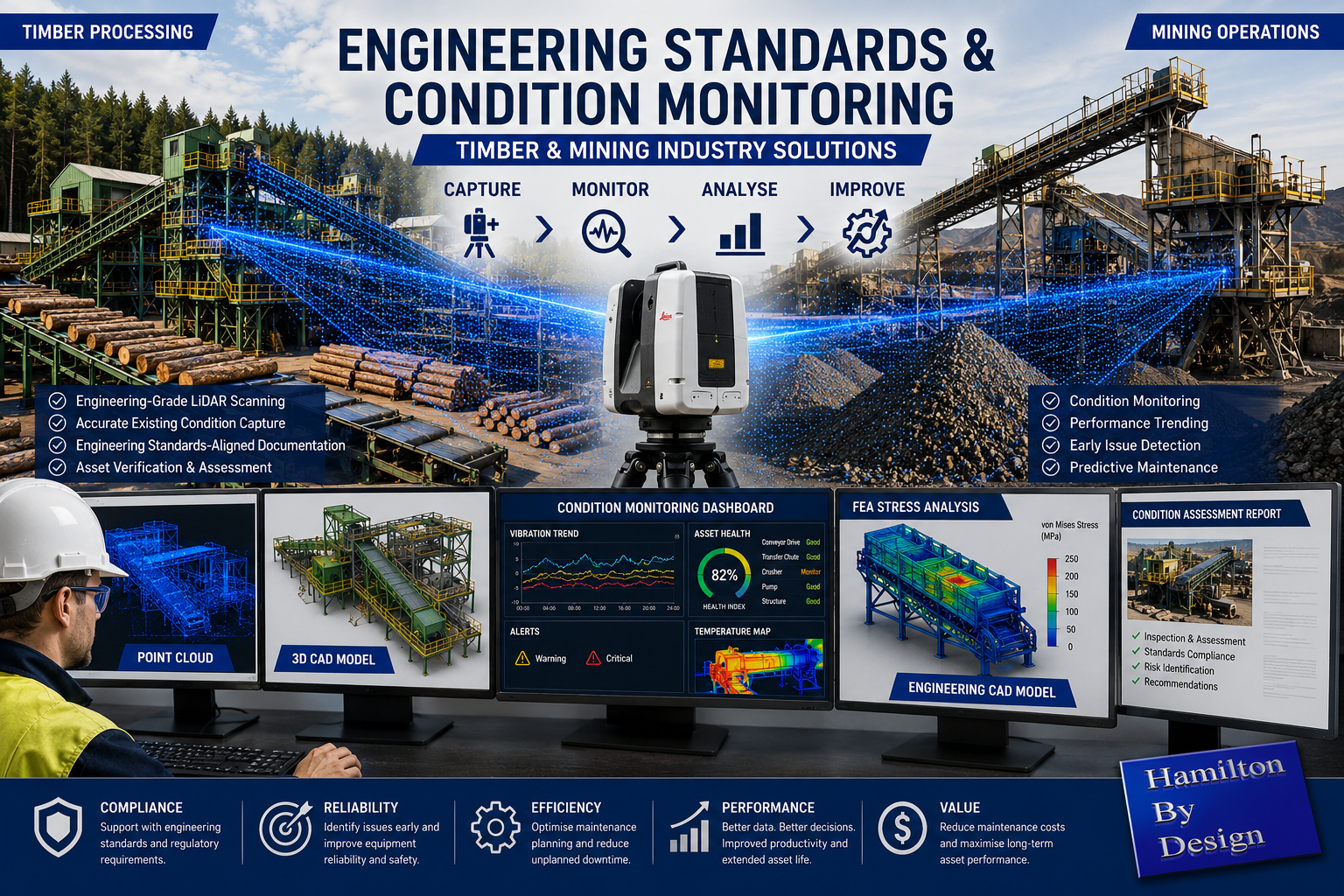
Engineering Standards & Condition Monitoring: Supporting Reliability in Timber and Mining Operations

Engineering-grade LiDAR scanning, condition monitoring, and FEA analysis workflow for timber processing and mining equipment reliability.

Industries such as timber processing and mining operate in demanding environments where equipment reliability directly affects productivity, maintenance costs, and operational performance. Conveyor systems, transfer chutes, rotating equipment, processing machinery, structural assets, and supporting infrastructure are often exposed to continuous loading, wear, vibration, fatigue, and harsh operating conditions.

While machinery failures may appear sudden, many develop gradually through changes in operating conditions, deterioration, or inadequate monitoring and maintenance practices.

Engineering standards and condition monitoring help organisations move from reactive maintenance toward informed engineering decisions and improved asset performance.

At Hamilton By Design, we support mining and timber processing industries through engineering-led approaches that combine engineering standards, digital engineering workflows, reality capture technologies, and practical engineering solutions.

Why Engineering Standards Matter

Engineering standards provide a structured framework for designing, assessing, operating, and maintaining equipment.

Standards help organisations achieve:

  • Improved safety
  • Greater consistency
  • Reduced risk
  • Improved reliability
  • Better maintenance planning
  • Regulatory compliance
  • Improved operational performance

Examples of standards commonly applied within industrial projects may include:

Structural and Mechanical Standards

  • AS 4100 – Steel structures
  • AS 1170 – Structural design actions
  • AS 3996 – Access covers and grates
  • AS 1657 – Fixed platforms, walkways, stairways and ladders
  • AS 1554 – Structural welding

Asset and Equipment Considerations

  • Fatigue assessment
  • Structural integrity
  • Mechanical reliability
  • Equipment life assessment
  • Materials handling performance

Engineering standards support more than design compliance. They help establish long-term operational reliability.

What is Condition Monitoring?

Condition monitoring involves collecting information about equipment performance and asset condition to identify potential issues before failures occur.

Rather than waiting for breakdowns, monitoring allows maintenance and engineering teams to make decisions using measurable data.

Condition monitoring can involve:

  • Equipment inspections
  • Structural assessments
  • Wear monitoring
  • Vibration monitoring
  • Alignment assessment
  • Existing condition capture
  • Thermal assessments
  • Trend analysis
  • Performance assessment

The objective is identifying deterioration before operational impacts occur.

Timber Industry Applications

Timber processing facilities operate continuously with significant material handling demands.

Common assets include:

  • Log conveyors
  • Timber handling systems
  • Chippers
  • Screening systems
  • Structural platforms
  • Transfer systems
  • Processing machinery

Typical challenges may include:

  • Equipment wear
  • Misalignment
  • Build-up
  • Fatigue
  • Structural deterioration
  • Conveyor performance issues

Engineering monitoring and assessment can improve:

  • Throughput
  • Reliability
  • Maintenance planning
  • Downtime reduction
  • Equipment life

Mining Industry Applications

Mining operations often involve harsh operating environments and heavy-duty equipment subjected to high loading conditions.

Applications can include:

  • Conveyor systems
  • Transfer chutes
  • Processing plants
  • Crushers
  • Pump systems
  • Structural assets
  • Materials handling systems

Common challenges may include:

  • Wear
  • Fatigue loading
  • Structural movement
  • Equipment deterioration
  • Production interruptions

Condition monitoring allows operational teams to move toward predictive maintenance approaches rather than emergency repairs.

How Hamilton By Design Supports Engineering Standards and Condition Monitoring

Hamilton By Design supports projects through a combination of engineering tools and practical experience.

Our services can include:

Engineering-Grade 3D LiDAR Scanning

Capture accurate existing conditions and generate point cloud information for:

  • Existing plant geometry
  • Structural assessment
  • Brownfield modifications
  • Asset verification
3D CAD Modelling Australia service banner for Hamilton By Design

Scan-to-CAD Workflows

Convert site information into:

  • Editable engineering models
  • Existing condition documentation
  • Engineering drawings

Engineering Analysis and Simulation

Support asset assessments through:

  • Finite Element Analysis (FEA)
  • Structural assessments
  • Load analysis
  • Design validation

Engineering Documentation

Deliver:

  • Drawings
  • Assessment reports
  • Design documentation
  • Asset information
3D LiDAR scanning and 3D modelling service button — laser scanner capturing a point cloud for engineering and CAD modelling
Mechanical engineering services

Supporting Long-Term Asset Performance

Successful operations are not built around simply repairing equipment after failure.

Long-term value often comes from:

  • Improved reliability
  • Reduced maintenance costs
  • Better planning
  • Increased productivity
  • Reduced downtime
  • Improved asset life
  • Better engineering decisions

By combining engineering standards, condition monitoring, digital engineering workflows, and practical engineering solutions, organisations can move beyond assumptions and improve operational performance.

Hamilton By Design supports timber processing and mining industries by helping transform engineering information into practical decisions and measurable outcomes.

Hamilton By Design logo displayed on a blue tilted rectangle with a grey gradient background
Name
Would you like us to arrange a phone consultation for you?
Address

Our Clients:

3D CAD Modelling Australia service banner for Hamilton By Design
Australian Drafting logo featuring bold white text reading "Australian Drafting" centred on a blue rounded rectangle background.
Engineering Governance title graphic featuring bold white text reading "Engineering Governance" centred on a blue rounded rectangle background.
Mechanical, Structural & Pipework Drafting service banner by Hamilton By Design featuring white text on a blue background.
Mechanical engineering services
Blue rounded button with the text “SolidWorks Design” in white.
Finite Element Analysis (FEA) engineering simulation button
3D LiDAR Scanning Darwin for engineering surveys, laser scanning, reality capture and point cloud modelling services
3D LiDAR Scanning Australia engineering services for laser scanning, reality capture, scan-to-CAD, Scan-to-BIM and as-built documentation across Australia
3D LiDAR scanning services on the Central Coast providing engineering-grade laser scanning, point cloud capture, scan-to-CAD modelling and industrial reality capture for infrastructure and industrial projects.
3D LiDAR Scanning Perth for engineering surveys, laser scanning, reality capture and point cloud modelling services
3D LiDAR Scanning Sydney for engineering surveys, laser scanning, reality capture and point cloud modelling services
3D LiDAR Scanning Brisbane for engineering surveys, laser scanning, reality capture and point cloud modelling services
3D LiDAR Scanning Canberra for engineering surveys, laser scanning, reality capture and point cloud modelling services
3D LiDAR Scanning Newcastle for engineering surveys, laser scanning, reality capture and point cloud modelling services
3D LiDAR Scanning Adelaide for engineering surveys, laser scanning, reality capture and point cloud modelling services

Engineering Analysis & Simulation: Turning Engineering Assumptions into Measured Decisions

Engineering Analysis and Simulation infographic showing LiDAR scanning, scan-to-CAD workflows, finite element analysis (FEA), and digital engineering processes used to optimise industrial plant design and improve project outcomes.

In modern engineering projects, assumptions can quickly become expensive. Whether designing a transfer chute, assessing a structural support frame, modifying a conveyor system, or evaluating equipment performance, understanding how a system will behave before fabrication or installation can reduce risk, minimise rework, and improve project outcomes.

Engineering analysis and simulation allow engineers to move beyond simple calculations and create a deeper understanding of how equipment, structures, and systems will perform under real operating conditions.

At Hamilton By Design, we provide engineering analysis and simulation services to support mining, manufacturing, infrastructure, and industrial projects by combining engineering judgement with digital engineering tools and practical industry experience.

What is Engineering Analysis and Simulation?

Engineering analysis and simulation involve creating mathematical and digital representations of real-world systems to predict behaviour and performance before implementation.

Examples include:

  • Structural analysis
  • Finite Element Analysis (FEA)
  • Stress and deflection assessment
  • Equipment performance modelling
  • Load analysis
  • Materials handling analysis
  • Mechanical design validation
  • Existing asset assessments
  • Failure investigations
  • Brownfield modification studies

Rather than relying solely on assumptions or conservative estimates, simulation can provide measurable engineering data to support decision making.

Why Engineering Analysis Matters

Engineering projects often involve balancing multiple competing factors:

  • Safety
  • Cost
  • Performance
  • Weight
  • Reliability
  • Manufacturability
  • Maintenance access
  • Project schedule

Without engineering analysis, projects can encounter:

  • Unexpected structural failures
  • Excessive equipment wear
  • Over-designed systems
  • Fabrication clashes
  • Higher maintenance costs
  • Delays during installation

Simulation allows these issues to be identified earlier in the project lifecycle.

Hamilton By Design Engineering Analysis Services

Hamilton By Design offers engineering analysis and simulation services integrated with practical engineering workflows and reality capture technologies.

Our services can include:

Finite Element Analysis (FEA)

FEA can be used to assess:

  • Structural loading
  • Stress concentrations
  • Deflection
  • Equipment supports
  • Platform structures
  • Mechanical components
  • Existing assets

This allows engineers to identify areas of concern before fabrication or installation.

3D CAD Modelling Australia service banner for Hamilton By Design

Mechanical Design Validation

Engineering models can be assessed against:

  • Expected operational loads
  • Serviceability requirements
  • Design standards
  • Fatigue considerations
  • Practical operating conditions

Scan-to-Analysis Workflows

Traditional analysis often starts with assumptions about existing conditions.

Hamilton By Design can integrate:

  • Engineering-grade LiDAR scanning
  • Point cloud capture
  • Existing condition verification
  • Scan-to-CAD workflows

This allows simulations to be based on actual site geometry rather than estimated dimensions.

For brownfield mining and industrial projects this can significantly reduce uncertainty.

Applications Across Industry

Engineering analysis and simulation can support:

Mining

  • Conveyor systems
  • Transfer chutes
  • Processing equipment
  • Structural platforms
  • Plant modifications
  • Shutdown planning

Manufacturing

  • Production equipment
  • Structural supports
  • Machine layouts
  • Fabrication design

Infrastructure

  • Existing asset modifications
  • Structural assessments
  • Mechanical systems
  • Upgrade projects

Moving Beyond Assumptions

One of the biggest advantages of digital engineering is moving from:

Estimated geometry → Verified geometry

Rather than assuming dimensions from old drawings or field measurements, engineering analysis can be built around actual conditions captured through reality capture and CAD workflows.

This creates:

  • Improved confidence
  • Reduced project risk
  • Better fabrication outcomes
  • Reduced rework
  • More reliable project delivery
3D LiDAR scanning and 3D modelling service button — laser scanner capturing a point cloud for engineering and CAD modelling
Mechanical engineering services

Supporting Better Engineering Decisions

At Hamilton By Design, engineering analysis is not treated as an isolated activity. It becomes part of a broader engineering workflow combining:

  • LiDAR scanning
  • Scan-to-CAD conversion
  • Mechanical design
  • Engineering documentation
  • Simulation and analysis
  • Project delivery support

The objective is not simply creating models. The objective is delivering engineering information that supports practical decisions and better outcomes.

Engineering analysis and simulation help projects move beyond assumptions and toward measurable, evidence-based engineering decisions.

Name
Would you like us to arrange a phone consultation for you?
Address

Our clients:

3D CAD Modelling Australia service banner for Hamilton By Design
Australian Drafting logo featuring bold white text reading "Australian Drafting" centred on a blue rounded rectangle background.
Engineering Governance title graphic featuring bold white text reading "Engineering Governance" centred on a blue rounded rectangle background.
Mechanical, Structural & Pipework Drafting service banner by Hamilton By Design featuring white text on a blue background.
Mechanical engineering services
Blue rounded button with the text “SolidWorks Design” in white.
Finite Element Analysis (FEA) engineering simulation button
3D LiDAR Scanning Darwin for engineering surveys, laser scanning, reality capture and point cloud modelling services
3D LiDAR Scanning Australia engineering services for laser scanning, reality capture, scan-to-CAD, Scan-to-BIM and as-built documentation across Australia
3D LiDAR scanning services on the Central Coast providing engineering-grade laser scanning, point cloud capture, scan-to-CAD modelling and industrial reality capture for infrastructure and industrial projects.
3D LiDAR Scanning Perth for engineering surveys, laser scanning, reality capture and point cloud modelling services
3D LiDAR Scanning Sydney for engineering surveys, laser scanning, reality capture and point cloud modelling services
3D LiDAR Scanning Brisbane for engineering surveys, laser scanning, reality capture and point cloud modelling services
3D LiDAR Scanning Canberra for engineering surveys, laser scanning, reality capture and point cloud modelling services
3D LiDAR Scanning Newcastle for engineering surveys, laser scanning, reality capture and point cloud modelling services
3D LiDAR Scanning Adelaide for engineering surveys, laser scanning, reality capture and point cloud modelling services