


The High Court Just Changed Engineering Liability — Why “As-Built Guessing” Is No Longer Enough
The recent High Court decision in Pafburn Pty Ltd v The Owners – Strata Plan No 84674 has been widely discussed across the construction and legal sectors. Most commentary has focused on developers and builders, particularly the finding that they can be held fully liable for defects and cannot rely on proportionate liability to distribute responsibility.
But for engineers, designers, and anyone working in brownfield environments, the real impact runs deeper.
This case signals a clear shift in expectation — away from assumption, and toward verified reality.


The Hidden Risk in “As-Built” Drawings
Across many projects, particularly in retrofit, maintenance, and upgrade work, design offices rely on what are commonly referred to as “as-built” drawings.
In theory, these drawings represent what has actually been constructed on site.
In practice, however, that is not always the case.
Many “as-builts” are produced through:
- Manual markups during construction
- Redline drawings updated after installation
- Verbal confirmation from site teams
- Interpretation of incomplete or outdated information
In some cases, they are never formally verified at all.
This creates a fundamental problem.
The design office is making decisions based on information that may be:
- Incomplete
- Inaccurate
- Or in the worst case — assumed
The Question That Is Now Being Asked
Following this High Court decision, the legal environment is changing.
It is no longer sufficient to say:
“I worked from the drawings provided.”
Instead, the question is becoming:
What should a competent engineer have verified?
This is a significant shift.
It places responsibility not just on what information was used — but on whether that information should have been trusted in the first place.
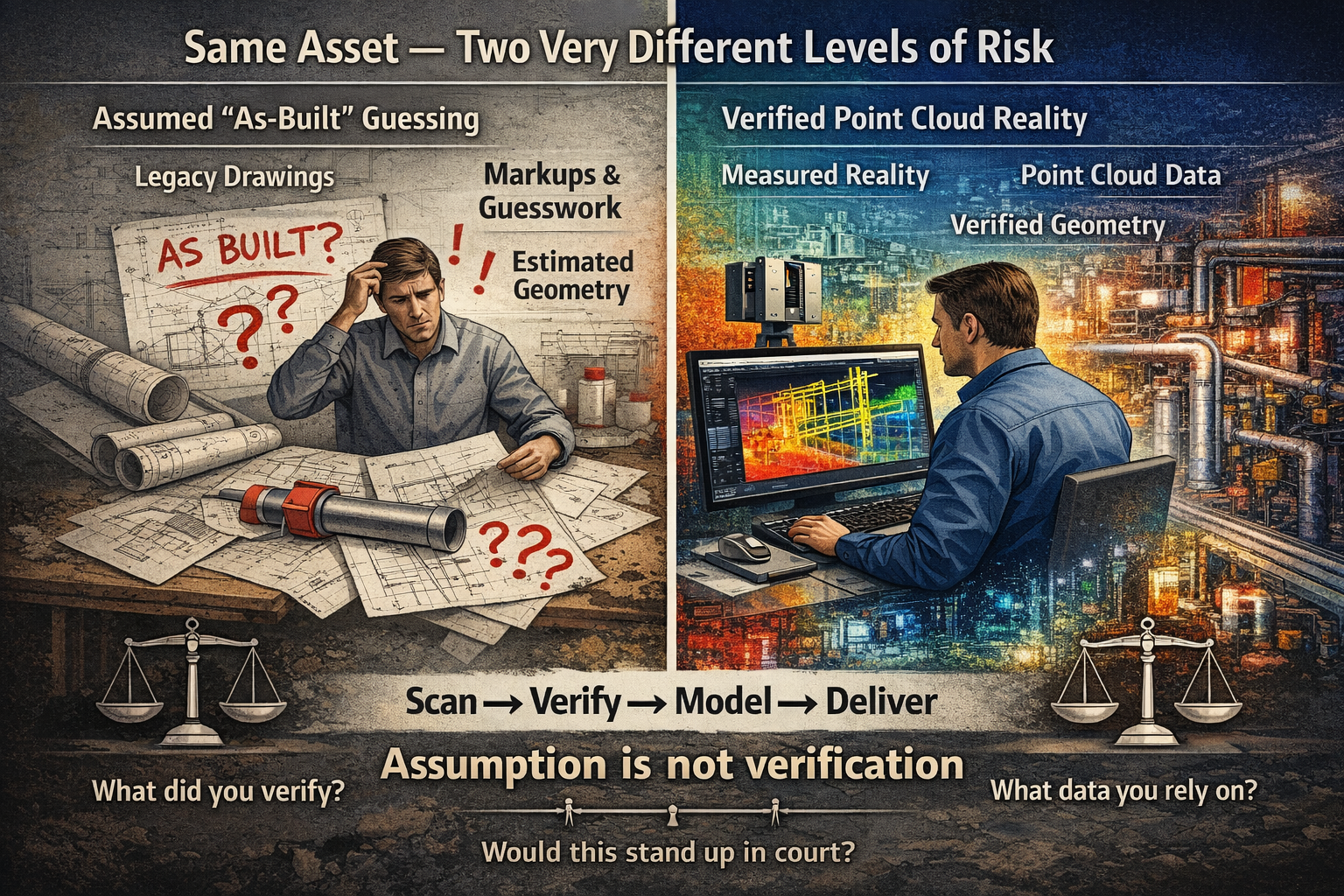
Assumption vs Measured Reality
At its core, this issue comes down to a simple comparison:
Does guessing what has been built offer the same level of coverage as measured data?
The answer is increasingly clear — it does not.
When geometry is assumed:
- Tolerances are unknown
- Deviations from design are hidden
- Errors compound as projects progress
- Rework risk increases
More importantly, from a legal standpoint:
There is no defensible evidence of what actually existed at the time decisions were made.
The Role of Point Cloud Scanning
This is where point cloud scanning and reality capture fundamentally change the workflow.
Rather than relying on interpretation, point cloud data provides a direct measurement of site conditions.
A properly captured scan:
- Records millions of measured points across the asset
- Captures geometry exactly as installed
- Provides a timestamped dataset of site conditions
- Can be referenced, rechecked, and validated at any time
Most importantly, it creates a feedback loop between site and design.
Instead of guessing what has been built, the design office receives:
- Accurate geometry
- Verified spatial relationships
- Real-world constraints
This allows models and drawings to be developed based on reality, not assumption.
Feeding Reality Back Into the Design Office
One of the most overlooked issues in engineering workflows is the disconnect between site and design.
Information typically flows in one direction:
- Design → Construction
But the return flow:
- Construction → Design
Is often inconsistent or incomplete.
Point cloud scanning closes this gap.
By scanning installed conditions and feeding that data back into the design environment, engineers can:
- Align models with actual site geometry
- Identify clashes before fabrication or installation
- Validate clearances and fitment
- Reduce the risk of downstream errors
This is not just about accuracy — it is about confidence.
Why This Matters More After the High Court Decision
The implications of Pafburn Pty Ltd v The Owners – Strata Plan No 84674 go beyond contractual structures.
They influence how engineering decisions are evaluated.
When something goes wrong, the question is no longer simply:
“Who was responsible for the design?”
It becomes:
- What information was relied upon?
- Was it reasonable to rely on that information?
- Could the actual conditions have been verified?
If the tools to verify existed — and were not used — that becomes part of the discussion.
From Design Intent to Verified Condition
The industry is moving through a transition.
Historically, projects were driven by:
- Design intent
- Nominal dimensions
- Idealised geometry
Today, the expectation is shifting toward:
- Verified condition
- Measured data
- Real-world constraints
This shift is particularly important in:
- Brownfield upgrades
- Industrial plants
- Mining infrastructure
- Retrofit and modification projects
Where existing conditions rarely match original design documentation.
Practical Implications for Engineers
For engineers and designers, this means a change in approach.
Relying solely on drawings — particularly for existing assets — introduces risk.
A more robust workflow includes:
- Verification of critical geometry
- Clear documentation of data sources
- Separation of assumed vs measured information
- Use of reality capture where accuracy matters
This is not about replacing engineering judgement.
It is about supporting that judgement with evidence.
Conclusion: Coverage, Confidence, and Accountability
At the centre of this discussion is a simple idea:
Not all information offers the same level of coverage.
“As-built” drawings based on interpretation provide one level of confidence.
Measured point cloud data provides another.
As legal expectations evolve, the difference between the two becomes more significant.
Guessing what has been built — even when done carefully — does not offer the same level of coverage as data that can be measured, verified, and defended.
How We Approach It
At Hamilton By Design, our workflow is built around this principle:
Scan → Verify → Model → Deliver
By capturing real-world conditions and feeding that data back into the design process, we reduce uncertainty and provide a clear basis for engineering decisions.
Not just for better outcomes — but for greater accountability.
If your next project relies on “as-built” drawings alone, it is worth asking:
Are they measured… or assumed?

Our clients
























