Mechanical Engineering Services Sydney | Engineer-Led Industrial Support
Engineer-Led Mechanical Engineering for Sydney’s Industrial & Fabrication Projects
Sydney’s industrial and fabrication projects rarely start with clean drawings or ideal conditions.
More often, they involve brownfield sites, missing or unreliable documentation, tight shutdown windows, and no margin for fit-up errors.
Hamilton By Design provides engineer-led mechanical engineering services in Sydney, focused on supporting industrial operators and fabricators where accuracy, accountability, and buildability matter.
This is mechanical engineering for projects where getting it wrong is expensive.

Who This Service Is For
Our Sydney mechanical engineering services are typically engaged by:
- Industrial and manufacturing operators upgrading or modifying existing plant
- Steel fabricators and mechanical contractors requiring tender-stage engineering support
- Project teams facing shutdown-critical works
- Clients dealing with missing, outdated, or untrustworthy drawings
- Fabricators who need engineering ownership, not just drafting
If your project involves existing assets, tight access, or zero tolerance for rework, this service is designed for you.
Common Problems We’re Brought In to Solve
Many Sydney clients come to us after experiencing issues such as:
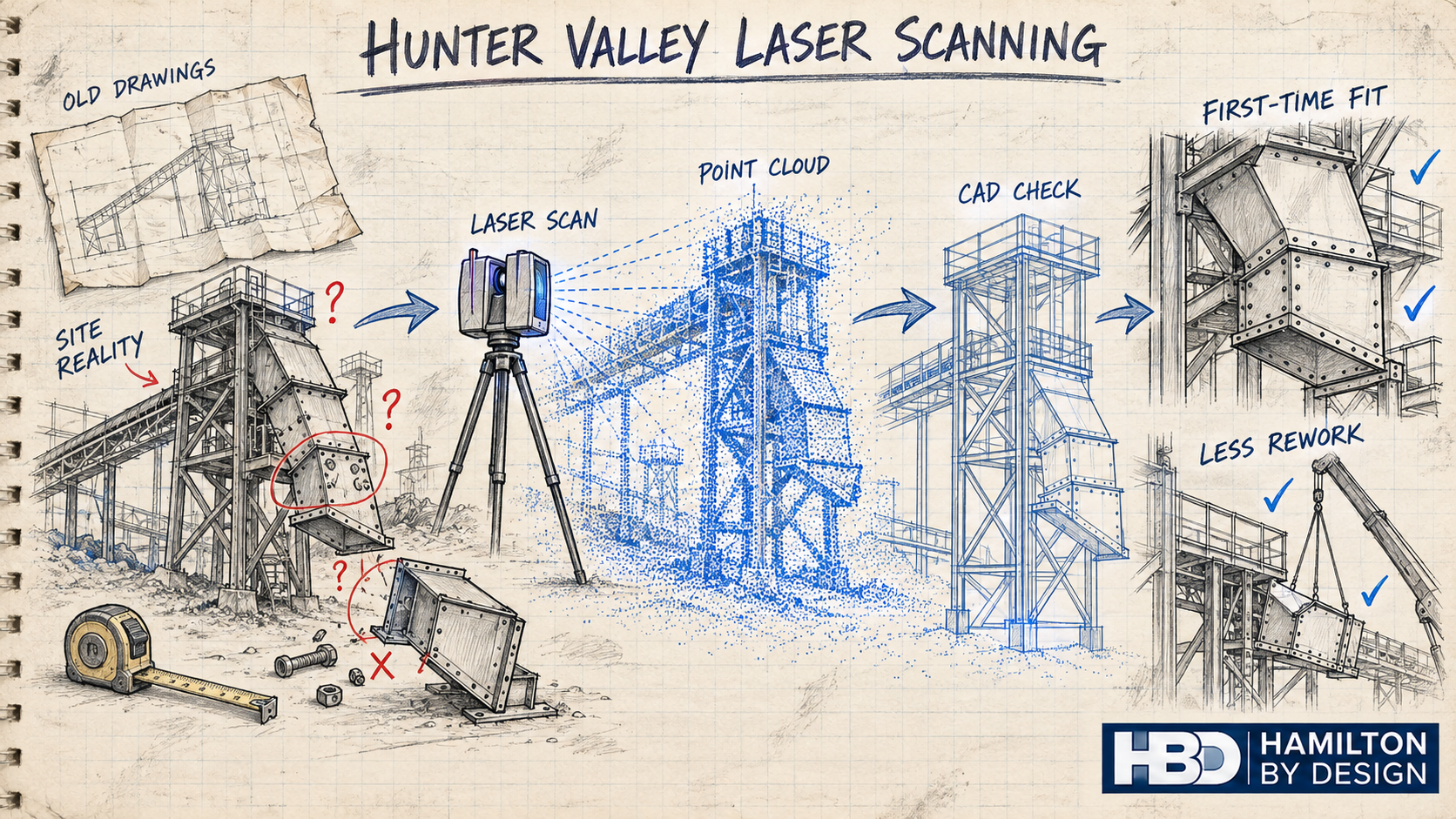
- Parts fabricated from drawings that didn’t match site reality
- Shutdown delays caused by fit-up problems
- Designers who don’t understand fabrication or installation constraints
- Engineering scopes that stopped at drawings, with no one owning the outcome
These issues aren’t theoretical. They’re the same systemic failures seen in real-world incidents such as the Kew Swimming Pool structural collapse and the sporting ground awning installation failure, both of which are discussed in detail on our website and highlight the consequences of poor engineering judgement and lack of accountability.

What “Engineer-Led” Actually Means
For our Sydney clients, engineer-led is not a marketing term — it defines how we work.
It means:
- A qualified mechanical engineer is directly involved from early assessment through to fabrication-ready documentation
- Engineering judgement is applied — not blind replication of scans or legacy drawings
- Designs are driven by fabrication and installation reality, not just theory
- We take responsibility for fit-up risk, not just data delivery
- Documentation is defensible, sign-off-ready, and aligned with applicable Australian Standards
This approach exists specifically to prevent the types of failures referenced above.
Mechanical Engineering Services We Provide in Sydney
Our services are tailored to industrial and fabrication-driven projects, including:
- Brownfield mechanical upgrades and modifications
- Tender-stage engineering support for fabricators and contractors
- Equipment replacement where original drawings are missing or unreliable
- Shutdown-critical mechanical works planning
- Fabrication-ready mechanical design and detailing
- Engineering verification and certification where required
Our strength lies in bridging the gap between site reality, engineering intent, and fabrication execution.
Why Fabricators Engage Us at Tender Stage
Many of our Sydney engagements start before a job is won.
Fabricators involve us during tendering to:
- Reduce pricing risk caused by unknown site conditions
- Identify fit-up and access issues early
- Avoid scope gaps that turn into cost overruns
- Present a stronger, lower-risk tender backed by engineering accountability
This approach consistently saves time, money, and reputation downstream.
Our clients:





















How We Differ from Large Consultancies
Compared to large, multi-layered consultancies, clients engage Hamilton By Design because we offer:
- Clear engineering ownership — no hand-offs, no dilution of responsibility
- Direct access to the engineer doing the work
- Practical, fabrication-aware solutions
- Focused scopes aligned to real construction risk
- Accountability through to fabrication and installation readiness
This is particularly valuable on Sydney projects where complexity and cost pressure are high.




Speak With a Mechanical Engineer Before You Fabricate
If you’re preparing a tender, planning a shutdown, or dealing with unclear site information, engaging engineering early can prevent costly downstream issues.
Request a tender-stage engineering review to discuss your Sydney project with a mechanical engineer who understands fabrication, installation, and real-world risk.
Use the contact form below to start the conversation.



Related Sydney Services
Hamilton By Design provides engineering-led 3D scanning, LiDAR scanning, mechanical engineering and digital engineering services throughout Sydney and Greater Sydney.
Explore our related Sydney services:
- 3D Scanning Sydney – Engineering-grade terrestrial laser scanning, as-built surveys and point cloud capture for industrial, infrastructure and commercial projects.
- Reality Capture Sydney – High-accuracy reality capture, digital twins, asset documentation and engineering-grade site verification.
- Scan to CAD Sydney – Convert point cloud data into AutoCAD, SolidWorks, Inventor and other engineering-ready CAD deliverables.
- Point Cloud Modelling Sydney – Engineering-grade point cloud processing, clash detection, as-built verification and 3D modelling.
- Mechanical Engineering Sydney – Mechanical design, plant upgrades, materials handling systems, conveyors, chutes, platforms and engineering support.
- Structural Drafting Sydney – Structural steel drafting, fabrication drawings, GA drawings, workshop detailing and as-built documentation.
Hamilton By Design supports projects throughout Sydney CBD, Parramatta, Liverpool, Penrith, Blacktown, Chatswood, Alexandria, Mascot, Newcastle and the Central Coast.
Mechanical Engineering | Structural Engineering