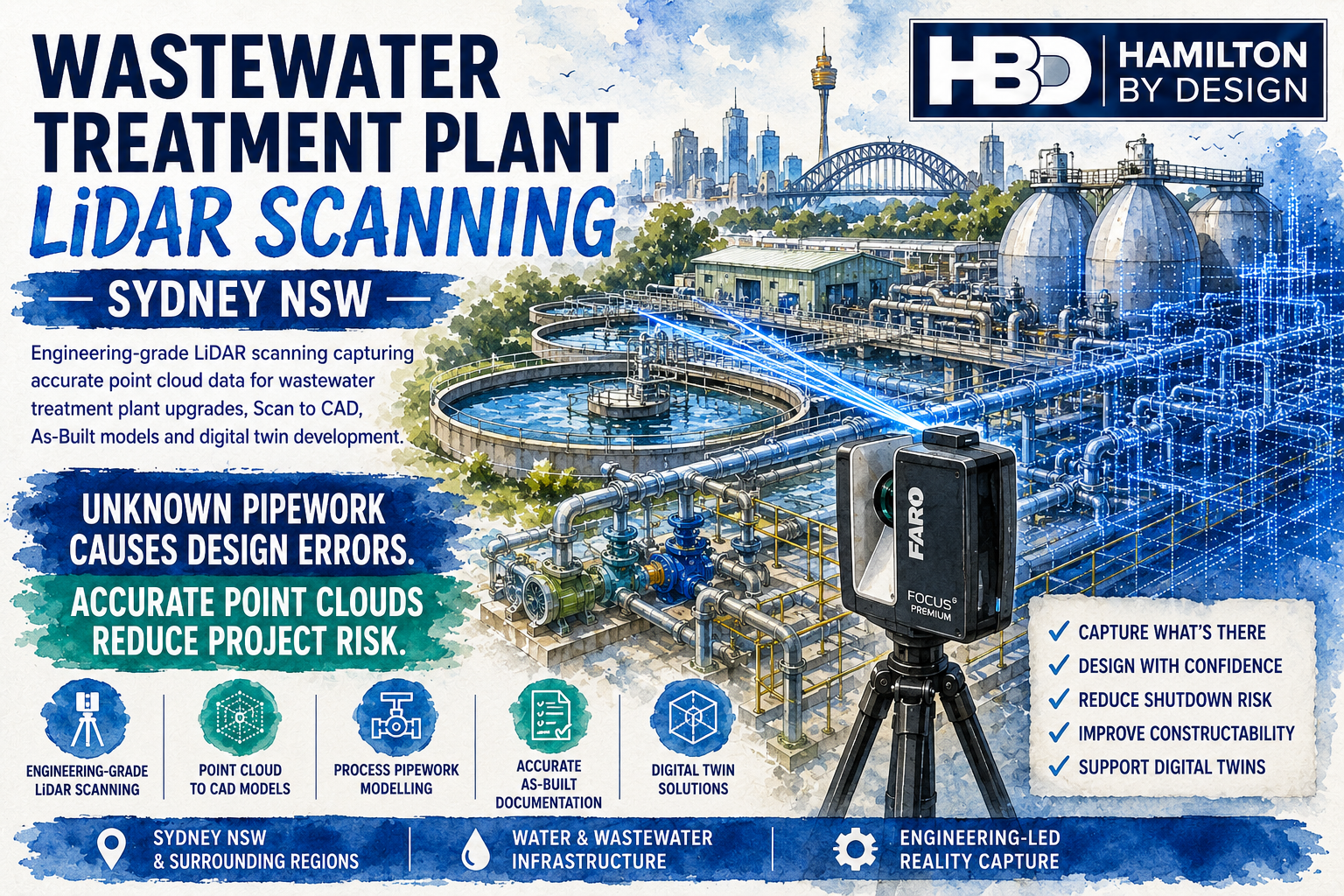
Wastewater Treatment Plant LiDAR Scanning in Sydney NSW โ€“ Engineering Accuracy for Complex Brownfield Upgrades

Engineering-grade LiDAR scanning at a Sydney wastewater treatment plant, capturing process pipework, tanks, pumps and equipment to create accurate point cloud data for As-Built models, Scan to CAD and digital twin development.

Wastewater treatment plants are among the most complex industrial facilities in Australia. They contain thousands of interconnected assets, including pumps, tanks, pipework, valves, digesters, blowers, electrical equipment, structural steel and process instrumentation. Many of Sydney’s wastewater treatment plants have evolved over decades, with continual upgrades, maintenance activities and emergency repairs altering the original plant layout.

Unfortunately, the engineering documentation often fails to keep pace with these changes.

One of the most common challenges facing engineers working on wastewater treatment plants is not knowing the exact location of existing pipework and equipment. Drawings may be outdated, undocumented modifications may have occurred during previous shutdowns, and temporary installations may have become permanent. When engineering teams rely on inaccurate information, the result is design errors, construction delays, costly rework and extended shutdowns.

Hamilton By Design provides engineering-grade Wastewater Treatment Plant LiDAR Scanning Services throughout Sydney NSW, delivering accurate point cloud data and reality capture that forms the foundation for reliable engineering design, Scan to CAD workflows, digital twins and future plant upgrades.


The Challenge of Existing Wastewater Infrastructure

Unlike greenfield projects where everything is designed from a clean slate, wastewater treatment plants present a true brownfield engineering environment.

Facilities are continually modified to improve capacity, meet environmental regulations and replace ageing assets. These modifications may include:

  • Replacement pumps
  • New process pipework
  • Chemical dosing systems
  • Additional valves
  • Electrical upgrades
  • Instrumentation changes
  • Structural steel modifications
  • Access platforms
  • Pipe bridges
  • Temporary bypass systems
  • Maintenance repairs

While these improvements keep the plant operating efficiently, they also create a significant challenge.

The original drawings rarely represent the current plant configuration.

Engineers designing future upgrades often discover that equipment is not where the drawings indicate, pipework has been rerouted and structural elements have changed considerably since construction.


Why Unknown Pipework Creates Expensive Problems

Pipework is the backbone of every wastewater treatment plant.

Unknown pipe locations can create serious engineering issues including:

  • Pipe clashes during installation
  • Incorrect spool fabrication
  • Valve interference
  • Equipment access restrictions
  • Foundation conflicts
  • Structural clashes
  • Maintenance clearance problems
  • Shutdown delays
  • Additional site welding
  • Emergency redesign

Even a small discrepancy in pipe alignment can require extensive fabrication changes during installation.

These problems become significantly more expensive once contractors are mobilised and the plant is offline.


Engineering LiDAR Scanning Removes Uncertainty

Hamilton By Design uses high-resolution terrestrial LiDAR scanners to accurately capture the entire wastewater treatment facility.

Rather than collecting isolated survey points, LiDAR scanning records millions of highly accurate measurements across every visible surface.

This includes:

  • Process pipework
  • Pumps
  • Blowers
  • Clarifiers
  • Digesters
  • Tanks
  • Screens
  • Conveyors
  • Valves
  • Structural steel
  • Pipe supports
  • Access platforms
  • Handrails
  • Stairways
  • Electrical switchrooms
  • Cable trays
  • Instrumentation
  • Concrete structures

The result is a highly detailed point cloud representing the facility exactly as it exists today.


Engineering Applications

Plant Upgrades

As treatment capacity increases, plants require continual expansion.

LiDAR scanning provides engineers with accurate existing-condition data before detailed design begins.


Pump Replacements

Pump replacement projects benefit from accurate verification of:

  • Baseplate locations
  • Pipe flange alignment
  • Maintenance clearances
  • Motor access
  • Lifting paths

Replacement equipment can be designed around actual site conditions rather than outdated drawings.


Pipework Modifications

New process improvements frequently require:

  • Additional pipelines
  • Larger pipe diameters
  • Bypass systems
  • New isolation valves
  • Flow measurement equipment
  • Chemical dosing lines

Point cloud data ensures new pipework integrates correctly with existing infrastructure.


Structural Modifications

Engineering upgrades often require:

  • New maintenance platforms
  • Pipe supports
  • Equipment frames
  • Walkways
  • Ladders
  • Access stairs

LiDAR scanning accurately captures existing structural steel for seamless integration.


Electrical and Instrumentation

Reality capture also supports:

  • Cable tray routing
  • MCC upgrades
  • Instrument relocation
  • Electrical design
  • Control system upgrades

Designers can verify available space before construction begins.


Accurate Point Cloud Data for Engineering Design

The value of LiDAR scanning extends well beyond visualisation.

Accurate point cloud data enables engineers to:

  • Measure existing equipment
  • Verify pipe routing
  • Confirm elevations
  • Check structural geometry
  • Review maintenance access
  • Identify clashes
  • Plan installations
  • Validate design assumptions

Because measurements can be taken directly from the point cloud, engineers spend less time returning to site and more time designing solutions.


Scan to CAD Services

Hamilton By Design transforms point cloud data into engineering-ready deliverables.

Typical outputs include:

  • Intelligent 3D CAD models
  • General Arrangement drawings
  • Equipment layouts
  • Pipework models
  • Structural steel models
  • Plant sections
  • Elevations
  • Fabrication drawings
  • Asset registers
  • As-built documentation

These deliverables integrate with modern engineering software including SOLIDWORKS, Autodesk Inventor, AutoCAD, Navisworks and ReCap.


Supporting Digital Twin Development

Water utilities across Australia are increasingly adopting digital twin technology.

LiDAR scanning provides the accurate geometric foundation for these digital assets.

Digital twins support:

  • Asset management
  • Maintenance planning
  • Capital works
  • Lifecycle management
  • Operator training
  • Shutdown planning
  • Future engineering design
  • Regulatory compliance

Instead of relying on historical drawings, digital twins represent the facility exactly as it exists.


Reducing Shutdown Risk

Wastewater treatment plants typically operate continuously, making shutdown windows extremely valuable.

Every hour of delay increases project costs.

Engineering-grade LiDAR scanning reduces shutdown risk by allowing designers to:

  • Verify equipment locations
  • Perform clash detection
  • Optimise installation sequences
  • Confirm maintenance access
  • Validate fabrication before delivery

Many construction issues can therefore be resolved during design rather than during installation.


Supporting Brownfield Engineering Projects

Brownfield engineering demands accurate information.

Hamilton By Design supports projects including:

  • Plant expansions
  • Process upgrades
  • Mechanical replacements
  • Structural modifications
  • Pipework redesign
  • Electrical upgrades
  • Asset verification
  • Condition assessments

Accurate reality capture significantly improves engineering confidence throughout the project lifecycle.


Typical Workflow

Our wastewater treatment plant scanning workflow includes:

1. Project Planning

Review project objectives, operational constraints and shutdown requirements.

2. Site LiDAR Scanning

Capture all required plant areas using engineering-grade terrestrial laser scanning.

3. Point Cloud Registration

Register individual scans into one accurate coordinate system.

4. Quality Assurance

Verify scan accuracy, completeness and registration quality.

5. Engineering Modelling

Develop CAD models, layouts and engineering documentation from the point cloud.

6. Design Integration

Use verified existing conditions for mechanical, structural and process design.

7. Construction Verification

Review proposed modifications against existing infrastructure before fabrication.


Why Choose Hamilton By Design?

Hamilton By Design combines engineering expertise with advanced reality capture technology.

Our capabilities include:

  • Engineering-grade terrestrial LiDAR scanning
  • Wastewater infrastructure surveying
  • Scan to CAD
  • Reverse engineering
  • Mechanical engineering
  • Structural engineering support
  • Engineering drafting
  • As-built documentation
  • Digital twin development
  • Brownfield engineering
  • Shutdown planning support

Because our team understands industrial engineering, we capture the information designers actually requireโ€”not simply visual data.


Supporting Sydney’s Wastewater Infrastructure

Sydney’s wastewater treatment plants are critical to protecting public health, supporting population growth and maintaining environmental compliance. As these facilities continue to modernise, reliable engineering information becomes essential for successful upgrades.

Unknown pipework and undocumented equipment locations should never compromise engineering design.

Engineering-grade LiDAR scanning provides accurate point cloud data that replaces uncertainty with confidence. By capturing every visible asset in its true position, Hamilton By Design helps engineers reduce design errors, improve constructability and minimise costly site modifications.

Whether your project involves replacing pumps, upgrading treatment processes, modifying pipework or developing a digital twin, our engineering-led LiDAR scanning services deliver the accurate existing-condition data required for successful project outcomes.

If you’re planning a wastewater treatment plant upgrade in Sydney NSW, Hamilton By Design can provide the engineering-grade reality capture, Scan to CAD modelling and As-Built documentation needed to ensure your design is based on the facility as it exists todayโ€”not as it was drawn years ago.

Talk to Us – Contact Us

Name
Would you like us to arrange a phone consultation for you?
Address

Our clients:


Talk to Us – Contact Us

Name
Would you like us to arrange a phone consultation for you?
Address

Our clients:


3D LiDAR Scanning Darwin for engineering surveys, laser scanning, reality capture and point cloud modelling services
3D LiDAR Scanning Australia engineering services for laser scanning, reality capture, scan-to-CAD, Scan-to-BIM and as-built documentation across Australia
3D LiDAR scanning services on the Central Coast providing engineering-grade laser scanning, point cloud capture, scan-to-CAD modelling and industrial reality capture for infrastructure and industrial projects.

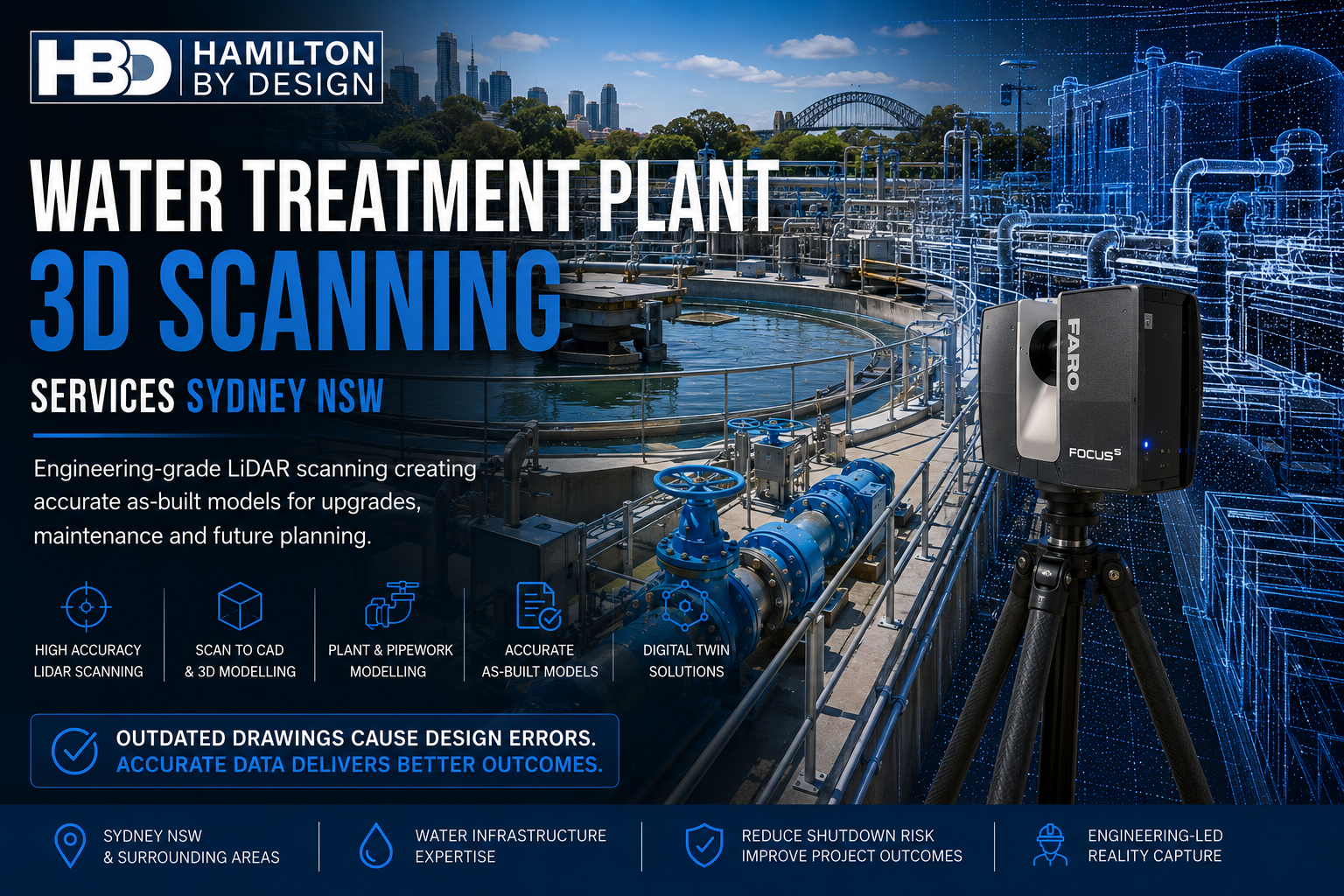
Water Treatment Plant 3D Scanning Services in Sydney NSW โ€“ Accurate As-Built Data for Smarter Engineering

Engineering-grade LiDAR scanning at a Sydney water treatment plant, capturing tanks, pipework and process infrastructure to create accurate As-Built models for plant upgrades, Scan to CAD and digital twin development.

Water treatment plants are among Australia’s most critical infrastructure assets. They operate continuously to deliver safe, reliable drinking water to millions of people while meeting stringent regulatory and environmental requirements. As Sydney continues to invest in expanding and modernising its water infrastructure, engineering teams are increasingly faced with a common challenge:

The existing as-built drawings no longer reflect what is actually installed on site.

Over decades of operation, treatment plants undergo numerous modifications. Pumps are replaced, pipework is rerouted, valves are upgraded, electrical equipment is relocated, and structural steel is modified to suit operational requirements. Unfortunately, these changes are not always captured in the engineering documentation.

When engineers begin designing upgrades using outdated drawings, errors quickly emerge. Pipework clashes with existing infrastructure, replacement equipment fails to fit, structural supports require redesign, and shutdown schedules are extended while unexpected site modifications are completed.

Hamilton By Design provides engineering-grade Water Treatment Plant 3D Scanning Services throughout Sydney NSW, using terrestrial LiDAR scanning to create highly accurate digital representations of existing facilities. By replacing outdated drawings with reliable reality capture, engineering teams can design with confidence, reduce project risk and improve construction outcomes.


The Problem with Outdated As-Built Drawings

Many of Sydney’s water treatment facilities have been operating for several decades. During this time, numerous maintenance activities and capital upgrades have altered the original plant configuration.

Typical undocumented changes include:

  • Replacement pumps with different footprints
  • Pipework rerouted around new equipment
  • Additional valves and instrumentation
  • Modified pipe supports
  • Structural strengthening
  • New cable trays
  • Electrical switchboard upgrades
  • Temporary modifications that became permanent
  • Altered maintenance platforms
  • Relocated access ladders

Although each modification may have been appropriate at the time, the cumulative effect is that original drawings often no longer represent actual site conditions.

Engineering projects based on these outdated documents carry significant risk.


Why Accurate Existing Conditions Matter

Every brownfield engineering project begins with one critical question:

What is actually installed today?

Without accurate existing information, designers are forced to rely on assumptions or undertake extensive manual site measurements.

Both approaches introduce unnecessary risk.

Common design issues include:

  • Pipework that does not align during installation
  • Pump discharge flanges requiring on-site modification
  • Structural steel interfering with new equipment
  • Insufficient maintenance access
  • Cable trays clashing with pipe supports
  • Valve actuators becoming inaccessible
  • Equipment foundations requiring redesign
  • Lifting clearances being overlooked

These problems typically become apparent during construction, when the cost of correcting them is significantly higher.


Engineering LiDAR Scanning Removes Uncertainty

Hamilton By Design uses professional terrestrial LiDAR scanners to capture millions of highly accurate measurement points throughout a water treatment facility.

Rather than recording selected dimensions using conventional survey methods, laser scanning captures the complete geometry of the plant.

Typical assets captured include:

  • Process pipework
  • Pumps
  • Motors
  • Valves
  • Tanks
  • Clarifiers
  • Filters
  • Chemical dosing systems
  • Structural steel
  • Pipe bridges
  • Walkways
  • Stairways
  • Handrails
  • Electrical switchrooms
  • MCC rooms
  • Cable trays
  • Instrumentation
  • Concrete structures

The result is a comprehensive point cloud representing the true existing condition of the facility.

Engineers can measure any feature directly from the scan throughout the design process without repeatedly returning to site.


Supporting Water Treatment Plant Upgrades

Sydney’s treatment plants require continual investment to maintain reliability, increase capacity and improve operational efficiency.

LiDAR scanning supports projects such as:

Pump Replacements

Replacement pumps frequently differ from the original equipment.

Accurate scanning ensures:

  • baseplates align correctly
  • suction and discharge pipework matches
  • maintenance clearances are maintained
  • lifting access is preserved

Pipework Modifications

Process improvements often require:

  • larger diameter pipework
  • bypass systems
  • additional isolation valves
  • flow meters
  • chemical dosing lines

Accurate point clouds allow new spool pieces to be designed around existing infrastructure before fabrication begins.


Structural Modifications

New equipment installations commonly require:

  • equipment platforms
  • maintenance walkways
  • lifting beams
  • pipe supports
  • access ladders
  • handrails

Scanning captures every structural member to ensure new steel integrates correctly.


Electrical and Instrumentation Upgrades

Electrical upgrades benefit significantly from reality capture.

Designers can accurately model:

  • cable trays
  • conduits
  • MCC rooms
  • switchboards
  • instrument locations
  • communication systems

This improves installation planning while reducing field modifications.


Creating Accurate As-Built Models

One of the greatest advantages of engineering-grade LiDAR scanning is the ability to create reliable as-built models.

These models provide:

  • current equipment locations
  • verified pipe routing
  • structural layouts
  • equipment dimensions
  • maintenance clearances
  • plant configuration

Unlike historic drawings, as-built models reflect the facility exactly as it exists today.

They become the foundation for future engineering projects.


Scan to CAD for Engineering Design

Point clouds are extremely valuable, but engineering projects often require intelligent CAD models.

Hamilton By Design converts point cloud data into engineering deliverables including:

  • 3D CAD models
  • General Arrangement drawings
  • Equipment layouts
  • Pipe routing models
  • Structural steel models
  • Plant sections
  • Elevations
  • Fabrication drawings
  • As-built documentation

These models integrate directly into engineering workflows using software such as Autodesk, SOLIDWORKS and Navisworks.


Supporting Digital Twin Development

Many water authorities are now investing in digital twins to improve long-term asset management.

LiDAR scanning forms the foundation of these digital assets.

A digital twin can support:

  • maintenance planning
  • shutdown coordination
  • asset lifecycle management
  • operator training
  • future upgrades
  • capital works planning
  • condition assessments
  • engineering analysis

Rather than relying on outdated information, the digital twin represents actual plant conditions.


Reducing Shutdown Risk

Water treatment plants often operate continuously, making shutdown planning critical.

Unexpected design errors during shutdowns can result in:

  • extended outages
  • contractor delays
  • increased labour costs
  • emergency fabrication
  • delayed commissioning

Accurate 3D scanning identifies potential issues before work begins.

Engineers can perform visual clash detection, verify clearances and optimise installation sequences during the design stage.

This significantly reduces project risk.


Brownfield Engineering Expertise

Unlike greenfield facilities, brownfield projects require engineers to work around existing assets.

Hamilton By Design specialises in engineering support for brownfield infrastructure, including:

  • water treatment plants
  • wastewater treatment plants
  • pumping stations
  • reservoirs
  • chemical dosing facilities
  • filtration plants
  • process buildings

Engineering-grade reality capture provides confidence that new infrastructure will integrate successfully with existing operations.


Typical Project Workflow

Our engineering workflow has been developed specifically for operational infrastructure.

1. Project Planning

Review plant access requirements, shutdown windows and engineering objectives.

2. Site LiDAR Scanning

Capture complete facility geometry using terrestrial laser scanning.

3. Scan Registration

Combine individual scans into one accurate point cloud.

4. Quality Assurance

Verify registration accuracy and confirm complete site coverage.

5. Engineering Modelling

Develop CAD models, equipment layouts and engineering documentation.

6. Design Integration

Use accurate as-built information to complete mechanical, structural and process designs.

7. Construction Verification

Verify proposed upgrades against existing infrastructure before fabrication.


Why Choose Hamilton By Design?

Hamilton By Design provides more than laser scanning.

We combine engineering expertise with advanced reality capture technologies to deliver practical engineering solutions.

Our capabilities include:

  • Engineering-grade terrestrial LiDAR scanning
  • Mechanical engineering design
  • Scan to CAD services
  • Reverse engineering
  • Pipework modelling
  • Structural steel modelling
  • Engineering drafting
  • Digital twin development
  • As-built verification
  • Brownfield engineering support
  • Shutdown engineering planning

Because our engineers understand industrial facilities, we capture the information that designers actually needโ€”not just visually impressive point clouds.


Supporting Sydney’s Water Infrastructure

Sydney’s water treatment plants play a vital role in supplying safe drinking water to millions of residents and businesses. As these facilities continue to expand, modernise and replace ageing assets, engineering accuracy becomes increasingly important.

Outdated as-built drawings should never be the reason a project experiences delays, redesigns or costly construction changes.

Engineering-grade LiDAR scanning provides reliable existing-condition data that supports smarter engineering decisions, reduces construction risk and improves project outcomes.

Whether your project involves replacing pumps, modifying pipework, upgrading process equipment or creating a digital twin, Hamilton By Design delivers accurate 3D scanning, engineering modelling and Scan to CAD services throughout Sydney NSW.

By capturing the plant exactly as it exists today, we help ensure tomorrow’s upgrades fit correctly the first time.

Talk to Us – Contact Us

Name
Would you like us to arrange a phone consultation for you?
Address

Our clients:


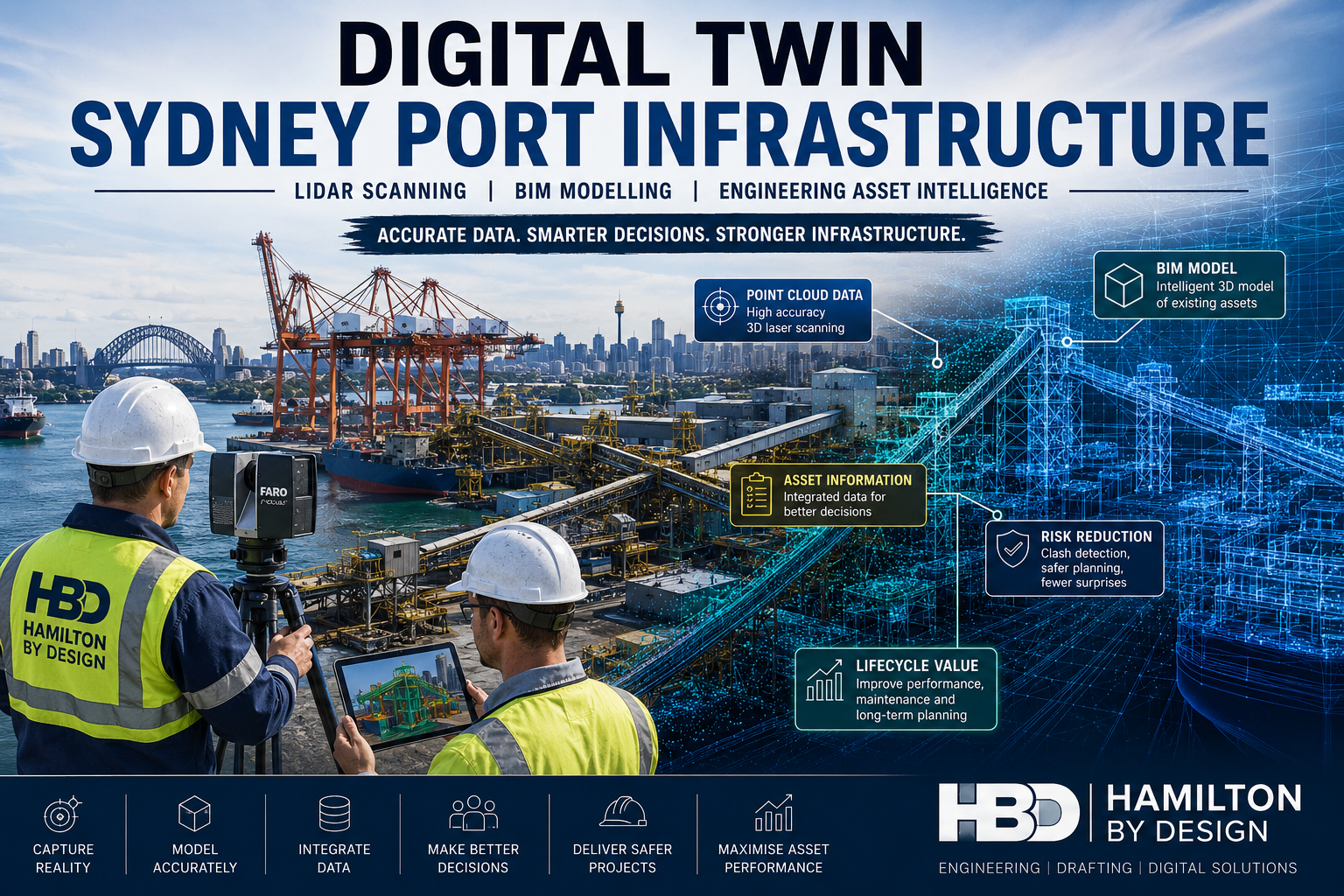
Digital Twin Sydney Port Infrastructure

Digital twin of Sydney port infrastructure showing LiDAR scanning, BIM modelling and engineering asset intelligence used to create accurate digital representations of port facilities for maintenance, upgrades and asset management.

Develop Digital Twins of Sydney Port Infrastructure Using LiDAR Scanning, BIM and Engineering Modelling Workflows

Blue mechanical engineering icon with gear and wrench

Sydney’s ports are among Australia’s most important infrastructure assets, supporting container handling, bulk materials, fuel imports, logistics operations and international trade. As port facilities continue to expand and age, asset owners face increasing challenges managing infrastructure that has often been modified over decades without complete documentation.

Hamilton By Design provides Digital Twin Sydney Port Infrastructure services, combining engineering-grade LiDAR scanning, reality capture, BIM modelling and engineering workflows to create accurate digital representations of existing port assets. These digital twins provide a reliable foundation for maintenance planning, shutdowns, upgrades, asset management and future capital works.

Whether the project involves a container terminal, bulk handling facility, conveyor network, berth structure, ship loader, fuel terminal or rail interface, our team develops accurate digital twins that allow stakeholders to make engineering decisions based on real-world conditions rather than outdated drawings.


What is a Digital Twin?

A digital twin is a detailed digital representation of a physical asset or facility. Unlike traditional CAD drawings, a digital twin combines accurate geometry, engineering information and asset data into a single environment that can be used throughout the asset lifecycle.

For Sydney port operators, a digital twin can include:

  • Existing structural steelwork
  • Conveyors and materials handling systems
  • Ship loaders and unloaders
  • Wharf and berth infrastructure
  • Mechanical equipment
  • Pipework and services
  • Electrical installations
  • Buildings and facilities
  • Road and rail interfaces
  • Underground and above-ground assets

Digital twins allow engineering, maintenance and operations teams to access accurate infrastructure information without needing to physically inspect every asset.


Why Sydney Ports Need Digital Twins

Many port facilities have undergone numerous upgrades, repairs and expansions over several decades. In many cases, original drawings are missing, inaccurate or no longer reflect the actual site conditions.

Common challenges include:

  • Incomplete or outdated as-built documentation
  • Unknown modifications performed during shutdowns
  • Limited visibility of asset condition
  • Difficulty planning future upgrades
  • High costs associated with site rework
  • Engineering clashes during construction
  • Safety risks from inaccurate information
  • Loss of knowledge when personnel retire or move on

Developing a digital twin provides a single source of truth that accurately reflects the current state of the facility.


Engineering-Grade LiDAR Scanning for Port Infrastructure

The foundation of every digital twin is accurate reality capture.

Hamilton By Design uses engineering-grade terrestrial LiDAR scanning technology to capture highly detailed three-dimensional data from existing port infrastructure.

Typical assets scanned include:

  • Container terminals
  • Conveyor systems
  • Transfer towers
  • Bulk handling facilities
  • Storage sheds
  • Fuel infrastructure
  • Structural steelwork
  • Ship loading equipment
  • Wharf structures
  • Marine infrastructure

Using advanced scanning equipment, millions of measurements are collected every second to generate a highly accurate point cloud of the facility.

This point cloud forms the basis of the digital twin development process.


Scan-to-BIM Workflows for Sydney Ports

Once the scanning process is complete, the captured data is processed and registered to create a coordinated digital representation of the facility.

The registered point cloud can then be converted into BIM models using industry-standard software platforms.

Depending on project requirements, digital twin models may include:

  • Structural steel modelling
  • Mechanical equipment modelling
  • Pipework systems
  • Architectural components
  • Electrical infrastructure
  • Access systems and walkways
  • Conveyor systems
  • Material handling equipment

These BIM models provide accurate geometry and can be linked to asset information, maintenance records and operational data.


Supporting Brownfield Port Upgrades

One of the most valuable applications of digital twin technology is supporting brownfield infrastructure upgrades.

Port facilities rarely provide the luxury of starting with an empty site. Most projects must be designed around existing equipment and infrastructure while maintaining operational requirements.

Digital twins help project teams:

  • Identify potential clashes before construction
  • Verify available space
  • Confirm existing dimensions
  • Plan shutdown activities
  • Reduce installation risk
  • Improve fabrication accuracy
  • Minimise site modifications

By working from a verified digital environment, engineers can significantly reduce uncertainty and improve project outcomes.


Improving Shutdown Planning and Execution

Shutdowns represent some of the highest-risk activities undertaken within port environments.

A single delay can impact vessel schedules, cargo handling operations and contractor productivity.

Digital twins support shutdown planning by allowing project teams to:

  • Virtually inspect assets before mobilisation
  • Develop detailed work packages
  • Verify access requirements
  • Confirm lifting clearances
  • Identify construction constraints
  • Plan temporary works
  • Validate installation sequences

This proactive approach helps reduce downtime and improves shutdown efficiency.


Asset Management and Lifecycle Planning

Digital twins also provide substantial long-term value for asset owners.

Instead of relying on scattered drawings and historical records, maintenance teams gain access to an accurate digital representation of their infrastructure.

Benefits include:

  • Improved asset registers
  • Faster maintenance planning
  • Better condition assessments
  • Improved inspection programs
  • Enhanced capital planning
  • Reduced engineering investigation time
  • Improved operational awareness

As infrastructure ages, access to accurate digital information becomes increasingly important for managing risk and maintaining operational reliability.


Typical Digital Twin Development Process

Hamilton By Design follows a structured workflow to ensure high-quality outcomes.

1. Site Assessment

The project begins with a review of existing documentation, operational requirements and access constraints.

2. LiDAR Scanning

Engineering-grade terrestrial laser scanning captures existing infrastructure conditions.

3. Point Cloud Registration

Individual scans are processed and combined into a unified digital dataset.

4. Quality Assurance

Registration accuracy and data coverage are verified to ensure engineering suitability.

5. BIM and Engineering Modelling

The point cloud is converted into intelligent engineering models and BIM environments.

6. Asset Classification

Assets are organised and structured according to project requirements.

7. Digital Twin Development

Engineering information and asset data are integrated into the model environment.

8. Final Delivery

The completed digital twin is delivered in client-specified formats.


Deliverables

Depending on project requirements, Hamilton By Design can provide:

  • Registered E57 point clouds
  • RCP and RCS files
  • Autodesk Revit models
  • Navisworks models
  • AutoCAD drawings
  • General arrangement drawings
  • Structural models
  • Mechanical equipment models
  • Asset registers
  • BIM deliverables
  • Digital twin datasets
  • Engineering reports

Deliverables are tailored to support ongoing operations, maintenance and future engineering projects.


Hamilton By Design logo displayed on a blue tilted rectangle with a grey gradient background

Why Choose Hamilton By Design?

Hamilton By Design combines practical engineering experience with advanced reality capture technology.

Our team understands the challenges associated with operating and upgrading complex industrial facilities, particularly within port and maritime environments.

Our capabilities include:

  • Engineering-led LiDAR scanning
  • Scan-to-BIM services
  • Mechanical engineering
  • Structural engineering support
  • Engineering drafting
  • Brownfield project experience
  • Shutdown planning support
  • Asset capture and verification

We focus on delivering digital twin solutions that provide practical value and support informed decision-making throughout the asset lifecycle.


Digital Twin Services for Sydney Port Infrastructure

If you are planning an upgrade, shutdown, expansion project or asset management initiative, an accurate digital twin can significantly reduce risk and improve project outcomes.

Hamilton By Design provides Digital Twin Sydney Port Infrastructure services throughout Sydney and surrounding regions, helping port operators, engineering teams and asset owners develop accurate digital representations of critical infrastructure.

By combining LiDAR scanning, BIM modelling and engineering expertise, we create digital twins that provide the confidence needed to plan, maintain and upgrade port assets effectively.

Talk to Us – Contact Us

Name
Would you like us to arrange a phone consultation for you?
Address

Our clients:


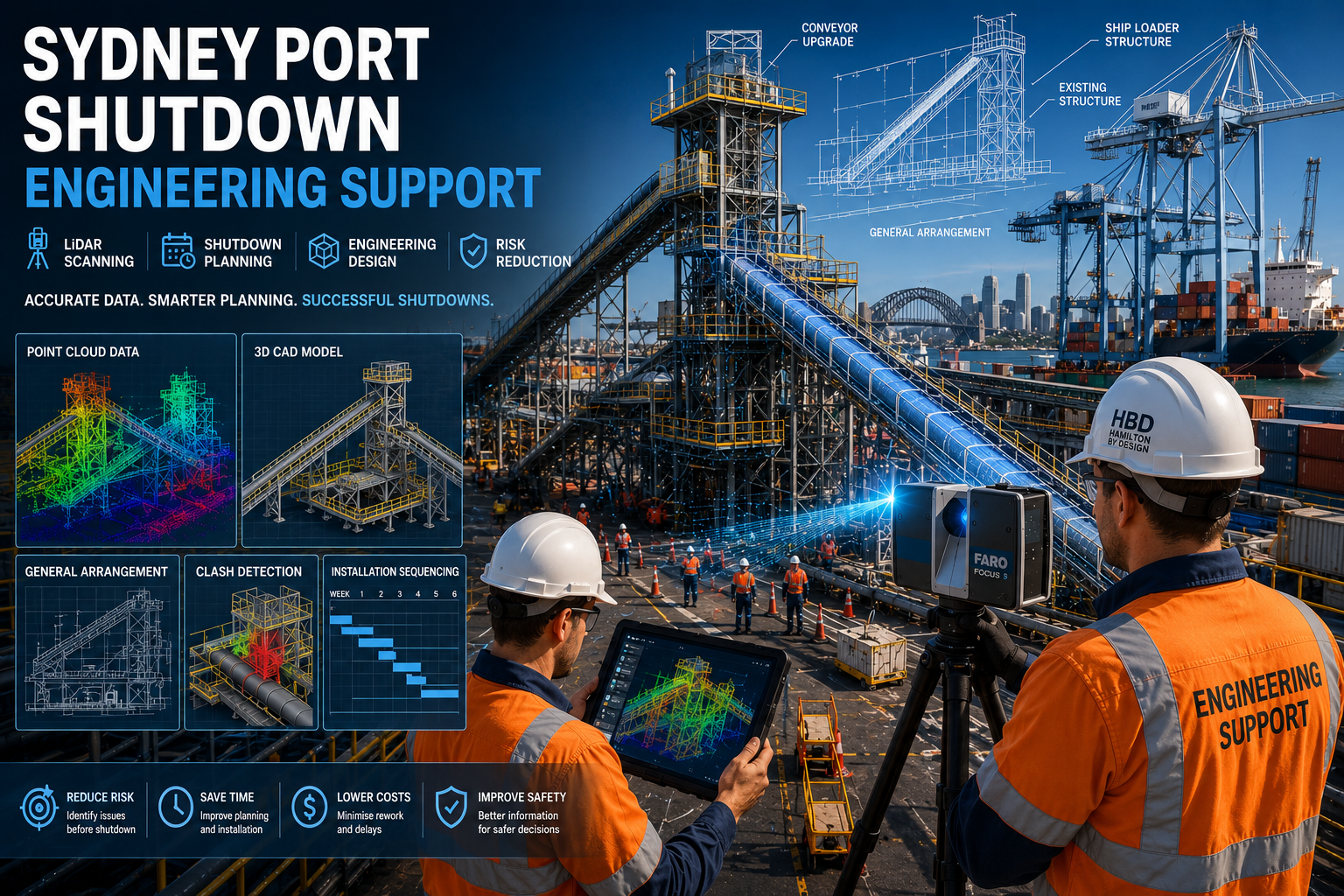
Sydney Port Shutdown Engineering Support

Sydney Port Shutdown Engineering Support engineers performing LiDAR scanning and digital shutdown planning at a Sydney port facility with conveyors, cranes, point cloud models, CAD drawings and engineering design overlays.

Reduce shutdown risk with engineering support, LiDAR scanning and detailed planning for Sydney port facilities.

Blue Gear and Spanner icon

Port shutdowns are some of the most complex engineering activities undertaken within maritime and logistics infrastructure. Whether the project involves conveyor replacements, ship loader upgrades, structural modifications, equipment installations, or brownfield expansion works, a successful shutdown depends on accurate information, detailed planning, and effective engineering support. Hamilton By Design provides Sydney Port Shutdown Engineering Support services, combining engineering-grade LiDAR scanning, Scan-to-CAD modelling, mechanical engineering, structural drafting, and detailed project documentation to help port operators complete shutdowns safely, efficiently, and with minimal disruption to operations.

Our engineering team works across Sydney’s ports, terminals, logistics facilities, and industrial infrastructure, providing the accurate site information and engineering deliverables required to reduce risk, minimise downtime, and improve shutdown outcomes.


Engineering Support for Sydney Port Shutdowns

Shutdowns are typically scheduled maintenance or upgrade periods where operational assets are taken offline to allow inspection, replacement, modification, or installation works. Every hour of shutdown time carries significant operational costs, making planning and execution critical.

Hamilton By Design supports shutdown projects by providing:

  • Engineering-grade 3D LiDAR scanning
  • Existing asset verification
  • Scan-to-CAD modelling
  • Mechanical engineering support
  • Structural engineering support
  • General arrangement drawings
  • Installation planning drawings
  • Fabrication documentation
  • Brownfield engineering services
  • As-built verification
  • Asset capture and documentation
  • Site measurement services

Our objective is to ensure contractors, engineers, maintenance teams, and project managers have accurate information before work begins.


Why Accurate Site Information Matters

Many shutdown projects rely on outdated drawings, incomplete records, or undocumented modifications that have occurred over years of operation.

Common challenges include:

  • Missing as-built drawings
  • Unknown equipment locations
  • Structural modifications not shown on drawings
  • Pipework clashes
  • Conveyor alignment issues
  • Limited access areas
  • Inaccurate dimensions
  • Restricted shutdown windows

Engineering decisions based on inaccurate information can lead to installation delays, rework, safety risks, and costly schedule overruns.

LiDAR scanning eliminates these uncertainties by capturing millions of accurate measurements of the existing facility.


LiDAR Scanning for Sydney Port Shutdown Planning

Hamilton By Design uses engineering-grade terrestrial laser scanning systems to capture highly detailed digital representations of port facilities.

Typical assets scanned include:

  • Ship loaders
  • Conveyors
  • Transfer towers
  • Wharf structures
  • Berths
  • Bulk handling equipment
  • Pipework systems
  • Structural steel
  • Access platforms
  • Stairs and walkways
  • Mechanical equipment
  • Storage facilities

Using FARO Focus laser scanners and mobile reality capture technology, we generate accurate point cloud datasets that provide a complete digital record of existing infrastructure.

This allows engineering teams to work with real-world conditions rather than relying solely on legacy drawings.


Scan-to-CAD and Digital Engineering Workflows

Once site scanning is complete, the captured data is processed into engineering-ready point clouds.

Deliverables can include:

  • E57 files
  • RCP files
  • RCS files
  • LAS files

The point cloud data can then be converted into:

  • AutoCAD models
  • SolidWorks assemblies
  • Inventor models
  • Navisworks coordination models
  • 2D engineering drawings
  • Structural layouts
  • Mechanical layouts

These models become the foundation for shutdown planning and engineering design.

By working within an accurate digital environment, project teams can identify issues before arriving onsite.


Brownfield Engineering for Existing Port Facilities

Most shutdown projects occur within existing operational facilities where space constraints and existing infrastructure present unique challenges.

Brownfield environments often contain:

  • Legacy equipment
  • Historical modifications
  • Congested plant layouts
  • Restricted access
  • Active operational interfaces

Hamilton By Design specialises in engineering solutions for these environments.

By integrating laser scanning with mechanical and structural engineering workflows, we can accurately assess existing conditions and develop practical upgrade solutions that suit the facility.

This approach reduces design assumptions and significantly improves constructability.


Shutdown Planning and Risk Reduction

A well-planned shutdown can save thousands of dollars in labour, equipment hire, and lost production.

Our engineering support services assist with:

Constructability Reviews

Assessing whether new equipment can be installed safely and efficiently within existing conditions.

Clash Detection

Identifying potential conflicts between:

  • Structural steel
  • Pipework
  • Conveyors
  • Mechanical equipment
  • Electrical services

before installation begins.

Installation Sequencing

Developing practical installation methodologies and staging plans.

Site Verification

Confirming dimensions and site conditions before fabrication commences.

Asset Documentation

Creating accurate records for future maintenance and upgrade projects.


Mechanical Engineering Support

Port facilities contain a wide range of mechanical systems requiring specialised engineering support during shutdowns.

Examples include:

  • Conveyor systems
  • Transfer chutes
  • Ship loading systems
  • Pump stations
  • Hydraulic systems
  • Material handling equipment
  • Bulk storage infrastructure

Hamilton By Design provides mechanical engineering services to support equipment upgrades, modifications, replacements, and maintenance activities.

Services can include:

  • Equipment measurement
  • Reverse engineering
  • CAD modelling
  • Design verification
  • Fabrication documentation
  • Engineering calculations

Structural Engineering Support

Shutdowns often involve modifications to structural infrastructure.

Common projects include:

  • Platform upgrades
  • Walkway replacements
  • Handrail modifications
  • Structural strengthening
  • Equipment support frames
  • Maintenance access improvements

Our engineering team develops detailed structural documentation suitable for fabrication and installation.

Designs can be developed in accordance with relevant Australian Standards and site-specific requirements.


Typical Shutdown Deliverables

Depending on project requirements, clients may receive:

Point Cloud Deliverables

  • E57 Point Clouds
  • RCP Files
  • RCS Files
  • LAS Files

CAD Deliverables

  • AutoCAD DWG Files
  • DXF Drawings
  • 3D CAD Models
  • Navisworks Models

Engineering Deliverables

  • General Arrangement Drawings
  • Installation Drawings
  • Fabrication Drawings
  • Structural Drawings
  • Mechanical Drawings
  • Engineering Reports

Asset Documentation

  • Equipment Registers
  • As-Built Drawings
  • Condition Documentation
  • Dimensional Verification Reports

Industries We Support

Hamilton By Design provides shutdown engineering support across a wide range of industries including:

Ports and Maritime

  • Container terminals
  • Bulk handling facilities
  • Export terminals
  • Wharf infrastructure

Mining and Bulk Materials

  • Coal terminals
  • Ore handling facilities
  • Material transfer systems

Manufacturing

  • Processing facilities
  • Industrial plants
  • Production infrastructure

Utilities and Infrastructure

  • Water treatment facilities
  • Pump stations
  • Energy infrastructure

Logistics and Transport

  • Warehousing facilities
  • Intermodal terminals
  • Freight infrastructure

Why Choose Hamilton By Design

Hamilton By Design combines practical engineering experience with advanced reality capture technology to support shutdown projects across Sydney and Australia.

Our team understands the challenges associated with working in operational industrial environments and provides engineering solutions focused on reducing risk and improving project outcomes.

By integrating LiDAR scanning, digital engineering, CAD modelling, and engineering design into a single workflow, we help clients make informed decisions before shutdowns begin.

Whether the project involves a conveyor replacement, structural upgrade, equipment installation, or brownfield expansion, our engineering support services provide the accurate information needed to minimise downtime and maximise productivity.


Hamilton By Design logo displayed on a blue tilted rectangle with a grey gradient background

Need Sydney Port Shutdown Engineering Support?

Hamilton By Design provides engineering-grade LiDAR scanning, Scan-to-CAD modelling, mechanical engineering, structural drafting, and shutdown planning support for Sydney port facilities, logistics terminals, and industrial infrastructure projects.

Contact our team today to discuss your upcoming shutdown and discover how accurate site capture and engineering planning can reduce risk, improve safety, and help keep your project on schedule.


Talk to Us – Contact Us

Name
Would you like us to arrange a phone consultation for you?
Address

Our clients:


3D LiDAR Scanning Darwin for engineering surveys, laser scanning, reality capture and point cloud modelling services
3D LiDAR Scanning Australia engineering services for laser scanning, reality capture, scan-to-CAD, Scan-to-BIM and as-built documentation across Australia
3D LiDAR scanning services on the Central Coast providing engineering-grade laser scanning, point cloud capture, scan-to-CAD modelling and industrial reality capture for infrastructure and industrial projects.

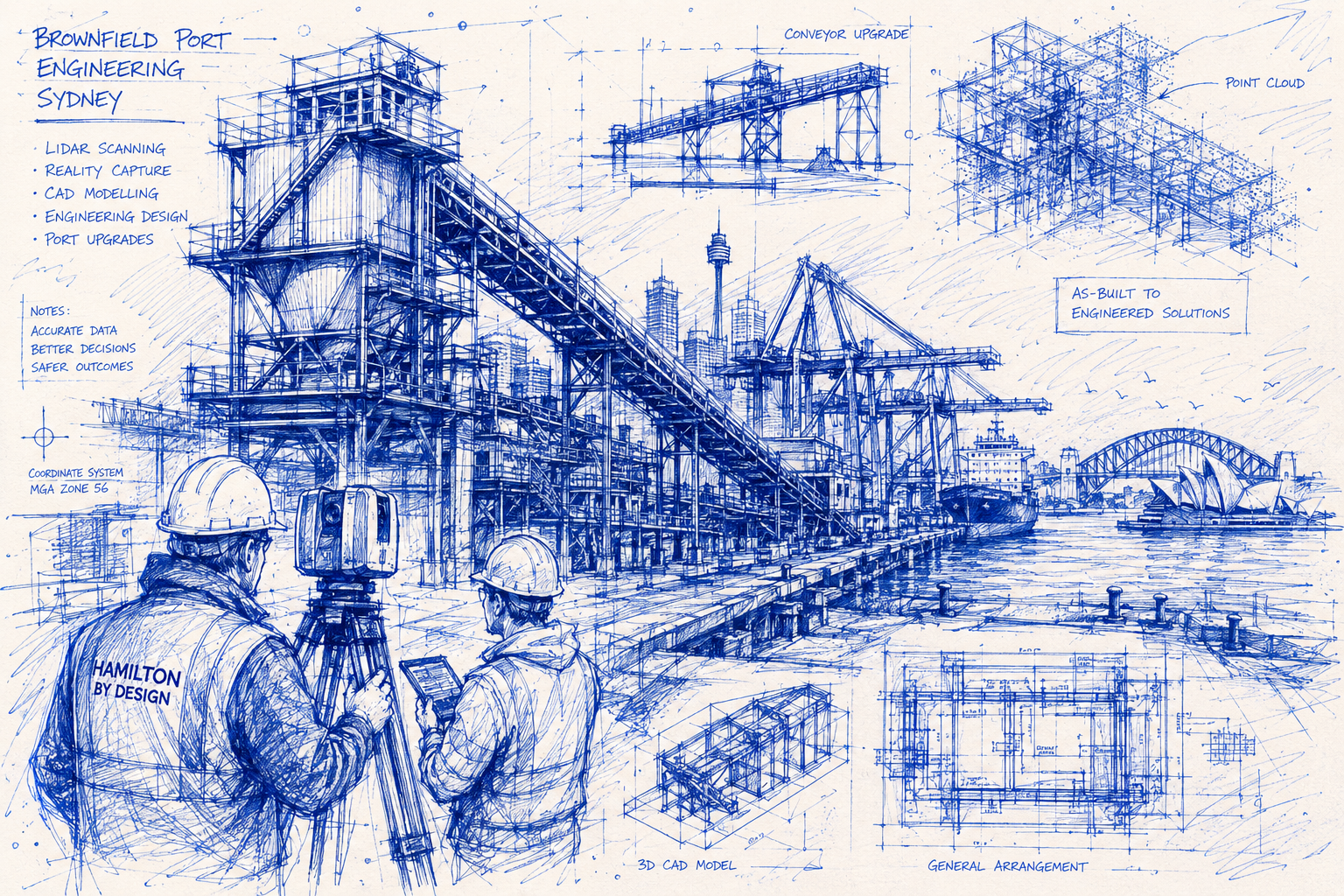
Brownfield Port Engineering Services in Sydney

Blue pen and ink illustration of a Sydney brownfield port engineering project showing LiDAR scanning, point cloud modelling, CAD design and port infrastructure upgrades with conveyors, cranes, wharves and engineering drawings.

Hamilton By Design provides engineering solutions for brownfield port upgrades throughout Sydney using engineering-grade LiDAR scanning, reality capture, CAD modelling, reverse engineering and mechanical design services. We help port operators, engineering consultants, infrastructure owners and contractors accurately capture existing conditions and develop practical engineering solutions for modifications, upgrades and asset management projects.

Brownfield engineering projects differ significantly from greenfield developments because they involve working within existing operational facilities. Existing infrastructure often contains undocumented modifications, outdated drawings, restricted access areas and complex interfaces between new and existing assets. Our engineering-led approach combines 3D laser scanning, CAD modelling and engineering design to reduce project risk and improve project outcomes.

Whether upgrading a conveyor system, replacing mechanical equipment, modifying a ship loader, installing new pipework or documenting existing infrastructure, Hamilton By Design delivers accurate information that supports successful project execution.


Engineering Solutions for Sydney Port Infrastructure

Sydney is home to a wide range of port and maritime infrastructure including:

  • Container terminals
  • Bulk material handling facilities
  • Fuel terminals
  • Storage and logistics facilities
  • Wharf structures
  • Berths and jetties
  • Ship loading facilities
  • Conveyor systems
  • Pump stations
  • Utility infrastructure
  • Mechanical handling equipment

Many of these facilities have evolved over decades and contain multiple generations of modifications. Original engineering drawings are often incomplete, inaccurate or unavailable. This creates significant challenges when planning upgrades, shutdown works and asset replacement projects.

Our brownfield port engineering services provide accurate site information and engineering documentation that enables confident design decisions.


Why Brownfield Port Projects Require Accurate Site Data

One of the biggest risks in any brownfield engineering project is relying on outdated information.

Existing drawings frequently fail to reflect:

  • Structural modifications
  • Equipment replacements
  • Pipework rerouting
  • Utility relocations
  • Maintenance alterations
  • Temporary works that became permanent

When engineering decisions are based on inaccurate information, projects can experience:

  • Design clashes
  • Construction delays
  • Increased costs
  • Installation difficulties
  • Additional shutdown requirements

Hamilton By Design uses terrestrial LiDAR scanning to create highly accurate digital representations of existing facilities, allowing engineering teams to work from verified site conditions rather than assumptions.


LiDAR Scanning for Brownfield Port Engineering Sydney

LiDAR scanning is typically the first stage of a brownfield port engineering project.

Using advanced terrestrial laser scanners, millions of measurements are captured across an operating facility to generate a detailed 3D point cloud.

Typical Sydney port scanning applications include:

  • Conveyor systems
  • Ship loaders and unloaders
  • Transfer stations
  • Structural steelwork
  • Wharf infrastructure
  • Pipework systems
  • Storage facilities
  • Marine mechanical equipment
  • Maintenance access structures
  • Utility corridors

The resulting point cloud becomes a digital twin of the facility that can be used throughout the engineering lifecycle.

Typical LiDAR Deliverables

Clients can receive:

  • E57 point cloud files
  • RCP and RCS files
  • LAS point clouds
  • Registered scan datasets
  • Site measurements
  • Asset verification reports
  • As-built documentation
  • Clash detection models

These deliverables can be integrated directly into engineering workflows.


Scan to CAD Modelling for Existing Port Assets

Once scanning is complete, the point cloud can be converted into engineering-ready CAD models.

This process creates accurate representations of:

  • Mechanical equipment
  • Structural steelwork
  • Pipework systems
  • Conveyors
  • Platforms
  • Access systems
  • Buildings
  • Utility infrastructure

Our engineering team develops models using industry-standard software including:

  • SolidWorks
  • Autodesk Inventor
  • AutoCAD
  • Autodesk ReCap
  • Navisworks

The resulting models provide an accurate foundation for engineering design and project planning.


Engineering Design for Brownfield Port Upgrades

Hamilton By Design supports a wide range of brownfield engineering projects throughout Sydney’s port and maritime sectors.

Mechanical Engineering Design

Mechanical engineering services may include:

  • Conveyor upgrades
  • Chute redesigns
  • Transfer station modifications
  • Equipment replacements
  • Maintenance access improvements
  • Materials handling improvements
  • Mechanical plant modifications
  • Pumping systems

Every design is developed using verified site conditions to minimise risk during installation.

Structural Engineering Support

Structural engineering support may include:

  • Platform design
  • Walkway modifications
  • Handrail systems
  • Equipment support structures
  • Maintenance access systems
  • Structural steel modifications
  • Wharf equipment support frames

Existing structures can be assessed and modelled to support future upgrade works.


Brownfield Port Upgrade Workflow

Hamilton By Design follows a structured workflow that ensures engineering decisions are based on accurate information.

1. Project Review

We review:

  • Existing drawings
  • Asset information
  • Site requirements
  • Operational constraints
  • Project objectives

This ensures the capture scope aligns with project requirements.

2. Site Capture

Engineering-grade LiDAR scanning is completed on site.

Data collection may occur during:

  • Normal operations
  • Maintenance shutdowns
  • Restricted access periods
  • Staged upgrade projects

3. Point Cloud Processing

Captured scan data is registered and processed to create a unified digital representation of the facility.

Quality checks are performed to verify registration accuracy.

4. Existing Conditions Modelling

The point cloud is converted into:

  • As-built CAD models
  • General arrangement drawings
  • Existing condition layouts
  • Structural models
  • Mechanical models

5. Engineering Design

Design concepts are developed directly within the verified digital environment.

This allows engineers to identify potential issues before fabrication begins.

6. Clash Detection and Verification

New equipment and structures are checked against existing infrastructure.

This process helps avoid:

  • Installation clashes
  • Structural conflicts
  • Pipework interference
  • Access restrictions

7. Final Documentation

Project deliverables are prepared for procurement, fabrication and construction activities.


Deliverables for Brownfield Port Engineering Projects

Depending on project requirements, clients may receive:

Reality Capture Deliverables

  • E57 files
  • RCP files
  • RCS files
  • LAS files
  • Registered point clouds

CAD Deliverables

  • DWG drawings
  • DXF drawings
  • 3D CAD models
  • STEP files
  • Parasolid files
  • SAT files

Engineering Documentation

  • General arrangement drawings
  • Fabrication drawings
  • Installation drawings
  • Structural details
  • Mechanical details
  • Engineering reports

These deliverables support engineering, construction and asset management activities.


Industries We Support

Hamilton By Design provides brownfield engineering services to a wide range of industries including:

  • Ports and marine infrastructure
  • Container terminals
  • Bulk materials handling facilities
  • Logistics operations
  • Manufacturing facilities
  • Mining export terminals
  • Fuel handling facilities
  • Water and utility infrastructure
  • Government infrastructure assets

Our experience working within operational industrial environments allows us to deliver practical engineering outcomes with minimal disruption to operations.


Hamilton By Design logo displayed on a blue tilted rectangle with a grey gradient background

Why Choose Hamilton By Design for Brownfield Port Engineering Sydney

Brownfield engineering projects require more than traditional design capabilities. They require accurate site information, a strong understanding of existing infrastructure and practical engineering experience.

Hamilton By Design combines:

  • Engineering-led LiDAR scanning
  • Scan-to-CAD modelling
  • Mechanical engineering expertise
  • Structural drafting support
  • Reverse engineering capabilities
  • Reality capture workflows
  • Industrial project experience

By integrating site capture and engineering design into a single workflow, we help Sydney port operators and infrastructure owners reduce project risk, improve design accuracy and achieve successful upgrade outcomes.

If you are planning a brownfield port upgrade in Sydney and require accurate site capture, CAD modelling or engineering support, Hamilton By Design can provide the engineering-grade information needed to move your project forward with confidence.


Talk to Us – Contact Us

Name
Would you like us to arrange a phone consultation for you?
Address

Our clients:


3D LiDAR Scanning Darwin for engineering surveys, laser scanning, reality capture and point cloud modelling services
3D LiDAR Scanning Australia engineering services for laser scanning, reality capture, scan-to-CAD, Scan-to-BIM and as-built documentation across Australia
3D LiDAR scanning services on the Central Coast providing engineering-grade laser scanning, point cloud capture, scan-to-CAD modelling and industrial reality capture for infrastructure and industrial projects.

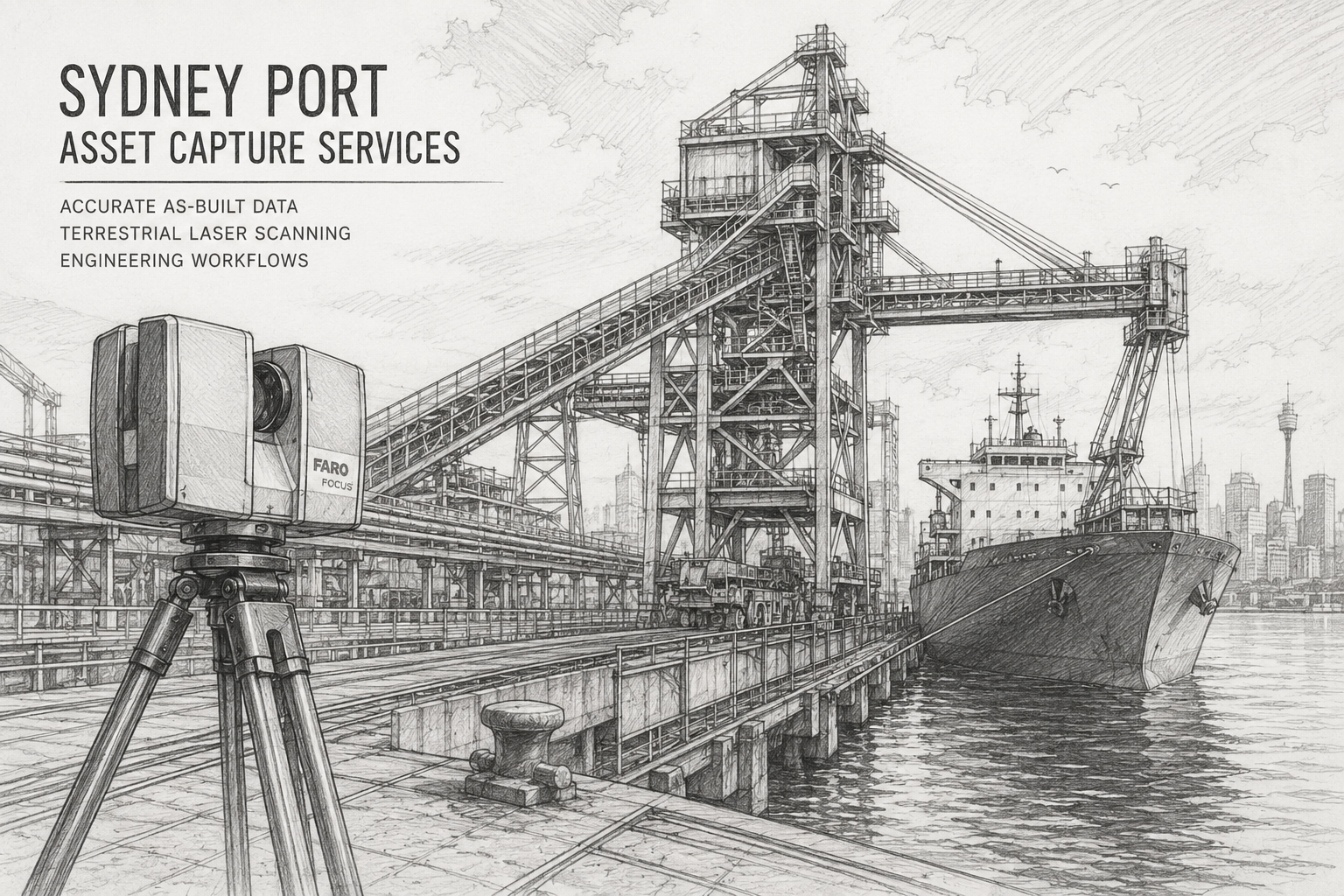
Sydney Port Asset Capture Services for Accurate As-Built Documentation

Pencil sketch of Sydney port infrastructure showing a terrestrial laser scanner capturing as-built data of conveyors, wharf structures and a cargo vessel for engineering asset capture services.
Blue 3D LiDAR scanner icon on a tripod with scanning waves

Hamilton By Design provides Sydney Port Asset Capture Services using engineering-grade terrestrial laser scanning, LiDAR technology, reality capture, and advanced engineering workflows. We capture accurate as-built data of port infrastructure, marine facilities, conveyors, ship loaders, bulk handling systems, structural steel, pipework, and mechanical assets throughout Sydney. Our services help port operators, engineering consultants, contractors, asset owners, and maintenance teams obtain reliable digital information for design, upgrades, maintenance, shutdown planning, and asset management projects.

Operating throughout Sydney and New South Wales, we deliver high-quality point cloud data, CAD drawings, 3D models, and engineering documentation suitable for brownfield industrial environments where accuracy and safety are critical.


Why Port Asset Capture Is Important

Many Sydney port facilities have been operating for decades and have undergone numerous modifications, expansions, repairs, and equipment upgrades. In many cases, original drawings no longer reflect actual site conditions.

Common challenges encountered at ports include:

  • Missing or outdated drawings
  • Undocumented modifications
  • Legacy infrastructure
  • Complex pipework networks
  • Congested mechanical installations
  • Structural steel changes over time
  • Limited access areas
  • Shutdown time constraints

Traditional tape measure and manual survey methods often struggle to capture the complexity of these environments accurately.

Terrestrial laser scanning allows millions of measurements to be collected rapidly, producing a highly detailed digital representation of existing conditions. This information forms the foundation for engineering design, asset management, maintenance planning, and future upgrades.


Sydney Port Infrastructure We Capture

Hamilton By Design provides asset capture services for a wide range of port and marine infrastructure assets throughout Sydney.

Marine Infrastructure

Our scanning services can capture:

  • Wharves
  • Berths
  • Jetties
  • Fender systems
  • Mooring facilities
  • Loading platforms
  • Ship loading infrastructure
  • Bulk export terminals

These assets often require detailed documentation to support maintenance, refurbishment, structural assessments, and future expansion projects.

Mechanical Infrastructure

Port facilities contain large amounts of mechanical equipment that can benefit from accurate reality capture.

Typical assets include:

  • Conveyors
  • Transfer towers
  • Chutes
  • Hoppers
  • Crushers
  • Ship loaders
  • Stackers
  • Reclaimers
  • Pumps
  • Valves
  • Hydraulic systems

Laser scanning enables engineers to model existing equipment accurately before modification or replacement projects commence.

Structural Assets

Our Sydney port asset capture services regularly support documentation of:

  • Structural steel
  • Buildings
  • Conveyor gantries
  • Access platforms
  • Walkways
  • Stairs
  • Handrails
  • Maintenance structures

Accurate structural information significantly reduces design risks during brownfield upgrade projects.

Pipework and Utilities

We can capture:

  • Process pipework
  • Fire services
  • Water systems
  • Fuel infrastructure
  • Hydraulic pipework
  • Compressed air systems
  • Utility corridors

Detailed point cloud data helps identify clashes and supports future engineering design activities.


Engineering-Grade Reality Capture Technology

Hamilton By Design uses professional terrestrial laser scanning equipment capable of capturing highly accurate spatial data in complex industrial environments.

Our workflows utilise technologies including:

  • FARO Focus Laser Scanners
  • Terrestrial LiDAR Scanning
  • High-resolution photography
  • Point cloud registration software
  • Engineering CAD software
  • 3D modelling platforms

The resulting datasets can be integrated directly into engineering and design workflows.

Software platforms commonly used include:

  • FARO SCENE
  • Autodesk ReCap
  • AutoCAD
  • Navisworks
  • SolidWorks
  • Autodesk Inventor
  • Revit

This ensures compatibility with client engineering systems and project requirements.


The Sydney Port Asset Capture Process

1. Project Planning

Every project begins with a detailed review of the clientโ€™s objectives.

This may include:

  • Asset identification
  • Access requirements
  • Safety planning
  • Site inductions
  • Survey control requirements
  • Deliverable specifications

Careful planning helps ensure the required information is captured efficiently during the site visit.

2. Site Data Capture

Our team conducts terrestrial laser scanning across the required areas.

During scanning we collect:

  • Point cloud data
  • Site photography
  • Asset information
  • Reference measurements
  • Engineering observations

Millions of measurements can be captured in a matter of hours, significantly reducing time spent on site compared with traditional methods.

3. Registration and Processing

Once field work is complete, the scan data is processed and registered.

This includes:

  • Scan alignment
  • Registration verification
  • Noise removal
  • Quality control
  • Data validation

The result is a complete and accurate digital representation of the scanned assets.

4. Engineering Modelling

The registered point cloud can then be used to create:

  • CAD drawings
  • General arrangement drawings
  • Structural models
  • Mechanical models
  • Pipework models
  • Equipment layouts
  • As-built documentation

Engineers can work directly from verified site conditions rather than relying on outdated information.

5. Project Delivery

Final deliverables are prepared and issued according to project requirements.

Data can be supplied in formats suitable for engineering, construction, maintenance, and asset management teams.


Deliverables Available

Hamilton By Design can provide a range of engineering and reality capture deliverables.

Point Cloud Deliverables

  • E57 files
  • RCP files
  • RCS files
  • LAS files
  • Registered point clouds

CAD Deliverables

  • DWG drawings
  • DXF drawings
  • General arrangement drawings
  • Site layouts
  • Sections
  • Elevations

3D Model Deliverables

  • SolidWorks models
  • Inventor models
  • STEP files
  • SAT files
  • Parasolid files

Engineering Documentation

  • As-built documentation
  • Asset verification reports
  • Engineering mark-ups
  • Digital asset records
  • Reality capture reports

Applications for Sydney Port Asset Capture Services

Asset capture data is commonly used for:

Brownfield Upgrades

Accurate site information allows engineers to design modifications that fit existing infrastructure.

Shutdown Planning

Detailed digital models enable planning work before site access windows become available.

Asset Management

Digital records assist with maintenance planning, inspections, and lifecycle management.

Scan to CAD Projects

Point clouds can be converted into engineering drawings and 3D models.

Reverse Engineering

Existing equipment can be digitally captured for redesign, refurbishment, or replacement.

Digital Twin Development

Reality capture forms the foundation for creating digital twins of port facilities and infrastructure assets.


Industries We Support

Our Sydney Port Asset Capture Services support clients across:

  • Ports and marine infrastructure
  • Container terminals
  • Bulk handling facilities
  • Mining export facilities
  • Manufacturing plants
  • Industrial processing facilities
  • Transport infrastructure
  • Utilities
  • Water infrastructure
  • Energy facilities

Whether the project involves a single asset or an entire terminal, our engineering workflows deliver reliable information that supports informed decision-making.


Why Choose Hamilton By Design?

Hamilton By Design combines engineering expertise with advanced reality capture technology to deliver practical outcomes for industrial clients.

Our team understands the challenges associated with brownfield infrastructure, complex mechanical systems, shutdown environments, and engineering documentation requirements.

By providing accurate as-built information, we help reduce project risk, minimise rework, improve design accuracy, and support the efficient management of critical port assets.

Need Sydney Port Asset Capture Services?

Hamilton By Design provides engineering-grade terrestrial laser scanning, LiDAR scanning, scan-to-CAD, 3D modelling, and asset capture services throughout Sydney and New South Wales.

Contact our team to discuss your next port infrastructure, marine facility, terminal upgrade, shutdown planning, or asset management project. Accurate data is the foundation of successful engineering outcomes.

Talk to Us – Contact Us

Name
Would you like us to arrange a phone consultation for you?
Address

Our clients: