


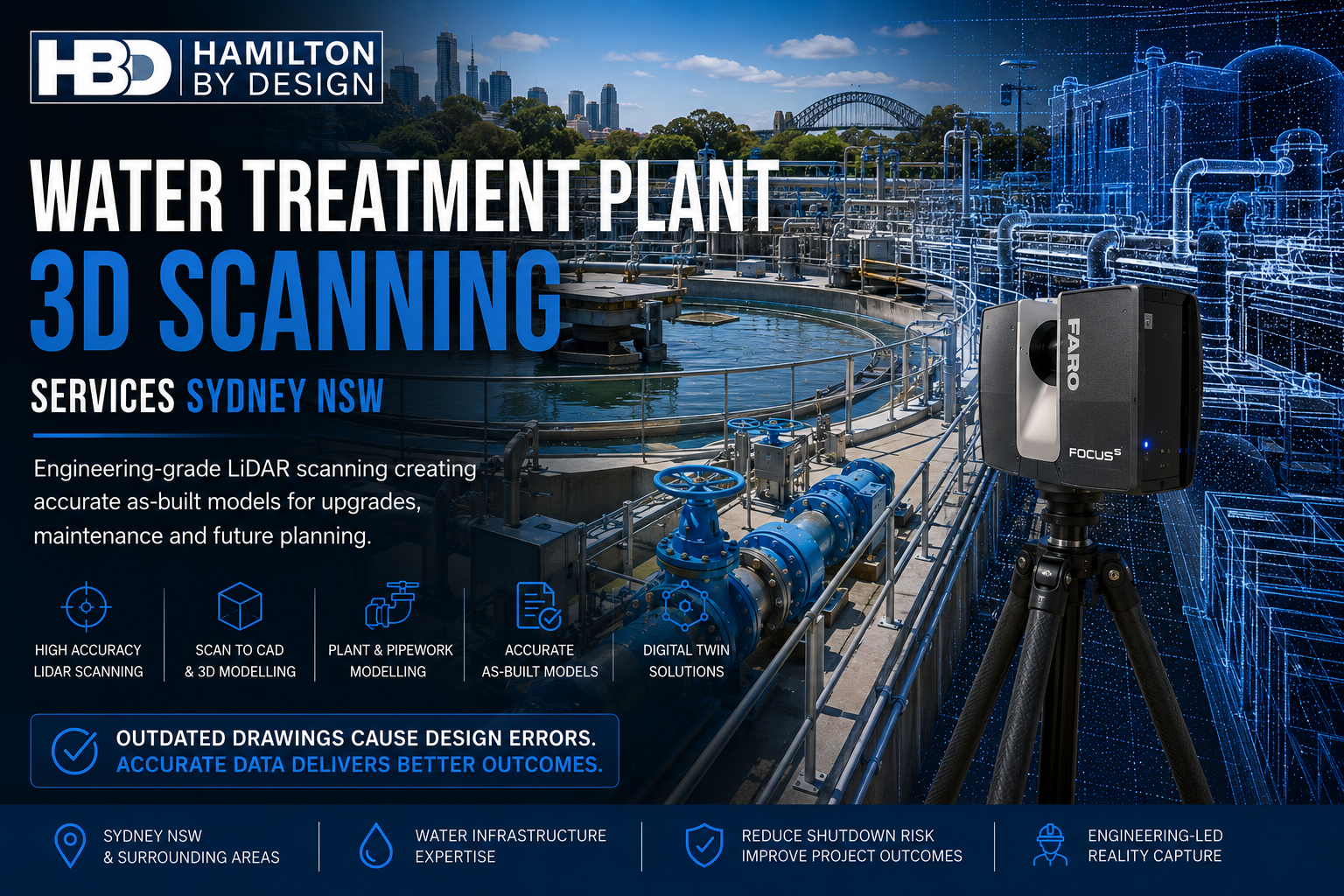
Water treatment plants are among Australia’s most critical infrastructure assets. They operate continuously to deliver safe, reliable drinking water to millions of people while meeting stringent regulatory and environmental requirements. As Sydney continues to invest in expanding and modernising its water infrastructure, engineering teams are increasingly faced with a common challenge:
The existing as-built drawings no longer reflect what is actually installed on site.
Over decades of operation, treatment plants undergo numerous modifications. Pumps are replaced, pipework is rerouted, valves are upgraded, electrical equipment is relocated, and structural steel is modified to suit operational requirements. Unfortunately, these changes are not always captured in the engineering documentation.
When engineers begin designing upgrades using outdated drawings, errors quickly emerge. Pipework clashes with existing infrastructure, replacement equipment fails to fit, structural supports require redesign, and shutdown schedules are extended while unexpected site modifications are completed.
Hamilton By Design provides engineering-grade Water Treatment Plant 3D Scanning Services throughout Sydney NSW, using terrestrial LiDAR scanning to create highly accurate digital representations of existing facilities. By replacing outdated drawings with reliable reality capture, engineering teams can design with confidence, reduce project risk and improve construction outcomes.
The Problem with Outdated As-Built Drawings
Many of Sydney’s water treatment facilities have been operating for several decades. During this time, numerous maintenance activities and capital upgrades have altered the original plant configuration.
Typical undocumented changes include:
- Replacement pumps with different footprints
- Pipework rerouted around new equipment
- Additional valves and instrumentation
- Modified pipe supports
- Structural strengthening
- New cable trays
- Electrical switchboard upgrades
- Temporary modifications that became permanent
- Altered maintenance platforms
- Relocated access ladders
Although each modification may have been appropriate at the time, the cumulative effect is that original drawings often no longer represent actual site conditions.
Engineering projects based on these outdated documents carry significant risk.
Why Accurate Existing Conditions Matter
Every brownfield engineering project begins with one critical question:
What is actually installed today?
Without accurate existing information, designers are forced to rely on assumptions or undertake extensive manual site measurements.
Both approaches introduce unnecessary risk.
Common design issues include:
- Pipework that does not align during installation
- Pump discharge flanges requiring on-site modification
- Structural steel interfering with new equipment
- Insufficient maintenance access
- Cable trays clashing with pipe supports
- Valve actuators becoming inaccessible
- Equipment foundations requiring redesign
- Lifting clearances being overlooked
These problems typically become apparent during construction, when the cost of correcting them is significantly higher.
Engineering LiDAR Scanning Removes Uncertainty
Hamilton By Design uses professional terrestrial LiDAR scanners to capture millions of highly accurate measurement points throughout a water treatment facility.
Rather than recording selected dimensions using conventional survey methods, laser scanning captures the complete geometry of the plant.
Typical assets captured include:
- Process pipework
- Pumps
- Motors
- Valves
- Tanks
- Clarifiers
- Filters
- Chemical dosing systems
- Structural steel
- Pipe bridges
- Walkways
- Stairways
- Handrails
- Electrical switchrooms
- MCC rooms
- Cable trays
- Instrumentation
- Concrete structures
The result is a comprehensive point cloud representing the true existing condition of the facility.
Engineers can measure any feature directly from the scan throughout the design process without repeatedly returning to site.
Supporting Water Treatment Plant Upgrades
Sydney’s treatment plants require continual investment to maintain reliability, increase capacity and improve operational efficiency.
LiDAR scanning supports projects such as:
Pump Replacements
Replacement pumps frequently differ from the original equipment.
Accurate scanning ensures:
- baseplates align correctly
- suction and discharge pipework matches
- maintenance clearances are maintained
- lifting access is preserved
Pipework Modifications
Process improvements often require:
- larger diameter pipework
- bypass systems
- additional isolation valves
- flow meters
- chemical dosing lines
Accurate point clouds allow new spool pieces to be designed around existing infrastructure before fabrication begins.
Structural Modifications
New equipment installations commonly require:
- equipment platforms
- maintenance walkways
- lifting beams
- pipe supports
- access ladders
- handrails
Scanning captures every structural member to ensure new steel integrates correctly.
Electrical and Instrumentation Upgrades
Electrical upgrades benefit significantly from reality capture.
Designers can accurately model:
- cable trays
- conduits
- MCC rooms
- switchboards
- instrument locations
- communication systems
This improves installation planning while reducing field modifications.
Creating Accurate As-Built Models
One of the greatest advantages of engineering-grade LiDAR scanning is the ability to create reliable as-built models.
These models provide:
- current equipment locations
- verified pipe routing
- structural layouts
- equipment dimensions
- maintenance clearances
- plant configuration
Unlike historic drawings, as-built models reflect the facility exactly as it exists today.
They become the foundation for future engineering projects.
Scan to CAD for Engineering Design
Point clouds are extremely valuable, but engineering projects often require intelligent CAD models.
Hamilton By Design converts point cloud data into engineering deliverables including:
- 3D CAD models
- General Arrangement drawings
- Equipment layouts
- Pipe routing models
- Structural steel models
- Plant sections
- Elevations
- Fabrication drawings
- As-built documentation
These models integrate directly into engineering workflows using software such as Autodesk, SOLIDWORKS and Navisworks.
Supporting Digital Twin Development
Many water authorities are now investing in digital twins to improve long-term asset management.
LiDAR scanning forms the foundation of these digital assets.
A digital twin can support:
- maintenance planning
- shutdown coordination
- asset lifecycle management
- operator training
- future upgrades
- capital works planning
- condition assessments
- engineering analysis
Rather than relying on outdated information, the digital twin represents actual plant conditions.
Reducing Shutdown Risk
Water treatment plants often operate continuously, making shutdown planning critical.
Unexpected design errors during shutdowns can result in:
- extended outages
- contractor delays
- increased labour costs
- emergency fabrication
- delayed commissioning
Accurate 3D scanning identifies potential issues before work begins.
Engineers can perform visual clash detection, verify clearances and optimise installation sequences during the design stage.
This significantly reduces project risk.
Brownfield Engineering Expertise
Unlike greenfield facilities, brownfield projects require engineers to work around existing assets.
Hamilton By Design specialises in engineering support for brownfield infrastructure, including:
- water treatment plants
- wastewater treatment plants
- pumping stations
- reservoirs
- chemical dosing facilities
- filtration plants
- process buildings
Engineering-grade reality capture provides confidence that new infrastructure will integrate successfully with existing operations.
Typical Project Workflow
Our engineering workflow has been developed specifically for operational infrastructure.
1. Project Planning
Review plant access requirements, shutdown windows and engineering objectives.
2. Site LiDAR Scanning
Capture complete facility geometry using terrestrial laser scanning.
3. Scan Registration
Combine individual scans into one accurate point cloud.
4. Quality Assurance
Verify registration accuracy and confirm complete site coverage.
5. Engineering Modelling
Develop CAD models, equipment layouts and engineering documentation.
6. Design Integration
Use accurate as-built information to complete mechanical, structural and process designs.
7. Construction Verification
Verify proposed upgrades against existing infrastructure before fabrication.
Why Choose Hamilton By Design?
Hamilton By Design provides more than laser scanning.
We combine engineering expertise with advanced reality capture technologies to deliver practical engineering solutions.
Our capabilities include:
- Engineering-grade terrestrial LiDAR scanning
- Mechanical engineering design
- Scan to CAD services
- Reverse engineering
- Pipework modelling
- Structural steel modelling
- Engineering drafting
- Digital twin development
- As-built verification
- Brownfield engineering support
- Shutdown engineering planning
Because our engineers understand industrial facilities, we capture the information that designers actually need—not just visually impressive point clouds.
Supporting Sydney’s Water Infrastructure
Sydney’s water treatment plants play a vital role in supplying safe drinking water to millions of residents and businesses. As these facilities continue to expand, modernise and replace ageing assets, engineering accuracy becomes increasingly important.
Outdated as-built drawings should never be the reason a project experiences delays, redesigns or costly construction changes.
Engineering-grade LiDAR scanning provides reliable existing-condition data that supports smarter engineering decisions, reduces construction risk and improves project outcomes.
Whether your project involves replacing pumps, modifying pipework, upgrading process equipment or creating a digital twin, Hamilton By Design delivers accurate 3D scanning, engineering modelling and Scan to CAD services throughout Sydney NSW.
By capturing the plant exactly as it exists today, we help ensure tomorrow’s upgrades fit correctly the first time.
Talk to Us – Contact Us
Our clients:
























