


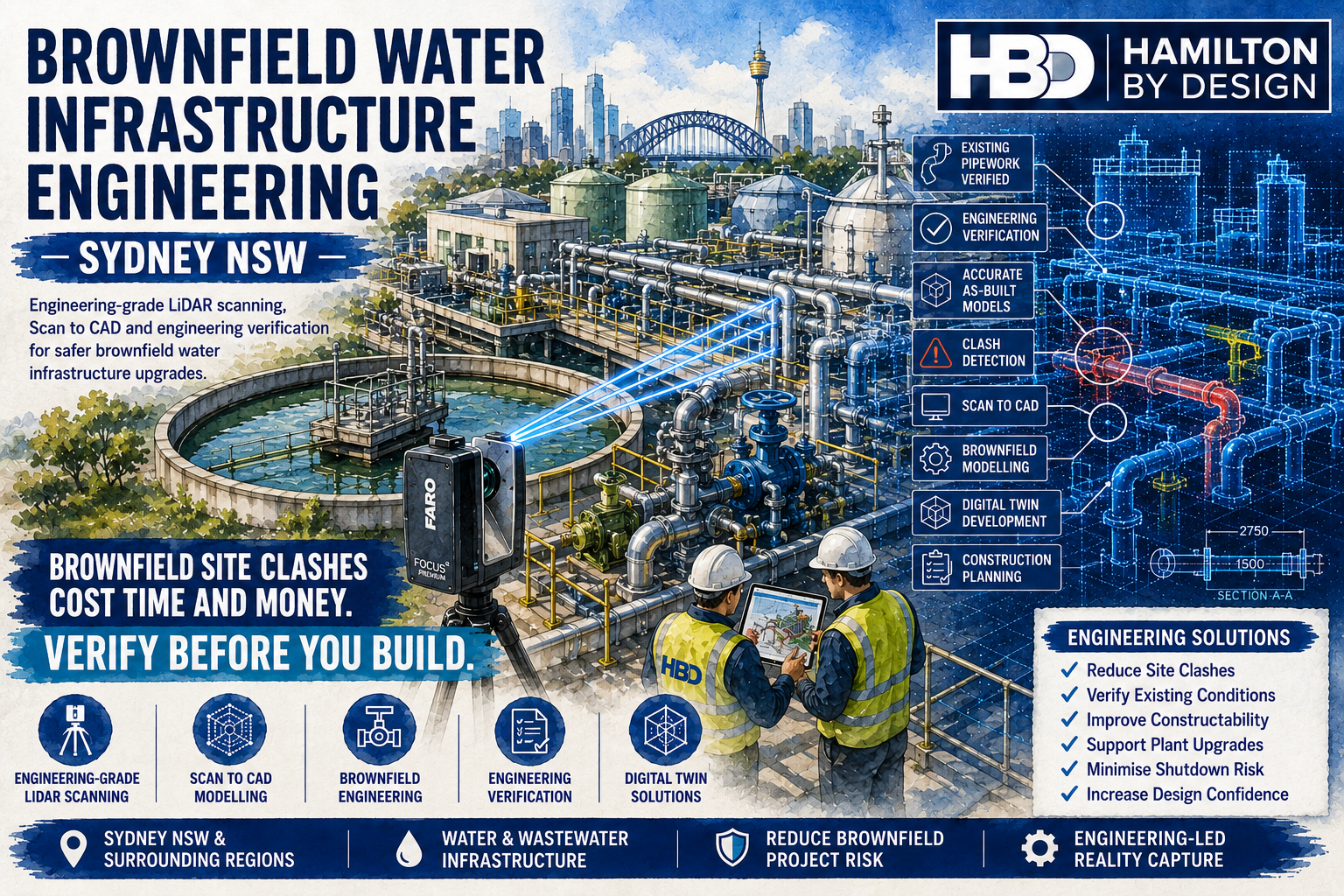
Sydney’s water infrastructure is constantly evolving. Ageing water treatment plants, wastewater treatment facilities, pumping stations, reservoirs and transfer pipelines require ongoing upgrades to meet increasing demand, improve reliability and comply with changing environmental regulations.
Unlike greenfield projects where engineers begin with an empty site, brownfield projects involve modifying existing operational infrastructure. Every new pipe, pump, platform or structural support must integrate seamlessly with equipment that may have been installed decades ago.
The greatest challenge with brownfield engineering is simple:
Existing infrastructure rarely matches the available drawings.
Over many years, maintenance activities, emergency repairs, plant expansions and operational improvements alter facilities in ways that are often never fully documented. As a result, engineering teams frequently encounter unknown pipework, relocated equipment, modified structural steel and outdated as-built drawings.
These discrepancies create one of the biggest risks in industrial engineering:
Brownfield modifications causing costly site clashes.
Hamilton By Design provides Brownfield Water Infrastructure Engineering Services throughout Sydney NSW, combining engineering-grade LiDAR scanning, Scan to CAD, mechanical engineering and engineering verification to reduce project risk before construction begins.
Why Brownfield Projects Are More Complex Than Greenfield Projects
A greenfield project starts with a clean site.
Engineers control every dimension, every structural member and every equipment location.
Brownfield projects are completely different.
Existing facilities already contain:
- Operating equipment
- Underground services
- Congested pipework
- Electrical infrastructure
- Instrumentation
- Structural steel
- Maintenance platforms
- Access walkways
- Cable trays
- Temporary modifications
- Legacy equipment
Every new design must fit around existing infrastructure while maintaining safe operation.
That is why accurate existing-condition data is essential.
The Hidden Cost of Site Clashes
A site clash occurs when newly designed equipment conflicts with existing infrastructure.
Typical clashes include:
- Pipework intersecting structural steel
- Pumps fouling maintenance platforms
- Valves becoming inaccessible
- Cable trays blocking pipe routing
- Pipe supports interfering with existing equipment
- Motors conflicting with overhead beams
- Access ladders blocking maintenance paths
- Concrete foundations overlapping underground services
Many of these issues are only discovered during construction.
By that stage:
- fabrication is complete
- contractors are mobilised
- shutdowns have commenced
- installation crews are waiting
The result is expensive redesign, fabrication changes and extended project durations.
Engineering-Grade LiDAR Scanning Eliminates Guesswork
Hamilton By Design uses professional terrestrial LiDAR scanning to accurately capture existing water infrastructure.
Rather than relying on tape measures or outdated drawings, millions of survey points are recorded across the entire facility.
This captures:
- Pumps
- Pipework
- Valves
- Tanks
- Structural steel
- Pipe bridges
- Clarifiers
- Digesters
- Access platforms
- Stairways
- Handrails
- Electrical equipment
- Cable trays
- Instrumentation
- Concrete structures
The resulting point cloud becomes the single source of truth for engineering design.
Accurate Existing Conditions Lead to Better Engineering
Reliable engineering begins with reliable information.
Accurate point cloud data enables engineers to:
- Verify dimensions
- Confirm pipe routing
- Check equipment locations
- Validate maintenance access
- Measure structural geometry
- Review installation clearances
- Detect clashes before construction
- Plan shutdown activities
Instead of making assumptions, engineers work from the actual plant.
Supporting Water Infrastructure Projects Across Sydney
Hamilton By Design supports a wide range of brownfield water infrastructure projects.
These include:
Water Treatment Plant Upgrades
Treatment plants require continual investment to maintain water quality and increase capacity.
LiDAR scanning provides accurate existing-condition data before detailed engineering begins.
Wastewater Treatment Plant Modifications
Wastewater facilities often involve highly congested process pipework.
Accurate point clouds reduce installation risk during process upgrades.
Pump Station Engineering
Pump replacements frequently require:
- new baseplates
- pipework modifications
- motor upgrades
- structural changes
Scanning ensures replacement equipment integrates correctly.
Reservoir Infrastructure
Reservoir facilities require accurate engineering for:
- inlet pipework
- outlet manifolds
- valve chambers
- overflow systems
- maintenance platforms
Reality capture improves design certainty.
Transfer Pipeline Connections
Tie-ins to existing pipelines require precise dimensional verification.
LiDAR scanning allows engineers to accurately model connection points before fabrication.
Scan to CAD Services
Point clouds are valuable, but engineering projects generally require CAD models.
Hamilton By Design converts point cloud data into:
- Intelligent 3D models
- General Arrangement drawings
- Pipework models
- Structural steel models
- Equipment layouts
- Sections
- Elevations
- Fabrication drawings
- As-built documentation
These deliverables integrate with:
- SOLIDWORKS
- Autodesk Inventor
- AutoCAD
- Navisworks
- Autodesk ReCap
Engineering Verification Before Construction
Engineering verification is one of the most valuable outcomes of reality capture.
Before fabrication begins, proposed designs can be compared against existing infrastructure.
Verification includes:
- Equipment fit
- Pipe routing
- Structural interfaces
- Maintenance access
- Installation clearances
- Lifting paths
- Serviceability
- Constructability
Resolving these issues during design significantly reduces project risk.
Supporting Digital Twin Development
Many Sydney water authorities are developing digital twins to improve long-term asset management.
LiDAR scanning provides the accurate geometric foundation required for these systems.
Digital twins assist with:
- Asset management
- Maintenance planning
- Shutdown coordination
- Future upgrades
- Operator training
- Lifecycle management
- Engineering studies
- Capital planning
Because the model reflects actual site conditions, future projects begin with reliable information.
Reducing Shutdown Risk
Brownfield water infrastructure projects often occur during tightly controlled shutdowns.
Unexpected site clashes can quickly extend shutdown durations.
LiDAR scanning helps engineers:
- Detect clashes early
- Validate fabrication
- Optimise installation sequences
- Improve access planning
- Confirm equipment clearances
Many construction problems are therefore resolved before anyone arrives on site.
Typical Brownfield Engineering Workflow
Hamilton By Design follows an engineering-led workflow designed specifically for operational infrastructure.
1. Project Definition
Understand project objectives, operational constraints and shutdown requirements.
2. Engineering LiDAR Scanning
Capture existing infrastructure using terrestrial laser scanning.
3. Point Cloud Registration
Register scans into one accurate engineering dataset.
4. Quality Assurance
Verify scan completeness and registration accuracy.
5. Scan to CAD
Develop engineering-ready models from the point cloud.
6. Engineering Design
Complete mechanical, structural and pipework design using verified site information.
7. Engineering Verification
Compare proposed modifications against existing infrastructure before fabrication.
8. Construction Support
Provide engineering assistance during installation if required.
Why Choose Hamilton By Design?
Hamilton By Design combines practical engineering knowledge with advanced reality capture technology.
Our capabilities include:
- Engineering-grade LiDAR scanning
- Brownfield engineering support
- Mechanical engineering
- Reverse engineering
- Scan to CAD
- Engineering drafting
- Structural modelling
- Pipework modelling
- As-built documentation
- Digital twin development
- Engineering verification
- Construction support
Unlike traditional survey-only providers, we understand how engineering models will be used throughout the project lifecycle.
Our reality capture services are designed to produce information engineers can immediately use for design, verification and construction planning.
Supporting Sydney’s Essential Water Infrastructure
Sydney’s water infrastructure supports millions of residents, businesses and industries every day. As assets continue to age, brownfield engineering projects will become increasingly important to maintain reliable services and improve operational performance.
Successful brownfield engineering depends on one critical factor:
Accurate existing-condition information.
Without reliable data, unknown infrastructure creates unnecessary engineering risk, costly site clashes and expensive construction delays.
Hamilton By Design provides engineering-grade LiDAR scanning, Scan to CAD modelling and engineering verification services that replace uncertainty with confidence. By accurately capturing existing water infrastructure before design begins, we help engineering consultants, utilities and contractors reduce project risk, improve constructability and deliver successful brownfield upgrades.
Whether your project involves a water treatment plant, wastewater treatment facility, pumping station, reservoir or pipeline connection, our engineering-led approach ensures every design decision is based on the facility as it exists today—not outdated drawings or assumptions.
Talk to Us – Contact Us
Our clients:
























