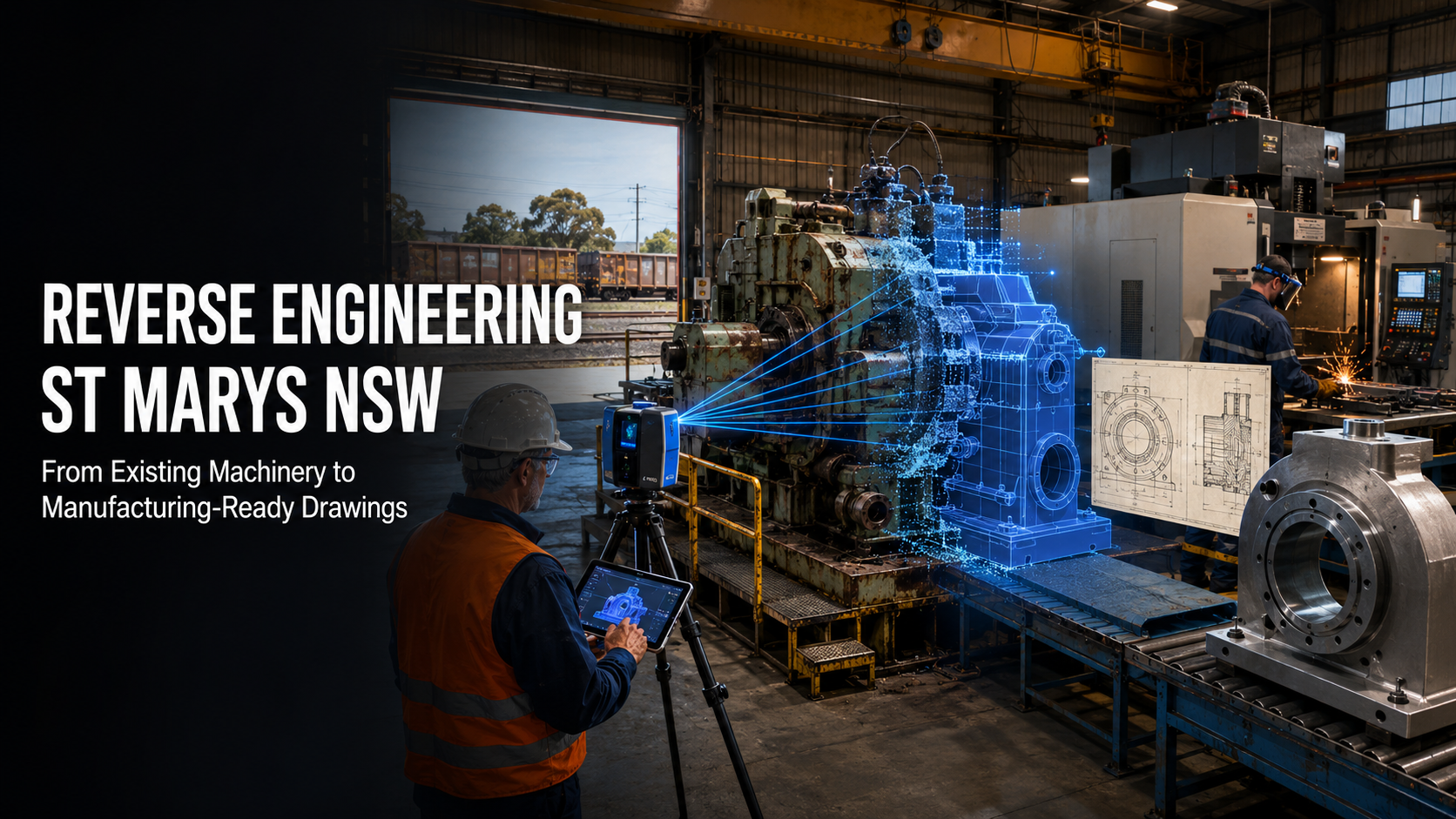
Industrial Scanning Western Sydney | Scan-to-CAD

Industrial scanning Western Sydney showing a LiDAR scanner capturing guarded factory machinery, transitioning into a point cloud, mechanical CAD model and FEA analysis.

Industrial Scanning Western Sydney: Engineering-Grade Reality Capture for Factories and Logistics Facilities

Blue 3D LiDAR scanner icon on a tripod with scanning waves

Western Sydney contains one of Australiaโ€™s most important concentrations of manufacturing, food production, packaging, warehousing and logistics activity. Within this wider industrial region, the Wetherill Parkโ€“Smithfieldโ€“Yennora corridor supports thousands of businesses operating production machinery, conveyors, automated systems, cold-storage facilities, warehouses and freight infrastructure.

These facilities are continually changing. Production lines are expanded, machinery is replaced, conveyors are redirected, safety guards are modified and new equipment must be installed around existing structures and services. Unfortunately, the drawings available to engineers and maintenance teams do not always reflect what is actually installed.

Industrial scanning provides a practical way to address this information gap.

Hamilton By Design combines engineering-grade 3D laser scanning with mechanical engineering, reverse engineering and drafting. This integrated approach allows industrial clients to move from physical site capture to usable point clouds, CAD models, as-built drawings and engineered modification packages.

The result is not simply a visual representation of a factory. It is a reliable digital foundation for engineering decisions.

The industrial character of Wetherill Park, Fairfield and Yennora

The Smithfieldโ€“Wetherill Park Industrial Estate is recognised as one of the largest established industrial areas in the Southern Hemisphere. It accommodates a broad mixture of food processors, machinery manufacturers, metal fabricators, packaging companies, chemical manufacturers, transport operators and industrial-service providers.

The estateโ€™s proximity to the M4 and M7 motorways, Port Botany, the Western Sydney employment corridor and the future Western Sydney Airport strengthens its role as a manufacturing and distribution centre.

Yennora adds another important industrial dimension. Its large intermodal distribution precinct connects road, rail, warehousing and container-handling operations. The precinct contains more than 300,000 square metres of warehouse facilities, extensive container hardstand areas and direct rail connections to Port Botany.

Prairiewood is not itself a major industrial estate. However, it forms part of the broader Fairfield commercial, residential and workforce catchment surrounding the Wetherill Park and Smithfield industrial areas.

The diversity of these operations creates strong demand for accurate facility information. A food-processing plant has different regulatory and operational requirements from a freight terminal, but both depend on dependable layouts, controlled engineering documentation and safe interaction between people, machinery and mobile equipment.

What is industrial scanning?

Industrial scanning is the capture of existing machinery, buildings and infrastructure using technologies such as terrestrial LiDAR and close-range 3D scanning.

A terrestrial laser scanner measures millions of visible points across the surrounding environment. These measurements are combined to create a three-dimensional dataset known as a point cloud. The point cloud records the position, form and spatial relationship of visible objects, including:

  • Machinery
  • Conveyors
  • Structural columns
  • Platforms and walkways
  • Pipework
  • Ducting
  • Building walls and roof structures
  • Loading areas
  • Storage systems
  • Access routes
  • Electrical and mechanical-service locations

The completed point cloud can be viewed directly or converted into drawings and engineering models through a point-cloud-to-CAD workflow.

Industrial scanning should not be confused with conventional photography. Photographs are valuable for visual reference, but they do not provide the same coordinated three-dimensional geometry. A registered point cloud allows an engineer or designer to inspect the spatial relationship between equipment, identify potential clashes and take measurements after the site visit.

Why existing industrial drawings become unreliable

Factories and logistics facilities rarely remain in their original configuration. Equipment is added or relocated, platforms are extended, pipework is rerouted and safety improvements are progressively introduced.

Individual changes may be documented, but the master facility layout is not always updated. After several years, a drawing can show the original design rather than the existing installation.

This creates problems when planning:

  • Production-line upgrades
  • Machinery replacement
  • Conveyor modifications
  • New access platforms
  • Guarding improvements
  • Warehouse reconfiguration
  • Pipework installation
  • Equipment removal
  • Building extensions
  • Shutdown work

Where the existing drawings are incomplete, project teams may rely on tape measurements, photographs and assumptions. These methods can be suitable for simple work, but they become increasingly risky when new equipment must fit into a congested operating facility.

Hamilton By Designโ€™s engineering-led point-cloud laser scanning captures the actual installed condition so that design work can begin from a more reliable spatial reference.

From site capture to engineering documentation

The value of scanning is created through the engineering workflow that follows the site visit.

A typical industrial scanning project begins with a review of the clientโ€™s objectives. The required scanning density, coverage, control, outputs and modelling detail should be determined before mobilisation. A facility-layout project does not necessarily require the same level of detail as the reverse engineering of a precision component.

The scanning process then generally includes:

  1. Planning scanner positions and areas of coverage.
  2. Capturing the facility from multiple locations.
  3. Recording photographs and supporting site information.
  4. Registering the individual scans into a coordinated point cloud.
  5. Undertaking quality checks and identifying incomplete areas.
  6. Converting relevant geometry into CAD models or drawings.
  7. Verifying critical dimensions where required.
  8. Reviewing the completed documentation with the client.

Hamilton By Design provides integrated 3D laser scanning and CAD modelling services so the information can progress beyond a raw point cloud.

Depending on the project, deliverables may include:

  • E57, RCP, RCS, LAS or XYZ point-cloud files
  • AutoCAD facility layouts
  • SolidWorks machinery models
  • STEP or SAT exchange models
  • Floor plans and elevations
  • General-arrangement drawings
  • Structural-steel models
  • Equipment and conveyor layouts
  • Fabrication drawings
  • Installation drawings
  • As-built drawing packages

This provides the client with documentation that can be used by engineers, fabricators, installers, equipment suppliers and maintenance personnel.

Factory scanning for food and packaging facilities

Food manufacturing is an important part of the Wetherill Park industrial economy. Local operations include meat processing, pasta and ingredient manufacturing, automated grocery fulfilment, packaging and refrigerated storage.

These facilities contain closely integrated machinery, including conveyors, fillers, mixers, ovens, packaging systems, palletisers and cleaning infrastructure. New equipment often has to be installed without compromising hygiene, maintenance access, product flow or employee safety.

Industrial scanning can support:

  • Production-line layout development
  • Conveyor relocation
  • Packaging-machine replacement
  • Utility and service coordination
  • Access and cleaning-clearance reviews
  • Equipment-platform design
  • Guarding upgrades
  • Installation planning
  • Shutdown sequencing
  • As-built records

Point clouds are especially valuable where equipment suppliers are located interstate or overseas. A coordinated dataset can allow suppliers and designers to examine the installation area without repeatedly travelling to the site.

However, the point cloud should be interpreted by people who understand machinery, fabrication and installation requirements. Hamilton By Design combines reality capture with mechanical engineering consulting to help convert captured geometry into practical design outcomes.

Food-processing projects must also consider the Food Standards Code, hygienic design requirements and the clientโ€™s cleaning, allergen-control and food-safety procedures. Scanning records the existing geometry, but engineering judgement remains necessary when designing modifications.

Industrial scanning for logistics and warehousing

Warehouses and distribution centres present a different set of engineering challenges. Their layouts must accommodate storage racks, conveyors, loading docks, trucks, forklifts, pedestrians and, increasingly, automated equipment.

The introduction of robotics and automated order-fulfilment systems makes accurate documentation particularly important. Minor spatial conflicts can affect conveyor routing, maintenance access, fire-service clearances or the movement of mobile plant.

Facility scanning can be used to document:

  • Warehouse columns and roof structures
  • Loading docks and dock equipment
  • Conveyor and sortation systems
  • Pallet-storage areas
  • Automated equipment
  • Vehicle access points
  • Pedestrian routes
  • Exclusion zones
  • Barriers and bollards
  • Emergency access
  • External hardstand areas

A point cloud can also support traffic-management drawings. These may identify separate pedestrian routes, forklift operating areas, driver safety zones, loading zones and restricted areas.

SafeWork NSW places strong emphasis on keeping forklifts and pedestrians physically separated wherever reasonably practicable. Hamilton By Design can assist by capturing the facility, preparing layouts and developing practical engineering concepts for barriers, access systems and traffic separation.

Reverse engineering existing machinery

Many Western Sydney factories continue to operate equipment that has been modified or maintained over several decades. Original suppliers may no longer exist, and replacement parts may be difficult to obtain.

Hamilton By Design provides reverse engineering and scan-to-CAD studies for machinery, plant and fabricated components.

A reverse-engineering project may involve:

  • Capturing the existing component or assembly
  • Identifying functional interfaces
  • Confirming critical dimensions
  • Creating a parametric CAD model
  • Selecting appropriate materials
  • Reviewing tolerances and manufacturing methods
  • Assessing possible design improvements
  • Preparing manufacturing drawings
  • Producing a bill of materials
  • Supporting fabrication and installation

Terrestrial LiDAR is well suited to facility layouts and larger machinery. Smaller components or complex surfaces may require handheld scanning, precision measurement or conventional metrology.

It is important to acknowledge the physical limitations of scanning. A scanner cannot see through machinery guards, covers, walls or solid components. Threads, bearing fits, holes, internal cavities and concealed interfaces may require the equipment to be opened or dismantled. Critical dimensions should be independently verified before manufacturing.

Hamilton By Designโ€™s approach to reverse engineering industrial equipment using 3D scanning combines measurement technology with engineering interpretation rather than treating scanning as an automatic replacement for inspection.

Mechanical drafting for manufacturing

Accurate CAD models must ultimately be translated into controlled documentation that a fabricator or machinist can use.

Hamilton By Designโ€™s Australian design and drafting services can include:

  • Mechanical drawings
  • Fabrication drawings
  • Machining drawings
  • Assembly drawings
  • General arrangements
  • Exploded views
  • Bills of materials
  • Welding details
  • Installation drawings
  • DXF cutting profiles
  • As-built drawings
  • Drawing revisions

Mechanical drawings may be prepared with reference to the applicable parts of the AS 1100 technical-drawing series and relevant dimensional, welding, material and fabrication standards.

A drawing should communicate more than geometry. Depending on its purpose, it may need to specify materials, tolerances, finishes, welds, fasteners, inspection requirements and revision status. These details are essential if a CAD model is to become a reliable manufacturing record.

Machinery safety and guarding

Machinery safety is a significant concern in food processing, packaging, metalworking and logistics. Common hazards include rotating shafts, conveyor nip points, crushing zones, unexpected movement and access to machinery during cleaning or maintenance.

Hamilton By Designโ€™s machine-guarding design and engineering can support:

  • Existing guarding assessments
  • Hazard identification
  • Guard-layout development
  • Fixed and movable guard design
  • Maintenance-access reviews
  • Conveyor guarding
  • Access-platform design
  • Fabrication drawings
  • Modification documentation
  • Recording residual design risks

The principal machinery-safety framework is the AS/NZS 4024 series, supported by AS ISO 12100 for machinery risk assessment and risk reduction. Conveyor projects may also require the relevant conveyor-specific parts of AS/NZS 4024, while platforms, stairs and walkways may be assessed against AS 1657.

Engineering support should not be presented as an automatic declaration that an entire facility is compliant. Compliance depends on the agreed scope, the machinery, its intended use, the applicable legislation and standards, the installed condition and the effectiveness of the implemented controls.

Managing point clouds and engineering records

Industrial scanning can also improve long-term asset-information management.

The initial point cloud provides a record of the facility at a particular date. When combined with CAD models, issued drawings and revision histories, it can become part of a controlled engineering-data environment.

Hamilton By Design can help clients retain:

  • Registered point clouds
  • Facility layouts
  • Machinery models
  • Drawings
  • Photographic records
  • Modification histories
  • Equipment interfaces
  • Issued revisions
  • Supporting engineering information

The importance of preserving these records is discussed in Hamilton By Designโ€™s article on 3D LiDAR scanning and engineering data governance.

Controlled records reduce the likelihood that future projects will begin with incomplete or superseded information. They can also support maintenance planning, contractor inductions, insurance investigations and future capital works.

A practical engineering-led approach

Industrial scanning creates the greatest value when it is connected to a clearly defined engineering purpose.

For a Western Sydney factory or logistics operator, the objective may be to install a new machine, replace an obsolete component, modify a conveyor or improve pedestrian safety. Each objective requires a different combination of scanning, modelling, verification and documentation.

Hamilton By Design can support the complete process:

  1. Define the engineering problem.
  2. Capture the relevant facility or machinery.
  3. Process and verify the point cloud.
  4. Develop CAD models and layout options.
  5. Undertake mechanical design or assessment.
  6. Prepare review and fabrication drawings.
  7. Support installation planning.
  8. Update the final as-built documentation.
  9. Retain the engineering information for future use.

Through engineering services in Sydney, industrial clients can engage one team to connect the physical facility with the required engineering outcome.

Frequently asked questions

What is industrial scanning?

Industrial scanning is the three-dimensional capture of factories, warehouses, machinery and infrastructure using LiDAR or other 3D measurement technology. It produces a point cloud that can be used for measurement, modelling, as-built documentation and engineering design.

What can be captured during a factory scan?

Visible machinery, conveyors, structures, pipework, access systems, walls, floors, services and clearances can generally be captured. Coverage depends on scanner position, line of sight, surface characteristics and site access.

Can a laser scanner see through machinery guards or walls?

No. LiDAR measures visible surfaces and cannot see through solid objects. Additional scanner positions may capture areas behind guards where there is safe access. Concealed or internal geometry may require dismantling, handheld scanning or manual measurement.

How accurate is industrial laser scanning?

Accuracy depends on the scanner, range, site conditions, registration method, surface characteristics and project controls. The required accuracy should be agreed before scanning. Critical manufacturing dimensions should be independently verified.

What is scan-to-CAD?

Scan-to-CAD is the process of converting selected point-cloud geometry into structured 2D drawings or 3D CAD models. The resulting information is easier to use for design, fabrication and coordination than an unprocessed point cloud.

Can scanning be completed while a factory remains operational?

Often, yes. However, movement, vehicle traffic, steam, airborne material and inaccessible areas can affect data capture. A scanning plan should be coordinated with operations and site-safety requirements.

Can Hamilton By Design create manufacturing drawings from scan data?

Yes. Scan data can support component models, assemblies, general arrangements and manufacturing drawings. Critical interfaces, tolerances, materials and functional requirements must also be established before drawings are released for manufacture.

Can industrial scanning support machinery safety?

Yes. Scanning can document existing machinery, access and guarding arrangements. The resulting models can support risk reviews and engineered guarding improvements. Scanning itself does not certify machinery safety.

What file formats can be supplied?

Depending on the project, outputs may include E57, RCP, RCS, LAS, XYZ, DWG, SolidWorks, STEP, SAT and PDF. The required native and exchange formats should be included in the project scope.

Can Hamilton By Design retain point clouds and drawings?

Yes. Point clouds, CAD models, layouts, drawings and revision records can be retained within an agreed data-management arrangement, providing authorised stakeholders with continuing access to the facilityโ€™s engineering information.

Who benefits from industrial scanning in Western Sydney?

Food processors, manufacturers, packaging businesses, warehouse operators, logistics companies, machine builders, maintenance contractors and asset owners can all benefitโ€”particularly where existing drawings are missing, outdated or unreliable.

Why use an engineering-led scanning provider?

An engineering-led provider considers how the captured information will be used. Scanner coverage, modelling detail, tolerances and outputs can therefore be planned around the required design, fabrication, safety or asset-management outcome rather than producing data without a defined engineering purpose.


Hamilton By Design logo displayed on a blue tilted rectangle with a grey gradient background

Contact Us – Talk To Us

Name
Would you like us to arrange a phone consultation for you?
Address

Our clients:
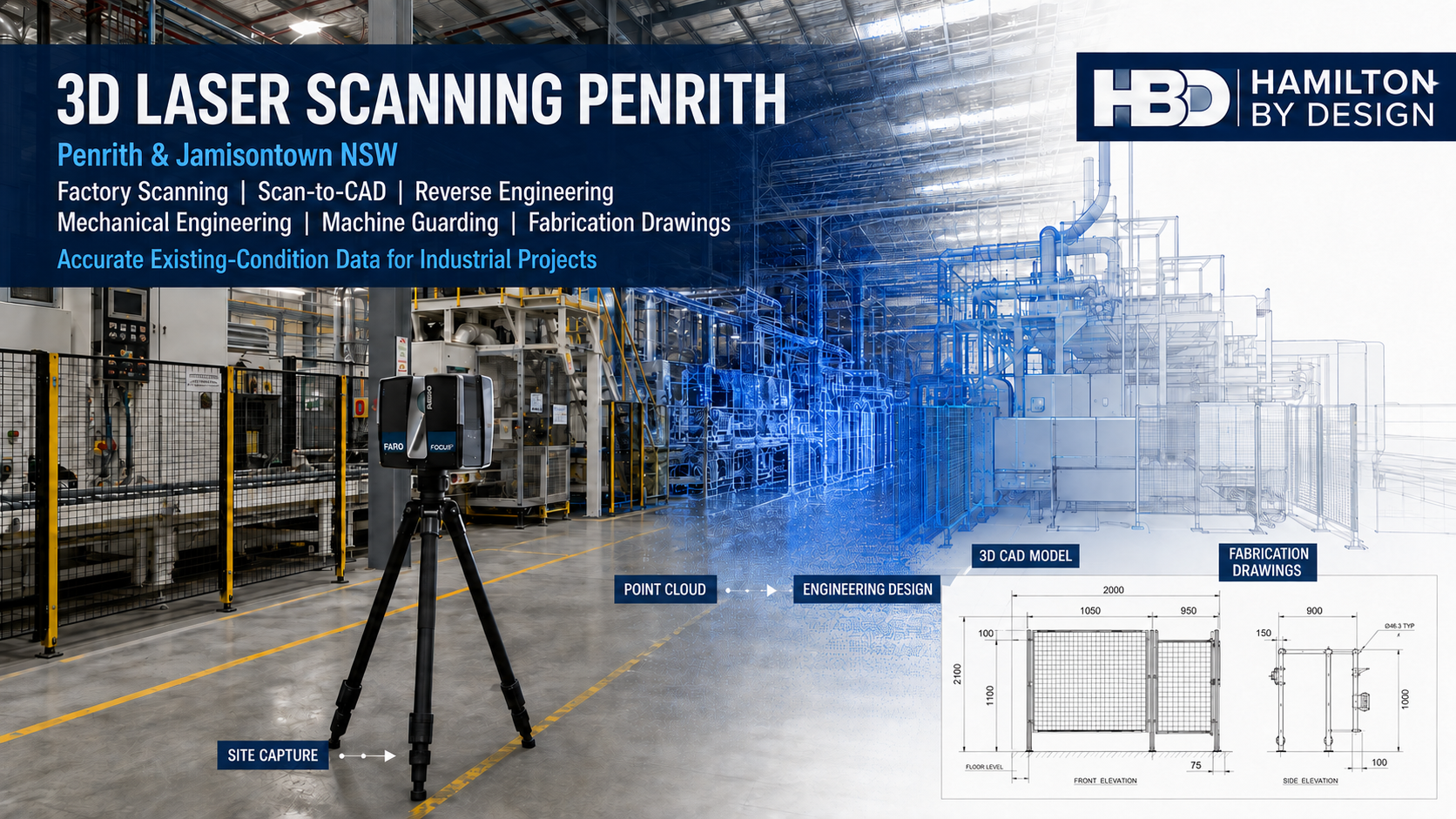


3D Laser Scanning Penrith | Scan-to-CAD & Engineering

3D laser scanning Penrith hero image showing a FARO scanner capturing a guarded factory for point-cloud modelling, engineering design, 3D CAD and fabrication drawings.

3D Laser Scanning Penrith: Engineering Support for Factories, Machinery and Industrial Facilities

Blue 3D LiDAR scanner icon on a tripod with scanning waves

Penrith and the neighbouring Jamisontown industrial area support a diverse range of manufacturing, engineering, automation, food-processing, fabrication, machinery-repair and industrial-service businesses. These operations rely on physical assets that must remain productive, safe and capable of being modified as business requirements change.

However, many industrial projects begin with a familiar problem: the available drawings no longer represent the equipment or facility as it exists today. Machinery may have been modified, production lines relocated, guards replaced, services rerouted or structural supports added without the corresponding engineering records being updated.

Hamilton By Design provides engineer-led 3D laser scanning in Penrith to capture existing industrial conditions and convert measurable spatial information into useful engineering outputs. These outputs can include point clouds, 3D CAD models, factory layouts, equipment models, guarding designs, fabrication drawings and controlled as-built records.

Unlike conventional surveying services that may stop at the point-cloud stage, Hamilton By Design combines reality capture with mechanical engineering consulting, design, drafting and practical manufacturing knowledge. This allows the captured information to support an engineering decision rather than remaining simply a visual record.

Penrith and Jamisontownโ€™s industrial character

Penrith is an important industrial and service centre within Western Sydney. Its industrial areas accommodate hydraulic specialists, machinery repairers, automation integrators, manufacturers, fabricators, construction suppliers and technical-service businesses.

Jamisontown, immediately south of central Penrith, includes established industrial and commercial properties around Batt Street, York Road, Regentville Road, Production Place and Blaikie Road. Operations in this area range from CNC machining and industrial-tool supply to equipment maintenance, warehousing and distribution.

Growth across Western Sydney is also creating demand for upgraded factories, more efficient warehouses, automated production systems and better-controlled engineering information. As facilities expand or change use, accurate knowledge of the existing environment becomes increasingly important.

Smeaton Grange is also relevant to Hamilton By Designโ€™s broader Western and South-Western Sydney service coverage. However, it is geographically separate from Penrith and forms part of the Camden local government area. It should therefore be treated as a distinct industrial precinct rather than described as part of Penrith.

Why industrial facilities need accurate existing-condition data

Industrial buildings and machinery are rarely static. A factory may undergo dozens of small modifications during its operational life. New conveyors are installed, platforms are extended, pipework is rerouted, electrical services are added and machinery is repositioned to meet changing production requirements.

The original drawings may still be available, but they do not necessarily represent the current plant.

Traditional site measurement can be effective for isolated dimensions, but it becomes increasingly difficult when a project involves congested machinery, overhead services, irregular structures or multiple interfaces. A measurement taken from one location may also fail to capture an obstruction that affects installation elsewhere.

Hamilton By Designโ€™s 3D scanning and CAD-modelling services provide a coordinated digital record of visible site conditions. The resulting point cloud can be reviewed, measured and used as a reference for subsequent engineering work.

It is important to understand that laser scanning remains a line-of-sight measurement process. It records visible surfaces; it does not see through guarding, cladding, machinery or stored materials. A suitable scanning plan therefore considers access, obstructions, required accuracy and the particular areas needed for the engineering task.

Factory scanning and production-line layouts

Factory layouts are often developed incrementally. Equipment is added where space appears to be available, but the resulting arrangement may not support efficient material flow, maintenance access or safe interaction between pedestrians and mobile plant.

A factory scan can establish the position of:

  • Production machinery
  • Conveyors and transfer systems
  • Structural columns and roof supports
  • Platforms, stairs and walkways
  • Pipework and service routes
  • Electrical cabinets and cable trays
  • Loading and storage areas
  • Doors, access routes and restricted spaces

Hamilton By Design can use this information to prepare manufacturing and production-line layouts for equipment relocation, new machinery installation, automation projects or factory expansion.

Proposed equipment can be modelled within the captured environment before the business commits to fabrication or installation. This allows project teams to identify spatial conflicts, maintenance-clearance problems and access restrictions earlier in the design process.

For a working factory, this can reduce disruption and improve confidence that new equipment will fit within the available space.

Reverse engineering machinery and components

Industrial businesses frequently depend on machinery for which drawings, CAD models and replacement components are no longer available. The original manufacturer may no longer support the equipment, or the machine may have been modified so extensively that its original documentation is no longer reliable.

Hamilton By Design provides reverse-engineering and Scan-to-CAD studies to capture existing machinery and components and recreate the required geometry in CAD.

Depending on the component and required accuracy, the process may combine:

  • Terrestrial laser scanning
  • Handheld 3D scanning
  • Direct physical measurement
  • Existing drawings and specifications
  • Material identification
  • Engineering calculations
  • Tolerance and fit assessment

The resulting model may be used to reproduce an unavailable component, design a modification, create a replacement guard or document an existing assembly.

Reverse engineering is more than copying external geometry. The engineer must consider function, load paths, materials, tolerances, manufacturing processes, wear and the relationship between the component and the surrounding equipment.

Hamilton By Design can develop fabrication-ready drawings from scan-to-CAD information so that the captured geometry becomes practical manufacturing information.

Mechanical design for industrial modifications

Accurate site data provides the foundation for mechanical design, but the design must still address operational requirements, loads, materials, maintenance, safety and manufacturability.

Hamilton By Design can assist Penrith businesses with:

  • Machinery and equipment modifications
  • Support frames and mechanical steelwork
  • Conveyor and material-handling changes
  • Equipment replacement studies
  • Platforms and maintenance access
  • Sheet-metal and fabricated components
  • Chutes, hoppers and transfer arrangements
  • Equipment installation planning
  • Finite element analysis
  • Design verification and technical documentation

Through its engineering design and drafting services, Hamilton By Design can support a project from the initial site investigation through to detailed design and fabrication documentation.

This integrated approach is particularly valuable in brownfield facilities. The same engineering team can interpret the scan, develop the model, identify the project constraints and prepare the final drawings. This reduces the risk of important site knowledge being lost between separate scanning, engineering and drafting providers.

Machine guarding and machinery safety

Machinery safety is a significant concern in manufacturing, food processing, packaging, fabrication and warehouse environments. Common hazards include exposed shafts, couplings, belts, pulleys, chains, sprockets, cutting tools, crushing zones and conveyor nip points.

Existing guards may also create secondary problems. They may restrict maintenance, be difficult to remove, leave unsafe gaps or encourage operators to bypass the protective system.

Hamilton By Design provides machine-guarding design and engineering for existing industrial machinery and fixed plant. A typical guarding project may include:

  1. Capturing the machinery and surrounding workspace.
  2. Identifying accessible mechanical hazards.
  3. Reviewing operating, cleaning and maintenance activities.
  4. Assessing the adequacy of existing guards and access controls.
  5. Developing practical risk-reduction concepts.
  6. Modelling guards within the actual machine environment.
  7. Preparing fabrication and installation drawings.
  8. Recording remaining or residual risks for the client.

The principal machinery-safety reference is the AS/NZS 4024 Safety of Machinery series. Depending on the project, other standards may apply to access systems, electrical controls, conveyors, lifting equipment or structural components.

A machinery review should not be treated as an automatic compliance certificate. The complete machine, its control system, installation, operating procedures and foreseeable uses must be considered. The appropriate scope and applicable standards should be established for each item of plant.

Mechanical drafting and fabrication drawings Penrith

A 3D model becomes significantly more useful when it is converted into a controlled drawing package that communicates what must be manufactured, assembled or installed.

Hamilton By Design provides Australian engineering drafting services for industrial and manufacturing projects. Typical deliverables include:

  • General-arrangement drawings
  • Part and assembly drawings
  • Fabrication drawings
  • Machining drawings
  • Sheet-metal details
  • Weld symbols and fabrication notes
  • Bills of materials
  • Installation drawings
  • Guarding layouts
  • As-built drawings
  • STEP, SAT, DWG, DXF and SolidWorks files

Mechanical drawings may be prepared with reference to the AS 1100 technical-drawing series. Fabricated steelwork may also require consideration of standards such as AS/NZS 1554.1 for structural steel welding and AS/NZS 5131 for structural steelwork fabrication and erection.

Standards must be selected according to the actual design, material, fabrication process and intended use. A single standard does not cover every aspect of an industrial assembly.

Logistics, warehousing and material handling

Warehouses and distribution facilities depend on the safe interaction of people, forklifts, pallet racking, conveyors, loading areas and automated equipment.

Problems can arise when a facility expands without a coordinated spatial plan. Pedestrian paths may cross forklift routes, stored materials may reduce access width and newly installed equipment may interfere with emergency exits or maintenance zones.

Hamilton By Design can assist logistics and warehouse operations with:

  • Facility and warehouse scanning
  • Racking and equipment layouts
  • Conveyor and palletising layouts
  • Forklift and pedestrian-separation concepts
  • Loading and dispatch-area planning
  • Maintenance and equipment clearances
  • Equipment-relocation studies
  • As-built documentation
  • Installation sequencing and clash reviews

The applicable requirements may include AS 4084 for steel storage racking, AS 1657 for fixed industrial access, the AS/NZS 4024 series for machinery safety and site-specific traffic-management requirements.

Hamilton By Design also provides engineering support for material-handling systems, including conveyors, transfer equipment and brownfield plant upgrades.

Engineering data retention and long-term asset knowledge

A scan or CAD model should not become another uncontrolled file stored on an individual computer. Industrial information has greater value when its origin, revision and approval status are understood.

Hamilton By Design can retain:

  • Registered point clouds
  • Facility scans
  • Equipment models
  • Guarding layouts
  • CAD assemblies
  • Fabrication drawings
  • As-built records
  • Revision histories
  • Supporting engineering documentation

Structured engineering-data governance gives authorised stakeholders controlled access to current project information and provides a reliable starting point for future modifications.

This is particularly valuable when staff change, machinery is relocated or another project begins several years after the original scan.

An engineer-led scanning workflow

Hamilton By Design has invested in the FARO scanning ecosystem to support engineering-grade reality capture and point-cloud processing.

A typical project follows these stages:

  1. Scope definition: Establish the project purpose, capture area, accuracy and required outputs.
  2. Site planning: Review access, obstructions, safety requirements and operational constraints.
  3. Data capture: Scan the visible facility, machinery or component from suitable positions.
  4. Registration and checking: Combine the scan positions and assess data quality.
  5. Point-cloud review: Confirm that the required interfaces and surfaces have been captured.
  6. Scan-to-CAD modelling: Develop the appropriate level of model detail for the task.
  7. Engineering and risk review: Apply mechanical-design, safety and operational requirements.
  8. Documentation: Produce drawings, models, reports or as-built records.
  9. Client review: Confirm the design intent and resolve comments.
  10. Controlled retention: Store approved information for future access and revision.

The objective is not to model every visible object unnecessarily. The level of detail should be selected according to what the model must achieve.

Who can benefit from 3D laser scanning in Penrith?

The service is suitable for:

  • Manufacturing businesses
  • Food and beverage processors
  • Packaging operations
  • Machine builders
  • Fabrication workshops
  • Hydraulic and mechanical-service companies
  • Warehouses and distribution centres
  • Project and maintenance teams
  • Safety managers
  • Asset owners planning brownfield modifications

Hamilton By Designโ€™s Scan-to-CAD Sydney service supports projects across Penrith, Jamisontown and the wider Western Sydney region.

Frequently asked questions

What is 3D laser scanning?

3D laser scanning is a non-contact measurement process that records the visible surfaces of an environment or object. The collected measurements form a point cloud containing spatial information that can be reviewed and converted into engineering models or drawings.

Can a laser scanner see through machinery or guards?

No. Laser scanning is a line-of-sight process. It captures visible surfaces and cannot see through machinery, sheet metal, walls or stored materials. Guards or obstructions may need to be removed where safe and authorised, or additional scan positions may be required.

What can be produced from a factory scan?

Deliverables may include a registered point cloud, factory layout, equipment model, 3D CAD assembly, guarding design, general-arrangement drawing, fabrication package or as-built record. The required output should be agreed before scanning.

Is laser scanning accurate enough for fabrication?

It can provide suitable data for many fabrication and installation projects when the correct equipment, scanning method and verification process are used. Critical fits, tolerances and inaccessible features may require supplementary handheld scanning or direct measurement.

Can Hamilton By Design reverse engineer an obsolete component?

Yes, subject to access, geometry, material information and the required engineering scope. Hamilton By Design can capture the component, reconstruct its geometry and prepare a CAD model or manufacturing drawing. Functional requirements, wear and tolerances must also be considered.

Can Hamilton By Design design machine guards?

Yes. Hamilton By Design can assess the physical machinery, develop guarding concepts and prepare fabrication drawings. The review should consider operation, cleaning, maintenance, foreseeable access and the relevant sections of AS/NZS 4024.

Which CAD formats are available?

Depending on the project, outputs may include SolidWorks files, STEP, SAT, DWG, DXF, AutoCAD layouts and other agreed exchange formats. Point-cloud formats can also be provided where included in the scope.

Can the scan data be retained for future projects?

Yes. Hamilton By Design can retain point clouds, CAD models, drawings and as-built information under structured revision control, providing a reliable baseline for future maintenance or plant modifications.

Does scanning require the factory to stop production?

Not always. Many areas can be captured while the facility remains operational, provided the work can be undertaken safely and moving objects do not compromise the required data. Some machinery areas may require isolation, controlled access or a planned shutdown.

Does Hamilton By Design provide surveying services?

Hamilton By Design provides engineering-focused 3D scanning and Scan-to-CAD services. It is not offering cadastral or registered land-surveying services. Where a project requires formal survey control, boundary definition or statutory surveying, an appropriately qualified surveyor may need to be engaged.

Talk to Hamilton By Design about 3D laser scanning Penrith

Accurate existing-condition data can reduce assumptions, improve design coordination and provide greater confidence before machinery is modified or components are fabricated.

Hamilton By Design supports Penrith and Jamisontown businesses with factory scanning, reverse engineering, mechanical design, machinery guarding, fabrication drawings, Scan-to-CAD modelling and controlled as-built information.

Whether the requirement involves a single component, an existing machine or an entire production area, the service can be scaled to capture the information needed for a practical engineering outcome.

Contact Hamilton By Design to discuss 3D laser scanning, mechanical engineering or fabrication drawings for a Penrith industrial project.


Hamilton By Design logo displayed on a blue tilted rectangle with a grey gradient background

Contact Us – Talk To Us

Name
Would you like us to arrange a phone consultation for you?
Address

Our clients:
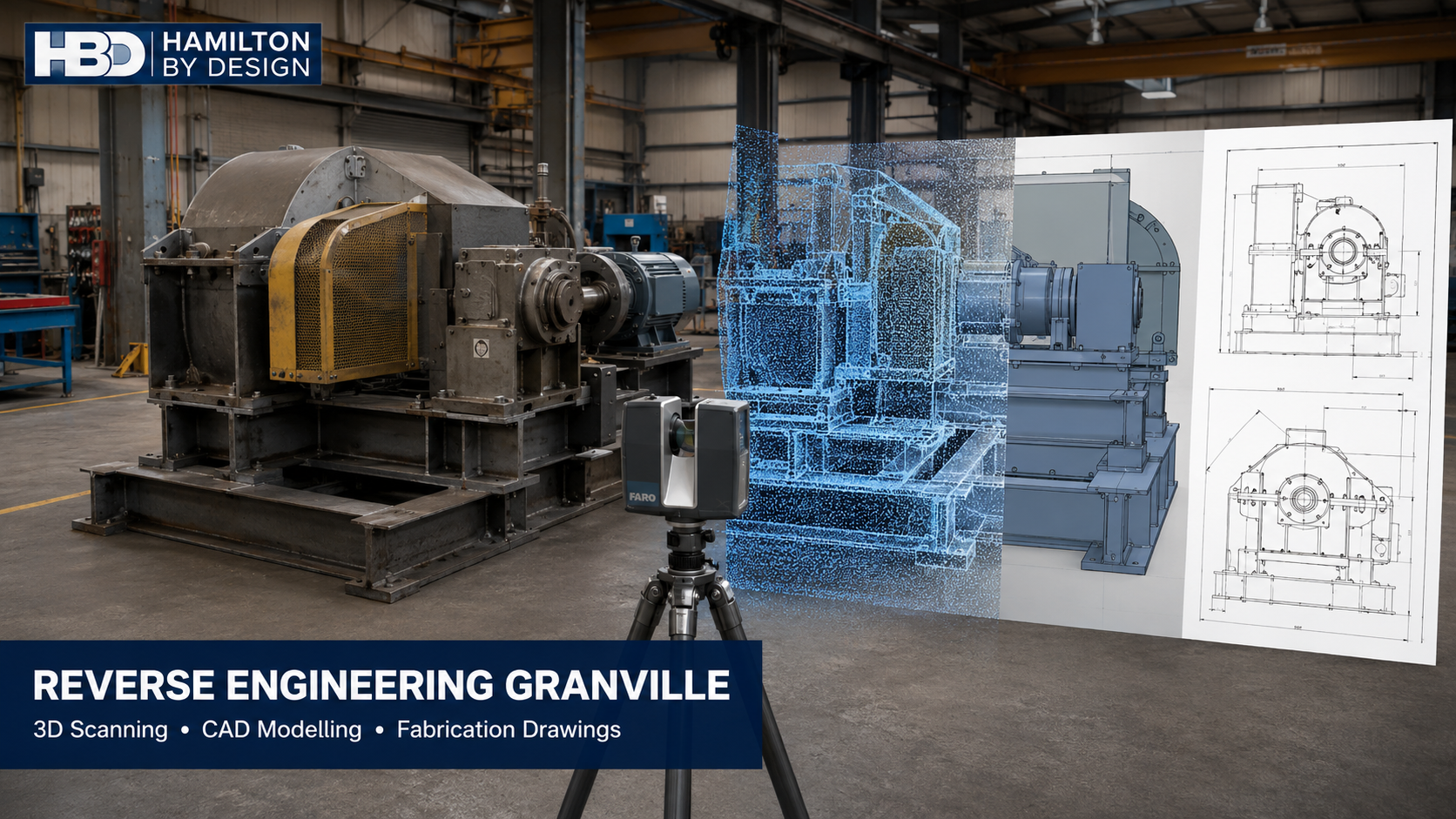


Reverse Engineering Granville | 3D Scanning and CAD

Reverse engineering in Granville showing industrial machinery captured with a FARO 3D scanner and converted into a point cloud, CAD model and fabrication drawings.

Reverse Engineering Granville: 3D Scanning, CAD Modelling and Fabrication Drawings for Industrial Machinery

Granville and South Granville have a long association with engineering, manufacturing, fabrication, railway operations, machinery maintenance and industrial workshops. Located close to Parramatta and connected to major road and rail freight routes, the area remains an important part of Western Sydneyโ€™s industrial economy.

Many businesses operating in Granville rely on machinery, production equipment and fabricated components that have been progressively repaired or modified over many years. Although these assets may remain operationally valuable, their original engineering information is often incomplete. Drawings may have been lost, suppliers may no longer exist, replacement parts may be unavailable, or the physical machine may no longer match its original documentation.

This is where reverse engineering in Granville can provide significant practical value.

Hamilton By Design combines engineering-grade 3D scanning, physical measurement, CAD modelling and mechanical engineering to convert existing machinery into useful digital engineering information. The resulting models and drawings can support component replacement, equipment refurbishment, safety improvements, plant modifications and future maintenance planning.

Granvilleโ€™s industrial and engineering character

Granvilleโ€™s industrial areas include a mixture of traditional workshops and increasingly sophisticated manufacturing operations. Representative activities include:

  • Rail braking, door, ventilation and onboard-system manufacture
  • CNC machining and precision-component production
  • General engineering and metal fabrication
  • Electrical switchboard and control-panel manufacturing
  • Sheet-metal production
  • Machinery repair and maintenance
  • Warehousing and freight distribution
  • Industrial building-product manufacture
  • Vehicle, transport and urban-support services

Businesses such as Knorr-Bremse Australia, Challenge Engineering, Trafalgar Access and a variety of smaller engineering and fabrication workshops demonstrate the diversity of the areaโ€™s industrial capability. These organisations are mentioned as representative local businesses and should not be interpreted as Hamilton By Design clients.

Granvilleโ€™s traditional engineering base also creates opportunities for industrial digitalisation. Existing knowledge held by operators, fitters and workshop personnel can be combined with modern scanning and modelling technology to create accurate, reusable engineering records.

What is reverse engineering?

Reverse engineering is the process of examining an existing machine, component or system and developing the engineering information required to understand, reproduce or modify it.

The process may involve:

  • Inspecting the equipment and understanding its function
  • Recording the machineryโ€™s existing condition
  • Capturing geometry using 3D laser scanning
  • Taking critical dimensions using calibrated measuring equipment
  • Identifying materials, fits, tolerances and interfaces
  • Developing a parametric 3D CAD model
  • Preparing manufacturing or fabrication drawings
  • Reviewing the design for safety, strength and maintainability

Reverse engineering should not be confused with simply creating a visual 3D mesh. A model can look realistic without containing the dimensional control, tolerances or engineering intent required for manufacturing.

Hamilton By Designโ€™s reverse engineering and Scan-to-CAD studies are intended to transform physical machinery into practical engineering information that can support real design, fabrication and maintenance decisions.

Why older machinery creates documentation problems

Industrial machinery often develops a complicated history. A machine may have been relocated, repaired, reinforced or altered several times during its operating life. Guards may have been replaced, motors upgraded, bearings changed and support structures modified.

Unfortunately, the drawings are not always updated when these changes occur.

As a result, a maintenance team may have an original drawing that no longer represents the actual machine. In other cases, only a general arrangement exists, with no detailed information about individual components.

Common documentation problems include:

  • Missing manufacturing drawings
  • Uncontrolled workshop sketches
  • Drawings that do not reflect previous modifications
  • Components with no visible part numbers
  • Obsolete imperial dimensions
  • Unidentified materials or heat treatments
  • Incomplete welding information
  • Unclear fits and tolerances
  • CAD files that cannot be opened in current software
  • Replacement parts that do not match the installed equipment

These problems increase the risk of incorrect procurement, fabrication errors, installation delays and unnecessary production downtime.

Engineering-grade 3D scanning in Granville

Manual measurement remains important, particularly when recording functional dimensions such as shaft diameters, bearing seats, threads, bores and machined interfaces. However, manual measurement alone can be inefficient when a machine has complex geometry or must be documented in relation to surrounding plant.

Engineering-grade 3D laser scanning captures millions of spatial measurements and converts them into a three-dimensional point cloud. This creates a detailed record of the machine and its environment.

For industrial projects, scanning can assist with:

  • Capturing machinery without extensive dismantling
  • Recording irregular and fabricated geometry
  • Locating mounting points and structural interfaces
  • Measuring existing pipework and services
  • Identifying obstructions around proposed modifications
  • Recording equipment before it is removed
  • Comparing existing and proposed layouts
  • Reducing repeated site visits
  • Supporting installation and clash reviews

Hamilton By Design uses FARO terrestrial LiDAR equipment and FARO SCENE software for point-cloud registration, processing and validation. The companyโ€™s FARO engineering workflow connects reality capture with downstream CAD modelling, design and fabrication documentation.

The appropriate scanner and measurement method must always be selected according to the required outcome. Large machines and workshop environments may suit terrestrial LiDAR, while small precision components generally require close-range measurement, detailed inspection and conventional metrology.

From point cloud to a usable CAD model

A point cloud is valuable evidence of existing conditions, but it is not automatically a manufacturing model.

Scan-to-CAD involves interpreting the measured data and rebuilding the component or assembly as controlled engineering geometry. The modeller must distinguish between original design intent, wear, damage, distortion, weld irregularities and later modifications.

For example, scanning a worn shaft does not necessarily mean that the replacement shaft should reproduce its worn diameter. The correct nominal size may need to be established by examining the bearing, seal, mating component, historical drawing and required engineering fit.

Hamilton By Designโ€™s Scan-to-CAD services in Sydney can convert existing-condition data into:

  • SolidWorks parts
  • Parametric assemblies
  • Sheet-metal components
  • Structural and fabricated models
  • Equipment general arrangements
  • Replacement-component geometry
  • Installation and interface models
  • Fabrication and machining drawings

This engineering interpretation is what separates reverse engineering from simple scanning.

Fabrication and manufacturing drawings

A successful reverse-engineering project must communicate enough information for the component or assembly to be manufactured correctly.

Hamilton By Design provides mechanical drafting services in Sydney for machinery, fabricated assemblies and industrial modifications. Deliverables may include:

  • General arrangement drawings
  • Detailed part drawings
  • Machining drawings
  • Fabrication drawings
  • Sheet-metal drawings
  • Weldment drawings
  • Assembly and exploded views
  • Bills of materials
  • Installation drawings
  • Inspection dimensions
  • Material and finish schedules
  • Revision-controlled as-built drawings

Mechanical drawings may be prepared with reference to AS 1100.101, covering general technical-drawing principles, and AS 1100.201, addressing mechanical engineering drawing practices. Structural and fabrication work may also require relevant parts of AS/NZS 1100.501, AS/NZS 1554, AS 4100 or other project-specific standards.

The applicable standards depend on the equipment, materials, manufacturing process, operational duty and client requirements. Standards should therefore be selected during the project rather than added to drawings as a generic compliance statement.

Supporting plant modifications

Reverse engineering is particularly useful when existing machinery must be modified rather than reproduced.

A Granville manufacturer may need to:

  • Install a different motor or gearbox
  • Replace an obsolete bearing arrangement
  • Increase production capacity
  • Modify a frame to accept new equipment
  • Relocate a machine within a workshop
  • Add platforms or maintenance access
  • Replace damaged guards
  • Integrate automation or robotic equipment
  • Change a conveyor or material-transfer arrangement
  • Develop new lifting or handling points

Hamilton By Design can capture the existing equipment, model the proposed modification and examine how it fits within the available space. Where appropriate, engineering calculations or finite element analysis can be used to assess stress, deformation and the suitability of proposed structural changes.

The objective is not merely to make a new component fit. A modification should also consider loads, fatigue, access, maintainability, manufacturing constraints and potential safety consequences.

Machinery safety and guarding

Older machinery may continue to perform its production function while presenting safety issues that were not adequately addressed in its original design.

Common hazards include:

  • Exposed shafts and couplings
  • Accessible belts, chains and sprockets
  • Crushing and shearing points
  • In-running nip points
  • Unexpected movement during maintenance
  • Inadequate isolation arrangements
  • Guards that can be easily removed or bypassed
  • Openings that allow access to hazardous areas
  • Poor access to lubrication or inspection points
  • Platforms, ladders or walkways that are difficult to use safely

Hamilton By Design can support machinery risk assessments and develop machine-guarding designs and engineering documentation. Depending on the project, this may include fixed guards, removable guards, interlocked access arrangements, maintenance openings, access platforms and supporting fabrication drawings.

Machinery safety work may reference the AS/NZS 4024 Safety of Machinery series, including principles for hazard identification, risk assessment and risk reduction. Access systems may require consideration of AS 1657, while the SafeWork NSW Managing the Risks of Plant in the Workplace Code of Practice provides additional guidance for workplaces in New South Wales.

Engineering documentation supports the plant ownerโ€™s safety and compliance process. It does not replace worker consultation, safe operating procedures, isolation systems, training or specialist electrical and control-system validation.

Engineering support for logistics and warehousing

Freight, logistics and warehousing are significant activities across Cumberland. As warehouses adopt automation, taller storage systems and more complex materials-handling equipment, accurate spatial information becomes increasingly valuable.

Hamilton By Design can assist logistics and warehouse operators with:

  • Existing-condition warehouse scans
  • Machinery and storage layouts
  • Conveyor modifications
  • Materials-flow planning
  • Forklift and pedestrian-interface layouts
  • Equipment-relocation studies
  • Loading and maintenance-access reviews
  • Lifting-device and lifting-point design
  • Clash detection for new plant
  • Installation drawings and as-built records

Relevant requirements may include the AS 2359 series for powered industrial trucks, AS 4084.1 for steel storage racking, AS 4991 for lifting devices and AS 1657 for fixed access systems.

A coordinated point cloud and CAD model can help project teams determine whether equipment will fit, how it will be installed and whether suitable operating and maintenance clearances are available.

Retaining valuable machinery information

The value of reverse engineering continues after the immediate repair or modification has been completed.

Subject to an agreed project scope and client data requirements, Hamilton By Design can retain:

  • Registered machine scans
  • Point-cloud information
  • Existing-condition photographs
  • CAD parts and assemblies
  • Fabrication and manufacturing drawings
  • Component geometry
  • Bills of materials
  • Modification records
  • Approved drawing revisions

Maintaining this information reduces the need to start again when another component fails or a future modification is proposed. It also helps organisations preserve engineering knowledge when experienced employees leave the business.

A controlled digital asset record can therefore support maintenance planning, procurement, future design work and business continuity.

A practical reverse-engineering process

A typical project begins by defining the problem and the required output. A client needing a replacement shaft requires a different level of capture from a client planning to relocate an entire production line.

The general process is:

  1. Review the machine, component and operational problem.
  2. Identify the required accuracy and final deliverables.
  3. Inspect and capture the existing equipment.
  4. Register and validate the scanning or measurement data.
  5. Model the required components and assemblies.
  6. Determine nominal geometry, materials, fits and tolerances.
  7. Review design function, safety and manufacturability.
  8. Complete engineering analysis where required.
  9. Prepare controlled manufacturing or fabrication drawings.
  10. Review the deliverables with the client and fabricator.
  11. Update the records following manufacture or installation.

Hamilton By Designโ€™s article on moving from an existing component to a fabrication drawing explains why accurate capture must be combined with practical engineering judgement.

Reverse engineering support for Granville businesses

Reverse engineering can help Granvilleโ€™s manufacturers, rail-equipment suppliers, fabricators, maintenance contractors and warehouse operators extend the useful life of existing assets.

The process provides a practical connection between traditional engineering knowledge and modern digital tools. Instead of relying on assumptions, incomplete sketches or outdated drawings, businesses can work from measured existing conditions.

Hamilton By Design offers reverse engineering and 3D scanning services in Sydney to support equipment replacement, machinery modifications, fabrication projects, safety improvements and long-term asset documentation.

For Granville businesses, the result can be reduced uncertainty, fewer fabrication errors, better-maintained engineering records and more informed decisions about existing machinery.

Frequently asked questions

What types of machinery can be reverse engineered?

Most industrial machinery and fabricated equipment can be assessed, including frames, shafts, housings, guards, chutes, conveyors, brackets, platforms, lifting devices and production-line assemblies. The measurement method depends on the componentโ€™s size, complexity, accessibility and required manufacturing accuracy.

Can 3D scanning produce a fabrication-ready drawing?

Scanning provides measured geometry, but engineering work is still required. The point cloud must be validated and interpreted before a controlled CAD model and drawing can be prepared. Materials, tolerances, welds, fits, finishes and functional requirements must also be established.

Can Hamilton By Design reproduce an obsolete component?

Hamilton By Design can capture and document obsolete components for replacement or refurbishment. Before manufacture, the componentโ€™s function, wear, material, interfaces and intellectual-property restrictions should be reviewed.

Is terrestrial LiDAR suitable for small precision parts?

Terrestrial LiDAR is particularly effective for machinery, plant rooms, workshops and large fabricated assemblies. Smaller precision components may require close-range scanning or conventional measurement using calipers, micrometers, bore gauges and other metrology equipment.

What file formats can be provided?

Deliverables can be discussed at the start of the project and may include SolidWorks files, STEP models, DWG or DXF drawings, PDF drawing packages, point-cloud formats and other agreed client formats.

Can existing drawings be checked against the actual machine?

Yes. Existing drawings or CAD models can be compared with scan data and physical measurements. Differences can be identified and updated as-built models or drawings can then be prepared.

Can reverse engineering help with machinery safety?

Yes. Existing-condition capture can support hazard identification, guarding reviews, access improvements and the preparation of modification drawings. The machinery risk assessment should consider the complete operating, cleaning, inspection and maintenance lifecycle.

Which Australian Standards apply?

The applicable standards depend on the project. Common references may include the AS/NZS 4024 machinery-safety series, AS 1100 technical-drawing standards, AS/NZS 1554 welding standards, AS 4100 for steel structures, AS 1657 for fixed access and AS 4991 for lifting devices. The correct standards must be confirmed for each asset.

Can the scan and CAD information be retained for future projects?

Yes, subject to the agreed data-management, confidentiality and retention arrangements. Retaining point clouds, models, drawings and revision histories can simplify future maintenance and modification work.

Does reverse engineering require the machine to be dismantled?

Not always. External geometry and surrounding interfaces can often be captured while the machine remains assembled. Dismantling may be required when internal features, hidden interfaces or precision fits must be measured.

How does reverse engineering reduce downtime?

Accurate existing-condition information allows much of the design and fabrication planning to occur before a shutdown. It can also reduce repeated site visits, incorrect parts, installation clashes and unexpected modifications during installation.

How can a Granville business begin a reverse-engineering project?

The first step is to identify the asset, the operational problem and the required outcome. Photographs, available drawings and a short description can support an initial discussion. Hamilton By Design can then recommend an appropriate combination of inspection, 3D scanning, measurement, CAD modelling and engineering documentation.


Hamilton By Design logo displayed on a blue tilted rectangle with a grey gradient background

Contact Us – Talk To Us

Name
Would you like us to arrange a phone consultation for you?
Address

Our clients:
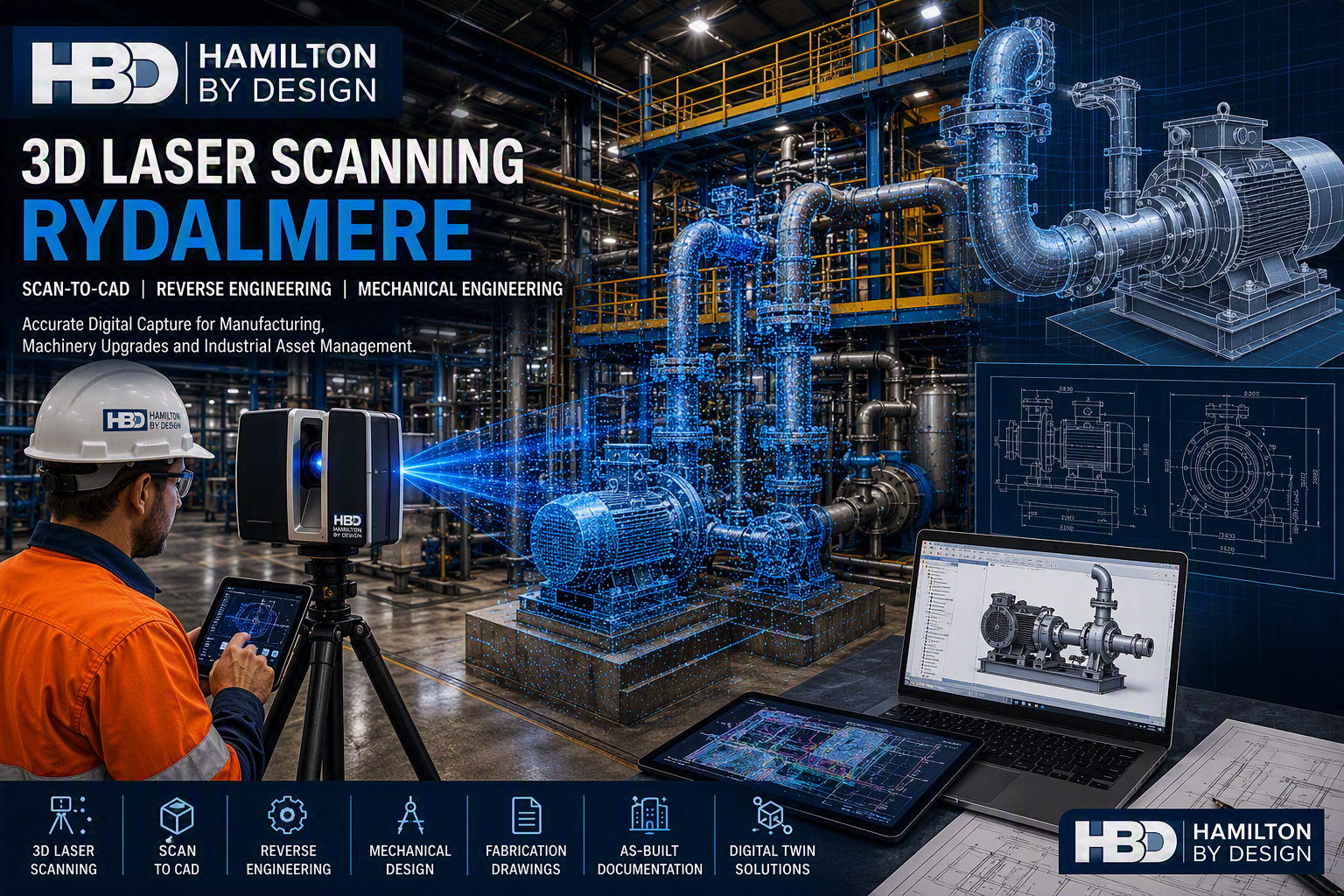


3D Laser Scanning Rydalmere NSW | Scan to CAD, Reverse Engineering & Mechanical Design

Engineer performing 3D laser scanning of industrial machinery in a Rydalmere manufacturing facility with digital point cloud and CAD model overlay

3D Laser Scanning Rydalmere: Modern Engineering Solutions for an Established Industrial Hub

Rydalmere has long been recognised as one of Western Sydney’s most important industrial precincts. Located adjacent to Parramatta and supported by major transport corridors including Victoria Road, James Ruse Drive and the M4 Motorway, the suburb is home to a diverse mix of manufacturers, engineering firms, technology businesses, warehousing operations and industrial service providers. The City of Parramatta identifies Rydalmere as a key employment precinct with increasing emphasis on advanced manufacturing, technology and knowledge-based industries.

As industrial facilities mature, businesses face a growing challenge: maintaining, upgrading and documenting assets that may have been modified repeatedly over many decades. Original drawings are often missing, equipment documentation may be outdated, and replacement parts can be difficult or impossible to source.

This is where 3D laser scanning in Rydalmere has become a valuable engineering tool. By capturing highly accurate digital representations of machinery, facilities and industrial infrastructure, businesses can make informed decisions, reduce project risks and improve operational efficiency.

At Hamilton By Design, we help industrial businesses throughout Rydalmere, Parramatta and Greater Sydney through specialised services including

3D Laser Scanning

Reverse Engineering

Mechanical Design

Scan-to-CAD


Why Rydalmere Businesses Need 3D Laser Scanning

Rydalmere contains a significant number of manufacturing and engineering businesses operating within established industrial facilities. Industries represented in the area include machinery manufacturing, water treatment equipment, fabrication, plastics processing, engineering services, industrial technology and logistics operations.

Many of these facilities share common challenges:

  • Ageing plant and equipment
  • Incomplete engineering documentation
  • Facility expansion constraints
  • Production downtime risks
  • Machinery safety compliance requirements
  • Difficulty sourcing replacement components

Traditional measurement techniques often require substantial time on-site and may not provide the level of accuracy needed for complex industrial projects.

Using https://www.hamiltonbydesign.com.au/3d-laser-scanning3D laser scanning services, organisations can capture millions of measurement points within a facility, creating an accurate digital point cloud that reflects actual site conditions. This information can then be converted into engineering models, layouts and drawings for future projects.


Understanding the Scan-to-CAD Process

One of the most valuable applications of industrial laser scanning is the development of accurate CAD models from real-world assets.

The process typically involves:

1. Site Capture

A laser scanner records the geometry of machinery, structures, pipework, production lines or facilities. The result is a highly detailed three-dimensional dataset known as a point cloud.

2. Data Processing

Scan data is merged and aligned to create a complete digital representation of the asset or facility.

3. CAD Modelling

The captured data is transformed into engineering-grade CAD models using specialised software.

4. Engineering Documentation

The completed models are then used to create:

  • Manufacturing drawings
  • Fabrication drawings
  • General arrangement drawings
  • Assembly drawings
  • Installation layouts
  • As-built documentation

Hamilton By Design provides comprehensive https://www.hamiltonbydesign.com.au/scan-to-cadscan-to-CAD services to help organisations create accurate engineering records and support future design activities.


Reverse Engineering for Obsolete Machinery

Many industrial businesses in Rydalmere continue to operate machinery that remains mechanically reliable but is no longer supported by original equipment manufacturers.

When components fail, businesses often face three choices:

  1. Purchase an entirely new machine.
  2. Attempt manual measurement and reproduction.
  3. Reverse engineer the component.

The third option is often the most cost-effective.

Using a combination of laser scanning, CAD modelling and engineering analysis, Hamilton By Design can provide https://www.hamiltonbydesign.com.au/reverse-engineeringreverse engineering services that enable businesses to:

  • Reproduce discontinued components
  • Improve existing designs
  • Manufacture replacement parts locally
  • Reduce production downtime
  • Extend equipment service life

This approach is particularly valuable in mature industrial precincts such as Rydalmere where machinery upgrades often occur incrementally rather than through complete facility replacement.


Supporting Manufacturing Through Mechanical Design

Modern manufacturers must continually improve productivity, safety and reliability while managing capital expenditure.

Mechanical design plays an essential role in achieving these objectives.

Hamilton By Design assists organisations through professional https://www.hamiltonbydesign.com.au/mechanical-designmechanical engineering and design services including:

  • Machinery upgrades
  • New equipment design
  • Production line modifications
  • Conveyor systems
  • Maintenance access improvements
  • Structural integration design
  • Plant optimisation projects

Every design project benefits significantly from having accurate existing-condition data generated through 3D laser scanning.

By designing from reliable site information, organisations can reduce clashes, avoid rework and improve installation outcomes.


Improving Safety Through Digital Engineering

Safety remains one of the most important considerations within industrial facilities.

As organisations carry out upgrades and modifications, they must ensure safe access, machine guarding and maintenance procedures are adequately addressed.

Laser scanning can support safety initiatives by providing accurate information for:

Machine Guarding Design

Digital models help engineers identify pinch points, entanglement hazards and unsafe operating areas.

Relevant Standards:

  • AS 4024 Safety of Machinery Series

Access Platform Design

Accurate scanning helps support the design of:

  • Platforms
  • Walkways
  • Stairs
  • Ladders

Relevant Standards:

  • AS 1657 Fixed Platforms, Walkways, Stairways and Ladders

Risk Assessments

Engineers can review equipment layouts and maintenance zones before physical construction begins.

Relevant Frameworks:

  • ISO 12100 Safety of Machinery
  • AS/NZS ISO 31000 Risk Management

Hamilton By Design assists organisations by integrating practical engineering solutions with recognised Australian standards to improve safety outcomes and reduce project uncertainty.


Supporting Logistics and Industrial Operations

Rydalmere’s location within Western Sydney makes it an important logistics and distribution hub. Warehousing, transportation and industrial storage facilities continue to operate throughout the precinct.

Logistics projects frequently involve:

  • Warehouse expansions
  • Conveyor installations
  • Material handling equipment upgrades
  • Vehicle movement reviews
  • Loading dock modifications

By using laser scanning before commencing design activities, project teams can gain a complete understanding of existing infrastructure.

Hamilton By Design supports logistics and warehousing operators by providing:

  • Facility scanning
  • Equipment modelling
  • Layout optimisation
  • Mechanical drafting
  • Engineering design support
  • Installation documentation

The result is improved planning, greater confidence during implementation and reduced operational disruption.


Engineering Documentation for Long-Term Asset Management

One of the strongest arguments for industrial laser scanning is the creation of long-term digital asset records.

Many businesses operate facilities that have evolved over decades. Documentation may exist in multiple formats, be incomplete or simply no longer reflect real-world conditions.

Hamilton By Design can create and retain valuable engineering information including:

  • Point clouds
  • Machinery scans
  • CAD assemblies
  • Fabrication drawings
  • As-built drawings
  • Digital asset records
  • Dimensional verification reports

These records provide a foundation for future maintenance, engineering projects, safety reviews and capital upgrades.

In many cases, organisations discover that the value of this digital information extends far beyond the initial project for which it was created.


Why Choose Hamilton By Design?

Hamilton By Design understands the unique challenges facing industrial businesses operating within mature manufacturing environments such as Rydalmere.

Our services combine practical industry experience with modern digital engineering tools to deliver accurate, reliable and actionable results.

Whether your project requires:

  • 3D laser scanning Rydalmere
  • Reverse engineering Rydalmere
  • Mechanical engineering Rydalmere
  • Machinery scanning Parramatta
  • Scan-to-CAD Rydalmere
  • Fabrication drawings
  • Industrial design support

our goal is to provide engineering solutions that reduce risk, improve efficiency and support long-term business performance.

For more information about our engineering and scanning capabilities, visit Hamilton By Design.


Frequently Asked Questions

What is 3D laser scanning?

3D laser scanning is a process that captures highly accurate measurements of physical objects, machinery or facilities using laser technology. The collected data is used to create a digital point cloud and engineering-grade models.

What industries benefit from 3D laser scanning in Rydalmere?

Industries commonly benefiting from scanning services include:

  • Manufacturing
  • Engineering
  • Industrial processing
  • Warehousing
  • Logistics
  • Utilities
  • Infrastructure
  • Asset management

What is scan-to-CAD?

Scan-to-CAD is the process of converting laser scan data into usable CAD models and engineering drawings. These models can be used for manufacturing, maintenance, upgrades and project planning.


Can obsolete machinery parts be reproduced?

Yes. Through reverse engineering, existing components can be scanned, modelled and documented to create replacement parts when original drawings are unavailable.


How accurate is industrial laser scanning?

Industrial laser scanning provides highly accurate spatial measurements that are significantly more comprehensive than traditional manual measuring methods.


What data can Hamilton By Design retain for future projects?

Hamilton By Design can maintain:

  • Point clouds
  • CAD models
  • Machinery assemblies
  • Fabrication drawings
  • Engineering documentation
  • As-built records
  • Dimensional verification data

Which Australian Standards are commonly relevant?

Depending on project requirements, relevant standards may include:

  • AS 4024 Safety of Machinery
  • AS 1657 Fixed Platforms, Walkways, Stairways and Ladders
  • AS 1100 Technical Drawing Series
  • AS 4100 Steel Structures
  • AS/NZS 1170 Structural Actions
  • AS/NZS ISO 31000 Risk Management

How can laser scanning reduce project risk?

Laser scanning provides accurate existing-condition information before design work begins. This helps reduce clashes, minimise rework, improve fabrication accuracy and support safer project execution.


Hamilton By Design logo displayed on a blue tilted rectangle with a grey gradient background

Contact Us – Talk To Us

Name
Would you like us to arrange a phone consultation for you?
Address

Our clients:

Reverse Engineering Milperra | 3D Scanning & Design

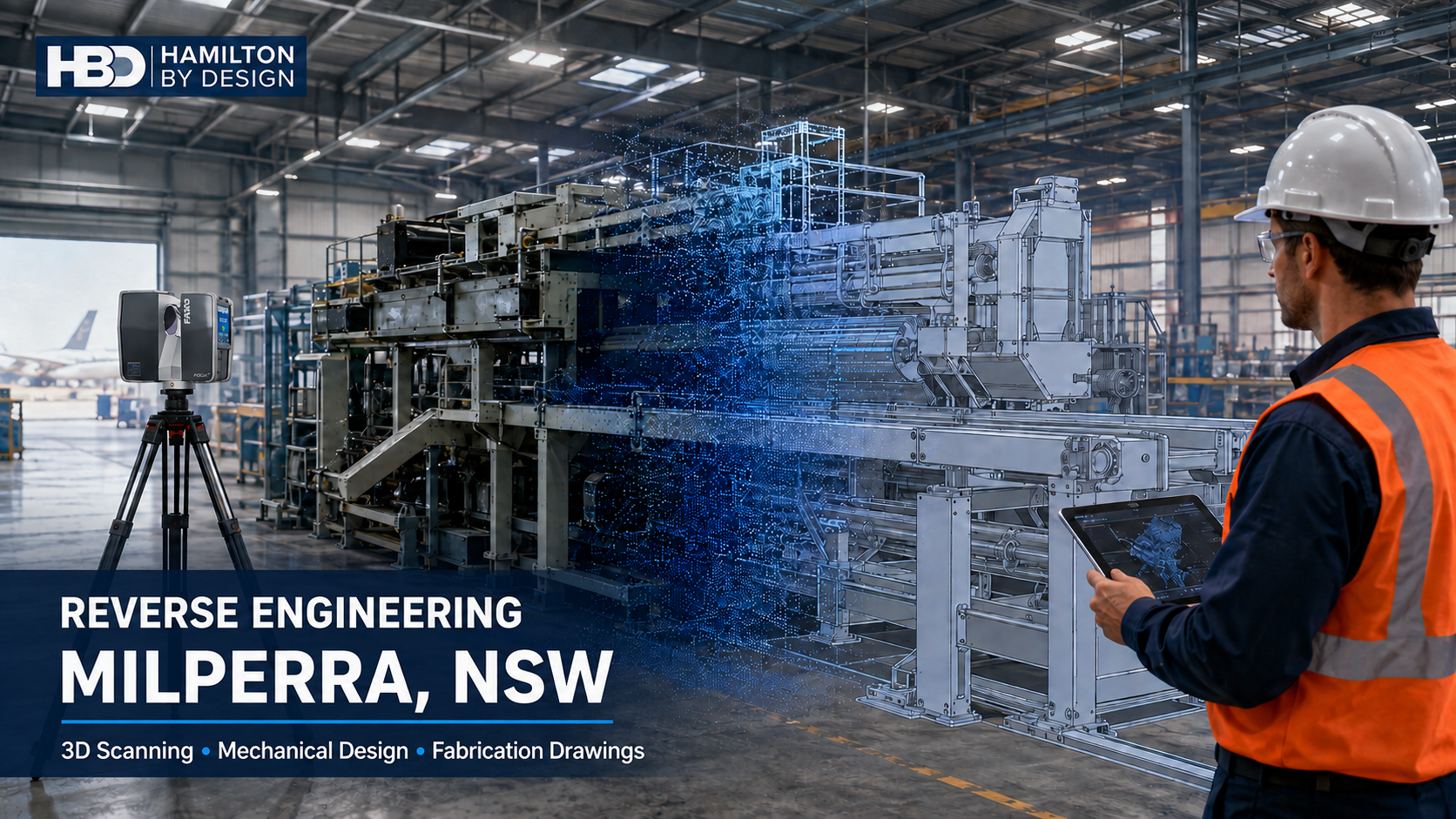
Hamilton By Design reverse engineering and 3D scanning services for industrial machinery in Milperra, NSW.

Reverse Engineering Milperra: 3D Scanning, Mechanical Design and Manufacturing Support

Blue Gear and Spanner icon

Milperra is one of south-west Sydneyโ€™s established industrial areas, supporting manufacturing, aviation-related businesses, metal fabrication, machinery suppliers, warehousing and logistics operations. Its proximity to Bankstown Airport, the M5 motorway and major freight routes makes the area attractive to businesses that depend on reliable machinery, accurate engineering information and efficient production facilities.

However, many established industrial operations face a common problem: the available drawings no longer represent the machinery or factory as it currently exists. Equipment may have been modified, replacement parts may be obsolete, and additions to the factory may never have been formally documented.

Hamilton By Design provides reverse engineering in Milperra, combining engineering-grade 3D scanning, mechanical engineering, CAD modelling and fabrication drawings to help businesses understand, maintain and improve their physical assets.

Solving problems caused by missing engineering information

Machinery often remains in service for decades. During that time, guards, frames, drives, conveyors, pipework and other components may be repaired or altered. Original equipment manufacturers can cease trading, spare parts can become unavailable and engineering drawings can be lost.

Without reliable information, even a relatively simple modification can involve considerable uncertainty. Incorrect measurements can result in components that do not fit, installation clashes, workshop rework and extended production shutdowns.

Hamilton By Designโ€™s reverse-engineering and 3D-scanning services can capture an existing component or machine and convert the required geometry into a usable CAD model. Depending on the purpose of the project, the resulting information may include a component model, complete assembly, general arrangement drawing, fabrication drawing or controlled as-built record.

This gives manufacturers and machinery operators a practical way to replace obsolete components, document modified equipment and establish reliable engineering information for future work.

3D scanning machinery and factories in Milperra

Blue 3D LiDAR scanner icon on a tripod with scanning waves

Traditional measurement tools remain valuable, but complex machinery and congested factory environments can be difficult to document with tapes and handheld laser-measuring devices alone. Important interfaces may be inaccessible, and individual measurements do not always communicate the full spatial relationship between equipment, structures and services.

Hamilton By Designโ€™s engineering-grade 3D laser-scanning service captures millions of measurable points from the existing environment. These points form a three-dimensional point cloud representing the machinery, factory or component at the time of scanning.

Factory and machinery scanning can assist with:

  • Capturing existing machinery and production equipment
  • Recording frames, guards, conveyors and fabricated assemblies
  • Locating columns, walls, pipework and building services
  • Confirming equipment connection and mounting points
  • Checking maintenance and installation clearances
  • Planning equipment relocations and factory modifications
  • Comparing manufactured or installed equipment with a design model
  • Creating an accurate reference for later engineering projects

Point-cloud data can be incorporated into a CAD environment, allowing proposed equipment to be modelled in relation to the existing factory. Potential clashes can then be identified before components are manufactured or installers arrive on site.

Mechanical engineering services for manufacturers

A point cloud records what exists, but engineering knowledge is required to turn that information into a safe, practical and manufacturable solution.

Through its mechanical-engineering consulting services, Hamilton By Design can assist Milperra manufacturers with machinery modifications, special-purpose equipment, production improvements, guards, access systems, mechanical supports, conveyors and equipment layouts.

The engineering process can consider:

  • The intended function of the equipment
  • Operating and environmental conditions
  • Applied, dynamic and cyclic loads
  • Materials and manufacturing methods
  • Installation constraints
  • Inspection and maintenance access
  • Interaction between workers and machinery
  • Existing structural and mechanical interfaces
  • Relevant Australian Standards and client specifications

Where component strength, stiffness, fatigue or stability requires investigation, Hamilton By Design can also provide finite element analysis and mechanical assessment. FEA can support design development by showing how a component or frame is expected to respond to defined loading conditions.

Depending on the particular scope, relevant standards may include the AS/NZS 4024 machinery-safety series, AS 3990 for mechanical equipment steelwork, AS 4100 for steel structures and AS 1657 for fixed platforms, walkways, stairs and ladders. The applicable standards must be identified for each project rather than applying one general standard to every item of machinery.

Mechanical drafting and fabrication documentation

Structural engineering drafting icon showing a seated engineer working at a drafting table in blue vector style.

A successful design must be communicated clearly to the people responsible for purchasing materials, machining components, cutting plate, welding assemblies and installing equipment.

Hamilton By Designโ€™s mechanical drafting services can produce:

  • Three-dimensional component models
  • Machinery and equipment assemblies
  • General arrangement drawings
  • Fabrication and workshop drawings
  • Machined-component drawings
  • Plate and sheet-metal details
  • Bills of materials
  • Weld and assembly information
  • Installation drawings
  • Factory and equipment layouts
  • As-built engineering records

The companyโ€™s fabrication and product-design service connects engineering intent with practical workshop requirements. Drawing packages can be developed around the required manufacturing process, materials, tolerances and assembly sequence.

Mechanical drawings may be prepared with reference to the AS 1100 technical-drawing series, including the conventions applicable to mechanical engineering drawings. Fabricated steelwork may also require consideration of AS/NZS 1554.1 for welding, AS/NZS 5131 for structural steelwork fabrication and erection, and other project-specific standards.

The drawing package should clearly identify which standards and specifications apply. It should not claim general compliance with unrelated standards.

Engineering support for logistics and warehousing

Milperraโ€™s logistics and warehousing sector also depends on machinery, conveyors, storage equipment, loading facilities and safe movement through the workplace.

Hamilton By Design can scan an operating warehouse and develop a coordinated layout showing existing structures, equipment and relevant services. Proposed conveyors, platforms or machinery can then be positioned within the scanned environment to assess available space and potential interference.

Engineering assistance for logistics operations may include:

  • Conveyor and materials-handling layouts
  • Equipment supports and platforms
  • Loading and transfer equipment
  • Forklift and pedestrian-separation concepts
  • Machinery guarding
  • Protective barriers
  • Maintenance-access systems
  • Warehouse and facility layouts
  • Installation-clearance assessments
  • As-built CAD documentation

Depending on the project, applicable standards may include AS/NZS 4024.3610 for conveyors, AS 2359.1 for powered industrial trucks, AS 4084.1 for steel storage racking design and AS 4084.2 for the operation and maintenance of steel storage racking.

Machinery safety and risk-management support

Manufacturing and logistics businesses must manage hazards associated with moving machinery, conveyors, forklifts, stored energy, maintenance activities and access at height.

SafeWork NSW identifies machinery and mobile plant as major workplace hazards and emphasises guarding, safe isolation and controls that prevent access to dangerous moving parts. Hamilton By Design can provide engineering support by helping clients identify hazards that may require a physical design response.

This assistance may include:

  • Machinery hazard identification
  • Guarding assessments and guard design
  • Identification of crush, shear and entanglement points
  • Maintenance and inspection-access reviews
  • Platform, stair and walkway design
  • Mechanical isolation-point documentation
  • Barrier and equipment-separation design
  • Assessment of ejected-component hazards
  • Design reviews for plant modifications
  • Design-risk registers
  • Documentation of residual engineering risks

Risk-management activities can be structured with reference to AS ISO 31000, while machinery-specific risk reduction may draw on the AS/NZS 4024 series. AS/NZS ISO 45001 may also inform the clientโ€™s broader occupational health and safety management system.

Hamilton By Designโ€™s role is to supply engineering analysis, design and documentation that support risk reduction. Operational procedures, worker consultation, training, electrical validation and statutory compliance may require collaboration with the client, specialist safety advisers and licensed practitioners.

Retaining valuable machinery and factory data

Following completion of an agreed project, Hamilton By Design can retain selected engineering information to support future work. This may include machinery models, component scans, CAD assemblies, fabrication documentation and facility layouts.

Retaining controlled information means a client may not need to start again when a component requires replacement or another factory modification is planned. Existing data can provide a valuable starting point, subject to verification that the asset has not changed since it was captured.

Frequently asked questions

What is reverse engineering?

Reverse engineering is the process of examining an existing component, machine or assembly to produce usable engineering information. This can include measurements, scan data, CAD models and manufacturing drawings.

Can 3D scanning reproduce a damaged component?

Scanning can capture the componentโ€™s existing geometry, including wear or damage. Engineering judgement is then required to determine the intended geometry and whether a replacement should reproduce, repair or improve the original design.

Can Hamilton By Design scan an operating factory?

Yes, subject to site access, safety requirements and scanning conditions. LiDAR can capture substantial information remotely, reducing the need to physically access every measurement point. Some equipment may still need to be isolated or made accessible.

What information can be supplied to a fabricator?

Depending on the agreed scope, Hamilton By Design can supply 3D models, general arrangements, fabrication drawings, component details and bills of materials. Required tolerances, materials, welding details and applicable standards should be established during the project.

Can scanning help reduce shutdown time?

Scanning does not eliminate every project risk, but it can reduce repeated site measurement, identify clashes earlier and allow more planning to occur before a shutdown begins.

Which Australian Standards apply?

The applicable standards depend on the machinery, materials, loads, workplace and intended use. Common references may include AS/NZS 4024, AS 1657, AS 3990, AS 4100, AS/NZS 1554.1 and AS ISO 31000. Standards should be confirmed for each individual scope.

How can I discuss a Milperra project?

Businesses requiring reverse engineering, 3D scanning, mechanical engineering or factory scanning in Milperra can contact Hamilton By Design to discuss the machinery, available information, required deliverables and proposed timeframe.


Hamilton By Design logo displayed on a blue tilted rectangle with a grey gradient background

Contact Us – Talk To Us

Name
Would you like us to arrange a phone consultation for you?
Address

Our clients:


Reverse Engineering St Marys NSW | Hamilton By Design

Reverse engineering in St Marys NSW, with a 3D laser scanner capturing legacy machinery and converting it into CAD and fabrication drawings.

Reverse Engineering St Marys NSW: Supporting Manufacturing, Machinery and Industrial Operations

Blue 3D LiDAR scanner icon on a tripod with scanning waves

St Marys and North St Marys form one of Western Sydneyโ€™s longest-established industrial areas. The precinct supports manufacturing, heavy and precision machining, metal fabrication, construction products, rail equipment, materials handling, warehousing and industrial engineering.

Many local businesses operate machinery that has been modified, repaired or upgraded over several decades. Original drawings may be incomplete, obsolete or no longer representative of the equipment installed on site. Replacement components can also become difficult to obtain when an original equipment manufacturer stops supporting an older machine.

Hamilton By Design provides reverse-engineering and 3D scanning services for St Marys manufacturers that need to understand, reproduce or modify existing machinery. By combining physical measurement, 3D scanning, mechanical engineering, CAD modelling and fabrication drawings, existing equipment can be converted into practical digital information for maintenance and manufacturing.

Common Machinery Problems in St Marys

Obsolete machinery parts

A machine may remain productive long after its original manufacturer has discontinued replacement parts. When a shaft, housing, bracket, guard, roller, casting or fabricated component fails, the absence of drawings can result in extended production downtime.

Reverse engineering allows the existing component and its surrounding interfaces to be measured. A replacement model can then be developed with consideration for wear, tolerances, material selection and the way the component connects to the remaining machinery.

Missing or inaccurate drawings

Older factories commonly retain drawings that no longer reflect the installed equipment. Machines may have been relocated, guards replaced, frames reinforced or production lines modified without the drawings being updated.

Hamilton By Design can use engineering-grade LiDAR scanning to document machinery, structures, platforms, conveyors, pipework and surrounding building conditions. The resulting point cloud provides a measurable record of what exists rather than relying entirely on historical information.

Limited shutdown time

Manufacturers cannot always stop machinery for several days while measurements are taken. Where practical, scanning can capture a large amount of dimensional information during a planned site visit or short shutdown.

The captured information can then be processed away from the production area. Models, modifications and drawings can be prepared before the next shutdown, reducing the amount of engineering work that must be completed while the equipment is unavailable.

Worn or complicated geometry

A worn part should not always be copied exactly. Wear may have changed its profile, hole positions, clearances or mating surfaces.

Three-dimensional scan data can be combined with vernier measurements, micrometers, bore gauges, thread gauges or coordinate measuring equipment. Critical fits and tolerances should be independently verified rather than relying only on plant-scale LiDAR.

This combined process helps distinguish the intended component geometry from the damage or wear that has developed during service.

Safety risks introduced by modifications

A machinery modification can introduce new trapping, crushing, entanglement, access or structural risks. A new guard may restrict maintenance access, while a relocated machine may interfere with a walkway, forklift route or emergency access area.

The objective is therefore not simply to reproduce an old design. It is to understand the equipment, its operating environment and the risks associated with the proposed change.

Engineering and Digital Tools

Different measurement and engineering tools suit different project scales.

Terrestrial LiDAR is suitable for complete machines, factories, platforms, conveyors and equipment interfaces. Mobile LiDAR can assist with the rapid capture of larger production, warehouse and logistics areas. Smaller components may require a validated handheld laser or structured-light scanner supported by precision manual measurements.

FARO SCENE and Autodesk ReCap can be used to register, review and manage point-cloud information. SolidWorks can then support component modelling, assemblies, sheet-metal development, weldments and machinery modifications. AutoCAD can be used for layouts and two-dimensional documentation, while Navisworks can assist with clash detection and installation planning.

Where structural performance needs to be investigated, Hamilton By Design can provide Finite Element Analysis and mechanical assessment. Depending on the project, FEA may examine stress, deflection, fatigue, buckling, vibration or the effect of different load conditions.

For chutes, hoppers and bulk-material systems, Rocky DEM can assist with material-flow, blockage, impact and wear investigations.

Mechanical Engineering Services for St Marys

Hamilton By Designโ€™s mechanical engineering consulting services can assist with:

  • Reverse engineering of machinery and components
  • Production-equipment modifications
  • Replacement shafts, rollers, brackets and fabricated assemblies
  • Equipment frames, supports and access arrangements
  • Machinery guards and enclosures
  • Conveyor and transfer-point modifications
  • Maintenance and installation planning
  • Component comparison and design review
  • FEA and mechanical assessment
  • Fabrication and commissioning support

Depending on the equipment, work may be developed with reference to AS/NZS 4024 for machinery safety, AS 4100 for steel structures, AS 1657 for fixed platforms and access systems, AS/NZS 1170 for structural actions and AS 4991 for certain lifting devices.

The applicable standards, loads and acceptance criteria should be established for each project. FEA is an engineering analysis method, but it does not replace the need to define the governing design standard and service conditions.

Mechanical Drafting for Manufacturing

Clear drawings are essential once the engineering work moves into manufacturing. Hamilton By Design provides mechanical drafting services that can include:

  • General arrangement drawings
  • Machining and component drawings
  • Fabrication and welding drawings
  • Assembly drawings
  • Sheet-metal developments
  • DXF cutting profiles
  • Exploded views
  • Bills of materials
  • Installation details
  • As-built drawing updates
  • STEP, Parasolid, DWG, DXF and PDF deliverables

Mechanical drawings may be prepared with reference to AS 1100.201, while structural drawings may reference AS/NZS 1100.501. Structural steel fabrication can also require consideration of AS/NZS 1554.1 and AS/NZS 5131.

Hamilton By Designโ€™s broader manufacturing and production services can connect the drafting process with practical fabrication, assembly and installation requirements.

Machinery Guarding and Safe Access

Machinery hazards may include exposed shafts, couplings, pulleys, belt drives, conveyor nip points, rotating tools, hot surfaces, ejected material and unexpected startup.

Hamilton By Design can assist with the mechanical aspects of guarding by scanning the equipment, identifying physical interfaces, developing guard arrangements and producing fabrication drawings. The design should provide protection without making inspection, cleaning and maintenance unnecessarily difficult.

The machine-guarding information provided by Hamilton By Design explains why guarding must be treated as an engineering and risk-management issue rather than simply adding mesh around moving parts.

Relevant standards can include AS/NZS 4024.1201 for risk assessment, AS/NZS 4024.1601 for safety distances and AS/NZS 4024.1603 for preventing unexpected startup.

For conveyors, the current references generally include AS/NZS 4024.3610 for general conveyor requirements and AS/NZS 4024.3611 for bulk-material belt conveyors. AS 1755:2000 has been superseded and should not be presented as the primary current conveyor standard for new projects.

Electrical interlocks, emergency-stop circuits and safety-control systems may require input and validation from an appropriately qualified electrical or functional-safety specialist.

Logistics and Materials-Handling Assistance

St Marys also supports warehousing, freight, distribution and construction-product operations. Hamilton By Design can assist with the physical engineering of logistics facilities through manufacturing layout design, equipment arrangements, conveyor modifications, stillages, transport frames, access structures and fabrication drawings.

Three-dimensional scanning can identify existing columns, racking, machinery, doors, services and access restrictions before a revised layout is developed. This helps assess equipment clearances, forklift routes, pedestrian separation, maintenance access and installation sequencing.

For bulk-material facilities, HBDโ€™s chute and materials-handling engineering can assist with transfer chutes, hoppers, conveyors, wear liners, dust-control interfaces and maintenance access.

Depending on the scope, relevant standards may include AS 4084.1 and AS 4084.2 for steel storage racking, AS 2359 for powered industrial trucks, AS/NZS 4024.3610 for conveyors, AS 1657 for access systems and AS 3774 for loads on bulk-solids containers.

Engineering-Led Risk Management

Effective risk management begins before a component is manufactured or a machine is modified.

Hamilton By Design can assist by documenting the existing conditions, defining the machineryโ€™s intended use, identifying hazards and developing engineering controls. Operators and maintenance personnel should be consulted because they often understand problems that are not visible in historical drawings.

The design process can include a hazard register, design assumptions, hierarchy-of-control review, documented residual risks, fabrication review and post-installation verification.

For NSW projects, this work should also consider the Work Health and Safety Act 2011, Work Health and Safety Regulation 2025 and the SafeWork NSW Code of Practice for managing plant risks.

Retaining Machinery Information for the Future

Subject to the clientโ€™s confidentiality and document-control requirements, Hamilton By Design can retain machinery scans, replacement-part CAD models, dimensional data, drawings, FEA records and modification histories.

This creates a reusable digital engineering record. If another component fails or the machinery requires a future upgrade, the business has a stronger starting point than an old paper drawing or an undocumented repair.

Frequently Asked Questions

What is reverse engineering?

Reverse engineering is the process of examining and measuring an existing component or machine to understand its geometry, function and interfaces. The information can then be used to produce CAD models, replacement-part drawings or machinery modifications.

Can a replacement part be produced without an original drawing?

Yes, in many cases. The existing component and mating equipment can be scanned and measured. Critical dimensions, materials, tolerances and service loads must still be verified before manufacturing.

Can Hamilton By Design scan both small parts and complete factories?

Yes, but different tools may be required. Terrestrial LiDAR is suitable for factories and large machinery, while smaller precision components may require close-range scanning, CMM inspection or manual metrology.

How accurate is 3D scanning?

Accuracy depends on the scanner, component size, surface condition, distance and required tolerance. Precision bearing fits, threads and sealing surfaces should be confirmed using appropriate dimensional inspection tools.

Can Hamilton By Design design machinery guards?

Hamilton By Design can assist with mechanical guard layouts, support frames, access considerations and fabrication drawings. Electrical interlocks and safety-control systems may require a qualified electrical or functional-safety specialist.

What drawings can be supplied to manufacturers?

Deliverables can include PDFs, AutoCAD drawings, DXF profiles, SolidWorks files, STEP or Parasolid models, assembly drawings, fabrication details and bills of materials.

What Australian Standards apply?

The applicable standards depend on the equipment. Common references include AS/NZS 4024 for machinery safety, AS 1657 for industrial access, AS 4100 for steel structures, AS/NZS 1554.1 for structural welding and AS 1100 for engineering drawings.

Can scan and CAD information be retained for later projects?

Yes. Subject to the agreed data-retention and confidentiality arrangements, HBD can maintain scan data, CAD models, drawings, FEA records and machinery modification histories for future maintenance and upgrades.


Hamilton By Design logo displayed on a blue tilted rectangle with a grey gradient background

Contact Us – Talk To Us

Name
Would you like us to arrange a phone consultation for you?
Address

Our clients: