Engineering Support During Mining Shutdown Projects

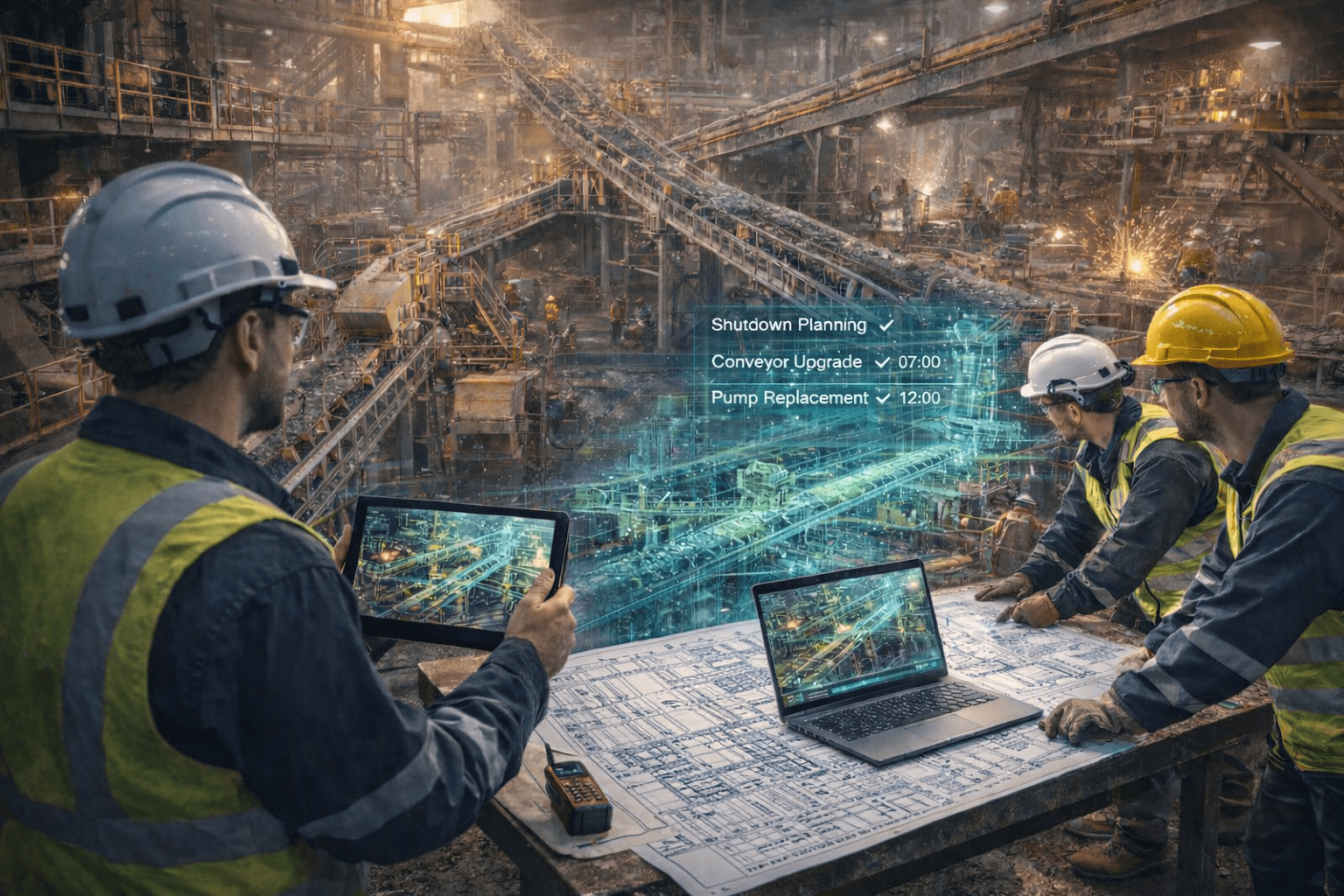
Engineering team reviewing plant drawings and digital models during planning for a mining shutdown maintenance project.

Why Engineering Planning Is Critical During Mining Shutdowns

Mining shutdowns are among the most complex operational events in industrial facilities. During these periods, large volumes of maintenance, upgrades, inspections, and equipment replacements must be completed within a tightly controlled timeframe.

Because production stops during shutdown work, every hour of delay can have a significant financial impact on operations.

This is where mining shutdown engineering plays a critical role. Proper engineering preparation ensures that upgrade work, equipment installation, and plant modifications can be executed safely and efficiently during the shutdown window.

Engineering support during shutdown projects often involves planning, documentation, scanning existing infrastructure, and preparing fabrication drawings before the shutdown begins.

At Hamilton By Design, engineering teams support mining shutdown work by providing accurate design data and technical documentation to ensure shutdown activities proceed as planned.


The Challenges of Mining Shutdown Projects

Mining shutdown projects involve coordinating multiple teams working across different areas of the plant simultaneously.

Common challenges include:

โ€ข limited shutdown timeframes
โ€ข complex plant infrastructure
โ€ข multiple contractors working concurrently
โ€ข incomplete or outdated plant drawings
โ€ข installation clashes between new and existing equipment

Without proper engineering preparation, shutdown work can quickly encounter unexpected obstacles that extend downtime and increase costs.

Engineering support helps minimise these risks by ensuring the plant layout, equipment geometry, and installation requirements are clearly understood before work begins.


Engineering Services That Support Shutdown Planning

Mining shutdown engineering typically involves several technical activities carried out prior to the shutdown window.

Plant Layout Verification

Before any upgrade work begins, engineers often need to verify the existing layout of equipment, pipework, and structures.

Many mining facilities have evolved over decades of maintenance work, meaning the actual plant configuration may differ from the original drawings.

Capturing accurate existing conditions ensures that shutdown installation work can proceed without unexpected clashes.

Learn more about capturing existing conditions here:


3D Laser Scanning of Existing Infrastructure

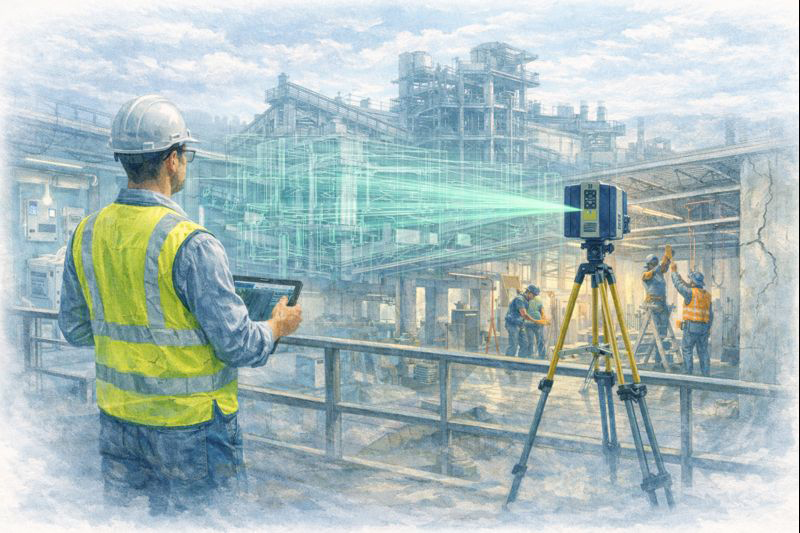
3D laser scanning is frequently used to document plant geometry before shutdown work begins.

Scanning allows engineers to capture millions of measurement points from existing infrastructure and generate accurate point cloud models of the plant environment.

These models help engineers design equipment modifications and plan installation sequences with greater confidence.

More information about engineering-grade scanning services:


Engineering Modelling and Design

Once site data has been captured, engineers can develop digital models used to design plant modifications or equipment upgrades.

These models help engineering teams:

โ€ข design new components that fit existing plant infrastructure
โ€ข identify potential clashes before installation
โ€ข improve coordination between mechanical and structural systems
โ€ข support fabrication of new equipment

The workflow of converting scan data into engineering models is explained here:


Equipment Upgrades During Shutdown Work

Shutdown windows are often used to install new equipment or upgrade existing plant systems.

Typical shutdown upgrade projects may include:

โ€ข conveyor system upgrades
โ€ข pump replacements
โ€ข pipework modifications
โ€ข structural upgrades
โ€ข installation of new process equipment

Engineering support ensures these modifications are designed to integrate with the existing plant layout while meeting operational and safety requirements.


Benefits of Engineering Preparation Before Shutdown

Engineering preparation carried out before the shutdown window helps mining operations complete work more efficiently.

Key benefits include:

โ€ข reduced installation risk
โ€ข improved equipment fitment
โ€ข shorter shutdown durations
โ€ข improved coordination between contractors
โ€ข reduced rework during installation

By preparing engineering documentation in advance, shutdown teams can focus on executing work safely and efficiently.


Supporting Safe and Efficient Shutdown Operations

Mining shutdown engineering is not only about improving efficiency โ€” it also supports safe operations.

Accurate engineering documentation helps ensure that:

โ€ข installation procedures are clearly defined
โ€ข equipment interfaces are properly designed
โ€ข access and maintenance requirements are considered
โ€ข potential safety hazards are identified early

For complex mining plants, this level of preparation significantly improves shutdown execution.


Hamilton By Design logo displayed on a blue tilted rectangle with a grey gradient background

Conclusion

Mining shutdowns are critical operational events where significant maintenance and upgrade work must be completed within a limited timeframe.

Engineering preparation plays an essential role in ensuring shutdown projects are executed safely and efficiently.

Through activities such as plant scanning, engineering modelling, and design preparation, mining shutdown engineering helps reduce operational risk and improve the success of shutdown projects.

Hamilton By Design provides engineering support services to assist mining operations with shutdown planning, plant upgrades, and infrastructure modifications.

3D LiDAR scanning and 3D modelling service button โ€” laser scanner capturing a point cloud for engineering and CAD modelling
Mechanical engineering services
Name
Would you like us to arrange a phone consultation for you?
Address

Our clients

3D CAD Modelling Australia service banner for Hamilton By Design

Engineering-Grade & Metrology-Grade 3D Scanning

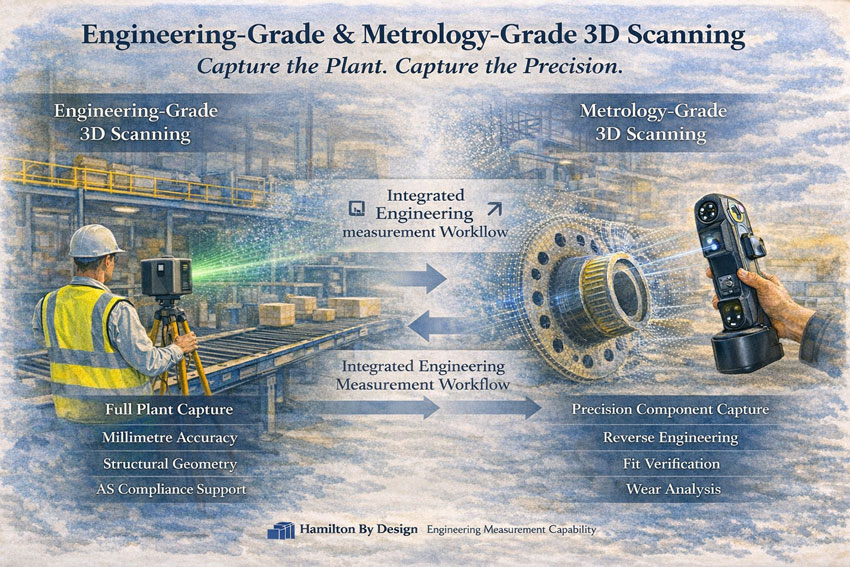
Engineering-grade and metrology-grade 3D scanning in an industrial plant environment.

Choosing the Right Tool for the Right Scale

At Hamilton By Design, we do not approach 3D scanning as a visual service โ€” we approach it as an engineering measurement tool.

Different projects require different levels of accuracy, coverage and control. For this reason, we operate with two distinct scanning capabilities:

  • Engineering-Grade Terrestrial Laser Scanning
  • Metrology-Grade Handheld 3D Scanning

Each serves a specific purpose within industrial, mining and mechanical environments.


Engineering measurement workflow combining plant scanning and precision component capture.

Engineering-Grade 3D Scanning

Capturing Entire Environments with Structural Accuracy

Engineering-grade laser scanning is used when capturing:

  • Processing plants
  • Conveyor systems
  • Structural steel platforms
  • Brownfield facilities
  • Infrastructure corridors
  • Stockpiles
  • Full building interiors and exteriors

This system is tripod-based and captures large-scale environments with millimetre-level accuracy across significant distances.

Typical Performance:

  • Up to hundreds of metres scanning range
  • ~2 mm accuracy at 10 m
  • Full 360ยฐ environmental capture
  • Suitable for survey control alignment

Used For:

  • As-built plant documentation
  • Structural verification
  • Clearance assessments
  • Shutdown planning
  • Retrofit design
  • Compliance validation under AS standards

If you can walk inside it โ€” this is the correct tool.

This system establishes the macro geometry of a site.


Metrology-Grade 3D Scanning

Capturing High-Precision Component Geometry

Metrology-grade handheld scanning is designed for detailed component-level capture.

This system is compact, highly accurate, and capable of sub-0.05 mm precision.

Typical Performance:

  • Accuracy to ~0.020 mm
  • Volume accuracy to 0.015 mm + scale factor
  • Ideal for complex surfaces and confined spaces
  • Suitable for reverse engineering

Used For:

  • Worn chute liners
  • Flanges and bolt patterns
  • Pump housings
  • Lifting lugs
  • Machined components
  • Distorted structural connections
  • Deep hole geometry
  • Fit-up verification prior to fabrication

If you can hold it โ€” this is the correct tool.

This system establishes the micro geometry of a part.


Why Both Matter

Industrial projects often require both levels of capture.

Example: Mining Shutdown

  1. Engineering-grade scanning captures the entire transfer station.
  2. Metrology-grade scanning captures the worn liner plate.
  3. Data is combined to:
    • Verify fit
    • Model replacement components
    • Reduce fabrication risk
    • Avoid rework during shutdown

This integrated approach reduces:

  • Site time
  • Fabrication errors
  • Installation clashes
  • Cost overruns

Measurement With Engineering Intent

We do not scan for visualisation alone.

We scan to support:

  • Structural compliance
  • Mechanical design
  • FEA validation
  • Access verification
  • Brownfield modification
  • Asset documentation
  • Engineering governance

Scanning without engineering oversight introduces risk.

Scanning with engineering intent reduces it.


When To Use Each Scanner

ScenarioEngineering-Grade ScannerMetrology-Grade Scanner
Full plant captureโœ”
Structural steel verificationโœ”
Conveyor alignmentโœ”
Large-area as-built surveyโœ”
Reverse engineering a componentโœ”
Flange or bolt pattern captureโœ”
Wear measurementโœ”
Fabrication fit verificationโœ”
Confined detailed geometryโœ”

Hamilton By Design logo displayed on a blue tilted rectangle with a grey gradient background
3D LiDAR scanning and 3D modelling service button โ€” laser scanner capturing a point cloud for engineering and CAD modelling
Mechanical engineering services

National Capability

Hamilton By Design provides:

  • Engineering-grade terrestrial scanning
  • Metrology-grade handheld scanning
  • Integrated modelling and verification
  • Compliance-aligned documentation

Across mining, industrial and infrastructure environments throughout Australia.


If your project requires both macro capture and micro precision, we can deliver a structured scanning approach aligned with engineering outcomes.


3D CAD Modelling Australia service banner for Hamilton By Design

Industrial 3D Scanning in WA Mines & Processing

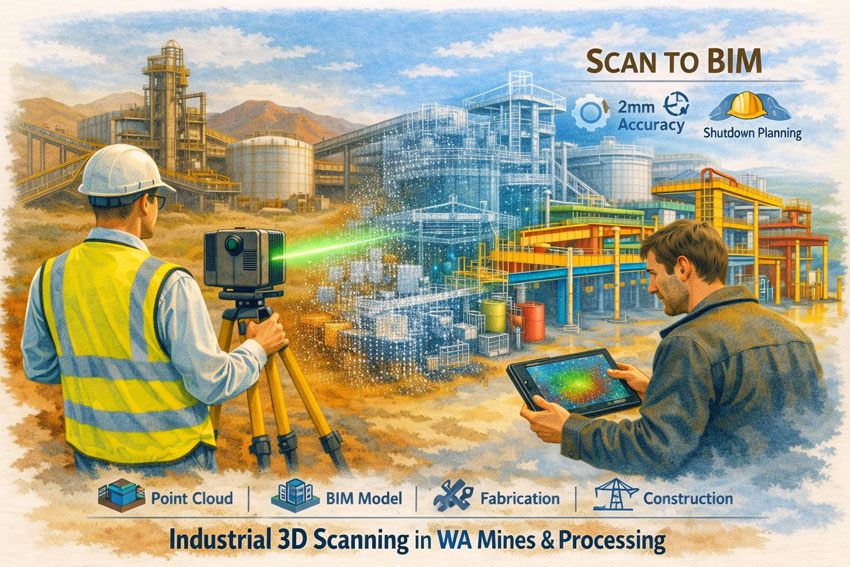
Laser scanning of WA mining infrastructure with Scan-to-BIM visualisation for industrial processing engineering.

Industrial 3D Scanning in WA Mines & Processing | Scan-to-BIM

Building Engineering Certainty in Brownfield Environments

Western Australiaโ€™s mining and mineral processing sector operates some of the most complex industrial assets in the world. Aging infrastructure, continuous production demands, and aggressive expansion schedules mean that every engineering decision must be based on accurate, reliable information. Industrial 3D Scanning in WA Mines & Processing has become the foundation for achieving this certaintyโ€”providing precise digital representations of plants, structures, and equipment before a single drawing is issued.


Industrial 3D scanning in WA mines showing laser capture of a processing plant with point cloud transforming into a BIM model.

The Backbone of Modern Mine Engineering

A laser scan is not simply a survey tool; it is the backbone of the entire project lifecycle. The quality of the initial scan determines the ease and accuracy of every task that followsโ€”layout design, clash detection, fabrication, and construction. If the backbone is broken, even simple tasks become difficult. Poor capture leads to rework, fabrication errors, and costly shutdown delays.

Industrial 3D scanning captures millions of measured points across conveyors, tanks, structural steel, pipe racks, and mechanical equipment with millimetre accuracy. For WA mine sites where access is restricted and downtime is expensive, this technology removes guesswork and replaces assumptions with verified data.

From Point Cloud to BIM Deliverables

The true value of scanning lies in what is delivered after capture. For mines and processing facilities, typical outputs include:

  • Engineering-grade point clouds for AutoCAD, Revit, and plant design platforms
  • Scan-to-BIM models of structures, pipework, and mechanical systems
  • Fabrication-ready DXF, STEP, or Parasolid files
  • Navisworks meshes for stakeholder review and constructability planning
  • As-built verification for shutdown and tie-in works

These deliverables allow engineering teams to design remotely, plan upgrades with confidence, and eliminate the need for repeated site visits across the vast distances of Western Australia.

Protecting the Project Team

Industrial projects are often pressured by schedules and budgets. High-quality 3D scanning protects the entire delivery teamโ€”project managers, engineers, designers, and fabricatorsโ€”by providing an objective source of truth. When design decisions are based on measured reality rather than tape measures and sketches, disputes reduce and collaboration improves.

For brownfield WA sites with decades of undocumented modifications, scanning becomes the neutral reference that aligns contractors, owners, and operators around the same dataset.

Applications Across WA Mines & Processing

Industrial 3D Scanning in WA Mines & Processing supports a wide range of activities:

  • Shutdown planning and tie-in verification
  • Conveyor and chute upgrades
  • Tank and structural remediation
  • Pipe spool prefabrication
  • Access platform and maintenance improvements
  • Expansion of crushing and screening circuits
  • Safety and egress compliance reviews

Whether in the Pilbara iron ore operations, Goldfields processing plants, or nickel and lithium facilities, scanning reduces risk in some of Australiaโ€™s harshest and most remote environments.

Remote Doesnโ€™t Mean Isolated

Western Australian mine sites can feel isolated, yet digital capture connects them directly to engineering teams anywhere in Australia. A single field visit can provide enough data for months of detailed design work. Teams can โ€œwalk the plantโ€ virtually, measure clearances, and develop solutions without repeated flights or shutdown interruptions.

An Engineer-Led Approach

Effective scan programs must be led by engineers who understand how the data will be used. Capture strategies, target placement, and accuracy tolerances are defined around the BIM deliverables, not around the scanner. This ensures that the final models support fabrication, not just visualisation.

3D LiDAR scanning and 3D modelling service button โ€” laser scanner capturing a point cloud for engineering and CAD modelling
Mechanical engineering services

Hamilton By Design logo displayed on a blue tilted rectangle with a grey gradient background

Industrial 3D Scanning in WA Mines & Processing is no longer optionalโ€”it is the starting point for safe, efficient, and predictable project delivery. When the backbone is strong, every downstream task becomes easier.

If your operation is planning upgrades, shutdowns, or expansions, begin with a measured digital foundation and let the data drive the outcome.

Our clients
Contact Us – Talk to Us

Name
Would you like us to arrange a phone consultation for you?
Address

3D CAD Modelling Australia service banner for Hamilton By Design
Mechanical Engineering Perth WA banner for Hamilton By Design featuring white text on a blue background.
3D Laser Scanning Perth WA banner for Hamilton By Design with white text on a blue background.
SolidWorks Perth WA banner for Hamilton By Design featuring white text on a blue background.
3D LiDAR scanning and 3D modelling service button โ€” laser scanner capturing a point cloud for engineering and CAD modelling
Mechanical engineering services

3D CAD Modelling Australia service banner for Hamilton By Design


CHPP Engineering title graphic featuring bold white text reading "CHPP Engineering" centred on a blue rounded rectangle background.
Pipework Drafting title graphic featuring bold white text reading "Pipework Drafting" centred on a blue rounded rectangle background.
3D LiDAR Scanning for Engineering Projects title graphic featuring bold white text on a blue rounded rectangle background.


Finite Element Analysis (FEA) engineering simulation button
Structural drafting services button
Mechanical drafting services button


Australian Drafting logo featuring bold white text reading "Australian Drafting" centred on a blue rounded rectangle background.
Engineering Governance title graphic featuring bold white text reading "Engineering Governance" centred on a blue rounded rectangle background.
Engineering-Grade LiDAR Scanning title graphic featuring bold white text on a blue rounded rectangle background.


Mechanical drafting services button
Structural drafting services button


Fabrication and product design services
3D CAD Modelling Australia service banner for Hamilton By Design
Mechanical, Structural & Pipework Drafting service banner by Hamilton By Design featuring white text on a blue background.


3D LiDAR scanning and 3D modelling service button โ€” laser scanner capturing a point cloud for engineering and CAD modelling
Mechanical engineering services
Mining & Processing Perth WA banner for Hamilton By Design featuring white text on a blue background.
Scan to BIM Perth WA banner for Hamilton By Design featuring white text on a blue background.
Ship Building Perth WA banner for Hamilton By Design featuring white text on a blue background.
Structural drafting services button
3D LiDAR scanning and 3D modelling services button
Mechanical drafting services button

Reality Capture for Live or Operational Sites (High-Risk Environments)

Engineer performing LiDAR scanning on live construction site with BIM model overlay for clash-free installation

Reality Capture for Live Sites Sydney | 3D Scanning Without Shutdowns

Keep Sydney Projects Running: Accurate Reality Capture Without Shutdowns

Many projects across Greater Sydney and the Central Coast take place in live, operational environments โ€” hospitals, shopping centres, CBD offices, industrial plants, transport facilities, and heritage buildings โ€” where shutdowns are either impossible or extremely costly.

At Hamilton By Design, we provide engineer-led reality capture and 3D scanning services that allow accurate measurement, modelling, and verification without interrupting operations. Our approach supports safe access, staged construction, and clash-free installation โ€” keeping your project moving while reducing risk, rework, and variations.


The Challenge of Working in Live Environments

Builders, project managers, and facilities teams face real risks when upgrading or modifying operational sites:

  • Buildings that have moved over time, with visible cracking or deformation
  • Changes in soil conditions or legacy engineering affecting structure and services
  • Outdated or unreliable drawings that no longer reflect site conditions
  • Unexpected clashes once walls, ceilings, or plant rooms are opened
  • High costs from rework and contract variations
  • Safety risks from confined spaces, working at heights, or restricted access zones

Relying on manual measurement or assumptions in these environments increases both programme risk and safety exposure.


Reality capture of operational industrial facility using 3D laser scanning without site shutdown

Non-Contact Measurement for High-Risk and Restricted Sites

Our reality capture solutions use non-contact laser scanning and LiDAR technology to safely collect accurate site data, even in difficult or restricted environments.

This allows us to capture:

  • Services above ceilings and within plant rooms
  • Structural elements and building geometry
  • Equipment clearances and access constraints
  • Deformed or out-of-plumb structures

All while minimising disruption to occupants and operations.

Safety and Access Benefits

  • Reduced need for working at heights
  • Faster site presence and data capture
  • Minimal interference with daily operations
  • Scanning possible from walkways or public-access areas
  • Fewer permits, isolations, and shutdown windows required

This makes scanning ideal for live hospitals, retail centres, offices, and industrial facilities where safety and continuity are critical.


Supporting Staged Construction and Live Upgrades

Live environments rarely allow full shutdowns. Our reality capture workflows are designed to support:

  • Staged construction programs
  • Progressive installation of services
  • Ongoing refurbishment works
  • Verification before each construction phase

We can also perform repeat scanning to monitor:

  • Structural movement
  • Progressive cracking
  • Deformation of walls, floors, or structural members

This is especially valuable where movement, settlement, or ageing infrastructure is a concern.


Practical Outcomes for Builders and Project Teams

Our scan data is not just collected โ€” it is engineered into practical construction deliverables that support real project decisions.

Clients use our reality capture outputs for:
  • Design of new mechanical, electrical, and plumbing services
  • Accurate as-built verification prior to fabrication
  • Set-out and coordination models for installation
  • Clash detection before construction begins
  • Monitoring movement or deformation over time

This reduces uncertainty, improves coordination between trades, and significantly lowers the risk of costly on-site surprises.


Construction-Ready Deliverables

We provide data in formats that integrate directly into your existing workflows and design platforms:

  • Point clouds (RCP / E57)
  • Revit models
  • AutoCAD files
  • SolidWorks models
  • 2D drawings (plans, sections, elevations)
  • Clash-ready coordination models

Our focus is on delivering usable, construction-ready information, not just raw scan files.


Engineer-Led Reality Capture โ€” Not Just Scanning

Hamilton By Design is not a scanning-only provider. We deliver end-to-end technical services, allowing us to support projects from concept through to installation.

Our integrated capabilities include:

  • Reality capture and 3D scanning
  • Mechanical engineering
  • Systems management
  • Project management
  • Machining and fabrication support

Because our work is engineer-led, scan data is interpreted with constructability, tolerances, and installation constraints in mind โ€” not simply converted into drawings by offshore drafting teams.
This means better decisions, fewer assumptions, and stronger outcomes on site.


Supporting Greater Sydney and the Central Coast

We regularly support projects across:
  • Sydney CBD and metropolitan areas
  • Major commercial and retail precincts
  • Health and education facilities
  • Industrial and processing plants
  • Infrastructure and heritage assets
  • Central Coast commercial and industrial sites

Our local presence allows efficient mobilisation and ongoing project support throughout staged works.


Hamilton By Design logo displayed on a blue tilted rectangle with a grey gradient background
3D LiDAR scanning and 3D modelling service button โ€” laser scanner capturing a point cloud for engineering and CAD modelling
Mechanical engineering services

Reduce Risk. Avoid Shutdowns. Build With Confidence.

Reality capture is no longer just a documentation tool โ€” it is a risk management strategy for live environments.

By capturing what is truly on site before construction begins, you can:

  • Prevent clashes and redesign
  • Reduce variations and rework
  • Improve safety planning
  • Protect programme and operational continuity

Arrange a Phone Consultation

If you are planning works in a live or high-risk environment and need reliable site data without shutdowns:

Please fill out the form below to arrange a phone consultation.

Weโ€™ll discuss your site conditions, construction staging, and deliverable requirements, and recommend the most effective reality capture approach for your project.

Name
Would you like us to arrange a phone consultation for you?
Address
Finite Element Analysis (FEA) engineering simulation button
Mechanical engineering services