Mechanical Engineering Services for Plant and Production Problems โ€” Sydney

Engineer-led reverse engineering with 3D scanning and drafting overlooking Sydney Harbour and the Harbour Bridge

Mechanical Engineering Services for Plant and Production Issues | Sydney

Practical engineering solutions when production issues, equipment failures, and compliance risks are impacting your business.

When production stops, costs rise quickly. Many operational problems arenโ€™t caused by staff or maintenance โ€” theyโ€™re caused by systems that are no longer fit for purpose. Whether your plant has grown, equipment has changed, or suppliers are no longer available, mechanical engineering support can help restore performance and reduce ongoing risk.

We provide engineering-led problem solving for operating facilities, focused on practical, buildable solutions that keep your business moving.
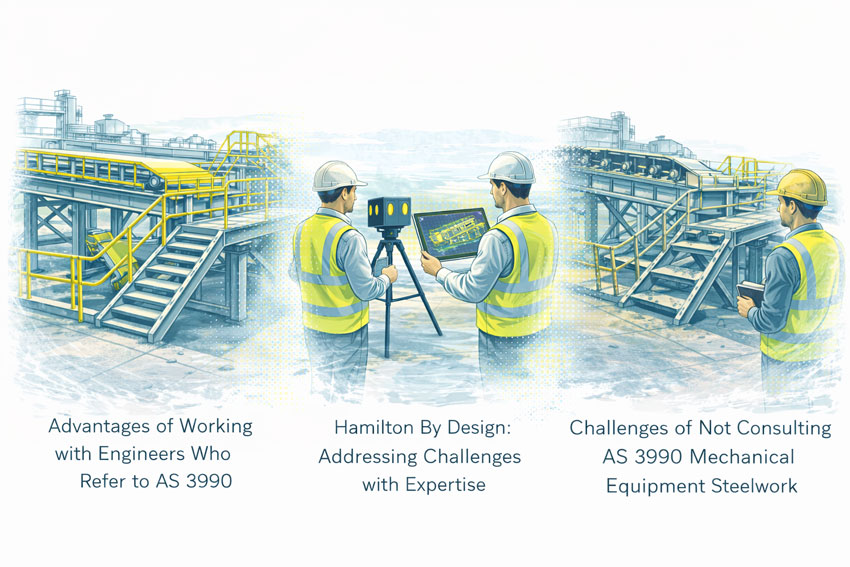

Engineers using LiDAR scanning and digital models to address challenges caused by not consulting AS 3990 mechanical equipment steelwork standards

When Businesses Typically Call a Mechanical Engineer

Most clients contact us when something critical is no longer working as it should โ€” not when everything is running smoothly.

Common triggers include:

  • Production line keeps jamming or backing up
  • Conveyor upgrades are needed to increase throughput
  • Plant layout no longer supports current operations
  • Original equipment supplier is no longer available
  • Compliance issues have been identified during audits or inspections

In these situations, quick fixes often fail because the underlying system was never designed for todayโ€™s operating conditions.


Production Line Keeps Jamming

If bottlenecks, product damage, or stoppages are becoming routine, the problem is often mechanical and systemic โ€” not operator error.

Engineering support can help by:

  • Identifying root causes of flow restrictions
  • Redesigning transfer points and interfaces
  • Improving guarding, access and maintenance zones
  • Reconfiguring equipment layout for smoother material movement

The goal is to improve reliability, not just reset alarms.


Conveyor Upgrade or Replacement Required

Conveyors are often the backbone of production and logistics systems. When capacity increases or materials change, existing conveyors may no longer perform as required.

Mechanical engineering services can support:

  • Conveyor capacity upgrades
  • Drive and structural modifications
  • Transfer chute redesign
  • Integration of new equipment into existing lines

Upgrades can often be achieved without full system replacement when engineered correctly.


Plant Layout No Longer Works

As facilities expand and processes change, original layouts can become inefficient or unsafe.

Engineering reviews can identify opportunities to:

  • Improve workflow and access
  • Reduce unnecessary material handling
  • Improve maintenance clearances
  • Support future equipment additions

Well-planned layout changes reduce downtime, improve safety, and increase operational flexibility.


Equipment Supplier Is No Longer Available

When OEMs stop supporting equipment or close operations, businesses are often left with:

  • No spare parts supply
  • No engineering documentation
  • No upgrade pathway

Mechanical engineers can reverse-engineer components, redesign systems, and develop replacement solutions that integrate with existing plant โ€” often improving performance at the same time.


Compliance Issues Raised

Compliance notices, insurance requirements, or safety audits can quickly become business-critical.

Engineering services can support:

  • Mechanical and structural assessments
  • Design of compliant modifications
  • Certification documentation where required
  • Implementation planning to minimise downtime

Addressing compliance early reduces operational and legal risk.


What We Provide

Our mechanical engineering services typically include:

  • Site assessments and problem diagnosis
  • Concept and detailed design solutions
  • Engineering drawings and documentation
  • Support for fabrication and installation
  • Design verification and compliance support

Where required, engineering services can be supported by 3D laser scanning and as-built modelling to ensure new designs fit accurately into existing facilities.


Why Use an Engineering Consultant Instead of Labour Hire

Labour hire provides people. Engineering consultants provide solutions and accountability.

Using an engineering service means:

  • Problems are diagnosed, not just worked around
  • Designs are developed and documented
  • Risk is managed through professional responsibility
  • Solutions are built to last, not patched temporarily

This approach reduces repeat failures and long-term maintenance costs.


Hamilton By Design logo displayed on a blue tilted rectangle with a grey gradient background

3D LiDAR scanning and 3D modelling service button โ€” laser scanner capturing a point cloud for engineering and CAD modelling
Mechanical engineering services

Supporting Businesses Across Sydney

We support manufacturing, processing, logistics, and industrial facilities across Sydney and surrounding regions, providing responsive engineering services for operating environments where downtime and rework are costly.

Whether the issue is urgent or part of a planned upgrade, engineering support can help stabilise operations and support future growth.


Talk to an Engineer About Your Plant Issues

If production problems, equipment limitations, or compliance risks are affecting your operation, early engineering input can prevent escalation into major shutdowns or capital replacements.

Contact us to discuss your facility and weโ€™ll help identify practical next steps.

Name
Would you like us to arrange a phone consultation for you?
Address

Related Sydney Services

Hamilton By Design provides engineering-led 3D scanning, LiDAR scanning, mechanical engineering and digital engineering services throughout Sydney and Greater Sydney.

Explore our related Sydney services:


  • 3D Scanning Sydney โ€“ Engineering-grade terrestrial laser scanning, as-built surveys and point cloud capture for industrial, infrastructure and commercial projects.
  • Reality Capture Sydney โ€“ High-accuracy reality capture, digital twins, asset documentation and engineering-grade site verification.
  • Scan to CAD Sydney โ€“ Convert point cloud data into AutoCAD, SolidWorks, Inventor and other engineering-ready CAD deliverables.
  • Point Cloud Modelling Sydney โ€“ Engineering-grade point cloud processing, clash detection, as-built verification and 3D modelling.
  • Mechanical Engineering Sydney โ€“ Mechanical design, plant upgrades, materials handling systems, conveyors, chutes, platforms and engineering support.
  • Structural Drafting Sydney โ€“ Structural steel drafting, fabrication drawings, GA drawings, workshop detailing and as-built documentation.

Hamilton By Design supports projects throughout Sydney CBD, Parramatta, Liverpool, Penrith, Blacktown, Chatswood, Alexandria, Mascot, Newcastle and the Central Coast.



Blue banner graphic displaying the text "Point Cloud to CAD - Australia" in large white lettering, representing point cloud processing, scan-to-CAD conversion and digital engineering services across Australia.
Blue banner graphic displaying the text "Scan to CAD Sydney" in large white lettering, representing engineering-led point cloud to CAD conversion, LiDAR scanning and digital engineering services in Sydney.
Blue banner graphic displaying the text "Reality Capture Sydney - CBD" in large white lettering, representing engineering-led reality capture, LiDAR scanning and digital engineering services within Sydney CBD commercial buildings and infrastructure.

Mechanical Plant Optimisation

Mechanical Plant Optimisation: Boosting Throughput, Reliability and Safety Across Australia

Industrial plants are under more pressure than ever to deliver higher output, reduce downtime and operate safely. Ageing equipment, inconsistent maintenance, and brownfield constraints often limit performance โ€” but with the right engineering approach, even long-running plants can achieve major efficiency gains.

At Hamilton By Design, we specialise in mechanical plant optimisation using a powerful combination of engineering expertise, high-accuracy LiDAR scanning, precise 3D modelling, and practical redesign strategies that deliver measurable improvements.

If your goal is higher throughput, fewer breakdowns and safer shutdowns, this guide explains how mechanical optimisation transforms plant performance.


Why Mechanical Plant Optimisation Is Essential

Most processing plants โ€” from CHPPs and quarries to manufacturing and power stations โ€” suffer from the same long-term issues:

  • Reduced throughput
  • Conveyor misalignment
  • Flow bottlenecks in chutes and transfer points
  • Vibration, cracking and structural fatigue
  • Outdated drawings and unknown modifications
  • Premature wear and high maintenance costs
  • Shutdown overruns due to poor fit-up

Optimisation tackles these issues using real engineering data, not assumptions.


Step 1: LiDAR Scanning to Capture True As-Built Conditions

As equipment ages, it moves, twists and wears in ways that drawings rarely capture. Our FARO laser scanners map a complete digital twin of your plant with ยฑ1โ€“2 mm accuracy, giving engineers:

  • Full geometry of structural frames
  • Wear patterns inside chutes
  • Deflection in platforms, conveyor trusses and supports
  • Misalignment in pipes, pulleys and mechanical drives
  • Clash risks for future upgrades

This becomes the foundation of all optimisation work โ€” ensuring upgrades fit first time.


Step 2: 3D Modelling & Engineering Redesign

Hamilton By Design converts point-cloud data into SolidWorks models to identify optimisation opportunities such as:

  • Reprofiling chutes for smoother flow
  • Strengthening or realigning structural members
  • Repositioning pumps or motors
  • Correcting conveyor and drive alignment
  • Redesigning access platforms for maintenance
  • Improving liner selection and service life

Every model is fabrication-ready, eliminating costly rework during shutdowns.


Step 3: Material Flow & Conveyor Performance Improvement

Flow constraints are one of the biggest sources of lost production. Through engineering review, modelling and experience, we address:

  • Impact zones causing excessive wear
  • Restrictive chute geometry
  • Poorly performing transfer points
  • Belt-tracking issues
  • Flow blockages
  • Inefficient material transitions

These improvements often deliver immediate gains in throughput and reliability.


Step 4: Mechanical Integrity & Reliability Assessments

We also perform condition assessments to understand the root causes of downtime:

  • Vibration analysis
  • Cracking and corrosion detection
  • Bearing, gearbox and pulley assessment
  • Thermal/overload risks
  • Misalignment and load distribution issues

This supports predictive maintenance and informed upgrade planning.


Step 5: Shutdown Planning & Upgrade Execution

By combining scanning, modelling and mechanical design, we ensure that every upgrade:

  • Fits perfectly into existing brownfield spaces
  • Reduces time on tools
  • Eliminates site modifications
  • Improves safety during installation
  • Delivers predictable shutdown timelines

Clients commonly see ROI within the first shutdown cycle.


Benefits of Mechanical Plant Optimisation

When optimisation is done properly, plants experience:

โœ” Measurable throughput increases

โœ” Longer equipment life

โœ” Reduced wear and maintenance costs

โœ” Safer operation and shutdown execution

โœ” Accurate documentation for future projects

โœ” Extended reliability of mechanical systems

With the right engineering support, even ageing plants can operate like new.


Serving Clients Across Australia

Hamilton By Design supports mechanical plant optimisation projects across:
Sydney, Newcastle, Hunter Valley, Central Coast, Bowen Basin, Surat Basin, Pilbara, Perth, Adelaide, Melbourne and regional Australia.

We work across mining, CHPPs, quarries, ports, power stations, manufacturing and heavy industrial sites.


Hamilton By Design logo displayed on a blue tilted rectangle with a grey gradient background
3D LiDAR scanning and 3D modelling service button โ€” laser scanner capturing a point cloud for engineering and CAD modelling
Mechanical engineering services

Ready to Optimise Your Plant?

If you want higher throughput, better reliability and safer operation, mechanical plant optimisation is the smartest investment you can make.

Or reach out directly for a project discussion.

Hamilton By Design โ€” Engineering Certainty for Complex Plants.


Name
Address
You would like to:
Finite Element Analysis (FEA) engineering simulation button
Mechanical engineering services
3D LiDAR scanning and 3D modelling service button โ€” laser scanner capturing a point cloud for engineering and CAD modelling
Mechanical engineering services


Finite Element Analysis (FEA) engineering simulation button
Mechanical engineering services


3D CAD Modelling Australia service banner for Hamilton By Design


CHPP Engineering title graphic featuring bold white text reading "CHPP Engineering" centred on a blue rounded rectangle background.
Pipework Drafting title graphic featuring bold white text reading "Pipework Drafting" centred on a blue rounded rectangle background.
3D LiDAR Scanning for Engineering Projects title graphic featuring bold white text on a blue rounded rectangle background.


Finite Element Analysis (FEA) engineering simulation button
Structural drafting services button
Mechanical drafting services button


Australian Drafting logo featuring bold white text reading "Australian Drafting" centred on a blue rounded rectangle background.
Engineering Governance title graphic featuring bold white text reading "Engineering Governance" centred on a blue rounded rectangle background.
Engineering-Grade LiDAR Scanning title graphic featuring bold white text on a blue rounded rectangle background.

Mining & Processing Perth WA banner for Hamilton By Design featuring white text on a blue background.
Scan to BIM Perth WA banner for Hamilton By Design featuring white text on a blue background.
Ship Building Perth WA banner for Hamilton By Design featuring white text on a blue background.
Structural drafting services button
3D LiDAR scanning and 3D modelling services button
Mechanical drafting services button

Stop Reacting โ€” Start Engineering

Hamilton By Design logo displayed on a blue tilted rectangle with a grey gradient background

How Smart Mechanical Strategies Extend CHPP Life

Every coal wash plant in Australia tells the same story: constant throughput pressure, harsh operating conditions, and the never-ending battle against wear, corrosion, and unplanned downtime. The reality is simple โ€” if you donโ€™t engineer for reliability, youโ€™ll spend your time repairing failure.

At Hamilton By Design, we specialise in mechanical engineering, 3D scanning, and digital modelling for coal handling and preparation plants (CHPPs). Our goal is to help site teams transition from reactive maintenance to a precision, data-driven strategy that keeps production steady and predictable.

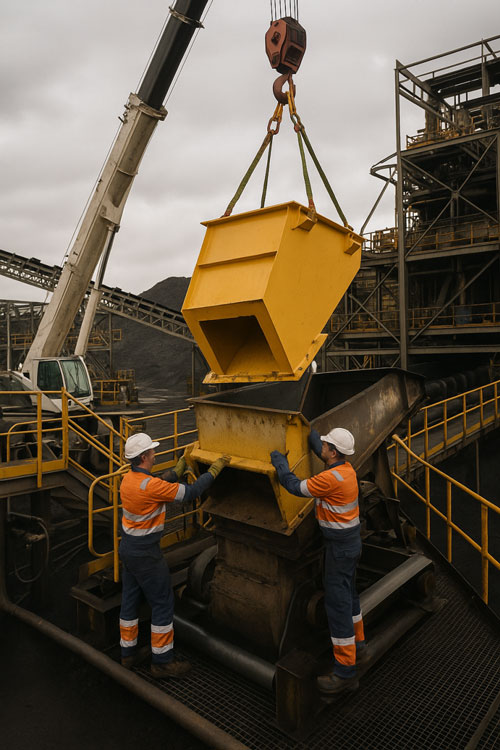
Workers guiding a crane-lifted yellow chute into position at a coal handling and preparation plant, with conveyor infrastructure and safety equipment visible on site

3D LiDAR scanning and 3D modelling service button โ€” laser scanner capturing a point cloud for engineering and CAD modelling
Mechanical engineering services

Design for Reliability โ€” Not Reaction

Reliability begins with smart mechanical design. Poor geometry, limited access, and undersized components lead to fatigue and repeated downtime. Instead, modern CHPP maintenance programs start by engineering for fit, lift, and life:

  • Fit: Design components that align with the existing structure โ€” every bolt, flange, and mating face verified digitally before fabrication.
  • Lift: Incorporate certified lifting points that comply with AS 4991 Lifting Devices, and ensure clear access paths for cranes or chain blocks.
  • Life: Select wear materials suited to the physics of the process โ€” quenched and tempered steel for impact, rubber or ceramic for abrasion, and UHMWPE for slurry lines.

Itโ€™s not just about parts; itโ€™s about engineering foresight. A well-designed plant component is safer to install, easier to inspect, and lasts longer between shutdowns.


Scan What You See โ€” Not What You Think You Have

Over time, every wash plant drifts from its original drawings. Field welds, retrofits, and corrosion mean that โ€œas-builtโ€ and โ€œas-existsโ€ are rarely the same thing.

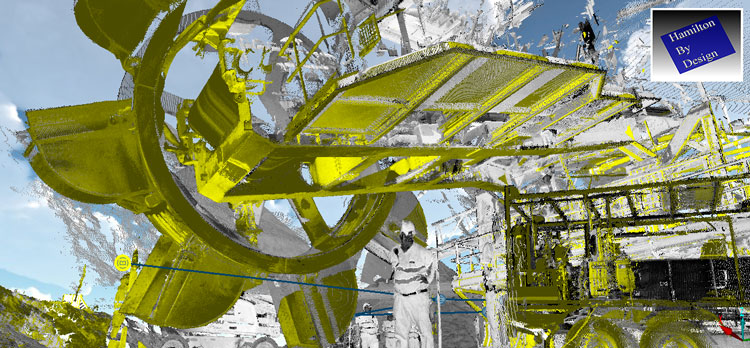
Thatโ€™s where LiDAR scanning transforms maintenance. Using sub-millimetre accuracy, 3D laser scans capture your plant exactly as it stands โ€” every pipe spool, every chute, every bolt hole.

With this data, our engineers can:

  • Overlay new models directly into your point cloud to confirm fit-up before fabrication.
  • Identify alignment errors, corrosion zones, and clearance conflicts before shutdowns.
  • Generate true digital twins that allow for predictive maintenance and simulation.

LiDAR scanning isnโ€™t just a measurement tool; itโ€™s an insurance policy against rework and lost production.

3D LiDAR point cloud of a CHPP plant showing detailed structural geometry, equipment, platforms, and personnel captured during an industrial site scan for engineering and upgrade planning.

Corrosion: The Hidden Killer in Every CHPP

Coal and water donโ€™t just move material โ€” they create acidic environments that eat through untreated or aging steel. In sumps, launders, and under conveyors, corrosion silently compromises strength until a structure is no longer safe to walk on.

Regular inspections are the first line of defence. At Hamilton By Design, we recommend combining:

  • Daily visual checks by operators for surface rust and coating damage.
  • Thickness testing during shutdowns to track wall loss on chutes and pipes.
  • 3D scan comparisons every 6โ€“12 months to quantify deformation and corrosion in critical structures.

With modern tools, you can see corrosion coming long before it becomes a failure.


From Data to Decision: Predictive Maintenance in Action

A coal wash plant produces a river of data โ€” motor loads, vibration levels, pump pressures, liner thickness, and flow rates. The key is turning that data into insight.

By integrating scanning results, maintenance records, and sensor data, plant teams can identify trends that point to future breakdowns. For example:

  • Vibration trending can reveal bearing fatigue weeks before failure.
  • Load monitoring can detect screen blinding or misalignment.
  • Scan data overlays can show sagging supports or displaced chutes.

When you understand what your plant is telling you, you move from reacting to problems to predicting and preventing them.


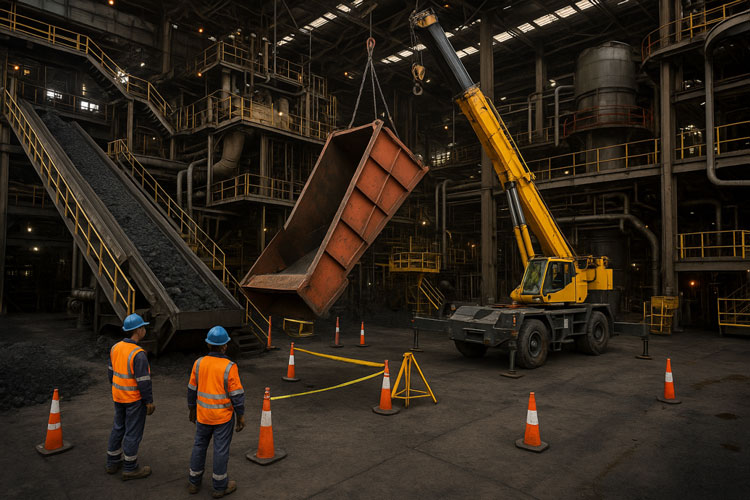
Industrial shutdown scene showing workers monitoring a mobile crane lifting a large steel chute inside a coal processing plant, with safety cones and exclusion zones in place

Shutdowns: Planned, Precise, and Productive

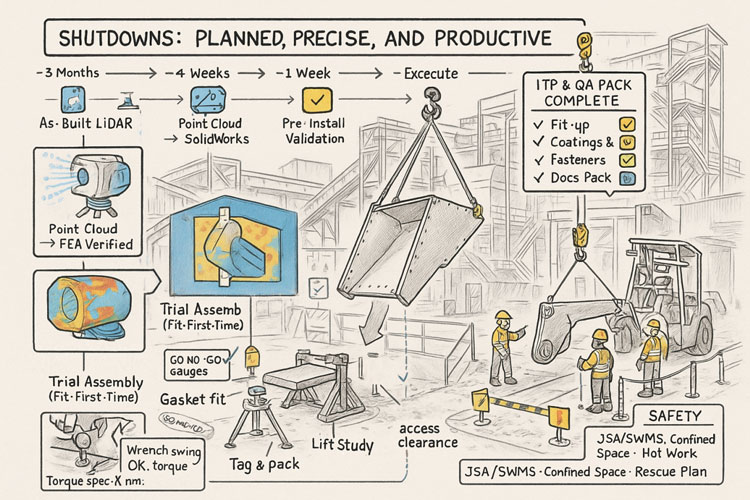
Every shutdown costs money โ€” the real goal is to make every hour count. The best shutdowns start months ahead with validated design data and prefabrication QA.

Before you cut steel or mobilise cranes, every component should be digitally proven to fit. Trial assemblies, lifting studies, and bolt access checks prevent costly surprises once youโ€™re on the clock.

At Hamilton By Design, our process combines:

  • LiDAR scanning to confirm as-built geometry.
  • SolidWorks modelling and FEA for mechanical verification.
  • Pre-installation validation to ensure bolt holes, flanges, and lift paths align on day one.

Thatโ€™s how you replace chutes, spools, and launders in a fraction of the usual time โ€” safely, and with confidence.

Hand-drawn infographic showing the shutdown workflow from LiDAR scanning and FEA verification through SolidWorks modelling, pre-install validation, trial assembly, lift study, and execution, including ITP and QA checks, safety steps, and onsite installation activities

The Payoff: Reliability You Can Measure

The plants that invest in engineering-led maintenance see results that are tangible and repeatable:

Improvement AreaTypical Gain
Reduced unplanned downtime30โ€“40%
Increased liner lifespan25โ€“50%
Shorter shutdown duration10โ€“20%
Fewer fit-up issues and rework60โ€“80%
Improved safety performance20โ€“30%

Reliability isnโ€™t luck โ€” itโ€™s engineered.


Hamilton By Design logo displayed on a blue tilted rectangle with a grey gradient background

Your Next Step: A Confidential Mechanical Assessment

Whether your plant is in the Bowen Basin, Hunter Valley, or Central West NSW, our team can deliver a confidential mechanical and scanning assessment of your wash plant.

Weโ€™ll benchmark your current maintenance strategy, identify high-risk areas, and provide a clear roadmap toward predictive, engineered reliability.

๐Ÿ“ฉ For a confidential assessment of your current wash plant, contact:
info@hamiltonbydesign.com.au

Stop reacting. Start engineering. Build reliability that lasts.

Name
Would you like us to arrange a phone consultation for you?
Address

Our clients:

Mechanical Engineering | Structural Engineering

Mechanical Drafting | Structural Drafting

3D CAD Modelling | 3D Scanning

Chute Design

Enhancing Plant Efficiency with Best Maintenance Practices: A White Paper by Hamilton By Design

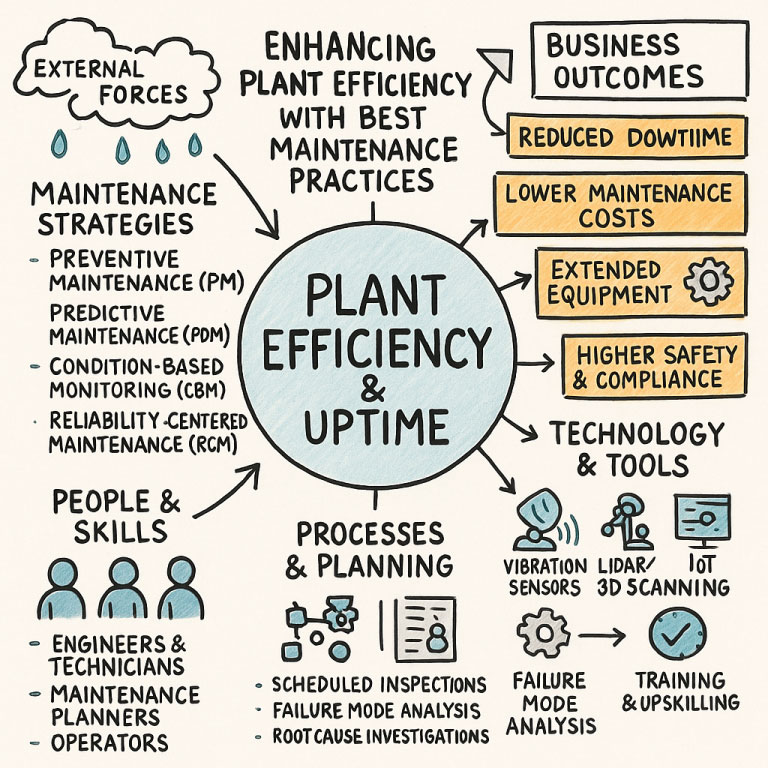
Hand-drawn infographic titled โ€œPlant Efficiency & Uptime,โ€ showing the key elements that enhance plant performance. Surrounding the central circle are categories including maintenance strategies (PM, PDM, CBM, RCM), people and skills (engineers, technicians, planners, operators), processes and planning (inspections, failure mode analysis, root-cause investigations), and technology and tools (vibration sensors, LiDAR/3D scanning, IoT, training). Benefits highlighted include reduced downtime, lower maintenance costs, extended equipment life, and higher safety and compliance.

ย 

In todayโ€™s competitive industrial landscape, maintaining high levels of Overall Equipment Effectiveness (OEE) is a cornerstone of operational success. Achieving this requires adopting advanced maintenance practices that minimize downtime, reduce operational costs, and extend the lifecycle of critical assets.

This white paper outlines best maintenance practices aligned with the ISO 18436.2 standard and highlights how Hamilton By Design’s team of mechanical engineers can partner with your organization to enhance your plantโ€™s OEE. By leveraging our expertise in condition-based and predictive maintenance, we can optimize equipment performance and drive measurable improvements in productivity and reliability.

The Role of Maintenance in Maximizing OEE

OEE is a comprehensive measure of manufacturing productivity, defined by three critical components:

  1. Availability: Minimizing downtime to maximize operational hours.
  2. Performance: Ensuring equipment runs at optimal speeds.
  3. Quality: Reducing defects and waste during production.

Maintenance strategies are key to influencing these factors. Moving beyond reactive approaches to predictive and condition-based maintenance can significantly enhance equipment reliability and efficiency, ensuring better alignment with OEE goals.


Adopting Best Maintenance Practices

Condition-Based Maintenance (CBM)

CBM involves monitoring the real-time condition of equipment to predict and prevent failures. At Hamilton By Design, we integrate cutting-edge technologies like vibration analysis, thermography, and ultrasonic testing to enable proactive interventions before problems escalate.

How CBM Enhances OEE:
  • Reduces unplanned downtime (Availability).
  • Maintains consistent performance by addressing issues early (Performance).
  • Prevents production disruptions that cause defects (Quality).

Predictive Maintenance (PdM)

Predictive maintenance leverages data analytics to anticipate potential failures. By applying ISO 18436.2-certified practices, we implement advanced diagnostic tools and algorithms to forecast maintenance needs with precision.

Our Approach:
  • Deploy vibration analysis tools managed by certified Level II and III analysts.
  • Use infrared thermography to detect heat anomalies in electrical and mechanical systems.
  • Employ ultrasonic testing to identify leaks and structural weaknesses.
Benefits for OEE:
  • Prolonged equipment lifespan by addressing issues at their inception.
  • Higher productivity with fewer interruptions.
  • Reduced maintenance costs through targeted interventions.

Reliability-Centered Maintenance (RCM)

RCM focuses on optimizing maintenance strategies for each asset, emphasizing a deep understanding of failure modes and effects. Our engineers employ RCM to prioritize maintenance tasks that align with your plant’s specific OEE goals.

Steps We Implement:
  1. Asset Function Analysis: Understanding the purpose and criticality of each asset.
  2. Failure Mode and Effects Analysis (FMEA): Identifying risks and developing mitigation strategies.
  3. Data-Driven Decision Making: Using condition monitoring data to guide maintenance schedules.
Impact on OEE:
  • Ensures maintenance is aligned with production priorities.
  • Reduces waste and rework caused by unexpected equipment malfunctions.

Leveraging ISO 18436.2 Standards

ISO 18436.2 defines the competencies required for condition monitoring personnel, ensuring a standardized approach to predictive maintenance. Hamilton By Designโ€™s mechanical engineers are certified under this standard, offering expertise in:

  • Vibration analysis for detecting unbalance, misalignment, and bearing faults.
  • Developing and managing comprehensive condition monitoring programs.
  • Interpreting and analyzing complex diagnostic data for actionable insights.

How Hamilton By Design Can Assist

Customized Maintenance Solutions

We recognize that every plant has unique operational challenges. Hamilton By Design tailors maintenance strategies to your specific needs, focusing on:

  • Asset Criticality Assessment: Identifying and prioritizing key equipment for monitoring and intervention.
  • Technology Integration: Implementing IoT-enabled sensors, data platforms, and diagnostic tools.
  • Program Development: Designing maintenance schedules aligned with production cycles and OEE targets.

Expert Training and Certification

Our team provides in-depth training for your personnel, ensuring they gain ISO 18436.2 certification and the skills to sustain advanced maintenance programs.

Ongoing Support and Continuous Improvement

Maintenance isnโ€™t static. Hamilton By Design offers ongoing support to refine your maintenance practices, ensuring your plant stays ahead of evolving operational demands.


Case Study: Improving OEE with Hamilton By Design

Challenge: A manufacturing plant experienced frequent equipment failures, leading to a 15% drop in OEE.

Solution: Hamilton By Design implemented a tailored predictive maintenance program:

  • Installed vibration sensors on critical rotating machinery.
  • Trained plant engineers to monitor and analyze data using ISO 18436.2 standards.
  • Provided ongoing diagnostics and recommendations.

Outcome:

  • Downtime was reduced by 40%, significantly improving availability.
  • Equipment performance stabilized, enhancing productivity.
  • Defects decreased by 25%, improving product quality.

Maximizing OEE requires a strategic approach to maintenance that integrates advanced tools, skilled personnel, and data-driven insights. Hamilton By Design’s mechanical engineers, certified under ISO 18436.2, are uniquely equipped to help your plant achieve these goals.

By partnering with us, you can transform your maintenance practices, boost operational efficiency, and secure a competitive edge in your industry. Let Hamilton By Design help you take the first step toward a more reliable and productive future.

WorkTrek โ€“ 8 Ways to Improve Your Plant Maintenance
Practical tips for improving maintenance processes, reducing downtime, and boosting productivity.
https://worktrek.com/blog/how-to-improve-plant-maintenance/

Petrochem Expert โ€“ Best Practices for Plant Maintenance
Explores how proper maintenance planning ensures efficiency, reliability, and safety in plant operations.
https://petrochemexpert.com/best-practices-for-plant-maintenance-ensuring-operational-efficiency-and-safety/

MaintBoard โ€“ Maintenance Planning Strategies
Highlights how scheduling, IoT tools, and predictive approaches improve plant reliability and uptime.
https://maintboard.com/maintenance-planning-strategies

Hamilton By Design โ€“ Mechanical Engineering for Mining & Industry
Showcases engineering solutions designed to reduce downtime, improve reliability, and optimize plant performance.
https://www.hamiltonbydesign.com.au/mechanical-engineering-mining-industry-australia/

Hamilton By Design โ€“ Drafting & LiDAR / Scanning Services
Describes how accurate scanning and drafting streamline retrofits, reducing errors and saving time during plant upgrades.
https://www.hamiltonbydesign.com.au/services-drafting-lidar-scanning/

Hamilton By Design โ€“ Blog: Maximising Uptime at Transfer Points
Focuses on optimising chutes, hoppers, and conveyors to minimise stoppages and keep production flowing.
https://www.hamiltonbydesign.com.au/blog-engineering-insights/

3D LiDAR scanning and 3D modelling service button โ€” laser scanner capturing a point cloud for engineering and CAD modelling
Mechanical engineering services

Mechanical Designers

Mechanical Engineers Design

3D Mechanical Engineering

Mechanical Engineering Consultants

3D Laser Scanning

Mechanical Engineering Challenges for Conveyor Reliability

Challenges for Conveyor Reliability

The challenges Mechanical Engineers have when it comes to maintaining the reliability of conveyor systems for transporting bulk materials, particularly particles ranging from 1mm to 100mm, presents mechanical engineers with a host of challenges. Reliability maintenance aims to ensure that these systems operate consistently and efficiently over their operational lifespan, minimizing downtime and optimizing productivity. Here are some key challenges faced by mechanical engineers in this regard:


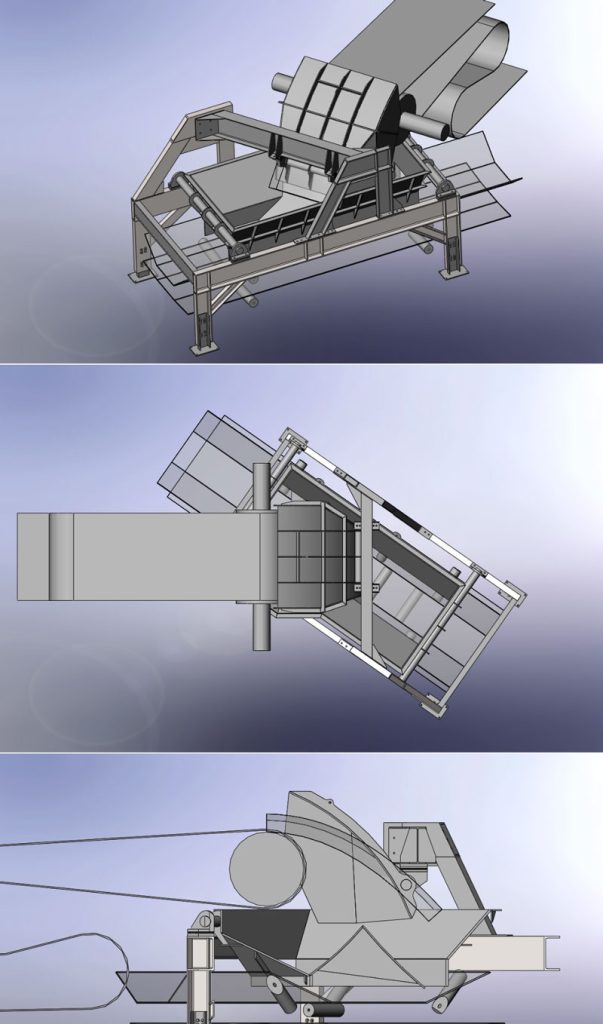
Three-view SolidWorks model of an industrial conveyor transfer system, showing an isometric view, top view, and side view. The assembly includes a transfer chute, conveyor belt sections, support frame, rollers, and structural steel components
3D LiDAR scanning and 3D modelling service button โ€” laser scanner capturing a point cloud for engineering and CAD modelling
Mechanical engineering services

1. Component Wear and Failure: The continuous operation of conveyor systems subjects various components such as belts, rollers, bearings, and drive mechanisms to wear and potential failure. The abrasive nature of bulk materials can accelerate this process, leading to shortened component lifespan and increased risk of unexpected breakdowns. Mechanical engineers must implement proactive maintenance strategies, including regular inspections, lubrication, and component replacement, to mitigate wear-related issues and enhance system reliability.

2. Material Contamination and Blockages: Bulk materials containing particles of diverse sizes can lead to material contamination and blockages within conveyor systems if not properly managed. Fine particles may accumulate in chutes, transfer points, or on conveyor surfaces, causing flow disruptions and increased friction. Engineers need to design systems with effective cleaning mechanisms, such as scrapers, brushes, and air blowers, to prevent material buildup and maintain uninterrupted material flow.

3. Misalignment and Tracking Issues: Misalignment of conveyor belts and tracking problems can result in uneven material distribution, increased friction, and premature wear on system components. Mechanical engineers must ensure proper belt tensioning and alignment during installation and implement monitoring systems to detect and correct any deviations from the desired trajectory. Advanced tracking technologies, such as automated belt positioners and laser alignment tools, can aid in maintaining optimal conveyor performance.

4. Environmental Factors: Harsh environmental conditions, including temperature variations, moisture, dust, and corrosive substances, pose significant challenges to conveyor system reliability. Exposure to such elements can accelerate component degradation and compromise system integrity. Engineers must select durable materials, coatings, and sealing solutions resistant to environmental hazards and implement preventive measures, such as regular cleaning and protective enclosures, to safeguard conveyor systems from adverse effects.

5. Safety and Regulatory Compliance: Compliance with safety regulations and industry standards is essential for ensuring the reliability and safe operation of conveyor systems. Mechanical engineers must stay abreast of regulatory requirements and design systems that meet or exceed applicable standards for material handling equipment. Regular safety inspections, training programs for personnel, and implementation of safety protocols are crucial aspects of reliability maintenance in conveyor systems.

At Hamilton By Design, our team have the experience in addressing these challenges requires a comprehensive approach that combines sound engineering principles, advanced technologies, and proactive maintenance practices. By implementing robust reliability maintenance programs, mechanical engineers can maximize the uptime and longevity of conveyor systems for transporting bulk materials, thereby optimizing operational efficiency and minimizing costly disruptions.


Our Clients


Mechanical Engineering | Structural Engineering

Mechanical Drafting | Structural Drafting

3D CAD Modelling | 3D Scanning

Hamilton By Design

Name
Would you like us to arrange a phone consultation for you?
Address