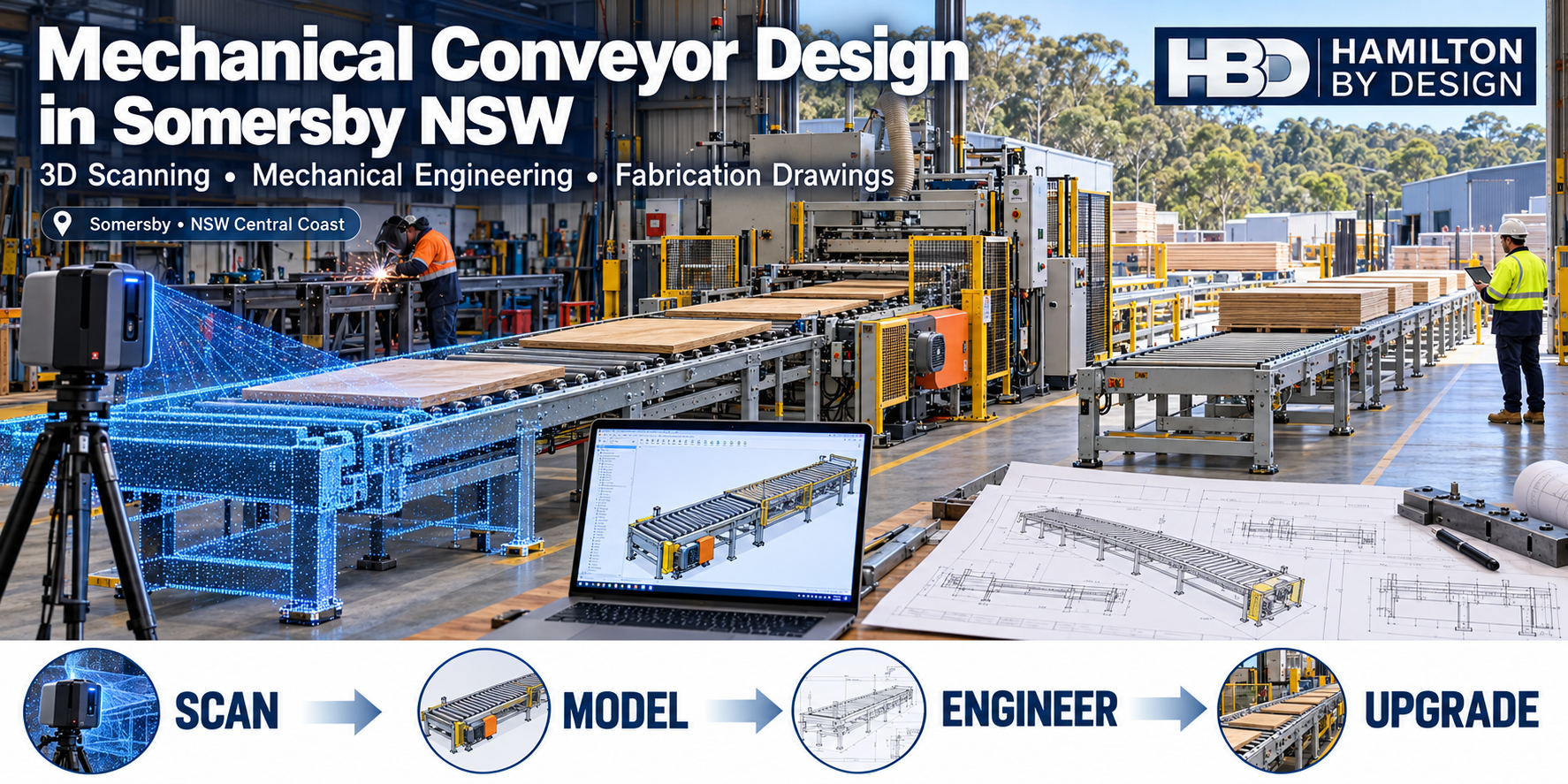
Mechanical Conveyor Design in Somersby NSW

Somersby conveyor design illustration showing timber panels on roller conveyors, LiDAR scanning, a CAD model and fabrication drawings, with the HBD logo.

Conveyor engineering for manufacturing, fabrication and industrial plant upgrades
Blue line icon of an industrial belt conveyor with rollers, support frame, gearbox and drive motor.

Hamilton By Design provides mechanical conveyor design in Somersby NSW, supporting manufacturers, fabricators and industrial businesses planning new equipment, production changes and upgrades to existing plant.

A conveyor must suit the product being handled and the factory in which it operates. Its layout needs to account for loading, discharge, machinery interfaces, guarding and maintenance access.

We bring together mechanical engineering, 3D laser scanning, SolidWorks modelling and fabrication drawings to develop conveyor arrangements around your operating requirements and existing site conditions.

From a workshop roller conveyor to a transfer chute modification or production-line extension, our approach follows a connected process:

Scan โ†’ Model โ†’ Engineer โ†’ Upgrade

Supporting Somersbyโ€™s manufacturing and industrial businesses

Somersby businesses work across a range of manufacturing, fabrication, processing and industrial applications. Each has different material handling requirements.

A conveyor carrying timber panels has different design needs from one transporting packaged products, fabricated steel components or process waste. Product dimensions, weight, surface condition and loading method all influence the arrangement.

Hamilton By Design can assist with projects involving:

  • Manufacturing and assembly lines.
  • Timber-panel and sheet-product handling.
  • Fabrication workshop transfer arrangements.
  • Packaging and production equipment.
  • Machinery infeed and discharge systems.
  • Industrial processing and bulk materials handling.
  • Recycling and process-waste transfer.
  • Replacement or modification of existing conveyors.

We begin by defining what the conveyor needs to achieve, then develop the mechanical design around that requirement.

Approximately 30 years of conveyor and materials handling experience

Hamilton By Designโ€™s principal mechanical engineer, Anthony Hamilton, brings approximately 30 years of experience working with conveyors and materials handling equipment.

That experience informs a practical approach to conveyor design: understand the process, establish the loads, check the interfaces and prepare documentation that supports fabrication and installation.

For an existing factory, the challenge often extends beyond the conveyor itself. New equipment may need to fit between columns, pipework, production machinery and access routes while retaining room for maintenance.

Considering these constraints early helps identify design issues before equipment is fabricated.

New conveyor installations and production-line changes

Adding machinery can change how materials move through a factory.

A new cutting machine, filling line or packing station may require revised conveyor heights, different transfer arrangements or additional accumulation space. Changes in product size or production rate can also affect the suitability of an existing system.

Our mechanical conveyor design service can support:

  • Preliminary conveyor layouts.
  • Infeed and discharge arrangements.
  • Connections between production machines.
  • Conveyor extensions and relocations.
  • Transfer tables and transition sections.
  • Equipment frames and mounting details.
  • Guarding and removable access panels.
  • Fabrication and assembly documentation.

Where electrical controls or automation are required, mechanical interfaces are coordinated with your nominated specialists.

Design around the factory that exists today

Factory drawings do not always reflect the current installation.

Equipment may have been relocated, conveyors extended or services added without corresponding drawing updates. Designing from incomplete information can create clashes or incorrect connection details.

3D laser scanning can establish a measured reference for visible factory geometry, including machinery, conveyors, columns, platforms and surrounding services.

This information can support:

  • Conveyor route development.
  • Equipment positioning and elevation checks.
  • Identification of potential clashes.
  • Reviews of transfer and connection geometry.
  • Maintenance and component-removal clearances.
  • Installation planning.

Scanning is planned around the projectโ€™s intended use. Critical dimensions and close-tolerance interfaces may require direct measurement or additional verification.

Learn more about our 3D laser scanning and factory engineering services in Somersby.

Conveyor upgrades and modifications

A complete conveyor replacement is not always necessary.

A project may involve improving a transfer point, changing the discharge position, replacing a damaged frame or modifying the arrangement to suit new equipment.

Hamilton By Design can assist with:

  • Conveyor length and layout changes.
  • Revised loading and discharge arrangements.
  • Transfer chutes and product guides.
  • Roller mounting and support details.
  • Guard replacements and access improvements.
  • Wear liners and replaceable components.
  • Connections to bins, hoppers and machinery.

We review the existing equipment and the operating problem before developing the modification.

If throughput is increasing, the review may also need to consider the drive, conveyor components and supporting arrangements. Extending the geometry alone does not establish that the equipment is suitable for the revised duty.

Transfer chutes and bulk materials handling

For bulk material applications, conveyor performance depends partly on how material enters and leaves the belt.

Transfer geometry can affect loading position, impact, spillage, wear and blockages. Chute modifications therefore need to consider the material characteristics and operating conditions, together with available space.

Design considerations may include:

  • Material trajectory and receiving-belt alignment.
  • Loading conditions and impact zones.
  • Chute geometry and potential build-up.
  • Wear protection and liner replacement.
  • Sealing and dust-control interfaces.
  • Inspection, cleaning and maintenance access.

Specialist flow analysis can be considered where the project requires it.

Explore our materials handling, chute and hopper design services.

Reverse engineering existing conveyor components

Older conveyors may have missing drawings, unsupported components or modifications that are difficult to trace.

Reverse engineering can help establish the information needed to design replacements for selected components and assemblies.

Depending on the project, this may include:

  • Conveyor brackets and mounting plates.
  • Guards and covers.
  • Transfer chute bodies.
  • Roller mounting arrangements.
  • Frames and mechanical interfaces.
  • Worn or modified equipment components.

Measurement methods are selected to suit the component and required tolerances. Large assemblies and surrounding plant geometry may be suitable for LiDAR capture, while smaller features can require other measurement methods.

Wear and deformation are also considered. A replacement should reflect the intended function and geometry rather than automatically reproduce the componentโ€™s worn condition.

SolidWorks models and fabrication drawings

A 3D model allows the proposed arrangement to be reviewed before fabrication begins.

Hamilton By Design uses SolidWorks and AutoCAD to develop conveyor models and drawings appropriate to the agreed scope.

Deliverables can include:

  • Concept and detailed arrangement models.
  • General arrangement drawings.
  • Fabrication and assembly drawings.
  • Guard and sheet-metal details.
  • Chute and liner layouts.
  • Bills of materials.
  • Equipment interface details.
  • Installation reference dimensions.

Models can help production and maintenance personnel review the proposed layout, access arrangements and removal paths.

Drawing revisions and outstanding information are identified so the project team understands which documents are ready for review and which are approved for the next stage.

Maintenance access and machinery guarding

Maintenance requirements should influence the conveyor design from the beginning.

A compact installation may fit the available space but leave insufficient room to service bearings, adjust equipment or remove a drive assembly.

Design reviews can consider:

  • Access to bearings, drives and take-up arrangements.
  • Space for belt, roller and component replacement.
  • Guard attachment and removal.
  • Inspection and cleaning requirements.
  • Potential nip, crush and entanglement points.
  • Interfaces with walkways and workstations.
  • Isolation and servicing arrangements.

Applicable safety requirements and specialist assessments are established for the project. Safety controls, emergency stops and electrical systems require coordination with the relevant specialists.

Working with Somersby fabricators and installation teams

Clear drawings and interface information help connect engineering design with workshop fabrication.

Hamilton By Design can work with your nominated fabricator, machinery supplier and installation contractor to clarify connection details, assembly requirements and site constraints.

Early discussions can address:

  • Available fabrication processes.
  • Standard sections and purchased components.
  • Transport and lifting arrangements.
  • Workshop assembly versus site assembly.
  • Site access and installation sequence.
  • Shutdown requirements.
  • Dimensions requiring verification before manufacture.

Our mechanical engineering and 3D scanning services in Somersby provide broader support for related plant and equipment modifications.

Our mechanical conveyor design process

1. Define the requirement

We discuss the product or material, required throughput, loading method, operating conditions and the problem you want to solve.

For existing equipment, photographs, drawings and operator feedback provide useful starting information.

2. Establish site conditions

Where required, we visit the site, capture the relevant geometry and verify critical interfaces.

3. Develop the concept

We prepare the proposed arrangement and review its relationship with machinery, access routes and surrounding equipment.

4. Complete the mechanical design

The agreed concept is developed into detailed models, calculations and component arrangements appropriate to the scope.

5. Prepare the drawing package

Drawings and supporting information are issued through the agreed review process before fabrication.

6. Support fabrication and installation

We can assist with technical queries, agreed drawing updates and interface clarification as the project progresses.

Frequently asked questions

Can you design a conveyor around our existing machinery?

Yes. Site measurements, available drawings and 3D scanning can help establish the layout and connection requirements around installed equipment.

Can you modify an existing conveyor?

Yes. We can develop designs for extensions, transfer changes, component replacement and other agreed modifications. The existing equipmentโ€™s suitability for the revised duty needs to be assessed.

What if we do not have drawings?

Missing drawings do not necessarily prevent a project from proceeding. Scanning, direct measurement and reverse engineering can help establish the required information.

Do you provide fabrication drawings?

Fabrication drawings can form part of the scope, together with general arrangements, assembly details, bills of materials and CAD models.

Can you work with our local fabricator?

Yes. We can coordinate mechanical details and drawing requirements with your nominated fabricator and installation team.

Can scanning take place while the factory is operating?

In some circumstances, yes. Access, moving equipment, visibility and site safety requirements must be reviewed before the capture plan is agreed.

What information is needed for a quotation?

Useful inputs include photographs, existing drawings, product dimensions and weights, required throughput, proposed layout changes and your delivery timeframe.

Discuss your Somersby conveyor project

Are you planning a new conveyor, production-line change or upgrade to existing equipment?

Hamilton By Design can help establish the site conditions, develop the mechanical arrangement and prepare the models and drawings needed for the project.

Send through your photographs, available drawings and a brief description of the work required.

Contact Hamilton By Design to discuss mechanical conveyor design in Somersby NSW.


Hamilton By Design logo displayed on a blue tilted rectangle with a grey gradient background

Contact Us – Talk To Us

Name
Would you like us to arrange a phone consultation for you?
Address

Our clients:


Related Engineering Services for Somersby Conveyor Projects

Explore Hamilton By Design services supporting conveyor design, factory upgrades, equipment modifications and fabrication projects in Somersby and across the NSW Central Coast.

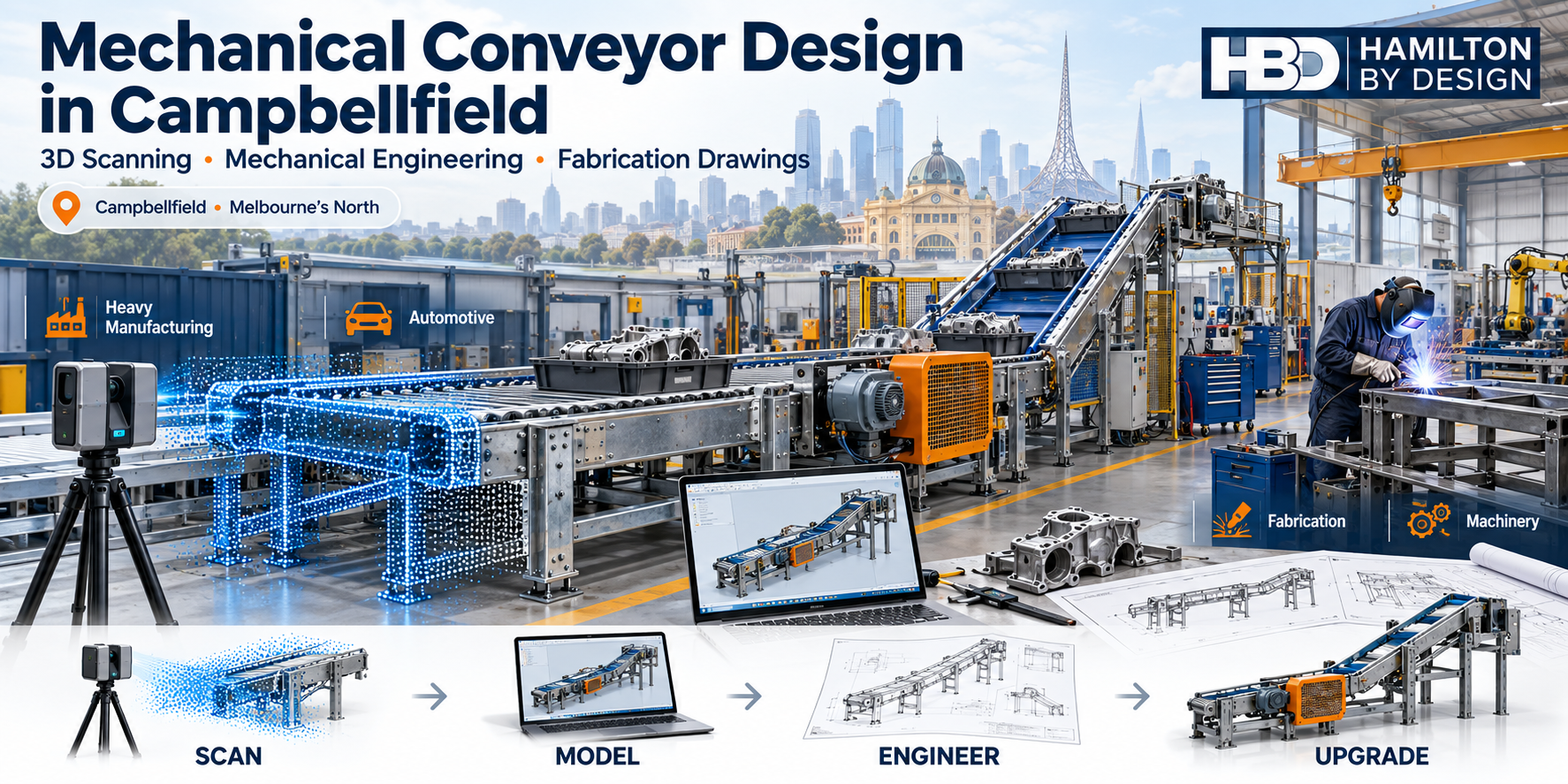
Mechanical Conveyor Design in Campbellfield

Campbellfield conveyor design illustration showing LiDAR scanning, CAD modelling, fabrication drawings and machinery, with Melbourne landmarks and the HBD logo.

Conveyor engineering for heavy manufacturing, automotive, fabrication and machinery

Blue line icon of an industrial belt conveyor with rollers, support frame, gearbox and drive motor.

Hamilton By Design provides mechanical conveyor design in Campbellfield, helping manufacturers, fabricators and machinery businesses plan new installations, modify existing equipment and improve material handling.

A conveyor needs to do more than move a product from one point to another. It must suit the material, fit the available space, connect with surrounding machinery and allow practical access for operation and maintenance.

We bring together mechanical engineering, 3D LiDAR scanning, SolidWorks modelling and fabrication drawings to develop conveyor designs around those requirements.

Whether you are adding production equipment, replacing an ageing conveyor or changing your factory layout, our approach follows a connected process:

Scan โ†’ Model โ†’ Engineer โ†’ Upgrade

Practical conveyor design built on engineering experience

Hamilton By Designโ€™s principal mechanical engineer, Anthony Hamilton, brings approximately 30 years of experience working with conveyors and materials handling equipment.

That experience supports a practical approach to design: understand the operating requirement, check the interfaces and develop documentation that fabricators and installation teams can use.

For Campbellfield businesses, conveyor projects may involve:

  • Moving manufactured components between workstations.
  • Feeding or discharging production machinery.
  • Handling fabricated assemblies and heavy parts.
  • Transferring products to inspection, packing or dispatch.
  • Collecting offcuts, scrap or process waste.
  • Modifying conveyors to accommodate new machinery.
  • Replacing worn components or unsupported equipment.

The design scope is developed around your process, site conditions and project priorities.

Conveyor design for Campbellfieldโ€™s industrial businesses

Heavy manufacturing

Heavy manufacturing applications require careful consideration of product weight, loading conditions, duty cycle and the working environment.

We can assist with conveyor frames, equipment supports, transfer arrangements and mechanical interfaces. Design considerations may include concentrated loads, impact during loading, uneven weight distribution and access for replacing wear components.

For an existing installation, we also consider how the proposed changes affect nearby equipment and supporting arrangements.

Automotive and component manufacturing

Automotive and component manufacturing applications often depend on controlled movement between machining, assembly, inspection and packing operations.

A conveyor may need to accommodate different component sizes, support a carrier or fixture, or transfer products at a defined working height.

Hamilton By Design can develop the mechanical layout and interface details, coordinating with machinery suppliers and electrical or automation specialists where those disciplines form part of the project.

Fabrication workshops

Fabrication workshops need material handling arrangements that suit their products and available floor space.

Applications may include roller conveyors beside cutting equipment, transfer tables between work areas, or handling arrangements for fabricated components.

We consider loading methods, forklift movements, crane access and the space required around the equipment. The aim is to develop a layout that supports production while retaining practical access through the workshop.

Machinery builders and equipment upgrades

For machinery builders, the conveyor is often one part of a larger system.

We can assist with conveyor infeed and discharge arrangements, mounting interfaces, transition sections, guarding and maintenance clearances.

Where existing machinery is being relocated or upgraded, capturing the surrounding geometry early helps establish how the new arrangement will fit.

Capture the existing factory before designing the upgrade

Older drawings may no longer reflect the equipment on site. Conveyors may have been extended, machinery relocated or services installed across a proposed route.

3D LiDAR scanning provides a measured reference for the visible site geometry, helping establish the relationship between conveyors, machinery, columns, platforms and surrounding services.

The scan data can support:

  • Factory and workshop layout planning.
  • Conveyor route and elevation development.
  • Identification of potential clashes.
  • Connection points with existing equipment.
  • Access and maintenance reviews.
  • Planning for prefabricated assemblies.

Scan coverage, accuracy requirements and critical dimensions are agreed for the project. Machined fits, bolt-hole positions and other close-tolerance interfaces may require additional measurement or verification.

This helps ensure the design uses measurement methods appropriate to each feature.

New conveyor layouts and existing conveyor modifications

A conveyor project does not always require a complete replacement.

Sometimes the most useful improvement is a revised transfer point, a new discharge arrangement or a change to the equipment layout.

Hamilton By Design can assist with:

  • Conveyor extensions and route changes.
  • Revised infeed and discharge heights.
  • Transfer chutes and transition sections.
  • Conveyor frames and mounting brackets.
  • Guarding and removable access panels.
  • Wear liners and replaceable components.
  • Interfaces with bins, hoppers and production machinery.

Before developing a modification, we review the operating problem and the existing arrangement. This helps establish whether the issue relates to geometry, product handling, wear, access or another part of the process.

For bulk material applications, learn more about our chute, hopper and materials handling design services.

Reverse engineering conveyor components

When drawings are missing or equipment has become obsolete, reverse engineering can provide a basis for replacement design.

Depending on the project, this may include:

  • Conveyor brackets and mounting assemblies.
  • Guards, covers and enclosures.
  • Transfer chute bodies.
  • Roller mounting arrangements.
  • Frames and equipment interfaces.
  • Worn or modified mechanical components.

We combine suitable measurement methods with CAD modelling and engineering review to establish the replacement requirements.

A worn component should not automatically be reproduced exactly as measured. Wear, deformation and previous repairs need to be considered when deciding the intended replacement geometry.

Read more about reverse engineering and 3D scanning in Melbourne.

SolidWorks models and fabrication drawings

A clear 3D model helps the project team review the conveyor arrangement before fabrication begins.

Hamilton By Design uses SolidWorks and AutoCAD to develop models and drawings appropriate to the agreed scope.

Deliverables can include:

  • Conveyor arrangement models.
  • General arrangement drawings.
  • Fabrication and assembly drawings.
  • Sheet-metal and guard details.
  • Chute and liner layouts.
  • Bills of materials.
  • Equipment interface details.
  • Installation reference dimensions.

Models can also help operators and maintenance personnel review working clearances, removal paths and access to serviceable components.

Where scan data forms part of the project, our 3D scanning for fabrication in Melbourne service connects site capture with modelling and drawing preparation.

Consider maintenance and guarding from the start

Maintenance access is best considered while the conveyor layout is being developed.

A design review may examine access to bearings, drives and take-up arrangements, along with the space needed to remove guards or replace components.

Other considerations include:

  • Potential nip, crush and entanglement points.
  • Cleaning and inspection access.
  • Guard attachment and removal.
  • Product accumulation and spillage.
  • Isolation requirements.
  • Interfaces with walkways and workstations.

The applicable safety requirements and any specialist assessment are established for the project. Electrical controls, emergency stops and safety control systems require coordination with the relevant specialists.

Our conveyor design process

1. Define the operating requirement

We begin with the material or product being handled, required throughput, loading method, operating conditions and the problem you want to solve.

For an upgrade, photographs, existing drawings and feedback from operators are useful starting points.

2. Capture and verify site conditions

Where required, we scan the installation and check critical interfaces. This establishes the available space and the connection requirements.

3. Develop the concept

We prepare the proposed conveyor arrangement and review its relationship with production machinery, access routes and surrounding equipment.

4. Complete the mechanical design

The agreed concept is developed into detailed models, calculations and component arrangements appropriate to the scope. Specialist inputs are coordinated where required.

5. Prepare the drawing package

Drawings and supporting information are prepared for review and fabrication, with revisions clearly identified.

6. Support fabrication and installation

We can assist with technical queries, interface clarification and agreed drawing updates during fabrication and installation.

Supporting Campbellfield conveyor projects

Hamilton By Design supports Campbellfield businesses planning new production equipment, factory changes and conveyor upgrades.

We work with asset owners, maintenance teams, machinery suppliers and fabricators to connect the operating requirement with a practical mechanical design.

Our broader mechanical engineering services in Melbourne can support related equipment modifications and plant integration.

Frequently asked questions

Can you modify an existing conveyor?

Yes. We can assess the existing arrangement and develop a design for extensions, transfer changes, guarding, component replacement or revised machinery interfaces. The scope depends on the condition and requirements of the installation.

Do you need existing conveyor drawings?

Existing drawings are helpful, but they are not always available. Site scanning, direct measurement and reverse engineering can help establish the information needed for design.

Can you design around our current factory layout?

Yes. Site measurements or 3D scanning can provide a reference for developing the conveyor arrangement around existing machinery and visible site constraints.

Do you provide fabrication drawings?

Fabrication drawings can form part of the agreed scope, together with general arrangements, assembly details and bills of materials.

Can you work with our fabricator or machinery supplier?

Yes. We can coordinate mechanical interfaces and drawing requirements with your nominated suppliers and installation team.

What information do you need for a quote?

Useful information includes photographs, existing drawings, product dimensions and weights, required throughput, proposed layout changes and your delivery timeframe.

Discuss your Campbellfield conveyor project

Are you planning a conveyor installation, machinery upgrade or factory layout change?

Hamilton By Design can help you establish the site conditions, develop the mechanical arrangement and prepare the documentation needed to move the project forward.

Send us your photographs, available drawings and a brief description of the work required.

Contact Hamilton By Design to discuss mechanical conveyor design in Campbellfield.


Hamilton By Design logo displayed on a blue tilted rectangle with a grey gradient background

Contact Us – Talk To Us

Name
Would you like us to arrange a phone consultation for you?
Address

Our clients:


Related Engineering Services for Campbellfield Conveyor Projects

Explore Hamilton By Design services supporting conveyor upgrades, manufacturing equipment, factory layouts and fabrication projects in Campbellfield and across Melbourne.

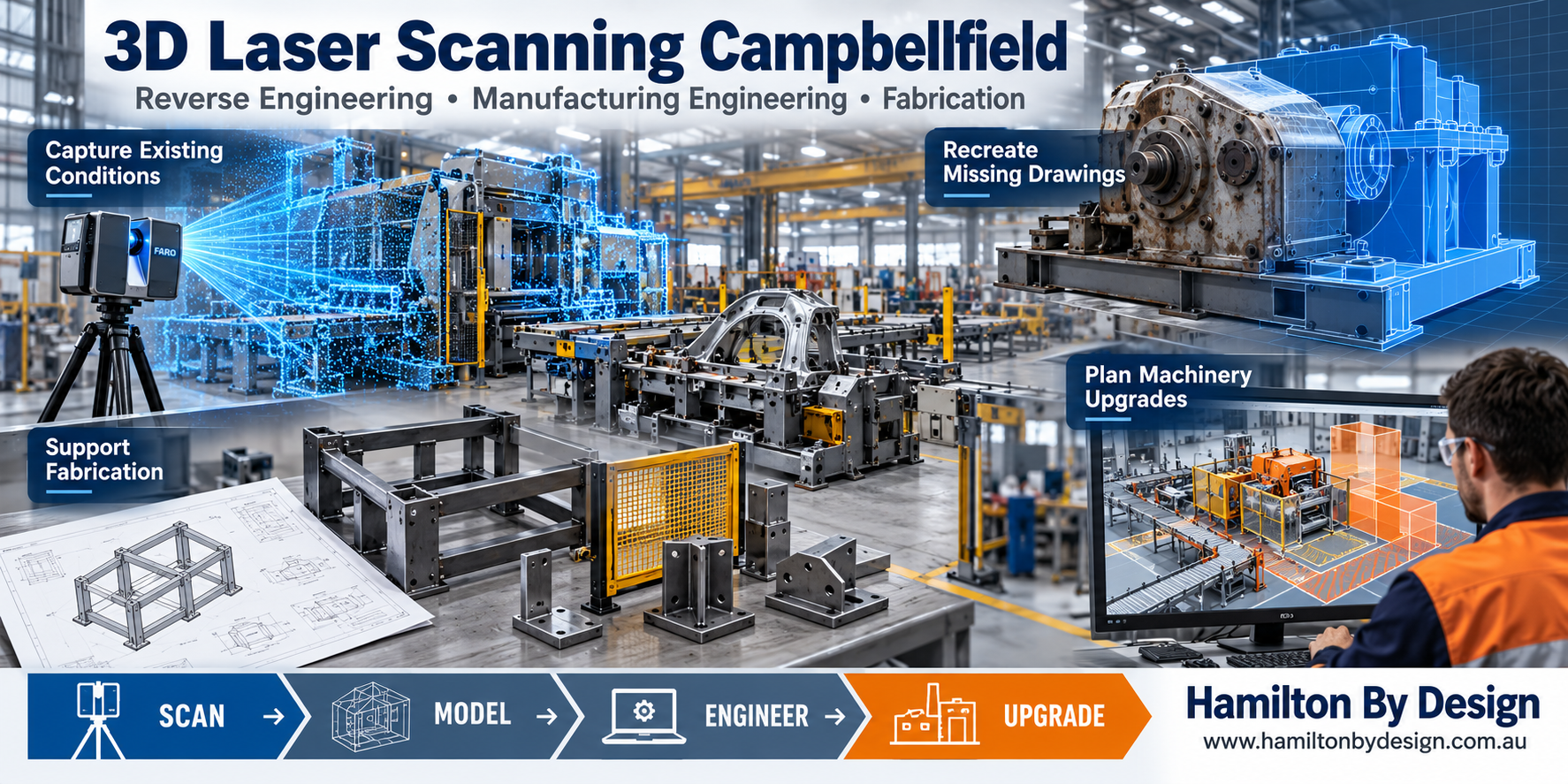
3D Laser Scanning Campbellfield โ€“ Reverse Engineering and Manufacturing Engineering

Campbellfield manufacturing illustration showing laser scanning, machinery converted to CAD, fabrication drawings and factory upgrade planning.
Blue 3D LiDAR scanner icon on a tripod with scanning waves

Hamilton By Design provides 3D laser scanning, reverse engineering and manufacturing engineering support for businesses in Campbellfield, Victoria. We help manufacturers, automotive workshops, fabricators and machinery operators capture existing equipment, develop useful CAD models and plan practical engineering improvements.

Whether you need to replace an obsolete component, install new machinery or modify an existing production line, understanding what is already there is an essential starting point.

Our approach connects site measurement, 3D modelling, mechanical design and fabrication documentation. This gives your project a clear path from existing equipment to a documented solution.

Engineering Support for Campbellfield Industry

Heavy manufacturing, automotive work, fabrication and machinery maintenance share a common challenge: existing equipment does not always match the available drawings.

Machines may have been modified over many years. Production lines can contain equipment from several suppliers. Replacement parts may no longer be available, and older drawings may omit the dimensions needed for a new installation.

Hamilton By Design helps businesses work through these challenges by capturing existing conditions and translating them into engineering information.

Typical applications include:

  • Recording factory layouts before installing new equipment.
  • Reverse engineering

Hamilton By Design logo displayed on a blue tilted rectangle with a grey gradient background

Contact Us – Talk To Us

Name
Would you like us to arrange a phone consultation for you?
Address

Our clients:


Engineering Services for Campbellfield Industry

Explore Hamilton By Design services supporting Campbellfieldโ€™s heavy manufacturing, automotive, fabrication and machinery projectsโ€”from existing-condition capture to mechanical design and production upgrades.

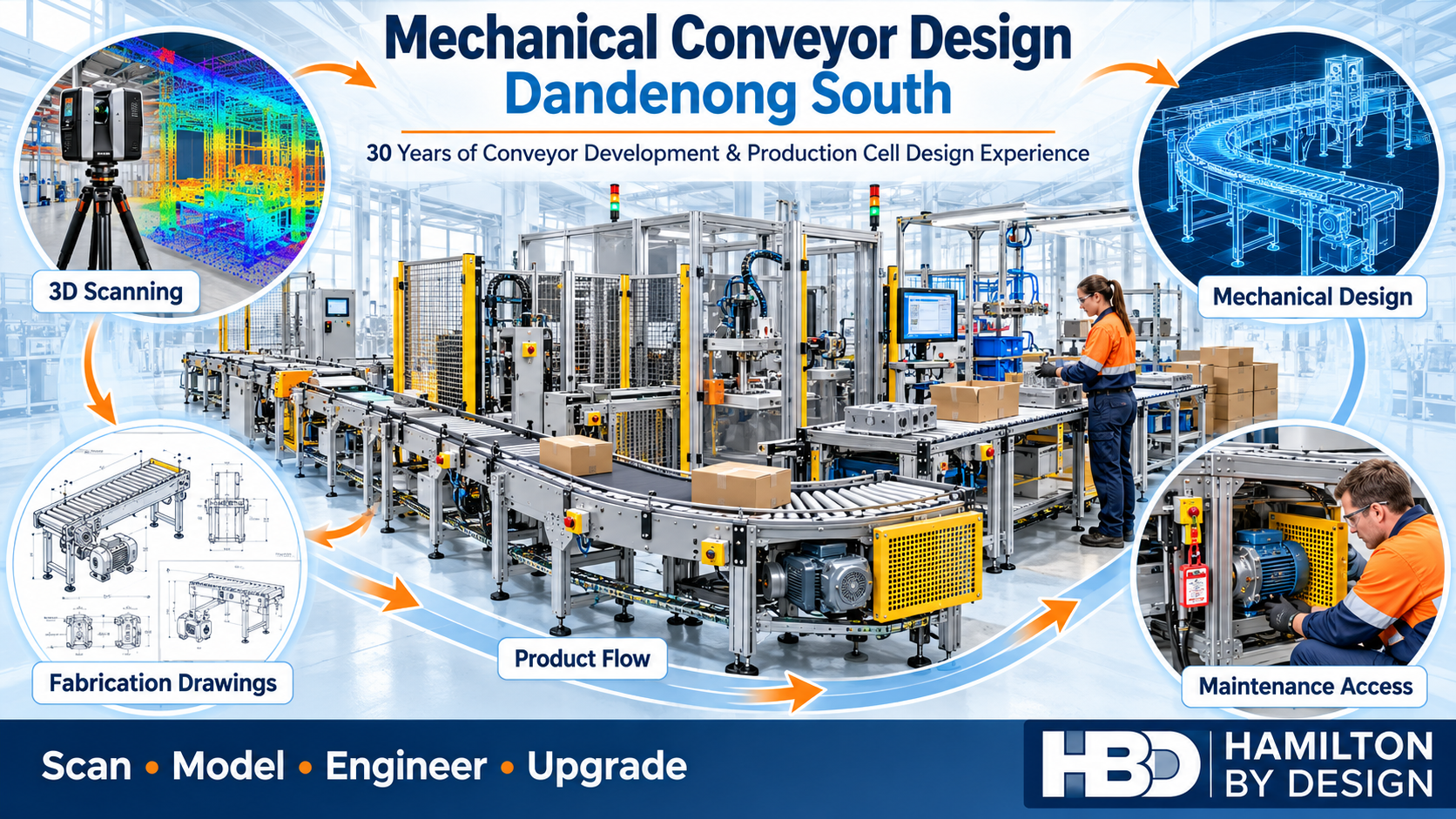
Mechanical Conveyor Design in Dandenong South

Conveyor production cell with 3D scanning, CAD modelling, fabrication drawings and maintenance access illustrations for Hamilton By Design in Dandenong South.

30 Years of Experience Developing Conveyors for Production Cells

Blue line icon of an industrial belt conveyor with rollers, support frame, gearbox and drive motor.

Hamilton By Design provides mechanical conveyor design in Dandenong South for manufacturers planning new production cells, equipment integration and conveyor upgrades. Our principal brings 30 years of experience developing and designing conveyors for production cells, supported by 3D scanning, SolidWorks modelling and fabrication drawings.

For 30 years, the principal at Hamilton By Design has worked on the development and design of conveyors for production cells. That experience shapes a practical approach to moving products between machines, workstations and process stages.

A successful conveyor design starts with understanding your production requirements. What needs to move? How quickly? In what orientation? How will operators interact with the equipment, and how will maintenance staff access it?

By combining mechanical design, 3D modelling, LiDAR scanning and engineering drawings, Hamilton By Design helps businesses develop conveyor arrangements that suit their products, processes and available factory space.

Conveyor Design That Fits Your Production Process

Conveyors connect individual machines into a working production system. Their performance depends on how well they integrate with the equipment upstream and downstream.

A conveyor may need to receive components from a machine, present products to an operator, feed a packaging station or transfer completed assemblies to the next process. Each application has different requirements for speed, spacing, loading and product handling.

Our design process considers:

  • Product dimensions, weight and orientation.
  • Required throughput and operating duty.
  • Conveyor length, width and working height.
  • Transfer points between conveyors and machines.
  • Available floor space and surrounding equipment.
  • Operator access and manual handling.
  • Cleaning, inspection and maintenance requirements.
  • Fabrication, assembly and installation constraints.

The aim is to develop a conveyor arrangement that supports the whole production cell.

New Conveyors and Existing Conveyor Modifications

Hamilton By Design can support new conveyor concepts and targeted modifications to existing systems.

Depending on the application, the mechanical design scope may include belt conveyors, roller conveyors, gravity transfers, product guides, support frames and machine interfaces.

For an existing production line, modifications might involve:

  • Extending or shortening a conveyor.
  • Changing the conveyor height or direction.
  • Connecting new machinery to an existing line.
  • Modifying product guides or transfer arrangements.
  • Replacing deteriorated frames and brackets.
  • Improving maintenance access.
  • Developing guarding and access arrangements.
  • Updating drawings to reflect the equipment installed.

Sometimes a targeted modification provides the improvement a business needs. We begin by understanding the issue and assessing the existing arrangement before developing the design scope.

Integrating Conveyors into Production Cells

Production-cell conveyor design requires attention to the interaction between people, products and machinery.

For example, installing a faster conveyor will not necessarily increase output if the next machine cannot accept products at that rate. Similarly, a compact layout may save floor space while making cleaning or maintenance difficult.

Hamilton By Design considers the proposed conveyor within the wider production process, including:

Product Flow

We assess how products enter, travel through and leave the conveyor. Product stability, spacing and transfer geometry can influence whether the arrangement operates smoothly.

Machine Interfaces

Conveyor heights, entry points and discharge positions need to coordinate with the equipment they serve. Mechanical interfaces should be established early so that brackets, guides and transition details can be developed around agreed dimensions.

Operator Interaction

Loading, unloading, inspection and assembly tasks influence conveyor positioning. The layout should account for how operators carry out their work and move through the production area.

Maintenance Access

Bearings, rollers, drives and adjustment points need suitable access. Considering component removal and maintenance tasks during design helps avoid difficult arrangements after installation.

Electrical controls, sensors and automation interfaces can be coordinated with the clientโ€™s nominated electrical or automation specialists.

3D Scanning Before Conveyor Upgrades

When a new conveyor must fit into an existing factory, reliable information about the surrounding equipment is valuable.

Older drawings may not show machinery relocations, additional services or previous modifications. Measuring only the proposed conveyor footprint can also miss obstructions above or beside it.

Hamilton By Designโ€™s 3D laser scanning services can capture visible existing conditions to support layout planning and mechanical design.

A scan can help establish:

  • Existing conveyor routes and elevations.
  • Machine positions and external geometry.
  • Columns, walls and nearby services.
  • Available space for new equipment.
  • Access routes and installation constraints.
  • Potential clashes with surrounding plant.

Capturing the factory before finalising a layout allows proposed equipment to be assessed against the existing environment.

Where close-tolerance interfaces are required, critical dimensions can be identified for separate verification. This is particularly relevant to mounting holes, shafts, bearings and machined connections.

3D Modelling for Conveyor Layouts

A coordinated 3D model makes the proposed conveyor arrangement easier to review before fabrication begins.

Hamilton By Design uses SolidWorks and CAD tools to develop mechanical assemblies and communicate the relationship between conveyors, machines, support frames and surrounding plant.

Models can support reviews of:

  • Overall conveyor geometry.
  • Product entry and discharge positions.
  • Frame and support arrangements.
  • Drive locations and component access.
  • Guarding envelopes.
  • Installation and assembly space.
  • Interfaces with existing equipment.

Production staff, maintenance personnel and fabricators can review the same arrangement and identify practical issues while changes are still straightforward to make.

For businesses in Dandenong South planning a production-cell upgrade, this provides an opportunity to resolve layout questions before committing to fabrication.

Mechanical Design and Fabrication Drawings

Once the arrangement is agreed, the design can progress into drawings and documentation appropriate to the project.

Our mechanical drafting services can support the manufacture, assembly and installation of new or modified conveyor equipment.

Depending on the agreed scope, deliverables may include:

  • General arrangement drawings.
  • Conveyor assembly drawings.
  • Frame and bracket fabrication details.
  • Sheet-metal and product-guide details.
  • Component drawings.
  • Bills of materials.
  • DXF cutting profiles.
  • STEP files for supplier coordination.
  • Installation and interface drawings.

The documentation package is established around the needs of the client, fabricator and installation team.

Designing for Maintenance and Practical Operation

A conveyor should be assessed over its working life, including the tasks needed to keep it operating.

During design, we consider questions such as:

  • Can the belt or rollers be replaced without dismantling surrounding equipment?
  • Are adjustment points accessible?
  • Can debris be removed from beneath the conveyor?
  • Is there space to inspect and maintain the drive?
  • Can guards be removed and reinstated for authorised maintenance?
  • Are wear components practical to source and replace?

These decisions affect maintenance effort, downtime and the usefulness of the final installation.

Machinery hazards and guarding requirements should also be considered during design. Conveyor safety depends on the complete arrangement, including access, controls, operating procedures and maintenance tasks.

A Practical Process from Concept to Installation Support

Hamilton By Designโ€™s mechanical engineering consulting can be tailored to a focused conveyor modification or a broader production-cell project.

1. Define the Requirement

We discuss the product, production target, existing problems, available space and project timing.

2. Establish Existing Conditions

Relevant drawings, measurements and site information are reviewed. Where useful, 3D scanning captures the surrounding plant.

3. Develop the Concept

Proposed layouts and mechanical arrangements are developed for review with the people who operate and maintain the equipment.

4. Complete the Detailed Design

The agreed concept progresses into component selection, mechanical details and the required design checks.

5. Prepare the Documentation

Models, drawings and supporting information are prepared for the agreed fabrication and installation scope.

6. Support Fabrication and Installation

Where included, we assist with technical queries and review changes that arise during manufacture or installation.

Frequently Asked Questions

Can Hamilton By Design modify an existing conveyor?

Yes. We can assess the existing arrangement and develop mechanical modifications to suit a new machine, revised product flow or changed production requirement.

Do we need a 3D scan for every conveyor project?

No. A straightforward conveyor may be designed using verified measurements and suitable drawings. Scanning is particularly useful where the factory is congested, records are incomplete or several equipment interfaces need coordination.

Can you design a conveyor around our available factory space?

Yes. Available space, equipment positions, access and maintenance requirements can be incorporated into the layout process. Providing information early helps establish the constraints before detailed design begins.

Can you provide drawings for our preferred fabricator?

Yes. The drawing package can be developed around the agreed fabrication scope and your fabricatorโ€™s requirements.

Can you assist before we purchase new machinery?

Yes. Early layout planning can help establish conveyor interfaces, working heights, access requirements and available installation space before machinery positions are finalised.

Discuss Your Conveyor Project in Dandenong South

Are you planning a new production cell, adding machinery or modifying an existing conveyor?

Hamilton By Design brings together 30 years of conveyor development and design experience, mechanical engineering, 3D scanning, CAD modelling and fabrication documentation.

Send us your existing drawings, photographs or a description of the production issue. Include the product being handled, your required throughput and any installation deadline so we can discuss a suitable scope.

Contact Hamilton By Design to discuss mechanical conveyor design in Dandenong South.


Hamilton By Design logo displayed on a blue tilted rectangle with a grey gradient background

Contact Us – Talk To Us

Name
Would you like us to arrange a phone consultation for you?
Address

Our clients:


Related Services for Conveyor and Production Cell Projects

Explore Hamilton By Design services that support conveyor design, factory upgrades and equipment integration in Dandenong South.

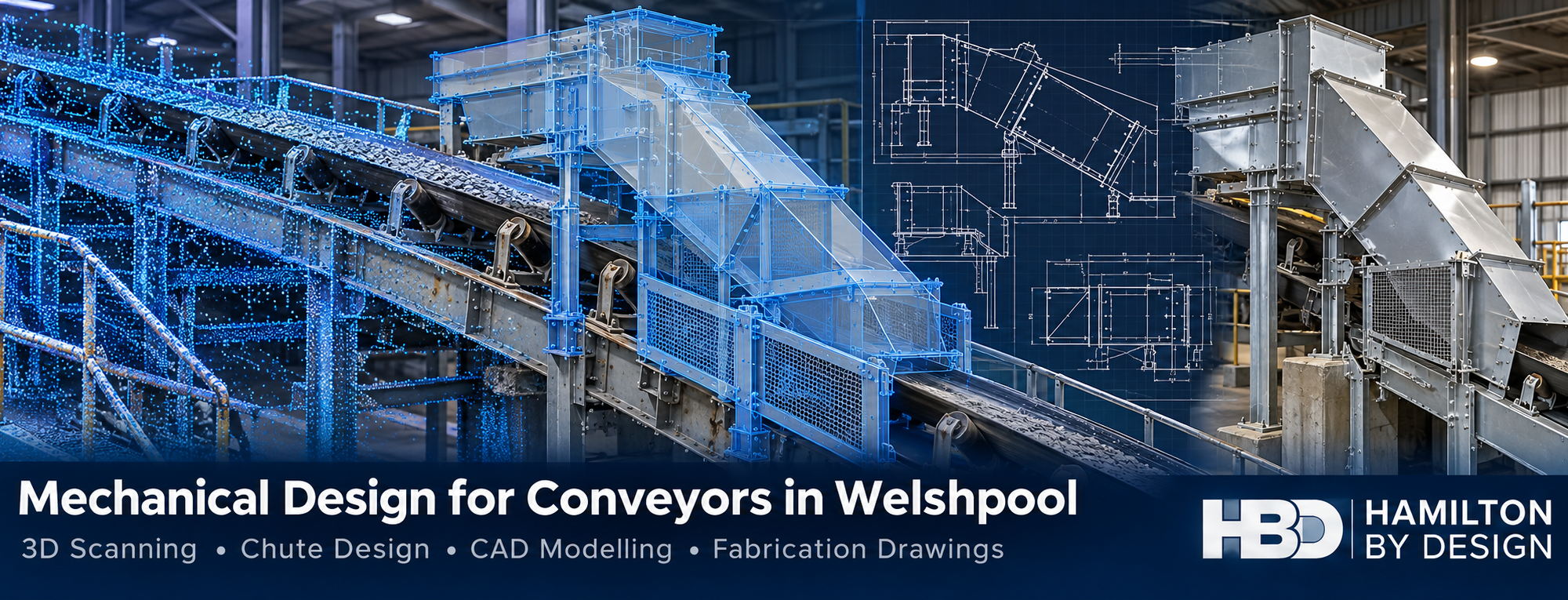
Mechanical Design for Conveyors in Welshpool

Industrial conveyor and transfer chute shown with a LiDAR point cloud, 3D CAD model and fabrication drawing, with the Hamilton By Design logo.

Conveyor upgrades, transfer chutes, 3D scanning and fabrication drawings for industrial facilities in Welshpool, WA

Blue line icon of an industrial belt conveyor with rollers, support frame, gearbox and drive motor.

A conveyor modification has to work with the equipment and space already on site. A replacement chute may need to fit between existing steelwork and services. A new conveyor section may need to connect to equipment whose drawings are incomplete or out of date. Guarding must allow for operation and maintenance as well as the intended installation.

Hamilton By Design brings these tasks together for Welshpool projects. We combine mechanical design, 3D LiDAR scanning, scan-to-CAD, reverse engineering and engineering drafting to help industrial clients move from an existing plant problem to a practical design and documented solution.

Welshpool is a major Perth industrial precinct with manufacturing, engineering, logistics and supply chain businesses. That mix makes conveyor and materials handling work relevant to both production facilities and the workshops that build equipment for projects elsewhere in Western Australia. canning.wa.gov.au

Conveyor design that starts with the existing plant

Conveyor projects often begin with a specific problem: a transfer point that spills material, a worn chute, restricted maintenance access, an equipment replacement or a proposed change to the production layout. The first step is to understand what must change and which parts of the existing installation must be retained.

Hamilton By Design can assist with the mechanical design and documentation of:

  • Conveyor modifications and equipment interfaces
  • Transfer, feed and discharge chutes
  • Hoppers, skirts and wear-liner arrangements
  • Support frames and equipment layouts
  • Machinery guarding and maintenance access
  • Replacement parts where usable drawings are unavailable
  • General arrangement and fabrication drawings

The scope can be tailored to the job. A workshop may need a model and drawings for one replacement assembly. An operating facility may need site capture, design development and an installation drawing package for a wider conveyor upgrade.

3D LiDAR scanning before conveyor modifications

Measurements taken from old drawings do not always represent the installed plant. Conveyor frames may have been altered, supports may have moved during earlier upgrades, and nearby pipework or cable trays may restrict the space available for new equipment.

For a brownfield project, industrial 3D scanning can capture the conveyor and its surrounding area as a point cloud. Relevant geometry can then be used to check proposed equipment locations, clearances and interfaces during design.

Scanning is particularly useful around crowded transfer stations, elevated conveyors and installations where a fabrication or shutdown window leaves little time to resolve a fit-up problem. The required measurements and tolerances should be agreed for each project; critical connection details may still need direct verification. Learn more about scanning conveyor transfer towers.

From point cloud to mechanical design

A point cloud records the existing condition. It becomes more useful when the project team can turn the relevant parts into a model, drawing or design decision.

Hamilton By Designโ€™s scan-to-CAD services for Perth projects can support the modelling of conveyor interfaces, surrounding steelwork and equipment layouts. A proposed modification can then be developed in context, with attention to access, removal paths and the space needed for fabrication and installation.

Depending on the agreed scope, deliverables may include a registered point cloud, a 3D CAD model, general arrangement drawings, fabrication details or files for coordination with the clientโ€™s wider plant model.

Transfer chutes and materials handling

The transfer point affects much more than the space between two conveyors. Material flow, loading position, impact, wear, dust, spillage and access for liner replacement all influence how a chute should be designed.

Hamilton By Design supports chute design and materials-handling engineering for new work and existing installations. For a Welshpool fabrication project, this may mean developing a replacement chute from supplied dimensions and operating information. For an installed plant upgrade, it may mean scanning the transfer area first and designing the new assembly around the actual conveyor and support geometry.

Where a chute is causing repeated maintenance problems, the design brief should identify the material being handled, operating duty, wear locations, cleaning needs and access constraints. Those inputs help define a solution that can be built and maintained, rather than simply reproducing a part that has performed poorly.

Reverse engineering and replacement components

Existing conveyors may have components with no current CAD model or reliable manufacturing drawing. A part may have been modified over time, or a supplier may no longer support the original equipment.

Hamilton By Design can use measurements and reverse-engineering 3D scanning to reconstruct relevant geometry. The resulting model can support a replacement design, drawing update or review of how a component interfaces with the rest of the conveyor.

Reverse engineering also creates an opportunity to examine the original componentโ€™s function and condition. Wear, deformation and previous repairs should be considered before dimensions are carried into a new design.

Drawings that support fabrication and installation

A 3D model helps the team review a proposal, but the workshop and installation team also need clear documentation. Depending on the project, Hamilton By Design can prepare general arrangement drawings, component drawings, assembly details and fabrication information for review and manufacture.

Good documentation makes the intended interfaces visible: what connects to the existing plant, which dimensions need checking on site, how an assembly is broken into transportable pieces and what access is required for installation. Our broader mechanical engineering services connect design, CAD modelling and drafting with the practical needs of plant upgrades.

Support for Welshpool workshops and industrial operators

Hamilton By Design can work with Welshpool fabrication businesses, maintenance teams, manufacturers and project engineers at different stages of a conveyor job.

A fabrication workshop may need a missing component modelled and drawn before it can quote or manufacture a replacement. A facility operator may need to establish the existing geometry before approving a layout change. A project engineer may need a coordinated model and drawing package for review before a shutdown. A maintenance team may need a chute or guard redesigned to improve access to a recurring problem area.

Projects can be scoped around the information already available. Existing drawings, photographs, operating requirements and site measurements provide a starting point; on-site scanning can be added where the installation needs a more complete survey.

Our approach to a conveyor project

  1. Define the problem. Confirm the equipment, operating duty, project boundaries and required deliverables.
  2. Review the existing information. Check drawings, photographs, models and known site constraints.
  3. Capture missing geometry where needed. Measure or scan the relevant conveyor and surrounding plant.
  4. Develop and review the design. Model the proposed change and resolve key interfaces with the client and fabricator.
  5. Issue the agreed documentation. Prepare drawings and model files suited to review, fabrication or installation.

The extent of each stage depends on the project. A small replacement component will need a different package from a multi-conveyor transfer upgrade.

Frequently asked questions

Can you design a replacement chute if our drawings are missing?

Yes. The starting point is to establish the existing interfaces and understand how the chute is expected to perform. Measurements or 3D scanning may be needed before the replacement is modelled and documented.

Do you provide 3D scanning as part of conveyor design?

Yes, where site capture is useful to the project. LiDAR scanning can help document the installed conveyor, support steelwork and surrounding obstructions before a modification is designed.

Can you work with our Welshpool fabricator?

Yes. Hamilton By Design can develop models and drawings for discussion with the nominated workshop, including practical fabrication and installation considerations within the agreed scope.

Can you help with one component rather than a complete conveyor?

Yes. Work can be scoped to a chute section, guard, support, replacement component or other defined mechanical assembly.

Discuss a conveyor project in Welshpool

If you are planning a conveyor upgrade, replacing a transfer chute or trying to document equipment with missing drawings, Hamilton By Design can help establish the existing condition and develop the mechanical design information needed for the next step.

Contact Hamilton By Design with your site location, a short description of the problem, available drawings or photographs, and your intended fabrication or shutdown timeframe.


Hamilton By Design logo displayed on a blue tilted rectangle with a grey gradient background

Contact Us – Talk To Us

Name
Would you like us to arrange a phone consultation for you?
Address

Our clients:


Services That Support Conveyor Projects in Welshpool

A conveyor upgrade can involve site measurement, mechanical design, guarding, analysis and fabrication documentation. Explore the Hamilton By Design services that support each stage.

Mechanical Engineering Services

Mechanical design for conveyors, materials handling equipment and plant modifications, supported by CAD modelling and engineering drawings.

Explore mechanical engineering โ†’

Chute Design and Materials Handling

Develop transfer chutes and related equipment around material flow, wear, maintenance access and the available space within existing plant.

Explore chute design โ†’

Machine Guarding Design

Review and design guarding for conveyor drives, pulleys and other moving machinery while considering operation, cleaning and maintenance.

Explore machine guarding โ†’

Reverse Engineering and 3D Scanning

Reconstruct useful engineering information for conveyor components and assemblies when original models or reliable drawings are unavailable.

Explore reverse engineering โ†’

3D CAD Modelling and Mechanical Drafting

Turn conveyor concepts and measured site information into 3D assemblies, general arrangements and drawings for project review and fabrication.

Explore CAD and drafting โ†’

FEA and Mechanical Assessment

Assess selected mechanical components and support arrangements where loads, stress, deflection or fatigue need closer engineering review.

Explore mechanical assessment โ†’

Scanning Conveyor Transfer Towers

Capture conveyors, chutes, steelwork and nearby services in congested transfer areas before planning an upgrade or replacement.

Explore transfer tower scanning โ†’

Industrial 3D Scanning

Record existing plant conditions as point cloud data to support layout review, scan-to-CAD modelling and brownfield conveyor modifications.

Explore industrial scanning โ†’

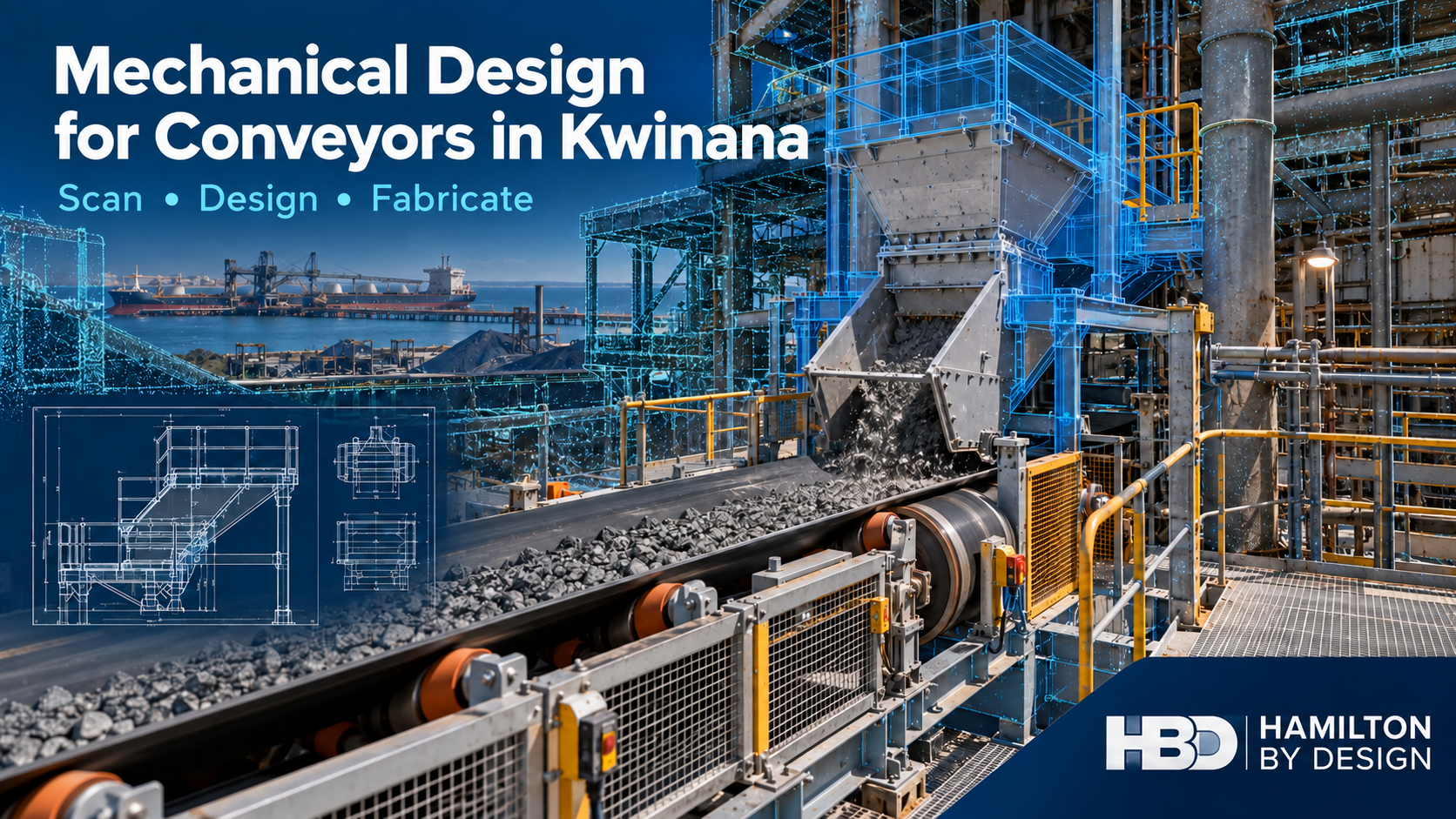
Mechanical Design for Conveyors in Kwinana

Conveyor transfer point in a Kwinana industrial plant with LiDAR and CAD overlays illustrating a proposed mechanical design upgrade.

Mechanical Design for Conveyors in Kwinana

Blue line icon of an industrial belt conveyor with rollers, support frame, gearbox and drive motor.

Conveyor changes need to work with the plant that is already there. Hamilton By Design provides mechanical design support for conveyors in Kwinana and Kwinana Beach, helping industrial teams plan modifications to transfer points, chutes, guarding, access and associated equipment.

A conveyor can appear straightforward on a general arrangement drawing. On site, its performance depends on how material enters and leaves the belt, the position of surrounding steel and services, available maintenance space, and the way components will be installed during a shutdown. A change to one transfer point can affect the equipment on either side.

We combine mechanical engineering, 3D laser scanning, CAD modelling and fabrication documentation to help maintenance managers, project engineers and fabricators develop practical conveyor upgrades. The work can begin with an existing problem, a proposed replacement or an ageing asset with incomplete drawings.

Conveyor engineering in Kwinanaโ€™s industrial environment

Kwinanaโ€™s industrial area includes process facilities, chemicals, minerals processing, energy infrastructure and bulk port operations. These facilities rely on equipment that can be maintained and modified within demanding operating schedules.

For a conveyor project, local conditions may include congested plant, limited shutdown access, abrasive or dusty material, marine exposure, established pipework and steelwork, and interfaces with other operating systems. These conditions need to be assessed for the particular site. They should not be assumed from a standard conveyor drawing.

Hamilton By Design can support the project from existing-condition capture through to mechanical design and drawings for fabrication. Our 3D laser scanning service in Kwinana provides measured site geometry where old drawings are missing or uncertain.

What conveyor components can we help design or modify?

  • Conveyor layouts and interfaces with existing equipment
  • Transfer chutes, hoppers, skirts and wear-liner arrangements
  • Drive, pulley, take-up and support-related mechanical layouts
  • Guards around accessible moving parts and maintenance areas
  • Access platforms, walkways and equipment-removal clearances
  • Replacement brackets, frames, covers and fabricated components
  • Installation arrangements for brownfield modifications
  • General arrangement and fabrication drawings

The design scope depends on the equipment and the problem being solved. A localised chute replacement requires different information from a complete conveyor redesign. We define the required calculations, site checks, specialist input and deliverables before detailed design begins.

Five common conveyor problems

1. Material does not transfer cleanly

Poorly controlled flow at a transfer point can contribute to spillage, dust, blockages and premature wear. The cause may involve the incoming trajectory, chute geometry, impact area, material properties, belt speed or the condition of existing equipment.

We can review the installed arrangement, capture relevant geometry and develop a proposed chute or interface modification in CAD. Depending on the scope, drawings can include liner layouts, replacement parts and fabrication details. Learn more about our chute and materials-handling engineering.

2. The proposed replacement may not fit

A new chute, drive assembly or platform can clash with existing steel, pipework, cable trays or access routes. The problem may only become visible after fabrication, when a shutdown crew is trying to install it.

Engineering-grade LiDAR scanning can establish the surrounding geometry before the new equipment is modelled. We can use the point cloud to review envelopes and likely clashes, then separately verify critical fabrication and installation dimensions. A scan is a strong starting point, but the tolerance of a critical connection must be confirmed for its intended use.

3. Wear makes maintenance too frequent

Abrasive material may wear through a chute, skirt or impact zone well before the rest of the conveyor reaches the end of its service life. Replacing the same component repeatedly may leave the underlying flow or access problem unresolved.

We can document the current arrangement, review reported wear patterns with the maintenance team and develop replaceable wear components or revised geometry. Inspection and removal access should be considered alongside the life of the component.

4. Guards are difficult to remove or leave hazards exposed

Conveyors include pulleys, belts, drives and other moving parts that can create entanglement and nip-point hazards. A guard needs to prevent access to the hazard while supporting the actual tasks performed by operators and maintainers.

Hamilton By Design can assist with measured guarding concepts and fabrication drawings. Guarding should be developed with the siteโ€™s task-based risk assessment, isolation procedures and machinery-safety requirements. Our machine guarding service explains this approach.

5. Maintenance access was overlooked

A component may fit the available space yet be difficult to inspect, lift out or replace. When designing a modification, we consider access to inspection points, fasteners, liners, guards and equipment-removal paths. The arrangement should also be reviewed against the siteโ€™s lifting and shutdown plan.

From site survey to fabrication drawings

For an existing conveyor, our workflow can be scaled to the project:

  1. Define the operating problem. Review material, duty, failure history, maintenance tasks and the proposed outcome with the site team.
  2. Capture existing conditions. Review available drawings and measure or scan the conveyor and surrounding interfaces.
  3. Develop design options. Model practical arrangements for flow, fit, wear, guarding and access.
  4. Check the design. Undertake agreed mechanical assessment and coordinate any required structural, electrical, process or specialist review.
  5. Prepare documentation. Issue general arrangements, part and assembly drawings, liner layouts or fabrication details suited to the agreed scope.
  6. Support implementation. Resolve design queries and record changes where fabrication or site installation requires them.

Depending on the project, we can provide registered point clouds, SolidWorks models, AutoCAD drawings, STEP files, PDF drawing packs and other agreed formats. Our Perth mechanical and industrial drafting service covers the drawing stage in more detail.

Standards and conveyor safety

Applicable standards must be selected for the conveyor type, site, hazards and design scope. The AS/NZS 4024 Safety of Machinery series includes conveyor-specific requirements and broader guidance for risk assessment and safeguarding. AS 1657 may be relevant to fixed platforms, walkways, stairs and ladders associated with access.

For a shiploader, stacker, reclaimer or other mobile bulk-handling machine, AS 4324.1 may be relevant to the design of its steel structure. Other mechanical, structural, electrical and hazardous-area requirements need to be established with the responsible disciplines.

Design work also needs to align with the operatorโ€™s plant-risk assessment, isolation procedures and management of change. Drawings alone cannot control how a conveyor is cleaned, operated or maintained. The site team must review the proposed arrangement against the tasks people actually perform.

Who we support

Our conveyor design support is intended for Kwinana maintenance teams planning a replacement, project engineers developing a plant upgrade, fabrication workshops needing reliable drawings, and operators reviewing transfer performance, wear or access.

For port and bulk-handling equipment, our shiploader 3D scanning page explains how measured data supports modifications to conveyors, chutes, booms and access systems. Our Perth mechanical engineering page covers wider brownfield design support.

Frequently asked questions

Can you design a replacement chute for an existing conveyor?

Yes, subject to the information available and an agreed scope. We would review the existing geometry, material and operating problem before developing the replacement arrangement and drawings.

Do you need to scan the whole conveyor?

Not always. A localised modification may only require the transfer point, adjacent equipment and installation path. A wider upgrade may need more extensive capture. The scan boundary should follow the design decision.

Can you work from old drawings?

Yes, but critical interfaces should be checked against the physical asset before fabrication. Existing drawings are useful references even when later site modifications have made them incomplete.

Can you provide fabrication drawings?

Yes. Depending on the scope, deliverables may include general arrangements, assembly and part drawings, liner details and installation references. The required tolerances, materials and review responsibilities should be agreed before issue.

Can you review conveyor guarding?

We can assist with mechanical guarding concepts, site measurement and drawings. The final control strategy must account for the equipment, access frequency, maintenance tasks, isolation arrangements and applicable machinery-safety requirements.

Discuss a conveyor project in Kwinana

If a conveyor, transfer chute or guarding arrangement in Kwinana needs modification, contact Hamilton By Design. Send the site location, photographs or drawings, material handled, current problem, shutdown window and the outcome you need. We can then define the survey, engineering and drawing scope.


Hamilton By Design logo displayed on a blue tilted rectangle with a grey gradient background

Contact Us – Talk To Us

Name
Would you like us to arrange a phone consultation for you?
Address

Our clients: