


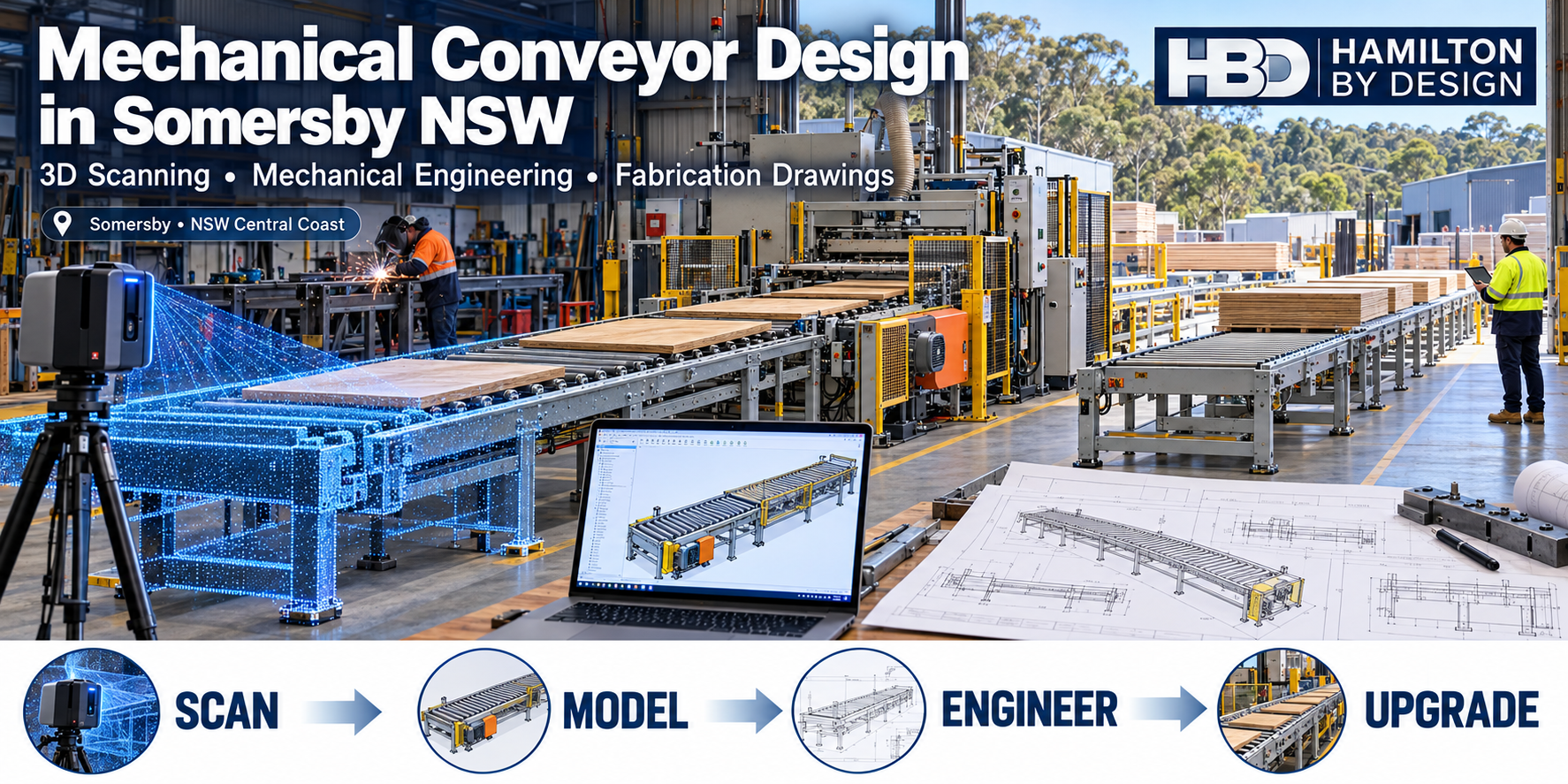
Conveyor engineering for manufacturing, fabrication and industrial plant upgrades
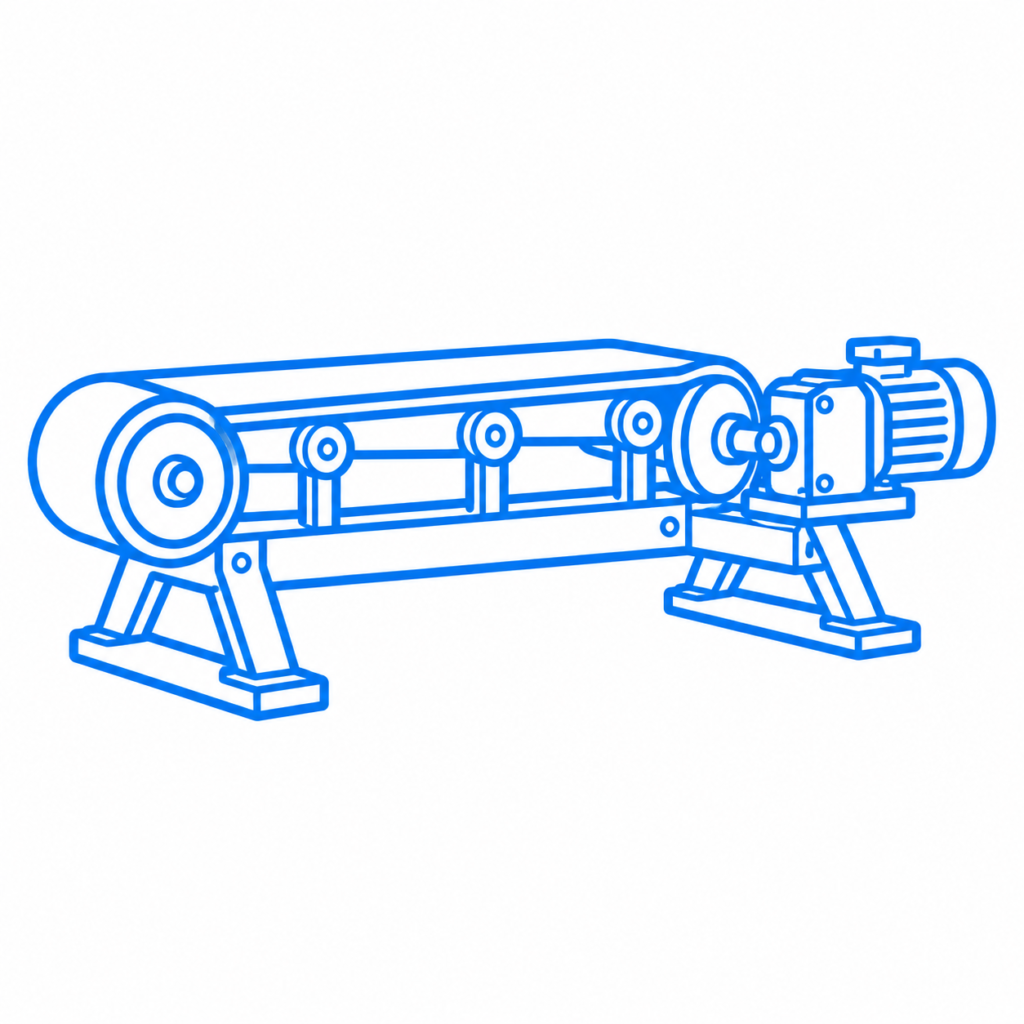
Hamilton By Design provides mechanical conveyor design in Somersby NSW, supporting manufacturers, fabricators and industrial businesses planning new equipment, production changes and upgrades to existing plant.
A conveyor must suit the product being handled and the factory in which it operates. Its layout needs to account for loading, discharge, machinery interfaces, guarding and maintenance access.
We bring together mechanical engineering, 3D laser scanning, SolidWorks modelling and fabrication drawings to develop conveyor arrangements around your operating requirements and existing site conditions.
From a workshop roller conveyor to a transfer chute modification or production-line extension, our approach follows a connected process:
Scan → Model → Engineer → Upgrade
Supporting Somersby’s manufacturing and industrial businesses
Somersby businesses work across a range of manufacturing, fabrication, processing and industrial applications. Each has different material handling requirements.
A conveyor carrying timber panels has different design needs from one transporting packaged products, fabricated steel components or process waste. Product dimensions, weight, surface condition and loading method all influence the arrangement.
Hamilton By Design can assist with projects involving:
- Manufacturing and assembly lines.
- Timber-panel and sheet-product handling.
- Fabrication workshop transfer arrangements.
- Packaging and production equipment.
- Machinery infeed and discharge systems.
- Industrial processing and bulk materials handling.
- Recycling and process-waste transfer.
- Replacement or modification of existing conveyors.
We begin by defining what the conveyor needs to achieve, then develop the mechanical design around that requirement.
Approximately 30 years of conveyor and materials handling experience
Hamilton By Design’s principal mechanical engineer, Anthony Hamilton, brings approximately 30 years of experience working with conveyors and materials handling equipment.
That experience informs a practical approach to conveyor design: understand the process, establish the loads, check the interfaces and prepare documentation that supports fabrication and installation.
For an existing factory, the challenge often extends beyond the conveyor itself. New equipment may need to fit between columns, pipework, production machinery and access routes while retaining room for maintenance.
Considering these constraints early helps identify design issues before equipment is fabricated.
New conveyor installations and production-line changes
Adding machinery can change how materials move through a factory.
A new cutting machine, filling line or packing station may require revised conveyor heights, different transfer arrangements or additional accumulation space. Changes in product size or production rate can also affect the suitability of an existing system.
Our mechanical conveyor design service can support:
- Preliminary conveyor layouts.
- Infeed and discharge arrangements.
- Connections between production machines.
- Conveyor extensions and relocations.
- Transfer tables and transition sections.
- Equipment frames and mounting details.
- Guarding and removable access panels.
- Fabrication and assembly documentation.
Where electrical controls or automation are required, mechanical interfaces are coordinated with your nominated specialists.
Design around the factory that exists today
Factory drawings do not always reflect the current installation.
Equipment may have been relocated, conveyors extended or services added without corresponding drawing updates. Designing from incomplete information can create clashes or incorrect connection details.
3D laser scanning can establish a measured reference for visible factory geometry, including machinery, conveyors, columns, platforms and surrounding services.
This information can support:
- Conveyor route development.
- Equipment positioning and elevation checks.
- Identification of potential clashes.
- Reviews of transfer and connection geometry.
- Maintenance and component-removal clearances.
- Installation planning.
Scanning is planned around the project’s intended use. Critical dimensions and close-tolerance interfaces may require direct measurement or additional verification.
Learn more about our 3D laser scanning and factory engineering services in Somersby.
Conveyor upgrades and modifications
A complete conveyor replacement is not always necessary.
A project may involve improving a transfer point, changing the discharge position, replacing a damaged frame or modifying the arrangement to suit new equipment.
Hamilton By Design can assist with:
- Conveyor length and layout changes.
- Revised loading and discharge arrangements.
- Transfer chutes and product guides.
- Roller mounting and support details.
- Guard replacements and access improvements.
- Wear liners and replaceable components.
- Connections to bins, hoppers and machinery.
We review the existing equipment and the operating problem before developing the modification.
If throughput is increasing, the review may also need to consider the drive, conveyor components and supporting arrangements. Extending the geometry alone does not establish that the equipment is suitable for the revised duty.
Transfer chutes and bulk materials handling
For bulk material applications, conveyor performance depends partly on how material enters and leaves the belt.
Transfer geometry can affect loading position, impact, spillage, wear and blockages. Chute modifications therefore need to consider the material characteristics and operating conditions, together with available space.
Design considerations may include:
- Material trajectory and receiving-belt alignment.
- Loading conditions and impact zones.
- Chute geometry and potential build-up.
- Wear protection and liner replacement.
- Sealing and dust-control interfaces.
- Inspection, cleaning and maintenance access.
Specialist flow analysis can be considered where the project requires it.
Explore our materials handling, chute and hopper design services.
Reverse engineering existing conveyor components
Older conveyors may have missing drawings, unsupported components or modifications that are difficult to trace.
Reverse engineering can help establish the information needed to design replacements for selected components and assemblies.
Depending on the project, this may include:
- Conveyor brackets and mounting plates.
- Guards and covers.
- Transfer chute bodies.
- Roller mounting arrangements.
- Frames and mechanical interfaces.
- Worn or modified equipment components.
Measurement methods are selected to suit the component and required tolerances. Large assemblies and surrounding plant geometry may be suitable for LiDAR capture, while smaller features can require other measurement methods.
Wear and deformation are also considered. A replacement should reflect the intended function and geometry rather than automatically reproduce the component’s worn condition.
SolidWorks models and fabrication drawings
A 3D model allows the proposed arrangement to be reviewed before fabrication begins.
Hamilton By Design uses SolidWorks and AutoCAD to develop conveyor models and drawings appropriate to the agreed scope.
Deliverables can include:
- Concept and detailed arrangement models.
- General arrangement drawings.
- Fabrication and assembly drawings.
- Guard and sheet-metal details.
- Chute and liner layouts.
- Bills of materials.
- Equipment interface details.
- Installation reference dimensions.
Models can help production and maintenance personnel review the proposed layout, access arrangements and removal paths.
Drawing revisions and outstanding information are identified so the project team understands which documents are ready for review and which are approved for the next stage.
Maintenance access and machinery guarding
Maintenance requirements should influence the conveyor design from the beginning.
A compact installation may fit the available space but leave insufficient room to service bearings, adjust equipment or remove a drive assembly.
Design reviews can consider:
- Access to bearings, drives and take-up arrangements.
- Space for belt, roller and component replacement.
- Guard attachment and removal.
- Inspection and cleaning requirements.
- Potential nip, crush and entanglement points.
- Interfaces with walkways and workstations.
- Isolation and servicing arrangements.
Applicable safety requirements and specialist assessments are established for the project. Safety controls, emergency stops and electrical systems require coordination with the relevant specialists.
Working with Somersby fabricators and installation teams
Clear drawings and interface information help connect engineering design with workshop fabrication.
Hamilton By Design can work with your nominated fabricator, machinery supplier and installation contractor to clarify connection details, assembly requirements and site constraints.
Early discussions can address:
- Available fabrication processes.
- Standard sections and purchased components.
- Transport and lifting arrangements.
- Workshop assembly versus site assembly.
- Site access and installation sequence.
- Shutdown requirements.
- Dimensions requiring verification before manufacture.
Our mechanical engineering and 3D scanning services in Somersby provide broader support for related plant and equipment modifications.
Our mechanical conveyor design process
1. Define the requirement
We discuss the product or material, required throughput, loading method, operating conditions and the problem you want to solve.
For existing equipment, photographs, drawings and operator feedback provide useful starting information.
2. Establish site conditions
Where required, we visit the site, capture the relevant geometry and verify critical interfaces.
3. Develop the concept
We prepare the proposed arrangement and review its relationship with machinery, access routes and surrounding equipment.
4. Complete the mechanical design
The agreed concept is developed into detailed models, calculations and component arrangements appropriate to the scope.
5. Prepare the drawing package
Drawings and supporting information are issued through the agreed review process before fabrication.
6. Support fabrication and installation
We can assist with technical queries, agreed drawing updates and interface clarification as the project progresses.
Frequently asked questions
Can you design a conveyor around our existing machinery?
Yes. Site measurements, available drawings and 3D scanning can help establish the layout and connection requirements around installed equipment.
Can you modify an existing conveyor?
Yes. We can develop designs for extensions, transfer changes, component replacement and other agreed modifications. The existing equipment’s suitability for the revised duty needs to be assessed.
What if we do not have drawings?
Missing drawings do not necessarily prevent a project from proceeding. Scanning, direct measurement and reverse engineering can help establish the required information.
Do you provide fabrication drawings?
Fabrication drawings can form part of the scope, together with general arrangements, assembly details, bills of materials and CAD models.
Can you work with our local fabricator?
Yes. We can coordinate mechanical details and drawing requirements with your nominated fabricator and installation team.
Can scanning take place while the factory is operating?
In some circumstances, yes. Access, moving equipment, visibility and site safety requirements must be reviewed before the capture plan is agreed.
What information is needed for a quotation?
Useful inputs include photographs, existing drawings, product dimensions and weights, required throughput, proposed layout changes and your delivery timeframe.
Discuss your Somersby conveyor project
Are you planning a new conveyor, production-line change or upgrade to existing equipment?
Hamilton By Design can help establish the site conditions, develop the mechanical arrangement and prepare the models and drawings needed for the project.
Send through your photographs, available drawings and a brief description of the work required.
Contact Hamilton By Design to discuss mechanical conveyor design in Somersby NSW.
Related Engineering Services for Somersby Conveyor Projects
Explore Hamilton By Design services supporting conveyor design, factory upgrades, equipment modifications and fabrication projects in Somersby and across the NSW Central Coast.
3D Laser Scanning Somersby — Factory Engineering
Capture existing factory layouts, conveyors and machinery interfaces to support production-line changes and equipment installation planning.
Explore Somersby factory scanning →Mechanical Engineering & 3D Scanning Somersby
Combine site capture, mechanical design and CAD modelling to support industrial equipment modifications and fabrication projects in Somersby.
Explore Somersby engineering services →Mechanical Engineering Services — Central Coast
Access mechanical design, drafting, analysis and fabrication support for plant upgrades and equipment changes across the Central Coast.
Explore Central Coast mechanical engineering →3D Laser Scanning — Central Coast NSW
Establish a measured site reference for conveyor layouts, equipment positioning and CAD development around existing factory installations.
Explore Central Coast LiDAR scanning →Materials Handling, Chute & Hopper Design
Develop bulk material transfer arrangements with consideration for chute geometry, wear protection, lining replacement and maintenance access.
Explore materials handling design →Australian Design & Drafting Services
Prepare CAD models and technical drawings to support conveyor assemblies, equipment replacement and workshop fabrication within the agreed scope.
Explore design and drafting →Point Cloud to AutoCAD
Convert registered scan data into CAD drawings for existing layouts, engineering reference and coordination of proposed conveyor changes.
Explore point cloud to AutoCAD →3D Scanning Services — Central Coast
Explore regional scanning services, registered point clouds and as-built modelling for industrial upgrades, interface reviews and installation planning.
Explore Central Coast scanning services →