


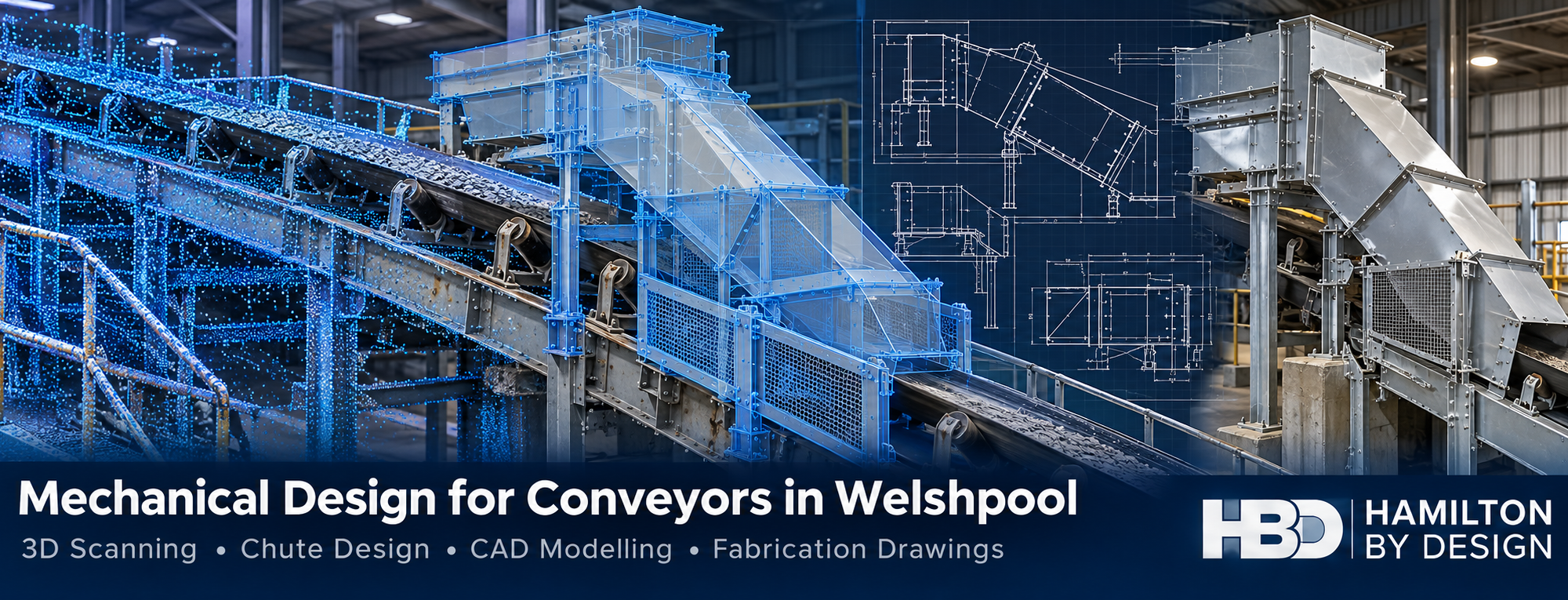
Conveyor upgrades, transfer chutes, 3D scanning and fabrication drawings for industrial facilities in Welshpool, WA
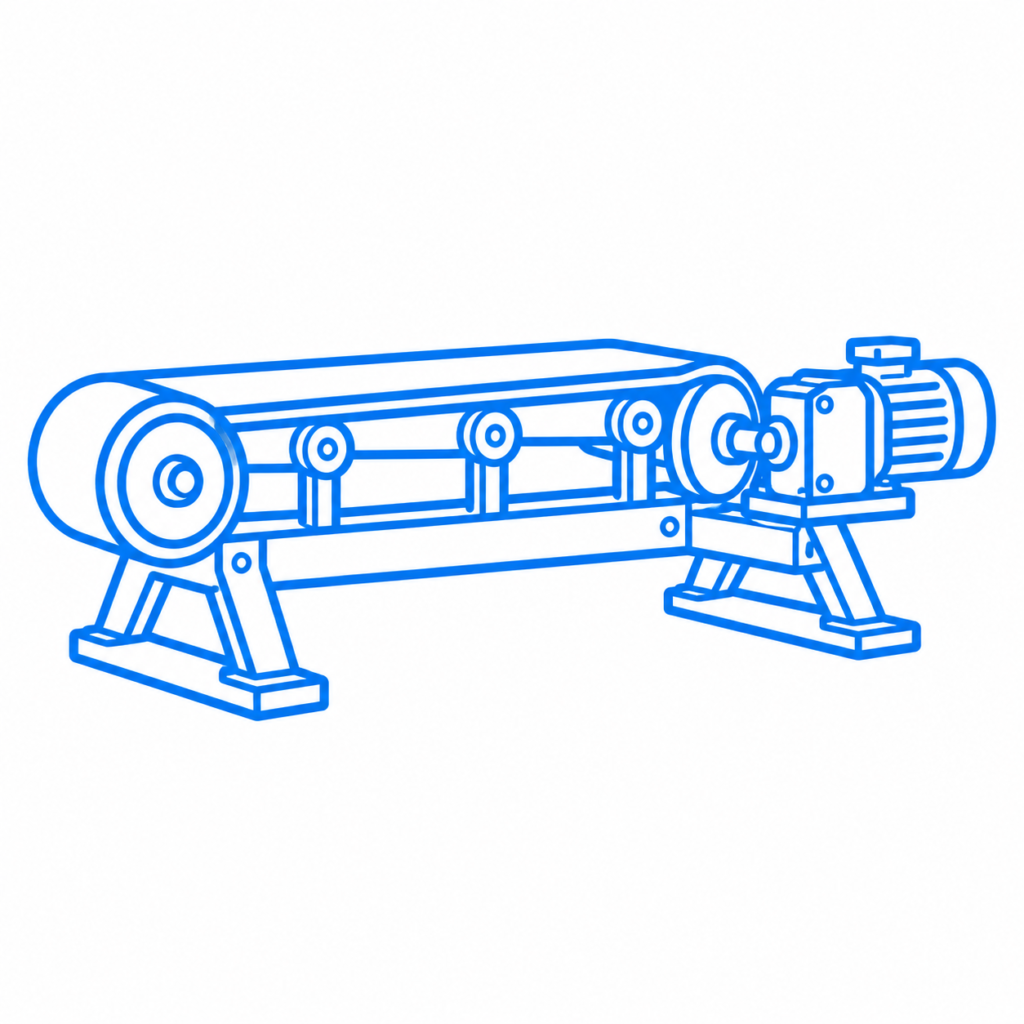
A conveyor modification has to work with the equipment and space already on site. A replacement chute may need to fit between existing steelwork and services. A new conveyor section may need to connect to equipment whose drawings are incomplete or out of date. Guarding must allow for operation and maintenance as well as the intended installation.
Hamilton By Design brings these tasks together for Welshpool projects. We combine mechanical design, 3D LiDAR scanning, scan-to-CAD, reverse engineering and engineering drafting to help industrial clients move from an existing plant problem to a practical design and documented solution.
Welshpool is a major Perth industrial precinct with manufacturing, engineering, logistics and supply chain businesses. That mix makes conveyor and materials handling work relevant to both production facilities and the workshops that build equipment for projects elsewhere in Western Australia. canning.wa.gov.au
Conveyor design that starts with the existing plant
Conveyor projects often begin with a specific problem: a transfer point that spills material, a worn chute, restricted maintenance access, an equipment replacement or a proposed change to the production layout. The first step is to understand what must change and which parts of the existing installation must be retained.
Hamilton By Design can assist with the mechanical design and documentation of:
- Conveyor modifications and equipment interfaces
- Transfer, feed and discharge chutes
- Hoppers, skirts and wear-liner arrangements
- Support frames and equipment layouts
- Machinery guarding and maintenance access
- Replacement parts where usable drawings are unavailable
- General arrangement and fabrication drawings
The scope can be tailored to the job. A workshop may need a model and drawings for one replacement assembly. An operating facility may need site capture, design development and an installation drawing package for a wider conveyor upgrade.
3D LiDAR scanning before conveyor modifications
Measurements taken from old drawings do not always represent the installed plant. Conveyor frames may have been altered, supports may have moved during earlier upgrades, and nearby pipework or cable trays may restrict the space available for new equipment.
For a brownfield project, industrial 3D scanning can capture the conveyor and its surrounding area as a point cloud. Relevant geometry can then be used to check proposed equipment locations, clearances and interfaces during design.
Scanning is particularly useful around crowded transfer stations, elevated conveyors and installations where a fabrication or shutdown window leaves little time to resolve a fit-up problem. The required measurements and tolerances should be agreed for each project; critical connection details may still need direct verification. Learn more about scanning conveyor transfer towers.
From point cloud to mechanical design
A point cloud records the existing condition. It becomes more useful when the project team can turn the relevant parts into a model, drawing or design decision.
Hamilton By Design’s scan-to-CAD services for Perth projects can support the modelling of conveyor interfaces, surrounding steelwork and equipment layouts. A proposed modification can then be developed in context, with attention to access, removal paths and the space needed for fabrication and installation.
Depending on the agreed scope, deliverables may include a registered point cloud, a 3D CAD model, general arrangement drawings, fabrication details or files for coordination with the client’s wider plant model.
Transfer chutes and materials handling
The transfer point affects much more than the space between two conveyors. Material flow, loading position, impact, wear, dust, spillage and access for liner replacement all influence how a chute should be designed.
Hamilton By Design supports chute design and materials-handling engineering for new work and existing installations. For a Welshpool fabrication project, this may mean developing a replacement chute from supplied dimensions and operating information. For an installed plant upgrade, it may mean scanning the transfer area first and designing the new assembly around the actual conveyor and support geometry.
Where a chute is causing repeated maintenance problems, the design brief should identify the material being handled, operating duty, wear locations, cleaning needs and access constraints. Those inputs help define a solution that can be built and maintained, rather than simply reproducing a part that has performed poorly.
Reverse engineering and replacement components
Existing conveyors may have components with no current CAD model or reliable manufacturing drawing. A part may have been modified over time, or a supplier may no longer support the original equipment.
Hamilton By Design can use measurements and reverse-engineering 3D scanning to reconstruct relevant geometry. The resulting model can support a replacement design, drawing update or review of how a component interfaces with the rest of the conveyor.
Reverse engineering also creates an opportunity to examine the original component’s function and condition. Wear, deformation and previous repairs should be considered before dimensions are carried into a new design.
Drawings that support fabrication and installation
A 3D model helps the team review a proposal, but the workshop and installation team also need clear documentation. Depending on the project, Hamilton By Design can prepare general arrangement drawings, component drawings, assembly details and fabrication information for review and manufacture.
Good documentation makes the intended interfaces visible: what connects to the existing plant, which dimensions need checking on site, how an assembly is broken into transportable pieces and what access is required for installation. Our broader mechanical engineering services connect design, CAD modelling and drafting with the practical needs of plant upgrades.
Support for Welshpool workshops and industrial operators
Hamilton By Design can work with Welshpool fabrication businesses, maintenance teams, manufacturers and project engineers at different stages of a conveyor job.
A fabrication workshop may need a missing component modelled and drawn before it can quote or manufacture a replacement. A facility operator may need to establish the existing geometry before approving a layout change. A project engineer may need a coordinated model and drawing package for review before a shutdown. A maintenance team may need a chute or guard redesigned to improve access to a recurring problem area.
Projects can be scoped around the information already available. Existing drawings, photographs, operating requirements and site measurements provide a starting point; on-site scanning can be added where the installation needs a more complete survey.
Our approach to a conveyor project
- Define the problem. Confirm the equipment, operating duty, project boundaries and required deliverables.
- Review the existing information. Check drawings, photographs, models and known site constraints.
- Capture missing geometry where needed. Measure or scan the relevant conveyor and surrounding plant.
- Develop and review the design. Model the proposed change and resolve key interfaces with the client and fabricator.
- Issue the agreed documentation. Prepare drawings and model files suited to review, fabrication or installation.
The extent of each stage depends on the project. A small replacement component will need a different package from a multi-conveyor transfer upgrade.
Frequently asked questions
Can you design a replacement chute if our drawings are missing?
Yes. The starting point is to establish the existing interfaces and understand how the chute is expected to perform. Measurements or 3D scanning may be needed before the replacement is modelled and documented.
Do you provide 3D scanning as part of conveyor design?
Yes, where site capture is useful to the project. LiDAR scanning can help document the installed conveyor, support steelwork and surrounding obstructions before a modification is designed.
Can you work with our Welshpool fabricator?
Yes. Hamilton By Design can develop models and drawings for discussion with the nominated workshop, including practical fabrication and installation considerations within the agreed scope.
Can you help with one component rather than a complete conveyor?
Yes. Work can be scoped to a chute section, guard, support, replacement component or other defined mechanical assembly.
Discuss a conveyor project in Welshpool
If you are planning a conveyor upgrade, replacing a transfer chute or trying to document equipment with missing drawings, Hamilton By Design can help establish the existing condition and develop the mechanical design information needed for the next step.
Contact Hamilton By Design with your site location, a short description of the problem, available drawings or photographs, and your intended fabrication or shutdown timeframe.

Contact Us – Talk To Us
Our clients:





















Services That Support Conveyor Projects in Welshpool
A conveyor upgrade can involve site measurement, mechanical design, guarding, analysis and fabrication documentation. Explore the Hamilton By Design services that support each stage.
Mechanical Engineering Services
Mechanical design for conveyors, materials handling equipment and plant modifications, supported by CAD modelling and engineering drawings.
Explore mechanical engineering →Chute Design and Materials Handling
Develop transfer chutes and related equipment around material flow, wear, maintenance access and the available space within existing plant.
Explore chute design →Machine Guarding Design
Review and design guarding for conveyor drives, pulleys and other moving machinery while considering operation, cleaning and maintenance.
Explore machine guarding →Reverse Engineering and 3D Scanning
Reconstruct useful engineering information for conveyor components and assemblies when original models or reliable drawings are unavailable.
Explore reverse engineering →3D CAD Modelling and Mechanical Drafting
Turn conveyor concepts and measured site information into 3D assemblies, general arrangements and drawings for project review and fabrication.
Explore CAD and drafting →FEA and Mechanical Assessment
Assess selected mechanical components and support arrangements where loads, stress, deflection or fatigue need closer engineering review.
Explore mechanical assessment →Scanning Conveyor Transfer Towers
Capture conveyors, chutes, steelwork and nearby services in congested transfer areas before planning an upgrade or replacement.
Explore transfer tower scanning →Industrial 3D Scanning
Record existing plant conditions as point cloud data to support layout review, scan-to-CAD modelling and brownfield conveyor modifications.
Explore industrial scanning →