Engineer-Led Industrial LiDAR Scanning for Mining and Heavy Industry

Engineer performing industrial LiDAR scanning on an Australian mining plant with point cloud overlay and mechanical CAD modelling workflow

Engineering-Grade LiDAR Scanning Australia | Hamilton By Design

Engineer-Led Industrial LiDAR Scanning Australia | Hamilton By Design

At Hamilton By Design, we believe industrial 3D laser scanning should deliver far more than a visual model or virtual walkthrough. In mining, manufacturing and heavy industrial environments, scanning data must support engineering decisions, fabrication accuracy, shutdown planning and long-term asset management.

Many companies now offer โ€œ3D scanningโ€ services. However, not all scanning systems, workflows or providers are the same. Across Australia, the market has become crowded with companies focused on real estate visualisation, architectural walkthroughs and general BIM modelling. While these services have their place, industrial facilities require a very different level of technical understanding.

Hamilton By Design specialises in engineer-led industrial LiDAR scanning focused on mechanical and structural engineering outcomes.


Why Industrial Facilities Require a Different Approach

Industrial sites are complex environments involving:

  • conveyors,
  • transfer chutes,
  • structural steel,
  • pipework,
  • pump skids,
  • process equipment,
  • access platforms,
  • shutdown works,
  • and brownfield modifications.
3D CAD Modelling Australia service banner for Hamilton By Design

In these environments, inaccurate data can create significant commercial and operational risks.

Poor-quality scanning or incomplete site capture can lead to:

  • fabrication clashes,
  • installation delays,
  • shutdown overruns,
  • rework costs,
  • safety risks,
  • and engineering non-conformance.

Unlike architectural walkthroughs or property visualisation projects, industrial scanning must support measurable engineering outcomes.

This is why Hamilton By Design focuses on:

  • engineering-grade terrestrial LiDAR,
  • scan-to-CAD workflows,
  • controlled engineering documentation,
  • and engineering governance systems.

Engineer-Led Scanning vs General Scanning Services

Owning a scanner does not automatically make a company an engineering specialist.

Many scanning providers focus on:

  • virtual tours,
  • digital walkthroughs,
  • building visualisation,
  • or general BIM deliverables.

Hamilton By Design approaches scanning differently.

Our workflow is driven by:

  • mechanical engineering requirements,
  • structural engineering considerations,
  • fabrication suitability,
  • and industrial project delivery.

We understand:

  • plant shutdown environments,
  • fabrication tolerances,
  • maintenance access requirements,
  • structural modifications,
  • and brownfield installation challenges.

This allows us to deliver scanning outcomes aligned with real engineering applications rather than simply producing point cloud data.


Industrial LiDAR Applications

Our industrial LiDAR scanning services support a wide range of applications across Australia.

Mining and Processing Plants

We assist mining and processing facilities with:

  • conveyor system upgrades,
  • transfer chute modifications,
  • pump station upgrades,
  • SMP projects,
  • slurry transport systems,
  • structural steel modifications,
  • and brownfield plant expansions.

Shutdown Planning

Accurate point cloud capture allows engineering teams to:

  • verify as-built conditions,
  • reduce shutdown uncertainty,
  • improve prefabrication accuracy,
  • and minimise onsite fit-up issues.

Structural and Mechanical Engineering

LiDAR data can support:

  • General Arrangement (GA) drawings,
  • structural modelling,
  • equipment integration,
  • pipe routing,
  • and engineering verification workflows.

Digital Engineering and Asset Management

Our workflows support:

  • scan-to-CAD modelling,
  • controlled revisions,
  • engineering governance,
  • and long-term asset documentation.

Understanding the Different Types of 3D Scanning

Not all scanning technologies are designed for the same purpose.

Terrestrial LiDAR Scanning

Tripod-based terrestrial LiDAR systems are typically best suited for:

  • industrial facilities,
  • mining plants,
  • brownfield environments,
  • and engineering-grade capture.

These systems provide highly controlled and repeatable data suitable for engineering workflows.

Mobile SLAM Scanning

SLAM-based systems can rapidly capture large environments and are useful in some applications. However, depending on the project requirements, these systems may introduce drift or reduced control compared with fixed terrestrial workflows.

Handheld Scanners

Handheld systems are often useful for:

  • smaller components,
  • reverse engineering,
  • and detailed geometry capture.

Virtual Tour Systems

Matterport and walkthrough systems can provide excellent visualisation tools but may not always deliver the level of engineering control required for fabrication or detailed industrial design.

At Hamilton By Design, we work with the technology that best suits the engineering outcome required by the client.

We do not make promises we cannot keep.


Why Engineering Governance Matters

One of the largest risks in industrial projects is poor drawing and document control.

Many organisations continue operating with:

  • outdated PDFs,
  • disconnected revisions,
  • unmanaged redlines,
  • and uncontrolled drawing systems.

Hamilton By Design supports engineering governance through:

  • revision-controlled workflows,
  • issue states such as IFR / IFA / IFC,
  • audit-ready documentation,
  • and structured engineering deliverables.

We also support workflows using:

  • SolidWorks,
  • AutoCAD LT,
  • and the 3DEXPERIENCE platform.

This helps provide a controlled single source of truth for engineering information across the project lifecycle.


Supporting Australian Industry

Hamilton By Design supports clients across Australia including:

  • mining operations,
  • manufacturing facilities,
  • processing plants,
  • infrastructure projects,
  • and heavy industrial sites.

We understand the realities of:

  • remote site access,
  • shutdown windows,
  • operational constraints,
  • and industrial project delivery.

Our focus is not simply collecting scan data.

Our focus is helping clients reduce engineering risk and improve project outcomes.


Industrial Scanning Backed by Engineering Understanding

The value of LiDAR scanning is not only the scanner itself.

The true value comes from:

  • understanding the engineering problem,
  • capturing the correct information,
  • and delivering data that supports real project outcomes.

At Hamilton By Design, our engineer-led approach combines:

  • industrial LiDAR scanning,
  • mechanical engineering understanding,
  • structural engineering workflows,
  • and engineering governance systems.

This allows us to support projects from initial site capture through to engineering documentation and fabrication-ready deliverables.
3D LiDAR scanning and 3D modelling service button โ€” laser scanner capturing a point cloud for engineering and CAD modelling
Mechanical engineering services

Our clients

Contact Hamilton By Design

To discuss industrial LiDAR scanning, scan-to-CAD workflows or engineering support for your next project, contact:

Hamilton By Design

We support mining, manufacturing and industrial clients across Australia with engineer-led reality capture and engineering documentation solutions.

Hamilton By Design logo displayed on a blue tilted rectangle with a grey gradient background

FARO Technologies โ€” Industrial 3D laser scanning, metrology and reality capture hardware/software solutions.

SolidWorks โ€” Professional CAD, simulation and product development platform widely used in mechanical engineering.

Dassault Systรจmes 3DEXPERIENCE Platform โ€” Cloud-based engineering governance, collaboration and product lifecycle management platform.

From Reality to Design: How 3D Scanning Powers Engineering Outcomes in Sydney

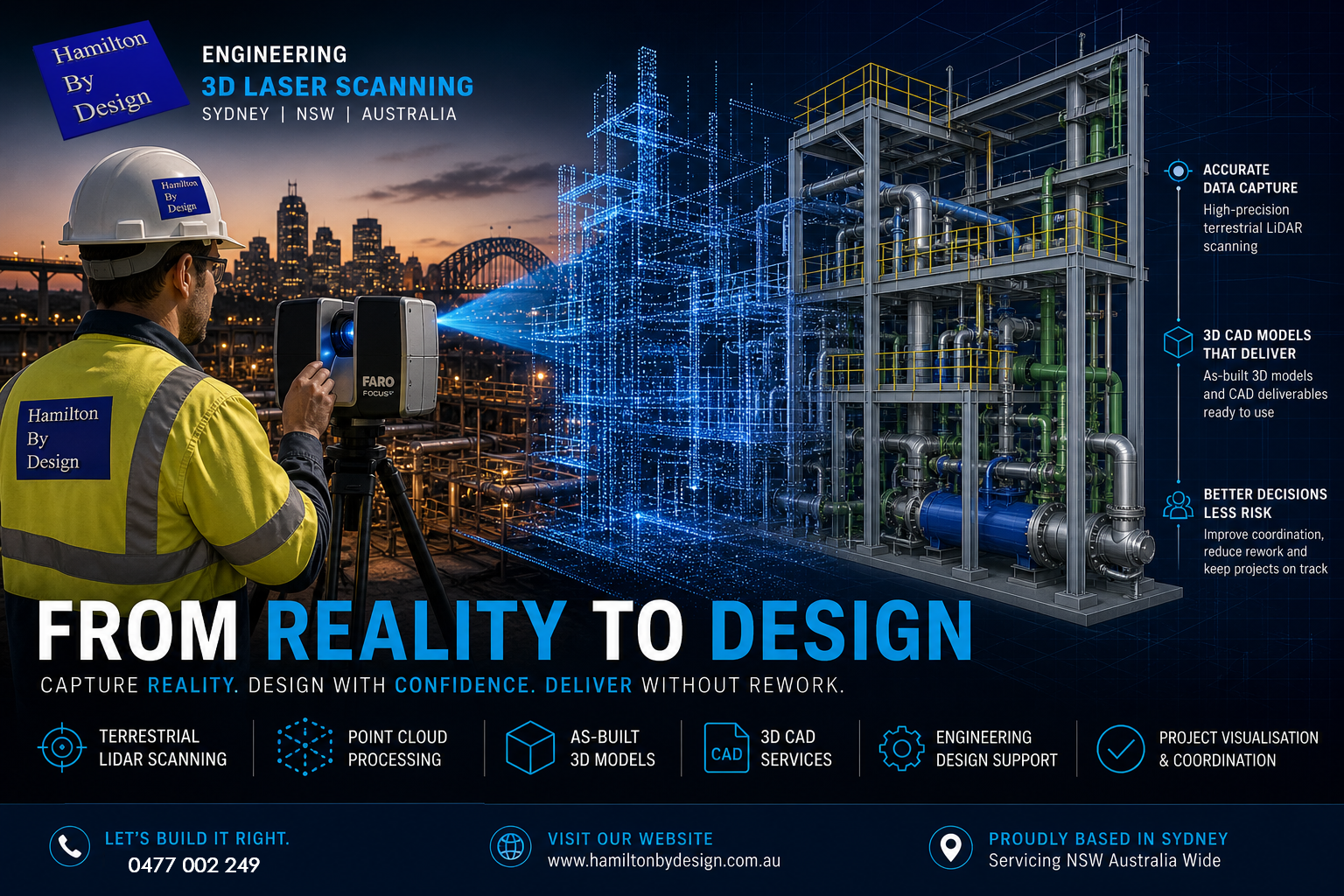
Engineer performing terrestrial LiDAR scanning on a Sydney construction site with point cloud transitioning into 3D CAD model

In todayโ€™s construction and industrial environment, the gap between what was designed and what actually exists on site is where most project risk lives.

Blue 3D LiDAR scanner icon on a tripod with scanning waves

Steel doesnโ€™t sit where drawings say it should. Pipework clashes with new installs. Structural tolerances stack up. And when projects move fast, those risks become expensive.

This is where engineering-led 3D scanning and design changes everything.

At Hamilton By Design, we donโ€™t just capture data โ€” we convert reality into accurate, buildable engineering outcomes.


The Shift from Measuring to Reality Capture

Traditional site measurement methods rely on tape measures, total stations, and assumptions. They work โ€” but they introduce risk.

Modern projects are moving toward terrestrial LiDAR scanning, using high-accuracy laser-based systems to capture millions of data points across a site.

A terrestrial LiDAR scanner works by emitting laser pulses and measuring the return time to build a precise 3D representation of the environment โ€” known as a point cloud.

This process, often referred to as a terrestrial scan, creates a true digital record of:

  • Structural steel
  • Pipework systems
  • Equipment layouts
  • Buildings and facades
  • Complex plant geometry

The result is not an interpretation โ€” it is reality.


From Point Cloud to As-Built 3D Model

Capturing data is only the first step.

The real value comes from converting that scan into an as-built 3D model that engineers, designers, and fabricators can actually use.

This is where many providers fall short.

At Hamilton By Design, we deliver:

  • Engineering-grade 3D CAD services
  • Parametric models (not mesh files)
  • Fabrication-ready geometry
  • Drawings aligned to Australian standards

We donโ€™t produce STL or OBJ files that sit unused.
We produce editable 3D engineering design models that integrate directly into your workflow.

Because ultimately โ€” scanning is not the deliverable.

Design is.


3D Scanning on Construction Sites

The use of 3D scanning on construction sites is growing rapidly โ€” and for good reason.

Projects across Sydney are using LiDAR to:

  • Verify structural installation before fit-up
  • Coordinate mechanical and piping systems
  • Reduce rework during shutdowns
  • Validate contractor work against design intent
  • Capture existing conditions for upgrades

Whether itโ€™s a building scan, plant upgrade, or infrastructure project, the ability to see the full site in 3D changes how teams make decisions.

Instead of relying on drawings โ€” teams work from reality.


Top 3D Scanning Platforms for Project Coordination

Not all scanning workflows are equal.

The top 3D scanning platforms for construction site visualisation and project coordination combine accurate capture with accessible data environments.

Typical platforms include:

  • FARO SCENE for registration and processing
  • Autodesk ReCap for cloud-based coordination
  • 3DEXPERIENCE for engineering governance and collaboration

However, the platform is only part of the equation.

Without engineering understanding, even the best software becomes a viewer โ€” not a solution.

Thatโ€™s why our workflow is built around:

Scan โ†’ Model โ†’ Design โ†’ Deliver


Engineering-Led 3D Design

What sets Hamilton By Design apart is simple:

We are a mechanical engineering business first โ€” not a scanning company.

Our team uses LiDAR to support:

  • 3D design engineering
  • Structural modifications
  • Conveyor and chute design
  • Pipework upgrades
  • Equipment integration

We scan with the intent of answering one question:

๐Ÿ‘‰ Will it fit?

Because in engineering โ€” thatโ€™s what matters.


Why โ€œ3D Scanner Service Near Meโ€ Isnโ€™t Enough

Many clients search for a โ€œ3D scanner service near meโ€ or look at 3D scanner hire as a cost-saving measure.

But scanning hardware alone does not solve engineering problems.

Without:

  • Proper scan planning (line of sight, density, coverage)
  • Registration accuracy
  • Engineering interpretation
  • CAD modelling capability

โ€ฆthe result is just raw data.

We often see projects where scanning was completed โ€” but nothing usable was produced.

Thatโ€™s why we offer both:

  • Full 3D scan services
  • 3D scanner hire (with guidance)
  • End-to-end modelling and design support

Applications Across Buildings and Industry

Our 3D scanning building services and industrial workflows support a wide range of sectors across Sydney and NSW:

Construction & Buildings

  • As-built verification
  • Facade capture
  • Structural coordination
  • Scan-to-BIM workflows

Industrial Plants

  • Brownfield upgrades
  • Shutdown planning
  • Equipment replacement
  • Pipe routing and clash detection

Infrastructure

  • Rail and transport assets
  • Utilities and pump stations
  • Structural assessments

Whether itโ€™s a commercial building or a complex processing plant, the principle is the same:

Capture reality. Design with confidence. Deliver without rework.


The Future: Digital Engineering Driven by LiDAR

LiDAR is not just a tool โ€” it is the foundation of modern digital engineering design.

As projects become more complex, the ability to:

  • Capture accurate site data
  • Build reliable 3D models
  • Coordinate across teams
  • Maintain a single source of truth

โ€ฆwill define successful delivery.

At Hamilton By Design, we combine:

  • Terrestrial LiDAR scanning
  • 3D CAD services
  • Engineering design expertise

to ensure that what gets built โ€” matches what was intended.


3D LiDAR scanning and 3D modelling service button โ€” laser scanner capturing a point cloud for engineering and CAD modelling
Mechanical engineering services

Work With an Engineer-Led 3D Scanning Team

If youโ€™re planning a project in Sydney or across NSW and need:

  • A 3D scan service
  • An as-built 3D model
  • 3D engineering design support

weโ€™re ready to help.

Because the difference between scanning and engineering is simple:

๐Ÿ‘‰ One captures data.
๐Ÿ‘‰ The other delivers outcomes.

Hamilton By Design logo displayed on a blue tilted rectangle with a grey gradient background

Hamilton By Design provides engineering-led 3D scanning, LiDAR scanning, mechanical engineering and digital engineering services throughout Sydney and Greater Sydney.

Explore our related Sydney services:


  • 3D Scanning Sydney โ€“ Engineering-grade terrestrial laser scanning, as-built surveys and point cloud capture for industrial, infrastructure and commercial projects.
  • Reality Capture Sydney โ€“ High-accuracy reality capture, digital twins, asset documentation and engineering-grade site verification.
  • Scan to CAD Sydney โ€“ Convert point cloud data into AutoCAD, SolidWorks, Inventor and other engineering-ready CAD deliverables.
  • Point Cloud Modelling Sydney โ€“ Engineering-grade point cloud processing, clash detection, as-built verification and 3D modelling.
  • Mechanical Engineering Sydney โ€“ Mechanical design, plant upgrades, materials handling systems, conveyors, chutes, platforms and engineering support.
  • Structural Drafting Sydney โ€“ Structural steel drafting, fabrication drawings, GA drawings, workshop detailing and as-built documentation.

Hamilton By Design supports projects throughout Sydney CBD, Parramatta, Liverpool, Penrith, Blacktown, Chatswood, Alexandria, Mascot, Newcastle and the Central Coast.


Our Clients

Contact Us – Talk to Us – Work with Us

Name
Would you like us to arrange a phone consultation for you?
Address

Point Cloud to CAD Australia | Engineering-Grade Scan to BIM & Drafting Services

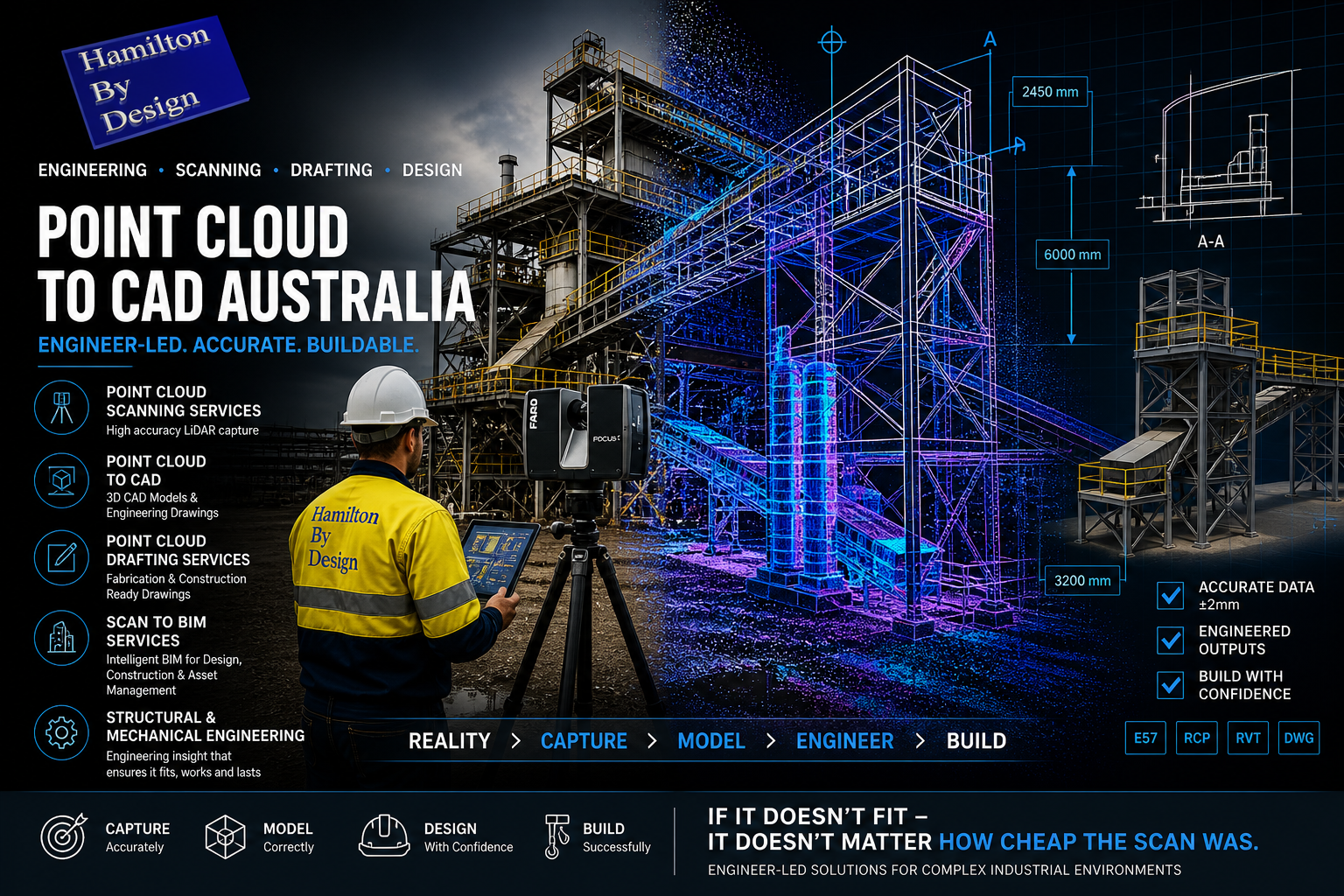
Engineer using LiDAR scanner capturing an industrial plant with overlay showing point cloud to CAD conversion and scan to BIM engineering workflow in Australia.

Engineer-Led Point Cloud to CAD Services Across Australia

At Hamilton By Design, we deliver engineering-grade point cloud to CAD services in Australia, purpose-built for industrial, mining, and complex mechanical environments.

We are not a visualisation or real estate scanning company.

We are a structural mechanical engineering-led organisation, using high-accuracy LiDAR scanning to support real-world design, fabrication, and construction outcomes.

3D CAD Modelling Australia service banner for Hamilton By Design

What We Do

We provide a complete workflow from point cloud scanning through to engineered deliverables, including:

  • Point cloud scanning services (LiDAR reality capture)
  • Point cloud to CAD conversion (2D & 3D)
  • Point cloud drafting services for fabrication and construction
  • Scan to BIM services for buildings and infrastructure
  • Mechanical and structural engineering integration

Our focus is simple:

๐Ÿ‘‰ Capture accurately. Model correctly. Design with confidence.


Point Cloud Scanning Service (Engineering Grade)

Our scanning services are built around engineering accuracy, not visual output.

Using high-precision LiDAR systems, we capture:

  • Industrial plants and processing facilities
  • Conveyor systems, chutes, and transfer stations
  • Structural steel and platforms
  • Pipework and mechanical systems
  • Existing buildings and infrastructure

Unlike low-cost scanning providers, we scan with design intent in mind โ€” ensuring the data can be used for:

  • Fabrication fit-up
  • Brownfield upgrades
  • Shutdown planning
  • Engineering verification

Point Cloud to CAD Australia

We convert raw point cloud data into usable engineering models and drawings, including:

  • 3D CAD models (SolidWorks-based workflows)
  • 2D AutoCAD drawings (plans, sections, elevations)
  • General Arrangement (GA) drawings
  • Fabrication-ready outputs

Our models are developed to support:

  • Clash detection
  • Design validation
  • Accurate measurement and geometry extraction
  • Integration into existing engineering workflows

Point Cloud Drafting Services

Our drafting services go beyond simple tracing.

We deliver engineering-controlled documentation, including:

  • Revision-controlled drawings (IFR / IFA / IFC)
  • Structured layouts driven from 3D models
  • Consistent drawing standards aligned with Australian practice
  • Clear geometry for fabrication and installation

This ensures your drawings are not just โ€œdrawnโ€ โ€” they are buildable.


Scan to BIM Services

For building and infrastructure projects, we offer Scan to BIM services tailored for:

  • Commercial buildings
  • Government assets
  • Industrial facilities
  • Upgrade and refurbishment projects

We create intelligent BIM models that support:

  • Asset management
  • Design coordination
  • Construction planning
  • Lifecycle management

Structural Mechanical Engineer-Led Approach

This is where Hamilton By Design is different.

We are not technicians capturing data.

We are engineers solving problems.

Our team understands:

  • Load paths and structural behaviour
  • Mechanical fit-up and tolerances
  • Fabrication constraints
  • Installation sequencing
  • Australian Standards and compliance requirements

This means:

๐Ÿ‘‰ We scan with purpose
๐Ÿ‘‰ We model with intent
๐Ÿ‘‰ We design for reality


Why Engineer-Led Scanning Matters

Low-cost scanning often leads to:

  • Incomplete data
  • Poor alignment
  • Unusable geometry
  • Costly rework during fabrication

Our approach eliminates that risk.

We provide:

  • Engineering-grade accuracy
  • Clear, structured deliverables
  • Confidence in fit and function

Because at the end of the day:

๐Ÿ‘‰ If it doesnโ€™t fit โ€” it doesnโ€™t matter how cheap the scan was.


Typical Applications

Our services are used across:

Mining & Heavy Industry

  • Conveyor upgrades
  • Transfer chute design
  • Plant modifications
  • Shutdown engineering

Industrial Plants

  • Brownfield expansions
  • Pipe routing and modifications
  • Structural upgrades

Buildings & Infrastructure

  • Scan to BIM for refurbishments
  • As-built documentation
  • Structural verification

Deliverables

Depending on your scope, we can provide:

  • Registered point clouds (.E57 / .RCP / .LAS)
  • Scan location plans
  • 3D CAD models
  • 2D engineering drawings
  • BIM models
  • Engineering review and input

Work With Hamilton By Design

If you are looking for:

  • Point cloud to CAD Australia
  • Reliable point cloud scanning service
  • Professional point cloud drafting services
  • High-quality scan to BIM services
  • A structural mechanical engineer who understands real-world constraints

Then weโ€™re ready to support your project.

3D LiDAR scanning and 3D modelling service button โ€” laser scanner capturing a point cloud for engineering and CAD modelling
Mechanical engineering services

Get Started

We typically operate on a day rate basis, with clear scope and deliverables.

๐Ÿ“ฉ Contact us today to:

  • Discuss your project
  • Arrange a site visit
  • Receive a proposal

Hamilton By Design logo displayed on a blue tilted rectangle with a grey gradient background

Final Word

At Hamilton By Design, we donโ€™t just capture data.

We deliver engineering certainty.

Our Clients

Finite Element Analysis (FEA) engineering simulation button
Mechanical engineering services

3D Laser Scanning for Industrial Plants in Sydney

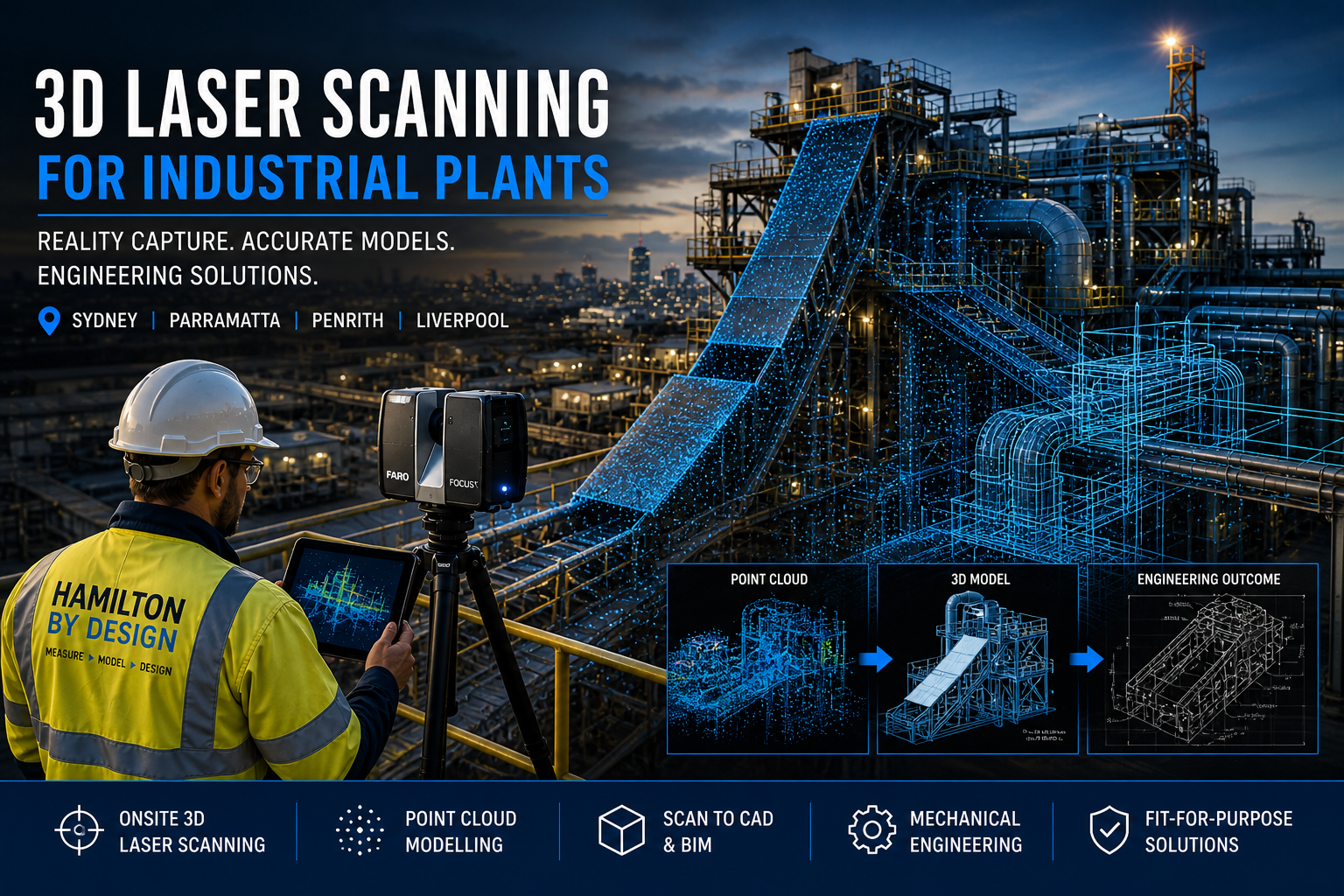
Industrial plant 3D laser scanning in Sydney showing engineer using LiDAR scanner with point cloud overlay and CAD modelling for engineering design

Point Cloud to CAD | Mechanical Engineering | Western Sydney Specialists

At Hamilton By Design, we provide engineering-grade 3D laser scanning for industrial plants, delivering accurate site data, detailed CAD models, and fit-for-purpose mechanical design solutions across Sydney, Parramatta, Penrith, and Liverpool.

Unlike typical 3D scanning companies, we are mechanical engineers first. That means every scan is captured with the end goal in mind โ€” design, fabrication, and real-world application.


3D Laser Scanning Services (Sydney & Western Sydney)

We offer onsite and mobile 3D scanning services across:

  • Parramatta
  • Penrith
  • Liverpool
  • Greater Western Sydney

Our LiDAR scanning services are ideal for:

  • Industrial plants
  • Manufacturing facilities
  • Processing plants
  • Construction and building upgrades

If youโ€™re searching for a โ€œ3D scanning company near meโ€, we deliver fast, accurate, and engineering-ready results.

3D CAD Modelling Australia service banner for Hamilton By Design

From Point Cloud to CAD (Engineering-Ready Models)

Scanning is only the first step.

We convert scan data into:

  • Point cloud modelling
  • 3D CAD models (SolidWorks, STEP, Parasolid)
  • 2D AutoCAD drawings
  • Scan-to-BIM models

This allows for:

  • Accurate design modifications
  • Clash detection
  • Fabrication-ready outputs

Mechanical Engineering Services

Hamilton By Design provides full mechanical engineering support, including:

  • Process equipment design
  • Structural and mechanical upgrades
  • Preventative maintenance design
  • Fit-for-purpose engineering solutions

All work is aligned with relevant Australian Standards, including AS 4991 where applicable.


Mining & Bulk Handling (High-Value Applications)

We specialise in mining and bulk materials handling systems, including:

  • Coal chutes and transfer stations
  • Conveyor systems
  • Outbye mining infrastructure
  • Header transition chutes

Custom Design vs Off-the-Shelf

Off-the-shelf chute designs often lead to:

  • Poor fit
  • Increased wear
  • High maintenance costs

Our approach:

  • Scan existing plant conditions
  • Develop custom designs based on real data
  • Deliver solutions that reduce downtime and improve performance

Building & Construction Scanning

We also support:

  • Building scanning services
  • Construction site verification
  • Scan-to-BIM for refurbishment projects

Ideal for commercial, industrial, and infrastructure upgrades.


Industries We Support

  • Industrial plants
  • Manufacturing facilities
  • Food processing plants
  • Mining and bulk handling
  • Construction and infrastructure

Locations We Service

We provide 3D laser scanning and engineering services across:

Sydney
Parramatta
Penrith
Liverpool
Western Sydney

With project capability across NSW and Australia.


Common Questions

What are the best 3D scanning platforms?

We use industry-leading LiDAR systems such as FARO and Leica. However, the real value comes from how the data is used in engineering design.


3D LiDAR scanning and 3D modelling service button โ€” laser scanner capturing a point cloud for engineering and CAD modelling
Mechanical engineering services

Do I need scan-to-CAD or just scanning?

Most industrial projects require CAD models and engineering input โ€” not just raw scan data.


Who provides professional 3D scanning near me?

Engineering-led companies like Hamilton By Design provide usable outcomes, not just visual data.


Hamilton By Design logo displayed on a blue tilted rectangle with a grey gradient background

Get Started

If you need accurate site data, modelling, or engineering support for an industrial project, contact Hamilton By Design today.


Related Sydney Services

Hamilton By Design provides engineering-led 3D scanning, LiDAR scanning, mechanical engineering and digital engineering services throughout Sydney and Greater Sydney.

Explore our related Sydney services:


  • 3D Scanning Sydney โ€“ Engineering-grade terrestrial laser scanning, as-built surveys and point cloud capture for industrial, infrastructure and commercial projects.
  • Reality Capture Sydney โ€“ High-accuracy reality capture, digital twins, asset documentation and engineering-grade site verification.
  • Scan to CAD Sydney โ€“ Convert point cloud data into AutoCAD, SolidWorks, Inventor and other engineering-ready CAD deliverables.
  • Point Cloud Modelling Sydney โ€“ Engineering-grade point cloud processing, clash detection, as-built verification and 3D modelling.
  • Mechanical Engineering Sydney โ€“ Mechanical design, plant upgrades, materials handling systems, conveyors, chutes, platforms and engineering support.
  • Structural Drafting Sydney โ€“ Structural steel drafting, fabrication drawings, GA drawings, workshop detailing and as-built documentation.

Hamilton By Design supports projects throughout Sydney CBD, Parramatta, Liverpool, Penrith, Blacktown, Chatswood, Alexandria, Mascot, Newcastle and the Central Coast.


Blue banner graphic displaying the text "Point Cloud to CAD - Australia" in large white lettering, representing point cloud processing, scan-to-CAD conversion and digital engineering services across Australia.
Blue banner graphic displaying the text "Scan to CAD Sydney" in large white lettering, representing engineering-led point cloud to CAD conversion, LiDAR scanning and digital engineering services in Sydney.
Blue banner graphic displaying the text "Reality Capture Sydney - CBD" in large white lettering, representing engineering-led reality capture, LiDAR scanning and digital engineering services within Sydney CBD commercial buildings and infrastructure.

Terrestrial LiDAR Scanner | Engineering-Grade 3D Laser Scanning

Terrestrial LiDAR scanner capturing industrial plant

What is a Terrestrial LiDAR Scanner?

A terrestrial LiDAR scanner is a ground-based 3D laser scanning system used to capture highly accurate measurements of real-world environments and convert them into detailed digital models known as point clouds.

At Hamilton By Design, we use engineering-grade terrestrial LiDAR scanning to support design, drafting, and construction across industrial, mining, and infrastructure projects.


3D LiDAR scanning and 3D modelling service button โ€” laser scanner capturing a point cloud for engineering and CAD modelling
Mechanical engineering services

How a Terrestrial LiDAR Scanner Works

A terrestrial LiDAR scanner measures distance using laser technology:

  • A laser beam is emitted from the scanner
  • The beam reflects off surfaces such as steel, concrete, or pipework
  • The scanner records the return signal
  • Distance is calculated using time-of-flight or phase shift
  • Millions of measurements are captured per second

The result is a dense and accurate 3D point cloud representing the scanned environment.


What is a Point Cloud?

A point cloud is a digital dataset made up of millions (or billions) of points.

Each point contains:

  • X, Y, Z coordinates
  • Spatial position in 3D space
  • Optional colour information (RGB)

This creates a true-to-life digital representation of physical assets, forming the foundation for CAD modelling and engineering design.


Why Use a Terrestrial LiDAR Scanner?

Accuracy

Terrestrial LiDAR scanners provide millimetre-level accuracy, making them suitable for engineering and fabrication.

Speed

Large and complex environments can be captured quickly compared to traditional survey methods.

Safety

Data can be captured without direct access to hazardous or difficult-to-reach areas.

Reduced Rework

Designs are based on real-world data, reducing clashes and site modifications.


3D CAD Modelling Australia service banner for Hamilton By Design

Engineering Applications

Terrestrial LiDAR scanning is widely used across:

  • Industrial plant upgrades
  • Mining and processing facilities
  • Structural and mechanical design
  • Brownfield engineering projects
  • As-built verification
  • Reverse engineering

For projects requiring integration with your team, this capability can also be delivered through our engineering secondment services:
https://www.hamiltonbydesign.com.au/home/secondment-services/


Engineering-Led LiDAR Scanning

Not all LiDAR scanning is equal.

At Hamilton By Design, scanning is performed with an engineering-first approach, ensuring the data is suitable for downstream use in CAD and design.

Key considerations include:

  • Line-of-sight limitations
  • Scan density and coverage
  • Registration accuracy
  • Data structure and usability

This ensures the output is not just a visual model, but a usable engineering dataset.


From Scan to CAD

Our workflow converts LiDAR data into practical deliverables:

Scan โ†’ Register โ†’ Model โ†’ Detail โ†’ Deliver

This includes:

  • Point cloud registration (.E57, .RCP, .LAS)
  • 3D CAD modelling (SolidWorks and other platforms)
  • 2D drawings and fabrication-ready documentation

Terrestrial vs Other Scanning Methods

  • Terrestrial LiDAR: High accuracy, long range, ideal for engineering
  • Handheld scanners: Faster but lower accuracy, suited to small objects
  • Photogrammetry: Visual models, not typically engineering-grade

For industrial and brownfield environments, terrestrial LiDAR remains the preferred method.


Terrestrial LiDAR scanner capturing industrial plant with Sydney Harbour Bridge in background

In-House & Secondment Delivery

We provide flexible delivery models to suit your project:

  • In-house scanning and modelling (fully managed)
  • Secondment services (embedded within your team)

Learn more about our secondment capability:
https://www.hamiltonbydesign.com.au/home/secondment-services/


Why Choose Hamilton By Design

  • Engineering-led LiDAR scanning
  • Integration with CAD modelling and drafting
  • Strong experience in industrial and mining environments
  • Brownfield project expertise
  • Practical, buildable outputs

Hamilton By Design logo displayed on a blue tilted rectangle with a grey gradient background

Get Started with Terrestrial LiDAR Scanning

If you require accurate, engineering-grade 3D data for your project, a terrestrial LiDAR scanner provides the foundation for reliable design and execution.

Hamilton By Design delivers scanning, modelling, and engineering support across Sydney and Australia.

Talk to Us – Contact Us

Name
Would you like us to arrange a phone consultation for you?
Address

Laser Scanning for Engineering

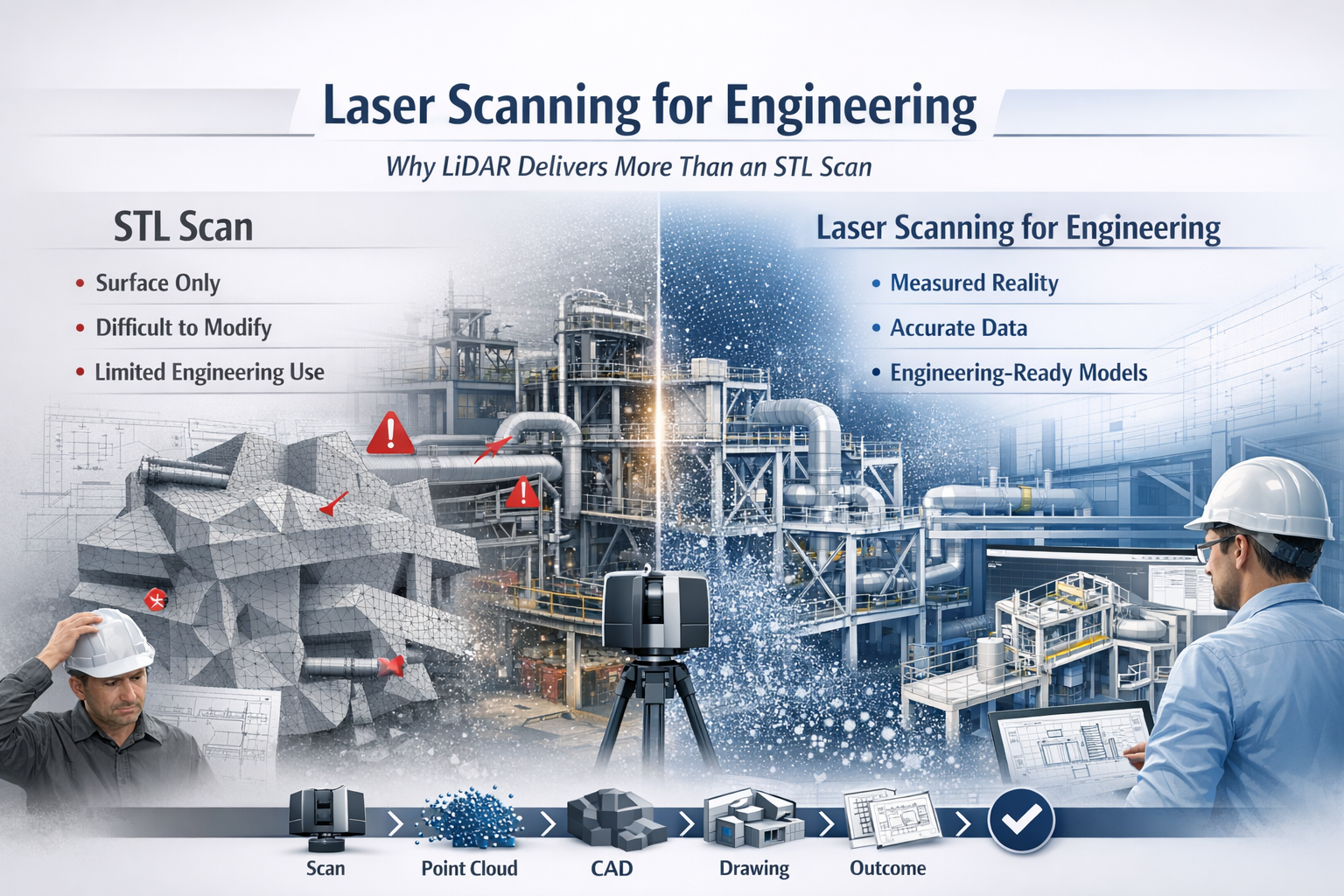
Laser scanning for engineering infographic comparing LiDAR point cloud data with STL mesh scanning, showing improved CAD modelling and engineering workflows.

Why LiDAR Delivers Real Engineering Outcomes

In modern engineering, accuracy is everything. Whether you are working in mining, manufacturing, infrastructure, or plant design, the difference between success and costly rework often comes down to how well you understand what has actually been built.

This is where laser scanning for engineering has become a critical tool.

While many providers offer โ€œ3D scanning,โ€ not all data is created equal. There is a significant difference between engineering-grade LiDAR point cloud data and basic STL mesh outputs. Understanding that difference can determine whether your project moves forward efficientlyโ€”or gets stuck in rework, assumptions, and redesign.


3D LiDAR scanning and 3D modelling service button โ€” laser scanner capturing a point cloud for engineering and CAD modelling
Mechanical engineering services

What is Laser Scanning for Engineering?

Laser scanning for engineering uses LiDAR (Light Detection and Ranging) technology to capture millions of precise measurements of a physical environment. The result is a high-density point cloudโ€”a true digital representation of reality.

Unlike traditional measurement methods, LiDAR captures:

  • Complex geometry
  • Structural relationships
  • Equipment positioning
  • Real-world deviations from design

This data becomes the foundation for:

  • CAD modelling (SolidWorks, AutoCAD, Revit)
  • Engineering drawings
  • Clash detection
  • Retrofit and upgrade design

In short, it bridges the gap between design intent and as-built reality.


The Problem with STL-Based Scanning

Many scanning providers deliver outputs as STL, OBJ, or mesh files. While these formats are useful for visualisation or 3D printing, they fall short in engineering applications.

Key limitations of STL scans:

  • No intelligence โ€“ Meshes are just surfaces, not structured geometry
  • Difficult to modify โ€“ Not suitable for parametric design workflows
  • Poor for engineering drawings โ€“ Cannot easily generate sections, tolerances, or fabrication details
  • Heavy and inefficient โ€“ Large file sizes with limited usability
  • No clear chain of accuracy โ€“ Hard to verify measurement reliability

In practical terms, an STL file often becomes a dead-end deliverableโ€”you can look at it, but you canโ€™t engineer from it effectively.


Why LiDAR Point Clouds Are Built for Engineering

LiDAR-based laser scanning for engineering produces structured, measurable, and verifiable data that integrates directly into engineering workflows.

Key advantages:

1. True-to-Reality Accuracy

Point clouds capture millions of measured points, providing a high-confidence representation of the real world.

2. Direct CAD Integration

Data can be converted into:

  • Parametric 3D models
  • Fabrication-ready drawings
  • Plant layouts and assemblies

3. Supports Engineering Decisions

Engineers can:

  • Measure directly from the dataset
  • Validate clearances and tolerances
  • Design with confidence

4. Enables Retrofit and Brownfield Design

In existing plants, nothing is ever exactly โ€œas drawn.โ€ LiDAR ensures your design fits what is actually there, not what was intended years ago.

5. Reduces Risk and Rework

Accurate input data leads to:

  • Fewer site revisits
  • Reduced fabrication errors
  • Lower project costs

6. Maintains Chain of Custody

Engineering-grade scanning supports data governance, traceability, and verificationโ€”critical in legal, compliance, and high-risk environments.


Engineering vs Visualisation: A Critical Distinction

A key misunderstanding in the industry is assuming all 3D scanning is equal.

  • STL / Mesh Scanning โ†’ Visualisation Output
  • LiDAR Point Cloud โ†’ Engineering Input

If your goal is:

  • 3D printing โ†’ STL may be enough
  • Engineering design, fabrication, or upgrades โ†’ LiDAR is essential

Real-World Application: Engineering in Practice

Across mining, manufacturing, and infrastructure, laser scanning for engineering is used to:

  • Capture conveyor systems before modification
  • Model structural steel for upgrades
  • Verify equipment installation
  • Design pipework and mechanical systems
  • Plan shutdown works with precision

Instead of guessing dimensions or relying on outdated drawings, engineers work from measured reality.


The Workflow That Delivers Results

A proper engineering workflow looks like this:

Scan โ†’ Register โ†’ Model โ†’ Detail โ†’ Deliver

Not:

Scan โ†’ Export STL โ†’ End

That difference defines whether you receive a usable engineering deliverable or just a digital artifact.


3D CAD Modelling Australia service banner for Hamilton By Design

Laser scanning for engineering is not just about capturing dataโ€”itโ€™s about enabling better engineering outcomes.

LiDAR-based point cloud data provides:

  • Accuracy
  • Usability
  • Engineering value

In contrast, STL-based scanning often limits what you can achieve.

If your project requires real design, real drawings, and real decisions, then the choice is clear:

Use laser scanning for engineeringโ€”not just scanning for appearance.

Our clients

Contact Us

Name
Would you like us to arrange a phone consultation for you?
Address