Engineering-Quality 3D Scanning in Papua New Guinea

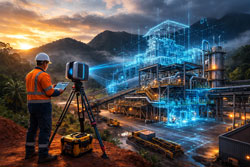
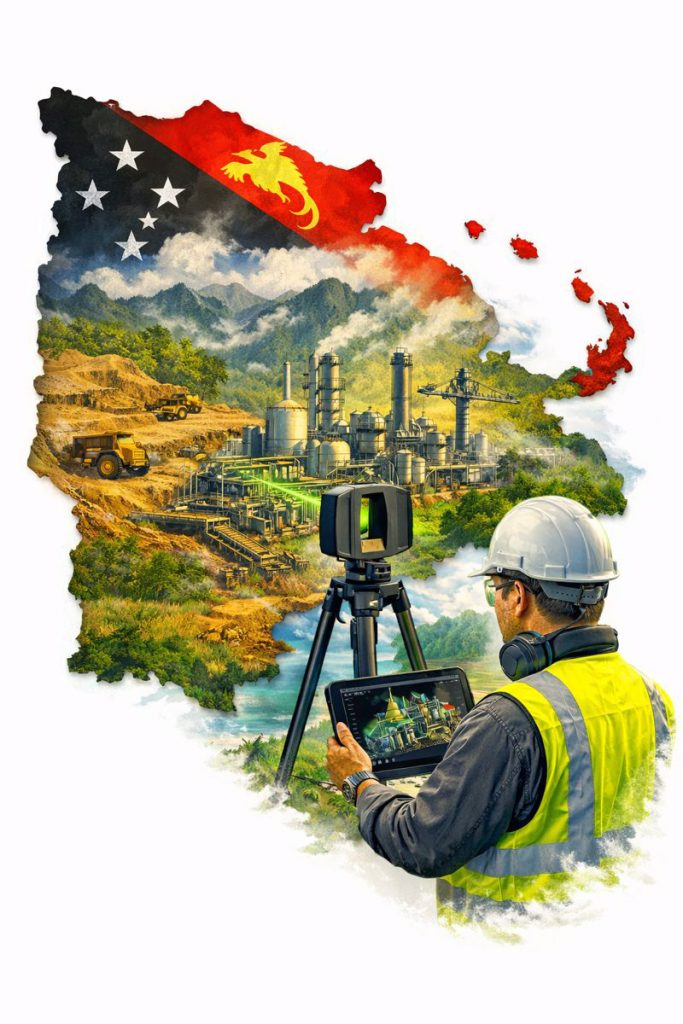
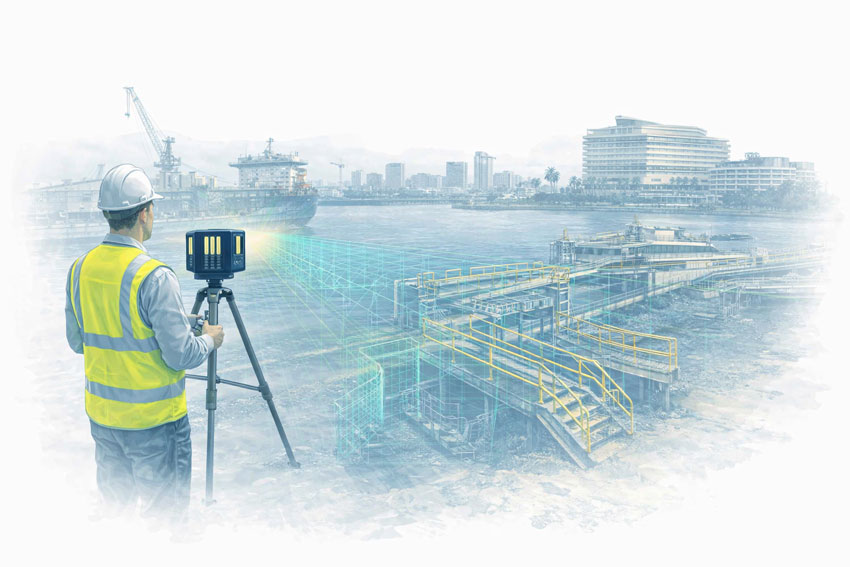
Engineer using LiDAR scanner to capture mining and processing plant within a map of Papua New Guinea for engineering design and plant upgrades.

Reality capture that stands up to design, fabrication and installation in remote industrial environments

Papua New Guinea (PNG) is home to complex, high-value industrial assets โ€” from mining and mineral processing plants through to ports, power generation and remote infrastructure. These projects are often delivered under tight shutdown windows, difficult logistics and challenging environmental conditions.

In these environments, engineering-quality 3D scanning is not a โ€œnice to haveโ€ โ€” itโ€™s a practical tool that reduces risk by capturing accurate as-built conditions and converting them into deliverables engineers can trust.

Hamilton By Design provides engineering-led LiDAR scanning and scan-to-CAD modelling workflows designed for real project outcomes: upgrades that fit, installations that align, and drawings that reflect reality.


Why โ€œEngineering Qualityโ€ Matters in PNG

Remote projects canโ€™t afford rework.

When access is limited and mobilisation costs are high, even a small design error can cause major delays:

  • fabricated components donโ€™t fit
  • tie-ins clash with existing pipework
  • platforms and handrails foul equipment clearances
  • shutdown windows blow out due to unexpected constraints

Engineering-quality reality capture reduces these risks by ensuring design starts from verified geometry โ€” not assumptions or outdated drawings.


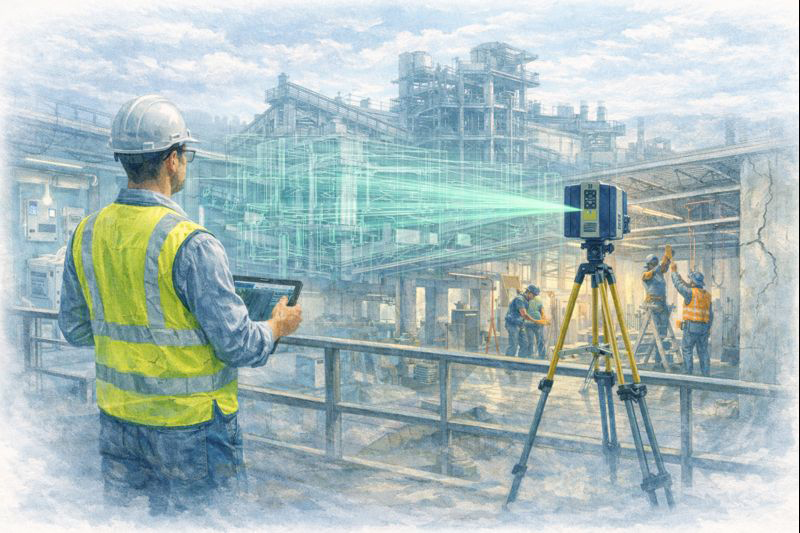
Papua New Guinea industrial facility being digitally captured with 3D scanning to create accurate models for remote engineering and shutdown planning.

What Engineering-Quality 3D Scanning Includes

Not all scanning services deliver engineering-grade outcomes. โ€œEngineering qualityโ€ means the capture and deliverables are suitable for mechanical and structural decisions, including fabrication and installation.

Key elements include:

  • Survey control and consistent site referencing (where required)
  • Defined accuracy targets aligned to project tolerances
  • Registration QA and documented checks
  • Clear deliverables (E57/RCP/RCS, CAD models, drawings)
  • Model verification against point cloud prior to issue

The goal is simple: data you can design from.


Typical PNG Use Cases

1) Plant Upgrades and Brownfield Modifications

For conveyors, chutes, pipework, pump skids, structural platforms and access upgrades, scanning provides accurate spatial context for clash-free design.

2) Shutdown Planning and Constructability Reviews

Point clouds help teams plan:

  • access routes and lifting paths
  • installation sequencing
  • workpack scoping and constraints

This is especially valuable when shutdown windows are short and remote support is required.

3) Scan-to-CAD for Fabrication and Fit-Up

When components must be fabricated off-site and installed first time, engineering-grade LiDAR scanning provides the geometry needed for:

  • interface modelling
  • connection detailing
  • fabrication drawings

4) As-Built Documentation and Asset Records

Many sites have incomplete legacy drawings. A scanned dataset can become the โ€œsingle source of truthโ€ for future upgrades and maintenance planning.


Choosing the Right Scanning Tool for PNG Conditions

PNG sites often include large structures, dense plant, tight access and harsh environmental conditions. In these cases, engineering-grade LiDAR is typically required because it provides:

  • long-range capture across large facilities
  • reliable geometry in low-light / indoor areas
  • accuracy suitable for engineering design decisions

Other capture methods (visual scanning or photogrammetry) can be useful for context and surfaces, but if fabrication, tie-ins, and fit-up matter, LiDAR is usually the right choice.


Deliverables That Engineers Actually Use

Engineering-quality reality capture is only valuable if it becomes practical outputs.

Common deliverables include:

  • Registered point clouds (E57 / RCP / RCS)
  • 2D layouts, sections and elevations extracted from scans
  • Scan-to-CAD models (structural, mechanical, piping)
  • Interface models for replacement components
  • Verification snapshots and check notes (QA evidence)

How We Manage Quality on Remote Projects

Remote work demands a higher standard of planning.

An engineering-quality workflow typically includes:

  1. Scope definition (what decisions will rely on the data?)
  2. Accuracy targets set to match the engineering requirement
  3. Capture plan (coverage, control, safe access, shutdown constraints)
  4. Registration + QA checks (repeatability, closure error, spot checks)
  5. Model extraction and verification against point cloud
  6. Issue deliverables in formats aligned to the project team

This approach reduces site revisits and ensures the data is fit for purpose.


Why Engineering-Led Reality Capture Matters

3D scanning becomes far more valuable when itโ€™s integrated with mechanical and structural engineering โ€” because the deliverables are designed to support:

  • design decisions
  • fabrication requirements
  • installation sequencing
  • long-term asset management

Engineering-led reality capture means scanning is not the end product โ€” it is the foundation for a better engineering outcome.


Hamilton By Design logo displayed on a blue tilted rectangle with a grey gradient background

3D LiDAR scanning and 3D modelling service button โ€” laser scanner capturing a point cloud for engineering and CAD modelling
Mechanical engineering services

Final Thoughts

For industrial projects in Papua New Guinea, engineering-quality 3D scanning helps teams deliver upgrades with confidence โ€” particularly where logistics are difficult, shutdown time is limited, and โ€œmeasure twiceโ€ is expensive.

If the project depends on fit-up, constructability and accurate as-built conditions, start with reality capture that is designed for engineering โ€” not just visualisation.

Name
Would you like us to arrange a phone consultation for you?
Address
Finite Element Analysis (FEA) engineering simulation button
Mechanical engineering services

Reality Capture for Live or Operational Sites (High-Risk Environments)

Engineer performing LiDAR scanning on live construction site with BIM model overlay for clash-free installation

Reality Capture for Live Sites Sydney | 3D Scanning Without Shutdowns

Keep Sydney Projects Running: Accurate Reality Capture Without Shutdowns

Many projects across Greater Sydney and the Central Coast take place in live, operational environments โ€” hospitals, shopping centres, CBD offices, industrial plants, transport facilities, and heritage buildings โ€” where shutdowns are either impossible or extremely costly.

At Hamilton By Design, we provide engineer-led reality capture and 3D scanning services that allow accurate measurement, modelling, and verification without interrupting operations. Our approach supports safe access, staged construction, and clash-free installation โ€” keeping your project moving while reducing risk, rework, and variations.


The Challenge of Working in Live Environments

Builders, project managers, and facilities teams face real risks when upgrading or modifying operational sites:

  • Buildings that have moved over time, with visible cracking or deformation
  • Changes in soil conditions or legacy engineering affecting structure and services
  • Outdated or unreliable drawings that no longer reflect site conditions
  • Unexpected clashes once walls, ceilings, or plant rooms are opened
  • High costs from rework and contract variations
  • Safety risks from confined spaces, working at heights, or restricted access zones

Relying on manual measurement or assumptions in these environments increases both programme risk and safety exposure.


Reality capture of operational industrial facility using 3D laser scanning without site shutdown

Non-Contact Measurement for High-Risk and Restricted Sites

Our reality capture solutions use non-contact laser scanning and LiDAR technology to safely collect accurate site data, even in difficult or restricted environments.

This allows us to capture:

  • Services above ceilings and within plant rooms
  • Structural elements and building geometry
  • Equipment clearances and access constraints
  • Deformed or out-of-plumb structures

All while minimising disruption to occupants and operations.

Safety and Access Benefits

  • Reduced need for working at heights
  • Faster site presence and data capture
  • Minimal interference with daily operations
  • Scanning possible from walkways or public-access areas
  • Fewer permits, isolations, and shutdown windows required

This makes scanning ideal for live hospitals, retail centres, offices, and industrial facilities where safety and continuity are critical.


Supporting Staged Construction and Live Upgrades

Live environments rarely allow full shutdowns. Our reality capture workflows are designed to support:

  • Staged construction programs
  • Progressive installation of services
  • Ongoing refurbishment works
  • Verification before each construction phase

We can also perform repeat scanning to monitor:

  • Structural movement
  • Progressive cracking
  • Deformation of walls, floors, or structural members

This is especially valuable where movement, settlement, or ageing infrastructure is a concern.


Practical Outcomes for Builders and Project Teams

Our scan data is not just collected โ€” it is engineered into practical construction deliverables that support real project decisions.

Clients use our reality capture outputs for:

  • Design of new mechanical, electrical, and plumbing services
  • Accurate as-built verification prior to fabrication
  • Set-out and coordination models for installation
  • Clash detection before construction begins
  • Monitoring movement or deformation over time

This reduces uncertainty, improves coordination between trades, and significantly lowers the risk of costly on-site surprises.


Construction-Ready Deliverables

We provide data in formats that integrate directly into your existing workflows and design platforms:

  • Point clouds (RCP / E57)
  • Revit models
  • AutoCAD files
  • SolidWorks models
  • 2D drawings (plans, sections, elevations)
  • Clash-ready coordination models

Our focus is on delivering usable, construction-ready information, not just raw scan files.


Engineer-Led Reality Capture โ€” Not Just Scanning

Hamilton By Design is not a scanning-only provider. We deliver end-to-end technical services, allowing us to support projects from concept through to installation.

Our integrated capabilities include:

  • Reality capture and 3D scanning
  • Mechanical engineering
  • Systems management
  • Project management
  • Machining and fabrication support

Because our work is engineer-led, scan data is interpreted with constructability, tolerances, and installation constraints in mind โ€” not simply converted into drawings by offshore drafting teams.

This means better decisions, fewer assumptions, and stronger outcomes on site.


Supporting Greater Sydney and the Central Coast

We regularly support projects across:

  • Sydney CBD and metropolitan areas
  • Major commercial and retail precincts
  • Health and education facilities
  • Industrial and processing plants
  • Infrastructure and heritage assets
  • Central Coast commercial and industrial sites

Our local presence allows efficient mobilisation and ongoing project support throughout staged works.


Hamilton By Design logo displayed on a blue tilted rectangle with a grey gradient background
3D LiDAR scanning and 3D modelling service button โ€” laser scanner capturing a point cloud for engineering and CAD modelling
Mechanical engineering services

Reduce Risk. Avoid Shutdowns. Build With Confidence.

Reality capture is no longer just a documentation tool โ€” it is a risk management strategy for live environments.

By capturing what is truly on site before construction begins, you can:

  • Prevent clashes and redesign
  • Reduce variations and rework
  • Improve safety planning
  • Protect programme and operational continuity

Arrange a Phone Consultation

If you are planning works in a live or high-risk environment and need reliable site data without shutdowns:

Please fill out the form below to arrange a phone consultation.

Weโ€™ll discuss your site conditions, construction staging, and deliverable requirements, and recommend the most effective reality capture approach for your project.

Name
Would you like us to arrange a phone consultation for you?
Address
Finite Element Analysis (FEA) engineering simulation button
Mechanical engineering services

3D Construction Scanning Darwin

Engineering-grade 3D laser scanner capturing Darwin port infrastructure, harbour assets, and urban skyline

Engineering-Grade LiDAR for Accurate As-Built & Construction Delivery

Construction projects in Darwin operate in a demanding environment โ€” tropical weather, remote logistics, accelerated schedules, and complex interfaces between structural, mechanical, and architectural elements. 3D construction scanning provides a reliable digital foundation to reduce risk, eliminate rework, and support confident decision-making throughout the project lifecycle.

Hamilton By Design delivers engineering-grade 3D construction scanning in Darwin, supporting contractors, engineers, builders, and asset owners with accurate spatial data, as-built models, and construction-ready documentation.

๐Ÿ‘‰ Learn more about our Darwin scanning capability:
https://www.hamiltonbydesign.com.au/3d-scanning-in-darwin/
https://www.hamiltonbydesign.com.au/home/engineering-services/3d-scanning-darwin/darwin-lidar-laser-scanning-services/


What Is 3D Construction Scanning?

3D construction scanning uses high-accuracy LiDAR laser scanners to capture the real-world geometry of construction sites, partially completed works, and existing assets. The output is a dense, survey-grade point cloud that can be used to create:

  • Accurate as-built drawings
  • BIM and digital twin models
  • Clash detection and coordination models
  • Verification of construction tolerances
  • Retrofit and upgrade designs

Unlike traditional tape or total-station methods, LiDAR captures millions of points per second, ensuring complex geometry is recorded correctly the first time.


Engineering-grade 3D laser scanner capturing Darwin port infrastructure, harbour assets, and urban skyline

Why 3D Construction Scanning Matters in Darwin

Construction in Darwin often involves:

  • Live brownfield sites
  • Remote or logistically constrained projects
  • Tight shutdown or installation windows
  • High consequences of dimensional errors

3D construction scanning enables:

โœ” Reduced rework and RFIs
โœ” Improved trade coordination
โœ” Accurate verification before fabrication
โœ” Faster design and approval cycles
โœ” Safer site data capture with minimal disruption

This is particularly valuable for industrial buildings, ports, power generation facilities, defence infrastructure, and commercial developments across the Northern Territory.


Typical Construction Applications

As-Built Verification

Confirm what has actually been built โ€” not what was assumed โ€” before handover, certification, or the next construction stage.

Construction Progress Capture

Document progress at key milestones to support planning, claims, and coordination.

Retrofit & Upgrade Projects

Capture existing structures accurately before mechanical, electrical, or structural upgrades commence.

Clash Detection & Coordination

Overlay scanned data with design models to identify clashes early and avoid costly site changes.


Hamilton By Design logo displayed on a blue tilted rectangle with a grey gradient background
3D LiDAR scanning and 3D modelling service button โ€” laser scanner capturing a point cloud for engineering and CAD modelling
Mechanical engineering services

Engineering-Led Scanning โ€” Not Just Data Capture

At Hamilton By Design, 3D construction scanning is delivered by engineers, not just scanning technicians. This means:

  • Scan strategies aligned to engineering outcomes
  • Data captured at appropriate accuracy for construction tolerances
  • Deliverables tailored for CAD, BIM, and fabrication workflows
  • Clear accountability from scan to design to documentation

Our scanning integrates directly with mechanical design, structural analysis, and construction documentation services โ€” providing a single source of truth for your project.


Deliverables to Suit Construction Teams

Depending on your requirements, we can provide:

  • Registered point clouds
  • CAD-ready models
  • Revit / BIM outputs
  • Section views and construction references
  • Engineering drawings derived from scan data

All deliverables are tailored to suit builders, engineers, subcontractors, and asset owners.


Our clients:

3D Construction Scanning Darwin โ€” Partner with Confidence

Whether you are delivering a new build, managing a complex refurbishment, or upgrading an existing facility, 3D construction scanning in Darwin provides the clarity and accuracy needed to build with confidence.

Hamilton By Design supports construction projects across Darwin and the Northern Territory with engineering-grade LiDAR scanning, practical deliverables, and real-world construction experience.

Let Connect us to discuss your project requirements or arrange a site scan.

Name
Would you like us to arrange a phone consultation for you?
Address

3D Scanning Engineering in Dubbo

3D Scanning Engineering in Dubbo

Dubbo is one of Australiaโ€™s most important inland cities. Often described as the capital of western New South Wales, it supports a vast region spanning agriculture, mining, infrastructure, health, education, and logistics. Unlike towns defined by a single industry, Dubboโ€™s strength lies in its diversity and its role as a regional engineering and services hub.

Engineering projects in and around Dubbo range from industrial facilities and infrastructure upgrades to mining support, utilities, and large-scale agricultural assets. Many of these projects involve brownfield conditions, legacy infrastructure, and tight delivery timelinesโ€”making accurate site data and practical engineering essential.

Hamilton By Design supports Dubbo projects with engineer-led 3D LiDAR laser scanning, mechanical and structural engineering, 3D CAD modelling, FEA, and fabrication-ready drafting. Our workflow is focused on accuracy, constructability, and delivering designs that work first time.

Engineering challenges in a regional hub like Dubbo

As a regional centre, Dubbo supports assets spread across a wide geographic area. Engineering teams often deal with:

  • Existing infrastructure that has been extended or modified over time
  • Limited or outdated drawings
  • Projects that must be delivered efficiently to minimise disruption
  • Assets that serve agriculture, mining, transport, and public infrastructure

In these environments, assumptions create risk. Reliable as-built information is critical before design, fabrication, or construction begins.

3D Laser Scanning for Dubbo projects

Hamilton By Design uses high-accuracy 3D Laser Scanning to capture the true as-built condition of sites in and around Dubbo. Laser scanning records millions of precise measurements, creating a detailed digital record of buildings, plant, structures, and surrounding interfaces.

3D laser scanning is particularly valuable for:

  • Brownfield industrial and infrastructure sites
  • Agricultural and processing facilities
  • Mining and quarry support assets
  • Projects where drawings no longer reflect site reality

Scanning is typically completed during short, controlled site visits, minimising disruption while providing data that can be relied on throughout the project.

From scan data to accurate 3D models

Once scanning is complete, the data is processed and converted into detailed 3D CAD Modelling. These models represent what actually exists on site, rather than what historic documentation suggests.

For Dubbo-based and regional projects, scan-based 3D modelling supports:

  • Mechanical upgrades and equipment replacements
  • Structural additions such as platforms, supports, and access ways
  • Integration of new assets into existing facilities
  • Long-term digital records for future maintenance and expansion

Accurate models reduce uncertainty and help project teams make informed decisions early.

Mechanical and structural engineering built on real conditions

Dubboโ€™s engineering projects often involve coordinating multiple disciplines across constrained or operational sites. Working from scan-derived models allows engineers to:

  • Understand existing load paths and constraints
  • Check clearances and access early in the design
  • Coordinate mechanical and structural elements within one environment

This leads to designs that are practical, buildable, and aligned with how assets are actually used.

FEA to support performance and compliance

Where performance, safety, or compliance is critical, Hamilton By Design applies FEA Capabilities to support engineering decisions.

Finite Element Analysis is commonly used to:

  • Check structural capacity under operational loads
  • Assess modifications to existing steel and concrete
  • Review fatigue, vibration, and deflection
  • Support engineering approval and sign-off

Using FEA on scan-based geometry gives confidence that designs will perform as intended in real operating conditions.

Easy-to-build fabrication drawings with engineering approval

Clear documentation is essential for successful deliveryโ€”particularly in regional locations where rework can be costly. Hamilton By Design produces fabrication-ready Drafting directly from coordinated 3D models.

Typical deliverables include:

  • General arrangement and detail drawings
  • Fabrication and installation drawings
  • Engineering-reviewed and approval-ready documentation

This focus on clarity and constructability helps fabricators and contractors build efficiently and accurately the first time.

Reducing risk through digital engineering

By capturing site conditions once and completing the majority of engineering off site, Dubbo projects benefit from:

  • Reduced site visits and travel costs
  • Improved safety outcomes
  • Better coordination before fabrication
  • Fewer surprises during installation

This approach is well suited to Dubboโ€™s role as a regional hub supporting diverse industries across western NSW.

Supporting Dubbo and regional NSW with practical engineering

Dubboโ€™s strength lies in its ability to support many industries across a wide region. Hamilton By Designโ€™s integrated scanning and engineering workflow aligns with this roleโ€”providing accurate data, sound engineering judgement, and clear documentation to support reliable project delivery.

3D Scanning Engineering in Dubbo is about turning complex, real-world conditions into clear, buildable engineering outcomes that support infrastructure, industry, and growth across western New South Wales.

Hamilton By Design logo displayed on a blue tilted rectangle with a grey gradient background
3D LiDAR scanning and 3D modelling service button โ€” laser scanner capturing a point cloud for engineering and CAD modelling
Mechanical engineering services

Our Clients:
Name
Would you like us to arrange a phone consultation for you?
Address

3D CAD Modelling | 3D Scanning