
Australia has strong researchers, capable engineers and experienced manufacturers. However, having these capabilities does not automatically mean that a promising idea will become equipment that can be manufactured, installed, operated and maintained successfully.
The Australian Government’s Ambitious Australia: Strategic Examination of Research and Development Final Report examines this gap. Released in March 2026, the report contains 20 recommendations focused on improving Australia’s research, development and innovation system.
For Australian manufacturers, the central issue is not simply how much research the country undertakes. It is how effectively research, technical knowledge and industrial experience are converted into productive equipment, improved processes, locally manufactured components and commercially useful technology.
This is where practical engineering becomes essential.
A concept may begin with a researcher, manufacturer, maintenance team, technology company or plant operator. Before it can become an industrial solution, someone must define the requirements, capture the existing conditions, develop the geometry, assess the interfaces, consider manufacturing constraints and produce the technical information needed by fabricators and installers.
Australia’s industrial innovation challenge
The Ambitious Australia report identifies six broad areas for improving Australia’s research, development and innovation system:
- Greater focus and scale for research, development and innovation impact
- A world-class foundational research system
- Better incentives for innovative businesses and industries
- Investment and capital across the innovation cycle
- A workforce capable of supporting research and development
- Government leadership and coordination
These are national policy objectives, but their success will eventually depend on practical work carried out inside factories, processing plants, workshops, laboratories and industrial sites.
The report was released on 17 March 2026. At the time of writing, the Australian Government is considering its recommendations. Proposed measures discussed in connection with the report should therefore be treated as recommendations rather than established programs unless the government formally implements them.
This distinction is important for businesses planning future R&D activities. However, manufacturers do not need to wait for every policy decision before improving the way they develop and implement industrial ideas.
Companies can already strengthen their innovation projects by improving their project requirements, engineering information, site data, prototype documentation, design control and relationships with local manufacturers.
Why should Australian manufacturers pay attention?
Research and development can sound removed from the daily pressures of industrial production. A manufacturer may be more concerned about machine reliability, labour availability, energy costs, obsolete parts, production bottlenecks or an approaching shutdown.
In practice, many of these operational problems can become industrial R&D projects.
Examples include:
- Developing a replacement for an obsolete imported component
- Modifying machinery to manufacture a new product
- Creating a safer and more reliable transfer chute
- Designing a test rig for a new technology
- Integrating robotic equipment into an existing production line
- Reducing material blockages or equipment wear
- Improving access, guarding or maintainability
- Reconstructing the original geometry of a worn component
- Developing locally manufactured alternatives to long-lead imported equipment
- Testing a new process before committing to full production
The opportunity for Australian manufacturers is to look beyond research as something that only happens in universities or laboratories.
Industrial R&D also happens when a company investigates an operational problem, compares possible solutions, develops and tests a prototype, records what it learns and turns the successful result into a controlled production solution.
The gap between research and industrial application
A successful experiment, research result or early prototype does not automatically become a successful industrial product.
An idea may work under controlled conditions but still be unsuitable for installation in an operating plant. The design may not account for available space, existing steelwork, maintenance access, manufacturing tolerances, service connections, lifting requirements, production conditions or relevant engineering standards.
Common translation gaps include:
- Incomplete or unclear engineering requirements
- Missing or outdated drawings of the existing facility
- Insufficient measurement of equipment interfaces
- Designs that do not reflect local workshop capability
- Uncertainty about materials, loading or operating conditions
- Inadequate consideration of access and maintainability
- No controlled process for managing design changes
- Insufficient fabrication and installation documentation
- Limited verification of the final installation
- Loss of engineering knowledge after a prototype project ends
These problems do not necessarily mean the original research was unsuccessful. They indicate that another stage of work is required between discovery and deployment.
That stage is industrial R&D translation engineering.
The opportunity for Australian SMEs
Small and medium-sized manufacturers often understand their equipment and production problems in considerable detail. They may know exactly where a process loses time, which imported part repeatedly fails or why a machine is difficult to maintain.
What they may not have is a permanent internal team covering 3D scanning, CAD modelling, mechanical design, engineering analysis, fabrication drawings, project coordination and as-built documentation.
Project-based engineering support allows an SME to access these capabilities when required without maintaining a large permanent engineering department.
This can help an organisation:
- Define an industrial problem before spending heavily on a solution
- Capture reliable information about its existing machinery or facility
- Convert workshop knowledge into controlled engineering information
- Compare multiple concepts before selecting a design
- Prepare a design around realistic Australian manufacturing capability
- Create drawings and models that can be reviewed by fabricators
- Retain technical information for future repairs and improvements
- Reduce dependence on a single employee, supplier or overseas manufacturer
For many SMEs, innovation does not need to begin with a completely new invention. It may start with solving a recurring problem more systematically and retaining the knowledge created during that process.
What engineering work is required to translate an idea?
A practical industrial innovation project can be divided into several controlled stages.
1. Define the problem and intended outcome
The project should begin with the industrial problem rather than a preferred piece of equipment.
The team needs to understand the required duty, operating environment, capacity, materials, interfaces, safety considerations, maintenance expectations and measures of success.
This prevents CAD modelling from starting before the project requirements are sufficiently understood.
2. Capture the existing conditions
Brownfield industrial projects frequently rely on drawings that are outdated, incomplete or unavailable.
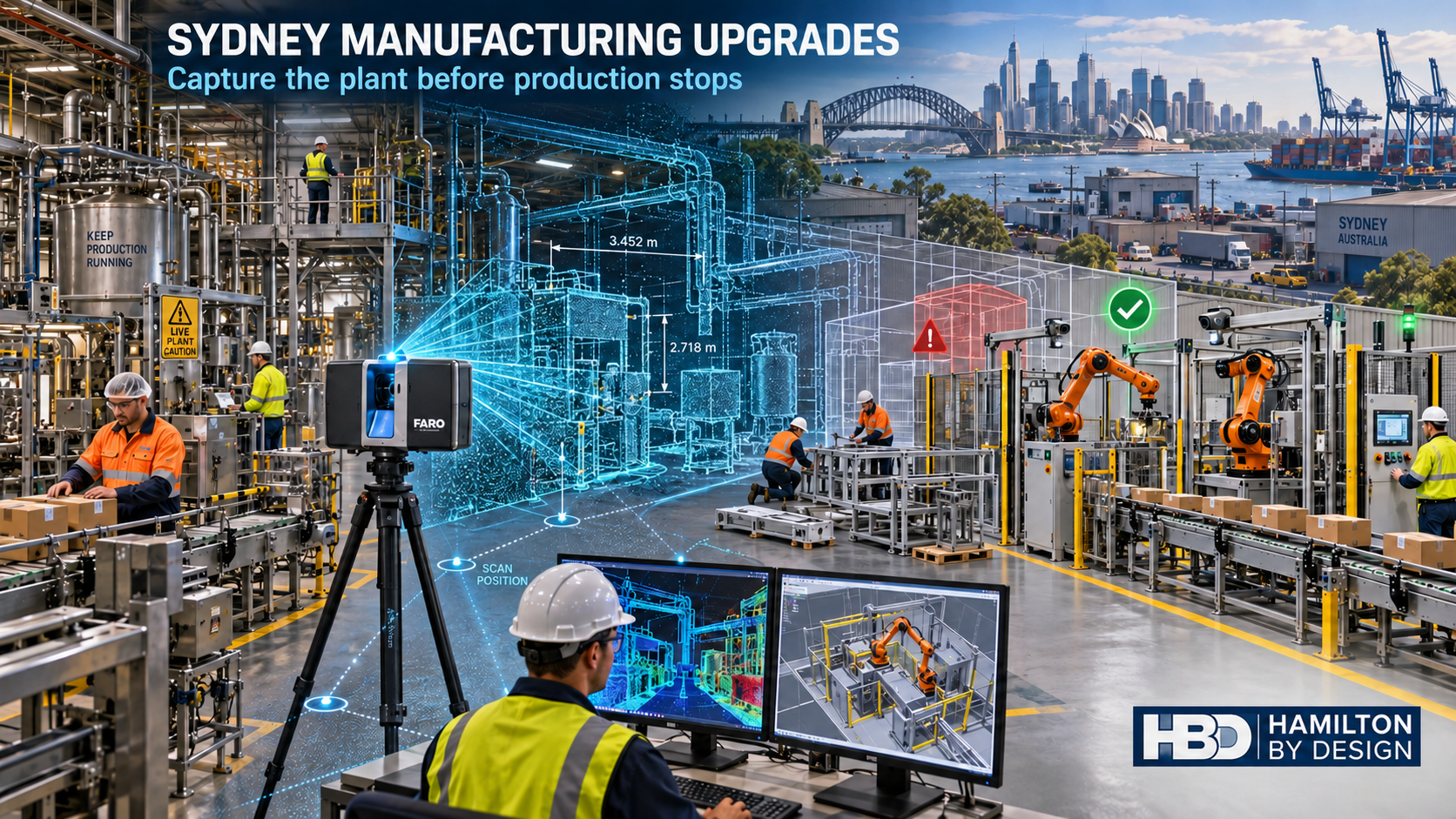
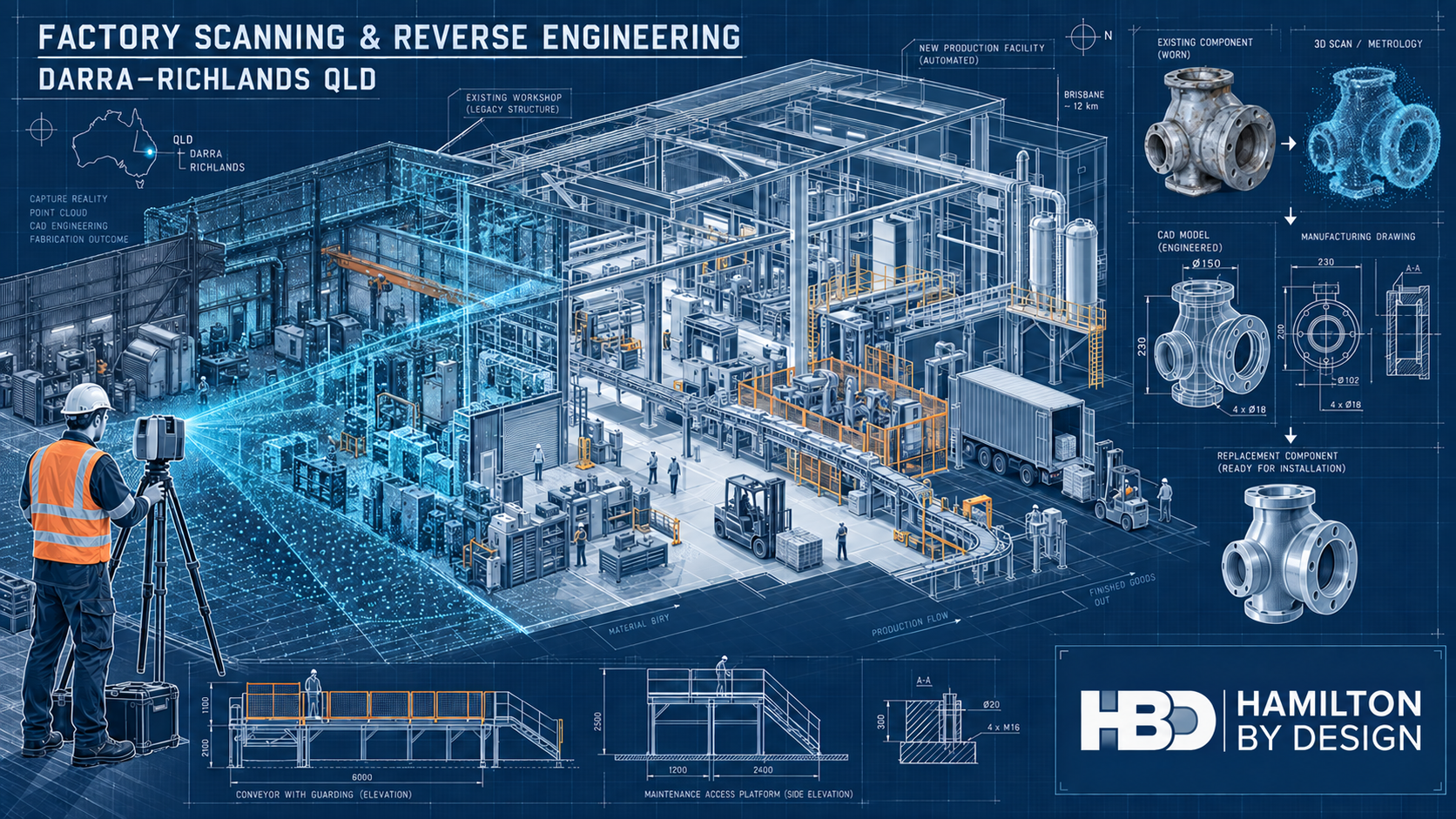
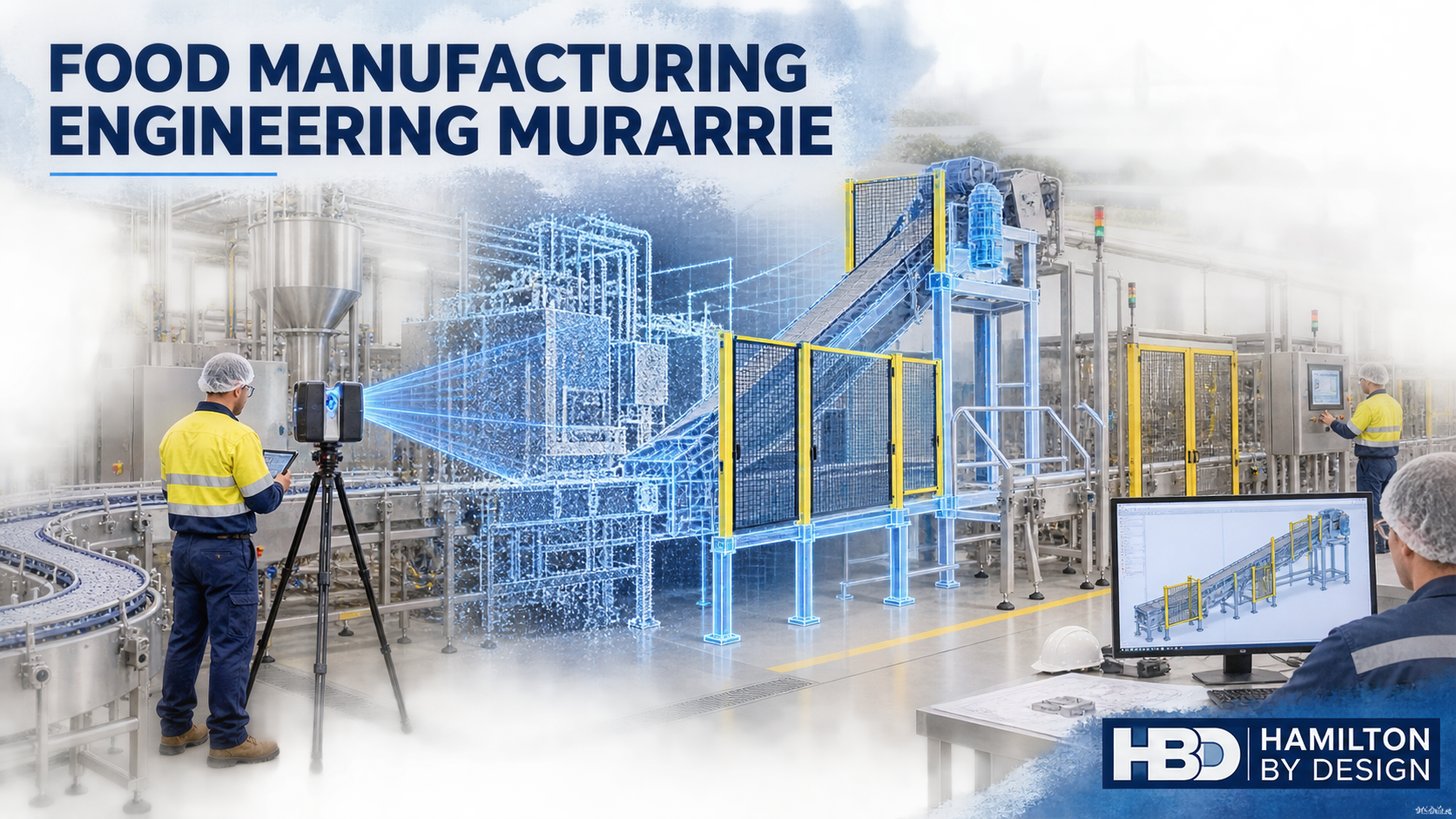
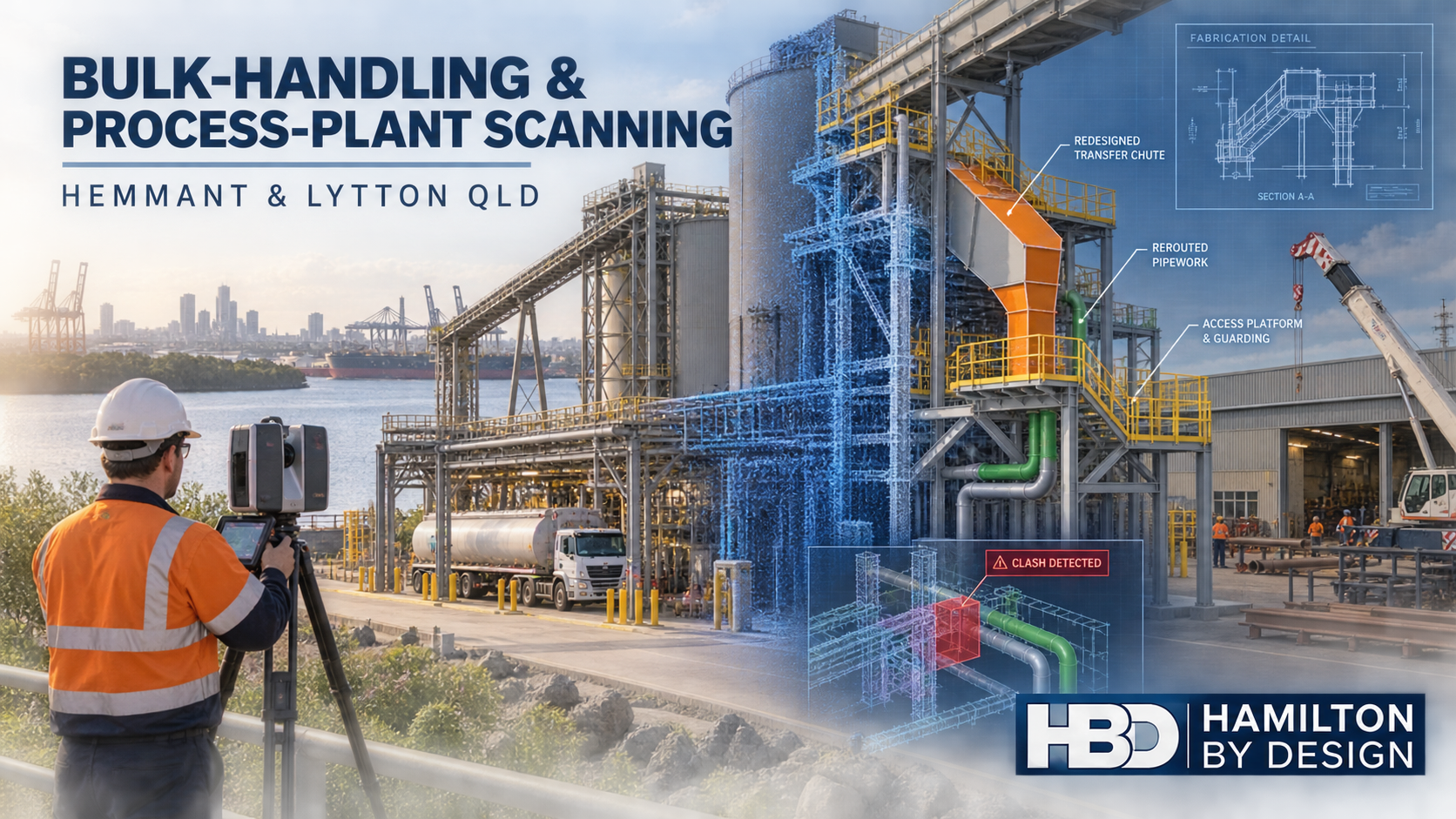
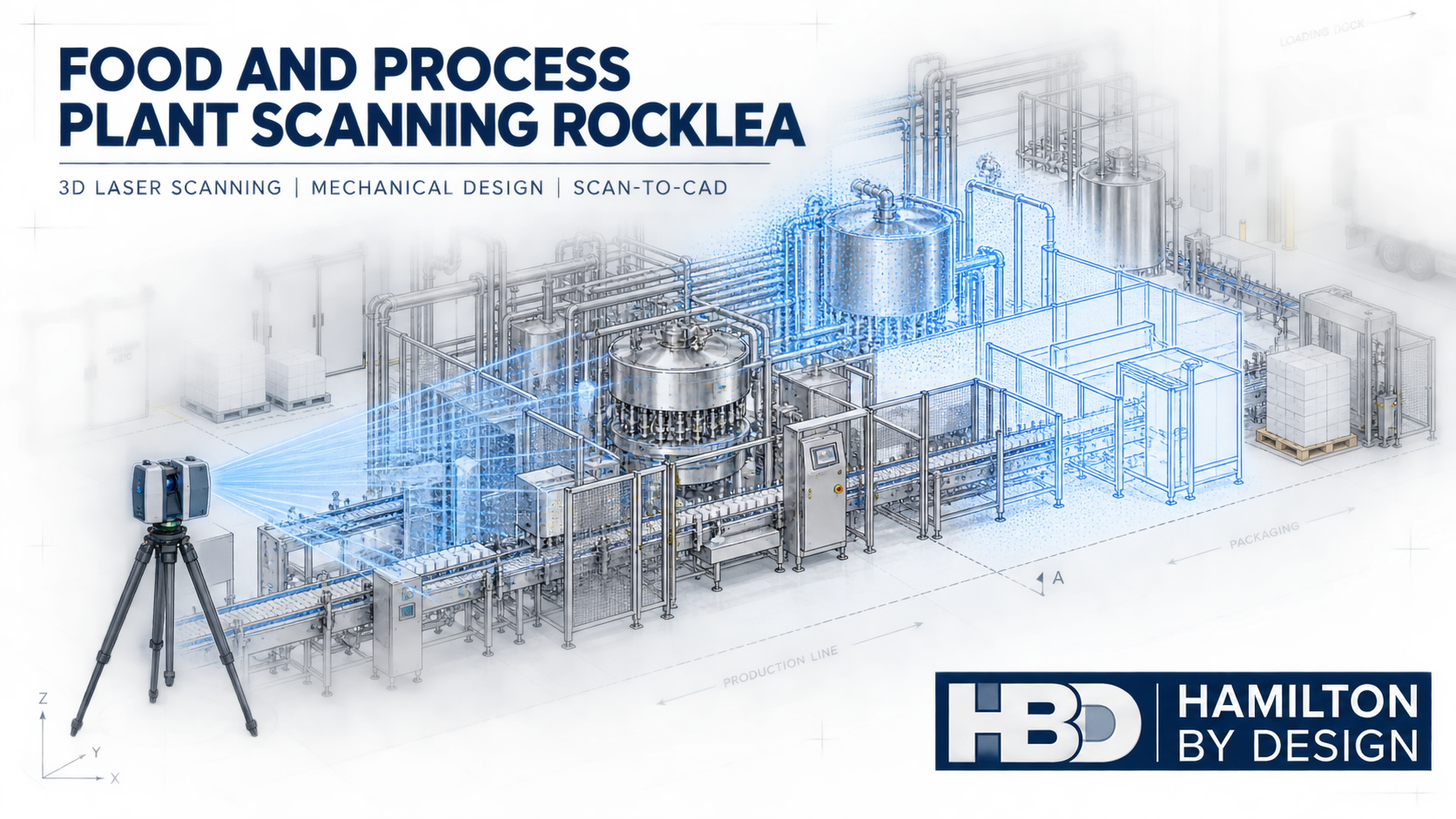
Engineering-grade 3D laser scanning can capture the existing factory, plant, machinery, pipework, steelwork and access conditions. The resulting point cloud provides a geometric reference for developing and checking the proposed solution.
For smaller components and detailed interfaces, metrology scanning and direct dimensional measurement may also be required.
3. Develop and compare concepts
The project team can then develop concepts that account for the available space, manufacturing methods, maintenance access, operating conditions and installation sequence.
At this stage, the objective is not to produce detailed drawings prematurely. It is to identify a practical arrangement and remove major technical uncertainties.
4. Create the engineering model
The selected concept can be developed into controlled 3D CAD geometry.
Depending on the project, this may include equipment assemblies, replacement components, support frames, chutes, guards, access systems, pipework or test equipment.
Where an existing component is worn, damaged or no longer supported by its original manufacturer, an engineering-led reverse engineering process may be used to reconstruct the intended geometry rather than simply copying every defect in the scanned component.
5. Analyse and review the proposed solution
The level of analysis should match the risks and uncertainties of the project.
This may involve checking clearances, equipment travel, installation access, loads, material behaviour, tolerances or predicted mechanical performance. Finite element analysis may be appropriate for some applications, provided that the input data and load cases are properly established.
Complex projects may also require specialist electrical, structural, process, civil or regulatory input.
6. Produce manufacturing and installation information
A 3D model alone is not necessarily sufficient for manufacture.
The fabricator may require drawings defining materials, dimensions, tolerances, weld requirements, finishes, interfaces, purchased components and revision status. Installation teams may also require general arrangements, lifting information, reference dimensions and staged installation details.
The required documentation should be agreed upon before detailed drafting begins.
7. Verify and retain the final information
After manufacture and installation, the project should not finish with uncontrolled mark-ups scattered across emails and workshop folders.
The final arrangement can be checked, revisions incorporated and the controlled CAD models, drawings and supporting information retained as an as-built record.
This creates a stronger starting point for maintenance, repeat manufacture and future improvements.
How Hamilton By Design can assist
Hamilton By Design helps connect industrial problems, research ideas and manufacturing outcomes.
Our workflow combines:
- 3D LiDAR and metrology scanning
- Point-cloud registration and preparation
- Scan-to-CAD modelling
- Mechanical design and drafting
- Reverse engineering
- SolidWorks 3D modelling
- Finite element analysis support
- Clash detection and interface checking
- Fabrication and general arrangement drawings
- Installation planning
- As-built verification
- Controlled retention of project information
Because the scanning, modelling and mechanical documentation can remain within one connected workflow, responsibility is less likely to become fragmented between unrelated service providers.
Hamilton By Design does not provide taxation or R&D Tax Incentive eligibility advice. We also distinguish mechanical engineering and drafting services from specialist structural certification or other professional services that may be required.
Our role is to help develop the technical information needed to move an industrial project from an identified problem or early concept towards a manufacturable, installable and properly documented outcome.
Information worth retaining during an R&D project
The value of an industrial R&D project is not limited to the final piece of equipment. The information created during the project may be equally important.
Useful records can include:
- The original problem statement
- Functional and performance requirements
- Site scans and dimensional measurements
- Photographs and inspection records
- Existing-condition point clouds
- Concept models and design alternatives
- Assumptions and technical uncertainties
- Testing methods and results
- Design calculations and analysis reports
- Controlled CAD assemblies
- Fabrication and installation drawings
- Design-review decisions
- Revision histories
- Final as-built information
These records can support future improvements, repeat manufacture, maintenance planning and technical knowledge retention.
Frequently asked questions
Does every factory improvement qualify as research and development?
No. An improvement project may involve engineering without satisfying the requirements of a particular R&D program or tax incentive. Eligibility should be assessed by an appropriately qualified taxation or grant adviser. Hamilton By Design can assist with the technical engineering and project documentation but does not determine eligibility.
Does Hamilton By Design conduct academic research?
Hamilton By Design is primarily an industrial engineering, 3D scanning, CAD and design business. We can support researchers, manufacturers and technology companies by translating concepts and technical results into practical industrial geometry, equipment models, drawings and implementation information.
Can an R&D project begin with an existing plant problem?
Yes. Many industrial projects begin with a recurring failure, production constraint, obsolete component, safety issue or installation challenge. The first step is to define what is unknown and what evidence or testing will be required.
Why is 3D scanning useful in industrial innovation?
3D scanning creates a reliable digital record of existing conditions. It can reduce assumptions about equipment positions, interfaces, access and surrounding structures when integrating a new solution into an existing plant.
Can Hamilton By Design manage every discipline required for a project?
Hamilton By Design focuses on mechanical engineering, industrial geometry, scanning, CAD, reverse engineering and technical documentation. Where a project requires specialist structural, electrical, civil, process or regulatory services, those requirements should be identified and coordinated with appropriately qualified professionals.
Turning ambition into industrial capability
The Ambitious Australia report provides a national discussion about how Australia can obtain greater value from research and build stronger industries.
For manufacturers, the practical message is straightforward: Australia needs to become better at turning knowledge into equipment, processes, products and productive capacity.
That work will require researchers, manufacturers, engineers, fabricators, investors, governments and industrial operators to collaborate more effectively. It will also require reliable site information, clearly defined engineering requirements, controlled technical documentation and a realistic understanding of how solutions will be manufactured and installed.
Hamilton By Design helps close the gap between an industrial idea and a manufacturable, installable and properly documented solution.
If your organisation has a live manufacturing problem, an early-stage prototype, an obsolete component or a technology that needs to be integrated into an existing facility, contact Hamilton By Design to discuss the project by phone or email.

Contact Us – Talk To Us
Our clients: