Reverse Engineering for Mining and Industrial Equipment: Extending Asset Life

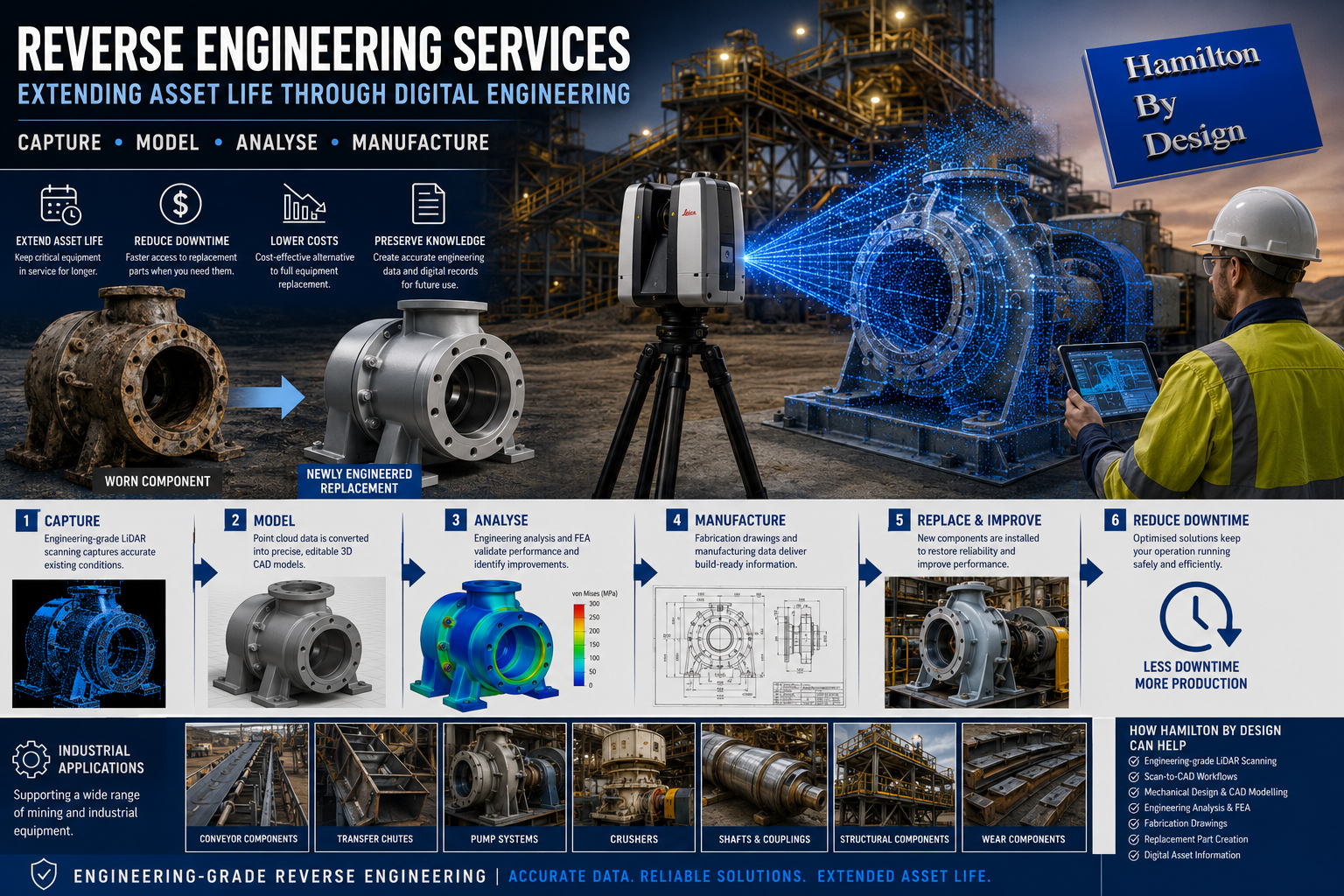
Engineering-grade reverse engineering workflow showing LiDAR scanning, CAD modelling, and FEA analysis used to recreate industrial equipment components.

Mining and industrial facilities often operate equipment for many years beyond its original installation date. Over time, machinery evolves through repairs, modifications, upgrades, and changing operational requirements. While equipment may continue performing effectively, obtaining replacement components can become increasingly difficult.

One of the most common challenges faced by industrial operations is finding replacement parts for ageing equipment where:

  • Original equipment manufacturers (OEMs) no longer support the product
  • Engineering drawings are unavailable
  • Documentation has been lost
  • Components have become obsolete
  • Lead times are excessive
  • Full equipment replacement becomes expensive

In these situations, reverse engineering can provide a practical pathway to maintain equipment performance and extend asset life.

At Hamilton By Design, we support mining and industrial operations through engineering-grade reverse engineering workflows incorporating 3D LiDAR scanning, CAD modelling, engineering analysis, and fabrication-ready documentation.

What is Reverse Engineering?

Reverse engineering involves capturing and analysing an existing component or system to recreate accurate engineering information.

Rather than starting from a new concept design, the process begins with an existing asset and develops:

  • Digital geometry
  • Engineering drawings
  • CAD models
  • Dimensional information
  • Design documentation
  • Manufacturing information

The goal is creating accurate engineering data that supports maintenance, fabrication, and equipment improvement.

Why Mining and Industrial Operations Use Reverse Engineering

Many industrial facilities contain equipment that may have operated for decades.

Examples include:

  • Conveyors
  • Transfer chutes
  • Pumps
  • Crushers
  • Structural components
  • Wear liners
  • Shafts
  • Fabricated assemblies
  • Mechanical components
  • Materials handling systems

As equipment ages, facilities can encounter increasing challenges obtaining replacement parts.
3D CAD Modelling Australia service banner for Hamilton By Design

Common issues include:

  • Obsolete components
  • Long manufacturing lead times
  • Missing drawings
  • Unknown modifications
  • Reduced OEM support
  • Increased maintenance costs

Reverse engineering helps bridge this information gap.

Obsolete Components and Missing Documentation

A common situation occurs when maintenance teams identify a failed component but no manufacturing information exists.

Examples may include:

  • Worn shafts
  • Custom brackets
  • Conveyor components
  • Pump assemblies
  • Structural items
  • Wear components

Without engineering information, organisations may face:

  • Extended downtime
  • Emergency fabrication
  • Manual measurement errors
  • Increased costs

Reverse engineering can convert physical components into accurate engineering data.

Extending Equipment Life

Full equipment replacement is not always necessary.

In many situations:

  • The surrounding system remains functional
  • Only selected components require replacement
  • Minor improvements may improve performance
  • Existing equipment can continue operating effectively

Extending equipment life may provide:

  • Lower capital expenditure
  • Reduced project risk
  • Reduced downtime
  • Improved return on investment
  • Improved operational continuity

Replacement Part Creation

Hamilton By Design can support replacement component development through engineering workflows including:

Existing Condition Capture

Capture existing equipment using:

  • Engineering-grade LiDAR scanning
  • Physical measurements
  • Dimensional verification

CAD Modelling

Develop:

  • Editable CAD models
  • Mechanical assemblies
  • Manufacturing information

Engineering Drawings

Generate:

  • General arrangement drawings
  • Fabrication drawings
  • Manufacturing documentation

Engineering Validation

Support projects through:

  • Design assessment
  • Engineering analysis
  • Finite Element Analysis (FEA)
  • Structural validation

Reducing Downtime

Unexpected equipment failures can significantly affect production.

Potential impacts may include:

  • Lost production
  • Shutdown delays
  • Increased labour requirements
  • Emergency maintenance costs
  • Reduced operational efficiency

Reverse engineering can support maintenance planning by creating:

  • Digital spare part libraries
  • Engineering records
  • Manufacturing information
  • Improved replacement processes

This allows organisations to move from reactive responses toward more structured asset management.

Cost Versus Full Equipment Replacement

Replacing an entire system can involve:

  • High capital cost
  • Long procurement timeframes
  • Installation costs
  • Production interruptions
  • Project risk

Reverse engineering may provide an alternative where:

  • Existing equipment remains suitable
  • Only selected components require replacement
  • Performance improvements can be introduced

Engineering decisions can then focus on lifecycle value rather than simply replacing complete systems.

Industrial Applications

Reverse engineering can support:

Mining Operations

  • Conveyor systems
  • Transfer chutes
  • Crushers
  • Pump systems
  • Structural assets
  • Processing equipment

Manufacturing Facilities

  • Production equipment
  • Mechanical assemblies
  • Custom components

Industrial Processing Plants

  • Wear components
  • Mechanical equipment
  • Plant modifications
  • Existing assets
3D LiDAR scanning and 3D modelling service button โ€” laser scanner capturing a point cloud for engineering and CAD modelling
Mechanical engineering services

How Hamilton By Design Supports Reverse Engineering Projects

Hamilton By Design combines engineering tools and practical engineering experience to support reverse engineering projects through:

  • Engineering-grade 3D LiDAR scanning
  • Scan-to-CAD workflows
  • Mechanical design
  • CAD modelling
  • Engineering analysis and FEA
  • Fabrication documentation
  • Existing condition verification

The objective is not simply reproducing a component.

The objective is creating reliable engineering information that supports productivity, maintenance, and long-term asset performance.

Engineering-grade reverse engineering helps transform ageing assets from a limitation into an opportunity for improved operational performance.

Our Clients:

Engineer-Led Industrial LiDAR Scanning for Mining and Heavy Industry

Engineer performing industrial LiDAR scanning on an Australian mining plant with point cloud overlay and mechanical CAD modelling workflow

Engineering-Grade LiDAR Scanning Australia | Hamilton By Design

Engineer-Led Industrial LiDAR Scanning Australia | Hamilton By Design

At Hamilton By Design, we believe industrial 3D laser scanning should deliver far more than a visual model or virtual walkthrough. In mining, manufacturing and heavy industrial environments, scanning data must support engineering decisions, fabrication accuracy, shutdown planning and long-term asset management.

Many companies now offer โ€œ3D scanningโ€ services. However, not all scanning systems, workflows or providers are the same. Across Australia, the market has become crowded with companies focused on real estate visualisation, architectural walkthroughs and general BIM modelling. While these services have their place, industrial facilities require a very different level of technical understanding.

Hamilton By Design specialises in engineer-led industrial LiDAR scanning focused on mechanical and structural engineering outcomes.


Why Industrial Facilities Require a Different Approach

Industrial sites are complex environments involving:

  • conveyors,
  • transfer chutes,
  • structural steel,
  • pipework,
  • pump skids,
  • process equipment,
  • access platforms,
  • shutdown works,
  • and brownfield modifications.
3D CAD Modelling Australia service banner for Hamilton By Design

In these environments, inaccurate data can create significant commercial and operational risks.

Poor-quality scanning or incomplete site capture can lead to:

  • fabrication clashes,
  • installation delays,
  • shutdown overruns,
  • rework costs,
  • safety risks,
  • and engineering non-conformance.

Unlike architectural walkthroughs or property visualisation projects, industrial scanning must support measurable engineering outcomes.

This is why Hamilton By Design focuses on:

  • engineering-grade terrestrial LiDAR,
  • scan-to-CAD workflows,
  • controlled engineering documentation,
  • and engineering governance systems.

Engineer-Led Scanning vs General Scanning Services

Owning a scanner does not automatically make a company an engineering specialist.

Many scanning providers focus on:

  • virtual tours,
  • digital walkthroughs,
  • building visualisation,
  • or general BIM deliverables.

Hamilton By Design approaches scanning differently.

Our workflow is driven by:

  • mechanical engineering requirements,
  • structural engineering considerations,
  • fabrication suitability,
  • and industrial project delivery.

We understand:

  • plant shutdown environments,
  • fabrication tolerances,
  • maintenance access requirements,
  • structural modifications,
  • and brownfield installation challenges.

This allows us to deliver scanning outcomes aligned with real engineering applications rather than simply producing point cloud data.


Industrial LiDAR Applications

Our industrial LiDAR scanning services support a wide range of applications across Australia.

Mining and Processing Plants

We assist mining and processing facilities with:

  • conveyor system upgrades,
  • transfer chute modifications,
  • pump station upgrades,
  • SMP projects,
  • slurry transport systems,
  • structural steel modifications,
  • and brownfield plant expansions.

Shutdown Planning

Accurate point cloud capture allows engineering teams to:

  • verify as-built conditions,
  • reduce shutdown uncertainty,
  • improve prefabrication accuracy,
  • and minimise onsite fit-up issues.

Structural and Mechanical Engineering

LiDAR data can support:

  • General Arrangement (GA) drawings,
  • structural modelling,
  • equipment integration,
  • pipe routing,
  • and engineering verification workflows.

Digital Engineering and Asset Management

Our workflows support:

  • scan-to-CAD modelling,
  • controlled revisions,
  • engineering governance,
  • and long-term asset documentation.

Understanding the Different Types of 3D Scanning

Not all scanning technologies are designed for the same purpose.

Terrestrial LiDAR Scanning

Tripod-based terrestrial LiDAR systems are typically best suited for:

  • industrial facilities,
  • mining plants,
  • brownfield environments,
  • and engineering-grade capture.

These systems provide highly controlled and repeatable data suitable for engineering workflows.

Mobile SLAM Scanning

SLAM-based systems can rapidly capture large environments and are useful in some applications. However, depending on the project requirements, these systems may introduce drift or reduced control compared with fixed terrestrial workflows.

Handheld Scanners

Handheld systems are often useful for:

  • smaller components,
  • reverse engineering,
  • and detailed geometry capture.

Virtual Tour Systems

Matterport and walkthrough systems can provide excellent visualisation tools but may not always deliver the level of engineering control required for fabrication or detailed industrial design.

At Hamilton By Design, we work with the technology that best suits the engineering outcome required by the client.

We do not make promises we cannot keep.


Why Engineering Governance Matters

One of the largest risks in industrial projects is poor drawing and document control.

Many organisations continue operating with:

  • outdated PDFs,
  • disconnected revisions,
  • unmanaged redlines,
  • and uncontrolled drawing systems.

Hamilton By Design supports engineering governance through:

  • revision-controlled workflows,
  • issue states such as IFR / IFA / IFC,
  • audit-ready documentation,
  • and structured engineering deliverables.

We also support workflows using:

  • SolidWorks,
  • AutoCAD LT,
  • and the 3DEXPERIENCE platform.

This helps provide a controlled single source of truth for engineering information across the project lifecycle.


Supporting Australian Industry

Hamilton By Design supports clients across Australia including:

  • mining operations,
  • manufacturing facilities,
  • processing plants,
  • infrastructure projects,
  • and heavy industrial sites.

We understand the realities of:

  • remote site access,
  • shutdown windows,
  • operational constraints,
  • and industrial project delivery.

Our focus is not simply collecting scan data.

Our focus is helping clients reduce engineering risk and improve project outcomes.


Industrial Scanning Backed by Engineering Understanding

The value of LiDAR scanning is not only the scanner itself.

The true value comes from:

  • understanding the engineering problem,
  • capturing the correct information,
  • and delivering data that supports real project outcomes.

At Hamilton By Design, our engineer-led approach combines:

  • industrial LiDAR scanning,
  • mechanical engineering understanding,
  • structural engineering workflows,
  • and engineering governance systems.

This allows us to support projects from initial site capture through to engineering documentation and fabrication-ready deliverables.

3D LiDAR scanning and 3D modelling service button โ€” laser scanner capturing a point cloud for engineering and CAD modelling
Mechanical engineering services

Our clients

Contact Hamilton By Design

To discuss industrial LiDAR scanning, scan-to-CAD workflows or engineering support for your next project, contact:

Hamilton By Design

We support mining, manufacturing and industrial clients across Australia with engineer-led reality capture and engineering documentation solutions.

Hamilton By Design logo displayed on a blue tilted rectangle with a grey gradient background

FARO Technologies โ€” Industrial 3D laser scanning, metrology and reality capture hardware/software solutions.

SolidWorks โ€” Professional CAD, simulation and product development platform widely used in mechanical engineering.

Dassault Systรจmes 3DEXPERIENCE Platform โ€” Cloud-based engineering governance, collaboration and product lifecycle management platform.

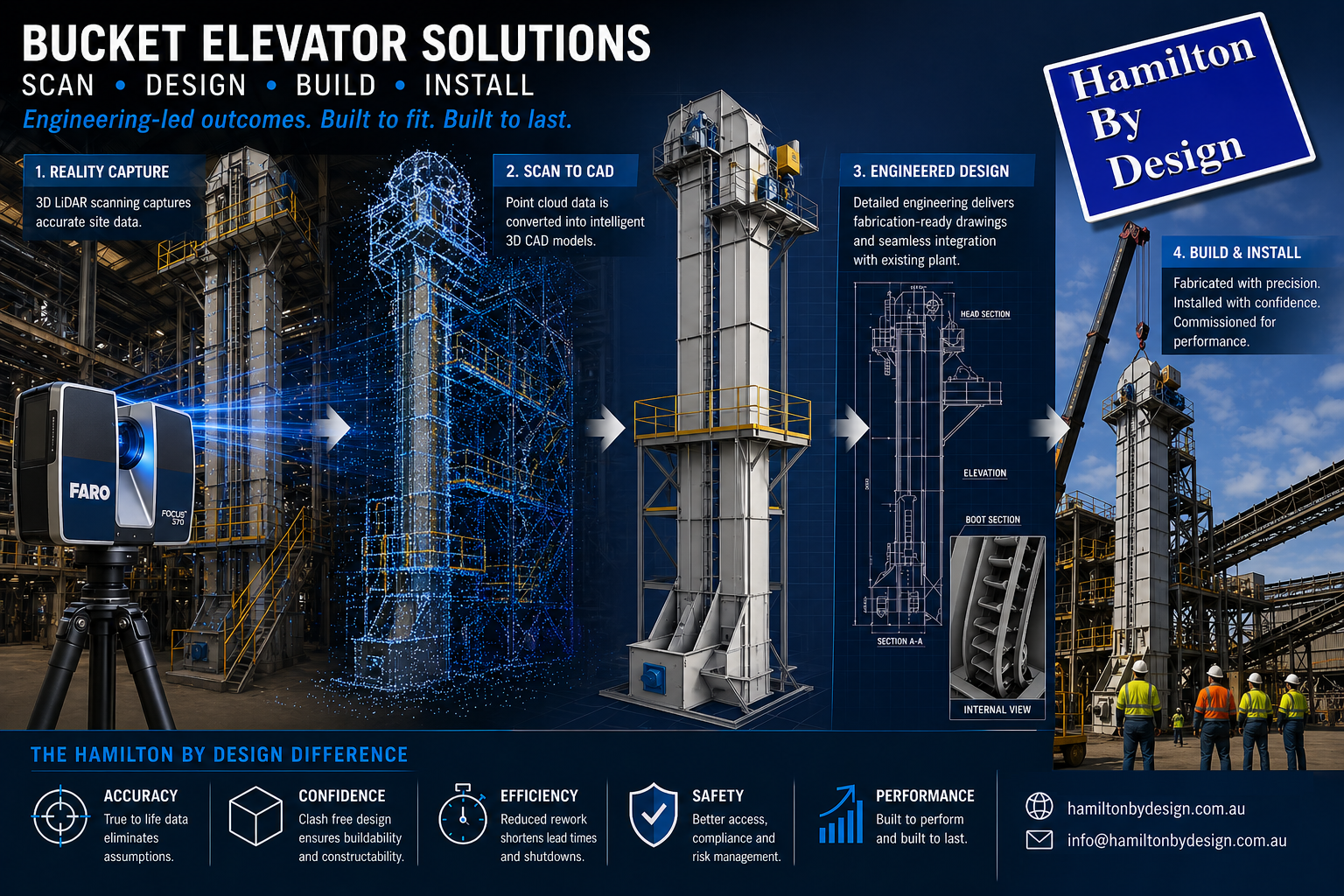
Material Handling: Bucket Elevator Scan, Design, Build and Install

3D LiDAR scanning to CAD modelling workflow for a bucket elevator system in an industrial material handling plant

An Engineering-Led Approach for Brownfield Industrial Environments

Bucket elevators are a fundamental component of bulk material handling systems, providing an efficient and reliable method for the vertical transport of materials such as ores, grains, cement, and industrial powders. Despite their apparent simplicity, the successful design and installation of bucket elevators within existing (brownfield) facilities presents significant engineering challenges. These challenges typically arise from undocumented modifications, limited access, and the inherent complexity of integrating new infrastructure into legacy plant environments.

This paper outlines an engineering-led methodology adopted by Hamilton By Design, incorporating 3D LiDAR scanning, scan-to-CAD modelling, and fabrication-ready design to deliver a complete scan, design, build, and install solution for bucket elevator systems.


3D CAD Modelling Australia service banner for Hamilton By Design

Limitations of Traditional Design Methodologies

Conventional approaches to bucket elevator design often rely on outdated drawings, manual site measurements, and engineering assumptions regarding existing plant conditions. While these methods may be adequate for greenfield developments, they are frequently inadequate in brownfield environments.

Common issues associated with traditional methodologies include:

  • Dimensional inaccuracies leading to misalignment during installation
  • Increased fabrication rework due to unforeseen clashes
  • Extended shutdown durations and associated production losses
  • Elevated safety risks resulting from poor integration with existing infrastructure

In material handling systems, particularly those involving rotating equipment and vertical conveyance, dimensional accuracy is critical. Minor deviations can result in significant operational inefficiencies, including premature wear, belt tracking issues, and mechanical failure.


Engineering-Grade 3D LiDAR Scanning

To address these challenges, an engineering-grade 3D LiDAR scanning process is employed to capture a high-resolution, spatially accurate representation of the existing plant environment. This process generates a point cloud dataset that reflects the true geometry of all visible structures, equipment, and interfaces.

The application of LiDAR scanning provides the following advantages:

  • Accurate capture of structural steelwork, platforms, and existing material handling systems
  • Identification of spatial constraints and potential clashes prior to design development
  • Reliable definition of tie-in points for new equipment
  • Reduction in reliance on assumptions and manual measurement

Importantly, the point cloud dataset is treated as an engineering input, rather than a visual reference. This distinction ensures that all subsequent design activities are grounded in verified, real-world data.


Scan-to-CAD Modelling and Engineering Design

Following data acquisition, the point cloud is processed and converted into a structured, parametric CAD model. This scan-to-CAD workflow enables the development of detailed engineering designs that accurately reflect existing site conditions.

Typical deliverables include:

  • Three-dimensional parametric models suitable for engineering analysis and coordination
  • General Arrangement (GA) drawings illustrating system layout and interfaces
  • Detailed sections and elevations through critical components
  • Interface definitions with existing conveyors, chutes, and structural systems

This approach facilitates seamless integration of the bucket elevator with existing plant infrastructure. Furthermore, it enables multidisciplinary coordination, ensuring alignment between mechanical, structural, and operational requirements.

A key differentiator of this methodology is the focus on producing fabrication-ready outputs, rather than conceptual or visual models. This ensures that the design intent can be directly translated into manufacturable components.


Engineering Considerations in Bucket Elevator Design

The design of a bucket elevator system must address a range of mechanical, structural, and operational factors.

Mechanical Design Parameters

  • Selection of belt or chain systems based on material characteristics and throughput requirements
  • Determination of bucket spacing, capacity, and configuration
  • Design of head pulley assemblies and drive systems
  • Specification of boot sections, including tensioning and clean-out provisions

Structural Integration

  • Design of support frames and load transfer mechanisms
  • Assessment of existing structural capacity and required reinforcements
  • Compliance with relevant standards, including AS 1657 for access and maintenance systems

Operational and Maintenance Considerations

  • Material flow behaviour and potential for blockages
  • Dust containment and environmental controls
  • Provision of safe access for inspection, maintenance, and replacement activities

By integrating scan data with engineering analysis, the resulting design is optimised for both performance and constructability within the constraints of the existing facility.


Fabrication and Quality Assurance

The transition from design to fabrication is significantly enhanced by the availability of accurate, detailed engineering documentation. Fabrication drawings derived from scan-based models provide a high degree of confidence in component fitment and assembly.

Key benefits include:

  • Reduction in fabrication errors and rework
  • Improved efficiency in workshop processes
  • Accurate material take-offs and procurement planning
  • Enhanced quality assurance through alignment with verified design data

Engineering oversight during fabrication ensures that all components meet specified tolerances and performance requirements.


Installation and Commissioning

Installation of bucket elevator systems within operational facilities is typically constrained by limited shutdown windows and restricted access. As such, careful planning and coordination are essential.

An engineering-led installation approach includes:

  • Development of detailed installation methodologies and sequencing
  • Planning of lifting operations and access requirements
  • Verification of alignment and fitment using scan data
  • Provision of on-site engineering support during critical installation phases

The use of pre-validated design data significantly reduces installation risk, minimises delays, and ensures a more efficient commissioning process.


Benefits of an Integrated Scan, Design, Build and Install Approach

The integration of LiDAR scanning, engineering design, and fabrication support provides a number of measurable benefits:
  • Reduced project risk through improved dimensional accuracy
  • Enhanced constructability and reduced fabrication rework
  • Shorter installation durations and reduced plant downtime
  • Improved coordination between engineering, fabrication, and site teams

For project stakeholders, this approach delivers greater certainty in both project outcomes and timelines.


Applications in Industry

This methodology is applicable across a range of industries where bulk material handling systems are utilised, including:

  • Mining and mineral processing operations
  • Agricultural and grain handling facilities
  • Cement and bulk powder processing plants
  • Recycling and industrial manufacturing environments

It is particularly valuable in brownfield projects involving upgrades, retrofits, or replacement of existing bucket elevator systems.


Conclusion

The successful implementation of bucket elevator systems in brownfield environments requires a departure from traditional design methodologies. By adopting an engineering-led approach grounded in accurate spatial data, it is possible to significantly reduce project risk and improve overall outcomes.

Hamilton By Design provides a comprehensive solution that integrates 3D LiDAR scanning, scan-to-CAD modelling, and fabrication-ready design. This approach ensures that bucket elevator systems are not only theoretically sound but also practically deliverable within the constraints of real-world industrial environments.

3D LiDAR scanning and 3D modelling service button โ€” laser scanner capturing a point cloud for engineering and CAD modelling
Mechanical engineering services

Contact Us – Talk to Us


Hamilton By Design logo displayed on a blue tilted rectangle with a grey gradient background

E-Mail: info@hamiltonbydesign.com.au

Engineering Resources for Mining, Mechanical and Industrial Design

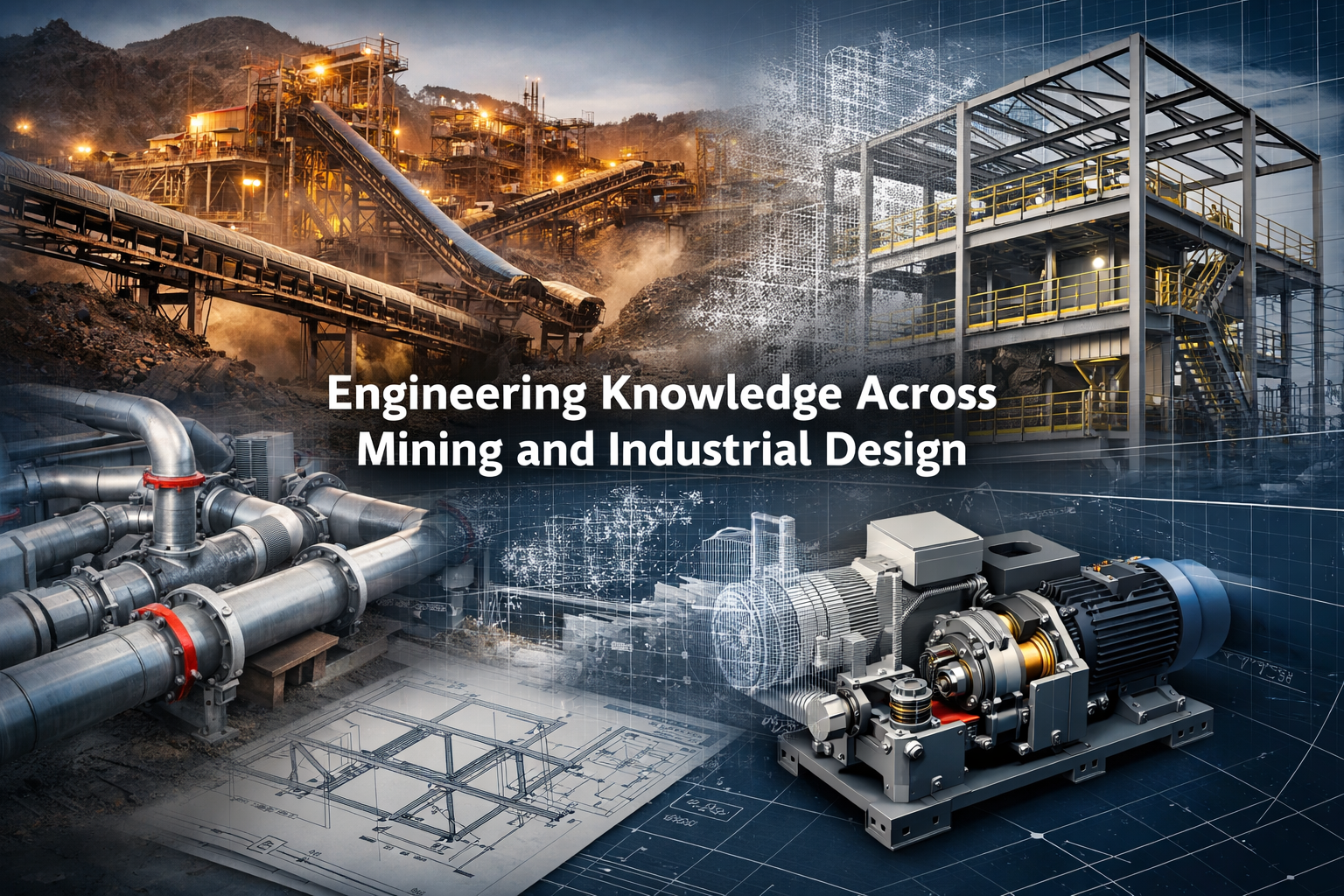
Mining and industrial engineering design montage showing conveyors, pipework systems, structural steel platforms and a mechanical assembly CAD model.

Supporting Engineering Knowledge Across Multiple Industry Blogs

At Hamilton By Design Co., we regularly publish engineering insights, technical discussions, and project examples across a number of specialist industry blogs.

These resources support engineers, plant operators, maintenance managers, and project teams working across mining, manufacturing, industrial infrastructure and structural design.

Many of these posts explore the practical engineering challenges encountered when designing, upgrading, or reverse engineering industrial equipment and facilities.

Topics include:

  • Mining plant design
  • Conveyor transfer systems
  • Structural steel detailing
  • Mechanical drafting
  • SolidWorks engineering design
  • Point cloud modelling and laser scanning
  • Design for manufacturing
  • Industrial plant upgrades

These blogs form part of the broader Hamilton By Design engineering knowledge network, providing practical insight into the real-world challenges of industrial design and engineering projects.


Hamilton By Design Engineering Blog Network

Hamilton By Design Engineering Blog

https://hamiltonbydesign.blogspot.com

This blog focuses on engineering services delivered by Hamilton By Design, including:

  • 3D laser scanning for engineering projects
  • Reverse engineering workflows
  • Industrial plant modelling
  • Engineering design case studies

It provides insights into how scanning and modelling technologies are applied to real engineering projects across Australia.


Mining Infrastructure and SolidWorks Design

https://mininginfrastructuresolidworksdesign.blogspot.com

This engineering blog focuses on the design and modelling of mining infrastructure, including:

  • Conveyor systems
  • Transfer chutes
  • Structural supports
  • Plant layout modelling

Articles often explore how SolidWorks and engineering modelling tools are used to develop reliable infrastructure for mining and bulk material handling.


Chutes and Transfer Stations

https://chutesandtransferstations.blogspot.com

Transfer chutes are one of the most critical components in bulk material handling systems.

This blog discusses:
  • Common chute failures in mining plants
  • Conveyor loading problems
  • Transfer point design
  • Bulk material handling improvements

Engineering design decisions made at transfer stations can significantly impact conveyor reliability, maintenance costs, and plant performance.


Design for Manufacturing

https://design-for-manufacturing.blogspot.com

The Design for Manufacturing (DFM) blog focuses on improving product and equipment designs to simplify fabrication and assembly.

Topics include:
  • Fabrication-friendly engineering design
  • Cost reduction through smarter design
  • Manufacturing workflow improvements
  • Practical mechanical engineering tips

Industrial Design Australia

https://industrialdesignaustralia.blogspot.com

This blog discusses engineering and industrial design challenges across Australian industries including:

  • Mining infrastructure
  • Industrial plants
  • Equipment upgrades
  • Plant shutdown planning

It highlights the engineering considerations required when working within complex operating facilities.


Mechanical Drafting Sydney

https://mechanical-drafting-sydney.blogspot.com

This blog focuses on professional drafting services including:

  • Mechanical design documentation
  • Engineering drawings
  • Industrial layout modelling
  • Detailed fabrication drawings

It provides insights into the role of drafting in delivering successful engineering projects.


Pipework Detailing

https://pipeworkdetailing.blogspot.com

Industrial pipe systems are critical infrastructure within processing plants.

This blog covers:

  • Pipe routing design
  • Pipe spool drawings
  • Scan-to-model workflows
  • Pipework engineering documentation

The content is particularly relevant to projects where laser scanning is used to capture existing plant geometry before upgrades.


SolidWorks Designer

https://solidworksdesigner.blogspot.com

This blog focuses on 3D mechanical design using SolidWorks, including:

  • Industrial equipment design
  • Mechanical assemblies
  • Engineering modelling workflows
  • Reverse engineering projects

SolidWorks Sydney

https://solidworkssydney.blogspot.com

This site focuses on SolidWorks engineering services in Australia, including:

  • Mechanical design
  • Industrial equipment modelling
  • Manufacturing design support

Structural Detailing

https://structural-detailing.blogspot.com

Structural detailing plays an important role in industrial plant upgrades and infrastructure projects.

This blog discusses:

  • Structural steel detailing
  • Engineering drawings for fabrication
  • Industrial infrastructure design

Structural Drafting

https://structural-drafting.blogspot.com

This blog focuses on structural drafting services including:

  • Steel framing drawings
  • Fabrication documentation
  • Structural engineering support for industrial facilities.

Structural Steel Drafting

https://structural-steel-drafting.blogspot.com

This blog focuses specifically on steel structures used in industrial plants and mining facilities, including:

  • Conveyor structures
  • Plant platforms
  • Maintenance walkways
  • Equipment support frames

Supporting Industrial Engineering Projects Across Australia

These blogs collectively explore the practical engineering knowledge required to support industrial facilities across Australia.

Many of the engineering topics discussed across these blogs are connected to services provided by Hamilton By Design, including:

  • Engineering grade 3D laser scanning
  • Point cloud to engineering model workflows
  • Mechanical and structural engineering design
  • Reverse engineering of industrial equipment
  • Plant upgrades and shutdown preparation

These resources help engineers and plant operators better understand how modern digital engineering tools can support safer, more efficient industrial infrastructure projects.

Hamilton By Design logo displayed on a blue tilted rectangle with a grey gradient background

3D LiDAR scanning and 3D modelling service button โ€” laser scanner capturing a point cloud for engineering and CAD modelling
Mechanical engineering services
Name
Would you like us to arrange a phone consultation for you?
Address


3D CAD Modelling Australia service banner for Hamilton By Design

Mechanical Engineering in Mining Infrastructure

Mining processing plant infrastructure with conveyors and transfer towers illustrating mechanical engineering design for mining operations.

Mining mechanical engineering covers the design, integration, and optimisation of equipment used in extraction, processing, and materials handling.

Typical systems include:

  • Conveyor systems and transfer stations
  • Crushing and screening equipment
  • Pumping systems and slurry transport
  • Structural mechanical equipment supports
  • Chutes, bins, and materials handling systems
  • Mechanical plant upgrades and retrofits

Each of these systems must be designed to handle high loads, abrasive materials, and continuous operation while integrating into existing plant layouts.

For projects involving plant upgrades or shutdown work, it is critical to capture existing plant conditions accurately before design begins.

Learn more about this process here:


Engineering Design for Existing Mining Plants

Many mining projects involve modifying existing infrastructure rather than building new facilities. This presents several engineering challenges:

  • Limited installation space
  • Legacy equipment and undocumented plant layouts
  • Structural constraints
  • Integration with operating equipment

Hamilton By Design addresses these challenges by using engineering-grade 3D laser scanning to capture precise plant geometry before design work begins.

This approach allows engineers to work with accurate digital models of operating plants, reducing risk during installation and shutdown work.

Learn more about our scanning services:


From Point Cloud to Mechanical Engineering Model

Once a plant has been scanned, the collected data is converted into a point cloud model that represents the existing infrastructure.

From this data we can produce:

  • Mechanical equipment layouts
  • Pipe routing designs
  • Structural steel interfaces
  • Conveyor and chute designs
  • Equipment modification models

The process ensures new engineering designs fit within the true geometry of the plant, avoiding clashes and installation problems.

Read more about the workflow here:


Mechanical Design for Mining Shutdown Projects

Shutdowns are one of the most critical periods in mining operations. Mechanical engineering designs prepared for shutdown installation must be accurate, buildable, and delivered on tight timelines.

Typical shutdown design work includes:

  • Conveyor upgrades and chute modifications
  • Pump station upgrades
  • Structural steel modifications
  • Pipework rerouting
  • Equipment replacement projects

With accurate plant models and detailed mechanical drafting, shutdown installations can proceed with minimal disruption to production.

Learn more about shutdown engineering support:


Materials Handling System Design

A large portion of mining mechanical engineering focuses on bulk materials handling systems.

These systems include:

  • Conveyors and drive systems
  • Transfer chutes and loading points
  • Storage bins and hoppers
  • Feeders and discharge systems

Engineering design must consider:

  • Flow characteristics of the material
  • Wear and abrasion resistance
  • Maintenance access
  • Structural loads and equipment interfaces

When properly designed, materials handling systems improve plant reliability and reduce maintenance costs.


Structural Integration in Mechanical Design

Mechanical equipment rarely operates independently. It must integrate with structural steel, concrete foundations, and existing infrastructure.

This requires coordination between:

  • Mechanical engineers
  • Structural engineers
  • drafting and modelling teams
  • site installation teams

At Hamilton By Design we integrate these disciplines within our modelling workflows to ensure mechanical systems are fully coordinated with plant infrastructure.


Engineering Services for Mining Operations

Hamilton By Design supports mining operations with a range of mechanical engineering services, including:

  • Mechanical equipment design
  • Conveyor and chute design
  • Pump system engineering
  • Structural steel interface design
  • Plant modification modelling
  • Engineering drafting and documentation
  • 3D laser scanning of existing infrastructure

Our engineering services are commonly used during:

  • plant upgrades
  • shutdown preparation
  • brownfield expansions
  • maintenance planning
  • infrastructure upgrades

Why Accurate Engineering Design Matters in Mining

Mining infrastructure operates under demanding conditions. Poor engineering design can lead to:

  • installation delays
  • shutdown overruns
  • equipment failures
  • safety risks

By combining accurate site capture, engineering modelling, and practical design experience, mechanical engineering teams can reduce project risk and deliver reliable infrastructure upgrades.


Mechanical Engineering Support for Mining Projects

Hamilton By Design works with mining companies, engineering contractors, and maintenance teams to deliver practical mechanical engineering solutions for mining infrastructure.

Our services combine:

  • site knowledge
  • engineering modelling
  • practical fabrication awareness
  • plant upgrade experience

To learn more about our mining engineering services visit:


Related Mechanical Engineering Articles

Further reading:

CHPP Engineering title graphic featuring bold white text reading "CHPP Engineering" centred on a blue rounded rectangle background.
Pipework Drafting title graphic featuring bold white text reading "Pipework Drafting" centred on a blue rounded rectangle background.
3D LiDAR Scanning for Engineering Projects title graphic featuring bold white text on a blue rounded rectangle background.
3D LiDAR scanning and 3D modelling service button โ€” laser scanner capturing a point cloud for engineering and CAD modelling
Mechanical engineering services

Name
Would you like us to arrange a phone consultation for you?
Address

Our clients

3D CAD Modelling Australia service banner for Hamilton By Design

Mechanical Design Consultants Broken Hill โ€“ Engineering for Mining, Materials Handling and Industrial Durability

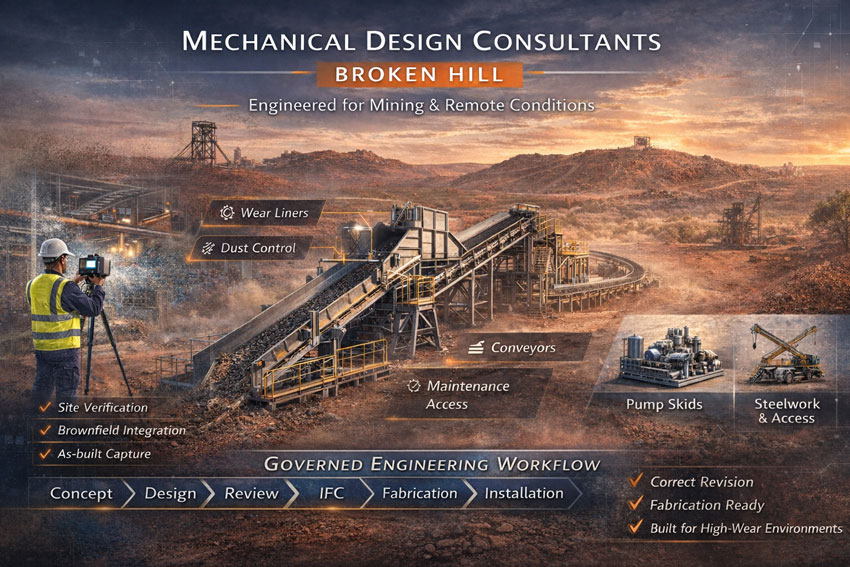
Mechanical Design Consultants Broken Hill banner featuring mining conveyor system, chute transfers and governed engineering workflow.

Mechanical Design Consultants Broken Hill | Mining & Industrial Engineering

Broken Hill is more than an iconic Australian mining town โ€” itโ€™s a living industrial environment where mechanical design means engineering solutions that withstand harsh climate, challenging site conditions and highly specialised plant requirements.

At Hamilton By Design, we provide Mechanical Design Consultants Broken Hill services that go beyond drafting. We deliver practical engineering, fabrication-ready documentation and on-site validation for projects tied to mining, materials handling, industrial process systems and structural upgrades throughout the region.


Broken Hill mining mechanical engineering visual with site verification, conveyors, pump skids and steelwork design.

Why Mechanical Design in Broken Hill Is Unique

Broken Hillโ€™s heritage and industrial character make it unlike typical metropolitan engineering contexts. Key factors influencing mechanical design here include:

Mining Legacy and Heavy Industry
Broken Hillโ€™s economy is centred on mining โ€” zinc, lead, silver and associated concentrates. Mechanical design solutions must integrate with existing plant infrastructure, high wear environments and heavy materials handling.

Harsh Climate Conditions
Extreme summer heat, dusty conditions and significant thermal expansion cycles impact equipment life and material performance. Engineering design must account for thermal stresses, corrosion resistance and maintainability over extended asset life.

Remote Logistics and Cost Sensitivity
Because Broken Hill is distant from major fabrication centres, rework and revision errors are expensive in both time and cost. Mechanical design must be right the first time with robust documentation and controlled revision systems.


Mechanical Design Services Tailored to Broken Hill Industry

Hamilton By Design provides a range of mechanical design consulting services that support Broken Hillโ€™s key industrial and mining projects.


Chute Design & Transfer Systems

Material flow equipment such as chutes and transfer points are critical in mining operations. We design and optimise:

  • Rock and ore chutes
  • Dust-controlโ€‰feed transfers
  • Wear-liner selection and replaceable panels
  • Structural support interfaces

Our designs minimise plugging, reduce abrasion wear and improve operational reliability within dusty and high-impact environments.


Conveyor Systems

Conveyors move heavy materials across site, often over extended distances and challenging terrain. Design considerations we incorporate include:

  • Conveyor frame layout and structural routing
  • Loading and take-up systems
  • Belt alignment and tensioning
  • Access platforms and maintenance walkways
  • Integration with processing plant interfaces

Our designs are 3D modelled, clash-checked and documented for first-time fabrication and installation.


Pump Skids and Process Mechanical

Hydraulic systems and processing modules require precise mechanical design, especially in mobile or modular mining applications:

  • Pump skid engineering
  • Piping layout and support design
  • Equipment anchoring and vibration isolation
  • Corrosion protection in abrasive or corrosive environments

We produce fabrication-ready documentation and coordinated layouts that fit site constraints and satisfy engineering governance.


Steelwork, Cranes and Structural Interfaces

Heavy steelwork and lifting systems are common in Broken Hill facilities. Our services include:

  • Structural support and lifting frame design
  • Workshop steel detailing
  • Light crane and jib crane integration
  • Lift points, access platforms and walkways
  • Compliance with Australian steelwork and crane standards

Whether upgrading existing infrastructure or designing new installations, our mechanical design integrates structure and mechanical integrity.


Brownfield Engineering and On-Site Validation

Many Broken Hill projects occur in live facilities with legacy equipment and tight access constraints. Hamilton By Design uses verification methods such as laser scanning and measured site capture to reduce design assumptions and ensure fit-for-site outcomes.

By combining 3D modelling with real-world site conditions, we eliminate costly guesswork and minimise installation revisions.


Governance and Documentation that Reduces Risk

High freight costs, remote fabrication and limited on-site rework options mean that mechanical design documentation must be perfectly controlled. We deliver:

  • Revision-controlled issue states (Concept โ†’ Design โ†’ Review โ†’ IFC)
  • Clear markups and revision histories
  • Digital engineering workflows
  • Maintainability-centred design

This structured approach improves contractor alignment, reduces RFIs and lowers risk across the project lifecycle.


Supporting Mining and Industrial Clients in Broken Hill

From conveyor upgrades to chute optimisation, pump skid engineering to structural crane work, Hamilton By Design applies disciplined mechanical design that solves real Broken Hill problems.

We work with:

  • Mining operations and concentrator plants
  • Materials handling facilities
  • Industrial process upgrades
  • Remote site mechanical installations

Our designs are engineered for durability, constructability and long-term performance.


Hamilton By Design logo displayed on a blue tilted rectangle with a grey gradient background
3D LiDAR scanning and 3D modelling service button โ€” laser scanner capturing a point cloud for engineering and CAD modelling
Mechanical engineering services

Mechanical Design Consultants Broken Hill โ€“ Letโ€™s Talk

If your project in Broken Hill or regional NSW requires experienced mechanical design consulting โ€” whether itโ€™s conveyors, chutes, steelwork, process modules or structural interfaces โ€” Hamilton By Design is ready to support you with practical engineering that works on site.

Contact us today to discuss your mechanical design needs and get solutions that are precise, controlled and ready to build.

Name
Would you like us to arrange a phone consultation for you?
Address

3D CAD Modelling Australia service banner for Hamilton By Design