


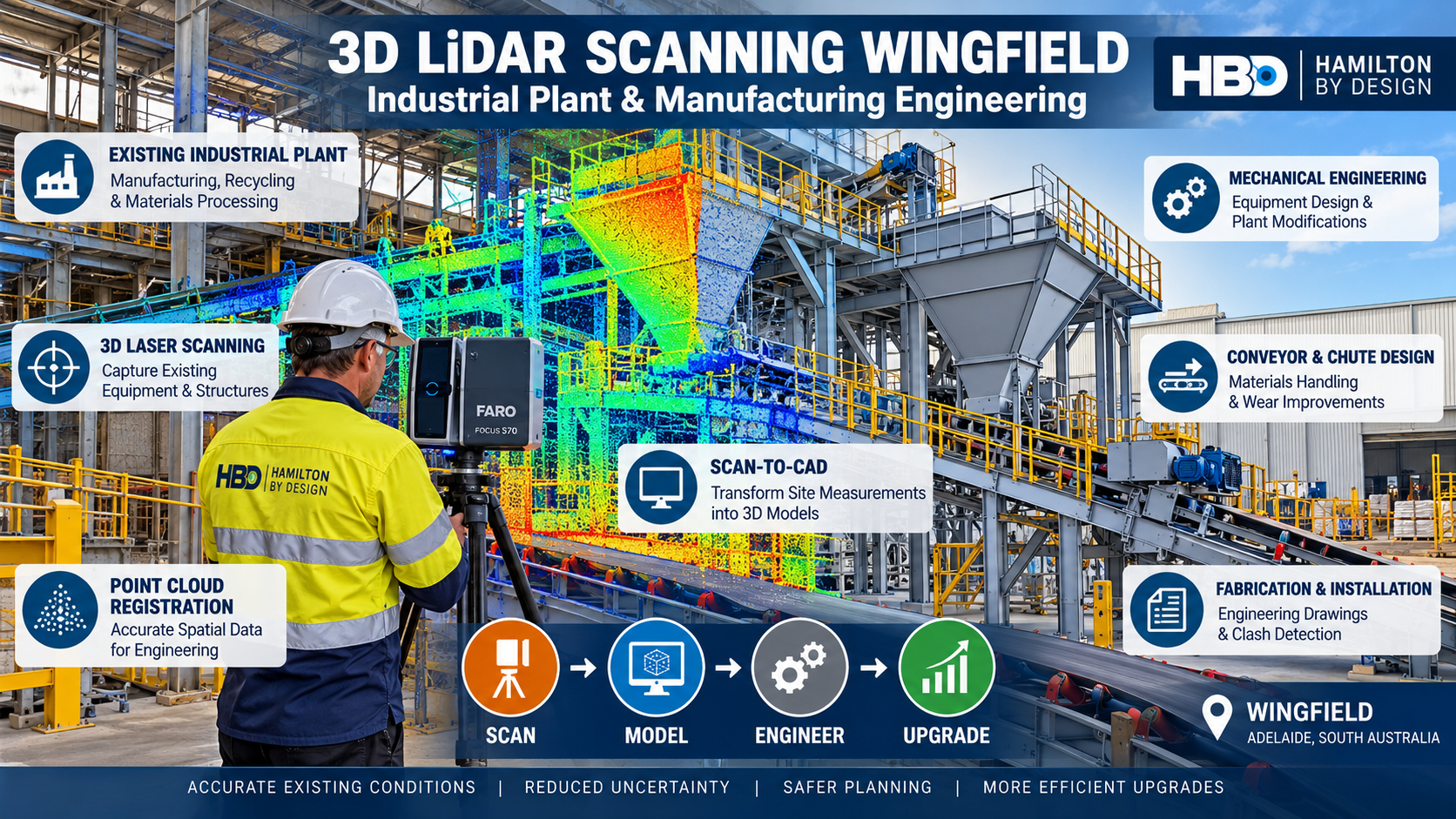
Supporting industrial plant modifications, manufacturing equipment upgrades, reverse engineering and as-built documentation across Wingfield, Adelaide and South Australia.
3D LiDAR Scanning Services in Wingfield, Adelaide

Wingfield is an established industrial precinct in Adelaide’s northern industrial corridor, supporting manufacturing, metal fabrication, recycling, transport, logistics and industrial maintenance operations.
Industrial facilities frequently undergo modifications to accommodate new equipment, improve production efficiency, replace ageing machinery and maintain operational reliability.
However, one of the challenges facing engineers, maintenance teams and fabrication contractors is the availability of accurate information about existing plant configurations.
Original engineering drawings may no longer represent the installed equipment. Machinery may have been relocated, structural modifications completed or pipework altered without corresponding updates to the facility’s documentation.
Hamilton By Design provides 3D LiDAR scanning, point cloud processing, scan-to-CAD modelling and mechanical engineering services to support industrial facilities in Wingfield and surrounding Adelaide manufacturing precincts.
Our approach combines physical measurement with practical mechanical engineering experience to support modifications to existing operational facilities.
Why 3D LiDAR Scanning Matters for Wingfield Industrial Facilities
Industrial modifications often require engineers to design new equipment within existing facilities where access, clearances and surrounding infrastructure create significant constraints.
Traditional measurement methods can be time-consuming when documenting complex machinery, elevated pipework, structural steelwork and congested production areas.
3D LiDAR scanning captures large quantities of spatial information, producing a three-dimensional point cloud representing the measured surfaces of the existing facility.
This information can be used to:
- Document existing industrial plant and equipment configurations.
- Identify potential clashes before fabrication or installation.
- Support conveyor, chute and material handling modifications.
- Establish equipment positions and available installation clearances.
- Develop three-dimensional CAD models of existing machinery.
- Support reverse engineering of components and assemblies.
- Produce general arrangement drawings for engineering reviews.
- Reduce uncertainty when planning plant upgrades and shutdown work.
The objective is not simply to collect measurements, but to convert reliable site information into engineering decisions.
Industrial Applications for 3D LiDAR Scanning in Wingfield
1. Manufacturing Plant Modifications
Manufacturing facilities regularly introduce new equipment, relocate production machinery and modify existing processing lines.
3D scanning provides spatial information that engineers can use when planning modifications around existing infrastructure.
Applications include production equipment layouts, machinery relocation, access improvements, pipework modifications and installation clearance assessments.
2. Conveyor Systems and Bulk Materials Handling
Industrial facilities handling raw materials, recycled products and manufactured goods often rely on conveyors, hoppers, transfer chutes and associated mechanical equipment.
Hamilton By Design can assist with scanning and modelling existing material handling systems to support:
- Conveyor modifications and equipment replacement.
- Transfer chute and hopper redesign.
- Material flow improvements.
- Wear liner replacement and arrangement.
- Access and maintenance improvements.
- Fabrication drawing development.
Where appropriate, mechanical design reviews can consider material flow behaviour, wear mechanisms, maintainability and installation constraints.
3. Recycling and Materials Processing Facilities
Wingfield supports recycling, resource recovery and industrial materials handling activities.
These operations may contain conveyors, screens, crushers, sorting equipment, hoppers, bins and other processing machinery.
3D LiDAR scanning can support plant modifications where existing equipment arrangements are difficult to document using conventional measurement techniques.
Potential applications include equipment replacement, structural clearance checks, new conveyor installations and preparation of as-built plant models.
4. Mechanical Equipment Reverse Engineering
Industrial equipment may remain operational long after original manufacturing drawings become unavailable.
Hamilton By Design provides reverse engineering support using 3D scanning, dimensional measurement and CAD modelling.
Applications include:
- Replacement machinery components.
- Existing mechanical assemblies.
- Pump and equipment mounting arrangements.
- Fabricated steel components.
- Machine guarding and access systems.
- Equipment interfaces and connection details.
For components requiring tighter dimensional tolerances, supplementary metrology and physical verification may be necessary.
5. Industrial Pipework and Equipment Layouts
Pipework modifications can be challenging when existing services are congested or original drawings are incomplete.
3D LiDAR scanning supports the documentation of pipework arrangements and surrounding equipment to assist with the development of proposed routes.
Applications include pipework replacement, spool arrangement planning, equipment connections and clearance assessment.
Detailed engineering, field verification and appropriate design checks remain necessary before fabrication and installation.
From 3D LiDAR Scanning to Mechanical Engineering
Hamilton By Design offers an integrated workflow connecting site measurement with engineering design.
Stage 1 – Site Inspection and Scanning
Review the project requirements, identify critical equipment interfaces and capture the existing facility using terrestrial 3D LiDAR scanning.
Stage 2 – Point Cloud Registration and Processing
Register individual scans into a coordinated point cloud dataset suitable for review and engineering modelling.
Stage 3 – Scan-to-CAD Modelling
Develop three-dimensional CAD models of the relevant equipment, structures or surrounding infrastructure using the registered point cloud.
Stage 4 – Mechanical Engineering and Design
Develop proposed modifications, review installation constraints and prepare engineering concepts or detailed models according to the agreed project scope.
Stage 5 – Engineering Drawings and Deliverables
Prepare relevant general arrangement drawings, mechanical details, fabrication information and digital models for review or downstream use.
This approach can reduce repeated site visits and improve coordination between engineering, fabrication and installation teams.
3D Scanning Accuracy and Engineering Verification
The accuracy of a 3D scanning project depends on several factors, including equipment capability, scanning geometry, environmental conditions, registration quality and the accessibility of measured surfaces.
For typical industrial scanning applications, Hamilton By Design uses project-specific measurement and verification procedures appropriate to the required deliverables.
A registered point cloud may provide sufficient information for general plant layouts and preliminary mechanical design. However, critical fabrication interfaces, bolt patterns, precision fits and machinery alignment requirements may require supplementary measurement.
A point cloud should not automatically be treated as a fabrication-tolerance dimensional inspection.
Measurement requirements and acceptance criteria should be agreed before commencing the work.
Supporting Industrial Engineering Across Adelaide
Although this page focuses on Wingfield, Hamilton By Design can support industrial projects throughout Adelaide and South Australia.
Relevant industrial areas include Wingfield, Regency Park, Gepps Cross, Dry Creek, Gillman, Port Adelaide, Kilburn, Cavan, Edinburgh and other manufacturing and logistics precincts.
Services can be delivered through site-based scanning, remote engineering development and coordination with local fabrication and installation contractors.
Why Choose Hamilton By Design?
Hamilton By Design combines 3D scanning capability with mechanical engineering and industrial plant experience.
Our services include:
- Terrestrial 3D LiDAR scanning using FARO scanning equipment.
- Point cloud registration and processing.
- Scan-to-CAD modelling using SolidWorks and AutoCAD workflows.
- Mechanical equipment and material handling design.
- Reverse engineering and fabrication documentation.
- Engineering support for operational plant modifications.
- Digital deliverables suitable for coordination and design review.
Unlike a scanning-only service, Hamilton By Design can assist with the subsequent mechanical engineering and design activities, subject to the agreed scope.
Frequently Asked Questions
What is 3D LiDAR scanning used for in manufacturing?
3D LiDAR scanning captures the existing geometry of machinery, structures and industrial facilities. The resulting point cloud can support plant modifications, equipment relocation, as-built documentation and engineering design.
Can 3D scanning be completed while a factory is operating?
Scanning may be possible during normal operations, depending on access restrictions, moving machinery, visibility, site safety requirements and the project objectives. Moving equipment and obstructed surfaces can affect the completeness of the captured data.
Can a point cloud be converted into SolidWorks models?
Yes. Point cloud data can be used as a reference to develop SolidWorks models of existing equipment and structures. The level of detail depends on the intended engineering application.
Is 3D LiDAR scanning suitable for conveyor modifications?
Yes. Scanning can document existing conveyor positions, supporting structures, transfer points and surrounding equipment to assist with proposed modifications and clash assessments.
Can Hamilton By Design provide fabrication drawings?
Yes. Mechanical engineering and drafting services can include general arrangement drawings, component details and fabrication documentation, depending on the agreed scope and engineering verification requirements.
Do you provide 3D scanning services outside Wingfield?
Yes. Hamilton By Design supports projects across Adelaide, regional South Australia and interstate locations, subject to project requirements and mobilisation arrangements.
Related Engineering Services
For additional information about our engineering and scanning capabilities, visit:
- 3D Laser Scanning Services
- Mechanical Consulting Engineers
- 3D Scanning for Engineering in Manufacturing
- 3D Scanning for Engineering in Mining
Discuss Your Wingfield Industrial Scanning Project
Planning a manufacturing equipment upgrade, conveyor modification, plant relocation or reverse engineering project in Wingfield?
Hamilton By Design can assist with capturing existing plant conditions and developing the engineering information required to support your project.
Contact Hamilton By Design to discuss your site, required deliverables, access arrangements and project schedule.

Contact Us – Talk To Us
Our clients:

























3D LiDAR Scanning | Scan-to-CAD | Mechanical Engineering | Industrial Plant Modifications | Wingfield, Adelaide, South Australia