
3D Laser Scanning and Mechanical Engineering in Smeaton Grange NSW

Smeaton Grange is one of the Macarthur region’s most important industrial precincts. Its factories, workshops and warehouses support food production, machinery manufacture, surface engineering, mining equipment, truck and trailer manufacturing, printing, pharmaceutical production, materials handling and logistics.
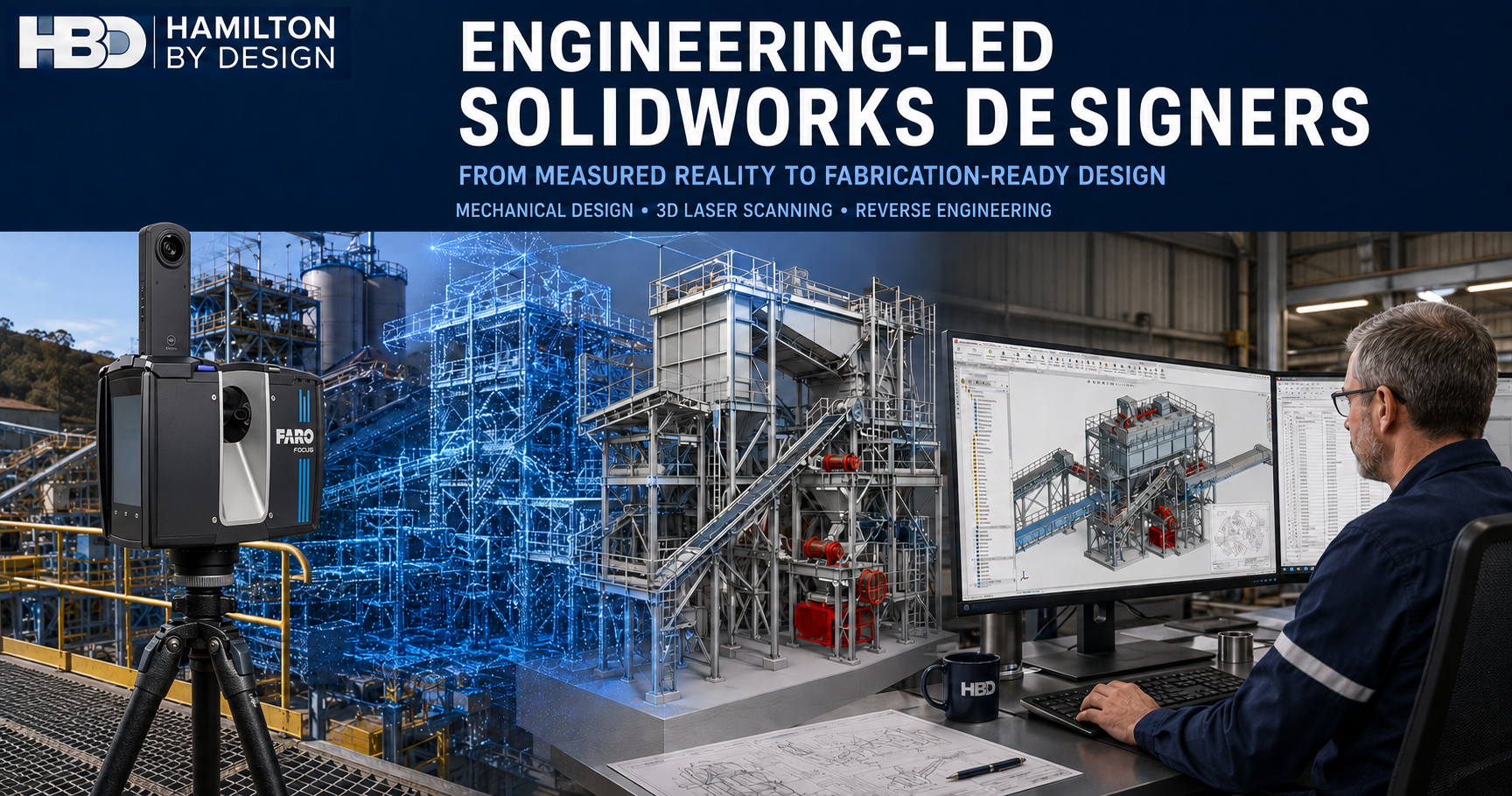
For businesses operating in this environment, the engineering challenge is rarely starting with a completely empty building. Most projects involve existing machinery, undocumented modifications, congested services and production schedules that allow very little time for installation errors. Hamilton By Design helps clients manage these risks by combining engineering-grade LiDAR scanning with mechanical engineering, reverse engineering and fabrication-ready documentation.
Supporting Smeaton Grange’s Industrial Operations
Publicly documented facilities in the precinct include fresh-food processing, trailer and conveyor manufacturing, surface engineering, signage production, complementary-medicine manufacturing and mining ground-support production. This does not imply that these businesses are HBD clients, but it demonstrates the area’s engineering diversity.
Across these industries, new machinery must be fitted around existing columns, conveyors, platforms, pipework, electrical services and access routes. Older machines may no longer have reliable drawings, while production lines may have been modified several times without the factory layout being updated.
Hamilton By Design can capture these existing conditions and convert them into practical engineering information for factory upgrades, equipment replacement and long-term asset management.
Five Common Factory Engineering Problems
1. Missing or Outdated Drawings
Many factories have drawings that no longer reflect the installed plant. Equipment, services, platforms and guards may all have changed. Designing from unreliable information increases the risk of clashes, rework and delays.
A 3D laser scan creates a measurable point-cloud record of the current factory. This can be used to develop verified layouts, sections, elevations and equipment-interface models.
2. New Equipment Must Fit a Congested Factory
Installing a conveyor, packaging machine or production cell inside an operating factory is difficult. Small dimensional errors can affect product flow, services, maintenance access and guarding.
HBD’s manufacturing layout design workflow allows proposed equipment to be coordinated with actual installed conditions before fabrication or installation begins.
3. Obsolete Machinery Parts Cannot Be Purchased
Factories often operate reliable machines long after supplier support ends. When a component fails, there may be no CAD model, drawing or replacement available.
Hamilton By Design provides reverse-engineering 3D scanning to capture existing components and develop replacement models. The objective is not simply to copy a worn part, but to understand its function, interfaces, tolerances and potential failure mechanisms before preparing a replacement.
4. Machinery Guarding Is Incomplete or Unsuitable
Factory modifications can expose shafts, couplings, chains, belts, pulleys, rollers and nip points. Guards may also be damaged, removed or altered to clear replacement equipment.
HBD provides machine-guarding design and engineering for existing and modified machinery. Scanning can capture the hazard area, available mounting points, maintenance access and surrounding obstructions so that guards fit the installed equipment.
5. Shutdown Time and Installation Rework Are Expensive
Factories cannot stop production for repeated measurements. Poor fit-up can create extra crane time, site cutting, welding, delayed commissioning and lost production.
Capturing the factory once and completing coordination digitally can reduce these risks and support a more controlled shutdown plan.
Engineering Tools for Factory Problems
Different tools suit different scales of work. A FARO Focus terrestrial scanner can capture buildings, structural steel and machinery lines. Mobile LiDAR supports rapid walkthrough capture, while handheld scanning can record smaller components and complex surfaces.
FARO SCENE and Autodesk ReCap can be used to register, review and export point-cloud information. The verified data can then be developed through SolidWorks 3D modelling and AutoCAD. Navisworks can support coordination and clash reviews where several models or disciplines are involved.
SolidWorks Simulation and FEA may be used where brackets, frames or components require assessment. For chutes, hoppers and bulk-product transfers, HBD can also apply its material-handling engineering experience and discrete element modelling where appropriate.
Mechanical Engineering Services
Hamilton By Design’s mechanical engineering consulting can support factory and warehouse projects involving:
- Production-line and conveyor modifications
- Machinery and equipment replacement
- Reverse engineering
- Platforms, stairs and maintenance access
- Guarding and safety barriers
- Equipment-support frames
- Factory relocation and machinery consolidation
- Brownfield installation planning
- Mechanical assessment and FEA
Depending on the scope, designs may consider AS/NZS 4024 for machinery safety, AS 3990 for mechanical-equipment steelwork, AS 4100 for steel structures, AS/NZS 1170 for structural actions, AS/NZS 1554.1 for structural welding and AS 1657 for fixed platforms, walkways, stairs and ladders.
Mechanical Drafting and Fabrication Documentation
Scanning and engineering analysis only create value when the information can be used by manufacturers, fabricators and installers. HBD’s mechanical drafting services can produce:
- Factory and production-line layouts
- General arrangement drawings
- Fabrication and assembly drawings
- Guarding and sheet-metal details
- Conveyor layouts and support details
- Installation drawings
- DXF profiles
- Bills of materials
- SolidWorks, STEP, Parasolid, DWG and PDF deliverables
Drawing presentation can follow the relevant parts of AS 1100, including general technical-drawing and mechanical-engineering drawing conventions. Project drawings should also identify the applicable materials, welding, tolerances, finishes and site requirements.
Machinery Safety and Conveyor Engineering
Effective guarding must consider foreseeable access, cleaning, inspection, lubrication, adjustment and maintenance—not simply place a barrier around moving machinery.
HBD can assist with guarding inspections, gap assessments, fixed guards, removable panels, perimeter guarding, maintenance openings, access gates and fabrication documentation. Electrical interlocks, emergency-stop circuits and functional-safety validation should be coordinated with an appropriately qualified electrical or control-systems specialist.
In NSW, machinery projects operate within the Work Health and Safety Act 2011 and Work Health and Safety Regulation 2025. Relevant technical guidance may include AS/NZS 4024.1201 for machinery risk assessment, AS/NZS 4024.1601 for guards, AS/NZS 4024.1803 for minimum gaps and AS/NZS 4024.1604 for emergency-stop principles.
Conveyor projects should use the relevant current AS/NZS 4024 conveyor standards. These include AS/NZS 4024.3610 for general conveyor requirements, AS/NZS 4024.3611 for bulk-material belt conveyors and AS/NZS 4024.3612 for chain and unit-handling conveyors. The older AS 1755 conveyor standard has been superseded and should not be treated as the primary standard for a new design.
Engineering for Warehousing and Logistics
Smeaton Grange is also a significant freight and logistics precinct. Warehouses may include conveyors, sortation equipment, palletisers, storage racking, loading areas, forklifts and pedestrian routes.
Hamilton By Design can scan warehouse interiors and document building columns, racking, conveyors, platforms, equipment and loading interfaces. Proposed changes can then be reviewed for equipment clearance, maintenance access, guarding and installation sequencing.
Depending on the project, relevant standards may include AS/NZS 4024.3612 for unit-handling conveyors, AS 4024.3404 for palletisers and depalletisers, AS 4084 for steel storage racking and AS 2359 for powered industrial trucks. Proprietary racking should remain subject to design and verification by the competent racking supplier or engineer.
Retaining a Reusable Digital Factory Record
The point cloud and CAD information created for one project can continue supporting future work. Subject to agreed confidentiality and retention arrangements, HBD can retain factory point clouds, machine models, conveyor layouts, equipment interfaces, CAD assemblies and fabrication drawings.
This gives the client a verified engineering baseline for later modifications and reduces the need to start each project with incomplete drawings and repeated site measurement.
Frequently Asked Questions
Can Hamilton By Design scan an operating factory?
Yes. Scanning can often proceed around normal operations, subject to site safety and access. Some areas may require a shutdown where moving equipment or product flow prevents safe capture.
Can scan data be converted into SolidWorks or AutoCAD?
Yes. Point clouds can support SolidWorks models, AutoCAD layouts, general arrangements, fabrication drawings and equipment-interface models. The required modelling level should be agreed first.
Can HBD reverse engineer an obsolete machine part?
Yes. HBD can capture the component, assess its interfaces and develop manufacturing information. Worn geometry should not be copied without considering function, tolerances, material and loads.
Can machine guards be designed from a point cloud?
Yes. Scanning is especially useful for retrofit guarding because it records the machinery, existing supports and nearby obstructions. HBD can prepare guard models, mounting details, fabrication drawings and bills of materials.
Does HBD design conveyors for factories and warehouses?
HBD can assist with conveyor layouts, modifications, supports, transfers, equipment interfaces and guarding. The exact engineering scope depends on conveyor type, product, capacity, controls and operating environment.
Does HBD retain the scan and CAD data?
Data can be retained subject to agreed client permissions, confidentiality and storage arrangements. Retention allows later projects to reuse the verified factory information rather than beginning again with incomplete records.
Discuss a Smeaton Grange Project
Hamilton By Design provides industrial 3D scanning and engineering support across Sydney, including Smeaton Grange and the wider Macarthur industrial region.
Whether the requirement involves factory scanning, reverse engineering, machinery guarding, conveyor modifications or fabrication-ready drawings, HBD can help convert existing conditions into practical engineering outcomes.

Contact Us – Talk To Us
Our clients: