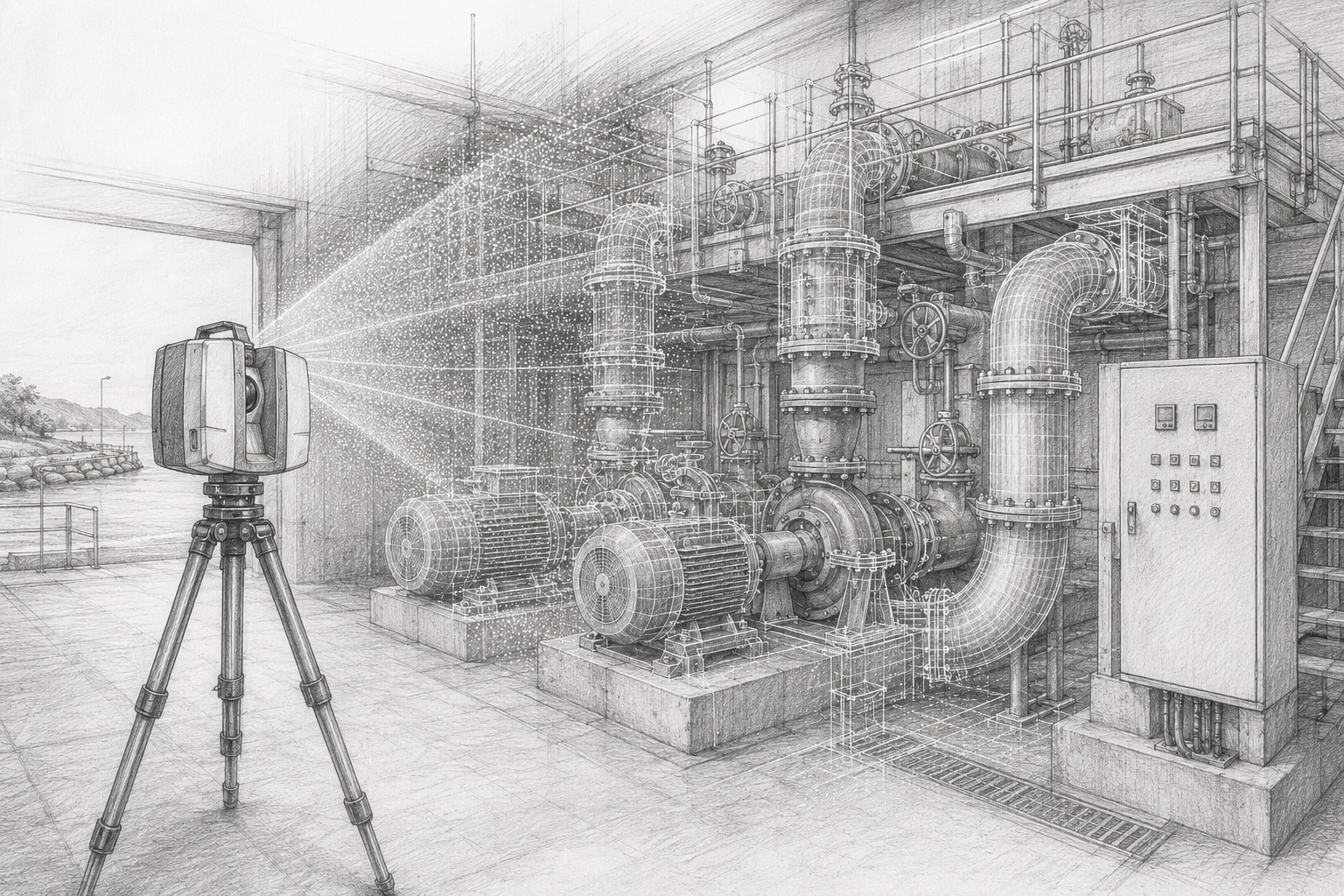
Central Coast Pump Station 3D Scanning Services

Grey pencil drawing of a LiDAR scanner capturing a Central Coast pump station with pumps, pipework, valves, access platforms and point cloud scan detail.

Engineering-Grade LiDAR Scanning for Pump Stations, Pipework, Access Platforms and As-Built Documentation

Blue 3D LiDAR scanner icon on a tripod with scanning waves

Hamilton By Design provides Central Coast pump station 3D scanning services for councils, water utilities, infrastructure owners, contractors, engineers and maintenance teams who need accurate site information before starting upgrade, maintenance or replacement work.

Pump stations are often congested, ageing and difficult to measure safely using traditional methods. Existing drawings may be missing, outdated or no longer match the real installation. This creates risk when replacing pumps, modifying pipework, installing new valves, upgrading access platforms or planning shutdown work.

Our 3D laser scanning service captures the existing pump station in high detail, creating accurate point cloud data that can be converted into CAD models, drawings and engineering documentation. This helps reduce rework, improve planning and give project teams confidence that new work will fit the existing site.

Hamilton By Design is based on the NSW Central Coast and supports pump station scanning projects across Gosford, Wyong, Tuggerah, Somersby, Erina, Woy Woy, Ourimbah, Lisarow, Lake Macquarie, Newcastle and the wider Hunter region.

Why Pump Stations Need 3D Scanning

Pump stations contain a mix of mechanical, civil, structural and electrical infrastructure. A single site may include pumps, motors, pipework, valves, supports, access platforms, pits, tanks, switchboards, cable trays and building structures.

Over time, many pump stations are modified during maintenance or upgrade work. Pipework may be rerouted, equipment may be replaced, platforms may be added, and drawings may not be updated. When engineers rely on old drawings or manual measurements, small errors can lead to major problems during installation.

3D scanning helps solve this by capturing the real site condition before design work begins.

Typical issues include:

  • Existing drawings do not match the site
  • Pipework routes are unclear
  • Pump and motor layouts are difficult to measure
  • Access platforms and handrails need upgrading
  • Valve locations and flange positions need verification
  • New equipment must fit around existing structures
  • Shutdown windows are short
  • Site access is limited
  • Manual measurement creates safety and accuracy risks

With accurate 3D scan data, engineers and contractors can plan upgrades using measured reality rather than assumptions.

What We Scan

Hamilton By Design can capture internal and external pump station assets, including:

  • Pump and motor assemblies
  • Pipework and valve layouts
  • Flanges, bends, reducers and fittings
  • Structural steel supports
  • Access platforms, stairs and handrails
  • Concrete pits, plinths and foundations
  • Tanks, vessels and wet well areas where accessible
  • Cable trays and service routes
  • Building envelopes and roof structures
  • Maintenance access zones
  • Existing clearances and installation constraints

The scan data can be used to support design, drafting, reverse engineering, clash checking and long-term asset documentation.

Scan-to-CAD for Pump Station Upgrades

A point cloud is useful, but the real value comes from converting the scan into practical engineering outputs.

Hamilton By Design can convert pump station scan data into:

  • 3D CAD models
  • 2D general arrangement drawings
  • Pipework layouts
  • Equipment location drawings
  • Structural platform layouts
  • As-built documentation
  • Fabrication drawings
  • Clearance studies
  • Reverse engineered components
  • Design-ready geometry for SolidWorks, AutoCAD, Inventor or ReCap workflows

This is especially useful when planning pump replacements, pipework modifications, new valve installations, access upgrades or structural support changes.

For broader industrial scanning capability, you can also refer to our Industrial 3D Scanning Services Australia page.

Local Central Coast Engineering Support

Because Hamilton By Design is based on the Central Coast, we can support local projects quickly and practically. We understand the needs of regional infrastructure, water assets, council facilities, industrial sites and brownfield upgrade work.

Our Central Coast scanning services are suited to:

  • Council pump stations
  • Water infrastructure
  • Wastewater facilities
  • Industrial pumping systems
  • Stormwater pump stations
  • Treatment plant assets
  • Manufacturing and process facilities
  • Brownfield plant upgrades
  • Maintenance and shutdown planning

For more general local scanning services, see our 3D Scanning Services Central Coast page.

Benefits of 3D Scanning Pump Stations

3D scanning provides a reliable foundation for engineering decisions.

Key benefits include:

  • Accurate as-built documentation
  • Reduced site rework
  • Fewer repeat site visits
  • Safer data capture
  • Improved design accuracy
  • Better shutdown planning
  • Faster engineering decisions
  • Better coordination between designers, fabricators and contractors
  • Clearer records for future asset management
  • Reduced risk when replacing or modifying equipment

For pump station projects, the biggest advantage is confidence. The design team can work from accurate existing conditions before fabrication or installation begins.

Typical Project Workflow

1. Project Review

We review the project scope, site access, required deliverables and available drawings. This helps determine the best scanning approach.

2. Site Scanning

Using FARO laser scanning equipment, we capture the pump station from multiple positions to record equipment, pipework, structures and surrounding constraints.

3. Point Cloud Registration

The scan data is processed and registered into a coordinated point cloud.

4. CAD Modelling and Drawing Production

Depending on the project, the point cloud can be converted into 3D models, 2D drawings, pipework layouts, equipment models or fabrication-ready documentation.

5. Engineering Support

We can support design review, reverse engineering, upgrade planning and documentation for contractors, councils and asset owners.

Common Pump Station Projects We Support

Hamilton By Design can assist with:

  • Pump replacement projects
  • Pipework upgrades
  • Valve and flange modifications
  • Access platform upgrades
  • Structural support design
  • Maintenance planning
  • Shutdown preparation
  • Reverse engineering of existing parts
  • As-built documentation recovery
  • Clash checking for new installations
  • Contractor tender documentation
  • Long-term asset records

For related pump station reverse engineering content, see our page on 3D Laser Scanning of Pump Stations for Reverse Engineering.

Why Choose Hamilton By Design

Hamilton By Design combines 3D laser scanning with mechanical engineering, CAD modelling and practical site experience.

We do more than capture a point cloud. We understand how the data will be used for design, fabrication, installation and maintenance.

Our strengths include:

  • Central Coast based service
  • Engineering-led scanning workflow
  • FARO laser scanning equipment
  • SolidWorks and AutoCAD capability
  • Scan-to-CAD modelling
  • Mechanical and structural drafting
  • Brownfield upgrade experience
  • Pump, pipework and plant layout understanding
  • Practical documentation for real projects

This makes our service suitable for clients who need accurate engineering information, not just visual site capture.

Central Coast Pump Station 3D Scanning

If you are planning a pump station upgrade, pipework change, equipment replacement or as-built documentation project on the Central Coast, Hamilton By Design can help capture the existing site accurately before design or fabrication begins.

Accurate scan data reduces uncertainty, improves project planning and helps ensure new work fits the real site conditions.

Contact Hamilton By Design to discuss your Central Coast pump station scanning project.

FAQs

What is pump station 3D scanning?

Pump station 3D scanning uses laser scanning technology to capture the real shape, position and layout of pumps, pipework, valves, structures and surrounding site conditions. The scan creates a point cloud that can be used for CAD modelling, drawings and engineering design.

Why is 3D scanning useful for pump station upgrades?

It helps confirm what is actually on site before design work begins. This is important because many pump stations have outdated drawings or undocumented modifications. Scanning reduces the risk of new pipework, pumps or platforms not fitting during installation.

Can you scan pipework and valve layouts?

Yes. We can scan pipework, valves, flanges, bends, reducers, supports and surrounding structures. This information can then be used to create CAD models, layouts or drawings for upgrade planning.

Can you convert the scan into CAD drawings?

Yes. Hamilton By Design can convert point cloud data into 2D drawings, 3D CAD models, general arrangements, pipework layouts and fabrication-ready documentation depending on the project requirements.

Do you work with councils and water infrastructure?

Yes. Our services are suitable for councils, water utilities, wastewater facilities, infrastructure contractors, engineers and asset owners managing pump stations or treatment plant assets.

What areas of the Central Coast do you service?

We support projects across Gosford, Wyong, Tuggerah, Somersby, Erina, Woy Woy, Ourimbah, Lisarow and surrounding Central Coast areas. We also service Newcastle, Lake Macquarie, Sydney and regional NSW.

What files can be delivered?

Common deliverables include registered point clouds, E57 files, RCP/RCS files, DWG drawings, DXF files, STEP models, SolidWorks models, Inventor models, AutoCAD layouts and PDF drawing packages.

Can scanning help with reverse engineering pump parts?

Yes. 3D scanning can assist with reverse engineering pump components, pipework assemblies, supports, access structures and other assets where drawings are missing or incomplete.

Is 3D scanning safer than manual measuring?

In many cases, yes. Laser scanning can capture large amounts of site information from a distance, reducing the need for repeated manual measurement around congested or difficult-to-access areas.

How do I know if my pump station needs scanning?

If the drawings are missing, outdated, unreliable or the upgrade needs to fit around existing equipment, scanning is usually worthwhile. It is especially useful before fabrication, shutdown work or equipment replacement.

Hamilton By Design logo displayed on a blue tilted rectangle with a grey gradient background

Talk to Us – Contact Us

Name
Would you like us to arrange a phone consultation for you?
Address

Our clients:
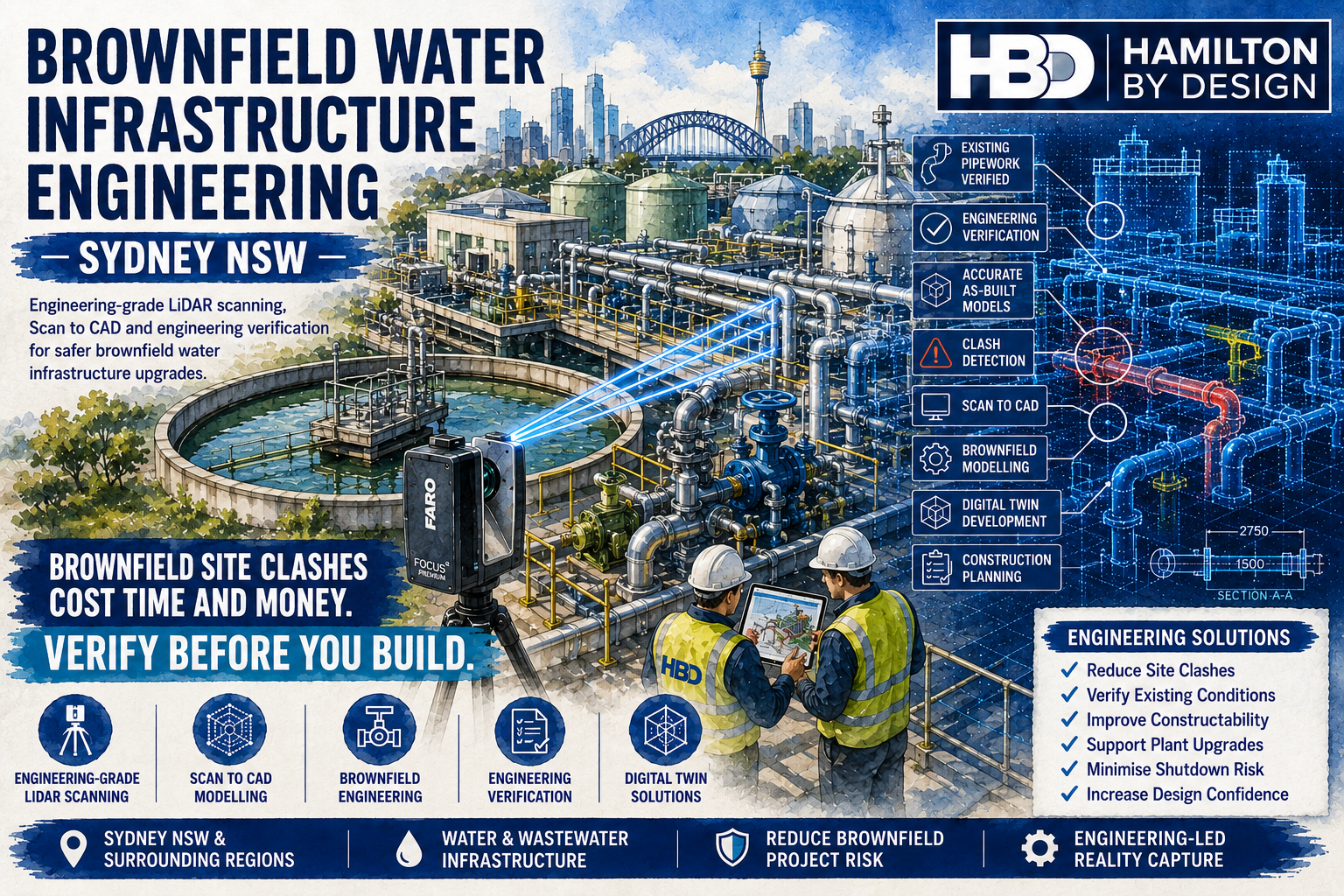


Brownfield Water Infrastructure Engineering in Sydney NSW โ€“ Reduce Risk Before Construction Begins

Engineering-grade LiDAR scanning of Sydney brownfield water infrastructure, capturing existing pipework, tanks, pumps and structural assets to support engineering verification, Scan to CAD and digital twin development.

Sydney’s water infrastructure is constantly evolving. Ageing water treatment plants, wastewater treatment facilities, pumping stations, reservoirs and transfer pipelines require ongoing upgrades to meet increasing demand, improve reliability and comply with changing environmental regulations.

Unlike greenfield projects where engineers begin with an empty site, brownfield projects involve modifying existing operational infrastructure. Every new pipe, pump, platform or structural support must integrate seamlessly with equipment that may have been installed decades ago.

The greatest challenge with brownfield engineering is simple:

Existing infrastructure rarely matches the available drawings.

Over many years, maintenance activities, emergency repairs, plant expansions and operational improvements alter facilities in ways that are often never fully documented. As a result, engineering teams frequently encounter unknown pipework, relocated equipment, modified structural steel and outdated as-built drawings.

These discrepancies create one of the biggest risks in industrial engineering:

Brownfield modifications causing costly site clashes.

Hamilton By Design provides Brownfield Water Infrastructure Engineering Services throughout Sydney NSW, combining engineering-grade LiDAR scanning, Scan to CAD, mechanical engineering and engineering verification to reduce project risk before construction begins.


Why Brownfield Projects Are More Complex Than Greenfield Projects

A greenfield project starts with a clean site.

Engineers control every dimension, every structural member and every equipment location.

Brownfield projects are completely different.

Existing facilities already contain:

  • Operating equipment
  • Underground services
  • Congested pipework
  • Electrical infrastructure
  • Instrumentation
  • Structural steel
  • Maintenance platforms
  • Access walkways
  • Cable trays
  • Temporary modifications
  • Legacy equipment

Every new design must fit around existing infrastructure while maintaining safe operation.

That is why accurate existing-condition data is essential.


The Hidden Cost of Site Clashes

A site clash occurs when newly designed equipment conflicts with existing infrastructure.

Typical clashes include:

  • Pipework intersecting structural steel
  • Pumps fouling maintenance platforms
  • Valves becoming inaccessible
  • Cable trays blocking pipe routing
  • Pipe supports interfering with existing equipment
  • Motors conflicting with overhead beams
  • Access ladders blocking maintenance paths
  • Concrete foundations overlapping underground services

Many of these issues are only discovered during construction.

By that stage:

  • fabrication is complete
  • contractors are mobilised
  • shutdowns have commenced
  • installation crews are waiting

The result is expensive redesign, fabrication changes and extended project durations.


Engineering-Grade LiDAR Scanning Eliminates Guesswork

Hamilton By Design uses professional terrestrial LiDAR scanning to accurately capture existing water infrastructure.

Rather than relying on tape measures or outdated drawings, millions of survey points are recorded across the entire facility.

This captures:

  • Pumps
  • Pipework
  • Valves
  • Tanks
  • Structural steel
  • Pipe bridges
  • Clarifiers
  • Digesters
  • Access platforms
  • Stairways
  • Handrails
  • Electrical equipment
  • Cable trays
  • Instrumentation
  • Concrete structures

The resulting point cloud becomes the single source of truth for engineering design.


Accurate Existing Conditions Lead to Better Engineering

Reliable engineering begins with reliable information.

Accurate point cloud data enables engineers to:

  • Verify dimensions
  • Confirm pipe routing
  • Check equipment locations
  • Validate maintenance access
  • Measure structural geometry
  • Review installation clearances
  • Detect clashes before construction
  • Plan shutdown activities

Instead of making assumptions, engineers work from the actual plant.


Supporting Water Infrastructure Projects Across Sydney

Hamilton By Design supports a wide range of brownfield water infrastructure projects.

These include:

Water Treatment Plant Upgrades

Treatment plants require continual investment to maintain water quality and increase capacity.

LiDAR scanning provides accurate existing-condition data before detailed engineering begins.


Wastewater Treatment Plant Modifications

Wastewater facilities often involve highly congested process pipework.

Accurate point clouds reduce installation risk during process upgrades.


Pump Station Engineering

Pump replacements frequently require:

  • new baseplates
  • pipework modifications
  • motor upgrades
  • structural changes

Scanning ensures replacement equipment integrates correctly.


Reservoir Infrastructure

Reservoir facilities require accurate engineering for:

  • inlet pipework
  • outlet manifolds
  • valve chambers
  • overflow systems
  • maintenance platforms

Reality capture improves design certainty.


Transfer Pipeline Connections

Tie-ins to existing pipelines require precise dimensional verification.

LiDAR scanning allows engineers to accurately model connection points before fabrication.


Scan to CAD Services

Point clouds are valuable, but engineering projects generally require CAD models.

Hamilton By Design converts point cloud data into:

  • Intelligent 3D models
  • General Arrangement drawings
  • Pipework models
  • Structural steel models
  • Equipment layouts
  • Sections
  • Elevations
  • Fabrication drawings
  • As-built documentation

These deliverables integrate with:

  • SOLIDWORKS
  • Autodesk Inventor
  • AutoCAD
  • Navisworks
  • Autodesk ReCap

Engineering Verification Before Construction

Engineering verification is one of the most valuable outcomes of reality capture.

Before fabrication begins, proposed designs can be compared against existing infrastructure.

Verification includes:

  • Equipment fit
  • Pipe routing
  • Structural interfaces
  • Maintenance access
  • Installation clearances
  • Lifting paths
  • Serviceability
  • Constructability

Resolving these issues during design significantly reduces project risk.


Supporting Digital Twin Development

Many Sydney water authorities are developing digital twins to improve long-term asset management.

LiDAR scanning provides the accurate geometric foundation required for these systems.

Digital twins assist with:

  • Asset management
  • Maintenance planning
  • Shutdown coordination
  • Future upgrades
  • Operator training
  • Lifecycle management
  • Engineering studies
  • Capital planning

Because the model reflects actual site conditions, future projects begin with reliable information.


Reducing Shutdown Risk

Brownfield water infrastructure projects often occur during tightly controlled shutdowns.

Unexpected site clashes can quickly extend shutdown durations.

LiDAR scanning helps engineers:

  • Detect clashes early
  • Validate fabrication
  • Optimise installation sequences
  • Improve access planning
  • Confirm equipment clearances

Many construction problems are therefore resolved before anyone arrives on site.


Typical Brownfield Engineering Workflow

Hamilton By Design follows an engineering-led workflow designed specifically for operational infrastructure.

1. Project Definition

Understand project objectives, operational constraints and shutdown requirements.

2. Engineering LiDAR Scanning

Capture existing infrastructure using terrestrial laser scanning.

3. Point Cloud Registration

Register scans into one accurate engineering dataset.

4. Quality Assurance

Verify scan completeness and registration accuracy.

5. Scan to CAD

Develop engineering-ready models from the point cloud.

6. Engineering Design

Complete mechanical, structural and pipework design using verified site information.

7. Engineering Verification

Compare proposed modifications against existing infrastructure before fabrication.

8. Construction Support

Provide engineering assistance during installation if required.


Why Choose Hamilton By Design?

Hamilton By Design combines practical engineering knowledge with advanced reality capture technology.

Our capabilities include:

  • Engineering-grade LiDAR scanning
  • Brownfield engineering support
  • Mechanical engineering
  • Reverse engineering
  • Scan to CAD
  • Engineering drafting
  • Structural modelling
  • Pipework modelling
  • As-built documentation
  • Digital twin development
  • Engineering verification
  • Construction support

Unlike traditional survey-only providers, we understand how engineering models will be used throughout the project lifecycle.

Our reality capture services are designed to produce information engineers can immediately use for design, verification and construction planning.


Supporting Sydney’s Essential Water Infrastructure

Sydney’s water infrastructure supports millions of residents, businesses and industries every day. As assets continue to age, brownfield engineering projects will become increasingly important to maintain reliable services and improve operational performance.

Successful brownfield engineering depends on one critical factor:

Accurate existing-condition information.

Without reliable data, unknown infrastructure creates unnecessary engineering risk, costly site clashes and expensive construction delays.

Hamilton By Design provides engineering-grade LiDAR scanning, Scan to CAD modelling and engineering verification services that replace uncertainty with confidence. By accurately capturing existing water infrastructure before design begins, we help engineering consultants, utilities and contractors reduce project risk, improve constructability and deliver successful brownfield upgrades.

Whether your project involves a water treatment plant, wastewater treatment facility, pumping station, reservoir or pipeline connection, our engineering-led approach ensures every design decision is based on the facility as it exists todayโ€”not outdated drawings or assumptions.

Talk to Us – Contact Us

Name
Would you like us to arrange a phone consultation for you?
Address

Our clients:
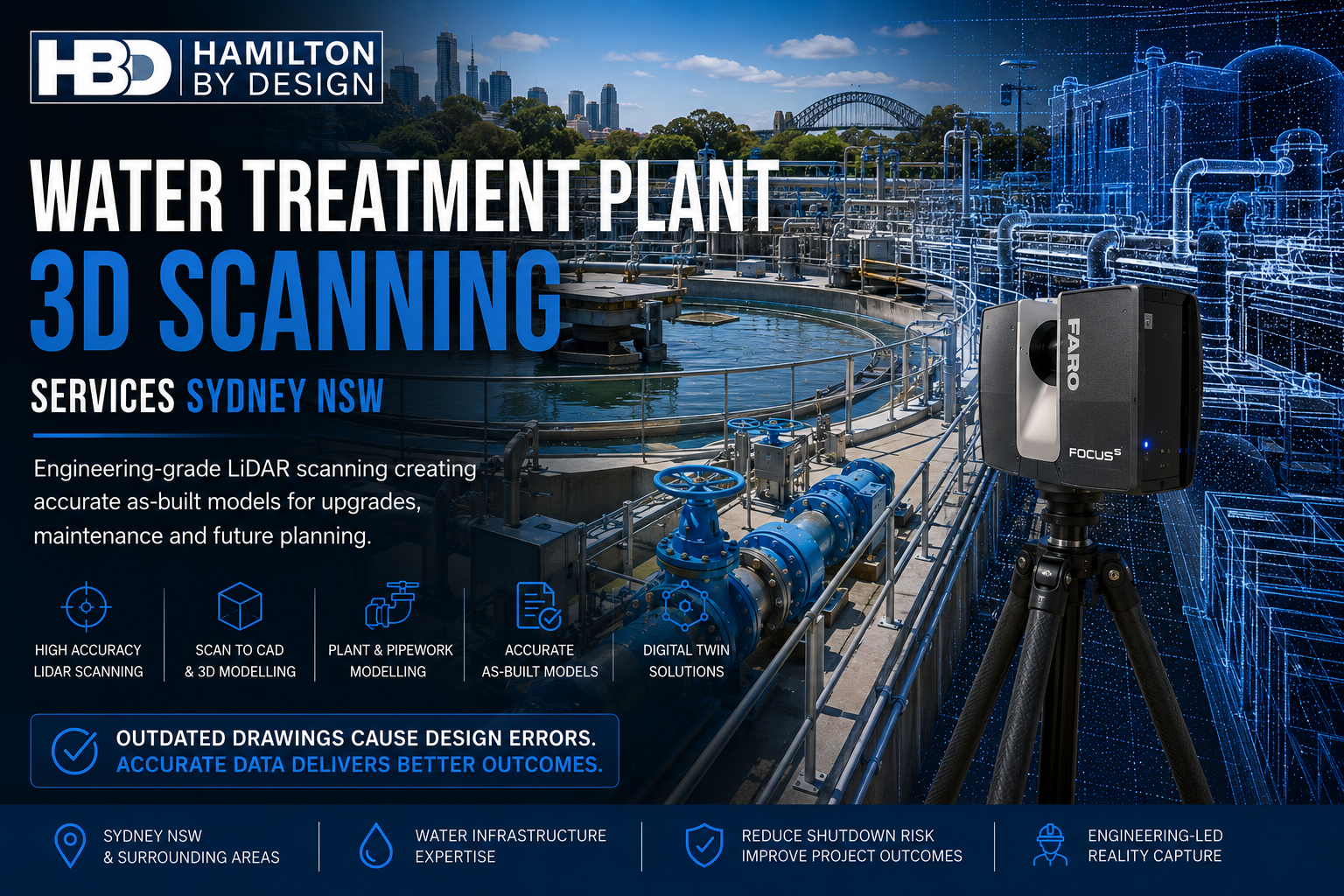


Water Treatment Plant 3D Scanning Services in Sydney NSW โ€“ Accurate As-Built Data for Smarter Engineering

Engineering-grade LiDAR scanning at a Sydney water treatment plant, capturing tanks, pipework and process infrastructure to create accurate As-Built models for plant upgrades, Scan to CAD and digital twin development.

Water treatment plants are among Australia’s most critical infrastructure assets. They operate continuously to deliver safe, reliable drinking water to millions of people while meeting stringent regulatory and environmental requirements. As Sydney continues to invest in expanding and modernising its water infrastructure, engineering teams are increasingly faced with a common challenge:

The existing as-built drawings no longer reflect what is actually installed on site.

Over decades of operation, treatment plants undergo numerous modifications. Pumps are replaced, pipework is rerouted, valves are upgraded, electrical equipment is relocated, and structural steel is modified to suit operational requirements. Unfortunately, these changes are not always captured in the engineering documentation.

When engineers begin designing upgrades using outdated drawings, errors quickly emerge. Pipework clashes with existing infrastructure, replacement equipment fails to fit, structural supports require redesign, and shutdown schedules are extended while unexpected site modifications are completed.

Hamilton By Design provides engineering-grade Water Treatment Plant 3D Scanning Services throughout Sydney NSW, using terrestrial LiDAR scanning to create highly accurate digital representations of existing facilities. By replacing outdated drawings with reliable reality capture, engineering teams can design with confidence, reduce project risk and improve construction outcomes.


The Problem with Outdated As-Built Drawings

Many of Sydney’s water treatment facilities have been operating for several decades. During this time, numerous maintenance activities and capital upgrades have altered the original plant configuration.

Typical undocumented changes include:

  • Replacement pumps with different footprints
  • Pipework rerouted around new equipment
  • Additional valves and instrumentation
  • Modified pipe supports
  • Structural strengthening
  • New cable trays
  • Electrical switchboard upgrades
  • Temporary modifications that became permanent
  • Altered maintenance platforms
  • Relocated access ladders

Although each modification may have been appropriate at the time, the cumulative effect is that original drawings often no longer represent actual site conditions.

Engineering projects based on these outdated documents carry significant risk.


Why Accurate Existing Conditions Matter

Every brownfield engineering project begins with one critical question:

What is actually installed today?

Without accurate existing information, designers are forced to rely on assumptions or undertake extensive manual site measurements.

Both approaches introduce unnecessary risk.

Common design issues include:

  • Pipework that does not align during installation
  • Pump discharge flanges requiring on-site modification
  • Structural steel interfering with new equipment
  • Insufficient maintenance access
  • Cable trays clashing with pipe supports
  • Valve actuators becoming inaccessible
  • Equipment foundations requiring redesign
  • Lifting clearances being overlooked

These problems typically become apparent during construction, when the cost of correcting them is significantly higher.


Engineering LiDAR Scanning Removes Uncertainty

Hamilton By Design uses professional terrestrial LiDAR scanners to capture millions of highly accurate measurement points throughout a water treatment facility.

Rather than recording selected dimensions using conventional survey methods, laser scanning captures the complete geometry of the plant.

Typical assets captured include:

  • Process pipework
  • Pumps
  • Motors
  • Valves
  • Tanks
  • Clarifiers
  • Filters
  • Chemical dosing systems
  • Structural steel
  • Pipe bridges
  • Walkways
  • Stairways
  • Handrails
  • Electrical switchrooms
  • MCC rooms
  • Cable trays
  • Instrumentation
  • Concrete structures

The result is a comprehensive point cloud representing the true existing condition of the facility.

Engineers can measure any feature directly from the scan throughout the design process without repeatedly returning to site.


Supporting Water Treatment Plant Upgrades

Sydney’s treatment plants require continual investment to maintain reliability, increase capacity and improve operational efficiency.

LiDAR scanning supports projects such as:

Pump Replacements

Replacement pumps frequently differ from the original equipment.

Accurate scanning ensures:

  • baseplates align correctly
  • suction and discharge pipework matches
  • maintenance clearances are maintained
  • lifting access is preserved

Pipework Modifications

Process improvements often require:

  • larger diameter pipework
  • bypass systems
  • additional isolation valves
  • flow meters
  • chemical dosing lines

Accurate point clouds allow new spool pieces to be designed around existing infrastructure before fabrication begins.


Structural Modifications

New equipment installations commonly require:

  • equipment platforms
  • maintenance walkways
  • lifting beams
  • pipe supports
  • access ladders
  • handrails

Scanning captures every structural member to ensure new steel integrates correctly.


Electrical and Instrumentation Upgrades

Electrical upgrades benefit significantly from reality capture.

Designers can accurately model:

  • cable trays
  • conduits
  • MCC rooms
  • switchboards
  • instrument locations
  • communication systems

This improves installation planning while reducing field modifications.


Creating Accurate As-Built Models

One of the greatest advantages of engineering-grade LiDAR scanning is the ability to create reliable as-built models.

These models provide:

  • current equipment locations
  • verified pipe routing
  • structural layouts
  • equipment dimensions
  • maintenance clearances
  • plant configuration

Unlike historic drawings, as-built models reflect the facility exactly as it exists today.

They become the foundation for future engineering projects.


Scan to CAD for Engineering Design

Point clouds are extremely valuable, but engineering projects often require intelligent CAD models.

Hamilton By Design converts point cloud data into engineering deliverables including:

  • 3D CAD models
  • General Arrangement drawings
  • Equipment layouts
  • Pipe routing models
  • Structural steel models
  • Plant sections
  • Elevations
  • Fabrication drawings
  • As-built documentation

These models integrate directly into engineering workflows using software such as Autodesk, SOLIDWORKS and Navisworks.


Supporting Digital Twin Development

Many water authorities are now investing in digital twins to improve long-term asset management.

LiDAR scanning forms the foundation of these digital assets.

A digital twin can support:

  • maintenance planning
  • shutdown coordination
  • asset lifecycle management
  • operator training
  • future upgrades
  • capital works planning
  • condition assessments
  • engineering analysis

Rather than relying on outdated information, the digital twin represents actual plant conditions.


Reducing Shutdown Risk

Water treatment plants often operate continuously, making shutdown planning critical.

Unexpected design errors during shutdowns can result in:

  • extended outages
  • contractor delays
  • increased labour costs
  • emergency fabrication
  • delayed commissioning

Accurate 3D scanning identifies potential issues before work begins.

Engineers can perform visual clash detection, verify clearances and optimise installation sequences during the design stage.

This significantly reduces project risk.


Brownfield Engineering Expertise

Unlike greenfield facilities, brownfield projects require engineers to work around existing assets.

Hamilton By Design specialises in engineering support for brownfield infrastructure, including:

  • water treatment plants
  • wastewater treatment plants
  • pumping stations
  • reservoirs
  • chemical dosing facilities
  • filtration plants
  • process buildings

Engineering-grade reality capture provides confidence that new infrastructure will integrate successfully with existing operations.


Typical Project Workflow

Our engineering workflow has been developed specifically for operational infrastructure.

1. Project Planning

Review plant access requirements, shutdown windows and engineering objectives.

2. Site LiDAR Scanning

Capture complete facility geometry using terrestrial laser scanning.

3. Scan Registration

Combine individual scans into one accurate point cloud.

4. Quality Assurance

Verify registration accuracy and confirm complete site coverage.

5. Engineering Modelling

Develop CAD models, equipment layouts and engineering documentation.

6. Design Integration

Use accurate as-built information to complete mechanical, structural and process designs.

7. Construction Verification

Verify proposed upgrades against existing infrastructure before fabrication.


Why Choose Hamilton By Design?

Hamilton By Design provides more than laser scanning.

We combine engineering expertise with advanced reality capture technologies to deliver practical engineering solutions.

Our capabilities include:

  • Engineering-grade terrestrial LiDAR scanning
  • Mechanical engineering design
  • Scan to CAD services
  • Reverse engineering
  • Pipework modelling
  • Structural steel modelling
  • Engineering drafting
  • Digital twin development
  • As-built verification
  • Brownfield engineering support
  • Shutdown engineering planning

Because our engineers understand industrial facilities, we capture the information that designers actually needโ€”not just visually impressive point clouds.


Supporting Sydney’s Water Infrastructure

Sydney’s water treatment plants play a vital role in supplying safe drinking water to millions of residents and businesses. As these facilities continue to expand, modernise and replace ageing assets, engineering accuracy becomes increasingly important.

Outdated as-built drawings should never be the reason a project experiences delays, redesigns or costly construction changes.

Engineering-grade LiDAR scanning provides reliable existing-condition data that supports smarter engineering decisions, reduces construction risk and improves project outcomes.

Whether your project involves replacing pumps, modifying pipework, upgrading process equipment or creating a digital twin, Hamilton By Design delivers accurate 3D scanning, engineering modelling and Scan to CAD services throughout Sydney NSW.

By capturing the plant exactly as it exists today, we help ensure tomorrow’s upgrades fit correctly the first time.

Talk to Us – Contact Us

Name
Would you like us to arrange a phone consultation for you?
Address

Our clients:
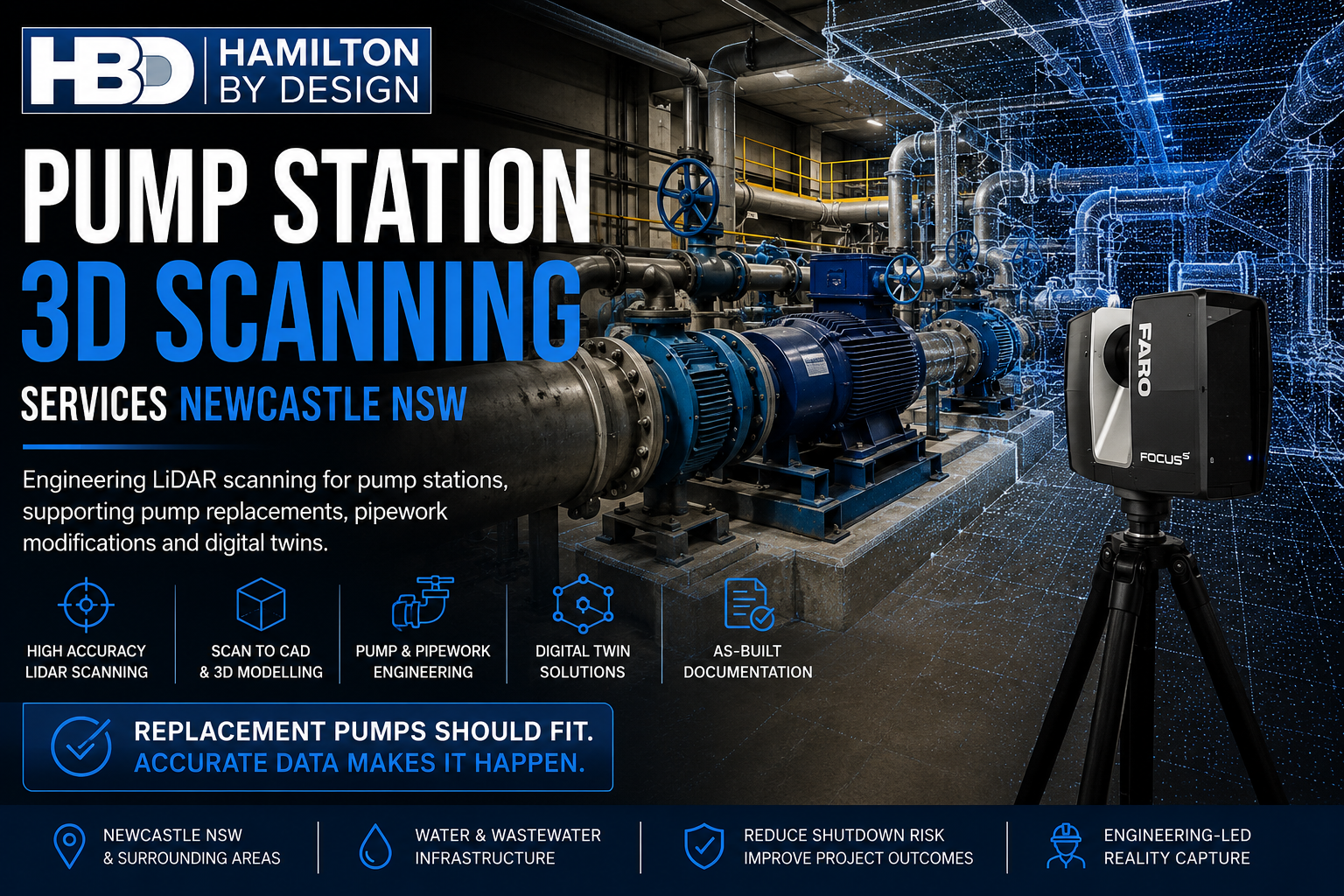


Pump Station 3D Scanning Services in Newcastle NSW โ€“ Engineering Accuracy for Successful Pump Replacements

Pump Station 3D Scanning Services in Newcastle NSW using engineering-grade LiDAR scanning to capture pumps, pipework and infrastructure for accurate pump replacements, Scan to CAD and digital twin modelling.

Replacing pumps within an operating pump station should be a straightforward engineering task. Unfortunately, reality is often very different.

Across Newcastle and the Hunter Region, many water and wastewater pump stations were constructed decades ago. Drawings have been revised multiple times, equipment has been replaced during emergency shutdowns, pipework has been modified in the field, and structural steel has been altered without always being fully documented.

The result is a common engineering problem:

The replacement pump doesn’t fit the existing infrastructure.

Bolt holes don’t align.

Pipe flanges are several millimetres out.

Motor centre heights have changed.

Valve positions differ from the original drawings.

Access platforms interfere with lifting equipment.

Pipe supports clash with new pipework.

These issues increase installation time, create unexpected fabrication costs and extend shutdown periods.

Hamilton By Design provides engineering-grade Pump Station 3D Scanning Services throughout Newcastle NSW, using terrestrial LiDAR scanning to accurately capture existing conditions before engineering design begins.

Rather than relying on outdated drawings or manual site measurements, our workflow creates an accurate digital representation of the entire pump station, allowing engineers to design with confidence.


Why Existing Pump Stations Are Difficult to Modify

Most operating pump stations have evolved over many years.

It is common to discover:

  • undocumented pipe alterations
  • additional isolation valves
  • replacement pumps with different footprints
  • non-standard pipe spool pieces
  • relocated cable trays
  • altered structural supports
  • maintenance modifications
  • corrosion repairs
  • temporary fabrication that became permanent

While these changes may have solved previous operational issues, they rarely appear on original engineering drawings.

This means every new project begins with uncertainty.

When engineers cannot trust existing documentation, they are forced to estimate dimensions or spend considerable time manually measuring equipment.

Neither approach is ideal.


The Cost of Incorrect Measurements

A few millimetres may not sound significant.

However, pump stations are highly constrained environments.

Common problems caused by inaccurate measurements include:

  • Pump discharge flanges missing pipework alignment
  • Suction pipework requiring site welding
  • Baseplates fouling existing concrete plinths
  • Electric motors conflicting with cable trays
  • Maintenance access becoming restricted
  • Valve actuators becoming inaccessible
  • New platforms interfering with lifting paths
  • Expansion joints installed under stress

Each issue can delay commissioning.

Even relatively minor modifications can require:

  • additional fabrication
  • emergency welding
  • redesign
  • new site measurements
  • shutdown extensions
  • contractor standby costs

These expenses often exceed the cost of a professional LiDAR survey many times over.


Engineering LiDAR Scanning Eliminates Guesswork

Hamilton By Design uses professional terrestrial laser scanning to capture millions of accurate measurement points across the entire pump station.

Instead of recording isolated dimensions with tape measures, the scanner captures complete geometry including:

  • pumps
  • motors
  • pipework
  • valves
  • supports
  • concrete structures
  • access platforms
  • stairways
  • cable trays
  • structural steel
  • walls
  • roofs
  • equipment clearances

The resulting point cloud provides engineers with an accurate digital record of the existing facility.

Measurements can then be taken directly from the scan throughout the design process.


Applications for Pump Station 3D Scanning

Our Newcastle pump station scanning services support a wide variety of engineering projects.

Pump Replacement Projects

Existing pumps are frequently obsolete or approaching end of service life.

Accurate scans allow replacement pumps to be designed around actual site conditions rather than historic drawings.

This reduces installation risk significantly.


Pipework Modifications

New pipework frequently requires:

  • rerouting
  • increased diameters
  • bypass lines
  • additional valves
  • instrumentation
  • flow meter installations

Accurate scans ensure every spool piece fits correctly before fabrication begins.


Valve Upgrades

Valve replacements often involve:

  • different face-to-face dimensions
  • actuator changes
  • gearbox clearances
  • maintenance access

LiDAR scanning verifies available space before procurement.


Structural Modifications

Pump stations regularly require:

  • new platforms
  • pipe supports
  • lifting beams
  • access ladders
  • maintenance walkways

Scanning captures existing structural steel so new components integrate correctly.


Electrical Upgrades

Electrical projects also benefit from scanning, including:

  • cable tray routing
  • MCC modifications
  • instrumentation upgrades
  • conduit routing
  • junction boxes

Designers can work around existing infrastructure with confidence.


Supporting Digital Twins

Many utilities throughout Australia are investing in digital asset management.

LiDAR scanning provides the foundation for developing accurate digital twins.

Rather than relying solely on historical CAD models, digital twins are created using actual site conditions.

These models can support:

  • asset management
  • maintenance planning
  • shutdown preparation
  • future upgrades
  • engineering studies
  • operator training
  • lifecycle management

As additional upgrades occur, the digital twin can continue evolving alongside the physical asset.


Engineering Deliverables

Hamilton By Design can provide a range of engineering deliverables depending on project requirements.

Typical outputs include:

  • Registered point clouds
  • Autodesk ReCap files
  • E57 files
  • LAS files
  • Scan-to-CAD models
  • Intelligent 3D models
  • Equipment layouts
  • General arrangement drawings
  • Pipe routing models
  • Structural steel models
  • Clash detection models
  • Digital twin datasets
  • Asset verification drawings

These deliverables integrate with most modern engineering workflows.


Supporting Brownfield Engineering

Brownfield projects present far greater complexity than new construction.

Every modification must integrate with existing infrastructure.

Unlike greenfield facilities, engineers rarely have the luxury of unlimited space.

Instead they must work around:

  • operating equipment
  • confined spaces
  • ageing structures
  • congested pipework
  • existing electrical systems
  • ongoing operations

LiDAR scanning provides confidence that every design decision is based on accurate information.


Reducing Shutdown Risk

Shutdown windows are often measured in hours rather than weeks.

Any unexpected issue can impact commissioning.

Accurate reality capture allows engineers to identify problems before arriving on site.

Potential clashes can be resolved during design instead of during construction.

This significantly reduces project risk.


Newcastle Pump Stations

Hamilton By Design supports utilities, councils, contractors and engineering consultants throughout Newcastle and surrounding regions.

Typical facilities include:

  • sewage pump stations
  • wastewater transfer stations
  • stormwater pumping stations
  • potable water pumping stations
  • recycled water facilities
  • rising main pump stations
  • treatment plant pumping systems
  • industrial pumping facilities

Projects may involve anything from individual pump replacements through to complete station upgrades.


Why Engineering-Led Scanning Matters

Not all laser scanning providers have engineering experience.

Capturing data is only part of the process.

Hamilton By Design combines terrestrial laser scanning with practical mechanical engineering knowledge.

This means scanning is undertaken with the engineering outcome in mind.

Important features are deliberately captured, including:

  • flange positions
  • bolt centres
  • pipe diameters
  • equipment interfaces
  • maintenance clearances
  • structural members
  • access routes
  • lifting paths
  • installation tolerances

This engineering-focused approach produces scan data that is immediately useful for design.


Typical Workflow

Our workflow has been refined for brownfield infrastructure projects.

1. Site Inspection

Review project scope, shutdown requirements and operational constraints.

2. LiDAR Scanning

Capture complete pump station geometry using terrestrial laser scanning.

3. Registration

Register individual scans into one accurate point cloud.

4. Quality Assurance

Verify registration accuracy and completeness.

5. Engineering Modelling

Develop CAD models or engineering layouts directly from scan data.

6. Design

Complete pump replacements, pipework modifications or structural upgrades.

7. Verification

Compare new designs against existing infrastructure before fabrication.


Why Choose Hamilton By Design?

Hamilton By Design provides engineering-led reality capture rather than simply delivering scan files.

Our capability includes:

  • Engineering-grade terrestrial LiDAR scanning
  • Mechanical engineering design
  • Reverse engineering
  • Scan-to-CAD
  • Pump station modelling
  • Pipework modelling
  • Structural steel modelling
  • As-built documentation
  • Digital twin development
  • Engineering drafting
  • Brownfield project support

Because scanning, modelling and engineering are delivered together, clients benefit from one coordinated workflow rather than multiple contractors.


Supporting Newcastle’s Water Infrastructure

Newcastle continues to invest in improving water and wastewater infrastructure to meet growing demand, improve environmental performance and maintain reliable essential services.

Whether replacing ageing pumps, upgrading pipework, installing new assets or planning future expansions, accurate information is critical to successful engineering outcomes.

Professional LiDAR scanning provides that foundation.

Instead of discovering problems during installation, engineers can resolve them during design, reducing project risk, shortening shutdowns and improving construction certainty.

If your next pump station project involves ageing infrastructure, undocumented modifications or complex brownfield conditions, Hamilton By Design can provide the engineering-grade 3D scanning, modelling and digital engineering services needed to ensure replacement equipment fits correctly the first time.

Talk to Us – Contact Us

Name
Would you like us to arrange a phone consultation for you?
Address

Our clients:
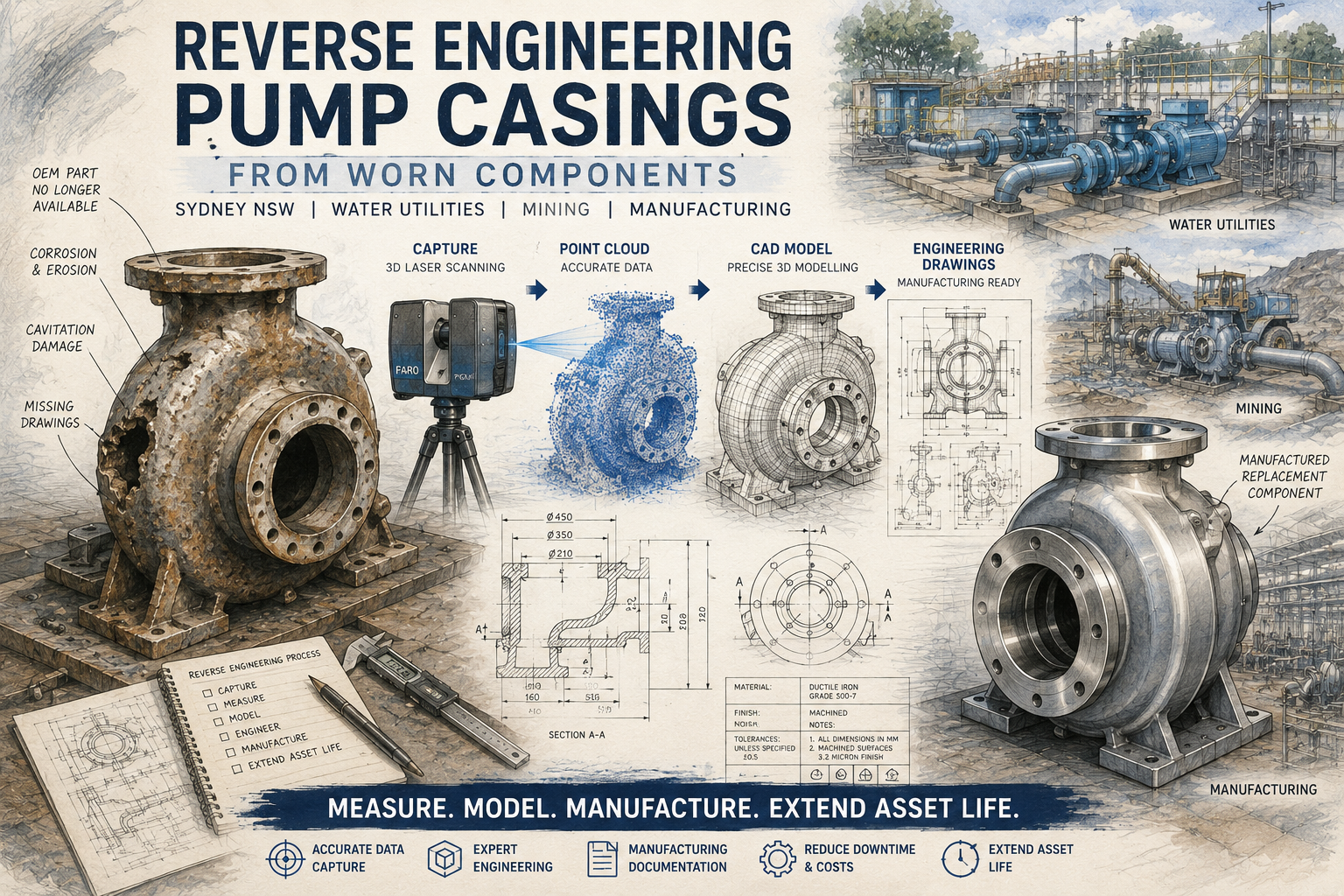


Reverse Engineering Pump Casings from Worn Components Sydney NSW

Reverse engineering worn pump casings from existing components using 3D laser scanning, CAD modelling and engineering drawings in Sydney NSW

Reverse Engineering Worn Pump Casings and Housings to Reduce Downtime and Avoid Costly Replacements

Pump and Motor Assembly Icon for Reverse Engineering and Water Infrastructure Engineering Services

Hamilton By Design provides reverse engineering services for worn pump casings, pump housings and obsolete pump components throughout Sydney NSW. Using engineering-grade 3D laser scanning, precision measurement, CAD modelling and engineering analysis, we recreate pump casings and associated components from existing assets when original drawings are unavailable, OEM support has ceased or replacement components are no longer manufactured.

Many water utilities, mining operations, industrial facilities and manufacturing plants rely on pumps that have been operating for decades. While pumps may remain structurally serviceable, pump casings often experience wear, corrosion, erosion, cavitation damage and mechanical deterioration. In many cases, replacement casings are unavailable or have excessive lead times, creating operational risks and unplanned downtime.

Hamilton By Design helps asset owners extend equipment life by reverse engineering worn components and producing manufacturing-ready documentation for replacement parts.


Why Reverse Engineer Pump Casings?

Pump casings are critical components that contain and direct fluid flow through centrifugal pumps and other pumping systems. Over time, exposure to abrasive materials, corrosive environments and continuous operation can result in significant wear and damage.

Common reasons for reverse engineering pump casings include:

  • OEM support no longer available
  • Replacement components obsolete
  • Original manufacturer no longer exists
  • Long lead times for imported parts
  • Missing engineering drawings
  • Emergency breakdown situations
  • Asset replacement costs are excessive
  • Critical infrastructure requires ongoing operation

Rather than replacing an entire pumping system, reverse engineering enables replacement casings to be manufactured while retaining existing infrastructure.


Industries We Support

Water Utilities

Water treatment plants, wastewater treatment facilities and sewer pump stations often contain legacy pumping equipment that remains operational but suffers from casing wear and corrosion.

Reverse engineering allows water utilities to maintain service reliability while avoiding premature asset replacement.

Mining Operations

Mining pumps operate in some of the harshest environments, handling abrasive slurries, process water and aggressive materials.

Pump casings frequently experience wear caused by:

  • Abrasive solids
  • High flow velocities
  • Corrosion
  • Cavitation
  • Impact damage

Reverse engineering supports ongoing maintenance and asset life extension within mining operations.

Manufacturing Facilities

Industrial processing plants rely on pumps for water transfer, chemical processing, cooling systems and manufacturing operations.

When replacement casings are unavailable, reverse engineering provides a practical solution to minimise downtime and maintain production.


Reverse Engineering from Worn Components

A common misconception is that reverse engineering requires a perfect original component.

In reality, Hamilton By Design can develop accurate replacement designs from worn, damaged or partially deteriorated components.

Our engineers assess:

  • Existing geometry
  • Wear patterns
  • Remaining wall thickness
  • Original design intent
  • Functional requirements
  • Manufacturing constraints

By combining engineering judgement with modern measurement technology, we reconstruct the original component geometry while incorporating improvements where appropriate.


Reverse Engineering


3D Laser Scanning of Pump Casings

Accurate measurement is the foundation of successful reverse engineering.

Hamilton By Design uses FARO 3D laser scanning technology to capture detailed geometry from existing pump casings and surrounding equipment.

Benefits include:

  • Rapid data capture
  • High accuracy measurements
  • Complex geometry capture
  • Reduced manual measurement errors
  • Accurate digital records
  • Improved engineering outcomes

Laser scanning is particularly valuable when dealing with large pump casings, complex shapes or equipment that remains installed within an operating facility.


Precision Measurement and Verification

In addition to laser scanning, conventional engineering measurement techniques are used where required.

Measurements may include:

  • Bearing locations
  • Shaft centre lines
  • Flange dimensions
  • Mounting interfaces
  • Bolt patterns
  • Wear surfaces
  • Internal geometries

This process ensures all critical dimensions are accurately captured before modelling begins.


CAD Modelling and Reconstruction

Following data capture, pump casings are recreated using advanced engineering software.

Hamilton By Design develops:

  • SolidWorks Models
  • AutoCAD Models
  • STEP Files
  • Parasolid Files
  • Manufacturing Models
  • Assembly Models

During the modelling process, engineers identify and compensate for wear, erosion and distortion to recreate the original design geometry.

Where beneficial, design improvements can also be incorporated to enhance performance and service life.


Engineering Analysis and Material Selection

Pump casing replacement projects often provide an opportunity to improve asset reliability.

Hamilton By Design can assess:

  • Material suitability
  • Corrosion resistance
  • Wear resistance
  • Manufacturing methods
  • Structural performance
  • Operational requirements

Where required, Finite Element Analysis (FEA) can be performed to evaluate stress distribution and verify component performance.

Potential material options may include:

  • Cast Iron
  • Ductile Iron
  • Stainless Steel
  • Duplex Stainless Steel
  • High Chrome Alloys
  • Specialty Wear Resistant Materials

Material selection is based on the operating environment and client requirements.


Manufacturing Documentation

Once the reverse engineering process is complete, Hamilton By Design develops manufacturing-ready documentation suitable for fabrication, machining and casting.

Typical deliverables include:

Engineering Drawings

  • General Arrangement Drawings
  • Manufacturing Drawings
  • Fabrication Drawings
  • Assembly Drawings

Digital Models

  • SolidWorks Files
  • STEP Files
  • Parasolid Files
  • DWG Files
  • DXF Files

Engineering Information

  • Material Specifications
  • Inspection Requirements
  • Critical Dimensions
  • Tolerance Information
  • Engineering Reports

These deliverables enable local or international manufacturers to produce replacement casings accurately and efficiently.


Supporting Asset Life Extension Programs

Many asset owners are under increasing pressure to maximise the value of existing infrastructure while reducing capital expenditure.

Reverse engineering worn pump casings supports:

  • Asset life extension
  • Reduced maintenance costs
  • Reduced downtime
  • Improved reliability
  • Replacement component availability
  • Reduced operational risk

By replacing only the worn components rather than entire pump systems, organisations can achieve significant cost savings while maintaining operational performance.


Typical Reverse Engineering Workflow

1. Component Inspection

Assess the condition of the existing pump casing and identify project objectives.

2. Data Capture

Undertake 3D laser scanning and detailed engineering measurements.

3. Engineering Analysis

Review wear patterns, material performance and operational requirements.

4. CAD Reconstruction

Develop accurate 3D models of the original component.

5. Design Verification

Validate dimensions, fitment and engineering requirements.

6. Manufacturing Documentation

Prepare detailed drawings and manufacturing deliverables.

7. Manufacturing Support

Provide engineering support throughout manufacturing and installation if required.


Why Choose Hamilton By Design?

Hamilton By Design combines practical engineering experience with advanced reverse engineering technology.

Our capabilities include:

  • Reverse Engineering
  • 3D Laser Scanning
  • Scan-to-CAD
  • Mechanical Engineering
  • SolidWorks Modelling
  • AutoCAD Drafting
  • FEA Analysis
  • Manufacturing Documentation
  • Asset Life Extension Engineering

Unlike companies that simply provide measurement services, Hamilton By Design delivers complete engineering solutions from site capture through to manufacturing-ready documentation.


Hamilton By Design logo displayed on a blue tilted rectangle with a grey gradient background

Reverse Engineering Pump Casings Across Sydney NSW

Hamilton By Design supports water utilities, mining operations, manufacturing facilities, engineering consultancies and maintenance contractors throughout Sydney NSW.

Whether you need to replace a worn pump casing, recreate obsolete components, develop manufacturing drawings or extend the life of critical infrastructure assets, our engineering-led reverse engineering services provide practical solutions that reduce downtime and avoid unnecessary asset replacement.

Contact Hamilton By Design to discuss your pump casing reverse engineering project.

Talk to Us – Contact Us

Name
Would you like us to arrange a phone consultation for you?
Address

Our clients:


3D LiDAR Scanning Darwin for engineering surveys, laser scanning, reality capture and point cloud modelling services
3D LiDAR Scanning Australia engineering services for laser scanning, reality capture, scan-to-CAD, Scan-to-BIM and as-built documentation across Australia
3D LiDAR scanning services on the Central Coast providing engineering-grade laser scanning, point cloud capture, scan-to-CAD modelling and industrial reality capture for infrastructure and industrial projects.

3D Laser Scanning of Pump Stations for Reverse Engineering Sydney NSW

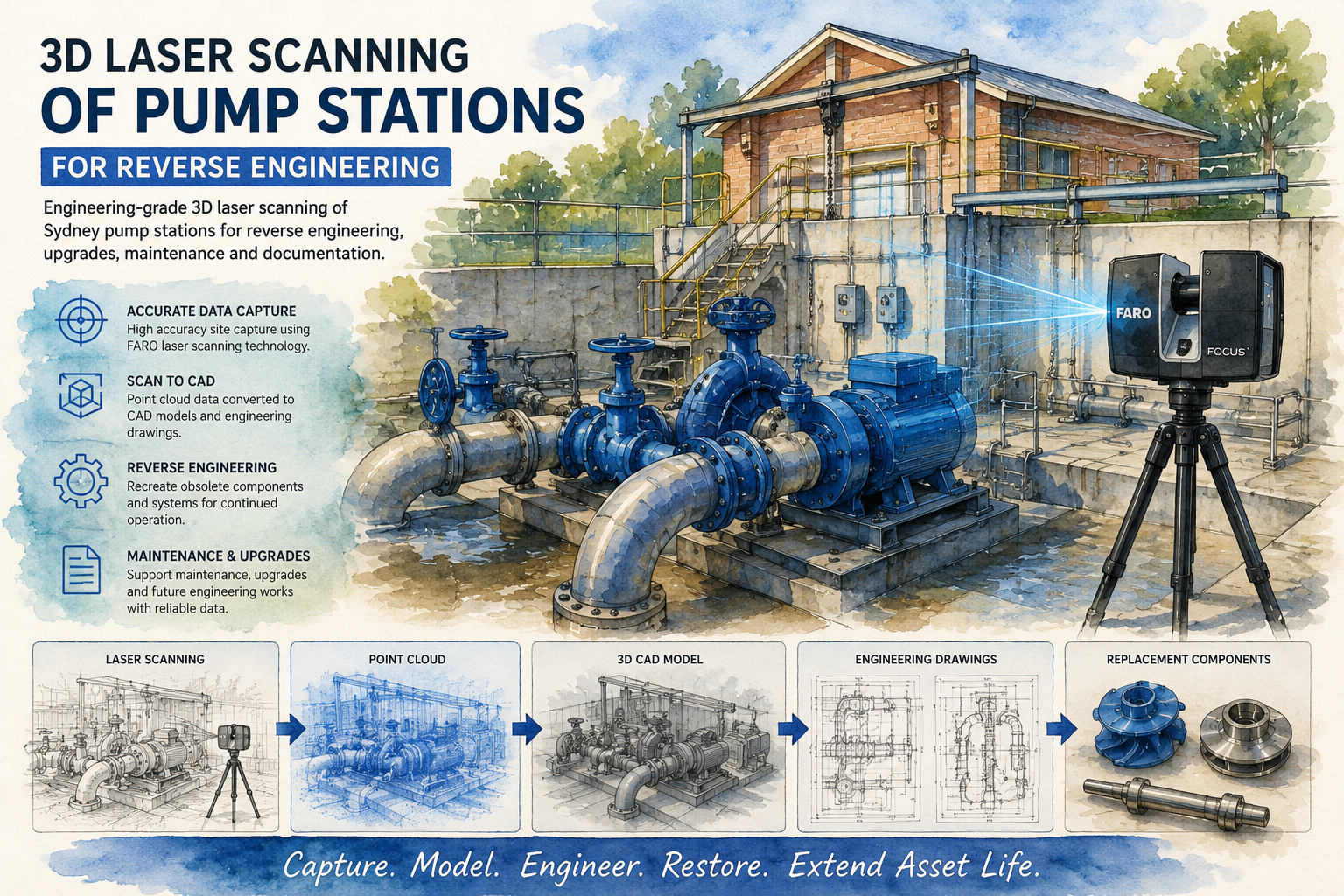
Watercolour illustration of 3D laser scanning of a Sydney pump station for reverse engineering, asset life extension and engineering documentation

Engineering-Grade 3D Laser Scanning of Sydney Pump Stations for Reverse Engineering, Upgrades, Maintenance and Documentation

Pump and Motor Assembly Icon for Reverse Engineering and Water Infrastructure Engineering Services

Hamilton By Design provides engineering-grade 3D laser scanning of pump stations throughout Sydney NSW. Using advanced FARO laser scanning technology, we capture highly accurate digital records of pump stations, mechanical equipment, pipework systems and structural infrastructure to support reverse engineering, maintenance planning, asset life extension, upgrades and engineering documentation.

Many water utilities, wastewater treatment facilities, councils and infrastructure owners operate ageing pump stations with incomplete drawings, obsolete equipment and limited documentation. Our 3D laser scanning services provide accurate as-built information that enables engineers, maintenance teams and asset managers to make informed decisions while reducing risk, downtime and costly site rework.

Whether the project involves reverse engineering a discontinued pump component, planning a pump station upgrade, developing manufacturing drawings or documenting an existing facility, Hamilton By Design delivers accurate engineering data that supports the entire asset lifecycle.


Why 3D Laser Scanning is Valuable for Pump Stations

Pump stations are complex facilities containing interconnected mechanical, structural and civil infrastructure. Over time, modifications are often made without updating drawings, resulting in discrepancies between existing documentation and actual site conditions.

Traditional measurement methods can be time-consuming, disruptive and prone to inaccuracies.

3D laser scanning captures millions of measurement points across an entire facility, creating a highly accurate digital representation of the site.

Benefits include:

  • Accurate As-Built Documentation
  • Reduced Site Rework
  • Improved Design Accuracy
  • Safer Data Collection
  • Faster Project Delivery
  • Reduced Shutdown Requirements
  • Improved Asset Management
  • Better Maintenance Planning
  • Enhanced Engineering Outcomes

Supporting Reverse Engineering of Pump Station Assets

One of the most valuable applications of 3D laser scanning is reverse engineering.

Many Sydney pump stations contain equipment that is no longer supported by the original manufacturer. Spare parts may be unavailable, drawings may be missing and replacement lead times may be unacceptable for critical infrastructure operations.

Hamilton By Design uses laser scanning and reverse engineering techniques to recreate:

  • Pump Casings
  • Pump Impellers
  • Pump Shafts
  • Bearing Housings
  • Wear Rings
  • Couplings
  • Valve Components
  • Pipework Assemblies
  • Structural Supports
  • Access Platforms
  • Equipment Mounting Systems

By capturing accurate geometry directly from the existing asset, replacement components can be engineered without relying on original OEM drawings.


Applications Across Sydney Water Infrastructure

Our 3D laser scanning services support a wide range of water and infrastructure assets across Sydney.

Water Pump Stations

Capture existing pump layouts, pipework systems, valve arrangements and structural infrastructure to support maintenance and future upgrades.

Wastewater Pump Stations

Document ageing facilities, verify site conditions and develop accurate engineering models for refurbishment projects.

Water Treatment Plants

Create digital twins of treatment infrastructure to support reverse engineering, plant modifications and ongoing asset management.

Wastewater Treatment Facilities

Capture process equipment, mechanical assets and structural systems to facilitate maintenance and engineering design.

Local Government Infrastructure

Support councils responsible for managing water and wastewater assets through accurate facility documentation and engineering-grade data capture.

Industrial and Mining Water Systems

Provide accurate site information for water transfer systems, pumping infrastructure and process water facilities.


FARO Laser Scanning Technology

Hamilton By Design utilises professional FARO laser scanning equipment capable of capturing engineering-grade measurements suitable for design and manufacturing applications.

Our technology enables:

  • High Accuracy Measurements
  • Detailed Facility Capture
  • Rapid Site Data Collection
  • Comprehensive Asset Documentation
  • Engineering-Grade Deliverables

Laser scanning allows the capture of equipment, structures and plant environments that would be difficult or impractical to measure using conventional methods.


Scan-to-CAD Services for Pump Stations

Following site capture, point cloud data is processed and converted into engineering deliverables suitable for design, drafting and maintenance projects.

Our Scan-to-CAD services include:

  • Existing Condition Drawings
  • General Arrangement Drawings
  • Equipment Layout Drawings
  • Structural Drawings
  • Pipework Drawings
  • Plant Documentation
  • Asset Records

These deliverables provide engineers and asset owners with reliable information for future projects.


3D Modelling and Digital Asset Creation

Laser scan data can be converted into detailed 3D CAD models using industry-leading engineering software.

Hamilton By Design develops:

  • SolidWorks Models
  • AutoCAD Models
  • STEP Files
  • Parasolid Files
  • Manufacturing Models
  • Assembly Models

These models can be used for:

  • Reverse Engineering
  • Asset Management
  • Upgrade Design
  • Interference Checking
  • Maintenance Planning
  • Replacement Component Design

Deliverables

Clients typically receive deliverables tailored to project requirements.

Common outputs include:

Point Cloud Deliverables

  • E57 Files
  • RCP Files
  • RCS Files
  • Registered Point Clouds

CAD Deliverables

  • DWG Drawings
  • DXF Drawings
  • AutoCAD Models
  • SolidWorks Models

Manufacturing Deliverables

  • STEP Files
  • Parasolid Files
  • Manufacturing Drawings
  • Fabrication Drawings
  • Assembly Drawings

Engineering Deliverables

  • Site Verification Reports
  • Asset Documentation
  • Reverse Engineering Models
  • Upgrade Planning Documentation

Supporting Asset Life Extension Projects

Water utilities and infrastructure owners are increasingly seeking ways to extend the life of existing assets while reducing capital expenditure.

3D laser scanning provides the foundation for asset life extension by delivering accurate information about existing conditions.

Our services support:

  • Asset Renewal Programs
  • Pump Replacement Projects
  • Maintenance Shutdowns
  • Infrastructure Upgrades
  • Equipment Refurbishments
  • Reverse Engineering Initiatives
  • Documentation Recovery Projects

Accurate data reduces uncertainty and enables more effective engineering decisions.


Typical Workflow

1. Site Inspection

Review project objectives, site access requirements and available documentation.

2. Laser Scanning

Capture the pump station using FARO laser scanning technology.

3. Point Cloud Registration

Process and register scan data into a unified engineering model.

4. Engineering Review

Verify dimensions, equipment layouts and site conditions.

5. Scan-to-CAD Modelling

Develop engineering drawings and 3D CAD models.

6. Reverse Engineering

Create replacement component models and manufacturing documentation where required.

7. Project Delivery

Provide engineering deliverables suitable for maintenance, upgrades and future asset management.


Why Choose Hamilton By Design?

Hamilton By Design combines practical engineering experience with advanced reality capture technology.

Unlike scanning companies that simply deliver point clouds, we provide engineering-focused solutions that support real-world maintenance, design and reverse engineering projects.

Our capabilities include:

  • Mechanical Engineering
  • Reverse Engineering
  • 3D Laser Scanning
  • Scan-to-CAD
  • Engineering Drafting
  • SolidWorks Modelling
  • AutoCAD Drafting
  • FEA Analysis
  • Manufacturing Documentation
  • Asset Life Extension Engineering

This combination allows us to deliver complete solutions from site capture through to engineered replacement components.


3D Laser Scanning of Pump Stations Across Sydney NSW

Hamilton By Design supports water utilities, wastewater operators, councils, infrastructure owners, engineering consultancies and maintenance contractors throughout Sydney NSW.

Whether you require accurate as-built documentation, reverse engineering of obsolete pump components, Scan-to-CAD services or support for a major pump station upgrade, our engineering-grade laser scanning services provide the information needed to reduce risk and improve project outcomes.

Contact Hamilton By Design to discuss your pump station scanning and reverse engineering requirements.

Talk to Us – Contact Us

Name
Would you like us to arrange a phone consultation for you?
Address

Our clients: