3-D Lidar Scanning Hunter Valley: Transforming Industrial Projects with Accuracy, Safety and Engineering Confidence

The Hunter Valley is one of Australiaโ€™s most strategically important industrial regions. It supports large mining operations, CHPP facilities, fabrication workshops, energy infrastructure, civil projects and heavy manufacturing. These industries depend on precision, safety and efficient project delivery โ€” yet most operate in aging brownfield environments where original drawings are outdated, equipment has shifted over time, and modifications have occurred for decades without accurate documentation.

In environments like these, traditional measuring methods often fail to provide the precision required for confident engineering and fabrication. This is why 3-D Lidar scanning in the Hunter Valley has become a critical tool for engineers, supervisors, fabricators and project managers. It captures the real-world site conditions with millimetre accuracy, creating a digital foundation for smarter, safer and more efficient project execution.

This article explores the benefits, pros and cons of 3-D Lidar scanning, and explains why the Hunter Valley is uniquely positioned to gain massive value from this technology.


Understanding 3-D Lidar Scanning

3-D Lidar (Light Detection and Ranging) scanning is a non-contact measurement technology that uses lasers to capture millions of points in seconds. The scanner emits laser pulses and measures the return time to determine distances, building a dense โ€œpoint cloudโ€ of the environment.

This point cloud is a precise 3-D representation of:

  • Structural steel
  • Conveyors and transfer towers
  • Chutes, bins and hoppers
  • Tanks, pipework and mechanical equipment
  • Platforms, walkways and buildings
  • Industrial plant rooms and process areas

Once captured, this digital data becomes the foundation for engineering models, fabrication drawings, digital fit checks and project planning.


Why 3-D Lidar Scanning Matters in the Hunter Valley

The Hunter Valley contains some of the most complex and heavily used industrial assets in Australia. Many facilities have been in operation for decades, and almost all have undergone modifications, expansions and repairs. Over time, the real-world geometry diverges significantly from the old drawings stored on paper or outdated CAD files.

This creates major challenges:

  • Measurements taken by hand are inaccurate or unsafe
  • Shutdown windows are extremely tight
  • Fabricators rely on precise data to avoid costly rework
  • Engineers require true geometry for load calculations and interface design
  • Supervisors need reliable information to scope replacement work

3-D Lidar scanning provides a millimetre-accurate representation of what exists onsite, removing guesswork and supporting engineering best practice.


The Benefits of 3-D Lidar Scanning in the Hunter Valley

1. Millimetre Accuracy Improves Engineering Outcomes

In heavy industrial environments, small measurement errors can create large, expensive problems. Structural misalignment, worn steel, bent frames, sagging conveyors and distorted chutes are all common in brownfield plants.

3-D Lidar scanning captures:

  • True dimensions
  • Variations from design
  • Deformation and misalignment
  • Complex curved surfaces
  • Differences caused by wear and tear

Engineers design with confidence because the digital model reflects actual site conditions โ€” not assumptions.


2. Huge Reduction in Rework and Fabrication Errors

Fabricators in Singleton, Muswellbrook, Rutherford, Tomago and throughout the Hunter region rely on accurate measurements to ensure steel and mechanical components fit the first time.

Without accurate data, common fabrication issues include:

  • Bolt holes misaligned
  • Steel members too short or too long
  • Chutes or hoppers not matching openings
  • Pipe spools missing clearances
  • Platforms not sitting square

These problems lead to:

  • Onsite cutting and welding
  • Delayed installations
  • Extended shutdown time
  • Additional crane costs
  • Extra labour expenses

3-D Lidar scanning eliminates these risks, ensuring every component is manufactured to match the as-built site geometry.


3. Improved Shutdown Planning and Faster Execution

Mining and CHPP shutdowns in the Hunter Valley operate under strict time constraints. Any unexpected measurement issue can cause delays affecting production and safety.

With 3-D Lidar scanning:

  • Scope is defined accurately before shutdown
  • Fabrication is completed correctly the first time
  • Digital fit checks identify problems early
  • Installation is faster and safer

Shutdowns become more predictable and efficient.


4. Massive Safety Improvements

Manual measurement often requires workers to:

  • Enter confined spaces
  • Access heights
  • Work around operating equipment
  • Lean over conveyors
  • Navigate dirty, uneven or hazardous areas

3-D Lidar scanning minimises physical access requirements. Technicians can scan large areas from safe positions, reducing:

  • Fall risks
  • Pinch-point exposure
  • Hot-work hazards
  • Time on elevated structures

This is a major benefit for HSE and maintenance teams across the Hunter Valley.


5. Better Communication, Collaboration and Visualisation

Point clouds and 3-D models make it easier for teams to understand the project environment, especially when stakeholders are spread across:

  • Mine sites
  • Fabrication workshops
  • Design offices
  • Engineering consultancies
  • Projects teams and OEM vendors

Digital data allows remote review, reducing the need for repeated site visits and improving decision-making.


6. Ideal for Brownfield Upgrades and Congested Areas

Many Hunter Valley facilities are decades old, with layers of modifications. Clearances are tight, geometry is irregular, and equipment alignment has changed over the years.

3-D Lidar scanning is perfect for:

  • Transfer towers with layered steel
  • Congested plant rooms
  • Pipe networks
  • Stockpile conveyors
  • Old building footprints
  • Complex structural junctions

The scanner captures the complexity instantly and precisely.

Hamilton By Design logo displayed on a blue tilted rectangle with a grey gradient background
Pros and Cons of 3-D Lidar Scanning

While 3-D Lidar scanning is a game-changing tool, it is important to understand both the advantages and limitations.

3D Scanning in The Hunter Valley

3D Laser Scanning

Hunter Valley Laser Scanning: Transforming Engineering Accuracy Across Mining, Manufacturing and Infrastructure

3D Laser Scanning in Singleton and the Hunter: Delivering Accuracy for Mining, Manufacturing and Industrial Projects

Laser Scanning Hunter Valley: Delivering Engineering-Grade Accuracy for Mining, Manufacturing and Industrial Projects

Name
Address
You would like to:
Mechanical engineering services
Australian Drafting logo featuring bold white text reading "Australian Drafting" centred on a blue rounded rectangle background.
Finite Element Analysis (FEA) engineering simulation button
Mechanical engineering services

3D Laser Scanning in Singleton and the Hunter: Delivering Accuracy for Mining, Manufacturing and Industrial Projects

Singleton sits at the heart of the Hunterโ€™s industrial engine room. Surrounded by major mines, CHPPs, power stations, fabrication workshops and heavy industrial precincts, the region depends on accurate information, efficient planning and safe, predictable project execution. With assets that have operated for decades, countless undocumented modifications and structures that no longer match original drawings, engineering teams face a constant challenge โ€” how to measure, model and design with confidence.

This is exactly where 3D laser scanning in Singleton and Hunter regions is transforming project workflows. Hamilton By Design provides millimetre-accurate digital capture that eliminates guesswork and supports engineering, fabrication, maintenance and shutdown planning across the entire industrial sector.
Whether you’re a CHPP superintendent in Singleton, a fabrication manager in Muswellbrook, a maintenance engineer in the Hunter Valley, or a project manager responsible for upgrades across multiple sites, accurate laser scanning has become essential. This article explores why the demand for 3D scanning has surged, how the technology works, and how Hamilton By Design uses it to support safer, more efficient and more reliable outcomes across the Hunter region.

Why Singleton and the Hunter Need 3D Laser Scanning

The Hunter region is home to some of Australiaโ€™s most active heavy industrial environments. These operations consist of massive structural steel assemblies, conveyors, process equipment, platforms, chutes, bins and pipework โ€” all subject to wear, deformation and ongoing modification. Many facilities were built long before digital documentation became standard. As a result:

  • Original drawings rarely reflect the current condition
  • Measurements taken by hand are slow, risky and often inaccurate
  • Shutdown windows are extremely tight
  • Brownfield constraints make new installations complex
  • Fabricators rely heavily on accurate data to ensure perfect fitment

Incorrect measurements donโ€™t just cause inconvenience โ€” they create costly fabrication errors, installation delays, safety risks and additional shutdown time.

3D laser scanning removes these risks entirely by creating a verified digital record of what is actually on site.


What 3D Laser Scanning Delivers

Hamilton By Design uses engineering-grade LiDAR scanners to capture millions of precise data points across a site. These points form a point cloud, which is a detailed 3D representation of the real environment. This data can then be used to create accurate models, drawings, simulations and digital checks.

With 3D laser scanning in Singleton and Hunter you get:

  • Accurate as-built geometry
  • Digital templates for fabrication
  • Reliable interface points for new steel or equipment
  • Precise alignment and clearance data
  • Clash identification before installation
  • Improved shutdown planning and safety

For engineers, fitters, boilermakers and fabricators, this accuracy becomes the foundation for smarter decision-making and better project outcomes.


Key Industries Using 3D Laser Scanning in Singleton and the Hunter

1. Mining & CHPP Operations

Singleton is surrounded by some of the most productive mines in the country. Mines and CHPP operations rely heavily on scanning for:

  • Chute and hopper replacements
  • Conveyor alignment checks
  • Transfer tower redesigns
  • Structural integrity assessments
  • Bin, screen and crusher upgrades
  • Digital twins for long-term planning

Because these plants operate continuously, shutdown windows are limited. Laser scanning allows accurate pre-planning, reducing time spent onsite during shutdowns and eliminating unexpected clashes.


2. Fabrication & Manufacturing

The Hunter has a strong fabrication industry, supplying steel structures, mechanical components, platforms, tanks and pipework to mining and energy clients. But fabrication quality relies on measurement quality.

3D laser scanning ensures:

  • Components fit the first time
  • Bolt holes align correctly
  • Flanges match perfectly
  • Structural steel connects without modification
  • Expensive rework on site is eliminated

Workshops across Singleton, Muswellbrook, Thornton and Rutherford increasingly depend on digital accuracy to remain competitive.


3. Power Stations & Energy Infrastructure

The Hunter region includes major power generation assets and critical energy infrastructure. Many structures are ageing, and modifications require absolute accuracy.

Laser scanning supports:

  • Platform replacements
  • Pipe rerouting
  • Structural upgrades
  • Boiler house modifications
  • Maintenance planning
  • Deformation analysis

Reliable as-built data ensures compliance and reduces risk during shutdowns.


4. Industrial, Civil and Commercial Upgrades

Singletonโ€™s industrial footprint is expanding, and many facilities require:

  • As-built documentation
  • Renovations and extensions
  • Spatial coordination
  • Facility redevelopment
  • BIM integration

Laser scanning provides the foundation for safe and efficient project planning across commercial and industrial facilities.


The Hamilton By Design Workflow
Hamilton By Design offers a complete digital engineering solution, from scanning to modelling to fabrication-ready drawings. Our workflow includes:
1. On-Site Scanning

We capture every detail โ€” structural steel, mechanical equipment, conveyors, platforms, bins, hoppers, pipework and building geometry.

2. Processing & Registration

Individual scans are stitched together into a single, accurate point cloud representing the full environment.

3. CAD Modelling

We convert point cloud data into:

  • 3D models
  • GA drawings
  • Fabrication details
  • DXF files for laser cutting
  • Assembly and installation references

4. Digital Fit Checks

Before fabrication begins, we overlay new designs to check for:

  • Clashes
  • Misalignments
  • Interference with existing structures
  • Access and maintenance constraints

5. Project Delivery

Clients receive data that supports safe installation and reduces downtime.


Benefits of 3D Laser Scanning in Singleton and the Hunter

Reduced Rework

Accurate digital data means fabricators build with confidence and installers avoid modifications on site.

Safer Data Capture

Laser scanning reduces the need for manual measuring in hazardous areas.

Faster Shutdown Execution

Pre-planning with accurate data speeds up installation and reduces plant downtime.

Improved Engineering and Design

Designers work from verified geometry rather than guessing from old drawings.

Better Communication

Point clouds and 3D models allow all stakeholders to visualise the site clearly.

Cost Savings from Start to Finish

Less rework, fewer delays and more efficient fabrication combine to deliver real financial value.


Why Choose Hamilton By Design?

Hamilton By Design is uniquely positioned to support Singleton and Hunter clients because:
  • We combine laser scanning expertise with real engineering capability
  • We understand mining, CHPP, fabrication and industrial environments
  • We provide end-to-end digital workflows, not just raw data
  • Our models and drawings are created with fabrication and installation in mind
  • We deliver millimetre-accurate results you can trust

Our team works closely with mine sites, fabricators, energy providers and industrial operators across the region, delivering practical solutions built on real data.


Hamilton By Design logo displayed on a blue tilted rectangle with a grey gradient background

Work With Hamilton By Design
If your project requires precise measurement, modelling, redesign or fabrication, 3D laser scanning in Singleton and the Hunter is the most reliable way to ensure accuracy and reduce risk.

Hamilton By Design is ready to support your next upgrade, shutdown, replacement or maintenance campaign with:
  • On-site laser scanning
  • Point cloud processing
  • CAD modelling
  • Fabrication drawings
  • Digital engineering support

Reach out to discuss your upcoming project โ€” and experience the confidence that only accurate, high-quality 3D data can provide.

Name
Would you like us to arrange a phone consultation for you?
Address

3D Scanning in The Hunter Valley

Hunter Valley Laser Scanning: Transforming Engineering Accuracy Across Mining, Manufacturing and Infrastructure

3D Laser Scanning

3D LiDAR Scanning โ€“ Digital Quality Assurance

Mechanical engineering services
Australian Drafting logo featuring bold white text reading "Australian Drafting" centred on a blue rounded rectangle background.
3D LiDAR scanning and 3D modelling service button โ€” laser scanner capturing a point cloud for engineering and CAD modelling
Mechanical engineering services
Finite Element Analysis (FEA) engineering simulation button
Mechanical engineering services

Newcastle & The Hunter Valley

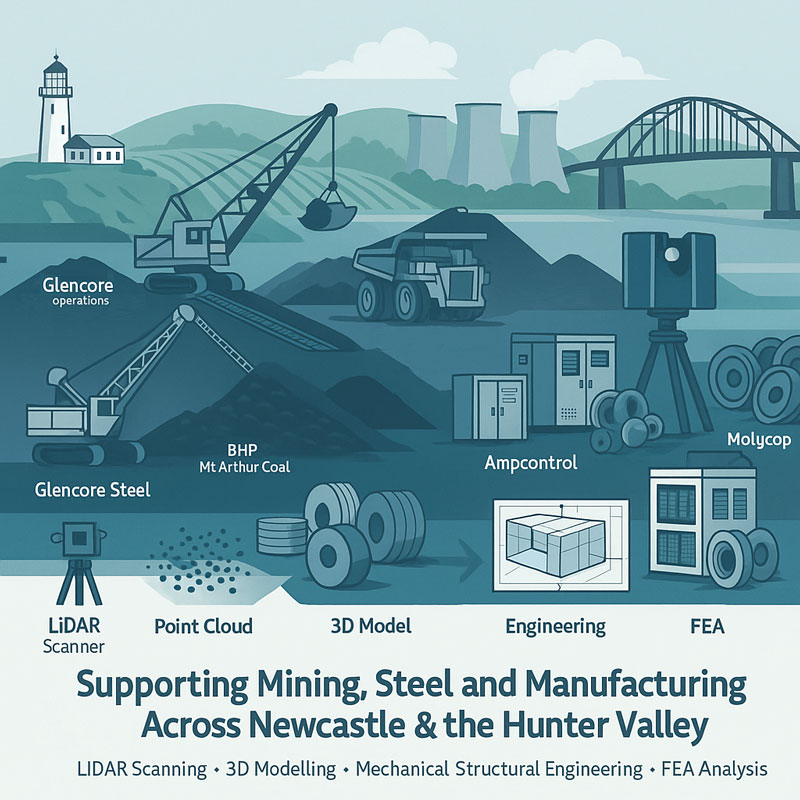
Illustrated scene showing major industrial landmarks across Newcastle and the Hunter Valley, including coal mining equipment, dump trucks, conveyors, steel coils, a LiDAR scanner, point-cloud and 3D model graphics, and labels for Glencore operations, BHP Mt Arthur Coal, Glencore Steel, Ampcontrol and Molycop. The banner text reads โ€˜Supporting Mining, Steel and Manufacturing Across Newcastle & the Hunter Valley โ€“ LIDAR Scanning, 3D Modelling, Mechanical Structural Engineering, FEA Analysis www.hamiltonbydesign.com.au

Precision Engineering for Mining, Steel, Manufacturing & Infrastructure

Blue Gear and Spanner icon

Hamilton By Design supports industry across Newcastle and the Hunter Valley with high-accuracy 3D laser scanning, mechanical and structural engineering, SolidWorks modelling, and fabrication-ready deliverables.
From CHPP plants to heavy manufacturing, we help your team deliver projects that fit first time, every time.

Whether you operate a coal handling facility, a steel mill, a power station, a manufacturing line, or a fabrication workshop, our digital workflows remove rework, reduce shutdown risk, and keep projects moving.


Why the Region Relies on Hamilton By Design
The Newcastleโ€“Hunter corridor is one of Australiaโ€™s most engineering-intensive regions, home to:

  • Glencore coal operations
  • BHP Mt Arthur Coal
  • BlueScope Steel
  • Ampcontrol Tomago
  • Molycop Waratah
  • PWCS Kooragang & Carrington
  • Bayswater & Liddell Power Stations
  • A large network of fabrication and machining workshops

These assets require measurement certainty, digital QA, and accurate engineering models to execute upgrades, fabricate replacements, or plan shutdowns.
Thatโ€™s where Hamilton By Design delivers value.

Our Core Services

โœ” 3D LiDAR Laser Scanning

High-accuracy FARO scanning for:

  • CHPP modules, conveyors, chutes, structural frames
  • Reclaimers, crushers, ROM bins, stockpile conveyors
  • Manufacturing plants and production lines
  • Steel structures and walkways
  • Pipe spools and pump skids
  • Power station equipment, ducting, and access systems

We capture the built environment with sub-millimetre precision.


โœ” Point Cloud Processing & Digital Twins

Your scanned environment is processed into clean, accessible formats for decisions and design:

  • Colourised point clouds
  • Autodesk, Navisworks, & SolidWorks compatible
  • De-cluttering, segmentation, and alignment
  • As-built digital twins

This forms the foundation of our engineering accuracy.


โœ” SolidWorks 3D Modelling & Detail Drafting

We transform your scan data into:

  • Fabrication-ready 3D models
  • Sheet metal components
  • Structural frames
  • Pipe spools
  • Chute geometry
  • Reverse-engineered machinery

All models are delivered with clear origin, mass properties, and assembly logic built in.


โœ” Mechanical & Structural Engineering

Our engineering capability supports:

  • Conveyor upgrades
  • Diverter chutes
  • Structural strengthening
  • Access systems
  • Vibrating equipment assessments
  • Pumping and fluid transfer systems
  • Walkways, stairs, platforms

We design with purpose and detailโ€”fit-for-service and fabrication-ready.


โœ” FEA, Simulation & Digital QA

We validate the performance of your designs:

  • Static stress analysis
  • Weld assessments
  • Fatigue checks
  • Lifting and handling design
  • Load cases for mining applications

Every analysis is supported by documented reports.


3D LiDAR Scanning Hunter & Newcastle banner with white text on a blue background promoting engineering-grade laser scanning services for industrial, mining and infrastructure projects across the Hunter Valley and Newcastle region.
Mechanical Engineering Hunter & Newcastle banner promoting mechanical engineering services for mining, industrial plants, power generation, manufacturing and heavy industry throughout the Hunter Valley and Newcastle region.
Structural Drafting Hunter & Newcastle banner promoting structural drafting services for mining, industrial plants, power generation, manufacturing and infrastructure projects across the Hunter Valley and Newcastle region.

Industries We Service

Mining & CHPP

Glencore โ€ข BHP โ€ข Yancoal โ€ข Bengalla
Conveyors, chutes, spools, access, structural remediation.

Steel & Manufacturing

BlueScope โ€ข Molycop โ€ข Bradken โ€ข Civmec
Heavy fabrication, machinery, production line bottleneck removal.

Power & Energy

AGL Bayswater โ€ข Liddell
Ducting, steelworks, access upgrades, maintenance planning.

Infrastructure & Port Operations

PWCS โ€ข Kooragang Island โ€ข Carrington
Shiploaders, reclaimers, transfer towers, berthing structures.


Why Clients Choose Hamilton By Design

Accuracy

We eliminate guesswork with precise field measurements.

Reduced Shutdown Risk

Projects assemble as intended, reducing time onsite.

Fabrication Certainty

Your workshop receives models and drawings that simply work.

Responsibility & Reliability

We take responsibility for measurement, engineering, and QA along the entire workflow.


Local Knowledge, Regional Capability

We understand the operational requirements of heavy industry in Newcastle & the Hunter Valley:

  • The constraints of CHPP shutdowns
  • The complexity of steel manufacturing
  • The workflow of fabrication shops
  • The need for accurate, fast engineering responses
  • The importance of minimal downtime

Weโ€™ve delivered successful projects across the entire region, from the coast through to Muswellbrook, Singleton, and the Upper Hunter.

Hamilton By Design logo displayed on a blue tilted rectangle with a grey gradient background
3D LiDAR scanning and 3D modelling service button โ€” laser scanner capturing a point cloud for engineering and CAD modelling
Mechanical engineering services

Ready to Improve Your Next Project?

Contact Hamilton By Design
LiDAR Scanning โ€ข 3D Modelling โ€ข Engineering โ€ข FEA โ€ข Digital QA
Supporting Newcastle & the Hunter Valley with precision and reliability.

Email โ€“ info@hamiltonbydesign.com.au

Phone – 0477002249

Name
Address
You would like to:

3D Laser Scanning

Mechanical engineering services
Australian Drafting logo featuring bold white text reading "Australian Drafting" centred on a blue rounded rectangle background.

3D LiDAR Scanning โ€“ Digital Quality Assurance

Why Shutdown Parts Donโ€™t Fit โ€” And How 2 mm LiDAR Scanning Stops the Rework

When Parts Donโ€™t Fit, Shutdowns Fail

Every shutdown fitter, maintenance crew member, and supervisor has lived the same nightmare:

A critical part arrives during shutdown.
The old part is removed.
Everyone gathers, ready to install the new one.
Production is waiting.
The pressure is on.

And thenโ€”
the part doesnโ€™t fit.

Not 2 mm out.
Not 10 mm out.
Sometimes 30โ€“50 mm out, wrong angle, wrong bolt pattern, wrong centreline, or wrong geometry altogether.

The job stops.
People get frustrated.
Supervisors argue.
Fitters cop the blame.
The plant misses production.
And someone eventually says the words everyone hates:

โ€œPut the old worn-out chute back on.โ€

This blog is about why shutdowns fall apart like thisโ€ฆ and how 2 mm LiDAR scanning finally gives fitters a system that gets it right the first time.


The Real Reason Parts Donโ€™t Fit

Most shutdown failures have nothing to do with the fitter, nothing to do with the workshop, and nothing to do with the installation crew.

Parts donโ€™t fit because:

  • Wrong measurements
  • Bad drawings
  • Outdated as-builts
  • Guesswork
  • Fabricators โ€œeyeballingโ€ dimensions
  • Cheap non-OEM parts purchased without geometry verification
  • Designers who have never seen the site
  • High staff turnover with no engineering history
  • Wear profiles not checked
  • Intersection points impossible to measure manually

Fitters are then expected to make magic happen with a tape measure and a grinder.

Itโ€™s not fair. Itโ€™s not professional. And itโ€™s completely avoidable.


3D LiDAR scanning and 3D modelling service button โ€” laser scanner capturing a point cloud for engineering and CAD modelling
Mechanical engineering services

Shutdown Pressures Make It Even Worse

When a part doesnโ€™t fit during a shutdown:

  • The entire job stalls
  • Crews stand around waiting
  • The supervisor gets hammered
  • The fitter gets the blame
  • Other shutdown tasks cannot start
  • The clock ticks
  • Production loses thousands per hour
  • Everyone becomes stressed and angry

And the worst part?

You were only replacing the part because the existing one was worn out.
Now youโ€™re bolting the worn-out one back on.

This isnโ€™t good enough.
Not in 2025.
Not in heavy industry.
Not when there is technology that eliminates this problem completely.


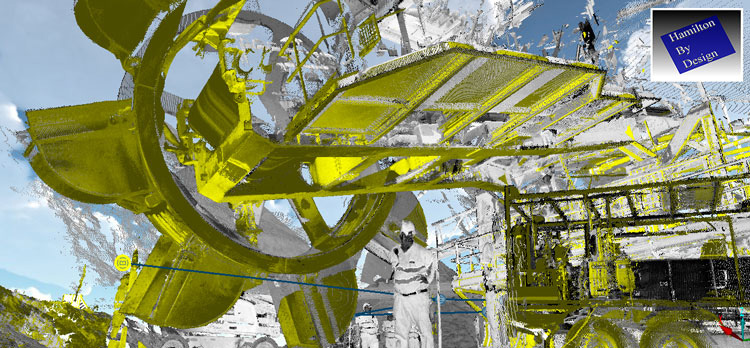
Coloured 3D LiDAR point-cloud scan of industrial CHPP machinery, including a large rotating component and surrounding structures. A worker stands beside the equipment for scale, with the Hamilton By Design logo displayed in the top-right corner.
Why Manual Measurement Fails Every Time

Fitters often get asked to measure:

  • Inside chutes
  • Wear sections
  • Pipe spools with intersection points
  • Tanks too large to measure from one position
  • Walkways too long for tape accuracy
  • Geometry with no records
  • Components 10+ metres above ground
  • Hard-to-reach bolt patterns
  • Angles and centrelines distorted by wear

But some measurements simply cannot be taken safely or accurately by hand.

You canโ€™t hang off an EWP 20 metres up measuring a worn flange angle.
You canโ€™t crawl deep inside a chute trying to measure intersecting surfaces.
You canโ€™t take a 20-metre walkway measurement with a tape measure and hope for precision.

This is not a measurement problem.
This is a method problem.

Manual measurement has hit its limit.
Shutdowns have outgrown tape measures.


This Is Where 2 mm LiDAR Scanning Changes Everything

Hamilton By Design uses 2 mm precision LiDAR scanning to capture the exact geometry of a site โ€” even in areas that are:

  • Too high
  • Too big
  • Too unsafe
  • Too worn
  • Too complex
  • Too tight
  • Too distorted to measure manually

From the ground, up to 30 metres away, we can capture:

  • Wear profiles
  • Flange positions
  • Bolt patterns
  • Pipe centrelines
  • Chute geometry
  • Conveyor interfaces
  • Complex intersections
  • Ductwork transitions
  • Mill inlet/outlet shapes
  • Tank dimensions
  • Walkway alignment
  • Structural deflection
  • Existing inaccuracies

No tape measure. No guesswork. No EWP. No risk.

The result is a perfect 3D point cloud accurate within 2 mm โ€” a digital version of real life.


2 mm Scanning + Fitter-informed Design = Parts That Fit First Time

This is where Hamilton By Design is different.

We donโ€™t just scan and hand the files to a drafter whoโ€™s never set foot on-site.

We scan and your parts are modelled by someone who:

  • Has been a fitter
  • Understands how parts are installed
  • Knows what goes wrong
  • Knows how to design parts that actually fit
  • Knows where shutdowns fail
  • Knows what to check
  • Knows what NOT to trust
  • And most importantly โ€” knows where the real-world problems are hidden

This fitter-informed engineering approach is why our parts fit the first time.

And why shutdown crews trust us.


Digital QA Ensures Fabrication Is Correct Before It Leaves the Workshop

Once the new chute, spool, or component is modelled, we run digital QA:

  • Fit-up simulation
  • Clash detection
  • Tolerance analysis
  • Wear profile compensation
  • Reverse engineering comparison
  • Bolt alignment verification
  • Centreline matching
  • Flange rotation accuracy
  • Structural interface checks

If something is out by even 2โ€“3 mm, we know.

We fix it digitally โ€” before the workshop cuts steel.

This stops rework.
This stops shutdown delays.
This stops blame.
This stops stress.

This is the future of shutdown preparation.


Accuracy of 3D LiDAR Scanning With FARO


When the Part Fits, Everything Runs Smooth

Hereโ€™s what actually happens when a chute or spool fits perfectly the first time:

  • The plant is back online faster
  • No rework
  • No reinstalling old worn-out parts
  • No arguing between fitters and supervisors
  • No unexpected surprises
  • No extra access equipment
  • No late-night stress
  • No grinding or โ€œmaking it fitโ€
  • Other shutdown tasks stay on schedule
  • Everyone looks good
  • Production trusts the maintenance team again

Shutdowns become predictable.
Fitters become heroes, not last-minute problem-solvers.


Shutdown Example (Anonymous but Real)

A major processing plant needed a large chute replaced during a short shutdown window.
Access was limited.
The geometry was distorted.
Measurements were impossible to take safely.
The workshop needed exact dimensions, fast.

Hamilton By Design scanned the entire area from the ground โ€” no EWP, no risk.

We produced:

  • Full 2 mm point cloud
  • As-built 3D model
  • New chute design
  • Digital fit-up validation
  • Workshop-ready drawings

The new chute arrived on site.
The old chute came out.
The new chute went straight in.
Zero rework.
Zero stress.
Plant online early.

The supervisor called it the smoothest shutdown theyโ€™d had in 10 years.


Why Fitters Should Reach Out Directly

Sometimes fitters know more about whatโ€™s really happening on-site than anyone in the office.

Fitters see the problems.
Fitters carry the blame.
Fitters deal with the rework.
Fitters just want parts that fit.

So weโ€™re making this simple:

If youโ€™re tired of fitting parts that donโ€™t fit โ€”
If youโ€™re tired of fixing other peopleโ€™s mistakes โ€”
If youโ€™re tired of shutdown stress โ€”

Call Hamilton By Design.

We scan it.
We model it.
We get it right.
Every time.


Services Featured

Hamilton By Design offers:

  • 3D LiDAR laser scanning (2 mm precision)
  • 3D modelling by a fitter-engineer who understands real-world installation
  • Digital QA before fabrication
  • Reverse engineering of worn components
  • Shutdown planning support
  • Fabrication-ready drawings
  • Fit-up simulation
  • Clash detection between old and new parts

This is how shutdowns run smooth.

Hamilton By Design logo displayed on a blue tilted rectangle with a grey gradient background

Call to Action

Are you a Fitter: tired of parts that donโ€™t fit?

Email or Call Hamilton By Design.

Email โ€“ info@hamiltonbydesign.com.au

Phone – 0477002249


Would you Like to Know more?

Name
Would you like us to arrange a phone consultation for you?
Address

Our clients:

Accuracy of 3D LiDAR Scanning With FARO

Why Shutdown Parts Donโ€™t Fit

Engineering Services

Coal Chute Design

Chute Design

3D CAD Modelling | 3D Scanning

3D Scanning Sydney CBD

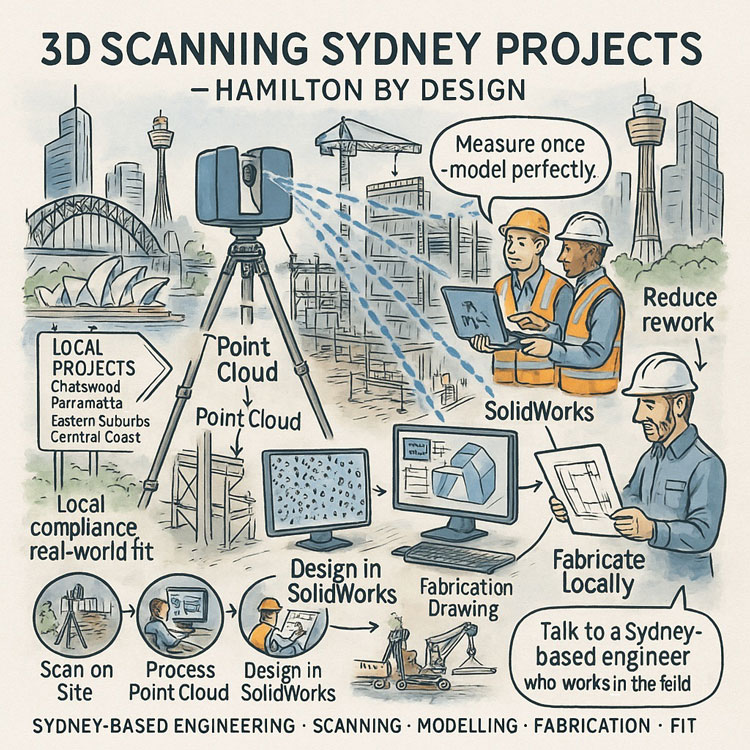
An illistration of the 3d scanning projects the Hamilton by design do for clients in sydney

High-Accuracy LiDAR, As-Built Documentation & Scan-to-BIM for Complex City Projects

Blue 3D LiDAR scanner icon on a tripod with scanning waves

Sydney CBD is one of Australiaโ€™s most complex built environments โ€” dense buildings, heritage structures, deep plant rooms, and construction sites with limited access. Hamilton By Design provides precise 3D laser scanning and engineering-grade modelling to help contractors, consultants, and building owners deliver accurate, compliant and efficient projects across the CBD and inner suburbs.


Why 3D Scanning Is Essential in Sydney CBD

Sydney CBD projects require millimetre-accurate data, especially where buildings are:

  • tightly packed
  • aged or heritage-protected
  • undocumented or modified over decades
  • congested with mechanical, electrical and hydraulic services
  • undergoing refurbishment, upgrade or fit-out

LiDAR scanning captures everything in one pass, giving you the as-built truth needed for confident design, fabrication and installation.


Our Services โ€“ 3D Scanning & Digital Engineering for Sydney CBD

1. Heritage Scanning & Conservation Documentation

Sydney CBD contains some of Australia’s most significant heritage buildings.
Our LiDAR scanning captures:

  • faรงades
  • internal structures
  • decorative features
  • irregular geometry
  • damaged or inaccessible areas

Deliverables can include high-resolution point clouds, CAD models, 3D digital twins and measured drawings, ensuring accurate conservation and refurbishment.


2. High-Accuracy LiDAR Scanning

We use advanced LiDAR scanners to produce engineering-grade point clouds for:

  • building refurbishments
  • tenant fit-outs
  • structural investigations
  • plant upgrades
  • redevelopment planning

Data is delivered in E57, RCP, RCS, PTS and other industry formats.


3. As-Built Documentation (Sydney CBD Buildings)

Many CBD buildings lack accurate drawings or have seen undocumented alterations.
We provide:

  • Mechanical, structural and architectural as-builts
  • Services mapping (HVAC, pipework, conduits, risers)
  • Floor plans and elevations
  • Dimensional audits for compliance
  • Verification of completed construction

As-builts can be delivered as 2D drawings, full 3D models, or updated BIM files.


4. Scan-to-BIM / Scan-to-SolidWorks

Perfect for engineering and refurbishment teams needing accurate geometry for design.

We convert point clouds into:

  • SolidWorks models for mechanical components
  • Revit / BIM models for architectural and structural design
  • IFC / STEP models for coordination and clash detection
  • Fabrication-ready 3D assemblies

This ensures all upgrades โ€œfit first timeโ€ โ€” critical in tight CBD plant rooms and equipment spaces.


5. Digital QA Before Fabrication

Reduce rework and installation delays by verifying the design against site conditions before fabrication begins.

Our digital QA service includes:

  • aligning design models with scan data
  • tolerance checking
  • interference analysis
  • clash detection
  • fabrication fit confirmation

Ideal for steel frames, pipe spools, platforms, walkways and modular units delivered into the CBD.


6. Plant Room Scanning (HVAC, Mechanical & Electrical)

CBD buildings often have extremely congested plant rooms.
We scan:

  • HVAC systems
  • chilled water lines
  • fire services
  • switch rooms
  • plumbing risers
  • mechanical plant

Accurate modelling helps prevent clashes and ensures efficient upgrade planning.


7. Construction Site Scanning (Brownfield & Greenfield)

Our construction site scanning supports:

Brownfield Projects

  • existing buildings
  • complex retrofit work
  • partial demolition
  • undocumented modifications
  • services rerouting

Greenfield Projects

  • as-built capture before handover
  • slab and structural verification
  • progress scanning
  • digital records for asset owners

CBD construction demands precision โ€” LiDAR provides it.


Industries & Clients We Serve in Sydney CBD

Hamilton By Design delivers 3D scanning to:

โœ” Tier 1โ€“3 Building Contractors

For refurbishments, upgrades and new development.

โœ” Mechanical, HVAC & MEP Contractors

For ductwork, pipework, services coordination, and modular fabrication.

โœ” Structural & Mechanical Engineering Consultancies

For modelling, retrofits, investigations and clash detection.

โœ” Architects & BIM Designers

For heritage documentation, refurbishments, and scan-to-BIM workflows.

โœ” Facility Managers & Building Owners

For asset documentation, records, and upgrade planning.

โœ” Data Centres (CBD & North Sydney)

For MEP scanning, capacity upgrades and digital twins.


Why Choose Hamilton By Design in Sydney CBD?

  • Engineering-led scanning service
    Not just scan technicians โ€” qualified mechanical engineers.
  • SolidWorks + BIM workflow capability
    Scan โ†’ Model โ†’ Drawings โ†’ Fabrication QA.
  • Experience with confined/tight CBD environments
    Plant rooms, risers, basement mechanical rooms, rooftops.
  • Fast, accurate, minimal-disruption data capture
    Ideal for occupied buildings and operational sites.
  • Fabrication-ready outputs
    Unlike generic scanning companies, we deliver engineering-ready models.
  • Local to Sydney and NSW
    Fast response and strong knowledge of CBD building constraints.

Hamilton By Design logo displayed on a blue tilted rectangle with a grey gradient background

Our clients


Name
Address
You would like to:


Related Sydney Services

Hamilton By Design provides engineering-led 3D scanning, LiDAR scanning, mechanical engineering and digital engineering services throughout Sydney and Greater Sydney.

Explore our related Sydney services:


  • 3D Scanning Sydney โ€“ Engineering-grade terrestrial laser scanning, as-built surveys and point cloud capture for industrial, infrastructure and commercial projects.
  • Reality Capture Sydney โ€“ High-accuracy reality capture, digital twins, asset documentation and engineering-grade site verification.
  • Scan to CAD Sydney โ€“ Convert point cloud data into AutoCAD, SolidWorks, Inventor and other engineering-ready CAD deliverables.
  • Point Cloud Modelling Sydney โ€“ Engineering-grade point cloud processing, clash detection, as-built verification and 3D modelling.
  • Mechanical Engineering Sydney โ€“ Mechanical design, plant upgrades, materials handling systems, conveyors, chutes, platforms and engineering support.
  • Structural Drafting Sydney โ€“ Structural steel drafting, fabrication drawings, GA drawings, workshop detailing and as-built documentation.

Hamilton By Design supports projects throughout Sydney CBD, Parramatta, Liverpool, Penrith, Blacktown, Chatswood, Alexandria, Mascot, Newcastle and the Central Coast.


3D Laser Scanning

3D Scanning for Construction in Sydney

Transforming Projects with 3D Scanning in Sydney

3D LiDAR Scanning โ€“ Digital Quality Assurance

Blue banner graphic displaying the text "Point Cloud to CAD - Australia" in large white lettering, representing point cloud processing, scan-to-CAD conversion and digital engineering services across Australia.
Blue banner graphic displaying the text "Scan to CAD Sydney" in large white lettering, representing engineering-led point cloud to CAD conversion, LiDAR scanning and digital engineering services in Sydney.
Blue banner graphic displaying the text "Reality Capture Sydney - CBD" in large white lettering, representing engineering-led reality capture, LiDAR scanning and digital engineering services within Sydney CBD commercial buildings and infrastructure.

Stop Guessing, Start Scanning: How 3D Laser Scanning Prevents Costly Shutdown Delays

The Cost of Guesswork in Shutdowns

Every shutdown comes with pressure โ€” time, budget, and safety. When mechanical upgrades or maintenance are based on outdated drawings or manual measurements, the risk of error skyrockets. A misaligned chute, an incorrectly measured pipe, or a bracket that doesnโ€™t quite fit can turn a planned three-day outage into a five-day scramble.
In industries where every hour offline costs tens of thousands of dollars, guesswork is expensive.

Illustrated scene showing a 3D laser scanner capturing an industrial plant while engineers observe and review data, highlighting how scanning prevents costly shutdown delays.
3D LiDAR scanning and 3D modelling service button โ€” laser scanner capturing a point cloud for engineering and CAD modelling
Mechanical engineering services

3D Laser Scanning: Seeing the Plant as It Really Is

Thatโ€™s where 3D laser scanning and LiDAR technology change the game. Using a FARO or similar high-accuracy scanner, Hamilton By Design captures millions of data points in a matter of minutes โ€” creating a precise digital replica of your plant or structure.
This point cloud model forms the foundation for all design work. Every pipe, beam, and bracket is located exactly where it exists in the real world, not where an old drawing says it should be.

From Scan to SolidWorks: Accurate Models, Confident Designs

Once the scan is complete, the data is reverse-modelled into SolidWorks or similar 3D design environments.
This means upgrades, chutes, handrails, and structural supports can be designed within the scanned environment โ€” guaranteeing they fit perfectly on installation day.
Our clients use this workflow to plan shutdowns with confidence, knowing that every fabricated part will bolt straight in.

Eliminating Fit-Up Errors and Rework

Traditional upgrade projects rely on tape measures, rough sketches, or outdated general arrangement drawings. Even a 10 mm error can cause weeks of rework once site access is restricted.
With 3D scanning, those errors disappear.
Before fabrication begins, engineers can check for:

  • Clashes and interferences between new and existing plant structures.
  • Clearances for maintenance and access.
  • Alignment with conveyors, supports, and existing chutes.

That level of insight is impossible with 2D drawings alone.

Shorter Shutdowns, Safer Teams

Fewer surprises mean faster, safer installations.
When every component is designed and verified within the scanned model, shutdown crews spend less time cutting, grinding, or reworking in the field.
Thatโ€™s not only a productivity win, itโ€™s a safety win โ€” fewer sparks, less manual handling, and minimal hot work in confined spaces.

Applications Across Mining and Processing

Hamilton By Designโ€™s scanning and modelling process is trusted across the Bowen Basin, Surat Basin, Hunter Valley, and Central West NSW.
Typical projects include:

  • CHPP upgrades โ€” chute replacements, diverter modifications, and screen structure changes.
  • Conveyor realignments โ€” ensuring belt runs are perfectly centred before shutdown.
  • Pipework and pump station retrofits โ€” avoiding rework when tie-ins occur.
  • Structural verification โ€” validating as-built conditions before new platforms or walkways are installed.
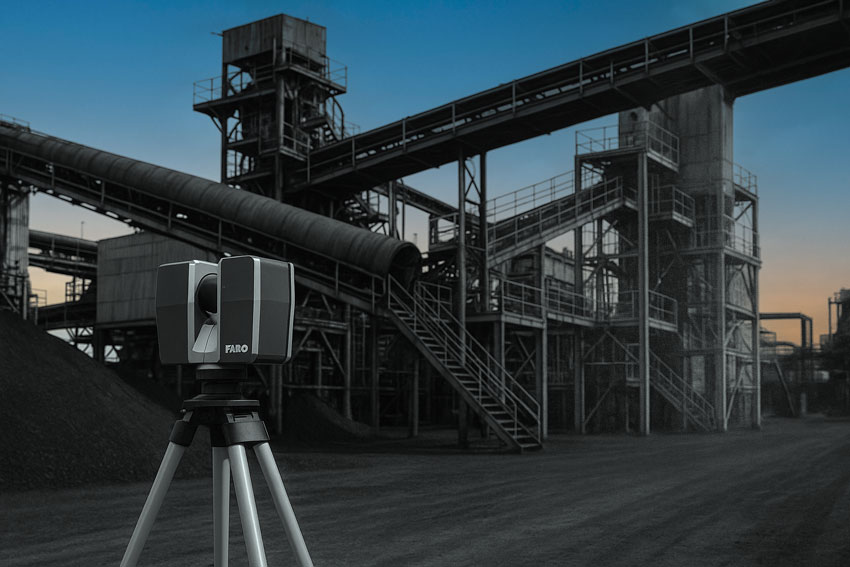
FARO 3D laser scanner set up on a tripod capturing an industrial plant for LiDAR scanning and digital modelling, with Hamilton By Design branding in the corner.

Real-World ROI

Clients routinely report saving days of downtime and thousands in rework costs by scanning before fabrication.
When you consider that a typical CHPP shutdown might cost $20,000โ€“$50,000 per hour in lost production, the return on investment is obvious.
A few hours spent scanning can mean days of avoided delay.

Stop Guessing, Start Scanning

If your next shutdown involves tight spaces, limited access, or unknown conditions โ€” donโ€™t rely on old drawings or assumptions.
Hamilton By Design provides LiDAR scanning, point-cloud modelling, and SolidWorks-based mechanical design to ensure your upgrades install exactly as intended.

๐Ÿ‘‰ Book a site scan before your next shutdown.
Visit www.hamiltonbydesign.com.au or contact us to discuss your upcoming project.

3D CAD Modelling | 3D Scanning

Hamilton By Design logo displayed on a blue tilted rectangle with a grey gradient background

Chute Design

Mechanical Engineering | Structural Engineering

Our clients

Name
Would you like us to arrange a phone consultation for you?
Address