Why 3D Laser Scanning is Critical During Mining Shutdowns

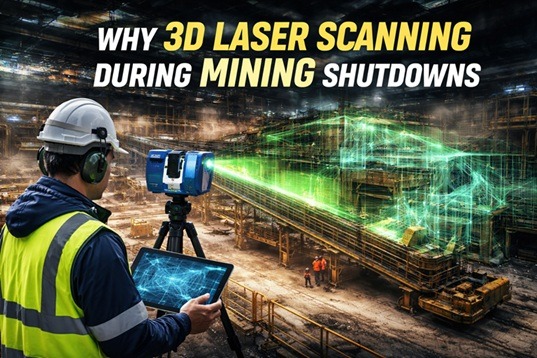
Engineer performing 3D laser scanning of a mining processing plant during a shutdown to capture accurate site conditions.

Mining shutdowns are among the most complex and high-pressure events in heavy industry. Whether the shutdown is scheduled for a processing plant, conveyor system, pump station, or structural upgrade, every hour of downtime carries significant cost.

Engineering teams must inspect, measure, design, fabricate, and install upgrades within an extremely tight timeframe. Any unexpected interference, misalignment, or dimensional error can delay commissioning and extend the shutdown.

This is why 3D laser scanning has become a critical technology for mining shutdown planning and execution.

By capturing millions of accurate measurement points in a matter of minutes, laser scanning provides engineers with a complete digital representation of existing plant conditions. These highly detailed point cloud models allow engineers to design upgrades with confidence before the shutdown even begins.

For mining operations across Australia, this approach significantly reduces risk, improves installation accuracy, and shortens shutdown durations.
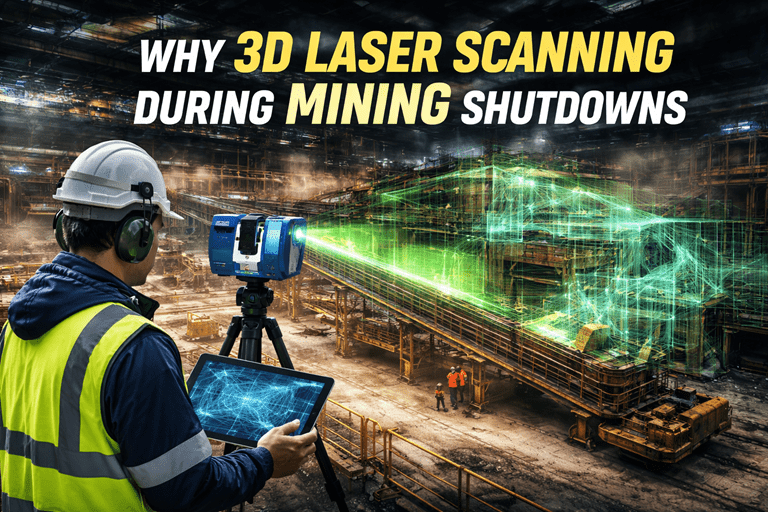

3D laser scanner capturing point cloud data across a mining facility during shutdown maintenance.

The Challenge of Mining Shutdown Engineering

Mining infrastructure evolves continuously. Over decades of modifications, maintenance work, and operational changes, the as-built condition of a plant rarely matches the original drawings.

Typical shutdown upgrade projects may involve:

  • Conveyor realignments
  • Chute redesigns
  • Pump station upgrades
  • Structural steel modifications
  • Platform and access upgrades
  • Pipework tie-ins and maintenance replacements

If the design team relies on outdated drawings or manual measurements, there is a significant risk that fabricated components will not fit during installation.

In a shutdown environment, discovering a fit-up issue onsite can quickly escalate into costly delays.

Accurate site data is therefore the foundation of effective shutdown planning.


What is 3D Laser Scanning?

3D laser scanning is a reality-capture technology that records the physical environment using millions of laser measurements per second.

The result is a high-resolution point cloud representing the exact geometry of the plant, equipment, and surrounding structures.

Engineers can then convert this data into detailed 3D models used for:

  • Engineering design
  • Clash detection
  • Fabrication drawings
  • Layout verification
  • Maintenance planning

The technology allows engineers to capture large industrial facilities quickly and accurately while minimizing disruption to site operations.

Learn more about the technology here:


How 3D Scanning Improves Shutdown Planning

Accurate As-Built Plant Models

One of the biggest advantages of laser scanning is the ability to capture the true geometry of an operating plant.

Instead of relying on assumptions, engineers can design within a precise digital twin of the facility, ensuring that new equipment or structures will fit exactly as intended.

This eliminates many of the dimensional errors that traditionally occur during shutdown installations.


Faster Site Data Capture

Traditional surveying methods can take days to measure complex industrial plants.

Laser scanning dramatically accelerates this process by capturing millions of measurements in minutes.

This speed is particularly valuable during shutdown preparation because it allows engineering teams to collect comprehensive data without extended site access requirements.


Clash Detection Before Fabrication

A common shutdown problem occurs when newly fabricated equipment clashes with existing infrastructure such as pipes, structural steel, cable trays, or maintenance access routes.

By designing directly inside the scanned model, engineers can perform clash detection and clearance analysis before fabrication begins.

This ensures that components will install smoothly during the shutdown window.


Reduced Rework and Installation Delays

When plant modifications are designed using precise scan data, installation crews spend less time cutting, grinding, or modifying fabricated components onsite.

This leads to:

  • Faster installations
  • Lower shutdown risk
  • Improved safety outcomes
  • Reduced hot work and manual handling

The result is a more predictable shutdown schedule and fewer unexpected delays.


Supporting Mining Plant Upgrades

3D scanning plays a major role in engineering upgrades across mining processing plants.

Typical projects supported by scanning include:

  • CHPP chute redesign and transfer upgrades
  • Conveyor realignment and structural modifications
  • Pump and piping system upgrades
  • Walkway and platform installation
  • Structural inspections and reinforcement

Hamilton By Design regularly applies this workflow to plant upgrade projects where accurate site information is critical.

You can learn more about this process here:


Engineering-Grade Scanning Across Australia

Mining operations across Australia are increasingly adopting 3D scanning because it enables faster engineering decisions and more reliable shutdown execution.

By combining laser scanning with engineering modelling tools such as SolidWorks and advanced analysis workflows, project teams can move from site capture to fabrication-ready designs much faster than traditional survey methods allow.

Hamilton By Design provides engineering-grade scanning services for industrial facilities across the country.

Explore the national service offering here:


The Future of Digital Mining Shutdowns

The mining industry is rapidly adopting digital engineering tools to reduce operational risk and improve plant reliability.

Technologies such as:

  • 3D laser scanning
  • Digital twins
  • LiDAR modelling
  • Reality capture workflows

are transforming how shutdown projects are planned and delivered.

Instead of reacting to problems during installation, engineers can now identify risks months before the shutdown begins.

For operations where downtime can cost hundreds of thousands of dollars per hour, this shift toward data-driven engineering is a major competitive advantage.
3D LiDAR scanning and 3D modelling service button โ€” laser scanner capturing a point cloud for engineering and CAD modelling
Mechanical engineering services

Hamilton By Design logo displayed on a blue tilted rectangle with a grey gradient background

Final Thoughts

Mining shutdowns demand precision, speed, and certainty.

3D laser scanning provides engineers with the accurate site data needed to design plant upgrades that fit the first time.

By capturing existing conditions with millimetre-level accuracy, engineers can eliminate guesswork, reduce installation risks, and ensure shutdown projects are delivered safely and efficiently.

For modern mining operations, 3D laser scanning is no longer optional โ€” it is a critical tool for successful shutdown execution.

Name
Would you like us to arrange a phone consultation for you?
Address

3D CAD Modelling Australia service banner for Hamilton By Design

3D Engineering in Sydney – BIM

BIM Documentation & Defensible Building Records

Sydney property and building projects live or die on what is documentedโ€”and how confidently that documentation can be relied upon. In a market defined by tight plant rooms, vertical services, constrained access, staged upgrades, and high holding costs, โ€œclose enoughโ€ drawings can become a legal, commercial, and program risk.

Hamilton By Design provides engineer-led 3D scanning and 3D engineering services in Sydney, focused on producing BIM-ready documentation and defensible building records to support:

  • Sale and purchase due diligence
  • Leasing and refurbishment planning
  • Services upgrades (HVAC, piping, mechanical plant, fire coordination interfaces)
  • Fit-first-time fabrication and constructability
  • Evidence-quality as-built records

If youโ€™re looking for a Sydney scanning service that goes beyond โ€œpretty point cloudsโ€ and delivers engineering-grade outputs, start here:
3D Scanning Sydney: https://www.hamiltonbydesign.com.au/3d-scanning-sydney/


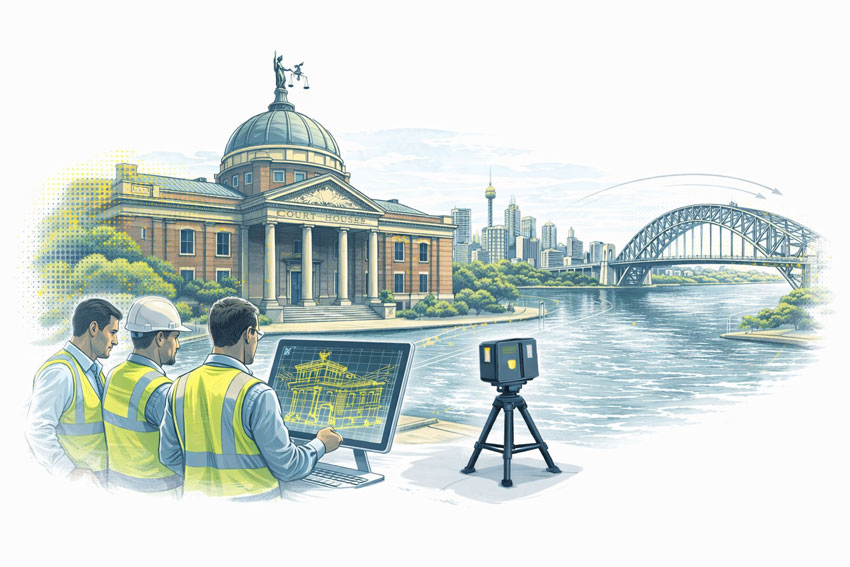
Engineers reviewing BIM documentation while a LiDAR scanner captures a Sydney courthouse with Sydney Harbour and the Harbour Bridge in the background
3D LiDAR scanning and 3D modelling service button โ€” laser scanner capturing a point cloud for engineering and CAD modelling
Mechanical engineering services

Why Documentation Matters for Property Sale in Sydney

When a commercial or industrial property changes hands, the documentation pack often becomes a key part of:

  • Pre-purchase due diligence
  • Capex forecasting
  • Compliance planning
  • Tenant fit-out feasibility
  • Valuation and defect risk assessment

In practice, the biggest issues arise when the โ€œas-builtsโ€ are:

  • Outdated (multiple refurbishments since issue)
  • Incomplete (plant rooms, risers, roof plant never updated)
  • Uncoordinated (services donโ€™t match structure or architecture)
  • Non-dimensional or ambiguous (typical details reused across floors)
  • Inconsistent with reality (especially in brownfield assets)

A reality-captured, engineering-led approach reduces uncertainty by establishing a reliable baseline: what exists, where it is, and what can fit.


Is BIM a Legal Requirement โ€” or a โ€œNice to Haveโ€?

BIM is not typically mandated by law for private property transactions. However, the legal and commercial requirement is not โ€œBIMโ€ โ€” it is adequate, accurate, and defensible documentation.

On modern Sydney assets, BIM-style coordination is often the most practical way to:

  • Demonstrate reasonable verification of existing conditions
  • Reduce foreseeable clashes and rework
  • Provide traceable design intent and change control
  • Support compliance pathways and certification workflows

For property sale and acquisition, BIM and 3D documentation increasingly function as risk controls. They help owners, buyers, and project teams make decisions using verifiable geometry instead of assumptions.

Note: This page is general information, not legal advice. Documentation obligations depend on building type, scope of work, and the relevant approval pathway.


What We Deliver: Documentation Packs That Stand Up to Scrutiny

Our Sydney workflow is designed to create outputs that are useful across multiple stakeholders: owners, facilities teams, designers, contractors, and project managers.

1) Reality Capture and Registered Outputs

  • Engineering-grade LiDAR / laser scanning
  • Site constraints captured in high detail (plant rooms, risers, mezzanines, service corridors)
  • Deliverables structured so they can be used for BIM modelling and coordination

2) BIM-Ready As-Built Models

We produce or support the production of:

  • Coordinated 3D models suitable for engineering design workflows
  • Mechanical service zones and clearance envelopes
  • Plant layout validation (lift paths, maintenance access, removable panels)

3) Drawing Sets for Sale, Leasing, and Upgrades

Depending on the asset and use case, documentation can include:

  • General arrangement drawings
  • Plant-room and rooftop plant layouts
  • Service routing diagrams (where required)
  • Key dimensions, levels, and coordination references

4) Evidence-Quality Record Packs

When the purpose is due diligence, risk reduction, or dispute avoidance, we can structure outputs with:

  • Traceable references back to the scan dataset
  • Clear assumptions and tolerances
  • Version control and change notes for future updates

Where This Helps Most in Sydney

Commercial Buildings and CBD Refurbishments

Sydneyโ€™s CBD and inner suburbs often involve:

  • Occupied buildings
  • After-hours access
  • Tight risers and low ceiling voids
  • Multiple generations of undocumented services

Reality capture + BIM documentation improves planning for:

  • HVAC replacement
  • Plant upgrades
  • Tenant fit-outs
  • Services reroutes
  • Staged works and shutdowns

Industrial and Processing Facilities

For industrial assets, โ€œdocument confidenceโ€ is directly tied to:

  • Fit-first-time fabrication
  • Shutdown windows
  • Safety and access planning

3D engineering outputs support:

  • Pipe spools and mechanical upgrades
  • Structural interfaces
  • Skid and equipment placement validation

Property Sale and Acquisition Due Diligence

For buyers and owners, BIM-ready records can help:

  • Confirm plant capacity and spatial constraints
  • Validate feasibility for intended refurbishments
  • Identify unknowns that should be priced into capex planning
  • Reduce โ€œlatent defectโ€ surprises caused by unknown geometry

Engineer-Led Scanning vs. Generic Capture

Not all scans are equal. The difference is not just the scanner โ€” itโ€™s the workflow and the engineering intent.

Engineer-led reality capture focuses on:

  • What must be measured for mechanical design
  • Clearances, access paths, and maintenance envelopes
  • Interfaces between structure and services
  • Deliverables that reduce fabrication and installation risk

If the goal is property documentation, the key question is:

โ€œCan this documentation be trusted to make decisions that cost money?โ€


Typical Deliverables (Choose What You Need)

A Sydney documentation package may include:

  • Point cloud dataset (registered and organised)
  • BIM-ready model (scope defined by asset type and use case)
  • Drawing set (GA layouts and key sections)
  • Plant and services spatial verification notes (where requested)
  • Asset record pack structure for ongoing lifecycle updates

Because the โ€œrightโ€ package depends on whether youโ€™re:

  • Selling / buying
  • Leasing / refurbishing
  • Upgrading services
  • Planning staged works

โ€ฆwe build the scope around what decisions the documentation must support.


Blue banner graphic displaying the text "Point Cloud to CAD - Australia" in large white lettering, representing point cloud processing, scan-to-CAD conversion and digital engineering services across Australia.
Blue banner graphic displaying the text "Scan to CAD Sydney" in large white lettering, representing engineering-led point cloud to CAD conversion, LiDAR scanning and digital engineering services in Sydney.
Blue banner graphic displaying the text "Reality Capture Sydney - CBD" in large white lettering, representing engineering-led reality capture, LiDAR scanning and digital engineering services within Sydney CBD commercial buildings and infrastructure.

Common Use Cases for Sale of Property

โ€œWeโ€™re selling a building โ€” what does the buyer actually want?โ€

Most buyers want confidence around:

  • What exists (geometry and plant placement)
  • What will fit (upgrade feasibility)
  • What risks are hidden (unknowns and clashes)
  • How much capex is coming (services condition + spatial constraint)

โ€œWeโ€™re buying โ€” can we validate the fit-out feasibility quickly?โ€

A scan-to-model workflow can quickly confirm:

  • Available plant space
  • Riser and shaft constraints
  • Ceiling space and structural conflicts
  • Staging or cranage constraints for replacement plant

โ€œWe need a defensible as-built record before we commit.โ€

If youโ€™re about to spend real money on design or refurbishment, scanning first prevents:

  • Design rework
  • Fabrication errors
  • Program delays caused by surprise constraints

How the Process Works

  1. Define the decision
    Sale pack, due diligence, upgrade design, or refurbishment planning.
  2. Site capture plan
    What areas matter most (plant rooms, risers, roof, loading dock, service corridors).
  3. LiDAR scanning and registration
    Delivered in an organised structure suitable for modelling and coordination.

  4. Model and documentation outputs
    BIM-ready models and drawings aligned to the defined purpose.
  5. Handover + future update pathway
    Documentation structured so future projects can update the baseline rather than restart.

Frequently Asked Questions

Do I legally need BIM for a property sale?

Usually, no. But you do need documentation that is accurate enough for decisions and defensible if assumptions are challenged. BIM-quality coordination often becomes the most practical method for complex assets.

Are existing drawings good enough?

Sometimes. But in many Sydney buildingsโ€”especially refurbished and service-dense assetsโ€”drawings can be incomplete or wrong. Scanning verifies the baseline.

Can you scan only the areas that matter most?

Yes. For sale and due diligence, we often focus on:

  • Roof plant
  • Main plant rooms
  • Key risers / service corridors
  • Basement services areas
  • Areas driving upgrade feasibility

Is this useful for strata or mixed-use buildings?

Yes โ€” especially where service routing and riser geometry are uncertain and upgrades need clear feasibility.


Hamilton By Design logo displayed on a blue tilted rectangle with a grey gradient background

Talk to an Engineer About Sydney Documentation

If you need 3D engineering in Sydney focused on BIM documentation and defensible records for property sale, we can help you establish a baseline that reduces commercial risk and improves decision-making.


Start with our Sydney service page:
https://www.hamiltonbydesign.com.au/3d-scanning-sydney/


Scan to CAD Sydney โ€“ converting laser scan data into accurate 3D CAD models
Building and construction services button

Our clients:

Name
Would you like us to arrange a phone consultation for you?
Address

Related Sydney Services

Hamilton By Design provides engineering-led 3D scanning, LiDAR scanning, mechanical engineering and digital engineering services throughout Sydney and Greater Sydney.

Explore our related Sydney services:


  • 3D Scanning Sydney โ€“ Engineering-grade terrestrial laser scanning, as-built surveys and point cloud capture for industrial, infrastructure and commercial projects.
  • Reality Capture Sydney โ€“ High-accuracy reality capture, digital twins, asset documentation and engineering-grade site verification.

  • Scan to CAD Sydney โ€“ Convert point cloud data into AutoCAD, SolidWorks, Inventor and other engineering-ready CAD deliverables.
  • Point Cloud Modelling Sydney โ€“ Engineering-grade point cloud processing, clash detection, as-built verification and 3D modelling.
  • Mechanical Engineering Sydney โ€“ Mechanical design, plant upgrades, materials handling systems, conveyors, chutes, platforms and engineering support.
  • Structural Drafting Sydney โ€“ Structural steel drafting, fabrication drawings, GA drawings, workshop detailing and as-built documentation.

Hamilton By Design supports projects throughout Sydney CBD, Parramatta, Liverpool, Penrith, Blacktown, Chatswood, Alexandria, Mascot, Newcastle and the Central Coast.