Port Infrastructure 3D Scanning Sydney

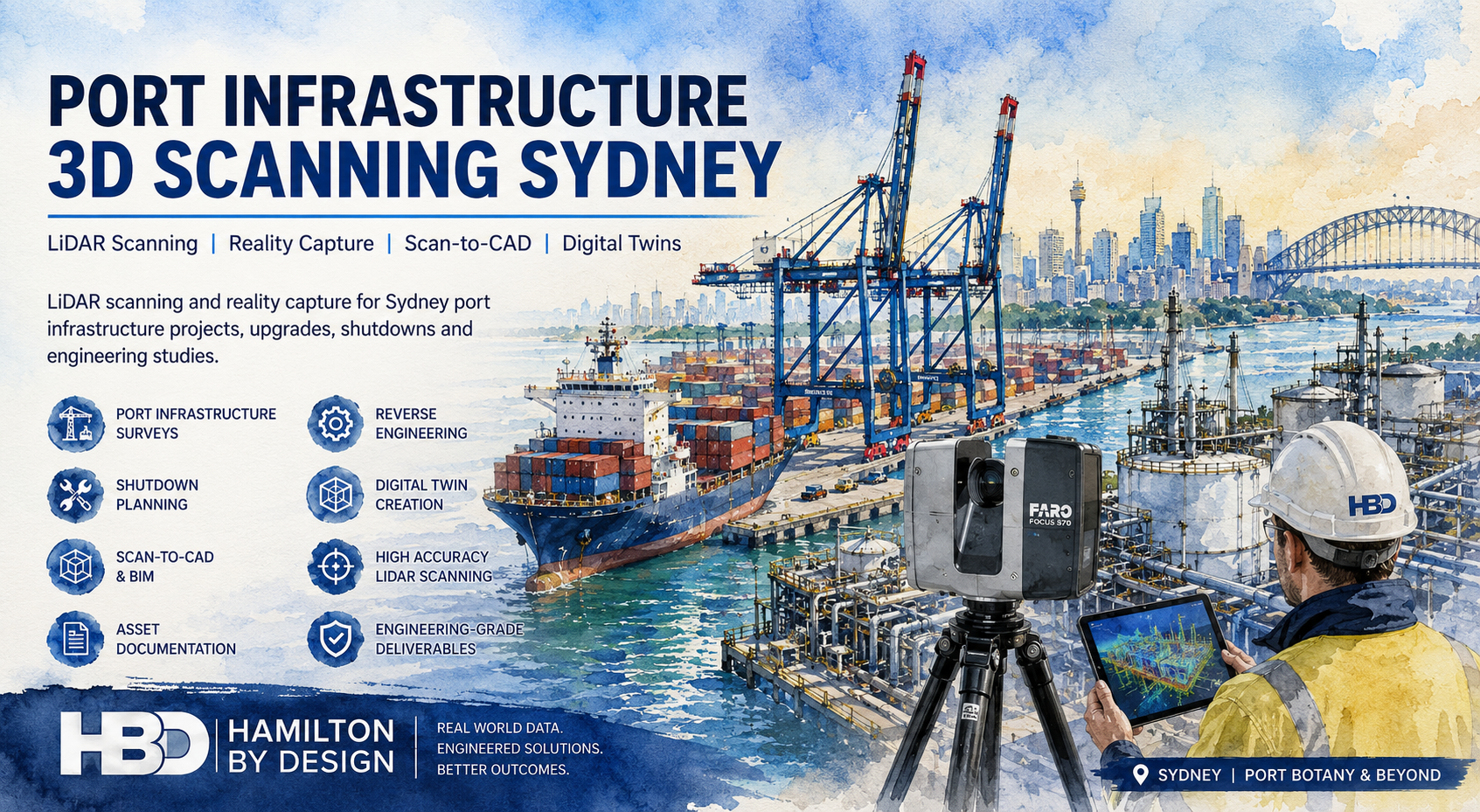
Watercolour illustration of Sydney port infrastructure showing container cranes, cargo vessels, tank farms, pipelines and a FARO Focus S70 laser scanner capturing reality capture data for port infrastructure engineering projects. Hamilton By Design Port Infrastructure 3D Scanning Sydney services.

Hamilton By Design provides professional Port Infrastructure 3D Scanning Sydney services for port operators, engineering consultants, contractors, infrastructure owners and industrial facilities throughout Sydney and New South Wales. Using engineering-grade terrestrial LiDAR scanning and reality capture technology, we accurately document existing conditions and create reliable digital datasets that support maintenance, shutdowns, upgrades, asset management and future development projects.

Our scanning services capture highly accurate measurements of wharves, container terminals, bulk handling facilities, rail infrastructure, tank farms, marine structures, conveyors, pipework and industrial assets. The resulting point cloud data can be converted into CAD drawings, BIM models, digital twins, engineering documentation and asset management systems.

Whether your project involves a major terminal upgrade, a brownfield expansion, shutdown planning or reverse engineering of existing assets, Hamilton By Design delivers accurate reality capture data to reduce project risk and improve engineering outcomes.


Engineering-Grade Reality Capture for Sydney Port Infrastructure

Sydney is home to some of Australia’s most critical maritime and logistics infrastructure. Facilities such as Port Botany, intermodal terminals, rail infrastructure, fuel terminals and marine assets are continuously upgraded to meet increasing operational demands.

Many of these facilities have evolved over decades, resulting in incomplete documentation and modifications that differ significantly from original drawings. Engineering projects often require accurate existing-condition information before design work can commence.

3D LiDAR scanning solves this problem by capturing millions of measurement points and creating an accurate digital representation of the facility.

This information becomes the foundation for:

  • Engineering design
  • Asset management
  • Maintenance planning
  • Shutdown preparation
  • Structural modifications
  • Equipment upgrades
  • Construction verification
  • Digital twin development

Port Infrastructure Assets We Scan

Hamilton By Design performs reality capture of a wide range of port and marine infrastructure assets throughout Sydney.

Container Terminals

Container terminals contain complex infrastructure requiring accurate documentation for future upgrades and maintenance projects.

Assets commonly scanned include:

  • Container cranes
  • Rail-mounted gantries
  • Container stacking yards
  • Maintenance facilities
  • Service corridors
  • Electrical infrastructure
  • Stormwater systems

Wharf and Berth Infrastructure

Marine infrastructure often requires detailed surveys to support inspections, maintenance and expansion projects.

Examples include:

  • Wharves
  • Berths
  • Jetties
  • Dolphins
  • Fender systems
  • Mooring structures
  • Access walkways

Bulk Materials Handling Facilities

Bulk handling infrastructure is ideally suited to 3D scanning due to its complexity and ongoing modification requirements.

Typical assets include:

  • Conveyors
  • Transfer towers
  • Chutes
  • Hoppers
  • Ship loaders
  • Stackers
  • Reclaimers

Tank Farms and Fuel Terminals

Storage and fuel facilities require accurate engineering information for maintenance and compliance projects.

Common assets include:

  • Storage tanks
  • Pipe racks
  • Pump stations
  • Loading facilities
  • Valve stations
  • Fire systems
  • Structural steel platforms

Rail and Intermodal Infrastructure

Port-related rail infrastructure often requires accurate as-built documentation for upgrades and future expansion.

Assets may include:

  • Rail sidings
  • Intermodal terminals
  • Service facilities
  • Signalling structures
  • Maintenance depots

Why Use 3D LiDAR Scanning for Port Infrastructure?

Accurate Existing Conditions

Many engineering projects fail because the actual site differs from available drawings.

LiDAR scanning captures the true condition of the facility, allowing engineers to design using real-world information.

Reduced Project Risk

Accurate site data reduces:

  • Design clashes
  • Site rework
  • Installation delays
  • Construction variations
  • Fabrication errors

Improved Safety

Field measurements in operational ports can expose personnel to moving equipment, vehicle traffic, elevated structures and restricted areas.

Laser scanning significantly reduces the amount of time required on-site.

Faster Engineering Delivery

Once captured, point cloud data can be accessed repeatedly without returning to site, allowing engineers and designers to obtain measurements directly from the digital model.

Long-Term Asset Records

The scan becomes a permanent digital record of the facility at the time of capture and can support future maintenance and upgrade projects.


Supporting Port Shutdowns and Maintenance Projects

Shutdowns are among the most time-critical activities undertaken within port infrastructure environments.

Every hour of downtime can result in significant operational costs.

LiDAR scanning supports shutdown planning by providing:

  • Accurate existing-condition models
  • Installation planning
  • Equipment replacement studies
  • Structural verification
  • Prefabrication support
  • Clash detection
  • Construction sequencing

Engineering teams can review and plan modifications before arriving on site, reducing shutdown durations and improving project certainty.


Scan to CAD Services for Port Infrastructure

Point cloud data can be converted into detailed engineering documentation suitable for maintenance, upgrades and future design projects.

Typical deliverables include:

  • Site plans
  • General arrangement drawings
  • Structural layouts
  • Equipment layouts
  • Pipework documentation
  • Existing-condition drawings
  • Sections and elevations

Output formats include:

  • DWG
  • DXF
  • PDF
  • AutoCAD models

Scan-to-CAD services provide engineering teams with accurate documentation for facilities where drawings may be outdated or unavailable.


Scan to BIM and Digital Twin Development

Many infrastructure owners are adopting BIM and digital twin strategies to improve asset management and long-term planning.

Hamilton By Design can convert point cloud data into:

  • BIM models
  • Revit models
  • Asset information models
  • Digital twins
  • Facilities management datasets

These models assist with:

  • Asset lifecycle management
  • Maintenance planning
  • Future upgrades
  • Risk management
  • Operational decision making

Reverse Engineering and Engineering Support

One of the major advantages of working with Hamilton By Design is the ability to combine reality capture with engineering expertise.

In addition to scanning, we can assist with:

  • Mechanical engineering
  • Reverse engineering
  • Structural design support
  • CAD modelling
  • Fabrication drawings
  • Equipment redesign
  • Asset verification

Where original drawings no longer exist, scanned data can be used to recreate components and assemblies for manufacture.

Typical reverse engineering projects include:

  • Pump components
  • Conveyor equipment
  • Structural steel assemblies
  • Marine infrastructure
  • Mechanical systems

Our Port Infrastructure Scanning Process

1. Project Planning

We review project requirements, access constraints, safety requirements and deliverables.

2. Site Capture

Engineering-grade LiDAR scanners are used to capture the required infrastructure with complete coverage.

3. Registration and Processing

Individual scans are registered into a unified point cloud and processed for engineering use.

4. Modelling and Documentation

The point cloud is converted into CAD drawings, BIM models or engineering deliverables as required.

5. Delivery

Final deliverables are supplied in formats suitable for engineering, construction and asset management teams.


Deliverables

Hamilton By Design can provide:

  • E57 point clouds
  • RCP files
  • RCS files
  • LAS files
  • AutoCAD DWG files
  • DXF files
  • PDF drawings
  • Navisworks models
  • Revit models
  • SolidWorks models
  • STEP files
  • Parasolid files
  • General arrangement drawings
  • Asset verification reports

Hamilton By Design logo displayed on a blue tilted rectangle with a grey gradient background

Sydney Port Infrastructure 3D Scanning Services

Hamilton By Design provides professional Port Infrastructure 3D Scanning Sydney services for container terminals, marine infrastructure, logistics facilities, fuel terminals, rail assets and industrial facilities throughout Sydney and New South Wales.

Our engineering-led approach combines LiDAR scanning, Scan-to-CAD, Scan-to-BIM, reverse engineering and mechanical engineering expertise to deliver practical outcomes for infrastructure owners, operators and contractors.

Whether you are planning a shutdown, upgrading existing facilities, developing a digital twin or undertaking a major engineering project, Hamilton By Design can provide the accurate reality capture data required to support informed decision-making and successful project delivery.

Talk to Us – Contact Us

Name
Would you like us to arrange a phone consultation for you?
Address

Our clients:


3D LiDAR Scanning Darwin for engineering surveys, laser scanning, reality capture and point cloud modelling services
3D LiDAR Scanning Australia engineering services for laser scanning, reality capture, scan-to-CAD, Scan-to-BIM and as-built documentation across Australia
3D LiDAR scanning services on the Central Coast providing engineering-grade laser scanning, point cloud capture, scan-to-CAD modelling and industrial reality capture for infrastructure and industrial projects.

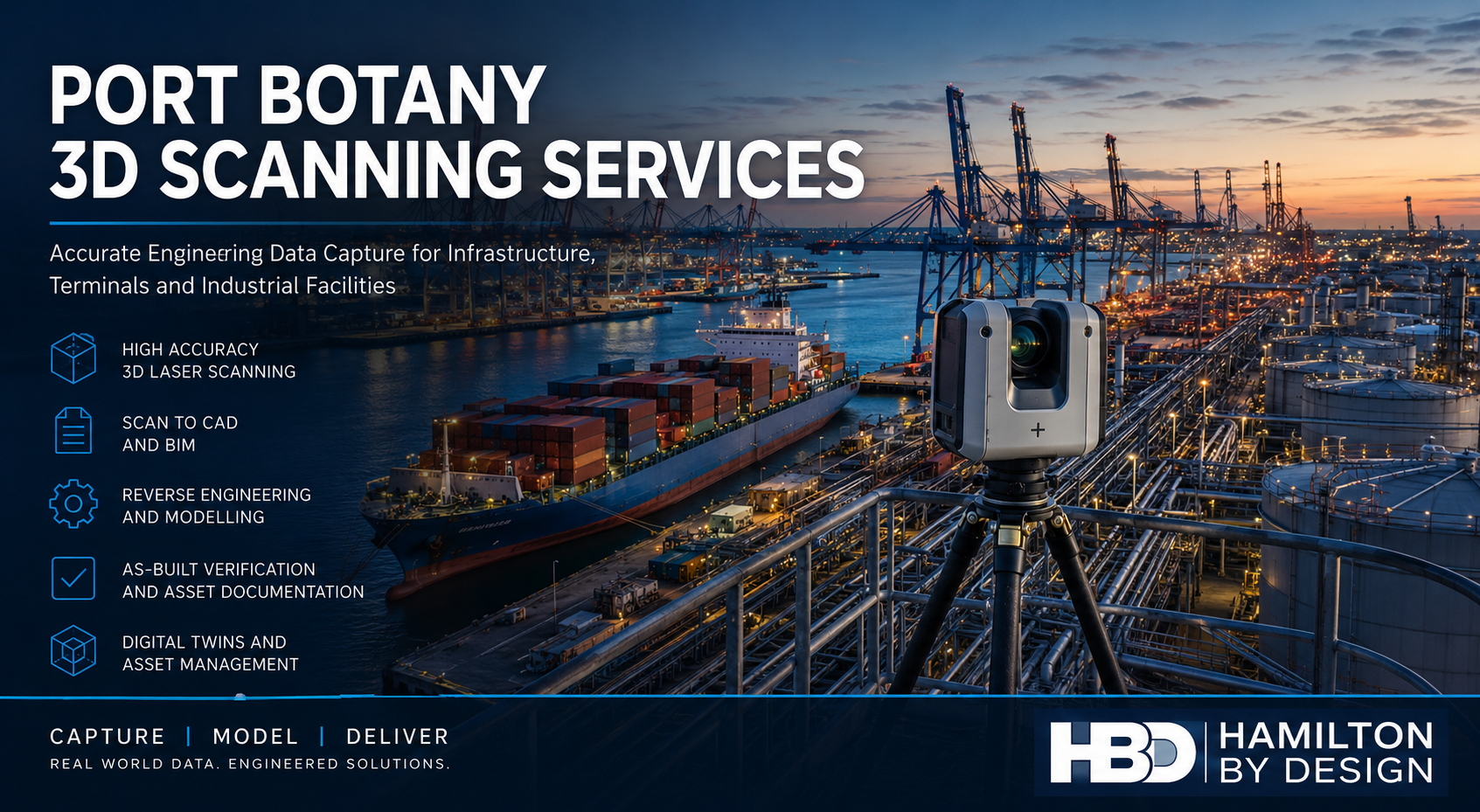
Port Botany 3D Scanning Services for Infrastructure, Terminals and Industrial Facilities

Port Botany 3D Scanning Services hero image showing a laser scanner overlooking container terminals, fuel storage tanks, pipelines, cranes and industrial infrastructure at Port Botany, Sydney. The image highlights LiDAR scanning, Scan-to-CAD, reverse engineering, asset documentation and digital twin services by Hamilton By Design.
Blue 3D LiDAR scanner icon on a tripod with scanning waves

Hamilton By Design provides professional Port Botany 3D scanning services for infrastructure, container terminals, industrial facilities, logistics operations, fuel terminals and engineering projects throughout Port Botany, Sydney. We use engineering-grade terrestrial LiDAR scanning technology to accurately capture existing conditions and create reliable digital models, drawings and datasets for maintenance, upgrades, asset management and construction projects.

Our 3D scanning services allow asset owners, engineers, contractors and project managers to obtain precise measurements of existing facilities without relying on outdated drawings or manual site measurements. The resulting point cloud data can be converted into CAD models, engineering drawings, BIM models, asset registers and digital twins to support informed decision-making and reduce project risk.

Whether you require a complete terminal survey, structural verification, Scan to CAD services, reverse engineering support or as-built documentation, Hamilton By Design delivers accurate engineering data capture across Port Botany and greater Sydney.


Engineering-Grade 3D Scanning in Port Botany

Port Botany is Australia’s largest container port and one of the country’s most important logistics and industrial hubs. The area contains a wide variety of assets that require ongoing maintenance, upgrades and engineering support, including:

  • Container terminals
  • Wharf infrastructure
  • Rail terminals
  • Bulk liquid storage facilities
  • Fuel terminals
  • Tank farms
  • Pipework systems
  • Pump stations
  • Conveyor systems
  • Warehouses
  • Distribution centres
  • Industrial workshops
  • Utilities infrastructure
  • Stormwater systems
  • Structural steel infrastructure

Many facilities have undergone numerous modifications over several decades, resulting in incomplete or outdated documentation. Accurate 3D laser scanning provides a reliable foundation for future engineering and construction activities.


Why Use 3D Scanning for Port Botany Facilities?

Traditional site measurement methods can be time-consuming, disruptive and prone to errors. Industrial facilities often contain complex structures, congested pipework and restricted access areas that make manual measurement difficult.

3D scanning provides significant advantages:

Improved Accuracy

Modern terrestrial laser scanners capture millions of measurement points per second, creating highly accurate representations of existing assets.

Reduced Site Time

Large facilities can be captured in a fraction of the time required for traditional measurement methods.

Increased Safety

Personnel spend less time working around operational equipment, traffic movements, elevated structures and hazardous areas.

Better Project Outcomes

Designers and engineers can work from accurate site information, reducing clashes, rework and unexpected site issues.

Long-Term Asset Records

The point cloud becomes a permanent digital record of the facility at the time of capture.


Industries We Support in Port Botany

Ports and Marine Infrastructure

Port operators and marine contractors use 3D scanning for:

  • Wharf upgrades
  • Berth modifications
  • Fender replacement projects
  • Structural inspections
  • Asset documentation
  • Marine infrastructure maintenance

Logistics and Distribution

Warehouses and logistics facilities often require:

  • Building surveys
  • Equipment installation planning
  • Conveyor modifications
  • Warehouse expansions
  • Asset verification

Fuel and Energy Facilities

Tank farms and fuel terminals benefit from:

  • Pipework modelling
  • Tank surveys
  • Structural steel verification
  • Equipment replacement projects
  • Brownfield upgrade planning

Manufacturing and Industrial Facilities

Industrial facilities commonly require:

  • Existing condition surveys
  • Reverse engineering support
  • Equipment installation planning
  • Structural modifications
  • Digital asset management

Typical Port Botany 3D Scanning Applications

Scan to CAD

Our Scan to CAD services convert point cloud data into engineering documentation including:

  • General arrangement drawings
  • Site layouts
  • Equipment layouts
  • Structural steel drawings
  • Existing condition plans
  • Sections and elevations

Deliverables may include:

  • DWG files
  • DXF files
  • PDF drawings
  • AutoCAD models

Scan to BIM

For larger infrastructure projects, point cloud data can be converted into BIM models suitable for asset management and project delivery.

Deliverables may include:

  • Revit models
  • Navisworks models
  • BIM coordination models
  • Asset information models

Reverse Engineering

Many industrial facilities contain legacy equipment where original drawings no longer exist.

3D scanning provides accurate geometry for:

  • Pump components
  • Impellers
  • Casings
  • Pipework fittings
  • Structural components
  • Mechanical assemblies

Resulting deliverables may include:

  • SolidWorks models
  • STEP files
  • Parasolid files
  • Manufacturing drawings

As-Built Verification

Construction and maintenance projects often require verification of completed works.

3D scanning enables:

  • Dimensional verification
  • Clash detection
  • Construction validation
  • Asset record updates

Our 3D Scanning Process

1. Site Assessment

We review the project requirements and identify:

  • Scope of work
  • Site access requirements
  • Safety requirements
  • Deliverables required
  • Survey control requirements

2. On-Site Data Capture

Using professional terrestrial LiDAR equipment, we capture the facility from multiple scan positions to ensure complete coverage.

Typical assets scanned include:

  • Buildings
  • Structures
  • Pipework
  • Conveyors
  • Tanks
  • Mechanical equipment
  • Marine infrastructure

3. Point Cloud Registration

Individual scans are registered into a unified coordinate system to create a complete digital representation of the facility.

4. Data Processing

The registered point cloud is cleaned, optimised and prepared for engineering use.

5. Modelling and Documentation

The point cloud is converted into the required deliverables, including CAD drawings, BIM models, engineering models or asset documentation.

6. Project Delivery

Final deliverables are issued in the formats required by the client.


Deliverables Available

Hamilton By Design can provide:

  • E57 point clouds
  • RCP files
  • RCS files
  • LAS files
  • AutoCAD DWG files
  • DXF files
  • PDF drawings
  • SolidWorks models
  • STEP files
  • Parasolid files
  • Navisworks models
  • Revit models
  • General arrangement drawings
  • Sections and elevations
  • Asset verification reports

All deliverables can be tailored to suit engineering, construction, maintenance or asset management requirements.


Supporting Brownfield Upgrade Projects

One of the most common applications for 3D scanning in Port Botany is supporting brownfield infrastructure upgrades.

Industrial facilities rarely match original drawings due to years of modifications, repairs and operational changes. Accurate point cloud data allows project teams to design around existing conditions with confidence.

Typical upgrade projects include:

  • Conveyor replacements
  • Pipework modifications
  • Structural steel upgrades
  • Tank farm expansions
  • Pump station upgrades
  • Equipment replacements
  • Wharf infrastructure improvements

By working from accurate existing-condition data, project teams can reduce site rework, minimise disruptions and improve project outcomes.


Hamilton By Design logo displayed on a blue tilted rectangle with a grey gradient background

Port Botany 3D Scanning Services from Hamilton By Design

Hamilton By Design provides engineering-focused 3D scanning services throughout Port Botany, Sydney and regional Australia. Our experience across ports, infrastructure, manufacturing, mining, utilities and industrial facilities allows us to deliver practical engineering solutions supported by accurate reality capture data.

Whether your project requires Scan to CAD, Scan to BIM, reverse engineering, asset documentation or as-built verification, our team can provide accurate and reliable digital data to support your next project.

Contact Hamilton By Design today to discuss your Port Botany 3D scanning requirements and obtain a tailored proposal for your facility or infrastructure project.

Talk to Us – Contact Us

Name
Would you like us to arrange a phone consultation for you?
Address

Our clients:


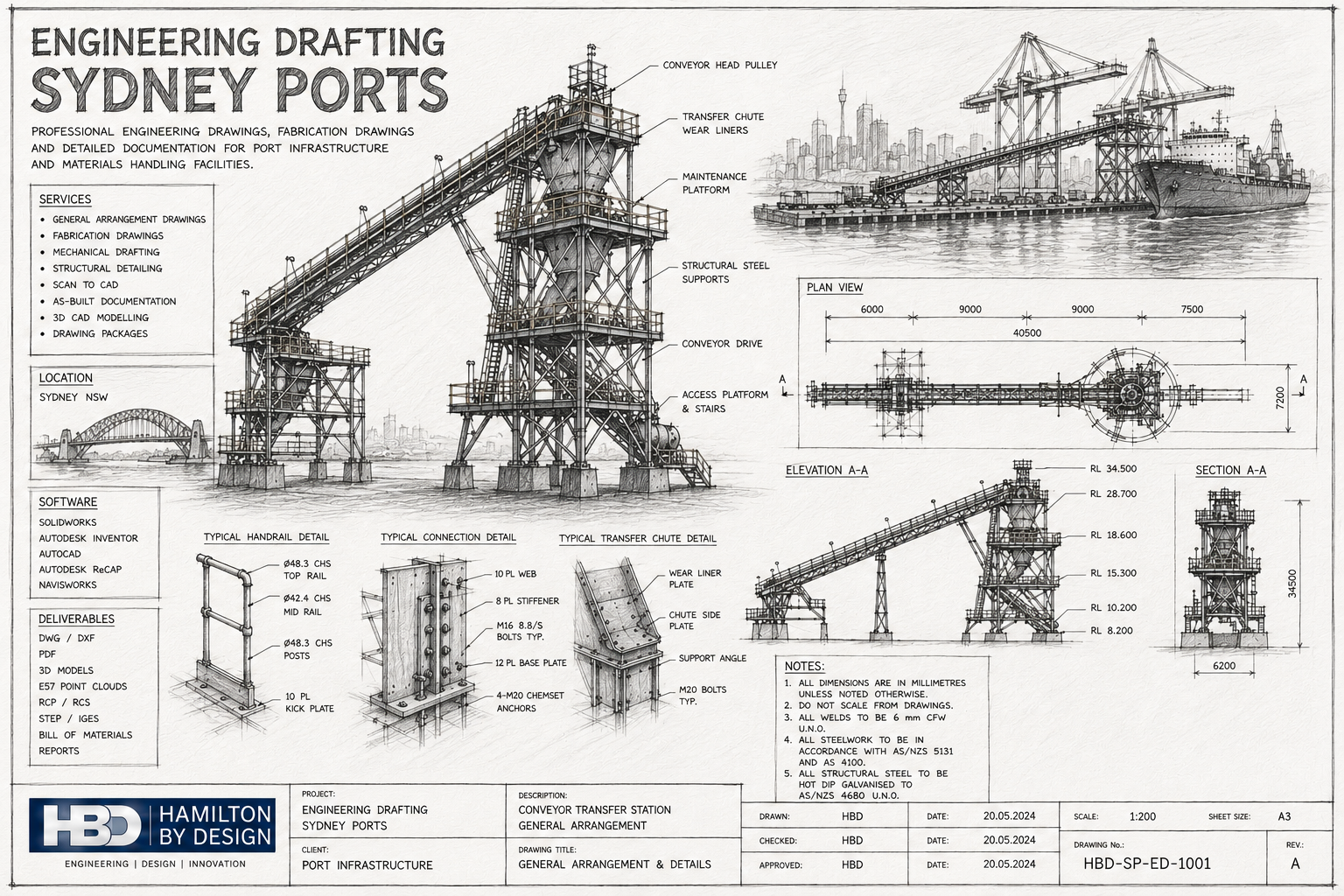
Engineering Drafting Sydney Ports

Engineering Drafting Sydney Ports technical drawing showing conveyor systems, fabrication drawings, general arrangement layouts, structural steel details and materials handling infrastructure.

Engineering Drafting Sydney Ports

Structural engineering drafting icon showing a seated engineer working at a drafting table in blue vector style.

Hamilton By Design provides engineering drafting services for Sydney ports, marine terminals, wharves, bulk handling facilities, container terminals and industrial port infrastructure. We prepare accurate general arrangement drawings, fabrication drawings, mechanical layouts, structural details, as-built documentation and CAD models for port operators, contractors, fabricators, manufacturers and maintenance teams across Sydney NSW.

Our drafting services support mechanical engineering projects, materials handling upgrades, conveyor modifications, structural steel works, access platforms, equipment layouts, pipework changes and brownfield plant upgrades. By combining practical trade knowledge, mechanical engineering experience, 3D LiDAR scanning and CAD design, we help clients produce clear, buildable and reliable engineering documentation.

Engineering Drafting Services for Sydney Ports

Sydney port facilities require accurate drawings to support safe installation, fabrication, maintenance and future asset management. Many existing facilities have been modified over time, which means old drawings may be incomplete, outdated or missing.

Hamilton By Design supports port infrastructure projects by producing technical drawings that reflect both the design intent and the real site conditions.

Our engineering drafting services include:

  • General arrangement drawings
  • Fabrication drawings
  • Mechanical layouts
  • Structural steel details
  • Conveyor arrangement drawings
  • Transfer chute drawings
  • Access platform drawings
  • Walkway, stair and handrail drawings
  • Equipment layout drawings
  • Pipework drafting
  • As-built drawings
  • Site measure drawings
  • Scan to CAD drawings
  • 3D CAD modelling
  • Drawing markups and revisions
  • Drawing package preparation

Drafting for Port Infrastructure and Materials Handling

Port environments often include conveyors, transfer stations, ship loaders, hoppers, chutes, platforms, pipework and support structures. These systems need clear documentation so that designers, fabricators, installers and maintenance teams can work from the same information.

We provide engineering drafting for:

  • Conveyor systems
  • Conveyor galleries
  • Transfer stations
  • Transfer chutes
  • Ship loading equipment
  • Maintenance platforms
  • Access stairs and walkways
  • Structural steel supports
  • Equipment bases and frames
  • Guarding and safety access
  • Pipework and mechanical services
  • Brownfield plant modifications
  • Industrial buildings and workshops

This makes the service suitable for Sydney ports, bulk material handling sites, infrastructure projects, manufacturing facilities, utilities, mining support operations and industrial plants.

Sydney NSW and Australia-Wide Support

Hamilton By Design supports engineering drafting projects throughout Sydney NSW, including port and industrial areas around Botany, Port Botany, Glebe Island, White Bay, Sydney Harbour, Kurnell, Parramatta River industrial areas and surrounding logistics hubs.

We also support clients across Newcastle, the Hunter Valley, Central Coast, Brisbane, Melbourne, Adelaide, Perth, Darwin, Mount Isa and regional Australia.

For clients outside Sydney, we can provide drafting support remotely using supplied drawings, site photos, point clouds, 3D scan data, markups and engineering sketches.

General Arrangement Drawings

General arrangement drawings show how equipment, structures and systems fit together. They are commonly used for design review, client approval, construction planning and installation coordination.

A GA drawing may include:

  • Plan views
  • Elevation views
  • Section views
  • Main dimensions
  • Equipment locations
  • Structural interfaces
  • Access clearances
  • Connection points
  • Drawing notes
  • Reference drawings
  • Revision history

For Sydney port projects, GA drawings are often required before fabrication drawings are produced. This helps confirm the design layout and reduce the risk of clashes during installation.

Fabrication Drawings

Fabrication drawings provide the detail required to manufacture steelwork, mechanical components and assemblies.

Depending on the project, fabrication drawings may include:

  • Plate details
  • Weld details
  • Material callouts
  • Hole sizes and locations
  • Cut lengths
  • Fold details
  • Machining details
  • Assembly information
  • Bill of materials
  • Finish requirements
  • Drawing notes

Fabrication drawings are especially important for conveyor supports, platforms, stairs, handrails, guarding, brackets, frames, hoppers, chutes and mechanical assemblies.

3D LiDAR Scanning and Scan to CAD

Many port projects are completed in brownfield environments where accurate site information is essential. When existing drawings are not reliable, Hamilton By Design can use 3D LiDAR scanning to capture the real site conditions before drafting begins.

3D scanning can capture:

  • Structural steel
  • Conveyors
  • Chutes
  • Platforms
  • Pipework
  • Equipment
  • Building layouts
  • Access areas
  • Obstructions
  • Existing services

The scan data can then be converted into CAD drawings, 3D models and as-built documentation.

Typical scan and CAD deliverables may include:

  • E57 point clouds
  • RCP files
  • RCS files
  • DWG drawings
  • DXF drawings
  • SolidWorks models
  • Autodesk Inventor models
  • STEP files
  • PDF drawing packages
  • As-built documentation

This workflow helps reduce site rework and improves confidence before fabrication or installation begins.

CAD Software and Technical Capability

Hamilton By Design works with commonly used engineering and drafting platforms to support practical project delivery.

Software and file formats may include:

  • SolidWorks
  • Autodesk Inventor
  • AutoCAD
  • Autodesk ReCap
  • Navisworks
  • STEP
  • Parasolid
  • DWG
  • DXF
  • PDF
  • E57
  • RCP
  • RCS

We can work from supplied sketches, old drawings, site markups, redline drawings, photographs, point cloud data or 3D models.

Relevant Standards and Drawing Considerations

Engineering drafting for port and industrial environments should be clear, consistent and suitable for the intended use.

Depending on the project, drawings may consider:

  • AS 1657 for fixed platforms, walkways, stairways and ladders
  • AS/NZS 4024 for machine safety and guarding considerations
  • AS 3990 for mechanical equipment and steelwork design considerations
  • AS 4100 for steel structures where applicable
  • Site-specific safety requirements
  • Client drawing standards
  • Fabricator requirements
  • Maintenance access requirements
  • Installation constraints

Drawings should be practical, readable and suitable for review by engineers, fabricators, project managers and site teams.

Step-by-Step Drafting Process

1. Project Review

We review the project scope, available drawings, sketches, photos, site information and client requirements.

2. Site Measure or 3D Scan

Where required, we attend site to measure or complete 3D LiDAR scanning to capture the existing conditions.

3. CAD Setup

Existing drawings, scan data or design sketches are brought into the CAD environment.

4. 3D Modelling or 2D Drafting

We prepare 3D models or 2D drawings depending on the project requirements.

5. Engineering Review

Drawings are reviewed for layout, access, interfaces, buildability and design intent.

6. Drawing Issue

The drawing package is issued for review, approval, fabrication, installation or as-built records.

7. Revisions and Final Documentation

Client comments, engineer markups and site changes are incorporated before final issue.

What the Client Receives

Depending on the project scope, clients may receive:

  • General arrangement drawings
  • Fabrication drawings
  • Mechanical detail drawings
  • Structural detail drawings
  • Conveyor layout drawings
  • Access platform drawings
  • As-built drawings
  • 3D CAD models
  • SolidWorks models
  • Inventor models
  • STEP files
  • DWG files
  • DXF files
  • PDF drawing sets
  • Bill of materials
  • Drawing registers
  • E57 point clouds
  • RCP and RCS files
  • Engineering notes and reports

The final deliverables are tailored to suit the project, whether the requirement is design review, fabrication, installation, asset management or maintenance planning.

Why Choose Hamilton By Design?

Hamilton By Design combines engineering drafting with practical mechanical engineering and site experience. This is important for port projects where drawings must be more than visually correct. They must also be practical, buildable and suitable for real site conditions.

Our strengths include:

  • Mechanical engineering experience
  • Trade and fabrication background
  • 3D CAD modelling capability
  • 3D LiDAR scanning capability
  • Brownfield industrial project experience
  • Materials handling knowledge
  • Conveyor and chute drafting experience
  • Port and infrastructure drafting support
  • Practical drawing documentation
  • Australia-wide project support

We understand the importance of clear drawings for shutdowns, fabrication, maintenance works and plant upgrade projects.

Hamilton By Design also provides related engineering and digital design services, including:

  • Mechanical Engineering Services
  • 3D LiDAR Scanning Sydney Ports
  • Scan to CAD Sydney Ports
  • Scan to BIM Sydney
  • Reverse Engineering Services
  • Structural Drafting Services
  • Industrial Plant 3D Scanning
  • Conveyor Design and Drafting
  • Fabrication Drawing Services

These related services allow clients to combine site capture, drafting, modelling and engineering support within one practical workflow.

Frequently Asked Questions

Do you provide engineering drafting for Sydney ports?

Yes. Hamilton By Design provides engineering drafting services for Sydney ports, port infrastructure, marine terminals, conveyors, transfer stations and industrial facilities.

What types of drawings can you produce?

We can produce general arrangement drawings, fabrication drawings, mechanical layouts, structural details, as-built drawings, conveyor drawings and CAD models.

Can you work from old or incomplete drawings?

Yes. We can work from existing drawings, site sketches, photos, redline markups and 3D scan data. Where drawings are unreliable, a site measure or 3D LiDAR scan may be recommended.

Can you provide fabrication drawings?

Yes. We prepare fabrication drawings for steelwork, platforms, brackets, frames, chutes, hoppers, conveyor supports and mechanical assemblies.

Do you provide Scan to CAD services?

Yes. We can convert 3D LiDAR scan data into DWG drawings, 3D CAD models, SolidWorks files and as-built documentation.

What software do you use?

We commonly use SolidWorks, Autodesk Inventor, AutoCAD, Autodesk ReCap and Navisworks.

Can you help with brownfield port upgrades?

Yes. We support brownfield upgrade projects where existing equipment, structures and services must be captured and documented before modification.

Do you provide drawing updates from site markups?

Yes. We can update drawings from redline markups, site measurements, scanned information and engineering comments.

Do you work outside Sydney?

Yes. We support clients across NSW and Australia, including Newcastle, Hunter Valley, Central Coast, Brisbane, Melbourne, Adelaide, Perth, Darwin and regional industrial sites.

What information do you need to prepare a quote?

Useful information includes the project scope, existing drawings, photos, site location, required drawing types, preferred file formats, deadlines and whether a site measure or 3D scan is required.

Hamilton By Design logo displayed on a blue tilted rectangle with a grey gradient background

Contact Hamilton By Design

If you require Engineering Drafting Sydney Ports services, Hamilton By Design can assist with general arrangement drawings, fabrication drawings, CAD modelling, Scan to CAD, as-built documentation and detailed engineering drawing packages for port and industrial infrastructure.

Contact Hamilton By Design to discuss your Sydney port drafting project and prepare a practical drawing solution for your site, workshop or engineering team.

Talk to Us – Contact Us

Name
Would you like us to arrange a phone consultation for you?
Address

Our clients:


Mechanical Engineering Sydney Ports

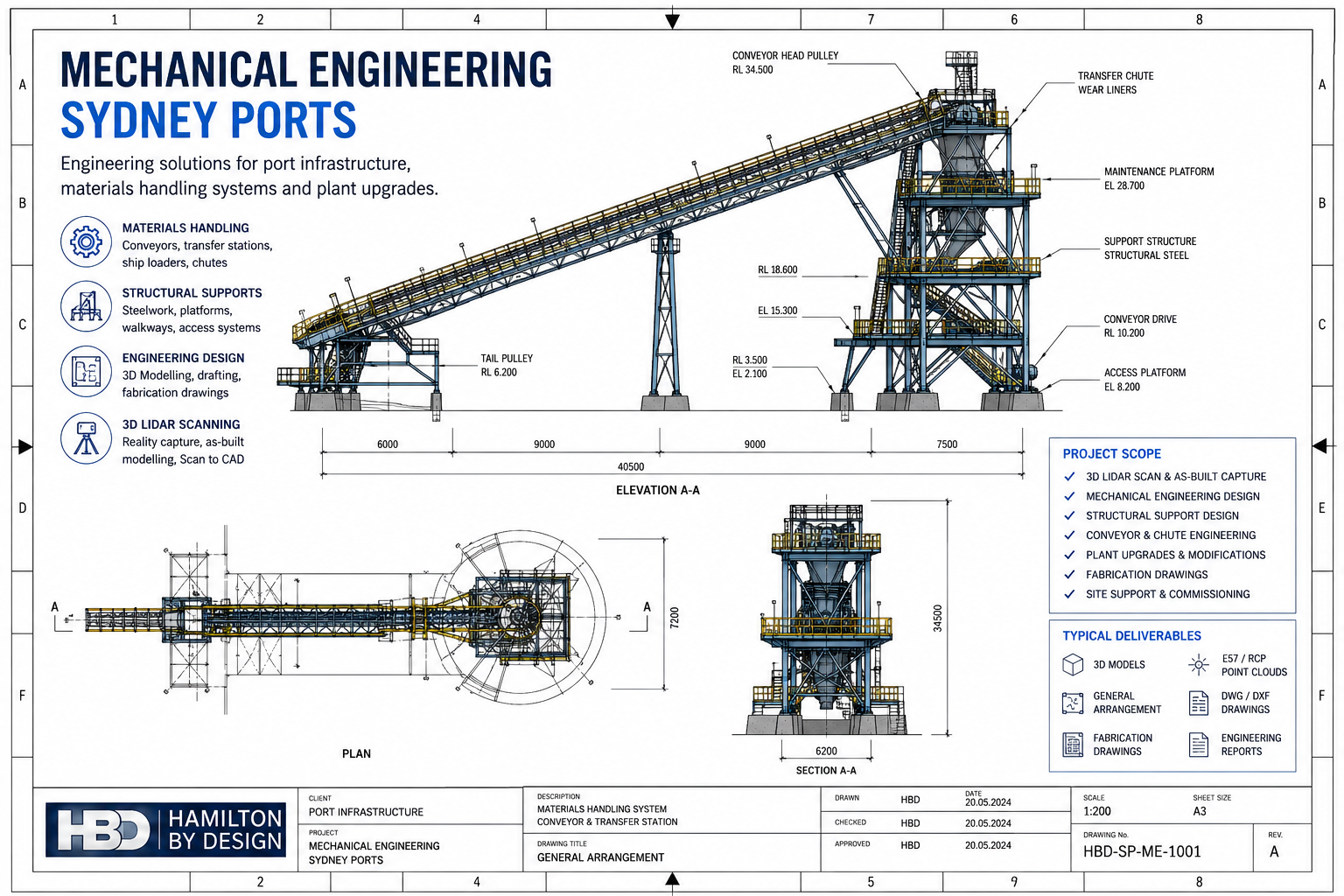
Mechanical Engineering Sydney Ports technical drawing showing conveyor systems, transfer stations, structural steel, materials handling infrastructure, 3D LiDAR scanning services and engineering deliverables by Hamilton By Design.

Mechanical Engineering Sydney Ports | Hamilton By Design

Blue 3D LiDAR scanner icon on a tripod with scanning waves

Sydney’s ports are critical infrastructure assets that support Australia’s import, export, logistics and maritime industries. Maintaining, upgrading and expanding port facilities requires practical mechanical engineering expertise capable of working within live operating environments while minimising disruption to ongoing operations.

Hamilton By Design provides mechanical engineering services for Sydney ports, marine terminals, bulk handling facilities, container terminals, wharves and associated industrial infrastructure. Our services support asset owners, port operators, contractors, manufacturers and maintenance teams requiring engineering solutions for materials handling systems, plant upgrades, structural modifications and brownfield developments.

Based in NSW and supporting projects throughout Sydney and regional Australia, we combine mechanical engineering, 3D LiDAR scanning, CAD design and engineering documentation to deliver practical, engineering-led outcomes.


Mechanical Engineering Services for Sydney Ports

Port facilities contain a wide range of mechanical systems that require ongoing maintenance, modification and improvement. Our engineering services are tailored to support both day-to-day operational requirements and major capital projects.

Typical services include:

  • Mechanical engineering design
  • Materials handling system design
  • Conveyor upgrades and modifications
  • Transfer chute design
  • Structural steel support design
  • Walkways, platforms and access systems
  • Equipment relocation projects
  • Plant upgrade engineering
  • Mechanical drafting and documentation
  • Reverse engineering of components
  • Engineering inspections and assessments
  • Brownfield infrastructure modifications
  • 3D LiDAR scanning and reality capture
  • Scan to CAD services
  • As-built documentation

Our experience across industrial and mining environments provides practical insight into maintaining operational facilities while delivering engineering improvements.


Industries and Port Infrastructure We Support

Sydney ports contain a diverse range of infrastructure requiring specialised engineering support.

We regularly assist with:

Bulk Materials Handling Facilities

  • Conveyor systems
  • Transfer stations
  • Ship loaders
  • Hopper systems
  • Stockpile conveyors
  • Materials handling equipment
  • Dust collection systems

Container Terminal Infrastructure

  • Container handling equipment
  • Mechanical support structures
  • Equipment foundations
  • Maintenance access systems
  • Service platforms

Marine and Wharf Facilities

  • Wharf structures
  • Mechanical services infrastructure
  • Pipework systems
  • Utility installations
  • Maintenance access platforms

Industrial Port Facilities

  • Warehouses
  • Processing plants
  • Storage facilities
  • Bulk liquid terminals
  • Manufacturing facilities
  • Logistics infrastructure

Engineering Design for Brownfield Port Facilities

Many Sydney port facilities have been operating for decades and contain limited or outdated engineering documentation.

Before modifications can commence, accurate information about existing conditions is essential.

Hamilton By Design specialises in engineering support for brownfield environments through:

  • Existing condition surveys
  • 3D LiDAR scanning
  • Point cloud capture
  • As-built modelling
  • Scan to CAD conversion
  • Equipment verification
  • Clash detection
  • Layout development

By capturing existing infrastructure before design begins, project risks can be significantly reduced while improving installation accuracy.


3D LiDAR Scanning and Mechanical Engineering

Modern engineering projects increasingly rely on accurate digital representations of existing facilities.

Our engineering team uses advanced 3D LiDAR scanning technology to capture:

  • Conveyors
  • Pipework
  • Structural steel
  • Transfer stations
  • Ship loading infrastructure
  • Equipment layouts
  • Processing plant assets
  • Mechanical services

The resulting point cloud data can be converted into engineering models and drawings used for:

  • Upgrade design
  • Retrofit projects
  • Structural modifications
  • Equipment replacements
  • Maintenance planning
  • Fabrication detailing

This approach reduces site rework, minimises clashes and improves project confidence.


Materials Handling Engineering

Materials handling systems form the backbone of many port operations.

Our mechanical engineering services include:

Conveyor System Design

We provide engineering support for:

  • New conveyor installations
  • Conveyor upgrades
  • Conveyor extensions
  • Transfer point modifications
  • Conveyor guarding
  • Structural support systems

Transfer Chute Design

Efficient transfer chutes are critical for reducing wear, dust generation and material spillage.

Services include:

  • Chute assessments
  • Flow analysis
  • Wear reduction solutions
  • Maintenance improvements
  • Upgrade concepts

Maintenance and Asset Improvement

Engineering support can assist with:

  • Reliability improvements
  • Equipment modifications
  • Replacement strategies
  • Asset life extension
  • Shutdown planning

Mechanical Drafting and Documentation

Clear engineering documentation is essential for fabrication, installation and maintenance activities.

Deliverables may include:

  • General arrangement drawings
  • Mechanical layouts
  • Fabrication drawings
  • Assembly drawings
  • Equipment models
  • Structural details
  • Site layouts
  • Installation drawings
  • CAD documentation

We work with commonly used engineering platforms including:

  • SolidWorks
  • Autodesk Inventor
  • AutoCAD
  • Autodesk ReCap
  • Navisworks

Typical Deliverables

Depending on project requirements, deliverables may include:

  • Mechanical engineering reports
  • Concept designs
  • Detailed engineering drawings
  • General arrangement drawings
  • CAD models
  • SolidWorks models
  • STEP files
  • DWG files
  • DXF files
  • Point cloud data
  • E57 files
  • RCP and RCS files
  • As-built documentation
  • Equipment layouts
  • Engineering recommendations

Our objective is to provide practical deliverables that can be directly used by project teams, fabricators and contractors.


Why Choose Hamilton By Design?

Hamilton By Design combines practical engineering experience with modern digital engineering technologies.

Our clients benefit from:

  • Mechanical engineering expertise
  • Engineering-led LiDAR scanning services
  • Brownfield project experience
  • Materials handling knowledge
  • Practical design solutions
  • Fast project mobilisation
  • Australia-wide support
  • Accurate engineering documentation

By combining engineering design with reality capture technologies, we help reduce project uncertainty while improving the quality of engineering outcomes.


Frequently Asked Questions

What mechanical engineering services do you provide for Sydney ports?

We provide engineering design, conveyor upgrades, materials handling engineering, plant modifications, structural support design, drafting and 3D LiDAR scanning services.

Can you scan existing port infrastructure before design work begins?

Yes. We provide engineering-grade 3D LiDAR scanning services to accurately capture existing facilities and create as-built models.

Do you work on operational port facilities?

Yes. Many projects are completed within live operational environments, allowing engineering work to be undertaken while minimising disruption.

Can you convert point clouds into CAD models?

Yes. Point cloud data can be converted into CAD drawings, SolidWorks models and engineering documentation.

Do you support conveyor upgrade projects?

Yes. We regularly assist with conveyor modifications, transfer chute improvements and materials handling upgrades.

Can you provide fabrication drawings?

Yes. Detailed fabrication and installation drawings can be produced where required.

What software do you use?

We commonly use SolidWorks, Autodesk Inventor, AutoCAD, Autodesk ReCap and Navisworks.

Do you provide Scan to CAD services?

Yes. We convert laser scan data into accurate engineering drawings and 3D models.

Do you work outside Sydney?

Yes. We support projects throughout NSW and Australia, including ports, mining operations, manufacturing facilities and industrial sites.

How do I obtain a quote?

Contact Hamilton By Design with your project requirements, available drawings and site information. We can then prepare a tailored proposal for your Sydney port engineering project.

Hamilton By Design logo displayed on a blue tilted rectangle with a grey gradient background

Contact Hamilton By Design

If you require Mechanical Engineering Sydney Ports services, Hamilton By Design can assist with engineering design, plant upgrades, materials handling systems, 3D LiDAR scanning, Scan to CAD and engineering documentation.

Contact our team today to discuss your Sydney port infrastructure project and obtain a tailored engineering solution.

Talk to Us – Contact Us

Name
Would you like us to arrange a phone consultation for you?
Address

Our clients:


3D LiDAR Scanning Darwin for engineering surveys, laser scanning, reality capture and point cloud modelling services
3D LiDAR Scanning Australia engineering services for laser scanning, reality capture, scan-to-CAD, Scan-to-BIM and as-built documentation across Australia
3D LiDAR scanning services on the Central Coast providing engineering-grade laser scanning, point cloud capture, scan-to-CAD modelling and industrial reality capture for infrastructure and industrial projects.

Scan to CAD Services for Sydney Ports

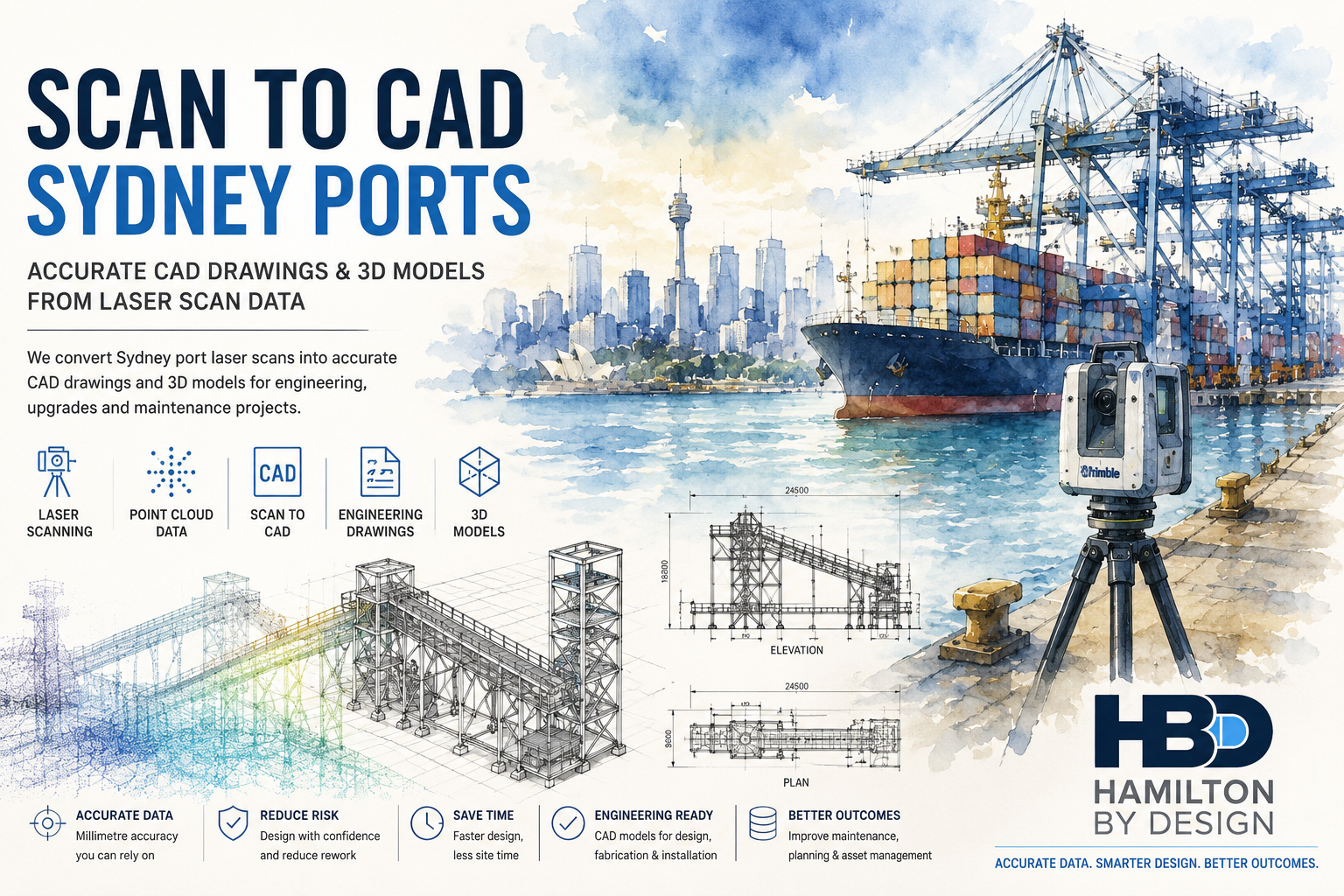
Scan to CAD Sydney Ports hero image showing Sydney Harbour port infrastructure, container terminal operations, LiDAR scanning equipment, point cloud data and engineering CAD models used for mechanical engineering, drafting and asset management projects.

Sydney’s ports and marine infrastructure are constantly evolving through maintenance programs, equipment upgrades, expansion projects and operational improvements. Accurate information about existing assets is essential for successful engineering design, fabrication and construction.

Hamilton By Design provides professional Scan to CAD services for Sydney ports, transforming laser scan and LiDAR point cloud data into accurate CAD drawings, 3D models and engineering documentation.

Our engineering-led approach ensures point cloud data is converted into practical deliverables that support mechanical engineering, drafting, fabrication, asset management and infrastructure upgrades.

Whether you require a simple as-built drawing or a complete 3D plant model, our Scan to CAD services provide accurate digital information that helps reduce project risk and improve engineering outcomes.


What is Scan to CAD?

Scan to CAD is the process of converting laser scan data into usable engineering drawings and 3D models.

Using point cloud data captured through terrestrial LiDAR scanning, engineers and drafters can create:

  • AutoCAD Drawings
  • General Arrangement Drawings
  • Plant Layouts
  • Structural Models
  • Mechanical Equipment Models
  • Pipework Models
  • As-Built Documentation
  • BIM Models
  • Digital Twin Assets

This process allows existing facilities to be accurately documented without relying on outdated or incomplete drawings.


Why Sydney Ports Require Scan to CAD Services

Many port facilities have been modified numerous times throughout their operational life.

Common challenges include:

  • Missing documentation
  • Outdated drawings
  • Unknown modifications
  • Congested infrastructure
  • Limited access areas
  • Restricted shutdown windows
  • Complex equipment layouts

By converting reality capture data into engineering-ready CAD models, project teams can work from accurate information that reflects actual site conditions.


Typical Sydney Port Infrastructure We Model

Container Terminals

We create CAD models and drawings for:

  • Container handling equipment
  • Crane support structures
  • Storage facilities
  • Maintenance workshops
  • Access infrastructure

Bulk Materials Handling Facilities

Our Scan to CAD services support:

  • Conveyors
  • Transfer stations
  • Chutes
  • Hoppers
  • Ship loaders
  • Stackers
  • Reclaimers

Marine Infrastructure

We can model:

  • Wharves
  • Jetties
  • Berths
  • Marine loading facilities
  • Access walkways
  • Structural steelwork

Industrial Plant Infrastructure

Including:

  • Pipework systems
  • Pump stations
  • Mechanical equipment
  • Structural steel
  • Maintenance platforms
  • Process infrastructure

Engineering Applications of Scan to CAD

Mechanical Engineering

Accurate CAD models provide the foundation for:

  • Equipment replacement projects
  • Plant upgrades
  • Retrofit design
  • Conveyor modifications
  • Maintenance planning
  • Shutdown engineering

Engineers can design around actual site conditions, reducing installation risks and minimising costly modifications.


Engineering Drafting

Point cloud data can be converted into:

  • Fabrication Drawings
  • General Arrangement Drawings
  • Layout Drawings
  • Equipment Drawings
  • Structural Steel Drawings
  • Installation Documentation

This allows engineering teams to produce reliable documentation from accurate site information.


Brownfield Engineering Projects

Scan to CAD is particularly valuable for brownfield projects where original drawings may no longer reflect existing conditions.

Benefits include:

  • Reduced site visits
  • Improved design accuracy
  • Clash detection
  • Better installation planning
  • Reduced construction risk

Shutdown Planning

Port shutdowns involve significant planning and coordination.

Accurate CAD models allow project teams to:

  • Verify clearances
  • Plan installations
  • Assess access requirements
  • Identify clashes
  • Improve shutdown efficiency

CAD Deliverables Available

Hamilton By Design can provide a range of engineering deliverables depending on project requirements.

2D Deliverables

  • AutoCAD Drawings
  • Floor Plans
  • Elevations
  • Sections
  • Layout Drawings
  • General Arrangement Drawings
  • As-Built Documentation

3D Deliverables

  • SolidWorks Models
  • Inventor Models
  • STEP Files
  • SAT Files
  • Parasolid Files
  • Plant Models

BIM Deliverables

  • Revit Models
  • IFC Models
  • Asset Information Models
  • Scan to BIM Models

Benefits of Scan to CAD for Sydney Port Projects

Accurate Engineering Information

CAD models are created directly from point cloud data, providing confidence that designs are based on actual site conditions.


Reduced Design Risk

Accurate models help identify clashes and installation issues before fabrication begins.


Faster Project Delivery

Engineering teams can begin work immediately without waiting for extensive site measurements.


Improved Asset Management

Accurate CAD documentation supports maintenance planning, inspections and future upgrades.


Better Project Outcomes

Reliable information results in improved decision making throughout the project lifecycle.


Why Choose Hamilton By Design?

Hamilton By Design combines:

  • Scan to CAD Services
  • 3D LiDAR Scanning
  • Mechanical Engineering
  • Engineering Drafting
  • Reverse Engineering
  • Scan to BIM
  • Asset Management Support

Unlike traditional drafting providers, we understand how engineering models are used throughout design, fabrication, installation and maintenance activities.

Our engineering-first approach ensures practical outcomes that support the long-term management and improvement of port infrastructure assets.


Sydney Port Facilities We Support

We provide Scan to CAD services throughout:

  • Port Botany
  • White Bay
  • Glebe Island
  • Sydney Harbour Industrial Facilities
  • Container Terminals
  • Bulk Handling Facilities
  • Marine Infrastructure Assets
  • Intermodal Freight Terminals

We also support projects throughout:

  • Sydney
  • Newcastle
  • Central Coast
  • Wollongong
  • Regional NSW
  • Australia-wide

Hamilton By Design logo displayed on a blue tilted rectangle with a grey gradient background

Need Scan to CAD Services for a Sydney Port Project?

Whether you require accurate as-built drawings, 3D plant models, mechanical engineering support or asset documentation, Hamilton By Design can convert your laser scan data into engineering-ready CAD deliverables.

Our Services Include:

โœ” Scan to CAD
โœ” 3D LiDAR Scanning
โœ” Mechanical Engineering
โœ” Engineering Drafting
โœ” Reverse Engineering
โœ” Scan to BIM
โœ” Digital Twin Development
โœ” Asset Documentation

Contact Hamilton By Design today to discuss your Sydney port infrastructure project and obtain a tailored proposal.

Talk to Us – Contact Us

Name
Would you like us to arrange a phone consultation for you?
Address

Our clients:


Frequently Asked Questions โ€“ Scan to CAD Sydney Ports

1. What is Scan to CAD and how is it used in Sydney ports?

Scan to CAD is the process of converting laser scan or LiDAR point cloud data into accurate 2D drawings and 3D CAD models. Sydney port operators use Scan to CAD for engineering design, maintenance planning, equipment upgrades and asset management projects.


2. What types of port infrastructure can be converted into CAD models?

Hamilton By Design can create CAD models of:

  • Container terminals
  • Wharves and jetties
  • Ship loaders
  • Conveyors
  • Chutes and hoppers
  • Pipework systems
  • Structural steelwork
  • Pump stations
  • Marine loading facilities
  • Industrial plant equipment

3. Why use Scan to CAD instead of traditional site measurements?

Scan to CAD uses millions of measured data points captured by LiDAR scanners, creating a far more detailed and accurate representation of existing conditions than traditional manual measurements.


4. What CAD deliverables can be produced from point cloud data?

Common deliverables include:

  • AutoCAD drawings
  • General arrangement drawings
  • Layout drawings
  • Structural steel models
  • Mechanical equipment models
  • Pipework models
  • Fabrication drawings
  • As-built documentation

5. Can Scan to CAD support brownfield port upgrades?

Yes. Scan to CAD is particularly valuable for brownfield projects where original drawings may be outdated, missing or no longer reflect actual site conditions. Accurate models help reduce design risks and improve project outcomes.


6. What file formats can Hamilton By Design provide?

We can provide deliverables in formats including:

  • DWG
  • DXF
  • STEP
  • SAT
  • Parasolid
  • SolidWorks
  • Inventor
  • IFC
  • Revit

Depending on project requirements.


7. How does Scan to CAD reduce engineering project risk?

Accurate CAD models allow engineers to verify dimensions, identify clashes, check clearances and develop designs based on actual site conditions. This reduces rework, installation issues and costly construction delays.


8. Can point cloud data be used for mechanical engineering projects?

Absolutely. Point cloud data provides the foundation for equipment upgrades, conveyor modifications, plant expansions, structural changes and reverse engineering projects commonly undertaken within Sydney ports.


9. Can Scan to CAD data be used for BIM and digital twin projects?

Yes. CAD models generated from laser scan data can be incorporated into BIM workflows, digital twin platforms, asset management systems and future infrastructure planning projects.


10. Why choose Hamilton By Design for Scan to CAD services in Sydney ports?

Hamilton By Design combines:

  • 3D LiDAR Scanning
  • Scan to CAD
  • Mechanical Engineering
  • Engineering Drafting
  • Reverse Engineering
  • Scan to BIM
  • Digital Twin Development

Unlike drafting-only providers, we understand how engineering models are used throughout design, fabrication, construction and maintenance, ensuring practical outcomes for port infrastructure projects.


3D LiDAR Scanning Services for Sydney Ports

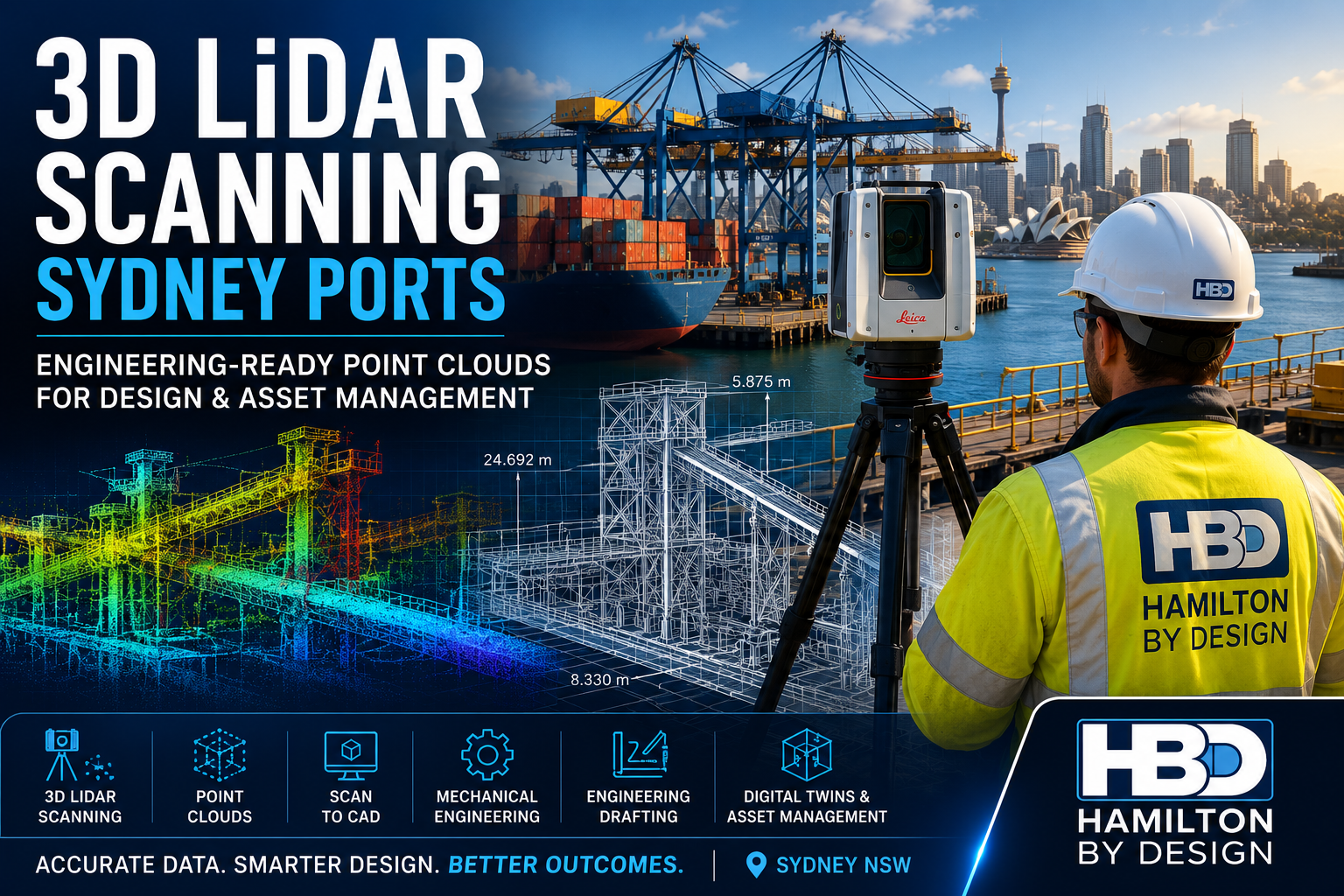
Engineer using 3D LiDAR scanner at Sydney port with container cranes, marine infrastructure and point cloud overlay for engineering design.

Sydney’s ports are critical gateways for Australia’s import, export and logistics industries. Facilities such as container terminals, bulk materials handling operations, fuel terminals, marine loading facilities and supporting infrastructure require accurate engineering information to support maintenance, upgrades and future expansion.

Hamilton By Design provides engineering-grade 3D LiDAR scanning services for Sydney ports, delivering highly accurate point cloud data for engineering design, drafting, asset management, digital twins and brownfield infrastructure projects.

Using advanced terrestrial LiDAR technology, we capture millions of measurement points across complex operating environments, creating detailed digital records that allow engineers, asset owners and project teams to make informed decisions with confidence.


What is 3D LiDAR Scanning?

LiDAR (Light Detection and Ranging) uses laser technology to accurately measure and record physical assets.

The result is a highly detailed point cloud, representing existing infrastructure in three dimensions. This digital dataset can be used for:

  • Mechanical engineering
  • Structural engineering
  • Engineering drafting
  • Scan to CAD workflows
  • Asset management
  • Digital twin development
  • BIM modelling
  • Shutdown planning
  • As-built verification

For ports and marine facilities, LiDAR scanning provides an efficient method of capturing accurate site information while reducing the need for repeat site visits.


Why Sydney Ports Use LiDAR Scanning

Many port facilities have evolved over decades through multiple upgrade projects, equipment replacements and operational modifications.

As a result, common challenges include:

  • Missing drawings
  • Outdated documentation
  • Inaccessible areas
  • Congested infrastructure
  • Unknown clearances
  • Limited shutdown windows
  • Safety restrictions

LiDAR scanning creates a complete digital record of the facility, allowing project teams to design around actual site conditions rather than assumptions.


Typical Sydney Port Assets We Scan

Container Terminals

We capture:

  • Container crane structures
  • Storage yards
  • Maintenance workshops
  • Container handling equipment
  • Access roads and infrastructure

Bulk Materials Handling Facilities

Our scanning services support:

  • Conveyors
  • Transfer stations
  • Ship loaders
  • Stackers
  • Reclaimers
  • Chutes and hoppers
  • Stockpile systems

Marine Infrastructure

LiDAR scanning is ideal for:

  • Wharves
  • Jetties
  • Berths
  • Loading facilities
  • Access walkways
  • Marine structures

Industrial Plant Assets

We regularly scan:

  • Pipework systems
  • Pump stations
  • Mechanical equipment
  • Structural steelwork
  • Maintenance platforms
  • Process infrastructure

Benefits of LiDAR Scanning for Port Engineering Projects

Accurate Site Capture

LiDAR scanning captures millions of survey-grade measurements to create a highly accurate representation of existing conditions.


Engineering-Ready Point Clouds

Data is delivered in formats suitable for engineering workflows including:

  • E57
  • RCP
  • RCS
  • LAS
  • LGS

Reduced Project Risk

Accurate site information reduces:

  • Design clashes
  • Installation issues
  • Site rework
  • Construction delays

Faster Engineering Design

Engineering teams can begin modelling and drafting immediately using accurate site information.


Improved Shutdown Planning

Detailed reality capture allows project teams to:

  • Plan work before mobilisation
  • Reduce site measurements
  • Minimise downtime
  • Improve installation efficiency

Engineering Applications

Mechanical Engineering

LiDAR scanning supports:

  • Equipment upgrades
  • Conveyor modifications
  • Plant expansions
  • Equipment replacement projects
  • Retrofit engineering

By designing around actual site conditions, engineers can reduce uncertainty and improve installation outcomes.


Engineering Drafting

Point cloud data can be converted into:

  • General arrangement drawings
  • Plant layouts
  • Fabrication drawings
  • Structural steel models
  • Equipment drawings
  • Installation documentation

Scan to CAD

Hamilton By Design can convert point cloud data into:

  • AutoCAD models
  • SolidWorks models
  • Inventor models
  • STEP files
  • As-built CAD documentation

This is particularly valuable when original drawings are unavailable or no longer accurate.


Asset Management & Digital Twins

Many port operators are implementing digital asset management systems.

LiDAR scanning provides the foundation for:

  • Digital twins
  • Asset registers
  • BIM models
  • Maintenance planning
  • Future upgrade projects

Engineering Deliverables

Depending on project requirements, Hamilton By Design can provide:

Point Cloud Deliverables

  • E57
  • RCP
  • RCS
  • LAS
  • LGS

CAD Deliverables

  • DWG
  • DXF
  • AutoCAD Models
  • Engineering Layouts

3D Models

  • SolidWorks
  • Inventor
  • STEP
  • Parasolid
  • SAT

BIM Deliverables

  • Revit Models
  • IFC Models
  • Scan to BIM Models
  • Asset Information Models

Why Choose Hamilton By Design?

Unlike many reality capture providers, Hamilton By Design combines:

  • 3D LiDAR Scanning
  • Mechanical Engineering
  • Engineering Drafting
  • Scan to CAD
  • Reverse Engineering
  • Structural Design Support
  • Digital Engineering Workflows

This engineering-first approach ensures that the information captured on site directly supports practical project outcomes.

Our team understands how point cloud data is used during engineering, design, fabrication and construction, enabling us to deliver solutions that reduce risk and improve project efficiency.


Sydney Port Locations We Support

We provide services throughout:

  • Port Botany
  • White Bay
  • Glebe Island
  • Sydney Harbour Industrial Facilities
  • Container Terminals
  • Bulk Handling Facilities
  • Intermodal Freight Terminals
  • Marine Infrastructure Assets

We also support projects throughout:

  • Sydney
  • Newcastle
  • Central Coast
  • Wollongong
  • Regional NSW
  • Australia-wide
Hamilton By Design logo displayed on a blue tilted rectangle with a grey gradient background

Need a 3D LiDAR Scanning Quote for a Sydney Port Project?

Whether you’re planning a brownfield upgrade, shutdown project, asset management program or engineering design activity, Hamilton By Design can provide accurate, engineering-grade reality capture services tailored to your project requirements.

Our Sydney Port Services Include:

โœ” 3D LiDAR Scanning
โœ” Terrestrial Laser Scanning
โœ” Scan to CAD
โœ” Mechanical Engineering
โœ” Engineering Drafting
โœ” Reverse Engineering
โœ” Scan to BIM
โœ” Digital Twin Development

Contact Hamilton By Design to discuss your Sydney port infrastructure project and obtain a tailored proposal.

Talk to Us – Contact Us

Name
Would you like us to arrange a phone consultation for you?
Address

Our clients:

Frequently Asked Questions โ€“ 3D LiDAR Scanning Sydney Ports

1. What is 3D LiDAR scanning and how is it used in Sydney ports?

3D LiDAR scanning uses laser technology to capture millions of accurate measurements of existing infrastructure. In Sydney ports, it is used to document container terminals, wharves, conveyors, ship loaders, pipework and marine facilities for engineering, maintenance and upgrade projects.


2. What are the benefits of LiDAR scanning for port infrastructure projects?

LiDAR scanning provides accurate as-built information, reduces site visits, improves engineering design accuracy, minimises project risk and helps prevent costly rework during construction and shutdown activities.


3. What types of Sydney port assets can be scanned?

Hamilton By Design can scan a wide range of infrastructure including:

  • Container terminals
  • Wharves and jetties
  • Ship loaders
  • Conveyors
  • Chutes and hoppers
  • Pipework systems
  • Structural steelwork
  • Pump stations
  • Marine loading facilities
  • Maintenance platforms

4. How accurate is 3D LiDAR scanning?

Engineering-grade LiDAR scanning can achieve millimetre-level accuracy. Typical registered point cloud datasets for industrial facilities are suitable for mechanical engineering, drafting, Scan to CAD and BIM workflows.


5. Can LiDAR scanning be performed while a port remains operational?

Yes. Many scanning projects are completed during normal operations, maintenance periods or scheduled shutdowns. The scanning process is non-contact and can often be completed with minimal disruption to operations.


6. What deliverables can be produced from a LiDAR scanning project?

Deliverables may include:

  • E57 Point Clouds
  • RCP and RCS Files
  • AutoCAD Drawings
  • SolidWorks Models
  • STEP Files
  • General Arrangement Drawings
  • Scan to BIM Models
  • Asset Information Models

7. How does LiDAR scanning support mechanical engineering projects?

LiDAR scanning provides accurate dimensional data that engineers can use to design replacement equipment, upgrade conveyors, modify structures, assess clearances and plan brownfield engineering projects with confidence.


8. Can point cloud data be converted into CAD models?

Yes. Hamilton By Design provides Scan to CAD services, converting point cloud data into accurate 2D drawings and 3D models suitable for engineering design, drafting, fabrication and asset management.


9. Is LiDAR scanning suitable for digital twin and asset management projects?

Absolutely. LiDAR scanning forms the foundation of many digital twin initiatives by creating accurate digital representations of physical assets that can be used for maintenance planning, inspections, upgrades and future development projects.


10. Why choose Hamilton By Design for Sydney port LiDAR scanning?

Hamilton By Design combines:

  • 3D LiDAR Scanning
  • Mechanical Engineering
  • Engineering Drafting
  • Scan to CAD
  • Reverse Engineering
  • Digital Twin Development

Unlike survey-only providers, we understand how scan data is used throughout the engineering lifecycle, delivering practical outcomes for Sydney port operators, engineering consultants and infrastructure asset owners.