Gold Mine 3D Scanning NSW | Mineral Processing Engineering

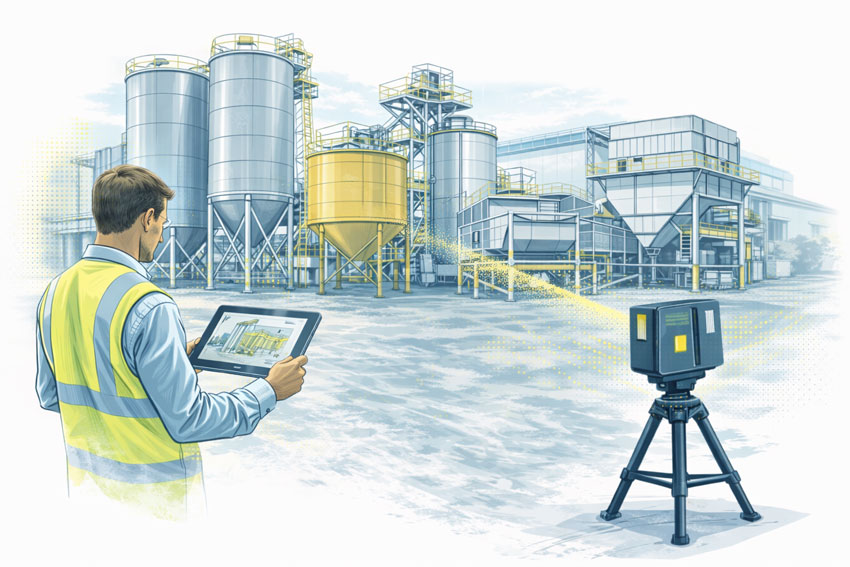
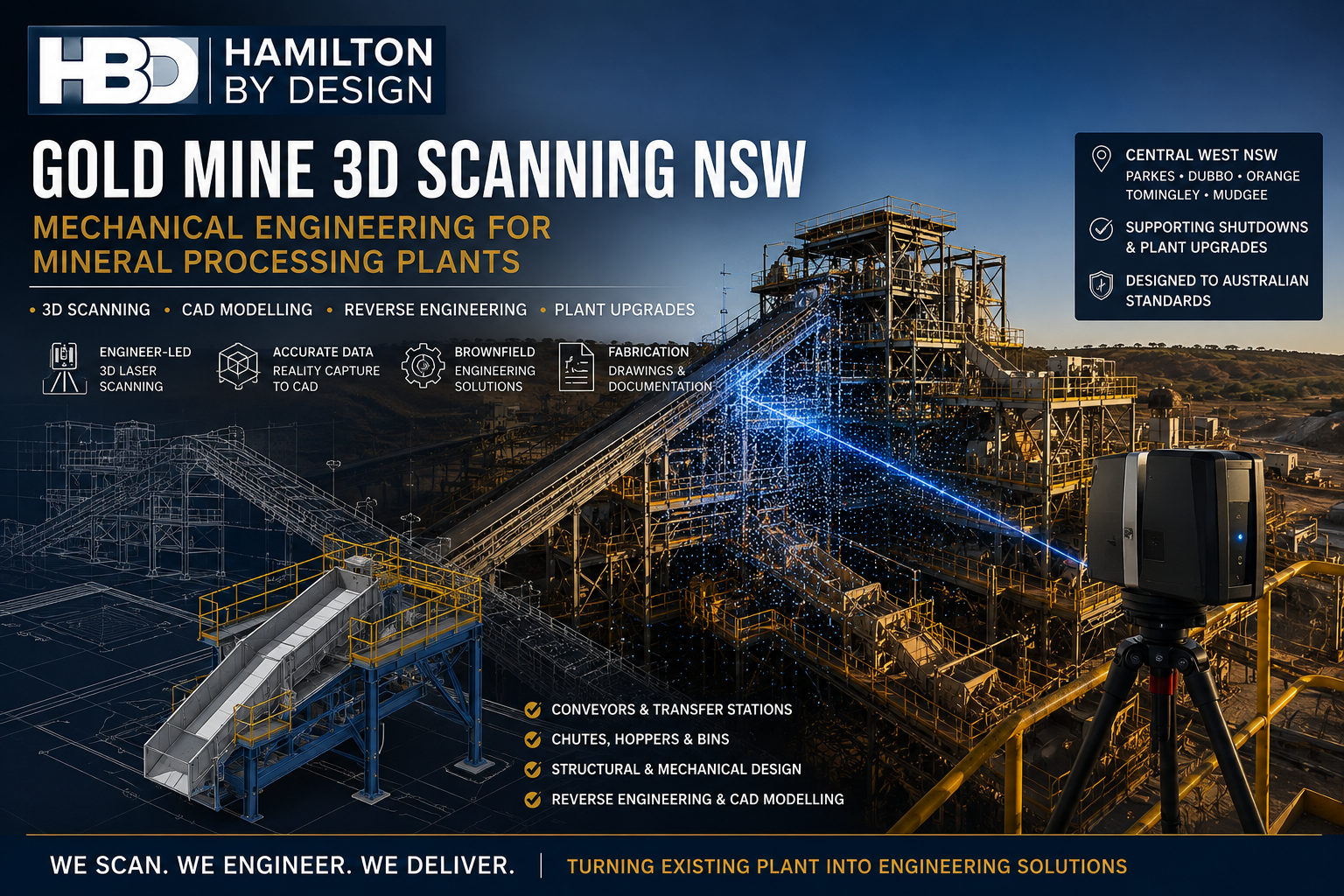
Gold mine 3D scanning NSW infographic showing a mineral processing plant, LiDAR point cloud, CAD model, conveyors, chutes and mechanical engineering services.

Gold processing plants across Central West NSW are continually changing. Conveyors are extended, chutes are replaced, pumps are upgraded, platforms are modified, pipework is rerouted and new equipment is installed around infrastructure that may have been operating for decades.

The challenge is that the engineering drawings available for an established plant do not always represent what actually exists on site.

For brownfield projects, even a relatively small dimensional discrepancy can result in fabrication problems, clashes, installation delays or additional work during a planned shutdown.

Hamilton By Design provides engineer-led 3D laser scanning, mechanical engineering, reverse engineering and CAD modelling to support gold mines and mineral-processing facilities throughout regional NSW.

Our broader Mining NSW engineering and 3D scanning services support mine operators, engineering teams, maintenance departments and contractors that need reliable existing-condition information before plant modifications are designed.

Engineering Starts With Understanding What Is Actually There

A common challenge in an operating gold processing plant is the difference between the original design and the plant’s current configuration.

Over years of operation, equipment may have been replaced, structural steel altered, platforms added and process lines rerouted. Maintenance modifications may never have been incorporated into the original drawings.

When another upgrade is required, engineers can therefore find themselves designing from incomplete or inaccurate information.

Engineering-grade 3D LiDAR scanning provides another approach.

Hamilton By Design can capture the existing plant as a detailed three-dimensional point cloud, providing a measurable representation of equipment, structures and surrounding interfaces.

For regional projects, our engineering-grade 3D LiDAR scanning in Parkes NSW demonstrates how this approach can be applied to processing plants, conveyors, transfer points, structural steel, pipework and access platforms throughout Central West NSW.

The objective is simple:

Scan the existing plant before designing the modification.

What Can Be Captured in a Gold Processing Plant?

Terrestrial LiDAR scanning is particularly useful where many different systems occupy a congested area.

A scanning scope can include:

  • crushers and screens;
  • conveyors and transfer stations;
  • chutes and hoppers;
  • feeders;
  • pumps and pump bases;
  • pipework;
  • tanks and process equipment;
  • structural steel;
  • maintenance platforms;
  • stairs and walkways;
  • guards;
  • motors and gearboxes;
  • equipment foundations; and
  • surrounding interfaces.

Multiple scan positions can be registered together to create a coordinated point cloud of the required area.

Hamilton By Design’s broader engineering-grade 3D laser scanning services across Australia are specifically directed toward producing engineering-useful information for mining, heavy industrial and brownfield projects.

Rather than treating reality capture as the final deliverable, the scan can become the dimensional foundation for the engineering project.

Mechanical Engineering for Mineral Processing Plant Upgrades

Once existing conditions have been captured, the point cloud can be brought into the mechanical design environment.

Hamilton By Design provides mechanical engineering for mining infrastructure, supporting equipment associated with extraction, mineral processing and materials handling.

Typical brownfield engineering scopes may include:

  • conveyor modifications;
  • replacement transfer chutes;
  • hopper modifications;
  • equipment replacement layouts;
  • crusher and screen interfaces;
  • pump arrangements;
  • equipment support frames;
  • maintenance access;
  • machinery guarding;
  • structural/mechanical interfaces; and
  • plant retrofit projects.

This creates a practical Scan โ†’ Model โ†’ Design โ†’ Document workflow.

Instead of designing a new component independently and hoping it fits the existing plant, the proposed arrangement can be developed around captured site geometry.

That can be particularly valuable when fabrication is completed off site and installation must occur within a tightly controlled shutdown window.
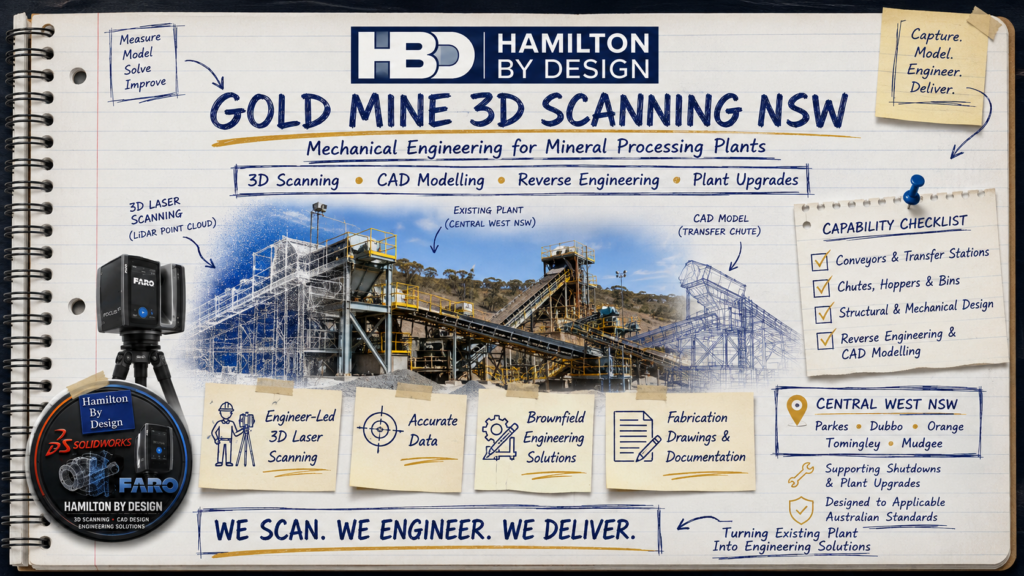
Gold Mine 3D Scanning NSW notebook infographic showing LiDAR scanning, CAD modelling, conveyors, chutes, reverse engineering and mineral processing plant upgrades.

Conveyors, Chutes, Hoppers and Transfer Points

Materials handling is one of the strongest applications for this workflow.

Gold-processing facilities depend on reliable movement of crushed ore and processed material between different stages of the plant. Transfer points can consequently become important areas for maintenance, wear management and future upgrades.

Hamilton By Design provides engineering support for bulk material handling in mining, including conveyors, transfer points, chutes, ROM bins, hoppers and associated steelwork.

For an existing transfer station, scanning can establish the position of:

  • conveyor centre lines;
  • head and tail pulleys;
  • surrounding steelwork;
  • existing chute geometry;
  • platforms;
  • handrails;
  • drives;
  • guards; and
  • adjacent plant.

A replacement chute or conveyor modification can then be modelled within this captured environment.

This provides greater confidence that interfaces, access requirements and surrounding infrastructure have been considered before fabrication begins.

Reverse Engineering Existing Mining Equipment

Not every plant problem requires completely new equipment.

Regional mining facilities can contain equipment that is no longer adequately documented or has been modified throughout its service life. In other cases, replacement parts may be difficult to source or the original manufacturer may no longer support the equipment.

Hamilton By Design’s reverse engineer 3D scanning service combines reality capture with engineering judgement and CAD modelling to assist with large industrial assets.

Depending on the component, reverse-engineering projects can establish existing geometry and interfaces before a replacement or improved design is developed.

Applications in a mineral-processing environment may include:

  • obsolete equipment components;
  • worn chute assemblies;
  • equipment bases;
  • housings;
  • fabricated structures;
  • guards;
  • ducting;
  • support frames; and
  • replacement mechanical assemblies.

The aim is not simply to copy an existing item. It is to understand how the component fits into the surrounding plant and develop an appropriate engineering solution for the required application.

Supporting Shutdown Engineering

Shutdowns provide limited opportunities to complete modifications to operating mineral-processing equipment.

Discovering that a fabricated component does not fit after the shutdown has commenced can result in significant pressure on maintenance and construction teams.

Hamilton By Design provides 3D scanning for mining shutdown projects to support plant upgrades, mechanical design, Scan-to-CAD modelling, structural verification and layout assessment before the shutdown begins.

Early scanning can allow engineering teams to investigate:

  • equipment installation envelopes;
  • structural interfaces;
  • pipework conflicts;
  • removal paths;
  • maintenance clearances;
  • access requirements;
  • conveyor interfaces; and
  • fabrication dimensions.

Proposed equipment can then be checked against captured existing conditions while there is still time to modify the design.

Scanning cannot remove every shutdown risk, but better existing-condition information can reduce the number of assumptions entering the engineering process.

From Point Cloud to Fabrication Documentation

Capturing the plant is only useful if the information can be converted into practical engineering deliverables.

Depending on the project scope, scan information can progress into:

  • registered point clouds;
  • existing-condition CAD models;
  • SolidWorks models;
  • STEP or SAT geometry;
  • equipment layouts;
  • general arrangements;
  • sections and elevations;
  • fabrication drawings;
  • DXF files;
  • bills of materials; and
  • installation information.

Hamilton By Design also provides mechanical drafting services across Australia for mining, industrial and plant projects, allowing the project to continue from site capture through design development and into documentation for fabrication.

This integrated approach can be valuable for regional mines because the same project information can be carried through multiple stages rather than being repeatedly interpreted by separate scanning, drafting and engineering providers.

Australian Standards for Mineral Processing Engineering

The standards applicable to a project depend on the particular equipment, design scope and site requirements.

For mechanical and structural modifications within mineral-processing facilities, applicable Australian Standards may include:

AS/NZS 4024 โ€“ Safety of Machinery
Relevant to machinery risk reduction, guarding and safety considerations associated with mechanical equipment and conveyor systems.

AS/NZS 4024.3610 โ€“ Conveyors โ€“ General Requirements
Potentially relevant where engineering modifications involve conveyor systems, transfer areas, guarding and associated safety requirements.

AS 1657 โ€“ Fixed Platforms, Walkways, Stairways and Ladders
Important where equipment modifications affect plant access, maintenance platforms, stairs, ladders, walkways and handrails.

AS 3990 โ€“ Mechanical Equipment โ€“ Steelwork
May apply to steelwork associated with mechanical equipment and equipment-support arrangements.

AS 4100 โ€“ Steel Structures
Relevant where a plant modification requires structural steel design, alteration, support frames or strengthening.

AS 3774 โ€“ Loads on Bulk Solids Containers
May be applicable when assessing loads associated with bins, hoppers and other structures containing bulk solids.

Other Australian Standards, client engineering specifications and statutory requirements may apply depending on the equipment and project.

Standards should therefore be identified as part of the project-specific engineering scope rather than assuming the same standards apply to every modification.

Gold Mine 3D Scanning Across Central West NSW

Hamilton By Design can support gold mines, mineral-processing facilities and industrial operations throughout Central West and regional NSW, including areas around:

Tomingley, Dubbo, Narromine, Peak Hill, Parkes, Orange, Bathurst, Mudgee and surrounding mining regions.

Site work can be combined with off-site point-cloud processing, CAD modelling, mechanical engineering and drafting.

This model is particularly suited to regional brownfield projects where the central engineering problem is straightforward:

The plant has changed, but the drawings have not.

By capturing the existing facility first, engineers can develop modifications using information that represents the plant as it exists today rather than relying entirely on historical documentation.

Engineer-Led Reality Capture for Brownfield Gold Plants

Hamilton By Design combines practical mechanical engineering experience with terrestrial LiDAR scanning and CAD modelling.

For mineral-processing projects, that means the scanning process can be planned around the engineering problem.

If the project involves replacing a transfer chute, modifying a conveyor, installing new equipment or reverse engineering an existing asset, the scan can focus on the interfaces needed to complete that work.

The result is more than a point cloud.

It is a digital engineering workflow designed to help turn existing plant conditions into practical information for design, fabrication, installation and future asset documentation.


Frequently Asked Questions

What is Gold Mine 3D Scanning?

Gold mine 3D scanning uses terrestrial laser scanning or LiDAR to capture accurate three-dimensional information about mining and mineral-processing infrastructure. The resulting point cloud can be used for CAD modelling, plant modifications, equipment replacement, reverse engineering and existing-condition documentation.

Can Hamilton By Design scan an operating gold processing plant?

Yes. Appropriate scanning scopes can capture conveyors, chutes, processing equipment, structural steel, pipework, platforms and other infrastructure. Site access, safety requirements and operational restrictions need to be considered when planning the work.

Can you design the modification after completing the scan?

Yes. One of the main benefits of an engineer-led scanning workflow is the ability to continue from reality capture into CAD modelling, mechanical engineering, clash checking and drafting.

Can you scan conveyors and transfer stations?

Yes. Conveyors, transfer stations, chutes, supporting steelwork, drives, platforms, guarding and surrounding equipment are well suited to terrestrial 3D laser scanning.

Can 3D scanning assist with shutdown preparation?

Yes. Scanning before a shutdown can provide existing-condition information for equipment replacement, fabrication, structural modifications, access planning and installation interfaces before the shutdown starts.

Does Hamilton By Design provide reverse engineering?

Yes. Existing industrial and mining assets can be captured using 3D scanning and developed into engineering CAD geometry where reverse engineering forms part of the project scope.

Which Australian Standards apply to mineral-processing plant modifications?

The standards depend on the equipment and scope. Commonly relevant standards can include AS/NZS 4024 for machinery safety, AS/NZS 4024.3610 for conveyors, AS 1657 for fixed access systems, AS 3990 for mechanical equipment steelwork, AS 4100 for structural steel and AS 3774 where bulk-solids-container loading is applicable.

Does Hamilton By Design service Central West NSW?

Yes. Hamilton By Design supports regional NSW mining and industrial projects, with site-based reality capture able to be combined with off-site point-cloud processing, CAD modelling, mechanical engineering and drafting.

Planning a Gold Processing Plant Upgrade?

If existing drawings cannot be trusted, obtaining reliable existing-condition information before detailed engineering begins can significantly improve the quality of a brownfield project.

Hamilton By Design can assist with 3D LiDAR scanning, mechanical engineering, reverse engineering, CAD modelling and fabrication documentation for gold mines and mineral-processing plants throughout Central West NSW and regional Australia.

Scan what exists. Engineer what is required. Design it to fit.


Hamilton By Design logo displayed on a blue tilted rectangle with a grey gradient background

Contact Us – Talk To Us

Name
Would you like us to arrange a phone consultation for you?
Address

Our clients:
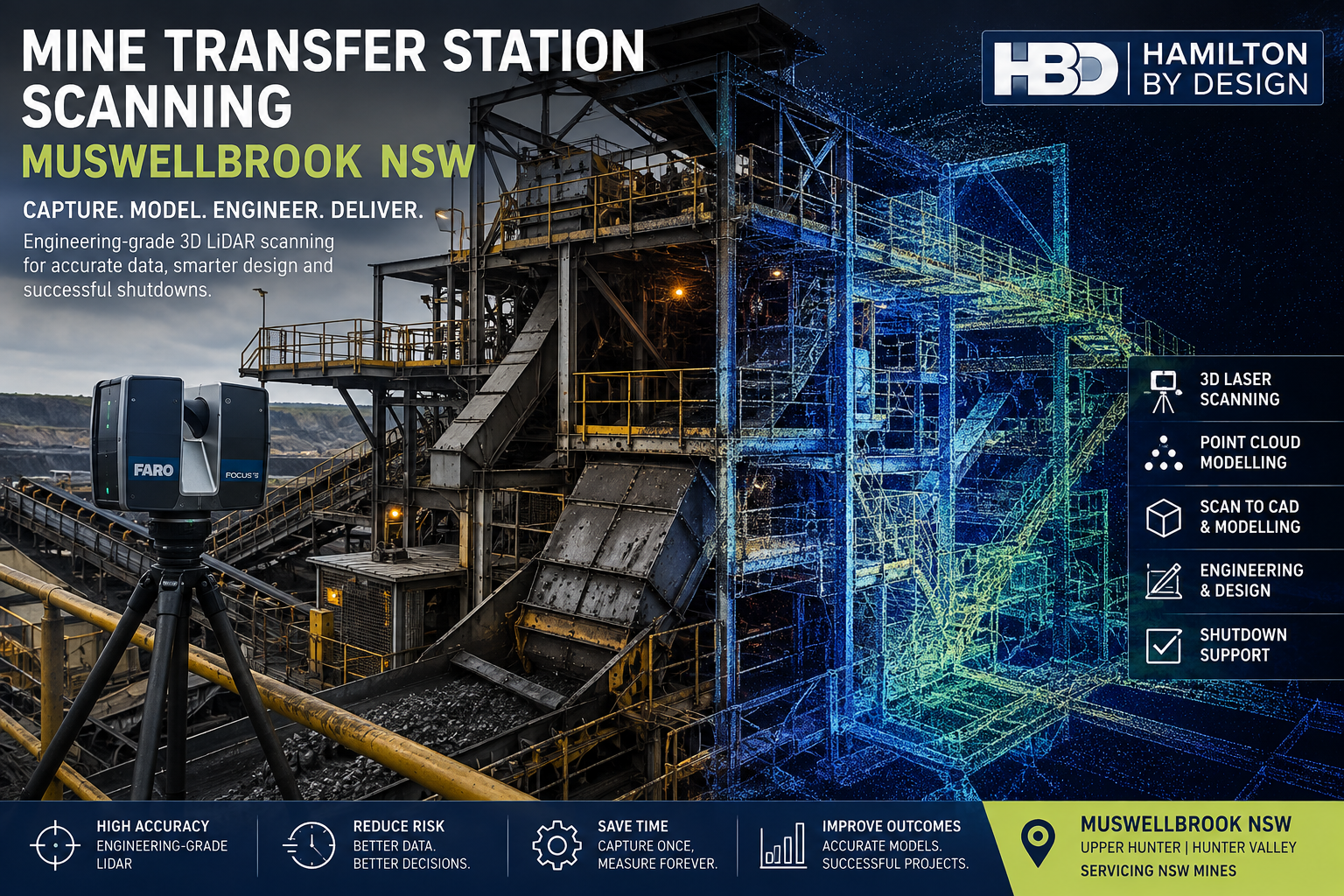


Mine Transfer Station Scanning Muswellbrook NSW | Hamilton By Design

Mine transfer station scanning in Muswellbrook NSW using engineering-grade 3D LiDAR and point-cloud modelling

Mine Transfer Station Scanning Muswellbrook NSW

Engineering-Grade 3D Laser Scanning for Congested Transfer Stations, Chutes and Conveyor Upgrades

Mine transfer stations are among the most spatially complex areas within coal-handling and bulk-material-handling infrastructure.

Within a relatively small footprint, a transfer station may contain conveyors, head pulleys, transfer chutes, structural steel, access platforms, walkways, guarding, dust extraction ducting, pipework, electrical services and maintenance zones. These systems must operate together while remaining accessible for inspection, maintenance and future modification.

For engineering teams, this creates a practical problem:

Transfer stations are highly congested and can be difficult to measure accurately using conventional methods.

Hamilton By Design provides mine transfer station scanning services in Muswellbrook NSW and throughout the Upper Hunter, using engineering-grade terrestrial LiDAR scanning, registered point clouds and CAD modelling to capture the actual installed condition of existing mining infrastructure.

The objective is not simply to create a visual 3D representation. It is to establish a reliable, measurable engineering dataset that can support conveyor modifications, chute replacements, structural upgrades, shutdown planning and brownfield plant development.

Why Transfer Stations Are Difficult to Measure

Transfer stations are different from relatively open conveyor galleries. They are typically vertical, congested structures in which multiple mechanical and structural systems intersect.

An existing transfer station may include:

  • incoming and outgoing conveyors;
  • head and discharge pulleys;
  • transfer chutes;
  • hoppers;
  • structural columns and beams;
  • maintenance platforms;
  • stairs and ladders;
  • handrails;
  • conveyor guarding;
  • pipework;
  • dust extraction systems;
  • cable trays;
  • concrete floors and plinths; and
  • surrounding plant interfaces.

As mining infrastructure is progressively modified, the installed arrangement may also diverge from original drawings.

A chute may have been replaced during a previous shutdown. Steelwork may have been strengthened. Platforms may have been modified. Additional services may have been installed around the original plant.

Hamilton By Design’s work with 3D laser scanning for conveyor transfer towers addresses this problem by capturing the true geometry of conveyors, chutes, structural steel and surrounding plant before engineering modifications are developed.

The Cost of Incomplete Site Information

Traditional field measurement remains useful, but it becomes increasingly difficult when an engineering project depends on hundreds of spatial relationships.

An engineer may visit site, obtain the dimensions considered necessary at the time and then return to the office to begin design.

Once modelling progresses, another critical dimension may be identified.

This can produce a repeated cycle:

Site measure โ†’ design โ†’ discover missing dimension โ†’ return to site โ†’ remeasure โ†’ revise design

For mine sites, repeated access can be costly because site visits may involve inductions, travel, permits, shutdown access and coordination with operations.

The engineering issue is therefore not merely the time required to measure one dimension. It is the uncertainty created when the wider installed environment has not been comprehensively captured.

Terrestrial LiDAR scanning changes that approach by recording millions of spatial measurements throughout the transfer station.

The resulting point cloud can subsequently be interrogated as the engineering develops.

A simple value proposition is:

Capture the transfer station once and continue measuring digitally from the registered point cloud.

Who Can Benefit from Transfer Station Scanning?

Mine transfer station scanning can support a wide range of technical stakeholders, including:

  • mine owners and operators;
  • engineering managers;
  • project engineers;
  • mechanical engineers;
  • structural engineers;
  • maintenance superintendents;
  • reliability teams;
  • shutdown planners;
  • CHPP personnel;
  • conveyor contractors;
  • chute specialists;
  • EPCM organisations;
  • fabrication contractors; and
  • drafting teams.

The important consideration is not who wants a 3D model.

The real question is:

Who requires reliable information about the existing transfer station to make an engineering decision?

For example, a project engineer may need accurate pulley centres before designing a replacement chute. A structural engineer may need existing beam locations before modifying supporting steel. A shutdown planner may need to understand removal paths and maintenance access before work begins.

Each discipline may use the same captured dataset differently.

Define the Engineering Requirement

Before scanning begins, the purpose of the project should be established.

Typical transfer-station projects may involve:

  • new transfer chute installation;
  • chute replacement;
  • conveyor modification;
  • pulley replacement;
  • structural strengthening;
  • new platforms or walkways;
  • guarding upgrades;
  • dust extraction modifications;
  • equipment replacement; or
  • plant expansion.

Understanding the engineering requirement determines the required scan coverage.

The objective is not to collect unnecessary data. It is to ensure that all critical interfaces are captured before the project moves into detailed design.

Capture the Existing Transfer Station

Terrestrial LiDAR scanners are positioned at multiple levels and viewpoints throughout the transfer station.

Each scan records the three-dimensional relationship between visible surfaces.

Because the scanner captures a broad field of view, the resulting dataset can include much more than the component initially being modified.

For example, a scan undertaken for a chute replacement may also capture surrounding beams, existing platforms, maintenance access, adjacent pipework, guarding, floor levels and nearby equipment.

This contextual information may become important later in the project.

For mining transfer points specifically, Hamilton By Design combines scanning with engineering analysis through its work on 3D scanning of chutes, hoppers and mining transfer points, where captured geometry can support retrofit accuracy, chute design and material-flow improvements.

Register the Point Cloud

Individual scans are processed and registered into a coordinated point-cloud dataset.

This creates a measurable digital representation of the transfer station at the time of capture.

Engineering personnel can then review dimensions away from site.

Typical information may include:

  • conveyor centrelines;
  • pulley locations;
  • chute flange positions;
  • structural member coordinates;
  • equipment offsets;
  • platform elevations;
  • available clearances;
  • service locations; and
  • maintenance access envelopes.

This is particularly useful where project teams are geographically separated or where physical access to the transfer station is restricted.

Convert the Scan into Engineering CAD

Point-cloud data may be sufficient for some projects.

For others, selected infrastructure can be reconstructed as engineering CAD geometry.

Depending on the project, the model may include:

  • conveyor centrelines;
  • pulleys;
  • transfer chute geometry;
  • structural steel;
  • platforms;
  • equipment envelopes;
  • maintenance clearances; and
  • surrounding plant interfaces.

The appropriate modelling philosophy is fit for purpose.

It is rarely necessary to model every nut, bolt, bracket and cable tray.

The objective is to represent the geometry required to answer the engineering question accurately.

For brownfield work, Hamilton By Design applies this type of reality-capture workflow through its engineering-led 3D scanning for brownfield industrial upgrades, where existing plant conditions are used as the basis for practical retrofit and shutdown engineering.

Design Against the Actual Installed Condition

Once the existing transfer station has been captured, the proposed modification can be developed directly against the point cloud or CAD model.

This can help engineers assess:

  • equipment clearances;
  • structural interfaces;
  • conveyor alignment;
  • chute fit-up;
  • installation pathways;
  • maintenance access;
  • guarding requirements; and
  • potential clashes.

The objective is straightforward:

Identify the interference during design rather than during the shutdown.

This is particularly important in brownfield mining environments where fabrication may occur off site and components must arrive ready to install.

Unexpected site modifications during a shutdown can affect labour, crane planning, production and overall project schedule.

Transfer Chutes and Material-Flow Problems

Not every transfer-station problem is dimensional.

Some are operational.

Examples include:

  • chute blockages;
  • material buildup;
  • excessive wear;
  • poor trajectory;
  • spillage;
  • dust generation;
  • impact damage; and
  • belt loading problems.

In these cases, scanning provides the actual installed geometry, while engineering analysis can investigate why the transfer point is not performing as intended.

Where appropriate, discrete element modelling can also be used to analyse material behaviour through the chute.

Hamilton By Design’s broader mining engineering services combine LiDAR capture, mechanical design and fabrication-focused engineering for brownfield mining and asset modification projects.

Conveyor Transfer Chute Design

Transfer chute performance is closely connected to conveyor reliability.

Poor chute geometry can contribute to material buildup, excessive wear, impact loading, spillage and belt-tracking problems.

Where the existing transfer point is being modified, the point cloud can be used to establish the installed geometry before a replacement or upgraded chute is developed.

Hamilton By Design provides conveyor transfer chute design for mining, combining practical mechanical engineering with existing-condition capture to support retrofit and brownfield projects.

Coal Chute Design

Coal transfer systems require consideration of more than dimensional fit.

Flow direction, material properties, liner arrangement, wear zones, impact velocity and maintenance access can influence chute performance.

For coal-handling applications, Hamilton By Design’s coal chute design services provide an additional engineering pathway where captured transfer-station geometry can be combined with chute redesign and materials-handling analysis.

Conveyor Reliability and Failure Reduction

Transfer stations are often closely associated with conveyor reliability problems.

Misalignment, wear, spillage, poor transfer geometry and structural movement can all contribute to operational issues.

Hamilton By Design’s technical resource on common conveyor failures in mining plants provides further context on how engineering, inspection and digital modelling can support more reliable conveyor systems.

Bulk Material Handling Engineering

Transfer stations should not always be considered in isolation.

They form part of a wider bulk-material-handling system connecting ROM infrastructure, conveyors, stockpiles, processing plant and product handling systems.

Hamilton By Design’s bulk material handling engineering for mining considers the wider relationship between conveyors, chutes, transfer stations and supporting mine infrastructure.

This broader systems view can be particularly useful when a transfer-station modification affects upstream or downstream equipment.

Mine Transfer Station Scanning in Muswellbrook NSW

Muswellbrook is strategically located within the Upper Hunter mining region and is surrounded by substantial coal-mining and materials-handling infrastructure.

This makes the area particularly relevant for services associated with:

  • conveyor upgrades;
  • CHPP modifications;
  • transfer-station refurbishments;
  • structural upgrades;
  • chute replacement;
  • shutdown engineering; and
  • mine plant life-extension projects.

Hamilton By Design can support projects throughout Muswellbrook, Denman, the Upper Hunter and the wider Hunter Valley region.

The service is particularly valuable where existing infrastructure is ageing, heavily modified or difficult to access.

Tools Supporting the Workflow

A practical mine transfer-station scanning workflow may incorporate several tools.

FARO Focus S70 can provide detailed terrestrial LiDAR capture of transfer towers and surrounding infrastructure.

FARO Orbis may support supplementary mobile capture where appropriate.

FARO SCENE can be used to register individual scans into a coordinated point cloud.

Autodesk ReCap can assist with point-cloud preparation and CAD interoperability.

SolidWorks can support mechanical components, chute geometry and fabrication models.

Autodesk Inventor and AutoCAD can support broader plant modelling, layouts and drafting.

Navisworks can assist with coordination and clash review between existing-condition data and proposed models.

Where material-flow performance is part of the engineering problem, Rocky DEM may assist with analysing particle trajectories, impact locations, wear zones and transfer behaviour.

The technology should, however, remain secondary to the engineering objective.

The primary deliverable is reliable information that supports better engineering decisions.

Typical Project Deliverables

Depending on client requirements, deliverables may include:

  • registered E57 point clouds;
  • RCP and RCS datasets;
  • LAS files;
  • measurable point-cloud data;
  • existing-condition CAD models;
  • SolidWorks models;
  • STEP or Parasolid files;
  • DWG and DXF drawings;
  • general arrangement drawings;
  • sections and elevations;
  • proposed-versus-existing models;
  • clash-review models;
  • eDrawings; and
  • PDF engineering documentation.

Some projects may require only scan data.

Others may progress through:

Scan โ†’ Register โ†’ Model โ†’ Engineer โ†’ Detail โ†’ Fabricate

Frequently Asked Questions

What is mine transfer station scanning?

Mine transfer station scanning uses terrestrial LiDAR to capture the three-dimensional geometry of conveyors, chutes, structural steel, platforms, services and surrounding plant within a transfer station.

Why are transfer stations difficult to measure manually?

Transfer stations are typically congested and multi-level structures. Conveyor systems, chute geometry, steelwork, access platforms, guarding and services can occupy the same restricted space, making comprehensive manual measurement difficult.

Can additional dimensions be obtained after leaving site?

Yes. Once scans are registered into a measurable point cloud, engineering teams can obtain many additional dimensions digitally without necessarily returning to site.

Can transfer station scanning support chute replacement?

Yes. LiDAR can capture existing pulley positions, chute interfaces, structural steel, surrounding equipment and maintenance clearances before a replacement chute is designed.

Can the point cloud be converted into CAD?

Yes. Relevant infrastructure can be reconstructed as CAD geometry according to the engineering requirement. The appropriate level of modelling depends on how the information will ultimately be used.

Can scanning assist with structural modifications?

Yes. Existing structural members, columns, beams, platforms and equipment interfaces can be captured to support brownfield structural modifications and strengthening projects.

Is DEM required for every transfer station project?

No. DEM is most relevant where material-flow behaviour, trajectory, wear, blockage or impact is part of the problem. For dimensional fit-up and structural modifications, LiDAR and CAD may be sufficient.

What areas do you service around Muswellbrook?

Hamilton By Design can support mine and industrial projects throughout Muswellbrook, Denman, the Upper Hunter and the wider Hunter Valley NSW region.

Mine Transfer Station Scanning Muswellbrook NSW

For transfer-station upgrades, reliable knowledge of the existing plant can significantly reduce engineering uncertainty.

Terrestrial LiDAR scanning provides a practical way to capture congested conveyors, chutes, structural steel, platforms and surrounding services as a measurable digital dataset.

That dataset can then support engineering modelling, structural upgrades, conveyor modifications, shutdown planning and fabrication.

For brownfield mine projects in Muswellbrook and the Upper Hunter, the principle is simple:

Capture the congested transfer station accurately. Develop the engineering from measured reality. Verify the modification before it reaches site.


Hamilton By Design logo displayed on a blue tilted rectangle with a grey gradient background

Contact Us – Talk To Us

Name
Would you like us to arrange a phone consultation for you?
Address

Our clients:



3D Scanning for Mining Shutdown Projects

3D Scanning for Mining Shutdown Projects | Engineering Laser Scanning

Mining shutdowns are critical windows where maintenance, upgrades, and engineering improvements must be completed quickly and safely. These shutdown periods often involve complex work scopes such as equipment replacements, structural upgrades, conveyor modifications, and new process installations.

One of the most effective technologies supporting shutdown planning today is engineering-grade 3D laser scanning. By capturing highly accurate spatial data of existing infrastructure, engineers can design and verify upgrades before the shutdown begins, reducing risk, rework, and costly delays.

At Hamilton By Design, 3D laser scanning plays a key role in helping mining operations capture accurate plant conditions and convert them into usable engineering data.


Why Mining Shutdowns Require Accurate Site Data

Mining plants evolve over decades. Equipment is modified, conveyors are relocated, structural steel is reinforced, and piping systems are extended or replaced. Unfortunately, plant drawings often do not reflect these changes.

During shutdown projects this creates significant risk, including:

  • Interference between new equipment and existing structures
  • Unexpected clashes with pipework or cable trays
  • Incorrect equipment fitment
  • Delays caused by rework or site modifications

3D laser scanning eliminates these uncertainties by capturing the true as-built condition of the plant.

Millions of spatial measurements are collected in minutes, producing a detailed point cloud model of the plant that engineers can use during design and planning.


How 3D Laser Scanning Supports Shutdown Planning

Engineering scanning provides accurate digital data that allows engineers to prepare shutdown work well before crews arrive onsite.

Capture Existing Plant Geometry

Scanning records the exact positions of key plant infrastructure including:

  • Conveyor structures
  • Transfer chutes
  • Structural steel
  • Pump skids
  • Pipework and services
  • Access platforms and walkways

This data forms a digital model of the plant that engineers can use during design.


Scan-to-CAD Engineering Models

Once scanning is complete, the point cloud data can be converted into CAD models. These models allow engineers to:

  • Design new components around existing infrastructure
  • Develop fabrication drawings
  • Plan shutdown installation sequences
  • Verify spatial clearances

This process is commonly known as Scan-to-CAD engineering modelling.


Clash Detection Before the Shutdown

One of the biggest advantages of scanning is the ability to identify problems before the shutdown begins.

Engineers can compare the scanned plant with proposed designs and identify potential clashes between:

  • Existing structures
  • Pipework and services
  • New equipment
  • Structural modifications

This ensures equipment will fit correctly when installation begins.


Typical Shutdown Projects That Benefit from 3D Scanning

Many mining upgrade projects benefit from scanning before shutdown work begins.

Conveyor and Transfer Upgrades

Mining conveyors are frequently modified during shutdowns. Engineers may need to:

  • Redesign transfer chutes
  • Install new belt cleaners
  • Upgrade pulley assemblies
  • Replace conveyor structures

Scanning ensures new equipment integrates correctly with existing infrastructure.


Pump and Process Equipment Replacement

Pump skids and process equipment often require precise alignment with existing pipework and foundations.

3D scanning allows engineers to verify:

  • Pipe flange locations
  • Equipment clearances
  • Structural support requirements

This reduces installation issues during shutdown.


Structural Steel Modifications

Structural upgrades are common in older processing plants. Scanning helps engineers assess:

  • Beam locations
  • Column spacing
  • Structural clearances
  • Equipment support interfaces

Accurate geometry reduces fabrication errors.


Brownfield Plant Expansions

Shutdowns are often used to integrate new plant sections into existing infrastructure.

Scanning allows engineers to design upgrades within tight spatial constraints, particularly in brownfield mining environments where space is limited.


Engineering-Grade Scanning vs Survey Scanning

Not all scanning services are the same.

Engineering-grade scanning focuses on design and fabrication accuracy, rather than simply generating visual models.

Hamilton By Design scanning workflows typically combine:

  • Engineering LiDAR scanners
  • Handheld metrology scanners where required
  • SolidWorks modelling
  • Engineering interpretation of point cloud data

This ensures the data supports real engineering decisions, not just visualisation.


Benefits for Mining Operations

Using 3D scanning during shutdown planning delivers several key advantages.

Reduced shutdown risk through accurate site data.

Faster engineering design using precise plant geometry.

Improved fabrication accuracy for shutdown components.

Reduced rework caused by installation clashes.

Improved safety through better shutdown planning.


Supporting Mining Shutdown Projects with Engineering 3D Scanning

Hamilton By Design provides engineering-led 3D laser scanning services for mining and industrial projects across Australia.

Our scanning workflows support:

  • Shutdown planning
  • Mechanical design upgrades
  • Scan-to-CAD modelling
  • Structural verification
  • Plant layout assessments
3D LiDAR scanning and 3D modelling service button โ€” laser scanner capturing a point cloud for engineering and CAD modelling
Mechanical engineering services

By combining advanced scanning technology with mechanical engineering expertise, we help mining companies reduce risk and deliver successful shutdown projects.


Name
Would you like us to arrange a phone consultation for you?
Address

3D CAD Modelling Australia service banner for Hamilton By Design
Australian Drafting logo featuring bold white text reading "Australian Drafting" centred on a blue rounded rectangle background.
Engineering Governance title graphic featuring bold white text reading "Engineering Governance" centred on a blue rounded rectangle background.
Mechanical, Structural & Pipework Drafting service banner by Hamilton By Design featuring white text on a blue background.
Mechanical engineering services
Blue rounded button with the text โ€œSolidWorks Designโ€ in white.
Finite Element Analysis (FEA) engineering simulation button
3D LiDAR Scanning Darwin for engineering surveys, laser scanning, reality capture and point cloud modelling services
3D LiDAR Scanning Australia engineering services for laser scanning, reality capture, scan-to-CAD, Scan-to-BIM and as-built documentation across Australia
3D LiDAR scanning services on the Central Coast providing engineering-grade laser scanning, point cloud capture, scan-to-CAD modelling and industrial reality capture for infrastructure and industrial projects.
3D LiDAR Scanning Perth for engineering surveys, laser scanning, reality capture and point cloud modelling services
3D LiDAR Scanning Sydney for engineering surveys, laser scanning, reality capture and point cloud modelling services
3D LiDAR Scanning Brisbane for engineering surveys, laser scanning, reality capture and point cloud modelling services
3D LiDAR Scanning Canberra for engineering surveys, laser scanning, reality capture and point cloud modelling services
3D LiDAR Scanning Newcastle for engineering surveys, laser scanning, reality capture and point cloud modelling services
3D LiDAR Scanning Adelaide for engineering surveys, laser scanning, reality capture and point cloud modelling services

Supporting Australian Coal โ€“ Engineering-Led 3D Scanning for CHPP & Coal Wash Plants

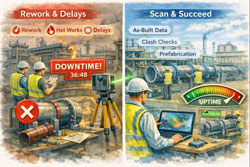
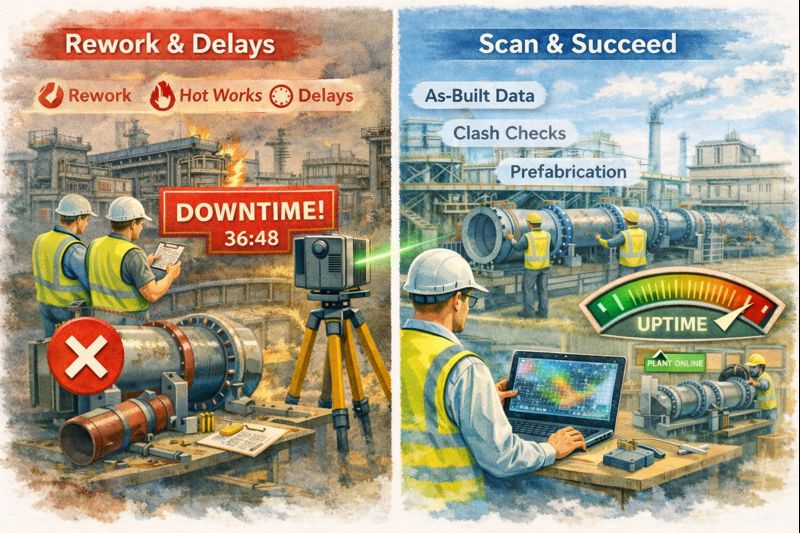
CHPP wash plant illustration comparing shutdown rework with LiDAR scanning and prefabrication success.

3D Scanning Services for CHPP โ€“ Reduce Rework, Maximise Uptime

Australian coal operations depend on reliable Coal Handling & Preparation Plants (CHPP), wash facilities, conveyors and mechanical systems. Every shutdown, upgrade and modification must be delivered quickly and safely to protect production. The most effective way to achieve this is through engineering-led 3D scanning services that capture real site conditions before a single component is fabricated.

Hamilton By Design specialises in FARO LiDAR and structured-light 3D scanning for the coal sector, turning complex brownfield sites into accurate digital models that drive practical engineering outcomes. Our focus is simple: maximise plant uptime by reducing rework.


Why Shutdowns Need Better Information

Coal wash plants are dynamic environments. Over decades of modifications:

  • drawings no longer match reality
  • structures move under load
  • pipe routes are altered
  • access becomes restricted

Relying on tape measures and sketches during a shutdown invites risk. A bracket that is 20 mm wrong or a spool that fouls an existing service can cost days of lost production. Accurate 3D scanning before the outage removes those unknowns.


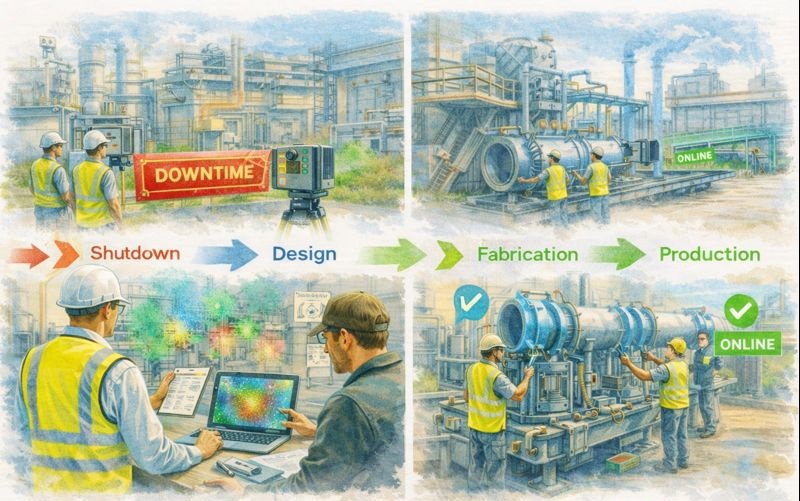
Coal wash plant shutdown workflow from delays to scan-led success using LiDAR.

Hamilton By Design 3D Scanning Services

Our scanning services are built specifically for industrial and mining applications:

FARO LiDAR As-Built Capture

  • full plant and conveyor surveys
  • transfer stations, bins and pump boxes
  • structural steel and foundations
  • tie-in points for new pipework
  • clearance verification for maintenance

Structured-Light Scanning (EinScan)

  • motors, gearboxes and legacy parts
  • guards, covers and small assemblies
  • reverse engineering for obsolete components
  • detailed capture for first-time-fit design

Point Cloud to CAD Workflows

  • modelling in SolidWorks & Fusion
  • fabrication drawings for local workshops
  • clash detection and installation planning
  • digital twins for ongoing maintenance

These services ensure that design decisions are based on measured reality, not assumptions.


Engineering-led LiDAR scanning sequence from downtime to online restart.

FARO LiDAR for CHPP As-Builts

Terrestrial LiDAR creates a high-density point cloud of the entire coal wash facility. Engineers can:

  • design new chutes and spools directly over site geometry
  • confirm conveyor alignments
  • plan access platforms and walkways
  • test installation sequences digitally

By linking scanning to engineering, components arrive on site ready to install โ€” protecting uptime and reducing rework during critical shutdown windows.


Practical Outcomes for Coal Plants

Conveyor & Transfer Upgrades

  • accurate chute replacements
  • skirt and belt line verification
  • drive and pulley modifications
  • minimal site adjustments

Pump Boxes & Pipework

  • prefabricated spools that fit first time
  • reverse engineering of worn equipment
  • safe tie-ins without surprises

Structural & Access Works

  • platform and handrail retrofits
  • screen support modifications
  • crane and lifting planning

Every task is driven by 3D scan data so workshops fabricate with confidence.


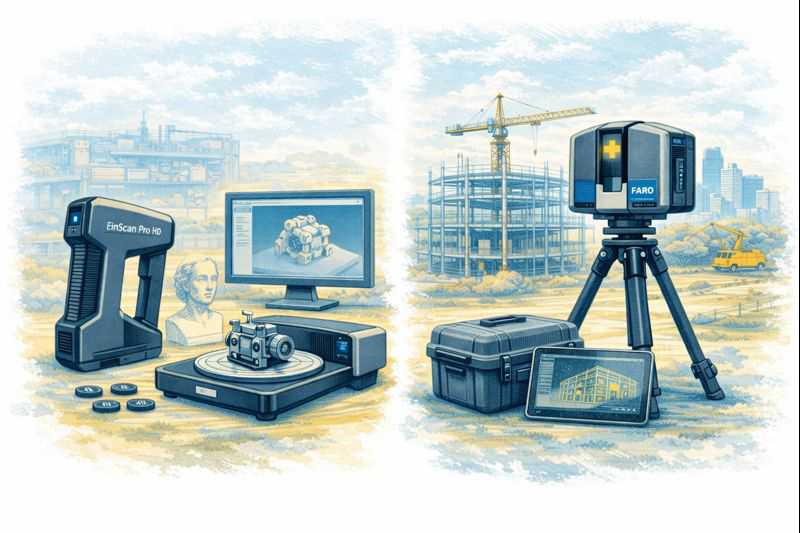
Visual comparison of EinScan object scanner and LiDAR terrestrial laser scanner in matching sketch style.

Engineering-Led, Not Just Surveying

Hamilton By Design treats scanning as part of the engineering process:

  1. 3D capture of the live plant
  2. engineering review of critical datums
  3. point cloud modelling in parametric CAD
  4. fabrication drawings for Australian workshops
  5. shutdown planning to ensure first-time fit

This approach directly supports the goal of maximum plant uptime.


Supporting Australian Capability

Scan-driven design keeps work local. Regional fabricators receive accurate models and drawings that reflect the real CHPP environment, enabling:

  • faster workshop production
  • fewer site variations
  • safer installations
  • reduced dependence on imported components

Committed to the Coal Sector

Hamilton By Design supports coal operations across NSW, the Central Coast, Sydney and regional Queensland including Mount Isa. Our 3D scanning services enhance every stage of shutdown planning and brownfield upgrades by eliminating guesswork and cutting rework.


Hamilton By Design logo displayed on a blue tilted rectangle with a grey gradient background
3D LiDAR scanning and 3D modelling service button โ€” laser scanner capturing a point cloud for engineering and CAD modelling
Mechanical engineering services

Our Services

  • FARO LiDAR scanning for CHPP as-builts
  • EinScan component capture
  • Point cloud to CAD modelling
  • Fabrication drawings & DXF outputs
  • Clash detection and digital twin support

Maximise your plant uptime by reducing rework โ€” talk to us before your next shutdown.

Name
Would you like us to arrange a phone consultation for you?
Address

3D CAD Modelling Australia service banner for Hamilton By Design
Finite Element Analysis (FEA) engineering simulation button
Mechanical engineering services

Mechanical Engineering | Structural Engineering


AS 3774 โ€“ Loads on Bulk Solids Containers: Why It Matters for Safety and Compliance

Engineer using 3D LiDAR scanner to capture silos, hoppers, bins, and bulk solids containers at an industrial processing plant.

AS 3774 โ€“ Loads on Bulk Solids Containers | Safety & Compliance

AS 3774 Loads on Bulk Solids Containers exists for a simple reason:
bulk solids do not behave like fluids, and incorrect load assumptions can create serious structural and safety risks.

For asset owners, engineers, and project teams involved in mining, mineral processing, manufacturing, and bulk materials handling, AS 3774 provides the framework for understanding how loads actually develop in silos, bins, hoppers, chutes, transfer stations, and surge bins.

Yet despite its long-standing availability, many new installations are still being delivered without full consideration of AS 3774 load cases.

The risks created by this gap are often not immediately visible โ€” but they are very real.


Engineer using 3D LiDAR scanner to capture silos, hoppers, bins, and bulk solids containers at an industrial processing plant.

What AS 3774 Is Designed to Address

AS 3774 recognises that bulk solids behave in complex and sometimes counter-intuitive ways. Unlike liquids, bulk materials:

  • Develop non-uniform wall pressures
  • Apply eccentric and asymmetric loads
  • Change load paths depending on flow behaviour
  • Generate dynamic and cyclic forces during filling and discharge

The standard provides guidance for determining realistic design loads based on how material actually flows and interacts with container geometry.

This applies across all bulk solids containers, including:

  • Silos
  • Bins and surge bins
  • Hoppers
  • Chutes and transfer stations
  • Rail and ship loading structures
  • Feeders integrated with bins

Why Safety and Compliance Depend on AS 3774

The purpose of AS 3774 is not academic. It exists to prevent outcomes such as:

  • Progressive wall deformation
  • Fatigue cracking and bolt failure
  • Local buckling or plate tearing
  • Uncontrolled discharge or blockage release
  • Unexpected load transfer into supporting structures

What makes these issues particularly dangerous is that they often develop over time, not at commissioning.

A structure can appear โ€œfineโ€ on day one โ€” while accumulating damage due to:

  • Cyclic loading
  • Eccentric discharge patterns
  • Inaccurate assumptions about material properties
  • Mixed construction materials behaving differently over time

Common Design Assumptions That Create Hidden Risk

In practice, many bulk solids containers are still designed using simplified or incorrect assumptions, including:

1. Treating Bulk Solids Like Fluids

Uniform hydrostatic pressure assumptions do not reflect real wall loading patterns and can significantly under-predict peak stresses.

2. Ignoring Eccentric Discharge

Off-centre outlets, partial blockages, or asymmetric flow paths can introduce large bending and torsional effects that are not obvious from geometry alone.

3. Incorrect or Assumed Material Properties

Bulk density, cohesion, moisture content, and flow behaviour are often assumed rather than verified โ€” yet small changes can have large load implications.

4. Mixed Materials Without Long-Term Consideration

It is not uncommon to see hoppers fabricated from a combination of stainless steel and mild steel, without adequate consideration of:

  • Differential stiffness
  • Fatigue behaviour
  • Corrosion mechanisms
  • Galvanic interaction

These issues may not present as immediate failures, but they can significantly reduce structural life and reliability.


Why the Risk Is Often Not Evident Today

One of the most concerning aspects of non-compliance with AS 3774 is that failure is rarely immediate.

Instead, risk accumulates quietly through:

  • Repeated filling and discharge cycles
  • Minor operational changes
  • Variations in material condition
  • Small geometric imperfections

By the time visible cracking, deformation, or operational issues appear, the structure may already be compromised.


The Role of Modern Engineering Tools (Briefly)

While AS 3774 is fundamentally about load determination, modern engineering tools can support compliance by helping teams:

  • Verify as-built geometry against design assumptions
  • Identify eccentric discharge paths and flow constraints
  • Review interfaces, wall angles, and structural continuity
  • Support independent engineering assessment without extended shutdowns

These tools do not replace the standard โ€” but they can help reveal whether its principles have been properly applied.


What Asset Owners and Project Managers Should Ask For

To demonstrate that AS 3774 has been adequately considered, asset owners and project managers should expect to see clear answers to questions such as:

  • What load cases were considered under AS 3774?
  • How were discharge conditions defined and assessed?
  • What assumptions were made about material properties?
  • How were eccentric and asymmetric loads addressed?
  • Was fatigue or cyclic loading considered?
  • How were mixed materials and interfaces assessed?
  • Has an independent engineering review been undertaken?

If this information cannot be clearly provided, compliance is difficult to demonstrate, regardless of how new the installation is.


Hamilton By Design logo displayed on a blue tilted rectangle with a grey gradient background
3D LiDAR scanning and 3D modelling service button โ€” laser scanner capturing a point cloud for engineering and CAD modelling
Mechanical engineering services

Why This Matters for New Installations

AS 3774 compliance is not about legacy assets or historical practices.
It is about ensuring that new installations are fit for purpose, safe, and defensible.

Where bulk solids containers are being delivered today without adequate consideration of realistic load behaviour, the risk is being transferred downstream โ€” to operators, maintainers, and asset owners.


Our clients


A Practical Closing Thought

If you are unsure whether AS 3774 has been properly applied to a bulk solids container, an independent engineering review can provide clarity.

The cost of verifying load assumptions and structural adequacy is typically minor compared to the consequences of discovering load-related issues after commissioning.

Hamilton By Design supports asset owners and project teams with engineering review, verification, and redesign of bulk solids containers, helping ensure that safety and compliance are addressed before problems develop.

Name
Would you like us to arrange a phone consultation for you?
Address
Finite Element Analysis (FEA) engineering simulation button
Mechanical engineering services

Mechanical Engineering | Structural Engineering


Mining Engineering Services Australia

Mining Engineering Services Australia

Hamilton By Design provides specialist mining engineering services supporting brownfield upgrades, plant modifications, and asset life-extension projects across Australia.

Our mining services combine engineer-led 3D LiDAR scanning, SolidWorks-based mechanical design, finite element analysis (FEA), and fabrication-ready documentation to reduce site risk, rework, and downtime. We work closely with mine owners, EPCMs, and fabricators to deliver practical, buildable engineering solutions for operating sites.


Engineering Services for Mining Operations

Mining assets operate in demanding environments where legacy drawings are often incomplete or unreliable. Hamilton By Design specialises in engineering services that start with accurate as-built capture and finish with constructible design documentation.

We support:

  • Operating mines and CHPP facilities
  • Brownfield plant upgrades and retrofits
  • Shutdown and maintenance projects
  • Safety, access, and compliance upgrades
  • Life-of-asset improvement programs

Our approach is tailored to live operational sites, minimising disruption while delivering reliable engineering outcomes.


Engineer-Led 3D LiDAR Scanning for Mining Sites

Accurate site data is the foundation of effective mining engineering. Hamilton By Design delivers engineer-led 3D laser scanning, ensuring the person responsible for the design understands site constraints from the outset.

Our scanning services support:

  • CHPPs and materials handling facilities
  • Conveyors, transfer chutes, and hoppers
  • Structural steel, platforms, and walkways
  • Pipework, mechanical services, and plant rooms

๐Ÿ‘‰ Learn more about our scanning capability:
3D Laser Scanning Services


Scan-to-CAD & As-Built Modelling for Mining Projects

Hamilton By Design converts mining site scans into accurate SolidWorks 3D models, forming the basis for design development, clash detection, and fabrication planning.

Our Scan-to-CAD services enable:

  • Confident retrofit design in brownfield environments
  • Reduced rework during fabrication and installation
  • Improved coordination between disciplines
  • Digital QA against real-world geometry

View our CAD modelling services:
3D CAD Modelling Australia


Mechanical Engineering for Mining Infrastructure

We deliver mechanical engineering services tailored to mining and heavy industry, with a strong focus on constructability, safety, and compliance.

Services include:

  • Mechanical design and equipment integration
  • Structural and load assessments
  • Retrofit and upgrade engineering
  • Design verification and peer review
  • Compliance with relevant Australian Standards

Learn more about our mining-focused engineering capability:
Mechanical Engineering โ€“ Mining Industry


Finite Element Analysis (FEA) & Engineering Verification

Where required, Hamilton By Design applies Finite Element Analysis (FEA) to verify structural performance, fatigue risk, and load paths for mining assets.

FEA is commonly applied to:

  • Modified steel structures and platforms
  • Equipment supports and frames
  • Conveyor and chute modifications
  • Brownfield load changes

Explore our FEA services:
FEA Capabilities


Fabrication-Ready Drawings & Digital QA

In mining projects, fabrication errors can lead to costly delays and extended shutdowns. Hamilton By Design delivers fabrication-ready drawings developed directly from verified 3D models and scan data.

Our drafting services include:

  • General arrangement drawings
  • Fabrication and assembly drawings
  • BOMs and part schedules
  • Digital QA against point-cloud data

View drafting services:
Drafting & Documentation Services


Supporting Mining Projects in a Skills-Constrained Market

Across Australia, skilled engineering and construction resources are increasingly limited. Hamilton By Design helps mining clients reduce reliance on site-based engineering, streamline design workflows, and progress projects with greater certainty.

Our integrated scan-to-engineering delivery model:

  • Reduces site visits and re-measurement
  • Minimises RFIs and design revisions
  • Improves coordination with fabricators
  • Accelerates design-to-installation timelines

Hamilton By Design logo displayed on a blue tilted rectangle with a grey gradient background
3D LiDAR scanning and 3D modelling service button โ€” laser scanner capturing a point cloud for engineering and CAD modelling
Mechanical engineering services

Speak With a Mining Engineer

If youโ€™re planning a mining upgrade, shutdown scope, or brownfield modification, speak directly with an engineer who understands site realities and fabrication requirements.

Our clients:
Contact Hamilton By Design:
Contact Us
E-mail : [email protected]

Name
Would you like us to arrange a phone consultation for you?
Address
Mechanical Engineering Perth WA banner for Hamilton By Design featuring white text on a blue background.
3D Laser Scanning Perth WA banner for Hamilton By Design with white text on a blue background.
SolidWorks Perth WA banner for Hamilton By Design featuring white text on a blue background.


Mining & Processing Perth WA banner for Hamilton By Design featuring white text on a blue background.
Scan to BIM Perth WA banner for Hamilton By Design featuring white text on a blue background.
Ship Building Perth WA banner for Hamilton By Design featuring white text on a blue background.
Structural drafting services button
3D LiDAR scanning and 3D modelling services button
Mechanical drafting services button
3D CAD Modelling Australia service banner for Hamilton By Design
3D LiDAR scanning and 3D modelling service button โ€” laser scanner capturing a point cloud for engineering and CAD modelling
Mechanical engineering services
3D CAD Modelling Australia service banner for Hamilton By Design
Mechanical, Structural & Pipework Drafting service banner by Hamilton By Design featuring white text on a blue background.
Australian Drafting logo featuring bold white text reading "Australian Drafting" centred on a blue rounded rectangle background.
Blue banner graphic displaying the text "Point Cloud to CAD - Australia" in large white lettering, representing point cloud processing, scan-to-CAD conversion and digital engineering services across Australia.
CHPP Engineering title graphic featuring bold white text reading "CHPP Engineering" centred on a blue rounded rectangle background.
Engineering Governance title graphic featuring bold white text reading "Engineering Governance" centred on a blue rounded rectangle background.
Mechanical engineering services
Australian Drafting logo featuring bold white text reading "Australian Drafting" centred on a blue rounded rectangle background.
3D LiDAR Scanning Hunter & Newcastle banner with white text on a blue background promoting engineering-grade laser scanning services for industrial, mining and infrastructure projects across the Hunter Valley and Newcastle region.
Mechanical Engineering Hunter & Newcastle banner promoting mechanical engineering services for mining, industrial plants, power generation, manufacturing and heavy industry throughout the Hunter Valley and Newcastle region.
Structural Drafting Hunter & Newcastle banner promoting structural drafting services for mining, industrial plants, power generation, manufacturing and infrastructure projects across the Hunter Valley and Newcastle region.
Mechanical Engineering Perth WA banner for Hamilton By Design featuring white text on a blue background.
3D Laser Scanning Perth WA banner for Hamilton By Design with white text on a blue background.
SolidWorks Perth WA banner for Hamilton By Design featuring white text on a blue background.
Fabrication and product design services
Finite Element Analysis (FEA) engineering simulation button
3D LiDAR scanning and 3D modelling service button โ€” laser scanner capturing a point cloud for engineering and CAD modelling
Blue rounded button with the text โ€œSolidWorks Designโ€ in white.
Mechanical drafting services button
Structural drafting services button
Reality Capture Brisbane title graphic with white text on a blue background promoting reality capture, LiDAR scanning and digital engineering services in Brisbane, Queensland.
3D Scanning Brisbane text graphic on a blue background promoting engineering-led laser scanning and reality capture services in Brisbane.

LiDAR Scanning Brisbane title graphic with white text on a blue background promoting terrestrial LiDAR scanning, point cloud capture and reality capture services in Brisbane, Queensland.
SolidWorks Brisbane title graphic with white text on a blue background promoting SolidWorks mechanical design, 3D CAD modelling and engineering drafting services in Brisbane, Queensland.


3D Scanning Sydney banner promoting engineering-grade 3D laser scanning, LiDAR scanning, and reality capture services by Hamilton By Design.
Mechanical Engineering Sydney banner with white text on a blue background representing Hamilton By Design's mechanical engineering services in Sydney.
Mechanical Drafting and 3D Modelling Sydney banner highlighting Hamilton By Design's CAD drafting, 3D modelling, and engineering design services in Sydney.

Mechanical Engineering | Structural Engineering