The Cost of Guesswork in Shutdowns
Every shutdown comes with pressure — time, budget, and safety. When mechanical upgrades or maintenance are based on outdated drawings or manual measurements, the risk of error skyrockets. A misaligned chute, an incorrectly measured pipe, or a bracket that doesn’t quite fit can turn a planned three-day outage into a five-day scramble.
In industries where every hour offline costs tens of thousands of dollars, guesswork is expensive.


3D Laser Scanning: Seeing the Plant as It Really Is
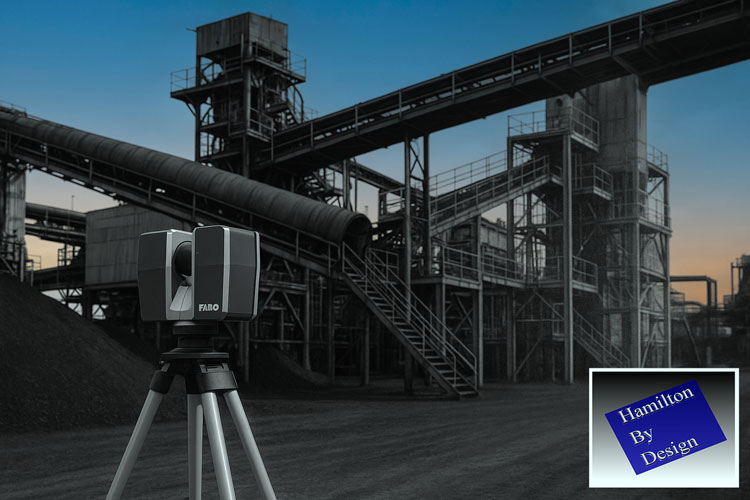
That’s where 3D laser scanning and LiDAR technology change the game. Using a FARO or similar high-accuracy scanner, Hamilton By Design captures millions of data points in a matter of minutes — creating a precise digital replica of your plant or structure.
This point cloud model forms the foundation for all design work. Every pipe, beam, and bracket is located exactly where it exists in the real world, not where an old drawing says it should be.
From Scan to SolidWorks: Accurate Models, Confident Designs
Once the scan is complete, the data is reverse-modelled into SolidWorks or similar 3D design environments.
This means upgrades, chutes, handrails, and structural supports can be designed within the scanned environment — guaranteeing they fit perfectly on installation day.
Our clients use this workflow to plan shutdowns with confidence, knowing that every fabricated part will bolt straight in.
Eliminating Fit-Up Errors and Rework
Traditional upgrade projects rely on tape measures, rough sketches, or outdated general arrangement drawings. Even a 10 mm error can cause weeks of rework once site access is restricted.
With 3D scanning, those errors disappear.
Before fabrication begins, engineers can check for:
- Clashes and interferences between new and existing plant structures.
- Clearances for maintenance and access.
- Alignment with conveyors, supports, and existing chutes.
That level of insight is impossible with 2D drawings alone.
Shorter Shutdowns, Safer Teams
Fewer surprises mean faster, safer installations.
When every component is designed and verified within the scanned model, shutdown crews spend less time cutting, grinding, or reworking in the field.
That’s not only a productivity win, it’s a safety win — fewer sparks, less manual handling, and minimal hot work in confined spaces.
Applications Across Mining and Processing
Hamilton By Design’s scanning and modelling process is trusted across the Bowen Basin, Surat Basin, Hunter Valley, and Central West NSW.
Typical projects include:
- CHPP upgrades — chute replacements, diverter modifications, and screen structure changes.
- Conveyor realignments — ensuring belt runs are perfectly centred before shutdown.
- Pipework and pump station retrofits — avoiding rework when tie-ins occur.
- Structural verification — validating as-built conditions before new platforms or walkways are installed.
Real-World ROI
Clients routinely report saving days of downtime and thousands in rework costs by scanning before fabrication.
When you consider that a typical CHPP shutdown might cost $20,000–$50,000 per hour in lost production, the return on investment is obvious.
A few hours spent scanning can mean days of avoided delay.
Stop Guessing, Start Scanning
If your next shutdown involves tight spaces, limited access, or unknown conditions — don’t rely on old drawings or assumptions.
Hamilton By Design provides LiDAR scanning, point-cloud modelling, and SolidWorks-based mechanical design to ensure your upgrades install exactly as intended.
👉 Book a site scan before your next shutdown.
Visit www.hamiltonbydesign.com.au or contact us to discuss your upcoming project.
3D CAD Modelling | 3D Scanning

Mechanical Engineering | Structural Engineering
Our clients

























As-Built Drawings from a LiDAR Scanner