Onsite Scanning Australia Wide

3D laser scanning services in Australia for mining and infrastructure modelling

Engineering-grade 3D laser scanning, LiDAR and digital captureโ€”delivered to site, anywhere in Australia.

When youโ€™re working in a live facility, a remote site, or an aging asset thatโ€™s been modified a hundred times, the biggest risk is uncertainty. Missing dimensions. Out-of-date drawings. Unknown interferences. A โ€œclose enoughโ€ site measure that turns into rework, delays, and variations.

Hamilton By Design provides onsite scanning Australia wide to capture accurate, verifiable site conditionsโ€”so your engineers, designers, fabricators, and project managers can make confident decisions from day one.
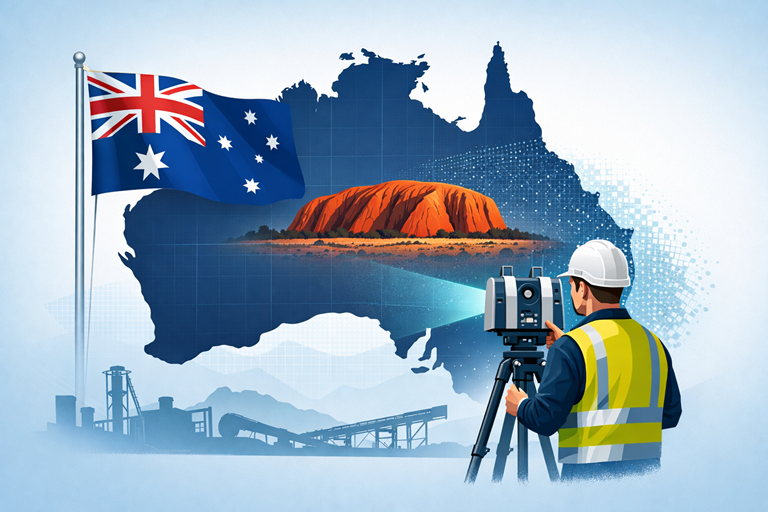

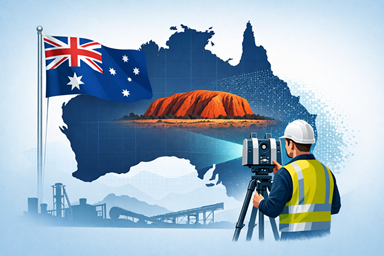
LiDAR scanning survey across Australia with engineer capturing industrial site data

Why onsite scanning matters

Onsite scanning is the fastest way to convert real-world assets into reliable digital informationโ€”especially in brownfield and retrofit environments where original documentation is incomplete or incorrect.

Our field capture provides a precise baseline for:

  • As-built verification before upgrades, tie-ins, and shutdown works
  • Retrofit engineering for legacy plants and facilities
  • Clash detection and constructability checks before fabrication or installation
  • Digital engineering workflows (scan-to-model / scan-to-drawings)
  • Condition documentation for risk reduction, scope definition and handover records

In plain terms: the scan becomes the backbone of your project. If that backbone is broken (poor capture, gaps, or low confidence), everything downstream becomes harderโ€”engineering, drafting, fabrication and installation.


Australia-wide coverage, site-ready delivery

We mobilise to projects across Australiaโ€”metro, regional and remoteโ€”bringing the scanning equipment, field workflow and practical site experience needed to operate safely and efficiently.

Typical deployment environments include:

  • Mining & resources (processing plants, conveyors, workshops, pump stations)
  • Industrial manufacturing (steel, smelting, production lines, utilities)
  • Infrastructure and utilities (water, wastewater, power, transport assets)
  • Commercial and government assets (plantrooms, services corridors, legacy buildings)
  • Marine and ship repair (fit-up checks, reverse engineering, space claims)

If your site is difficult to access, operational, or time-restricted (e.g., night works), we can plan around your constraints.


What we scan onsite

We support a wide range of scanning objectives, including:

As-built capture for engineering and design

Capture existing steelwork, pipework, structures, platforms, equipment skids, services, and building geometryโ€”so design is based on reality, not assumptions.

Retrofit and brownfield modification support

Ideal for upgrades where the facility has changed over time and legacy drawings donโ€™t match current conditions.

Fabrication and installation verification

Use scans to confirm fitment, alignment, clearances, and integration points before committing to fabrication or mobilisation.

Reverse engineering and metrology-style capture

Where components are undocumented, worn, or customโ€”scanning provides a measurement foundation for remanufacture or replacement design.


Deliverables that suit real projects

Every project is different, so we align deliverables to what your team actually needs.

Common outputs include:

  • Registered point clouds (for design coordination and record)
  • 2D CAD outputs (elevations, sections, plans where required)
  • 3D model-ready datasets to support engineering and drafting
  • Digital verification notes to support design sign-off and QA

If youโ€™re not sure what deliverable is best, weโ€™ll recommend a practical option based on your scope, schedule, and how the data will be used downstream.


How our onsite scanning service works

  1. Scope & goals โ€“ what needs to be captured, why, and what level of detail is required
  2. Site requirements โ€“ access windows, inductions, permits, traffic management, WAH/EWP needs
  3. Onsite scanning mobilisation โ€“ safe, efficient field capture with a plan to minimise disruption
  4. Processing & registration โ€“ structured datasets prepared for engineering use
  5. Delivery & support โ€“ files issued with clear naming, coordination notes, and handover guidance

Safety and site integration

We operate with a strong focus on safe field work, practical site coordination, and minimal disruption to operations. Where required, we can work alongside site teams to manage access, exclusion zones, and staged capture.


Why Hamilton By Design

Weโ€™re an engineering-led team. That mattersโ€”because onsite scanning isnโ€™t just โ€œcollecting data.โ€ Itโ€™s collecting the right data, at the right density, in the right areas, with a clear understanding of how the information will be used for design, verification, and construction.

If you need confidence in your existing conditionsโ€”we can help.


Hamilton By Design logo displayed on a blue tilted rectangle with a grey gradient background

3D LiDAR scanning and 3D modelling service button โ€” laser scanner capturing a point cloud for engineering and CAD modelling
Mechanical engineering services

Request onsite scanning Australia wide

If you have an upcoming retrofit, upgrade, verification, or design project and you need accurate site capture, get in touch.

Contact Hamilton By Design to discuss your site, your schedule, and the deliverables you needโ€”anywhere in Australia.


Send us your site location, a brief scope, and any drawings/photos available, and weโ€™ll advise the best scanning approach.
Name
Would you like us to arrange a phone consultation for you?
Address

3D CAD Modelling Australia service banner for Hamilton By Design

Every Shutdown Matters โ€“ Engineering-Led Scanning with FARO LiDAR for As-Builts

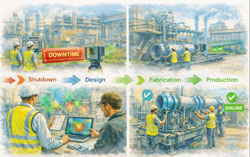
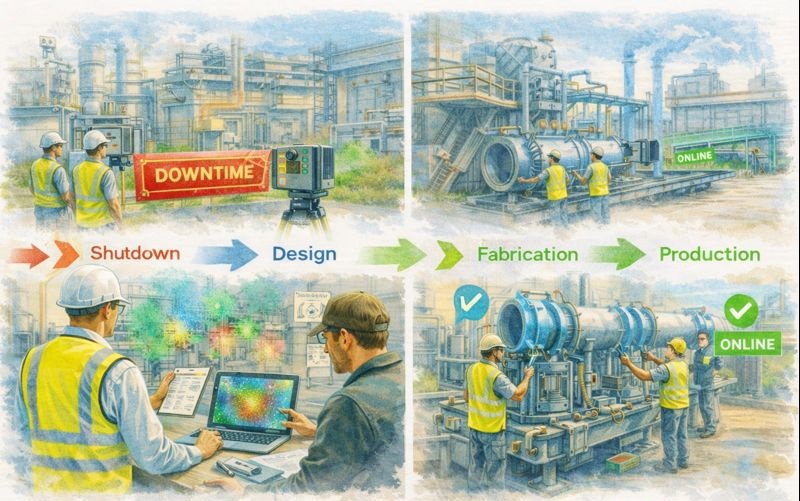
Illustration showing LiDAR scanning workflow for industrial shutdown from capture to installation.

Every Shutdown Matters โ€“ FARO LiDAR for As-Built Scanning

In heavy industry, a shutdown is not just another project milestone โ€” it is the most expensive window on the calendar. Production stops, contractors mobilise, and every hour has a dollar value attached. When something does not fit, the cost is immediate and visible. This is why every shutdown matters, and why the approach to measurement and design before the outage has become critical.

Traditional site measurement relies on tape measures, sketches, and assumptions about existing conditions. In brownfield environments those assumptions are often wrong. Steel moves, plant is modified without drawings, and tolerances stack up over decades. Engineering-led 3D scanning, particularly using FARO terrestrial LiDAR for as-built capture, has changed the way shutdowns are planned and delivered.


Engineering-led LiDAR scanning sequence from downtime to online restart.

From Guesswork to Measured Reality

A terrestrial LiDAR scanner captures millions of accurate points across an entire facility. Instead of a handful of manual dimensions, designers receive a complete digital replica of the plant โ€” every beam, pipe, handrail and obstruction recorded in context. The result is a point cloud that becomes the single source of truth for engineering decisions.

The difference between scanning and traditional measurement is not just accuracy; it is completeness. A fitter with a tape can only measure what they think is relevant. A LiDAR scan measures everything, including the issues no one knew to look for: misaligned bases, out-of-square structures, undocumented modifications and clearance problems that would otherwise appear during the shutdown itself.

When this data is managed by engineers rather than survey technicians alone, it becomes more than a pretty model โ€” it becomes a design tool.

Engineering-Led Scanning

Scanning by itself does not deliver value. The benefit comes when point clouds are interpreted through an engineering lens:

  • What tolerances actually matter?
  • Which surfaces are datums and which are cosmetic?
  • Where will fabrication interfaces occur?
  • How will the new design be installed within the shutdown sequence?

At Hamilton By Design we approach LiDAR capture as part of the engineering workflow, not a separate service. FARO scans are registered, cleaned and aligned to suit the specific design task โ€” whether that is a conveyor upgrade, pump replacement, structural modification or access platform.

The aim is simple: design once, fit first time.

FARO LiDAR for As-Built Confidence

FARO terrestrial scanners are built for industrial environments. They capture long-range, high-density point clouds that allow designers to work with real conditions rather than idealised drawings. Typical applications include:

  • As-built capture of processing plants and mine infrastructure
  • Pipework routing and clash detection
  • Structural modifications and tie-ins
  • Equipment change-outs and baseplate verification
  • Access and safety improvements

By modelling new work directly over the point cloud, engineers can test installation paths, crane clearances and maintenance access long before the shutdown begins. Fabrication drawings are generated from a model that already โ€œfitsโ€ the site.

The Cost of Getting It Wrong

During outages the smallest oversight becomes expensive:

  • A pipe spool 20 mm too long
  • A bracket that fouls an existing conduit
  • A motor base drilled to the wrong PCD
  • A platform clash discovered after hot works have started

Each of these problems triggers rework, additional labour, hot work permits and schedule delays. The true cost is rarely the part itself โ€” it is the lost hours in the critical path.

Engineering-led LiDAR scanning attacks these risks at the source. By understanding existing geometry before fabrication begins, contractors arrive on site with components that have already been proven digitally.

Complementing LiDAR with Object Scanning

Large-scale LiDAR captures the plant; structured-light scanners such as EinScan capture the individual components within it. Motors, guards, cast housings and legacy parts can be digitised on the bench and integrated back into the LiDAR model. This two-tool approach supports:

  • Reverse engineering of obsolete components
  • Design of adapters and mounting brackets
  • Verification of replacement equipment
  • Creation of accurate fabrication models

The result is a seamless path from reality capture to parametric CAD in Fusion 360 or SolidWorks โ€” guided by engineering intent rather than raw mesh data.

Planning the Shutdown Backwards

Successful outages are designed backwards from the installation day. FARO as-built scanning supports this process:

  1. Pre-shutdown capture โ€“ full LiDAR survey of affected areas
  2. Engineering modelling โ€“ new design built over the point cloud
  3. Workshop fabrication โ€“ components manufactured to verified geometry
  4. Dry fit digitally โ€“ clash and access checks completed
  5. On-site installation โ€“ minimal adjustment required

By the time the shutdown begins, the unknowns have been removed. Crews are executing a plan rather than solving problems in real time.

More Than Measurement

LiDAR point clouds are also powerful communication tools. Maintenance teams, project managers and contractors can visualise the work in context, improving safety and coordination. Decisions that once required multiple site visits can be made from the office with confidence.

For organisations moving toward digital twin strategies, as-built scans provide the foundation layer โ€” an accurate spatial framework that future projects can reference.

Why Every Shutdown Matters

In mining, manufacturing and energy sectors the shutdown window defines the success of the year. Budgets are tight, schedules are fixed, and tolerance for rework is zero. Engineering-led scanning recognises that reality capture is not an optional extra; it is risk management.

FARO LiDAR for as-builts delivers:

  • Reduced site hours
  • Fewer fabrication errors
  • Safer installation planning
  • Better collaboration between design and maintenance
  • Confidence that new work will integrate with old

Most importantly, it respects the fact that every shutdown matters.


3D LiDAR scanning and 3D modelling service button โ€” laser scanner capturing a point cloud for engineering and CAD modelling
Mechanical engineering services

Talk to Us

Hamilton By Design provides engineering-led LiDAR scanning across Sydney, the Central Coast and regional Australia, supporting brownfield upgrades, shutdown planning and reverse engineering.

If youโ€™re preparing for an outage or plant modification, speak with our team about capturing accurate as-builts before the clock starts ticking.

www.hamiltonbydesign.com.au


3D CAD Modelling Australia service banner for Hamilton By Design

3D LiDAR Scanning for As-Built & Brownfield Engineering

3D LiDAR Scanning for As-Built & Brownfield Engineering

At Hamilton By Design, we use engineering-grade 3D LiDAR scanning to capture the true as-built condition of your plant, structures and equipment โ€” so you can design, fabricate and install with confidence.

From coal handling preparation plants (CHPP) and hard rock processing lines, through to power stations, manufacturing plants and commercial buildings, our engineer-led scanning process gives you accurate, clash-ready data for every brownfield project.


Why 3D LiDAR Scanning Matters for Brownfield Projects

Brownfield engineering is never โ€œlike the drawingsโ€.

Over years of operation, plants twist, deflect, corrode and get modified during shutdowns. Legacy drawings are often incomplete or out of date. Thatโ€™s where 3D LiDAR scanning changes the game:

  • Capture real geometry, not assumptions
    Record every beam, pipe, chute, cable tray and accessway as it actually exists today.
  • See deformations and historic repairs
    Pick up deflections, sagging, wear, corrosion loss and undocumented modifications that donโ€™t appear in old drawings.
  • De-risk shutdowns and fit-ups
    Use the scan-based model to check new designs for clashes, access, maintenance and installation sequence before you cut steel.
  • Improve safety and compliance
    Support structural integrity assessments, access/egress reviews and compliance checks with a trusted, measurable digital record.
  • Reduce site time for designers
    Capture everything once, then let your engineering and drafting team work from the digital plant model instead of repeated site visits.

What We Scan

Hamilton By Design can scan and model:

  • CHPP and coal handling infrastructure
    • Screens, crushers, transfer towers, chutes, hoppers, conveyors, tripper gantries, stackers and reclaimers
  • Hard-rock and mineral processing plants
    • Mills, cyclones, crushers, bins, slurry pipework, support structures
  • Power stations and energy infrastructure
    • Boiler houses, turbine halls, pipe racks, cable trays, access platforms
  • Manufacturing and industrial facilities
    • Production lines, material handling systems, automation cells, storage areas
  • Commercial and building services
    • Plant rooms, risers, roof services, faรงades and structural frames

If itโ€™s built and you need to understand it, we can scan it.


Engineer-Led Scanning, Not Just Survey

What sets Hamilton By Design apart is that our scanning is driven by mechanical engineers, not just surveyors.

That means we plan each scan campaign based on:

  • The future design work you need to do
  • The critical interfaces (bolt patterns, flanges, centre-lines, datum points)
  • The tolerances needed for fabrication and installation
  • The shutdown and access constraints on site

Because the same team that scans your plant is also involved in modelling, design and checking, we make sure the data captured is actually usable for engineering and drafting โ€” not just a pretty point cloud.


Typical Workflow: From Scan to Engineering Model

  1. Scope & Planning
    • Define the upgrade, problem area or shutdown scope
    • Agree survey tolerances, required deliverables and file formats
    • Plan access, shutdown windows and safety requirements
  2. On-Site 3D LiDAR Scanning
    • Set up control and scanning positions for full coverage
    • Capture high-density scans of structures, equipment and services
    • Minimise disruption to operations where possible
  3. Registration & Quality Checks
    • Register and align scans into a single, unified point cloud
    • Apply QA checks to confirm alignment and global accuracy
    • Provide initial visualisation for client review if required
  4. 3D Modelling & As-Built Geometry
    • Create engineering-ready 3D models in SolidWorks (or other CAD platforms as agreed)
    • Model structural steel, mechanical equipment, chutes, pipework and key interfaces
    • Prepare background models suitable for new design and layout work
  5. As-Built & Brownfield Engineering Support
    • Use the model to support new projects: upgrades, replacements, debottlenecking and layout changes
    • Run fit-up checks, clash detection and access/maintenance reviews
    • Prepare fabrication drawings and installation packages as required
  6. Handover & Ongoing Use
    • Provide point clouds, 3D models and drawings in agreed formats
    • Support future shutdowns and projects using the same trusted digital plant model

Deliverables You Can Expect

Depending on the project, we can provide:

  • Registered point clouds in industry-standard formats
  • 3D CAD models (SolidWorks or exchange formats such as STEP, IGES, DWG)
  • As-built drawings and GA layouts for mechanical and structural systems
  • Clash-check models for integration of new designs
  • Sections and detail views for critical interfaces (bolt patterns, flange faces, datum planes)
  • Visualisations to support stakeholder communication and approvals

All deliverables are produced with fabrication and construction in mind โ€” so your fabricators, installers and site team can act on them immediately.


Applications in As-Built & Brownfield Engineering

3D LiDAR scanning directly supports:

  • Shutdown-driven upgrades โ€“ de-risking installation windows by checking fit-up beforehand
  • Chute and hopper redesign โ€“ improving flow and wear life using accurate existing geometry
  • Conveyor and transfer tower modifications โ€“ adding new equipment or re-routing systems
  • Structural remediation and strengthening โ€“ understanding real load paths and condition
  • Pipework reroutes and tie-ins โ€“ locating existing lines, clashes and tie-in opportunities
  • Compliance and audit documentation โ€“ maintaining accurate records under Australian standards and site governance

Why Choose Hamilton By Design for 3D LiDAR Scanning?

  • Engineer-led, not equipment-led โ€“ we start with the engineering problem, then choose the scanning approach.

  • Single-source accountability โ€“ one team for scanning, modelling, engineering and drawings.
  • Brownfield experience โ€“ extensive work in CHPPs, mineral processing plants, power stations and heavy industry.
  • Fabrication-ready outputs โ€“ deliverables tailored for fabricators, installers and project engineers.
  • National coverage โ€“ servicing sites across NSW, QLD, WA, VIC and SA.

Hamilton By Design logo displayed on a blue tilted rectangle with a grey gradient background
3D LiDAR scanning and 3D modelling service button โ€” laser scanner capturing a point cloud for engineering and CAD modelling
Mechanical engineering services

Next Steps

Planning a shutdown, upgrade or brownfield modification?

Hamilton By Design can help you capture the plant once and then reuse that digital model across multiple projects โ€” reducing risk, improving accuracy and cutting rework.

Contact us to discuss your 3D LiDAR scanning requirements and weโ€™ll help you define:

  • The scanning scope
  • Required tolerances
  • Ideal deliverables for your designers, fabricators and site team

So your next project starts with facts, not assumptions.

Email โ€“ info@hamiltonbydesign.com.au

Phone – (+61) 047 700 2249

Our Clients

Name
Would you like us to arrange a phone consultation for you?
Address
Finite Element Analysis (FEA) engineering simulation button
Mechanical engineering services

Stop Guessing, Start Scanning: How 3D Laser Scanning Prevents Costly Shutdown Delays

The Cost of Guesswork in Shutdowns

Every shutdown comes with pressure โ€” time, budget, and safety. When mechanical upgrades or maintenance are based on outdated drawings or manual measurements, the risk of error skyrockets. A misaligned chute, an incorrectly measured pipe, or a bracket that doesnโ€™t quite fit can turn a planned three-day outage into a five-day scramble.
In industries where every hour offline costs tens of thousands of dollars, guesswork is expensive.

Illustrated scene showing a 3D laser scanner capturing an industrial plant while engineers observe and review data, highlighting how scanning prevents costly shutdown delays.
3D LiDAR scanning and 3D modelling service button โ€” laser scanner capturing a point cloud for engineering and CAD modelling
Mechanical engineering services

3D Laser Scanning: Seeing the Plant as It Really Is

Thatโ€™s where 3D laser scanning and LiDAR technology change the game. Using a FARO or similar high-accuracy scanner, Hamilton By Design captures millions of data points in a matter of minutes โ€” creating a precise digital replica of your plant or structure.
This point cloud model forms the foundation for all design work. Every pipe, beam, and bracket is located exactly where it exists in the real world, not where an old drawing says it should be.

From Scan to SolidWorks: Accurate Models, Confident Designs

Once the scan is complete, the data is reverse-modelled into SolidWorks or similar 3D design environments.
This means upgrades, chutes, handrails, and structural supports can be designed within the scanned environment โ€” guaranteeing they fit perfectly on installation day.
Our clients use this workflow to plan shutdowns with confidence, knowing that every fabricated part will bolt straight in.

Eliminating Fit-Up Errors and Rework

Traditional upgrade projects rely on tape measures, rough sketches, or outdated general arrangement drawings. Even a 10 mm error can cause weeks of rework once site access is restricted.
With 3D scanning, those errors disappear.
Before fabrication begins, engineers can check for:

  • Clashes and interferences between new and existing plant structures.
  • Clearances for maintenance and access.
  • Alignment with conveyors, supports, and existing chutes.

That level of insight is impossible with 2D drawings alone.

Shorter Shutdowns, Safer Teams

Fewer surprises mean faster, safer installations.
When every component is designed and verified within the scanned model, shutdown crews spend less time cutting, grinding, or reworking in the field.
Thatโ€™s not only a productivity win, itโ€™s a safety win โ€” fewer sparks, less manual handling, and minimal hot work in confined spaces.

Applications Across Mining and Processing

Hamilton By Designโ€™s scanning and modelling process is trusted across the Bowen Basin, Surat Basin, Hunter Valley, and Central West NSW.
Typical projects include:

  • CHPP upgrades โ€” chute replacements, diverter modifications, and screen structure changes.
  • Conveyor realignments โ€” ensuring belt runs are perfectly centred before shutdown.
  • Pipework and pump station retrofits โ€” avoiding rework when tie-ins occur.
  • Structural verification โ€” validating as-built conditions before new platforms or walkways are installed.
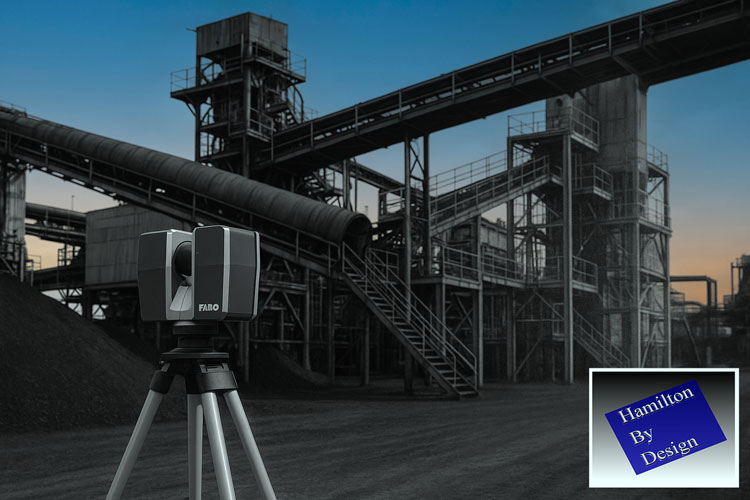
FARO 3D laser scanner set up on a tripod capturing an industrial plant for LiDAR scanning and digital modelling, with Hamilton By Design branding in the corner.

Real-World ROI

Clients routinely report saving days of downtime and thousands in rework costs by scanning before fabrication.
When you consider that a typical CHPP shutdown might cost $20,000โ€“$50,000 per hour in lost production, the return on investment is obvious.
A few hours spent scanning can mean days of avoided delay.

Stop Guessing, Start Scanning

If your next shutdown involves tight spaces, limited access, or unknown conditions โ€” donโ€™t rely on old drawings or assumptions.
Hamilton By Design provides LiDAR scanning, point-cloud modelling, and SolidWorks-based mechanical design to ensure your upgrades install exactly as intended.

๐Ÿ‘‰ Book a site scan before your next shutdown.
Visit www.hamiltonbydesign.com.au or contact us to discuss your upcoming project.

3D CAD Modelling | 3D Scanning

Hamilton By Design logo displayed on a blue tilted rectangle with a grey gradient background

Chute Design

Mechanical Engineering | Structural Engineering

Our clients

Name
Would you like us to arrange a phone consultation for you?
Address