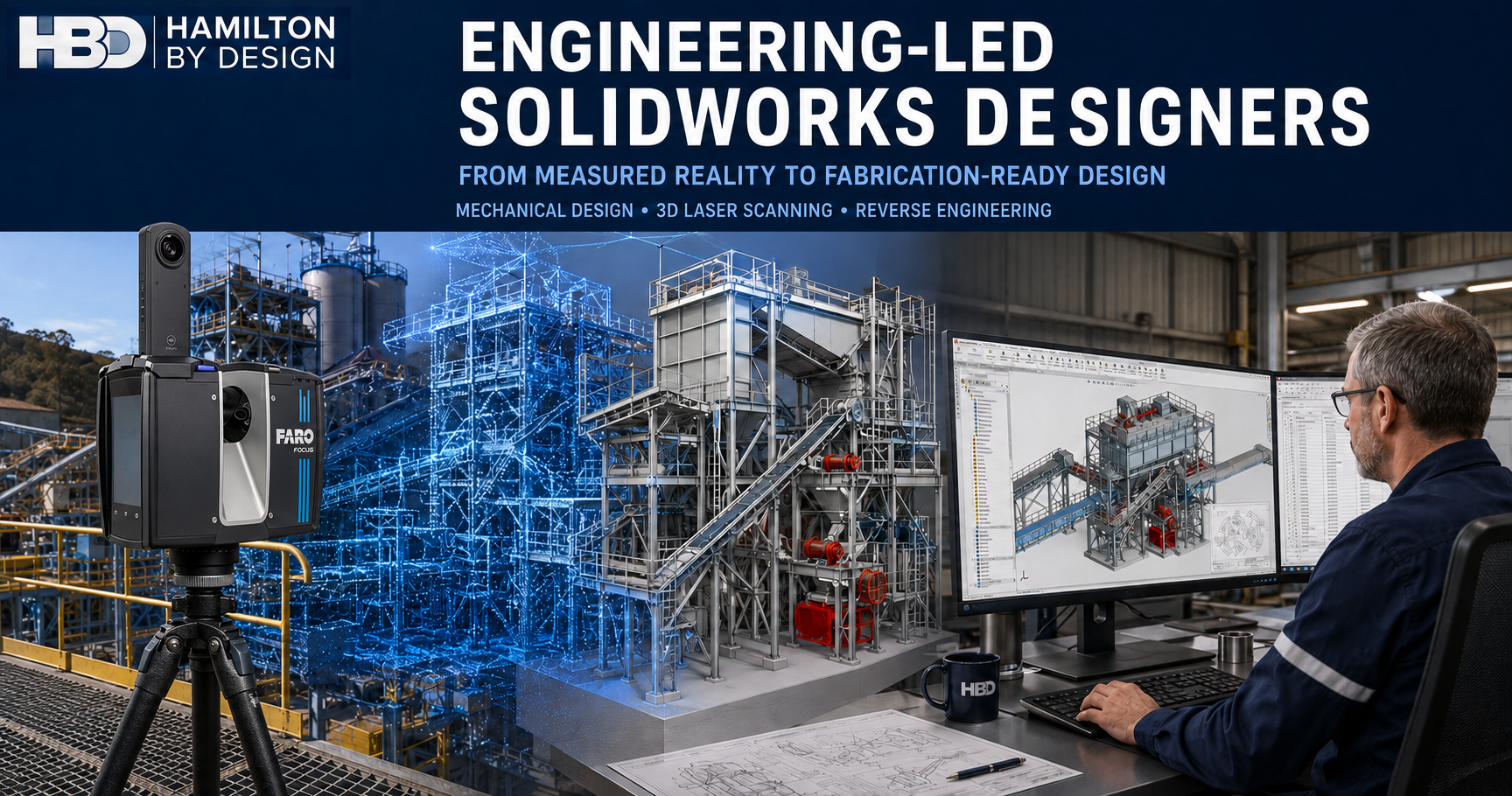
3D Laser Scanning Smeaton Grange | Factory Engineering

Engineer using a 3D laser scanner in a Smeaton Grange factory with point-cloud and CAD conveyor overlays.

3D Laser Scanning and Mechanical Engineering in Smeaton Grange NSW

Blue 3D LiDAR scanner icon on a tripod with scanning waves

Smeaton Grange is one of the Macarthur region’s most important industrial precincts. Its factories, workshops and warehouses support food production, machinery manufacture, surface engineering, mining equipment, truck and trailer manufacturing, printing, pharmaceutical production, materials handling and logistics.

For businesses operating in this environment, the engineering challenge is rarely starting with a completely empty building. Most projects involve existing machinery, undocumented modifications, congested services and production schedules that allow very little time for installation errors. Hamilton By Design helps clients manage these risks by combining engineering-grade LiDAR scanning with mechanical engineering, reverse engineering and fabrication-ready documentation.

Supporting Smeaton Grange’s Industrial Operations

Publicly documented facilities in the precinct include fresh-food processing, trailer and conveyor manufacturing, surface engineering, signage production, complementary-medicine manufacturing and mining ground-support production. This does not imply that these businesses are HBD clients, but it demonstrates the area’s engineering diversity.

Across these industries, new machinery must be fitted around existing columns, conveyors, platforms, pipework, electrical services and access routes. Older machines may no longer have reliable drawings, while production lines may have been modified several times without the factory layout being updated.

Hamilton By Design can capture these existing conditions and convert them into practical engineering information for factory upgrades, equipment replacement and long-term asset management.

Five Common Factory Engineering Problems

1. Missing or Outdated Drawings

Many factories have drawings that no longer reflect the installed plant. Equipment, services, platforms and guards may all have changed. Designing from unreliable information increases the risk of clashes, rework and delays.

A 3D laser scan creates a measurable point-cloud record of the current factory. This can be used to develop verified layouts, sections, elevations and equipment-interface models.

2. New Equipment Must Fit a Congested Factory

Installing a conveyor, packaging machine or production cell inside an operating factory is difficult. Small dimensional errors can affect product flow, services, maintenance access and guarding.

HBD’s manufacturing layout design workflow allows proposed equipment to be coordinated with actual installed conditions before fabrication or installation begins.

3. Obsolete Machinery Parts Cannot Be Purchased

Factories often operate reliable machines long after supplier support ends. When a component fails, there may be no CAD model, drawing or replacement available.

Hamilton By Design provides reverse-engineering 3D scanning to capture existing components and develop replacement models. The objective is not simply to copy a worn part, but to understand its function, interfaces, tolerances and potential failure mechanisms before preparing a replacement.

4. Machinery Guarding Is Incomplete or Unsuitable

Factory modifications can expose shafts, couplings, chains, belts, pulleys, rollers and nip points. Guards may also be damaged, removed or altered to clear replacement equipment.

HBD provides machine-guarding design and engineering for existing and modified machinery. Scanning can capture the hazard area, available mounting points, maintenance access and surrounding obstructions so that guards fit the installed equipment.

5. Shutdown Time and Installation Rework Are Expensive

Factories cannot stop production for repeated measurements. Poor fit-up can create extra crane time, site cutting, welding, delayed commissioning and lost production.

Capturing the factory once and completing coordination digitally can reduce these risks and support a more controlled shutdown plan.

Engineering Tools for Factory Problems

Different tools suit different scales of work. A FARO Focus terrestrial scanner can capture buildings, structural steel and machinery lines. Mobile LiDAR supports rapid walkthrough capture, while handheld scanning can record smaller components and complex surfaces.

FARO SCENE and Autodesk ReCap can be used to register, review and export point-cloud information. The verified data can then be developed through SolidWorks 3D modelling and AutoCAD. Navisworks can support coordination and clash reviews where several models or disciplines are involved.

SolidWorks Simulation and FEA may be used where brackets, frames or components require assessment. For chutes, hoppers and bulk-product transfers, HBD can also apply its material-handling engineering experience and discrete element modelling where appropriate.

Mechanical Engineering Services

Hamilton By Design’s mechanical engineering consulting can support factory and warehouse projects involving:

  • Production-line and conveyor modifications
  • Machinery and equipment replacement
  • Reverse engineering
  • Platforms, stairs and maintenance access
  • Guarding and safety barriers
  • Equipment-support frames
  • Factory relocation and machinery consolidation
  • Brownfield installation planning
  • Mechanical assessment and FEA

Depending on the scope, designs may consider AS/NZS 4024 for machinery safety, AS 3990 for mechanical-equipment steelwork, AS 4100 for steel structures, AS/NZS 1170 for structural actions, AS/NZS 1554.1 for structural welding and AS 1657 for fixed platforms, walkways, stairs and ladders.

Mechanical Drafting and Fabrication Documentation

Scanning and engineering analysis only create value when the information can be used by manufacturers, fabricators and installers. HBD’s mechanical drafting services can produce:

  • Factory and production-line layouts
  • General arrangement drawings
  • Fabrication and assembly drawings
  • Guarding and sheet-metal details
  • Conveyor layouts and support details
  • Installation drawings
  • DXF profiles
  • Bills of materials
  • SolidWorks, STEP, Parasolid, DWG and PDF deliverables

Drawing presentation can follow the relevant parts of AS 1100, including general technical-drawing and mechanical-engineering drawing conventions. Project drawings should also identify the applicable materials, welding, tolerances, finishes and site requirements.

Machinery Safety and Conveyor Engineering

Effective guarding must consider foreseeable access, cleaning, inspection, lubrication, adjustment and maintenance—not simply place a barrier around moving machinery.

HBD can assist with guarding inspections, gap assessments, fixed guards, removable panels, perimeter guarding, maintenance openings, access gates and fabrication documentation. Electrical interlocks, emergency-stop circuits and functional-safety validation should be coordinated with an appropriately qualified electrical or control-systems specialist.

In NSW, machinery projects operate within the Work Health and Safety Act 2011 and Work Health and Safety Regulation 2025. Relevant technical guidance may include AS/NZS 4024.1201 for machinery risk assessment, AS/NZS 4024.1601 for guards, AS/NZS 4024.1803 for minimum gaps and AS/NZS 4024.1604 for emergency-stop principles.

Conveyor projects should use the relevant current AS/NZS 4024 conveyor standards. These include AS/NZS 4024.3610 for general conveyor requirements, AS/NZS 4024.3611 for bulk-material belt conveyors and AS/NZS 4024.3612 for chain and unit-handling conveyors. The older AS 1755 conveyor standard has been superseded and should not be treated as the primary standard for a new design.

Engineering for Warehousing and Logistics

Smeaton Grange is also a significant freight and logistics precinct. Warehouses may include conveyors, sortation equipment, palletisers, storage racking, loading areas, forklifts and pedestrian routes.

Hamilton By Design can scan warehouse interiors and document building columns, racking, conveyors, platforms, equipment and loading interfaces. Proposed changes can then be reviewed for equipment clearance, maintenance access, guarding and installation sequencing.

Depending on the project, relevant standards may include AS/NZS 4024.3612 for unit-handling conveyors, AS 4024.3404 for palletisers and depalletisers, AS 4084 for steel storage racking and AS 2359 for powered industrial trucks. Proprietary racking should remain subject to design and verification by the competent racking supplier or engineer.

Retaining a Reusable Digital Factory Record

The point cloud and CAD information created for one project can continue supporting future work. Subject to agreed confidentiality and retention arrangements, HBD can retain factory point clouds, machine models, conveyor layouts, equipment interfaces, CAD assemblies and fabrication drawings.

This gives the client a verified engineering baseline for later modifications and reduces the need to start each project with incomplete drawings and repeated site measurement.

Frequently Asked Questions

Can Hamilton By Design scan an operating factory?

Yes. Scanning can often proceed around normal operations, subject to site safety and access. Some areas may require a shutdown where moving equipment or product flow prevents safe capture.

Can scan data be converted into SolidWorks or AutoCAD?

Yes. Point clouds can support SolidWorks models, AutoCAD layouts, general arrangements, fabrication drawings and equipment-interface models. The required modelling level should be agreed first.

Can HBD reverse engineer an obsolete machine part?

Yes. HBD can capture the component, assess its interfaces and develop manufacturing information. Worn geometry should not be copied without considering function, tolerances, material and loads.

Can machine guards be designed from a point cloud?

Yes. Scanning is especially useful for retrofit guarding because it records the machinery, existing supports and nearby obstructions. HBD can prepare guard models, mounting details, fabrication drawings and bills of materials.

Does HBD design conveyors for factories and warehouses?

HBD can assist with conveyor layouts, modifications, supports, transfers, equipment interfaces and guarding. The exact engineering scope depends on conveyor type, product, capacity, controls and operating environment.

Does HBD retain the scan and CAD data?

Data can be retained subject to agreed client permissions, confidentiality and storage arrangements. Retention allows later projects to reuse the verified factory information rather than beginning again with incomplete records.

Discuss a Smeaton Grange Project

Hamilton By Design provides industrial 3D scanning and engineering support across Sydney, including Smeaton Grange and the wider Macarthur industrial region.

Whether the requirement involves factory scanning, reverse engineering, machinery guarding, conveyor modifications or fabrication-ready drawings, HBD can help convert existing conditions into practical engineering outcomes.


Hamilton By Design logo displayed on a blue tilted rectangle with a grey gradient background

Contact Us – Talk To Us

Name
Would you like us to arrange a phone consultation for you?
Address

Our clients:
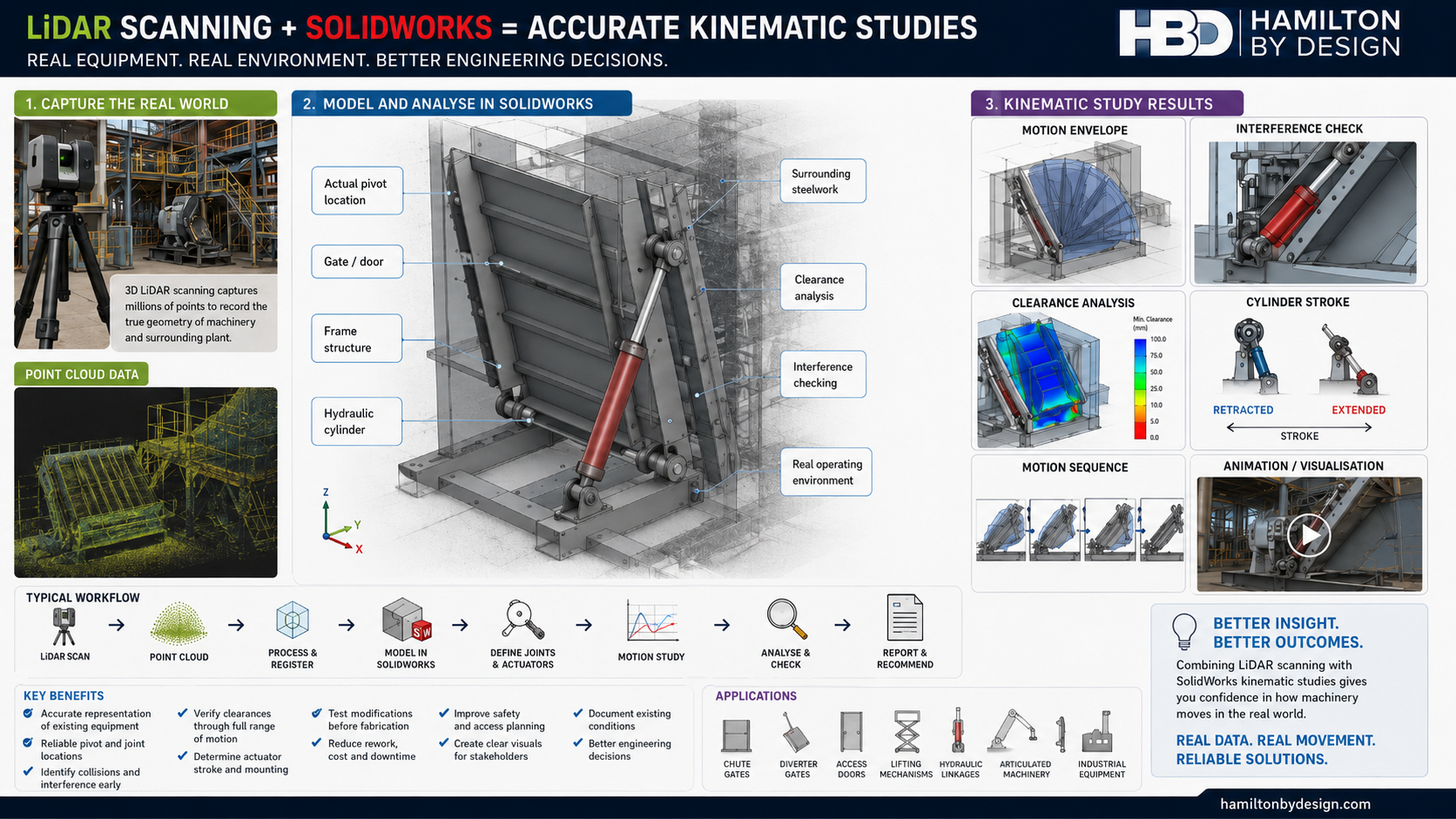


LiDAR Scanning and SolidWorks for Kinematic Studies

Infographic showing how LiDAR scanning and SOLIDWORKS are combined to create accurate kinematic studies, including point cloud capture, CAD modelling, motion analysis, interference checking, clearance analysis and actuator stroke review.

Combining LiDAR Scanning and SolidWorks for Kinematic Studies

Understanding how machinery moves within an existing industrial environment can be difficult when drawings are unavailable, outdated or do not reflect site modifications.

By combining 3D LiDAR scanning with SolidWorks, engineers can create kinematic studies based on the actual installed geometry of machinery, structures and surrounding plant. This provides a more reliable foundation for assessing movement, clearances, interference risks and proposed mechanical modifications.

What Is a Kinematic Study?

A kinematic study examines the movement of mechanical components without initially focusing on the forces that create that movement.

It may assess:

  • component position;
  • direction of movement;
  • travel distance;
  • angular rotation;
  • velocity;
  • acceleration;
  • linkage behaviour;
  • actuator stroke;
  • motion envelopes;
  • clearances between components;
  • potential collisions or interference.

Kinematic studies are commonly used for mechanical linkages, hydraulic cylinders, access doors, gates, chutes, diverters, lifting systems, articulated equipment and other moving machinery.

Why Existing Geometry Matters

A motion study is only as reliable as the geometry used to create it.

Many industrial machines have been modified, repaired or repositioned over time. Original drawings may no longer represent the actual equipment. Manual measurements may also be difficult where machinery is large, complex, elevated or surrounded by operating plant.

LiDAR scanning provides a detailed three-dimensional record of the equipment and its surroundings. The resulting point cloud can be used as a reference for developing an accurate SolidWorks model.

How LiDAR Scanning Supports the Study

A terrestrial LiDAR scanner records millions of measurement points across the visible surfaces of machinery, structures and plant.

The scan can help establish:

  • shaft and pivot locations;
  • hinge centres;
  • actuator mounting positions;
  • linkage lengths;
  • equipment orientation;
  • machine-frame geometry;
  • surrounding structural steel;
  • guards and access platforms;
  • nearby pipework;
  • operating clearances;
  • fixed obstructions.

This reduces reliance on assumptions and provides an engineering record of the existing condition at the time of capture.

How SolidWorks Is Used

Once the LiDAR data has been processed, the point cloud can be used to develop simplified or detailed SolidWorks models of the relevant machinery.

SolidWorks can then be used to:

  • create individual parts and assemblies;
  • locate pivots, shafts and mounting points;
  • define mechanical mates and joints;
  • simulate rotational and linear movement;
  • represent hydraulic-cylinder extension;
  • evaluate linkage positions;
  • calculate displacement, velocity and acceleration;
  • check component interference;
  • assess minimum clearances;
  • determine the swept path of moving equipment;
  • test proposed modifications before fabrication.

The surrounding plant can also be included as reference geometry so the machinery is analysed within its actual operating environment.

Typical LiDAR-to-SolidWorks Workflow

A typical workflow may include:

  1. Capture the machinery and surrounding plant using a LiDAR scanner.
  2. Register and process the scan data into a coordinated point cloud.
  3. Import or reference the point cloud within the CAD workflow.
  4. Identify the equipment required for the kinematic study.
  5. Create simplified SolidWorks models of the moving components.
  6. Position the models using the scanned geometry.
  7. Define mates, joints, travel limits and actuator movement.
  8. Run the SolidWorks motion study.
  9. Review clearances, collisions and movement envelopes.
  10. Develop recommendations, modifications or fabrication drawings.

Example: Hydraulic Chute Gate

A hydraulic chute gate may include a gate plate, pivot shaft, support frame and hydraulic cylinder.

A LiDAR scan can capture:

  • the existing chute geometry;
  • the gate position;
  • the pivot-shaft location;
  • upper and lower cylinder mounts;
  • surrounding structural steel;
  • platforms, guards and walkways;
  • nearby services and obstructions.

The geometry can then be recreated in SolidWorks to assess:

  • the gate opening angle;
  • the required cylinder stroke;
  • the relationship between cylinder travel and gate rotation;
  • potential dead-centre positions;
  • interference with the chute or surrounding steelwork;
  • clearances through the full operating cycle;
  • whether a proposed replacement cylinder will fit;
  • whether revised mounting points will improve movement.

This allows potential problems to be identified before components are manufactured or installed.

Collision and Interference Assessment

One of the main advantages of combining LiDAR with SolidWorks is the ability to assess moving machinery against the real site environment.

A standalone CAD model may show that a mechanism operates correctly. However, it may not reveal that the moving equipment could contact:

  • an existing handrail;
  • a structural beam;
  • electrical cable trays;
  • nearby pipework;
  • a maintenance platform;
  • machine guarding;
  • adjacent equipment.

By modelling the mechanism within the scanned environment, these conflicts can be identified before shutdown, fabrication or installation.

Evaluating Hydraulic Cylinders and Actuators

SolidWorks motion studies can assist with assessing actuator geometry, including:

  • extended and retracted cylinder lengths;
  • required stroke;
  • cylinder mounting angles;
  • connection-point movement;
  • mechanical advantage;
  • actuator alignment;
  • over-travel;
  • end-of-stroke position;
  • potential side loading;
  • approach to dead-centre conditions.

Where forces and loads must also be evaluated, the kinematic model may be expanded into a dynamic motion or structural assessment using suitable engineering inputs.

Benefits for Brownfield Engineering

LiDAR and SolidWorks are particularly valuable for brownfield projects where machinery must be modified within an existing facility.

The combined workflow can provide:

  • improved confidence in existing dimensions;
  • reduced dependence on outdated drawings;
  • fewer manual site measurements;
  • improved identification of site constraints;
  • better interference detection;
  • more reliable actuator selection;
  • improved design coordination;
  • reduced fabrication rework;
  • better shutdown planning;
  • clearer communication with stakeholders;
  • visual animations of proposed movement;
  • a documented digital record of existing conditions.

Static Scanning and Multiple Equipment Positions

A conventional terrestrial LiDAR scanner generally captures static geometry rather than continuously recording fast mechanical movement.

For this reason, equipment may be scanned in several controlled positions, such as:

  • fully closed;
  • partially open;
  • fully open;
  • maintenance position;
  • parked position.

These positions can be compared and used to confirm the geometry and range of movement.

Where actual operating speed or time-dependent behaviour is required, LiDAR data may be combined with:

  • video footage;
  • shaft encoders;
  • linear displacement sensors;
  • accelerometers;
  • control-system data;
  • hydraulic pressure records;
  • machine operating logs.

From Kinematic Study to Engineering Deliverables

The SolidWorks model developed from the LiDAR data can support more than the motion study itself.

Potential deliverables may include:

  • existing-condition 3D models;
  • kinematic study reports;
  • movement-envelope drawings;
  • interference reports;
  • clearance assessments;
  • actuator-stroke calculations;
  • SolidWorks motion animations;
  • general arrangement drawings;
  • modification concepts;
  • fabrication drawings;
  • installation planning models;
  • shutdown work packs;
  • stakeholder presentation images.

Applications

LiDAR-supported kinematic studies may be suitable for:

  • chute gates;
  • diverter gates;
  • conveyor take-up systems;
  • hydraulic linkages;
  • access doors;
  • lifting mechanisms;
  • maintenance hatches;
  • articulated machinery;
  • robotic systems;
  • positioning equipment;
  • stackers and reclaimers;
  • mobile plant attachments;
  • mechanical dampers;
  • valve-actuation systems;
  • machine guarding;
  • equipment relocation projects.

A More Reliable Basis for Mechanical Design

Combining LiDAR scanning with SolidWorks allows a kinematic study to be developed around the actual machine and the actual site environment.

LiDAR captures the existing geometry. SolidWorks converts that information into an intelligent mechanical model that can be moved, tested and reviewed.

Together, these tools can help engineers identify movement restrictions, confirm actuator requirements, assess clearances and test proposed modifications before work reaches fabrication or site installation.

LiDAR Scanning and SolidWorks Support

Hamilton By Design provides engineer-led 3D LiDAR scanning, point-cloud processing, SolidWorks modelling and mechanical design support for existing industrial machinery and brownfield facilities.

Our services can assist with:

  • existing-condition capture;
  • reverse engineering;
  • SolidWorks assembly modelling;
  • kinematic studies;
  • motion-envelope assessments;
  • interference checking;
  • actuator and linkage reviews;
  • mechanical modifications;
  • fabrication drawings;
  • installation planning.

For assistance with a kinematic study, machinery modification or LiDAR-based SolidWorks model, contact Hamilton By Design to discuss the equipment, required movement and project objectives.

Hamilton By Design logo displayed on a blue tilted rectangle with a grey gradient background

Contact Us – Talk To Us

Name
Would you like us to arrange a phone consultation for you?
Address

Our clients:
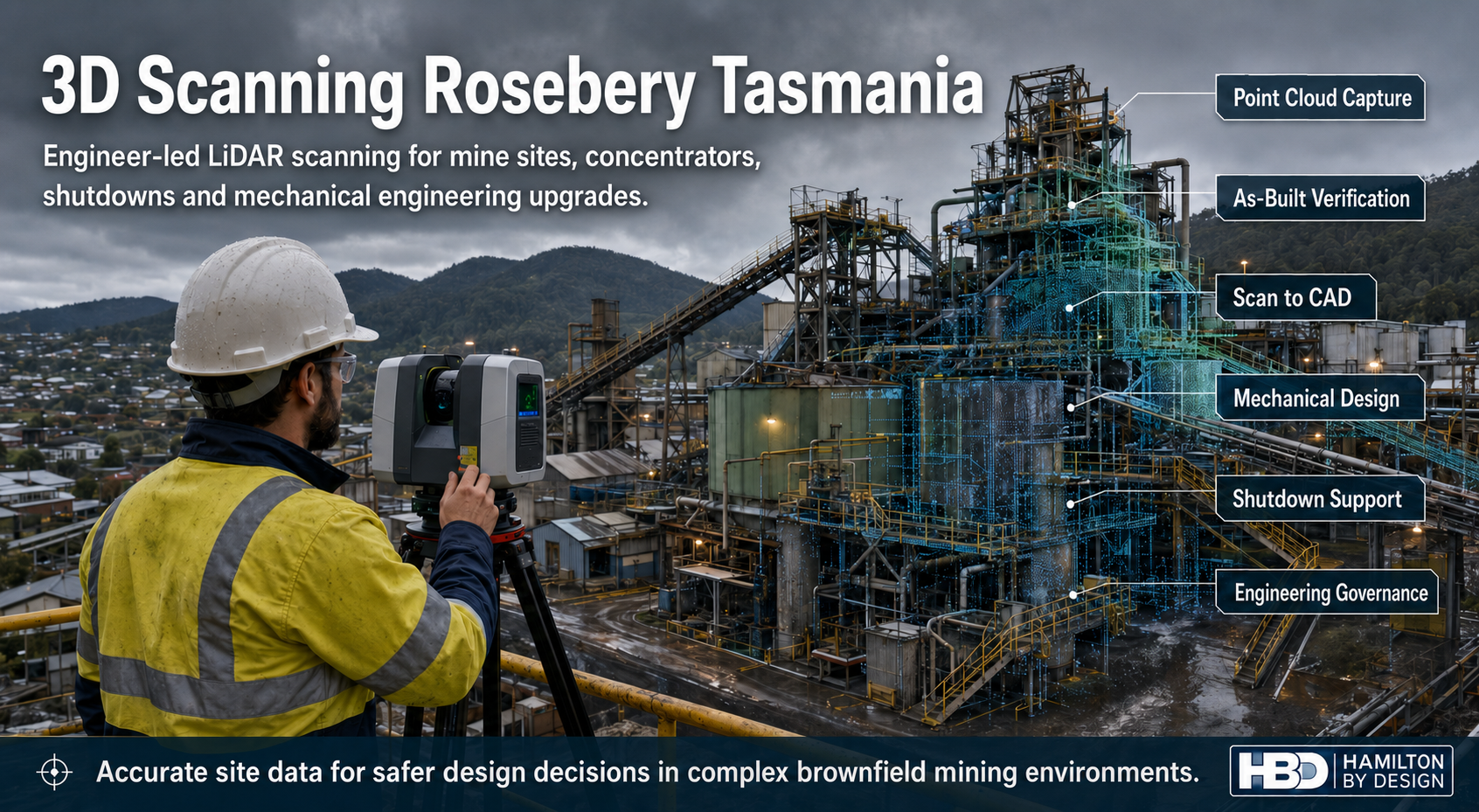


Mechanical Engineering and 3D Scanning Support for Rosebery, Tasmania

Engineer using a LiDAR scanner at a Rosebery Tasmania mining processing plant with point cloud data overlay for 3D scanning and mechanical engineering.

Mechanical Engineering & 3D Scanning Rosebery Tasmania

Rosebery is a working mining town, and the work on site is practical. Fitters, riggers, maintenance crews and supervisors are often dealing with real plant problems before the drawings catch up.

A chute wears out. A pipe spool needs replacing. A pump base does not match what is on the drawing. Access is tight. Shutdown time is limited. The job needs to fit the first time.

Hamilton By Design supports Rosebery and Tasmania’s west coast with mechanical engineering, 3D laser scanning, scan-to-CAD, reverse engineering and drafting support for mining, processing and industrial sites.

Supporting Fitters, Riggers and Maintenance Teams

On brownfield sites, the people closest to the work often understand the problem best.

A fitter may know where the wear is occurring. A rigger may know where the lift or install will be difficult. A maintenance supervisor may know which parts of the plant have been modified over time.

Hamilton By Design helps turn that site knowledge into usable engineering information.

We can assist with:

  • site measurement and 3D scanning
  • scan-to-CAD modelling
  • mechanical drafting
  • reverse engineering
  • chute and hopper replacement
  • conveyor and transfer point modifications
  • pipework and spool development
  • pump, bracket and baseplate measurement
  • shutdown planning support
  • fabrication-ready drawings

3D Scanning for Rosebery Mining and Processing Sites

Rosebery’s mining and processing environment makes accurate site information important. Existing drawings may be outdated, incomplete or missing. Plant may have changed over years of maintenance, repair and modification.

3D laser scanning captures the actual site conditions before design or fabrication begins.

This can help reduce:

  • site rework
  • fabrication errors
  • unexpected clashes
  • repeat site visits
  • shutdown delays
  • uncertainty during quoting and planning

For mining and concentrator environments, scanning can be used around conveyors, transfer points, chutes, pipework, tanks, pump areas, platforms, stairs, guarding and structural interfaces.

Scan-to-CAD and Mechanical Drafting

Once the site has been scanned, Hamilton By Design can convert the captured information into practical CAD deliverables.

Depending on the job, this may include:

  • registered point cloud data
  • E57, RCP or RCS files
  • 3D CAD models
  • SolidWorks or Inventor models
  • AutoCAD DWG layouts
  • general arrangement drawings
  • fabrication drawings
  • sections and elevations
  • clearance and clash checks

The aim is simple: provide information that helps the job move from site problem to fabrication, installation or engineering review.

Mechanical Engineering Support for Concentrator Plant Work

Rosebery includes underground mining and onsite processing, with production of zinc, copper and lead concentrates, as well as gold and silver.

For concentrator and mineral processing work, Hamilton By Design can support:

  • crushing and grinding area modifications
  • flotation plant access and layout checks
  • slurry pipework and pump arrangements
  • chute and liner replacement
  • conveyor upgrades
  • transfer point improvements
  • platform, stair and access changes
  • guarding and maintenance access reviews
  • brownfield plant modifications

This type of work often needs a mix of practical trade understanding, site capture, CAD modelling and mechanical engineering judgement.

Secondment Support for Rosebery Projects

For longer shutdowns, ongoing upgrades or peak workload periods, Hamilton By Design can also provide support through secondment.

This allows experienced engineers, designers, draftspersons, fitters, fabricators and riggers to support your team directly during planning, site measurement, drawing updates, fabrication support or project delivery.

Learn more about Hamilton By Design’s Secondment Services.

Servicing Rosebery and Tasmania’s West Coast

Hamilton By Design can support Rosebery and nearby west coast locations, including:

  • Tullah
  • Zeehan
  • Queenstown
  • Strahan
  • Burnie
  • Devonport
  • broader Tasmanian mining and industrial sites
Hamilton By Design logo displayed on a blue tilted rectangle with a grey gradient background

Need Mechanical Engineering or 3D Scanning Support in Rosebery?

If you are planning maintenance, shutdown work, fabrication, reverse engineering or plant modification in Rosebery, Hamilton By Design can help capture the site accurately and turn that information into practical engineering deliverables.

Contact Hamilton By Design to discuss your Rosebery site capture, mechanical engineering, scan-to-CAD or secondment support requirements.

Talk to Us – Contact Us

Name
Would you like us to arrange a phone consultation for you?
Address

Our clients:
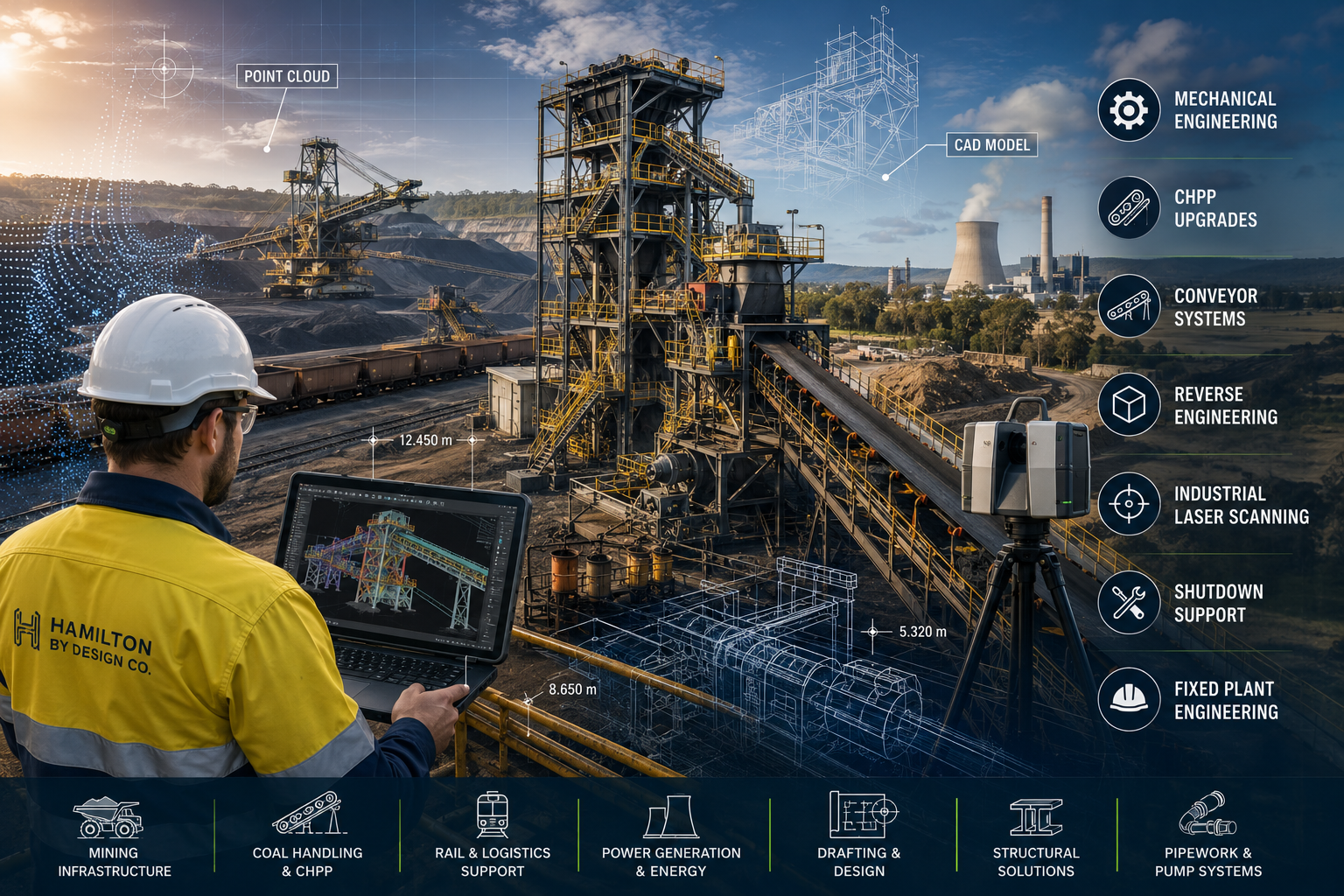


https://www.hamiltonbydesign.com.au/scan-to-bim-services-australia-lidar-point-clouds-cad-modelling

Mechanical Engineering Muswellbrook NSW | Mining, CHPP & Industrial Engineering

Mechanical engineering services in Muswellbrook NSW including CHPP upgrades, conveyor systems, industrial laser scanning, reverse engineering, fixed plant engineering and mining infrastructure design.

Mechanical Engineering Services in Muswellbrook NSW

Blue Gear and Spanner icon

Muswellbrook sits at the centre of one of Australia’s most important heavy industrial regions. Located in the Upper Hunter Valley, the area supports large-scale coal mining, Coal Handling and Preparation Plants (CHPP), power generation, rail infrastructure, bulk materials handling systems, maintenance workshops and emerging energy projects.

At Hamilton By Design Co., we provide engineer-led mechanical engineering, industrial laser scanning, reverse engineering and drafting services for mining, power generation and heavy industry throughout Muswellbrook and the wider Hunter Valley region.


Supporting Mining & Fixed Plant Infrastructure

The Muswellbrook region remains heavily connected to mining operations, bulk materials handling and fixed plant infrastructure. These facilities require ongoing engineering support for maintenance, shutdowns, brownfield upgrades and asset life extension programs.

Our team can assist with:

  • Conveyor system engineering
  • Transfer chute design
  • Crusher and screening plant upgrades
  • Pump station engineering
  • Structural steel modifications
  • Mechanical equipment installations
  • Walkways, platforms and access systems
  • Shutdown engineering support
  • Maintenance engineering documentation
  • Fabrication and workshop drawings
  • Asset integrity inspections

Many sites throughout the Hunter Valley operate ageing infrastructure that requires modification around existing operating plant. Accurate site measurement, engineering-grade scanning and practical engineering experience become critical when working in these environments.


3D LiDAR Scanning Hunter & Newcastle banner with white text on a blue background promoting engineering-grade laser scanning services for industrial, mining and infrastructure projects across the Hunter Valley and Newcastle region.
Mechanical Engineering Hunter & Newcastle banner promoting mechanical engineering services for mining, industrial plants, power generation, manufacturing and heavy industry throughout the Hunter Valley and Newcastle region.
Structural Drafting Hunter & Newcastle banner promoting structural drafting services for mining, industrial plants, power generation, manufacturing and infrastructure projects across the Hunter Valley and Newcastle region.

CHPP & Coal Handling Engineering

Coal Handling and Preparation Plants (CHPP) remain a major part of the Muswellbrook industrial landscape.

Hamilton By Design can support projects involving:

  • Conveyor transfers
  • Transfer tower upgrades
  • Coal sampling systems
  • Stacker and reclaimer infrastructure
  • Surge bins and hoppers
  • Dust suppression systems
  • Structural modifications
  • Pipework and pumping systems
  • Maintenance access upgrades
  • Shutdown planning and engineering

Our experience in bulk materials handling allows us to support both operational facilities and brownfield upgrade projects where existing site conditions present significant engineering challenges.


Power Generation & Energy Infrastructure

Muswellbrook has long been associated with major power generation assets including Bayswater Power Station and the former Liddell Power Station.

Mechanical engineering support remains essential across:

  • Turbine systems
  • Boiler infrastructure
  • Cooling water systems
  • Ash handling systems
  • Pipework upgrades
  • Structural inspections
  • Mechanical maintenance projects
  • Asset integrity assessments
  • Brownfield modifications
  • Renewable energy infrastructure

As the Hunter Valley continues transitioning toward energy storage and renewable infrastructure, engineering companies capable of supporting both legacy industrial assets and future energy projects will continue to play an important role.


3D LiDAR scanning and 3D modelling service button — laser scanner capturing a point cloud for engineering and CAD modelling
Mechanical engineering services

Industrial 3D Laser Scanning in Muswellbrook

Hamilton By Design provides engineering-grade terrestrial LiDAR scanning services throughout Muswellbrook and the Hunter Valley.

Our scanning services support:

  • As-built verification
  • Conveyor systems
  • CHPP facilities
  • Power stations
  • Structural steelwork
  • Processing plants
  • Workshop facilities
  • Pipe racks
  • Tanks and vessels
  • Brownfield expansion projects

Deliverables can include:

  • Registered point clouds
  • E57 files
  • RCP and RCS datasets
  • CAD models
  • STEP files
  • SAT files
  • General Arrangement drawings
  • Fabrication drawings

Engineering-grade scanning reduces project risk by allowing accurate design work to occur around existing infrastructure before fabrication begins.


Reverse Engineering Services

Many mining and industrial sites throughout the Hunter Valley continue to operate equipment that is obsolete, difficult to source or no longer supported by the original manufacturer.

Hamilton By Design provides reverse engineering services for:

  • Mechanical components
  • Castings
  • Machined parts
  • Conveyor components
  • Wear liners
  • Pump assemblies
  • Couplings
  • Structural assemblies
  • Site-specific plant equipment

Using a combination of laser scanning, precision measurement, CAD modelling and practical manufacturing knowledge, we can recreate engineering models and fabrication drawings from existing components.


Mechanical Drafting & Design

Our drafting and design services support mining companies, fabrication workshops, contractors and maintenance teams throughout Muswellbrook and the Hunter Valley.

Services include:

  • Mechanical drafting
  • Structural drafting
  • Pipework drafting
  • Fabrication drawings
  • Workshop drawings
  • General Arrangement drawings
  • Site layouts
  • Conveyor detailing
  • Access platform design
  • Engineering documentation

We work across a range of deliverables including SolidWorks, AutoCAD, Inventor, STEP, DWG and PDF formats.


Supporting the Future of the Hunter Valley

The Upper Hunter region continues to undergo significant industrial transformation. While coal mining, bulk materials handling and fixed plant maintenance remain major industries, investment in energy storage, renewable energy and infrastructure upgrades is creating new engineering opportunities across the region.

Hamilton By Design supports clients throughout Muswellbrook, Singleton, Maitland, Newcastle and the wider Hunter Valley with engineer-led services focused on practical industrial outcomes.

Whether the project involves a conveyor upgrade, CHPP modification, power station infrastructure, reverse engineering, industrial laser scanning or mechanical drafting, our team can assist from site measurement through to detailed design documentation.

CHPP Engineering title graphic featuring bold white text reading "CHPP Engineering" centred on a blue rounded rectangle background.
Pipework Drafting title graphic featuring bold white text reading "Pipework Drafting" centred on a blue rounded rectangle background.
3D LiDAR Scanning for Engineering Projects title graphic featuring bold white text on a blue rounded rectangle background.

Contact Us – Talk to Us

Name
Would you like us to arrange a phone consultation for you?
Address

Our Clients:

3D CAD Modelling Australia service banner for Hamilton By Design
Finite Element Analysis (FEA) engineering simulation button
Structural drafting services button
Mechanical drafting services button
Australian Drafting logo featuring bold white text reading "Australian Drafting" centred on a blue rounded rectangle background.
Engineering Governance title graphic featuring bold white text reading "Engineering Governance" centred on a blue rounded rectangle background.
Engineering-Grade LiDAR Scanning title graphic featuring bold white text on a blue rounded rectangle background.
Mechanical engineering services
Australian Drafting logo featuring bold white text reading "Australian Drafting" centred on a blue rounded rectangle background.

Hunter Valley Mining Engineering & 3D Laser Scanning Services | Hamilton By Design

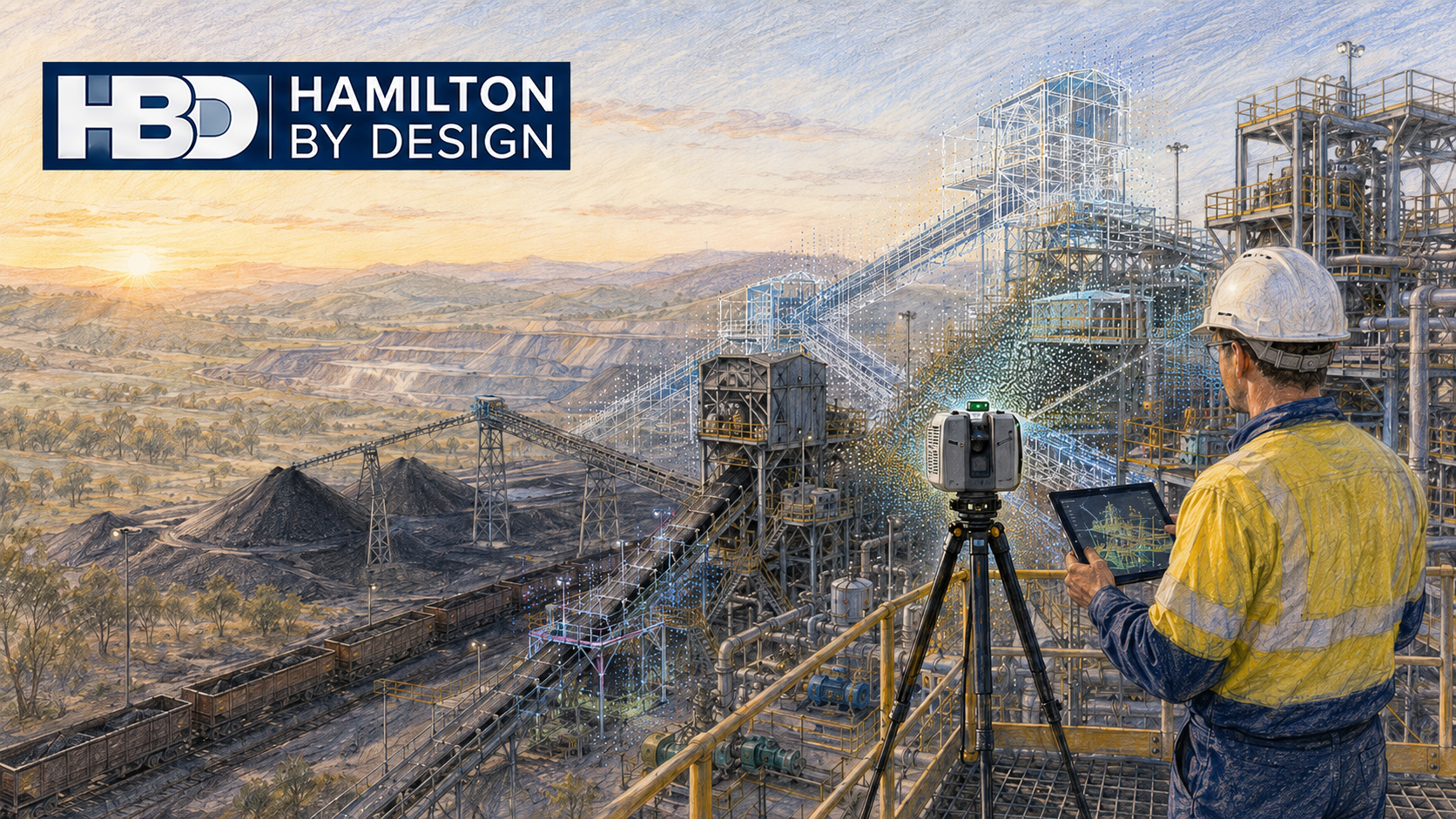
Colour-pencil illustration of 3D laser scanning at a Hunter Valley coal handling plant, with an engineer, conveyors, rail wagons and the Hamilton By Design logo.

Hunter Valley + Mining + Mechanical Engineering + Conveyor Systems + Industrial Design + 3D Lidar Laser Scanning Services = Hamilton By Design

Supporting Hunter Valley Mining Infrastructure, CHPP Facilities & Materials Handling Systems

The Hunter Valley is one of Australia’s most significant mining and industrial regions. Home to major coal mining operations, Coal Handling and Preparation Plants (CHPP), rail infrastructure, export facilities and bulk materials handling systems, the region continues to support large-scale engineering, maintenance and infrastructure projects.

At Hamilton By Design, we provide engineering-grade 3D laser scanning, reverse engineering, mechanical engineering and drafting services supporting mining infrastructure throughout the Hunter Valley.

Our team understands mining environments because we come from industry. Our experience spans materials handling systems, conveyor infrastructure, CHPP facilities, structural steelwork, shutdown engineering and brownfield plant modifications.

Supporting the Hunter Valley Coal Industry

The Hunter Valley Coal Chain is one of the largest integrated coal export systems in the world, linking mining operations throughout the Hunter Region with rail infrastructure and the Port of Newcastle export terminals.

Mining operations throughout the region rely on extensive infrastructure including:

  • Conveyor systems
  • CHPP facilities
  • Rail loading systems
  • Bulk materials handling equipment
  • Transfer stations
  • Stackers and reclaimers
  • Structural steel infrastructure
  • Pumping systems
  • Water management assets

Hamilton By Design provides engineering support services helping operators, contractors and project teams better understand existing site conditions before design, fabrication and installation activities commence.

3D LiDAR Scanning Hunter & Newcastle banner with white text on a blue background promoting engineering-grade laser scanning services for industrial, mining and infrastructure projects across the Hunter Valley and Newcastle region.
Mechanical Engineering Hunter & Newcastle banner promoting mechanical engineering services for mining, industrial plants, power generation, manufacturing and heavy industry throughout the Hunter Valley and Newcastle region.
Structural Drafting Hunter & Newcastle banner promoting structural drafting services for mining, industrial plants, power generation, manufacturing and infrastructure projects across the Hunter Valley and Newcastle region.

Engineering-Grade 3D Laser Scanning

Not all scans are equal.

At Hamilton By Design, we specialise in engineering-grade terrestrial LiDAR scanning designed to support practical engineering outcomes.

Our scanning services support:

  • Conveyor upgrades
  • Transfer station modifications
  • Shutdown planning
  • Existing condition surveys
  • Structural steel verification
  • Pipework modifications
  • Equipment replacement projects
  • Brownfield engineering
  • Asset capture programs
  • As-built verification

We provide registered point cloud data suitable for:

  • SolidWorks
  • Autodesk Revit
  • AutoCAD
  • Navisworks
  • Inventor
  • Recap
  • Digital engineering workflows

Accurate site information helps reduce project risk, improve constructability and minimise installation issues during shutdown activities.

Conveyor Systems & Materials Handling Engineering

Conveyor systems form the backbone of Hunter Valley mining operations.

Hamilton By Design supports projects involving:

  • Overland conveyors
  • Transfer stations
  • Conveyor gantries
  • Belt feeder systems
  • Chute upgrades
  • Structural modifications
  • Maintenance access improvements
  • Conveyor replacement projects

Working within existing operating facilities often requires accurate existing condition information before fabrication begins.

Our laser scanning and engineering services help ensure designs reflect real-world site conditions.

CHPP Upgrades & Plant Modifications

Coal Handling and Preparation Plants continue to evolve as production requirements change and ageing infrastructure requires replacement or modification.

We support projects involving:

  • Structural steel modifications
  • Conveyor upgrades
  • Pipework systems
  • Access platform improvements
  • Transfer chute modifications
  • Equipment replacement projects
  • Existing condition verification
  • Brownfield expansion works

Engineering-grade scanning provides a reliable foundation for design development and project planning.

Shutdown Engineering Support

Mining shutdowns are often where accurate engineering information delivers the greatest value.

Every hour of shutdown downtime can have significant production implications.

Hamilton By Design assists shutdown projects with:

  • Existing condition capture
  • Laser scanning surveys
  • Installation planning
  • Fabrication verification
  • Clash detection
  • Asset documentation
  • As-built verification

Accurate scan data helps reduce rework, improve fitment outcomes and minimise project risk during shutdown execution.

Reverse Engineering Services

Many mining facilities continue operating equipment where original drawings are incomplete, unavailable or no longer represent the installed asset.

Our reverse engineering services support:

  • Conveyor components
  • Chutes and transfer systems
  • Pump assemblies
  • Wear liners
  • Castings
  • Structural assemblies
  • Legacy plant equipment
  • Fabricated mining infrastructure

Using engineering-grade scanning and practical manufacturing experience, we develop models and fabrication drawings suitable for refurbishment, replacement or modification.

Mining Infrastructure Engineering

Mining infrastructure must operate in demanding environments while remaining maintainable and practical to construct.

Hamilton By Design supports projects involving:

  • Materials handling systems
  • Conveyor structures
  • Access platforms
  • Maintenance walkways
  • Pipework systems
  • Structural steel modifications
  • Brownfield upgrades
  • Industrial plant infrastructure

Our engineering approach focuses on constructability, maintainability and long-term asset performance.

Why Hamilton By Design?

Hamilton By Design combines practical trade experience with engineering capability.

Our experience includes:

  • Mechanical engineering
  • Fitting and machining
  • Industrial drafting
  • Mining operations
  • Materials handling systems
  • Smelting and processing facilities
  • Site-based engineering
  • Industrial maintenance

We understand that successful engineering projects require more than accurate models. They require solutions that can be fabricated, installed and maintained within real operating mining environments.

Servicing the Hunter Valley Mining Region

Hamilton By Design supports projects throughout:

  • Cessnock
  • Singleton
  • Muswellbrook
  • Mount Thorley
  • Ravensworth
  • Warkworth
  • Branxton
  • Rutherford
  • Beresfield
  • Tomago
  • Newcastle
  • Hunter Valley mining operations

Whether you require engineering-grade laser scanning, reverse engineering, conveyor design support or shutdown engineering services, our team is available to assist.

3D LiDAR scanning and 3D modelling service button — laser scanner capturing a point cloud for engineering and CAD modelling
Mechanical engineering services

Engineering Support for Hunter Valley Mining Operations

Hamilton By Design provides engineering-grade 3D laser scanning, mechanical engineering, drafting and reverse engineering services supporting Hunter Valley mining infrastructure, CHPP facilities, conveyor systems and materials handling operations.

Contact Us – Talk to Us

Contact our team to discuss your next mining project and discover how accurate site data and practical engineering experience can improve project outcomes, reduce shutdown risk and support long-term asset performance.

Name
Would you like us to arrange a phone consultation for you?
Address
CHPP Engineering title graphic featuring bold white text reading "CHPP Engineering" centred on a blue rounded rectangle background.
Pipework Drafting title graphic featuring bold white text reading "Pipework Drafting" centred on a blue rounded rectangle background.
3D LiDAR Scanning for Engineering Projects title graphic featuring bold white text on a blue rounded rectangle background.

Our Clients:
Mechanical engineering services
Australian Drafting logo featuring bold white text reading "Australian Drafting" centred on a blue rounded rectangle background.
3D CAD Modelling Australia service banner for Hamilton By Design

Mechanical Engineering | Structural Engineering


3D Scanning & Engineering – Kooragang & Carrington | Hamilton By Design

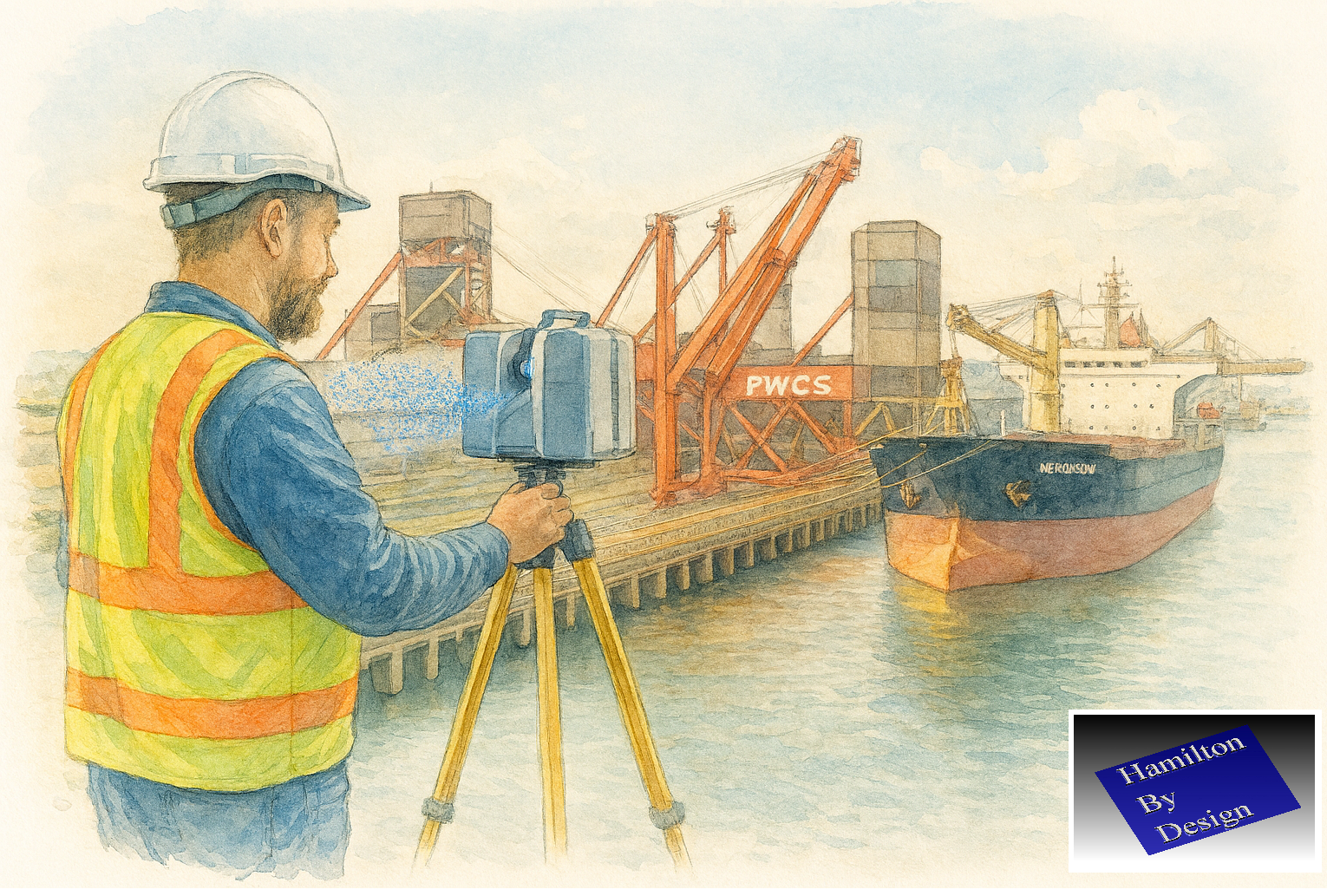
3D scanning of heavy industrial port infrastructure in Kooragang Newcastle watercolour style

Newcastle Port Industrial Scanning & Engineering Services

Kooragang & Carrington (Heavy Industry)

Kooragang and Carrington form the core of Newcastle’s heavy industrial and port operations, supporting some of the largest export, chemical, and bulk material facilities in Australia. With direct access to the Port of Newcastle, these areas are home to major processing plants, marine infrastructure, and high-value industrial assets.

Hamilton By Design provides specialised 3D scanning, reverse engineering, and engineering support services tailored to the demanding conditions of port and heavy industrial environments.


Our Services for Port & Heavy Industry

3D Laser Scanning (LiDAR)

We deliver high-accuracy site capture for complex industrial environments, including:

  • Processing plants and refineries
  • Conveyor systems and bulk handling infrastructure
  • Ship-loading and port facilities
  • Structural steel frameworks and pipework

Our scanning minimises downtime by capturing data quickly and safely in live environments.


Scan to CAD / As-Built Modelling

Convert real-world assets into usable digital models:

  • Existing plant layouts and structural steel
  • Pipework and mechanical systems
  • Equipment positioning and clearances

Deliverables include:

  • 2D drawings (plans, sections, elevations)
  • 3D CAD models for engineering and fabrication

Reverse Engineering of Components

Ideal for ageing or undocumented equipment commonly found in port operations:

  • Pumps, valves, and mechanical assemblies
  • Conveyor components and wear parts
  • Marine and infrastructure components

We capture and recreate accurate models for repair, replacement, or redesign.


Fabrication & Upgrade Support

Support fabrication and site upgrades with verified data:

  • Structural modifications and extensions
  • Conveyor and chute upgrades
  • Mechanical plant upgrades

Reduce rework and ensure fabrication accuracy with real-world geometry.


Engineering Measurement & Verification

Precision measurement services to support compliance and construction:

  • Steel alignment and deformation checks
  • Flatness and level surveys
  • Clearance and clash detection

Critical for shutdown planning and installation works.


Industrial Plant & Shutdown Support

We work with shutdown teams and maintenance planners to:

  • Capture existing conditions before demolition
  • Verify installation readiness
  • Provide rapid-turnaround models for time-critical works

Why Hamilton By Design

  • ✅ Experience in heavy industrial environments
  • ✅ Fast mobilisation across Newcastle and the Hunter Region
  • ✅ High-accuracy data suitable for fabrication and engineering
  • ✅ Reduced site risk through non-contact measurement
  • ✅ Deliverables tailored to real project outcomes

Typical Projects in Kooragang & Carrington

  • Bulk handling conveyor upgrades
  • Port infrastructure surveys
  • Chemical plant scanning and modelling
  • Marine facility measurement
  • Structural steel verification

3D LiDAR Scanning Hunter & Newcastle banner with white text on a blue background promoting engineering-grade laser scanning services for industrial, mining and infrastructure projects across the Hunter Valley and Newcastle region.
Mechanical Engineering Hunter & Newcastle banner promoting mechanical engineering services for mining, industrial plants, power generation, manufacturing and heavy industry throughout the Hunter Valley and Newcastle region.
Structural Drafting Hunter & Newcastle banner promoting structural drafting services for mining, industrial plants, power generation, manufacturing and infrastructure projects across the Hunter Valley and Newcastle region.

Servicing Newcastle’s Port & Industrial Hub

Based on the Central Coast, Hamilton By Design regularly services:

  • Kooragang Island
  • Carrington
  • Mayfield and Port precincts

We support fabricators, engineers, and asset owners requiring accurate, reliable site data to deliver complex industrial projects.


Hamilton By Design logo displayed on a blue tilted rectangle with a grey gradient background

Enquire Today – Contact Us

If you’re planning a plant upgrade, fabrication project, or require accurate site data in a heavy industrial environment, contact Hamilton By Design to discuss your requirements.

Name
Would you like us to arrange a phone consultation for you?
Address

Our Clients:

3D LiDAR scanning and 3D modelling service button — laser scanner capturing a point cloud for engineering and CAD modelling
Mechanical engineering services
3D LiDAR scanning and 3D modelling service button — laser scanner capturing a point cloud for engineering and CAD modelling
Mechanical engineering services
CHPP Engineering title graphic featuring bold white text reading "CHPP Engineering" centred on a blue rounded rectangle background.
Pipework Drafting title graphic featuring bold white text reading "Pipework Drafting" centred on a blue rounded rectangle background.
3D LiDAR Scanning for Engineering Projects title graphic featuring bold white text on a blue rounded rectangle background.
Mechanical engineering services
Australian Drafting logo featuring bold white text reading "Australian Drafting" centred on a blue rounded rectangle background.