


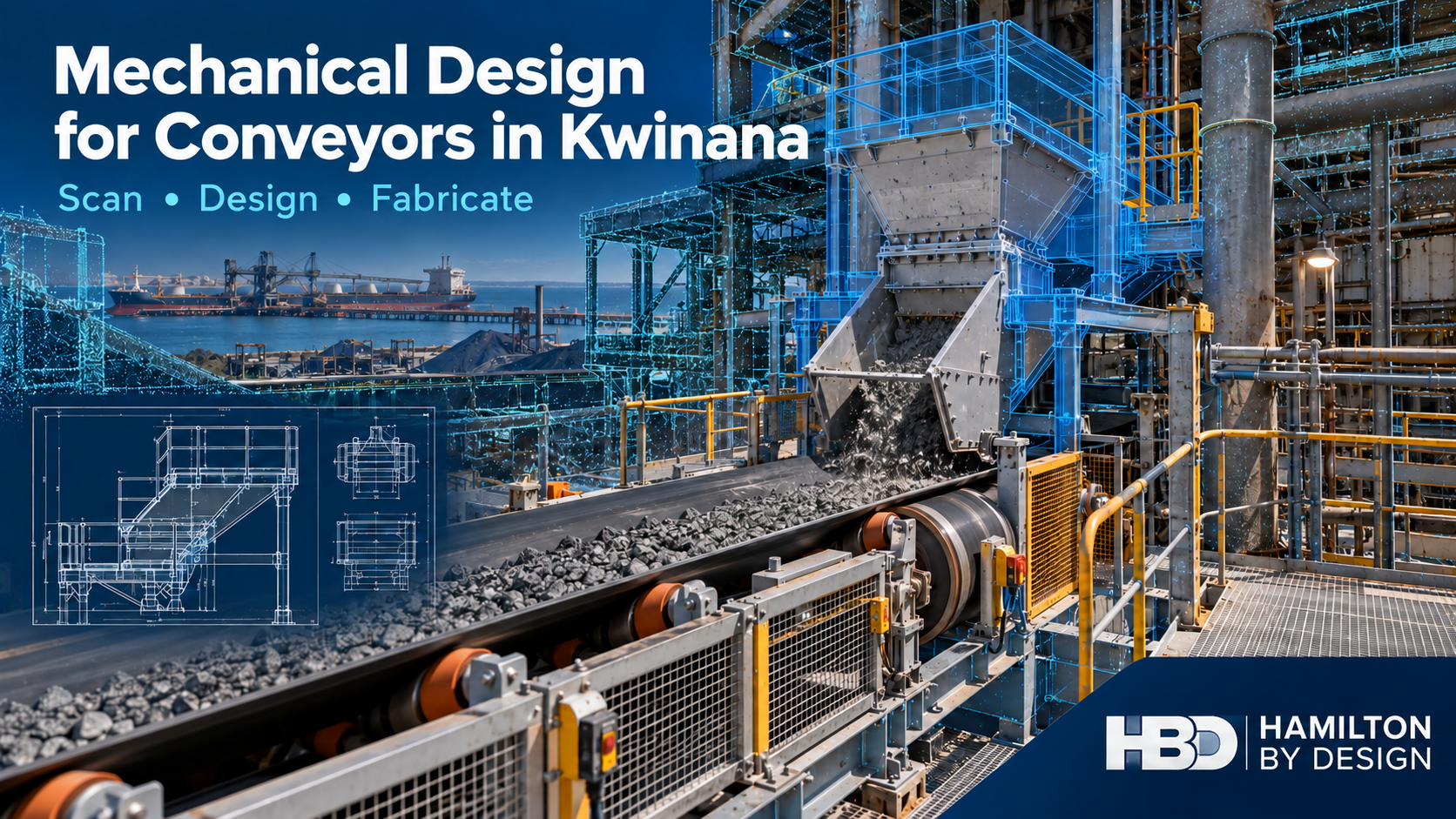
Mechanical Design for Conveyors in Kwinana
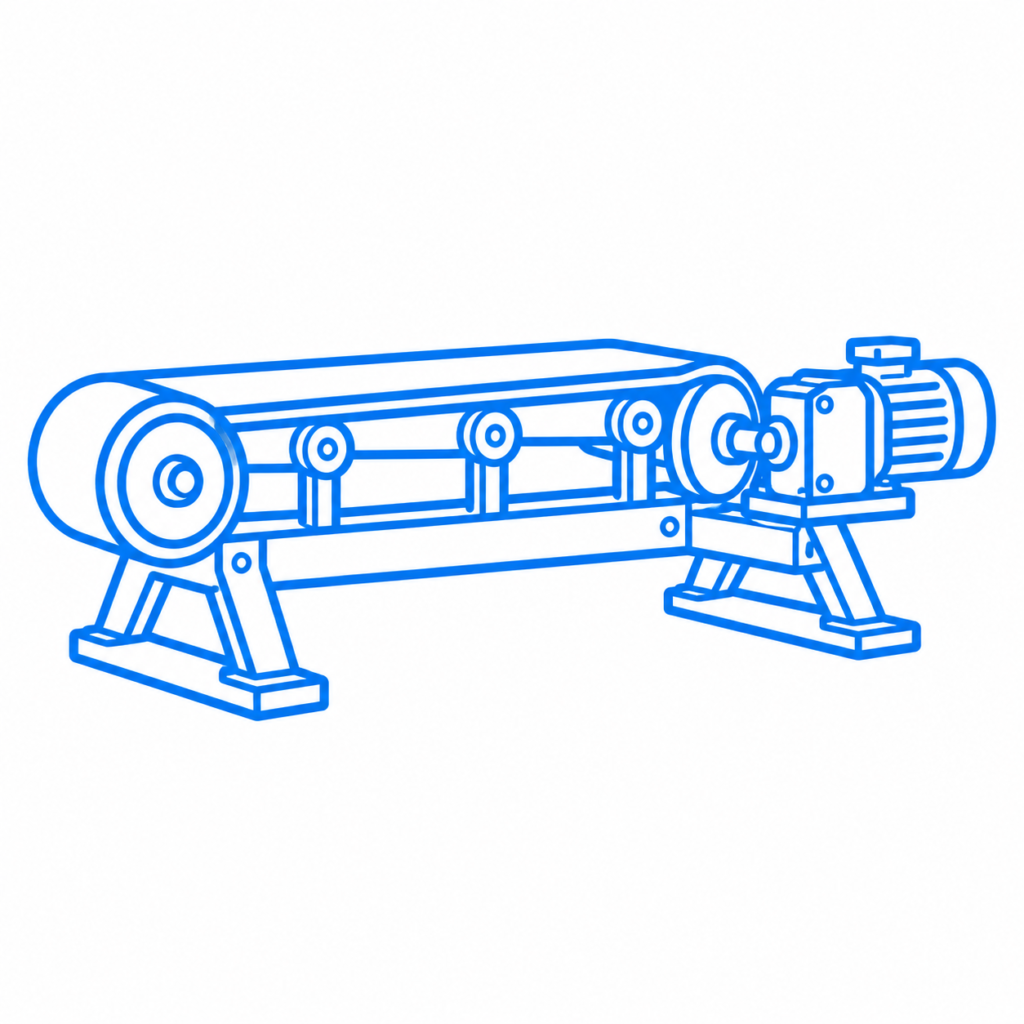
Conveyor changes need to work with the plant that is already there. Hamilton By Design provides mechanical design support for conveyors in Kwinana and Kwinana Beach, helping industrial teams plan modifications to transfer points, chutes, guarding, access and associated equipment.
A conveyor can appear straightforward on a general arrangement drawing. On site, its performance depends on how material enters and leaves the belt, the position of surrounding steel and services, available maintenance space, and the way components will be installed during a shutdown. A change to one transfer point can affect the equipment on either side.
We combine mechanical engineering, 3D laser scanning, CAD modelling and fabrication documentation to help maintenance managers, project engineers and fabricators develop practical conveyor upgrades. The work can begin with an existing problem, a proposed replacement or an ageing asset with incomplete drawings.
Conveyor engineering in Kwinana’s industrial environment
Kwinana’s industrial area includes process facilities, chemicals, minerals processing, energy infrastructure and bulk port operations. These facilities rely on equipment that can be maintained and modified within demanding operating schedules.
For a conveyor project, local conditions may include congested plant, limited shutdown access, abrasive or dusty material, marine exposure, established pipework and steelwork, and interfaces with other operating systems. These conditions need to be assessed for the particular site. They should not be assumed from a standard conveyor drawing.
Hamilton By Design can support the project from existing-condition capture through to mechanical design and drawings for fabrication. Our 3D laser scanning service in Kwinana provides measured site geometry where old drawings are missing or uncertain.
What conveyor components can we help design or modify?
- Conveyor layouts and interfaces with existing equipment
- Transfer chutes, hoppers, skirts and wear-liner arrangements
- Drive, pulley, take-up and support-related mechanical layouts
- Guards around accessible moving parts and maintenance areas
- Access platforms, walkways and equipment-removal clearances
- Replacement brackets, frames, covers and fabricated components
- Installation arrangements for brownfield modifications
- General arrangement and fabrication drawings
The design scope depends on the equipment and the problem being solved. A localised chute replacement requires different information from a complete conveyor redesign. We define the required calculations, site checks, specialist input and deliverables before detailed design begins.
Five common conveyor problems
1. Material does not transfer cleanly
Poorly controlled flow at a transfer point can contribute to spillage, dust, blockages and premature wear. The cause may involve the incoming trajectory, chute geometry, impact area, material properties, belt speed or the condition of existing equipment.
We can review the installed arrangement, capture relevant geometry and develop a proposed chute or interface modification in CAD. Depending on the scope, drawings can include liner layouts, replacement parts and fabrication details. Learn more about our chute and materials-handling engineering.
2. The proposed replacement may not fit
A new chute, drive assembly or platform can clash with existing steel, pipework, cable trays or access routes. The problem may only become visible after fabrication, when a shutdown crew is trying to install it.
Engineering-grade LiDAR scanning can establish the surrounding geometry before the new equipment is modelled. We can use the point cloud to review envelopes and likely clashes, then separately verify critical fabrication and installation dimensions. A scan is a strong starting point, but the tolerance of a critical connection must be confirmed for its intended use.
3. Wear makes maintenance too frequent
Abrasive material may wear through a chute, skirt or impact zone well before the rest of the conveyor reaches the end of its service life. Replacing the same component repeatedly may leave the underlying flow or access problem unresolved.
We can document the current arrangement, review reported wear patterns with the maintenance team and develop replaceable wear components or revised geometry. Inspection and removal access should be considered alongside the life of the component.
4. Guards are difficult to remove or leave hazards exposed
Conveyors include pulleys, belts, drives and other moving parts that can create entanglement and nip-point hazards. A guard needs to prevent access to the hazard while supporting the actual tasks performed by operators and maintainers.
Hamilton By Design can assist with measured guarding concepts and fabrication drawings. Guarding should be developed with the site’s task-based risk assessment, isolation procedures and machinery-safety requirements. Our machine guarding service explains this approach.
5. Maintenance access was overlooked
A component may fit the available space yet be difficult to inspect, lift out or replace. When designing a modification, we consider access to inspection points, fasteners, liners, guards and equipment-removal paths. The arrangement should also be reviewed against the site’s lifting and shutdown plan.
From site survey to fabrication drawings
For an existing conveyor, our workflow can be scaled to the project:
- Define the operating problem. Review material, duty, failure history, maintenance tasks and the proposed outcome with the site team.
- Capture existing conditions. Review available drawings and measure or scan the conveyor and surrounding interfaces.
- Develop design options. Model practical arrangements for flow, fit, wear, guarding and access.
- Check the design. Undertake agreed mechanical assessment and coordinate any required structural, electrical, process or specialist review.
- Prepare documentation. Issue general arrangements, part and assembly drawings, liner layouts or fabrication details suited to the agreed scope.
- Support implementation. Resolve design queries and record changes where fabrication or site installation requires them.
Depending on the project, we can provide registered point clouds, SolidWorks models, AutoCAD drawings, STEP files, PDF drawing packs and other agreed formats. Our Perth mechanical and industrial drafting service covers the drawing stage in more detail.
Standards and conveyor safety
Applicable standards must be selected for the conveyor type, site, hazards and design scope. The AS/NZS 4024 Safety of Machinery series includes conveyor-specific requirements and broader guidance for risk assessment and safeguarding. AS 1657 may be relevant to fixed platforms, walkways, stairs and ladders associated with access.
For a shiploader, stacker, reclaimer or other mobile bulk-handling machine, AS 4324.1 may be relevant to the design of its steel structure. Other mechanical, structural, electrical and hazardous-area requirements need to be established with the responsible disciplines.
Design work also needs to align with the operator’s plant-risk assessment, isolation procedures and management of change. Drawings alone cannot control how a conveyor is cleaned, operated or maintained. The site team must review the proposed arrangement against the tasks people actually perform.
Who we support
Our conveyor design support is intended for Kwinana maintenance teams planning a replacement, project engineers developing a plant upgrade, fabrication workshops needing reliable drawings, and operators reviewing transfer performance, wear or access.
For port and bulk-handling equipment, our shiploader 3D scanning page explains how measured data supports modifications to conveyors, chutes, booms and access systems. Our Perth mechanical engineering page covers wider brownfield design support.
Frequently asked questions
Can you design a replacement chute for an existing conveyor?
Yes, subject to the information available and an agreed scope. We would review the existing geometry, material and operating problem before developing the replacement arrangement and drawings.
Do you need to scan the whole conveyor?
Not always. A localised modification may only require the transfer point, adjacent equipment and installation path. A wider upgrade may need more extensive capture. The scan boundary should follow the design decision.
Can you work from old drawings?
Yes, but critical interfaces should be checked against the physical asset before fabrication. Existing drawings are useful references even when later site modifications have made them incomplete.
Can you provide fabrication drawings?
Yes. Depending on the scope, deliverables may include general arrangements, assembly and part drawings, liner details and installation references. The required tolerances, materials and review responsibilities should be agreed before issue.
Can you review conveyor guarding?
We can assist with mechanical guarding concepts, site measurement and drawings. The final control strategy must account for the equipment, access frequency, maintenance tasks, isolation arrangements and applicable machinery-safety requirements.
Discuss a conveyor project in Kwinana
If a conveyor, transfer chute or guarding arrangement in Kwinana needs modification, contact Hamilton By Design. Send the site location, photographs or drawings, material handled, current problem, shutdown window and the outcome you need. We can then define the survey, engineering and drawing scope.

Contact Us – Talk To Us
Our clients:
























